Possessive Adjectives
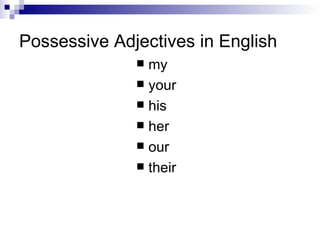
Possessive Adjectives in English my your his her our their
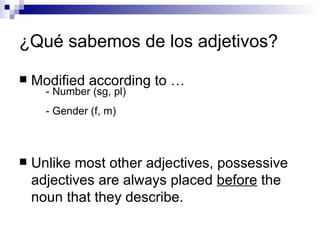
¿Qué sabemos de los adjetivos? Modified according to … Unlike most other adjectives, possessive adjectives are always placed  before  the noun that they describe. - Number (sg, pl) - Gender (f, m)
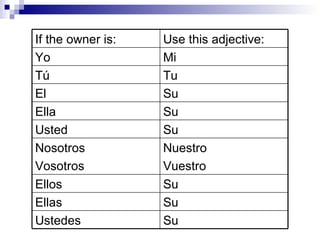
Su Ustedes Su Ellas Su Ellos Nuestro Vuestro Nosotros Vosotros Su Usted Su Ella Su El Tu Tú Mi Yo Use this adjective: If the owner is:
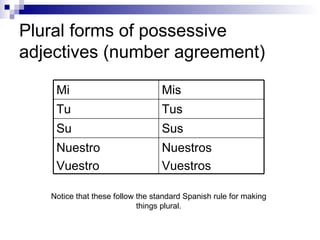
Plural forms of possessive adjectives (number agreement) Notice that these follow the standard Spanish rule for making things plural. Nuestros Vuestros Nuestro Vuestro Sus Su Tus Tu Mis Mi
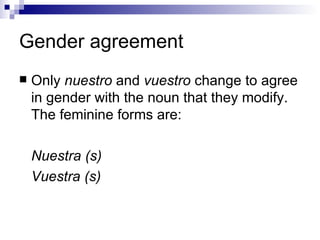
Gender agreement Only  nuestro  and  vuestro  change to agree in gender with the noun that they modify.  The feminine forms are: Nuestra (s) Vuestra (s)
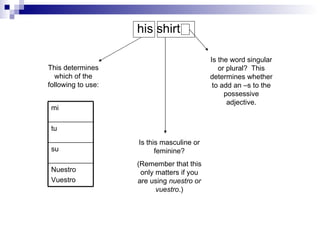
his shirt This determines which of the following to use: Is this masculine or feminine? (Remember that this only matters if you are using  nuestro or vuestro .) Is the word singular or plural?  This determines whether to add an –s to the possessive adjective. Nuestro Vuestro su tu mi
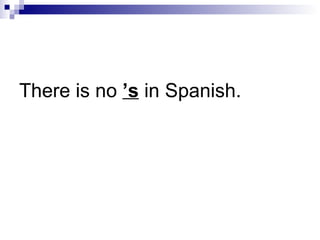
There is no  ’s  in Spanish.
His shirt Su camisa La camisa de él
Our class Nuestra clase
Her pencil Su lápiz El lápiz de ella
Their book Su libro El libro de ellos El libro de ellas
Your (singular, informal) shoes Tus zapatos
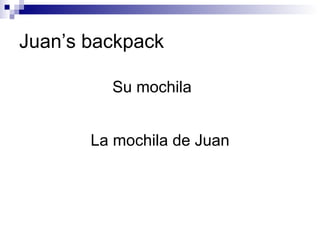
Juan’s backpack Su mochila La mochila de Juan
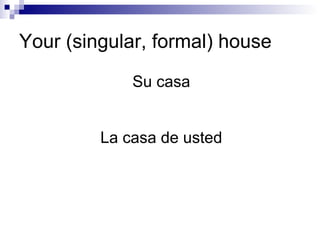
Your (singular, formal) house Su casa La casa de usted

Spanish possessive adjectives

  • 1.
  • 2.
    Possessive Adjectives inEnglish my your his her our their
  • 3.
    ¿Qué sabemos delos adjetivos? Modified according to … Unlike most other adjectives, possessive adjectives are always placed before the noun that they describe. - Number (sg, pl) - Gender (f, m)
  • 4.
    Su Ustedes SuEllas Su Ellos Nuestro Vuestro Nosotros Vosotros Su Usted Su Ella Su El Tu Tú Mi Yo Use this adjective: If the owner is:
  • 5.
    Plural forms ofpossessive adjectives (number agreement) Notice that these follow the standard Spanish rule for making things plural. Nuestros Vuestros Nuestro Vuestro Sus Su Tus Tu Mis Mi
  • 6.
    Gender agreement Only nuestro and vuestro change to agree in gender with the noun that they modify. The feminine forms are: Nuestra (s) Vuestra (s)
  • 7.
    his shirt Thisdetermines which of the following to use: Is this masculine or feminine? (Remember that this only matters if you are using nuestro or vuestro .) Is the word singular or plural? This determines whether to add an –s to the possessive adjective. Nuestro Vuestro su tu mi
  • 8.
    There is no ’s in Spanish.
  • 9.
    His shirt Sucamisa La camisa de él
  • 10.
  • 11.
    Her pencil Sulápiz El lápiz de ella
  • 12.
    Their book Sulibro El libro de ellos El libro de ellas
  • 13.
    Your (singular, informal)shoes Tus zapatos
  • 14.
    Juan’s backpack Sumochila La mochila de Juan
  • 15.
    Your (singular, formal)house Su casa La casa de usted