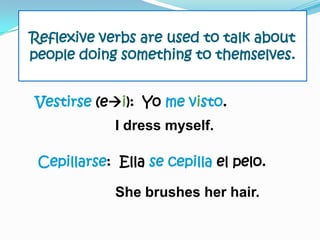
Reflexive verbs are used to talk about
people doing something to themselves.


Vestirse (ei): Yo me visto.
             I dress myself.

 Cepillarse: Ella se cepilla el pelo.

             She brushes her hair.
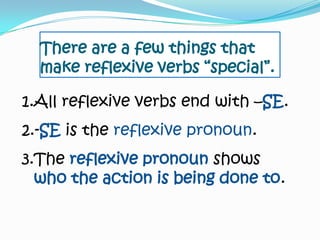
There are a few things that
  make reflexive verbs “special”.

1.All reflexive verbs end with –SE.
2.-SE is the reflexive pronoun.
3.The reflexive pronoun shows
  who the action is being done to.
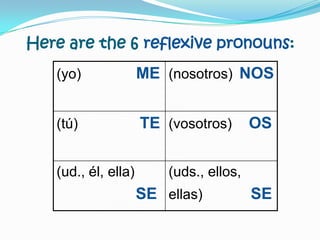
Here are the 6 reflexive pronouns:
   (yo)              ME (nosotros) NOS


   (tú)              TE (vosotros)       OS


   (ud., él, ella)       (uds., ellos,
                     SE ellas)           SE
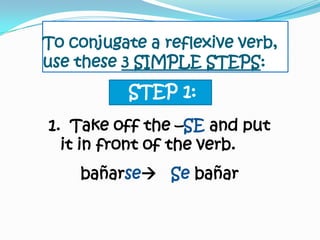
To conjugate a reflexive verb,
use these 3 SIMPLE STEPS:
          STEP 1:
1. Take off the –SE and put
  it in front of the verb.
    bañarse Se bañar
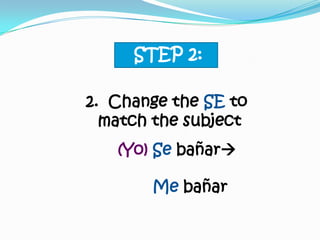
STEP 2:

2. Change the SE to
  match the subject
   (Yo) Se bañar

       Me bañar
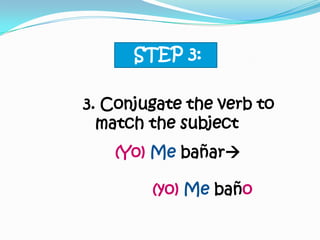
STEP 3:

3. Conjugate the verb to
  match the subject
    (Yo) Me bañar

        (yo) Me baño
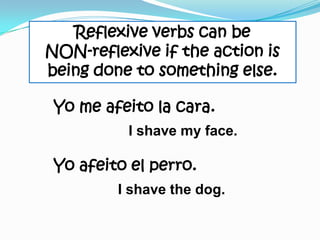
Reflexive verbs can be
NON-reflexive if the action is
being done to something else.

 Yo me afeito la cara.
          I shave my face.

 Yo afeito el perro.
         I shave the dog.
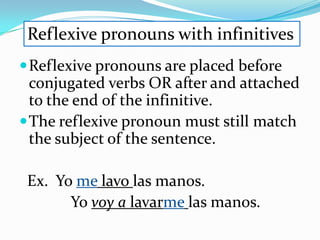
Reflexive pronouns with infinitives
 Reflexive pronouns are placed before
  conjugated verbs OR after and attached
  to the end of the infinitive.
 The reflexive pronoun must still match
  the subject of the sentence.

 Ex. Yo me lavo las manos.
       Yo voy a lavarme las manos.

Reflexive verbs

  • 2.
    Reflexive verbs areused to talk about people doing something to themselves. Vestirse (ei): Yo me visto. I dress myself. Cepillarse: Ella se cepilla el pelo. She brushes her hair.
  • 3.
    There are afew things that make reflexive verbs “special”. 1.All reflexive verbs end with –SE. 2.-SE is the reflexive pronoun. 3.The reflexive pronoun shows who the action is being done to.
  • 4.
    Here are the6 reflexive pronouns: (yo) ME (nosotros) NOS (tú) TE (vosotros) OS (ud., él, ella) (uds., ellos, SE ellas) SE
  • 5.
    To conjugate areflexive verb, use these 3 SIMPLE STEPS: STEP 1: 1. Take off the –SE and put it in front of the verb. bañarse Se bañar
  • 6.
    STEP 2: 2. Changethe SE to match the subject (Yo) Se bañar Me bañar
  • 7.
    STEP 3: 3. Conjugatethe verb to match the subject (Yo) Me bañar (yo) Me baño
  • 8.
    Reflexive verbs canbe NON-reflexive if the action is being done to something else. Yo me afeito la cara. I shave my face. Yo afeito el perro. I shave the dog.
  • 9.
    Reflexive pronouns withinfinitives  Reflexive pronouns are placed before conjugated verbs OR after and attached to the end of the infinitive.  The reflexive pronoun must still match the subject of the sentence. Ex. Yo me lavo las manos. Yo voy a lavarme las manos.