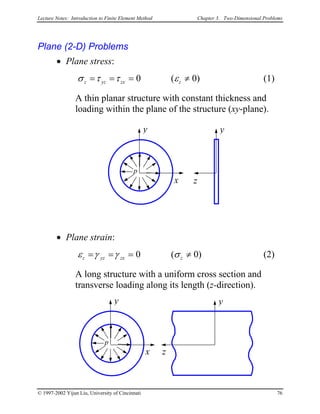
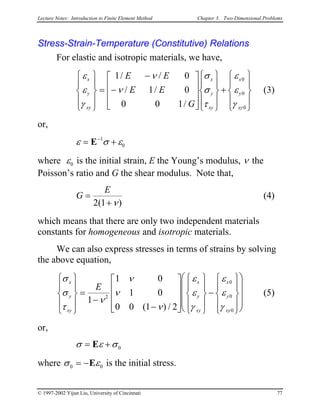
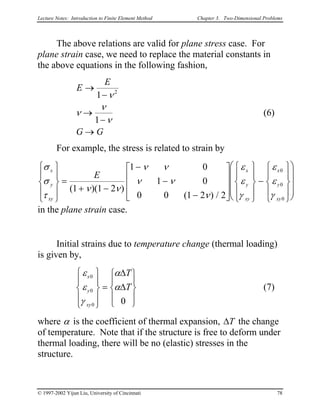
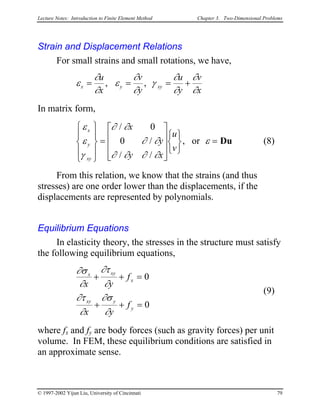
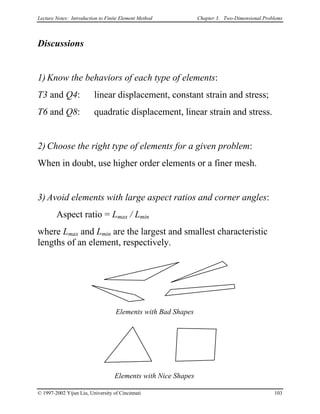
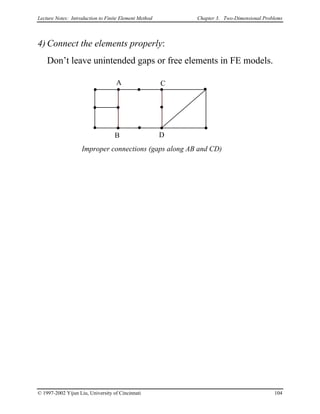
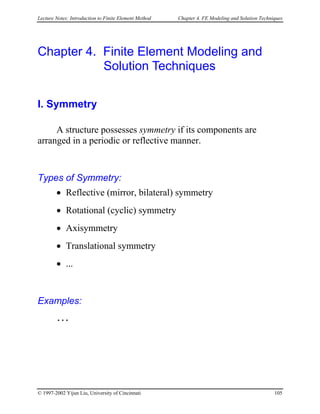
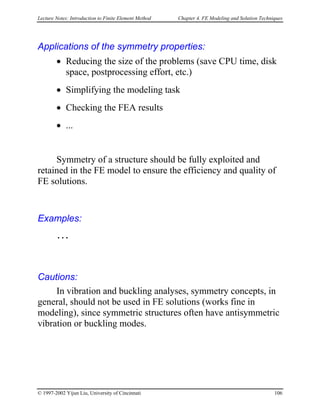
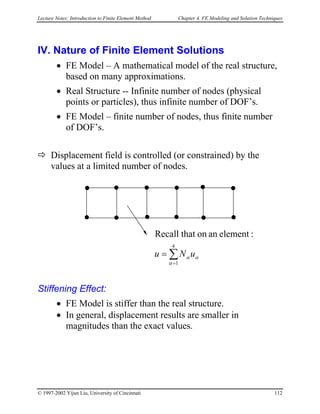
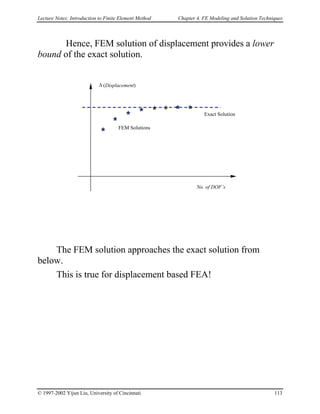
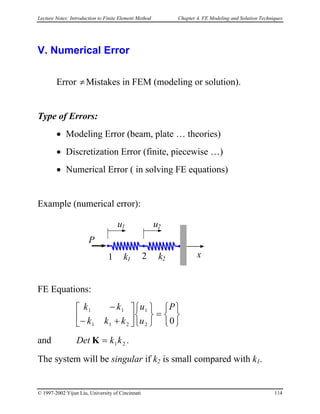
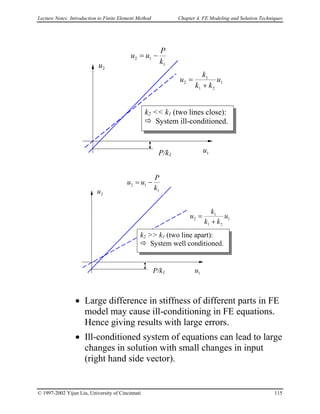
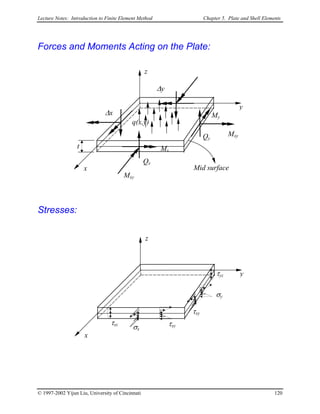
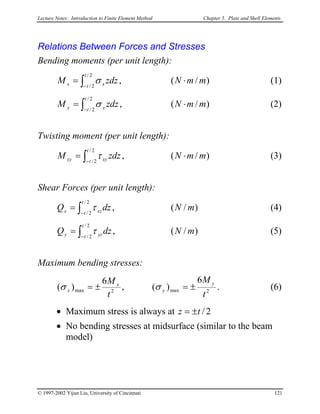
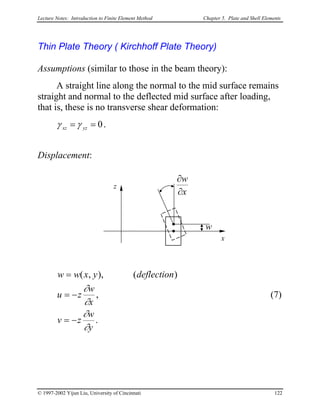
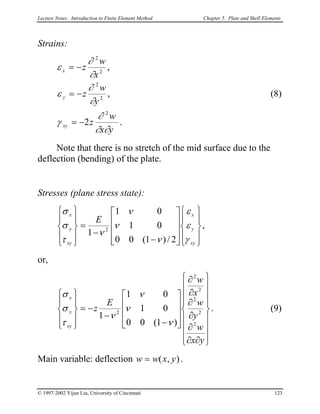
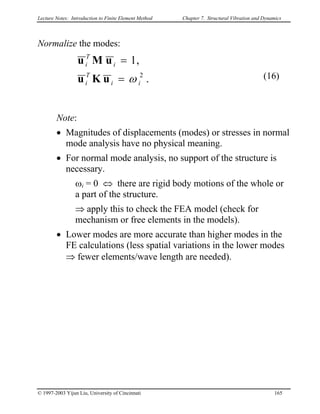
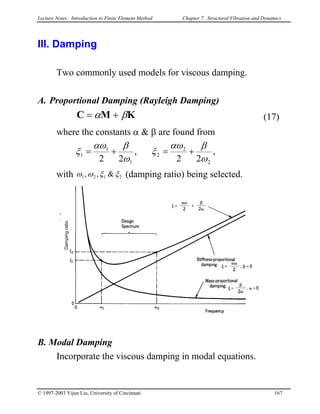
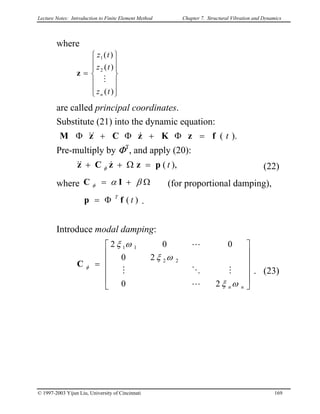
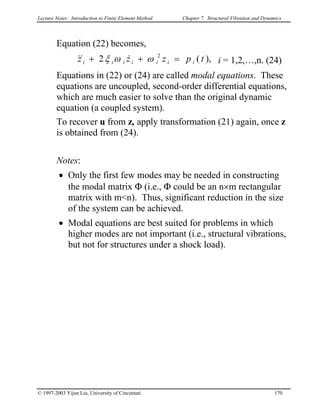
Lecture Notes: Introduction to the Finite Element Method
Lecture Notes: Introduction to the
Finite Element Method
Yijun Liu
CAE Research Laboratory
Mechanical Engineering Department
University of Cincinnati
Cincinnati, OH 45221-0072, U.S.A.
E-mail: Yijun.Liu@uc.edu
Web: http://urbana.mie.uc.edu/yliu
This document is downloaded from the course website:
http://urbana.mie.uc.edu/yliu/FEM-525/FEM-525.htm
(Last Updated: May 21, 2003)
© 1997-2003 by Yijun Liu, University of Cincinnati.
© 1997-2003 Yijun Liu, University of Cincinnati i
Lecture Notes: Introduction to the Finite Element Method
Copyright Notice
© 1997-2003 by Yijun Liu, University of Cincinnati.
All rights reserved. Permissions are granted for personal
and educational uses only. Any other uses of these lecture
notes (such as for classroom lectures outside the University
of Cincinnati, trainings elsewhere, and those of a
commercial nature) are not permitted, unless such uses
have been granted in writing by the author.
© 1997-2003 Yijun Liu, University of Cincinnati ii
Lecture Notes: Introduction to the Finite Element Method
Table of Contents
Copyright Notice....................................................................................................... ii
Table of Contents ..................................................................................................... iii
Preface .......................................................................................................................v
Chapter 1. Introduction ............................................................................................1
I. Basic Concepts...................................................................................................1
II. Review of Matrix Algebra.................................................................................7
III. Spring Element ..............................................................................................14
Chapter 2. Bar and Beam Elements.......................................................................25
I. Linear Static Analysis .......................................................................................25
II. Bar Element .....................................................................................................26
III. Beam Element.................................................................................................53
Chapter 3. Two-Dimensional Problems ................................................................75
I. Review of the Basic Theory...............................................................................75
II. Finite Elements for 2-D Problems..................................................................82
Chapter 4. Finite Element Modeling and Solution Techniques........................... 105
I. Symmetry ........................................................................................................ 105
II. Substructures (Superelements) ..................................................................... 107
III. Equation Solving......................................................................................... 109
IV. Nature of Finite Element Solutions ............................................................. 112
V. Numerical Error............................................................................................ 114
© 1997-2003 Yijun Liu, University of Cincinnati iii
Lecture Notes: Introduction to the Finite Element Method
VI. Convergence of FE Solutions ...................................................................... 116
VII. Adaptivity (h-, p-, and hp-Methods)........................................................... 117
Chapter 5. Plate and Shell Elements ................................................................... 119
I. Plate Theory ................................................................................................... 119
II. Plate Elements ............................................................................................. 129
III. Shells and Shell Elements........................................................................... 133
Chapter 6. Solid Elements for 3-D Problems ..................................................... 138
I. 3-D Elasticity Theory ..................................................................................... 138
II. Finite Element Formulation.......................................................................... 142
III. Typical 3-D Solid Elements......................................................................... 144
Chapter 7. Structural Vibration and Dynamics................................................... 157
I. Basic Equations.............................................................................................. 157
II. Free Vibration............................................................................................... 163
III. Damping ...................................................................................................... 167
IV. Modal Equations.......................................................................................... 168
V. Frequency Response Analysis....................................................................... 171
VI. Transient Response Analysis ....................................................................... 172
Chapter 8. Thermal Analysis ............................................................................... 177
I. Temperature Field.......................................................................................... 177
II. Thermal Stress Analysis................................................................................ 180
Further Reading.................................................................................................... 183
© 1997-2003 Yijun Liu, University of Cincinnati iv
Lecture Notes: Introduction to the Finite Element Method
Preface
These online lecture notes (in the form of an e-book) are intended to serve as
an introduction to the finite element method (FEM) for undergraduate students or
other readers who have no previous experience with this computational method.
The notes cover the basic concepts in the FEM using the simplest mechanics
problems as examples, and lead to the discussions and applications of the 1-D bar
and beam, 2-D plane and 3-D solid elements in the analyses of structural stresses,
vibrations and dynamics. The proper usage of the FEM, as a popular numerical
tool in engineering, is emphasized throughout the notes.
This online document is based on the lecture notes developed by the author
since 1997 for the undergraduate course on the FEM in the mechanical engineering
department at the University of Cincinnati. Since this is an e-book, the author
suggests that the readers keep it that way and view it either online or offline on
his/her computer. The contents and styles of these notes will definitely change
from time to time, and therefore hard copies may become obsolete immediately
after they are printed. Readers are welcome to contact the author for any
suggestions on improving this e-book and to report any mistakes in the
presentations of the subjects or typographical errors. The ultimate goal of this e-
book on the FEM is to make it readily available for students, researchers and
engineers, worldwide, to help them learn subjects in the FEM and eventually solve
their own design and analysis problems using the FEM.
The author thanks his former undergraduate and graduate students for their
suggestions on the earlier versions of these lecture notes and for their contributions
to many of the examples used in the current version of the notes.
Yijun Liu
Cincinnati, Ohio, USA
December 2002
© 1997-2003 Yijun Liu, University of Cincinnati v
Lecture Notes: Introduction to Finite Element Method Chapter 1. Introduction
Chapter 1. Introduction
I. Basic Concepts
The finite element method (FEM), or finite element analysis
(FEA), is based on the idea of building a complicated object with
simple blocks, or, dividing a complicated object into small and
manageable pieces. Application of this simple idea can be found
everywhere in everyday life, as well as in engineering.
Examples:
• Lego (kids’ play)
• Buildings
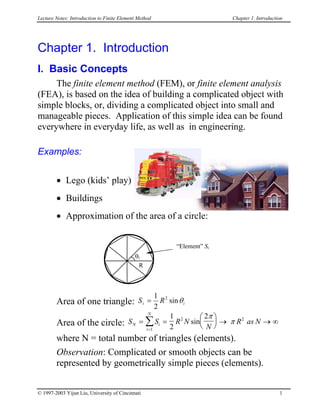
• Approximation of the area of a circle:
R
θi
“Element” Si
Area of one triangle: S Ri i=
1
2
2
sinθ
Area of the circle: S S R N
N
R as NN i
i
N
= =





 → → ∞
=
∑1
2 21
2
2
sin
π
π
where N = total number of triangles (elements).
Observation: Complicated or smooth objects can be
represented by geometrically simple pieces (elements).
© 1997-2003 Yijun Liu, University of Cincinnati 1
Lecture Notes: Introduction to Finite Element Method Chapter 1. Introduction
Why Finite Element Method?
• Design analysis: hand calculations, experiments, and
computer simulations
• FEM/FEA is the most widely applied computer simulation
method in engineering
• Closely integrated with CAD/CAM applications
• ...
Applications of FEM in Engineering
• Mechanical/Aerospace/Civil/Automobile Engineering
• Structure analysis (static/dynamic, linear/nonlinear)
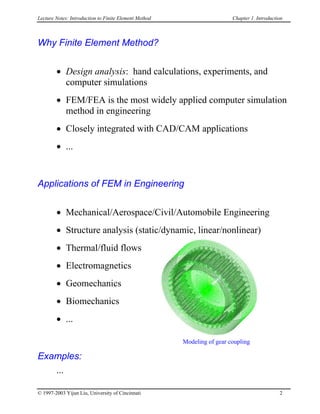
Modeling of gear coupling
• Thermal/fluid flows
• Electromagnetics
• Geomechanics
• Biomechanics
• ...
Examples:
...
© 1997-2003 Yijun Liu, University of Cincinnati 2
Lecture Notes: Introduction to Finite Element Method Chapter 1. Introduction
A Brief History of the FEM
• 1943 ----- Courant (Variational methods)
• 1956 ----- Turner, Clough, Martin and Topp (Stiffness)
• 1960 ----- Clough (“Finite Element”, plane problems)
• 1970s ----- Applications on mainframe computers
• 1980s ----- Microcomputers, pre- and postprocessors
• 1990s ----- Analysis of large structural systems
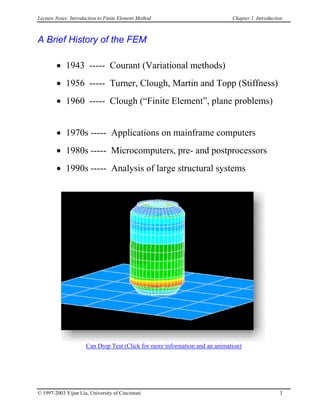
Can Drop Test (Click for more information and an animation)
© 1997-2003 Yijun Liu, University of Cincinnati 3
Lecture Notes: Introduction to Finite Element Method Chapter 1. Introduction
FEM in Structural Analysis (The Procedure)
• Divide structure into pieces (elements with nodes)
• Describe the behavior of the physical quantities on each
element
• Connect (assemble) the elements at the nodes to form an
approximate system of equations for the whole structure
• Solve the system of equations involving unknown
quantities at the nodes (e.g., displacements)
• Calculate desired quantities (e.g., strains and stresses) at
selected elements
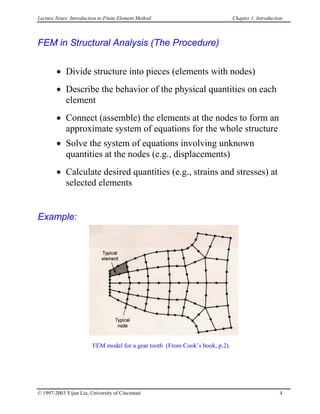
Example:
FEM model for a gear tooth (From Cook’s book, p.2).
© 1997-2003 Yijun Liu, University of Cincinnati 4
Lecture Notes: Introduction to Finite Element Method Chapter 1. Introduction
Computer Implementations
• Preprocessing (build FE model, loads and constraints)
• FEA solver (assemble and solve the system of equations)
• Postprocessing (sort and display the results)
Available Commercial FEM Software Packages
• ANSYS (General purpose, PC and workstations)
• SDRC/I-DEAS (Complete CAD/CAM/CAE package)
• NASTRAN (General purpose FEA on mainframes)
• ABAQUS (Nonlinear and dynamic analyses)
• COSMOS (General purpose FEA)
• ALGOR (PC and workstations)
• PATRAN (Pre/Post Processor)
• HyperMesh (Pre/Post Processor)
• Dyna-3D (Crash/impact analysis)
• ...
A Link to CAE Software and Companies
© 1997-2003 Yijun Liu, University of Cincinnati 5
Lecture Notes: Introduction to Finite Element Method Chapter 1. Introduction
Objectives of This FEM Course
• Understand the fundamental ideas of the FEM
• Know the behavior and usage of each type of elements
covered in this course
• Be able to prepare a suitable FE model for given problems
• Can interpret and evaluate the quality of the results (know
the physics of the problems)
• Be aware of the limitations of the FEM (don’t misuse the
FEM - a numerical tool)
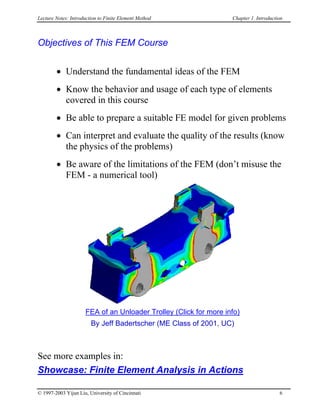
FEA of an Unloader Trolley (Click for more info)
By Jeff Badertscher (ME Class of 2001, UC)
See more examples in:
Showcase: Finite Element Analysis in Actions
© 1997-2003 Yijun Liu, University of Cincinnati 6
Lecture Notes: Introduction to Finite Element Method Chapter 1. Introduction
II. Review of Matrix Algebra
Linear System of Algebraic Equations
a x a x a x b
a x a x a x b
a x a x a x b
n n
n n
n n nn n
11 1 12 2 1 1
21 1 22 2 2 2
1 1 2 2
+ +
n
+ =
+ + + =
+ + + =
...
...
.......
...
(1)
where x1, x2, ..., xn are the unknowns.
In matrix form:
Ax (2)b=
where
(3)
[ ]
{ } { }
A
x b
= =












= =














= =














a
a a a
a a a
a a a
x
x
x
x
b
b
b
b
ij
n
n
n n nn
i
n
i
n
11 12 1
21 22 2
1 2
1
2
1
2
...
...
... ... ... ...
...
: :
A is called a n×n (square) matrix, and x and b are (column)
vectors of dimension n.
© 1997-2003 Yijun Liu, University of Cincinnati 7
Lecture Notes: Introduction to Finite Element Method Chapter 1. Introduction
Row and Column Vectors
v w[ ]= =










v v v
w
w
w
1 2 3
1
2
3
Matrix Addition and Subtraction
For two matrices A and B, both of the same size (m×n), the
addition and subtraction are defined by
ijijij
ijijij
bad
bac
−=−=
+=+=
with
with
BAD
BAC
Scalar Multiplication
[ ]ijaλλ =A
Matrix Multiplication
For two matrices A (of size l×m) and B (of size m×n), the
product of AB is defined by
C kj
m
k
ikij bac ∑=
==
1
withAB
where i = 1, 2, ..., l; j = 1, 2, ..., n.
Note that, in general, AB BA≠ , but (
(associative).
) ( )AB C A BC=
© 1997-2003 Yijun Liu, University of Cincinnati 8
Lecture Notes: Introduction to Finite Element Method Chapter 1. Introduction
Transpose of a Matrix
If A = [aij], then the transpose of A is
A [ ]T
jia=
Notice that .( )AB B AT T
= T
Symmetric Matrix
A square (n×n) matrix A is called symmetric, if
orA A= T
a aij ji=
Unit (Identity) Matrix
I =












1 0 0
0 1 0
0 0 1
...
...
... ... ... ...
...
Note that AI = A, Ix = x.
Determinant of a Matrix
The determinant of square matrix A is a scalar number
denoted by det A or |A|. For 2×2 and 3×3 matrices, their
determinants are given by
det
a b
c d
ad bc





 = −
and
© 1997-2003 Yijun Liu, University of Cincinnati 9
Lecture Notes: Introduction to Finite Element Method Chapter 1. Introduction
det
a a a
a a a
a a a
a a a a a a a a a
a a a a a a a a a
11 12 13
21 22 23
31 32 33
11 22 33 12 23 31 21 32 13
13 22 31 12 21 33 23 32 11










= + +
− − −
Singular Matrix
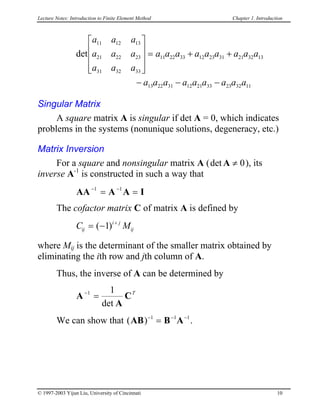
A square matrix A is singular if det A = 0, which indicates
problems in the systems (nonunique solutions, degeneracy, etc.)
Matrix Inversion
For a square and nonsingular matrix A ( ), its
inverse A
det A ≠ 0
-1
is constructed in such a way that
AA A A I− −
= =1 1
The cofactor matrix C of matrix A is defined by
C Mij
i j
ij= − +
( )1
where Mij is the determinant of the smaller matrix obtained by
eliminating the ith row and jth column of A.
Thus, the inverse of A can be determined by
A
A
C−
=1 1
det
T
We can show that ( )AB B A− − −
=1 1 1
.
© 1997-2003 Yijun Liu, University of Cincinnati 10
Lecture Notes: Introduction to Finite Element Method Chapter 1. Introduction
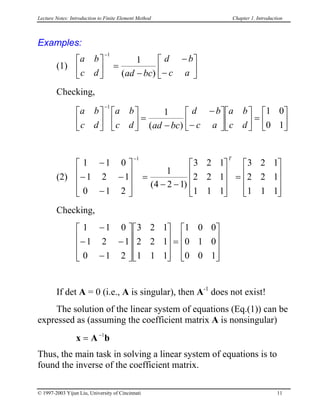
Examples:
(1)
a b
c d ad bc
d b
c a


 =
−
−
−







−1
1
( )
Checking,
a b
c d
a b
c d ad bc
d b
c a
a b
c d











 =
−
−
−











 =






−1
1 1 0
0 1( )
(2)
1 1 0
1 2 1
0 1 2
1
4 2 1
3 2 1
2 2 1
1 1 1
3 2 1
2 2 1
1 1 1
1
−
− −
−







=
− −










=












−
( )
T
Checking,


1 1 0
1 2 1
0 1 2
3 2 1
2 2 1
1 1 1
1 0 0
0 1 0
0 0 1
−
− −
−

















=










If det A = 0 (i.e., A is singular), then A-1
does not exist!
The solution of the linear system of equations (Eq.(1)) can be
expressed as (assuming the coefficient matrix A is nonsingular)
x A b= −1
Thus, the main task in solving a linear system of equations is to
found the inverse of the coefficient matrix.
© 1997-2003 Yijun Liu, University of Cincinnati 11
Lecture Notes: Introduction to Finite Element Method Chapter 1. Introduction
Solution Techniques for Linear Systems of Equations
• Gauss elimination methods
• Iterative methods
Positive Definite Matrix
A square (n×n) matrix A is said to be positive definite, if for
all nonzero vector x of dimension n,
x AxT
> 0
Note that positive definite matrices are nonsingular.
Differentiation and Integration of a Matrix
Let
A [ ]( ) ( )t a tij=
then the differentiation is defined by
d
dt
t
da t
dt
ij
A( )
( )
=






and the integration by
∫A( ) ( )t dt a t dtij= 


∫
© 1997-2003 Yijun Liu, University of Cincinnati 12
Lecture Notes: Introduction to Finite Element Method Chapter 1. Introduction
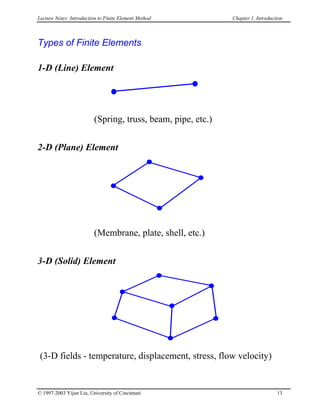
Types of Finite Elements
1-D (Line) Element
(Spring, truss, beam, pipe, etc.)
2-D (Plane) Element
(Membrane, plate, shell, etc.)
3-D (Solid) Element
(3-D fields - temperature, displacement, stress, flow velocity)
© 1997-2003 Yijun Liu, University of Cincinnati 13
Lecture Notes: Introduction to Finite Element Method Chapter 1. Introduction
III. Spring Element
“Everything important is simple.”
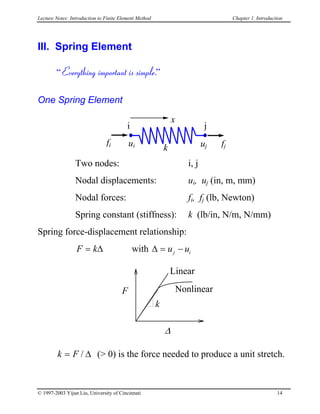
One Spring Element
Two nodes: i, j
k
i j
ujuifi fj
x
Nodal displacements: ui, uj (in, m, mm)
Nodal forces: fi, fj (lb, Newton)
Spring constant (stiffness): k (lb/in, N/m, N/mm)
Spring force-displacement relationship:
F k= ∆ with ∆ = −u uj i
∆
F Nonlinear
Linear
k
k F= / ∆ (> 0) is the force needed to produce a unit stretch.
© 1997-2003 Yijun Liu, University of Cincinnati 14
Lecture Notes: Introduction to Finite Element Method Chapter 1. Introduction
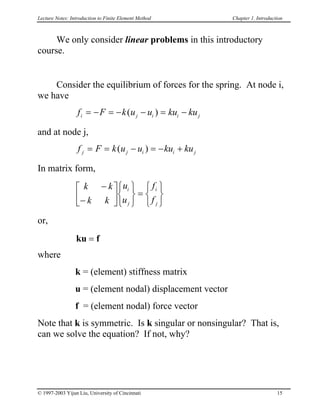
We only consider linear problems in this introductory
course.
Consider the equilibrium of forces for the spring. At node i,
we have
f F k u u ku kui j i= − = − i j− = −( )
and at node j,
f F k u u ku kuj j i i= = j− = − +( )
In matrix form,


k k
k k
u
u
f
f
i
j
i
j
−
−









=






or,
ku f=
where
k = (element) stiffness matrix
u = (element nodal) displacement vector
f = (element nodal) force vector
Note that k is symmetric. Is k singular or nonsingular? That is,
can we solve the equation? If not, why?
© 1997-2003 Yijun Liu, University of Cincinnati 15
Lecture Notes: Introduction to Finite Element Method Chapter 1. Introduction
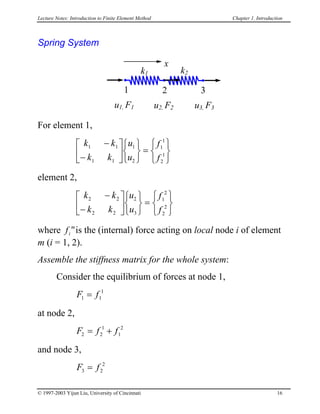
Spring System
k1
u1, F1
x
k2
u2, F2 u3, F3
1 2 3
For element 1,


k k
k k
u
u
f
f
1 1
1 1
1
2
1
1
2
1
−
−









=






element 2,


k k
k k
u
u
f
f
2 2
2 2
2
3
1
2
2
2
−
−









=






where is the (internal) force acting on local node i of element
m (i = 1, 2).
fi
m
Assemble the stiffness matrix for the whole system:
Consider the equilibrium of forces at node 1,
F f1 1
1
=
at node 2,
F f f2 2
1
1
2
= +
and node 3,
F f3 2
2
=
© 1997-2003 Yijun Liu, University of Cincinnati 16
Lecture Notes: Introduction to Finite Element Method Chapter 1. Introduction
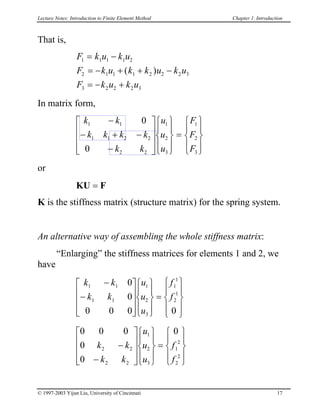
That is,
F k u k u
F k u k k u k
F k u k u
1 1 1 1 2
2 1 1 1 2 2 2
3 2 2 2 3
= −
= − + + −
= − +
( ) u3
In matrix form,












=







 3
2
1
3
2
1
0
0
F
F
F
u
u
u






−
−+
22
221
kk
kk

−
−
1
11
kk
kk
or
KU F=
K is the stiffness matrix (structure matrix) for the spring system.
An alternative way of assembling the whole stiffness matrix:
“Enlarging” the stiffness matrices for elements 1 and 2, we
have
k k
k k
u
u
u
f
f
1 1
1 1
1
2
3
1
1
2
1
0
0
0 0 0 0
−
−




















=










0 0 0
0
0
0
2 2
2 2
1
2
3
1
2
2
2
k k
k k
u
u
u
f
f
−
−




















=










© 1997-2003 Yijun Liu, University of Cincinnati 17
Lecture Notes: Introduction to Finite Element Method Chapter 1. Introduction
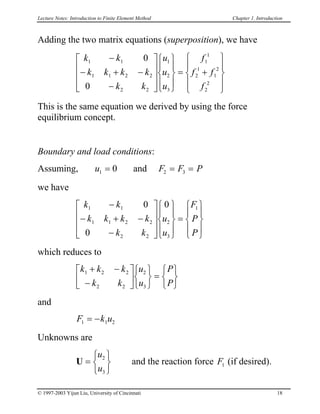
Adding the two matrix equations (superposition), we have
k k
k k k k
k k
u
u
u
f
f f
f
1 1
1 1 2 2
2 2
1
2
3
1
1
2
1
1
2
2
2
0
0
−
− + −
−




















= +










This is the same equation we derived by using the force
equilibrium concept.
Boundary and load conditions:
Assuming, u F F P1 20= 3= =and
we have
k k
k k k k
k k
u
u
F
P
P
1 1
1 1 2 2
2 2
2
3
10
0
0−
− + −
−




















=










which reduces to
k k k
k k
u
u
P
P
1 2 2
2 2
2
3
+ −
−












=






and
F k u1 1= − 2
Unknowns are
U =






u
u
2
3
and the reaction force (if desired).F1
© 1997-2003 Yijun Liu, University of Cincinnati 18
Lecture Notes: Introduction to Finite Element Method Chapter 1. Introduction
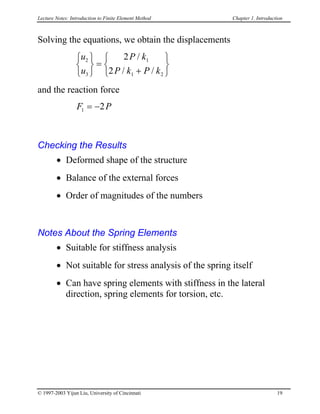
Solving the equations, we obtain the displacements
u
u
P k
P k P k
2
3
1
1 2
2
2






=
+






/
/ /
and the reaction force
F P1 2= −
Checking the Results
• Deformed shape of the structure
• Balance of the external forces
• Order of magnitudes of the numbers
Notes About the Spring Elements
• Suitable for stiffness analysis
• Not suitable for stress analysis of the spring itself
• Can have spring elements with stiffness in the lateral
direction, spring elements for torsion, etc.
© 1997-2003 Yijun Liu, University of Cincinnati 19
Lecture Notes: Introduction to Finite Element Method Chapter 1. Introduction
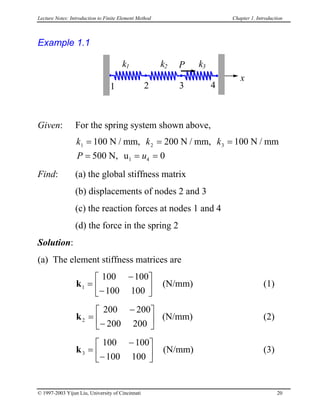
Example 1.1
k1
x
1 2 3
k3
4
Pk2
Given: For the spring system shown above,
k k k
P u
1 2 3
4 0
= = =
= = =
100 N / mm, 200 N / mm, 100 N / mm
500 N, u1
Find: (a) the global stiffness matrix
(b) displacements of nodes 2 and 3
(c) the reaction forces at nodes 1 and 4
(d) the force in the spring 2
Solution:
(a) The element stiffness matrices are
k (N/mm) (1)1
100 100
100 100
=
−
−






k2
200 200
200 200
=
−
−





 (N/mm) (2)
k3
100 100
100 100
=
−
−





 (N/mm) (3)
© 1997-2003 Yijun Liu, University of Cincinnati 20
Lecture Notes: Introduction to Finite Element Method Chapter 1. Introduction
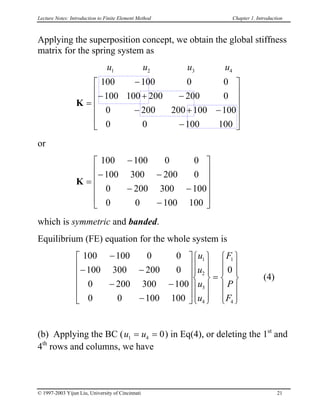
Applying the superposition concept, we obtain the global stiffness
matrix for the spring system as
u u u1 2 3
0 0
0
0
0 0
K =
−
−









u4
−
100 100
100 100
−
− + 200 200
200 200− +100 100
100 100 


or
K =
−
− −
− −
−












100 100 0 0
100 300 200 0
0 200 300 100
0 0 100 100
which is symmetric and banded.
Equilibrium (FE) equation for the whole system is
 (4)
100 100 0 0
100 300 200 0
0 200 300 100
0 0 100 100
0
1
2
3
4
1
4
−
− −
− −
−

























=














u
u
u
u
F
P
F
(b) Applying the BC (u u1 4 0= = ) in Eq(4), or deleting the 1st
and
4th
rows and columns, we have
© 1997-2003 Yijun Liu, University of Cincinnati 21
Lecture Notes: Introduction to Finite Element Method Chapter 1. Introduction

 (5)
300 200
200 300
02
3
−
−









=






u
u P
Solving Eq.(5), we obtain
(6)
u
u
P
P
2
3
250
3 500
2
3






=






=






/
/
(mm)
(c) From the 1st
and 4th
equations in (4), we get the reaction forces
F u1 2100 200= − = − (N)
F u4 3100 300= − = − ( )N
(d) The FE equation for spring (element) 2 is

200 200
200 200
−
−











=






u
u
f
f
i
j
i
j
Here i = 2, j = 3 for element 2. Thus we can calculate the spring
force as
[ ]
[ ]
F f f
u
u
j i= = − = −






= −






=
200 200
200 200
2
3
200
2
3
(N)
Check the results!
© 1997-2003 Yijun Liu, University of Cincinnati 22
Lecture Notes: Introduction to Finite Element Method Chapter 1. Introduction
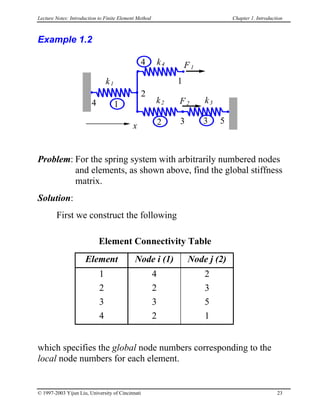
Example 1.2
k1
x
k24
2
3
k3
5
F2
F1
4
1
2 3
k
1
4
Problem: For the spring system with arbitrarily numbered nodes
and elements, as shown above, find the global stiffness
matrix.
Solution:
First we construct the following
Element Connectivity Table
Element Node i (1) Node j (2)
1 4 2
2 2 3
3 3 5
4 2 1
which specifies the global node numbers corresponding to the
local node numbers for each element.
© 1997-2003 Yijun Liu, University of Cincinnati 23
Lecture Notes: Introduction to Finite Element Method Chapter 1. Introduction
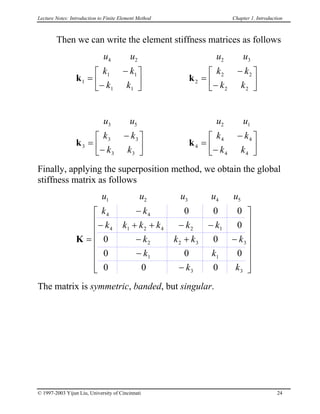
Then we can write the element stiffness matrices as follows
u u
k k
k k
4 2
1
1 1
1 1
k =
−
−






u u
k k
k k
2 3
2
2 2
2 2
k =
−
−






u u
k
k k
3 5
3
3 3
3 3
k =
−
−






k
k
5
3
0
−
u u
k k
k k
2 1
4
4 4
4 4
k =
−
−






Finally, applying the superposition method, we obtain the global
stiffness matrix as follows
u u u u u
k k
k k k k k k
k k k
k k
k k
1 2 3 4
4 4
4 1 2 4 2
2 2 3
1 1
3 3
0 0 0
0
0 0
0 0
0 0 0
K =
−
− + − −
− +
−
−
















+ 1
The matrix is symmetric, banded, but singular.
© 1997-2003 Yijun Liu, University of Cincinnati 24
Lecture Notes: Introduction to Finite Element Method Chapter 2. Bar and Beam Elements
Chapter 2. Bar and Beam Elements
I. Linear Static Analysis
Most structural analysis problems can be treated as linear
static problems, based on the following assumptions
1. Small deformations (loading pattern is not changed due
to the deformed shape)
2. Elastic materials (no plasticity or failures)
3. Static loads (the load is applied to the structure in a slow
or steady fashion)
Linear analysis can provide most of the information about
the behavior of a structure, and can be a good approximation for
many analyses. It is also the bases of nonlinear analysis in most
of the cases.
© 1997-2002 Yijun Liu, University of Cincinnati 25
Lecture Notes: Introduction to Finite Element Method Chapter 2. Bar and Beam Elements
II. Bar Element
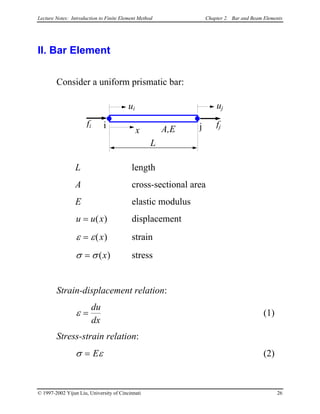
Consider a uniform prismatic bar:
L
x
fi i j fj
ui uj
A,E
L length
A cross-sectional area
E elastic modulus
u u x= ( ) displacement
ε ε= ( )x strain
σ σ= ( )x stress
Strain-displacement relation:
ε =
du
dx
(1)
Stress-strain relation:
σ ε= E (2)
© 1997-2002 Yijun Liu, University of Cincinnati 26
Lecture Notes: Introduction to Finite Element Method Chapter 2. Bar and Beam Elements
Stiffness Matrix --- Direct Method
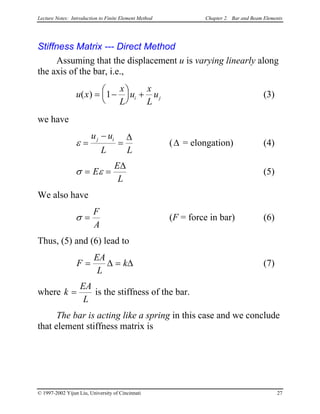
Assuming that the displacement u is varying linearly along
the axis of the bar, i.e.,
u x (3)
x
L
u
x
L
ui( ) = −




 +1 j
we have
ε =
−
=
u u
L L
j i ∆
(∆ = elongation) (4)
σ ε= =E
E
L
∆
(5)
We also have
σ =
F
A
(F = force in bar) (6)
Thus, (5) and (6) lead to
F
EA
L
k= =∆ ∆ (7)
where k
EA
L
= is the stiffness of the bar.
The bar is acting like a spring in this case and we conclude
that element stiffness matrix is
© 1997-2002 Yijun Liu, University of Cincinnati 27
Lecture Notes: Introduction to Finite Element Method Chapter 2. Bar and Beam Elements
k =
−
−





 =
−
−










k k
k k
EA
L
EA
L
EA
L
EA
L
or
k =
−
−






EA
L
1 1
1 1
(8)
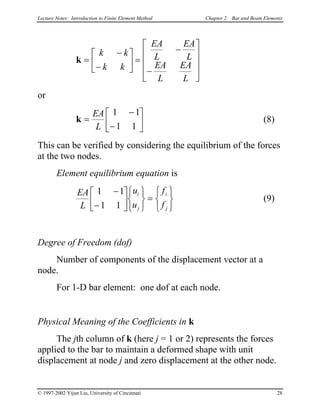
This can be verified by considering the equilibrium of the forces
at the two nodes.
Element equilibrium equation is
EA
L
u
u
f
f
i
j
i
j
1 1
1 1
−
−












=






(9)
Degree of Freedom (dof)
Number of components of the displacement vector at a
node.
For 1-D bar element: one dof at each node.
Physical Meaning of the Coefficients in k
The jth column of k (here j = 1 or 2) represents the forces
applied to the bar to maintain a deformed shape with unit
displacement at node j and zero displacement at the other node.
© 1997-2002 Yijun Liu, University of Cincinnati 28
Lecture Notes: Introduction to Finite Element Method Chapter 2. Bar and Beam Elements
Stiffness Matrix --- A Formal Approach
We derive the same stiffness matrix for the bar using a
formal approach which can be applied to many other more
complicated situations.
Define two linear shape functions as follows
N Ni ( ) , ( )jξ ξ ξ ξ= − =1 (10)
where
ξ =
x
L
, 0 ξ≤ ≤ 1 (11)
From (3) we can write the displacement as
u x u N u N ui i j( ) ( ) ( ) ( )= = j+ξ ξ ξ
or
u N (12)[ ]N
u
ui j
i
j
=






= Nu
Strain is given by (1) and (12) as
ε = = 


 =
du
dx
d
dx
N u Bu (13)
where B is the element strain-displacement matrix, which is
[ ] [ ]B = =
d
dx
N N
d
d
N N
d
dx
i j i j( ) ( ) ( ) ( )ξ ξ
ξ
ξ ξ •
ξ
i.e., (14)[B = −1 1/ /L ]L
© 1997-2002 Yijun Liu, University of Cincinnati 29
Lecture Notes: Introduction to Finite Element Method Chapter 2. Bar and Beam Elements
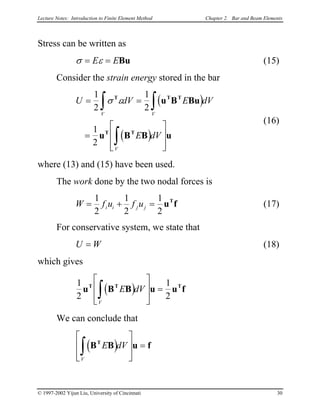
Stress can be written as
σ ε= =E EBu (15)
Consider the strain energy stored in the bar
( )
( )
U dV E
E dV
V V
V
= =
=








∫ ∫
∫
1
2
1
2
1
2
σ εT T T
T T
u B Bu
u B B u
dV
(16)
where (13) and (15) have been used.
The work done by the two nodal forces is
W f (17)u f ui i j j= + =
1
2
1
2
1
2
u fT
For conservative system, we state that
U (18)W=
which gives
( )1
2
1
2
u B B u uT T
E dV
V
∫








= fT
f
We can conclude that
( )B B uT
E dV
V
∫








=
© 1997-2002 Yijun Liu, University of Cincinnati 30
Lecture Notes: Introduction to Finite Element Method Chapter 2. Bar and Beam Elements
or
ku f= (19)
where
(20)( )k B BT
=
∫ E dV
V
is the element stiffness matrix.
Expression (20) is a general result which can be used for
the construction of other types of elements. This expression can
also be derived using other more rigorous approaches, such as
the Principle of Minimum Potential Energy, or the Galerkin’s
Method.
Now, we evaluate (20) for the bar element by using (14)
[ ]k =
−





− =
−
−





∫
1
1
1 1
1 1
1 1
0
/
/
/ /
L
L
E L L Adx
EA
L
L
which is the same as we derived using the direct method.
Note that from (16) and (20), the strain energy in the
element can be written as
U (21)=
1
2
u kuT
© 1997-2002 Yijun Liu, University of Cincinnati 31
Lecture Notes: Introduction to Finite Element Method Chapter 2. Bar and Beam Elements
Example 2.1
L
x1 P
2A,E
L
2 3
A,E1 2
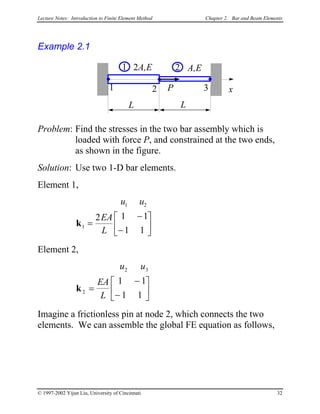
Problem: Find the stresses in the two bar assembly which is
loaded with force P, and constrained at the two ends,
as shown in the figure.
Solution: Use two 1-D bar elements.
Element 1,
u u
EA
L
1 2
1
2 1 1
1 1
k =
−
−






Element 2,
u u
EA
L
2 3
2
1 1
1 1
k =
−
−






Imagine a frictionless pin at node 2, which connects the two
elements. We can assemble the global FE equation as follows,
© 1997-2002 Yijun Liu, University of Cincinnati 32
Lecture Notes: Introduction to Finite Element Method Chapter 2. Bar and Beam Elements
EA
L
u
u
u
F
F
F
2 2 0
2 3 1
0 1 1
1
2
3
1
2
3
−
− −
−




















=










Load and boundary conditions (BC) are,
u u F P1 3 20= = =,
FE equation becomes,
EA
L
u
F
P
F
2 2 0
2 3 1
0 1 1
0
0
2
1
3
−
− −
−




















=










Deleting the 1st
row and column, and the 3rd
row and column, we
obtain,
[ ]{ } { }
EA
L
u P3 2 =
Thus,
u
PL
EA
2
3
=
and
u
u
u
PL
EA
1
2
3
3
0
1
0








=












Stress in element 1 is
© 1997-2002 Yijun Liu, University of Cincinnati 33
Lecture Notes: Introduction to Finite Element Method Chapter 2. Bar and Beam Elements
[ ]σ ε1 1 1 1
1
2
2 1
1 1
3
0
3
= = = −






=
−
= −




 =
E E E L L
u
u
E
u u
L
E
L
PL
EA
P
A
B u / /
Similarly, stress in element 2 is
[ ]σ ε2 2 2 2
2
3
3 2
1 1
0
3 3
= = = −






=
−
= −





 = −
E E E L L
u
u
E
u u
L
E
L
PL
EA
P
A
B u / /
which indicates that bar 2 is in compression.
Check the results!
Notes:
• In this case, the calculated stresses in elements 1 and 2
are exact within the linear theory for 1-D bar structures.
It will not help if we further divide element 1 or 2 into
smaller finite elements.
• For tapered bars, averaged values of the cross-sectional
areas should be used for the elements.
• We need to find the displacements first in order to find
the stresses, since we are using the displacement based
FEM.
© 1997-2002 Yijun Liu, University of Cincinnati 34
Lecture Notes: Introduction to Finite Element Method Chapter 2. Bar and Beam Elements
Example 2.2
L
x1 P
A,E
L
2 3
1 2
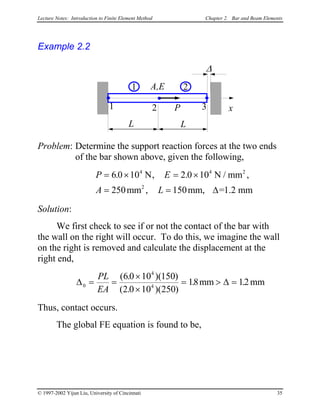
∆
Problem: Determine the support reaction forces at the two ends
of the bar shown above, given the following,
P E
A L =
= × = ×
= =
6 0 10 2 0 10
250 150
4 4
2
. , .
,
N N /
mm mm, 1.2 mm
2
∆
,mm
Solution:
We first check to see if or not the contact of the bar with
the wall on the right will occur. To do this, we imagine the wall
on the right is removed and calculate the displacement at the
right end,
∆ ∆0
4
4
60 10 150
2 0 10 250
18 12= =
×
×
= > =
PL
EA
( . )( )
( . )( )
. .mm mm
Thus, contact occurs.
The global FE equation is found to be,
© 1997-2002 Yijun Liu, University of Cincinnati 35
Lecture Notes: Introduction to Finite Element Method Chapter 2. Bar and Beam Elements
EA
L
u
u
u
F
F
F
1 1 0
1 2 1
0 1 1
1
2
3
1
2
3
−
− −
−




















=










The load and boundary conditions are,
F P
u u
2
4
1 3
6 0 10
0 1
= = ×
= = =
.
, .
N
mm∆ 2
FE equation becomes,
EA
L
u
F
P
F
1 1 0
1 2 1
0 1 1
0
2
1
3
−
− −
−




















=









∆
The 2nd
equation gives,
[ ] { }
EA
L
u
P2 1 2
−






=
∆
that is,
[ ]{ }
EA
L
u P
EA
L
2 2 = +





∆
Solving this, we obtain
u
PL
EA
2
1
2
15= +




 =∆ . mm
and
© 1997-2002 Yijun Liu, University of Cincinnati 36
Lecture Notes: Introduction to Finite Element Method Chapter 2. Bar and Beam Elements


u
u
u
1
2
3
0
15
12








=










.
.
( )mm
To calculate the support reaction forces, we apply the 1st
and 3rd
equations in the global FE equation.
The 1st
equation gives,
[ ] ( )
EA
L
u
u
u
EA
L
u1
1
2
3
2
4
1 1 0 50 10= −










= − = − ×. NF
and the 3rd
equation gives,
[ ] ( )F
EA
L
u
u
u
EA
L
u u3
1
2
3
2 3
4
0 1 1
10 10
= −










= − +
= − ×. N
Check the results.!
© 1997-2002 Yijun Liu, University of Cincinnati 37
Lecture Notes: Introduction to Finite Element Method Chapter 2. Bar and Beam Elements
Distributed Load
x
i j
q
qL/2
i j
qL/2
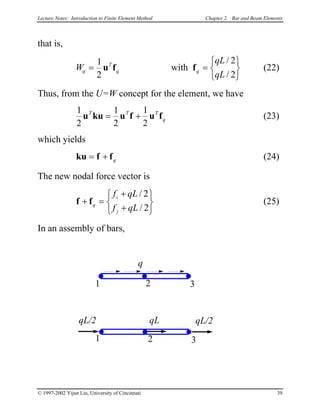
Uniformly distributed axial load q (N/mm, N/m, lb/in) can
be converted to two equivalent nodal forces of magnitude qL/2.
We verify this by considering the work done by the load q,
[ ]
[ ]
[ ]
W uqdx u q Ld
qL
u d
qL
N N
u
u
d
qL
d
u
u
qL qL u
u
u u
qL
qL
q
L
i j
i
j
i
j
i
j
i j
= = =
=






= −






=










=






∫ ∫ ∫
∫
∫
1
2
1
2 2
2
2
1
1
2 2 2
1
2
2
2
0 0
1
0
1
0
1
0
1
( ) ( ) ( )
( ) ( )
/
/
ξ ξ ξ
ξ ξ ξ
ξ ξ ξ
ξ
© 1997-2002 Yijun Liu, University of Cincinnati 38
Lecture Notes: Introduction to Finite Element Method Chapter 2. Bar and Beam Elements
that is,
W (22)
qL
qLq
T
q q= =






1
2
2
2
u f fwith
/
/
Thus, from the U=W concept for the element, we have
1
2
1
2
1
2
u ku u f u fT T
q= + T
(23)
which yields
ku f f= + q (24)
The new nodal force vector is
f f (25)+ =
+
+






q
i
j
f qL
f qL
/
/
2
2
In an assembly of bars,
1 3
q
qL/2
1 3
qL/2
2
2
qL
© 1997-2002 Yijun Liu, University of Cincinnati 39
Lecture Notes: Introduction to Finite Element Method Chapter 2. Bar and Beam Elements
Bar Elements in 2-D and 3-D Space
2-D Case
x
i
j
ui
’
y
X
Y
θ
ui
vi
Local Global
x, y X, Y
u vi i
' '
, u vi i,
1 dof at a node 2 dof’s at a node
Note: Lateral displacement vi
’
does not contribute to the stretch
of the bar, within the linear theory.
Transformation
[ ]
[ ]
u u v l m
u
v
v u v m l
u
v
i i i
i
i
i i i
i
i
'
'
cos sin
sin cos
= + =






= − + = −






θ θ
θ θ
where l m= =cos , sinθ θ .
© 1997-2002 Yijun Liu, University of Cincinnati 40
Lecture Notes: Introduction to Finite Element Method Chapter 2. Bar and Beam Elements
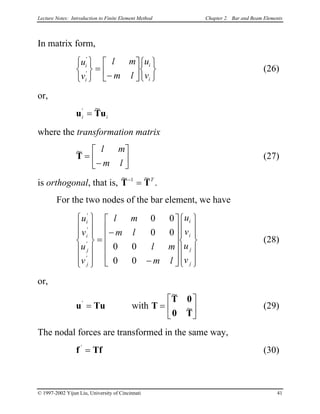
In matrix form,
(26)
u
v
l m
m l
u
v
i
i
i
i
'
'






=
−












or,
u Ti i
'
u
~
=
where the transformation matrix
(27)
~
T =
−






l m
m l
is orthogonal, that is,
~ ~
T T−
=1 T
.
For the two nodes of the bar element, we have
(28)
u
v
u
v
l m
m l
l m
m l
u
v
u
v
i
i
j
j
i
i
j
j
'
'
'
'














=
−
−


























0 0
0 0
0 0
0 0
or,
u T'
= u with T
T 0
0 T
=






~
~ (29)
The nodal forces are transformed in the same way,
f Tf'
= (30)
© 1997-2002 Yijun Liu, University of Cincinnati 41
Lecture Notes: Introduction to Finite Element Method Chapter 2. Bar and Beam Elements
Stiffness Matrix in the 2-D Space
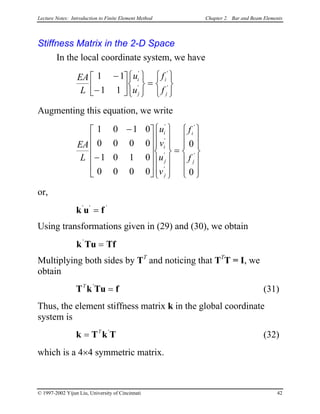
In the local coordinate system, we have
EA
L
u
u
f
f
i
j
i
j
1 1
1 1
−
−












=






'
'
'
'
Augmenting this equation, we write
EA
L
u
v
u
v
f
f
i
i
j
j
i
j
1 0 1 0
0 0 0 0
1 0 1 0
0 0 0 0
0
0
−
−


























=














'
'
'
'
'
'
or,
k u f' '
= '
Using transformations given in (29) and (30), we obtain
k Tu Tf'
=
Multiplying both sides by TT
and noticing that TT
T = I, we
obtain
T k Tu fT '
= (31)
Thus, the element stiffness matrix k in the global coordinate
system is
(32)k T k= T '
T
which is a 4×4 symmetric matrix.
© 1997-2002 Yijun Liu, University of Cincinnati 42
Lecture Notes: Introduction to Finite Element Method Chapter 2. Bar and Beam Elements
Explicit form,
u v u v
EA
L
l lm l l
lm m lm m
l lm l lm
lm m lm m
i i j
k =
− −
− −
− −
− −












2 2
2
2 2
2 2
m
j
2
(33)
Calculation of the directional cosines l and m:
l
X X
L
m
Y Y
L
j i j
= = i−
= =
−
cos , sinθ θ (34)
The structure stiffness matrix is assembled by using the element
stiffness matrices in the usual way as in the 1-D case.
Element Stress
σ ε= =






= −























E E
u
u
E
L L
l m
l m
u
v
u
v
i
j
i
i
j
j
B
'
'
1 1 0 0
0 0
That is,
[σ = − −














E
L
l m l m
u
v
u
v
i
i
j
j
] (35)
© 1997-2002 Yijun Liu, University of Cincinnati 43
Lecture Notes: Introduction to Finite Element Method Chapter 2. Bar and Beam Elements
Example 2.3
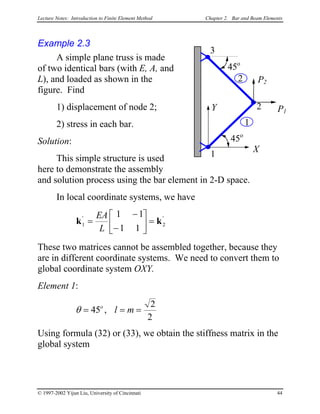
A simple plane truss is made
of two identical bars (with E, A, and
L), and loaded as shown in the
figure. Find
1) displacement of node 2;
2) stress in each bar.
Solution:
This simple structure is used
here to demonstrate the assembly
and solution process using the bar element in 2-D space.
X
Y P1
P2
45o
45o
3
2
1
1
2
In local coordinate systems, we have
k k1 2
1 1
1 1
' '
=
−
−





 =
EA
L
These two matrices cannot be assembled together, because they
are in different coordinate systems. We need to convert them to
global coordinate system OXY.
Element 1:
θ = = =45
2
2
o
l m,
Using formula (32) or (33), we obtain the stiffness matrix in the
global system
© 1997-2002 Yijun Liu, University of Cincinnati 44
Lecture Notes: Introduction to Finite Element Method Chapter 2. Bar and Beam Elements
u v u v
EA
L
T
1 1 2 2
1 1 1 1
2
1 1 1 1
1 1 1 1
1 1 1 1
1 1 1 1
k T k T= =
− −
− −
− −
− −












'
Element 2:
θ = = − =135
2
2
2
2
o
l m, ,
We have,
u v u v
EA
L
T
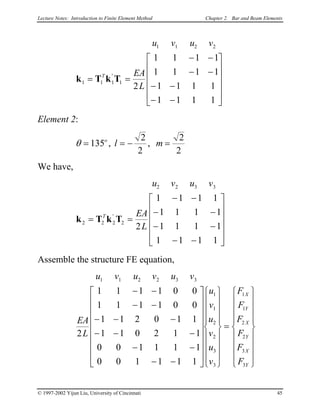
2 2 3 3
2 2 2 2
2
1 1 1 1
1 1 1 1
1 1 1 1
1 1 1 1
k T k T= =
− −
− −
− −
− −












'
Assemble the structure FE equation,
u v u v u v
EA
L
u
v
u
v
u
v
F
F
F
F
F
F
X
Y
X
Y
X
Y
1 1 2 2 3 3
1
1
2
2
3
3
1
1
2
2
3
3
2
1 1 1 1 0 0
1 1 1 1 0 0
1 1 2 0 1 1
1 1 0 2 1 1
0 0 1 1 1 1
0 0 1 1 1 1
− −
− −
− − −
− − −
− −
− −




































=


















© 1997-2002 Yijun Liu, University of Cincinnati 45
Lecture Notes: Introduction to Finite Element Method Chapter 2. Bar and Beam Elements
Load and boundary conditions (BC):
u v u v F P F PX Y1 1 3 3 2 1 20= = = 2= = =, ,
Condensed FE equation,
EA
L
u
v
P
P2
2 0
0 2
2
2
1
2












=






Solving this, we obtain the displacement of node 2,
u
v
L
EA
P
P
2
2
1
2






=






Using formula (35), we calculate the stresses in the two bars,
[ ] ( )σ1
1
2
1 2
2
2
1 1 1 1
0
0 2
2
= − −














= +
E
L
L
EA P
P
A
P P
[ ] ( )σ2
1
2
1 2
2
2
1 1 1 1
0
0
2
2
= − −














= −
E
L
L
EA
P
P
A
P P
Check the results:
Look for the equilibrium conditions, symmetry,
antisymmetry, etc.
© 1997-2002 Yijun Liu, University of Cincinnati 46
Lecture Notes: Introduction to Finite Element Method Chapter 2. Bar and Beam Elements
Example 2.4 (Multipoint Constraint)
X
Y
P
45o
3
2
1
3
2
1
x’
y’
L
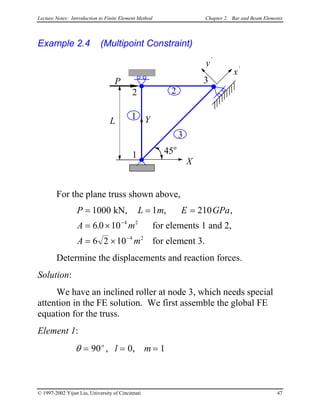
For the plane truss shown above,
P L m E GPa
A m
A m
= = =
= ×
= ×
−
−
1000 1 210
6 0 10
6 2 10
4 2
4 2
kN,
for elements 1 and 2,
for element 3.
, ,
.
Determine the displacements and reaction forces.
Solution:
We have an inclined roller at node 3, which needs special
attention in the FE solution. We first assemble the global FE
equation for the truss.
Element 1:
θ = = =90 0 1o
l m, ,
© 1997-2002 Yijun Liu, University of Cincinnati 47
Lecture Notes: Introduction to Finite Element Method Chapter 2. Bar and Beam Elements
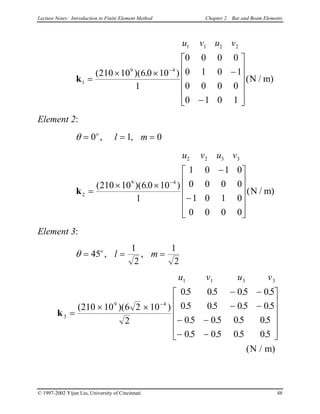
u v u v1 1 2 2
1
9 4
210 10 6 0 10
1
0 0 0 0
0 1 0 1
0 0 0 0
0 1 0 1
k =
× × −
−












−
( )( . )
( )N / m
Element 2:
θ = = =0 1o
l m, , 0
u v u v2 2 3 3
2
9 4
210 10 6 0 10
1
1 0 1 0
0 0 0 0
1 0 1 0
0 0 0 0
k =
× ×
−
−












−
( )( . )
( )N / m
Element 3:
θ = = =45
1
2
1
2
o
l m, ,
u v u v1 1 3
3
9 4
210 10 6 2 10
2
05 05 05 05
05 05 05 05
05 05 05 05
05 05 05 05
k =
× ×
− −
− −
− −
− −












−
( )( )
. . . .
. . . .
. . . .
. . . .
( )N / m
3
© 1997-2002 Yijun Liu, University of Cincinnati 48
Lecture Notes: Introduction to Finite Element Method Chapter 2. Bar and Beam Elements
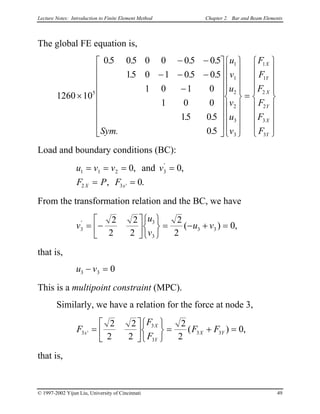
The global FE equation is,
1260 10
05 05 0 0 05 05
15 0 1 05 05
1 0 1 0
1 0 0
15 05
05
5
1
1
2
2
3
3
1
1
2
2
3
3
×
− −
− − −
−




































=


















. . . .
. . .
. .
.Sym.
u
v
u
v
u
v
F
F
F
F
F
F
X
Y
X
Y
X
Y
Load and boundary conditions (BC):
u v v v
F P FX x
1 1 2 3
2 3
0 0
0
= = = =
= =
, ,
, .
'
'
and
From the transformation relation and the BC, we have
v
u
v
u v3
3
3
3 3
2
2
2
2
2
2
0'
( )= −












= − + = ,
that is,
u v3 3 0− =
This is a multipoint constraint (MPC).
Similarly, we have a relation for the force at node 3,
F
F
F
F Fx
X
Y
X Y3
3
3
3 3
2
2
2
2
2
2
0' ( )=












= + ,=
that is,
© 1997-2002 Yijun Liu, University of Cincinnati 49
Lecture Notes: Introduction to Finite Element Method Chapter 2. Bar and Beam Elements
F FX Y3 3 0+ =
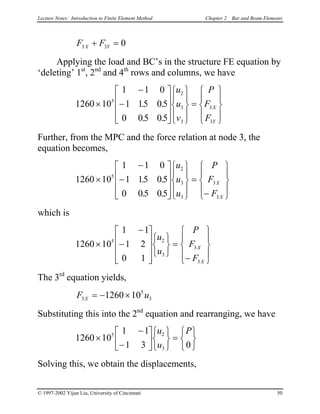
Applying the load and BC’s in the structure FE equation by
‘deleting’ 1st
, 2nd
and 4th
rows and columns, we have
1260 10
1 1 0
1 15 05
0 05 05
5
2
3
3
3
3
×
−
−




















=










. .
. .
u
u
v
P
F
F
X
Y
Further, from the MPC and the force relation at node 3, the
equation becomes,
1260 10
1 1 0
1 15 05
0 05 05
5
2
3
3
3
3
×
−
−




















=
−










. .
. .
u
u
u
P
F
F
X
X
which is
1260 10
1 1
1 2
0 1
5 2
3
3
3
×
−
−
















=
−










u
u
P
F
F
X
X
The 3rd
equation yields,
F uX3
5
31260 10= − ×
Substituting this into the 2nd
equation and rearranging, we have
1260 10
1 1
1 3 0
5 2
3
×
−
−












=






u
u
P
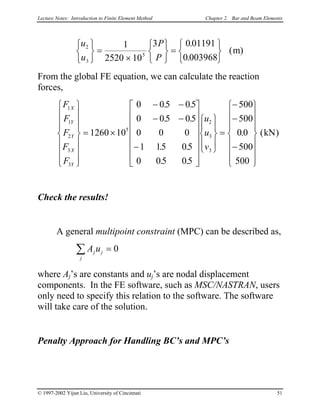
Solving this, we obtain the displacements,
© 1997-2002 Yijun Liu, University of Cincinnati 50
Lecture Notes: Introduction to Finite Element Method Chapter 2. Bar and Beam Elements
u
u
P
P
2
3
5
1
2520 10
3 0 01191
0 003968






=
×






=






.
.
( )m
From the global FE equation, we can calculate the reaction
forces,
F
F
F
F
F
u
u
v
X
Y
Y
X
Y
1
1
2
3
3
5
2
3
3
1260 10
0 05 05
0 05 05
0 0 0
1 15 05
0 05 05
500
500
0 0
500
500
















= ×
− −
− −
−


























=
−
−
−
















. .
. .
. .
. .
. (kN)
Check the results!
A general multipoint constraint (MPC) can be described as,
A uj j
j
=∑ 0
where Aj’s are constants and uj’s are nodal displacement
components. In the FE software, such as MSC/NASTRAN, users
only need to specify this relation to the software. The software
will take care of the solution.
Penalty Approach for Handling BC’s and MPC’s
© 1997-2002 Yijun Liu, University of Cincinnati 51
Lecture Notes: Introduction to Finite Element Method Chapter 2. Bar and Beam Elements
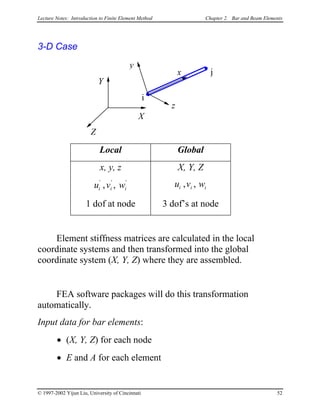
3-D Case
x
i
j
y
X
Y
Z
z
Local Global
x, y, z X, Y, Z
u v wi i
' '
, , i
'
iu v wi i, ,
1 dof at node 3 dof’s at node
Element stiffness matrices are calculated in the local
coordinate systems and then transformed into the global
coordinate system (X, Y, Z) where they are assembled.
FEA software packages will do this transformation
automatically.
Input data for bar elements:
• (X, Y, Z) for each node
• E and A for each element
© 1997-2002 Yijun Liu, University of Cincinnati 52
Lecture Notes: Introduction to Finite Element Method Chapter 2. Bar and Beam Elements
III. Beam Element
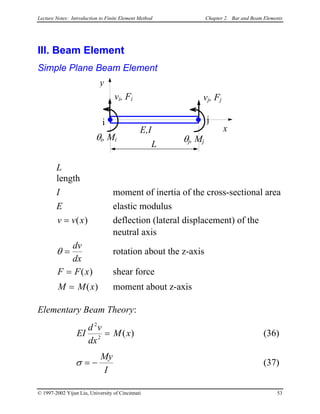
Simple Plane Beam Element
L
x
i j
vj, Fj
E,I
θi, Mi θj, Mj
vi, Fi
y
L
length
I moment of inertia of the cross-sectional area
E elastic modulus
v v x= ( ) deflection (lateral displacement) of the
neutral axis
θ =
dv
dx
rotation about the z-axis
F F x= ( ) shear force
M M x= ( ) moment about z-axis
Elementary Beam Theory:
EI
d v
dx
M x
2
2
= ( ) (36)
σ = −
My
I
(37)
© 1997-2002 Yijun Liu, University of Cincinnati 53
Lecture Notes: Introduction to Finite Element Method Chapter 2. Bar and Beam Elements
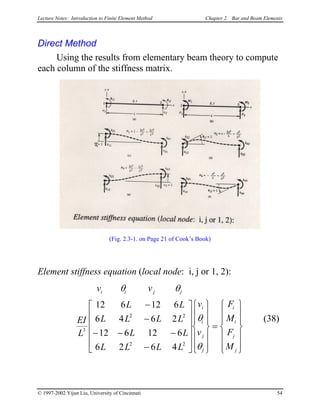
Direct Method
Using the results from elementary beam theory to compute
each column of the stiffness matrix.
(Fig. 2.3-1. on Page 21 of Cook’s Book)
Element stiffness equation (local node: i, j or 1, 2):
v v
EI
L
L L
L L L L
L L
L L L L
v
v
F
M
F
M
i i j j
i
i
j
j
i
i
j
j
θ θ
θ
θ
3
2 2
2 2
12 6 12 6
6 4 6 2
12 6 12 6
6 2 6 4
−
−
− − −
−


























=














(38)
© 1997-2002 Yijun Liu, University of Cincinnati 54
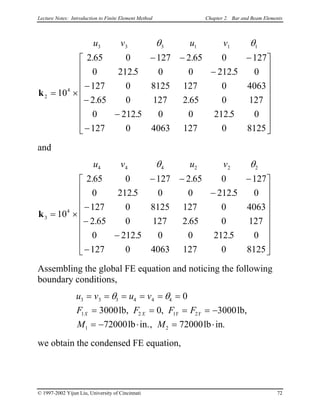
Lecture Notes: Introduction to Finite Element Method Chapter 2. Bar and Beam Elements
Formal Approach
Apply the formula,
(39)k B B=
∫
T
L
EI dx
0
To derive this, we introduce the shape functions,
(40)
N x x L x L
N x x x L x L
N x x L x L
N x x L x L
1
2 2 3
2
2 3
3
2 2 3 3
4
2 3 2
1 3 2
2
3 2
( ) / /
( ) / /
( ) / /
( ) / /
= − +
= − +
= −
= − +
3
2
Then, we can represent the deflection as,
(41)
[ ]
v x
N x N x N x N x
v
v
i
i
j
j
( )
( ) ( ) ( ) ( )
=
=














Nu
1 2 3 4
θ
θ
which is a cubic function. Notice that,
N N
N N L N
1 3
2 3 4
1+ =
+ + = x
which implies that the rigid body motion is represented by the
assumed deformed shape of the beam.
© 1997-2002 Yijun Liu, University of Cincinnati 55
Lecture Notes: Introduction to Finite Element Method Chapter 2. Bar and Beam Elements
Curvature of the beam is,
d v
dx
d
dx
2
2
2
2
= =Nu Bu (42)
where the strain-displacement matrix B is given by,
[ ]B N= =
= − + − + − − +



d
dx
N x N x N x N x
L
x
L L
x
L L
x
L L
x
L
2
2 1 2 3 4
2 3 2 2 3 2
6 12 4 6 6 12 2 6
" " " "
( ) ( ) ( ) ( )
(43)
Strain energy stored in the beam element is
( ) ( )
U dV
My
I E
My
I
dAdx
M
EI
Mdx
d v
dx
EI
d v
dx
dx
EI dx
EI dx
T
V A
L T
T
L TL
T
L
T T
L
= = −





 −






= =












=
=








∫ ∫∫
∫ ∫
∫
∫
1
2
1
2
1
1
2
1 1
2
1
2
1
2
0
0
2
2
2
2
0
0
0
σ ε
Bu Bu
u B B u
We conclude that the stiffness matrix for the simple beam
element is
k B B=
∫
T
L
EI dx
0
© 1997-2002 Yijun Liu, University of Cincinnati 56
Lecture Notes: Introduction to Finite Element Method Chapter 2. Bar and Beam Elements
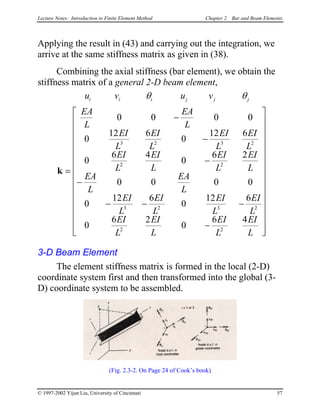
Applying the result in (43) and carrying out the integration, we
arrive at the same stiffness matrix as given in (38).
Combining the axial stiffness (bar element), we obtain the
stiffness matrix of a general 2-D beam element,
u v u v
EA
L
EA
L
EI
L
EI
L
EI
L
EI
L
EI
L
EI
L
EI
L
EI
L
EA
L
EA
L
EI
L
EI
L
EI
L
EI
L
EI
L
EI
L
EI
L
EI
L
i i i j j jθ θ
k =
−
−
−
−
− − −
−






























0 0 0 0
0
12 6
0
12 6
0
6 4
0
6 2
0 0 0 0
0
12 6
0
12 6
0
6 2
0
6 4
3 2 3 2
2 2
3 2 3
2 2
2
3-D Beam Element
The element stiffness matrix is formed in the local (2-D)
coordinate system first and then transformed into the global (3-
D) coordinate system to be assembled.
(Fig. 2.3-2. On Page 24 of Cook’s book)
© 1997-2002 Yijun Liu, University of Cincinnati 57
Lecture Notes: Introduction to Finite Element Method Chapter 2. Bar and Beam Elements
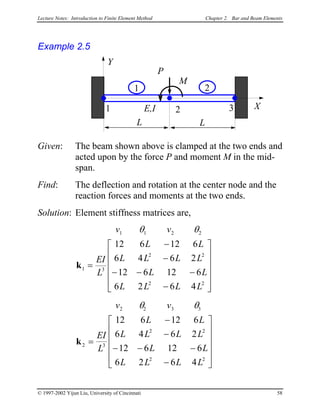
Example 2.5
L
X1 2
P
E,I
Y
L
3
M
1 2
Given: The beam shown above is clamped at the two ends and
acted upon by the force P and moment M in the mid-
span.
Find: The deflection and rotation at the center node and the
reaction forces and moments at the two ends.
Solution: Element stiffness matrices are,
v v
EI
L
L L
L L L L
L L
L L L L
1 1 2 2
1 3
2 2
2 2
12 6 12 6
6 4 6 2
12 6 12 6
6 2 6 4
θ θ
k =
−
−
− − −
−












v v
EI
L
L L
L L L L
L L
L L L L
2 2 3 3
2 3
2 2
2 2
12 6 12 6
6 4 6 2
12 6 12 6
6 2 6 4
θ θ
k =
−
−
− − −
−












© 1997-2002 Yijun Liu, University of Cincinnati 58
Lecture Notes: Introduction to Finite Element Method Chapter 2. Bar and Beam Elements
Global FE equation is,
v v v
EI
L
L L
L L L L
L L
L L L L L
L L
L L L L
v
v
v
F
M
F
M
F
M
Y
Y
Y
1 1 2 2 3 3
3
2 2
2 2 2
2 2
1
1
2
2
3
3
1
1
2
2
3
3
12 6 12 6 0 0
6 4 6 2 0 0
12 6 24 0 12 6
6 2 0 8 6 2
0 0 12 6 12 6
0 0 6 2 6 4
θ θ θ
θ
θ
θ
−
−
− − −
−
− − −
−




































=


















Loads and constraints (BC’s) are,
F P M M
v v
Y2 2
1 3 1 3 0
= − =
= = = =
, ,
θ θ
Reduced FE equation,
EI
L L
v P
M3 2
2
2
24 0
0 8












=
−




θ
Solving this we obtain,
v L
EI
PL
M
2
2
2
24 3θ



=
−







From global FE equation, we obtain the reaction forces and
moments,
© 1997-2002 Yijun Liu, University of Cincinnati 59
Lecture Notes: Introduction to Finite Element Method Chapter 2. Bar and Beam Elements
F
M
F
M
EI
L
L
L L
L
L L
v
P M L
PL M
P M L
PL M
Y
Y
1
1
3
3
3
2
2
2
2
12 6
6 2
12 6
6 2
1
4
2 3
2 3












=
−
−
− −


















=
+
+
−
− +














θ
/
/


Stresses in the beam at the two ends can be calculated using the
formula,
σ σ= = −x
My
I
Note that the FE solution is exact according to the simple beam
theory, since no distributed load is present between the nodes.
Recall that,
EI
d v
dx
M x
2
2
= ( )
and
dM
dx
V V
dV
dx
q q
=
=
(
(
- shear force in the beam)
- distributed load on the beam)
Thus,
EI
d v
dx
q x
4
4
= ( )
If q(x)=0, then exact solution for the deflection v is a cubic
function of x, which is what described by our shape functions.
© 1997-2002 Yijun Liu, University of Cincinnati 60
Lecture Notes: Introduction to Finite Element Method Chapter 2. Bar and Beam Elements
Equivalent Nodal Loads of Distributed Transverse Load
xi j
q
qL/2
i j
qL/2
L
qL2
/12qL2
/12
This can be verified by considering the work done by the
distributed load q.
L
q
L
L
qL
L
qL/2
qL2
/12
© 1997-2002 Yijun Liu, University of Cincinnati 61
Lecture Notes: Introduction to Finite Element Method Chapter 2. Bar and Beam Elements
Example 2.6
L
x1 2
p
E,I
y
Given: A cantilever beam with distributed lateral load p as
shown above.
Find: The deflection and rotation at the right end, the
reaction force and moment at the left end.
Solution: The work-equivalent nodal loads are shown below,
L
x1 2
f
E,I
y
m
where
f pL m pL= =/ , /2 12
2
Applying the FE equation, we have
© 1997-2002 Yijun Liu, University of Cincinnati 62
Lecture Notes: Introduction to Finite Element Method Chapter 2. Bar and Beam Elements
EI
L
L L
L L L L
L L
L L L L
v
v
F
M
F
M
Y
Y
3
2 2
2 2
1
1
2
2
1
1
2
2
12 6 12 6
6 4 6 2
12 6 12 6
6 2 6 4
−
−
− − −
−


























=














θ
θ
Load and constraints (BC’s) are,
F f M m
v
Y2 2
1 1 0
= − =
= =
,
θ
Reduced equation is,
EI
L
L
L L
v f
m3 2
2
2
12 6
6 4
−
−












=
−




θ
Solving this, we obtain,
v L
EI
L f Lm
Lf m
pL EI
pL EI
2
2
2 4
3
6
2 3
3 6
8
6θ



=
− +
− +






=
−
−






/
/

 (A)
These nodal values are the same as the exact solution. Note
that the deflection v(x) (for 0 < x< 0) in the beam by the FEM is,
however, different from that by the exact solution. The exact
solution by the simple beam theory is a 4th
order polynomial of
x, while the FE solution of v is only a 3rd
order polynomial of x.
If the equivalent moment m is ignored, we have,
v L
EI
L f
Lf
pL EI
pL EI
2
2
2 4
3
6
2
3
6
4θ





=
−
−






=
−
−






/
/
 (B)
The errors in (B) will decrease if more elements are used. The
© 1997-2002 Yijun Liu, University of Cincinnati 63
Lecture Notes: Introduction to Finite Element Method Chapter 2. Bar and Beam Elements
equivalent moment m is often ignored in the FEM applications.
The FE solutions still converge as more elements are applied.
From the FE equation, we can calculate the reaction force
and moment as,
F
M
L
EI
L
L L
v pL
pL
Y1
1
3
2
2
2
2
12 6
6 2
2
5 1



=
−
−












=





θ
/
/ 2
2


where the result in (A) is used. This force vector gives the total
effective nodal forces which include the equivalent nodal forces
for the distributed lateral load p given by,


−
−



pL
pL
/
/
2
122
The correct reaction forces can be obtained as follows,


F
M
pL
pL
pL
pL
pL
pL
Y1
1
2 2
2
5 12
2
12 2



=






−
−
−






=






/
/
/
/ /
Check the results!
© 1997-2002 Yijun Liu, University of Cincinnati 64
Lecture Notes: Introduction to Finite Element Method Chapter 2. Bar and Beam Elements
Example 2.7
L
X1
2
P
E,I
Y
L
3
1 2
k
4
Given: P = 50 kN, k = 200 kN/m, L = 3 m,
E = 210 GPa, I = 2×10⁻⁴
m4
.
Find: Deflections, rotations and reaction forces.
Solution:
The beam has a roller (or hinge) support at node 2 and a
spring support at node 3. We use two beam elements and one
spring element to solve this problem.
The spring stiffness matrix is given by,
v v
k k
k k
s
3 4
k =
−
−






Adding this stiffness matrix to the global FE equation (see
Example 2.5), we have
© 1997-2002 Yijun Liu, University of Cincinnati 65
Lecture Notes: Introduction to Finite Element Method Chapter 2. Bar and Beam Elements
v v v v
EI
L
L L
L L L
L
L L L
k L
L
k
Symmetry k
v
v
v
v
F
M
F
M
F
M
F
Y
Y
Y
Y
1 1 2 2 3 3 4
3
2 2
2 2
2
1
1
2
2
3
3
4
1
1
2
2
3
3
4
12 6 12 6 0 0
4 6 2 0 0
24 0 12 6
8 6 2
12 6
4
0
0
0
0
0
θ θ θ
θ
θ
θ
−
−
−
−
+ − −










































=




' '
'


















in which
k
L
EI
k'=
3
is used to simply the notation.
We now apply the boundary conditions,
v v v
M M F PY
1 1 2 4
2 3 3
0
0
= = = =
= = = −
θ ,
,
‘Deleting’ the first three and seventh equations (rows and
columns), we have the following reduced equation,
EI
L
L L L
L k L
L L L
v P3
2 2
2 2
2
3
3
8 6 2
6 12 6
2 6 4
0
0
−
− + −
−




















= −










'
θ
θ
Solving this equation, we obtain the deflection and rotations at
node 2 and node 3,
© 1997-2002 Yijun Liu, University of Cincinnati 66
Lecture Notes: Introduction to Finite Element Method Chapter 2. Bar and Beam Elements
θ
θ
2
3
3
2
12 7
3
7
9
v
PL
EI k
L








= −
+









( ')


The influence of the spring k is easily seen from this result.
Plugging in the given numbers, we can calculate
θ
θ
2
3
3
0 002492
0 01744
0 007475
v








=
−
−
−










.
.
.
rad
m
rad


From the global FE equation, we obtain the nodal reaction
forces as,


F
M
F
F
Y
Y
Y
1
1
2
4
69 78
69 78
116 2
3488












=
−
− ⋅














.
.
.
.
kN
kN m
kN
kN
Checking the results: Draw free body diagram of the beam
1 2
50 kN
3
3.488 kN116.2 kN
69.78 kN
69.78 kN⋅m
© 1997-2002 Yijun Liu, University of Cincinnati 67
Lecture Notes: Introduction to Finite Element Method Chapter 2. Bar and Beam Elements
FE Analysis of Frame Structures
Members in a frame are considered to be rigidly connected.
Both forces and moments can be transmitted through their joints.
We need the general beam element (combinations of bar and
simple beam elements) to model frames.
Example 2.8
12 ft
X
1 23000 lb
E, I, A
Y
3
1
2 3
8 ft
500 lb/ft
4
Given: E I A= × = =30 10 686 2
psi, 65 in. in4
, . .
Find: Displacements and rotations of the two joints 1 and 2.
Solution:
For this example, we first convert the distributed load to its
equivalent nodal loads.
© 1997-2002 Yijun Liu, University of Cincinnati 68
Lecture Notes: Introduction to Finite Element Method Chapter 2. Bar and Beam Elements
1 23000 lb
3
1
2 3
3000 lb
4
3000 lb
72000 lb-in.
72000 lb-in.
In local coordinate system, the stiffness matrix for a general 2-D
beam element is
u v u v
EA
L
EA
L
EI
L
EI
L
EI
L
EI
L
EI
L
EI
L
EI
L
EI
L
EA
L
EA
L
EI
L
EI
L
EI
L
EI
L
EI
L
EI
L
EI
L
EI
L
i i i j j jθ θ
k =
−
−
−
−
− − −
−






























0 0 0 0
0
12 6
0
12 6
0
6 4
0
6 2
0 0 0 0
0
12 6
0
12 6
0
6 2
0
6 4
3 2 3 2
2 2
3 2 3
2 2
2
© 1997-2002 Yijun Liu, University of Cincinnati 69
Lecture Notes: Introduction to Finite Element Method Chapter 2. Bar and Beam Elements
Element Connectivity Table
Element Node i (1) Node j (2)
1 1 2
2 3 1
3 4 2
For element 1, we have
u v u v1 1 1 2 2 2
1 1
4
10
1417 0 0 1417 0 0
0 0 784 56 4 0 0 784 56 4
0 56 4 5417 0 56 4 2708
1417 0 0 1417 0 0
0 0 784 56 4 0 0 784 56 4
0 56 4 2708 0 56 4 5417
θ θ
k k= = ×
−
−
−
−
− − −
−


















'
. .
. . .
. .
. .
. . .
. .
.
.
For elements 2 and 3, the stiffness matrix in local system is,
u v u vi i i j j j' ' ' ' ' '
' '
. .
. .
. .
. .
θ θ
k k2 3
4
10
212 5 0 0 212 5 0 0
0 2 65 127 0 2 65 127
0 127 8125 0 127 4063
212 5 0 0 212 5 0 0
0 2 65 127 0 2 65 127
0 127 4063 0 127 8125
= = ×
−
−
−
−
− − −
−


















where i=3, j=1 for element 2 and i=4, j=2 for element 3.
© 1997-2002 Yijun Liu, University of Cincinnati 70
Lecture Notes: Introduction to Finite Element Method Chapter 2. Bar and Beam Elements
In general, the transformation matrix T is,
T =
−
−


















l m
m l
l m
m l
0 0 0 0
0 0 0 0
0 0 1 0 0 0
0 0 0 0
0 0 0 0
0 0 0 0 0 1
We have
l = 0, m = 1
for both elements 2 and 3. Thus,
T =
−
−


















0 1 0 0 0 0
1 0 0 0 0 0
0 0 1 0 0 0
0 0 0 0 1 0
0 0 0 1 0 0
0 0 0 0 0 1
Using the transformation relation,
k T k T= T
'
we obtain the stiffness matrices in the global coordinate system
for elements 2 and 3,
© 1997-2002 Yijun Liu, University of Cincinnati 71
Lecture Notes: Introduction to Finite Element Method Chapter 2. Bar and Beam Elements
u v u v3 3 3 1 1 1
2
4
10
2 65 0 127 2 65 0 127
0 212 5 0 0 212 5 0
127 0 8125 127 0 4063
2 65 0 127 2 65 0 127
0 212 5 0 0 212 5 0
127 0 4063 127 0 8125
θ θ
k = ×
− − −
−
−
−
−
−


















. .
. .
. .
. .
and
u v u v4 4 4 2 2 2
3
4
10
2 65 0 127 2 65 0 127
0 212 5 0 0 212 5 0
127 0 8125 127 0 4063
2 65 0 127 2 65 0 127
0 212 5 0 0 212 5 0
127 0 4063 127 0 8125
θ θ
k = ×
− − −
−
−
−
−
−


















. .
. .
. .
. .
Assembling the global FE equation and noticing the following
boundary conditions,
u v u v
F F F F
M M
X X Y Y
3 3 3 4 4 4
1 2 1 2
1 2
0
3000 0 3000
72000 72000
= = = = = =
= = = = −
= − ⋅ = ⋅
θ θ
lb lb
lb in. lb in
, ,
, .
,
we obtain the condensed FE equation,
© 1997-2002 Yijun Liu, University of Cincinnati 72
Lecture Notes: Introduction to Finite Element Method Chapter 2. Bar and Beam Elements
10
144 3 0 127 1417 0 0
0 2133 56 4 0 0 784 56 4
127 56 4 13542 0 56 4 2708
1417 0 0 144 3 0 127
0 0 784 56 4 0 2133 56 4
0 56 4 2708 127 56 4 13542
3000
3000
72000
0
3000
72000
4
1
1
1
2
2
2
×
−
−
−
−
− − −
−




































=
−
−
−











. .
. . . .
. .
. .
. . . .
. .
u
v
u
v
θ
θ







Solving this, we get
u
v
u
v
1
1
1
2
2
2
5
0092
000104
000139
00901
00018
388 10
θ
θ


















=
−
−
−
− ×

















−
.
.
.
.
.
.
in.
in.
rad
in.
in.
rad
To calculate the reaction forces and moments at the two ends,
we employ the element FE equations for element 2 and element
3. We obtain,
© 1997-2002 Yijun Liu, University of Cincinnati 73
Lecture Notes: Introduction to Finite Element Method Chapter 2. Bar and Beam Elements
F
F
M
X
Y
3
3
3
672 7
2210
60364










=
−
⋅










.
.
lb
lb
lb in
and
F
F
M
X
Y
4
4
4
2338
3825
112641










=
−
⋅










lb
lb
lb in.
Check the results:
Draw the free-body diagram of the frame. Equilibrium is
maintained with the calculated forces and moments.
3000 lb
3000 lb 3000 lb
72000 lb-in.
72000 lb-in.
2210 lb
672.7 lb
3825 lb
2338 lb
60364 lb-in.
112641 lb-in.
© 1997-2002 Yijun Liu, University of Cincinnati 74
Lecture Notes: Introduction to Finite Element Method Chapter 3. Two-Dimensional Problems
Chapter 3. Two-Dimensional Problems
I. Review of the Basic Theory
In general, the stresses and strains in a structure consist of
six components:
σ σ σ τ τ τx y z xy yz, , , , , zx for stresses,
and
ε ε ε γ γ γx y z xy yz, , , , , zx for strains.
x
z
y
σx
σ y
σz
τ yz
τzx
τ xy
Under contain conditions, the state of stresses and strains
can be simplified. A general 3-D structure analysis can,
therefore, be reduced to a 2-D analysis.
© 1997-2002 Yijun Liu, University of Cincinnati 75
Lecture Notes: Introduction to Finite Element Method Chapter 3. Two-Dimensional Problems
Plane (2-D) Problems
• Plane stress:
σ τ τ εz yz zx z= = = ≠0 ( 0) (1)
A thin planar structure with constant thickness and
loading within the plane of the structure (xy-plane).
p
y
x
y
z
• Plane strain:
ε γ γ σz yz zx z= = = ≠0 ( 0) (2)
A long structure with a uniform cross section and
transverse loading along its length (z-direction).
p
y
x
y
z
© 1997-2002 Yijun Liu, University of Cincinnati 76
Lecture Notes: Introduction to Finite Element Method Chapter 3. Two-Dimensional Problems
Stress-Strain-Temperature (Constitutive) Relations
For elastic and isotropic materials, we have,
(3)
ε
ε
γ
ν
ν
σ
σ
τ
ε
ε
γ
x
y
xy
x
y
xy
x
y
xy
E E
E E
G










=
−
−




















+










1 0
1 0
0 0 1
0
0
0
/ /
/ /
/
or,
ε σ ε= +−
E 1
0
where ε0 is the initial strain, E the Young’s modulus, ν the
Poisson’s ratio and G the shear modulus. Note that,
G
E
=
+2 1( )ν
(4)
which means that there are only two independent materials
constants for homogeneous and isotropic materials.
We can also express stresses in terms of strains by solving
the above equation,
σ
σ
τ
ν
ν
ν
ν
ε
ε
γ
ε
ε
γ
x
y
xy
x
y
xy
x
y
xy
E










=
−
−




















−



















1
1 0
1 0
0 0 1 2
2
0
0
0( ) /
(5)
or,
σ ε σ= +E 0
where σ ε0 = −E 0 is the initial stress.
© 1997-2002 Yijun Liu, University of Cincinnati 77
Lecture Notes: Introduction to Finite Element Method Chapter 3. Two-Dimensional Problems
The above relations are valid for plane stress case. For
plane strain case, we need to replace the material constants in
the above equations in the following fashion,
E
E
G G
→
−
→
−
→
1
1
2
ν
ν
ν
ν
(6)
For example, the stress is related to strain by
σ
σ
τ
ν ν
ν ν
ν ν
ν
ε
ε
γ
ε
ε
γ
x
y
xy
x
y
xy
x
y
xy
E










=
+ −
−
−
−




















−



















( )( )
( ) /
1 1 2
1 0
1 0
0 0 1 2 2
0
0
0
in the plane strain case.
Initial strains due to temperature change (thermal loading)
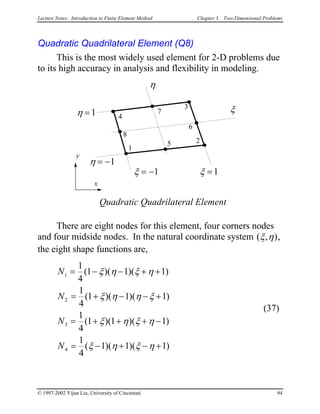
is given by,
(7)
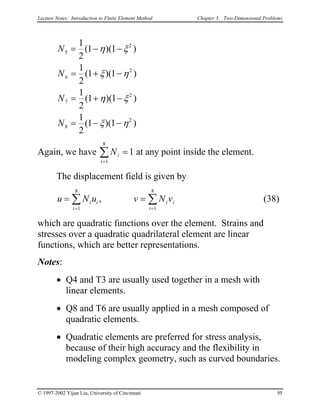
ε
ε
γ
α
α
x
y
xy
T
T
0
0
0 0










=










∆
∆
where α is the coefficient of thermal expansion, ∆T the change
of temperature. Note that if the structure is free to deform under
thermal loading, there will be no (elastic) stresses in the
structure.
© 1997-2002 Yijun Liu, University of Cincinnati 78
Lecture Notes: Introduction to Finite Element Method Chapter 3. Two-Dimensional Problems
Strain and Displacement Relations
For small strains and small rotations, we have,
ε
∂
∂
ε
∂
∂
γ
∂
∂
∂
∂x y xy
u
x
v
y
u
y
v
x
= = =, , +
In matrix form,
, or
ε
ε
γ
∂ ∂
∂ ∂
∂ ∂ ∂ ∂
x
y
xy
x
y
y x
u
v










=
















/
/
/ /
0
0 ε = Du (8)
From this relation, we know that the strains (and thus
stresses) are one order lower than the displacements, if the
displacements are represented by polynomials.
Equilibrium Equations
In elasticity theory, the stresses in the structure must satisfy
the following equilibrium equations,
∂σ
∂
∂τ
∂
∂τ
∂
∂σ
∂
x xy
x
xy y
y
x y
f
x y
f
+ + =
+ + =
0
0
(9)
where fx and fy are body forces (such as gravity forces) per unit
volume. In FEM, these equilibrium conditions are satisfied in
an approximate sense.
© 1997-2002 Yijun Liu, University of Cincinnati 79
Lecture Notes: Introduction to Finite Element Method Chapter 3. Two-Dimensional Problems
Boundary Conditions
x
y
p
tx
ty
Su
St
The boundary S of the body can be divided into two parts,
Su and St. The boundary conditions (BC’s) are described as,
u u v v S
t t t t S
u
x x y y
= =
= =
, ,
, ,
on
on t
(10)
in which tx and ty are traction forces (stresses on the boundary)
and the barred quantities are those with known values.
In FEM, all types of loads (distributed surface loads, body
forces, concentrated forces and moments, etc.) are converted to
point forces acting at the nodes.
Exact Elasticity Solution
The exact solution (displacements, strains and stresses) of a
given problem must satisfy the equilibrium equations (9), the
given boundary conditions (10) and compatibility conditions
(structures should deform in a continuous manner, no cracks or
overlaps in the obtained displacement fields).
© 1997-2002 Yijun Liu, University of Cincinnati 80
Lecture Notes: Introduction to Finite Element Method Chapter 3. Two-Dimensional Problems
Example 3.1
A plate is supported and loaded with distributed force p as
shown in the figure. The material constants are E and ν.
x
y
p
The exact solution for this simple problem can be found
easily as follows,
Displacement:
u
p
E
x v
p
E
y= =, ν−
Strain:
ε ε νx y γ xy
p
E
p
E
= = −, , = 0
Stress:
σ σ τx y xyp= = =, ,0 0
Exact (or analytical) solutions for simple problems are
numbered (suppose there is a hole in the plate!). That is why we
need FEM!
© 1997-2002 Yijun Liu, University of Cincinnati 81
Lecture Notes: Introduction to Finite Element Method Chapter 3. Two-Dimensional Problems
II. Finite Elements for 2-D Problems
A General Formula for the Stiffness Matrix
Displacements (u, v) in a plane element are interpolated
from nodal displacements (ui, vi) using shape functions Ni as
follows,
(11)
u
v
N N
N N
u
v
u
v






=






















=
1 2
1 2
1
1
2
2
0 0
0 0
L
L
M
or u Nd
where N is the shape function matrix, u the displacement vector
and d the nodal displacement vector. Here we have assumed
that u depends on the nodal values of u only, and v on nodal
values of v only.
From strain-displacement relation (Eq.(8)), the strain vector
is,
ε ε= = =Du DNd Bd, or (12)
where B = DN is the strain-displacement matrix.
© 1997-2002 Yijun Liu, University of Cincinnati 82
Lecture Notes: Introduction to Finite Element Method Chapter 3. Two-Dimensional Problems
Consider the strain energy stored in an element,
( )
( )
U dV
dV dV
dV
T
V
x x y y xy xy
V
T
V
T
V
T T
V
T
= = + +
= =
=
=
∫ ∫
∫ ∫
∫
1
2
1
2
1
2
1
2
1
2
1
2
σ ε σ ε σ ε τ γ
ε ε ε εE E
d B EB d
d kd
dV
From this, we obtain the general formula for the element
stiffness matrix,
(13)k B EB=
∫
T
V
dV
Note that unlike the 1-D cases, E here is a matrix which is given
by the stress-strain relation (e.g., Eq.(5) for plane stress).
The stiffness matrix k defined by (13) is symmetric since E
is symmetric. Also note that given the material property, the
behavior of k depends on the B matrix only, which in turn on the
shape functions. Thus, the quality of finite elements in
representing the behavior of a structure is entirely determined by
the choice of shape functions.
Most commonly employed 2-D elements are linear or
quadratic triangles and quadrilaterals.
© 1997-2002 Yijun Liu, University of Cincinnati 83
Lecture Notes: Introduction to Finite Element Method Chapter 3. Two-Dimensional Problems
Constant Strain Triangle (CST or T3)
This is the simplest 2-D element, which is also called
linear triangular element.
x
y
1
3
2
(x1, y1)
(x3, y3)
(x2, y2)
u
v
(x, y)
u1
v1
u2
v2
u3
v3
Linear Triangular Element
For this element, we have three nodes at the vertices of the
triangle, which are numbered around the element in the
counterclockwise direction. Each node has two degrees of
freedom (can move in the x and y directions). The
displacements u and v are assumed to be linear functions within
the element, that is,
u b b x b y v b b x b= + + y= + +1 2 3 4 5 6, (14)
where bi (i = 1, 2, ..., 6) are constants. From these, the strains
are found to be,
ε ε γx y xyb b b= = b= +2 6 3, , 5 (15)
which are constant throughout the element. Thus, we have the
name “constant strain triangle” (CST).
© 1997-2002 Yijun Liu, University of Cincinnati 84
Lecture Notes: Introduction to Finite Element Method Chapter 3. Two-Dimensional Problems
Displacements given by (14) should satisfy the following
six equations,
u b b x b y
u b b x b y
v b b x b y
1 1 2 1 3
2 1 2 2 3
3 4 5 3 6
= + +
= + +
= + +
M
1
2
3
Solving these equations, we can find the coefficients b1, b2, ...,
and b6 in terms of nodal displacements and coordinates.
Substituting these coefficients into (14) and rearranging the
terms, we obtain,
(16)
u
v
N N N
N N N
u
v
u
v
u
v






=
























1 2 3
1 2 3
1
1
2
2
3
3
0 0 0
0 0 0
where the shape functions (linear functions in x and y) are
{ }
{ }
{ }
N
A
x y x y y y x x x y
N
A
x y x y y y x x x y
N
A
x y x y y y x x x y
1 2 3 3 2 2 3 3
2 3 1 1 3 3 1 1 3
3 1 2 2 1 1 2 2 1
1
2
1
2
1
2
= − + − + −
= − + − + −
= − + − + −
( ) ( ) (
( ) ( ) (
( ) ( ) (
2 )
)
)
(17)
and
© 1997-2002 Yijun Liu, University of Cincinnati 85
Lecture Notes: Introduction to Finite Element Method Chapter 3. Two-Dimensional Problems
A
x y
x y
x y
=










1
2
1
1
1
1 1
2 2
3 3
det (18)
is the area of the triangle (Prove this!).
Using the strain-displacement relation (8), results (16) and
(17), we have,
ε
ε
γ
x
y
xy
A
y y y
x x x
x y x y x y
u
v
u
v
u
v










= =




























Bd
1
2
0 0 0
0 0 0
23 31 12
32 13 21
32 23 13 31 21 12
1
1
2
2
3
3
(19)
where xij = xi - xj and yij = yi - yj (i, j = 1, 2, 3). Again, we see
constant strains within the element. From stress-strain relation
(Eq.(5), for example), we see that stresses obtained using the
CST element are also constant.
Applying formula (13), we obtain the element stiffness
matrix for the CST element,
(20)k B EB B EB= =
∫
T
V
T
dV tA( )
in which t is the thickness of the element. Notice that k for CST
is a 6 by 6 symmetric matrix. The matrix multiplication in (20)
can be carried out by a computer program.
© 1997-2002 Yijun Liu, University of Cincinnati 86
Lecture Notes: Introduction to Finite Element Method Chapter 3. Two-Dimensional Problems
Both the expressions of the shape functions in (17) and
their derivations are lengthy and offer little insight into the
behavior of the element.
1
3
2
ξ=0
ξ=1
ξ=a
η=0
η=1
η=b
The Natural Coordinates
(a, b)
We introduce the natural coordinates ( , )ξ η on the triangle,
then the shape functions can be represented simply by,
N N N1 2 3 1= = = − −ξ η ξ η, , (21)
Notice that,
N N N1 2 3 1+ + = (22)
which ensures that the rigid body translation is represented by
the chosen shape functions. Also, as in the 1-D case,
(23)Ni =



1
0
,
,
at node i;
at the other nodes
and varies linearly within the element. The plot for shape
function N1 is shown in the following figure. N2 and N3 have
similar features.
© 1997-2002 Yijun Liu, University of Cincinnati 87
Lecture Notes: Introduction to Finite Element Method Chapter 3. Two-Dimensional Problems
1
3
2
ξ=0
ξ=1
Shape Function N1 for CST
N1
1
We have two coordinate systems for the element: the global
coordinates (x, y) and the natural coordinates ( , )ξ η . The
relation between the two is given by
x N x N x N x
y N y N y N y
= + +
= + +
1 1 2 2 3 3
1 1 2 2 3 3
(24)
or,
x x x x
y y y y
= + +
= + +
13 23 3
13 23 3
ξ η
ξ η
(25)
where xij = xi - xj and yij = yi - yj (i, j = 1, 2, 3) as defined earlier.
Displacement u or v on the element can be viewed as
functions of (x, y) or ( , )ξ η . Using the chain rule for derivatives,
we have,
∂
∂ ξ
∂
∂ η
∂
∂ ξ
∂
∂ ξ
∂
∂ η
∂
∂ η
∂
∂
∂
∂
∂
∂
∂
∂
u
u
x y
x y
u
x
u
y
u
x
u
y












=
























=












J (26)
where J is called the Jacobian matrix of the transformation.
© 1997-2002 Yijun Liu, University of Cincinnati 88
Lecture Notes: Introduction to Finite Element Method Chapter 3. Two-Dimensional Problems
From (25), we calculate,
J J=





 =
−
−






−
x y
x y A
y y
x x
13 13
23 23
1 23 13
23 13
1
2
, (27)
where det J = − =x y x y A13 23 23 13 2 has been used (A is the area of
the triangular element. Prove this!).
From (26), (27), (16) and (21) we have,
∂
∂
∂
∂
∂
∂ ξ
∂
∂ η
u
x
u
y
A
y y
x x
u
u
A
y y
x x
u u
u u












=
−
−


















=
−
−






−
−






1
2
1
2
23 13
23 13
23 13
23 13
1 3
2 3
(28)
Similarly,
∂
∂
∂
∂
v
x
v
y
A
y y
x x
v v
v v












=
−
−






−
−






1
2
23 13
23 13
1 3
2 3
(29)
Using the results in (28) and (29), and the relations
ε = = =Du DNd Bd, we obtain the strain-displacement matrix,
B =










1
2
0 0
0 0 0
23 31 12
32 13 21
32 23 13 31 21 12
A
y y y
x x
x y x y x y
0
x (30)
which is the same as we derived earlier in (19).
© 1997-2002 Yijun Liu, University of Cincinnati 89
Lecture Notes: Introduction to Finite Element Method Chapter 3. Two-Dimensional Problems
Applications of the CST Element:
• Use in areas where the strain gradient is small.
• Use in mesh transition areas (fine mesh to coarse mesh).
• Avoid using CST in stress concentration or other crucial
areas in the structure, such as edges of holes and corners.
• Recommended for quick and preliminary FE analysis of
2-D problems.
Analysis of composite materials (for which the CST is NOT appropriate!)
© 1997-2002 Yijun Liu, University of Cincinnati 90
Lecture Notes: Introduction to Finite Element Method Chapter 3. Two-Dimensional Problems
Linear Strain Triangle (LST or T6)
This element is also called quadratic triangular element.
x
y
1
3
2
u1
v1
u2
v2
u3
v3
Quadratic Triangular Element
u4
v4
u5
v5
u6
v6
6 5
4
There are six nodes on this element: three corner nodes and
three midside nodes. Each node has two degrees of freedom
(DOF) as before. The displacements (u, v) are assumed to be
quadratic functions of (x, y),
(31)
u b b x b y b x b xy b y
v b b x b y b x b xy b y
= + + + + +
= + + + + +
1 2 3 4
2
5 6
2
7 8 9 10
2
11 12
2
where bi (i = 1, 2, ..., 12) are constants. From these, the strains
are found to be,
ε
ε
γ
x
y
xy
b b x b y
b b x b y
b b b b x b b
= + +
= + +
= + + + + +
2 4 5
9 11 12
3 8 5 10 6 11
2
2
2 2( ) ( ) ( y)
(32)
which are linear functions. Thus, we have the “linear strain
triangle” (LST), which provides better results than the CST.
© 1997-2002 Yijun Liu, University of Cincinnati 91
Lecture Notes: Introduction to Finite Element Method Chapter 3. Two-Dimensional Problems
In the natural coordinate system we defined earlier, the six
shape functions for the LST element are,
N
N
N
N
N
N
1
2
3
4
5
6
2 1
2 1
2 1
4
4
4
= −
= −
= −
=
=
=
ξ ξ
η η
ζ ζ
ξη
ηζ
ζ ξ
( )
( )
( )
(33)
in which ζ ξ η= − −1 . Each of these six shape functions
represents a quadratic form on the element as shown in the
figure.
Displacements can be written as,
1
3
2
ξ=0
ξ=1
Shape Function N1 for LST
N1
1
ξ=1/2
6 5
4
(34)u N u v Ni i
i
i i
i
=
= =
∑
1
6
1
6
, v= ∑
The element stiffness matrix is still given by
, but here Bk B EB= ∫
T
V
dV T
EB is quadratic in x and y. In
general, the integral has to be computed numerically.
© 1997-2002 Yijun Liu, University of Cincinnati 92
Lecture Notes: Introduction to Finite Element Method Chapter 3. Two-Dimensional Problems
Linear Quadrilateral Element (Q4)
x
y
1
3
2
u4
v4
u1
v1
u2
v2
u3
v3
Linear Quadrilateral Element
4
ξ
η
ξ = −1 ξ =1
η = −1
η =1
There are four nodes at the corners of the quadrilateral
shape. In the natural coordinate system ( , )ξ η , the four shape
functions are,
N N
N N
1 2
3 4
1
4
1 1
1
4
1 1
1
4
1 1
1
4
1 1
= − − = + −
= + + = − +
( )( ), ( )( )
( )( ), ( )( )
ξ η ξ η
ξ η ξ η
(35)
Note that at any point inside the element, as expected.Ni
i=
∑ =
1
4
1
The displacement field is given by
(36)u N u v Ni i
i
i i
i
=
= =
∑
1
4
1
4
, v= ∑
which are bilinear functions over the element.
© 1997-2002 Yijun Liu, University of Cincinnati 93
Lecture Notes: Introduction to Finite Element Method Chapter 3. Two-Dimensional Problems
Quadratic Quadrilateral Element (Q8)
This is the most widely used element for 2-D problems due
to its high accuracy in analysis and flexibility in modeling.
x
y
1
3
2
Quadratic Quadrilateral Element
4
ξ
η
ξ = −1 ξ =1
η = −1
η =1
6
7
5
8
There are eight nodes for this element, four corners nodes
and four midside nodes. In the natural coordinate system ( , )ξ η ,
the eight shape functions are,
N
N
N
N
1
2
3
4
1
4
1 1
1
4
1 1 1
1
4
1 1
1
4
1 1
= − − + +
= + − − +
= + + + −
= − + − +
( )( )(
( )( )(
( )( )(
( )( )(
ξ η ξ η
ξ η η ξ
ξ η ξ η
ξ η ξ η
1
1
1
)
)
)
)
(37)
© 1997-2002 Yijun Liu, University of Cincinnati 94
Lecture Notes: Introduction to Finite Element Method Chapter 3. Two-Dimensional Problems
N
N
N
N
5
2
6
2
7
2
8
2
1
2
1 1
1
2
1 1
1
2
1 1
1
2
1 1
= − −
= + −
= + −
= − −
( )(
( )(
( )(
( )(
η ξ
ξ η
η ξ
ξ η
)
)
)
)
v= ∑
Again, we have at any point inside the element.Ni
i=
∑ =
1
8
1
The displacement field is given by
(38)u N u v Ni i
i
i i
i
=
= =
∑
1
8
1
8
,
which are quadratic functions over the element. Strains and
stresses over a quadratic quadrilateral element are linear
functions, which are better representations.
Notes:
• Q4 and T3 are usually used together in a mesh with
linear elements.
• Q8 and T6 are usually applied in a mesh composed of
quadratic elements.
• Quadratic elements are preferred for stress analysis,
because of their high accuracy and the flexibility in
modeling complex geometry, such as curved boundaries.
© 1997-2002 Yijun Liu, University of Cincinnati 95
Lecture Notes: Introduction to Finite Element Method Chapter 3. Two-Dimensional Problems
Example 3.2
A square plate with a hole at the center and under pressure
in one direction.
x
y
p
B
A
The dimension of the plate is 10 in. x 10 in., thickness is
0.1 in. and radius of the hole is 1 in. Assume E = 10x106
psi, v
= 0.3 and p = 100 psi. Find the maximum stress in the plate.
FE Analysis:
From the knowledge of stress concentrations, we should
expect the maximum stresses occur at points A and B on the
edge of the hole. Value of this stress should be around 3p (=
300 psi) which is the exact solution for an infinitely large plate
with a hole.
© 1997-2002 Yijun Liu, University of Cincinnati 96
Lecture Notes: Introduction to Finite Element Method Chapter 3. Two-Dimensional Problems
We use the ANSYS FEA software to do the modeling
(meshing) and analysis, using quadratic triangular (T6 or LST),
linear quadrilateral (Q4) and quadratic quadrilateral (Q8)
elements. Linear triangles (CST or T3) is NOT available in
ANSYS.
The stress calculations are listed in the following table,
along with the number of elements and DOF used, for
comparison.
Table. FEA Stress Results
Elem. Type No. Elem. DOF Max. σ (psi)
T6 966 4056 310.1
Q4 493 1082 286.0
Q8 493 3150 327.1
... ... ... ...
Q8 2727 16,826 322.3
Discussions:
• Check the deformed shape of the plate
• Check convergence (use a finer mesh, if possible)
• Less elements (~ 100) should be enough to achieve the
same accuracy with a better or “smarter” mesh
• We’ll redo this example in next chapter employing the
symmetry conditions.
© 1997-2002 Yijun Liu, University of Cincinnati 97
Lecture Notes: Introduction to Finite Element Method Chapter 3. Two-Dimensional Problems
FEA Mesh (Q8, 493 elements)
FEA Stress Plot (Q8, 493 elements)
© 1997-2002 Yijun Liu, University of Cincinnati 98
Lecture Notes: Introduction to Finite Element Method Chapter 3. Two-Dimensional Problems
Transformation of Loads
Concentrated load (point forces), surface traction (pressure
loads) and body force (weight) are the main types of loads
applied to a structure. Both traction and body forces need to be
converted to nodal forces in the FEA, since they cannot be
applied to the FE model directly. The conversions of these loads
are based on the same idea (the equivalent-work concept) which
we have used for the cases of bar and beam elements.
Traction on a Q4 element
A
B
L
s
q
qA
qB
A
B
fA
fB
Suppose, for example, we have a linearly varying traction q
on a Q4 element edge, as shown in the figure. The traction is
normal to the boundary. Using the local (tangential) coordinate
s, we can write the work done by the traction q as,
W t u s q s dq n
L
= ∫ ( ) ( )
0
s
where t is the thickness, L the side length and un the component
of displacement normal to the edge AB.
For the Q4 element (linear displacement field), we have
© 1997-2002 Yijun Liu, University of Cincinnati 99
Lecture Notes: Introduction to Finite Element Method Chapter 3. Two-Dimensional Problems
u s s L u s L un nA( ) ( / ) ( / )= − nB+1
The traction q(s), which is also linear, is given in a similar way,
q s s L q s L qA B( ) ( / ) ( / )= − +1
Thus, we have,
[ ] [ ]
[ ]
[ ]
W t u u
s L
s L
s L s L
q
q
ds
u u t
s L s L s L
s L s L s L
ds
q
q
u u
tL q
q
q nA nB
A
B
L
nA nB
L
A
B
nA nB
A
B
=
−










 −












=
− −
−












=












∫
∫
1
1
1 1
1
6
2 1
1 2
0
2
2
0
/
/
/ /
( / ) ( / )( / )
( / )( / ) ( / )
and the equivalent nodal force vector is,
f
f
tL q
q
A
B
A
B






=











6
2 1
1 2
Note, for constant q, we have,
f
f
qtLA
B






=





2
1
1
For quadratic elements (either triangular or quadrilateral),
the traction is converted to forces at three nodes along the edge,
instead of two nodes.
Traction tangent to the boundary, as well as body forces,
are converted to nodal forces in a similar way.
© 1997-2002 Yijun Liu, University of Cincinnati 100
Lecture Notes: Introduction to Finite Element Method Chapter 3. Two-Dimensional Problems
Stress Calculation
The stress in an element is determined by the following
relation,
(39)
σ
σ
τ
ε
ε
γ
x
y
xy
x
y
xy










=










=E EBd
where B is the strain-nodal displacement matrix and d is the
nodal displacement vector which is known for each element
once the global FE equation has been solved.
Stresses can be evaluated at any point inside the element
(such as the center) or at the nodes. Contour plots are usually
used in FEA software packages (during post-process) for users
to visually inspect the stress results.
The von Mises Stress:
The von Mises stress is the effective or equivalent stress for
2-D and 3-D stress analysis. For a ductile material, the stress
level is considered to be safe, if
σ σe Y≤
where σe is the von Mises stress and σY the yield stress of the
material. This is a generalization of the 1-D (experimental)
result to 2-D and 3-D situations.
© 1997-2002 Yijun Liu, University of Cincinnati 101
Lecture Notes: Introduction to Finite Element Method Chapter 3. Two-Dimensional Problems
The von Mises stress is defined by
σ σ σ σ σ σe = − + − + −
1
2
1 2
2
2 3
2
3 1
2
( ) ( ) ( σ ) (40)
in which σ σ σ1 2, an 3d are the three principle stresses at the
considered point in a structure.
For 2-D problems, the two principle stresses in the plane
are determined by
σ
σ σ σ σ
τ
σ
σ σ σ σ
τ
1
2
2
2
2
2
2 2
2 2
P x y x y
xy
P x y x y
xy
=
+
+
−




 +
=
+
−
−




 +
(41)
Thus, we can also express the von Mises stress in terms of
the stress components in the xy coordinate system. For plane
stress conditions, we have,
σ σ σ σ σ τe x y x y= + − −( ) (2
3 xy )2
(42)
Averaged Stresses:
Stresses are usually averaged at nodes in FEA software
packages to provide more accurate stress values. This option
should be turned off at nodes between two materials or other
geometry discontinuity locations where stress discontinuity does
exist.
© 1997-2002 Yijun Liu, University of Cincinnati 102
Lecture Notes: Introduction to Finite Element Method Chapter 3. Two-Dimensional Problems
Discussions
1) Know the behaviors of each type of elements:
T3 and Q4: linear displacement, constant strain and stress;
T6 and Q8: quadratic displacement, linear strain and stress.
2) Choose the right type of elements for a given problem:
When in doubt, use higher order elements or a finer mesh.
3) Avoid elements with large aspect ratios and corner angles:
Aspect ratio = Lmax / Lmin
where Lmax and Lmin are the largest and smallest characteristic
lengths of an element, respectively.
Elements with Bad Shapes
Elements with Nice Shapes
© 1997-2002 Yijun Liu, University of Cincinnati 103
Lecture Notes: Introduction to Finite Element Method Chapter 3. Two-Dimensional Problems
4) Connect the elements properly:
Don’t leave unintended gaps or free elements in FE models.
A
B
C
D
Improper connections (gaps along AB and CD)
© 1997-2002 Yijun Liu, University of Cincinnati 104
Lecture Notes: Introduction to Finite Element Method Chapter 4. FE Modeling and Solution Techniques
Chapter 4. Finite Element Modeling and
Solution Techniques
I. Symmetry
A structure possesses symmetry if its components are
arranged in a periodic or reflective manner.
Types of Symmetry:
• Reflective (mirror, bilateral) symmetry
• Rotational (cyclic) symmetry
• Axisymmetry
• Translational symmetry
• ...
Examples:
…
© 1997-2002 Yijun Liu, University of Cincinnati 105
Lecture Notes: Introduction to Finite Element Method Chapter 4. FE Modeling and Solution Techniques
Applications of the symmetry properties:
• Reducing the size of the problems (save CPU time, disk
space, postprocessing effort, etc.)
• Simplifying the modeling task
• Checking the FEA results
• ...
Symmetry of a structure should be fully exploited and
retained in the FE model to ensure the efficiency and quality of
FE solutions.
Examples:
…
Cautions:
In vibration and buckling analyses, symmetry concepts, in
general, should not be used in FE solutions (works fine in
modeling), since symmetric structures often have antisymmetric
vibration or buckling modes.
© 1997-2002 Yijun Liu, University of Cincinnati 106
Lecture Notes: Introduction to Finite Element Method Chapter 4. FE Modeling and Solution Techniques
II. Substructures (Superelements)
Substructuring is a process of analyzing a large structure as
a collection of (natural) components. The FE models for these
components are called substructures or superelements (SE).
Physical Meaning:
A finite element model of a portion of structure.
Mathematical Meaning:
Boundary matrices which are load and stiffness matrices
reduced (condensed) from the interior points to the exterior or
boundary points.
© 1997-2002 Yijun Liu, University of Cincinnati 107
Lecture Notes: Introduction to Finite Element Method Chapter 4. FE Modeling and Solution Techniques
Advantages of Using Substructures/Superelements:
• Large problems (which will otherwise exceed your
computer capabilities)
• Less CPU time per run once the superelements have
been processed (i.e., matrices have been saved)
• Components may be modeled by different groups
• Partial redesign requires only partial reanalysis (reduced
cost)
• Efficient for problems with local nonlinearities (such as
confined plastic deformations) which can be placed in
one superelement (residual structure)
• Exact for static stress analysis
Disadvantages:
• Increased overhead for file management
• Matrix condensation for dynamic problems introduce
new approximations
• ...
© 1997-2002 Yijun Liu, University of Cincinnati 108
Lecture Notes: Introduction to Finite Element Method Chapter 4. FE Modeling and Solution Techniques
III. Equation Solving
Direct Methods (Gauss Elimination):
• Solution time proportional to NB2
(N is the dimension of
the matrix, B the bandwidth)
• Suitable for small to medium problems, or slender
structures (small bandwidth)
• Easy to handle multiple load cases
Iterative Methods:
• Solution time is unknown beforehand
• Reduced storage requirement
• Suitable for large problems, or bulky structures (large
bandwidth, converge faster)
• Need solving again for different load cases
© 1997-2002 Yijun Liu, University of Cincinnati 109
Lecture Notes: Introduction to Finite Element Method Chapter 4. FE Modeling and Solution Techniques
Gauss Elimination - Example:










−=




















−
−−
−
3
1
2
330
342
028
3
2
1
x
x
x
or bAx = .
Forward Elimination:
Form ;










−
−
−−
−
3
1
2
330
342
028
)3(
)2(
)1(
(1) + 4 x (2) ⇒ (2):
( ;










−
−
−
−
3
2
2
330
12140
028
)3(
)2
)1(
(2) +
3
14
(3) ⇒ (3):
( ;










−−
−
12
2
2
200
12140
028
)3(
)2
)1(
Back Substitution:
or .
5.18/)22(
514/)122(
62/12
21
32
3
=+=
=+−=
==
xx
xx
x










=
6
5
51.
x
© 1997-2002 Yijun Liu, University of Cincinnati 110
Lecture Notes: Introduction to Finite Element Method Chapter 4. FE Modeling and Solution Techniques
Iterative Method - Example:
The Gauss-Seidel Method
bAx = (A is symmetric)
or ....,,2,1,
1
Nibxa
N
j
ijij ==∑
=
Start with an estimate and then iterate using the following:)( 0
x
....,,2,1for
,
1 1
1 1
)()1()1(
Ni
xaxab
a
x
i
j
N
ij
k
jij
k
jiji
ii
k
i
=






−−= ∑ ∑
−
= +=
++
In vector form,
[ ],)()1(1)1( kT
L
k
LD
k
xAxAbAx −−= +−+
where
〉〈= iiD aA is the diagonal matrix of A,
LA is the lower triangular matrix of A,
such that A .
T
LLD AAA ++=
Iterations continue until solution x converges, i.e.
,)(
)()1(
ε≤
−+
k
kk
x
xx
where ε is the tolerance for convergence control.
© 1997-2002 Yijun Liu, University of Cincinnati 111
Lecture Notes: Introduction to Finite Element Method Chapter 4. FE Modeling and Solution Techniques
IV. Nature of Finite Element Solutions
• FE Model – A mathematical model of the real structure,
based on many approximations.
• Real Structure -- Infinite number of nodes (physical
points or particles), thus infinite number of DOF’s.
• FE Model – finite number of nodes, thus finite number
of DOF’s.
Displacement field is controlled (or constrained) by the
values at a limited number of nodes.
∑
=
=
4
1
:elementanonthatRecall
α
αα uNu
Stiffening Effect:
• FE Model is stiffer than the real structure.
• In general, displacement results are smaller in
magnitudes than the exact values.
© 1997-2002 Yijun Liu, University of Cincinnati 112
Lecture Notes: Introduction to Finite Element Method Chapter 4. FE Modeling and Solution Techniques
Hence, FEM solution of displacement provides a lower
bound of the exact solution.
No. of DOF’s
∆ (Displacement)
Exact Solution
FEM Solutions
The FEM solution approaches the exact solution from
below.
This is true for displacement based FEA!
© 1997-2002 Yijun Liu, University of Cincinnati 113
Lecture Notes: Introduction to Finite Element Method Chapter 4. FE Modeling and Solution Techniques
V. Numerical Error
Error Mistakes in FEM (modeling or solution).≠
Type of Errors:
• Modeling Error (beam, plate … theories)
• Discretization Error (finite, piecewise …)
• Numerical Error ( in solving FE equations)
Example (numerical error):
k1
xk21 2
P
u1 u2
FE Equations:








=









 +−
−
02
1
211
11 P
u
u
kkk
kk
and .21kkDet =K
The system will be singular if k2 is small compared with k1.
© 1997-2002 Yijun Liu, University of Cincinnati 114
Lecture Notes: Introduction to Finite Element Method Chapter 4. FE Modeling and Solution Techniques
1u
2u
1
21
1
2 u
kk
k
u
+
=
1
12
k
P
uu −=
k2 >> k1 (two line apart):
System well conditioned.
P/k1
1u
2u
1
21
1
2 u
kk
k
u
+
=
1
12
k
P
uu −=
k2 << k1 (two lines close):
System ill-conditioned.
P/k1
• Large difference in stiffness of different parts in FE
model may cause ill-conditioning in FE equations.
Hence giving results with large errors.
• Ill-conditioned system of equations can lead to large
changes in solution with small changes in input
(right hand side vector).
© 1997-2002 Yijun Liu, University of Cincinnati 115
Lecture Notes: Introduction to Finite Element Method Chapter 4. FE Modeling and Solution Techniques
VI. Convergence of FE Solutions
As the mesh in an FE model is “refined” repeatedly, the FE
solution will converge to the exact solution of the mathematical
model of the problem (the model based on bar, beam, plane
stress/strain, plate, shell, or 3-D elasticity theories or
assumptions).
Type of Refinements:
h-refinement: reduce the size of the element (“h” refers to the
typical size of the elements);
p-refinement: Increase the order of the polynomials on an
element (linear to quadratic, etc.; “h” refers to
the highest order in a polynomial);
r-refinement: re-arrange the nodes in the mesh;
hp-refinement: Combination of the h- and p-refinements
(better results!).
Examples:
…
© 1997-2002 Yijun Liu, University of Cincinnati 116
Lecture Notes: Introduction to Finite Element Method Chapter 4. FE Modeling and Solution Techniques
VII. Adaptivity (h-, p-, and hp-Methods)
• Future of FE applications
• Automatic refinement of FE meshes until converged
results are obtained
• User’s responsibility reduced: only need to generate a
good initial mesh
Error Indicators:
Define,
σ --- element by element stress field (discontinuous),
σ*
--- averaged or smooth stress (continuous),
σE = σ - σ*
--- the error stress field.
Compute strain energy,
∫∑ −
=
==
iV
T
i
M
i
i dVUUU σEσ 1
1 2
1
, ;
∫∑ −
=
==
i
i
V
T
M
i
i dVUUU *1**
1
**
2
1
, σEσ ;
∫∑ −
=
==
iV
E
T
EiE
M
i
iEE dVUUU σEσ 1
1 2
1
, ;
where M is the total number of elements, V is the volume of the
element i.
i
© 1997-2002 Yijun Liu, University of Cincinnati 117
Lecture Notes: Introduction to Finite Element Method Chapter 4. FE Modeling and Solution Techniques
One error indicator --- the relative energy error:
)10(.
2/1
≤≤





+
= ηη
E
E
UU
U
The indicator η is computed after each FE solution. Refinement
of the FE model continues until, say
η ≤ 0.05.
=> converged FE solution.
Examples:
…
© 1997-2002 Yijun Liu, University of Cincinnati 118
Lecture Notes: Introduction to Finite Element Method Chapter 5. Plate and Shell Elements
Chapter 5. Plate and Shell Elements
I. Plate Theory
• Flat plate
• Lateral loading
• Bending behavior dominates
Note the following similarity:
1-D straight beam model 2-D flat plate model
Applications:
• Shear walls
• Floor panels
• Shelves
• …
© 1997-2002 Yijun Liu, University of Cincinnati 119
Lecture Notes: Introduction to Finite Element Method Chapter 5. Plate and Shell Elements
Forces and Moments Acting on the Plate:
Mxy
Mx
Qx
Mxy
My
Qy
x
y
z
Mid surface
q(x,y)
t
∆x
∆y
Stresses:
σx
τxz
x
y
z
τxy
σy
τxy
τyz
© 1997-2002 Yijun Liu, University of Cincinnati 120
Lecture Notes: Introduction to Finite Element Method Chapter 5. Plate and Shell Elements
Relations Between Forces and Stresses
Bending moments (per unit length):
(1))
)
)
)
)
/(,
2/
2/
mmNzdzM
t
t xx ⋅= ∫−
σ
(2)/(,
2/
2/
mmNzdzM
t
t yy ⋅= ∫−
σ
Twisting moment (per unit length):
(3)/(,
2/
2/
mmNzdzM
t
t xyxy ⋅= ∫−
τ
Shear Forces (per unit length):
(4)/(,
2/
2/
mNdzQ
t
t xzx ∫−
= τ
(5)/(,
2/
2/
mNdzQ
t
t yzy ∫−
= τ
Maximum bending stresses:
2max2max
6
)(,
6
)(
t
M
t
M y
y
x
x ±=±= σσ . (6)
• Maximum stress is always at 2/tz ±=
• No bending stresses at midsurface (similar to the beam
model)
© 1997-2002 Yijun Liu, University of Cincinnati 121
Lecture Notes: Introduction to Finite Element Method Chapter 5. Plate and Shell Elements
Thin Plate Theory ( Kirchhoff Plate Theory)
Assumptions (similar to those in the beam theory):
A straight line along the normal to the mid surface remains
straight and normal to the deflected mid surface after loading,
that is, these is no transverse shear deformation:
0== yzxz γγ .
Displacement:
x
z
w
x
w
∂
∂
.
,
)(),,(
y
w
zv
x
w
zu
deflectionyxww
∂
∂
∂
∂
−=
−=
=
(7)
© 1997-2002 Yijun Liu, University of Cincinnati 122
Lecture Notes: Introduction to Finite Element Method Chapter 5. Plate and Shell Elements
Strains:
.2
,
,
2
2
2
2
2
yx
w
z
y
w
z
x
w
z
xy
y
x
∂∂
∂
γ
∂
∂
ε
∂
∂
ε
−=
−=
−=
(8)
Note that there is no stretch of the mid surface due to the
deflection (bending) of the plate.
Stresses (plane stress state):




















−
−
=










xy
y
x
xy
y
x
E
γ
ε
ε
ν
ν
ν
ν
τ
σ
σ
2/)1(00
01
01
1 2
,
or,


















∂∂
∂
∂
∂
∂
∂










−
−
−=










yx
w
y
w
x
w
E
z
xy
y
x
2
2
2
2
2
2
)1(00
01
01
1
ν
ν
ν
ν
τ
σ
σ
. (9)
Main variable: deflection ),( yxww = .
© 1997-2002 Yijun Liu, University of Cincinnati 123
Lecture Notes: Introduction to Finite Element Method Chapter 5. Plate and Shell Elements
Governing Equation:
),(4
yxqwD =∇ , (10)
where
),2( 4
4
22
4
4
4
4
yyxx ∂
∂
∂∂
∂
∂
∂
++≡∇
)1(12 2
3
ν−
=
Et
D (the bending rigidity of the plate),
q = lateral distributed load (force/area).
Compare the 1-D equation for straight beam:
)(4
4
xq
dx
wd
EI = .
Note: Equation (10) represents the equilibrium condition in
the z-direction. To see this, refer to the previous figure showing
all the forces on a plate element. Summing the forces in the z-
direction, we have,
,0=∆∆+∆+∆ yxqxQyQ yx
which yields,
0),( =+
∂
∂
+
∂
∂
yxq
y
Q
x
Q yx
.
Substituting the following relations into the above equation, we
obtain Eq. (10).
© 1997-2002 Yijun Liu, University of Cincinnati 124
Lecture Notes: Introduction to Finite Element Method Chapter 5. Plate and Shell Elements
Shear forces and bending moments:
,,
y
M
x
M
Q
y
M
x
M
Q yxy
y
xyx
x
∂
∂
+
∂
∂
=
∂
∂
+
∂
∂
=






∂
∂
+
∂
∂
=





∂
∂
+
∂
∂
= 2
2
2
2
2
2
2
2
,
x
w
y
w
DM
y
w
x
w
DM yx νν .
The fourth-order partial differential equation, given in (10)
and in terms of the deflection w(x,y), needs to be solved under
certain given boundary conditions.
Boundary Conditions:
Clamped: 0,0 =
∂
∂
=
n
w
w ; (11)
Simply supported: 0,0 == nMw ; (12)
Free: 0,0 == nn MQ ; (13)
where n is the normal direction of the boundary. Note that the
given values in the boundary conditions shown above can be
non-zero values as well.
boundary
ns
© 1997-2002 Yijun Liu, University of Cincinnati 125
Lecture Notes: Introduction to Finite Element Method Chapter 5. Plate and Shell Elements
Examples:
A square plate with four edges clamped or hinged, and
under a uniform load q or a concentrated force P at the center C.
y
z
Given: E, t, and ν = 0.3
C
L
L
x
For this simple geometry, Eq. (10) with boundary condition
(11) or (12) can be solved analytically. The maximum
deflections are given in the following table for the different
cases.
Deflection at the Center (wc)
Clamped Simply supported
Under uniform load q 0.00126 qL4
/D 0.00406 qL4
/D
Under concentrated
force P
0.00560 PL2
/D 0.0116 PL2
/D
in which: D= Et3
/(12(1-v2
)).
These values can be used to verify the FEA solutions.
© 1997-2002 Yijun Liu, University of Cincinnati 126
Lecture Notes: Introduction to Finite Element Method Chapter 5. Plate and Shell Elements
Thick Plate Theory (Mindlin Plate Theory)
If the thickness t of a plate is not “thin”, e.g., 10/1/ ≥Lt
(L = a characteristic dimension of the plate), then the thick plate
theory by Mindlin should be applied. This theory accounts for
the angle changes within a cross section, that is,
0,0 ≠≠ yzxz γγ .
This means that a line which is normal to the mid surface before
the deformation will not be so after the deformation.
x
z
w
x
w
∂
∂






∂
∂
−≠
x
w
yθ
New independent variables:
xθ and yθ : rotation angles of a line, which is normal to the
mid surface before the deformation, about x- and y-axis,
respectively.
© 1997-2002 Yijun Liu, University of Cincinnati 127
Lecture Notes: Introduction to Finite Element Method Chapter 5. Plate and Shell Elements
New relations:
xy zvzu θθ −== , ; (14)
.
,
),(
,
,
xyz
yxz
xy
xy
x
y
y
x
y
w
x
w
xy
z
y
z
x
z
θ
∂
∂
γ
θ
∂
∂
γ
∂
∂θ
∂
∂θ
γ
∂
∂θ
ε
∂
∂θ
ε
−=
+=
−=
−=
=
(15)
Note that if we imposed the conditions (or assumptions)
that
,0,0 =−==+= xyzyxz
y
w
x
w
θ
∂
∂
γθ
∂
∂
γ
then we can recover the relations applied in the thin plate theory.
Main variables: ),(and),(),,( yxyxy yxxw θθ .
The governing equations and boundary conditions can be
established for thick plate based on the above assumptions.
© 1997-2002 Yijun Liu, University of Cincinnati 128
Lecture Notes: Introduction to Finite Element Method Chapter 5. Plate and Shell Elements
II. Plate Elements
Kirchhoff Plate Elements:
4-Node Quadrilateral Element
DOF at each node:
y
w
y
w
w
∂
∂
∂
∂
,, .
x
yz
t
1 2
3
4
11
1 ,, 





∂
∂






∂
∂
y
w
x
w
w
22
2 ,, 





∂
∂






∂
∂
y
w
x
w
w
Mid surface
On each element, the deflection w(x,y) is represented by
∑
=






++=
4
1
)()(),(
i
iyiixiii
y
w
N
x
w
NwNyxw
∂
∂
∂
∂
,
where Ni, Nxi and Nyi are shape functions. This is an
incompatible element! The stiffness matrix is still of the form
,∫=
V
T
dVEBBk
where B is the strain-displacement matrix, and E the stress-
strain matrix.
© 1997-2002 Yijun Liu, University of Cincinnati 129
Lecture Notes: Introduction to Finite Element Method Chapter 5. Plate and Shell Elements
Mindlin Plate Elements:
4-Node Quadrilateral 8-Node Quadrilateral
x
yz
t
1 2
34
5
6
7
8
x
yz
t
1 2
3
4
DOF at each node: w, θx and θy.
On each element:
.),(
,),(
,),(
1
1
1
∑
∑
∑
=
=
=
=
=
=
n
i
yiiy
n
i
xiix
n
i
ii
Nyx
Nyx
wNyxw
θθ
θθ
• Three independent fields.
• Deflection w(x,y) is linear for Q4, and quadratic for Q8.
© 1997-2002 Yijun Liu, University of Cincinnati 130
Lecture Notes: Introduction to Finite Element Method Chapter 5. Plate and Shell Elements
Discrete Kirchhoff Element:
Triangular plate element (not available in ANSYS).
Start with a 6-node triangular element,
DOF at corner nodes: yx
y
w
x
w
w θθ
∂
∂
∂
∂
,,,, ;
x
yz
t
1 2
3
4
5
6
DOF at mid side nodes: yx θθ , .
Total DOF = 21.
Then, impose conditions 0== yzxz γγ , etc., at selected
nodes to reduce the DOF (using relations in (15)). Obtain:
x
yz
1 2
3
At each node: 





=




=
y
w
x
w
w yx
∂
∂
θ
∂
∂
θ ,, .
Total DOF = 9 (DKT Element).
• Incompatible w(x,y); convergence is faster (w is cubic
along each edge) and it is efficient.
© 1997-2002 Yijun Liu, University of Cincinnati 131
Lecture Notes: Introduction to Finite Element Method Chapter 5. Plate and Shell Elements
Test Problem:
y
z
L/t = 10, ν = 0.3
C
L
L
P
x
ANSYS 4-node quadrilateral plate element.
ANSYS Result for wc
Mesh wc (× PL2
/D)
2×2 0.00593
4×4 0.00598
8×8 0.00574
16×16 0.00565
: :
Exact Solution 0.00560
Question:Converges from “above”? Contradiction to what
we learnt about the nature of the FEA solution?
Reason: This is an incompatible element ( See comments
on p. 177).
© 1997-2002 Yijun Liu, University of Cincinnati 132
Lecture Notes: Introduction to Finite Element Method Chapter 5. Plate and Shell Elements
III. Shells and Shell Elements
Shells – Thin structures witch span over curved surfaces.
Example:
• Sea shell, egg shell (the wonder of the nature);
• Containers, pipes, tanks;
• Car bodies;
• Roofs, buildings (the Superdome), etc.
Forces in shells:
Membrane forces + Bending Moments
(cf. plates: bending only)
© 1997-2002 Yijun Liu, University of Cincinnati 133
Lecture Notes: Introduction to Finite Element Method Chapter 5. Plate and Shell Elements
Example: A Cylindrical Container.
p p
internal forces:
membrane stresses
dominate
p
p
Shell Theory:
• Thin shell theory
• Thick shell theory
Shell theories are the most complicated ones to formulate
and analyze in mechanics (Russian’s contributions).
• Engineering ≠ Craftsmanship
• Demand strong analytical skill
© 1997-2002 Yijun Liu, University of Cincinnati 134
Lecture Notes: Introduction to Finite Element Method Chapter 5. Plate and Shell Elements
Shell Elements:
+
plane stress element plate bending element
flat shell element
cf.: bar + simple beam element => general beam element.
DOF at each node:
Q4 or Q8 shell element.
u
v
w
θx
θy
© 1997-2002 Yijun Liu, University of Cincinnati 135
Lecture Notes: Introduction to Finite Element Method Chapter 5. Plate and Shell Elements
Curved shell elements:
u
v
w
θx
θy
θz
i
i
• Based on shell theories;
• Most general shell elements (flat shell and plate elements
are subsets);
• Complicated in formulation.
© 1997-2002 Yijun Liu, University of Cincinnati 136
Lecture Notes: Introduction to Finite Element Method Chapter 5. Plate and Shell Elements
Test Cases:
AR
80o
Roof
R
A
F
F
L/2
L/2
Pinched Cylinder
A
F
F
F
F
R
Pinched Hemisphere
q
A
F2
F1
b
L
Twisted Strip (90o
)
Check the Table, on page 188 of Cook’s book, for values
of the displacement ∆A under the various loading
conditions.
Difficulties in Application:
• Non uniform thickness (turbo blades, vessels with
stiffeners, thin layered structures, etc.);
• Should turn to 3-D theory and apply solid elements.
© 1997-2002 Yijun Liu, University of Cincinnati 137
Lecture Notes: Introduction to Finite Element Method Chapter 6. Solid Elements for 3-D Problems
Chapter 6. Solid Elements for 3-D
Problems
I. 3-D Elasticity Theory
Stress State:
y
F
x
z
y
yx
yzτ
zyτ
zxτ
zσ
xzτ
xσ
xyτ
σ
τ
z, w
x, u
y , v
© 1997-2002 Yijun Liu, University of Cincinnati 138
Lecture Notes: Introduction to Finite Element Method Chapter 6. Solid Elements for 3-D Problems
{ } [ ] )1(, ij
zx
yz
xy
z
y
x
or σ
τ
τ
τ
σ
σ
σ
σ


















==σ
Strains:
{ } [ ] )2(, ij
zx
yz
xy
z
y
x
or ε
γ
γ
γ
ε
ε
ε
ε














==ε
Stress-strain relation:








































−
−
−
−
−
−
−+
=


















zx
yz
xy
z
y
x
zx
yz
xy
z
y
x
v
v
v
vvv
vvv
vvv
vv
E
γ
γ
γ
ε
ε
ε
τ
τ
τ
σ
σ
σ
2
21
00000
0
2
21
0000
00
2
21
000
0001
0001
0001
)21)(1(
or )3(Eεσ =
© 1997-2002 Yijun Liu, University of Cincinnati 139
Lecture Notes: Introduction to Finite Element Method Chapter 6. Solid Elements for 3-D Problems
Displacement:
)4(
),,(
),,(
),,(
3
2
1










=










=
u
u
u
zyxw
zyxv
zyxu
u
Strain-Displacement Relation:
)5(,,
,,,
x
w
z
u
z
v
y
w
y
u
x
v
z
w
y
v
x
u
xzyzxy
zyx
∂
∂
+
∂
∂
=
∂
∂
+
∂
∂
=
∂
∂
+
∂
∂
=
∂
∂
=
∂
∂
=
∂
∂
=
γγγ
εεε
or
( )
( ) notation)tensor(
2
1
simply,or
3,2,1,,
2
1
,, ijjiij
i
j
j
i
ij
uu
ji
x
u
x
u
+=
=
∂
∂
+
∂
∂
= 





ε
ε
© 1997-2002 Yijun Liu, University of Cincinnati 140
Lecture Notes: Introduction to Finite Element Method Chapter 6. Solid Elements for 3-D Problems
Equilibrium Equations:
0
or
,0
)6(,0
,0
, =+
=+
∂
∂
+
∂
∂
+
∂
∂
=+
∂
∂
+
∂
∂
+
∂
∂
=+
∂
∂
+
∂
∂
+
∂
∂
ijij
z
zzyzx
y
yzyyx
x
xzxyx
f
f
zyx
f
zyx
f
zyx
σ
σττ
τστ
ττσ
Boundary Conditions (BC’s):
)traction(
)7()(,
)(,
jiji
ii
uii
nt
tractionspecifiedontt
ntdisplacemespecifiedonuu
σ
σ
=
Γ=
Γ=
p
n
uΓ
σΓ
)( σΓ+Γ=Γ u
Stress Analysis:
Solving equations in (3), (5) and (6) under the BC’s in (7)
provides the stress, strain and displacement fields (15 equations
for 15 unknowns for 3-D problems). Analytical solutions are
difficult to find!
© 1997-2002 Yijun Liu, University of Cincinnati 141
Lecture Notes: Introduction to Finite Element Method Chapter 6. Solid Elements for 3-D Problems
II. Finite Element Formulation
Displacement Field:
v =
i
N
i
i
i
N
i
i
N
i
ii
wNw
vN
uNu
∑
∑
∑
=
=
=
=
=
1
1
1
)8(
Nodal values
In matrix form:
)9(
)13(
)33()13(
2
2
2
1
1
1
21
21
21
0000
0000
0000
×
××


























=










N
N
w
v
u
w
v
u
NN
NN
NN
w
v
u
M
L
L
L
or dNu=
Using relations (5) and (8), we can derive the strain vector
ε =B d
(6×1) (6×3N)×(3N×1)
© 1997-2002 Yijun Liu, University of Cincinnati 142
Lecture Notes: Introduction to Finite Element Method Chapter 6. Solid Elements for 3-D Problems
Stiffness Matrix:
)10(∫=
v
T
dvBEBk
(3×N) (3N×6)×(6×6)×(6×3N)
Numerical quadratures are often needed to evaluate the
above integration.
Rigid-body motions for 3-D bodies (6 components):
3 translations, 3 rotations.
These rigid-body motions (causes of singularity of the
system of equations) must be removed from the FEA model to
ensure the quality of the analysis.
© 1997-2002 Yijun Liu, University of Cincinnati 143
Lecture Notes: Introduction to Finite Element Method Chapter 6. Solid Elements for 3-D Problems
III. Typical 3-D Solid Elements
Tetrahedron:
linear (4 nodes) quadratic (10 nodes)
Hexahedron (brick):
linear (8 nodes) quadratic (20 nodes)
Penta:
linear (6 nodes) quadratic (15 nodes)
Avoid using the linear (4-node) tetrahedron element in 3-D
stress analysis (Inaccurate! However, it is OK for static
deformation or vibration analysis).
© 1997-2002 Yijun Liu, University of Cincinnati 144
Lecture Notes: Introduction to Finite Element Method Chapter 6. Solid Elements for 3-D Problems
Element Formulation:
Linear Hexahedron Element
3
4
y 8 7 2
1
5 6
x
z mapping (xyz↔ξηζ)
(-1≤ ξ,η,ζ ≤ 1)
η
(-1,1,-1) 4 3 (1,1,-1)
(-1,1,1) 8 7 (1,1,1)
o ξ
(-1,-1,-1) 1 2 (1,-1,-1)
(-1,-1,1) 5 6 (1,-1,1)
ζ
Displacement field in the element:
)11(,,
8
1
8
11
8
1
∑ ∑∑
= ==
===
i i
iiii
i
ii wNwvNvuNu
© 1997-2002 Yijun Liu, University of Cincinnati 145
Lecture Notes: Introduction to Finite Element Method Chapter 6. Solid Elements for 3-D Problems
Shape functions:
.)1()1()1(
8
1
),,(
)12(,)1()1()1(
8
1
),,(
,)1()1()1(
8
1
),,(
,)1()1()1(
8
1
),,(
8
3
2
1
ζηξζηξ
ζηξζηξ
ζηξζηξ
ζηξζηξ
++−=
−++=
−−+=
−−−=
N
N
N
N
MM
Note that we have the following relations for the shape
functions:
.1),,(
.8,,2,1,,),,(
8
1
∑
=
=
==
i
i
ijjjji
N
jiN
ζηξ
δζηξ L
Coordinate Transformation (Mapping):
)13(.,,
8
1
8
1
8
1
∑∑ ∑
== =
===
i
ii
i i
iiii zNzyNyxNx
The same shape functions are used as for the displacement field.
⇒ Isoparametric element.
© 1997-2002 Yijun Liu, University of Cincinnati 146
Lecture Notes: Introduction to Finite Element Method Chapter 6. Solid Elements for 3-D Problems
Jacobian Matrix:
matrixJacobian
z
u
y
u
x
u
zyx
zyx
zyx
u
u
u
J≡
















∂
∂
∂
∂
∂
∂
















∂
∂
∂
∂
∂
∂
∂
∂
∂
∂
∂
∂
∂
∂
∂
∂
∂
∂
=


















∂
∂
∂
∂
∂
∂
)14(
ζζζ
ηηη
ξξξ
ζ
η
ξ
⇒ 





∂
∂
=
∂
∂


















∂
∂
∂
∂
∂
∂
=
















∂
∂
∂
∂
∂
∂
∑
=
−
.,,
8
1
1
etcu
Nu
u
u
u
z
u
y
u
x
u
i
i
i
ξξ
ζ
η
ξ
J
and
)15(,1


















∂
∂
∂
∂
∂
∂
=
















∂
∂
∂
∂
∂
∂
−
ζ
η
ξ
v
v
v
z
v
y
v
x
v
J
also for w.
© 1997-2002 Yijun Liu, University of Cincinnati 147
Lecture Notes: Introduction to Finite Element Method Chapter 6. Solid Elements for 3-D Problems
⇒
dBε ==






























∂
∂
+
∂
∂
∂
∂
+
∂
∂
∂
∂
+
∂
∂
∂
∂
∂
∂
∂
∂
=


















= )15(use
zx
yz
xy
z
y
x
x
w
z
u
z
v
y
w
y
u
x
x
z
w
y
v
x
u
L
γ
γ
γ
ε
ε
ε
where d is the nodal displacement vector,
i.e.,
)16(dBε=
(6×1) (6×24)×(24×1)
© 1997-2002 Yijun Liu, University of Cincinnati 148
Lecture Notes: Introduction to Finite Element Method Chapter 6. Solid Elements for 3-D Problems
Strain energy,
)17(
2
1
2
1
)(
2
1
2
1
dBEBd
εEε
εEεεσ






=
=
==
∫
∫
∫∫
V
TT
V
T
V
T
V
T
dV
dV
dVdVU
Element stiffness matrix,
)18(∫=
V
T
dVBEBk
(24×24) (24×6)×(6×6)×(6×24)
In ξηζ coordinates:
)19()det( ζηξ ddddV J=
⇒ )20()(det
1
1
1
1
1
1
∫ ∫ ∫
− − −
= ζηξ dddT
JBEBk
( Numerical integration)
• 3-D elements usually do not use rotational DOFs.
© 1997-2002 Yijun Liu, University of Cincinnati 149
Lecture Notes: Introduction to Finite Element Method Chapter 6. Solid Elements for 3-D Problems
Treatment of distributed loads:
Distributed loads ⇒ Nodal forces
Area =A Nodal forces for 20-node
pA/3 pA/12
p
Hexahedron
Stresses:
dBEεEσ ==
Principal stresses:
.,, 321 σσσ
von Mises stress:
2
13
2
32
2
21 )()()(
2
1
σσσσσσσσ −+−+−== VMe .
Stresses are evaluated at selected points (including nodes)
on each element. Averaging (around a node, for example) may
be employed to smooth the field.
Examples: …
© 1997-2002 Yijun Liu, University of Cincinnati 150
Lecture Notes: Introduction to Finite Element Method Chapter 6. Solid Elements for 3-D Problems
Solids of Revolution (Axisymmetric Solids)
Baseball bat shaft
Apply cylindrical coordinates:
( x, y, z) ⇒ (r, θ, z)
θσ
zσ
rzτ
rσ
r
r, u
θ
z, w
z, w
r, u
θ
© 1997-2002 Yijun Liu, University of Cincinnati 151
Lecture Notes: Introduction to Finite Element Method Chapter 6. Solid Elements for 3-D Problems
Displacement field:
( )componentntialcircumfereNo),(,),( −== vzrwwzruu
Strains:
)21()0(,
,,,
==
∂
∂
+
∂
∂
=
∂
∂
==
∂
∂
=
θθ
θ
γγγ
εεε
zrrz
zr
z
u
r
w
z
w
r
u
r
u
u
rdθ
(r+u)dθ
dθ
r
Stresses:
)22(
2
21
000
01
01
01
)21()1(




























−
−
−
−
−+
=














rz
z
r
rz
z
r
v
vvv
vvv
vvv
vv
E
γ
ε
ε
ε
τ
σ
σ
σ
θθ
© 1997-2002 Yijun Liu, University of Cincinnati 152
Lecture Notes: Introduction to Finite Element Method Chapter 6. Solid Elements for 3-D Problems
Axisymmetric Elements
3
2
1
3
2
r, u
η
14
2
r, u
3
ξ
1
4-node element (ring)3-node element (ring)
)23(
∫=
V
T
dzdrdr θBEBk
or
)24()(det2
)(det
1
1
1
1
2
0
1
1
1
1
ηξπ
θηξ
π
ddr
dddr
T
T
∫∫
∫∫∫
− −
− −
=
=
JBEB
JBEBk
© 1997-2002 Yijun Liu, University of Cincinnati 153
Lecture Notes: Introduction to Finite Element Method Chapter 6. Solid Elements for 3-D Problems
Applications
• Rotating Flywheel:
r
ω angular velocity (rad/s)
z
Body forces:
)forcenalgravitatio(
)forceinertiall/centrifugaradialequivalent(2
gf
rf
z
r
ρ
ωρ
−=
=
© 1997-2002 Yijun Liu, University of Cincinnati 154
Lecture Notes: Introduction to Finite Element Method Chapter 6. Solid Elements for 3-D Problems
• Cylinder Subject to Internal Pressure:
0r
02)( rpq π=
p
• Press Fit:
ring ( Sleeve) shaft
0r
ir
δ+ir
MPC
uu io
⇒
=− δ
:irrat =
“i” “o”
© 1997-2002 Yijun Liu, University of Cincinnati 155
Lecture Notes: Introduction to Finite Element Method Chapter 6. Solid Elements for 3-D Problems
• Belleville (Conical) Spring:
r
δ
z
δ
p
p
This is a geometrically nonlinear (large deformation)
problem and iteration method (incremental approach) needs to
be employed.
© 1997-2002 Yijun Liu, University of Cincinnati 156
Lecture Notes: Introduction to Finite Element Method Chapter 7. Structural Vibration and Dynamics
Chapter 7. Structural Vibration and
Dynamics
• Natural frequencies and modes F(t)
• Frequency response (F(t)=Fo sinωt)
• Transient response (F(t) arbitrary)
I. Basic Equations
A. Single DOF System
k
c
m
m
f=f(t)
f(t)uc
ku
&







force-)(
damping-
stiffness-
mass-
tf
c
k
m
x, u
From Newton’s law of motion (ma = F), we have
ucukf(t)um &&& −−= ,
i.e.
f(t)ukucum =++ &&& , (1)
where u is the displacement, dtduu /=& and ./ 22
dtudu =&&
© 1997-2003 Yijun Liu, University of Cincinnati 157
Lecture Notes: Introduction to Finite Element Method Chapter 7. Structural Vibration and Dynamics
Free Vibration: f(t) = 0 and no damping (c = 0)
Eq. (1) becomes
0=+ ukum&& . (2)
(meaning: inertia force + stiffness force = 0)
Assume:
t)(Uu(t) ωsin= ,
where ω is the frequency of oscillation, U the amplitude.
Eq. (2) yields
0sinsin2
=+− t)ω(Ukt)ω(mωU
i.e.,
[ ] 02
=+− Ukmω .
For nontrivial solutions for U, we must have
[ ] 02
=+− kmω ,
which yields
m
k
=ω . (3)
This is the circular natural frequency of the single DOF
system (rad/s). The cyclic frequency (1/s = Hz) is
π
ω
2
=f , (4)
© 1997-2003 Yijun Liu, University of Cincinnati 158
Lecture Notes: Introduction to Finite Element Method Chapter 7. Structural Vibration and Dynamics
u
t
U
U
T = 1 / f
U n d a m p e d F r e e V ib r a t io n
u = U s in w t
With non-zero damping c, where
mkmcc c 220 ==<< ω (cc = critical damping) (5)
we have the damped natural frequency:
2
1 ξωω −=d , (6)
where
cc
c
=ξ (damping ratio).
For structural damping: 0 15.0<≤ ξ (usually 1~5%)
ωω ≈d . (7)
Thus, we can ignore damping in normal mode analysis.
u
t
Damped Free Vibration
© 1997-2003 Yijun Liu, University of Cincinnati 159
Lecture Notes: Introduction to Finite Element Method Chapter 7. Structural Vibration and Dynamics
B. Multiple DOF System
Equation of Motion
Equation of motion for the whole structure is
)(tfKuuCuM =++ &&& , (8)
in which: u  nodal displacement vector,
M  mass matrix,
C  damping matrix,
K  stiffness matrix,
f  forcing vector.
Physical meaning of Eq. (8):
Inertia forces + Damping forces + Elastic forces
= Applied forces
Mass Matrices
Lumped mass matrix (1-D bar element):
1 ρ,A,L 2ρ ρ
u1 u22
1
AL
m =
2
2
AL
m =
Element mass matrix is found to be
44 344 21
matrixdiagonal
2
0
0
2










=
AL
AL
ρ
ρ
m
© 1997-2003 Yijun Liu, University of Cincinnati 160
Lecture Notes: Introduction to Finite Element Method Chapter 7. Structural Vibration and Dynamics
© 1997-2003 Yijun Liu, University of Cincinnati 161
In general, we have the consistent mass matrix given by
(9)dV
V
T
∫= NNm ρ
where N is the same shape function matrix as used for the
displacement field.
This is obtained by considering the kinetic energy:
( )
( ) ( )
uNNu
uNuN
umu
m
&
43421
&
&&
&&&
&&
∫
∫
∫∫
=
=
==
=Κ
V
TT
V
T
V
T
V
T
dV
dV
dVuudVu
mv
ρ
ρ
ρρ
2
1
2
1
2
1
2
1
)
2
1
(cf.
2
1
2
2
Bar Element (linear shape function):
(10)
[ ]
3/16/1
6/13/1
1
1
2
1
u
u
AL
ALd
V
&&
&&






=
−




 −
= ∫
ρ
ξξξ
ξ
ξ
ρm
Element mass matrices:
⇒ local coordinates ⇒ to global coordinates
⇒ assembly of the global structure mass matrix M.
Lecture Notes: Introduction to Finite Element Method Chapter 7. Structural Vibration and Dynamics
Example
Simple Beam Element:
1
1
θ
v
2
2
θ
v
ρ, A, L
422313
221561354
313422
135422156
420
2
2
1
1
22
22
θ
θρ
ρ
&&
&&
&&
&&
v
v
LLLL
LL
LLLL
LL
AL
dVT












−−−
−
−
−
=
= ∫V
NNm
(11)
Units in dynamic analysis (make sure they are consistent):
Choice I Choice II
t (time)
L (length)
m (mass)
a (accel.)
f (force)
ρ (density)
s
m
kg
m/s2
N
kg/m3
s
mm
Mg
mm/s2
N
Mg/mm3
© 1997-2003 Yijun Liu, University of Cincinnati 162
Lecture Notes: Introduction to Finite Element Method Chapter 7. Structural Vibration and Dynamics
II. Free Vibration
Study of the dynamic characteristics of a structure:
• natural frequencies
• normal modes (shapes)
Let f(t) = 0 and C = 0 (ignore damping) in the dynamic
equation (8) and obtain
0KuuM =+&& (12)
Assume that displacements vary harmonically with time, that
is,
),sin()(
),cos()(
),sin()(
2
tt
tt
tt
ωω
ωω
ω
uu
uu
uu
−=
=
=
&&
&
where u is the vector of nodal displacement amplitudes.
Eq. (12) yields,
[ ] 0uMK =− 2
ω (13)
This is a generalized eigenvalue problem (EVP).
Solutions?
© 1997-2003 Yijun Liu, University of Cincinnati 163
Lecture Notes: Introduction to Finite Element Method Chapter 7. Structural Vibration and Dynamics
Trivial solution: 0u = for any values of ω (not interesting).
Nontrivial solutions: 0u ≠ only if
02
=− MK ω (14)
This is an n-th order polynomial of ω2
, from which we can
find n solutions (roots) or eigenvalues ωi.
ωi (i = 1, 2, …, n) are the natural frequencies (or
characteristic frequencies) of the structure.
ω1 (the smallest one) is called the fundamental frequency.
For each ωi , Eq. (13) gives one solution (or eigen) vector
[ ] 0uMK =− ii
2
ω .
iu (i=1,2,…,n) are the normal modes (or natural modes,
mode shapes, etc.).
Properties of Normal Modes
0=j
T
i uKu ,
0=j
T
i uMu , for i ≠ j, (15)
if ji ωω ≠ . That is, modes are orthogonal (or independent) to
each other with respect to K and M matrices.
© 1997-2003 Yijun Liu, University of Cincinnati 164
Lecture Notes: Introduction to Finite Element Method Chapter 7. Structural Vibration and Dynamics
Normalize the modes:
.
,1
2
ii
T
i
i
T
i
ω=
=
uKu
uMu
(16)
Note:
• Magnitudes of displacements (modes) or stresses in normal
mode analysis have no physical meaning.
• For normal mode analysis, no support of the structure is
necessary.
ωi = 0 ⇔ there are rigid body motions of the whole or
a part of the structure.
⇒ apply this to check the FEA model (check for
mechanism or free elements in the models).
• Lower modes are more accurate than higher modes in the
FE calculations (less spatial variations in the lower modes
⇒ fewer elements/wave length are needed).
© 1997-2003 Yijun Liu, University of Cincinnati 165
Lecture Notes: Introduction to Finite Element Method Chapter 7. Structural Vibration and Dynamics
Example:
L
x1 2
v2
ρ, A, EI
y
θ2
[ ]
.
422
22156
420
,
46
612
,
0
0
223
2
22






−
−
=





−
−
=






=






−
LL
LAL
LL
L
L
EI
v
ρ
θ
ω
MK
MK
EVP:
in which λ = .EIAL 420/42
ρω
,0
44226
22615612
22
=
−+−
+−−
λλ
λλ
LLLL
LL
Solving the EVP, we obtain,
.62.7
1v
,81.34
,38.1
1v
,533.3
22
2
2
1
42
12
2
2
1
41








=












=








=












=
LAL
EI
LAL
EI
θρ
ω
θρ
ω
#1
#2#3
Exact solutions:
.03.22,516.3
2
1
42
2
1
41 





=





=
AL
EI
AL
EI
ρ
ω
ρ
ω
We can see that mode 1 is calculated much more accurately
than mode 2, with one beam element.
© 1997-2003 Yijun Liu, University of Cincinnati 166
Lecture Notes: Introduction to Finite Element Method Chapter 7. Structural Vibration and Dynamics
III. Damping
Two commonly used models for viscous damping.
A. Proportional Damping (Rayleigh Damping)
KMC βα += (17)
where the constants α & β are found from
,
22
,
22 2
2
2
1
1
1
ω
βαω
ξ
ω
βαω
ξ +=+=
with 2121 &,, ξξωω (damping ratio) being selected.
Dampingratio
B. Modal Damping
Incorporate the viscous damping in modal equations.
© 1997-2003 Yijun Liu, University of Cincinnati 167
Lecture Notes: Introduction to Finite Element Method Chapter 7. Structural Vibration and Dynamics
IV. Modal Equations
Use the normal modes (modal matrix) to transform the
coupled system of dynamic equations to uncoupled system of
equations.
We have
[ ] n1,2,...,,
2
==− iii 0uMK ω (18)
where the normal mode iu satisfies:



=
=
,0
,0
j
T
i
j
T
i
uMu
uKu
for i ≠ j,
and



=
=
,
,1
2
ii
T
i
i
T
i
ωuKu
uMu
for i = 1, 2, …, n.
Form the modal matrix:
[ ]nnn uuuΦ 21)( L=× (19)
We can verify that
.
,matrix)Spectral(
00
0
0
00
2
n
2
2
2
1
IMΦΦ
ΩKΦΦ
=












==
T
T
ω
ω
ω
L
OM
M
L
(20)
Transformation for the displacement vector,
zuuuu Φ=+++= nnzzz L2211 , (21)
© 1997-2003 Yijun Liu, University of Cincinnati 168
Lecture Notes: Introduction to Finite Element Method Chapter 7. Structural Vibration and Dynamics
where














=
)(
)(
)(
2
1
tz
tz
tz
n
M
z
are called principal coordinates.
Substitute (21) into the dynamic equation:
).( tfzKzCzM =Φ+Φ+Φ &&&
Pre-multiply by ΦT
, and apply (20):
),( tpzzCz =Ω++ &&& φ (22)
where Ω+= βαφC (for proportional damping),I
p = .)( tT
fΦ
Introduce modal damping:
. (23)












=
nn ωξ
ωξ
ωξ
φ
20
20
002
22
11
L
MOM
L
C
© 1997-2003 Yijun Liu, University of Cincinnati 169
Lecture Notes: Introduction to Finite Element Method Chapter 7. Structural Vibration and Dynamics
Equation (22) becomes,
),(2 2
tpzzz iiiiiii =++ ωωξ &&& i = 1,2,…,n. (24)
Equations in (22) or (24) are called modal equations. These
equations are uncoupled, second-order differential equations,
which are much easier to solve than the original dynamic
equation (a coupled system).
To recover u from z, apply transformation (21) again, once z
is obtained from (24).
Notes:
• Only the first few modes may be needed in constructing
the modal matrix Φ (i.e., Φ could be an n×m rectangular
matrix with m<n). Thus, significant reduction in the size
of the system can be achieved.
• Modal equations are best suited for problems in which
higher modes are not important (i.e., structural vibrations,
but not for structures under a shock load).
© 1997-2003 Yijun Liu, University of Cincinnati 170
Lecture Notes: Introduction to Finite Element Method Chapter 7. Structural Vibration and Dynamics
V. Frequency Response Analysis
(Harmonic Response Analysis)
321&&&
loadingHarmonic
sin tωFKuuCuM =++
(25)
Modal method: Apply the modal equations,
i=1,2,…,m. (26)
These are 1-D equations. Solutions are
,sin2 2
tpzzz iiiiiii ωωωξ =++ &&&
),sin(
)2()1(
)(
222
2
i
iii
ii
i t
p
tz θω
ηξη
ω
−
+−
= (27)
i
where
z
ω/ωi







==
=
−
=
ratiodamping,
2
,
anglephase,
1
2
arctan
i
2
i
i
c
i
i
i
i
ii
i
m
c
c
c
ω
ξ
ωωη
η
ηξ
θ
Recover u from (21).
Direct Method: Solve Eq. (25) directly, that is, calculate the
inverse. With
ti
e ω
uu = (complex notation), Eq. (25)
becomes
[ ] .2
FuMCK =−+ ωωi
This equation is expensive to solve and matrix is ill-
conditioned if ω is close to any ωi.
© 1997-2003 Yijun Liu, University of Cincinnati 171
Lecture Notes: Introduction to Finite Element Method Chapter 7. Structural Vibration and Dynamics
VI. Transient Response Analysis
(Dynamic Response/Time-History Analysis)
• Structure response to arbitrary, time-dependent loading.
f(t)
t
u(t)
t
Compute responses by integrating through time:
t 0 t 1 t 2 t n t n+1
u 1
u 2
u n u n+1
t
© 1997-2003 Yijun Liu, University of Cincinnati 172
Lecture Notes: Introduction to Finite Element Method Chapter 7. Structural Vibration and Dynamics
Equation of motion at instance nt , n = 0, 1, 2, 3, ⋅⋅⋅:
.nnnn fKuuCuM =++ &&&
Time increment: ∆t=tn+1-tn, n=0, 1, 2, 3, ⋅⋅⋅.
There are two categories of methods for transient analysis.
A. Direct Methods (Direct Integration Methods)
• Central Difference Method
Approximate using finite difference:
)2(
)(
1
),(
2
1
112
11
−+
−+
+−
∆
=
−
∆
=
nnnn
nnn
t
t
uuuu
uuu
&&
&
Dynamic equation becomes,
,)(
2
1
)2(
)(
1
11112 nnnnnnn
tt
fKuuuCuuuM =+



−
∆
+





+−
∆
−+−+
which yields,
)(1 tn FAu =+
where
( )
( ) ( )












∆
−
∆
−





∆
−−=
∆
+
∆
=
− .
2
112
)(
,
2
11
122
2
nnn
ttt
t
tt
uCMuMKfF
CMA
un+1 is calculated from un & un-1, and solution is marching
from until convergent.,,1,,1,0 LL +nn tttt
© 1997-2003 Yijun Liu, University of Cincinnati 173
Lecture Notes: Introduction to Finite Element Method Chapter 7. Structural Vibration and Dynamics
This method is unstable if ∆t is too large.
• Newmark Method:
Use approximations:
[ ]
[ ],)1(
)(,2)21(
2
)(
11
11
2
1
++
+++
+−∆+≈
=→+−
∆
+∆+≈
nnnn
nnnnnn
t
t
t
uuuu
uuuuuu
&&&&&&
L&&&&&&&
γγ
ββ
where β & γ are chosen constants. These lead to
)(1 tn FAu =+
where
).,,,,,,,,()(
,
)(
1
1
2
nnnn tft
tt
uuuMCfF
MCKA
&&&∆=
∆
+
∆
+=
+ βγ
ββ
γ
This method is unconditionally stable if
4
1
,
2
1
.,.e
.
2
1
2
==
≥≥
βγ
γβ
g
which gives the constant average acceleration method.
Direct methods can be expensive! (the need to compute
A-1
, often repeatedly for each time step).
© 1997-2003 Yijun Liu, University of Cincinnati 174
Lecture Notes: Introduction to Finite Element Method Chapter 7. Structural Vibration and Dynamics
B. Modal Method
First, do the transformation of the dynamic equations using
the modal matrix before the time marching:
),(2
,)(
1
tpzzz
tz
iiiiiii
m
i
ii
=++
Φ== ∑=
ωωξ &&&
zuu
i = 1,2,⋅⋅⋅, m.
Then, solve the uncoupled equations using an integration
method. Can use, e.g., 10%, of the total modes (m= n/10).
• Uncoupled system,
• Fewer equations,
• No inverse of matrices,
• More efficient for large problems.
Comparisons of the Methods
Direct Methods Modal Method
• Small model
• More accurate (with small ∆t)
• Single loading
• Shock loading
• …
• Large model
• Higher modes ignored
• Multiple loading
• Periodic loading
• …
© 1997-2003 Yijun Liu, University of Cincinnati 175
Lecture Notes: Introduction to Finite Element Method Chapter 7. Structural Vibration and Dynamics
Cautions in Dynamic Analysis
• Symmetry: It should not be used in the dynamic analysis
(normal modes, etc.) because symmetric structures can
have antisymmetric modes.
• Mechanism, rigid body motion means ω = 0. Can use this
to check FEA models to see if they are properly connected
and/or supported.
Input for FEA: loading F(t) or F(ω) can be very complicated in
real applications and often needs to be filtered first before used as
input for FEA.
Examples
Impact, drop tests, etc.
Crash Analysis for a Car (from LS-DYNA3D)
© 1997-2003 Yijun Liu, University of Cincinnati 176
Lecture Notes: Introduction to Finite Element Method Chapter 8. Thermal Analysis
Chapter 8. Thermal Analysis
Two objectives:
• Determine the temperature field (steady or unsteady state)
• Stresses due to the temperature changes
I. Temperature Field
Fourier Heat Conduction Equation:
1-D Case:
x
T
kfx
∂
∂
−= , (1)
where,
fx = heat flux per unit area,
k = thermal conductivity, x
T = T(x) = temperature.
3-D Case:










∂∂
∂∂
∂∂
−=










zT
yT
xT
f
f
f
z
y
x
Κ , (2)
where, fx, fy, fz = heat flux in x, y and z direction, respectively,
and in case of isotropy,
. (3)










=
k
k
k
00
00
00
Κ
© 1997-2003 Yijun Liu, University of Cincinnati 177
Lecture Notes: Introduction to Finite Element Method Chapter 8. Thermal Analysis
The Equation of Heat Flow is:
t
T
cq
z
f
y
f
x
f
v
zyx
∂
∂
=+





∂
∂
+
∂
∂
+
∂
∂
− ρ (4)
in which,
qv = rate of internal heat generation per unit volume,
c = specific heat,
ρ = mass density.
For steady state ( 0=∂∂ tT ) and isotropic materials, we can
obtain:
k . (5)vqT −=∇2
This a Poisson equation.
Boundary Conditions (BC’s):
x
y
ST
Sq
n
,T=T on S ;T
,Q
n
T
=
∂
∂
on S . (6)q
Note that at any point on the boundary S qT SS U= , only one
type of BC can be specified.
© 1997-2003 Yijun Liu, University of Cincinnati 178
Lecture Notes: Introduction to Finite Element Method Chapter 8. Thermal Analysis
Finite Element Formulation for Heat Conduction:
(7)qTK =T
where,
KT = conductivity matrix,
T = vector of nodal temperature,
q = vector of thermal loads.
The element conductivity matrix is given by:
k . (8)∫=
V
T
T dVΚBB
This is obtained in a similar way as for the structural analysis,
e.g., by starting with the interpolation eT NT= (N is the
shape function matrix, Te the nodal temperature).
Note that there is only one DOF at each node for the thermal
problems.
Thermal Transient Analysis:
0≠
∂
∂
t
T
.
Apply FDM (use time steps and integrate in time), as in the
transient structural analysis, to obtain the transient
temperature fields.
© 1997-2003 Yijun Liu, University of Cincinnati 179
Lecture Notes: Introduction to Finite Element Method Chapter 8. Thermal Analysis
II. Thermal Stress Analysis
• Solve Eq. (7) first to obtain the temperature (change)
fields.
• Apply the temperature change ∆T as initial strains (or
initial stresses) to the structure.
1-D Case:
Thermal Strain (Initial Strain):
εo
At temperature T2
At temperature T1
To ∆= αε , (9)
in which,
α = the coefficient of thermal expansion,
12 TTT −=∆ is the change of temperature.
Total strain,
oe εεε += (10)
with eε being the elastic strain due to mechanical load.
That is,
TE ∆+= −
ασε 1
, (11)
or )( oE εεσ −= . (12)
© 1997-2003 Yijun Liu, University of Cincinnati 180
Lecture Notes: Introduction to Finite Element Method Chapter 8. Thermal Analysis
Example: The above shown bar under thermal load T∆ .
(a) If no constraint on the right-hand side, that is, the bar is
free to expand to the right, then
0,0, === σεεε eo ,
from Eq. (12). No thermal stress!
(b) If there is a constraint on the right-hand side, that is, the
bar can not expand to the right, then
TEToe ∆−=∆−=−== ασαεεε ,,0 ,
from Eqs. (10) and (12). Thus, thermal stress exists!
2-D Cases:
Plane Stress,
. (13)










∆
∆
=










=
0
T
T
oxy
y
x
o α
α
γ
ε
ε
ε
Plane Strain,
. (14)










∆+
∆+
=










=
0
)1(
)1(
T
T
oxy
y
x
o αν
αν
γ
ε
ε
ε
Here, ν is the Poisson’s ratio.
© 1997-2003 Yijun Liu, University of Cincinnati 181
Lecture Notes: Introduction to Finite Element Method Chapter 8. Thermal Analysis
3-D Case:


















∆
∆
∆
=


















=
0
0
0
T
T
T
ozx
yz
xy
z
y
x
o
α
α
α
γ
γ
γ
ε
ε
ε
ε . (15)
Observation: Temperature changes do not yield shear strains.
Total Strain:
. (16)oe εεε +=
Stress-Strain Relation:
)( oe εεEEεσ −== . (17)
Thermal Stress Analysis Using the FEM:
• Need to specify α for the structure and T∆ on the related
elements (which experience the temperature change).
• Note that for linear thermoelasticity, same temperature
change will yield same stresses, even if the structure is at
two different temperatures.
• Differences in the temperatures during the manufacturing
and working environment are the main cause of thermal
(residual) stresses.
© 1997-2003 Yijun Liu, University of Cincinnati 182
Lecture Notes: Introduction to Finite Element Method Further Reading
Further Reading
1. O. C. Zienkiewicz and R. L. Taylor, The Finite Element Method, 4th
ed (McGraw-Hill, New York, 1989).
2. J. N. Reddy, An Introduction To The Finite Element Method,
Second Edition ed (McGraw-Hill, New York, 1993).
3. R. D. Cook, Finite Element Modeling For Stress Analysis (John
Wiley & Sons, Inc., New York, 1995).
4. K. J. Bathe, Finite Element Procedures (Prentice Hall, Englewood
Cliffs, NJ, 1996).
5. T. R. Chandrupatla and A. D. Belegundu, Introduction To Finite
Elements in Engineering, 3rd ed (Prentice Hall, Upper Saddle
River, NJ, 2002).
6. R. D. Cook, D. S. Malkus, M. E. Plesha, and R. J. Witt, Concepts
and Applications of Finite Element Analysis, 4th ed (John Wiley &
Sons, Inc., New York, 2002).
7. S. Moaveni, Finite Element Analysis - Theory and Application with
ANSYS, 2nd ed (Prentice-Hall, Upper Saddle River, NJ, 2002).
© 1997-2003 Yijun Liu, University of Cincinnati 183

Yijun liu -_nummeth_20040121_fem

  • 1.
    Lecture Notes: Introductionto the Finite Element Method Lecture Notes: Introduction to the Finite Element Method Yijun Liu CAE Research Laboratory Mechanical Engineering Department University of Cincinnati Cincinnati, OH 45221-0072, U.S.A. E-mail: Yijun.Liu@uc.edu Web: http://urbana.mie.uc.edu/yliu This document is downloaded from the course website: http://urbana.mie.uc.edu/yliu/FEM-525/FEM-525.htm (Last Updated: May 21, 2003) © 1997-2003 by Yijun Liu, University of Cincinnati. © 1997-2003 Yijun Liu, University of Cincinnati i
  • 2.
    Lecture Notes: Introductionto the Finite Element Method Copyright Notice © 1997-2003 by Yijun Liu, University of Cincinnati. All rights reserved. Permissions are granted for personal and educational uses only. Any other uses of these lecture notes (such as for classroom lectures outside the University of Cincinnati, trainings elsewhere, and those of a commercial nature) are not permitted, unless such uses have been granted in writing by the author. © 1997-2003 Yijun Liu, University of Cincinnati ii
  • 3.
    Lecture Notes: Introductionto the Finite Element Method Table of Contents Copyright Notice....................................................................................................... ii Table of Contents ..................................................................................................... iii Preface .......................................................................................................................v Chapter 1. Introduction ............................................................................................1 I. Basic Concepts...................................................................................................1 II. Review of Matrix Algebra.................................................................................7 III. Spring Element ..............................................................................................14 Chapter 2. Bar and Beam Elements.......................................................................25 I. Linear Static Analysis .......................................................................................25 II. Bar Element .....................................................................................................26 III. Beam Element.................................................................................................53 Chapter 3. Two-Dimensional Problems ................................................................75 I. Review of the Basic Theory...............................................................................75 II. Finite Elements for 2-D Problems..................................................................82 Chapter 4. Finite Element Modeling and Solution Techniques........................... 105 I. Symmetry ........................................................................................................ 105 II. Substructures (Superelements) ..................................................................... 107 III. Equation Solving......................................................................................... 109 IV. Nature of Finite Element Solutions ............................................................. 112 V. Numerical Error............................................................................................ 114 © 1997-2003 Yijun Liu, University of Cincinnati iii
  • 4.
    Lecture Notes: Introductionto the Finite Element Method VI. Convergence of FE Solutions ...................................................................... 116 VII. Adaptivity (h-, p-, and hp-Methods)........................................................... 117 Chapter 5. Plate and Shell Elements ................................................................... 119 I. Plate Theory ................................................................................................... 119 II. Plate Elements ............................................................................................. 129 III. Shells and Shell Elements........................................................................... 133 Chapter 6. Solid Elements for 3-D Problems ..................................................... 138 I. 3-D Elasticity Theory ..................................................................................... 138 II. Finite Element Formulation.......................................................................... 142 III. Typical 3-D Solid Elements......................................................................... 144 Chapter 7. Structural Vibration and Dynamics................................................... 157 I. Basic Equations.............................................................................................. 157 II. Free Vibration............................................................................................... 163 III. Damping ...................................................................................................... 167 IV. Modal Equations.......................................................................................... 168 V. Frequency Response Analysis....................................................................... 171 VI. Transient Response Analysis ....................................................................... 172 Chapter 8. Thermal Analysis ............................................................................... 177 I. Temperature Field.......................................................................................... 177 II. Thermal Stress Analysis................................................................................ 180 Further Reading.................................................................................................... 183 © 1997-2003 Yijun Liu, University of Cincinnati iv
  • 5.
    Lecture Notes: Introductionto the Finite Element Method Preface These online lecture notes (in the form of an e-book) are intended to serve as an introduction to the finite element method (FEM) for undergraduate students or other readers who have no previous experience with this computational method. The notes cover the basic concepts in the FEM using the simplest mechanics problems as examples, and lead to the discussions and applications of the 1-D bar and beam, 2-D plane and 3-D solid elements in the analyses of structural stresses, vibrations and dynamics. The proper usage of the FEM, as a popular numerical tool in engineering, is emphasized throughout the notes. This online document is based on the lecture notes developed by the author since 1997 for the undergraduate course on the FEM in the mechanical engineering department at the University of Cincinnati. Since this is an e-book, the author suggests that the readers keep it that way and view it either online or offline on his/her computer. The contents and styles of these notes will definitely change from time to time, and therefore hard copies may become obsolete immediately after they are printed. Readers are welcome to contact the author for any suggestions on improving this e-book and to report any mistakes in the presentations of the subjects or typographical errors. The ultimate goal of this e- book on the FEM is to make it readily available for students, researchers and engineers, worldwide, to help them learn subjects in the FEM and eventually solve their own design and analysis problems using the FEM. The author thanks his former undergraduate and graduate students for their suggestions on the earlier versions of these lecture notes and for their contributions to many of the examples used in the current version of the notes. Yijun Liu Cincinnati, Ohio, USA December 2002 © 1997-2003 Yijun Liu, University of Cincinnati v
  • 6.
    Lecture Notes: Introductionto Finite Element Method Chapter 1. Introduction Chapter 1. Introduction I. Basic Concepts The finite element method (FEM), or finite element analysis (FEA), is based on the idea of building a complicated object with simple blocks, or, dividing a complicated object into small and manageable pieces. Application of this simple idea can be found everywhere in everyday life, as well as in engineering. Examples: • Lego (kids’ play) • Buildings • Approximation of the area of a circle: R θi “Element” Si Area of one triangle: S Ri i= 1 2 2 sinθ Area of the circle: S S R N N R as NN i i N = =       → → ∞ = ∑1 2 21 2 2 sin π π where N = total number of triangles (elements). Observation: Complicated or smooth objects can be represented by geometrically simple pieces (elements). © 1997-2003 Yijun Liu, University of Cincinnati 1
  • 7.
    Lecture Notes: Introductionto Finite Element Method Chapter 1. Introduction Why Finite Element Method? • Design analysis: hand calculations, experiments, and computer simulations • FEM/FEA is the most widely applied computer simulation method in engineering • Closely integrated with CAD/CAM applications • ... Applications of FEM in Engineering • Mechanical/Aerospace/Civil/Automobile Engineering • Structure analysis (static/dynamic, linear/nonlinear) Modeling of gear coupling • Thermal/fluid flows • Electromagnetics • Geomechanics • Biomechanics • ... Examples: ... © 1997-2003 Yijun Liu, University of Cincinnati 2
  • 8.
    Lecture Notes: Introductionto Finite Element Method Chapter 1. Introduction A Brief History of the FEM • 1943 ----- Courant (Variational methods) • 1956 ----- Turner, Clough, Martin and Topp (Stiffness) • 1960 ----- Clough (“Finite Element”, plane problems) • 1970s ----- Applications on mainframe computers • 1980s ----- Microcomputers, pre- and postprocessors • 1990s ----- Analysis of large structural systems Can Drop Test (Click for more information and an animation) © 1997-2003 Yijun Liu, University of Cincinnati 3
  • 9.
    Lecture Notes: Introductionto Finite Element Method Chapter 1. Introduction FEM in Structural Analysis (The Procedure) • Divide structure into pieces (elements with nodes) • Describe the behavior of the physical quantities on each element • Connect (assemble) the elements at the nodes to form an approximate system of equations for the whole structure • Solve the system of equations involving unknown quantities at the nodes (e.g., displacements) • Calculate desired quantities (e.g., strains and stresses) at selected elements Example: FEM model for a gear tooth (From Cook’s book, p.2). © 1997-2003 Yijun Liu, University of Cincinnati 4
  • 10.
    Lecture Notes: Introductionto Finite Element Method Chapter 1. Introduction Computer Implementations • Preprocessing (build FE model, loads and constraints) • FEA solver (assemble and solve the system of equations) • Postprocessing (sort and display the results) Available Commercial FEM Software Packages • ANSYS (General purpose, PC and workstations) • SDRC/I-DEAS (Complete CAD/CAM/CAE package) • NASTRAN (General purpose FEA on mainframes) • ABAQUS (Nonlinear and dynamic analyses) • COSMOS (General purpose FEA) • ALGOR (PC and workstations) • PATRAN (Pre/Post Processor) • HyperMesh (Pre/Post Processor) • Dyna-3D (Crash/impact analysis) • ... A Link to CAE Software and Companies © 1997-2003 Yijun Liu, University of Cincinnati 5
  • 11.
    Lecture Notes: Introductionto Finite Element Method Chapter 1. Introduction Objectives of This FEM Course • Understand the fundamental ideas of the FEM • Know the behavior and usage of each type of elements covered in this course • Be able to prepare a suitable FE model for given problems • Can interpret and evaluate the quality of the results (know the physics of the problems) • Be aware of the limitations of the FEM (don’t misuse the FEM - a numerical tool) FEA of an Unloader Trolley (Click for more info) By Jeff Badertscher (ME Class of 2001, UC) See more examples in: Showcase: Finite Element Analysis in Actions © 1997-2003 Yijun Liu, University of Cincinnati 6
  • 12.
    Lecture Notes: Introductionto Finite Element Method Chapter 1. Introduction II. Review of Matrix Algebra Linear System of Algebraic Equations a x a x a x b a x a x a x b a x a x a x b n n n n n n nn n 11 1 12 2 1 1 21 1 22 2 2 2 1 1 2 2 + + n + = + + + = + + + = ... ... ....... ... (1) where x1, x2, ..., xn are the unknowns. In matrix form: Ax (2)b= where (3) [ ] { } { } A x b = =             = =               = =               a a a a a a a a a a x x x x b b b b ij n n n n nn i n i n 11 12 1 21 22 2 1 2 1 2 1 2 ... ... ... ... ... ... ... : : A is called a n×n (square) matrix, and x and b are (column) vectors of dimension n. © 1997-2003 Yijun Liu, University of Cincinnati 7
  • 13.
    Lecture Notes: Introductionto Finite Element Method Chapter 1. Introduction Row and Column Vectors v w[ ]= =           v v v w w w 1 2 3 1 2 3 Matrix Addition and Subtraction For two matrices A and B, both of the same size (m×n), the addition and subtraction are defined by ijijij ijijij bad bac −=−= +=+= with with BAD BAC Scalar Multiplication [ ]ijaλλ =A Matrix Multiplication For two matrices A (of size l×m) and B (of size m×n), the product of AB is defined by C kj m k ikij bac ∑= == 1 withAB where i = 1, 2, ..., l; j = 1, 2, ..., n. Note that, in general, AB BA≠ , but ( (associative). ) ( )AB C A BC= © 1997-2003 Yijun Liu, University of Cincinnati 8
  • 14.
    Lecture Notes: Introductionto Finite Element Method Chapter 1. Introduction Transpose of a Matrix If A = [aij], then the transpose of A is A [ ]T jia= Notice that .( )AB B AT T = T Symmetric Matrix A square (n×n) matrix A is called symmetric, if orA A= T a aij ji= Unit (Identity) Matrix I =             1 0 0 0 1 0 0 0 1 ... ... ... ... ... ... ... Note that AI = A, Ix = x. Determinant of a Matrix The determinant of square matrix A is a scalar number denoted by det A or |A|. For 2×2 and 3×3 matrices, their determinants are given by det a b c d ad bc       = − and © 1997-2003 Yijun Liu, University of Cincinnati 9
  • 15.
    Lecture Notes: Introductionto Finite Element Method Chapter 1. Introduction det a a a a a a a a a a a a a a a a a a a a a a a a a a a 11 12 13 21 22 23 31 32 33 11 22 33 12 23 31 21 32 13 13 22 31 12 21 33 23 32 11           = + + − − − Singular Matrix A square matrix A is singular if det A = 0, which indicates problems in the systems (nonunique solutions, degeneracy, etc.) Matrix Inversion For a square and nonsingular matrix A ( ), its inverse A det A ≠ 0 -1 is constructed in such a way that AA A A I− − = =1 1 The cofactor matrix C of matrix A is defined by C Mij i j ij= − + ( )1 where Mij is the determinant of the smaller matrix obtained by eliminating the ith row and jth column of A. Thus, the inverse of A can be determined by A A C− =1 1 det T We can show that ( )AB B A− − − =1 1 1 . © 1997-2003 Yijun Liu, University of Cincinnati 10
  • 16.
    Lecture Notes: Introductionto Finite Element Method Chapter 1. Introduction Examples: (1) a b c d ad bc d b c a    = − − −        −1 1 ( ) Checking, a b c d a b c d ad bc d b c a a b c d             = − − −             =       −1 1 1 0 0 1( ) (2) 1 1 0 1 2 1 0 1 2 1 4 2 1 3 2 1 2 2 1 1 1 1 3 2 1 2 2 1 1 1 1 1 − − − −        = − −           =             − ( ) T Checking,   1 1 0 1 2 1 0 1 2 3 2 1 2 2 1 1 1 1 1 0 0 0 1 0 0 0 1 − − − −                  =           If det A = 0 (i.e., A is singular), then A-1 does not exist! The solution of the linear system of equations (Eq.(1)) can be expressed as (assuming the coefficient matrix A is nonsingular) x A b= −1 Thus, the main task in solving a linear system of equations is to found the inverse of the coefficient matrix. © 1997-2003 Yijun Liu, University of Cincinnati 11
  • 17.
    Lecture Notes: Introductionto Finite Element Method Chapter 1. Introduction Solution Techniques for Linear Systems of Equations • Gauss elimination methods • Iterative methods Positive Definite Matrix A square (n×n) matrix A is said to be positive definite, if for all nonzero vector x of dimension n, x AxT > 0 Note that positive definite matrices are nonsingular. Differentiation and Integration of a Matrix Let A [ ]( ) ( )t a tij= then the differentiation is defined by d dt t da t dt ij A( ) ( ) =       and the integration by ∫A( ) ( )t dt a t dtij=    ∫ © 1997-2003 Yijun Liu, University of Cincinnati 12
  • 18.
    Lecture Notes: Introductionto Finite Element Method Chapter 1. Introduction Types of Finite Elements 1-D (Line) Element (Spring, truss, beam, pipe, etc.) 2-D (Plane) Element (Membrane, plate, shell, etc.) 3-D (Solid) Element (3-D fields - temperature, displacement, stress, flow velocity) © 1997-2003 Yijun Liu, University of Cincinnati 13
  • 19.
    Lecture Notes: Introductionto Finite Element Method Chapter 1. Introduction III. Spring Element “Everything important is simple.” One Spring Element Two nodes: i, j k i j ujuifi fj x Nodal displacements: ui, uj (in, m, mm) Nodal forces: fi, fj (lb, Newton) Spring constant (stiffness): k (lb/in, N/m, N/mm) Spring force-displacement relationship: F k= ∆ with ∆ = −u uj i ∆ F Nonlinear Linear k k F= / ∆ (> 0) is the force needed to produce a unit stretch. © 1997-2003 Yijun Liu, University of Cincinnati 14
  • 20.
    Lecture Notes: Introductionto Finite Element Method Chapter 1. Introduction We only consider linear problems in this introductory course. Consider the equilibrium of forces for the spring. At node i, we have f F k u u ku kui j i= − = − i j− = −( ) and at node j, f F k u u ku kuj j i i= = j− = − +( ) In matrix form,   k k k k u u f f i j i j − −          =       or, ku f= where k = (element) stiffness matrix u = (element nodal) displacement vector f = (element nodal) force vector Note that k is symmetric. Is k singular or nonsingular? That is, can we solve the equation? If not, why? © 1997-2003 Yijun Liu, University of Cincinnati 15
  • 21.
    Lecture Notes: Introductionto Finite Element Method Chapter 1. Introduction Spring System k1 u1, F1 x k2 u2, F2 u3, F3 1 2 3 For element 1,   k k k k u u f f 1 1 1 1 1 2 1 1 2 1 − −          =       element 2,   k k k k u u f f 2 2 2 2 2 3 1 2 2 2 − −          =       where is the (internal) force acting on local node i of element m (i = 1, 2). fi m Assemble the stiffness matrix for the whole system: Consider the equilibrium of forces at node 1, F f1 1 1 = at node 2, F f f2 2 1 1 2 = + and node 3, F f3 2 2 = © 1997-2003 Yijun Liu, University of Cincinnati 16
  • 22.
    Lecture Notes: Introductionto Finite Element Method Chapter 1. Introduction That is, F k u k u F k u k k u k F k u k u 1 1 1 1 2 2 1 1 1 2 2 2 3 2 2 2 3 = − = − + + − = − + ( ) u3 In matrix form,             =         3 2 1 3 2 1 0 0 F F F u u u       − −+ 22 221 kk kk  − − 1 11 kk kk or KU F= K is the stiffness matrix (structure matrix) for the spring system. An alternative way of assembling the whole stiffness matrix: “Enlarging” the stiffness matrices for elements 1 and 2, we have k k k k u u u f f 1 1 1 1 1 2 3 1 1 2 1 0 0 0 0 0 0 − −                     =           0 0 0 0 0 0 2 2 2 2 1 2 3 1 2 2 2 k k k k u u u f f − −                     =           © 1997-2003 Yijun Liu, University of Cincinnati 17
  • 23.
    Lecture Notes: Introductionto Finite Element Method Chapter 1. Introduction Adding the two matrix equations (superposition), we have k k k k k k k k u u u f f f f 1 1 1 1 2 2 2 2 1 2 3 1 1 2 1 1 2 2 2 0 0 − − + − −                     = +           This is the same equation we derived by using the force equilibrium concept. Boundary and load conditions: Assuming, u F F P1 20= 3= =and we have k k k k k k k k u u F P P 1 1 1 1 2 2 2 2 2 3 10 0 0− − + − −                     =           which reduces to k k k k k u u P P 1 2 2 2 2 2 3 + − −             =       and F k u1 1= − 2 Unknowns are U =       u u 2 3 and the reaction force (if desired).F1 © 1997-2003 Yijun Liu, University of Cincinnati 18
  • 24.
    Lecture Notes: Introductionto Finite Element Method Chapter 1. Introduction Solving the equations, we obtain the displacements u u P k P k P k 2 3 1 1 2 2 2       = +       / / / and the reaction force F P1 2= − Checking the Results • Deformed shape of the structure • Balance of the external forces • Order of magnitudes of the numbers Notes About the Spring Elements • Suitable for stiffness analysis • Not suitable for stress analysis of the spring itself • Can have spring elements with stiffness in the lateral direction, spring elements for torsion, etc. © 1997-2003 Yijun Liu, University of Cincinnati 19
  • 25.
    Lecture Notes: Introductionto Finite Element Method Chapter 1. Introduction Example 1.1 k1 x 1 2 3 k3 4 Pk2 Given: For the spring system shown above, k k k P u 1 2 3 4 0 = = = = = = 100 N / mm, 200 N / mm, 100 N / mm 500 N, u1 Find: (a) the global stiffness matrix (b) displacements of nodes 2 and 3 (c) the reaction forces at nodes 1 and 4 (d) the force in the spring 2 Solution: (a) The element stiffness matrices are k (N/mm) (1)1 100 100 100 100 = − −       k2 200 200 200 200 = − −       (N/mm) (2) k3 100 100 100 100 = − −       (N/mm) (3) © 1997-2003 Yijun Liu, University of Cincinnati 20
  • 26.
    Lecture Notes: Introductionto Finite Element Method Chapter 1. Introduction Applying the superposition concept, we obtain the global stiffness matrix for the spring system as u u u1 2 3 0 0 0 0 0 0 K = − −          u4 − 100 100 100 100 − − + 200 200 200 200− +100 100 100 100    or K = − − − − − −             100 100 0 0 100 300 200 0 0 200 300 100 0 0 100 100 which is symmetric and banded. Equilibrium (FE) equation for the whole system is  (4) 100 100 0 0 100 300 200 0 0 200 300 100 0 0 100 100 0 1 2 3 4 1 4 − − − − − −                          =               u u u u F P F (b) Applying the BC (u u1 4 0= = ) in Eq(4), or deleting the 1st and 4th rows and columns, we have © 1997-2003 Yijun Liu, University of Cincinnati 21
  • 27.
    Lecture Notes: Introductionto Finite Element Method Chapter 1. Introduction   (5) 300 200 200 300 02 3 − −          =       u u P Solving Eq.(5), we obtain (6) u u P P 2 3 250 3 500 2 3       =       =       / / (mm) (c) From the 1st and 4th equations in (4), we get the reaction forces F u1 2100 200= − = − (N) F u4 3100 300= − = − ( )N (d) The FE equation for spring (element) 2 is  200 200 200 200 − −            =       u u f f i j i j Here i = 2, j = 3 for element 2. Thus we can calculate the spring force as [ ] [ ] F f f u u j i= = − = −       = −       = 200 200 200 200 2 3 200 2 3 (N) Check the results! © 1997-2003 Yijun Liu, University of Cincinnati 22
  • 28.
    Lecture Notes: Introductionto Finite Element Method Chapter 1. Introduction Example 1.2 k1 x k24 2 3 k3 5 F2 F1 4 1 2 3 k 1 4 Problem: For the spring system with arbitrarily numbered nodes and elements, as shown above, find the global stiffness matrix. Solution: First we construct the following Element Connectivity Table Element Node i (1) Node j (2) 1 4 2 2 2 3 3 3 5 4 2 1 which specifies the global node numbers corresponding to the local node numbers for each element. © 1997-2003 Yijun Liu, University of Cincinnati 23
  • 29.
    Lecture Notes: Introductionto Finite Element Method Chapter 1. Introduction Then we can write the element stiffness matrices as follows u u k k k k 4 2 1 1 1 1 1 k = − −       u u k k k k 2 3 2 2 2 2 2 k = − −       u u k k k 3 5 3 3 3 3 3 k = − −       k k 5 3 0 − u u k k k k 2 1 4 4 4 4 4 k = − −       Finally, applying the superposition method, we obtain the global stiffness matrix as follows u u u u u k k k k k k k k k k k k k k k 1 2 3 4 4 4 4 1 2 4 2 2 2 3 1 1 3 3 0 0 0 0 0 0 0 0 0 0 0 K = − − + − − − + − −                 + 1 The matrix is symmetric, banded, but singular. © 1997-2003 Yijun Liu, University of Cincinnati 24
  • 30.
    Lecture Notes: Introductionto Finite Element Method Chapter 2. Bar and Beam Elements Chapter 2. Bar and Beam Elements I. Linear Static Analysis Most structural analysis problems can be treated as linear static problems, based on the following assumptions 1. Small deformations (loading pattern is not changed due to the deformed shape) 2. Elastic materials (no plasticity or failures) 3. Static loads (the load is applied to the structure in a slow or steady fashion) Linear analysis can provide most of the information about the behavior of a structure, and can be a good approximation for many analyses. It is also the bases of nonlinear analysis in most of the cases. © 1997-2002 Yijun Liu, University of Cincinnati 25
  • 31.
    Lecture Notes: Introductionto Finite Element Method Chapter 2. Bar and Beam Elements II. Bar Element Consider a uniform prismatic bar: L x fi i j fj ui uj A,E L length A cross-sectional area E elastic modulus u u x= ( ) displacement ε ε= ( )x strain σ σ= ( )x stress Strain-displacement relation: ε = du dx (1) Stress-strain relation: σ ε= E (2) © 1997-2002 Yijun Liu, University of Cincinnati 26
  • 32.
    Lecture Notes: Introductionto Finite Element Method Chapter 2. Bar and Beam Elements Stiffness Matrix --- Direct Method Assuming that the displacement u is varying linearly along the axis of the bar, i.e., u x (3) x L u x L ui( ) = −      +1 j we have ε = − = u u L L j i ∆ (∆ = elongation) (4) σ ε= =E E L ∆ (5) We also have σ = F A (F = force in bar) (6) Thus, (5) and (6) lead to F EA L k= =∆ ∆ (7) where k EA L = is the stiffness of the bar. The bar is acting like a spring in this case and we conclude that element stiffness matrix is © 1997-2002 Yijun Liu, University of Cincinnati 27
  • 33.
    Lecture Notes: Introductionto Finite Element Method Chapter 2. Bar and Beam Elements k = − −       = − −           k k k k EA L EA L EA L EA L or k = − −       EA L 1 1 1 1 (8) This can be verified by considering the equilibrium of the forces at the two nodes. Element equilibrium equation is EA L u u f f i j i j 1 1 1 1 − −             =       (9) Degree of Freedom (dof) Number of components of the displacement vector at a node. For 1-D bar element: one dof at each node. Physical Meaning of the Coefficients in k The jth column of k (here j = 1 or 2) represents the forces applied to the bar to maintain a deformed shape with unit displacement at node j and zero displacement at the other node. © 1997-2002 Yijun Liu, University of Cincinnati 28
  • 34.
    Lecture Notes: Introductionto Finite Element Method Chapter 2. Bar and Beam Elements Stiffness Matrix --- A Formal Approach We derive the same stiffness matrix for the bar using a formal approach which can be applied to many other more complicated situations. Define two linear shape functions as follows N Ni ( ) , ( )jξ ξ ξ ξ= − =1 (10) where ξ = x L , 0 ξ≤ ≤ 1 (11) From (3) we can write the displacement as u x u N u N ui i j( ) ( ) ( ) ( )= = j+ξ ξ ξ or u N (12)[ ]N u ui j i j =       = Nu Strain is given by (1) and (12) as ε = =     = du dx d dx N u Bu (13) where B is the element strain-displacement matrix, which is [ ] [ ]B = = d dx N N d d N N d dx i j i j( ) ( ) ( ) ( )ξ ξ ξ ξ ξ • ξ i.e., (14)[B = −1 1/ /L ]L © 1997-2002 Yijun Liu, University of Cincinnati 29
  • 35.
    Lecture Notes: Introductionto Finite Element Method Chapter 2. Bar and Beam Elements Stress can be written as σ ε= =E EBu (15) Consider the strain energy stored in the bar ( ) ( ) U dV E E dV V V V = = =         ∫ ∫ ∫ 1 2 1 2 1 2 σ εT T T T T u B Bu u B B u dV (16) where (13) and (15) have been used. The work done by the two nodal forces is W f (17)u f ui i j j= + = 1 2 1 2 1 2 u fT For conservative system, we state that U (18)W= which gives ( )1 2 1 2 u B B u uT T E dV V ∫         = fT f We can conclude that ( )B B uT E dV V ∫         = © 1997-2002 Yijun Liu, University of Cincinnati 30
  • 36.
    Lecture Notes: Introductionto Finite Element Method Chapter 2. Bar and Beam Elements or ku f= (19) where (20)( )k B BT = ∫ E dV V is the element stiffness matrix. Expression (20) is a general result which can be used for the construction of other types of elements. This expression can also be derived using other more rigorous approaches, such as the Principle of Minimum Potential Energy, or the Galerkin’s Method. Now, we evaluate (20) for the bar element by using (14) [ ]k = −      − = − −      ∫ 1 1 1 1 1 1 1 1 0 / / / / L L E L L Adx EA L L which is the same as we derived using the direct method. Note that from (16) and (20), the strain energy in the element can be written as U (21)= 1 2 u kuT © 1997-2002 Yijun Liu, University of Cincinnati 31
  • 37.
    Lecture Notes: Introductionto Finite Element Method Chapter 2. Bar and Beam Elements Example 2.1 L x1 P 2A,E L 2 3 A,E1 2 Problem: Find the stresses in the two bar assembly which is loaded with force P, and constrained at the two ends, as shown in the figure. Solution: Use two 1-D bar elements. Element 1, u u EA L 1 2 1 2 1 1 1 1 k = − −       Element 2, u u EA L 2 3 2 1 1 1 1 k = − −       Imagine a frictionless pin at node 2, which connects the two elements. We can assemble the global FE equation as follows, © 1997-2002 Yijun Liu, University of Cincinnati 32
  • 38.
    Lecture Notes: Introductionto Finite Element Method Chapter 2. Bar and Beam Elements EA L u u u F F F 2 2 0 2 3 1 0 1 1 1 2 3 1 2 3 − − − −                     =           Load and boundary conditions (BC) are, u u F P1 3 20= = =, FE equation becomes, EA L u F P F 2 2 0 2 3 1 0 1 1 0 0 2 1 3 − − − −                     =           Deleting the 1st row and column, and the 3rd row and column, we obtain, [ ]{ } { } EA L u P3 2 = Thus, u PL EA 2 3 = and u u u PL EA 1 2 3 3 0 1 0         =             Stress in element 1 is © 1997-2002 Yijun Liu, University of Cincinnati 33
  • 39.
    Lecture Notes: Introductionto Finite Element Method Chapter 2. Bar and Beam Elements [ ]σ ε1 1 1 1 1 2 2 1 1 1 3 0 3 = = = −       = − = −      = E E E L L u u E u u L E L PL EA P A B u / / Similarly, stress in element 2 is [ ]σ ε2 2 2 2 2 3 3 2 1 1 0 3 3 = = = −       = − = −       = − E E E L L u u E u u L E L PL EA P A B u / / which indicates that bar 2 is in compression. Check the results! Notes: • In this case, the calculated stresses in elements 1 and 2 are exact within the linear theory for 1-D bar structures. It will not help if we further divide element 1 or 2 into smaller finite elements. • For tapered bars, averaged values of the cross-sectional areas should be used for the elements. • We need to find the displacements first in order to find the stresses, since we are using the displacement based FEM. © 1997-2002 Yijun Liu, University of Cincinnati 34
  • 40.
    Lecture Notes: Introductionto Finite Element Method Chapter 2. Bar and Beam Elements Example 2.2 L x1 P A,E L 2 3 1 2 ∆ Problem: Determine the support reaction forces at the two ends of the bar shown above, given the following, P E A L = = × = × = = 6 0 10 2 0 10 250 150 4 4 2 . , . , N N / mm mm, 1.2 mm 2 ∆ ,mm Solution: We first check to see if or not the contact of the bar with the wall on the right will occur. To do this, we imagine the wall on the right is removed and calculate the displacement at the right end, ∆ ∆0 4 4 60 10 150 2 0 10 250 18 12= = × × = > = PL EA ( . )( ) ( . )( ) . .mm mm Thus, contact occurs. The global FE equation is found to be, © 1997-2002 Yijun Liu, University of Cincinnati 35
  • 41.
    Lecture Notes: Introductionto Finite Element Method Chapter 2. Bar and Beam Elements EA L u u u F F F 1 1 0 1 2 1 0 1 1 1 2 3 1 2 3 − − − −                     =           The load and boundary conditions are, F P u u 2 4 1 3 6 0 10 0 1 = = × = = = . , . N mm∆ 2 FE equation becomes, EA L u F P F 1 1 0 1 2 1 0 1 1 0 2 1 3 − − − −                     =          ∆ The 2nd equation gives, [ ] { } EA L u P2 1 2 −       = ∆ that is, [ ]{ } EA L u P EA L 2 2 = +      ∆ Solving this, we obtain u PL EA 2 1 2 15= +      =∆ . mm and © 1997-2002 Yijun Liu, University of Cincinnati 36
  • 42.
    Lecture Notes: Introductionto Finite Element Method Chapter 2. Bar and Beam Elements   u u u 1 2 3 0 15 12         =           . . ( )mm To calculate the support reaction forces, we apply the 1st and 3rd equations in the global FE equation. The 1st equation gives, [ ] ( ) EA L u u u EA L u1 1 2 3 2 4 1 1 0 50 10= −           = − = − ×. NF and the 3rd equation gives, [ ] ( )F EA L u u u EA L u u3 1 2 3 2 3 4 0 1 1 10 10 = −           = − + = − ×. N Check the results.! © 1997-2002 Yijun Liu, University of Cincinnati 37
  • 43.
    Lecture Notes: Introductionto Finite Element Method Chapter 2. Bar and Beam Elements Distributed Load x i j q qL/2 i j qL/2 Uniformly distributed axial load q (N/mm, N/m, lb/in) can be converted to two equivalent nodal forces of magnitude qL/2. We verify this by considering the work done by the load q, [ ] [ ] [ ] W uqdx u q Ld qL u d qL N N u u d qL d u u qL qL u u u u qL qL q L i j i j i j i j i j = = = =       = −       =           =       ∫ ∫ ∫ ∫ ∫ 1 2 1 2 2 2 2 1 1 2 2 2 1 2 2 2 0 0 1 0 1 0 1 0 1 ( ) ( ) ( ) ( ) ( ) / / ξ ξ ξ ξ ξ ξ ξ ξ ξ ξ © 1997-2002 Yijun Liu, University of Cincinnati 38
  • 44.
    Lecture Notes: Introductionto Finite Element Method Chapter 2. Bar and Beam Elements that is, W (22) qL qLq T q q= =       1 2 2 2 u f fwith / / Thus, from the U=W concept for the element, we have 1 2 1 2 1 2 u ku u f u fT T q= + T (23) which yields ku f f= + q (24) The new nodal force vector is f f (25)+ = + +       q i j f qL f qL / / 2 2 In an assembly of bars, 1 3 q qL/2 1 3 qL/2 2 2 qL © 1997-2002 Yijun Liu, University of Cincinnati 39
  • 45.
    Lecture Notes: Introductionto Finite Element Method Chapter 2. Bar and Beam Elements Bar Elements in 2-D and 3-D Space 2-D Case x i j ui ’ y X Y θ ui vi Local Global x, y X, Y u vi i ' ' , u vi i, 1 dof at a node 2 dof’s at a node Note: Lateral displacement vi ’ does not contribute to the stretch of the bar, within the linear theory. Transformation [ ] [ ] u u v l m u v v u v m l u v i i i i i i i i i i ' ' cos sin sin cos = + =       = − + = −       θ θ θ θ where l m= =cos , sinθ θ . © 1997-2002 Yijun Liu, University of Cincinnati 40
  • 46.
    Lecture Notes: Introductionto Finite Element Method Chapter 2. Bar and Beam Elements In matrix form, (26) u v l m m l u v i i i i ' '       = −             or, u Ti i ' u ~ = where the transformation matrix (27) ~ T = −       l m m l is orthogonal, that is, ~ ~ T T− =1 T . For the two nodes of the bar element, we have (28) u v u v l m m l l m m l u v u v i i j j i i j j ' ' ' '               = − −                           0 0 0 0 0 0 0 0 or, u T' = u with T T 0 0 T =       ~ ~ (29) The nodal forces are transformed in the same way, f Tf' = (30) © 1997-2002 Yijun Liu, University of Cincinnati 41
  • 47.
    Lecture Notes: Introductionto Finite Element Method Chapter 2. Bar and Beam Elements Stiffness Matrix in the 2-D Space In the local coordinate system, we have EA L u u f f i j i j 1 1 1 1 − −             =       ' ' ' ' Augmenting this equation, we write EA L u v u v f f i i j j i j 1 0 1 0 0 0 0 0 1 0 1 0 0 0 0 0 0 0 − −                           =               ' ' ' ' ' ' or, k u f' ' = ' Using transformations given in (29) and (30), we obtain k Tu Tf' = Multiplying both sides by TT and noticing that TT T = I, we obtain T k Tu fT ' = (31) Thus, the element stiffness matrix k in the global coordinate system is (32)k T k= T ' T which is a 4×4 symmetric matrix. © 1997-2002 Yijun Liu, University of Cincinnati 42
  • 48.
    Lecture Notes: Introductionto Finite Element Method Chapter 2. Bar and Beam Elements Explicit form, u v u v EA L l lm l l lm m lm m l lm l lm lm m lm m i i j k = − − − − − − − −             2 2 2 2 2 2 2 m j 2 (33) Calculation of the directional cosines l and m: l X X L m Y Y L j i j = = i− = = − cos , sinθ θ (34) The structure stiffness matrix is assembled by using the element stiffness matrices in the usual way as in the 1-D case. Element Stress σ ε= =       = −                        E E u u E L L l m l m u v u v i j i i j j B ' ' 1 1 0 0 0 0 That is, [σ = − −               E L l m l m u v u v i i j j ] (35) © 1997-2002 Yijun Liu, University of Cincinnati 43
  • 49.
    Lecture Notes: Introductionto Finite Element Method Chapter 2. Bar and Beam Elements Example 2.3 A simple plane truss is made of two identical bars (with E, A, and L), and loaded as shown in the figure. Find 1) displacement of node 2; 2) stress in each bar. Solution: This simple structure is used here to demonstrate the assembly and solution process using the bar element in 2-D space. X Y P1 P2 45o 45o 3 2 1 1 2 In local coordinate systems, we have k k1 2 1 1 1 1 ' ' = − −       = EA L These two matrices cannot be assembled together, because they are in different coordinate systems. We need to convert them to global coordinate system OXY. Element 1: θ = = =45 2 2 o l m, Using formula (32) or (33), we obtain the stiffness matrix in the global system © 1997-2002 Yijun Liu, University of Cincinnati 44
  • 50.
    Lecture Notes: Introductionto Finite Element Method Chapter 2. Bar and Beam Elements u v u v EA L T 1 1 2 2 1 1 1 1 2 1 1 1 1 1 1 1 1 1 1 1 1 1 1 1 1 k T k T= = − − − − − − − −             ' Element 2: θ = = − =135 2 2 2 2 o l m, , We have, u v u v EA L T 2 2 3 3 2 2 2 2 2 1 1 1 1 1 1 1 1 1 1 1 1 1 1 1 1 k T k T= = − − − − − − − −             ' Assemble the structure FE equation, u v u v u v EA L u v u v u v F F F F F F X Y X Y X Y 1 1 2 2 3 3 1 1 2 2 3 3 1 1 2 2 3 3 2 1 1 1 1 0 0 1 1 1 1 0 0 1 1 2 0 1 1 1 1 0 2 1 1 0 0 1 1 1 1 0 0 1 1 1 1 − − − − − − − − − − − − − −                                     =                   © 1997-2002 Yijun Liu, University of Cincinnati 45
  • 51.
    Lecture Notes: Introductionto Finite Element Method Chapter 2. Bar and Beam Elements Load and boundary conditions (BC): u v u v F P F PX Y1 1 3 3 2 1 20= = = 2= = =, , Condensed FE equation, EA L u v P P2 2 0 0 2 2 2 1 2             =       Solving this, we obtain the displacement of node 2, u v L EA P P 2 2 1 2       =       Using formula (35), we calculate the stresses in the two bars, [ ] ( )σ1 1 2 1 2 2 2 1 1 1 1 0 0 2 2 = − −               = + E L L EA P P A P P [ ] ( )σ2 1 2 1 2 2 2 1 1 1 1 0 0 2 2 = − −               = − E L L EA P P A P P Check the results: Look for the equilibrium conditions, symmetry, antisymmetry, etc. © 1997-2002 Yijun Liu, University of Cincinnati 46
  • 52.
    Lecture Notes: Introductionto Finite Element Method Chapter 2. Bar and Beam Elements Example 2.4 (Multipoint Constraint) X Y P 45o 3 2 1 3 2 1 x’ y’ L For the plane truss shown above, P L m E GPa A m A m = = = = × = × − − 1000 1 210 6 0 10 6 2 10 4 2 4 2 kN, for elements 1 and 2, for element 3. , , . Determine the displacements and reaction forces. Solution: We have an inclined roller at node 3, which needs special attention in the FE solution. We first assemble the global FE equation for the truss. Element 1: θ = = =90 0 1o l m, , © 1997-2002 Yijun Liu, University of Cincinnati 47
  • 53.
    Lecture Notes: Introductionto Finite Element Method Chapter 2. Bar and Beam Elements u v u v1 1 2 2 1 9 4 210 10 6 0 10 1 0 0 0 0 0 1 0 1 0 0 0 0 0 1 0 1 k = × × − −             − ( )( . ) ( )N / m Element 2: θ = = =0 1o l m, , 0 u v u v2 2 3 3 2 9 4 210 10 6 0 10 1 1 0 1 0 0 0 0 0 1 0 1 0 0 0 0 0 k = × × − −             − ( )( . ) ( )N / m Element 3: θ = = =45 1 2 1 2 o l m, , u v u v1 1 3 3 9 4 210 10 6 2 10 2 05 05 05 05 05 05 05 05 05 05 05 05 05 05 05 05 k = × × − − − − − − − −             − ( )( ) . . . . . . . . . . . . . . . . ( )N / m 3 © 1997-2002 Yijun Liu, University of Cincinnati 48
  • 54.
    Lecture Notes: Introductionto Finite Element Method Chapter 2. Bar and Beam Elements The global FE equation is, 1260 10 05 05 0 0 05 05 15 0 1 05 05 1 0 1 0 1 0 0 15 05 05 5 1 1 2 2 3 3 1 1 2 2 3 3 × − − − − − −                                     =                   . . . . . . . . . .Sym. u v u v u v F F F F F F X Y X Y X Y Load and boundary conditions (BC): u v v v F P FX x 1 1 2 3 2 3 0 0 0 = = = = = = , , , . ' ' and From the transformation relation and the BC, we have v u v u v3 3 3 3 3 2 2 2 2 2 2 0' ( )= −             = − + = , that is, u v3 3 0− = This is a multipoint constraint (MPC). Similarly, we have a relation for the force at node 3, F F F F Fx X Y X Y3 3 3 3 3 2 2 2 2 2 2 0' ( )=             = + ,= that is, © 1997-2002 Yijun Liu, University of Cincinnati 49
  • 55.
    Lecture Notes: Introductionto Finite Element Method Chapter 2. Bar and Beam Elements F FX Y3 3 0+ = Applying the load and BC’s in the structure FE equation by ‘deleting’ 1st , 2nd and 4th rows and columns, we have 1260 10 1 1 0 1 15 05 0 05 05 5 2 3 3 3 3 × − −                     =           . . . . u u v P F F X Y Further, from the MPC and the force relation at node 3, the equation becomes, 1260 10 1 1 0 1 15 05 0 05 05 5 2 3 3 3 3 × − −                     = −           . . . . u u u P F F X X which is 1260 10 1 1 1 2 0 1 5 2 3 3 3 × − −                 = −           u u P F F X X The 3rd equation yields, F uX3 5 31260 10= − × Substituting this into the 2nd equation and rearranging, we have 1260 10 1 1 1 3 0 5 2 3 × − −             =       u u P Solving this, we obtain the displacements, © 1997-2002 Yijun Liu, University of Cincinnati 50
  • 56.
    Lecture Notes: Introductionto Finite Element Method Chapter 2. Bar and Beam Elements u u P P 2 3 5 1 2520 10 3 0 01191 0 003968       = ×       =       . . ( )m From the global FE equation, we can calculate the reaction forces, F F F F F u u v X Y Y X Y 1 1 2 3 3 5 2 3 3 1260 10 0 05 05 0 05 05 0 0 0 1 15 05 0 05 05 500 500 0 0 500 500                 = × − − − − −                           = − − −                 . . . . . . . . . (kN) Check the results! A general multipoint constraint (MPC) can be described as, A uj j j =∑ 0 where Aj’s are constants and uj’s are nodal displacement components. In the FE software, such as MSC/NASTRAN, users only need to specify this relation to the software. The software will take care of the solution. Penalty Approach for Handling BC’s and MPC’s © 1997-2002 Yijun Liu, University of Cincinnati 51
  • 57.
    Lecture Notes: Introductionto Finite Element Method Chapter 2. Bar and Beam Elements 3-D Case x i j y X Y Z z Local Global x, y, z X, Y, Z u v wi i ' ' , , i ' iu v wi i, , 1 dof at node 3 dof’s at node Element stiffness matrices are calculated in the local coordinate systems and then transformed into the global coordinate system (X, Y, Z) where they are assembled. FEA software packages will do this transformation automatically. Input data for bar elements: • (X, Y, Z) for each node • E and A for each element © 1997-2002 Yijun Liu, University of Cincinnati 52
  • 58.
    Lecture Notes: Introductionto Finite Element Method Chapter 2. Bar and Beam Elements III. Beam Element Simple Plane Beam Element L x i j vj, Fj E,I θi, Mi θj, Mj vi, Fi y L length I moment of inertia of the cross-sectional area E elastic modulus v v x= ( ) deflection (lateral displacement) of the neutral axis θ = dv dx rotation about the z-axis F F x= ( ) shear force M M x= ( ) moment about z-axis Elementary Beam Theory: EI d v dx M x 2 2 = ( ) (36) σ = − My I (37) © 1997-2002 Yijun Liu, University of Cincinnati 53
  • 59.
    Lecture Notes: Introductionto Finite Element Method Chapter 2. Bar and Beam Elements Direct Method Using the results from elementary beam theory to compute each column of the stiffness matrix. (Fig. 2.3-1. on Page 21 of Cook’s Book) Element stiffness equation (local node: i, j or 1, 2): v v EI L L L L L L L L L L L L L v v F M F M i i j j i i j j i i j j θ θ θ θ 3 2 2 2 2 12 6 12 6 6 4 6 2 12 6 12 6 6 2 6 4 − − − − − −                           =               (38) © 1997-2002 Yijun Liu, University of Cincinnati 54
  • 60.
    Lecture Notes: Introductionto Finite Element Method Chapter 2. Bar and Beam Elements Formal Approach Apply the formula, (39)k B B= ∫ T L EI dx 0 To derive this, we introduce the shape functions, (40) N x x L x L N x x x L x L N x x L x L N x x L x L 1 2 2 3 2 2 3 3 2 2 3 3 4 2 3 2 1 3 2 2 3 2 ( ) / / ( ) / / ( ) / / ( ) / / = − + = − + = − = − + 3 2 Then, we can represent the deflection as, (41) [ ] v x N x N x N x N x v v i i j j ( ) ( ) ( ) ( ) ( ) = =               Nu 1 2 3 4 θ θ which is a cubic function. Notice that, N N N N L N 1 3 2 3 4 1+ = + + = x which implies that the rigid body motion is represented by the assumed deformed shape of the beam. © 1997-2002 Yijun Liu, University of Cincinnati 55
  • 61.
    Lecture Notes: Introductionto Finite Element Method Chapter 2. Bar and Beam Elements Curvature of the beam is, d v dx d dx 2 2 2 2 = =Nu Bu (42) where the strain-displacement matrix B is given by, [ ]B N= = = − + − + − − +    d dx N x N x N x N x L x L L x L L x L L x L 2 2 1 2 3 4 2 3 2 2 3 2 6 12 4 6 6 12 2 6 " " " " ( ) ( ) ( ) ( ) (43) Strain energy stored in the beam element is ( ) ( ) U dV My I E My I dAdx M EI Mdx d v dx EI d v dx dx EI dx EI dx T V A L T T L TL T L T T L = = −       −       = =             = =         ∫ ∫∫ ∫ ∫ ∫ ∫ 1 2 1 2 1 1 2 1 1 2 1 2 1 2 0 0 2 2 2 2 0 0 0 σ ε Bu Bu u B B u We conclude that the stiffness matrix for the simple beam element is k B B= ∫ T L EI dx 0 © 1997-2002 Yijun Liu, University of Cincinnati 56
  • 62.
    Lecture Notes: Introductionto Finite Element Method Chapter 2. Bar and Beam Elements Applying the result in (43) and carrying out the integration, we arrive at the same stiffness matrix as given in (38). Combining the axial stiffness (bar element), we obtain the stiffness matrix of a general 2-D beam element, u v u v EA L EA L EI L EI L EI L EI L EI L EI L EI L EI L EA L EA L EI L EI L EI L EI L EI L EI L EI L EI L i i i j j jθ θ k = − − − − − − − −                               0 0 0 0 0 12 6 0 12 6 0 6 4 0 6 2 0 0 0 0 0 12 6 0 12 6 0 6 2 0 6 4 3 2 3 2 2 2 3 2 3 2 2 2 3-D Beam Element The element stiffness matrix is formed in the local (2-D) coordinate system first and then transformed into the global (3- D) coordinate system to be assembled. (Fig. 2.3-2. On Page 24 of Cook’s book) © 1997-2002 Yijun Liu, University of Cincinnati 57
  • 63.
    Lecture Notes: Introductionto Finite Element Method Chapter 2. Bar and Beam Elements Example 2.5 L X1 2 P E,I Y L 3 M 1 2 Given: The beam shown above is clamped at the two ends and acted upon by the force P and moment M in the mid- span. Find: The deflection and rotation at the center node and the reaction forces and moments at the two ends. Solution: Element stiffness matrices are, v v EI L L L L L L L L L L L L L 1 1 2 2 1 3 2 2 2 2 12 6 12 6 6 4 6 2 12 6 12 6 6 2 6 4 θ θ k = − − − − − −             v v EI L L L L L L L L L L L L L 2 2 3 3 2 3 2 2 2 2 12 6 12 6 6 4 6 2 12 6 12 6 6 2 6 4 θ θ k = − − − − − −             © 1997-2002 Yijun Liu, University of Cincinnati 58
  • 64.
    Lecture Notes: Introductionto Finite Element Method Chapter 2. Bar and Beam Elements Global FE equation is, v v v EI L L L L L L L L L L L L L L L L L L L L v v v F M F M F M Y Y Y 1 1 2 2 3 3 3 2 2 2 2 2 2 2 1 1 2 2 3 3 1 1 2 2 3 3 12 6 12 6 0 0 6 4 6 2 0 0 12 6 24 0 12 6 6 2 0 8 6 2 0 0 12 6 12 6 0 0 6 2 6 4 θ θ θ θ θ θ − − − − − − − − − −                                     =                   Loads and constraints (BC’s) are, F P M M v v Y2 2 1 3 1 3 0 = − = = = = = , , θ θ Reduced FE equation, EI L L v P M3 2 2 2 24 0 0 8             = −     θ Solving this we obtain, v L EI PL M 2 2 2 24 3θ    = −        From global FE equation, we obtain the reaction forces and moments, © 1997-2002 Yijun Liu, University of Cincinnati 59
  • 65.
    Lecture Notes: Introductionto Finite Element Method Chapter 2. Bar and Beam Elements F M F M EI L L L L L L L v P M L PL M P M L PL M Y Y 1 1 3 3 3 2 2 2 2 12 6 6 2 12 6 6 2 1 4 2 3 2 3             = − − − −                   = + + − − +               θ / /   Stresses in the beam at the two ends can be calculated using the formula, σ σ= = −x My I Note that the FE solution is exact according to the simple beam theory, since no distributed load is present between the nodes. Recall that, EI d v dx M x 2 2 = ( ) and dM dx V V dV dx q q = = ( ( - shear force in the beam) - distributed load on the beam) Thus, EI d v dx q x 4 4 = ( ) If q(x)=0, then exact solution for the deflection v is a cubic function of x, which is what described by our shape functions. © 1997-2002 Yijun Liu, University of Cincinnati 60
  • 66.
    Lecture Notes: Introductionto Finite Element Method Chapter 2. Bar and Beam Elements Equivalent Nodal Loads of Distributed Transverse Load xi j q qL/2 i j qL/2 L qL2 /12qL2 /12 This can be verified by considering the work done by the distributed load q. L q L L qL L qL/2 qL2 /12 © 1997-2002 Yijun Liu, University of Cincinnati 61
  • 67.
    Lecture Notes: Introductionto Finite Element Method Chapter 2. Bar and Beam Elements Example 2.6 L x1 2 p E,I y Given: A cantilever beam with distributed lateral load p as shown above. Find: The deflection and rotation at the right end, the reaction force and moment at the left end. Solution: The work-equivalent nodal loads are shown below, L x1 2 f E,I y m where f pL m pL= =/ , /2 12 2 Applying the FE equation, we have © 1997-2002 Yijun Liu, University of Cincinnati 62
  • 68.
    Lecture Notes: Introductionto Finite Element Method Chapter 2. Bar and Beam Elements EI L L L L L L L L L L L L L v v F M F M Y Y 3 2 2 2 2 1 1 2 2 1 1 2 2 12 6 12 6 6 4 6 2 12 6 12 6 6 2 6 4 − − − − − −                           =               θ θ Load and constraints (BC’s) are, F f M m v Y2 2 1 1 0 = − = = = , θ Reduced equation is, EI L L L L v f m3 2 2 2 12 6 6 4 − −             = −     θ Solving this, we obtain, v L EI L f Lm Lf m pL EI pL EI 2 2 2 4 3 6 2 3 3 6 8 6θ    = − + − +       = − −       / /   (A) These nodal values are the same as the exact solution. Note that the deflection v(x) (for 0 < x< 0) in the beam by the FEM is, however, different from that by the exact solution. The exact solution by the simple beam theory is a 4th order polynomial of x, while the FE solution of v is only a 3rd order polynomial of x. If the equivalent moment m is ignored, we have, v L EI L f Lf pL EI pL EI 2 2 2 4 3 6 2 3 6 4θ      = − −       = − −       / /  (B) The errors in (B) will decrease if more elements are used. The © 1997-2002 Yijun Liu, University of Cincinnati 63
  • 69.
    Lecture Notes: Introductionto Finite Element Method Chapter 2. Bar and Beam Elements equivalent moment m is often ignored in the FEM applications. The FE solutions still converge as more elements are applied. From the FE equation, we can calculate the reaction force and moment as, F M L EI L L L v pL pL Y1 1 3 2 2 2 2 12 6 6 2 2 5 1    = − −             =      θ / / 2 2   where the result in (A) is used. This force vector gives the total effective nodal forces which include the equivalent nodal forces for the distributed lateral load p given by,   − −    pL pL / / 2 122 The correct reaction forces can be obtained as follows,   F M pL pL pL pL pL pL Y1 1 2 2 2 5 12 2 12 2    =       − − −       =       / / / / / Check the results! © 1997-2002 Yijun Liu, University of Cincinnati 64
  • 70.
    Lecture Notes: Introductionto Finite Element Method Chapter 2. Bar and Beam Elements Example 2.7 L X1 2 P E,I Y L 3 1 2 k 4 Given: P = 50 kN, k = 200 kN/m, L = 3 m, E = 210 GPa, I = 2×10⁻⁴ m4 . Find: Deflections, rotations and reaction forces. Solution: The beam has a roller (or hinge) support at node 2 and a spring support at node 3. We use two beam elements and one spring element to solve this problem. The spring stiffness matrix is given by, v v k k k k s 3 4 k = − −       Adding this stiffness matrix to the global FE equation (see Example 2.5), we have © 1997-2002 Yijun Liu, University of Cincinnati 65
  • 71.
    Lecture Notes: Introductionto Finite Element Method Chapter 2. Bar and Beam Elements v v v v EI L L L L L L L L L L k L L k Symmetry k v v v v F M F M F M F Y Y Y Y 1 1 2 2 3 3 4 3 2 2 2 2 2 1 1 2 2 3 3 4 1 1 2 2 3 3 4 12 6 12 6 0 0 4 6 2 0 0 24 0 12 6 8 6 2 12 6 4 0 0 0 0 0 θ θ θ θ θ θ − − − − + − −                                           =     ' ' '                   in which k L EI k'= 3 is used to simply the notation. We now apply the boundary conditions, v v v M M F PY 1 1 2 4 2 3 3 0 0 = = = = = = = − θ , , ‘Deleting’ the first three and seventh equations (rows and columns), we have the following reduced equation, EI L L L L L k L L L L v P3 2 2 2 2 2 3 3 8 6 2 6 12 6 2 6 4 0 0 − − + − −                     = −           ' θ θ Solving this equation, we obtain the deflection and rotations at node 2 and node 3, © 1997-2002 Yijun Liu, University of Cincinnati 66
  • 72.
    Lecture Notes: Introductionto Finite Element Method Chapter 2. Bar and Beam Elements θ θ 2 3 3 2 12 7 3 7 9 v PL EI k L         = − +          ( ')   The influence of the spring k is easily seen from this result. Plugging in the given numbers, we can calculate θ θ 2 3 3 0 002492 0 01744 0 007475 v         = − − −           . . . rad m rad   From the global FE equation, we obtain the nodal reaction forces as,   F M F F Y Y Y 1 1 2 4 69 78 69 78 116 2 3488             = − − ⋅               . . . . kN kN m kN kN Checking the results: Draw free body diagram of the beam 1 2 50 kN 3 3.488 kN116.2 kN 69.78 kN 69.78 kN⋅m © 1997-2002 Yijun Liu, University of Cincinnati 67
  • 73.
    Lecture Notes: Introductionto Finite Element Method Chapter 2. Bar and Beam Elements FE Analysis of Frame Structures Members in a frame are considered to be rigidly connected. Both forces and moments can be transmitted through their joints. We need the general beam element (combinations of bar and simple beam elements) to model frames. Example 2.8 12 ft X 1 23000 lb E, I, A Y 3 1 2 3 8 ft 500 lb/ft 4 Given: E I A= × = =30 10 686 2 psi, 65 in. in4 , . . Find: Displacements and rotations of the two joints 1 and 2. Solution: For this example, we first convert the distributed load to its equivalent nodal loads. © 1997-2002 Yijun Liu, University of Cincinnati 68
  • 74.
    Lecture Notes: Introductionto Finite Element Method Chapter 2. Bar and Beam Elements 1 23000 lb 3 1 2 3 3000 lb 4 3000 lb 72000 lb-in. 72000 lb-in. In local coordinate system, the stiffness matrix for a general 2-D beam element is u v u v EA L EA L EI L EI L EI L EI L EI L EI L EI L EI L EA L EA L EI L EI L EI L EI L EI L EI L EI L EI L i i i j j jθ θ k = − − − − − − − −                               0 0 0 0 0 12 6 0 12 6 0 6 4 0 6 2 0 0 0 0 0 12 6 0 12 6 0 6 2 0 6 4 3 2 3 2 2 2 3 2 3 2 2 2 © 1997-2002 Yijun Liu, University of Cincinnati 69
  • 75.
    Lecture Notes: Introductionto Finite Element Method Chapter 2. Bar and Beam Elements Element Connectivity Table Element Node i (1) Node j (2) 1 1 2 2 3 1 3 4 2 For element 1, we have u v u v1 1 1 2 2 2 1 1 4 10 1417 0 0 1417 0 0 0 0 784 56 4 0 0 784 56 4 0 56 4 5417 0 56 4 2708 1417 0 0 1417 0 0 0 0 784 56 4 0 0 784 56 4 0 56 4 2708 0 56 4 5417 θ θ k k= = × − − − − − − − −                   ' . . . . . . . . . . . . . . . . For elements 2 and 3, the stiffness matrix in local system is, u v u vi i i j j j' ' ' ' ' ' ' ' . . . . . . . . θ θ k k2 3 4 10 212 5 0 0 212 5 0 0 0 2 65 127 0 2 65 127 0 127 8125 0 127 4063 212 5 0 0 212 5 0 0 0 2 65 127 0 2 65 127 0 127 4063 0 127 8125 = = × − − − − − − − −                   where i=3, j=1 for element 2 and i=4, j=2 for element 3. © 1997-2002 Yijun Liu, University of Cincinnati 70
  • 76.
    Lecture Notes: Introductionto Finite Element Method Chapter 2. Bar and Beam Elements In general, the transformation matrix T is, T = − −                   l m m l l m m l 0 0 0 0 0 0 0 0 0 0 1 0 0 0 0 0 0 0 0 0 0 0 0 0 0 0 0 1 We have l = 0, m = 1 for both elements 2 and 3. Thus, T = − −                   0 1 0 0 0 0 1 0 0 0 0 0 0 0 1 0 0 0 0 0 0 0 1 0 0 0 0 1 0 0 0 0 0 0 0 1 Using the transformation relation, k T k T= T ' we obtain the stiffness matrices in the global coordinate system for elements 2 and 3, © 1997-2002 Yijun Liu, University of Cincinnati 71
  • 77.
    Lecture Notes: Introductionto Finite Element Method Chapter 2. Bar and Beam Elements u v u v3 3 3 1 1 1 2 4 10 2 65 0 127 2 65 0 127 0 212 5 0 0 212 5 0 127 0 8125 127 0 4063 2 65 0 127 2 65 0 127 0 212 5 0 0 212 5 0 127 0 4063 127 0 8125 θ θ k = × − − − − − − − −                   . . . . . . . . and u v u v4 4 4 2 2 2 3 4 10 2 65 0 127 2 65 0 127 0 212 5 0 0 212 5 0 127 0 8125 127 0 4063 2 65 0 127 2 65 0 127 0 212 5 0 0 212 5 0 127 0 4063 127 0 8125 θ θ k = × − − − − − − − −                   . . . . . . . . Assembling the global FE equation and noticing the following boundary conditions, u v u v F F F F M M X X Y Y 3 3 3 4 4 4 1 2 1 2 1 2 0 3000 0 3000 72000 72000 = = = = = = = = = = − = − ⋅ = ⋅ θ θ lb lb lb in. lb in , , , . , we obtain the condensed FE equation, © 1997-2002 Yijun Liu, University of Cincinnati 72
  • 78.
    Lecture Notes: Introductionto Finite Element Method Chapter 2. Bar and Beam Elements 10 144 3 0 127 1417 0 0 0 2133 56 4 0 0 784 56 4 127 56 4 13542 0 56 4 2708 1417 0 0 144 3 0 127 0 0 784 56 4 0 2133 56 4 0 56 4 2708 127 56 4 13542 3000 3000 72000 0 3000 72000 4 1 1 1 2 2 2 × − − − − − − − −                                     = − − −            . . . . . . . . . . . . . . . . u v u v θ θ        Solving this, we get u v u v 1 1 1 2 2 2 5 0092 000104 000139 00901 00018 388 10 θ θ                   = − − − − ×                  − . . . . . . in. in. rad in. in. rad To calculate the reaction forces and moments at the two ends, we employ the element FE equations for element 2 and element 3. We obtain, © 1997-2002 Yijun Liu, University of Cincinnati 73
  • 79.
    Lecture Notes: Introductionto Finite Element Method Chapter 2. Bar and Beam Elements F F M X Y 3 3 3 672 7 2210 60364           = − ⋅           . . lb lb lb in and F F M X Y 4 4 4 2338 3825 112641           = − ⋅           lb lb lb in. Check the results: Draw the free-body diagram of the frame. Equilibrium is maintained with the calculated forces and moments. 3000 lb 3000 lb 3000 lb 72000 lb-in. 72000 lb-in. 2210 lb 672.7 lb 3825 lb 2338 lb 60364 lb-in. 112641 lb-in. © 1997-2002 Yijun Liu, University of Cincinnati 74
  • 80.
    Lecture Notes: Introductionto Finite Element Method Chapter 3. Two-Dimensional Problems Chapter 3. Two-Dimensional Problems I. Review of the Basic Theory In general, the stresses and strains in a structure consist of six components: σ σ σ τ τ τx y z xy yz, , , , , zx for stresses, and ε ε ε γ γ γx y z xy yz, , , , , zx for strains. x z y σx σ y σz τ yz τzx τ xy Under contain conditions, the state of stresses and strains can be simplified. A general 3-D structure analysis can, therefore, be reduced to a 2-D analysis. © 1997-2002 Yijun Liu, University of Cincinnati 75
  • 81.
    Lecture Notes: Introductionto Finite Element Method Chapter 3. Two-Dimensional Problems Plane (2-D) Problems • Plane stress: σ τ τ εz yz zx z= = = ≠0 ( 0) (1) A thin planar structure with constant thickness and loading within the plane of the structure (xy-plane). p y x y z • Plane strain: ε γ γ σz yz zx z= = = ≠0 ( 0) (2) A long structure with a uniform cross section and transverse loading along its length (z-direction). p y x y z © 1997-2002 Yijun Liu, University of Cincinnati 76
  • 82.
    Lecture Notes: Introductionto Finite Element Method Chapter 3. Two-Dimensional Problems Stress-Strain-Temperature (Constitutive) Relations For elastic and isotropic materials, we have, (3) ε ε γ ν ν σ σ τ ε ε γ x y xy x y xy x y xy E E E E G           = − −                     +           1 0 1 0 0 0 1 0 0 0 / / / / / or, ε σ ε= +− E 1 0 where ε0 is the initial strain, E the Young’s modulus, ν the Poisson’s ratio and G the shear modulus. Note that, G E = +2 1( )ν (4) which means that there are only two independent materials constants for homogeneous and isotropic materials. We can also express stresses in terms of strains by solving the above equation, σ σ τ ν ν ν ν ε ε γ ε ε γ x y xy x y xy x y xy E           = − −                     −                    1 1 0 1 0 0 0 1 2 2 0 0 0( ) / (5) or, σ ε σ= +E 0 where σ ε0 = −E 0 is the initial stress. © 1997-2002 Yijun Liu, University of Cincinnati 77
  • 83.
    Lecture Notes: Introductionto Finite Element Method Chapter 3. Two-Dimensional Problems The above relations are valid for plane stress case. For plane strain case, we need to replace the material constants in the above equations in the following fashion, E E G G → − → − → 1 1 2 ν ν ν ν (6) For example, the stress is related to strain by σ σ τ ν ν ν ν ν ν ν ε ε γ ε ε γ x y xy x y xy x y xy E           = + − − − −                     −                    ( )( ) ( ) / 1 1 2 1 0 1 0 0 0 1 2 2 0 0 0 in the plane strain case. Initial strains due to temperature change (thermal loading) is given by, (7) ε ε γ α α x y xy T T 0 0 0 0           =           ∆ ∆ where α is the coefficient of thermal expansion, ∆T the change of temperature. Note that if the structure is free to deform under thermal loading, there will be no (elastic) stresses in the structure. © 1997-2002 Yijun Liu, University of Cincinnati 78
  • 84.
    Lecture Notes: Introductionto Finite Element Method Chapter 3. Two-Dimensional Problems Strain and Displacement Relations For small strains and small rotations, we have, ε ∂ ∂ ε ∂ ∂ γ ∂ ∂ ∂ ∂x y xy u x v y u y v x = = =, , + In matrix form, , or ε ε γ ∂ ∂ ∂ ∂ ∂ ∂ ∂ ∂ x y xy x y y x u v           =                 / / / / 0 0 ε = Du (8) From this relation, we know that the strains (and thus stresses) are one order lower than the displacements, if the displacements are represented by polynomials. Equilibrium Equations In elasticity theory, the stresses in the structure must satisfy the following equilibrium equations, ∂σ ∂ ∂τ ∂ ∂τ ∂ ∂σ ∂ x xy x xy y y x y f x y f + + = + + = 0 0 (9) where fx and fy are body forces (such as gravity forces) per unit volume. In FEM, these equilibrium conditions are satisfied in an approximate sense. © 1997-2002 Yijun Liu, University of Cincinnati 79
  • 85.
    Lecture Notes: Introductionto Finite Element Method Chapter 3. Two-Dimensional Problems Boundary Conditions x y p tx ty Su St The boundary S of the body can be divided into two parts, Su and St. The boundary conditions (BC’s) are described as, u u v v S t t t t S u x x y y = = = = , , , , on on t (10) in which tx and ty are traction forces (stresses on the boundary) and the barred quantities are those with known values. In FEM, all types of loads (distributed surface loads, body forces, concentrated forces and moments, etc.) are converted to point forces acting at the nodes. Exact Elasticity Solution The exact solution (displacements, strains and stresses) of a given problem must satisfy the equilibrium equations (9), the given boundary conditions (10) and compatibility conditions (structures should deform in a continuous manner, no cracks or overlaps in the obtained displacement fields). © 1997-2002 Yijun Liu, University of Cincinnati 80
  • 86.
    Lecture Notes: Introductionto Finite Element Method Chapter 3. Two-Dimensional Problems Example 3.1 A plate is supported and loaded with distributed force p as shown in the figure. The material constants are E and ν. x y p The exact solution for this simple problem can be found easily as follows, Displacement: u p E x v p E y= =, ν− Strain: ε ε νx y γ xy p E p E = = −, , = 0 Stress: σ σ τx y xyp= = =, ,0 0 Exact (or analytical) solutions for simple problems are numbered (suppose there is a hole in the plate!). That is why we need FEM! © 1997-2002 Yijun Liu, University of Cincinnati 81
  • 87.
    Lecture Notes: Introductionto Finite Element Method Chapter 3. Two-Dimensional Problems II. Finite Elements for 2-D Problems A General Formula for the Stiffness Matrix Displacements (u, v) in a plane element are interpolated from nodal displacements (ui, vi) using shape functions Ni as follows, (11) u v N N N N u v u v       =                       = 1 2 1 2 1 1 2 2 0 0 0 0 L L M or u Nd where N is the shape function matrix, u the displacement vector and d the nodal displacement vector. Here we have assumed that u depends on the nodal values of u only, and v on nodal values of v only. From strain-displacement relation (Eq.(8)), the strain vector is, ε ε= = =Du DNd Bd, or (12) where B = DN is the strain-displacement matrix. © 1997-2002 Yijun Liu, University of Cincinnati 82
  • 88.
    Lecture Notes: Introductionto Finite Element Method Chapter 3. Two-Dimensional Problems Consider the strain energy stored in an element, ( ) ( ) U dV dV dV dV T V x x y y xy xy V T V T V T T V T = = + + = = = = ∫ ∫ ∫ ∫ ∫ 1 2 1 2 1 2 1 2 1 2 1 2 σ ε σ ε σ ε τ γ ε ε ε εE E d B EB d d kd dV From this, we obtain the general formula for the element stiffness matrix, (13)k B EB= ∫ T V dV Note that unlike the 1-D cases, E here is a matrix which is given by the stress-strain relation (e.g., Eq.(5) for plane stress). The stiffness matrix k defined by (13) is symmetric since E is symmetric. Also note that given the material property, the behavior of k depends on the B matrix only, which in turn on the shape functions. Thus, the quality of finite elements in representing the behavior of a structure is entirely determined by the choice of shape functions. Most commonly employed 2-D elements are linear or quadratic triangles and quadrilaterals. © 1997-2002 Yijun Liu, University of Cincinnati 83
  • 89.
    Lecture Notes: Introductionto Finite Element Method Chapter 3. Two-Dimensional Problems Constant Strain Triangle (CST or T3) This is the simplest 2-D element, which is also called linear triangular element. x y 1 3 2 (x1, y1) (x3, y3) (x2, y2) u v (x, y) u1 v1 u2 v2 u3 v3 Linear Triangular Element For this element, we have three nodes at the vertices of the triangle, which are numbered around the element in the counterclockwise direction. Each node has two degrees of freedom (can move in the x and y directions). The displacements u and v are assumed to be linear functions within the element, that is, u b b x b y v b b x b= + + y= + +1 2 3 4 5 6, (14) where bi (i = 1, 2, ..., 6) are constants. From these, the strains are found to be, ε ε γx y xyb b b= = b= +2 6 3, , 5 (15) which are constant throughout the element. Thus, we have the name “constant strain triangle” (CST). © 1997-2002 Yijun Liu, University of Cincinnati 84
  • 90.
    Lecture Notes: Introductionto Finite Element Method Chapter 3. Two-Dimensional Problems Displacements given by (14) should satisfy the following six equations, u b b x b y u b b x b y v b b x b y 1 1 2 1 3 2 1 2 2 3 3 4 5 3 6 = + + = + + = + + M 1 2 3 Solving these equations, we can find the coefficients b1, b2, ..., and b6 in terms of nodal displacements and coordinates. Substituting these coefficients into (14) and rearranging the terms, we obtain, (16) u v N N N N N N u v u v u v       =                         1 2 3 1 2 3 1 1 2 2 3 3 0 0 0 0 0 0 where the shape functions (linear functions in x and y) are { } { } { } N A x y x y y y x x x y N A x y x y y y x x x y N A x y x y y y x x x y 1 2 3 3 2 2 3 3 2 3 1 1 3 3 1 1 3 3 1 2 2 1 1 2 2 1 1 2 1 2 1 2 = − + − + − = − + − + − = − + − + − ( ) ( ) ( ( ) ( ) ( ( ) ( ) ( 2 ) ) ) (17) and © 1997-2002 Yijun Liu, University of Cincinnati 85
  • 91.
    Lecture Notes: Introductionto Finite Element Method Chapter 3. Two-Dimensional Problems A x y x y x y =           1 2 1 1 1 1 1 2 2 3 3 det (18) is the area of the triangle (Prove this!). Using the strain-displacement relation (8), results (16) and (17), we have, ε ε γ x y xy A y y y x x x x y x y x y u v u v u v           = =                             Bd 1 2 0 0 0 0 0 0 23 31 12 32 13 21 32 23 13 31 21 12 1 1 2 2 3 3 (19) where xij = xi - xj and yij = yi - yj (i, j = 1, 2, 3). Again, we see constant strains within the element. From stress-strain relation (Eq.(5), for example), we see that stresses obtained using the CST element are also constant. Applying formula (13), we obtain the element stiffness matrix for the CST element, (20)k B EB B EB= = ∫ T V T dV tA( ) in which t is the thickness of the element. Notice that k for CST is a 6 by 6 symmetric matrix. The matrix multiplication in (20) can be carried out by a computer program. © 1997-2002 Yijun Liu, University of Cincinnati 86
  • 92.
    Lecture Notes: Introductionto Finite Element Method Chapter 3. Two-Dimensional Problems Both the expressions of the shape functions in (17) and their derivations are lengthy and offer little insight into the behavior of the element. 1 3 2 ξ=0 ξ=1 ξ=a η=0 η=1 η=b The Natural Coordinates (a, b) We introduce the natural coordinates ( , )ξ η on the triangle, then the shape functions can be represented simply by, N N N1 2 3 1= = = − −ξ η ξ η, , (21) Notice that, N N N1 2 3 1+ + = (22) which ensures that the rigid body translation is represented by the chosen shape functions. Also, as in the 1-D case, (23)Ni =    1 0 , , at node i; at the other nodes and varies linearly within the element. The plot for shape function N1 is shown in the following figure. N2 and N3 have similar features. © 1997-2002 Yijun Liu, University of Cincinnati 87
  • 93.
    Lecture Notes: Introductionto Finite Element Method Chapter 3. Two-Dimensional Problems 1 3 2 ξ=0 ξ=1 Shape Function N1 for CST N1 1 We have two coordinate systems for the element: the global coordinates (x, y) and the natural coordinates ( , )ξ η . The relation between the two is given by x N x N x N x y N y N y N y = + + = + + 1 1 2 2 3 3 1 1 2 2 3 3 (24) or, x x x x y y y y = + + = + + 13 23 3 13 23 3 ξ η ξ η (25) where xij = xi - xj and yij = yi - yj (i, j = 1, 2, 3) as defined earlier. Displacement u or v on the element can be viewed as functions of (x, y) or ( , )ξ η . Using the chain rule for derivatives, we have, ∂ ∂ ξ ∂ ∂ η ∂ ∂ ξ ∂ ∂ ξ ∂ ∂ η ∂ ∂ η ∂ ∂ ∂ ∂ ∂ ∂ ∂ ∂ u u x y x y u x u y u x u y             =                         =             J (26) where J is called the Jacobian matrix of the transformation. © 1997-2002 Yijun Liu, University of Cincinnati 88
  • 94.
    Lecture Notes: Introductionto Finite Element Method Chapter 3. Two-Dimensional Problems From (25), we calculate, J J=       = − −       − x y x y A y y x x 13 13 23 23 1 23 13 23 13 1 2 , (27) where det J = − =x y x y A13 23 23 13 2 has been used (A is the area of the triangular element. Prove this!). From (26), (27), (16) and (21) we have, ∂ ∂ ∂ ∂ ∂ ∂ ξ ∂ ∂ η u x u y A y y x x u u A y y x x u u u u             = − −                   = − −       − −       1 2 1 2 23 13 23 13 23 13 23 13 1 3 2 3 (28) Similarly, ∂ ∂ ∂ ∂ v x v y A y y x x v v v v             = − −       − −       1 2 23 13 23 13 1 3 2 3 (29) Using the results in (28) and (29), and the relations ε = = =Du DNd Bd, we obtain the strain-displacement matrix, B =           1 2 0 0 0 0 0 23 31 12 32 13 21 32 23 13 31 21 12 A y y y x x x y x y x y 0 x (30) which is the same as we derived earlier in (19). © 1997-2002 Yijun Liu, University of Cincinnati 89
  • 95.
    Lecture Notes: Introductionto Finite Element Method Chapter 3. Two-Dimensional Problems Applications of the CST Element: • Use in areas where the strain gradient is small. • Use in mesh transition areas (fine mesh to coarse mesh). • Avoid using CST in stress concentration or other crucial areas in the structure, such as edges of holes and corners. • Recommended for quick and preliminary FE analysis of 2-D problems. Analysis of composite materials (for which the CST is NOT appropriate!) © 1997-2002 Yijun Liu, University of Cincinnati 90
  • 96.
    Lecture Notes: Introductionto Finite Element Method Chapter 3. Two-Dimensional Problems Linear Strain Triangle (LST or T6) This element is also called quadratic triangular element. x y 1 3 2 u1 v1 u2 v2 u3 v3 Quadratic Triangular Element u4 v4 u5 v5 u6 v6 6 5 4 There are six nodes on this element: three corner nodes and three midside nodes. Each node has two degrees of freedom (DOF) as before. The displacements (u, v) are assumed to be quadratic functions of (x, y), (31) u b b x b y b x b xy b y v b b x b y b x b xy b y = + + + + + = + + + + + 1 2 3 4 2 5 6 2 7 8 9 10 2 11 12 2 where bi (i = 1, 2, ..., 12) are constants. From these, the strains are found to be, ε ε γ x y xy b b x b y b b x b y b b b b x b b = + + = + + = + + + + + 2 4 5 9 11 12 3 8 5 10 6 11 2 2 2 2( ) ( ) ( y) (32) which are linear functions. Thus, we have the “linear strain triangle” (LST), which provides better results than the CST. © 1997-2002 Yijun Liu, University of Cincinnati 91
  • 97.
    Lecture Notes: Introductionto Finite Element Method Chapter 3. Two-Dimensional Problems In the natural coordinate system we defined earlier, the six shape functions for the LST element are, N N N N N N 1 2 3 4 5 6 2 1 2 1 2 1 4 4 4 = − = − = − = = = ξ ξ η η ζ ζ ξη ηζ ζ ξ ( ) ( ) ( ) (33) in which ζ ξ η= − −1 . Each of these six shape functions represents a quadratic form on the element as shown in the figure. Displacements can be written as, 1 3 2 ξ=0 ξ=1 Shape Function N1 for LST N1 1 ξ=1/2 6 5 4 (34)u N u v Ni i i i i i = = = ∑ 1 6 1 6 , v= ∑ The element stiffness matrix is still given by , but here Bk B EB= ∫ T V dV T EB is quadratic in x and y. In general, the integral has to be computed numerically. © 1997-2002 Yijun Liu, University of Cincinnati 92
  • 98.
    Lecture Notes: Introductionto Finite Element Method Chapter 3. Two-Dimensional Problems Linear Quadrilateral Element (Q4) x y 1 3 2 u4 v4 u1 v1 u2 v2 u3 v3 Linear Quadrilateral Element 4 ξ η ξ = −1 ξ =1 η = −1 η =1 There are four nodes at the corners of the quadrilateral shape. In the natural coordinate system ( , )ξ η , the four shape functions are, N N N N 1 2 3 4 1 4 1 1 1 4 1 1 1 4 1 1 1 4 1 1 = − − = + − = + + = − + ( )( ), ( )( ) ( )( ), ( )( ) ξ η ξ η ξ η ξ η (35) Note that at any point inside the element, as expected.Ni i= ∑ = 1 4 1 The displacement field is given by (36)u N u v Ni i i i i i = = = ∑ 1 4 1 4 , v= ∑ which are bilinear functions over the element. © 1997-2002 Yijun Liu, University of Cincinnati 93
  • 99.
    Lecture Notes: Introductionto Finite Element Method Chapter 3. Two-Dimensional Problems Quadratic Quadrilateral Element (Q8) This is the most widely used element for 2-D problems due to its high accuracy in analysis and flexibility in modeling. x y 1 3 2 Quadratic Quadrilateral Element 4 ξ η ξ = −1 ξ =1 η = −1 η =1 6 7 5 8 There are eight nodes for this element, four corners nodes and four midside nodes. In the natural coordinate system ( , )ξ η , the eight shape functions are, N N N N 1 2 3 4 1 4 1 1 1 4 1 1 1 1 4 1 1 1 4 1 1 = − − + + = + − − + = + + + − = − + − + ( )( )( ( )( )( ( )( )( ( )( )( ξ η ξ η ξ η η ξ ξ η ξ η ξ η ξ η 1 1 1 ) ) ) ) (37) © 1997-2002 Yijun Liu, University of Cincinnati 94
  • 100.
    Lecture Notes: Introductionto Finite Element Method Chapter 3. Two-Dimensional Problems N N N N 5 2 6 2 7 2 8 2 1 2 1 1 1 2 1 1 1 2 1 1 1 2 1 1 = − − = + − = + − = − − ( )( ( )( ( )( ( )( η ξ ξ η η ξ ξ η ) ) ) ) v= ∑ Again, we have at any point inside the element.Ni i= ∑ = 1 8 1 The displacement field is given by (38)u N u v Ni i i i i i = = = ∑ 1 8 1 8 , which are quadratic functions over the element. Strains and stresses over a quadratic quadrilateral element are linear functions, which are better representations. Notes: • Q4 and T3 are usually used together in a mesh with linear elements. • Q8 and T6 are usually applied in a mesh composed of quadratic elements. • Quadratic elements are preferred for stress analysis, because of their high accuracy and the flexibility in modeling complex geometry, such as curved boundaries. © 1997-2002 Yijun Liu, University of Cincinnati 95
  • 101.
    Lecture Notes: Introductionto Finite Element Method Chapter 3. Two-Dimensional Problems Example 3.2 A square plate with a hole at the center and under pressure in one direction. x y p B A The dimension of the plate is 10 in. x 10 in., thickness is 0.1 in. and radius of the hole is 1 in. Assume E = 10x106 psi, v = 0.3 and p = 100 psi. Find the maximum stress in the plate. FE Analysis: From the knowledge of stress concentrations, we should expect the maximum stresses occur at points A and B on the edge of the hole. Value of this stress should be around 3p (= 300 psi) which is the exact solution for an infinitely large plate with a hole. © 1997-2002 Yijun Liu, University of Cincinnati 96
  • 102.
    Lecture Notes: Introductionto Finite Element Method Chapter 3. Two-Dimensional Problems We use the ANSYS FEA software to do the modeling (meshing) and analysis, using quadratic triangular (T6 or LST), linear quadrilateral (Q4) and quadratic quadrilateral (Q8) elements. Linear triangles (CST or T3) is NOT available in ANSYS. The stress calculations are listed in the following table, along with the number of elements and DOF used, for comparison. Table. FEA Stress Results Elem. Type No. Elem. DOF Max. σ (psi) T6 966 4056 310.1 Q4 493 1082 286.0 Q8 493 3150 327.1 ... ... ... ... Q8 2727 16,826 322.3 Discussions: • Check the deformed shape of the plate • Check convergence (use a finer mesh, if possible) • Less elements (~ 100) should be enough to achieve the same accuracy with a better or “smarter” mesh • We’ll redo this example in next chapter employing the symmetry conditions. © 1997-2002 Yijun Liu, University of Cincinnati 97
  • 103.
    Lecture Notes: Introductionto Finite Element Method Chapter 3. Two-Dimensional Problems FEA Mesh (Q8, 493 elements) FEA Stress Plot (Q8, 493 elements) © 1997-2002 Yijun Liu, University of Cincinnati 98
  • 104.
    Lecture Notes: Introductionto Finite Element Method Chapter 3. Two-Dimensional Problems Transformation of Loads Concentrated load (point forces), surface traction (pressure loads) and body force (weight) are the main types of loads applied to a structure. Both traction and body forces need to be converted to nodal forces in the FEA, since they cannot be applied to the FE model directly. The conversions of these loads are based on the same idea (the equivalent-work concept) which we have used for the cases of bar and beam elements. Traction on a Q4 element A B L s q qA qB A B fA fB Suppose, for example, we have a linearly varying traction q on a Q4 element edge, as shown in the figure. The traction is normal to the boundary. Using the local (tangential) coordinate s, we can write the work done by the traction q as, W t u s q s dq n L = ∫ ( ) ( ) 0 s where t is the thickness, L the side length and un the component of displacement normal to the edge AB. For the Q4 element (linear displacement field), we have © 1997-2002 Yijun Liu, University of Cincinnati 99
  • 105.
    Lecture Notes: Introductionto Finite Element Method Chapter 3. Two-Dimensional Problems u s s L u s L un nA( ) ( / ) ( / )= − nB+1 The traction q(s), which is also linear, is given in a similar way, q s s L q s L qA B( ) ( / ) ( / )= − +1 Thus, we have, [ ] [ ] [ ] [ ] W t u u s L s L s L s L q q ds u u t s L s L s L s L s L s L ds q q u u tL q q q nA nB A B L nA nB L A B nA nB A B = −            −             = − − −             =             ∫ ∫ 1 1 1 1 1 6 2 1 1 2 0 2 2 0 / / / / ( / ) ( / )( / ) ( / )( / ) ( / ) and the equivalent nodal force vector is, f f tL q q A B A B       =            6 2 1 1 2 Note, for constant q, we have, f f qtLA B       =      2 1 1 For quadratic elements (either triangular or quadrilateral), the traction is converted to forces at three nodes along the edge, instead of two nodes. Traction tangent to the boundary, as well as body forces, are converted to nodal forces in a similar way. © 1997-2002 Yijun Liu, University of Cincinnati 100
  • 106.
    Lecture Notes: Introductionto Finite Element Method Chapter 3. Two-Dimensional Problems Stress Calculation The stress in an element is determined by the following relation, (39) σ σ τ ε ε γ x y xy x y xy           =           =E EBd where B is the strain-nodal displacement matrix and d is the nodal displacement vector which is known for each element once the global FE equation has been solved. Stresses can be evaluated at any point inside the element (such as the center) or at the nodes. Contour plots are usually used in FEA software packages (during post-process) for users to visually inspect the stress results. The von Mises Stress: The von Mises stress is the effective or equivalent stress for 2-D and 3-D stress analysis. For a ductile material, the stress level is considered to be safe, if σ σe Y≤ where σe is the von Mises stress and σY the yield stress of the material. This is a generalization of the 1-D (experimental) result to 2-D and 3-D situations. © 1997-2002 Yijun Liu, University of Cincinnati 101
  • 107.
    Lecture Notes: Introductionto Finite Element Method Chapter 3. Two-Dimensional Problems The von Mises stress is defined by σ σ σ σ σ σe = − + − + − 1 2 1 2 2 2 3 2 3 1 2 ( ) ( ) ( σ ) (40) in which σ σ σ1 2, an 3d are the three principle stresses at the considered point in a structure. For 2-D problems, the two principle stresses in the plane are determined by σ σ σ σ σ τ σ σ σ σ σ τ 1 2 2 2 2 2 2 2 2 2 P x y x y xy P x y x y xy = + + −      + = + − −      + (41) Thus, we can also express the von Mises stress in terms of the stress components in the xy coordinate system. For plane stress conditions, we have, σ σ σ σ σ τe x y x y= + − −( ) (2 3 xy )2 (42) Averaged Stresses: Stresses are usually averaged at nodes in FEA software packages to provide more accurate stress values. This option should be turned off at nodes between two materials or other geometry discontinuity locations where stress discontinuity does exist. © 1997-2002 Yijun Liu, University of Cincinnati 102
  • 108.
    Lecture Notes: Introductionto Finite Element Method Chapter 3. Two-Dimensional Problems Discussions 1) Know the behaviors of each type of elements: T3 and Q4: linear displacement, constant strain and stress; T6 and Q8: quadratic displacement, linear strain and stress. 2) Choose the right type of elements for a given problem: When in doubt, use higher order elements or a finer mesh. 3) Avoid elements with large aspect ratios and corner angles: Aspect ratio = Lmax / Lmin where Lmax and Lmin are the largest and smallest characteristic lengths of an element, respectively. Elements with Bad Shapes Elements with Nice Shapes © 1997-2002 Yijun Liu, University of Cincinnati 103
  • 109.
    Lecture Notes: Introductionto Finite Element Method Chapter 3. Two-Dimensional Problems 4) Connect the elements properly: Don’t leave unintended gaps or free elements in FE models. A B C D Improper connections (gaps along AB and CD) © 1997-2002 Yijun Liu, University of Cincinnati 104
  • 110.
    Lecture Notes: Introductionto Finite Element Method Chapter 4. FE Modeling and Solution Techniques Chapter 4. Finite Element Modeling and Solution Techniques I. Symmetry A structure possesses symmetry if its components are arranged in a periodic or reflective manner. Types of Symmetry: • Reflective (mirror, bilateral) symmetry • Rotational (cyclic) symmetry • Axisymmetry • Translational symmetry • ... Examples: … © 1997-2002 Yijun Liu, University of Cincinnati 105
  • 111.
    Lecture Notes: Introductionto Finite Element Method Chapter 4. FE Modeling and Solution Techniques Applications of the symmetry properties: • Reducing the size of the problems (save CPU time, disk space, postprocessing effort, etc.) • Simplifying the modeling task • Checking the FEA results • ... Symmetry of a structure should be fully exploited and retained in the FE model to ensure the efficiency and quality of FE solutions. Examples: … Cautions: In vibration and buckling analyses, symmetry concepts, in general, should not be used in FE solutions (works fine in modeling), since symmetric structures often have antisymmetric vibration or buckling modes. © 1997-2002 Yijun Liu, University of Cincinnati 106
  • 112.
    Lecture Notes: Introductionto Finite Element Method Chapter 4. FE Modeling and Solution Techniques II. Substructures (Superelements) Substructuring is a process of analyzing a large structure as a collection of (natural) components. The FE models for these components are called substructures or superelements (SE). Physical Meaning: A finite element model of a portion of structure. Mathematical Meaning: Boundary matrices which are load and stiffness matrices reduced (condensed) from the interior points to the exterior or boundary points. © 1997-2002 Yijun Liu, University of Cincinnati 107
  • 113.
    Lecture Notes: Introductionto Finite Element Method Chapter 4. FE Modeling and Solution Techniques Advantages of Using Substructures/Superelements: • Large problems (which will otherwise exceed your computer capabilities) • Less CPU time per run once the superelements have been processed (i.e., matrices have been saved) • Components may be modeled by different groups • Partial redesign requires only partial reanalysis (reduced cost) • Efficient for problems with local nonlinearities (such as confined plastic deformations) which can be placed in one superelement (residual structure) • Exact for static stress analysis Disadvantages: • Increased overhead for file management • Matrix condensation for dynamic problems introduce new approximations • ... © 1997-2002 Yijun Liu, University of Cincinnati 108
  • 114.
    Lecture Notes: Introductionto Finite Element Method Chapter 4. FE Modeling and Solution Techniques III. Equation Solving Direct Methods (Gauss Elimination): • Solution time proportional to NB2 (N is the dimension of the matrix, B the bandwidth) • Suitable for small to medium problems, or slender structures (small bandwidth) • Easy to handle multiple load cases Iterative Methods: • Solution time is unknown beforehand • Reduced storage requirement • Suitable for large problems, or bulky structures (large bandwidth, converge faster) • Need solving again for different load cases © 1997-2002 Yijun Liu, University of Cincinnati 109
  • 115.
    Lecture Notes: Introductionto Finite Element Method Chapter 4. FE Modeling and Solution Techniques Gauss Elimination - Example:           −=                     − −− − 3 1 2 330 342 028 3 2 1 x x x or bAx = . Forward Elimination: Form ;           − − −− − 3 1 2 330 342 028 )3( )2( )1( (1) + 4 x (2) ⇒ (2): ( ;           − − − − 3 2 2 330 12140 028 )3( )2 )1( (2) + 3 14 (3) ⇒ (3): ( ;           −− − 12 2 2 200 12140 028 )3( )2 )1( Back Substitution: or . 5.18/)22( 514/)122( 62/12 21 32 3 =+= =+−= == xx xx x           = 6 5 51. x © 1997-2002 Yijun Liu, University of Cincinnati 110
  • 116.
    Lecture Notes: Introductionto Finite Element Method Chapter 4. FE Modeling and Solution Techniques Iterative Method - Example: The Gauss-Seidel Method bAx = (A is symmetric) or ....,,2,1, 1 Nibxa N j ijij ==∑ = Start with an estimate and then iterate using the following:)( 0 x ....,,2,1for , 1 1 1 1 )()1()1( Ni xaxab a x i j N ij k jij k jiji ii k i =       −−= ∑ ∑ − = += ++ In vector form, [ ],)()1(1)1( kT L k LD k xAxAbAx −−= +−+ where 〉〈= iiD aA is the diagonal matrix of A, LA is the lower triangular matrix of A, such that A . T LLD AAA ++= Iterations continue until solution x converges, i.e. ,)( )()1( ε≤ −+ k kk x xx where ε is the tolerance for convergence control. © 1997-2002 Yijun Liu, University of Cincinnati 111
  • 117.
    Lecture Notes: Introductionto Finite Element Method Chapter 4. FE Modeling and Solution Techniques IV. Nature of Finite Element Solutions • FE Model – A mathematical model of the real structure, based on many approximations. • Real Structure -- Infinite number of nodes (physical points or particles), thus infinite number of DOF’s. • FE Model – finite number of nodes, thus finite number of DOF’s. Displacement field is controlled (or constrained) by the values at a limited number of nodes. ∑ = = 4 1 :elementanonthatRecall α αα uNu Stiffening Effect: • FE Model is stiffer than the real structure. • In general, displacement results are smaller in magnitudes than the exact values. © 1997-2002 Yijun Liu, University of Cincinnati 112
  • 118.
    Lecture Notes: Introductionto Finite Element Method Chapter 4. FE Modeling and Solution Techniques Hence, FEM solution of displacement provides a lower bound of the exact solution. No. of DOF’s ∆ (Displacement) Exact Solution FEM Solutions The FEM solution approaches the exact solution from below. This is true for displacement based FEA! © 1997-2002 Yijun Liu, University of Cincinnati 113
  • 119.
    Lecture Notes: Introductionto Finite Element Method Chapter 4. FE Modeling and Solution Techniques V. Numerical Error Error Mistakes in FEM (modeling or solution).≠ Type of Errors: • Modeling Error (beam, plate … theories) • Discretization Error (finite, piecewise …) • Numerical Error ( in solving FE equations) Example (numerical error): k1 xk21 2 P u1 u2 FE Equations:         =           +− − 02 1 211 11 P u u kkk kk and .21kkDet =K The system will be singular if k2 is small compared with k1. © 1997-2002 Yijun Liu, University of Cincinnati 114
  • 120.
    Lecture Notes: Introductionto Finite Element Method Chapter 4. FE Modeling and Solution Techniques 1u 2u 1 21 1 2 u kk k u + = 1 12 k P uu −= k2 >> k1 (two line apart): System well conditioned. P/k1 1u 2u 1 21 1 2 u kk k u + = 1 12 k P uu −= k2 << k1 (two lines close): System ill-conditioned. P/k1 • Large difference in stiffness of different parts in FE model may cause ill-conditioning in FE equations. Hence giving results with large errors. • Ill-conditioned system of equations can lead to large changes in solution with small changes in input (right hand side vector). © 1997-2002 Yijun Liu, University of Cincinnati 115
  • 121.
    Lecture Notes: Introductionto Finite Element Method Chapter 4. FE Modeling and Solution Techniques VI. Convergence of FE Solutions As the mesh in an FE model is “refined” repeatedly, the FE solution will converge to the exact solution of the mathematical model of the problem (the model based on bar, beam, plane stress/strain, plate, shell, or 3-D elasticity theories or assumptions). Type of Refinements: h-refinement: reduce the size of the element (“h” refers to the typical size of the elements); p-refinement: Increase the order of the polynomials on an element (linear to quadratic, etc.; “h” refers to the highest order in a polynomial); r-refinement: re-arrange the nodes in the mesh; hp-refinement: Combination of the h- and p-refinements (better results!). Examples: … © 1997-2002 Yijun Liu, University of Cincinnati 116
  • 122.
    Lecture Notes: Introductionto Finite Element Method Chapter 4. FE Modeling and Solution Techniques VII. Adaptivity (h-, p-, and hp-Methods) • Future of FE applications • Automatic refinement of FE meshes until converged results are obtained • User’s responsibility reduced: only need to generate a good initial mesh Error Indicators: Define, σ --- element by element stress field (discontinuous), σ* --- averaged or smooth stress (continuous), σE = σ - σ* --- the error stress field. Compute strain energy, ∫∑ − = == iV T i M i i dVUUU σEσ 1 1 2 1 , ; ∫∑ − = == i i V T M i i dVUUU *1** 1 ** 2 1 , σEσ ; ∫∑ − = == iV E T EiE M i iEE dVUUU σEσ 1 1 2 1 , ; where M is the total number of elements, V is the volume of the element i. i © 1997-2002 Yijun Liu, University of Cincinnati 117
  • 123.
    Lecture Notes: Introductionto Finite Element Method Chapter 4. FE Modeling and Solution Techniques One error indicator --- the relative energy error: )10(. 2/1 ≤≤      + = ηη E E UU U The indicator η is computed after each FE solution. Refinement of the FE model continues until, say η ≤ 0.05. => converged FE solution. Examples: … © 1997-2002 Yijun Liu, University of Cincinnati 118
  • 124.
    Lecture Notes: Introductionto Finite Element Method Chapter 5. Plate and Shell Elements Chapter 5. Plate and Shell Elements I. Plate Theory • Flat plate • Lateral loading • Bending behavior dominates Note the following similarity: 1-D straight beam model 2-D flat plate model Applications: • Shear walls • Floor panels • Shelves • … © 1997-2002 Yijun Liu, University of Cincinnati 119
  • 125.
    Lecture Notes: Introductionto Finite Element Method Chapter 5. Plate and Shell Elements Forces and Moments Acting on the Plate: Mxy Mx Qx Mxy My Qy x y z Mid surface q(x,y) t ∆x ∆y Stresses: σx τxz x y z τxy σy τxy τyz © 1997-2002 Yijun Liu, University of Cincinnati 120
  • 126.
    Lecture Notes: Introductionto Finite Element Method Chapter 5. Plate and Shell Elements Relations Between Forces and Stresses Bending moments (per unit length): (1)) ) ) ) ) /(, 2/ 2/ mmNzdzM t t xx ⋅= ∫− σ (2)/(, 2/ 2/ mmNzdzM t t yy ⋅= ∫− σ Twisting moment (per unit length): (3)/(, 2/ 2/ mmNzdzM t t xyxy ⋅= ∫− τ Shear Forces (per unit length): (4)/(, 2/ 2/ mNdzQ t t xzx ∫− = τ (5)/(, 2/ 2/ mNdzQ t t yzy ∫− = τ Maximum bending stresses: 2max2max 6 )(, 6 )( t M t M y y x x ±=±= σσ . (6) • Maximum stress is always at 2/tz ±= • No bending stresses at midsurface (similar to the beam model) © 1997-2002 Yijun Liu, University of Cincinnati 121
  • 127.
    Lecture Notes: Introductionto Finite Element Method Chapter 5. Plate and Shell Elements Thin Plate Theory ( Kirchhoff Plate Theory) Assumptions (similar to those in the beam theory): A straight line along the normal to the mid surface remains straight and normal to the deflected mid surface after loading, that is, these is no transverse shear deformation: 0== yzxz γγ . Displacement: x z w x w ∂ ∂ . , )(),,( y w zv x w zu deflectionyxww ∂ ∂ ∂ ∂ −= −= = (7) © 1997-2002 Yijun Liu, University of Cincinnati 122
  • 128.
    Lecture Notes: Introductionto Finite Element Method Chapter 5. Plate and Shell Elements Strains: .2 , , 2 2 2 2 2 yx w z y w z x w z xy y x ∂∂ ∂ γ ∂ ∂ ε ∂ ∂ ε −= −= −= (8) Note that there is no stretch of the mid surface due to the deflection (bending) of the plate. Stresses (plane stress state):                     − − =           xy y x xy y x E γ ε ε ν ν ν ν τ σ σ 2/)1(00 01 01 1 2 , or,                   ∂∂ ∂ ∂ ∂ ∂ ∂           − − −=           yx w y w x w E z xy y x 2 2 2 2 2 2 )1(00 01 01 1 ν ν ν ν τ σ σ . (9) Main variable: deflection ),( yxww = . © 1997-2002 Yijun Liu, University of Cincinnati 123
  • 129.
    Lecture Notes: Introductionto Finite Element Method Chapter 5. Plate and Shell Elements Governing Equation: ),(4 yxqwD =∇ , (10) where ),2( 4 4 22 4 4 4 4 yyxx ∂ ∂ ∂∂ ∂ ∂ ∂ ++≡∇ )1(12 2 3 ν− = Et D (the bending rigidity of the plate), q = lateral distributed load (force/area). Compare the 1-D equation for straight beam: )(4 4 xq dx wd EI = . Note: Equation (10) represents the equilibrium condition in the z-direction. To see this, refer to the previous figure showing all the forces on a plate element. Summing the forces in the z- direction, we have, ,0=∆∆+∆+∆ yxqxQyQ yx which yields, 0),( =+ ∂ ∂ + ∂ ∂ yxq y Q x Q yx . Substituting the following relations into the above equation, we obtain Eq. (10). © 1997-2002 Yijun Liu, University of Cincinnati 124
  • 130.
    Lecture Notes: Introductionto Finite Element Method Chapter 5. Plate and Shell Elements Shear forces and bending moments: ,, y M x M Q y M x M Q yxy y xyx x ∂ ∂ + ∂ ∂ = ∂ ∂ + ∂ ∂ =       ∂ ∂ + ∂ ∂ =      ∂ ∂ + ∂ ∂ = 2 2 2 2 2 2 2 2 , x w y w DM y w x w DM yx νν . The fourth-order partial differential equation, given in (10) and in terms of the deflection w(x,y), needs to be solved under certain given boundary conditions. Boundary Conditions: Clamped: 0,0 = ∂ ∂ = n w w ; (11) Simply supported: 0,0 == nMw ; (12) Free: 0,0 == nn MQ ; (13) where n is the normal direction of the boundary. Note that the given values in the boundary conditions shown above can be non-zero values as well. boundary ns © 1997-2002 Yijun Liu, University of Cincinnati 125
  • 131.
    Lecture Notes: Introductionto Finite Element Method Chapter 5. Plate and Shell Elements Examples: A square plate with four edges clamped or hinged, and under a uniform load q or a concentrated force P at the center C. y z Given: E, t, and ν = 0.3 C L L x For this simple geometry, Eq. (10) with boundary condition (11) or (12) can be solved analytically. The maximum deflections are given in the following table for the different cases. Deflection at the Center (wc) Clamped Simply supported Under uniform load q 0.00126 qL4 /D 0.00406 qL4 /D Under concentrated force P 0.00560 PL2 /D 0.0116 PL2 /D in which: D= Et3 /(12(1-v2 )). These values can be used to verify the FEA solutions. © 1997-2002 Yijun Liu, University of Cincinnati 126
  • 132.
    Lecture Notes: Introductionto Finite Element Method Chapter 5. Plate and Shell Elements Thick Plate Theory (Mindlin Plate Theory) If the thickness t of a plate is not “thin”, e.g., 10/1/ ≥Lt (L = a characteristic dimension of the plate), then the thick plate theory by Mindlin should be applied. This theory accounts for the angle changes within a cross section, that is, 0,0 ≠≠ yzxz γγ . This means that a line which is normal to the mid surface before the deformation will not be so after the deformation. x z w x w ∂ ∂       ∂ ∂ −≠ x w yθ New independent variables: xθ and yθ : rotation angles of a line, which is normal to the mid surface before the deformation, about x- and y-axis, respectively. © 1997-2002 Yijun Liu, University of Cincinnati 127
  • 133.
    Lecture Notes: Introductionto Finite Element Method Chapter 5. Plate and Shell Elements New relations: xy zvzu θθ −== , ; (14) . , ),( , , xyz yxz xy xy x y y x y w x w xy z y z x z θ ∂ ∂ γ θ ∂ ∂ γ ∂ ∂θ ∂ ∂θ γ ∂ ∂θ ε ∂ ∂θ ε −= += −= −= = (15) Note that if we imposed the conditions (or assumptions) that ,0,0 =−==+= xyzyxz y w x w θ ∂ ∂ γθ ∂ ∂ γ then we can recover the relations applied in the thin plate theory. Main variables: ),(and),(),,( yxyxy yxxw θθ . The governing equations and boundary conditions can be established for thick plate based on the above assumptions. © 1997-2002 Yijun Liu, University of Cincinnati 128
  • 134.
    Lecture Notes: Introductionto Finite Element Method Chapter 5. Plate and Shell Elements II. Plate Elements Kirchhoff Plate Elements: 4-Node Quadrilateral Element DOF at each node: y w y w w ∂ ∂ ∂ ∂ ,, . x yz t 1 2 3 4 11 1 ,,       ∂ ∂       ∂ ∂ y w x w w 22 2 ,,       ∂ ∂       ∂ ∂ y w x w w Mid surface On each element, the deflection w(x,y) is represented by ∑ =       ++= 4 1 )()(),( i iyiixiii y w N x w NwNyxw ∂ ∂ ∂ ∂ , where Ni, Nxi and Nyi are shape functions. This is an incompatible element! The stiffness matrix is still of the form ,∫= V T dVEBBk where B is the strain-displacement matrix, and E the stress- strain matrix. © 1997-2002 Yijun Liu, University of Cincinnati 129
  • 135.
    Lecture Notes: Introductionto Finite Element Method Chapter 5. Plate and Shell Elements Mindlin Plate Elements: 4-Node Quadrilateral 8-Node Quadrilateral x yz t 1 2 34 5 6 7 8 x yz t 1 2 3 4 DOF at each node: w, θx and θy. On each element: .),( ,),( ,),( 1 1 1 ∑ ∑ ∑ = = = = = = n i yiiy n i xiix n i ii Nyx Nyx wNyxw θθ θθ • Three independent fields. • Deflection w(x,y) is linear for Q4, and quadratic for Q8. © 1997-2002 Yijun Liu, University of Cincinnati 130
  • 136.
    Lecture Notes: Introductionto Finite Element Method Chapter 5. Plate and Shell Elements Discrete Kirchhoff Element: Triangular plate element (not available in ANSYS). Start with a 6-node triangular element, DOF at corner nodes: yx y w x w w θθ ∂ ∂ ∂ ∂ ,,,, ; x yz t 1 2 3 4 5 6 DOF at mid side nodes: yx θθ , . Total DOF = 21. Then, impose conditions 0== yzxz γγ , etc., at selected nodes to reduce the DOF (using relations in (15)). Obtain: x yz 1 2 3 At each node:       =     = y w x w w yx ∂ ∂ θ ∂ ∂ θ ,, . Total DOF = 9 (DKT Element). • Incompatible w(x,y); convergence is faster (w is cubic along each edge) and it is efficient. © 1997-2002 Yijun Liu, University of Cincinnati 131
  • 137.
    Lecture Notes: Introductionto Finite Element Method Chapter 5. Plate and Shell Elements Test Problem: y z L/t = 10, ν = 0.3 C L L P x ANSYS 4-node quadrilateral plate element. ANSYS Result for wc Mesh wc (× PL2 /D) 2×2 0.00593 4×4 0.00598 8×8 0.00574 16×16 0.00565 : : Exact Solution 0.00560 Question:Converges from “above”? Contradiction to what we learnt about the nature of the FEA solution? Reason: This is an incompatible element ( See comments on p. 177). © 1997-2002 Yijun Liu, University of Cincinnati 132
  • 138.
    Lecture Notes: Introductionto Finite Element Method Chapter 5. Plate and Shell Elements III. Shells and Shell Elements Shells – Thin structures witch span over curved surfaces. Example: • Sea shell, egg shell (the wonder of the nature); • Containers, pipes, tanks; • Car bodies; • Roofs, buildings (the Superdome), etc. Forces in shells: Membrane forces + Bending Moments (cf. plates: bending only) © 1997-2002 Yijun Liu, University of Cincinnati 133
  • 139.
    Lecture Notes: Introductionto Finite Element Method Chapter 5. Plate and Shell Elements Example: A Cylindrical Container. p p internal forces: membrane stresses dominate p p Shell Theory: • Thin shell theory • Thick shell theory Shell theories are the most complicated ones to formulate and analyze in mechanics (Russian’s contributions). • Engineering ≠ Craftsmanship • Demand strong analytical skill © 1997-2002 Yijun Liu, University of Cincinnati 134
  • 140.
    Lecture Notes: Introductionto Finite Element Method Chapter 5. Plate and Shell Elements Shell Elements: + plane stress element plate bending element flat shell element cf.: bar + simple beam element => general beam element. DOF at each node: Q4 or Q8 shell element. u v w θx θy © 1997-2002 Yijun Liu, University of Cincinnati 135
  • 141.
    Lecture Notes: Introductionto Finite Element Method Chapter 5. Plate and Shell Elements Curved shell elements: u v w θx θy θz i i • Based on shell theories; • Most general shell elements (flat shell and plate elements are subsets); • Complicated in formulation. © 1997-2002 Yijun Liu, University of Cincinnati 136
  • 142.
    Lecture Notes: Introductionto Finite Element Method Chapter 5. Plate and Shell Elements Test Cases: AR 80o Roof R A F F L/2 L/2 Pinched Cylinder A F F F F R Pinched Hemisphere q A F2 F1 b L Twisted Strip (90o ) Check the Table, on page 188 of Cook’s book, for values of the displacement ∆A under the various loading conditions. Difficulties in Application: • Non uniform thickness (turbo blades, vessels with stiffeners, thin layered structures, etc.); • Should turn to 3-D theory and apply solid elements. © 1997-2002 Yijun Liu, University of Cincinnati 137
  • 143.
    Lecture Notes: Introductionto Finite Element Method Chapter 6. Solid Elements for 3-D Problems Chapter 6. Solid Elements for 3-D Problems I. 3-D Elasticity Theory Stress State: y F x z y yx yzτ zyτ zxτ zσ xzτ xσ xyτ σ τ z, w x, u y , v © 1997-2002 Yijun Liu, University of Cincinnati 138
  • 144.
    Lecture Notes: Introductionto Finite Element Method Chapter 6. Solid Elements for 3-D Problems { } [ ] )1(, ij zx yz xy z y x or σ τ τ τ σ σ σ σ                   ==σ Strains: { } [ ] )2(, ij zx yz xy z y x or ε γ γ γ ε ε ε ε               ==ε Stress-strain relation:                                         − − − − − − −+ =                   zx yz xy z y x zx yz xy z y x v v v vvv vvv vvv vv E γ γ γ ε ε ε τ τ τ σ σ σ 2 21 00000 0 2 21 0000 00 2 21 000 0001 0001 0001 )21)(1( or )3(Eεσ = © 1997-2002 Yijun Liu, University of Cincinnati 139
  • 145.
    Lecture Notes: Introductionto Finite Element Method Chapter 6. Solid Elements for 3-D Problems Displacement: )4( ),,( ),,( ),,( 3 2 1           =           = u u u zyxw zyxv zyxu u Strain-Displacement Relation: )5(,, ,,, x w z u z v y w y u x v z w y v x u xzyzxy zyx ∂ ∂ + ∂ ∂ = ∂ ∂ + ∂ ∂ = ∂ ∂ + ∂ ∂ = ∂ ∂ = ∂ ∂ = ∂ ∂ = γγγ εεε or ( ) ( ) notation)tensor( 2 1 simply,or 3,2,1,, 2 1 ,, ijjiij i j j i ij uu ji x u x u += = ∂ ∂ + ∂ ∂ =       ε ε © 1997-2002 Yijun Liu, University of Cincinnati 140
  • 146.
    Lecture Notes: Introductionto Finite Element Method Chapter 6. Solid Elements for 3-D Problems Equilibrium Equations: 0 or ,0 )6(,0 ,0 , =+ =+ ∂ ∂ + ∂ ∂ + ∂ ∂ =+ ∂ ∂ + ∂ ∂ + ∂ ∂ =+ ∂ ∂ + ∂ ∂ + ∂ ∂ ijij z zzyzx y yzyyx x xzxyx f f zyx f zyx f zyx σ σττ τστ ττσ Boundary Conditions (BC’s): )traction( )7()(, )(, jiji ii uii nt tractionspecifiedontt ntdisplacemespecifiedonuu σ σ = Γ= Γ= p n uΓ σΓ )( σΓ+Γ=Γ u Stress Analysis: Solving equations in (3), (5) and (6) under the BC’s in (7) provides the stress, strain and displacement fields (15 equations for 15 unknowns for 3-D problems). Analytical solutions are difficult to find! © 1997-2002 Yijun Liu, University of Cincinnati 141
  • 147.
    Lecture Notes: Introductionto Finite Element Method Chapter 6. Solid Elements for 3-D Problems II. Finite Element Formulation Displacement Field: v = i N i i i N i i N i ii wNw vN uNu ∑ ∑ ∑ = = = = = 1 1 1 )8( Nodal values In matrix form: )9( )13( )33()13( 2 2 2 1 1 1 21 21 21 0000 0000 0000 × ××                           =           N N w v u w v u NN NN NN w v u M L L L or dNu= Using relations (5) and (8), we can derive the strain vector ε =B d (6×1) (6×3N)×(3N×1) © 1997-2002 Yijun Liu, University of Cincinnati 142
  • 148.
    Lecture Notes: Introductionto Finite Element Method Chapter 6. Solid Elements for 3-D Problems Stiffness Matrix: )10(∫= v T dvBEBk (3×N) (3N×6)×(6×6)×(6×3N) Numerical quadratures are often needed to evaluate the above integration. Rigid-body motions for 3-D bodies (6 components): 3 translations, 3 rotations. These rigid-body motions (causes of singularity of the system of equations) must be removed from the FEA model to ensure the quality of the analysis. © 1997-2002 Yijun Liu, University of Cincinnati 143
  • 149.
    Lecture Notes: Introductionto Finite Element Method Chapter 6. Solid Elements for 3-D Problems III. Typical 3-D Solid Elements Tetrahedron: linear (4 nodes) quadratic (10 nodes) Hexahedron (brick): linear (8 nodes) quadratic (20 nodes) Penta: linear (6 nodes) quadratic (15 nodes) Avoid using the linear (4-node) tetrahedron element in 3-D stress analysis (Inaccurate! However, it is OK for static deformation or vibration analysis). © 1997-2002 Yijun Liu, University of Cincinnati 144
  • 150.
    Lecture Notes: Introductionto Finite Element Method Chapter 6. Solid Elements for 3-D Problems Element Formulation: Linear Hexahedron Element 3 4 y 8 7 2 1 5 6 x z mapping (xyz↔ξηζ) (-1≤ ξ,η,ζ ≤ 1) η (-1,1,-1) 4 3 (1,1,-1) (-1,1,1) 8 7 (1,1,1) o ξ (-1,-1,-1) 1 2 (1,-1,-1) (-1,-1,1) 5 6 (1,-1,1) ζ Displacement field in the element: )11(,, 8 1 8 11 8 1 ∑ ∑∑ = == === i i iiii i ii wNwvNvuNu © 1997-2002 Yijun Liu, University of Cincinnati 145
  • 151.
    Lecture Notes: Introductionto Finite Element Method Chapter 6. Solid Elements for 3-D Problems Shape functions: .)1()1()1( 8 1 ),,( )12(,)1()1()1( 8 1 ),,( ,)1()1()1( 8 1 ),,( ,)1()1()1( 8 1 ),,( 8 3 2 1 ζηξζηξ ζηξζηξ ζηξζηξ ζηξζηξ ++−= −++= −−+= −−−= N N N N MM Note that we have the following relations for the shape functions: .1),,( .8,,2,1,,),,( 8 1 ∑ = = == i i ijjjji N jiN ζηξ δζηξ L Coordinate Transformation (Mapping): )13(.,, 8 1 8 1 8 1 ∑∑ ∑ == = === i ii i i iiii zNzyNyxNx The same shape functions are used as for the displacement field. ⇒ Isoparametric element. © 1997-2002 Yijun Liu, University of Cincinnati 146
  • 152.
    Lecture Notes: Introductionto Finite Element Method Chapter 6. Solid Elements for 3-D Problems Jacobian Matrix: matrixJacobian z u y u x u zyx zyx zyx u u u J≡                 ∂ ∂ ∂ ∂ ∂ ∂                 ∂ ∂ ∂ ∂ ∂ ∂ ∂ ∂ ∂ ∂ ∂ ∂ ∂ ∂ ∂ ∂ ∂ ∂ =                   ∂ ∂ ∂ ∂ ∂ ∂ )14( ζζζ ηηη ξξξ ζ η ξ ⇒       ∂ ∂ = ∂ ∂                   ∂ ∂ ∂ ∂ ∂ ∂ =                 ∂ ∂ ∂ ∂ ∂ ∂ ∑ = − .,, 8 1 1 etcu Nu u u u z u y u x u i i i ξξ ζ η ξ J and )15(,1                   ∂ ∂ ∂ ∂ ∂ ∂ =                 ∂ ∂ ∂ ∂ ∂ ∂ − ζ η ξ v v v z v y v x v J also for w. © 1997-2002 Yijun Liu, University of Cincinnati 147
  • 153.
    Lecture Notes: Introductionto Finite Element Method Chapter 6. Solid Elements for 3-D Problems ⇒ dBε ==                               ∂ ∂ + ∂ ∂ ∂ ∂ + ∂ ∂ ∂ ∂ + ∂ ∂ ∂ ∂ ∂ ∂ ∂ ∂ =                   = )15(use zx yz xy z y x x w z u z v y w y u x x z w y v x u L γ γ γ ε ε ε where d is the nodal displacement vector, i.e., )16(dBε= (6×1) (6×24)×(24×1) © 1997-2002 Yijun Liu, University of Cincinnati 148
  • 154.
    Lecture Notes: Introductionto Finite Element Method Chapter 6. Solid Elements for 3-D Problems Strain energy, )17( 2 1 2 1 )( 2 1 2 1 dBEBd εEε εEεεσ       = = == ∫ ∫ ∫∫ V TT V T V T V T dV dV dVdVU Element stiffness matrix, )18(∫= V T dVBEBk (24×24) (24×6)×(6×6)×(6×24) In ξηζ coordinates: )19()det( ζηξ ddddV J= ⇒ )20()(det 1 1 1 1 1 1 ∫ ∫ ∫ − − − = ζηξ dddT JBEBk ( Numerical integration) • 3-D elements usually do not use rotational DOFs. © 1997-2002 Yijun Liu, University of Cincinnati 149
  • 155.
    Lecture Notes: Introductionto Finite Element Method Chapter 6. Solid Elements for 3-D Problems Treatment of distributed loads: Distributed loads ⇒ Nodal forces Area =A Nodal forces for 20-node pA/3 pA/12 p Hexahedron Stresses: dBEεEσ == Principal stresses: .,, 321 σσσ von Mises stress: 2 13 2 32 2 21 )()()( 2 1 σσσσσσσσ −+−+−== VMe . Stresses are evaluated at selected points (including nodes) on each element. Averaging (around a node, for example) may be employed to smooth the field. Examples: … © 1997-2002 Yijun Liu, University of Cincinnati 150
  • 156.
    Lecture Notes: Introductionto Finite Element Method Chapter 6. Solid Elements for 3-D Problems Solids of Revolution (Axisymmetric Solids) Baseball bat shaft Apply cylindrical coordinates: ( x, y, z) ⇒ (r, θ, z) θσ zσ rzτ rσ r r, u θ z, w z, w r, u θ © 1997-2002 Yijun Liu, University of Cincinnati 151
  • 157.
    Lecture Notes: Introductionto Finite Element Method Chapter 6. Solid Elements for 3-D Problems Displacement field: ( )componentntialcircumfereNo),(,),( −== vzrwwzruu Strains: )21()0(, ,,, == ∂ ∂ + ∂ ∂ = ∂ ∂ == ∂ ∂ = θθ θ γγγ εεε zrrz zr z u r w z w r u r u u rdθ (r+u)dθ dθ r Stresses: )22( 2 21 000 01 01 01 )21()1(                             − − − − −+ =               rz z r rz z r v vvv vvv vvv vv E γ ε ε ε τ σ σ σ θθ © 1997-2002 Yijun Liu, University of Cincinnati 152
  • 158.
    Lecture Notes: Introductionto Finite Element Method Chapter 6. Solid Elements for 3-D Problems Axisymmetric Elements 3 2 1 3 2 r, u η 14 2 r, u 3 ξ 1 4-node element (ring)3-node element (ring) )23( ∫= V T dzdrdr θBEBk or )24()(det2 )(det 1 1 1 1 2 0 1 1 1 1 ηξπ θηξ π ddr dddr T T ∫∫ ∫∫∫ − − − − = = JBEB JBEBk © 1997-2002 Yijun Liu, University of Cincinnati 153
  • 159.
    Lecture Notes: Introductionto Finite Element Method Chapter 6. Solid Elements for 3-D Problems Applications • Rotating Flywheel: r ω angular velocity (rad/s) z Body forces: )forcenalgravitatio( )forceinertiall/centrifugaradialequivalent(2 gf rf z r ρ ωρ −= = © 1997-2002 Yijun Liu, University of Cincinnati 154
  • 160.
    Lecture Notes: Introductionto Finite Element Method Chapter 6. Solid Elements for 3-D Problems • Cylinder Subject to Internal Pressure: 0r 02)( rpq π= p • Press Fit: ring ( Sleeve) shaft 0r ir δ+ir MPC uu io ⇒ =− δ :irrat = “i” “o” © 1997-2002 Yijun Liu, University of Cincinnati 155
  • 161.
    Lecture Notes: Introductionto Finite Element Method Chapter 6. Solid Elements for 3-D Problems • Belleville (Conical) Spring: r δ z δ p p This is a geometrically nonlinear (large deformation) problem and iteration method (incremental approach) needs to be employed. © 1997-2002 Yijun Liu, University of Cincinnati 156
  • 162.
    Lecture Notes: Introductionto Finite Element Method Chapter 7. Structural Vibration and Dynamics Chapter 7. Structural Vibration and Dynamics • Natural frequencies and modes F(t) • Frequency response (F(t)=Fo sinωt) • Transient response (F(t) arbitrary) I. Basic Equations A. Single DOF System k c m m f=f(t) f(t)uc ku &        force-)( damping- stiffness- mass- tf c k m x, u From Newton’s law of motion (ma = F), we have ucukf(t)um &&& −−= , i.e. f(t)ukucum =++ &&& , (1) where u is the displacement, dtduu /=& and ./ 22 dtudu =&& © 1997-2003 Yijun Liu, University of Cincinnati 157
  • 163.
    Lecture Notes: Introductionto Finite Element Method Chapter 7. Structural Vibration and Dynamics Free Vibration: f(t) = 0 and no damping (c = 0) Eq. (1) becomes 0=+ ukum&& . (2) (meaning: inertia force + stiffness force = 0) Assume: t)(Uu(t) ωsin= , where ω is the frequency of oscillation, U the amplitude. Eq. (2) yields 0sinsin2 =+− t)ω(Ukt)ω(mωU i.e., [ ] 02 =+− Ukmω . For nontrivial solutions for U, we must have [ ] 02 =+− kmω , which yields m k =ω . (3) This is the circular natural frequency of the single DOF system (rad/s). The cyclic frequency (1/s = Hz) is π ω 2 =f , (4) © 1997-2003 Yijun Liu, University of Cincinnati 158
  • 164.
    Lecture Notes: Introductionto Finite Element Method Chapter 7. Structural Vibration and Dynamics u t U U T = 1 / f U n d a m p e d F r e e V ib r a t io n u = U s in w t With non-zero damping c, where mkmcc c 220 ==<< ω (cc = critical damping) (5) we have the damped natural frequency: 2 1 ξωω −=d , (6) where cc c =ξ (damping ratio). For structural damping: 0 15.0<≤ ξ (usually 1~5%) ωω ≈d . (7) Thus, we can ignore damping in normal mode analysis. u t Damped Free Vibration © 1997-2003 Yijun Liu, University of Cincinnati 159
  • 165.
    Lecture Notes: Introductionto Finite Element Method Chapter 7. Structural Vibration and Dynamics B. Multiple DOF System Equation of Motion Equation of motion for the whole structure is )(tfKuuCuM =++ &&& , (8) in which: u  nodal displacement vector, M  mass matrix, C  damping matrix, K  stiffness matrix, f  forcing vector. Physical meaning of Eq. (8): Inertia forces + Damping forces + Elastic forces = Applied forces Mass Matrices Lumped mass matrix (1-D bar element): 1 ρ,A,L 2ρ ρ u1 u22 1 AL m = 2 2 AL m = Element mass matrix is found to be 44 344 21 matrixdiagonal 2 0 0 2           = AL AL ρ ρ m © 1997-2003 Yijun Liu, University of Cincinnati 160
  • 166.
    Lecture Notes: Introductionto Finite Element Method Chapter 7. Structural Vibration and Dynamics © 1997-2003 Yijun Liu, University of Cincinnati 161 In general, we have the consistent mass matrix given by (9)dV V T ∫= NNm ρ where N is the same shape function matrix as used for the displacement field. This is obtained by considering the kinetic energy: ( ) ( ) ( ) uNNu uNuN umu m & 43421 & && &&& && ∫ ∫ ∫∫ = = == =Κ V TT V T V T V T dV dV dVuudVu mv ρ ρ ρρ 2 1 2 1 2 1 2 1 ) 2 1 (cf. 2 1 2 2 Bar Element (linear shape function): (10) [ ] 3/16/1 6/13/1 1 1 2 1 u u AL ALd V && &&       = −      − = ∫ ρ ξξξ ξ ξ ρm Element mass matrices: ⇒ local coordinates ⇒ to global coordinates ⇒ assembly of the global structure mass matrix M.
  • 167.
    Lecture Notes: Introductionto Finite Element Method Chapter 7. Structural Vibration and Dynamics Example Simple Beam Element: 1 1 θ v 2 2 θ v ρ, A, L 422313 221561354 313422 135422156 420 2 2 1 1 22 22 θ θρ ρ && && && && v v LLLL LL LLLL LL AL dVT             −−− − − − = = ∫V NNm (11) Units in dynamic analysis (make sure they are consistent): Choice I Choice II t (time) L (length) m (mass) a (accel.) f (force) ρ (density) s m kg m/s2 N kg/m3 s mm Mg mm/s2 N Mg/mm3 © 1997-2003 Yijun Liu, University of Cincinnati 162
  • 168.
    Lecture Notes: Introductionto Finite Element Method Chapter 7. Structural Vibration and Dynamics II. Free Vibration Study of the dynamic characteristics of a structure: • natural frequencies • normal modes (shapes) Let f(t) = 0 and C = 0 (ignore damping) in the dynamic equation (8) and obtain 0KuuM =+&& (12) Assume that displacements vary harmonically with time, that is, ),sin()( ),cos()( ),sin()( 2 tt tt tt ωω ωω ω uu uu uu −= = = && & where u is the vector of nodal displacement amplitudes. Eq. (12) yields, [ ] 0uMK =− 2 ω (13) This is a generalized eigenvalue problem (EVP). Solutions? © 1997-2003 Yijun Liu, University of Cincinnati 163
  • 169.
    Lecture Notes: Introductionto Finite Element Method Chapter 7. Structural Vibration and Dynamics Trivial solution: 0u = for any values of ω (not interesting). Nontrivial solutions: 0u ≠ only if 02 =− MK ω (14) This is an n-th order polynomial of ω2 , from which we can find n solutions (roots) or eigenvalues ωi. ωi (i = 1, 2, …, n) are the natural frequencies (or characteristic frequencies) of the structure. ω1 (the smallest one) is called the fundamental frequency. For each ωi , Eq. (13) gives one solution (or eigen) vector [ ] 0uMK =− ii 2 ω . iu (i=1,2,…,n) are the normal modes (or natural modes, mode shapes, etc.). Properties of Normal Modes 0=j T i uKu , 0=j T i uMu , for i ≠ j, (15) if ji ωω ≠ . That is, modes are orthogonal (or independent) to each other with respect to K and M matrices. © 1997-2003 Yijun Liu, University of Cincinnati 164
  • 170.
    Lecture Notes: Introductionto Finite Element Method Chapter 7. Structural Vibration and Dynamics Normalize the modes: . ,1 2 ii T i i T i ω= = uKu uMu (16) Note: • Magnitudes of displacements (modes) or stresses in normal mode analysis have no physical meaning. • For normal mode analysis, no support of the structure is necessary. ωi = 0 ⇔ there are rigid body motions of the whole or a part of the structure. ⇒ apply this to check the FEA model (check for mechanism or free elements in the models). • Lower modes are more accurate than higher modes in the FE calculations (less spatial variations in the lower modes ⇒ fewer elements/wave length are needed). © 1997-2003 Yijun Liu, University of Cincinnati 165
  • 171.
    Lecture Notes: Introductionto Finite Element Method Chapter 7. Structural Vibration and Dynamics Example: L x1 2 v2 ρ, A, EI y θ2 [ ] . 422 22156 420 , 46 612 , 0 0 223 2 22       − − =      − − =       =       − LL LAL LL L L EI v ρ θ ω MK MK EVP: in which λ = .EIAL 420/42 ρω ,0 44226 22615612 22 = −+− +−− λλ λλ LLLL LL Solving the EVP, we obtain, .62.7 1v ,81.34 ,38.1 1v ,533.3 22 2 2 1 42 12 2 2 1 41         =             =         =             = LAL EI LAL EI θρ ω θρ ω #1 #2#3 Exact solutions: .03.22,516.3 2 1 42 2 1 41       =      = AL EI AL EI ρ ω ρ ω We can see that mode 1 is calculated much more accurately than mode 2, with one beam element. © 1997-2003 Yijun Liu, University of Cincinnati 166
  • 172.
    Lecture Notes: Introductionto Finite Element Method Chapter 7. Structural Vibration and Dynamics III. Damping Two commonly used models for viscous damping. A. Proportional Damping (Rayleigh Damping) KMC βα += (17) where the constants α & β are found from , 22 , 22 2 2 2 1 1 1 ω βαω ξ ω βαω ξ +=+= with 2121 &,, ξξωω (damping ratio) being selected. Dampingratio B. Modal Damping Incorporate the viscous damping in modal equations. © 1997-2003 Yijun Liu, University of Cincinnati 167
  • 173.
    Lecture Notes: Introductionto Finite Element Method Chapter 7. Structural Vibration and Dynamics IV. Modal Equations Use the normal modes (modal matrix) to transform the coupled system of dynamic equations to uncoupled system of equations. We have [ ] n1,2,...,, 2 ==− iii 0uMK ω (18) where the normal mode iu satisfies:    = = ,0 ,0 j T i j T i uMu uKu for i ≠ j, and    = = , ,1 2 ii T i i T i ωuKu uMu for i = 1, 2, …, n. Form the modal matrix: [ ]nnn uuuΦ 21)( L=× (19) We can verify that . ,matrix)Spectral( 00 0 0 00 2 n 2 2 2 1 IMΦΦ ΩKΦΦ =             == T T ω ω ω L OM M L (20) Transformation for the displacement vector, zuuuu Φ=+++= nnzzz L2211 , (21) © 1997-2003 Yijun Liu, University of Cincinnati 168
  • 174.
    Lecture Notes: Introductionto Finite Element Method Chapter 7. Structural Vibration and Dynamics where               = )( )( )( 2 1 tz tz tz n M z are called principal coordinates. Substitute (21) into the dynamic equation: ).( tfzKzCzM =Φ+Φ+Φ &&& Pre-multiply by ΦT , and apply (20): ),( tpzzCz =Ω++ &&& φ (22) where Ω+= βαφC (for proportional damping),I p = .)( tT fΦ Introduce modal damping: . (23)             = nn ωξ ωξ ωξ φ 20 20 002 22 11 L MOM L C © 1997-2003 Yijun Liu, University of Cincinnati 169
  • 175.
    Lecture Notes: Introductionto Finite Element Method Chapter 7. Structural Vibration and Dynamics Equation (22) becomes, ),(2 2 tpzzz iiiiiii =++ ωωξ &&& i = 1,2,…,n. (24) Equations in (22) or (24) are called modal equations. These equations are uncoupled, second-order differential equations, which are much easier to solve than the original dynamic equation (a coupled system). To recover u from z, apply transformation (21) again, once z is obtained from (24). Notes: • Only the first few modes may be needed in constructing the modal matrix Φ (i.e., Φ could be an n×m rectangular matrix with m<n). Thus, significant reduction in the size of the system can be achieved. • Modal equations are best suited for problems in which higher modes are not important (i.e., structural vibrations, but not for structures under a shock load). © 1997-2003 Yijun Liu, University of Cincinnati 170
  • 176.
    Lecture Notes: Introductionto Finite Element Method Chapter 7. Structural Vibration and Dynamics V. Frequency Response Analysis (Harmonic Response Analysis) 321&&& loadingHarmonic sin tωFKuuCuM =++ (25) Modal method: Apply the modal equations, i=1,2,…,m. (26) These are 1-D equations. Solutions are ,sin2 2 tpzzz iiiiiii ωωωξ =++ &&& ),sin( )2()1( )( 222 2 i iii ii i t p tz θω ηξη ω − +− = (27) i where z ω/ωi        == = − = ratiodamping, 2 , anglephase, 1 2 arctan i 2 i i c i i i i ii i m c c c ω ξ ωωη η ηξ θ Recover u from (21). Direct Method: Solve Eq. (25) directly, that is, calculate the inverse. With ti e ω uu = (complex notation), Eq. (25) becomes [ ] .2 FuMCK =−+ ωωi This equation is expensive to solve and matrix is ill- conditioned if ω is close to any ωi. © 1997-2003 Yijun Liu, University of Cincinnati 171
  • 177.
    Lecture Notes: Introductionto Finite Element Method Chapter 7. Structural Vibration and Dynamics VI. Transient Response Analysis (Dynamic Response/Time-History Analysis) • Structure response to arbitrary, time-dependent loading. f(t) t u(t) t Compute responses by integrating through time: t 0 t 1 t 2 t n t n+1 u 1 u 2 u n u n+1 t © 1997-2003 Yijun Liu, University of Cincinnati 172
  • 178.
    Lecture Notes: Introductionto Finite Element Method Chapter 7. Structural Vibration and Dynamics Equation of motion at instance nt , n = 0, 1, 2, 3, ⋅⋅⋅: .nnnn fKuuCuM =++ &&& Time increment: ∆t=tn+1-tn, n=0, 1, 2, 3, ⋅⋅⋅. There are two categories of methods for transient analysis. A. Direct Methods (Direct Integration Methods) • Central Difference Method Approximate using finite difference: )2( )( 1 ),( 2 1 112 11 −+ −+ +− ∆ = − ∆ = nnnn nnn t t uuuu uuu && & Dynamic equation becomes, ,)( 2 1 )2( )( 1 11112 nnnnnnn tt fKuuuCuuuM =+    − ∆ +      +− ∆ −+−+ which yields, )(1 tn FAu =+ where ( ) ( ) ( )             ∆ − ∆ −      ∆ −−= ∆ + ∆ = − . 2 112 )( , 2 11 122 2 nnn ttt t tt uCMuMKfF CMA un+1 is calculated from un & un-1, and solution is marching from until convergent.,,1,,1,0 LL +nn tttt © 1997-2003 Yijun Liu, University of Cincinnati 173
  • 179.
    Lecture Notes: Introductionto Finite Element Method Chapter 7. Structural Vibration and Dynamics This method is unstable if ∆t is too large. • Newmark Method: Use approximations: [ ] [ ],)1( )(,2)21( 2 )( 11 11 2 1 ++ +++ +−∆+≈ =→+− ∆ +∆+≈ nnnn nnnnnn t t t uuuu uuuuuu &&&&&& L&&&&&&& γγ ββ where β & γ are chosen constants. These lead to )(1 tn FAu =+ where ).,,,,,,,,()( , )( 1 1 2 nnnn tft tt uuuMCfF MCKA &&&∆= ∆ + ∆ += + βγ ββ γ This method is unconditionally stable if 4 1 , 2 1 .,.e . 2 1 2 == ≥≥ βγ γβ g which gives the constant average acceleration method. Direct methods can be expensive! (the need to compute A-1 , often repeatedly for each time step). © 1997-2003 Yijun Liu, University of Cincinnati 174
  • 180.
    Lecture Notes: Introductionto Finite Element Method Chapter 7. Structural Vibration and Dynamics B. Modal Method First, do the transformation of the dynamic equations using the modal matrix before the time marching: ),(2 ,)( 1 tpzzz tz iiiiiii m i ii =++ Φ== ∑= ωωξ &&& zuu i = 1,2,⋅⋅⋅, m. Then, solve the uncoupled equations using an integration method. Can use, e.g., 10%, of the total modes (m= n/10). • Uncoupled system, • Fewer equations, • No inverse of matrices, • More efficient for large problems. Comparisons of the Methods Direct Methods Modal Method • Small model • More accurate (with small ∆t) • Single loading • Shock loading • … • Large model • Higher modes ignored • Multiple loading • Periodic loading • … © 1997-2003 Yijun Liu, University of Cincinnati 175
  • 181.
    Lecture Notes: Introductionto Finite Element Method Chapter 7. Structural Vibration and Dynamics Cautions in Dynamic Analysis • Symmetry: It should not be used in the dynamic analysis (normal modes, etc.) because symmetric structures can have antisymmetric modes. • Mechanism, rigid body motion means ω = 0. Can use this to check FEA models to see if they are properly connected and/or supported. Input for FEA: loading F(t) or F(ω) can be very complicated in real applications and often needs to be filtered first before used as input for FEA. Examples Impact, drop tests, etc. Crash Analysis for a Car (from LS-DYNA3D) © 1997-2003 Yijun Liu, University of Cincinnati 176
  • 182.
    Lecture Notes: Introductionto Finite Element Method Chapter 8. Thermal Analysis Chapter 8. Thermal Analysis Two objectives: • Determine the temperature field (steady or unsteady state) • Stresses due to the temperature changes I. Temperature Field Fourier Heat Conduction Equation: 1-D Case: x T kfx ∂ ∂ −= , (1) where, fx = heat flux per unit area, k = thermal conductivity, x T = T(x) = temperature. 3-D Case:           ∂∂ ∂∂ ∂∂ −=           zT yT xT f f f z y x Κ , (2) where, fx, fy, fz = heat flux in x, y and z direction, respectively, and in case of isotropy, . (3)           = k k k 00 00 00 Κ © 1997-2003 Yijun Liu, University of Cincinnati 177
  • 183.
    Lecture Notes: Introductionto Finite Element Method Chapter 8. Thermal Analysis The Equation of Heat Flow is: t T cq z f y f x f v zyx ∂ ∂ =+      ∂ ∂ + ∂ ∂ + ∂ ∂ − ρ (4) in which, qv = rate of internal heat generation per unit volume, c = specific heat, ρ = mass density. For steady state ( 0=∂∂ tT ) and isotropic materials, we can obtain: k . (5)vqT −=∇2 This a Poisson equation. Boundary Conditions (BC’s): x y ST Sq n ,T=T on S ;T ,Q n T = ∂ ∂ on S . (6)q Note that at any point on the boundary S qT SS U= , only one type of BC can be specified. © 1997-2003 Yijun Liu, University of Cincinnati 178
  • 184.
    Lecture Notes: Introductionto Finite Element Method Chapter 8. Thermal Analysis Finite Element Formulation for Heat Conduction: (7)qTK =T where, KT = conductivity matrix, T = vector of nodal temperature, q = vector of thermal loads. The element conductivity matrix is given by: k . (8)∫= V T T dVΚBB This is obtained in a similar way as for the structural analysis, e.g., by starting with the interpolation eT NT= (N is the shape function matrix, Te the nodal temperature). Note that there is only one DOF at each node for the thermal problems. Thermal Transient Analysis: 0≠ ∂ ∂ t T . Apply FDM (use time steps and integrate in time), as in the transient structural analysis, to obtain the transient temperature fields. © 1997-2003 Yijun Liu, University of Cincinnati 179
  • 185.
    Lecture Notes: Introductionto Finite Element Method Chapter 8. Thermal Analysis II. Thermal Stress Analysis • Solve Eq. (7) first to obtain the temperature (change) fields. • Apply the temperature change ∆T as initial strains (or initial stresses) to the structure. 1-D Case: Thermal Strain (Initial Strain): εo At temperature T2 At temperature T1 To ∆= αε , (9) in which, α = the coefficient of thermal expansion, 12 TTT −=∆ is the change of temperature. Total strain, oe εεε += (10) with eε being the elastic strain due to mechanical load. That is, TE ∆+= − ασε 1 , (11) or )( oE εεσ −= . (12) © 1997-2003 Yijun Liu, University of Cincinnati 180
  • 186.
    Lecture Notes: Introductionto Finite Element Method Chapter 8. Thermal Analysis Example: The above shown bar under thermal load T∆ . (a) If no constraint on the right-hand side, that is, the bar is free to expand to the right, then 0,0, === σεεε eo , from Eq. (12). No thermal stress! (b) If there is a constraint on the right-hand side, that is, the bar can not expand to the right, then TEToe ∆−=∆−=−== ασαεεε ,,0 , from Eqs. (10) and (12). Thus, thermal stress exists! 2-D Cases: Plane Stress, . (13)           ∆ ∆ =           = 0 T T oxy y x o α α γ ε ε ε Plane Strain, . (14)           ∆+ ∆+ =           = 0 )1( )1( T T oxy y x o αν αν γ ε ε ε Here, ν is the Poisson’s ratio. © 1997-2003 Yijun Liu, University of Cincinnati 181
  • 187.
    Lecture Notes: Introductionto Finite Element Method Chapter 8. Thermal Analysis 3-D Case:                   ∆ ∆ ∆ =                   = 0 0 0 T T T ozx yz xy z y x o α α α γ γ γ ε ε ε ε . (15) Observation: Temperature changes do not yield shear strains. Total Strain: . (16)oe εεε += Stress-Strain Relation: )( oe εεEEεσ −== . (17) Thermal Stress Analysis Using the FEM: • Need to specify α for the structure and T∆ on the related elements (which experience the temperature change). • Note that for linear thermoelasticity, same temperature change will yield same stresses, even if the structure is at two different temperatures. • Differences in the temperatures during the manufacturing and working environment are the main cause of thermal (residual) stresses. © 1997-2003 Yijun Liu, University of Cincinnati 182
  • 188.
    Lecture Notes: Introductionto Finite Element Method Further Reading Further Reading 1. O. C. Zienkiewicz and R. L. Taylor, The Finite Element Method, 4th ed (McGraw-Hill, New York, 1989). 2. J. N. Reddy, An Introduction To The Finite Element Method, Second Edition ed (McGraw-Hill, New York, 1993). 3. R. D. Cook, Finite Element Modeling For Stress Analysis (John Wiley & Sons, Inc., New York, 1995). 4. K. J. Bathe, Finite Element Procedures (Prentice Hall, Englewood Cliffs, NJ, 1996). 5. T. R. Chandrupatla and A. D. Belegundu, Introduction To Finite Elements in Engineering, 3rd ed (Prentice Hall, Upper Saddle River, NJ, 2002). 6. R. D. Cook, D. S. Malkus, M. E. Plesha, and R. J. Witt, Concepts and Applications of Finite Element Analysis, 4th ed (John Wiley & Sons, Inc., New York, 2002). 7. S. Moaveni, Finite Element Analysis - Theory and Application with ANSYS, 2nd ed (Prentice-Hall, Upper Saddle River, NJ, 2002). © 1997-2003 Yijun Liu, University of Cincinnati 183