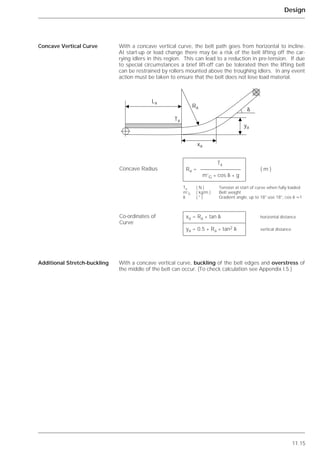
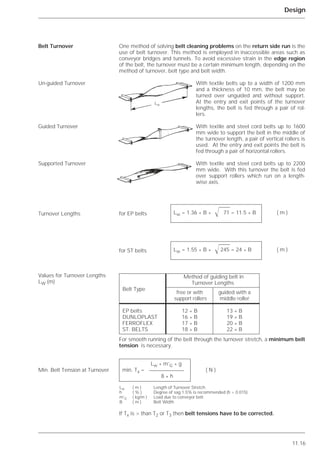
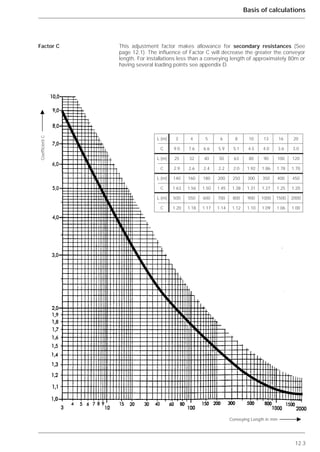
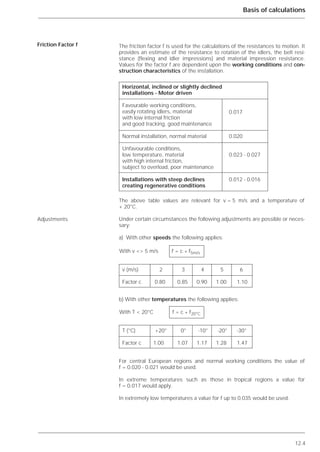
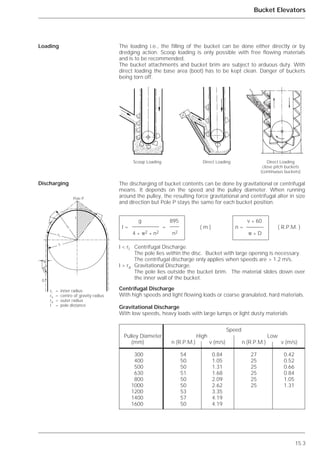
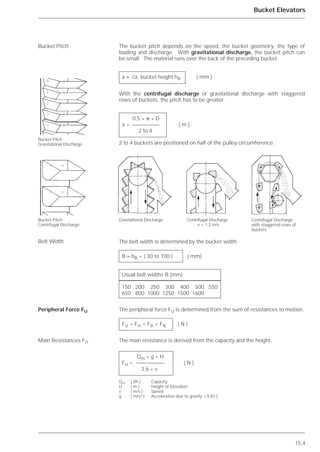
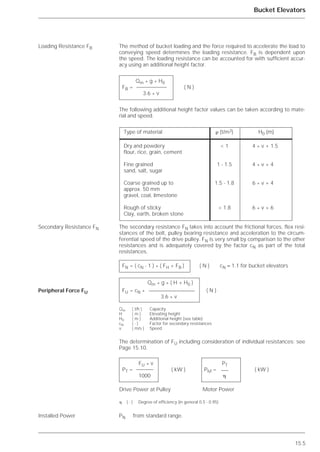
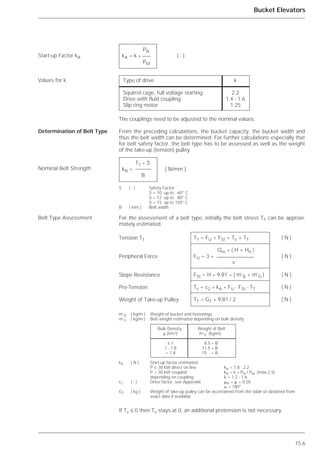
CONVEYOR BELT TECHNIQUE
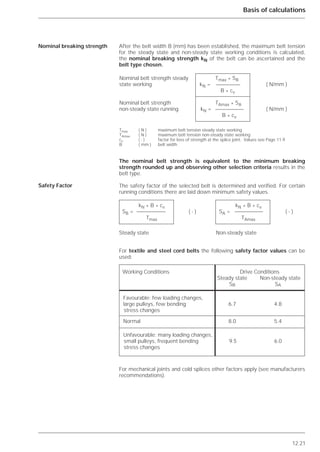
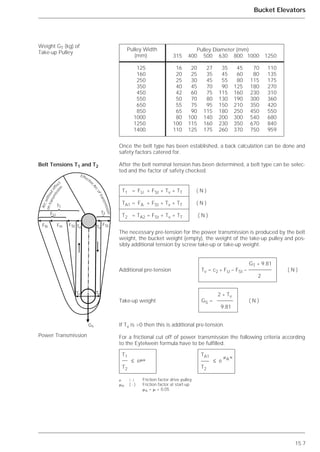
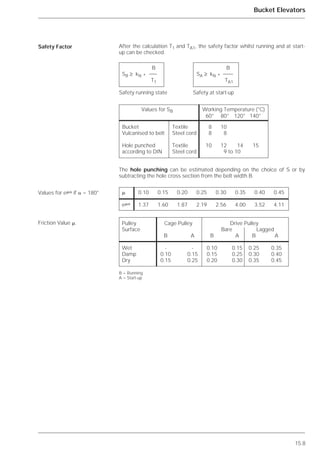
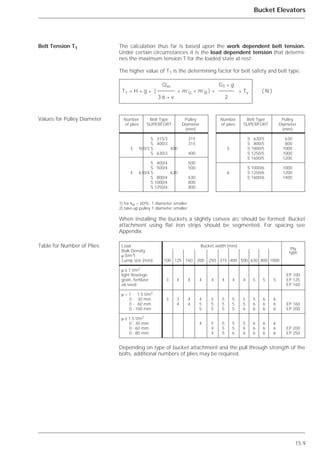
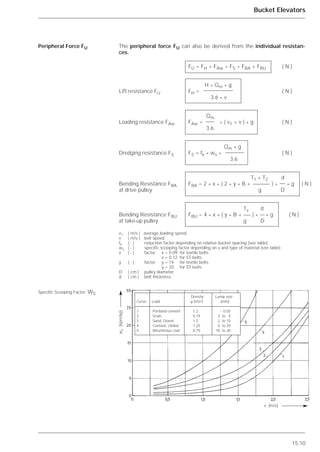
D E S I G N A N D C A L C U L AT I O N
I
Index
1 Introduction
1.1 Foreword
1.2 Development chronology, development aims
1.3 Dunlop-Enerka test rig
2 Belt Conveyors
2.1 Basic sketch, concept, description
3. Drive Systems
3.1 Pulley arrangement, conveying systems
3.2 Single pulley head drive, Dual pulley head drive, Head and tail drive,
general criteria
3.3 Drive components
Pulley motor, Geared motor, Motor-gears-Couplings
4 Couplings
4.1 Coupling types, fixed coupling, flexible coupling, fluid coupling,
hydro dynamic coupling
4.2 Start-up procedure
4.3 Run back prevention (holdback)
5. Drive Pulley
5.1 Force transmission, Eytelwein limitations, slip, creep
5.2 Friction factor ␮, angle of wrap ␣
6. Take-up (tension) Systems
6.1 General, fixed take-up, gravity weight take-up, regulated take-up
tension
7 Detection Devices
7.1 Belt tension detection, off-track detection, belt slip detection,
longitudinal slitting safety device
8 Cleaning Devices
8.1 General, ground rules
8.2 Cable scraper, transverse scraper, fan scraper staggered scraper,
rotary scraper (vertical)
8.3 Rotary scraper (horizontal) rapping roller, belt turnover, high pres-
sure water cleaning
9 Load
9.1 General, bulk loads, piece loads, bulk density, angle of repose/sur-
charge, lump size, classification
9.2 Temperature, moisture, chemical characteristics, pH value, angle of
inclination
10 Conveyor Belt
10.1 General, belt construction
10.2 Carcase, ply material
10.3 Covers, cover qualities (DIN/ISO)
10.4 Special qualities, cover thickness ratio
10.5 Angle of inclination values, cover thickness values
10.6 DUNLOP cover qualities, specifications
10.7 Basic Materials
10.8 Belt specification, DUNLOP belt types
II
Index
11 Design
11.1 Main data, belt speed, standard values, recommended values
11.2 Belt widths, standard widths, minimum belt width, idler arrange-
ment, idler spacing
11.3 Idler spacing (recommended values) idler rotation, idler roll diame-
ter, standard idler roll lengths L
11.4 Photograph
11.5 Cross sectional area of load, comparison various cross sections
11.6 Conveyor capacity, load stream volume, load stream mass, degree
of filling, reduction factor
11.7 Power requirement, electric motor type list
11.8 Adjustment factors
11.9 Belt types
11.10 Pulley diameters, standard diameters
11.11 Pulley rotation, pulley loading
11.12 Average surface pressure, transmission capability, start-up torque
11.13 Troughing transition, pulley lift
11.14 Convex vertical curve values
11.15 Concave vertical curve, curve co-ordinates
11.16 Belt turnover, turnover length, values
11.17 Horizontal curve, values
12 Basis of Calculation
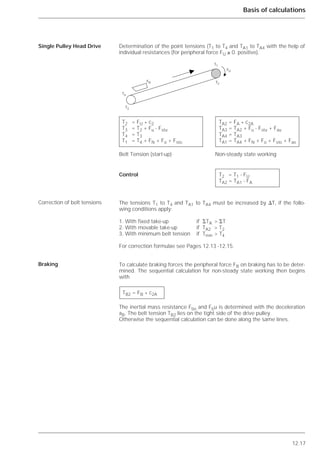
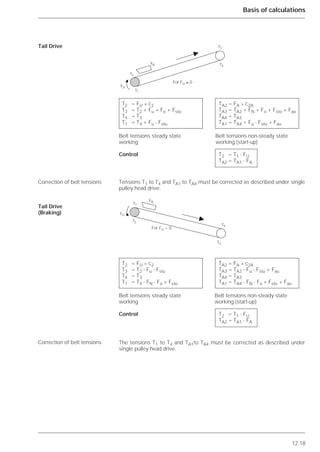
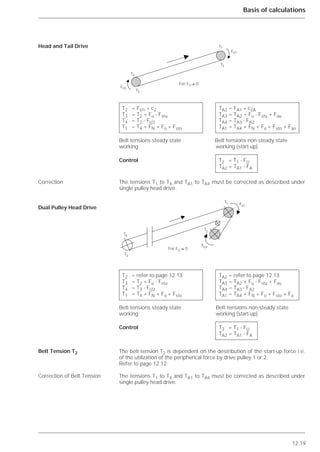
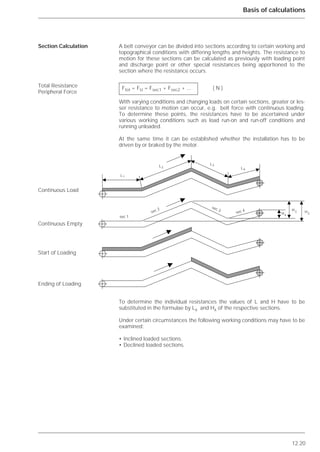
12.1 Resistance to motion, main resistance, secondary resistance, slope
resistance, special resistances
12.2 Peripheral force FU (working), summation
12.3 Factor C (allowance for secondary resistance)
12.4 Fictitious friction factor f
12.5 Mass of rotating idler parts. Mass of belt
12.6 Mass of material load. Peripheral force FA (start-up) friction cut-off
material/belt
12.7 Start-up factor KA, acceleration aA, take-off time, acceleration
distance
12.8 Peripheral force FB (braking), delay, over-run distance, braking tor-
que of motor MM, drive power at pulley PT, motor power PM
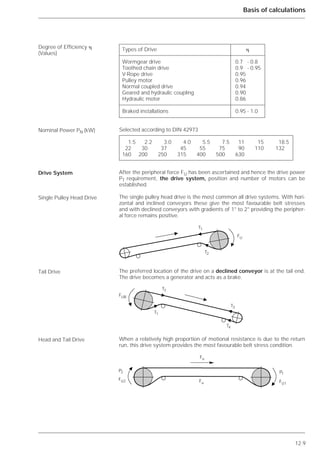
12.9 Degree of efficiency ␮, nominal motor power (DIN) drive system
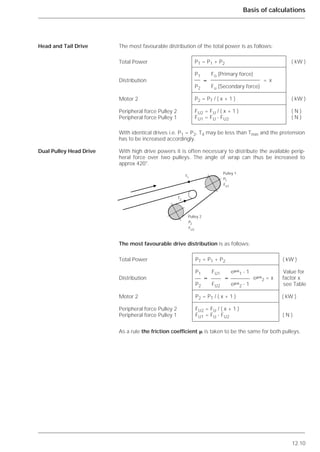
12.10 Distribution of drive power with head and tail drive, distribution of
drive power with dual pulley head drive
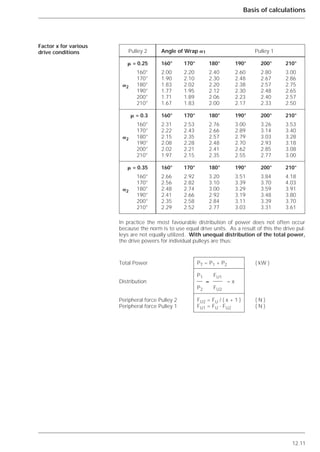
12.11 Factor x for various drive conditions
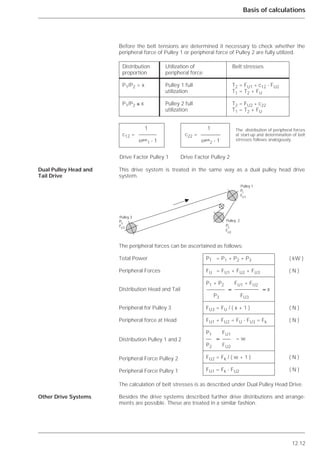
12.12 Distribution of drive power with dual pulley head and tail drive
12.13 Belt tensions T1 and T2. Belt tension correction, fixed take-up
12.14 Correction of belt tensions moveable take-up
12.15 Correction of belt tensions for minimum belt tensions
12.16 Sequential calculation to ascertain belt tensions T1 to T4, force
distribution, individual resistances
12.17 Sequential calculation for single pulley head drive
12.18 Sequential calculation for tail drive and tail drive braking
12.19 Sequential calculation for head and tail drive and dual pulley head
drive
12.20 Section loadings
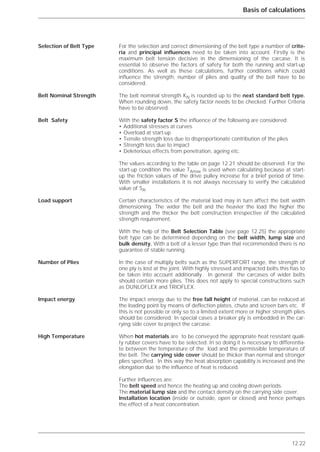
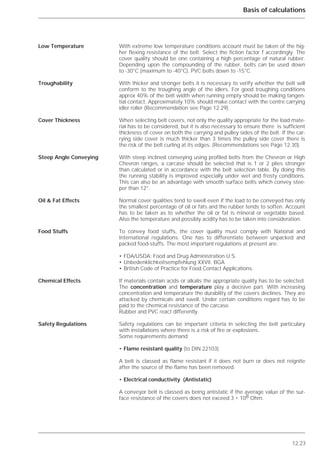
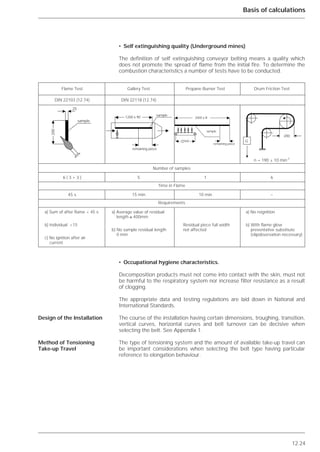
12.21 Nominal belt strength, safety factor
12.22 Selection of belt type (criteria)
12.23 Selection of belt type (criteria continuation)
12.24 Selection of belt type (criteria continuation)
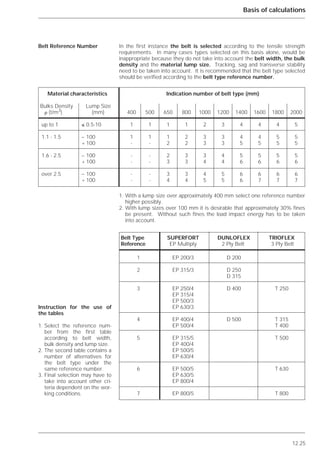
12.25 Belt reference to ascertain a belt type
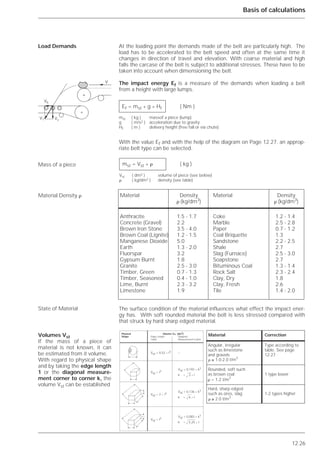
12.26 Determination of fall energy at the loading point
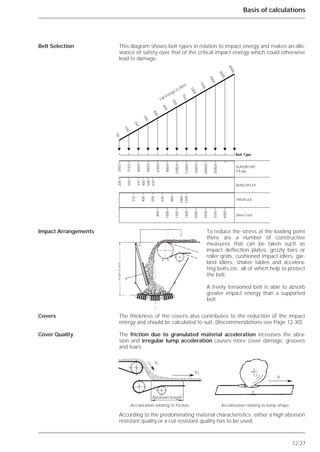
12.27 Influence of stresses on belt selection
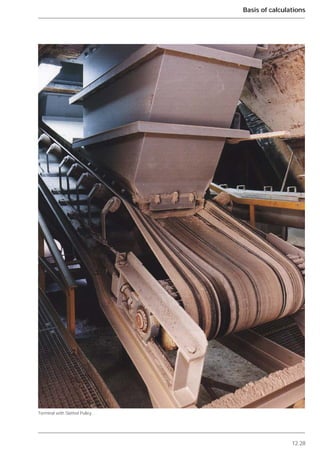
12.28 Photograph
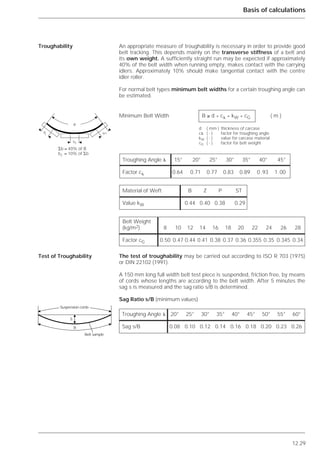
12.29 Determination of troughing capabilities
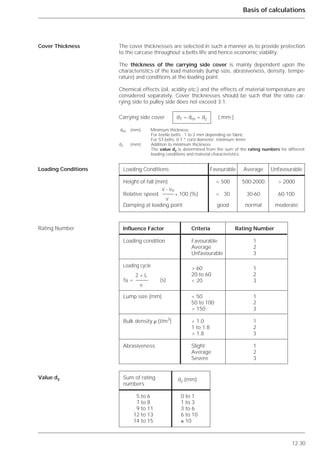
12.30 Determination of cover thicknesses
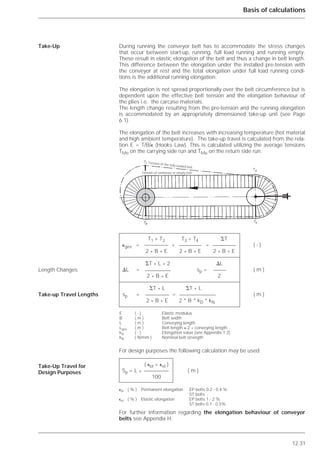
12.31 Determination of take-up travel, values
III
Index
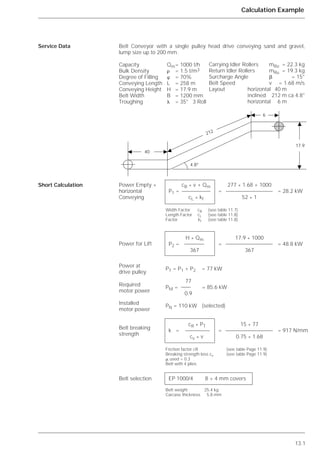
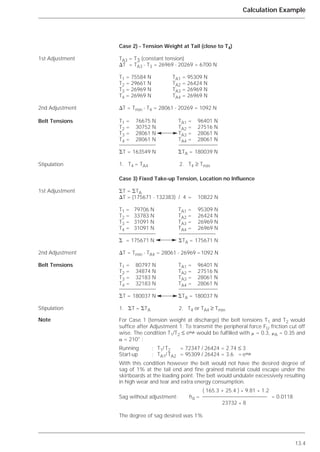
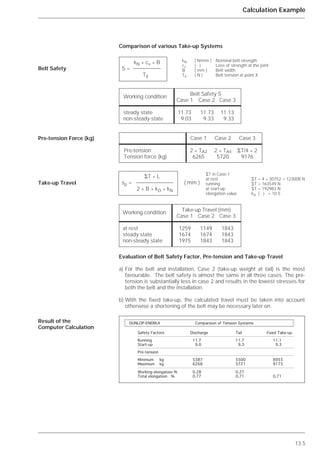
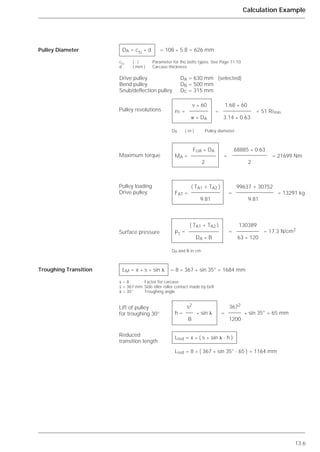
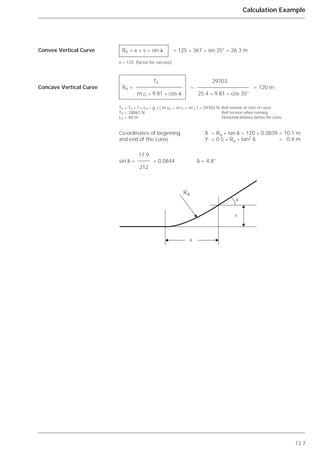
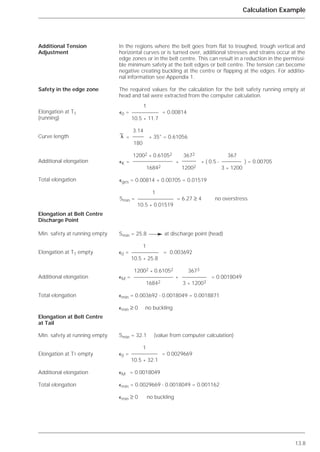
13 Calculation Example
13.1 Duty data, short calculation
13.2 Peripheral force FU and motor performance PM
13.3 Individual resistances, sequential calculation
13.4 Sequential calculation for various take-up systems
13.5 Belt safety, pre-tension, take-up travel
13.6 Pulley diameter, troughing transition
13.7 Convex and concave vertical curve
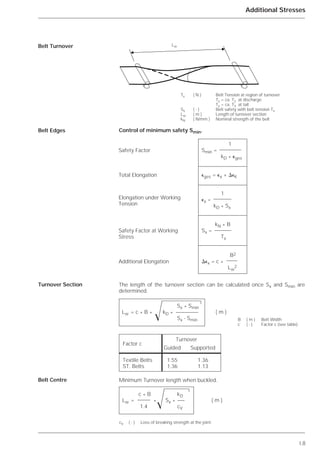
13.8 Control of additional stresses
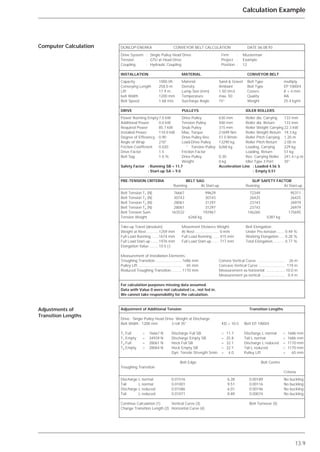
13.9 Computer calculations
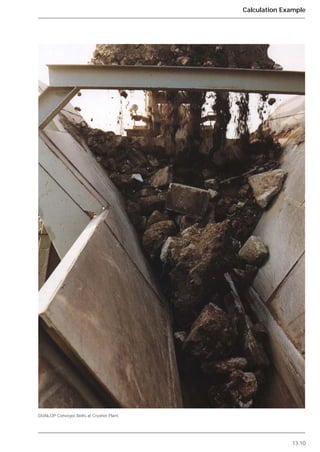
13.10 Photograph
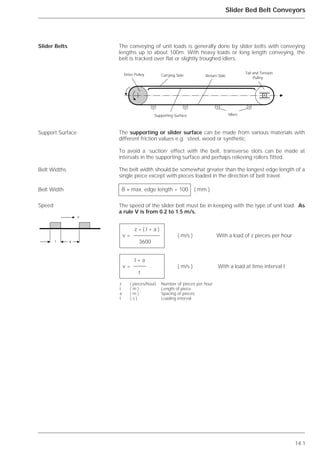
14 Slider Bed Belt Conveyors
14.1 Supporting surface, belt widths, belt speeds
14.2 Conveying capacity, resistance to motion
14.3 Frictional resistance, friction coefficient ␮G (belt/supporting surface)
14.4 Slope resistance, special resistances
14.5 Special Resistances (continued)
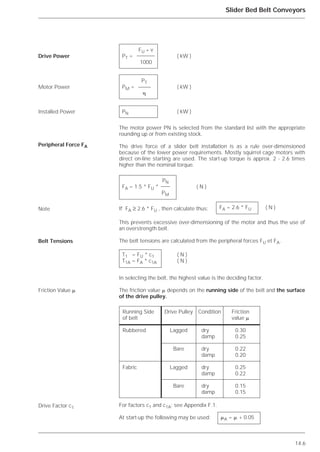
14.6 Drive power, belt tension, peripheral force FA
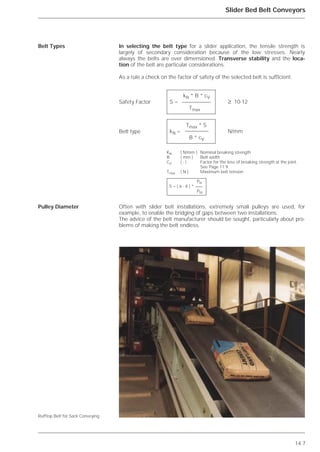
14.7 Safety Factor S, nominal belt strength KN
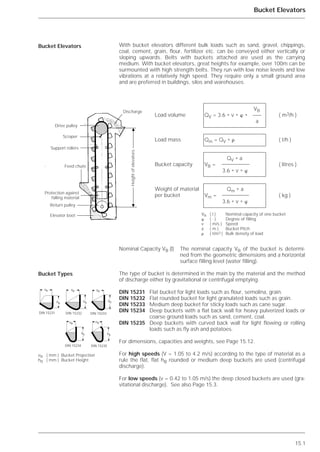
15 Bucket Elevator Belts
15.1 Conveying capacity, bucket contents, bucket shape
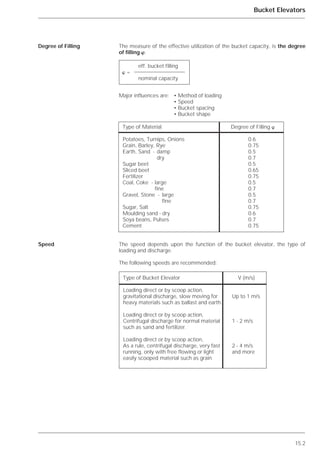
15.2 Degree of Filling, speed
15.3 Loading, discharging
15.4 Bucket spacing, belt width, main resistance
15.5 Loading resistance, secondary resistance, peripheral force FU,
motor power
15.6 Start-up factor, determination of belt type
15.7 Determination of belt tensions T1 and T2
15.8 Safety factor S, friction coefficient ␮ (belt/drive pulley)
15.9 Belt stress T1 (load dependent) pulley diameter, number of plies
15.10 Individual resistances, peripheral force FU
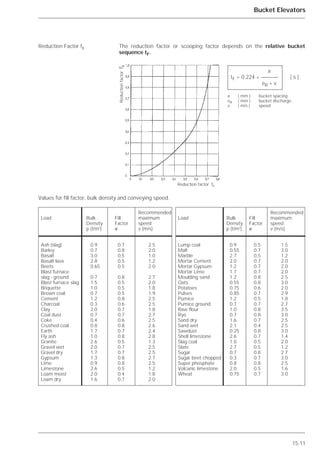
15.11 Values for degree of filling, bulk density, speed
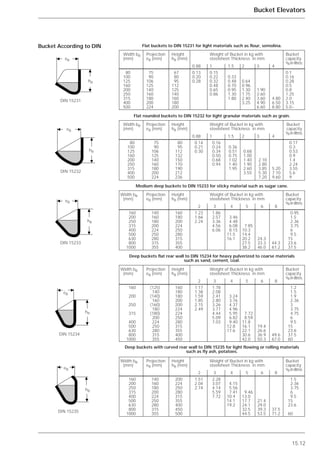
15.12 Bucket shapes and dimensions
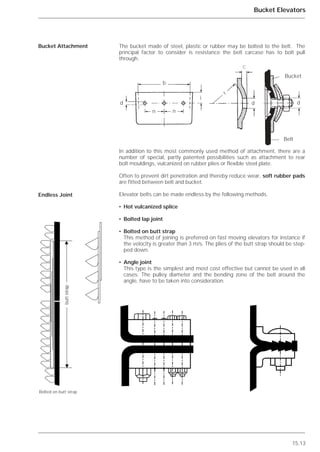
15.13 Bucket attachment, making endless joint
IV
Index
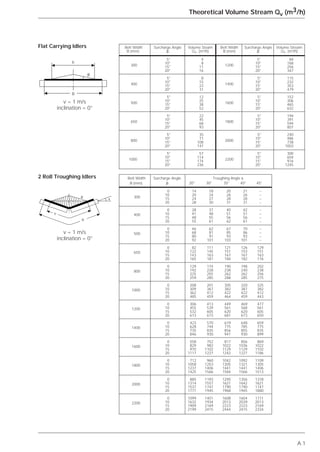
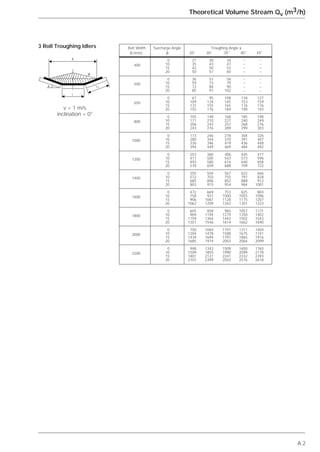
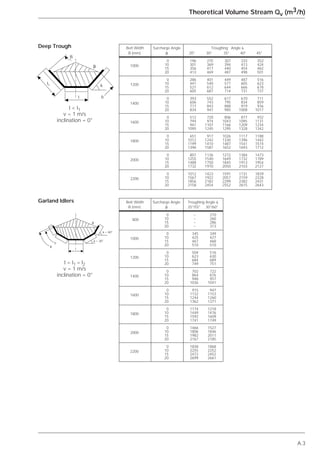
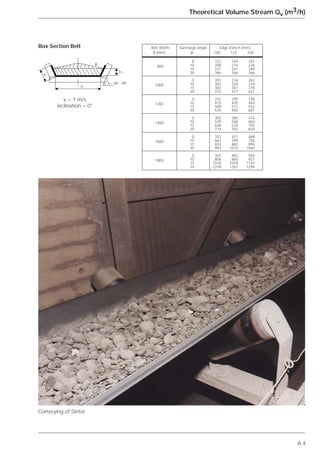
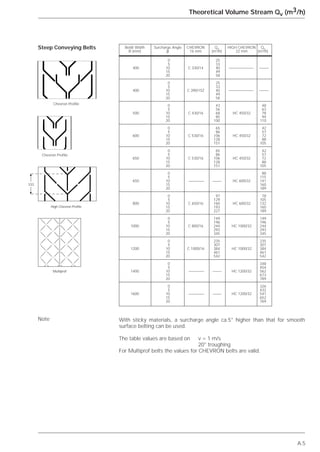
A Theoretical Volume Stream
A.1 Flat carrying idlers, 2 roll troughing idlers
A.2 3 roll troughing idlers
A.3 Deep troughing, garland idlers
A.4 Box section belt
A.5 Steep conveying belts
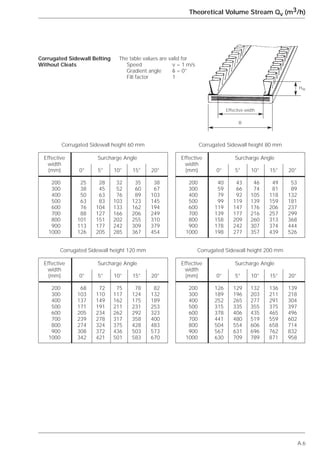
A.6 Corrugated edge belts without cleats
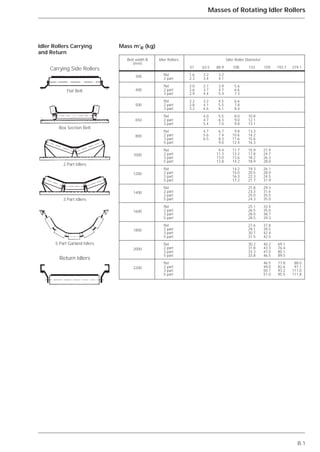
B Masses of Rotating Idler Rollers
B.1 Standard idlers
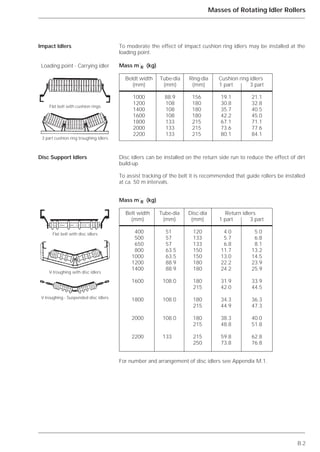
B.2 Cushion idlers, disc idlers
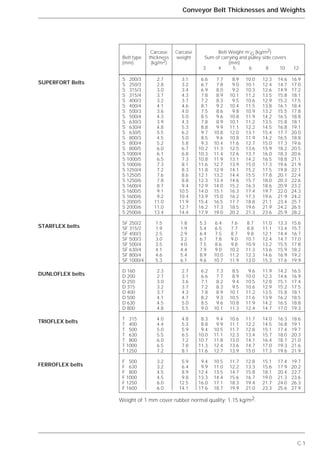
C Conveyor Belt Thicknesses and weights
C.1 Belt types SUPERFORT, STARFLEX, DUNLOFLEX, TRIOFLEX,
FERROFLEX
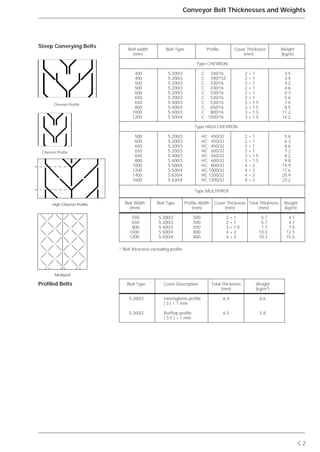
C.2 Steep incline belts CHEVRON, HIGH-CHEVRON, MULTIPROF
C.3 Slider bed belts, DUNLOPLAST belts
C.4 Steel cord belts SILVERCORD
rubber cleats
D Secondary Resistances
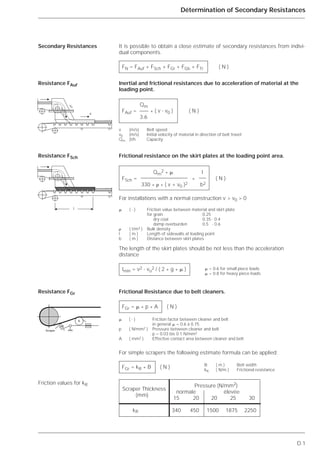
D.1 Inertial and frictional resistance at the loading point
Frictional resistance from skirt plates (loading point)
Frictional resistance from belt cleaners
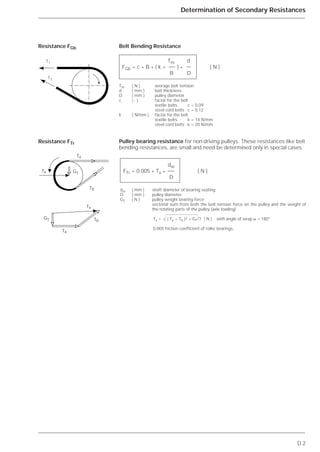
D.2 Belt bending (flexing) resistance, pulley bearing resistance
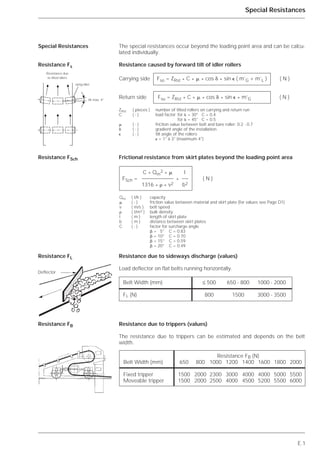
E Special Resistances
E.1 Resistance due to idler tilt
Frictional resistance from skirt plates beyond the loading point
Resistance due to sideways load discharge
Resistance from trippers
E.2 Resistance to belt sealing strip beyond the loading point
Resistance from motion of bunker drag-out belts
F Drive Factors c1 and c2
F.1 Drive factors c1 and c2 value e␮a
G Safety Factor S
G.1 Belt safety (definition) time/strength behaviour, reductions
G.2 Safety factors S for steady and non-steady state working and for
temporary localised peak stresses
H Stress-Strain Curve
H.1 Elongation characteristics (hysteresis curve)
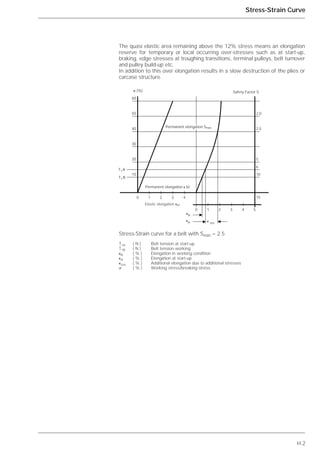
H.2 Stress-strain curve (diagram)
I Additional Stresses
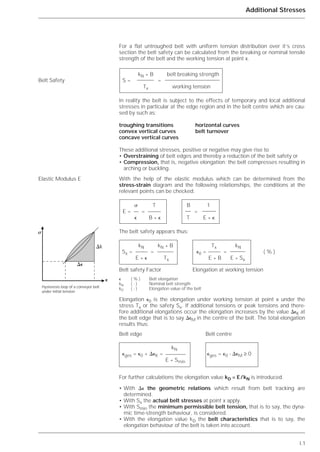
I.1 Belt safety, elastic modulus
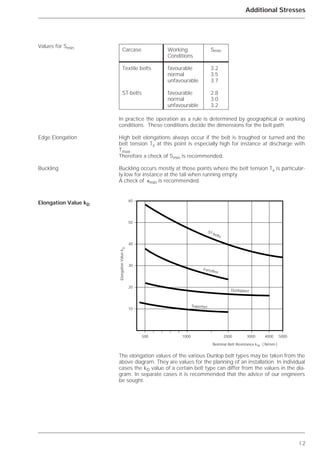
I.2 Values for Smin, elongation value kD
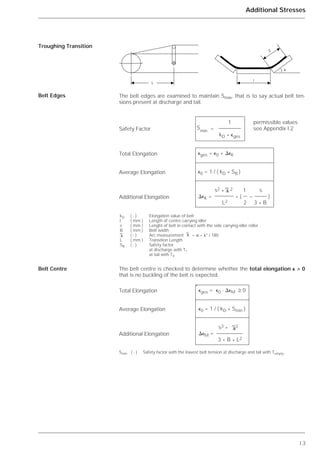
I.3 Troughing transition: safety and elongation
I.4 Troughing transition with raised pulley
I.5 Concave vertical curves
I.6 Convex vertical curves
I.7 Horizontal curve
I.8 Belt turnover
J Roll Diameter
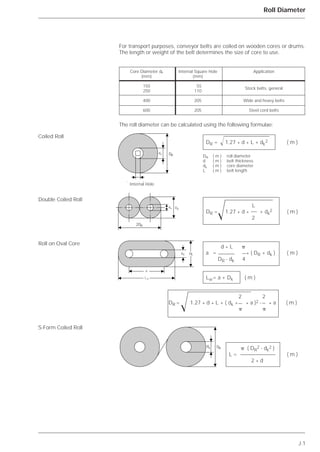
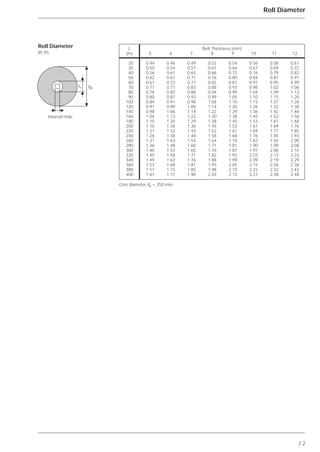
J.1 Standard rolls, coiled roll, double coiled roll, `S’ form coiled roll, roll
on oval core
J.2 Diameter of standard rolls (table)
V
Index
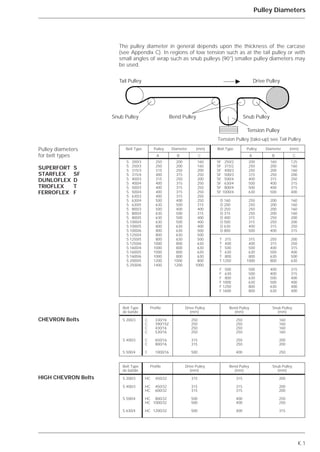
K Pulley Diameters
K.1 Pulley diameters for DUNLOP-ENERKA belt types
K.2 Pulley diameters for DUNLOPLAST PVG and PVC belts
K.3 Pulley diameters for steel cord belts SILVERCORD
L Crowned Pulleys
L.1 Dimensions, taper
M Arrangement of Rubber Supporting Idler Discs
M.1 Installation instructions, measurements
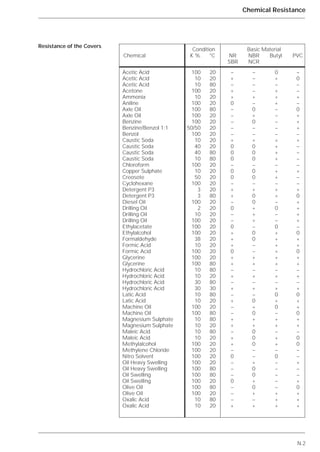
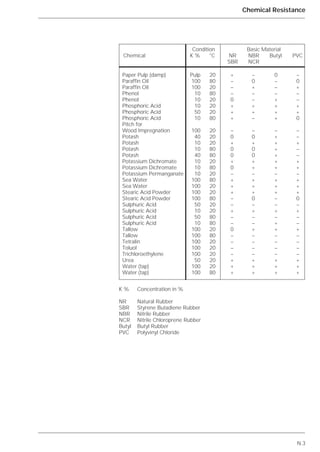
N Chemical Resistance
N.1 Resistance of the carcase
N.2 Resistance of the covers
N.3 Resistance of the covers (continued)
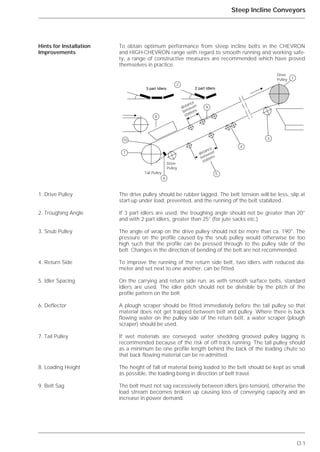
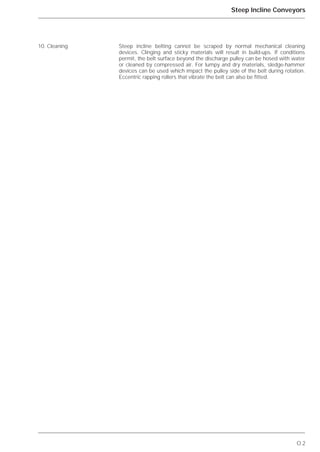
O Steep Incline Installations
O.1 Hints for the improvement of installation components
O.2 Hints for the improvement of installation components (continued)
P Endless Splicing
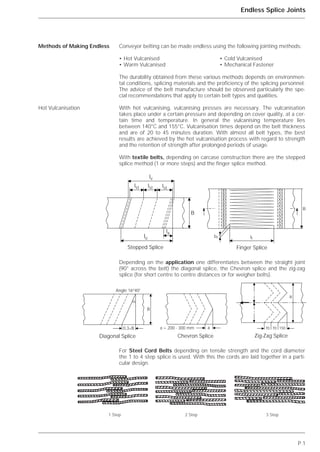
P.1 Methods, hot vulcanising
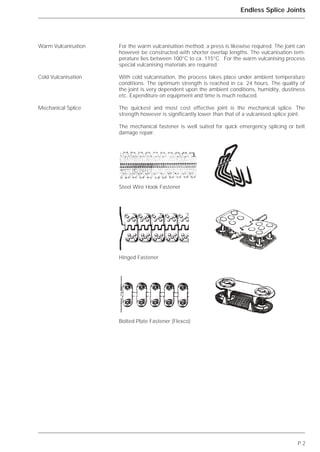
P.2 Warm vulcanization, cold vulcanisation, mechanical fasteners
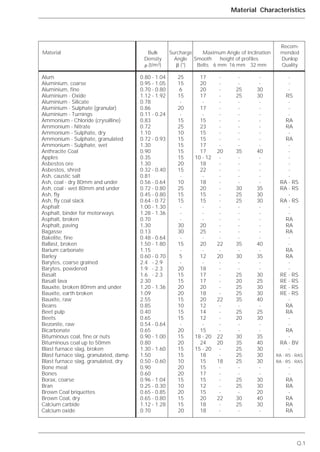
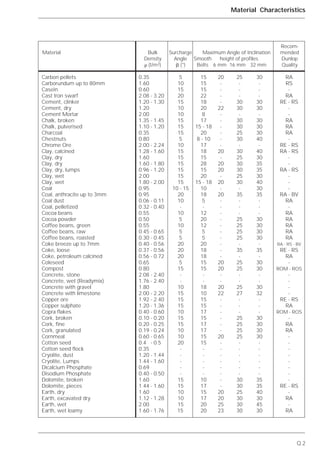
Q Material Characteristics
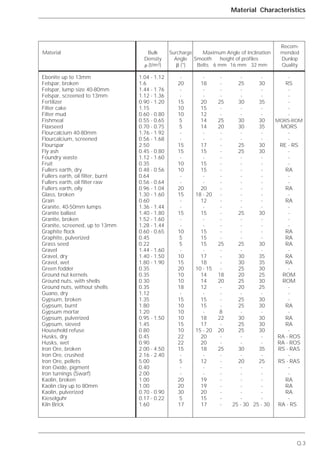
Q.1 Material characteristics
Q.2 Material characteristics (continued)
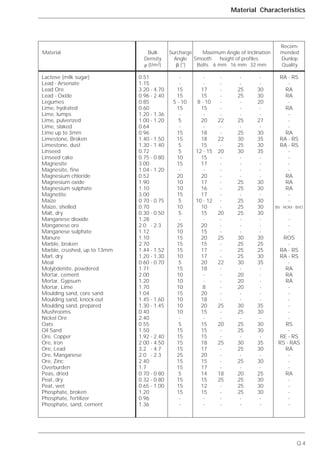
Q.3 Material characteristics (continued)
Q.4 Material characteristics (continued)
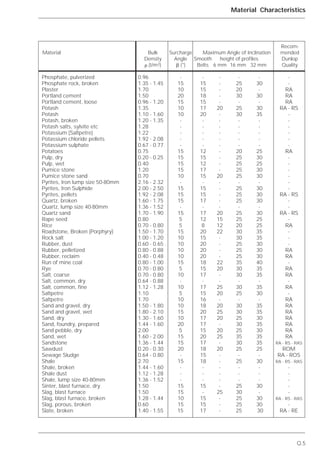
Q.5 Material characteristics (continued)
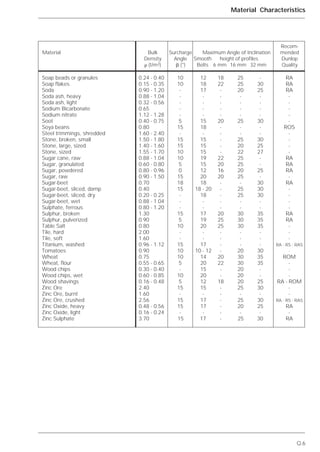
Q.6 Material characteristics (continued)
Dunlop-Enerka Belting Dunlop-Enerka France Sarl
P.O. Box 86 Z.I. des Ebisoires
Centurion Way 78370 Plaisir
Farington, Leyland France
Preston, Lancashire PR5 2EY Tel. +33 (0)1 3055 5419
United Kingdom Fax +33 (0)1 3054 0238
Tel. +44 (0) 1772 433 751 Telex 695608
Fax +44 (0) 1772 623 967
Telex 627080
Dunlop-CCT s.a. Dunlop-Enerka b.v.
Boulevard des Combattants 64 Visokovol’tnij Proezd, 1
7500 Tournai 127577, Moskow
Belgium Russia
Tel. +32 (0) 69 254 811 Tel. +7 095 901 8857
Fax +32 (0) 69 226 270 Fax +7 095 901 2921
Telex 57187
Dunlop-Enerka b.v. Dunlop-CCT s.a.
Postbus 14 Ovnatanyana str. 4
9200 AA Drachten 340017, Donjetsk
The Netherlands The Ukraine
Tel. +31 (0) 512 585 555 Tel. +38 0622 955 038
Fax +31 (0) 512 585 490 Fax +38 0622 323 977
Telex 46116
Dunlop-Enerka GmbH Dunlop-Enerka S.L.
Friedrich-Bergius-Strasse 10 Pol. Ind. Les Comes
41516 Grevenbroich C/Italia, Parc, 70 Nave 3
Germany 08700 Igualada
Tel. +49 (0) 2181 2701 00 Barcelona
Fax +49 (0) 2181 2701 30 Spain
Tel. +34 (9)3 80 55 446
Fax +34 (9)3 80 54 269
All information contained in this manual has been assembled with great care. It represents up-to-date knowledge and techniques and is based on our long experience of the
industry. We would however advise you that modifications may be necessary to cater for new technical developments. All information, guide values, comments etc. are given
for guidance purposes only and the ultimate responsibility for the use of this information in conveyor design and any subsequent liability rests with the end user, particularly
where the suitability of our products for certain applications is concerned. The data and values given are based on average values.
Introduction
1.1
Conveyor belts have been used for decades to transport bulk and unit loads.
They have proved their worth everywhere because belt conveyor installations
can be adapted to meet nearly all local conditions. They are work-safe and
economical.
The demand for ever increasing capacities and ever longer conveying lengths
has accelerated the development of the belt conveyor technique, new mate-
rials are being developed, new conveying systems are being planned and
tested especially those having regard to the environmental.
The conveyor belt plays the major part in the whole system and has to over-
come the many and varied stresses. In addition to this every conveying
problem is different and needs careful planning and selection of the right ele-
ments in order to achieve the optimum conveying capacity in an economical
way.
There are a number of practical rules, values and experiences which can be
useful during the planning stage. This manual aims to be of assistance to
operators, engineers and project people and provides a substantial amount of
elementary data. In addition there are a number of instructions and hints
offered to enable accurate calculations or checks on installation components
that impinge on the running of the belt.
In future there will be more and more use of the computer for calculations
and dimensioning of belt conveyors. With this often the correlation of the
valuation criteria will no longer be recognizable. This manual should also help
to understand the background to a calculation, the selection criteria for an
optimum belt type and to recognize a special operating case.
All new standards DIN, EN, or ISO, have been taken into consideration as
well as the results of individual research studies. The developments continue
and we are grateful for all hints and practical experiences.
July 1994
Foreword
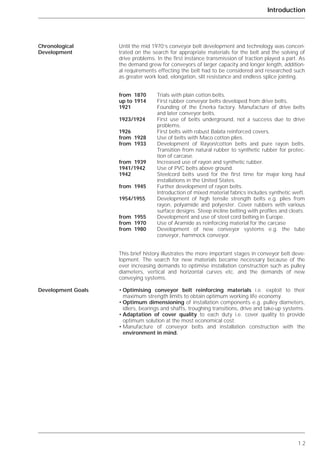
1.2
Introduction
Until the mid 1970’s conveyor belt development and technology was concen-
trated on the search for appropriate materials for the belt and the solving of
drive problems. In the first instance transmission of traction played a part. As
the demand grew for conveyors of larger capacity and longer length, addition-
al requirements effecting the belt had to be considered and researched such
as greater work load, elongation, slit resistance and endless splice jointing.
from 1870 Trials with plain cotton belts.
up to 1914 First rubber conveyor belts developed from drive belts.
1921 Founding of the Enerka factory. Manufacture of drive belts
and later conveyor belts.
1923/1924 First use of belts underground, not a success due to drive
problems.
1926 First belts with robust Balata reinforced covers.
from 1928 Use of belts with Maco cotton plies.
from 1933 Development of Rayon/cotton belts and pure rayon belts.
Transition from natural rubber to synthetic rubber for protec-
tion of carcase.
from 1939 Increased use of rayon and synthetic rubber.
1941/1942 Use of PVC belts above ground.
1942 Steelcord belts used for the first time for major long haul
installations in the United States.
from 1945 Further development of rayon belts.
Introduction of mixed material fabrics includes synthetic weft.
1954/1955 Development of high tensile strength belts e.g. plies from
rayon, polyamide and polyester. Cover rubbers with various
surface designs. Steep incline belting with profiles and cleats.
from 1955 Development and use of steel cord belting in Europe.
from 1970 Use of Aramide as reinforcing material for the carcase
from 1980 Development of new conveyor systems e.g. the tube
conveyor, hammock conveyor.
This brief history illustrates the more important stages in conveyor belt deve-
lopment. The search for new materials became necessary because of the
ever increasing demands to optimise installation construction such as pulley
diameters, vertical and horizontal curves etc. and the demands of new
conveying systems.
• Optimising conveyor belt reinforcing materials i.e. exploit to their
maximum strength limits to obtain optimum working life economy.
• Optimum dimensioning of installation components e.g. pulley diameters,
idlers, bearings and shafts, troughing transitions, drive and take-up systems.
• Adaptation of cover quality to each duty i.e. cover quality to provide
optimum solution at the most economical cost.
• Manufacture of conveyor belts and installation construction with the
environment in mind.
Chronological
Development
Development Goals
1.3
Introduction
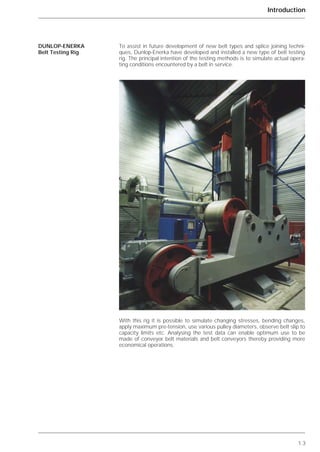
To assist in future development of new belt types and splice joining techni-
ques, Dunlop-Enerka have developed and installed a new type of belt testing
rig. The principal intention of the testing methods is to simulate actual opera-
ting conditions encountered by a belt in service.
With this rig it is possible to simulate changing stresses, bending changes,
apply maximum pre-tension, use various pulley diameters, observe belt slip to
capacity limits etc. Analysing the test data can enable optimum use to be
made of conveyor belt materials and belt conveyors thereby providing more
economical operations.
DUNLOP-ENERKA
Belt Testing Rig
2.1
Belt Conveyor
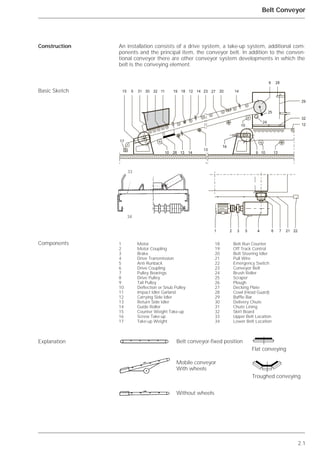
An installation consists of a drive system, a take-up system, additional com-
ponents and the principal item, the conveyor belt. In addition to the conven-
tional conveyor there are other conveyor system developments in which the
belt is the conveying element.
Construction
Basic Sketch
Components
Explanation
16
24
25
17
Belt conveyor-fixed position
Mobile conveyor
With wheels
Without wheels
Flat conveying
Troughed conveying
34
33
1 Motor
2 Motor Coupling
3 Brake
4 Drive Transmission
5 Anti Runback
6 Drive Coupling
7 Pulley Bearings
8 Drive Pulley
9 Tail Pulley
10 Deflection or Snub Pulley
11 Impact Idler Garland
12 Carrying Side Idler
13 Return Side Idler
14 Guide Roller
15 Counter Weight Take-up
16 Screw Take-up
17 Take-up Weight
18 Belt Run Counter
19 Off Track Control
20 Belt Steering Idler
21 Pull Wire
22 Emergency Switch
23 Conveyor Belt
24 Brush Roller
25 Scraper
26 Plough
27 Decking Plate
28 Cowl (Head Guard)
29 Baffle Bar
30 Delivery Chute
31 Chute Lining
32 Skirt Board
33 Upper Belt Location
34 Lower Belt Location
3.1
Drive Systems
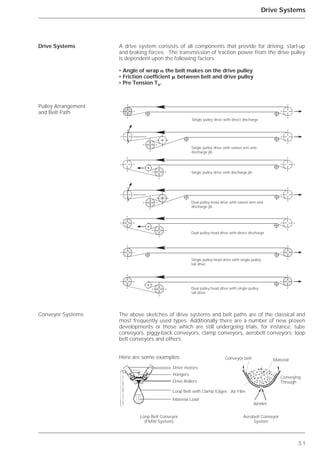
A drive system consists of all components that provide for driving, start-up
and braking forces. The transmission of traction power from the drive pulley
is dependent upon the following factors:
• Angle of wrap ␣ the belt makes on the drive pulley
• Friction coefficient ␮ between belt and drive pulley
• Pre Tension Tv.
The above sketches of drive systems and belt paths are of the classical and
most frequently used types. Additionally there are a number of new proven
developments or those which are still undergoing trials, for instance, tube
conveyors, piggy-back conveyors, clamp conveyors, aerobelt conveyors, loop
belt conveyors and others.
Here are some examples:
Drive Systems
Pulley Arrangement
and Belt Path
Conveyor Systems
Eintrommel-Antrieb mit direktem Abwurf
Eintrommel-Antrieb mit Schwenkarm und
Abwurfausleger
Eintrommel-Antrieb mit Abwurfausleger
Zweitrommel-Kopfantrieb mit Schwenkarm
und Abwurfausleger
Zweitrommel-Kopfantrieb mit direktem Abwurf
Eintrommel-Kopfantrieb
mit Eintrommel-Umkehrantrieb
Zweitrommel-Kopfantrieb
mit Eintrommel-Umkehrantrieb
Loop Belt Conveyor Aerobelt Conveyor
(FMW System) System
Conveyor belt Material
Conveying
Through
Airinlet
Air Film
Drive motors
Hangers
Drive Rollers
Material Load
Loop Belt with Clamp Edges
Single pulley drive with direct discharge
Single pulley drive with swivel arm and
discharge jib
Single pulley drive with discharge jib
Single pulley head drive with single pulley
tail drive
Dual pulley head drive with direct discharge
Dual pulley head drive with single pulley
tail drive
Dual pulley head drive with swivel arm and
discharge jib
3.2
Drive Systems
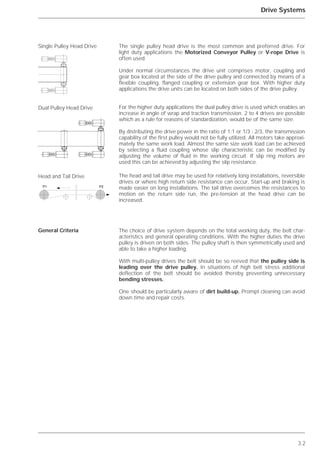
The single pulley head drive is the most common and preferred drive. For
light duty applications the Motorized Conveyor Pulley or V-rope Drive is
often used.
Under normal circumstances the drive unit comprises motor, coupling and
gear box located at the side of the drive pulley and connected by means of a
flexible coupling, flanged coupling or extension gear box. With higher duty
applications the drive units can be located on both sides of the drive pulley.
For the higher duty applications the dual pulley drive is used which enables an
increase in angle of wrap and traction transmission. 2 to 4 drives are possible
which as a rule for reasons of standardization, would be of the same size.
By distributing the drive power in the ratio of 1:1 or 1/3 : 2/3, the transmission
capability of the first pulley would not be fully utilized. All motors take approxi-
mately the same work load. Almost the same size work load can be achieved
by selecting a fluid coupling whose slip characteristic can be modified by
adjusting the volume of fluid in the working circuit. If slip ring motors are
used this can be achieved by adjusting the slip resistance.
The head and tail drive may be used for relatively long installations, reversible
drives or where high return side resistance can occur. Start-up and braking is
made easier on long installations. The tail drive overcomes the resistances to
motion on the return side run, the pre-tension at the head drive can be
increased.
The choice of drive system depends on the total working duty, the belt char-
acteristics and general operating conditions. With the higher duties the drive
pulley is driven on both sides. The pulley shaft is then symmetrically used and
able to take a higher loading.
With multi-pulley drives the belt should be so reeved that the pulley side is
leading over the drive pulley. In situations of high belt stress additional
deflection of the belt should be avoided thereby preventing unnecessary
bending stresses.
One should be particularly aware of dirt build-up. Prompt cleaning can avoid
down time and repair costs.
Single Pulley Head Drive
Dual Pulley Head Drive
Head and Tail Drive
General Criteria
P1 P2
3.3
Drive Systems
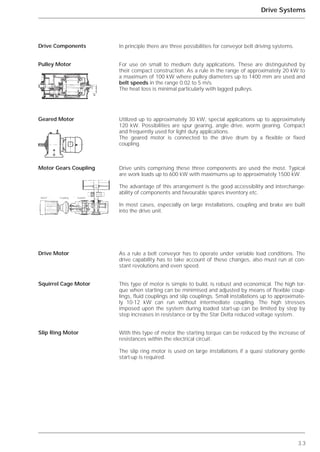
In principle there are three possibilities for conveyor belt driving systems.
For use on small to medium duty applications. These are distinguished by
their compact construction. As a rule in the range of approximately 20 kW to
a maximum of 100 kW where pulley diameters up to 1400 mm are used and
belt speeds in the range 0.02 to 5 m/s.
The heat loss is minimal particularly with lagged pulleys.
Utilized up to approximately 30 kW, special applications up to approximately
120 kW. Possibilities are spur gearing, angle drive, worm gearing. Compact
and frequently used for light duty applications.
The geared motor is connected to the drive drum by a flexible or fixed
coupling.
Drive units comprising these three components are used the most. Typical
are work loads up to 600 kW with maximums up to approximately 1500 kW.
The advantage of this arrangement is the good accessibility and interchange-
ability of components and favourable spares inventory etc.
In most cases, especially on large installations, coupling and brake are built
into the drive unit.
As a rule a belt conveyor has to operate under variable load conditions. The
drive capability has to take account of these changes, also must run at con-
stant revolutions and even speed.
This type of motor is simple to build, is robust and economical. The high tor-
que when starting can be minimised and adjusted by means of flexible coup-
lings, fluid couplings and slip couplings. Small installations up to approximate-
ly 10-12 kW can run without intermediate coupling. The high stresses
imposed upon the system during loaded start-up can be limited by step by
step increases in resistance or by the Star Delta reduced voltage system.
With this type of motor the starting torque can be reduced by the increase of
resistances within the electrical circuit.
The slip ring motor is used on large installations if a quasi stationary gentle
start-up is required.
Drive Components
Pulley Motor
Geared Motor
Motor Gears Coupling
Drive Motor
Squirrel Cage Motor
Slip Ring Motor
Motor Coupling Gearbox
4.1
Couplings
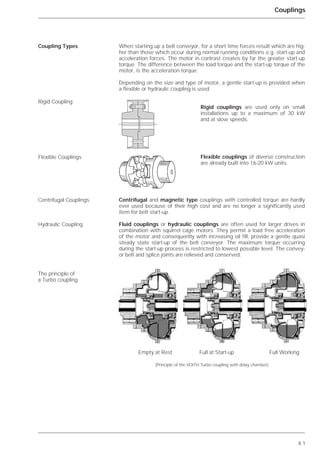
When starting up a belt conveyor, for a short time forces result which are hig-
her than those which occur during normal running conditions e.g. start-up and
acceleration forces. The motor in contrast creates by far the greater start-up
torque. The difference between the load torque and the start-up torque of the
motor, is the acceleration torque.
Depending on the size and type of motor, a gentle start-up is provided when
a flexible or hydraulic coupling is used.
Rigid couplings are used only on small
installations up to a maximum of 30 kW
and at slow speeds.
Flexible couplings of diverse construction
are already built into 16-20 kW units.
Centrifugal and magnetic type couplings with controlled torque are hardly
ever used because of their high cost and are no longer a significantly used
item for belt start-up.
Fluid couplings or hydraulic couplings are often used for larger drives in
combination with squirrel cage motors. They permit a load free acceleration
of the motor and consequently with increasing oil fill, provide a gentle quasi
steady state start-up of the belt conveyor. The maximum torque occurring
during the start-up process is restricted to lowest possible level. The convey-
or belt and splice joints are relieved and conserved.
Empty at Rest Full at Start-up Full Working
(Principle of the VOITH Turbo coupling with delay chamber)
Coupling Types
Rigid Coupling
Flexible Couplings
Centrifugal Couplings
Hydraulic Coupling
The principle of
a Turbo coupling
4.2
Couplings
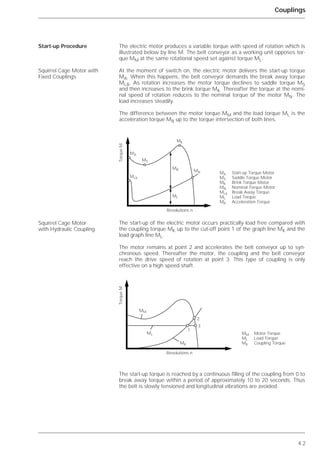
The electric motor produces a variable torque with speed of rotation which is
illustrated below by line M. The belt conveyor as a working unit opposes tor-
que MM at the same rotational speed set against torque ML.
At the moment of switch on, the electric motor delivers the start-up torque
MA. When this happens, the belt conveyor demands the break away torque
MLB. As rotation increases the motor torque declines to saddle torque MS
and then increases to the brink torque MK. Thereafter the torque at the nomi-
nal speed of rotation reduces to the nominal torque of the motor MN. The
load increases steadily.
The difference between the motor torque MM and the load torque ML is the
acceleration torque MB up to the torque intersection of both lines.
The start-up of the electric motor occurs practically load free compared with
the coupling torque MK up to the cut-off point 1 of the graph line MK and the
load graph line ML.
The motor remains at point 2 and accelerates the belt conveyor up to syn-
chronous speed. Thereafter the motor, the coupling and the belt conveyor
reach the drive speed of rotation at point 3. This type of coupling is only
effective on a high speed shaft.
The start-up torque is reached by a continuous filling of the coupling from 0 to
break away torque within a period of approximately 10 to 20 seconds. Thus
the belt is slowly tensioned and longitudinal vibrations are avoided.
Start-up Procedure
Squirrel Cage Motor with
Fixed Couplings
Squirrel Cage Motor
with Hydraulic Coupling
MA Start-up Torque Motor
MS Saddle Torque Motor
MK Brink Torque Motor
MN Nominal Torque Motor
MLb Break Away Torque
ML Load Torque
MB Acceleration Torque
MM Motor Torque
ML Load Torque
MK Coupling Torque
MA
MS
MK
MN
MB
ML
MLb
MM
ML
MK
1
3
2
Revolutions n
Revolutions n
TorqueMTorqueM
4.3
Couplings
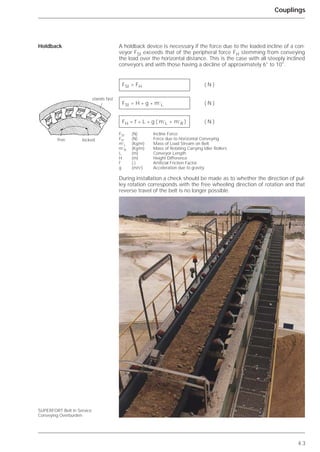
A holdback device is necessary if the force due to the loaded incline of a con-
veyor FSt exceeds that of the peripheral force FH stemming from conveying
the load over the horizontal distance. This is the case with all steeply inclined
conveyors and with those having a decline of approximately 6° to 10°.
FSt (N) Incline Force
FH (N) Force due to Horizontal Conveying
m’L (Kg/m) Mass of Load Stream on Belt
m’R (Kg/m) Mass of Rotating Carrying Idler Rollers
L (m) Conveyor Length
H (m) Height Difference
f (-) Artificial Friction Factor
g (m/s2
) Acceleration due to gravity
During installation a check should be made as to whether the direction of pul-
ley rotation corresponds with the free wheeling direction of rotation and that
reverse travel of the belt is no longer possible.
Holdback
SUPERFORT Belt in Service
Conveying Overburden
FSt > FH ( N )
FSt = H * g * m’L ( N )
FH = f * L * g ( m’L + m’R ) ( N )
stands fast
free locked
5.1
Drive Pulley
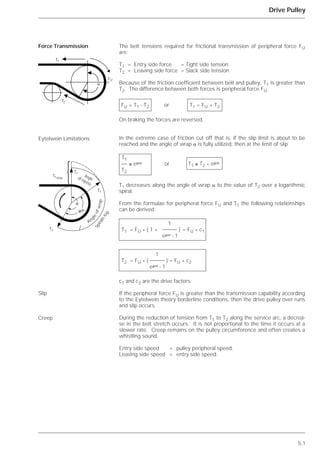
The belt tensions required for frictional transmission of peripheral force FU
are:
T1 = Entry side force = Tight side tension
T2 = Leaving side force = Slack side tension
Because of the friction coefficient between belt and pulley, T1 is greater than
T2. The difference between both forces is peripheral force FU.
On braking the forces are reversed.
In the extreme case of friction cut off that is, if the slip limit is about to be
reached and the angle of wrap ␣ is fully utilized, then at the limit of slip
T1 decreases along the angle of wrap ␣ to the value of T2 over a logarithmic
spiral.
From the formulae for peripheral force FU and T1 the following relationships
can be derived:
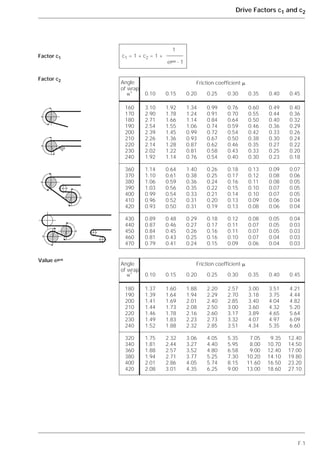
c1 and c2 are the drive factors.
If the peripheral force FU is greater than the transmission capability according
to the Eytelwein theory borderline conditions, then the drive pulley over runs
and slip occurs.
During the reduction of tension from T1 to T2 along the service arc, a decrea-
se in the belt stretch occurs. It is not proportional to the time it occurs at a
slower rate. Creep remains on the pulley circumference and often creates a
whistling sound.
Entry side speed = pulley peripheral speed.
Leaving side speed < entry side speed.
Force Transmission
Eytelwein Limitations
Slip
Creep
FU = T1 - T2 or T1 = FU + T2
T1
≤ e␮␣ or T1 ≤ T2 * e␮␣
T2
1
T1 = FU * ( 1 + ) = FU * c1
e␮␣ - 1
1
T2 = FU * ( ) = FU * c2
e␮␣ - 1
␣
T1
T2
FU
T2
An
gleofwrap
Spiralelog.
Angleof repose
N
␣␸
T1
T1
T1max
5.2
Drive Pulley
The factors determining the transmission of peripheral force Fu are the fric-
tion coefficient, the angle of wrap ␮ and the pretension T2 e.g. Tv.
The number of drive pulleys, the pretension force as well as various other
installation components are dependent upon the friction coefficient ␮. In
order to assess the friction coefficient, full knowledge of the operation is
desirable. In practice the friction coefficient varies within limits which are
dependent upon:
• Surface condition of the pulley
• Lubricating material such as water
or load slime between belt and pulley
• Temperature
• Surface pressure
• Slip and creep speed
The friction coefficient declines with increasing surface pressure and increa-
ses with increasing speed of creep for instance at start-up.
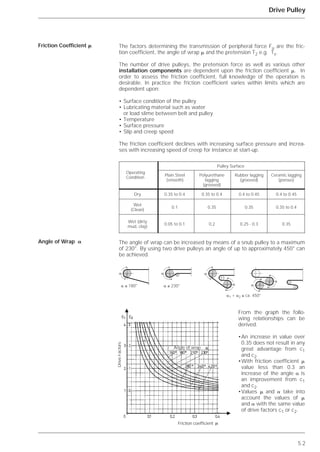
The angle of wrap can be increased by means of a snub pulley to a maximum
of 230°. By using two drive pulleys an angle of up to approximately 450° can
be achieved.
Friction Coefficient ␮
Angle of Wrap ␣
␣ ␣ ␣
␣
␣
␣
Operating
Condition
Plain Steel
(smooth)
Polyurethane
lagging
(grooved)
Rubber lagging
(grooved)
Ceramic lagging
(porous)
Pulley Surface
Dry 0.35 to 0.4
Wet
(Clean)
0.1
Wet (dirty
mud, clay)
0.05 to 0.1
0.35 to 0.4
0.35
0.2
0.4 to 0.45
0.35
0.25 - 0.3
0.4 to 0.45
0.35 to 0.4
0.35
␣ ≤ 180° ␣ ≤ 230°
␣1 + ␣2 ≤ ca. 450°
coefficient de frottement ␮
Facteursdecommande
c1 c2
᭤
᭤
c1 c2
arc de contact
c1 c2
᭤
᭤
c1 c2
Angle of wrap
DriveFactors
Friction coefficient
␣ ␣
␣ ␣
␣
␣
From the graph the follo-
wing relationships can be
derived.
•An increase in value over
0.35 does not result in any
great advantage from c1
and c2.
•With friction coefficient ␮
value less than 0.3 an
increase of the angle ␣ is
an improvement from c1
and c2.
•Values ␮ and ␣ take into
account the values of ␮
and ␣ with the same value
of drive factors c1 or c2.
6.1
Take-up Systems
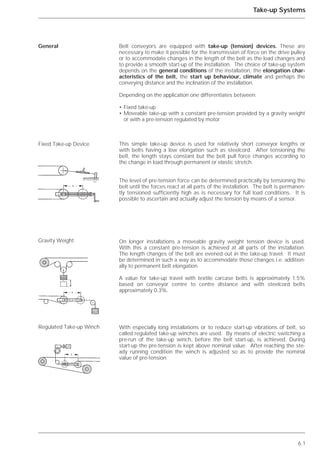
Belt conveyors are equipped with take-up (tension) devices. These are
necessary to make it possible for the transmission of force on the drive pulley
or to accommodate changes in the length of the belt as the load changes and
to provide a smooth start-up of the installation. The choice of take-up system
depends on the general conditions of the installation, the elongation char-
acteristics of the belt, the start up behaviour, climate and perhaps the
conveying distance and the inclination of the installation.
Depending on the application one differentiates between:
• Fixed take-up
• Moveable take-up with a constant pre-tension provided by a gravity weight
or with a pre-tension regulated by motor
This simple take-up device is used for relatively short conveyor lengths or
with belts having a low elongation such as steelcord. After tensioning the
belt, the length stays constant but the belt pull force changes according to
the change in load through permanent or elastic stretch.
The level of pre-tension force can be determined practically by tensioning the
belt until the forces react at all parts of the installation. The belt is permanen-
tly tensioned sufficiently high as is necessary for full load conditions. It is
possible to ascertain and actually adjust the tension by means of a sensor.
On longer installations a moveable gravity weight tension device is used.
With this a constant pre-tension is achieved at all parts of the installation.
The length changes of the belt are evened out in the take-up travel. It must
be determined in such a way as to accommodate those changes i.e. addition-
ally to permanent belt elongation.
A value for take-up travel with textile carcase belts is approximately 1.5%
based on conveyor centre to centre distance and with steelcord belts
approximately 0.3%.
With especially long installations or to reduce start-up vibrations of belt, so
called regulated take-up winches are used. By means of electric switching a
pre-run of the take-up winch, before the belt start-up, is achieved. During
start-up the pre-tension is kept above nominal value. After reaching the ste-
ady running condition the winch is adjusted so as to provide the nominal
value of pre-tension.
General
Fixed Take-up Device
Gravity Weight
Regulated Take-up Winch
7.1
Detection Devices
For the operation of complex belt conveyor installations a range of safety
devices were developed. They serve to prevent accidents, to guard the
conveyor belt and to run and automize the complete installation.
This device detects the belt tension changes during different working condi-
tions such as starting, braking and load variations.
A tensiometer measures the changing belt tensions. As soon as the defined
limits of the upper and lower belts tensions are exceeded a signal is transmit-
ted to the take-up unit.
An off-track of the belt can be limited or corrected by means of a number of
mechanical devices. Another possibility is to track the belt with light beams.
If a deviation beyond the defined limits is detected a motorized steering sys-
tem is set into operation. If the off-track is not adjusted the installation is
brought to a halt.
With the help of this device the overloading of a transfer point is registered.
A contact probe is suspended in the chute and adjusted to the required mate-
rial flow. With an overload, contact is made with the probe and the installa-
tion is switched off.
This device detects the force transmission between belt and drive pulley.
Too great or too long a duration of slip leads to overheating of the pulley sur-
face which can lead to fire. Slip can occur more often at start up as well as
overload conditions or when the pre-tension is too low.
Slitting open of conveyor belts is a relatively frequent cause of damage which
leads to prolonged interruptions and incurs great costs. In most cases it
stems from sharp edged pieces of material being trapped in the transfer
chute.
To avoid such damage the following remedies are possible.
• Textile or Steel breaker ply embedded in the cover rubber
• Bunched steel cords are embedded in the carrying side cover set at fixed
spacing.
• Rip detection loops at approximately 50 to 100m spacings vulcanised into
the belt.
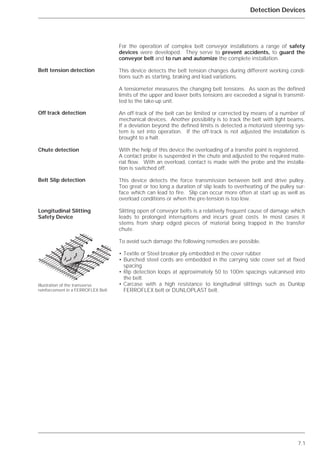
• Carcase with a high resistance to longitudinal slittings such as Dunlop
FERROFLEX belt or DUNLOPLAST belt.
Belt tension detection
Off track detection
Chute detection
Belt Slip detection
Longitudinal Slitting
Safety Device
Illustration of the transverse
reinforcement in a FERROFLEX Belt
8.1
Cleaning Devices
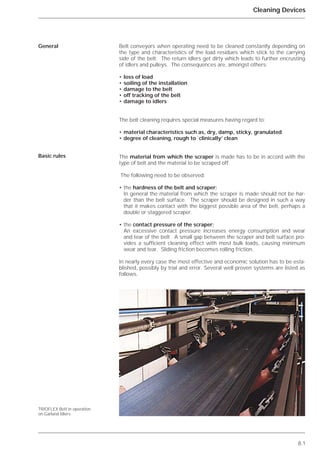
Belt conveyors when operating need to be cleaned constantly depending on
the type and characteristics of the load residues which stick to the carrying
side of the belt. The return idlers get dirty which leads to further encrusting
of idlers and pulleys. The consequences are, amongst others:
• loss of load
• soiling of the installation
• damage to the belt
• off tracking of the belt
• damage to idlers
The belt cleaning requires special measures having regard to:
• material characteristics such as, dry, damp, sticky, granulated
• degree of cleaning, rough to `clinically’ clean
The material from which the scraper is made has to be in accord with the
type of belt and the material to be scraped off.
The following need to be observed:
• the hardness of the belt and scraper;
In general the material from which the scraper is made should not be har-
der than the belt surface. The scraper should be designed in such a way
that it makes contact with the biggest possible area of the belt, perhaps a
double or staggered scraper.
• the contact pressure of the scraper;
An excessive contact pressure increases energy consumption and wear
and tear of the belt. A small gap between the scraper and belt surface pro-
vides a sufficient cleaning effect with most bulk loads, causing minimum
wear and tear. Sliding friction becomes rolling friction.
In nearly every case the most effective and economic solution has to be esta-
blished, possibly by trial and error. Several well proven systems are listed as
follows.
General
Basic rules
TRIOFLEX Belt in operation
on Garland Idlers
8.2
Cleaning Devices
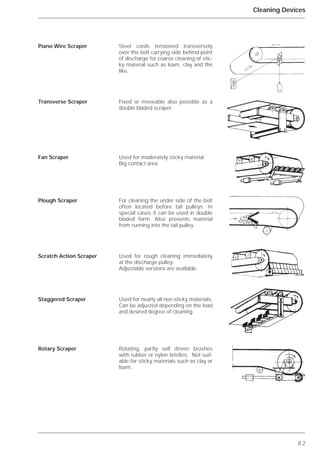
Steel cords tensioned transversely
over the belt carrying side behind point
of discharge for coarse cleaning of stic-
ky material such as loam, clay and the
like.
Fixed or moveable also possible as a
double bladed scraper.
Used for moderately sticky material
Big contact area.
For cleaning the under side of the belt
often located before tail pulleys. In
special cases it can be used in double
bladed form. Also prevents material
from running into the tail pulley.
Used for rough cleaning immediately
at the discharge pulley.
Adjustable versions are available.
Used for nearly all non-sticky materials.
Can be adjusted depending on the load
and desired degree of cleaning.
Rotating, partly self driven brushes
with rubber or nylon bristles. Not suit-
able for sticky materials such as clay or
loam.
Piano Wire Scraper
Transverse Scraper
Fan Scraper
Plough Scraper
Scratch Action Scraper
Staggered Scraper
Rotary Scraper
8.3
Cleaning Devices
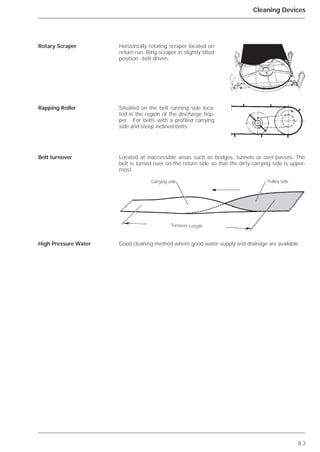
Horizontally rotating scraper located on
return run. Ring scraper in slightly tilted
position - belt driven.
Situated on the belt running side loca-
ted in the region of the discharge hop-
per. For belts with a profiled carrying
side and steep inclined belts.
Located at inaccessible areas such as bridges, tunnels or over-passes. The
belt is turned over on the return side so that the dirty carrying side is upper-
most.
Good cleaning method where good water supply and drainage are available.
Rotary Scraper
Rapping Roller
Belt turnover
High Pressure Water
Pulley sideCarrying side
Turnover Length
9.1
Load
It is important to know the exact make-up and material component of the
load when constructing a conveyor installation. The choice of conveyor belt
is determined by the physical and chemical properties of the materials
and possibly by safety regulations and demands.
Dusty, granular or lumps. Loads for instance, stone, earth, sand, grain,
cement. They are defined by their physical characteristics such as density,
granulometry, moisture, oil and fat content, pH value, abrasiveness, angle of
surcharge etc.
Piece loads comprise such as boxes sacks, blocks etc., and are defined by
shape, measurement and weight.
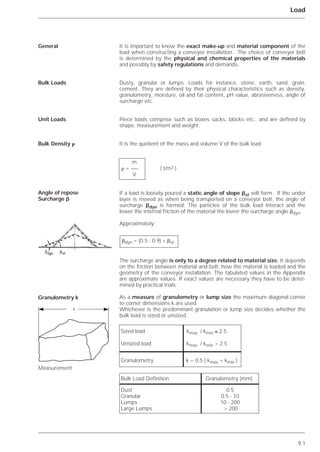
It is the quotient of the mass and volume V of the bulk load
If a load is loosely poured a static angle of slope ␤st will form. If the under
layer is moved as when being transported on a conveyor belt, the angle of
surcharge ␤dyn is formed. The particles of the bulk load interact and the
lower the internal friction of the material the lower the surcharge angle ␤dyn.
Approximately:
The surcharge angle is only to a degree related to material size. It depends
on the friction between material and belt, how the material is loaded and the
geometry of the conveyor installation. The tabulated values in the Appendix
are approximate values. If exact values are necessary they have to be deter-
mined by practical trials.
As a measure of granulometry or lump size the maximum diagonal corner
to corner dimensions k are used.
Whichever is the predominant granulation or lump size decides whether the
bulk load is sized or unsized.
General
Bulk Loads
Unit Loads
Bulk Density ␳
Angle of repose
Surcharge ␤
Granulometry k
Measurement
m
␳ = ( t/m3 )
V
␤dyn = (0.5 - 0.9) * ␤st
Sized load kmax / kmin ≤ 2.5
Unsized load kmax / kmin > 2.5
Granulometry k = 0.5 ( kmax + kmin )
Bulk Load Definition Granulometry (mm)
Dust 0.5
Granular 0.5 - 10
Lumps 10 - 200
Large Lumps > 200
kk
9.2
Load
It is important to have as near accurate as possible knowledge of the load
temperature and ambient conditions in order to select the optimum cover
quality and in certain circumstances the layout of particular installation com-
ponents.
Further influencing factors are:
• Granulometry of the material and hence the contact density made with
the belt.
• The speed of the belt and therefore the heating up and cooling off
times.
• Whether installation is open or enclosed.
The moisture content of the material has an influence on the surcharge
angle ␤dyn, the friction value between material and belt and thus the maxi-
mum angle of inclination of an installation. It is difficult to give an exact
assessment and if necessary practical trials need be conducted. The moistu-
re content is measured in percentage.
A sound knowledge of the chemical characteristics of the load is necessary
when selecting the cover quality and also the carcase reinforcement.
Important are the proportions of oils and fats (mineral and vegetable) and
acidity.
The temperature of the chemical material as well as the proportion of acidity
influences the level of attack made on the belt cover.
The pH value is the concentration of hydrogen ions which are present in a
solution e.g. the negative exponent to base 10 of the concentration (hydrogen
exponent).
The neutral point is pH = 7
Under 7 indicates acidity
Over 7 indicates alkalinity (bases)
The pH value indicates the degree of acidity or alkalinity and can be important
in selecting the cover quality.
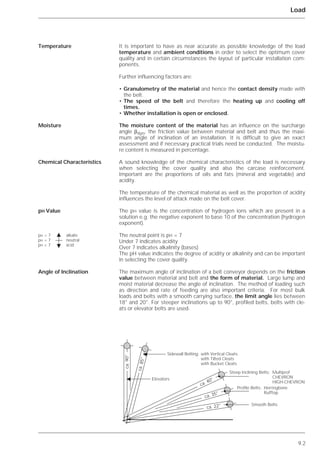
The maximum angle of inclination of a belt conveyor depends on the friction
value between material and belt and the form of material. Large lump and
moist material decrease the angle of inclination. The method of loading such
as direction and rate of feeding are also important criteria. For most bulk
loads and belts with a smooth carrying surface, the limit angle lies between
18° and 20°. For steeper inclinations up to 90°, profiled belts, belts with cle-
ats or elevator belts are used.
Temperature
Moisture
Chemical Characteristics
pH Value
Angle of Inclination
ca.90°
ca.85°
ca. 40°
ca. 35°
ca. 22°
pH > 7 alkalis
pH = 7 neutral
pH < 7 acid
᭡
᭢
Smooth Belts
Sidewall Belting: with Vertical Cleats
with Tilted Cleats
with Bucket Cleats
Elevators
᭣
᭣
Steep Inclining Belts: Multiprof
CHEVRON
HIGH-CHEVRON
Profile Belts: Herringbone
Rufftop
10.1
Conveyor Belt
The conveyor belt is the most important element of a belt conveyor instal-
lation. It has to be capable of doing numerous tasks:
• Absorb the stresses developed at drive start-up.
• Transport the load.
• Absorb the impact energy at the loading point.
• Withstand temperature and chemical effects (heat, oil and fat containing
materials, acidity etc.).
• Meet safety requirements (flame resistant, antistatic etc.).
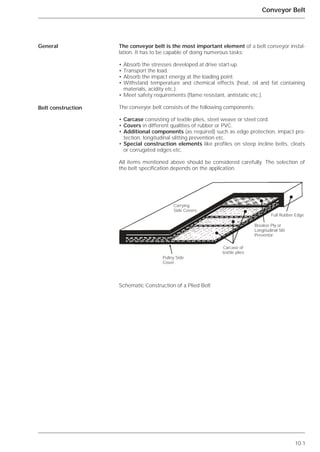
The conveyor belt consists of the following components:
• Carcase consisting of textile plies, steel weave or steel cord.
• Covers in different qualities of rubber or PVC.
• Additional components (as required) such as edge protection, impact pro-
tection, longitudinal slitting prevention etc.
• Special construction elements like profiles on steep incline belts, cleats
or corrugated edges etc.
All items mentioned above should be considered carefully. The selection of
the belt specification depends on the application.
Schematic Construction of a Plied Belt
General
Belt construction
Carcase of
textile plies
Pulley Side
Cover
Breaker Ply or
Longitudinal Slit
Preventor
Carrying
Side Covers
Full Rubber Edge
10.2
Conveyor Belt
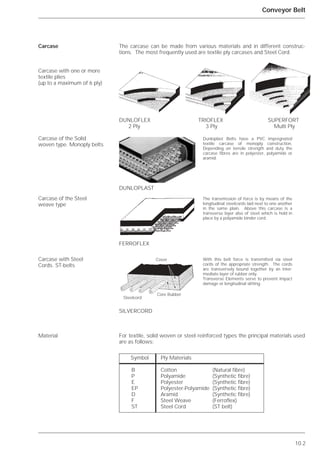
The carcase can be made from various materials and in different construc-
tions. The most frequently used are textile ply carcases and Steel Cord.
DUNLOFLEX TRIOFLEX SUPERFORT
2 Ply 3 Ply Multi Ply
DUNLOPLAST
FERROFLEX
SILVERCORD
For textile, solid woven or steel reinforced types the principal materials used
are as follows:
Carcase
Carcase with one or more
textile plies
(up to a maximum of 6 ply)
Carcase of the Solid
woven type. Monoply belts
Carcase of the Steel
weave type
Carcase with Steel
Cords. ST-belts
Material
Dunloplast Belts have a PVC impregnated
textile carcase of monoply construction.
Depending on tensile strength and duty the
carcase fibres are in polyester, polyamide or
aramid.
The transmission of force is by means of the
longitudinal steelcords laid next to one another
in the same plain. Above this carcase is a
transverse layer also of steel which is held in
place by a polyamide binder cord.
With this belt force is transmitted via steel
cords of the appropriate strength. The cords
are transversely bound together by an inter-
mediate layer of rubber only.
Transverse Elements serve to prevent impact
damage or longitudinal slitting.
Symbol Ply Materials
B Cotton (Natural fibre)
P Polyamide (Synthetic fibre)
E Polyester (Synthetic fibre)
EP Polyester-Polyamide (Synthetic fibre)
D Aramid (Synthetic fibre)
F Steel Weave (Ferroflex)
ST Steel Cord (ST belt)
Cover
Core Rubber
Steelcord
10.3
Conveyor Belt
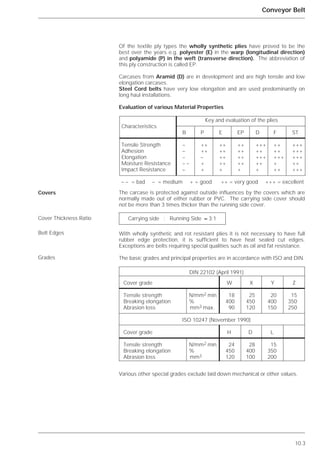
Of the textile ply types the wholly synthetic plies have proved to be the
best over the years e.g. polyester (E) in the warp (longitudinal direction)
and polyamide (P) in the weft (transverse direction). The abbreviation of
this ply construction is called EP.
Carcases from Aramid (D) are in development and are high tensile and low
elongation carcases.
Steel Cord belts have very low elongation and are used predominantly on
long haul installations.
Evaluation of various Material Properties
The carcase is protected against outside influences by the covers which are
normally made out of either rubber or PVC. The carrying side cover should
not be more than 3 times thicker than the running side cover.
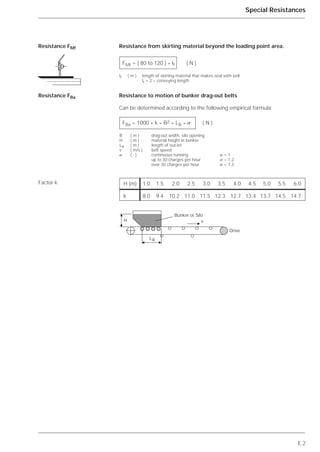
With wholly synthetic and rot resistant plies it is not necessary to have full
rubber edge protection, it is sufficient to have heat sealed cut edges.
Exceptions are belts requiring special qualities such as oil and fat resistance.
The basic grades and principal properties are in accordance with ISO and DIN.
Various other special grades exclude laid down mechanical or other values.
Covers
Cover Thickness Ratio
Belt Edges
Grades
Key and evaluation of the plies
Characteristics
B P E EP D F ST
Tensile Strength – ++ ++ ++ +++ ++ +++
Adhesion – ++ ++ ++ ++ ++ +++
Elongation – – ++ ++ +++ +++ +++
Moisture Resistance – – + ++ ++ ++ + ++
Impact Resistance – + + + + ++ +++
– – = bad – = medium + = good ++ = very good +++ = excellent
Carrying side : Running Side ≈ 3:1
DIN 22102 (April 1991)
Cover grade W X Y Z
Tensile strength N/mm2 min. 18 25 20 15
Breaking elongation % 400 450 400 350
Abrasion loss mm3 max. 90 120 150 250
ISO 10247 (November 1990)
Cover grade H D L
Tensile strength N/mm2 min. 24 28 15
Breaking elongation % 450 400 350
Abrasion loss mm3 120 100 200
10.4
Conveyor Belt
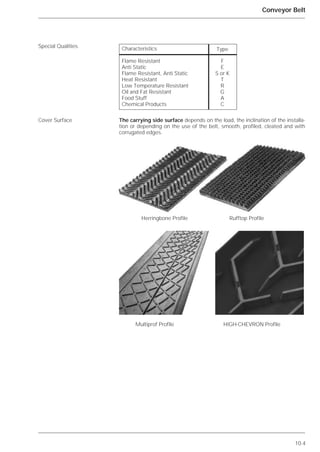
The carrying side surface depends on the load, the inclination of the installa-
tion or depending on the use of the belt, smooth, profiled, cleated and with
corrugated edges.
Multiprof Profile HIGH-CHEVRON Profile
Special Qualities
Cover Surface
Characteristics Type
Flame Resistant F
Anti Static E
Flame Resistant, Anti Static S or K
Heat Resistant T
Low Temperature Resistant R
Oil and Fat Resistant G
Food Stuff A
Chemical Products C
Herringbone Profile Rufftop Profile
10.5
Conveyor Belt
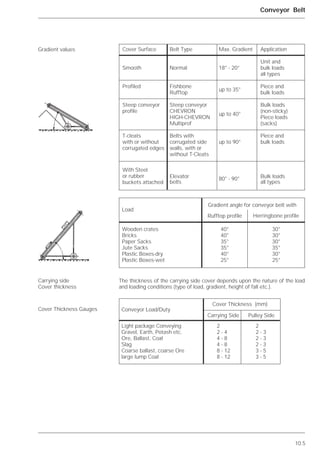
The thickness of the carrying side cover depends upon the nature of the load
and loading conditions (type of load, gradient, height of fall etc.).
Gradient values
Carrying side
Cover thickness
Cover Thickness Gauges
Cover Surface Belt Type Max. Gradient Application
Unit and
Smooth Normal 18° - 20° bulk loads
all types
Profiled Fishbone
up to 35°
Piece and
Rufftop bulk loads
Steep conveyor Steep conveyor Bulk loads
profile CHEVRON (non-sticky)
HIGH-CHEVRON
up to 40°
Piece loads
Multiprof (sacks)
T-cleats Belts with Piece and
with or without corrugated side up to 90° bulk loads
corrugated edges walls, with or
without T-Cleats
With Steel
Elevator Bulk loadsor rubber
belts
80° - 90°
all typesbuckets attached
Load
Wooden crates
Bricks
Paper Sacks
Jute Sacks
Plastic Boxes-dry
Plastic Boxes-wet
40°
40°
35°
35°
40°
25°
30°
30°
30°
35°
30°
25°
Gradient angle for conveyor belt with
Rufftop profile Herringbone profile
Cover Thickness (mm)
Conveyor Load/Duty
Carrying Side Pulley Side
Light package Conveying 2 2
Gravel, Earth, Potash etc. 2 - 4 2 - 3
Ore, Ballast, Coal 4 - 8 2 - 3
Slag 4 - 8 2 - 3
Coarse ballast, coarse Ore 8 - 12 3 - 5
large lump Coal 8 - 12 3 - 5
10.6
Conveyor belt
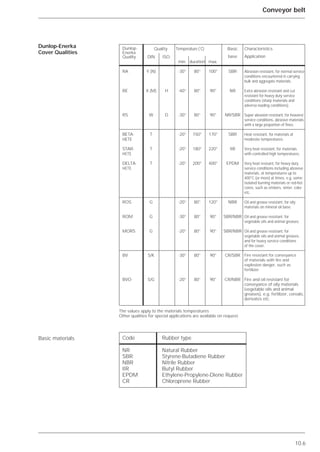
Dunlop-Enerka
Cover Qualities
Basic materials Code Rubber type
NR Natural Rubber
SBR Styrene-Butadiene Rubber
NBR Nitrile Rubber
IIR Butyl Rubber
EPDM Ethylene-Propylene-Diene Rubber
CR Chloroprene Rubber
Dunlop- Quality Temperature (˚C) Basic Characteristics
Enerka
Quality DIN ISO. base Application
min. duration max.
RA Y (N) -30° 80° 100° SBR Abrasion resistant, for normal service
conditions encountered in carrying
bulk and aggregate materials.
RE X (M) H -40° 80° 90° NR Extra abrasion resistant and cut
resistant for heavy duty service
conditions (sharp materials and
adverse loading conditions).
RS W D -30° 80° 90° NR/SBR Super abrasion resistant, for heaviest
service conditions, abrasive materials
with a large proportion of fines.
BETA- T -20° 150° 170° SBR Heat resistant, for materials at
HETE moderate temperatures.
STAR- T -20° 180° 220° IIR Very heat resistant, for materials
HETE with controlled high temperatures.
DELTA- T -20° 200° 400° EPDM Very heat resisant, for heavy duty
HETE service conditions including abrasive
materials, at temperatures up to
400°C (or more) at times, e.g. some
isolated burning materials or red-hot
cores, such as embers, sinter, coke
etc.
ROS G -20° 80° 120° NBR Oil and grease resistant, for oily
materials on mineral oil base.
ROM G -30° 80° 90° SBR/NBR Oil and grease resistant, for
vegetable oils and animal greases.
MORS G -20° 80° 90° SBR/NBR Oil and grease resistant, for
vegetable oils and animal greases,
and for heavy service conditions
of the cover.
BV S/K -30° 80° 90° CR/SBR Fire resistant for conveyance
of materials with fire and
explosion danger, such as
fertilizer
BVO S/G -20° 80° 90° CR/NBR Fire and oil resistant for
conveyance of oily materials
(vegetable oils and animal
greases), e.g. fertilizer, cereals,
derivates etc.
The values apply to the materials temperatures
Other qualities for special applications are available on request.
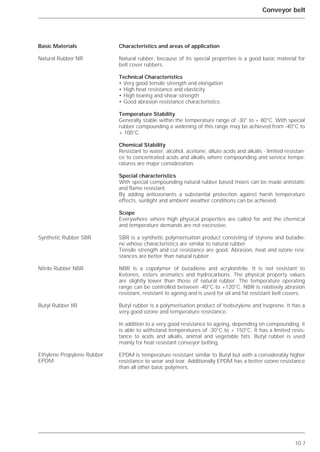
10.7
Conveyor belt
Characteristics and areas of application
Natural rubber, because of its special properties is a good basic material for
belt cover rubbers.
Technical Characteristics
• Very good tensile strength and elongation
• High heat resistance and elasticity
• High tearing and shear strength
• Good abrasion resistance characteristics
Temperature Stability
Generally stable within the temperature range of -30° to + 80°C. With special
rubber compounding a widening of this range may be achieved from -40°C to
+ 100°C.
Chemical Stability
Resistant to water, alcohol, acetone, dilute acids and alkalis - limited resistan-
ce to concentrated acids and alkalis where compounding and service tempe-
ratures are major consideration.
Special characteristics
With special compounding natural rubber based mixes can be made antistatic
and flame resistant.
By adding antiozonants a substantial protection against harsh temperature
effects, sunlight and ambient weather conditions can be achieved.
Scope
Everywhere where high physical properties are called for and the chemical
and temperature demands are not excessive.
SBR is a synthetic polymerisation product consisting of styrene and butadie-
ne whose characteristics are similar to natural rubber.
Tensile strength and cut resistance are good. Abrasion, heat and ozone resi-
stances are better than natural rubber.
NBR is a copolymer of butadiene and acrylonitrile. It is not resistant to
Ketones, esters aromatics and hydrocarbons. The physical property values
are slightly lower than those of natural rubber. The temperature operating
range can be controlled between -40°C to +120°C. NBR is relatively abrasion
resistant, resistant to ageing and is used for oil and fat resistant belt covers.
Butyl rubber is a polymerisation product of Isobutylene and Isoprene. It has a
very good ozone and temperature resistance.
In addition to a very good resistance to ageing, depending on compounding, it
is able to withstand temperatures of -30°C to + 150°C. It has a limited resis-
tance to acids and alkalis, animal and vegetable fats. Butyl rubber is used
mainly for heat resistant conveyor belting.
EPDM is temperature resistant similar to Butyl but with a considerably higher
resistance to wear and tear. Additionally EPDM has a better ozone resistance
than all other basic polymers.
Basic Materials
Natural Rubber NR
Synthetic Rubber SBR
Nitrile Rubber NBR
Butyl Rubber IIR
Ethylene Propylene Rubber
EPDM
CR is a Synthetic polymerisation product of Chlorobutadiene. The mechanical
properties are similar to natural rubber but significantly better in respect of
ozone and oil resistance. The chlorine in Chloroprene gives the product a high
degree of flame resistance.
The working temperature range is -30°C to +80°C.
The resistance to animal and vegetable oils and fats is superior to natural rub-
ber as is the ageing resistance.
The use of Nitrile in Chloroprene rubber enhances the dynamic properties.
For cover rubber which requires a high oil and fat resistance whether it be
animal, vegetable or mineral and also requiring superior mechanical proper-
ties. NCR is better than CR.
The foregoing basic materials are main ingredients of cover rubber compo-
nents. They provide the principal characteristics of each quality but can be
affected by the addition of other compounding ingredients to achieve requi-
rements of standards and regulations.
Conveyor belting is described according to laid down International standards.
Additionally special types and qualities may be described by the manufacturer
or in accordance with Customer wishes.
The belt length is generally given in metres either open or endless.
Open Length is the length around the pulleys plus an allowance for making
endless.
Endless Length is the inside circumference of the endless belt.
This number gives the nominal or breaking strength of the carcase in N/mm
of belt width. The values are Internationally Standardized.
The nominal strength of the carcase is made up by a number of plies. The
monoply belt has a solid woven carcase.
The nominal tensile strength of the full thickness carcase is the sum of the
ply strengths rounded up to the next nominal tensile strength. The number
of plies is not indicated in specially described types such as DUNLOFLEX,
TRIOFLEX or DUNLOPLAST.
D DUNLOFLEX 2 Ply Belt F FERROFLEX Steelweave Belt
T TRIOFLEX 3 Ply Belt DLP DUNLOPLAST Monoply Belt
S SUPERFORT Multiply Belt ST SILVERCORD Steelcord Belt
10.8
Conveyor belt
Chloroprene Rubber CR
Nitrile Chloroprene
Rubber NCR
Note
Belt Description
Belt Length
DUNLOP types
Nominal Tensile Strength
the Carcase
Number of Plies
Nominal Tensile Strength
of Plies
Ordering Example 100 m 800 mm EP 400/3 4+2 mm X
Belt Length
Belt Width
Material (carcase)
Nominal Tensile Strength
Number of Plies
Carrying Side Cover Thickness
Pulley Side Cover Thickness
Cover Quality
125 160 200 250 315 400 500
630 800 1000 1250 1600 2000 2500
63 80 100 125 160 200 250 315 400
11.1
Design
Main Data Values
Speed V
Standard Values
Recommended
Velocity (m/s)
After establishing the duty of the operation and the type of belt conveyor,
the main data may be determined.
Belt Speed v (m/s)
Belt Width B (m) or (mm)
Carrying Idler Arrangement
Cross Sectional area of Load Stream A (m2)
Conveyor Capacity Q (t/h)
The belt or Conveying Speed V (m/s) must be appropriate for the material
composition and operation conditions.
High Speed - Narrower belt widths
Lower belt tension
Greater wear and tear
Low Speed - Greater belt widths
Higher belt tension
Less wear and tear
The most economical installation is that having the highest belt speed consis-
tent with the type of material and operating conditions.
Speeds V (m/s)
0.42 - 0.52 - 0.66 - 0.84 - 1.05 - 1.31 - 1.68
2.09 - 2.62 - 3.35 - 4.19 - 5.20 - 6.60 - 8.40
Duty v (m/s)
Unit Loads, Assembly Lines ≤ 1.68
Mobile Conveyors 0.52 - 1.68
Very dusty loads such as Flour, Cement ≤ 1.31
Ash and Refuse ≤ 1.68
Grain, Crushed Limestone 1.05 - 2.09
Gravel, Sand Readymix
Ores, Bituminous Coal, Sinter
Storage and transhipment, Power Stations 1.31 - 3.35
Long distance conveying, overburden 2.62 - 6.60
Brown coal
Thrower belts ≥ 8.40
Steep gradient belts 0.84 - 2.62
Type CHEVRON and HIGH CHEVRON
11.2
Design
Wherever possible a standard belt width should be selected. Type and granu-
lometry of the materials determine the minimum belt width. After determi-
ning the belt type a check on troughability may be necessary under some
circumstances.
With unsized material the large lumps are embedded in the smaller granula-
ted material.
The disposition of the carrying idler varies from application to application. The
number of idler rolls in a carrying idler set and troughing angle determine the
cross sectional area of the load stream and thus the conveying capacity.
In deciding on the carrying idler spacing one has to take account of the load
limitation of the carrying idler (note: Refer to manufacturer’s specification).
After establishing the belt tension the belt sag between idler rollers has to be
checked.
The roller spacing has to be selected in such a way that the sag of a loaded
belt is no more than 0.5%-1.5% of the centre to centre distance. With return
side idlers one may allow approximately 2-3% sag.
Belt Width B
Standard Widths (mm)
Minimum Belt Widths
Carrying Idler Disposition
Distance between
Carrying Idlers
300 - 400 - 500 - 650 - 800 - 1000
1200 - 1400 - 1600 - 1800 - 2000 - 2200
Min. Width Lump Size K
(mm) Sized Unsized
400 50 100
500 80 150
650 130 200
800 200 300
1000 250 400
1200 350 500
1400 400 600
1600 450 650
1800 550 700
2000 600 800
k
hTx Tx
lo
lu
Tx * 8 * hrel
lo = ( m )
(m’L + m’G) * g
Tx * 8 * hrel
lu = ( m )
m’G * g
Tx ( N ) Belt tension at point X
m’L ( kg/m ) Weight of load per metre
m’G ( kg/m ) Weight of belt per metre
g ( m/s2 ) Gravitational acceleration (9.81 m/s2)
hrel ( - ) Relative belt sag
Carrying run : hrel = 0.005-0.015
Return run : hrel = 0.020-0.030
Flat 2 Part 3 Part Deep Trough Garland
Carrying Side
Return Side
11.3
Design
Idler rotation should not be greater than approximately 650 r.p.m.
The length of the middle idler roll determines the cross sectional area of the
load and thus the conveying capacity.
The gap d between 2 adjacent rolls should not be greater than 10mm, with
belt widths B > 2000mm d = 15mm refer to DIN22107, carrying idler arrange-
ments.
Values for Idler Spacing
Idler Rotation
Standard
Idler Diameter (mm)
Carrying Side
lo = 0.5 à 1.0 m Small installation or high impact
lo = app. 1.2 m Normal installation
lo = 1.4 à 4.0 m High tension installation
Return Side
lu = (2-3)*lo Maximum approx 6 m
nR = 60 * v (r.p.m. )
␲ DR
DR ( m ) Roll diameter
v ( m/s ) Belt speed
Carrying Idlers 51 63.5 88.9 108 133 159 193.7 219
Impact Idlers 156 180 215 250 290
Return Run
Support Discs 120 138 150 180 215 250 290
Standard length L (mm) of rollers
Belt Troughing Type
Width Flat 2 roll 3 roll Deeptrough Garland
B
(mm)
300 380 200 - - -
400 500 250 160 - -
500 600 315 200 - -
600 700 340 250 - -
650 750 380 250 - -
800 950 465 315 200 165
1000 1150 600 380 250 205
1200 1400 700 465 315 250
1400 1600 800 530 380 290
1600 1800 900 600 465 340
1800 2000 1000 670 530 380
2000 2200 1100 750 600 420
2200 2500 1250 800 640 460
l
B
l
d ld d
l
l
d
11.4
Design
FERROFLEX Conveying Broken Stone
Forme d’auge Angle Section de char- Comparai-
d’auge ␭ gement A(m2) son
plat 0,0483 44%
20° 0,1007 91%
30° 0,1145 104%
20° 0,0935 85%
30° 0,1100 100%
45° 0,1247 113%
20° 0,0989 90%
30° 0,1161 106%
45° 0,1284 117%
30°/60° 0,1329 121%
Auge profonde
Guirlande
11.5
Design
To determine the cross-sectional area of the load stream A, one may use as a
basis the geometric relationship which can be constructed from the troughing
angle ␭, the usable belt width b and the angle of surcharge ß.
For 1, 2 and 3 roll carrying idler sets, the part cross-sectional area can be cal-
culated as follows:
Cross Sectional Area of
Load Stream
Cross-Sectional Area of
Load Stream
Part Cross-Sectional
Area
Cross Sectional Area
Comparison for Various
Forms of Troughing.
Note:
The values for the cross sec-
tional area and the compari-
son are for a belt width B =
1000 mm and for an angle of
surcharge ␤ = 15°.
B
b
l
␭
␤
l1
A2
A1
᭤
᭣ ᭣
᭣
᭣ ᭤
᭤
᭣
᭤
᭣
᭤᭣
A = A1 + A2 ( m2 )
A1 = 0.25 * tan ␤ * [ l + ( b - l ) * cos ␭ ]2 ( m2 )
A2 = l1 * sin ␭ * [ l + l1 * cos ␭ ] ( m2 )
l ( m ) Length of middle carrying roll
l1 ( m ) Loading width of outer rolls
l1 = 0.5 ( b - l ) for 3 roll idler sets
l1 = 0.5 ( b - 3 * l )for 5 roll Garland sets
b ( m ) Usable belt width (loadstream width)
b = 0.9 * B - 50 mm for belts B ≤ 2000 mm
b = B - 250 mm for belts B > 2200 mm
␭ ( ° ) Troughing Angle
␤ ( ° ) Surcharge Angle
Troughing Form Troughing
Angle
Load Cross Sec-
tion Area A(M2
)
Compari-
son
Flat
Deep Trough
Garland
0.0483
0.1329
0.1007
0.1145
0.0935
0.1100
0.1247
0.0989
0.1161
0.1284
11.6
Design
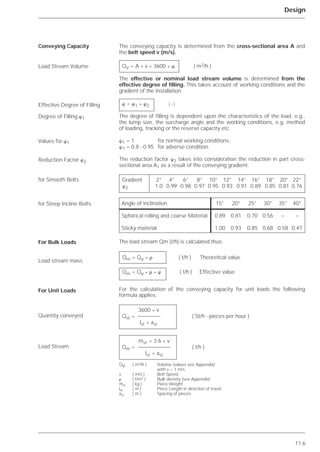
The conveying capacity is determined from the cross-sectional area A and
the belt speed v (m/s).
The effective or nominal load stream volume is determined from the
effective degree of filling. This takes account of working conditions and the
gradient of the installation.
The degree of filling is dependent upon the characteristics of the load, e.g.,
the lump size, the surcharge angle and the working conditions, e.g, method
of loading, tracking or the reserve capacity etc.
␸1 = 1 for normal working conditions;
␸1 = 0.8 - 0.95 for adverse condition.
The reduction factor ␸2 takes into consideration the reduction in part cross-
sectional area A1 as a result of the conveying gradient.
The load stream Qm (t/h) is calculated thus:
For the calculation of the conveying capacity for unit loads the following
formula applies.
Conveying Capacity
Load Stream Volume
Effective Degree of Filling
Degree of Filling ␸1
Values for ␸1
Reduction Factor ␸2
for Smooth Belts
for Steep Incline Belts
For Bulk Loads
Load stream mass
For Unit Loads
Quantity conveyed
Load Stream
QV = A * v * 3600 * ␸ ( m3/h )
␸ = ␸1 * ␸2 ( - )
Gradient 2° 4° 6° 8° 10° 12° 14° 16° 18° 20° 22°
␸2 1.0 0.99 0.98 0.97 0.95 0.93 0.91 0.89 0.85 0.81 0.76
Qm = Qv * ␳ ( t/h ) Theoretical value
Qm = Qv * ␳ * ␸ ( t/h ) Effective value
3600 * v
Qst = ( St/h - pieces per hour )
lst + ast
mst * 3.6 * v
Qm = ( t/h )
lst + ast
QV ( m3/h ) Volume (values see Appendix)
with v = 1 m/s
v ( m/s ) Belt Speed
␳ ( t/m3 ) Bulk density (see Appendix)
mst ( kg ) Piece Weight
lst ( m ) Piece Length in direction of travel
ast ( m ) Spacing of pieces
Angle of inclination 15° 20° 25° 30° 35° 40°
Spharical rolling and coarse Material 0.89 0.81 0.70 0.56 – –
Sticky material 1.00 0.93 0.85 0.68 0.58 0.47
11.7
Design
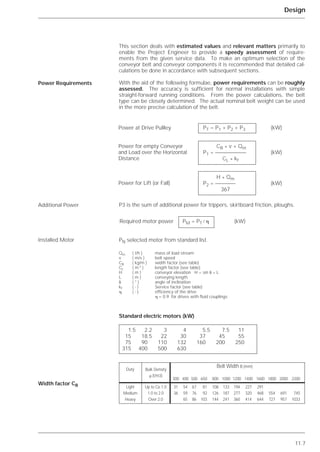
This section deals with estimated values and relevant matters primarily to
enable the Project Engineer to provide a speedy assessment of require-
ments from the given service data. To make an optimum selection of the
conveyor belt and conveyor components it is recommended that detailed cal-
culations be done in accordance with subsequent sections.
With the aid of the following formulae, power requirements can be roughly
assessed. The accuracy is sufficient for normal installations with simple
straight-forward running conditions. From the power calculations, the belt
type can be closely determined. The actual nominal belt weight can be used
in the more precise calculation of the belt.
P3 is the sum of additional power for trippers, skirtboard friction, ploughs.
Standard electric motors (kW)
Power Requirements
Additional Power
Installed Motor
Width factor CB
PT = P1 + P2 + P3 (kW)
CB * v + Qm
P1 = (kW)
CL * kf
H * Qm
P2 = (kW)
367
Required motor power PM = PT / ␩ (kW)
Qm ( t/h ) mass of load stream
v ( m/s ) belt speed
CB ( kg/m ) width factor (see table)
CL ( m-1 ) length factor (see table)
H ( m ) conveyor elevation H = sin ␦ * L
L ( m ) conveying length
␦ ( ° ) angle of inclination
kf ( - ) Service factor (see table)
␩ ( - ) efficiency of the drive
␩ = 0.9 for drives with fluid couplings
1.5 2.2 3 4 5.5 7.5 11
15 18.5 22 30 37 45 55
75 90 110 132 160 200 250
315 400 500 630
Duty Bulk Density
␳ (t/m3)
Light
Medium
Heavy
Up to Ca.1.0
1.0 to 2.0
Over 2.0
31 54 67 81 108 133 194 227 291
36 59 76 92 126 187 277 320 468 554 691 745
65 86 103 144 241 360 414 644 727 957 1033
Belt Width B (mm)
300 400 500 650 800 1000 1200 1400 1600 1800 2000 2200
Power at Drive Pullley
Power for empty Conveyor
and Load over the Horizontal
Distance
Power for Lift (or Fall)
PN selected motor from standard list.
Trippers
(throw-off carraiges)
Scrapers
(for installations L ≤ 80 m)
Material - skirtboard
Discharge plough
Belt Width B (mm)
≤ 500
≤ 1000
> 1000
11.8
Design
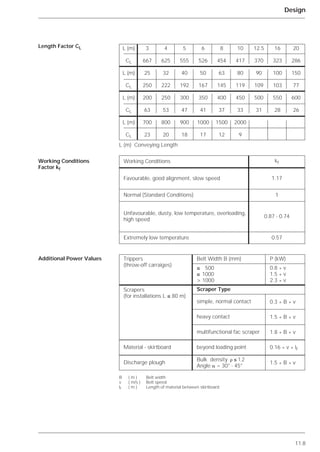
Length Factor CL
Working Conditions
Factor kf
Additional Power Values
L (m) 3 4 5 6 8 10 12.5 16 20
CL 667 625 555 526 454 417 370 323 286
L (m) 25 32 40 50 63 80 90 100 150
CL 250 222 192 167 145 119 109 103 77
L (m) 200 250 300 350 400 450 500 550 600
CL 63 53 47 41 37 33 31 28 26
L (m) 700 800 900 1000 1500 2000
CL 23 20 18 17 12 9
Working Conditions
Favourable, good alignment, slow speed
Unfavourable, dusty, low temperature, overloading,
high speed
Normal (Standard Conditions)
Extremely low temperature
kf
1.17
1
0.87 - 0.74
0.57
Scraper Type
simple, normal contact 0.3 * B * v
1.5 * B * v
1.8 * B * v
heavy contact
multifunctional fac scraper
0.16 * v * lfbeyond loading point
1.5 * B * v
Bulk density ␳ ≤ 1.2
Angle ␣ = 30° - 45°
P (kW)
0.8 * v
1.5 * v
2.3 * v
B ( m ) Belt width
v ( m/s ) Belt speed
lf ( m ) Length of material between skirtboard
L (m) Conveying Length
Belt Type
Nominal Breaking Strength
Number of Plies
Friction Value Factor cR
11.9
Design
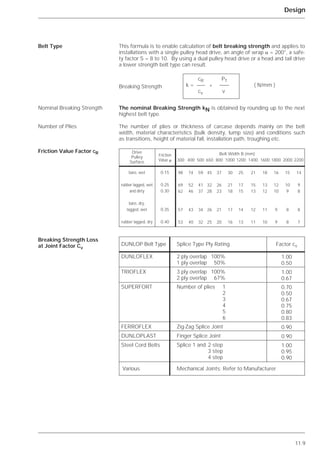
This formula is to enable calculation of belt breaking strength and applies to
installations with a single pulley head drive, an angle of wrap ␣ = 200°, a safe-
ty factor S = 8 to 10. By using a dual pulley head drive or a head and tail drive
a lower strength belt type can result.
The nominal Breaking Strength kN is obtained by rounding up to the next
highest belt type.
The number of plies or thickness of carcase depends mainly on the belt
width, material characteristics (bulk density, lump size) and conditions such
as transitions, height of material fall, installation path, troughing etc.
cR PT
k = * ( N/mm )
cv v
98 74 59 45 37 30 25 21 18 16 15 14
69 52 41 32 26 21 17 15 13 12 10 9
62 46 37 28 23 18 15 13 12 10 9 8
57 43 34 26 21 17 14 12 11 9 8 8
53 40 32 25 20 16 13 11 10 9 8 7
DUNLOP Belt Type
DUNLOFLEX 2 ply overlap 100%
1 ply overlap 50%
1.00
0.50
TRIOFLEX 3 ply overlap 100%
2 ply overlap 67%
1.00
0.67
FERROFLEX Zig-Zag Splice Joint 0.90
DUNLOPLAST Finger Splice Joint 0.90
Steel Cord Belts Splice 1 and 2 step
3 step
4 step
Various Mechanical Joints: Refer to Manufacturer
1.00
0.95
0.90
SUPERFORT Number of plies 1
2
3
4
5
6
0.70
0.50
0.67
0.75
0.80
0.83
Splice Type Ply Rating Factor cv
Breaking Strength Loss
at Joint Factor Cv
Breaking Strength
0.15
0.25
0.30
0.35
0.40
bare, wet
rubber lagged, wet
and dirty
bare, dry,
lagged, wet
rubber lagged, dry
Friction
Value ␮
Belt Width B (mm)
300 400 500 650 800 1000 1200 1400 1600 1800 2000 2200
Drive
Pulley
Surface
11.10
Design
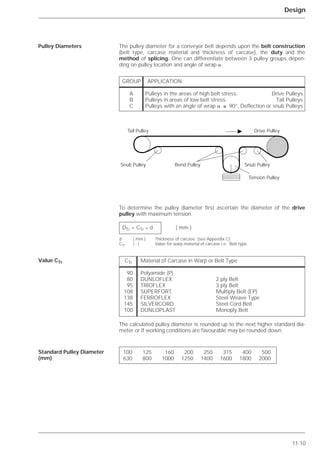
The pulley diameter for a conveyor belt depends upon the belt construction
(belt type, carcase material and thickness of carcase), the duty and the
method of splicing. One can differentiate between 3 pulley groups depen-
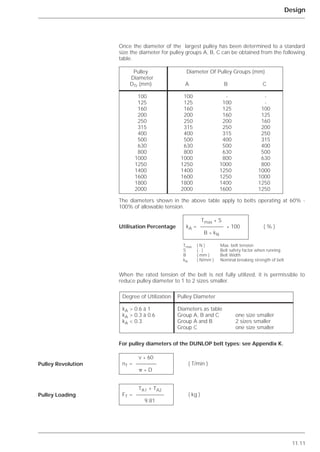
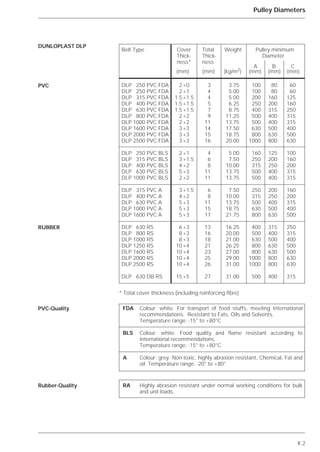
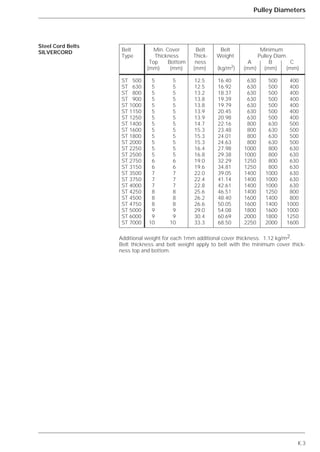
ding on pulley location and angle of wrap ␣.
To determine the pulley diameter first ascertain the diameter of the drive
pulley with maximum tension.
The calculated pulley diameter is rounded up to the next higher standard dia-
meter or if working conditions are favourable may be rounded down.
Pulley Diameters
Value CTr
Standard Pulley Diameter
(mm)
GROUP APPLICATION
A Pulleys in the areas of high belt stress. Drive Pulleys
B Pulleys in areas of low belt stress. Tail Pulleys
C Pulleys with an angle of wrap ␣ ≤ 90°, Deflection or snub Pulleys
DTr = CTr * d ( mm )
d ( mm ) Thickness of carcase (see Appendix C)
CTr ( - ) Value for warp material of carcase i.e. Belt type.
CTr Material of Carcase in Warp or Belt Type
90 Polyamide (P)
80 DUNLOFLEX 2 ply Belt
95 TRIOFLEX 3 ply Belt
108 SUPERFORT Multiply Belt (EP)
138 FERROFLEX Steel Weave Type
145 SILVERCORD Steel Cord Belt
100 DUNLOPLAST Monoply Belt
᭤Tail Pulley
Snub Pulley Bend Pulley Snub Pulley
Drive Pulley
Tension Pulley
100 125 160 200 250 315 400 500
630 800 1000 1250 1400 1600 1800 2000
11.11
Design
Once the diameter of the largest pulley has been determined to a standard
size the diameter for pulley groups A, B, C can be obtained from the following
table.
The diameters shown in the above table apply to belts operating at 60% -
100% of allowable tension.
When the rated tension of the belt is not fully utilized, it is permissible to
reduce pulley diameter to 1 to 2 sizes smaller.
For pulley diameters of the DUNLOP belt types: see Appendix K.
Pulley Revolution
Pulley Loading
Pulley Diameter Of Pulley Groups (mm)
Diameter
DTr (mm) A B C
100 100 - -
125 125 100 -
160 160 125 100
200 200 160 125
250 250 200 160
315 315 250 200
400 400 315 250
500 500 400 315
630 630 500 400
800 800 630 500
1000 1000 800 630
1250 1250 1000 800
1400 1400 1250 1000
1600 1600 1250 1000
1800 1800 1400 1250
2000 2000 1600 1250
Tmax * S
kA = * 100 ( % )
B * kN
Tmax ( N ) Max. belt tension
S ( - ) Belt safety factor when running
B ( mm ) Belt Width
kN ( N/mm ) Nominal breaking strength of belt
Degree of Utilization Pulley Diameter
kA > 0.6 à 1 Diameters as table
kA > 0.3 à 0.6 Group A, B and C one size smaller
kA < 0.3 Group A and B 2 sizes smaller
Group C one size smaller
v * 60
nT = ( T/min )
␲ * D
TA1 + TA2
FT = ( kg )
9.81
Utilisation Percentage
11.12
Design
With rubber lagged drive pulleys the average surface pressure limit is approxi-
mately 70 N/cm2. This limit is only reached on heavy drives and relatively
small pulley diameters.
The transmission capability pü is not to be confused with surface pressure!
The surface pressure is summary calculated, the belt bending stresses being
ignored. With high belt stresses the pulley diameter becomes too large
because of the low values for pü.
pü = 1600 - 2000 N/mm2 above ground
pü = 3000 - 3500 N/mm2 under ground
This formula is no longer used to determine the pulley diameter.
The distance between a terminal pulley and the adjacent fully troughed idler
set at either the head or tail end of a conveyor is know as the transition dis-
tance. In this distance the belt changes from a fully troughed to a flat profile
or vice versa respectively. The belt stretches additionally at its edge zone and
buckling in the middle of the belt is also possible.
To relieve the belt and edge stresses, the pulley may be raised slightly to the
value h (mm) (see Page 11.13).
The necessary transition length for tension distribution with or without pulley
elevation when designing can be estimated or taken from the table.
Average Surface Pressure
Transmission Capability
Torque at Start-Up
Troughing Transition
Elevation of Pulley
TA1 + TA2
pT = ( N/cm2 )
D * B
360 * FU
pü = ( N/mm2 )
␲ * D * ␣ * B
FA * D
MA = ( Nm )
2 * 1000
D ( mm ) Pulley diameter
B ( mm ) Belt width
FA ( N ) Peripheral force at start-up
␣ ( ° ) Angle of wrap
v ( m/s ) Speed
FU ( N ) Peripheral force when running
LM
Lred
l
h
S
␭
L
1
11.13
Design
The pulley lift should not exceed the value h (mm) in order not to get a “ski
jump” effect. Lift-off from the centre roller is not desirable as this would
have an adverse effect on belt tracking.
Values apply to 3 roll idler sets.
1) Reduced lengths Lred apply to the raised pulley with the value h (mm)
according to the table.
Troughing Transition
Pulley Rise
Reduced Transition Distance
Trough Transition Values
Pulley Lift h (mm)
LM = x * s * sin ␭ ( mm )
s2
h = * sin ␭ ( mm )
B
Lred = x * (s * sin ␭ - h) ( mm )
LM ( mm ) Normal transition length
Lred ( mm ) Reduced transition length with raised pulley
l ( mm ) Length of centre carrying roller (see page 11.3)
s ( mm ) Portion of belt in contact with side idler roller, s = 0.5 * (B-l)
x ( - ) Factor for carcase x = 8 for Textile belts
x = 16 for ST. belts
␭ ( ° ) Troughing angle
h ( mm ) Pulley lift
Troughing Angle
Textile belts
LM (mm) Lred
1) (mm)
ST Belts
Lred
1) (mm)
Troughing ␭ 20° 30° 30° 40° 45° 30° 45°
Belt Width
(mm)
500
650
800
1000
1200
1400
1600
1800
2000
2200
410
550
665
850
1000
1190
1370
1550
1710
1920
600
800
970
1240
1470
1740
2000
2260
2500
2800
680
860
1020
1200
1380
1550
1720
1900
870
1100
1310
1540
1770
1990
2200
2450
950
1210
1440
1700
1950
2200
2430
2700
1350
1710
2040
2400
2750
3100
3432
3800
1900
2420
2870
3380
3890
4390
4860
5390
Belt Width
(mm)
37
48
56
68
78
89
98
112
47
62
72
87
100
114
126
143
52
68
80
96
110
125
138
158
800
1000
1200
1400
1600
1800
2000
2200
Troughing Angle ␭
30° 40° 45°
In the transition from inclined to horizontal, the belt edge zone is subjected to
additional stretch. In order not to exceed certain limits, as a rule 0.8% addi-
tional stretch, the transition radius Re has to be dimensioned accordingly.
Minimum radii for 3 roll carrying idlers.
11.14
Design
Convex Vertical Curve
Values of Radius Re (m)
l
S
␭
Re
␦
␣
L
l0
Carrying side
Return side
Re = x * s * sin ␭ ( m )
s ( mm ) Portion of belt in contact with side idler roller
x ( - ) Factor for carcase
x = 125 for textile belts
x = 400 for steel cord belts
L = ␲ * ␦ * Re / 180 ( m )
z = ␦ / ␣ (Pieces)
lo = L / z ( m )
␣ ( ° ) Deviation per idler
␣ = approx 2˚ for 30˚ troughing
␣ = approx 3˚ for 20˚ troughing
␦ ( ° ) Gradient of installation
Convex Radius
Curve Length
Number of Idlers
in Curve
Idler Pitch
Textile belts
20° 30° 45°
500
650
800
1000
1200
1400
1600
1800
2000
2200
6.5
8.5
10.5
13.0
16.0
18.5
21.0
24.0
26.5
30.0
9.3
12.5
15.0
19.5
23.0
27.0
31.0
35.0
39.0
44.0
13.5
17.5
21.0
27.0
32.0
38.0
44.0
50.0
55.0
62.0
30.0
40.0
48.5
62.0
74.5
87.0
100.0
113.0
125.0
140.0
-
-
68.5
88.0
104.0
123.0
141.0
160.0
177.0
198.0
ST Belts
30° 45°
Belt Width
(mm)
11.15
Design
With a concave vertical curve, the belt path goes from horizontal to incline.
At start-up or load change there may be a risk of the belt lifting off the car-
rying idlers in this region. This can lead to a reduction in pre-tension. If due
to special circumstances a brief lift-off can be tolerated then the lifting belt
can be restrained by rollers mounted above the troughing idlers. In any event
action must be taken to ensure that the belt does not lose load material.
With a concave vertical curve, buckling of the belt edges and overstress of
the middle of the belt can occur. (To check calculation see Appendix I.5.)
Concave Vertical Curve
Additional Stretch-buckling
Ra
Lx
Tx
xa
ya
␦
Tx ( N ) Tension at start of curve when fully loaded
m’G ( kg/m ) Belt weight
␦ ( ° ) Gradient angle, up to 18° use 18°, cos ␦ Ӎ1
Tx
Ra = ( m )
m’G * cos ␦ * g
xa = Ra * tan ␦ horizontal distance
ya = 0.5 * Ra * tan2 ␦ vertical distance
Concave Radius
Co-ordinates of
Curve
11.16
Design
One method of solving belt cleaning problems on the return side run is the
use of belt turnover. This method is employed in inaccessible areas such as
conveyor bridges and tunnels. To avoid excessive strain in the edge region
of the belt, the turnover must be a certain minimum length, depending on the
method of turnover, belt type and belt width.
With textile belts up to a width of 1200 mm
and a thickness of 10 mm, the belt may be
turned over unguided and without support.
At the entry and exit points of the turnover
lengths, the belt is fed through a pair of rol-
lers.
With textile and steel cord belts up to 1600
mm wide to support the belt in the middle of
the turnover length, a pair of vertical rollers is
used. At the entry and exit points the belt is
fed through a pair of horizontal rollers.
With textile and steel cord belts up to 2200
mm wide. With this turnover the belt is fed
over support rollers which run on a length-
wise axis.
For smooth running of the belt through the turnover stretch, a minimum belt
tension is necessary.
If Tx is > than T2 or T3 then belt tensions have to be corrected.
Belt Turnover
Un-guided Turnover
Guided Turnover
Supported Turnover
Turnover Lengths
Values for Turnover Lengths
LW (m)
Min. Belt Tension at Turnover
Lw * m’G * g
min. Tx = ( N )
8 * h
Lw ( m ) Length of Turnover Stretch
h ( % ) Degree of sag 1.5% is recommended (h = 0.015)
m’G ( kg/m ) Load due to conveyor belt
B ( m ) Belt Width
Lw
Lw = 1.36 * B * ͱ 71 = 11.5 * B ( m )
Lw = 1.55 * B * ͱ245 = 24 * B ( m )
Method of guiding belt in
Turnover Lengths
Belt Type
free or with guided with a
support rollers middle roller
EP belts 12 * B 13 * B
DUNLOPLAST 16 * B 19 * B
FERROFLEX 17 * B 20 * B
ST. BELTS 18 * B 22 * B
for EP belts
for ST belts
11.17
Design
Within limits, belts are able to negotiate horizontal curves. To do this the car-
rying idlers on the inside of the curve are slightly raised by the angle ␭R accor-
ding to radius and belt tension by approximately 5°-15°.
The exact position has to be determined by adjustment.
For design purposes the following radii may be selected being the smaller
permissible radii RH (m).
The values RH apply to a troughing angle of 30°
Horizontal Curve
Value of Curve Radius
RH
᭤
᭤
᭤
RH
␭R
l
Inside of Curve
␭
l
RH = k * [ l + B * ( 1 - ) * cos ␭ ] ( m )
B
l ( mm ) Length of middle carrying roller (see Page 11.3)
B ( mm ) Belt width
␭ ( ° ) Troughing angle
␭R ( ° ) Lifting of the carrying rollers (ca. 5° to 15°)
k ( - ) Factor (consider belt type and duty)
for EP belts k = 71
DUNLOPLAST k = 150
FERROFLEX k = 225
ST belts k = 245
Belt width
(mm) 300 400 500 650 800 1000 1200 1400
EP belts 20 26 33 42 52 65 72 91
DUNLOPLAST 42 56 69 89 110 137 165 192
FERROFLEX - - - 134 165 206 248 289
ST belts - - - 146 180 224 270 314
Belt width
(mm) 1600 1800 2000 2200 2400 2600 2800
EP belts 104 117 130 142 156 169 182
DUNLOPLAST 220 247 275 - - - -
FERROFLEX 329 370 412 452 - - -
ST belts 359 404 449 493 - - -
12.1
Basis of calculations
After the design of the installation and the main data has been determined an
exact calculation can be undertaken. Established installation components
can be checked and dimensioned. The belt selection can be undertaken
according to forces that have been established and other relevant
criteria.
The resistances to motion within a belt installation may be categorised thus:
- Main resistance
- Secondary resistance
- Slope resistance
- Special resistances
Resistance due to moving the mass of idlers, belt and material on the car-
rying and return runs. Running resistance of idlers (bearing and seal fric-
tion). Resistance due to impressions made in the belt by idlers and the
flexing of the belt.
With gradients ␦ ≤ 18° Cos ␦ = 1.
Resistance occurring mainly in the loading area such as the acceleration of
the material at the loading point. Resistance due to the friction on the side
walls of the chute, resistance due to belt flexing on pulleys, pulley bearing
resistance.
• With normal installations with one loading point, the secondary resistance
can be calculated by using the factor C as part of the main resistance.
Factor C depends on the conveying length and can be taken from the table
on Page 12.3.
• If the secondary resistance relative to the total resistance is high as for
instance with conveyors less than approximately 80 m long with several
loading points, a separate calculation is necessary.
Resistance from load and elevation.
The special resistances are due to installation components such as:
• the forward tilt of outer idler rollers to improve tracking
• material deflection ploughs and belt cleaners, continuous skirtboards
• trippers (throw-off carriages)
• bunker drag out belts
The resistances to motion are relatively simple to calculate. Information not
available such as pulley diameters etc. can be estimated for initial calculation
formulae or taken from the appropriate table.
Formulae for calculation: see Appendix E.
Resistance to Motion FH
Main Resistance FH
Secondary Resistance FN
Note
Slope Resistance FSt
Special Resistances FS
FH = f * L * g * [ m’R + ( 2 * m’G + m’L ) * cos ␦ ] ( N )
FN = ( C - 1 ) * FH ( N )
FSt = H * g * m’L ( N )
12.2
Basis of calculations
Peripheral force steady state working
The sum of the resistances to motion is equal to the peripheral force FU at
the drive pulley (or shared over several drive pulleys).
For installations with one loading point, as a rule the following summation
applies:
Peripheral Force FU
Working Conditions
Summation
Herringbone Belt in Operation
FU = FH + FN + FSt + FS ( N )
FU = C * f * L * g * [m’R + (2 * m’G + m’L) * cos ␦] + H * g * m’L + FS ( N )
C ( - ) Length factor
f ( - ) Artificial friction factor
L ( m ) Conveyor length
g ( m/s2 ) Acceleration due to gravity
m’R ( kg/m ) Mass of the rotating carrying and return idlers
m’G ( kg/m ) Mass of the belt
m’L ( kg/m ) Mass of the load
␦ ( ° ) Gradient of the installation with ␦ ≤ 18° cos ␦ = 1
H ( m ) Conveying height
H > 0 inclined conveying
H < 0 declined conveying
FS ( N ) Sum of the special resistances. For separate calculations see Appendix.
12.3
Basis of calculations
This adjustment factor makes allowance for secondary resistances (See
page 12.1). The influence of Factor C will decrease the greater the conveyor
length. For installations less than a conveying length of approximately 80m or
having several loading points see appendix D.
Factor C
Förderlänge L in m
BeiwertC
L (m) 3 4 5 6 8 10 13 16 20
C 9.0 7.6 6.6 5.9 5.1 4.5 4.0 3.6 3.0
L (m) 25 32 40 50 63 80 90 100 120
C 2.9 2.6 2.4 2.2 2.0 1.92 1.86 1.78 1.70
L (m) 140 160 180 200 250 300 350 400 450
C 1.63 1.56 1.50 1.45 1.38 1.31 1.27 1.25 1.20
L (m) 500 550 600 700 800 900 1000 1500 2000
C 1.20 1.18 1.17 1.14 1.12 1.10 1.09 1.06 1.00
CoefficientC
Conveying Length in mm
12.4
Basis of calculations
The friction factor f is used for the calculations of the resistances to motion. It
provides an estimate of the resistance to rotation of the idlers, the belt resi-
stance (flexing and idler impressions) and material impression resistance.
Values for the factor f are dependent upon the working conditions and con-
struction characteristics of the installation.
The above table values are relevant for v = 5 m/s and a temperature of
+ 20°C.
Under certain circumstances the following adjustments are possible or neces-
sary:
a) With other speeds the following applies:
b) With other temperatures the following applies:
For central European regions and normal working conditions the value of
f = 0.020 - 0.021 would be used.
In extreme temperatures such as those in tropical regions a value for
f = 0.017 would apply.
In extremely low temperatures a value for f up to 0.035 would be used.
Friction Factor f
Adjustments
Horizontal, inclined or slightly declined
installations - Motor driven
Favourable working conditions,
easily rotating idlers, material 0.017
with low internal friction
and good tracking, good maintenance
Normal installation, normal material 0.020
Unfavourable conditions,
low temperature, material 0.023 - 0.027
with high internal friction,
subject to overload, poor maintenance
Installations with steep declines 0.012 - 0.016
creating regenerative conditions
With v <> 5 m/s f = c * f5m/s
v (m/s) 2 3 4 5 6
Factor c 0.80 0.85 0.90 1.00 1.10
With T < 20°C f = c * f20°C
T (°C) +20° 0° -10° -20° -30°
Factor c 1.00 1.07 1.17 1.28 1.47
12.5
Basis of calculations
The mass of rotating parts m’R (kg/m) is calculated from the weight of the
rotating idler rollers on the carrying and return runs.
For the masses mRO and mRu (kg). Applicable to standard rollers diameters
and belt widths 300 mm to 2200 mm. See table in the Appendix.
If this information is not available roller pitch values as per Page 11.3 may be
used.
Standard idler roller diameters (mm) of flat or troughed rollers according to
DIN 15107 are:
The idlers and discs may vary from manufacturer to manufacturer. For loca-
tion of disc rollers see Appendix M.1.
The mass of the belt m’G is determined from the weights of the various belt
types.
For the belt weights m”G (kg/m2) of the DUNLOP-belt types see Appendix C.
Mass of Rotating Parts m’R
Weight of rollers per m
Mass of rollers
mRo et mRu
Roller Pitch
Idler Roller Diameter
Mass of Belt m’G
Belt weight per m
mRo mRu
m’R = + ( kg/m )
lo lu
mRo ( kg ) Mass of one set of carrying idler rollers
mRu ( kg ) Mass of one set of return idler rollers
lo ( m ) Pitch of carrying idlers
lu ( m ) Pitch of return idlers
(51) 63.5 88.9 108 133 159 193.7 219.1
Tube dia. mm. 51 57 63.5 88.9 108 133
Disc rollers 120 133 150 180 180 215
dia. mm. 215 250
m’G = m”G * B ( kg/m )
m”G ( kg/m2 ) Belt weight per m2
B ( m ) Belt width
12.6
Basis of calculations
The load m’L is derived from the cross sectional area of the bulk load stream
Qm alternatively with piece loads, from the weight of one piece.
Peripheral force FA in a non-steady state running condition
At the breakaway and start-up of a loaded installation, the inertial resistan-
ces to motion of the masses to be moved, have to be overcome. The belt
stresses during acceleration have to be kept to a minimum. The initial pulley
peripheral force at start-up must not exceed a certain value.
• The maximum peripheral force FA should not be greater than approx (1.3 to
1.5) * Fu, the steady state running peripheral force.
• In order to accelerate the masses on the conveying length, a force equiva-
lent to a minimum of 20% of the motional resistances should be available.
• The peripheral force FA should be applied to the belt over such a period of
time that the installation is maintained at almost a steady state and so acce-
lerates with minimum additional dynamic forces.
• At start-up with acceleration aA and peripheral for FA one should seek to
ascertain the friction cut-off value between material and belt ( perhaps also
when braking)
Mass of the Load m’L
Material weight per m
Peripheral Force FA
at Start-Up
Recommendations
Friction cut-off
Material Belt
Qm
m’L = ( kg/m )
3.6 * v
mst
m’L = ( kg/m )
lst + ast
Qm ( t/h ) Loadstream mass
v ( m/s ) Belt speed
mst ( kg ) Weight of each piece
lst ( m ) Length of each piece
ast ( m ) Spacing of pieces
aA ≤ ( ␮1 * cos ␦max - sin ␦max ) * g ( m/s2 )
␦ ( ° ) angle of slope of the installation
␦ > 0 inclined conveyors
␦ < 0 declined conveyors
␮1 ( - ) friction value belt/material
␮1 = 0.5 à 0.7
aA ( m/s2 ) acceleration (calculationl, see Page 12.7)
For bulk loads
For unit loads
12.7
Basis of calculations
The peripheral force FU increases at start-up. To take account of the start-up
resistances a factor kA is applied resulting in peripheral force FA. The value of
kA is dependent on the drive unit motor/coupling used.
Rigid couplings are used on small installations up to approx. 30kw motor
power and squirrel cage type. The peripheral force FA is derived from the
installed motor power.
With this type of coupling the start-up torque of the motor is reduced.
The installed motor power may be substantially higher than is necessary
therefore FA should be less than or equal to FU * 2.5.
With hydraulic couplings the start-up torque can be regulated and limited to
the desired start-up factor and by doing this, depending on the size of the
installation, a near steady state running condition can be achieved.
At start-up and braking the acceleration and deceleration forces of the mass
being moved have to be considered. If the drive elements (motor, coupling,
gears) and the non-driven pulley resistances are higher than the remaining
resistances, this has to be taken into account.
If the acceleration time tA is greater than 10 s, in the case of squirrel cage
motors a start-up coupling is necessary because of thermal effects.
Start-Up Factor kA
Rigid Couplings
Flexible Coupling
Hydraulic Coupling
Acceleration aA
PN * ␩ * 1000
FA = kA * ( N )
v
PN ( kW ) installed motor power
␩ ( - ) degree of drive efficiency
v ( m/s ) speed
kA ( - ) start-up factor
KA = 2.0 to 2.2
if FA > FU * 2.5 then FA should = 2.5 * FU, (cut-off torque)
PN
FA = kA * FU * ( N )
PM
FA = kA * FU ( N )
kA ( - ) start-up factor,
kA = 1.2 to 1.5
regulated by the volume of oil in the working circuit.
FA - FU
aA = ( m/s2 )
L * ( m’Red + 2 * m’G + m’L ) + ⌺m’Ared + ⌺m’red
m’Red ( kg/m ) Reduced mass of idlers m’Red ≈ 0.9 * m’R
m’Ared ( kg/m ) Reduced mass of drive elements
m’red ( kg/m ) Reduced mass of non-driven elements (bend pulleys etc)
tA = v / aA ( s )
sA = v * tA / 2 ( m )
Acceleration time
Acceleration Distance
PM ( kW ) required motor power
kA ( - ) start-up factor,
kA = 1.2 to 1.6
12.8
Basis of calculations
The peripheral force FB on braking has to be determined for the most
adverse circumstances. The braking time tB has to take care of safety requi-
rements (emergency stop) or the braking distance sB because of the possi-
bility of continuing flow due to over-run of the conveyor.
The brake has to take account of the braking duty and delay.
Peripheral Force FB
on Braking
Peripheral Force FB
aB = v / tB ( m/s2 )
sB = v * tB / 2 ( m )
FB = aB * L * ( m’Red + 2 * m’G + m’L ) + FU + FT ( N )
FT ( N ) If a great proportion arises from the non-braked elements these forces must be
added.
FT = aB * ⌺mred ( N )
mred ( kg ) Reduced masses of the non-braked elements or pulleys
Braking torque of the Motor
FB * ␮B
MV = ( Nm )
i
MBr = MM + MV ( Nm )
n ( T/min ) Motor revolutions
␮B ( - ) Friction value of brake disc
FB ( N ) Peripheral force on braking
i ( - ) Transmission ratio
FU * v
PT = ( kW )
1000
PM = PT / ␩ ( kW ) FU > 0
PM = PT * ␩ ( kW ) FU < 0
PN ( kW ) selected motor power
Delay
Overun Distance
Delay Moment
Braking Torque of the Motor
Drive Motor at Pulley
Required Motor Power
Motor Power on
Braked Installation
Installed Motor Power
PN
MM = 975 * g * ( Nm )
n
12.9
Basis of calculations
After the peripheral force FU has been ascertained and hence the drive power
PT requirement, the drive system, position and number of motors can be
established.
The single pulley head drive is the most common all drive systems. With hori-
zontal and inclined conveyors these give the most favourable belt stresses
and with declined conveyors with gradients of 1° to 2° providing the peripher-
al force remains positive.
The preferred location of the drive on a declined conveyor is at the tail end.
The drive becomes a generator and acts as a brake.
When a relatively high proportion of motional resistance is due to the return
run, this drive system provides the most favourable belt stress condition.
Degree of Efficiency ␩
(Values)
Nominal Power PN (kW)
Drive System
Single Pulley Head Drive
Tail Drive
Head and Tail Drive
Types of Drive ␩
Wormgear drive 0.7 - 0.8
Toothed chain drive 0.9 - 0.95
V-Rope drive 0.95
Pulley motor 0.96
Normal coupled drive 0.94
Geared and hydraulic coupling 0.90
Hydraulic motor 0.86
Braked installations 0.95 - 1.0
Selected according to DIN 42973
1.5 2.2 3.0 4.0 5.5 7.5 11 15 18.5
22 30 37 45 55 75 90 110 132
160 200 250 315 400 500 630
T1
T2
FU
P1
P2
FU1
FU2 Fu
Fo
T1
T2
FUB
T3
T4
The most favourable distribution of the total power is as follows:
With identical drives i.e. P1 = P2, T4 may be less than Tmin and the pretension
has to be increased accordingly.
With high drive powers it is often necessary to distribute the available perip-
heral force over two pulleys. The angle of wrap can thus be increased to
approx 420°.
The most favourable drive distribution is as follows:
As a rule the friction coefficient ␮ is taken to be the same for both pulleys.
12.10
Basis of calculations
Head and Tail Drive
Dual Pulley Head Drive
PT = P1 + P2 ( kW )
P1 Fo (Primary force)
≈ = x
P2 Fu (Secondary force)
P2 = PT / ( x + 1 ) ( kW )
FU2 = FU / ( x + 1 ) ( N )
FU1 = FU - FU2 ( N )
PT = P1 + P2 ( kW )
P1 FU1 e␮␣
1 - 1 Value for
≈ ≈ e␮␣
2 = x factor x
P2 FU2 e␮␣
2 - 1 see Table
P2 = PT / ( x + 1 ) ( kW )
FU2 = FU / ( x + 1 )
FU1 = FU - FU2 ( N )
Total Power
Distribution
Motor 2
Peripheral force Pulley 2
Peripheral force Pulley 1
Total Power
Distribution
Motor 2
Peripheral force Pulley 2
Peripheral force Pulley 1
Pulley 1
P1
FU1
Pulley 2
P2
FU2
T2
T1
12.11
Basis of calculations
In practice the most favourable distribution of power does not often occur
because the norm is to use equal drive units. As a result of this the drive pul-
leys are not equally utilized. With unequal distribution of the total power,
the drive powers for individual pulleys are thus:
Factor x for various
drive conditions
PT = P1 + P2 ( kW )
P1 FU1
≈ = x
P2 FU2
FU2 = FU / ( x + 1 ) ( N )
FU1 = FU - FU2 ( N )
Total Power
Distribution
Peripheral force Pulley 2
Peripheral force Pulley 1
Pulley 2 Angle of Wrap ␣1 Pulley 1
␮ = 0.25 160° 170° 180° 190° 200° 210°
160° 2.00 2.20 2.40 2.60 2.80 3.00
170° 1.90 2.10 2.30 2.48 2.67 2.86
180° 1.83 2.02 2.20 2.38 2.57 2.75␣2
190° 1.77 1.95 2.12 2.30 2.48 2.65
200° 1.71 1.89 2.06 2.23 2.40 2.57
210° 1.67 1.83 2.00 2.17 2.33 2.50
␮ = 0.3 160° 170° 180° 190° 200° 210°
160° 2.31 2.53 2.76 3.00 3.26 3.53
170° 2.22 2.43 2.66 2.89 3.14 3.40
180° 2.15 2.35 2.57 2.79 3.03 3.28␣2
190° 2.08 2.28 2.48 2.70 2.93 3.18
200° 2.02 2.21 2.41 2.62 2.85 3.08
210° 1.97 2.15 2.35 2.55 2.77 3.00
␮ = 0.35 160° 170° 180° 190° 200° 210°
160° 2.66 2.92 3.20 3.51 3.84 4.18
170° 2.56 2.82 3.10 3.39 3.70 4.03
180° 2.48 2.74 3.00 3.29 3.59 3.91␣2
190° 2.41 2.66 2.92 3.19 3.48 3.80
200° 2.35 2.58 2.84 3.11 3.39 3.70
210° 2.29 2.52 2.77 3.03 3.31 3.61
12.12
Basis of calculations
Before the belt tensions are determined it necessary to check whether the
peripheral force of Pulley 1 or peripheral force of Pulley 2 are fully utilized.
This drive system is treated in the same way as a dual pulley head drive
system.
The peripheral forces can be ascertained as follows:
The calculation of belt stresses is as described under Dual Pulley Head Drive.
Besides the drive systems described further drive distributions and arrange-
ments are possible. These are treated in a similar fashion.
Dual Pulley Head and
Tail Drive
Other Drive Systems
Distribution Utilization of Belt stresses
proportion peripheral force
P1/P2 > x Pulley 1 full T2 = FU1 * c12 - FU2
utilization T1 = T2 + FU
P1/P2 ≤ x Pulley 2 full T2 = FU2 * c22
utilization T1 = T2 + FU
1 1
c12 = c22 =
e␮␣
1 - 1 e␮␣
2 - 1
Drive Factor Pulley 1 Drive Factor Pulley 2
᭤
Pulley 3
Pulley 1
Pulley 2
FU3
P3
FU1
P1
FU2
P2
PT = P1 + P2 + P3 ( kW )
FU = FU1 + FU2 + FU3 ( N )
P1 + P2 FU1 + FU2
≈ ≈ x
P3 FU3
FU3 = FU / ( x + 1 ) ( N )
FU1 + FU2 = FU - FU3 = Fk ( N )
P1 FU1
≈ = w
P2 FU2
FU2 = Fk / ( w + 1 ) ( N )
FU1 = Fk - FU2 ( N )
Total Power
Peripheral Forces
Distribution Head and Tail
Peripheral for Pulley 3
Peripheral force at Head
Distribution Pulley 1 and 2
Peripheral Force Pulley 2
Peripheral Force Pulley 1
The distribution of peripheral forces
at start-up and determination of belt
stresses follows analogously.
12.13
Basis of calculations
From the calculated peripheral forces FU and FA maximum belt tensions T1
and T2. T1A and T2A can be ascertained for the steady state and non-steady
state running conditions respectively.
At start-up of the installation the friction value increases slightly for a short
period of time, therefore calculate thus.
Belt tensions thus calculated are not yet the belt tensions that will actually
occur when working. They may be used for estimating purposes on small
installations. For exact and ongoing calculations the following corrections are
necessary.
Depending on the type of take-up system, a correction of the belt ten-
sion is necessary.
With a fixed take-up the tension pulley is at a fixed location after tensioning.
The centre to centre distance does not change. Depending on changing
loads, the belt stretches and contracts within its elastic limits. The total elon-
gation is constant. For all working condition, the sum of the belt tensions
has to be constant.
The pre-tension has to be calculated and set so as to take account of the non-
steady state running conditions such as start-up and braking. The location of
the take-up pulley does not matter. It can be at the discharge end, the tail end
or the middle of the conveyor installation.
Belt Tension
Belt Tension Correction
1. Correction with fixed
take-up
Location of take-up Pulley
T1 = FU * c1 ( N ) T1A = FA * c1A ( N )
T2 = FU * c2 ( N ) T2A = FA * c2A ( N )
Steady State Running Non-Steady State Running
1 1
c1 = 1+ c2 =
e␮␣ - 1 e␮␣ - 1
Drive Factor tight side Drive Factor slack side
Friction value at start-up ␮A ≈ ␮ + 0.05
1 1
c1A = 1+ c2A =
e␮A␣ - 1 e␮A␣ - 1
Drive Factor tight side at Drive Factor slack side at
start-up start-up
⌺TWorking = ⌺TStart-Up = Constant
᭟
Drive
T1
T2
᭤
᭤
᭤
T3
T4Fv
Return
᭟
᭤
12.14
Basis of calculations
The belt tensions on the bend pulleys are higher at rest than they are when
running.
Because the length of the belt does not alter, the take-up is constant.
The pre-tension has to cater for start-up therefore all belt tensions increase by
the difference between running and start-up conditions.
With a fixed take-up, all belt tensions when running are increased by the
correction value T.
With the movable take-up the belt length is not constant. With changes in
belt stress the take-up weight adjusts to the various belt elongations/length
changes. The belt tensions at the take-up location are always the same. The
take-up weight has to be calculated to cater for the non-steady state running
conditions such as start-up and braking. The belt tensions at the take-up
location are always higher than those necessary for the steady state running
condition.
The take-up weight can be installed at the drive, the tail or at any location.
Stress Distribution
Take-up
Correction value
for fixed take-up
1. Correction with
moveable take-up
Location of take-up weight
᭤
T4
T3 T2
T1
TM
Running
At Rest
TM = ⌺TB / 4 ( N )
T = ⌺TA / 4 ( N )
sB = sA ( mm )
SB ( mm ) Take-up when running
SA ( mm ) Take-up at start-up
⌺TA - ⌺TB
⌬T = ( N )
4
᭤
᭤
T3
T4
Fv
᭤
T2
T1
Fv
᭤
Belt tension at rest
Average belt tension at start-up
12.15
Basis of calculations
The size of the take-up weight depends on the location of the take-up
system.
Because the tension weight is effective both at rest and during running, all
belt tensions increase by the correction value ⌬T.
The control of minimum belt tension. Tmin is necessary in order that the
belt sag between carrying idlers at the loading point does not exceed a cer-
tain value.
If the loading T4 < Tmin the belt would sag between the idlers. To avoid this,
all belt tensions have to be increased by the correction value ⌬T.
Stress Distribution
Correction Value
2. Correction
Correction Value
Running At rest
᭤
T4
T3 T2
T1
FV = T3 + T4 or FV = 2 * T2 ( N )
GV = FV / g ( kg )
⌬T = TA2 - T2 ( N )
⌬T = Tmin - T4 ( N )
( m’L + m’G ) * lo * g
Tmin = ( N )
8 * hrel
hrel = h / lo Sag ratio
hrel = 0.005 to 0.015 for carrying side
hrel = 0.020 to 0.030 for return side
lo (mm) Distance between the carrying idlers
h (mm) Belt sag (see Page 11.2)
Take-up tension
Take-up weight
Minimum belt tension
12.16
Basis of calculations
The tensions T1 to T4 are best determined according to the sequential calcula-
tion principle. This method enables the tension to be ascertained at any given
point on the installation as well as under certain working conditions such as
start-up and braking.
The forces that affect the belt are determined according to their size and
direction in which they operate. Those are the secondary resistances which
arise at the loading point, friction resistances, the slope resistance and the
inertial resistances at start-up and braking.
The force diagram can be applied to the carrying side, return side as well as
to drive and return pulleys.
The point tensions T1 to T4 can be calculated from the condition ⌺F = 0.
Sequential Calculation
Force Distribution
Individual Resistances
᭤
᭤
᭤
᭤
᭤
FN
Fsto
Fo
Fao
Fbo
FU
Fstu
Fbu
Fau
Fu
T4
T3
T1
T2
aB
aB
aA
aA
v
v
᭤
FU
᭤
᭤
T2
T1
᭤
FUTail
T4
T3
Tail drive
FUTail
Carrying side 0 = T1 - T4 - FN - Fo - Fsto - Fao
Return side 0 = T3 - T2 - Fu + Fstu - Fau
with Head Drive 0 = T1 - FU - T2
with Tail Drive 0 = T4 + FU Heck - T3
Main resistance FH = f * L * g * (m’R + 2 * m’G * m’L)
Secondary resistance FN = ( C - 1 ) * FH
Friction resistance
Carrying side Fo = f * L * g * (m’Ro + m’G + m’L)
Return side Fu = f * L * g * (m’Ru + m’G)
Slope resistance
Carrying side Fsto = H * g * (m’G + m’L)
Return side Fstu = H * g * m’G
Inertial resistance
Carrying side Fao = L * a * (m’Redo + m’G + m’L)
Return side Fau = L * a * (m’Redu + m’G)
a ( m/s2 ) Acceleration aA or deceleration aB
m’Redo ( kg/m ) Reduced mass of carrying idlers
m’Redu ( kg/m ) Reduced mass of return idlers
Reduced mass m’Red ≈ 0.9 * m’R
For other formulae symbols see Page 12.2.
The individual resistances are calculated as follows:
12.17
Basis of calculations
Determination of the point tensions (T1 to T4 and TA1 to TA4 with the help of
individual resistances (for peripheral force FU ≥ 0. positive).
The tensions T1 to T4 and TA1 to TA4 must be increased by ⌬T, if the follo-
wing conditions apply:
1. With fixed take-up if ⌺TA > ⌺T
2. With movable take-up if TA2 > T2
3. With minimum belt tension if Tmin > T4
For correction formulae see Pages 12.13 -12.15.
To calculate braking forces the peripheral force FB on braking has to be deter-
mined. The sequential calculation for non-steady state working then begins
with
The inertial mass resistance Fbo and Fbu is determined with the deceleration
aB. The belt tension TB2 lies on the tight side of the drive pulley.
Otherwise the sequential calculation can be done along the same lines.
Single Pulley Head Drive
Correction of belt tensions
Braking
᭤
᭤
T4
T3
T1
T2
FN
FU
T2 = FU * c2 TA2 = FA * c2A
T3 = T2 + Fu - Fstu TA3 = TA2 + Fu - Fstu + Fau
T4 = T3 TA4 = TA3
T1 = T4 + FN + Fo + Fsto TA1 = TA4 + FN + Fo + Fsto + Fao
Belt Tension (start-up) Non-steady state working
Control T2 = T1 - FU
TA2 = TA1 - FA
TB2 = FB * c2A
12.18
Basis of calculations
Tensions T1 to T4 and TA1 to TA4 must be corrected as described under single
pulley head drive.
The tensions T1 to T4 and TA1to TA4 must be corrected as described under
single pulley head drive.
Tail Drive
Correction of belt tensions
Tail Drive
(Braking)
Correction of belt tensions
᭤
᭤
T2
T1
T3
T4
FN
FU
᭤
᭤
T2
T1
T3
T4
FN
FU
T2 = FU * c2 TA2 = FA * c2A
T3 = T2 + Fu + Fo + Fsto TA3 = TA2 + FN + Fo + Fsto + Fao
T4 = T3 TA4 = TA3
T1 = T4 + Fu - Fstu TA1 = TA4 + Fu - Fstu + Fau
Belt tensions steady state Belt tensions non-steady state
working working (start-up)
Control T2 = T1 - FU
TA2 = TA1 - FA
T2 = FU * c2 TA2 = FA * c2A
T3 = T2 - Fu - Fstu TA3 = TA2 - Fu - Fstu + Fau
T4 = T3 TA4 = TA3
T1 = T4 - FN - Fo + Fsto TA1 = TA4 - FN - Fo + Fsto + Fao
Belt tensions steady state Belt tensions non-steady state
working working (start-up)
Control T2 = T1 - FU
TA2 = TA1 - FA
For FU ≥ 0
For FU < 0
12.19
Basis of calculations
The tensions T1 to T4 and TA1 to TA4 must be corrected as described under
single pulley head drive.
The belt tension T2 is dependent on the destribution of the start-up force i.e.
of the utilization of the peripherical force by drive pulley 1 or 2.
Refer to page 12.12.
The tensions T1 to T4 and TA1 to TA4 must be corrected as described under
single pulley head drive.
Head and Tail Drive
Correction
Dual Pulley Head Drive
Belt Tension T2
Correction of Belt Tension
᭤
᭤
T4
T3
T1
T2
FU2
᭤
FU1
᭤
T3
FU1
FU2
T4
T2
T1
᭤
᭤
For FU ≥ 0
For FU ≥ 0
T2 = FU1 * c2 TA2 = FA1 * c2A
T3 = T2 + Fu - Fstu TA3 = TA2 + Fu - Fstu + Fau
T4 = T3 - FU2 TA4 = TA3 - FA2
T1 = T4 + FN + Fo + Fsto TA1 = TA4 + FN + Fo + Fsto + Fao
Belt tensions steady state Belt tensions non-steady state
working working (start-up)
Control T2 = T1 - FU
TA2 = TA1 - FA
T2 = refer to page 12.13 TA2 = refer to page 12.13
T3 = T2 + Fu - Fstu TA3 = TA2 + Fu - Fstu + Fau
T4 = T3 - FU2 TA4 = TA3 - FA2
T1 = T4 + FN + Fo + Fsto TA1 = TA4 + FN + Fo + Fsto + Fa
Belt tensions steady state Belt tensions non-steady state
working working (start-up)
Control T2 = T1 - FU
TA2 = TA1 - FA
12.20
Basis of calculations
A belt conveyor can be divided into sections according to certain working and
topographical conditions with differing lengths and heights. The resistance to
motion for these sections can be calculated as previously with loading point
and discharge point or other special resistances being apportioned to the
section where the resistance occurs.
With varying conditions and changing loads on certain sections, greater or les-
ser resistance to motion can occur, e.g. belt force with continuous loading.
To determine these points, the resistances have to be ascertained under
various working conditions such as load run-on and run-off conditions and
running unloaded.
At the same time it can be established whether the installation has to be
driven by or braked by the motor.
To determine the individual resistances the values of L and H have to be
substituted in the formulae by Lx and Hx of the respective sections.
Under certain circumstances the following working conditions may have to be
examined:
• Inclined loaded sections.
• Declined loaded sections.
Section Calculation
Total Resistance
Peripheral Force
Continuous Load
Continuous Empty
Start of Loading
Ending of Loading
Ftot = FU = Fsec1 + Fsec2 + ... ( N )
᭤
᭤
᭤
᭤
᭤
᭤
᭤
᭤
᭤ ᭤
᭤
᭤
L1
L2
L3
L4
sec 1
sec 2
sec 3
sec 4
᭤
᭤
᭤
᭤
᭤
᭤
H2H4
H3
12.21
Basis of calculations
After the belt width B (mm) has been established, the maximum belt tension
for the steady state and non-steady state working conditions is calculated,
the nominal breaking strength kN of the belt can be ascertained and the
belt type chosen.
The nominal belt strength is equivalent to the minimum breaking
strength rounded up and observing other selection criteria results in the
belt type.
The safety factor of the selected belt is determined and verified. For certain
running conditions there are laid down minimum safety values.
For textile and steel cord belts the following safety factor values can be
used:
For mechanical joints and cold splices other factors apply (see manufacturers
recommendations).
Nominal breaking strength
Safety Factor
Nominal belt strength steady Tmax * SB
state working kN = ( N/mm )
B * cv
Nominal belt strength TAmax * SA
non-steady state running kN = ( N/mm )
B * cv
Tmax ( N ) maximum belt tension steady state working
TAmax ( N ) maximum belt tension non-steady state working
cv ( - ) factor for loss of strength at the splice joint. Values see Page 11.9
B ( mm ) belt width
kN * B * cv kN * B * cv
SB = ( - ) SA = ( - )
Tmax TAmax
Working Conditions Drive Conditions
Steady state Non-steady state
SB SA
Favourable: few loading changes,
large pulleys, few bending 6.7 4.8
stress changes
Normal 8.0 5.4
Unfavourable: many loading changes,
small pulleys, frequent bending 9.5 6.0
stress changes
Steady state Non-steady state
12.22
Basis of calculations
For the selection and correct dimensioning of the belt type a number of crite-
ria and principal influences need to be taken into account. Firstly is the
maximum belt tension decisive in the dimensioning of the carcase. It is
essential to observe the factors of safety for both the running and start-up
conditions. As well as these calculations, further conditions which could
influence the strength, number of plies and quality of the belt have to be
considered.
The belt nominal strength KN is rounded up to the next standard belt type.
When rounding down, the safety factor needs to be checked. Further Criteria
have to be observed.
With the safety factor S the influence of the following are considered:
• Additional stresses at curves
• Overload at start-up
• Tensile strength loss due to disproportionate contribution of the plies
• Strength loss due to impact
• Deleterious effects from penetration, ageing etc.
The values according to the table on page 12.21 should be observed. For the
start-up condition the value TAmax is used when calculating because at start-
up the friction values of the drive pulley increase for a brief period of time.
With smaller installations it is not always necessary to verify the calculated
value of SA.
Certain characteristics of the material load may in turn affect the belt width
dimensioning. The wider the belt and the heavier the load the higher the
strength and the thicker the belt construction irrespective of the calculated
strength requirement.
With the help of the Belt Selection Table (see page 12.25) the appropriate
belt type can be determined depending on the belt width, lump size and
bulk density. With a belt of a lesser type than that recommended there is no
guarantee of stable running.
In the case of multiply belts such as the SUPERFORT range, the strength of
one ply is lost at the joint. With highly stressed and impacted belts this has to
be taken into account additionally. In general the carcases of wider belts
should contain more plies. This does not apply to special constructions such
as DUNLOFLEX and TRIOFLEX.
The impact energy due to the free fall height of material, can be reduced at
the loading point by means of deflection plates, chute and screen bars etc. If
this is not possible or only so to a limited extent more or higher strength plies
should be considered. In special cases a breaker ply is embedded in the car-
rying side cover to project the carcase.
When hot materials are to be conveyed the appropriate heat resistant quali-
ty rubber covers have to be selected. In so doing it is necessary to differentia-
te between the temperature of the load and the permissible temperature of
the belt. The carrying side cover should be thicker than normal and stronger
plies specified. In this way the heat absorption capability is increased and the
elongation due to the influence of heat is reduced.
Further influences are:
The belt speed and hence the heating up and cooling down periods.
The material lump size and the contact density on the carrying side cover.
Installation location (inside or outside, open or closed) and hence perhaps
the effect of a heat concentration.
Selection of Belt Type
Belt Nominal Strength
Belt Safety
Load support
Number of Plies
Impact energy
High Temperature
12.23
Basis of calculations
With extreme low temperature conditions account must be taken of the hig-
her flexing resistance of the belt. Select the fiction factor f accordingly. The
cover quality should be one containing a high percentage of natural rubber.
Depending upon the compounding of the rubber, belts can be used down
to -30°C (maximum to -40°C). PVC belts down to -15°C.
With thicker and stronger belts it is necessary to verify whether the belt will
conform to the troughing angle of the idlers. For good troughing conditions
approx 40% of the belt width when running empty should be making tangen-
tial contact. Approximately 10% should make contact with the centre carrying
idler roller (Recommendation see Page 12.29).
When selecting belt covers, not only the quality appropriate for the load mate-
rial has to be considered, but it is also necessary to ensure there is sufficient
thickness of cover on both the carrying and pulley sides of the belt. If the car-
rying side cover is much thicker than 3 times the pulley side cover there is
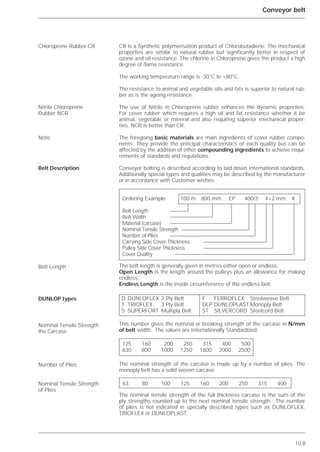
the risk of the belt curling at its edges. (Recommendations see Page 12.30).
With steep inclined conveying using profiled belts from the Chevron or High
Chevron ranges, a carcase should be selected that is 1 or 2 plies stronger
than calculated or in accordance with the belt selection table. By doing this
the running stability is improved especially under wet and frosty conditions.
This can also be an advantage with smooth surface belts which convey stee-
per than 12°.
Normal cover qualities tend to swell even if the load to be conveyed has only
the smallest percentage of oil or fats and the rubber tends to soften. Account
has to be taken as to whether the oil or fat is mineral or vegetable based.
Also the temperature and possibly acidity has to be taken into consideration.
To convey food stuffs, the cover quality must comply with National and
International regulations. One has to differentiate between unpacked and
packed food-stuffs. The most important regulations at present are:
• FDA/USDA: Food and Drug Administration U.S.
• Unbedenklichkeitsempfehlung XXVII. BGA
• British Code of Practice for Food Contact Applications.
If materials contain acids or alkalis the appropriate quality has to be selected.
The concentration and temperature play a decisive part. With increasing
concentration and temperature the durability of the covers declines. They are
attacked by chemicals and swell. Under certain conditions regard has to be
paid to the chemical resistance of the carcase.
Rubber and PVC react differently.
Safety regulations can be important criteria in selecting the belt particulary
with installations where there is a risk of fire or explosions.
Some requirements demand:
• Flame resistant quality (to DIN 22103)
A belt is classed as flame resistant if it does not burn or does not reignite
after the source of the flame has been removed.
• Electrical conductivity (Antistatic)
A conveyor belt is classed as being antistatic if the average value of the sur-
face resistance of the covers does not exceed 3 * 108 Ohm.
Low Temperature
Troughability
Cover Thickness
Steep Angle Conveying
Oil & Fat Effects
Food Stuffs
Chemical Effects
Safety Regulations
12.24
Basis of calculations
• Self extinguishing quality (Underground mines)
The definition of self extinguishing conveyor belting means a quality which
does not promote the spread of flame from the initial fire. To determine the
combustion characteristics a number of tests have to be conducted.
• Occupational hygiene characteristics.
Decomposition products must not come into contact with the skin, must not
be harmful to the respiratory system nor increase filter resistance as a result
of clogging.
The appropriate data and testing regulations are laid down in National and
International Standards.
The course of the installation having certain dimensions, troughing, transition,
vertical curves, horizontal curves and belt turnover can be decisive when
selecting the belt. See Appendix 1.
The type of tensioning system and the amount of available take-up travel can
be important considerations when selecting the belt type having particular
reference to elongation behaviour.
Design of the Installation
Method of Tensioning
Take-up Travel
Flame Test Gallery Test Propane Burner Test Drum Friction Test
DIN 22103 (12.74) DIN 22118 (12.74)
n = 190 ± 10 min-1
Number of samples
6 ( 3 + 3 ) 5 1 6
Time in Flame
45 s 15 min 10 min –
Requirements
a) Sum of after flame < 45 s a) Average value of residual a) No reignition
length ≥ 400mm
b) Individual <15 Residual piece full width b) With flame glow
b) No sample residual length not affected preventative substitute
0 mm (slipobservation necessary)
c) No ignition after air
current
᭤
᭤
᭤
᭤
sample
200
25
sample
1200 x 90
remaining piece
2000 x B
sample
remaining piece
450
200
G
12.25
Basis of calculations
Belt Reference Number In the first instance the belt is selected according to the tensile strength
requirements. In many cases types selected on this basis alone, would be
inappropriate because they do not take into account the belt width, the bulk
density and the material lump size. Tracking, sag and transverse stability
need to be taken into account. It is recommended that the belt type selected
should be verified according to the belt type reference number.
1. With a lump size over approximately 400 mm select one reference number
higher possibly.
2. With lump sizes over 100 mm it is desirable that approximately 30% fines
be present. Without such fines the load impact energy has to be taken
into account.
Material characteristics Indication number of belt type (mm)
Bulks Density Lump Size
␳ (t/m3
) (mm) 400 500 650 800 1000 1200 1400 1600 1800 2000
up to 1 ≤ 0.5-10 1 1 1 1 2 3 4 4 4 5
1.1 - 1.5 – 100 1 1 1 2 3 3 4 4 5 5
+ 100 - - 2 2 3 3 5 5 5 5
1.6 - 2.5 – 100 - - 2 3 3 4 5 5 5 5
+ 100 - - 3 3 4 4 6 6 6 6
over 2.5 – 100 - - 3 3 4 5 6 6 6 6
+ 100 - - 4 4 5 5 6 7 7 7
Belt Type SUPERFORT DUNLOFLEX TRIOFLEX
Reference EP Multiply 2 Ply Belt 3 Ply Belt
1 EP 200/3 D 200
2 EP 315/3 D 250
D 315
3 EP 250/4 D 400 T 250
EP 315/4
EP 500/3
EP 630/3
4 EP 400/4 D 500 T 315
EP 500/4 T 400
5 EP 315/5 T 500
EP 400/4
EP 500/5
EP 630/4
6 EP 500/5 T 630
EP 630/5
EP 800/4
7 EP 800/5 T 800
Instruction for the use of
the tables
1. Select the reference num-
ber from the first table
according to belt width,
bulk density and lump size.
2. The second table contains a
number of alternatives for
the belt type under the
same reference number.
3. Final selection may have to
take into account other cri-
teria dependent on the wor-
king conditions.
12.26
Basis of calculations
At the loading point the demands made of the belt are particularly high. The
load has to be accelerated to the belt speed and often at the same time it
changes in direction of travel and elevation. With coarse material and high
falls the carcase of the belt is subject to additional stresses. These have to be
taken into account when dimensioning the belt.
The impact energy Ef is a measure of the demands when loading a belt
from a height with large lumps.
With the value Ef and with the help of the diagram on Page 12.27. an approp-
riate belt type can be selected.
The surface condition of the material influences what effect the impact ener-
gy has. With soft rounded material the belt is less stressed compared with
that struck by hard sharp edged material.
Load Demands
Mass of a piece
Material Density ␳
State of Material
Volumes Vst
If the mass of a piece of
material is not known, it can
be estimated from it volume.
With regard to physical shape
and by taking the edge length
1 or the diagonal measure-
ment corner to corner k, the
volume Vst can be established
Ef = mst * g * Hf ( Nm )
mst ( kg ) massof a piece (lump)
g ( m/s2 ) acceleration due to gravity
Hf ( m ) delivery height (free fall or via chute)
Material Density Material Density
␳ (kg/dm3) ␳ (kg/dm3)
Anthracite 1.5 - 1.7 Coke 1.2 - 1.4
Concrete (Gravel) 2.2 Marble 2.5 - 2.8
Brown Iron Stone 3.5 - 4.0 Paper 0.7 - 1.2
Brown Coal (Lignite) 1.2 - 1.5 Coal Briquette 1.3
Manganese Dioxide 5.0 Sandstone 2.2 - 2.5
Earth 1.3 - 2.0 Shale 2.7
Fluorspar 3.2 Slag (Furnace) 2.5 - 3.0
Gypsum Burnt 1.8 Soapstone 2.7
Granite 2.5 - 3.0 Bituminous Coal 1.3 - 1.4
Timber, Green 0.7 - 1.3 Rock Salt 2.3 - 2.4
Timber, Seasoned 0.4 - 1.0 Clay, Dry 1.8
Lime, Burnt 2.3 - 3.2 Clay, Fresh 2.6
Limestone 1.9 Tile 1.4 - 2.0
Material Correction
Angular, irregular Type according to
such as limestone table. See page
and gravels 12.27
␳ ≤ 1.0-2.0 t/m3
Rounded, soft such
as brown coal 1 type lower
␳ = 1.2 t/m3
Hard, sharp edged
such as ores, slag 1-2 types higher
␳ ≥ 2.0 t/m3
mst = Vst * ␳ ( kg )
Vst ( dm3 ) volume of piece (see below)
␳ ( kg/dm3 ) density (see table)
Vh
VvV1
V
Physical Volume Vst (dm3
)
Shape Edge Length Diagonal
l (dm) Measurement k (dm)
Vst = 0,52 * l3 –
Vst = 0,192 * k3
Vst = l3
k = 3 * l
Vst = 0,136 * k3
Vst = 2 * l3
k = 6 * l
Vst = 0,083 * k3
Vst = l3
k = 5,25 * l
l
Ί
Ί
Ί
l
k
0,5 l
2l
*
l
k
l
2l
l
k
12.27
Basis of calculations
This diagram shows belt types in relation to impact energy and makes an allo-
wance of safety over that of the critical impact energy which could otherwise
lead to damage.
To reduce the stress at the loading point
there are a number of constructive
measures that can be taken such as
impact deflection plates, grizzly bars or
roller grids, cushioned impact idlers, gar-
land idlers, shaker tables and accelera-
ting belts etc. all of which help to protect
the belt.
A freely tensioned belt is able to absorb
greater impact energy than a supported
belt.
The thickness of the covers also contributes to the reduction of the impact
energy and should be calculated to suit. (Recommendations see Page 12.30).
The friction due to granulated material acceleration increases the abra-
sion and irregular lump acceleration causes more cover damage, grooves
and tears.
According to the predominating material characteristics either a high abrasion
resistant quality or a cut resistant quality has to be used.
Belt Selection
Impact Arrangements
Covers
Cover Quality
250/3
315/3
400/3
500/3
630/4
800/4
1000/4
1250/5
1600/5
2000/5
2500/5
200
250
315
400
500
630
315
400
500
630
800
1000
1250
800
1000
1250
1600
2000
2500
3150
4000
Belt Type
SUPERFORT
3-5 ply
DUNLOFLEX
TRIOFLEX
Steel Cord
Fall Energie E
(Nm)
4000
3000
2000
1500
1000
750
500
400
300
200
150
100
50
f
Abrasion length
V
Acceleration relating to friction Acceleration relating to lump shape
V1
V2
Heightofchute
12.28
Basis of calculations
Terminal with Slatted Pulley.
12.29
Basis of calculations
An appropriate measure of troughability is necessary in order to provide good
belt tracking. This depends mainly on the transverse stiffness of a belt and
its own weight. A sufficiently straight run may be expected if approximately
40% of the belt width when running empty, makes contact with the carrying
idlers. Approximately 10% should make tangential contact with the centre
idler roller.
For normal belt types minimum belt widths for a certain troughing angle can
be estimated.
The test of troughability may be carried out according to ISO R 703 (1975)
or DIN 22102 (1991).
A 150 mm long full width belt test piece is suspended, friction free, by means
of cords whose lengths are according to the belt width. After 5 minutes the
sag s is measured and the sag ratio s/B is determined.
Sag Ratio s/B (minimum values)
Troughability
Test of Troughability
Troughing Angle ␭ 15° 20° 25° 30° 35° 40° 45°
Factor c␭ 0.64 0.71 0.77 0.83 0.89 0 .93 1.00
Material of Weft B Z P ST
Value kW 0.44 0.40 0.38 0.29
Belt Weight
(kg/m2) 8 10 12 14 16 18 20 22 24 26 28
Factor cG 0.50 0.47 0.44 0.41 0.38 0.37 0.36 0.355 0.35 0.345 0.34
Troughing Angle ␭ 20° 25° 30° 35° 40° 45° 50° 55° 60°
Sag s/B 0.08 0.10 0.12 0.14 0.16 0.18 0.20 0.23 0.26
b2
b 3
b
1
B
Suspension cords
Belt sample
B
S
⌺b ≈ 40% of B
b2 ≈ 10% of ⌺b
B ≥ d * c␭ * kW * cG ( m )
d ( mm ) thickness of carcase
c␭ ( - ) factor for troughing angle
kW ( - ) value for carcase material
cG ( - ) factor for belt weight
Minimum Belt Width
12.30
Basis of calculations
The cover thicknesses are selected in such a manner as to provide protection
to the carcase throughout a belts life and hence economic viability.
The thickness of the carrying side cover is mainly dependent upon the
characteristics of the load materials (lump size, abrasiveness, density, tempe-
rature) and conditions at the loading point.
Chemical effects (oil, acidity etc.) and the effects of material temperature are
considered separately. Cover thicknesses should be such that the ratio car-
rying side to pulley side does not exceed 3:1.
Cover Thickness
Loading Conditions
Rating Number
Value dz
Carrying side cover dT = dm + dz ( mm )
dM (mm) Minimum thickness
For textile belts : 1 to 2 mm depending on fabric
For ST belts: 0.7 * cord diameter, minimum 4mm
dZ (mm) Addition to minimum thickness
The value dz is determined from the sum of the rating numbers for different
loading conditions and material characteristics.
Loading Conditions Favourable Average Unfavourable
Height of fall (mm) < 500 500-2000 > 2000
v - vo
Relative speed * 100 (%) < 30 30-60 60-100
v
Damping at loading point good normal moderate
Influence Factor Criteria Rating Number
Loading condition Favourable 1
Average 2
Unfavourable 3
Loading cycle
> 60 1
20 to 60 2
< 20 3
Lump size (mm) < 50 1
50 to 100 2
> 150 3
Bulk density ␳ (t/m3
) < 1.0 1
1 to 1.8 2
> 1.8 3
Abrasiveness Slight 1
Average 2
Severe 3
Sum of rating
numbers
dz (mm)
5 to 6 0 to 1
7 to 8 1 to 3
9 to 11 3 to 6
12 to 13 6 to 10
14 to 15 ≥ 10
2 * L
fB = (s)
v
12.31
Basis of calculations
During running the conveyor belt has to accommodate the stress changes
that occur between start-up, running, full load running and running empty.
These result in elastic elongation of the belt and thus a change in belt length.
This difference between the elongation under the installed pre-tension with
the conveyor at rest and the total elongation under full load running condi-
tions is the additional running elongation.
The elongation is not spread proportionally over the belt circumference but is
dependent upon the effective belt tension and the elongation behaviour of
the plies i.e. the carcase materials.
The length change resulting from the pre-tension and the running elongation
is accommodated by an appropriately dimensioned take-up unit (see Page
6.1).
The elongation of the belt increases with increasing temperature (hot material
and high ambient temperature). The take-up travel is calculated from the rela-
tion E = T/B/⑀ (Hooks Law). This is calculated utilizing the average tensions
TMo on the carrying side run and TMu on the return side run.
For design purposes the following calculation may be used:
For further information regarding the elongation behaviour of conveyor
belts see Appendix H.
Take-Up
Length Changes
Take-up Travel Lengths
Take-Up Travel for
Design Purposes
T1 + T2 T3 + T4 ⌺T
⑀ges = + = ( - )
2 * B * E 2 * B * E 2 * B * E
⌺T * L * 2 ⌬L
⌬L = sp = ( m )
2 * B * E 2
⌺T * L ⌺T * L
sp = = ( m )
2 * B * E 2 * B * kD * kN
E ( - ) Elastic modulus
B ( m ) Belt width
L ( m ) Conveying length
Lges ( m ) Belt length ≈ 2 * conveying length
kD ( - ) Elongation value (see Appendix 1.2)
kN ( N/mm ) Nominal belt strength
( ⑀bl + ⑀el )
Sp = L * ( m )
100
⑀bl ( % ) Permanent elongation EP belts 0.2 - 0.4 %
ST belts -
⑀el ( % ) Elastic elongation EP belts 1 - 2 %
ST belts 0.1 - 0.5%
Tension of the fully loaded belt
Tension of stationary or empty belt
13.1
Calculation Example
Belt Conveyor with a single pulley head drive conveying sand and gravel,
lump size up to 200 mm.
Capacity Qm= 1000 t/h
Bulk Density ␳ = 1.5 t/m3
Degree of Filling ␸ = 70%
Conveying Length L = 258 m
Conveying Height H = 17.9 m
Belt Width B = 1200 mm
Troughing ␭ = 35° 3 Roll
Service Data
Short Calculation cB * v + Qm 277 * 1.68 + 1000
P1 = = = 28.2 kW
cL * kf 52 * 1
Width Factor cB (see table 11.7)
Length Factor cL (see table 11.8)
Factor kf (see table 11.8)
H * Qm 17.9 * 1000
P2 = = = 48.8 kW
367 367
PT = P1 + P2 = 77 kW
77
PM = = 85.6 kW
0.9
PN = 110 kW (selected)
cR * PT 15 * 77
k = = = 917 N/mm
cv * v 0.75 * 1.68
Friction factor cR (see table Page 11.9)
Breaking strength loss cv (see table Page 11.9)
␮ used = 0.3
Belt with 4 plies
EP 1000/4 8 + 4 mm covers
Belt weight 25.4 kg
Carcase thickness 5.8 mm
40
6
17.9
4.8°
212
Carrying Idler Rollers mRo = 22.3 kg
Return Idler Rollers mRu = 19.3 kg
Surcharge Angle ␤ = 15°
Belt Speed v = 1.68 m/s
Layout horizontal 40 m
inclined 212 m ca 4.8°
horizontal 6 m
Power Empty +
horizontal
Conveying
Power for Lift
Power at
drive pulley
Required
motor power
Installed
motor power
Belt breaking
strength
Belt selection
13.2
Calculation Example
Peripheral Force
Peripheral Force
FU = C * f * L * g [ m’R + ( 2 * m’G + m’L ) * cos ␦ ] + H * g * m’L
Factor C = 1.37
Friction factor f = 0.02
Drive Power and Belt Tension
22.3 19.3
m’R = + = 18.6 + 9.6 = 28.2 kg/m
1.2 2
m’G = 25.4 kg/m
1000
m’L = = 165.3 kg/m
3.6 * 1.68
␦ = 4.8° cos 4.8° = 0.997
kA = 1.5 (hydraulic coupling)
FU = 16897 + 29027 = 45924 N
FA = 45924 * 1.5 = 68885 N
45923 * 1.68
PT = = 77.2 kW
1000
drive degree of efficiency ␩ = 0.9
PT
PM = = 85.7 kW
0.9
PN = 110 kW (selected)
( m’L + m’G ) * g * lo
Tmin = = 28061 N
8 * 0.01
With belt sag 1%
Carrying side idle pitch lo = 1.2m
68885 - 45924
aA = = 0.368 m/s2
258 * ( 165.3 + 25.4 + 50.8 )
1.68
tA = = 4.56 s
0.368
1.68 * 4.56
sA = = 3.83 m
2
Load due to idlers
Load due to belt
Load due to material
Incline
Start-up factor
Steady state
Non-steady state
Power at pulley
Motor power
Installed motor power
Min. belt tension
Acceleration
Start-up time
Start-up distance
FU = 1.37*0.02*258*9.81[28.2+(2*25.4+165.3)*0.997]+17.9*9.81*165.3
13.3
Calculation Example
Individual Resistances for Sequential Calculation
Case 1) Tension Weight at Discharge Point (close to T2)
TA2 = T2 (constant tension)
⌬T = TA2 - T2 = 26424 - 22961 = 3463 N
With the value ⌬ T belt tensions T1 to T4 are increased
T1 = 72347 N TA1 = 95309 N
T2 = 26424 N TA2 = 26424 N
T3 = 23732 N TA3 = 26969 N
T4 = 23732 N TA4 = 26969 N
Tmin = 28061 N est nécessaire pour la flèche de 1%, i.e. T4 ≥ Tmin
⌬T = Tmin - T4 = 28061 - 23732 = 4328 N
With the value ⌬ T all belt tensions T1 to T4 and TA1 to TA4 will be increased
Main resistance
Secondary resistance
Frictional Resistances
Carrying side
Return side
Slope Resistance
Carrying side
Return side
Inertial Resistance
Carrying side
Return side
Running (steady state)
Control T1
Start-up (non-steady state)
Control TA1
1st Adjustment
2nd Adjustment
Belt Tensions
FH = 0.02 * 258 * 9.81 * [ 28.2 + ( 50.8 + 165.3 ) * 0.997 ] = 12333 N
FN = ( C - 1 ) * FH = 12333 * 0.37 = 4563 N
Fo = 0.02 * 258 * 9.81 * [ 18.6 + ( 25.4 + 165.3 ) * 0.997 ] = 10566 N
Fu = 0.02 * 258 * 9.81 * ( 9.6 + 25.4 ) * 0.997 = 1768 N
Fsto = 17.9 * 9.81 * ( 25.4 + 165.3 ) = 33486 N
Fstu = 17.9 * 9.81 * 25.4 = 4460 N
Fao = 0.368 * 258 * ( 16.7 + 25.4 + 165.3 ) = 19725 N
Fau = 0.368 * 258 * ( 8.7 + 25.4 ) = 3237 N
Sequential Calculation T1 to T4
T2 = FU * c2 = 45924 * 0.5 = 22961 N
T3 = 22962 + 1768 - 4460 = 20269 N
T4 = T3 = 20269 N
T1 = 20269 + 4563 + 10566 + 33486 = 68884 N
Sum = 132383 N
T1 = FU * c1 = 45924 * 1.5 = 68884 N
TA2 = FA * c2A = 68886 * 0.3836 = 26424 N
TA3 = 26424 + 1768 - 4460 + 3237 = 26969 N
TA4 = TA3 = 26969 N
TA1 = 26969 + 4563 + 10566 + 33486 + 19725 = 95309 N
Sum = 175671 N
TA1 = FA * c1A = 68886 * 1.3836 = 95309 N
T1 = 76675 N TA1 = 99637 N
T2 = 30752 N TA2 = 30752 N
T3 = 28061 N TA3 = 31297 N
T4 = 28061 N TA4 = 31297 N
⌺T = 163549 N ⌺TA = 192983 N
The stipulations T2 = TA2 and T4 ≥ Tmin are fulfilled.
13.4
Calculation Example
Case 2) - Tension Weight at Tail (close to T4)
TA3 = T3 (constant tension)
⌬T = TA3 - T3 = 26969 - 20269 = 6700 N
T1 = 75584 N TA1 = 95309 N
T2 = 29661 N TA2 = 26424 N
T3 = 26969 N TA3 = 26969 N
T4 = 26969 N TA4 = 26969 N
⌬T = Tmin - T4 = 28061 - 20269 = 1092 N
Case 3) Fixed Take-up Tension, Location no Influence
⌺T = ⌺TA
⌬T = (175671 - 132383) / 4 = 10822 N
T1 = 79706 N TA1 = 95309 N
T2 = 33783 N TA2 = 26424 N
T3 = 31091 N TA3 = 26969 N
T4 = 31091 N TA4 = 26969 N
⌺ = 175671 N ⌺TA = 175671 N
⌬T = Tmin - TA4 = 28061 - 26969 =1092 N
For Case 1 (tension weight at discharge) the belt tensions T1 and T2 would
suffice after Adjustment 1. To transmit the peripheral force FU friction cut off
wise. The condition T1/T2 ≤ e␣␮ would be fulfilled with ␮ = 0.3, ␮A = 0.35 and
␣ = 210° :
Running : T1/ T2 = 72347 / 26424 = 2.74 ≤ 3
Start-up : TA1/ TA2 = 95309 / 26424 = 3.6 = e␣␮
With this condition however the belt would not have the desired degree of
sag of 1% at the tail end and fine grained material could escape under the
skirtboards at the loading point. The belt would undulate excessively resulting
in high wear and tear and extra energy consumption.
Sag without adjustment:
The degree of sag desired was 1%
1st Adjustment
2nd Adjustment
Belt Tensions
Stipulation
1st Adjustment
2nd Adjustment
Belt Tensions
Stipulation
Note
T1 = 80797 N TA1 = 96401 N
T2 = 34874 N TA2 = 27516 N
T3 = 32183 N TA3 = 28061 N
T4 = 32183 N TA4 = 28061 N
⌺T = 180037 N ⌺TA = 180037 N
1. ⌺T = ⌺TA 2. T4 or TA4 ≥ Tmin
T1 = 76675 N TA1 = 96401 N
T2 = 30752 N TA2 = 27516 N
T3 = 28061 N TA3 = 28061 N
T4 = 28061 N TA4 = 28061 N
⌺T = 163549 N ⌺TA = 180039 N
1. T4 = TA4 2. T4 ≥ Tmin
( 165.3 + 25.4 ) * 9.81 * 1.2
hd = = 0.0118
23732 * 8
13.5
Calculation Example
Comparison of various Take-up Systems
Evaluation of Belt Safety Factor, Pre-tension and Take-up Travel
a) For the belt and installation, Case 2 (take-up weight at tail) is the most
favourable. The belt safety is almost the same in all three cases. The pre-
tension is substantially less in case 2 and results in the lowest stresses for
both the belt and the installation.
b) With the fixed take-up, the calculated travel must be taken into account
otherwise a shortening of the belt may be necessary later on.
Belt Safety
Pre-tension Force (kg)
Take-up Travel
Result of the
Computer Calculation
kN * cv * B
S =
TX
Working condition
Belt Safety S
Case 1 Case 2 Case 3
steady state 11.73 11.73 11.13
non-steady state 9.03 9.33 9.33
Working condition
Take-up Travel (mm)
Case 1 Case 2 Case 3
at rest 1259 1149 1843
steady state 1674 1674 1843
non-steady state 1975 1843 1843
Case 1 Case 2 Case 3
Pre-tension 2 * TA2 2 * TA4 ⌺T/4 * 2
Tension force (kg) 6265 5720 9176
⌺T * L
sp = ( mm )
2 * B * kD * kN
kN ( N/mm ) Nominal belt strength
cv ( - ) Loss of strength at the joint
B ( mm ) Belt width
TX ( N ) Belt tension at point X
⌺T in Case 1
at rest ⌺T = 4 * 30752 = 123008 N
running ⌺T = 163549 N
at start-up ⌺T = 192983 N
elongation value kD ( - ) = 10.5
DUNLOP-ENERKA Comparison of Tension Systems
Safety Factors Discharge Tail Fixed Take-up
Running 11.7 11.7 11.1
Start-up 9.0 9.3 9.3
Pre-tension
Minimum kg 5387 5500 8955
Maximum kg 6268 5721 9175
Working elongation % 0.28 0.27
Total elongation % 0.77 0.71 0.71
13.6
Calculation Example
Pulley Diameter
Troughing Transition
DA = cTr * d = 108 * 5.8 = 626 mm
cTr
( - ) Parameter for the belts types. See Page 11.10
d ( mm ) Carcase thickness
Drive pulley DA = 630 mm (selected)
Bend pulley DB = 500 mm
Snub/deflection pulley DC = 315 mm
v * 60 1.68 * 60
nT = = = 51 U/min
␲ * DA 3.14 * 0.63
DA ( m ) Trommeldurchmesser
FUA * DA 68885 * 0.63
MA = = = 21699 Nm
2 2
( TA1 + TA2 ) 99637 + 30752
FAT = = = 13291 Kg
9.81 9.81
( TA1 + TA2 ) 130389
pT
= = = 17.3 N/cm2
DA * B 63 * 120
DA und B in cm
LM = x * s * sin ␭ = 8 * 367 * sin 35° = 1684 mm
x = 8 Factor for carcase
s = 367 mm Side idler roller contact made by belt
␭ = 35° Troughing angle
s2 3672
h = * sin ␭ = * sin 35° = 65 mm
B 1200
Lred = x * ( s * sin ␭ - h ) mm
Lred = 8 * ( 367 * sin 35° - 65 ) = 1164 mm
v * 60 1.68 * 60
nT = = = 51 R/min
␲ * DA 3.14 * 0.63
DA ( m ) Pulley diameter
FUA * DA 68885 * 0.63
MA = = = 21699 Nm
2 2
( TA1 + TA2 ) 99637 + 30752
FAT = = = 13291 kg
9.81 9.81
( TA1 + TA2 ) 130389
pT
= = = 17.3 N/cm2
DA * B 63 * 120
DA and B in cm
s2 3672
h = * sin ␭ = * sin 35° = 65 mm
B 1200
Lred = x * ( s * sin ␭ - h )
Lred = 8 * ( 367 * sin 35° - 65 ) = 1164 mm
Pulley revolutions
Maximum torque
Pulley loading
Drive pulley
Surface pressure
Lift of pulley
for troughing 30°
Reduced
transition length
13.7
Calculation Example
Convex Vertical Curve
Concave Vertical Curve
Re = x * s * sin ␭ = 125 * 367 * sin 35° = 26.3 m
x = 125 (factor for carcase)
Tx 29703
Ra = = = 120 m
m’G * 9.81 * cos ␭ 25.4 * 9.81 * cos 35°
Tx = T4 + f * Lx * g * ( m’Ro + m’G + m’L ) = 29703 N Belt tension at start of curve
T4 = 28061 N Belt tension when running
Lx = 40 m Horizontal distance before the curve
Co-ordinates of beginning X = Ra * tan ␦ = 120 * 0.0839 = 10.1 m
and end of the curve Y = 0.5 * Ra * tan2 ␦ = 0.4 m
17.9
sin ␦ = = 0.0844 ␦ = 4.8°
212
X
Y
Ra
␦
13.8
Calculation Example
In the regions where the belt goes from flat to troughed, trough vertical and
horizontal curves or is turned over, additional stresses and strains occur at the
edge zones or in the belt centre. This can result in a reduction in the permissi-
ble minimum safety at the belt edges or belt centre. The tension can become
negative creating buckling at the centre or flapping at the edges. For additio-
nal information see Appendix 1.
The required values for the calculation for the belt safety running empty at
head and tail were extracted from the computer calculation.
Additional Tension
Adjustment
Safety in the edge zone
Elongation at T1
(running)
Curve length
Additional elongation
Total elongation
Elongation at Belt Centre
Discharge Point
Min. safety at running empty
Elongation at T1 empty
Additional elongation
Total elongation
Elongation at Belt Centre
at Tail
Min. safety at running empty
Elongation at T1 empty
Additional elongation
Total elongation
1
⑀0 = = 0.00814
10.5 * 11.7
3.14
= * 35° = 0.61056
180
12002
* 0.61052 3672 367
⑀K = * * ( 0.5 - ) = 0.00705
16842 12002 3 * 1200
⑀ges = 0.00814 + 0.00705 = 0.01519
1
Smin = = 6.27 ≥ 4 no overstress
10.5 * 0.01519
␭
Smin = 25.8 at discharge point (head)
1
⑀0 = = 0.003692
10.5 * 25.8
12002
* 0.61052 3673
⑀M = * = 0.0018049
16842 3 * 12003
⑀min = 0.003692 - 0.0018049 = 0.0018871
⑀min ≥ 0 no buckling
Smin = 32.1 (value from computer calculation)
1
⑀0 = = 0.0029669
10.5 * 32.1
⑀M = 0.0018049
⑀min = 0.0029669 - 0.0018049 = 0.001162
⑀min ≥ 0 no buckling
13.9
Calculation Example
Computer Calculation
Adjustments of
Transition Lengths
DUNLOP-ENERKA CONVEYOR BELT CALCULATION DATE 06.08.93
Drive System : Single Pulley Head Drive Firm : Musterman
Tension : GTU at Head Drive Project : Example
Coupling : Hydraulic Coupling Position : 12
INSTALLATION MATERIAL CONVEYOR BELT
Capacity 1000 t/h Material Sand & Gravel Belt Type multiply
Conveying Length 258.0 m Density Ambiant Belt Type EP 1000/4
Lift 17.9 m Lump Size (mm) 1.50 t/m3 Covers 8 + 4 mm
belt Width 1200 mm Temperature max. 50 Quality RA
Belt Speed 1.68 m/s Surcharge Angle 15° Weight 25.4 kg/m
DRIVE PULLEYS IDLER ROLLERS
Power Running Empty7.0 kW Drive Pulley 630 mm Roller dia. Carrying 133 mm
Additional Power 0.0 kW Tension Pulley 500 mm Roller dia. Return 133 mm
Required Power 85.7 kW Snub Pulley 315 mm Roller Weight Carrying 22.3 kW
Installed Power 110.0 kW Max. Torque 21699 Nm Roller Weight Return 19.3 kg
Degree of Efficiency 0.90 Drive Pulley Rev 51.0 R/min Roller Pitch Carrying 1.20 m
Angle of Wrap 210° Load-Drive Pulley 13290 kg Roller Pitch Return 2.00 m
Friction Coefficient 0.020 “ Tension Pulley 6268 kg Loading, Carrying 229 kg
Drive Factor 1.5 Friction Factor Loading, Return 51 kg
Belt Sag 1.0 % Drive Pulley 0.30 Rev. Carrying Roller 241.4 r.p.m
Weight 0 kg Idler Type 3 Port 35°
Safety Factor : Running SB = 11.7 Acceleration Line : Loaded 4.56 S
: Start-up SA = 9.0 : Empty 0.51
PRE-TENSION CRITERIA BELT SAG SLIP SAFETY FACTOR
Running At Start-up Running At Start-up
Belt Tension T1 (N) 76667 99629 72349 95311
Belt Tension T2 (N) 30743 30743 26425 26425
Belt Tension T3 (N) 28061 31297 23743 26979
Belt Tension T4 (N) 28061 31297 23743 26979
Belt Tension Sum 163532 192967 146260 175695
Tension Weight 6268 kg 5387 kg
Take-up Travel (absolute): Movement Distance Weight: Belt Elongation:
Weight at Rest............1259 mm At Rest....................... 0 mm Under Pre-tension ....... 0.49 %
Full Load Running .......1674 mm Full Load Running ...... 415 mm Working Elongation..... 0.28 %
Full Load Start-up........1976 mm Full Load Start-up ....... 717 mm Total Elongation........... 0.77 %
Elongation Value .........10.5 (-)
Measurement of Installation Elements:
Troughing Transition ......................... 1686 mm Convex Vertical Curve .......................... 26 m
Pulley Lift ......................................... 65 mm Concave Vertical Curve ......................... 119 m
Reduced Troughing Transition.......... 1170 mm Measurement xa horizontal .................. 10.0 m
Measurement ya vertical ...................... 0.4 m
For calculation purposes missing data assumed.
Data with Value 0 were not calculated i.e., not fed in.
We cannot take responsibility for the calculation.
Adjustment of Additional Tension Transition Lengths
Drive : Single Pulley Head Drive Weight at Discharge
Belt Width : 1200 mm 3 roll 35° KD = 10.5 Belt EP 1000/4
T1 Full = 76667 N Discharge Full SB = 11.7 Discharge L normal = 1686 mm
T1 Empty = 34939 N Discharge Empty SB = 25.8 Tail L normal = 1686 mm
T4 Full = 28061 N Heck Full SB = 32.1 Discharge L reduced = 1170 mm
T4 Empty = 28064 N Heck Empty SB = 32.1 Tail L reduced = 1170 mm
Dyn. Tensile Strength Smin = 4.0 Pulley Lift = 65 mm
Belt Edge Belt Centre
Troughing Transition
Criteria
Discharge L normal 0.01516 6.28 0.00189 No buckling
Tail L normal 0.01001 9.51 0.00116 No buckling
Discharge L reduced 0.01586 6.01 0.00146 No buckling
Tail L reduced 0.01071 8.89 0.00074 No buckling
Continue Calculation (1) Vertical Curve (3) Belt Turnover (5)
Change Transition Length (2) Horizontal Curve (4)
13.10
Calculation Example
DUNLOP Conveyor Belts at Crusher Plant.
14.1
Slider Bed Belt Conveyors
The conveying of unit loads is generally done by slider belts with conveying
lengths up to about 100m. With heavy loads or long length conveying, the
belt is tracked over flat or slightly troughed idlers.
The supporting or slider surface can be made from various materials with
different friction values e.g. steel, wood or synthetic.
To avoid a `suction’ effect with the belt, transverse slots can be made at
intervals in the supporting surface and perhaps relieving rollers fitted.
The belt width should be somewhat greater than the longest edge length of a
single piece except with pieces loaded in the direction of belt travel.
The speed of the slider belt must be in keeping with the type of unit load. As
a rule V is from 0.2 to 1.5 m/s.
Slider Belts
Support Surface
Belt Widths
Belt Width
Speed
Carrying Side Return Side
Supporting Surface Idlers
Drive Pulley Tail and Tension
Pulley
B ≈ max. edge length + 100 ( mm )
z * ( l + a )
v = ( m/s ) With a load of z pieces per hour
3600
l + a
v = ( m/s ) With a load at time interval t
t
z ( pieces/hour) Number of pieces per hour
l ( m ) Length of piece
a ( m ) Spacing of pieces
t ( s ) Loading interval
᭤ v
l a ᭤᭤
᭤
m’G + m’L
pm = ( kg/m2 )
B
For bulk loads
14.2
Slider Bed Belt Conveyors
The conveying capacity can be evaluated from the given data.
For bulk loads see appropriate tables.
The total resistance to motion and therefore the pulley peripheral force FU is
calculated from the sum of the individual resistances. With slider belts the
sum of the main resistances from friction on the carrying and return side is
relatively high compared with belts supported by idlers.
The secondary resistances are independent of the installation length and only
occur at certain points. Only with relatively short installations is the value
greater that 1.
The secondary resistances are estimated using factor Cg. The value is depen-
dent on the average surface loading. The effect of the secondary resistances
is considerably smaller than obtained from the friction value ␮g between belt
and supporting surface.
Conveying Capacity
Resistance to Motion
Peripheral Force
Secondary Resistances
Factor Cg
Average Surface Loading
m
Qm = 3.6 * v * ( t/h )
l + a
FU = Cg * ( Fo + Fu ) + Fst + FS† ( N )
Conveying Average Surface Loading
Length pm (kg/m2)
L (m) 5 -10 up to 300
2.5 1.8 1.04
5 1.4 1.02
10 1.2 1.01
25 1.09 ≈ 1
50 1.05 ≈ 1
>100 ≈ 1 ≈ 1
zm * m
Qm = 3.6 * v * ( t/h )
L
z * m
Qm = ( t/h )
1000
v ( m/s ) Belt speed
m ( kg ) Mass of piece
zm ( St/m ) Number each metre zm = L / ( l + a )
z ( St/h ) Pieces per hour
L ( m ) Conveying Length
m’G m’L
pm = + ( kg/m2 )
B b
For unit loads
b B
l
m’G (kg/m) Load due to belt
m’L (kg/m) Load due to material (see page 12.6)
B (m) Belt width
b (m) Load width or width of piece
l (m) Length of piece
14.3
Slider Bed Belt Conveyors
Frictional resistance occurs on the carrying and return side either sliding or
rolling resistance depending on how the belt is supported.
The average friction value between belt and supporting surface was deter-
mined thus:
• Surface load p = 20 - 500 N/mm2
• Speed v = 0.2 - 0.8 m/s
The friction value ␮g is mainly depen-
dent upon the combination of the belt
under side surface and the tempera-
ture, the speed and the surface load-
ing.
With increasing temperature the fric-
tion value ␮g increases with PVC run-
ning side surfaces and decreases
with fabric surfaces.
Independent of the characteristics of the slider surface, the friction value ␮g
increases with increasing speed and decreases with increasing surface loa-
ding. When selecting the friction value these parameters can be taken into
account according to the given working conditions.
Frictional Resistances
Carrying Side
Return Side
Friction Value ␮g
Temperature
Speed Surface
Loading
Fo = ␮g * L * g * ( m’L + m’G ) ( N )
Fo = 2 * zR + 0.02 * L * g * ( m’L + m’G ) ( N )
Fu = ␮g * L * g * m’G ( N )
Fu = 2 * zR + 0.02 * L * g * m’G ( N )
m’L (kg/m) Load due to material m’L = Qm / 3.6 / v ( kg/m )
m’G (kg/m) Load due to belt
zR (pieces) Number of rollers
␮g (-) Friction value between belt and supporting surfaces
(see table)
Slider Bed Surface - Upper Surface Temperature (°C)
Steel Sheet Polished Synthetic Hard Wood
-20° 0° +18° +40° +18° +18°
Cotton (bare) 0.75 0.70 0.45 0.35 0.40 0.35
EP (bare, impregnated) 0.30 0.30 0.30 0.25 0.30 0.25
Rubber covered 0.90
Cotton (PVC impregnated) 0.60 0.55 0.50 0.40 0.45 0.35
PVC (film) 0.60 0.60 0.60 0.55 0.60 0.50
PVC (smooth) 0.55 0.70 1.00 1.70 1.30 0.95
PVC (textured) 0.50 0.65 0.80 1.30 1.10 0.75
Sliding
On rollers
Sliding
On rollers
1,4
1,2
1,0
0,8
0,6
0,4
0,2
0
-20 0 20 40 60 80 100
PVC
Cotton Rayon
(bare)
B, Z, EP
Temperature t in °C
Frictionvalue␮g
0,8
0,6
0,4
0,2
0
10 20 304050
steel plate
hard wood
Surface pressure p in N/mm
Friction
value␮g
hard synthetic
2
100 200 300 400
0,8
0,6
0,4
0,2
0
0 0,2 0,4 0,6 0,8
steel plate
hard wood
Belt speed v m/s
Friction
value␮g
hard synthetic
14.4
Slider Bed Belt Conveyors
The special resistances have to be calculated separately according to the con-
ditions existing.
• Resistance FA1 Skirtboard seals
• Resistance FAw Tripper (throw-off carriage)
• Resistance FAb Scraper
• Resistance FMe Knife edges
• Resistance FSp Unit load barrier
• Resistance FLa Load deflector
Resistance from side skirtboards used to channel the load stream (value).
Resistance due to trippers (values)
Resistance due to simple scraper for cleaning belts upper surface.
Resistances due to knife edges (value). Knife edges are used to change the
direction of very thin slider belts where particularly small transition gaps are
necessary. At such knife edges relatively high temperatures may develop, up
to approx. 150°C.
Slope Resistance Fst
Special Resistance FS
Resistance FAl
Resistance FAw
Resistance FAb
Resistance FMe
Fst = H * g * m’L ( N )
H ( m ) elevation (lift or fall)
FS = FAl + FAw + FAb + FMe + FSp + FLa
FAl = 160 * lf ( N )
lf ( m ) Length of skirtboards per metre of conveying length
FAw = z * k ( N )
Belt Width Factor k for Tripper
(mm) fixed movable
300 - 500 1000 1100
650 1500 1700
800 2000 2200
1000 3500 3600
1200 4400 5100
>1200 4700 5400
FMe = z * 0.1 * B ( N )
FAb = z * 800 * B ( N )
z ( - ) number of trippers
k ( - ) factor
z ( - ) Number of scrapers
B ( m ) Belt width
z ( - ) Number of knife edges
B ( m ) Belt width
14.5
Slider Bed Belt Conveyors
Resistance due to unit load blockage.
When conveying unit loads temporary hold-ups may occur due to congestion,
that is, the belt slides underneath the loaded units resulting in a frictional resi-
stance. This friction resistance can be very high in comparison to the frictional
resistance on the belts running side.
Resistance due to sideways transfer of load when conveying horizontally
(load deflector). For bulk and unit loads the following values can be used.
For light bulk and unit loads these values may be reduced. With sideways
transfer of the load, the belt is deflected in the opposite direction.
Appropriate tracking devices need to be built in.
Resistance FSp
Resistance FLa
FSp = ␮l * g * L1 * m’L * cos ␦ - m’L * H1† ( N )
L1 ( m ) Hold-up length
␦ ( ° ) Gradient of installation
␮l ( - ) Friction factor belt/load
This friction value can differ widely and depending on the load can be
greater than the friction value µg between belt and slider surface.
H1 ( m ) Lift (or fall)
m’L ( kg/m ) Load due to material
Slider
Slider Surface
Hold-up Device
L1
Belt Width
(mm) ≤ 500 650-800 1000-2000
FLa (N) 800 1500 3000-3500
Deflector
14.6
Slider Bed Belt Conveyors
The motor power PN is selected from the standard list with the appropriate
rounding up or from existing stock.
The drive force of a slider belt installation is as a rule over-dimensioned
because of the lower power requirements. Mostly squirrel cage motors with
direct on-line starting are used. The start-up torque is approx. 2 - 2.6 times
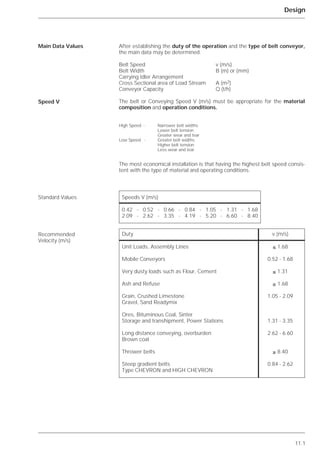
higher than the nominal torque.
If FA ≥ 2.6 * FU , then calculate thus:
This prevents excessive over-dimensioning of the motor and thus the use of
an overstrength belt.
The belt tensions are calculated from the peripheral forces FU et FA.
In selecting the belt, the highest value is the deciding factor.
The friction value ␮ depends on the running side of the belt and the surface
of the drive pulley.
For factors c1 and c1A: see Appendix F.1.
At start-up the following may be used:
Drive Power
Motor Power
Installed Power
Peripheral Force FA
Note
Belt Tensions
Friction Value ␮
Drive Factor c1
FU * v
PT = ( kW )
1000
PT
PM = ( kW )
␩
PN ( kW )
PN
FA = 1.5 * FU * ( N )
PM
FA = 2.6 * FU ( N )
T1 = FU * c1 ( N )
T1A = FA * c1A ( N )
Running Side Drive Pulley Condition Friction
of belt value ␮
Rubbered Lagged dry 0.30
damp 0.25
Bare dry 0.22
damp 0.20
Fabric Lagged dry 0.25
damp 0.22
Bare dry 0.15
damp 0.15
␮A = ␮ + 0.05
14.7
Slider Bed Belt Conveyors
In selecting the belt type for a slider application, the tensile strength is
largely of secondary consideration because of the low stresses. Nearly
always the belts are over dimensioned. Transverse stability and the loca-
tion of the belt are particular considerations.
As a rule a check on the factor of safety of the selected belt is sufficient.
Often with slider belt installations, extremely small pulleys are used, for
example, to enable the bridging of gaps between two installations.
The advice of the belt manufacturer should be sought, particularly about pro-
blems of making the belt endless.
Belt Types
Pulley Diameter
Rufftop Belt for Sack Conveying
kN * B * cV
S = ≥ 10-12
Tmax
Tmax * S
kN = N/mm
B * cV
KN ( N/mm ) Nominal breaking strength
B ( mm ) Belt width
CV ( - ) Factor for the loss of breaking strength at the joint.
See Page 11.9.
Tmax ( N ) Maximum belt tension
PN
S = ( 6 - 8 ) *
PM
Safety Factor
Belt type
15.1
Bucket Elevators
With bucket elevators different bulk loads such as sand, gravel, chippings,
coal, cement, grain, flour, fertilizer etc. can be conveyed either vertically or
sloping upwards. Belts with buckets attached are used as the carrying
medium. With bucket elevators, great heights for example, over 100m can be
surmounted with high strength belts. They run with low noise levels and low
vibrations at a relatively high speed. They require only a small ground area
and are preferred in buildings, silos and warehouses.
Nominal Capacity VB (l) The nominal capacity VB of the bucket is determi-
ned from the geometric dimensions and a horizontal
surface filling level (water filling).
The type of bucket is determined in the main by the material and the method
of discharge either by gravitational or centrifugal emptying.
DIN 15231 Flat bucket for light loads such as flour, semolina, grain.
DIN 15232 Flat rounded bucket for light granulated loads such as grain.
DIN 15233 Medium deep bucket for sticky loads such as cane sugar.
DIN 15234 Deep buckets with a flat back wall for heavy pulverized loads or
coarse ground loads such as sand, cement, coal.
DIN 15235 Deep buckets with curved back wall for light flowing or rolling
loads such as fly ash and potatoes.
For dimensions, capacities and weights, see Page 15.12.
For high speeds (V = 1.05 to 4.2 m/s) according to the type of material as a
rule the flat, flat hB rounded or medium deep buckets are used (centrifugal
discharge).
For low speeds (v = 0.42 to 1.05 m/s) the deep closed buckets are used (gra-
vitational discharge). See also Page 15.3.
Bucket Elevators
Bucket Types
VB
QV = 3.6 * v * ␸ * ( m3/h )
a
Qm = QV * ␳ ( t/h )
QV * a
VB = ( litres )
3.6 * v * ␸
Qm * a
Vm = ( kg )
3.6 * v * ␸
VB ( l ) Nominal capacity of one bucket
␸ ( - ) Degree of filling
v ( m/s ) Speed
a ( m ) Bucket Pitch
␳ ( t/m3 ) Bulk density of load
eB ( mm ) Bucket Projection
hB ( mm ) Bucket Height
Load volume
Load mass
Bucket capacity
Weight of material
per bucket
hB
eB
DIN 15231
hB
eB
DIN 15234
hB
eB
DIN 15235
hB
eB
DIN 15232
hB
eB
DIN 15233
Tambour de commande
Racleur
Rouleaux pour la
stabilisation de la bande
Goulotte de chargement
Système de protection
contre les poussières
Tambour de renvoi
Pied de l’élévateur
Déchargement
Hauteurd’élévation
Drive pulley
Discharge
Scraper
Feed chute
Heightofelevators
Return pulley
Elevator boot
Support rollers
Protection against
falling material
15.2
Bucket Elevators
The measure of the effective utilization of the bucket capacity, is the degree
of filling ␸.
Major influences are: • Method of loading
• Speed
• Bucket spacing
• Bucket shape
The speed depends upon the function of the bucket elevator, the type of
loading and discharge.
The following speeds are recommended:
Degree of Filling
Speed
eff. bucket filling
␸ =
nominal capacity
Type of Material Degree of Filling ␸
Potatoes, Turnips, Onions 0.6
Grain, Barley, Rye 0.75
Earth, Sand - damp 0.5
dry 0.7
Sugar beet 0.5
Sliced beet 0.65
Fertilizer 0.75
Coal, Coke - large 0.5
fine 0.7
Gravel, Stone - large 0.5
fine 0.7
Sugar, Salt 0.75
Moulding sand - dry 0.6
Soya beans, Pulses 0.7
Cement 0.75
Type of Bucket Elevator V (m/s)
Loading direct or by scoop action,
gravitational discharge, slow moving for Up to 1 m/s
heavy materials such as ballast and earth.
Loading direct or by scoop action,
Centrifugal discharge for normal material 1 - 2 m/s
such as sand and fertilizer.
Loading direct or by scoop action,
As a rule, centrifugal discharge, very fast 2 - 4 m/s
running, only with free flowing or light and more
easily scooped material such as grain
The loading i.e., the filling of the bucket can be done either directly or by
dredging action. Scoop loading is only possible with free flowing materials
and is to be recommended.
The bucket attachments and bucket brim are subject to arduous duty. With
direct loading the base area (boot) has to be kept clean. Danger of buckets
being torn off.
Scoop Loading Direct Loading Direct Loading
close pitch buckets
(continuous buckets)
The discharging of bucket contents can be done by gravitational or centrifugal
means. It depends on the speed and the pulley diameter. When running
around the pulley, the resulting force gravitational and centrifugal alter in size
and direction but Pole P stays the same for each bucket position.
Centrifugal Discharge
With high speeds and light flowing loads or coarse granulated, hard materials.
Gravitational Discharge
With low speeds, heavy loads with large lumps or light dusty materials
15.3
Bucket Elevators
Loading
Discharging
g 895 v * 60
l = = ( m ) n = ( R.P.M. )
4 * ␲2
* n2 n2 ␲ * D
l < ri Centrifugal Discharge.
The pole lies within the disc. Bucket with large opening is necessary.
The centrifugal discharge only applies when speeds are > 1.2 m/s.
l > ra Gravitational Discharge.
The pole lies outside the bucket brim. The material slides down over
the inner wall of the bucket.G
S
eB
rs
ri
ra
l
Pôle P
᭤
᭤
᭤
Speed
Pulley Diameter High Low
(mm) n (R.P.M.) v (m/s) n (R.P.M.) v (m/s)
300 54 0.84 27 0.42
400 50 1.05 25 0.52
500 50 1.31 25 0.66
630 51 1.68 25 0.84
800 50 2.09 25 1.05
1000 50 2.62 25 1.31
1200 53 3.35
1400 57 4.19
1600 50 4.19
ri = inner radius
rs = centre of gravity radius
ra = outer radius
l = pole distance
Pole P
The bucket pitch depends on the speed, the bucket geometry, the type of
loading and discharge. With gravitational discharge, the bucket pitch can
be small. The material runs over the back of the preceding bucket.
With the centrifugal discharge or gravitational discharge with staggered
rows of buckets, the pitch has to be greater.
2 to 4 buckets are positioned on half of the pulley circumference.
The belt width is determined by the bucket width.
The peripheral force FU is determined from the sum of resistances to motion.
The main resistance is derived from the capacity and the height.
15.4
Bucket Elevators
Bucket Pitch
Belt Width
Peripheral Force FU
Main Resistances FH
a ≈ ca. bucket height hB ( mm )
0.5 * ␲ * D
a = ( m )
2 to 4
Gravitational Discharge Centrifugal Discharge
v > 1.2 m/s
Centrifugal Discharge
with staggered rows of
buckets
B ≈ bB + ( 30 to 100 ) ( mm)
Usual belt widths B (mm)
150 200 250 300 400 500 550
650 800 1000 1250 1500 1600
FU = FH + FB + FN ( N )
Qm * g * H
FH = ( N )
3.6 * v
Qm ( t/h ) Capacity
H ( m ) Height of Elevation
v ( m/s ) Speed
g ( m/s2 ) Acceleration due to gravity ( 9.81 )
Bucket Pitch
Gravitational Discharge
Bucket Pitch
Centrifugal Discharge
15.5
Bucket Elevators
The method of bucket loading and the force required to accelerate the load to
conveying speed determines the loading resistance. FB is dependent upon
the speed. The loading resistance can be accounted for with sufficient accur-
acy using an additional height factor.
The following additional height factor values can be taken according to mate-
rial and speed.
The secondary resistance FN takes into account the frictional forces, flex resi-
stances of the belt, pulley bearing resistance and acceleration to the circum-
ferential speed of the drive pulley. FN is very small by comparison to the other
resistances and is adequately covered by the factor cN as part of the total
resistances.
The determination of FU including consideration of individual resistances: see
Page 15.10.
PN from standard range.
Loading Resistance FB
Secondary Resistance FN
Peripheral Force FU
Installed Power
Qm * g * H0
FB = ( N )
3.6 * v
Type of material ␳ (t/m3) H0 (m)
Dry and powdery < 1 4 * v + 1.5
flour, rice, grain, cement
Fine grained 1 - 1.5 4 * v + 4
sand, salt, sugar
Coarse grained up to 1.5 - 1.8 6 * v + 4
approx. 50 mm
gravel, coal, limestone
Rough of sticky > 1.8 6 * v + 6
Clay, earth, broken stone
FN = ( cN - 1 ) * ( FH + FB ) ( N ) cN ≈ 1.1 for bucket elevators
Qm * g * ( H + H0 )
FU = cN * ( N )
3.6 * v
Qm ( t/h ) Capacity
H ( m ) Elevating height
H0 ( m ) Additional height (see table)
cN ( - ) Factor for secondary resistances
v ( m/s ) Speed
FU * v PT
PT = ( kW ) PM = ( kW )
1000 ␩
Drive Power at Pulley Motor Power
␩ ( - ) Degree of efficiency (in general 0.5 - 0.95)
15.6
Bucket Elevators
The couplings need to be adjusted to the nominal values.
From the preceding calculations, the bucket capacity, the bucket width and
thus the belt width can be determined. For further calculations especially that
for belt safety factor, the belt type has to be assessed as well as the weight
of the take-up (tension) pulley.
For the assessment of a belt type, initially the belt stress T1 can be approxi-
mately estimated.
If Tv ≤ 0 then Tv stays at 0, an additional pretension is not necessary.
Start-up Factor kA
Values for k
Determination of Belt Type
Nominal Belt Strength
Belt Type Assessment
PN
kA = k * ( - )
PM
Type of drive k
Squirrel cage, full voltage starting 2.2
Drive with fluid coupling 1.4 - 1.6
Slip ring motor 1.25
T1 * S
kN = ( N/mm )
B
S ( - ) Safety Factor
S = 10 up to 60° C
S = 12 up to 80° C
S = 15 up to 150° C
B ( mm ) Belt width
T1 = FU + FSt + Tv + TT ( N )
Qm * ( H + H0 )
FU = 3 * ( N )
v
FSt = H * 9.81 * ( m’B + m’G ) ( N )
Tv = c2 * kA * FU - FSt - TT ( N )
TT = GT * 9.81 / 2 ( N )
Tension T1
Peripheral Force
Slope Resistance
Pre-Tension
Weight of Take-up Pulley
m’B ( kg/m ) Weight of bucket and fastenings
m’G ( kg/m ) Belt weight estimated depending on bulk density
Bulk Density Weight of Belt
␳ (t/m3) m’G (kg/m)
≤ 1 18.5 * B
1 - 1.8 11.5 * B
> 1.8 15 * B
kA ( N ) Start-up factor estimated
P ≤ 30 kW direct on line kA = 1.8 - 2.2
P > 30 kW coupled kA = k * PN / PM (max 2.5)
depending on coupling k = 1.2 - 1.6
c2 ( - ) Drive factor, see Appendix ␮A = ␮ + 0.05
␣ = 180°
GT ( kg ) Weight of take-up pulley can be ascertained from the table or obtained from
exact data if available
15.7
Bucket Elevators
Once the belt type has been established, a back calculation can be done and
safety factors catered for.
After the belt nominal tension has been determined, a belt type can be selec-
ted and the factor of safety checked.
The necessary pre-tension for the power transmission is produced by the belt
weight, the bucket weight (empty), the weight of the take-up pulley and pos-
sibly additional tension by screw take-up or take-up weight.
If Tv is >0 then this is additional pre-tension.
For a frictional cut off of power transmission the following criteria according
to the Eytelwein formula have to be fulfilled.
Weight GT (kg) of
Take-up Pulley
Belt Tensions T1 and T2
Power Transmission
Pulley Width
(mm)
Pulley Diameter (mm)
315 400 500 630 800 1000 1250
125 16 20 27 35 45 70 110
160 20 25 35 45 60 80 135
250 25 30 45 55 80 115 175
350 40 45 70 90 125 180 270
450 42 60 75 115 160 230 310
550 50 70 80 130 190 300 360
650 55 75 95 150 210 350 420
850 65 90 115 180 250 450 550
1000 80 100 140 200 300 540 680
1250 100 115 160 230 350 670 840
1400 110 125 175 260 370 750 959
T1 = FU + FSt + Tv + TT ( N )
TA1 = FA + FSt + Tv + TT ( N )
T2 = TA2 = FSt + Tv + TT ( N )
GT * 9.81
Tv = c2 * FU – FSt – ( N )
2
2 * Tv
GS = ( N )
9.81
T1 TA1
≤ e␮␣ ≤ e
␮A ␣
T2 T2
␮ ( - ) Friction factor drive pulley
␮A ( - ) Friction factor at start-up
␮A = ␮ + 0.05
Gs
Tv Tv
Tv Tv
T1
T2FU
FN FH FSt FSt
Arcwithouteff
ect
ontransmissio
n
Effectiv
e
Arcoftransmission
Additional pre-tension
Take-up weight
15.8
Bucket Elevators
After the calculation T1 and TA1, the safety factor whilst running and at start-
up can be checked.
The hole punching can be estimated depending on the choice of S or by
subtracting the hole cross section from the belt width B.
Safety Factor
Values for e␮␣ if ␣ = 180°
Friction Value ␮
B B
SB ≥ kN * SA ≥ kN *
T1 TA1
Safety running state Safety at start-up
Values for SB Working Temperature (°C)
60° 80° 120° 140°
Bucket Textile 8 10
Vulcanised to belt Steel cord 8 8
Hole punched Textile 10 12 14 15
according to DIN Steel cord 9 to 10
␮ 0.10 0.15 0.20 0.25 0.30 0.35 0.40 0.45
e␮␣ 1.37 1.60 1.87 2.19 2.56 4.00 3.52 4.11
Pulley Cage Pulley Drive Pulley
Surface Bare Lagged
B A B A B A
Wet - - 0.10 0.15 0.25 0.35
Damp 0.10 0.15 0.15 0.25 0.30 0.40
Dry 0.15 0.25 0.20 0.30 0.35 0.45
B = Running
A = Start-up
15.9
Bucket Elevators
The calculation thus far is based upon the work dependent belt tension.
Under certain circumstances it is the load dependent tension that determi-
nes the maximum tension T for the loaded state at rest:
The higher value of T1 is the determining factor for belt safety and belt type.
Belt Tension T1
Values for Pulley Diameter
Table for Number of Plies
Qm GT * g
T1 = H * g * ( + m’G + m’B ) + + Tv ( N )
3.6 * v 2
Number Belt Type Pulley
of plies SUPERFORT Diameter
(mm)
S 315/3 315
S 400/3 315
3 S500/3 400
S 630/3 400
S 400/4 500
S 500/4 500
4 S630/4 630
S 800/4 630
S 1000/4 800
S 1250/4 800
Number Belt Type Pulley
of plies SUPERFORT Diameter
(mm)
S 630/5 630
S 800/5 800
5 S 1000/5 1000
S 1250/5 1000
S 1600/5 1200
S 1000/6 1000
6 S 1250/6 1200
S 1600/6 1400
Load Bucket width (mm)
PlyBulk Density type
␳ (t/m3
)
Lump size (mm) 100 125 160 200 250 315 400 500 630 800 1000
␳ ≤ 1 t/m3
light flowinge EP 100
grain, fertilizer 3 4 4 4 4 4 4 4 5 5 5 EP 125
oil seed EP 160
␳ = 1 - 1.5 t/m3
0 - 30 mm 3 3 4 4 5 5 5 5 5 6 6
0 - 60 mm 4 4 5 5 5 5 5 6 6 6 EP 160
0 - 100 mm 5 5 5 5 6 6 6 6 EP 200
␳ ≥ 1.5 t/m3
0 - 30 mm 4 5 5 5 5 6 6 6
0 - 60 mm 4 5 5 6 6 6 6 EP 200
0 - 80 mm 4 5 6 6 6 6 6 EP 250
1) for kN < 60%, 1 diameter smaller
2) take-up pulley 1 diameter smaller
When installing the buckets a slightly convex arc should be formed. Bucket
attachment using flat iron strips should be segmented. For spacing see
Appendix.
Depending on type of bucket attachment and the pull through strength of the
bolts, additional numbers of plies may be required.
15.10
Bucket Elevators
The peripheral force FU can also be derived from the individual resistan-
ces.
Peripheral Force FU
Specific Scooping Factor WS
FU = FH + FAw + FS + FBA + FBU ( N )
H * Qm * g
FH = ( N )
3.6 * v
Qm
FAw = * ( v1 + v ) * g ( N )
3.6
Qm * g
FS = fk * ws * ( N )
3.6
T1 + T2 d
FBA = 2 * x * ( 2 * y * B + ) * * g ( N )
g D
Tv d
FBU = 4 * x * ( y * B + ) * * g ( N )
g D
v (m/s)
ws(kpm/kp)
Density Lump size
Curve Load ␳ (t/m3) (mm)
1 Portland cement 1.2 ~ 0.05
2 Grain 0.74 2 to 5
3 Sand, Gravel 1.50 2 to 10
4 Cement, clinker 1.25 5 to 20
5 Bituminous coal 0.75 18 to 30
Lift resistance FU
Loading resistance FAw
Dredging resistance FS
Bending Resistance FBA
at drive pulley
Bending Resistance FBU
at take-up pulley
v1 ( m/s ) average loading speed
v ( m/s ) belt speed
fk ( - ) reduction factor depending on relative bucket spacing (see table)
ws ( - ) specific scooping factor depending on v and type of material (see table)
x ( - ) factor x = 0.09 for textile belts
x = 0.12 for ST belts
y ( - ) factor y = 14 for textile belts
y = 20 for ST belts
D ( cm ) pulley diameter
d ( cm ) belt thickness
15.11
Bucket Elevators
The reduction factor or scooping factor depends on the relative bucket
sequence tF.
Reduction Factor fk
a
tF = 0.224 * ( s )
eB * v
a ( mm ) bucket spacing
eB ( mm ) bucket discharge
v ( m/s ) speed
Reduction factor fk
Reductionfactorfk
Values for fill factor, bulk density and conveying speed.
Recommended
Load Bulk Fill maximum
Density Factor speed
p (t/m3
) ␸ v (m/s)
Ash (slag) 0.9 0.7 2.5
Barley 0.7 0.8 2.0
Basalt 3.0 0.5 1.0
Basalt lava 2.8 0.5 1.2
Beets 0.65 0.5 2.0
Blast furnace
slag - ground 0.7 0.8 2.7
Blast furnace slag 1.5 0.5 2.0
Briquette 1.0 0.5 1.8
Brown coal 0.7 0.5 1.9
Cement 1.2 0.8 2.5
Charcoal 0.3 0.6 2.5
Clay 2.0 0.7 1.8
Coal dust 0.7 0.7 2.7
Coke 0.4 0.6 2.5
Crushed coal 0.8 0.8 2.6
Earth 1.7 0.7 2.4
Fly ash 1.0 0.8 2.8
Granite 2.6 0.5 1.3
Gravel wet 2.0 0.7 2.5
Gravel dry 1.7 0.7 2.5
Gypsum 1.3 0.8 2.7
Lime 0.9 0.8 2.5
Limestone 2.6 0.5 1.2
Loam moist 2.0 0.4 1.8
Loam dry 1.6 0.7 2.0
Recommended
Load Bulk Fill maximum
Density Factor speed
p (t/m3
) ␸ v (m/s)
Lump coal 0.9 0.5 1.5
Malt 0.55 0.7 3.0
Marble 2.7 0.5 1.2
Mortar Cement 2.0 0.7 2.0
Mortar Gypsum 1.2 0.7 2.0
Mortar Lime 1.7 0.7 2.0
Moulding sand 1.2 0.8 2.5
Oats 0.55 0.8 3.0
Potatoes 0.75 0.6 2.0
Pulses 0.85 0.7 2.9
Pumice 1.2 0.5 1.8
Pumice ground 0.7 0.7 2.7
Raw flour 1.0 0.8 3.5
Rye 0.7 0.8 3.0
Sand dry 1.6 0.7 2.5
Sand wet 2.1 0.4 2.5
Sawdust 0.25 0.8 3.0
Shell limestone 2.6 0.7 1.4
Slag coal 1.0 0.5 2.0
Slate 2.7 0.5 1.2
Sugar 0.7 0.8 2.7
Sugar beet chopped 0.3 0.7 3.0
Super phosphate 0.8 0.8 2.5
Volcanic limestone 2.0 0.5 1.6
Wheat 0.75 0.7 3.0
15.12
Bucket Elevators
Bucket According to DIN Flat buckets to DIN 15231 for light materials such as flour, semolina.
Width bB Projection Height Weight of Bucket in kg with Bucket
(mm) eB (mm) hB (mm) steelsheet Thickness in mm capacity
vB in litres
0.88 1 1.5 2 3 4
80 75 67 0.13 0.15 0.1
100 90 80 0.20 0.22 0.33 0.16
125 106 95 0.28 0.32 0.48 0.64 0.28
160 125 112 0.48 0.70 0.96 0.5
200 140 125 0.65 0.95 1.30 1.90 0.8
250 160 140 0.86 1.30 1.75 2.60 1.25
315 180 160 1.80 2.40 3.60 4.80 2.0
400 200 180 3.25 4.90 6.50 3.15
500 224 200 6.60 8.80 5.0--
Flat rounded buckets to DIN 15232 for light granular materials such as grain.
Width bB Projection Height Weight of Bucket in kg with Bucket
(mm) eB (mm) hB (mm) steelsheet Thickness in mm capacity
vB in litres
0.88 1 1.5 2 3 4
80 75 80 0.14 0.16 0.17
100 90 95 0.21 0.24 0.36 0.3
125 106 112 0.30 0.34 0.51 0.68 0.53
160 125 132 0.50 0.75 1.00 0.9
200 140 150 0.68 1.02 1.40 2.10 1.4
250 160 170 0.94 1.40 1.90 2.80 2.24
315 180 190 1.95 2.60 3.85 5.20 3.55
400 200 212 3.55 5.30 7.10 5.6
500 224 236 7.20 9.60 9
Medium deep buckets to DIN 15233 for sticky material such as sugar cane.
Width bB Projection Height Weight of Bucket in kg with Bucket
(mm) eB (mm) hB (mm) steelsheet Thickness in mm capacity
vB in litres
2 3 4 5 6 8
160 140 160 1.23 1.86 0.95
200 160 180 1.66 2.57 3.46 1.5
250 180 200 2.24 3.36 4.48 2.36
315 200 224 4.56 6.08 7.85 3.75
400 224 250 6.06 8.15 10.3 6
500 250 280 11.5 14.4 9.5
630 280 315 16.1 20.2 24.3 15
800 315 355 27.5 33.3 44.3 23.6
1000 355 400 38.2 46.0 61.2 37.5
Deep buckets with curved rear wall to DIN 15235 for light flowing or rolling materials
such as fly ash, potatoes.
Width bB Projection Height Weight of Bucket in kg with Bucket
(mm) eB (mm) hB (mm) steelsheet Thickness in mm capacity
vB in litres
2 3 4 5 6 8
160 140 200 1.51 2.28 1.5
200 160 224 2.04 3.07 4.15 2.36
250 180 250 2.74 4.14 5.56 3.75
315 200 280 5.59 7.41 9.46 6
400 224 315 7.72 10.4 13.0 9.5
500 250 355 14.1 17.7 21.4 15
630 280 400 19.2 24.1 29.0 23.6
800 315 450 32.5 39.3 37.5
1000 355 500 44.5 53.5 71.2 60
Deep buckets flat rear wall to DIN 15234 for heavy pulverized to coarse materials
such as sand, cement, coal.
Width bB Projection Height Weight of Bucket in kg with Bucket
(mm) eB (mm) hB (mm) steelsheet Thickness in mm capacity
vB in litres
2 3 4 5 6 8
160 (125) 160 1.17 1.78 1.2
140 180 1.38 2.08 1.5
200 (140) 180 1.59 2.41 3.24 1.9
160 200 1.85 2.80 3.76 2.36
250 (160) 200 2.15 3.26 4.37 3
180 224 2.49 3.77 4.96 3.75
315 (180) 224 4.44 5.95 7.72 4.75
200 250 5.09 6.82 8.59 6
400 224 280 7.03 9.40 11.8 9.5
500 250 315 12.8 16.1 19.4 15
630 280 355 17.6 22.1 26.6 23.6
800 315 400 30.6 36.9 49.6 37.5
1000 355 450 42.0 50.3 67.0 60
hB
eB
DIN 15231
hB
eB
DIN 15232
hB
eB
DIN 15233
hB
eB
DIN 15234
hB
eB
DIN 15235
eB
hB
DIN 15231
eB
hB
DIN 15232
eB
hB
DIN 15233
eB
hB
DIN 15234
eB
hB
DIN 15235
Bucket Attachment
Endless Joint
15.13
Bucket Elevators
The bucket made of steel, plastic or rubber may be bolted to the belt. The
principal factor to consider is resistance the belt carcase has to bolt pull
through.
In addition to this most commonly used method of attachment, there are a
number of special, partly patented possibilities such as attachment to rear
bolt mouldings, vulcanized on rubber plies or flexible steel plate.
Often to prevent dirt penetration and thereby reduce wear, soft rubber pads
are fitted between belt and bucket.
Elevator belts can be made endless by the following methods.
• Hot vulcanized splice
• Bolted lap joint
• Bolted on butt strap
This method of joining is preferred on fast moving elevators for instance if
the velocity is greater than 3 m/s. The plies of the butt strap should be step-
ped down.
• Angle joint
This type is the simplest and most cost effective but cannot be used in all
cases. The pulley diameter and the bending zone of the belt around the
angle, have to be taken into consideration.
Bolted on butt strap
buttstrap
Bucket
Belt
dd
C
r
b
d
n n
i
A.1
Theoretical Volume Stream Qv (m3/h)
Belt Width Surcharge Angle Volume Steam Belt Width Surcharge Angle Volume Stream
B (mm) ␤ QV (m3/h) B (mm) ␤ QV (m3/h)
300
5° 4
1200
5° 84
10° 8 10° 168
15° 11 15° 256
20° 16 20° 347
400
5° 8
1400
5° 115
10° 15 10° 232
15° 23 15° 353
20° 31 20° 479
500
5° 12
1600
5° 152
10° 25 10° 306
15° 38 15° 465
20° 52 20° 632
650
5° 22
1800
5° 194
10° 45 10° 391
15° 68 15° 594
20° 93 20° 807
800
5° 35
2000
5° 240
10° 71 10° 486
15° 108 15° 738
20° 147 20° 1003
1000
5° 57
2200
5° 300
10° 114 10° 604
15° 174 15° 916
20° 236 20° 1245
Flat Carrying Idlers
v = 1 m/s
inclination = 0°
2 Roll Troughing Idlers
v = 1 m/s
inclination = 0°
Belt Width Surcharge Angle Troughing Angle ␭
B (mm) ␤ 20° 30° 35° 40° 45°
300
0 14 18 20 21 –
10 20 24 26 26 –
15 24 27 28 28 –
20 28 30 31 31 –
400
0 28 37 40 42 –
10 41 48 51 51 –
15 48 55 56 56 –
20 55 61 62 61 –
500
0 46 62 67 70 –
10 68 81 85 86 –
15 80 91 93 93 –
20 92 101 103 101 –
650
0 82 111 121 126 129
10 122 145 151 153 151
15 143 163 167 167 163
20 165 181 184 182 176
800
0 129 174 190 198 202
10 192 228 238 240 238
15 225 255 262 262 256
20 259 285 288 285 275
1000
0 208 201 305 320 325
10 309 367 382 387 382
15 362 412 422 422 412
20 485 459 464 459 443
1200
0 306 413 449 469 477
10 455 539 561 568 561
15 532 605 620 620 605
20 613 673 681 673 650
1400
0 423 570 619 648 659
10 628 744 775 785 775
15 735 835 856 855 835
20 846 930 941 930 899
1600
0 558 752 817 856 869
10 829 982 1022 1036 1022
15 970 1102 1129 1129 1102
20 1117 1227 1242 1227 1186
1800
0 712 960 1042 1092 1109
10 1058 1253 1305 1321 1305
15 1237 1406 1441 1441 1406
20 1425 1566 1584 1566 1513
2000
0 885 1193 1295 1356 1378
10 1314 1557 1621 1642 1621
15 1537 1747 1790 1790 1747
20 1771 1945 1968 1945 1880
2200
0 1099 1401 1608 1604 1711
10 1632 1934 2013 2039 2013
15 1909 2169 2223 2223 2169
20 2199 2415 2444 2415 2334
␤
␭
b
B
b
B
␤
A.2
Theoretical Volume Stream Qv (m3/h)
3 Roll Troughing Idlers
v = 1 m/s
inclination = 0°
Belt Width Surcharge Angle Troughing Angle ␭
B (mm) ␤ 20° 30° 35° 40° 45°
400
0 21 30 34 – –
10 35 43 47 – –
15 42 50 53 – –
20 50 57 60 – –
500
0 36 51 58 – –
10 59 73 79 – –
15 72 84 90 – –
20 85 97 102 – –
650
0 67 95 108 118 127
10 109 134 145 153 159
15 131 155 165 176 176
20 155 176 184 190 193
800
0 105 149 168 185 198
10 171 210 227 240 249
15 206 243 257 268 276
20 243 276 289 299 303
1000
0 173 246 278 304 326
10 280 344 370 391 407
15 336 396 419 436 448
20 394 449 469 484 492
1200
0 253 360 406 445 477
10 411 505 543 573 596
15 493 580 614 640 658
20 578 659 688 709 722
1400
0 355 504 567 622 666
10 572 703 755 797 828
15 685 806 852 888 912
20 803 915 954 984 1001
1600
0 472 669 753 825 883
10 758 931 1000 1055 1096
15 906 1067 1128 1175 1207
20 1062 1209 1263 1301 1323
1800
0 605 858 965 1057 1131
10 969 1194 1279 1350 1402
15 1159 1364 1443 1502 1543
20 1357 1546 1614 1662 1690
2000
0 750 1064 1197 1311 1404
10 1204 1478 1588 1675 1741
15 1439 1694 1791 1865 1916
20 1685 1919 2003 2064 2099
2200
0 948 1343 1509 1650 1765
10 1509 1855 1990 2099 2178
15 1801 2121 2241 2332 2393
20 2107 2399 2503 2576 2618
␤
␭
b
l
l 1
A.3
Theoretical Volume Stream Qv (m3/h)
Deep Trough
l < l1
v = 1 m/s
inclination = 0°
Garland Idlers
l = l1 = l2
v = 1 m/s
inclination = 0°
Belt Width Surcharge Angle Troughing Angle ␭
B (mm) ␤ 20° 30° 35° 40° 45°
1000
0 196 275 307 333 352
10 301 369 394 413 424
15 356 417 440 454 462
20 413 469 487 498 501
1200
0 286 401 449 487 516
10 441 540 577 605 623
15 521 612 644 666 678
20 605 687 714 731 737
1400
0 393 552 617 670 711
10 606 743 795 834 859
15 717 843 888 919 936
20 834 947 985 1008 1017
1600
0 512 720 806 877 932
10 794 974 1043 1095 1131
15 941 1107 1166 1209 1234
20 1095 1245 1295 1328 1342
1800
0 651 917 1026 1117 1188
10 1012 1242 1330 1396 1442
15 1199 1410 1487 1541 1574
20 1396 1587 1652 1693 1712
2000
0 807 1136 1272 1384 1473
10 1255 1540 1649 1732 1789
15 1488 1750 1845 1913 1954
20 1732 1970 2050 2103 2127
2200
0 1012 1423 1591 1731 1839
10 1567 1922 2057 2159 2228
15 1856 2182 2299 2382 2431
20 2158 2454 2552 2615 2643
Belt Width Surcharge Angle Troughing Angle ␭
B (mm) ␤ 25°/55° 30°/60°
800
0 – 210
10 – 260
15 – 286
20 – 313
1000
0 345 349
10 425 427
15 467 468
20 510 510
1200
0 504 516
10 623 630
15 684 689
20 749 751
1400
0 702 722
10 864 876
15 948 957
20 1036 1041
1600
0 915 947
10 1132 1153
15 1244 1260
20 1362 1371
1800
0 1174 1218
10 1449 1476
15 1592 1609
20 1741 1749
2000
0 1466 1527
10 1806 1846
15 1982 2011
20 2167 2185
2200
0 1838 1868
10 2255 2252
15 2472 2452
20 2699 2661
᭤
᭤
᭤
᭤
᭤
᭤ ␤
␭
bl
B
l1
␤
␭ = 60°
␭ = 30°
l
b
B
A.4
Theoretical Volume Stream Qv (m3/h)
Box Section Belt
v = 1 m/s
inclination = 0°
Conveying of Sinter
Belt Width Surcharge Angle Edge Zone h (mm)
B (mm) ␤ 100 125 150
800
0 151 169 187
10 208 216 226
15 237 241 244
20 266 266 266
1000
0 201 234 262
10 302 320 334
15 362 367 378
20 410 417 421
1200
0 252 295 338
10 410 435 464
15 489 511 532
20 576 590 601
1400
0 302 360 414
10 529 568 604
15 648 676 705
20 774 792 810
1600
0 352 421 489
10 662 709 756
15 824 860 896
20 993 1015 1040
1800
0 403 482 565
10 806 860 921
15 1018 1058 1105
20 1238 1267 1299
␤
␭ = 80° - 90°
h
b
h1
᭤᭤
A.5
Theoretical Volume Stream Qv (m3/h)
Steep Conveying Belts Beldt Width Surcharge Angle CHEVRON Qv HIGH CHEVRON Qv
B (mm) ␤ 16 mm (m3/h) 32 mm (m3/h)
0 25
5 33
400 10 C 330/14 40
15 49
20 58
0 25
5 33
400 10 C 390/15Z 40
15 49
20 58
0 43 48
5 56 63
500 10 C 430/16 68 HC 450/32 78
15 85 94
20 100 110
0 65 42
5 86 57
600 10 C 530/16 106 HC 450/32 72
15 128 88
20 151 105
0 65 42
5 86 57
650 10 C 530/16 106 HC 450/32 72
15 128 88
20 151 105
0 88
5 115
650 10 HC 600/32 141
15 160
20 189
0 97 78
5 129 105
800 10 C 650/16 160 HC 600/32 132
15 193 160
20 227 189
0 149 149
5 196 196
1000 10 C 800/16 244 HC 1000/32 244
15 293 293
20 345 345
0 235 235
5 307 307
1200 10 C 1000/16 384 HC 1000/32 384
15 461 461
20 542 542
0 348
5 454
1400 10 HC 1200/32 562
15 673
20 789
0 326
5 432
1600 10 HC 1200/32 541
15 652
20 769
With sticky materials, a surcharge angle ca.5° higher than that for smooth
surface belting can be used.
The table values are based on v = 1 m/s
20° troughing
For Multiprof belts the values for CHEVRON belts are valid.
Chevron Profile
Chevron Profile
Note
᭤
᭤
333
High Chevron Profile
Multiprof
A.6
Theoretical Volume Stream Qv (m3/h)
The table values are valid for
Speed v = 1 m/s
Gradient angle ␦ = 0°
Fill factor 1
Corrugated Sidewall Belting
Without Cleats
Effective Surcharge Angle
width
(mm) 0° 5° 10° 15° 20°
200 25 28 32 35 38
300 38 45 52 60 67
400 50 63 76 89 103
500 63 83 103 123 145
600 76 104 133 162 194
700 88 127 166 206 249
800 101 151 202 255 310
900 113 177 242 309 379
1000 126 205 285 367 454
Corrugated Sidewall height 60 mm
Effective Surcharge Angle
width
(mm) 0° 5° 10° 15° 20°
200 40 43 46 49 53
300 59 66 74 81 89
400 79 92 105 118 132
500 99 119 139 159 181
600 119 147 176 206 237
700 139 177 216 257 299
800 158 209 260 313 368
900 178 242 307 374 444
1000 198 277 357 439 526
Corrugated Sidewall height 80 mm
Effective Surcharge Angle
width
(mm) 0° 5° 10° 15° 20°
200 68 72 75 78 82
300 103 110 117 124 132
400 137 149 162 175 189
500 171 191 211 231 253
600 205 234 262 292 323
700 239 278 317 358 400
800 274 324 375 428 483
900 308 372 436 503 573
1000 342 421 501 583 670
Corrugated Sidewall height 120 mm
Effective Surcharge Angle
width
(mm) 0° 5° 10° 15° 20°
200 126 129 132 136 139
300 189 196 203 211 218
400 252 265 277 291 304
500 315 335 355 375 397
600 378 406 435 465 496
700 441 480 519 559 602
800 504 554 606 658 714
900 567 631 696 762 832
1000 630 709 789 871 958
Corrugated Sidewall height 200 mm
Effective width
B
HW
B.1
Masses of Rotating Idler Rollers
Mass m’R (kg)Idler Rollers Carrying
and Return
Belt width B Idler Rollers Idler Roller Diameter
(mm)
51 63.5 88.9 108 133 159 193.7 219.1
300 flat 1.6 2.2 3.2
2 part 2.3 3.4 4.1
flat 2.0 2.7 3.9 5.6
400 2 part 2.6 3.7 4.7 6.6
3 part 2.9 4.4 5.4 7.3
flat 2.2 3.2 4.5 6.6
500 2 part 2.8 4.1 5.5 7.8
3 part 3.2 4.6 6.1 8.4
flat 4.0 5.5 8.0 10.8
650 2 part 4.7 6.3 9.0 12.1
3 part 5.4 7.0 9.8 13.1
800
flat 4.7 6.7 9.8 13.3
2 part 5.6 7.4 10.6 14.2
3 part 6.5 8.3 11.6 15.6
5 part 9.0 12.4 16.3
1000
flat 9.4 11.7 15.9 21.9
2 part 11.3 13.2 17.8 24.7
3 part 13.0 13.6 18.2 26.3
5 part 13.8 14.2 18.9 28.0
1200
flat 14.2 19.3 26.1
2 part 15.0 20.5 28.0
3 part 16.3 22.3 24.5
5 part 17.2 21.7 31.9
1400
flat 21.8 29.3
2 part 23.3 31.6
3 part 25.0 35.5
5 part 24.3 35.0
1600
flat 25.1 33.4
2 part 26.5 35.0
3 part 28.0 38.7
5 part 28.5 39.3
1800
flat 27.6 37.8
2 part 29.1 39.5
3 part 30.7 42.4
5 part 31.5 42.5
2000
flat 30.2 40.2 69.1
2 part 31.8 43.3 76.4
3 part 33.3 47.0 80.1
5 part 33.8 46.5 89.5
2200
flat 46.5 77.8 88.0
2 part 49.0 82.6 97.1
3 part 50.1 93.2 111.0
5 part 51.0 95.5 111.8
Carrying Side Rollers
Flat Belt
Return Idlers
Box Section Belt
2 Part Idlers
3 Part Idlers
5 Part Garland Idlers
B.2
Masses of Rotating Idler Rollers
To moderate the effect of impact cushion ring idlers may be installed at the
loading point.
Disc idlers can be installed on the return side run to reduce the effect of dirt
build-up.
To assist tracking of the belt it is recommended that guide rollers be installed
at ca. 50 m intervals.
For number and arrangement of disc idlers see Appendix M.1.
Impact Idlers
Disc Support Idlers
Mass m´R (kg)Loading point - Carrying idler
Flat belt with cushion rings
3 part cushion ring troughing idlers
Flat belt with disc idlers
V-troughing with disc idlers
V-troughing - Suspended disc idlers
Beldt width Tube-dia Ring-dia Cushion ring idlers
(mm) (mm) (mm) 1 part 3 part
1000 88.9 156 19.1 21.1
1200 108 180 30.8 32.8
1400 108 180 35.7 40.5
1600 108 180 42.2 45.0
1800 133 215 67.1 71.1
2000 133 215 73.6 77.6
2200 133 215 80.1 84.1
Mass m´R (kg)
Belt width Tube-dia Disc-dia Return idlers
(mm) (mm) (mm) 1 part 3 part
400 51.5 120 4.0 5.0
500 57.5 133 5.7 6.8
650 57.5 133 6.8 8.1
800 63.5 150 11.7 13.2
1000 63.5 150 13.0 14.5
1200 88.9 180 22.2 23.9
1400 88.9 180 24.2 25.9
1600 108.0 180 31.9 33.9
215 42.0 44.5
1800 108.0 180 34.3 36.3
215 44.9 47.3
2000 108.0 180 38.3 40.0
215 48.8 51.8
2200 133.5 215 59.8 62.8
250 73.8 76.8
C.1
Conveyor Belt Thicknesses and Weights
Carcase Carcase Belt Weight m’G (kg/m2)
Belt type thickness weight Sum of carrying and pulley side covers
(mm) (kg/m2) (mm)
3 4 5 6 8 10 12
S 200/3 2.7 3.1 6.6 7.7 8.9 10.0 12.3 14.6 16.9
S 250/3 2.8 3.2 6.7 7.8 9.0 10.1 12.4 14.7 17.0
S 315/3 3.0 3.4 6.9 8.0 9.2 10.3 12.6 14.9 17.2
S 315/4 3.7 4.3 7.8 8.9 10.1 11.2 13.5 15.8 18.1
S 400/3 3.2 3.7 7.2 8.3 9.5 10.6 12.9 15.2 17.5
S 400/4 4.1 4.6 8.1 9.2 10.4 11.5 13.8 16.1 18.4
S 500/3 3.6 4.0 7.5 8.6 9.8 10.9 13.2 15.5 17.8
S 500/4 4.3 5.0 8.5 9.6 10.8 11.9 14.2 16.5 18.8
S 630/3 3.9 4.3 7.8 8.9 10.1 11.2 13.5 15.8 18.1
S 630/4 4.8 5.3 8.8 9.9 11.1 12.2 14.5 16.8 19.1
S 630/5 5.5 6.2 9.7 10.8 12.0 13.1 15.4 17.7 20.0
S 800/3 4.5 5.0 8.5 9.6 10.8 11.9 14.2 16.5 18.8
S 800/4 5.2 5.8 9.3 10.4 11.6 12.7 15.0 17.3 19.6
S 800/5 6.0 6.7 10.2 11.3 12.5 13.6 15.9 18.2 20.5
S 1000/4 6.1 6.8 10.3 11.4 12.6 13.7 16.0 18.3 20.6
S 1000/5 6.5 7.3 10.8 11.9 13.1 14.2 16.5 18.8 21.1
S 1000/6 7.3 8.1 11.6 12.7 13.9 15.0 17.3 19.6 21.9
S 1250/4 7.2 8.3 11.8 12.9 14.1 15.2 17.5 19.8 22.1
S 1250/5 7.6 8.6 12.1 13.2 14.4 15.5 17.8 20.1 22.4
S 1250/6 7.8 8.8 12.3 13.4 14.6 15.7 18.0 20.3 22.6
S 1600/4 8.7 9.4 12.9 14.0 15.2 16.3 18.6 20.9 23.2
S 1600/5 9.1 10.5 14.0 15.1 16.3 17.4 19.7 22.0 24.3
S 1600/6 9.2 10.4 13.9 15.0 16.2 17.3 19.6 21.9 24.2
S 2000/5 11.0 11.9 15.4 16.5 17.7 18.8 21.1 23.4 25.7
S 2000/6 11.0 12.7 16.2 17.3 18.5 19.6 21.9 24.2 26.5
S 2500/6 13.4 14.4 17.9 19.0 20.2 21.3 23.6 25.9 28.2
SF 250/2 1.5 1.8 5.3 6.4 7.6 8.7 11.0 13.3 15.6
SF 315/2 1.9 1.9 5.4 6.5 7.7 8.8 11.1 13.4 15.7
SF 400/3 2.5 2.9 6.4 7.5 8.7 9.8 12.1 14.4 16.7
SF 500/3 3.0 3.2 6.7 7.8 9.0 10.1 12.4 14.7 17.0
SF 500/4 3.5 4.0 7.5 8.6 9.8 10.9 13.2 15.5 17.8
SF 630/4 4.1 4.4 7.9 9.0 10.2 11.3 13.6 15.9 18.2
SF 800/4 4.6 5.4 8.9 10.0 11.2 12.3 14.6 16.9 19.2
SF 1000/4 5.3 6.1 9.6 10.7 11.9 13.0 15.3 17.6 19.9
D 160 2.3 2.7 6.2 7.3 8.5 9.6 11.9 14.2 16.5
D 200 2.7 3.1 6.6 7.7 8.9 10.0 12.3 14.6 16.9
D 250 3.0 3.6 7.1 8.2 9.4 10.5 12.8 15.1 17.4
D 315 3.2 3.7 7.2 8.3 9.5 10.6 12.9 15.2 17.5
D 400 3.7 4.3 7.8 8.9 10.1 11.2 13.5 15.8 18.1
D 500 4.1 4.7 8.2 9.3 10.5 11.6 13.9 16.2 18.5
D 630 4.5 5.0 8.5 9.6 10.8 11.9 14.2 16.5 18.8
D 800 4.8 5.5 9.0 10.1 11.3 12.4 14.7 17.0 19.3
T 315 4.0 4.8 8.3 9.4 10.6 11.7 14.0 16.3 18.6
T 400 4.4 5.3 8.8 9.9 11.1 12.2 14.5 16.8 19.1
T 500 5.0 5.9 9.4 10.5 11.7 12.8 15.1 17.4 19.7
T 630 5.5 6.5 10.0 11.1 12.3 13.4 15.7 18.0 20.3
T 800 6.0 7.2 10.7 11.8 13.0 14.1 16.4 18.7 21.0
T 1000 6.5 7.8 11.3 12.4 13.6 14.7 17.0 19.3 21.6
T 1250 7.2 8.1 11.6 12.7 13.9 15.0 17.3 19.6 21.9
F 500 3.2 5.9 9.4 10.5 11.7 12.8 15.1 17.4 19.7
F 630 3.2 6.4 9.9 11.0 12.2 13.3 15.6 17.9 20.2
F 800 4.5 8.9 12.4 13.5 14.7 15.8 18.1 20.4 22.7
F 1000 4.5 9.8 13.3 14.4 15.6 16.7 19.0 21.3 23.6
F 1250 6.0 12.5 16.0 17.1 18.3 19.4 21.7 24.0 26.3
F 1600 6.0 14.1 17.6 18.7 19.9 21.0 23.3 25.6 27.9
SUPERFORT Belts
STARFLEX belts
DUNLOFLEX belts
TRIOFLEX belts
FERROFLEX belts
Weight of 1 mm cover rubber normal quality: 1.15 kg/m2.
C.2
Conveyor Belt Thicknesses and Weights
Belt width Belt Type Profile Cover Thickness Weight
(mm) (mm) (kg/m)
Type CHEVRON
400 S 200/3 C 330/16 2 + 1 3.5
400 S 200/3 C 390/15Z 2 + 1 3.4
500 S 200/3 C 330/16 2 + 1 4.2
500 S 200/3 C 430/16 2 + 1 4.6
600 S 200/3 C 530/16 2 + 1 5.3
650 S 200/3 C 530/16 2 + 1 5.6
650 S 400/3 C 530/16 3 + 1.5 7.0
800 S 400/3 C 650/16 3 + 1.5 8.5
1000 S 400/3 C 800/16 3 + 1.5 11.2
1200 S 500/4 C 1000/16 3 + 1.5 14.2
Type HIGH-CHEVRON
500 S 200/3 HC 450/32 2 + 1 5.6
600 S 200/3 HC 450/32 2 + 1 6.3
650 S 200/3 HC 450/32 2 + 1 6.6
650 S 200/3 HC 600/32 2 + 1 7.2
650 S 400/3 HC 450/32 3 + 1.5 8.2
800 S 400/3 HC 600/32 3 + 1.5 9.8
1000 S 500/4 HC 800/32 4 + 2 14.9
1200 S 500/4 HC 1000/32 4 + 2 17.6
1400 S 630/4 HC 1200/32 4 + 2 20.9
1600 S 630/4 HC 1200/32 4 + 2 23.2
High Chevron Profile
Multiprof
Type MULTIPROF
Belt Width Belt Type Profile Width Cover Thickness Total Thickness Weight
(mm) (mm) (mm) (mm) (kg/m)
550 S 200/3 500 2 + 1 5.7 4.1
650 S 200/3 500 2 + 1 5.7 4.7
800 S 400/3 650 3 + 1.5 7.7 7.6
1000 S 500/4 800 4 + 2 10.3 12.5
1200 S 500/4 800 4 + 2 10.3 15.0
* Belt thickness excluding profile
Belt Type Cover Description Total Thickness Weight
(mm) (kg/m2
)
S 200/3 Herringbone profile 6.4 6.6
( 3 ) + 1 mm
S 200/2 Rufftop profile 6.5 5.8
( 3.5 ) + 1 mm
Steep Conveying Belts
Profiled Belts
Chevron Profile
Chevron Profile
C.3
Conveyor Belt Thicknesses and Weights
Slider Belting
Monoply Belts
DUNLOPLAST PVG,
Quality “RS”
Monoply Belts
DUNLOPLAST PVC
Belt Type Cover Description Total Thickness Weight
(mm) (kg/m2
)
S 200/2 GB-Standard 4.9 5.5
1.5 + 0 mm smooth
S 200/2 GB-Standard 6.9 6.2
3.5 + 0 mm Rufftop
S 200/2 GB-Standard 6.1 6.2
3 + 0 mm Herringbone
S 250/3 GB-Extra 5.0 5.6
1.5 + 0 mm smooth
S 250/3 GB-Extra 7.0 6.3
3.5 + 0 mm Rufftop
Belt weight m’G (kg/m2)
Belt Type Carcase Top and Bottom covers (mm)
Thickness
(mm) 5 + 3 6 + 3 7 + 3 8 + 3 8 + 4 10 + 4
DLP 630 RS 4 14.85 16.25 17.65 19.05 20.45 21.85
DLP 800 RS 5 15.80 17.20 18.60 20.00 21.40 22.80
DLP 1000 RS 6 16.80 18.20 19.60 21.00 22.40 23.80
DLP 1250 RS 7 18.00 19.40 20.80 22.20 23.60 25.00
DLP 1600 RS 8 20.00 21.40 22.80 24.20 25.60 27.00
DLP 2000 RS 9 22.00 23.40 24.80 26.20 27.60 29.00
DLP 2500 RS 10 24.00 25.40 26.80 28.20 29.60 31.00
Belt Type Cover Thickness Cover Thickness Weight
(mm) (mm) (kg/m2)
DLP 250 PVC FDA 2 + 0 3 3.75
DLP 250 PVC FDA 2 + 1 4 5.00
DLP 315 PVC FDA 1.5 + 1.5 4 5.00
DLP 400 PVC FDA 1.5 + 1.5 5 6.25
DLP 630 PVC FDA 1.5 + 1.5 7 8.75
DLP 800 PVC FDA 2 + 2 9 11.25
DLP 1000 PVC FDA 2 + 2 11 13.75
DLP 1600 PVC FDA 3 + 3 14 17.50
DLP 2000 PVC FDA 3 + 3 15 18.75
DLP 2500 PVC FDA 3 + 3 16 20.00
DLP 250 PVC BLS 2 + 1 4 5.00
DLP 315 PVC BLS 3 + 1.5 6 7.50
DLP 400 PVC BLS 4 + 2 8 10.00
DLP 630 PVC BLS 5 + 3 11 13.75
DLP 1000 PVC BLS 2 + 2 11 13.75
DLP 315 PVC A 3 + 1.5 6 7.50
DLP 400 PVC A 4 + 2 8 10.00
DLP 630 PVC A 5 + 3 11 13.75
DLP 1000 PVC A 5 + 3 15 18.75
DLP 1600 PVC A 5 + 3 17 21.75
C.4
Conveyor Belt Thicknesses and Weights
Form Type Measurements Weight
Designation (mm) (kg/m)
H B D
T 15/20 15 20 8 0.18
T 20/40 20 40 5 0.27
T 40/70 40 70 4 0.70
T 60/80 60 80 4 1.04
T 80/90 80 90 4 1.55
T 100/100 100 100 4 2.00
TS 50/65 50 65 7 0.88
TS 70/80 70 80 6 0.82
B 80 80 80 – 1.90
B 110 110 80 – 2.90
TB 25/11/ 36 25 36 11 0.49
TB 50/25/ 80 50 80 25 2.10
TB 75/10/ 80 75 80 10 1.83
TB 80/15/100 80 100 15 3.20
Steel Cord Belts
Type `SILVERCORD’
Rubber Cleats
Belt Type Cord Diameter Belt Weight m’G (kg/m2
)
(mm) Sum of Carrying and Pulleyside Covers (mm)
10 11 12 13 14 15 16 20
ST 500 2.7 16.4 17.5 18.6 19.8 20.9 22.0 23.1 27.6
ST 630 2.7 16.9 18.0 19.2 20.3 21.4 22.5 23.6 28.1
ST 800 3.1 18.4 19.5 20.6 21.7 22.9 24.0 25.1 29.6
ST 900 3.6 19.4 20.5 21.6 22.8 23.9 25.0 26.1 30.6
ST 1000 3.6 19.8 20.9 22.0 23.2 24.3 25.4 26.5 31.0
ST 1150 4.1 20.5 21.6 22.7 23.8 24.9 26.1 27.2 31.7
ST 1250 4.1 21.0 22.1 23.2 24.3 25.5 26.6 27.7 32.2
ST 1400 4.4 22.2 23.3 24.4 25.5 26.6 27.8 28.9 33.4
ST 1600 5.0 23.5 24.6 25.7 26.8 28.0 29.1 30.2 34.7
ST 1800 5.0 24.0 25.1 26.3 27.4 28.5 29.6 30.7 35.2
ST 2000 5.0 24.6 25.8 26.9 28.0 29.1 30.2 31.4 35.8
ST 2250 5.9 28.0 29.1 30.2 31.3 32.5 33.6 34.7 39.2
ST 2500 6.3 29.4 30.5 31.6 32.7 33.9 35.0 36.1 40.6
ST 2750 6.9 30.1 31.2 32.3 33.4 34.5 35.7 36.8 41.3
ST 3150 7.4 32.6 33.7 34.8 35.9 37.1 38.2 39.3 43.8
ST 3500 7.6 34.6 35.7 36.8 37.9 39.1 40.2 41.3 45.8
ST 3750 8.2 36.7 37.8 38.9 40.0 41.1 42.3 43.4 47.9
ST 4000 8.6 38.1 39.3 40.4 41.5 42.6 43.7 44.9 49.3
ST 4250 8.8 39.8 40.9 42.0 43.2 44.3 45.4 46.5 51.0
ST 4500 9.6 41.7 42.8 43.9 45.0 46.2 47.3 48.4 52.9
ST 4750 9.6 43.3 44.5 45.6 46.7 47.8 48.9 50.1 54.5
ST 5000 10.7 45.1 46.2 47.4 48.5 49.6 50.7 51.8 56.3
Weight 1 mm cover rubber normal quality 1.12 kg/m2.
Minimum cover thickness is 5 mm each side.
Straight
T-Cleat
Sloping
T-Cleat
Bucket Cleat
Block Cleat
D
H
B
T-Cleat
D
H
B
Sloping T-Cleat
H
B
Bucket Cleat
D.1
Détermination of Secondary Resistances
It is possible to obtain a close estimate of secondary resistances from indivi-
dual components.
Inertial and frictional resistances due to acceleration of material at the
loading point.
Frictional resistance on the skirt plates at the loading point area.
The length of the skirt plates should be not less than the acceleration
distance
Frictional Resistance due to belt cleaners.
For simple scrapers the following estimate formula can be applied:
Secondary Resistances
Resistance FAuf
Resistance FSch
Resistance FGr
Friction values for kR
FN = FAuf + FSch + FGr + FGb + FTr ( N )
Qm
FAuf = * ( v - v0 ) ( N )
3.6
v (m/s) Belt speed
v0 (m/s) Initial velocity of material in direction of belt travel
Qm (t/h Capacity
Qm
2
* ␮ l
FSch = * ( N )
330 * ␳ * ( v + v0 )2 b2
For installations with a normal construction v > v0 > 0
␮ ( - ) Friction value between material and skirt plate
for grain 0.25
for dry coal 0.35 - 0.4
for damp overburden 0.5 - 0.6
␳ ( t/m3 ) Bulk density
l ( m ) Length of sidewalls at loading point
b ( m ) Distance between skirt plates
lmin = v2 - vo
2 / ( 2 * g * ␮ )
FGr = ␮ * p * A ( N )
␮ ( - ) Friction factor between cleaner and belt
in general ␮ = 0.6 à 0.75
p ( N/mm2 ) Pressure between cleaner and belt
p = 0.03 bis 0.1 N/mm2
A ( mm2 ) Effective contact area between cleaner and belt
FGr = kR * B ( N )
vo
v
l
Racleur
Scraper Thickness
Pressure (N/mm2)
(mm)
normale élevée
15 20 20 25 30
kR 340 450 1500 1875 2250
␮ = 0.6 for small piece loads
␮ = 0.8 for heavy piece loads
B ( m ) Belt width
kR ( N/m ) Frictional resistance
Scraper
D.2
Determination of Secondary Resistances
Belt Bending Resistance
Pulley bearing resistance for non-driving pulleys. These resistances like belt
bending resistances, are small and need be determined only in special cases.
Resistance FGb
Resistance FTr
Tm d
FGb = c * B * ( k + ) * ( N )
B D
Tm ( N ) average belt tension
d ( mm ) belt thickness
D ( mm ) pulley diameter
c ( - ) factor for the belt
textile belts c = 0.09
steel cord belts c = 0.12
k ( N/mm ) factor for the belt
textile belts k = 14 N/mm
steel cord belts k = 20 N/mm
dw
FTr = 0.005 * Tx * ( N )
D
dw ( mm ) shaft diameter of bearing seating
D ( mm ) pulley diameter
GT ( N ) pulley weight bearing force
vectorial sum from both the belt tension force on the pulley and the weight of
the rotating parts of the pulley (axle loading)
Tx = ( Ta + Tb )2 + GT
2† ( N ) with angle of wrap ␣ = 180°
0.005 friction coefficient of roller bearings.
T1
T2
ͱ
᭤
᭤
Ta
Tb
Tx GT
᭤
GT
Ta
Tx
Tb
T1
T2
E.1
Special Resistances
The special resistances occur beyond the loading point area and can be calcu-
lated individually.
Resistance caused by forward tilt of idler rollers
Frictional resistance from skirt plates beyond the loading point area
Resistance due to sideways discharge (values)
Load deflector on flat belts running horizontally.
Resistance due to trippers (values)
The resistance due to trippers can be estimated and depends on the belt
width.
Special Resistances
Resistance Fs
Resistance FSch
Resistance FL
Resistance FB
Deflector
Carrying side Fso = ZRst * C * ␮ * cos ␦ * sin ⑀ ( m’G + m’L ) ( N )
Return side Fsu = ZRst * C * ␮ * cos ␦ * sin ⑀ * m’G ( N )
ZRst ( pieces ) number of tilted rollers on carrying and return run
C ( - ) load factor for ␭ = 30° C = 0.4
for ␭ = 45° C = 0.5
␮ ( - ) friction value between belt and bare roller: 0.2 - 0.7
␦ ( - ) gradient angle of the installation
⑀ ( - ) tilt angle of the rollers
⑀ = 1° à 3° (maximum 4°)
C * Qm
2
* ␮ l
FSch = * ( N )
1316 * ␳ * v2 b2
Qm ( t/h ) capacity
␮ ( - ) friction value between material and skirt plate (for values see Page D1)
v ( m/s ) belt speed
␳ ( t/m3 ) bulk density
l ( m ) length of skirt plate
b ( m ) distance between skirt plates
C ( - ) factor for surcharge angle
␤ = 5° C = 0.83
␤ = 10° C = 0.70
␤ = 15° C = 0.59
␤ = 20° C = 0.49
Belt Width (mm) ≤ 500 650 - 800 1000 - 2000
FL (N) 800 1500 3000 - 3500
pincement max. 4°
rouleaux latéral
Résistance due
au pincement
des rouleaux porteurs
Resistance FB (N)
Belt Width (mm) 650 800 1000 1200 1400 1600 1800 2000
Fixed tripper 1500 2000 2300 3000 4000 4000 5000 5500
Moveable tripper 1500 2000 2500 4000 4500 5200 5500 6000
Resistance due
to tilted idlers
wing idler
tilt max. 4°
E.2
Special Resistances
Resistance from skirting material beyond the loading point area.
Resistance to motion of bunker drag-out belts
Can be determined according to the following empirical formula:
Resistance FMf
Resistance FBa
Factor k
FMf = ( 80 to 120 ) * lf ( N )
lf ( m ) length of skirting material that makes seal with belt
lf = 2 * conveying length
FBa = 1000 * k * B2
* LB * ␴ ( N )
B ( m ) drag-out width, silo opening
H ( m ) material height in bunker
LB ( m ) length of out-let
v ( m/s ) belt speed
␴ ( - ) continuous running ␴ = 1
up to 30 charges per hour ␴ = 1.2
over 30 charges per hour ␴ = 1.3
H (m) 1.0 1.5 2.0 2.5 3.0 3.5 4.0 4.5 5.0 5.5 6.0
k 8.0 9.4 10.2 11.0 11.5 12.3 12.7 13.4 13.7 14.5 14.7
Drive
vH
LB
Bunker or Silo
F.1
Drive Factors c1 and c2
1
c1 = 1 + c2 = 1 +
e␮␣ - 1
Factor c1
Factor c2
Value e␮␣
Friction coefficient ␮
␣° 0.10 0.15 0.20 0.25 0.30 0.35 0.40 0.45
160 3.10 1.92 1.34 0.99 0.76 0.60 0.49 0.40
170 2.90 1.78 1.24 0.91 0.70 0.55 0.44 0.36
180 2.71 1.66 1.14 0.84 0.64 0.50 0.40 0.32
190 2.54 1.55 1.06 0.74 0.59 0.46 0.36 0.29
200 2.39 1.45 0.99 0.72 0.54 0.42 0.33 0.26
210 2.26 1.36 0.93 0.67 0.50 0.38 0.30 0.24
220 2.14 1.28 0.87 0.62 0.46 0.35 0.27 0.22
230 2.02 1.22 0.81 0.58 0.43 0.33 0.25 0.20
240 1.92 1.14 0.76 0.54 0.40 0.30 0.23 0.18
360 1.14 0.64 1.40 0.26 0.18 0.13 0.09 0.07
370 1.10 0.61 0.38 0.25 0.17 0.12 0.08 0.06
380 1.06 0.59 0.36 0.24 0.16 0.11 0.08 0.05
390 1.03 0.56 0.35 0.22 0.15 0.10 0.07 0.05
400 0.99 0.54 0.33 0.21 0.14 0.10 0.07 0.05
410 0.96 0.52 0.31 0.20 0.13 0.09 0.06 0.04
420 0.93 0.50 0.31 0.19 0.13 0.08 0.06 0.04
430 0.89 0.48 0.29 0.18 0.12 0.08 0.05 0.04
440 0.87 0.46 0.27 0.17 0.11 0.07 0.05 0.03
450 0.84 0.45 0.26 0.16 0.11 0.07 0.05 0.03
460 0.81 0.43 0.25 0.16 0.10 0.07 0.04 0.03
470 0.79 0.41 0.24 0.15 0.09 0.06 0.04 0.03
Friction coefficient ␮
␣° 0.10 0.15 0.20 0.25 0.30 0.35 0.40 0.45
180 1.37 1.60 1.88 2.20 2.57 3.00 3.51 4.21
190 1.39 1.64 1.94 2.29 2.70 3.18 3.75 4.44
200 1.41 1.69 2.01 2.40 2.85 3.40 4.04 4.82
210 1.44 1.73 2.08 2.50 3.00 3.60 4.32 5.20
220 1.46 1.78 2.16 2.60 3.17 3.89 4.65 5.64
230 1.49 1.83 2.23 2.73 3.32 4.07 4.97 6.09
240 1.52 1.88 2.32 2.85 3.51 4.34 5.35 6.60
320 1.75 2.32 3.06 4.05 5.35 7.05 9.35 12.40
340 1.81 2.44 3.27 4.40 5.95 8.00 10.70 14.50
360 1.88 2.57 3.52 4.80 6.58 9.00 12.40 17.00
380 1.94 2.71 3.77 5.25 7.30 10.20 14.10 19.80
400 2.01 2.86 4.05 5.74 8.15 11.60 16.50 23.20
420 2.08 3.01 4.35 6.25 9.00 13.00 18.60 27.10
␣
␣
␣
␣
␣
␣
Angle
of wrap
Angle
of wrap
G.1
Belt Safety Factor S
The safety factor S is reduced by additional stresses which cannot be deter-
mined by calculation.
With= the factor r0 and r2 the various additional stresses are determined.
With this factor the time-strength behaviour under dynamic conditions is
determined. Low r0 values result from favourable working conditions with
few additional stresses from the physical and chemical characteristics of the
load, few changes of conveying elevation, infrequent stopping and starting,
regular servicing and no extreme environmental influences. Belts with plan-
ned relatively low working durations, can be calculated with low r0 values.
This factor takes into consideration the influence of additional strains caused
by the belt flexing around pulleys, transition zones, belt turnovers and vertical
curves. The values of r1 apply to standard dimensioning of the pulleys and
transitions without belt turnover.
This factor takes into account the peak stresses of temporary occurrence for
instance at start-up and stopping.
Belt Safety
Steady State
Non-Steady State
Reduction r0
Reduction r1
Reduction r2
Time-Strength Behaviour
1
SB =
1 - ( r0 + r1 + r2 )
1
SA =
1 - ( r0 + r1 )
3,5
5,4
8
nombre de rotations
100
90
80
70
60
50
40
30
20
10
0
Résistance dynamique dans le temps
Sécurité S
% de k = k cNV N V*
Facteur c : perte de tension de rupture dans la jonction
(valeurs voir page G.2)
V
SA
SB
r2
r1
r0
Les réductions r et les facteurs de sécurité S concernantles bandes EP
sont valables pour des conditions de manutention normales.
The above reductions r and safety S apply to EP belts, normal running
conditions.
Number of rotations
Factor cv = Loss of strength at the joint
(values see Page G.2)
Dynamic Time-strength
Safety S
G.2
Belt Safety Factor S
KNV = Breaking Strength at Joint Belt Safety Factor (DIN 22101)Safety Factor
100%
28.5%
18.5%
12.5%
0%
r0 = 0.715 Basic reduction for dynamic stresses
and time-strength behaviour
r1 = 0.100 Reduction due to the effect of
additional strains
r2 = 0.060 Reduction for
temporary peaks
(start-up, braking)
Steady state working
1
S =
1 - ( r0 + r1 )
SA = 5.4
The values given are valid for a textile belt under normal working conditions.
Minimum values based on joint strength, safety factor S and reduction r
Non-steady state working.
Start-up, braking
Temporary occurrence
localised peak stresses
Dynamic time-strength
Taking into account all
additional stresses Smin
shall not be less than
1
S =
1 - r0
Smin = 3.5
1
S =
1 - ( r0 + r1 + r2 )
SB = 8
Safety factors and reductions 1)
carcase working basic non-continuous maximum stress
material conditions reduction peak stresses steady-state working
r0 r1 Sinsta r1 r2 Ssta
B (Cotton) favourable ≥ 0.691 ≥ 4.8 ≥ 6.7
P (Polyamide) normal ≥ 0.715 ≥ 0.100 ≥ 5.4 ≥ 0.100 ≥ 0.060 ≥ 8.0
E (Polyester) unfavourable ≥ 0.734 ≥ 6.0 ≥ 9.5
favourab le ≥ 0.641 ≥ 4.8 ≥ 6.7
Steel Cord normal ≥ 0.665 ≥ 0.150 ≥ 5.4 ≥ 0.150 ≥ 0.060 ≥ 8.0
unfavourable ≥ 0.684 ≥ 6.0 ≥ 9.5
1) With extraordinary favourable installation conditions (for instance untroughed belt or belt
conserving start-up conditions) lower values for r1 and r2 can be used. The mathematical
inter relationship between the additional stresses and the values r1 and r2 is at present still
unknown.
{
{
}
}
Sinsta belt safety at start-up (braking)
Ssta belt safety running
H.1
Stress-Strain Curve
When working a conveyor belt has to undergo constant load changes and
hence constant length changes. These are catered for by the elastic characte-
ristics of the carcase and are also partly reduced by the take-up system. As a
result of constant stress changes, a fatigue and diminution of elasticity occurs
compared as with the as manufactured belt.
The elongation behaviour of a belt can be determined with the aid of a stress-
strain curve. The test piece is subject to a pre-tension of 0.5% of the nominal
tensile strength of the belt. It is then subjected to a test programm of 200
load cycles of between 2% and 10% of the nominal tensile strength of the
belt.
The following example is derived from the hysteresis loop thus obtained:
Initial Elongation 0.42% Elastic Elongation 0.88%
Permanent Elongation 0.43% Total Elongation 1.74%
The practical stress of the belt should be within these limits.
Elastic Characteristics
Stress-Strain Curve
L - G Max. elongation
L - A Pre-tension elongation
L - E Elastic elongation
L - P Permanent elongation
2%
0.5%
10%
Results of the tests
Pre-tension
elongation
Permanent
elongation
0.433%
Elastic elongation
0.886%
H.2
Stress-Strain Curve
The quasi elastic area remaining above the 12% stress means an elongation
reserve for temporary or local occurring over-stresses such as at start-up,
braking, edge stresses at troughing transitions, terminal pulleys, belt turnover
and pulley build-up etc.
In addition to this over elongation results in a slow destruction of the plies or
carcase structure.
Permanent elongation ⑀ bl.
Eastic elongation ⑀el
Permanent elongation Smin
⑀B
⑀ zus.
Safety Factor S
60
50
40
30
20
10
␴ (%)
2,0
2,5
5
6
10
100 1 2 3 4
0 1 2 3 4 5
T B1
T A1
⑀A
Stress-Strain curve for a belt with Smin = 2.5
T1A ( N ) Belt tension at start-up
T1B ( N ) Belt tension working
⑀B ( % ) Elongation in working condition
⑀A ( % ) Elongation at start-up
⑀zus. ( % ) Additional elongation due to additional stresses
␴ ( % ) Working stress/breaking stress
Elastic elongation
I.1
Additional Stresses
For a flat untroughed belt with uniform tension distribution over it’s cross
section the belt safety can be calculated from the breaking or nominal tensile
strength of the belt and the working tension at point x.
In reality the belt is subject to the effects of temporary and local additional
stresses in particular at the edge region and in the belt centre which are cau-
sed by such as:
troughing transitions horizontal curves
convex vertical curves belt turnover
concave vertical curves
These additional stresses, positive or negative may give rise to
• Overstraining of belt edges and thereby a reduction of the belt safety or
• Compression, that is, negative elongation; the belt compresses resulting in
arching or buckling.
With the help of the elastic modulus which can be determined from the
stress-strain diagram and the following relationships, the conditions at the
relevant points can be checked:
The belt safety appears thus:
Elongation ⑀0 is the elongation under working tension at point x under the
stress Tx or the safety Sx. If additional tensions or peak tensions and there-
fore additional elongations occur the elongation increases by the value ⌬⑀K at
the belt edge that is to say ⌬⑀M in the centre of the belt. The total elongation
results thus:
Belt edge Belt centre
For further calculations the elongation value kD = E/kN is introduced.
• With ⌬⑀ the geometric relations which result from belt tracking are
determined.
• With Sx the actual belt stresses at point x apply.
• With Smin the minimum permissible belt tension, that is to say, the dyna-
mic time-strength behaviour, is considered.
• With the elongation value kD the belt characteristics that is to say, the
elongation behaviour of the belt is taken into account.
Belt Safety
Elastic Modulus E
kN * B belt breaking strength
S = =
Tx working tension
␴ T B 1
E = = =
⑀ B * ⑀ T E * ⑀
kN kN * B Tx kN
Sx = = ⑀0 = = ( % )
E * ⑀ Tx E * B E * Sx
Belt safety Factor Elongation at working tension
⑀ ( % ) Belt elongation
kN ( - ) Nominal belt strength
kD ( - ) Elongation value of the belt
kN
⑀ges = ⑀0 + ⌬⑀K = ⑀ges = ⑀0 - ⌬⑀M ≥ 0
E * Smin
⌬⑀
⌬k
⑀
␴
Hysteresis loop of a conveyor belt
under initial tension
I.2
Additional Stresses
In practice the operation as a rule is determined by geographical or working
conditions. These conditions decide the dimensions for the belt path.
High belt elongations always occur if the belt is troughed or turned and the
belt tension Tx at this point is especially high for instance at discharge with
Tmax.
Therefore a check of Smin is recommended.
Buckling occurs mostly at those points where the belt tension Tx is particular-
ly low for instance at the tail when running empty.
A check of ⑀min is recommended.
Values for Smin
Edge Elongation
Buckling
Elongation Value kD
Carcase Working Smin
Conditions
Textile belts favourable 3.2
normal 3.5
unfavourable 3.7
ST-belts favourable 2.8
normal 3.0
unfavourable 3.2
60
50
40
30
20
10
500 1000 2000 3000 4000 5000
Nominal Belt Resistance k ( N/mm )N
ElongationValuekD
Superfort
Dunloplast
Ferroflex
ST-belts
The elongation values of the various Dunlop belt types may be taken from the
above diagram. They are values for the planning of an installation. In individual
cases the kD value of a certain belt type can differ from the values in the dia-
gram. In separate cases it is recommended that the advice of our engineers
be sought.
I.3
Additional Stresses
The belt edges are examined to maintain Smin, that is to say actual belt ten-
sions present at discharge and tail.
The belt centre is checked to determine whether the total elongation ⑀ > 0
that is no buckling of the belt is expected.
Troughing Transition
Belt Edges
Belt Centre
l
S
␭
L
†† 1 zulässige Werte
Smin = siehe Seite .
††kD * ⑀ges
⑀ges = ⑀0 + ⌬⑀K
⑀0 = 1 / ( kD * SB )
† s2
*
2 1†s
⌬⑀K =††* ( -† )
†† L2† 2 3 * B
kD ( - ) Elongation value of belt
l ( mm ) Length of centre carrying idler
s ( mm ) Lenght of belt in contact with the side carrying idler roller
B ( mm ) Belt width
( - ) Arc measurement = ␲ * ␭° / 180
L ( mm ) Transition Length
SB ( - ) Safety factor
at discharge with T1
at tail with T4
␭
␭ ␭
⑀ges = ⑀0 - ⌬⑀M ≥ 0
⑀0 = 1 / ( kD * Smin )
s3
*
2
⌬⑀M =
3 * B * L2
␭
`
1 permissible values
= see Appendix I.2S
min
kD * ⑀ges
⑀ges = ⑀0 + ⌬⑀K
⑀0 = 1 / ( kD * SB )
s2
*
2 1 s
⌬⑀K = * ( – )
L2 2 3 * B
␭
Safety Factor
Total Elongation
Average Elongation
Additional Elongation
Total Elongation
Average Elongation
Additional Elongation
Smin ( - ) Safety factor with the lowest belt tension at discharge and tail with Tempty.
I.4
Additional Stresses
Check of Minimum Safety Smin.
Check of Elongation i.e. Possible Buckling.
Troughing Transition
with Raised Pulley
Belt Edge
Centre of Belt
l
S
␭
Lred
h
1 Permissible values
Smin = see Appendix I.2
kD * ⑀ges
⑀ges = ⑀0 + ⌬⑀K
⑀0 = 1 / ( kD * SB )
⌬⑀K = ⑀1 - ⑀2
s2
*
2 1 s
⑀1 = * ( – )
L2 2 3 * B
h * B * sin ␭ l2
⑀2 = ( 1 – )
4 * Lred
2 B2
h ( mm ) lift of pulley
Lred ( mm ) reduced transition length
␭
⑀ges = ⑀0 - ⌬⑀M ≥ 0
⑀0 = 1 / ( kD * Smin )
⌬⑀M = ⑀1 - ⑀2
s2
*
2 1 s
⑀1 = * ( – )
L2 2 3 * B
1 h * B * sin ␭ l
⑀2 = * ( 1 – )2
8 Lred
2 B
␭
Safety Factor
Total Elongation
Average Elongation
Additional Elongation
Total Elongation
Average Elongation
Additional Elongation
I.5
Additional Stresses
Check on Buckling Risk.
Check on Minimum Safety Smin.
Concave Vertical Curve
Belt Edges
Belt Centre
l
S
␭
␦
Ra
⑀ges = ⑀0 - ⌬⑀K ≥ 0
⑀0 = 1 / ( kD * Sempty )
s * sin ␭ s
⌬⑀K = * ( 1 – )
Ra B
⑀ges = ⑀0 - ⌬⑀M
⑀0 = 1 / ( kD * SB )
s2 sin ␭
⌬⑀M = *
B Ra
1 Permissible values
Smin = see Appendix 1.2
kD * ⑀ges
Total Elongation
Average Elongation
Additional Elongation
Total Elongation
Average Elongation
Additional Elongation
Safety Factor
I.6
Additional Stresses
Check on Minimum Safety Smin.
Check on Buckling Risk.
Convex Vertical Curve
Belt Edge
Belt Centre
l
S
␭
Re
␦
1 Permissible values
Smin = see Appendix I2
kD * ⑀ges
⑀ges = ⑀0 + ⌬⑀K
⑀0 = 1 / ( kD * SB )
s * sin ␭ s
⌬⑀K = * ( 1 – )
Re B
⑀ges = ⑀0 - ⌬⑀M ≥ 0
⑀0 = 1 / ( kD * Sempty )
s2
⌬⑀M = * sin ␭
B * Re
Safety Factor
Total Elongation
Average Elongation
Additional Elongation
Total Elongation
Average Elongation
Additional Elongation
I.7
Additional Stresses
Check on Minimum Safety Smin.
Check on Buckling Risk.
Horizontal Curve
Belt Edge
Outer Radius
Belt Edge
Inner Radius
L
R
᭤
᭤
᭤
RH
␭R
l
Intérieur de
la courbe
␭
1 Permissible values
Smin = see Appendix I2
kD * ⑀ges
⑀ges = ⑀0 ⌬⑀K
⑀0 = 1 / ( kD * SB )
l B – 1
⌬⑀K = + cos ␭R + ( ) cos(␭ + ␭R)
2R 2R
⑀ges = ⑀0 - ⌬⑀K ≥ 0
1
⑀0 =
kD * Sempty
Safety Factor
Total Elongation
Average Elongation
Additional Elongation
Total Elongation
Average Elongation
Inside of
curve
I.8
Additional Stresses
Control of minimum safety Smin.
The length of the turnover section can be calculated once Sx and Smin are
determined.
Minimum Turnover length when buckled.
Belt Turnover
Belt Edges
Turnover Section
Belt Centre
1
Smin =
kD * ⑀ges
⑀ges = ⑀x + ⌬⑀K
1
⑀x =
kD * Sx
kN * B
Sx =
Tx
B2
⌬⑀x = c *
Lw
2
Tx ( N ) Belt Tension at region of turnover
Tx = ca. T2 at discharge
Tx = ca. T3 at tail
Sx ( - ) Belt safety with belt tension Tx
Lw ( m ) Length of turnover section
kN ( N/mm ) Nominal strength of the belt
Sx * Smin
Lw = c * B * kD * ( m )
Sx - Smin
Factor c
Turnover
Guided Supported
Textile Belts 1.55 1.36
ST. Belts 1.36 1.13
Ί
c * B kD
Lw = * Sx * ( m )
1.4 cV
cV ( - ) Loss of breaking strength at the joint.
Ί
B ( m ) Belt Width
c ( - ) Factor c (see table)
Safety Factor
Total Elongation
Elongation under Working
Tension
Safety Factor at Working
Stress
Additional Elongation
Lw
For transport purposes, conveyor belts are coiled on wooden cores or drums.
The length or weight of the belt determines the size of core to use.
The roll diameter can be calculated using the following formulae:
d * L ␲
a =- * ( DR + dk ) ( m )
DR - dk 4
Lw= a + Dk ( m )
J.1
Roll Diameter
Coiled Roll
Double Coiled Roll
Roll on Oval Core
S-Form Coiled Roll
Core Diameter dk Internal Square Hole Application
(mm) (mm)
150 55
250 110
Stock belts, general
400 205 Wide and heavy belts
600 205 Steel cord belts
DR = 1.27 * d * L + dk
2 ( m )
DR ( m ) roll diameter
d ( m ) belt thickness
dk ( m ) core diameter
L ( m ) belt length
Ί
Innenvierkant
DR
2D
DR
dk
a
Lw
dK DR
dk
R
L
DR = 1.27 * d * + dk
2 ( m )
2
Ί
2 2
DR = 1.27 * d * L + ( dk + * a )2 - * a ( m )
␲ ␲Ί
dk DR ␲ ( DR
2 - dk
2 )
L = ( m )
2 * d
Internal Hole
J.2
Roll Diameter
Roll Diameter
in m
L Belt Thickness (mm)
(m) 5 6 7 8 9 10 11 12
20 0.44 0.46 0.49 0.52 0.54 0.56 0.58 0.61
30 0.50 0.54 0.57 0.61 0.64 0.67 0.69 0.72
40 0.56 0.61 0.65 0.68 0.72 0.76 0.79 0.82
50 0.62 0.67 0.71 0.76 0.80 0.84 0.87 0.91
60 0.67 0.72 0.77 0.82 0.87 0.91 0.95 0.99
70 0.71 0.77 0.83 0.88 0.93 0.98 1.02 1.06
80 0.76 0.82 0.88 0.94 0.99 1.04 1.09 1.13
90 0.80 0.87 0.93 0.99 1.05 1.10 1.15 1.20
100 0.84 0.91 0.98 1.04 1.10 1.15 1.21 1.26
120 0.91 0.99 1.06 1.14 1.20 1.26 1.32 1.38
140 0.98 1.06 1.14 1.22 1.29 1.36 1.42 1.48
160 1.04 1.13 1.22 1.30 1.38 1.45 1.52 1.58
180 1.10 1.20 1.29 1.38 1.45 1.53 1.61 1.68
200 1.16 1.26 1.36 1.45 1.53 1.61 1.69 1.76
220 1.21 1.32 1.42 1.52 1.61 1.69 1.77 1.85
240 1.26 1.38 1.48 1.58 1.68 1.76 1.85 1.93
260 1.31 1.43 1.54 1.64 1.74 1.83 1.92 2.00
280 1.36 1.48 1.60 1.71 1.81 1.90 1.99 2.08
300 1.40 1.53 1.65 1.76 1.87 1.97 2.06 2.15
320 1.45 1.58 1.71 1.82 1.93 2.03 2.13 2.22
340 1.49 1.63 1.76 1.88 1.99 2.09 2.19 2.29
360 1.53 1.68 1.81 1.93 2.05 2.15 2.26 2.36
380 1.57 1.72 1.85 1.98 2.10 2.22 2.32 2.42
400 1.61 1.77 1.90 2.03 2.15 2.27 2.38 2.48
Core diameter dk = 250 mm
Innenvierkant
DR
dk
Internal Hole
K.1
Pulley Diameters
The pulley diameter in general depends upon the thickness of the carcase
(see Appendix C). In regions of low tension such as at the tail pulley or with
small angles of wrap such as snub pulleys (90°) smaller pulley diameters may
be used.
Pulley diameters
for belt types
SUPERFORT S
STARFLEX SF
DUNLOFLEX D
TRIOFLEX T
FERROFLEX F
CHEVRON Belts
HIGH CHEVRON Belts
᭤Tail Pulley
Snub Pulley Bend Pulley Snub Pulley
Drive Pulley
Tension Pulley
Belt Type Pulley Diameter (mm) Belt Type Pulley Diameter (mm)
A B C A B C
S 200/3 250 200 160 SF 250/2 200 160 125
S 250/3 250 200 160 SF 315/2 250 200 160
S 315/3 315 250 200 SF 400/3 250 200 160
S 315/4 400 315 250 SF 500/3 315 250 200
S 400/3 315 250 200 SF 500/4 400 315 250
S 400/4 400 315 250 SF 630/4 500 400 315
S 500/3 400 315 250 SF 800/4 500 400 315
S 500/4 400 315 250 SF 1000/4 630 500 400
S 630/3 400 315 250
S 630/4 500 400 250 D 160 250 200 160
S 630/5 630 500 315 D 200 250 200 160
S 800/3 500 400 400 D 250 250 200 160
S 800/4 630 500 315 D 315 250 200 160
S 800/5 630 500 400 D 400 315 250 200
S 1000/4 630 500 400 D 500 315 250 200
S 1000/5 800 630 400 D 630 400 315 250
S 1000/6 800 630 500 D 800 500 400 315
S 1250/4 800 630 500
S 1250/5 800 630 500 T 315 315 250 200
S 1250/6 1000 800 630 T 400 400 315 250
S 1600/4 1000 800 630 T 500 500 400 315
S 1600/5 1000 800 630 T 630 630 500 400
S 1600/6 1000 800 630 T 800 800 630 500
S 2000/5 1200 1000 800 T 1250 1000 800 630
S 2500/6 1400 1200 1000
F 500 500 400 315
F 630 500 400 315
F 800 630 500 400
F 1000 630 500 400
F 1250 800 630 400
F 1600 800 630 400
Belt Type Profile Drive Pulley Bend Pulley Snub Pulley
de bande (mm) (mm) (mm)
S 200/3 C 330/16 250 250 160
C 390/15Z 250 250 160
C 430/16 250 250 160
C 530/16 250 250 160
S 400/3 C 650/16 315 250 200
C 800/16 315 250 200
S 500/4 C 1000/16 500 400 250
Belt Type Profile Drive Pulley Bend Pulley Snub Pulley
de bande (mm) (mm) (mm)
S 200/3 HC 450/32 315 315 200
S 400/3 HC 450/32 315 315 200
HC 600/32 315 315 200
S 500/4 HC 800/32 500 400 250
HC 1000/32 500 400 250
S 630/4 HC 1200/32 500 400 315
Tension Pulley (take-up) see Tail Pulley
K.2
Pulley Diameters
Belt Type Cover Total Weight Pulley minimum
Thick- Thick- Diameter
ness* ness
A B C
(mm) (mm) (kg/m2) (mm) (mm) (mm)
DLP 250 PVC FDA 2+0 3 3.75 100 80 60
DLP 250 PVC FDA 2+1 4 5.00 100 80 60
DLP 315 PVC FDA 1.5+1.5 4 5.00 200 160 125
DLP 400 PVC FDA 1.5+1.5 5 6.25 250 200 160
DLP 630 PVC FDA 1.5+1.5 7 8.75 400 315 250
DLP 800 PVC FDA 2+2 9 11.25 500 400 315
DLP 1000 PVC FDA 2+2 11 13.75 500 400 315
DLP 1600 PVC FDA 3+3 14 17.50 630 500 400
DLP 2000 PVC FDA 3+3 15 18.75 800 630 500
DLP 2500 PVC FDA 3+3 16 20.00 1000 800 630
DLP 250 PVC BLS 2+1 4 5.00 160 125 100
DLP 315 PVC BLS 3+1.5 6 7.50 250 200 160
DLP 400 PVC BLS 4+2 8 10.00 315 250 200
DLP 630 PVC BLS 5+3 11 13.75 500 400 315
DLP 1000 PVC BLS 2+2 11 13.75 500 400 315
DLP 315 PVC A 3+1.5 6 7.50 250 200 160
DLP 400 PVC A 4+2 8 10.00 315 250 200
DLP 630 PVC A 5+3 11 13.75 500 400 315
DLP 1000 PVC A 5+3 15 18.75 630 500 400
DLP 1600 PVC A 5+3 17 21.75 800 630 500
DLP 630 RS 6+3 13 16.25 400 315 250
DLP 800 RS 8+3 16 20.00 500 400 315
DLP 1000 RS 8+3 18 21.00 630 500 400
DLP 1250 RS 10+4 21 26.25 800 630 500
DLP 1600 RS 10+4 23 27.00 800 630 500
DLP 2000 RS 10+4 25 29.00 1000 800 630
DLP 2500 RS 10+4 26 31.00 1000 800 630
DLP 630 DB RS 15+5 27 31.00 500 400 315
DUNLOPLAST DLP
PVC
RUBBER
PVC-Quality
Rubber-Quality
* Total cover thickness (including reinforcing fibre)
FDA Colour: white. For transport of food stuffs, meeting International
recommendations. Resistant to Fats, Oils and Solvents.
Temperature range: -15° to +80°C
BLS Colour: white. Food quality and flame resistant according to
International recommendations.
Temperature range: -15° to +80°C
A Colour: grey. Non-toxic, highly abrasion resistant, Chemical, Fat and
oil. Temperature range: -20° to +80°
RA Highly abrasion resistant under normal working conditions for bulk
and unit loads.
K.3
Pulley Diameters
Belt Min. Cover Belt Belt Minimum
Type Thickness Thick- Weight Pulley Diam.
Top Bottom ness A B C
(mm) (mm) (mm) (kg/m2) (mm) (mm) (mm)
ST 500 5 5 12.5 16.40 630 500 400
ST 630 5 5 12.5 16.92 630 500 400
ST 800 5 5 13.2 18.37 630 500 400
ST 900 5 5 13.8 19.39 630 500 400
ST 1000 5 5 13.8 19.79 630 500 400
ST 1150 5 5 13.9 20.45 630 500 400
ST 1250 5 5 13.9 20.98 630 500 400
ST 1400 5 5 14.7 22.16 800 630 500
ST 1600 5 5 15.3 23.48 800 630 500
ST 1800 5 5 15.3 24.01 800 630 500
ST 2000 5 5 15.3 24.63 800 630 500
ST 2250 5 5 16.4 27.98 1000 800 630
ST 2500 5 5 16.8 29.38 1000 800 630
ST 2750 6 6 19.0 32.29 1250 800 630
ST 3150 6 6 19.6 34.81 1250 800 630
ST 3500 7 7 22.0 39.05 1400 1000 630
ST 3750 7 7 22.4 41.14 1400 1000 630
ST 4000 7 7 22.8 42.61 1400 1000 630
ST 4250 8 8 25.6 46.51 1400 1250 800
ST 4500 8 8 26.2 48.40 1600 1400 800
ST 4750 8 8 26.6 50.05 1600 1400 1000
ST 5000 9 9 29.0 54.08 1800 1600 1000
ST 6000 9 9 30.4 60.69 2000 1800 1250
ST 7000 10 10 33.3 68.50 2250 2000 1600
Steel Cord Belts
SILVERCORD
Additional weight for each 1mm additional cover thickness: 1.12 kg/m2.
Belt thickness and belt weight apply to belt with the minimum cover thick-
ness top and bottom.
L.1
Crowned Pulleys
The tracking of conveyor belts will in practice be effectively achieved using
crowned pulleys. In most cases for reasons of price and manufacture, the
pulley is shaped in a cylindrical-tapered manner.
Pulley crown should be carefully dimensioned to ensure belt life, wear and
tear and working behaviour are not influenced determinately.
•If the taper h is too great or if bz is too small differential belt tensions result
which has an adverse effect on belt life.
•If the belt in the taper area does not make full contact this will lead to wear
and tear on the pulley side of the belt.
•If the taper h is too great diagonal creases can appear in the belt. The track-
ing effect is reduced.
•The transition from the cylindrical to the tapered part of the pulley must be
well rounded.
•Crowned pulleys can also be lagged.
Empirical determinations:
•The belt runs towards the slack
side.
•The belt wanders towards the
side to which it first makes
contact with the pulley surface.
Cylindrical Mid Section bz
Taper h
Notes
Ballige Trommel
h
bT
h
bz bkbk
Zylindrisch-konische Trommel
h
bz
B
D
Kanten
gut abrunden.
bT
0,3 bT* 0,3 bT*0,4 bT*
D2
D1
B ( mm ) Belt width
D ( mm ) Pulley diameter
h ( mm ) Taper
bz ( mm ) Width of cylindrical section
D1 - D2 D1
f = f < 0.005 *
2 2
Belt Width B bz B/bz
(mm) (mm)
> 300 0.4 * B 2.5
> 300 à 800 0.5 * B 2.5
> 800 0.65 * B 1.5
Pulley Diameter Taper h (mm)
(mm) L < 3000 mm L > 3000 mm
B ≤ 800 mm B > 800 mm
< 200 0.5 0.5 0.7
> 200 à 400 1 1.25 1.5
> 400 à 800 1.5 2 2.5
> 800 2 2.5 3
Bandablauf
Crowned Pulley
Cylindrical Tapered Pulley
Edges to be
well rounded
Belt
runof
Taper to ISO/DIN 5286
M.1
Arrangement of Rubber Supporting Idler Discs
Rubber supporting discs on the return side run will behave as a belt surface
cleaner. These idlers sometimes influence the tracking of the belt in a nega-
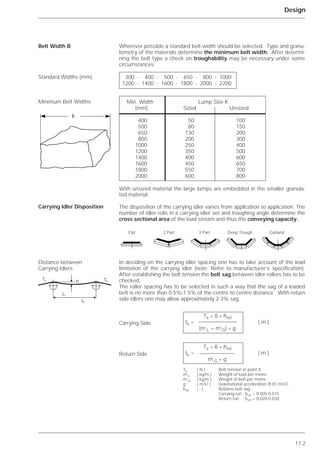
tive manner.
Supporting Discs on
Return Side Run
Installation Instruction
Measurements
(Values)
B Untertrum
b b b b b c c c
a
R Ø ØD
Number of Discs Tube Disc
Belt Width B a b c each Diam. R Diam. D
(mm) (mm) (mm) (ca. mm) roller total (mm) (mm)
end
400 425 25 108 3 8 51 120
500 530 30 137 3 8 57 133
650 680 30 140 3 9 57 133
800 890 30 130 5 14 63.5 150
1000 1090 30 122 5 16 63.5 150
1200 1305 35 128 5 17 88.9 180
1400 1505 35 136 5 18 88.9 180
180
1600 1800 40 140 6 21 108
215
180
1800 2000 40 145 6 22 108
215
180
2000 2200 40 156 7 24 108
215
B Return Run
Chemical Carcase Material
B P E D
Acetic Acid 10% + 0 + +
Acetone + + + +
Ammonia 10% + 0 + +
Benzine + + + +
Benzol + + + +
Creosote + – + +
Diesel Oil + + + +
Drilling Oil + + + +
Ethylacetate 0 0 + +
Formaldehyde 10% + 0 + +
Formic Acid 10% + 0 + +
Glycerine + + + +
Hydrochloric Acid 10% – – + +
Latic Acid 10% + 0 + +
Machine Oil + + + +
Methylalcohol 0 – + +
Oil, Heavy Swelling + + + +
Oil, Light Swelling + + + +
Phenol 10% + – + +
Pine Tar + + + +
Potassium Bichromate 10% + 0 + +
Sulphuric Acid 10% – – + +
Trichloroethylene + + + +
Urea 50% + 0 + +
Water 20°C + + + +
Water 80°C + + + +
N.1
Chemical Resistance
The conveyor belt must not only meet the mechanical and thermal demands
of the load but also be resistant to diverse chemicals. The chemicals can be
in liquid, solid form or gaseous form. In many cases the quantity, concentra-
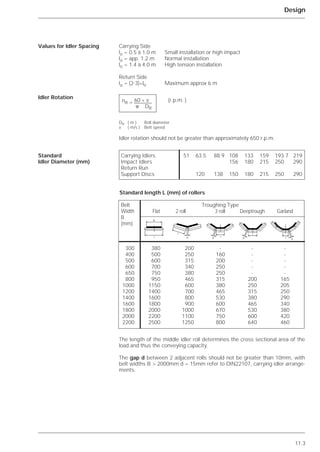
tion and temperature of the substances being handled is not exactly known
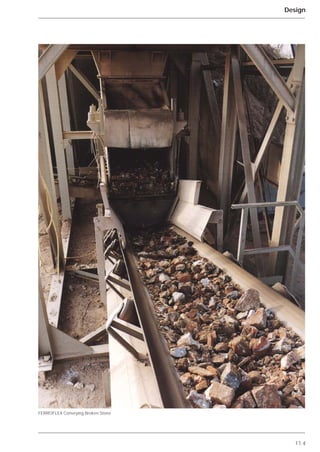
or defined.
The chemical resistance of the belt will be judged by the swelling of the
covers. At ca. 8-10% swelling the physical properties decline, the belt loses
its working capability and its life will be reduced.
The reaction will intensify through higher concentration, also with relatively
low temperature, or with lower concentration and higher temperature.
Resistance of the Carcase
+ = resistant 0 = limited resistance – = not resistant
B Cotton
P Polyamide
E Polyester
D Aramid
N.2
Chemical Resistance
Resistance of the Covers
Condition Basic Material
Chemical K % °C NR NBR Butyl PVC
SBR NCR
Acetic Acid 100 20 – – 0 –
Acetic Acid 10 20 + – + 0
Acetic Acid 10 80 – – – –
Acetone 100 20 + – + –
Ammonia 10 20 + + + +
Aniline 100 20 0 – + –
Axle Oil 100 80 – 0 – 0
Axle Oil 100 20 – + – +
Benzine 100 20 – 0 – +
Benzine/Benzol 1:1 50/50 20 – – – +
Benzol 100 20 – – – –
Caustic Soda 10 20 + + + +
Caustic Soda 40 20 0 0 + –
Caustic Soda 40 80 0 0 + –
Caustic Soda 10 80 0 0 + –
Chloroform 100 20 – – – –
Copper Sulphate 10 20 0 0 + +
Creosote 50 20 0 0 + –
Cyclohexane 100 20 – – – –
Detergent P3 3 20 + + + +
Detergent P3 3 80 + 0 + 0
Diesel Oil 100 20 – 0 – +
Drilling Oil 2 20 0 + 0 +
Drilling Oil 10 20 – + – +
Drilling Oil 100 20 – + – +
Ethylacetate 100 20 0 – 0 –
Ethylalcohol 100 20 + 0 + 0
Formaldehyde 38 20 + 0 + +
Formic Acid 10 20 + – + +
Formic Acid 100 20 0 – + 0
Glycerine 100 20 + + + +
Glycerine 100 80 + + + +
Hydrochloric Acid 10 80 – – – –
Hydrochloric Acid 10 20 + + + +
Hydrochloric Acid 30 80 – – – –
Hydrochloric Acid 30 30 + + + +
Latic Acid 10 80 – – 0 0
Latic Acid 10 20 + 0 + +
Machine Oil 100 20 – + 0 +
Machine Oil 100 80 – 0 – 0
Magnesium Sulphate 10 80 + + + +
Magnesium Sulphate 10 20 + + + +
Maleic Acid 10 80 – 0 – –
Maleic Acid 10 20 + 0 + 0
Methylalcohol 100 20 + 0 + 0
Methylene Chloride 100 20 – – – –
Nitro Solvent 100 20 0 – 0 –
Oil Heavy Swelling 100 20 – + – +
Oil Heavy Swelling 100 80 – 0 – –
Oil Swelling 100 80 – 0 – –
Oil Swelling 100 20 0 + – +
Olive Oil 100 80 – 0 – 0
Olive Oil 100 20 – + + +
Oxalic Acid 10 80 – – + +
Oxalic Acid 10 20 + + + +
N.3
Chemical Resistance
Condition Basic Material
Chemical K % °C NR NBR Butyl PVC
SBR NCR
K % Concentration in %
NR Natural Rubber
SBR Styrene Butadiene Rubber
NBR Nitrile Rubber
NCR Nitrile Chloroprene Rubber
Butyl Butyl Rubber
PVC Polyvinyl Chloride
Paper Pulp (damp) Pulp 20 + – 0 –
Paraffin Oil 100 80 – 0 – 0
Paraffin Oil 100 20 – + – +
Phenol 10 80 – – – –
Phenol 10 20 0 – + –
Phosphoric Acid 10 20 + + + +
Phosphoric Acid 50 20 + + + +
Phosphoric Acid 10 80 + – + 0
Pitch for
Wood Impregnation 100 20 – – – –
Potash 40 20 0 0 + –
Potash 10 20 + + + +
Potash 10 80 0 0 + –
Potash 40 80 0 0 + –
Potassium Dichromate 10 20 + + + +
Potassium Dichromate 10 80 0 + + +
Potassium Permanganate 10 20 – – – –
Sea Water 100 80 + + + +
Sea Water 100 20 + + + +
Stearic Acid Powder 100 20 + + + +
Stearic Acid Powder 100 80 – 0 – 0
Sulphuric Acid 50 20 – – – –
Sulphuric Acid 10 20 + + + +
Sulphuric Acid 50 80 – – – –
Sulphuric Acid 10 80 – – + –
Tallow 100 20 0 + + +
Tallow 100 80 – – – –
Tetralin 100 20 – – – –
Toluol 100 20 – – – –
Trichloroethylene 100 20 – – – –
Urea 50 20 + + + +
Water (tap) 100 20 + + + +
Water (tap) 100 80 + + + +
O.1
Steep Incline Conveyors
To obtain optimum performance from steep incline belts in the CHEVRON
and HIGH-CHEVRON range with regard to smooth running and working safe-
ty, a range of constructive measures are recommended which have proved
themselves in practice.
The drive pulley should be rubber lagged. The belt tension will be less, slip at
start-up under load, prevented, and the running of the belt stabilized.
If 3 part idlers are used, the troughing angle should not be greater than 20°
and with 2 part idlers, greater than 25° (for jute sacks etc.)
The angle of wrap on the drive pulley should not be more than ca. 190°. The
pressure on the profile caused by the snub pulley would otherwise be too
high such that the profile can be pressed through to the pulley side of the
belt. Changes in the direction of bending of the belt are not recommended.
To improve the running of the return side belt, two idlers with reduced dia-
meter and set next to one another, can be fitted.
On the carrying and return side run, as with smooth surface belts, standard
idlers are used. The idler pitch should not be divisible by the pitch of the
profile pattern on the belt.
A plough scraper should be fitted immediately before the tail pulley so that
material does not get trapped between belt and pulley. Where there is back
flowing water on the pulley side of the return belt, a water scraper (plough
scraper) should be used.
If wet materials are conveyed, water shedding grooved pulley lagging is
recommended because of the risk of off-track running. The tail pulley should
as a minimum be one profile length behind the back of the loading chute so
that back flowing material can be re-admitted.
The height of fall of material being loaded to the belt should be kept as small
as possible, the loading being in direction of belt travel.
The belt must not sag excessively between idlers (pre-tension), otherwise the
load stream becomes broken up causing loss of conveying capacity and an
increase in power demand.
Hints for Installation
Improvements
1. Drive Pulley
2. Troughing Angle
3. Snub Pulley
4. Return Side
5. Idler Spacing
6. Deflector
7. Tail Pulley
8. Loading Height
9. Belt Sag
distance
between
stations
distance
between
stations
2
9
8
10
7
6
5
4
3
1
3 part Idlers 2 part Idlers
Drive
Pulley
Drive
Pulley
Tail Pulley
O.2
Steep Incline Conveyors
Steep incline belting cannot be scraped by normal mechanical cleaning
devices. Clinging and sticky materials will result in build-ups. If conditions
permit, the belt surface beyond the discharge pulley can be hosed with water
or cleaned by compressed air. For lumpy and dry materials, sledge-hammer
devices can be used which impact the pulley side of the belt during rotation.
Eccentric rapping rollers that vibrate the belt can also be fitted.
10. Cleaning
P.1
Endless Splice Joints
Conveyor belting can be made endless using the following jointing methods:
• Hot Vulcanised • Cold Vulcanised
• Warm Vulcanised • Mechanical Fastener
The durability obtained from these various methods depends on environmen-
tal conditions, splicing materials and the proficiency of the splicing personnel.
The advice of the belt manufacture should be observed particularly the spe-
cial recommendations that apply to certain belt types and qualities.
With hot vulcanising, vulcanising presses are necessary. The vulcanisation
takes place under a certain pressure and depending on cover quality, at a cer-
tain time and temperature. In general the vulcanising temperature lies
between 140°C and 155°C. Vulcanisation times depend on the belt thickness
and are of 20 to 45 minutes duration. With almost all belt types, the best
results are achieved by the hot vulcanisation process with regard to strength
and the retention of strength after prolonged periods of usage.
With textile belts, depending on carcase construction there are the stepped
splice method (1 or more steps) and the finger splice method.
Depending on the application one differentiates between the straight joint
(90° across the belt) the diagonal splice, the Chevron splice and the zig-zag
splice (for short centre to centre distances or for weigher belts).
For Steel Cord Belts depending on tensile strength and the cord diameter
the 1 to 4 step splice is used. With this the cords are laid together in a parti-
cular design.
Methods of Making Endless
Hot Vulcanisation
᭤
᭤᭤᭤
᭤
᭤
᭤
᭤᭤᭤
᭤
᭤
᭤
᭤
lv
lst lst lst
la
lü
B
Stepped Splice
᭤
᭤
᭤
᭤
᭤
᭤
᭤
B
ltbt
Finger Splice
᭤
᭤
᭤
᭤
B
Angle 16°40'
0,3*B
Diagonal Splice
᭤
᭤
Chevron Splice
a = 200 - 300 mm a 70 70 150
B
"
"
᭤
᭤
᭤
᭤
᭤
᭤
᭤
᭤
᭤
Zig-Zag Splice
1 Step 2 Step 3 Step
P.2
Endless Splice Joints
For the warm vulcanisation method, a press is likewise required. The joint can
however be constructed with shorter overlap lengths. The vulcanisation tem-
perature lies between 100°C to ca. 115°C. For the warm vulcanising process
special vulcanising materials are required.
With cold vulcanisation, the process takes place under ambient temperature
conditions. The optimum strength is reached in ca. 24 hours. The quality of
the joint is very dependent upon the ambient conditions, humidity, dustiness
etc. Expenditure on equipment and time is much reduced.
The quickest and most cost effective joint is the mechanical splice. The
strength however is significantly lower than that of a vulcanised splice joint.
The mechanical fastener is well suited for quick emergency splicing or belt
damage repair.
Warm Vulcanisation
Cold Vulcanisation
Mechanical Splice
Steel Wire Hook Fastener
Hinged Fastener
Bolted Plate Fastener (Flexco)
Q.1
Material Characteristics
Recom-
Material Bulk Surcharge Maximum Angle of Inclination mended
Density Angle Smooth height of profiles Dunlop
␳ (t/m3) ␤ (°) Belts 6 mm 16 mm 32 mm Quality
Alum
Aluminium, coarse
Aluminium, fine
Aluminium - Oxide
Aluminium - Silicate
Aluminium - Sulphate (granular)
Aluminium - Turnings
Ammonium - Chloride (crysalline)
Ammonium - Nitrate
Ammonium - Sulphate, dry
Ammonium - Sulphate, granulated
Ammonium - Sulphate, wet
Anthracite Coal
Apples
Asbestos ore
Asbestos, shred
Ash, caustic salt
Ash, coal - dry 80mm and under
Ash, coal - wet 80mm and under
Ash, fly
Ash, fly coal slack
Asphalt
Asphalt, binder for motorways
Asphalt, broken
Asphalt, paving
Bagasse
Bakelite, fine
Ballast, broken
Barium carbonate
Barley
Barytes, coarse grained
Barytes, powdered
Basalt
Basalt lava
Bauxite, broken 80mm and under
Bauxite, earth broken
Bauxite, raw
Beans
Beet pulp
Beets
Bezonite, raw
Bicarbonate
Bituminous coal, fine or nuts
Bituminous coal up to 50mm
Blast furnace slag, broken
Blast furnace slag, granulated, damp
Blast furnace slag, granulated, dry
Bone meal
Bones
Borax, coarse
Bran
Brown Coal briquettes
Brown Coal, dry
Calcium carbide
Calcium oxide
0.80 - 1.04
0.95 - 1.05
0.70 - 0.80
1.12 - 1.92
0.78
0.86
0.11 - 0.24
0.83
0.72
1.10
0.72 - 0.93
1.30
0.90
0.35
1.30
0.32 - 0.40
0.81
0.56 - 0.64
0.72 - 0.80
0.45 - 0.80
0.64 - 0.72
1.00 - 1.30
1.28 - 1.36
0.70
1.30
0.13
0.48 - 0.64
1.50 - 1.80
1.15
0.60 - 0.70
2.4 - 2.9
1.9 - 2.3
1.6 - 2.3
2.30
1.20 - 1.36
1.09
2.55
0.85
0.40
0.65
0.54 - 0.64
0.65
0.90 - 1.00
0.80
1.30 - 1.60
1.50
0.50 - 0.60
0.90
0.60
0.96 - 1.04
0.25 - 0.30
0.65 - 0.85
0.65 - 0.80
1.12 - 1.28
0.70
25
15
6
15
-
20
-
15
25
10
15
15
15
15
20
15
-
10
25
15
15
-
-
-
30
30
-
15
-
5
-
20
15
15
20
20
15
10
15
15
-
20
15
20
15
15
10
20
20
15
10
20
15
15
20
17
20
20
17
-
17
-
15
23
15
15
17
17
10 - 12
18
22
-
18
20
15
15
-
-
-
20
25
-
20
-
12
-
18
17
17
20
18
20
12
14
12
-
15
18 - 20
24
15 - 20
18
15
15
17
15
12
15
20
18
18
-
-
-
-
-
-
-
-
-
-
-
-
20
-
-
-
-
-
-
-
-
-
-
-
-
-
-
22
-
20
-
-
-
-
-
-
22
-
-
-
-
-
22
20
-
-
18
-
-
-
-
-
22
-
-
-
-
25
25
-
-
-
-
-
-
-
-
35
-
-
-
-
-
30
25
25
-
-
-
-
-
-
35
-
30
-
-
25
20
25
25
35
-
25
20
-
-
30
35
25
25
25
-
-
25
25
-
30
25
-
-
-
30
30
-
-
-
-
-
-
-
-
40
-
-
-
-
-
35
30
30
-
-
-
-
-
-
40
-
35
-
-
30
25
30
30
40
-
25
30
-
-
35
40
30
30
30
-
-
30
30
20
40
30
-
-
-
-
RS
-
-
-
RA
RA
-
RA
-
-
-
-
-
-
RA - RS
RA - RS
-
RA - RS
-
-
RA
RA
RA
-
-
RA
RA
-
-
RE - RS
RE - RS
RE - RS
RE - RS
-
RA
RA
-
-
RA
-
RA - BV
-
RA - RS - RAS
RA - RS - RAS
-
-
RA
RA
-
RA
RA
RA
Q.2
Material Characteristics
Recom-
Material Bulk Surcharge Maximum Angle of Inclination mended
Density Angle Smooth height of profiles Dunlop
␳ (t/m3) ␤ (°) Belts 6 mm 16 mm 32 mm Quality
0.35
1.60
0.60
2.08 - 3.20
1.20 - 1.30
1.20
2.00
1.35 - 1.45
1.10 - 1.20
0.35
0.80
2.00 - 2.24
1.28 - 1.60
1.60
1.60 - 1.80
0.96 - 1.20
2.00
1.80 - 2.00
0.95
0.95
0.06 - 0.11
0.32 - 0.40
0.55
0.50
0.55
0.45 - 0.65
0.30 - 0.45
0.40 - 0.56
0.37 - 0.56
0.56 - 0.72
0.65
0.80
2.08 - 2.40
1.76 - 2.40
1.80
2.00 - 2.20
1.92 - 2.40
1.20 - 1.36
0.40 - 0.60
0.10 - 0.20
0.20 - 0.25
0.19 - 0.24
0.60 - 0.65
0.4 - 0.5
0.35
1.20 - 1.44
1.44 - 1.60
0.69
0.40 - 0.50
1.60
1.44 - 1.60
1.60
1.12 - 1.28
2.00
1.60 - 1.76
5
10
15
20
15
10
10
15
15
15
5
10
15
15
15
15
15
15
10 - 15
20
10
-
10
5
10
5
5
20
20
20
5
15
-
-
10
15
15
15
10
15
15
10
10
20
-
-
-
-
-
15
15
10
10
15
15
15
15
15
22
18
20
8
17
15 - 18
20
8 - 10
17
18
15
28
15
20
15 - 18
10
18
5
-
12
20
12
5
5
20
18
18
15
15
-
-
18
10
15
15
17
15
17
17
15
15
-
-
-
-
-
10
17
15
17
20
20
20
-
-
-
-
22
-
-
-
-
-
-
20
-
20
20
-
20
-
20
-
-
-
-
-
-
-
-
-
-
20
20
-
-
20
22
-
-
-
-
-
-
20
-
-
-
-
-
-
-
-
20
20
25
23
25
-
-
-
30
30
-
30
30
25
30
-
30
25
30
30
25
30
-
35
-
-
-
25
25
25
25
-
35
-
25
25
-
-
25
27
-
-
-
25
25
25
25
-
-
-
-
-
-
30
30
25
30
30
30
30
-
-
-
30
30
-
30
30
30
40
-
40
30
35
35
30
40
30
35
-
-
-
30
30
30
30
-
35
-
30
30
-
-
30
32
-
-
-
30
30
30
30
-
-
-
-
-
-
35
35
40
30
45
30
RA
RS
-
RA
RE - RS
-
-
RA
RA
RA
-
RE - RS
RA - RS
-
-
RA - RS
-
-
-
RA - BV
RA
-
RA
RA
RA
RA
RA
RA - RS - BV
RE - RS
RA
-
ROM - ROS
-
-
-
-
RE - RS
RA
ROM - ROS
-
RA
RA
-
-
-
-
-
-
-
-
RE - RS
-
RA
-
RA
Carbon pellets
Carborundum up to 80mm
Casein
Cast Iron swarf
Cement, clinker
Cement, dry
Cement Mortar
Chalk, broken
Chalk, pulverised
Charcoal
Chestnuts
Chrome Ore
Clay, calcined
Clay, dry
Clay, dry
Clay, dry, lumps
Clay, wet
Clay, wet
Coal
Coal, anthracite up to 3mm
Coal dust
Coal, pelletized
Cocoa beans
Cocoa powder
Coffee beans, green
Coffee beans, raw
Coffee beans, roasted
Coke breeze up to 7mm
Coke, loose
Coke, petroleum calcined
Coleseed
Compost
Concrete, stone
Concrete, wet (Readymix)
Concrete with gravel
Concrete with limestone
Copper ore
Copper sulphate
Copra flakes
Cork, broken
Cork, fine
Cork, granulated
Cornmeal
Cotton seed
Cotton seed flock
Cryolite, dust
Cryolite, Lumps
Dicalcium Phosphate
Disodium Phosphate
Dolomite, broken
Dolomite, pieces
Earth, dry
Earth, excavated dry
Earth, wet
Earth, wet loamy
Q.3
Material Characteristics
Recom-
Material Bulk Surcharge Maximum Angle of Inclination mended
Density Angle Smooth height of profiles Dunlop
␳ (t/m3) ␤ (°) Belts 6 mm 16 mm 32 mm Quality
1.04 - 1.12
1.6
1.44 - 1.76
1.12 - 1.36
0.90 - 1.20
1.15
0.60 - 0.80
0.55 - 0.65
0.70 - 0.75
1.76 - 1.92
0.56 - 1.68
2.50
0.45 - 0.80
1.12 - 1.60
0.35
0.48 - 0.56
0.64
0.56 - 0.64
0.96 - 1.04
1.30 - 1.60
0.60
1.36 - 1.44
1.40 - 1.80
1.52 - 1.60
1.28 - 1.44
0.60 - 0.65
0.45
0.22
1.44 - 1.60
1.40 - 1.50
1.80 - 1.90
0.35
0.35
0.30
0.35
1.12
1.35
1.80
1.20
0.95 - 1.50
1.45
0.80
0.45
0.90
2.00 - 4.50
2.16 - 2.40
5.00
0.40
2.00
1.00
1.00
0.70 - 0.90
0.17 - 0.22
1.60
-
20
-
-
15
10
10
5
5
-
-
15
15
-
10
10
-
-
20
15
-
-
15
-
-
10
5
5
-
10
15
20
10
10
18
-
15
10
10
10
15
10
22
22
15
-
5
-
-
20
20
30
5
17
-
18
-
-
20
15
12
14
14
-
-
17
15
-
15
15
-
-
20
18 - 20
12
-
15
-
-
15
15
15
-
17
18
10 - 15
14
14
12
-
15
15
-
18
17
15 - 20
20
20
18
-
12
-
-
19
19
20
15
17
-
-
-
-
25
-
-
25
20
-
-
-
-
-
-
-
-
-
-
-
-
-
-
-
-
-
-
25
-
-
-
-
18
20
-
-
-
-
8
22
-
20
-
-
25
-
-
-
-
-
-
-
-
-
Ebonite up to 13mm
Felspar, broken
Felspar, lump size 40-80mm
Felspar, screened to 13mm
Fertilizer
Filter cake
Filter mud
Fishmeal
Flaxseed
Flourcalcium 40-80mm
Flourcalcium, screened
Flourspar
Fly ash
Foundry waste
Fruit
Fullers earth, dry
Fullers earth, oil filter, burnt
Fullers earth, oil filter raw
Fullers earth, oily
Glass, broken
Grain
Granite, 40-50mm lumps
Granite ballast
Granite, broken
Granite, screened, up to 13mm
Graphite flock
Graphite, pulverized
Grass seed
Gravel
Gravel, dry
Gravel, wet
Green fodder
Ground nut kernels
Ground nuts, with shells
Ground nuts, without shells
Guano, dry
Gypsum, broken
Gypsum, burnt
Gypsum mortar
Gypsum, pulverized
Gypsum, sieved
Household refuse
Husks, dry
Husks, wet
Iron Ore, broken
Iron Ore, crushed
Iron Ore, pellets
Iron Oxide, pigment
Iron turnings (Swarf)
Kaolin, broken
Kaolin clay up to 80mm
Kaolin, pulverized
Kieselguhr
Kiln Brick
-
25
-
-
30
-
-
30
30
-
-
25
25
-
-
-
-
-
-
-
-
-
25
-
-
-
-
25
-
30
30
25
20
25
20
-
25
25
-
30
25
25
-
-
30
-
20
-
-
-
-
-
-
25 - 30
-
30
-
-
35
-
-
30
35
-
-
30
30
-
-
-
-
-
-
-
-
-
30
-
-
-
-
30
-
35
35
30
25
30
25
-
30
30
-
30
30
30
-
-
35
-
25
-
-
-
-
-
-
25 - 30
-
RS
-
-
-
-
-
MORS-ROM
MORS
-
-
RE - RS
-
-
-
RA
-
-
RA
-
RA
-
-
-
-
RA
RA
RA
-
RA
RA
-
ROM
ROM
-
-
-
RA
-
RA
RA
-
RA - ROS
RA - ROS
RS - RAS
-
RS - RAS
-
-
RA
RA
RA
-
RA - RS
Q.4
Material Characteristics
Recom-
Material Bulk Surcharge Maximum Angle of Inclination mended
Density Angle Smooth height of profiles Dunlop
␳ (t/m3) ␤ (°) Belts 6 mm 16 mm 32 mm Quality
Lactose (milk sugar)
Lead - Arsenate
Lead Ore
Lead - Oxide
Legumes
Lime, hydrated
Lime, lumps
Lime, pulverized
Lime, slaked
Lime up to 3mm
Limestone, Broken
Limestone, dust
Linseed
Linseed cake
Magnesite
Magnesite, fine
Magnesium chloride
Magnesium oxide
Magnesium sulphate
Magnetite
Maize
Maize, shelled
Malt, dry
Manganese dioxide
Manganese ore
Manganese sulphate
Manure
Marble, broken
Marble, crushed, up to 13mm
Marl, dry
Meal
Molybdenite, powdered
Mortar, cement
Mortar, Gypsum
Mortar, Lime
Moulding sand, core sand
Moulding sand, knock-out
Moulding sand, prepared
Mushrooms
Nickel Ore
Oats
Oil Sand
Ore, Copper
Ore, Iron
Ore, Lead
Ore, Manganese
Ore, Zinc
Overburden
Peas, dried
Peat, dry
Peat, wet
Phosphate, broken
Phosphate, fertilizer
Phosphate, sand, cement
0.51
1.15
3.20 - 4.70
0.96 - 2.40
0.85
0.60
1.20 - 1.36
1.00 - 1.20
0.64
0.96
1.40 - 1.50
1.30 - 1.40
0.72
0.75 - 0.80
3.00
1.04 - 1.20
0.52
1.90
1.10
3.00
0.70 - 0.75
0.70
0.30 - 0.50
1.28
2.0 - 2.3
1.12
1.10
2.70
1.44 - 1.52
1.20 - 1.30
0.60 - 0.70
1.71
2.00
1.20
1.70
1.04
1.45 - 1.60
1.30 - 1.45
0.40
2.40
0.55
1.50
1.92 - 2.40
2.00 - 4.50
3.2 - 4.7
2.0 - 2.3
2.40
1.7
0.70 - 0.80
0.32 - 0.80
0.65 - 1.00
1.20
0.96
1.36
-
-
15
15
5 - 10
15
-
5
-
15
15
5
5
10
15
-
20
10
10
15
5
10
5
-
25
10
15
15
15
10
5
15
10
10
10
15
10
10
10
-
5
15
15
15
15
25
15
15
5
15
15
15
-
-
-
-
17
15
8 - 10
15
-
20
-
18
18
15
12 - 15
15
17
-
20
17
16
17
10 - 12
10
15
-
20
15
20
15
17
17
20
18
-
-
8
20
18
20
15
-
15
15
15
18
17
20
15
17
14
15
12
15
-
-
-
-
-
-
-
-
-
22
-
-
22
-
20
-
-
-
-
-
-
-
-
-
20
-
-
-
25
-
-
-
22
-
-
-
-
-
-
25
-
-
20
-
-
25
-
-
-
-
18
25
-
-
-
-
-
-
25
25
-
-
-
25
-
25
30
25
30
-
-
-
-
25
25
-
25
25
25
-
-
-
30
25
25
25
30
-
20
20
20
-
-
30
25
-
25
25
-
30
25
-
25
-
20
25
25
25
-
-
-
-
30
30
20
-
-
27
-
30
35
30
35
-
-
-
-
30
30
-
30
30
30
-
-
-
30
25
25
30
35
-
-
-
-
-
-
35
30
-
30
30
-
35
30
-
30
-
25
30
30
30
-
-
RA - RS
-
RA
RA
-
RA
-
-
-
RA
RA - RS
RA - RS
-
-
-
-
RA
RA
RA
-
-
BV - ROM - BVO
-
-
-
-
ROS
-
RA - RS
RA - RS
-
RA
RA
RA
-
-
-
-
-
-
RS
-
RE - RS
RS - RAS
RA
-
-
-
RA
-
-
-
-
-
Q.5
Material Characteristics
Recom-
Material Bulk Surcharge Maximum Angle of Inclination mended
Density Angle Smooth height of profiles Dunlop
␳ (t/m3) ␤ (°) Belts 6 mm 16 mm 32 mm Quality
Phosphate, pulverized
Phosphate rock, broken
Plaster
Portland cement
Portland cement, loose
Potash
Potash
Potash, broken
Potash salts, sylvite etc
Potassium (Saltpetre)
Potassium chloride pellets
Potassium sulphate
Potatoes
Pulp, dry
Pulp, wet
Pumice stone
Pumice stone sand
Pyrites, Iron lump size 50-80mm
Pyrites, Iron Sulphide
Pyrites, pellets
Quartz, broken
Quartz, lump size 40-80mm
Quartz sand
Rape seed
Rice
Roadstone, Broken (Porphyry)
Rock salt
Rubber, dust
Rubber, pelletized
Rubber, reclaim
Run of mine coal
Rye
Salt, coarse
Salt, common, dry
Salt, common, fine
Saltpetre
Saltpetre
Sand and gravel, dry
Sand and gravel, wet
Sand, dry
Sand, foundry, prepared
Sand pebble, dry
Sand, wet
Sandstone
Sawdust
Sewage Sludge
Shale
Shale, broken
Shale dust
Shale, lump size 40-80mm
Sinter, blast furnace, dry
Slag, blast furnace
Slag, blast furnace, broken
Slag, porous, broken
Slate, broken
0.96
1.35 - 1.45
1.70
1.50
0.96 - 1.20
1.35
1.10 - 1.60
1.20 - 1.35
1.28
1.22
1.92 - 2.08
0.67 - 0.77
0.75
0.20 - 0.25
0.40
1.20
0.70
2.16 - 2.32
2.00 - 2.50
1.92 - 2.08
1.60 - 1.75
1.36 - 1.52
1.70 - 1.90
0.80
0.70 - 0.80
1.50 - 1.70
1.00 - 1.20
0.60 - 0.65
0.80 - 0.88
0.40 - 0.48
0.80 - 1.00
0.70 - 0.80
0.70 - 0.80
0.64 - 0.88
1.12 - 1.28
1.10
1.70
1.50 - 1.80
1.80 - 2.10
1.30 - 1.60
1.44 - 1.60
2.00
1.60 - 2.00
1.36 - 1.44
0.20 - 0.30
0.64 - 0.80
2.70
1.44 - 1.60
1.12 - 1.28
1.36 - 1.52
1.50
1.50
1.28 - 1.44
0.60
1.40 - 1.55
-
15
10
20
15
10
10
-
-
-
-
-
15
15
15
15
10
-
15
15
15
-
15
5
5
15
10
10
10
10
15
5
10
-
10
5
10
10
15
10
20
5
15
15
20
-
15
-
-
-
15
15
10
15
15
-
15
15
18
15
17
20
-
-
-
-
-
12
15
12
17
15
-
15
15
17
-
17
12
8
20
15
20
20
20
18
15
17
-
17
15
16
18
20
17
17
15
20
17
18
15
18
-
-
-
15
-
15
15
17
-
-
-
-
-
20
-
-
-
-
-
-
-
-
-
-
20
-
-
-
-
-
20
15
12
22
-
-
-
-
22
20
-
-
25
20
-
20
25
20
-
20
25
-
20
-
-
-
-
-
-
25
-
-
-
-
25
20
30
-
25
30
-
-
-
-
-
20
25
25
25
25
-
25
25
25
-
25
25
20
30
30
25
25
25
35
30
30
-
30
25
-
30
30
25
30
25
35
30
25
-
25
-
-
-
25
30
25
25
25
-
30
-
30
-
30
35
-
-
-
-
-
25
30
25
30
30
-
30
30
30
-
30
25
25
35
35
30
30
30
40
35
35
-
35
30
-
35
35
30
35
30
35
35
25
-
30
-
-
-
30
-
30
30
30
-
-
RA
RA
RA
RA - RS
-
-
-
-
-
-
RA
-
-
-
-
-
-
RA - RS
-
-
RA - RS
-
RA
-
-
-
RA
RA
-
RA
RA
-
RA
-
RA
RA
RA
RA
RA
RA
RA
RA - RS - RAS
ROM
RA - ROS
RA - RS - RAS
-
-
-
-
-
RA - RS - RAS
-
RA - RE
Q.6
Material Characteristics
Recom-
Material Bulk Surcharge Maximum Angle of Inclination mended
Density Angle Smooth height of profiles Dunlop
␳ (t/m3) ␤ (°) Belts 6 mm 16 mm 32 mm Quality
Soap beads or granules
Soap flakes
Soda
Soda ash, heavy
Soda ash, light
Sodium Bicarbonate
Sodium nitrate
Soot
Soya beans
Steel trimmings, shredded
Stone, broken, small
Stone, large, sized
Stone, sized
Sugar cane, raw
Sugar, granulated
Sugar, powdered
Sugar, raw
Sugar-beet
Sugar-beet, sliced, damp
Sugar-beet, sliced, dry
Sugar-beet, wet
Sulphate, ferrous
Sulphur, broken
Sulphur, pulverized
Table Salt
Tile, hard
Tile, soft
Titanium, washed
Tomatoes
Wheat
Wheat, flour
Wood chips
Wood chips, wet
Wood shavings
Zinc Ore
Zinc Ore, burnt
Zinc Ore, crushed
Zinc Oxide, heavy
Zinc Oxide, light
Zinc Sulphate
0.24 - 0.40
0.15 - 0.35
0.90 - 1.20
0.88 - 1.04
0.32 - 0.56
0.65
1.12 - 1.28
0.40 - 0.75
0.80
1.60 - 2.40
1.50 - 1.80
1.40 - 1.60
1.55 - 1.70
0.88 - 1.04
0.60 - 0.80
0.80 - 0.96
0.90 - 1.50
0.70
0.40
0.20 - 0.25
0.88 - 1.04
0.80 - 1.20
1.30
0.90
0.80
2.00
1.60
0.96 - 1.12
0.90
0.75
0.55 - 0.65
0.30 - 0.40
0.60 - 0.85
0.16 - 0.48
2.40
1.60
2.56
0.48 - 0.56
0.16 - 0.24
3.70
10
10
-
-
-
-
-
5
15
-
15
15
10
10
5
0
15
18
15
-
-
-
15
5
10
-
-
15
10
10
5
-
10
5
15
-
15
15
-
15
12
18
17
-
-
-
-
15
18
-
15
15
15
19
15
12
20
18
18 - 20
18
-
-
17
19
20
-
-
17
10 - 12
14
20
15
20
12
15
-
17
17
-
17
18
22
-
-
-
-
-
20
-
-
-
-
-
22
20
16
20
-
-
-
-
-
20
25
25
-
-
-
-
20
22
-
-
18
-
-
-
-
-
-
25
25
20
-
-
-
-
25
-
-
25
20
22
25
25
20
25
-
25
25
-
-
30
30
30
-
-
-
20
30
30
20
20
20
25
-
25
20
-
25
-
30
25
-
-
-
-
30
-
-
30
25
27
-
-
25
-
30
30
30
-
-
35
35
35
-
-
-
30
35
35
-
-
25
30
-
30
25
-
30
RA
RA
RA
-
-
-
-
-
ROS
-
-
-
-
RA
RA
RA
-
RA
-
-
-
-
RA
RA
-
-
-
RA - RS - RAS
-
ROM
-
-
-
RA - ROM
-
-
RA - RS - RAS
RA
-
RA

Belt conveyor design-dunlop

  • 1.
    CONVEYOR BELT TECHNIQUE DE S I G N A N D C A L C U L AT I O N
  • 2.
    I Index 1 Introduction 1.1 Foreword 1.2Development chronology, development aims 1.3 Dunlop-Enerka test rig 2 Belt Conveyors 2.1 Basic sketch, concept, description 3. Drive Systems 3.1 Pulley arrangement, conveying systems 3.2 Single pulley head drive, Dual pulley head drive, Head and tail drive, general criteria 3.3 Drive components Pulley motor, Geared motor, Motor-gears-Couplings 4 Couplings 4.1 Coupling types, fixed coupling, flexible coupling, fluid coupling, hydro dynamic coupling 4.2 Start-up procedure 4.3 Run back prevention (holdback) 5. Drive Pulley 5.1 Force transmission, Eytelwein limitations, slip, creep 5.2 Friction factor ␮, angle of wrap ␣ 6. Take-up (tension) Systems 6.1 General, fixed take-up, gravity weight take-up, regulated take-up tension 7 Detection Devices 7.1 Belt tension detection, off-track detection, belt slip detection, longitudinal slitting safety device 8 Cleaning Devices 8.1 General, ground rules 8.2 Cable scraper, transverse scraper, fan scraper staggered scraper, rotary scraper (vertical) 8.3 Rotary scraper (horizontal) rapping roller, belt turnover, high pres- sure water cleaning 9 Load 9.1 General, bulk loads, piece loads, bulk density, angle of repose/sur- charge, lump size, classification 9.2 Temperature, moisture, chemical characteristics, pH value, angle of inclination 10 Conveyor Belt 10.1 General, belt construction 10.2 Carcase, ply material 10.3 Covers, cover qualities (DIN/ISO) 10.4 Special qualities, cover thickness ratio 10.5 Angle of inclination values, cover thickness values 10.6 DUNLOP cover qualities, specifications 10.7 Basic Materials 10.8 Belt specification, DUNLOP belt types
  • 3.
    II Index 11 Design 11.1 Maindata, belt speed, standard values, recommended values 11.2 Belt widths, standard widths, minimum belt width, idler arrange- ment, idler spacing 11.3 Idler spacing (recommended values) idler rotation, idler roll diame- ter, standard idler roll lengths L 11.4 Photograph 11.5 Cross sectional area of load, comparison various cross sections 11.6 Conveyor capacity, load stream volume, load stream mass, degree of filling, reduction factor 11.7 Power requirement, electric motor type list 11.8 Adjustment factors 11.9 Belt types 11.10 Pulley diameters, standard diameters 11.11 Pulley rotation, pulley loading 11.12 Average surface pressure, transmission capability, start-up torque 11.13 Troughing transition, pulley lift 11.14 Convex vertical curve values 11.15 Concave vertical curve, curve co-ordinates 11.16 Belt turnover, turnover length, values 11.17 Horizontal curve, values 12 Basis of Calculation 12.1 Resistance to motion, main resistance, secondary resistance, slope resistance, special resistances 12.2 Peripheral force FU (working), summation 12.3 Factor C (allowance for secondary resistance) 12.4 Fictitious friction factor f 12.5 Mass of rotating idler parts. Mass of belt 12.6 Mass of material load. Peripheral force FA (start-up) friction cut-off material/belt 12.7 Start-up factor KA, acceleration aA, take-off time, acceleration distance 12.8 Peripheral force FB (braking), delay, over-run distance, braking tor- que of motor MM, drive power at pulley PT, motor power PM 12.9 Degree of efficiency ␮, nominal motor power (DIN) drive system 12.10 Distribution of drive power with head and tail drive, distribution of drive power with dual pulley head drive 12.11 Factor x for various drive conditions 12.12 Distribution of drive power with dual pulley head and tail drive 12.13 Belt tensions T1 and T2. Belt tension correction, fixed take-up 12.14 Correction of belt tensions moveable take-up 12.15 Correction of belt tensions for minimum belt tensions 12.16 Sequential calculation to ascertain belt tensions T1 to T4, force distribution, individual resistances 12.17 Sequential calculation for single pulley head drive 12.18 Sequential calculation for tail drive and tail drive braking 12.19 Sequential calculation for head and tail drive and dual pulley head drive 12.20 Section loadings 12.21 Nominal belt strength, safety factor 12.22 Selection of belt type (criteria) 12.23 Selection of belt type (criteria continuation) 12.24 Selection of belt type (criteria continuation) 12.25 Belt reference to ascertain a belt type 12.26 Determination of fall energy at the loading point 12.27 Influence of stresses on belt selection 12.28 Photograph 12.29 Determination of troughing capabilities 12.30 Determination of cover thicknesses 12.31 Determination of take-up travel, values
  • 4.
    III Index 13 Calculation Example 13.1Duty data, short calculation 13.2 Peripheral force FU and motor performance PM 13.3 Individual resistances, sequential calculation 13.4 Sequential calculation for various take-up systems 13.5 Belt safety, pre-tension, take-up travel 13.6 Pulley diameter, troughing transition 13.7 Convex and concave vertical curve 13.8 Control of additional stresses 13.9 Computer calculations 13.10 Photograph 14 Slider Bed Belt Conveyors 14.1 Supporting surface, belt widths, belt speeds 14.2 Conveying capacity, resistance to motion 14.3 Frictional resistance, friction coefficient ␮G (belt/supporting surface) 14.4 Slope resistance, special resistances 14.5 Special Resistances (continued) 14.6 Drive power, belt tension, peripheral force FA 14.7 Safety Factor S, nominal belt strength KN 15 Bucket Elevator Belts 15.1 Conveying capacity, bucket contents, bucket shape 15.2 Degree of Filling, speed 15.3 Loading, discharging 15.4 Bucket spacing, belt width, main resistance 15.5 Loading resistance, secondary resistance, peripheral force FU, motor power 15.6 Start-up factor, determination of belt type 15.7 Determination of belt tensions T1 and T2 15.8 Safety factor S, friction coefficient ␮ (belt/drive pulley) 15.9 Belt stress T1 (load dependent) pulley diameter, number of plies 15.10 Individual resistances, peripheral force FU 15.11 Values for degree of filling, bulk density, speed 15.12 Bucket shapes and dimensions 15.13 Bucket attachment, making endless joint
  • 5.
    IV Index A Theoretical VolumeStream A.1 Flat carrying idlers, 2 roll troughing idlers A.2 3 roll troughing idlers A.3 Deep troughing, garland idlers A.4 Box section belt A.5 Steep conveying belts A.6 Corrugated edge belts without cleats B Masses of Rotating Idler Rollers B.1 Standard idlers B.2 Cushion idlers, disc idlers C Conveyor Belt Thicknesses and weights C.1 Belt types SUPERFORT, STARFLEX, DUNLOFLEX, TRIOFLEX, FERROFLEX C.2 Steep incline belts CHEVRON, HIGH-CHEVRON, MULTIPROF C.3 Slider bed belts, DUNLOPLAST belts C.4 Steel cord belts SILVERCORD rubber cleats D Secondary Resistances D.1 Inertial and frictional resistance at the loading point Frictional resistance from skirt plates (loading point) Frictional resistance from belt cleaners D.2 Belt bending (flexing) resistance, pulley bearing resistance E Special Resistances E.1 Resistance due to idler tilt Frictional resistance from skirt plates beyond the loading point Resistance due to sideways load discharge Resistance from trippers E.2 Resistance to belt sealing strip beyond the loading point Resistance from motion of bunker drag-out belts F Drive Factors c1 and c2 F.1 Drive factors c1 and c2 value e␮a G Safety Factor S G.1 Belt safety (definition) time/strength behaviour, reductions G.2 Safety factors S for steady and non-steady state working and for temporary localised peak stresses H Stress-Strain Curve H.1 Elongation characteristics (hysteresis curve) H.2 Stress-strain curve (diagram) I Additional Stresses I.1 Belt safety, elastic modulus I.2 Values for Smin, elongation value kD I.3 Troughing transition: safety and elongation I.4 Troughing transition with raised pulley I.5 Concave vertical curves I.6 Convex vertical curves I.7 Horizontal curve I.8 Belt turnover J Roll Diameter J.1 Standard rolls, coiled roll, double coiled roll, `S’ form coiled roll, roll on oval core J.2 Diameter of standard rolls (table)
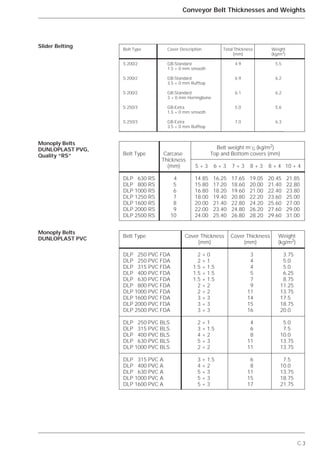
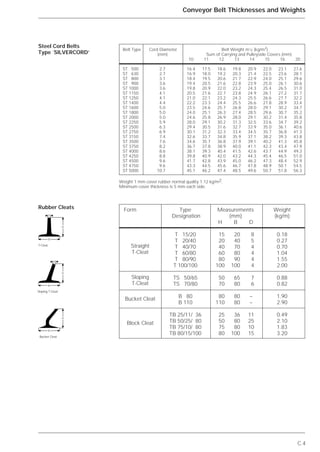
  • 6.
    V Index K Pulley Diameters K.1Pulley diameters for DUNLOP-ENERKA belt types K.2 Pulley diameters for DUNLOPLAST PVG and PVC belts K.3 Pulley diameters for steel cord belts SILVERCORD L Crowned Pulleys L.1 Dimensions, taper M Arrangement of Rubber Supporting Idler Discs M.1 Installation instructions, measurements N Chemical Resistance N.1 Resistance of the carcase N.2 Resistance of the covers N.3 Resistance of the covers (continued) O Steep Incline Installations O.1 Hints for the improvement of installation components O.2 Hints for the improvement of installation components (continued) P Endless Splicing P.1 Methods, hot vulcanising P.2 Warm vulcanization, cold vulcanisation, mechanical fasteners Q Material Characteristics Q.1 Material characteristics Q.2 Material characteristics (continued) Q.3 Material characteristics (continued) Q.4 Material characteristics (continued) Q.5 Material characteristics (continued) Q.6 Material characteristics (continued)
  • 7.
    Dunlop-Enerka Belting Dunlop-EnerkaFrance Sarl P.O. Box 86 Z.I. des Ebisoires Centurion Way 78370 Plaisir Farington, Leyland France Preston, Lancashire PR5 2EY Tel. +33 (0)1 3055 5419 United Kingdom Fax +33 (0)1 3054 0238 Tel. +44 (0) 1772 433 751 Telex 695608 Fax +44 (0) 1772 623 967 Telex 627080 Dunlop-CCT s.a. Dunlop-Enerka b.v. Boulevard des Combattants 64 Visokovol’tnij Proezd, 1 7500 Tournai 127577, Moskow Belgium Russia Tel. +32 (0) 69 254 811 Tel. +7 095 901 8857 Fax +32 (0) 69 226 270 Fax +7 095 901 2921 Telex 57187 Dunlop-Enerka b.v. Dunlop-CCT s.a. Postbus 14 Ovnatanyana str. 4 9200 AA Drachten 340017, Donjetsk The Netherlands The Ukraine Tel. +31 (0) 512 585 555 Tel. +38 0622 955 038 Fax +31 (0) 512 585 490 Fax +38 0622 323 977 Telex 46116 Dunlop-Enerka GmbH Dunlop-Enerka S.L. Friedrich-Bergius-Strasse 10 Pol. Ind. Les Comes 41516 Grevenbroich C/Italia, Parc, 70 Nave 3 Germany 08700 Igualada Tel. +49 (0) 2181 2701 00 Barcelona Fax +49 (0) 2181 2701 30 Spain Tel. +34 (9)3 80 55 446 Fax +34 (9)3 80 54 269 All information contained in this manual has been assembled with great care. It represents up-to-date knowledge and techniques and is based on our long experience of the industry. We would however advise you that modifications may be necessary to cater for new technical developments. All information, guide values, comments etc. are given for guidance purposes only and the ultimate responsibility for the use of this information in conveyor design and any subsequent liability rests with the end user, particularly where the suitability of our products for certain applications is concerned. The data and values given are based on average values.
  • 8.
    Introduction 1.1 Conveyor belts havebeen used for decades to transport bulk and unit loads. They have proved their worth everywhere because belt conveyor installations can be adapted to meet nearly all local conditions. They are work-safe and economical. The demand for ever increasing capacities and ever longer conveying lengths has accelerated the development of the belt conveyor technique, new mate- rials are being developed, new conveying systems are being planned and tested especially those having regard to the environmental. The conveyor belt plays the major part in the whole system and has to over- come the many and varied stresses. In addition to this every conveying problem is different and needs careful planning and selection of the right ele- ments in order to achieve the optimum conveying capacity in an economical way. There are a number of practical rules, values and experiences which can be useful during the planning stage. This manual aims to be of assistance to operators, engineers and project people and provides a substantial amount of elementary data. In addition there are a number of instructions and hints offered to enable accurate calculations or checks on installation components that impinge on the running of the belt. In future there will be more and more use of the computer for calculations and dimensioning of belt conveyors. With this often the correlation of the valuation criteria will no longer be recognizable. This manual should also help to understand the background to a calculation, the selection criteria for an optimum belt type and to recognize a special operating case. All new standards DIN, EN, or ISO, have been taken into consideration as well as the results of individual research studies. The developments continue and we are grateful for all hints and practical experiences. July 1994 Foreword
  • 9.
    1.2 Introduction Until the mid1970’s conveyor belt development and technology was concen- trated on the search for appropriate materials for the belt and the solving of drive problems. In the first instance transmission of traction played a part. As the demand grew for conveyors of larger capacity and longer length, addition- al requirements effecting the belt had to be considered and researched such as greater work load, elongation, slit resistance and endless splice jointing. from 1870 Trials with plain cotton belts. up to 1914 First rubber conveyor belts developed from drive belts. 1921 Founding of the Enerka factory. Manufacture of drive belts and later conveyor belts. 1923/1924 First use of belts underground, not a success due to drive problems. 1926 First belts with robust Balata reinforced covers. from 1928 Use of belts with Maco cotton plies. from 1933 Development of Rayon/cotton belts and pure rayon belts. Transition from natural rubber to synthetic rubber for protec- tion of carcase. from 1939 Increased use of rayon and synthetic rubber. 1941/1942 Use of PVC belts above ground. 1942 Steelcord belts used for the first time for major long haul installations in the United States. from 1945 Further development of rayon belts. Introduction of mixed material fabrics includes synthetic weft. 1954/1955 Development of high tensile strength belts e.g. plies from rayon, polyamide and polyester. Cover rubbers with various surface designs. Steep incline belting with profiles and cleats. from 1955 Development and use of steel cord belting in Europe. from 1970 Use of Aramide as reinforcing material for the carcase from 1980 Development of new conveyor systems e.g. the tube conveyor, hammock conveyor. This brief history illustrates the more important stages in conveyor belt deve- lopment. The search for new materials became necessary because of the ever increasing demands to optimise installation construction such as pulley diameters, vertical and horizontal curves etc. and the demands of new conveying systems. • Optimising conveyor belt reinforcing materials i.e. exploit to their maximum strength limits to obtain optimum working life economy. • Optimum dimensioning of installation components e.g. pulley diameters, idlers, bearings and shafts, troughing transitions, drive and take-up systems. • Adaptation of cover quality to each duty i.e. cover quality to provide optimum solution at the most economical cost. • Manufacture of conveyor belts and installation construction with the environment in mind. Chronological Development Development Goals
  • 10.
    1.3 Introduction To assist infuture development of new belt types and splice joining techni- ques, Dunlop-Enerka have developed and installed a new type of belt testing rig. The principal intention of the testing methods is to simulate actual opera- ting conditions encountered by a belt in service. With this rig it is possible to simulate changing stresses, bending changes, apply maximum pre-tension, use various pulley diameters, observe belt slip to capacity limits etc. Analysing the test data can enable optimum use to be made of conveyor belt materials and belt conveyors thereby providing more economical operations. DUNLOP-ENERKA Belt Testing Rig
  • 11.
    2.1 Belt Conveyor An installationconsists of a drive system, a take-up system, additional com- ponents and the principal item, the conveyor belt. In addition to the conven- tional conveyor there are other conveyor system developments in which the belt is the conveying element. Construction Basic Sketch Components Explanation 16 24 25 17 Belt conveyor-fixed position Mobile conveyor With wheels Without wheels Flat conveying Troughed conveying 34 33 1 Motor 2 Motor Coupling 3 Brake 4 Drive Transmission 5 Anti Runback 6 Drive Coupling 7 Pulley Bearings 8 Drive Pulley 9 Tail Pulley 10 Deflection or Snub Pulley 11 Impact Idler Garland 12 Carrying Side Idler 13 Return Side Idler 14 Guide Roller 15 Counter Weight Take-up 16 Screw Take-up 17 Take-up Weight 18 Belt Run Counter 19 Off Track Control 20 Belt Steering Idler 21 Pull Wire 22 Emergency Switch 23 Conveyor Belt 24 Brush Roller 25 Scraper 26 Plough 27 Decking Plate 28 Cowl (Head Guard) 29 Baffle Bar 30 Delivery Chute 31 Chute Lining 32 Skirt Board 33 Upper Belt Location 34 Lower Belt Location
  • 12.
    3.1 Drive Systems A drivesystem consists of all components that provide for driving, start-up and braking forces. The transmission of traction power from the drive pulley is dependent upon the following factors: • Angle of wrap ␣ the belt makes on the drive pulley • Friction coefficient ␮ between belt and drive pulley • Pre Tension Tv. The above sketches of drive systems and belt paths are of the classical and most frequently used types. Additionally there are a number of new proven developments or those which are still undergoing trials, for instance, tube conveyors, piggy-back conveyors, clamp conveyors, aerobelt conveyors, loop belt conveyors and others. Here are some examples: Drive Systems Pulley Arrangement and Belt Path Conveyor Systems Eintrommel-Antrieb mit direktem Abwurf Eintrommel-Antrieb mit Schwenkarm und Abwurfausleger Eintrommel-Antrieb mit Abwurfausleger Zweitrommel-Kopfantrieb mit Schwenkarm und Abwurfausleger Zweitrommel-Kopfantrieb mit direktem Abwurf Eintrommel-Kopfantrieb mit Eintrommel-Umkehrantrieb Zweitrommel-Kopfantrieb mit Eintrommel-Umkehrantrieb Loop Belt Conveyor Aerobelt Conveyor (FMW System) System Conveyor belt Material Conveying Through Airinlet Air Film Drive motors Hangers Drive Rollers Material Load Loop Belt with Clamp Edges Single pulley drive with direct discharge Single pulley drive with swivel arm and discharge jib Single pulley drive with discharge jib Single pulley head drive with single pulley tail drive Dual pulley head drive with direct discharge Dual pulley head drive with single pulley tail drive Dual pulley head drive with swivel arm and discharge jib
  • 13.
    3.2 Drive Systems The singlepulley head drive is the most common and preferred drive. For light duty applications the Motorized Conveyor Pulley or V-rope Drive is often used. Under normal circumstances the drive unit comprises motor, coupling and gear box located at the side of the drive pulley and connected by means of a flexible coupling, flanged coupling or extension gear box. With higher duty applications the drive units can be located on both sides of the drive pulley. For the higher duty applications the dual pulley drive is used which enables an increase in angle of wrap and traction transmission. 2 to 4 drives are possible which as a rule for reasons of standardization, would be of the same size. By distributing the drive power in the ratio of 1:1 or 1/3 : 2/3, the transmission capability of the first pulley would not be fully utilized. All motors take approxi- mately the same work load. Almost the same size work load can be achieved by selecting a fluid coupling whose slip characteristic can be modified by adjusting the volume of fluid in the working circuit. If slip ring motors are used this can be achieved by adjusting the slip resistance. The head and tail drive may be used for relatively long installations, reversible drives or where high return side resistance can occur. Start-up and braking is made easier on long installations. The tail drive overcomes the resistances to motion on the return side run, the pre-tension at the head drive can be increased. The choice of drive system depends on the total working duty, the belt char- acteristics and general operating conditions. With the higher duties the drive pulley is driven on both sides. The pulley shaft is then symmetrically used and able to take a higher loading. With multi-pulley drives the belt should be so reeved that the pulley side is leading over the drive pulley. In situations of high belt stress additional deflection of the belt should be avoided thereby preventing unnecessary bending stresses. One should be particularly aware of dirt build-up. Prompt cleaning can avoid down time and repair costs. Single Pulley Head Drive Dual Pulley Head Drive Head and Tail Drive General Criteria P1 P2
  • 14.
    3.3 Drive Systems In principlethere are three possibilities for conveyor belt driving systems. For use on small to medium duty applications. These are distinguished by their compact construction. As a rule in the range of approximately 20 kW to a maximum of 100 kW where pulley diameters up to 1400 mm are used and belt speeds in the range 0.02 to 5 m/s. The heat loss is minimal particularly with lagged pulleys. Utilized up to approximately 30 kW, special applications up to approximately 120 kW. Possibilities are spur gearing, angle drive, worm gearing. Compact and frequently used for light duty applications. The geared motor is connected to the drive drum by a flexible or fixed coupling. Drive units comprising these three components are used the most. Typical are work loads up to 600 kW with maximums up to approximately 1500 kW. The advantage of this arrangement is the good accessibility and interchange- ability of components and favourable spares inventory etc. In most cases, especially on large installations, coupling and brake are built into the drive unit. As a rule a belt conveyor has to operate under variable load conditions. The drive capability has to take account of these changes, also must run at con- stant revolutions and even speed. This type of motor is simple to build, is robust and economical. The high tor- que when starting can be minimised and adjusted by means of flexible coup- lings, fluid couplings and slip couplings. Small installations up to approximate- ly 10-12 kW can run without intermediate coupling. The high stresses imposed upon the system during loaded start-up can be limited by step by step increases in resistance or by the Star Delta reduced voltage system. With this type of motor the starting torque can be reduced by the increase of resistances within the electrical circuit. The slip ring motor is used on large installations if a quasi stationary gentle start-up is required. Drive Components Pulley Motor Geared Motor Motor Gears Coupling Drive Motor Squirrel Cage Motor Slip Ring Motor Motor Coupling Gearbox
  • 15.
    4.1 Couplings When starting upa belt conveyor, for a short time forces result which are hig- her than those which occur during normal running conditions e.g. start-up and acceleration forces. The motor in contrast creates by far the greater start-up torque. The difference between the load torque and the start-up torque of the motor, is the acceleration torque. Depending on the size and type of motor, a gentle start-up is provided when a flexible or hydraulic coupling is used. Rigid couplings are used only on small installations up to a maximum of 30 kW and at slow speeds. Flexible couplings of diverse construction are already built into 16-20 kW units. Centrifugal and magnetic type couplings with controlled torque are hardly ever used because of their high cost and are no longer a significantly used item for belt start-up. Fluid couplings or hydraulic couplings are often used for larger drives in combination with squirrel cage motors. They permit a load free acceleration of the motor and consequently with increasing oil fill, provide a gentle quasi steady state start-up of the belt conveyor. The maximum torque occurring during the start-up process is restricted to lowest possible level. The convey- or belt and splice joints are relieved and conserved. Empty at Rest Full at Start-up Full Working (Principle of the VOITH Turbo coupling with delay chamber) Coupling Types Rigid Coupling Flexible Couplings Centrifugal Couplings Hydraulic Coupling The principle of a Turbo coupling
  • 16.
    4.2 Couplings The electric motorproduces a variable torque with speed of rotation which is illustrated below by line M. The belt conveyor as a working unit opposes tor- que MM at the same rotational speed set against torque ML. At the moment of switch on, the electric motor delivers the start-up torque MA. When this happens, the belt conveyor demands the break away torque MLB. As rotation increases the motor torque declines to saddle torque MS and then increases to the brink torque MK. Thereafter the torque at the nomi- nal speed of rotation reduces to the nominal torque of the motor MN. The load increases steadily. The difference between the motor torque MM and the load torque ML is the acceleration torque MB up to the torque intersection of both lines. The start-up of the electric motor occurs practically load free compared with the coupling torque MK up to the cut-off point 1 of the graph line MK and the load graph line ML. The motor remains at point 2 and accelerates the belt conveyor up to syn- chronous speed. Thereafter the motor, the coupling and the belt conveyor reach the drive speed of rotation at point 3. This type of coupling is only effective on a high speed shaft. The start-up torque is reached by a continuous filling of the coupling from 0 to break away torque within a period of approximately 10 to 20 seconds. Thus the belt is slowly tensioned and longitudinal vibrations are avoided. Start-up Procedure Squirrel Cage Motor with Fixed Couplings Squirrel Cage Motor with Hydraulic Coupling MA Start-up Torque Motor MS Saddle Torque Motor MK Brink Torque Motor MN Nominal Torque Motor MLb Break Away Torque ML Load Torque MB Acceleration Torque MM Motor Torque ML Load Torque MK Coupling Torque MA MS MK MN MB ML MLb MM ML MK 1 3 2 Revolutions n Revolutions n TorqueMTorqueM
  • 17.
    4.3 Couplings A holdback deviceis necessary if the force due to the loaded incline of a con- veyor FSt exceeds that of the peripheral force FH stemming from conveying the load over the horizontal distance. This is the case with all steeply inclined conveyors and with those having a decline of approximately 6° to 10°. FSt (N) Incline Force FH (N) Force due to Horizontal Conveying m’L (Kg/m) Mass of Load Stream on Belt m’R (Kg/m) Mass of Rotating Carrying Idler Rollers L (m) Conveyor Length H (m) Height Difference f (-) Artificial Friction Factor g (m/s2 ) Acceleration due to gravity During installation a check should be made as to whether the direction of pul- ley rotation corresponds with the free wheeling direction of rotation and that reverse travel of the belt is no longer possible. Holdback SUPERFORT Belt in Service Conveying Overburden FSt > FH ( N ) FSt = H * g * m’L ( N ) FH = f * L * g ( m’L + m’R ) ( N ) stands fast free locked
  • 18.
    5.1 Drive Pulley The belttensions required for frictional transmission of peripheral force FU are: T1 = Entry side force = Tight side tension T2 = Leaving side force = Slack side tension Because of the friction coefficient between belt and pulley, T1 is greater than T2. The difference between both forces is peripheral force FU. On braking the forces are reversed. In the extreme case of friction cut off that is, if the slip limit is about to be reached and the angle of wrap ␣ is fully utilized, then at the limit of slip T1 decreases along the angle of wrap ␣ to the value of T2 over a logarithmic spiral. From the formulae for peripheral force FU and T1 the following relationships can be derived: c1 and c2 are the drive factors. If the peripheral force FU is greater than the transmission capability according to the Eytelwein theory borderline conditions, then the drive pulley over runs and slip occurs. During the reduction of tension from T1 to T2 along the service arc, a decrea- se in the belt stretch occurs. It is not proportional to the time it occurs at a slower rate. Creep remains on the pulley circumference and often creates a whistling sound. Entry side speed = pulley peripheral speed. Leaving side speed < entry side speed. Force Transmission Eytelwein Limitations Slip Creep FU = T1 - T2 or T1 = FU + T2 T1 ≤ e␮␣ or T1 ≤ T2 * e␮␣ T2 1 T1 = FU * ( 1 + ) = FU * c1 e␮␣ - 1 1 T2 = FU * ( ) = FU * c2 e␮␣ - 1 ␣ T1 T2 FU T2 An gleofwrap Spiralelog. Angleof repose N ␣␸ T1 T1 T1max
  • 19.
    5.2 Drive Pulley The factorsdetermining the transmission of peripheral force Fu are the fric- tion coefficient, the angle of wrap ␮ and the pretension T2 e.g. Tv. The number of drive pulleys, the pretension force as well as various other installation components are dependent upon the friction coefficient ␮. In order to assess the friction coefficient, full knowledge of the operation is desirable. In practice the friction coefficient varies within limits which are dependent upon: • Surface condition of the pulley • Lubricating material such as water or load slime between belt and pulley • Temperature • Surface pressure • Slip and creep speed The friction coefficient declines with increasing surface pressure and increa- ses with increasing speed of creep for instance at start-up. The angle of wrap can be increased by means of a snub pulley to a maximum of 230°. By using two drive pulleys an angle of up to approximately 450° can be achieved. Friction Coefficient ␮ Angle of Wrap ␣ ␣ ␣ ␣ ␣ ␣ ␣ Operating Condition Plain Steel (smooth) Polyurethane lagging (grooved) Rubber lagging (grooved) Ceramic lagging (porous) Pulley Surface Dry 0.35 to 0.4 Wet (Clean) 0.1 Wet (dirty mud, clay) 0.05 to 0.1 0.35 to 0.4 0.35 0.2 0.4 to 0.45 0.35 0.25 - 0.3 0.4 to 0.45 0.35 to 0.4 0.35 ␣ ≤ 180° ␣ ≤ 230° ␣1 + ␣2 ≤ ca. 450° coefficient de frottement ␮ Facteursdecommande c1 c2 ᭤ ᭤ c1 c2 arc de contact c1 c2 ᭤ ᭤ c1 c2 Angle of wrap DriveFactors Friction coefficient ␣ ␣ ␣ ␣ ␣ ␣ From the graph the follo- wing relationships can be derived. •An increase in value over 0.35 does not result in any great advantage from c1 and c2. •With friction coefficient ␮ value less than 0.3 an increase of the angle ␣ is an improvement from c1 and c2. •Values ␮ and ␣ take into account the values of ␮ and ␣ with the same value of drive factors c1 or c2.
  • 20.
    6.1 Take-up Systems Belt conveyorsare equipped with take-up (tension) devices. These are necessary to make it possible for the transmission of force on the drive pulley or to accommodate changes in the length of the belt as the load changes and to provide a smooth start-up of the installation. The choice of take-up system depends on the general conditions of the installation, the elongation char- acteristics of the belt, the start up behaviour, climate and perhaps the conveying distance and the inclination of the installation. Depending on the application one differentiates between: • Fixed take-up • Moveable take-up with a constant pre-tension provided by a gravity weight or with a pre-tension regulated by motor This simple take-up device is used for relatively short conveyor lengths or with belts having a low elongation such as steelcord. After tensioning the belt, the length stays constant but the belt pull force changes according to the change in load through permanent or elastic stretch. The level of pre-tension force can be determined practically by tensioning the belt until the forces react at all parts of the installation. The belt is permanen- tly tensioned sufficiently high as is necessary for full load conditions. It is possible to ascertain and actually adjust the tension by means of a sensor. On longer installations a moveable gravity weight tension device is used. With this a constant pre-tension is achieved at all parts of the installation. The length changes of the belt are evened out in the take-up travel. It must be determined in such a way as to accommodate those changes i.e. addition- ally to permanent belt elongation. A value for take-up travel with textile carcase belts is approximately 1.5% based on conveyor centre to centre distance and with steelcord belts approximately 0.3%. With especially long installations or to reduce start-up vibrations of belt, so called regulated take-up winches are used. By means of electric switching a pre-run of the take-up winch, before the belt start-up, is achieved. During start-up the pre-tension is kept above nominal value. After reaching the ste- ady running condition the winch is adjusted so as to provide the nominal value of pre-tension. General Fixed Take-up Device Gravity Weight Regulated Take-up Winch
  • 21.
    7.1 Detection Devices For theoperation of complex belt conveyor installations a range of safety devices were developed. They serve to prevent accidents, to guard the conveyor belt and to run and automize the complete installation. This device detects the belt tension changes during different working condi- tions such as starting, braking and load variations. A tensiometer measures the changing belt tensions. As soon as the defined limits of the upper and lower belts tensions are exceeded a signal is transmit- ted to the take-up unit. An off-track of the belt can be limited or corrected by means of a number of mechanical devices. Another possibility is to track the belt with light beams. If a deviation beyond the defined limits is detected a motorized steering sys- tem is set into operation. If the off-track is not adjusted the installation is brought to a halt. With the help of this device the overloading of a transfer point is registered. A contact probe is suspended in the chute and adjusted to the required mate- rial flow. With an overload, contact is made with the probe and the installa- tion is switched off. This device detects the force transmission between belt and drive pulley. Too great or too long a duration of slip leads to overheating of the pulley sur- face which can lead to fire. Slip can occur more often at start up as well as overload conditions or when the pre-tension is too low. Slitting open of conveyor belts is a relatively frequent cause of damage which leads to prolonged interruptions and incurs great costs. In most cases it stems from sharp edged pieces of material being trapped in the transfer chute. To avoid such damage the following remedies are possible. • Textile or Steel breaker ply embedded in the cover rubber • Bunched steel cords are embedded in the carrying side cover set at fixed spacing. • Rip detection loops at approximately 50 to 100m spacings vulcanised into the belt. • Carcase with a high resistance to longitudinal slittings such as Dunlop FERROFLEX belt or DUNLOPLAST belt. Belt tension detection Off track detection Chute detection Belt Slip detection Longitudinal Slitting Safety Device Illustration of the transverse reinforcement in a FERROFLEX Belt
  • 22.
    8.1 Cleaning Devices Belt conveyorswhen operating need to be cleaned constantly depending on the type and characteristics of the load residues which stick to the carrying side of the belt. The return idlers get dirty which leads to further encrusting of idlers and pulleys. The consequences are, amongst others: • loss of load • soiling of the installation • damage to the belt • off tracking of the belt • damage to idlers The belt cleaning requires special measures having regard to: • material characteristics such as, dry, damp, sticky, granulated • degree of cleaning, rough to `clinically’ clean The material from which the scraper is made has to be in accord with the type of belt and the material to be scraped off. The following need to be observed: • the hardness of the belt and scraper; In general the material from which the scraper is made should not be har- der than the belt surface. The scraper should be designed in such a way that it makes contact with the biggest possible area of the belt, perhaps a double or staggered scraper. • the contact pressure of the scraper; An excessive contact pressure increases energy consumption and wear and tear of the belt. A small gap between the scraper and belt surface pro- vides a sufficient cleaning effect with most bulk loads, causing minimum wear and tear. Sliding friction becomes rolling friction. In nearly every case the most effective and economic solution has to be esta- blished, possibly by trial and error. Several well proven systems are listed as follows. General Basic rules TRIOFLEX Belt in operation on Garland Idlers
  • 23.
    8.2 Cleaning Devices Steel cordstensioned transversely over the belt carrying side behind point of discharge for coarse cleaning of stic- ky material such as loam, clay and the like. Fixed or moveable also possible as a double bladed scraper. Used for moderately sticky material Big contact area. For cleaning the under side of the belt often located before tail pulleys. In special cases it can be used in double bladed form. Also prevents material from running into the tail pulley. Used for rough cleaning immediately at the discharge pulley. Adjustable versions are available. Used for nearly all non-sticky materials. Can be adjusted depending on the load and desired degree of cleaning. Rotating, partly self driven brushes with rubber or nylon bristles. Not suit- able for sticky materials such as clay or loam. Piano Wire Scraper Transverse Scraper Fan Scraper Plough Scraper Scratch Action Scraper Staggered Scraper Rotary Scraper
  • 24.
    8.3 Cleaning Devices Horizontally rotatingscraper located on return run. Ring scraper in slightly tilted position - belt driven. Situated on the belt running side loca- ted in the region of the discharge hop- per. For belts with a profiled carrying side and steep inclined belts. Located at inaccessible areas such as bridges, tunnels or over-passes. The belt is turned over on the return side so that the dirty carrying side is upper- most. Good cleaning method where good water supply and drainage are available. Rotary Scraper Rapping Roller Belt turnover High Pressure Water Pulley sideCarrying side Turnover Length
  • 25.
    9.1 Load It is importantto know the exact make-up and material component of the load when constructing a conveyor installation. The choice of conveyor belt is determined by the physical and chemical properties of the materials and possibly by safety regulations and demands. Dusty, granular or lumps. Loads for instance, stone, earth, sand, grain, cement. They are defined by their physical characteristics such as density, granulometry, moisture, oil and fat content, pH value, abrasiveness, angle of surcharge etc. Piece loads comprise such as boxes sacks, blocks etc., and are defined by shape, measurement and weight. It is the quotient of the mass and volume V of the bulk load If a load is loosely poured a static angle of slope ␤st will form. If the under layer is moved as when being transported on a conveyor belt, the angle of surcharge ␤dyn is formed. The particles of the bulk load interact and the lower the internal friction of the material the lower the surcharge angle ␤dyn. Approximately: The surcharge angle is only to a degree related to material size. It depends on the friction between material and belt, how the material is loaded and the geometry of the conveyor installation. The tabulated values in the Appendix are approximate values. If exact values are necessary they have to be deter- mined by practical trials. As a measure of granulometry or lump size the maximum diagonal corner to corner dimensions k are used. Whichever is the predominant granulation or lump size decides whether the bulk load is sized or unsized. General Bulk Loads Unit Loads Bulk Density ␳ Angle of repose Surcharge ␤ Granulometry k Measurement m ␳ = ( t/m3 ) V ␤dyn = (0.5 - 0.9) * ␤st Sized load kmax / kmin ≤ 2.5 Unsized load kmax / kmin > 2.5 Granulometry k = 0.5 ( kmax + kmin ) Bulk Load Definition Granulometry (mm) Dust 0.5 Granular 0.5 - 10 Lumps 10 - 200 Large Lumps > 200 kk
  • 26.
    9.2 Load It is importantto have as near accurate as possible knowledge of the load temperature and ambient conditions in order to select the optimum cover quality and in certain circumstances the layout of particular installation com- ponents. Further influencing factors are: • Granulometry of the material and hence the contact density made with the belt. • The speed of the belt and therefore the heating up and cooling off times. • Whether installation is open or enclosed. The moisture content of the material has an influence on the surcharge angle ␤dyn, the friction value between material and belt and thus the maxi- mum angle of inclination of an installation. It is difficult to give an exact assessment and if necessary practical trials need be conducted. The moistu- re content is measured in percentage. A sound knowledge of the chemical characteristics of the load is necessary when selecting the cover quality and also the carcase reinforcement. Important are the proportions of oils and fats (mineral and vegetable) and acidity. The temperature of the chemical material as well as the proportion of acidity influences the level of attack made on the belt cover. The pH value is the concentration of hydrogen ions which are present in a solution e.g. the negative exponent to base 10 of the concentration (hydrogen exponent). The neutral point is pH = 7 Under 7 indicates acidity Over 7 indicates alkalinity (bases) The pH value indicates the degree of acidity or alkalinity and can be important in selecting the cover quality. The maximum angle of inclination of a belt conveyor depends on the friction value between material and belt and the form of material. Large lump and moist material decrease the angle of inclination. The method of loading such as direction and rate of feeding are also important criteria. For most bulk loads and belts with a smooth carrying surface, the limit angle lies between 18° and 20°. For steeper inclinations up to 90°, profiled belts, belts with cle- ats or elevator belts are used. Temperature Moisture Chemical Characteristics pH Value Angle of Inclination ca.90° ca.85° ca. 40° ca. 35° ca. 22° pH > 7 alkalis pH = 7 neutral pH < 7 acid ᭡ ᭢ Smooth Belts Sidewall Belting: with Vertical Cleats with Tilted Cleats with Bucket Cleats Elevators ᭣ ᭣ Steep Inclining Belts: Multiprof CHEVRON HIGH-CHEVRON Profile Belts: Herringbone Rufftop
  • 27.
    10.1 Conveyor Belt The conveyorbelt is the most important element of a belt conveyor instal- lation. It has to be capable of doing numerous tasks: • Absorb the stresses developed at drive start-up. • Transport the load. • Absorb the impact energy at the loading point. • Withstand temperature and chemical effects (heat, oil and fat containing materials, acidity etc.). • Meet safety requirements (flame resistant, antistatic etc.). The conveyor belt consists of the following components: • Carcase consisting of textile plies, steel weave or steel cord. • Covers in different qualities of rubber or PVC. • Additional components (as required) such as edge protection, impact pro- tection, longitudinal slitting prevention etc. • Special construction elements like profiles on steep incline belts, cleats or corrugated edges etc. All items mentioned above should be considered carefully. The selection of the belt specification depends on the application. Schematic Construction of a Plied Belt General Belt construction Carcase of textile plies Pulley Side Cover Breaker Ply or Longitudinal Slit Preventor Carrying Side Covers Full Rubber Edge
  • 28.
    10.2 Conveyor Belt The carcasecan be made from various materials and in different construc- tions. The most frequently used are textile ply carcases and Steel Cord. DUNLOFLEX TRIOFLEX SUPERFORT 2 Ply 3 Ply Multi Ply DUNLOPLAST FERROFLEX SILVERCORD For textile, solid woven or steel reinforced types the principal materials used are as follows: Carcase Carcase with one or more textile plies (up to a maximum of 6 ply) Carcase of the Solid woven type. Monoply belts Carcase of the Steel weave type Carcase with Steel Cords. ST-belts Material Dunloplast Belts have a PVC impregnated textile carcase of monoply construction. Depending on tensile strength and duty the carcase fibres are in polyester, polyamide or aramid. The transmission of force is by means of the longitudinal steelcords laid next to one another in the same plain. Above this carcase is a transverse layer also of steel which is held in place by a polyamide binder cord. With this belt force is transmitted via steel cords of the appropriate strength. The cords are transversely bound together by an inter- mediate layer of rubber only. Transverse Elements serve to prevent impact damage or longitudinal slitting. Symbol Ply Materials B Cotton (Natural fibre) P Polyamide (Synthetic fibre) E Polyester (Synthetic fibre) EP Polyester-Polyamide (Synthetic fibre) D Aramid (Synthetic fibre) F Steel Weave (Ferroflex) ST Steel Cord (ST belt) Cover Core Rubber Steelcord
  • 29.
    10.3 Conveyor Belt Of thetextile ply types the wholly synthetic plies have proved to be the best over the years e.g. polyester (E) in the warp (longitudinal direction) and polyamide (P) in the weft (transverse direction). The abbreviation of this ply construction is called EP. Carcases from Aramid (D) are in development and are high tensile and low elongation carcases. Steel Cord belts have very low elongation and are used predominantly on long haul installations. Evaluation of various Material Properties The carcase is protected against outside influences by the covers which are normally made out of either rubber or PVC. The carrying side cover should not be more than 3 times thicker than the running side cover. With wholly synthetic and rot resistant plies it is not necessary to have full rubber edge protection, it is sufficient to have heat sealed cut edges. Exceptions are belts requiring special qualities such as oil and fat resistance. The basic grades and principal properties are in accordance with ISO and DIN. Various other special grades exclude laid down mechanical or other values. Covers Cover Thickness Ratio Belt Edges Grades Key and evaluation of the plies Characteristics B P E EP D F ST Tensile Strength – ++ ++ ++ +++ ++ +++ Adhesion – ++ ++ ++ ++ ++ +++ Elongation – – ++ ++ +++ +++ +++ Moisture Resistance – – + ++ ++ ++ + ++ Impact Resistance – + + + + ++ +++ – – = bad – = medium + = good ++ = very good +++ = excellent Carrying side : Running Side ≈ 3:1 DIN 22102 (April 1991) Cover grade W X Y Z Tensile strength N/mm2 min. 18 25 20 15 Breaking elongation % 400 450 400 350 Abrasion loss mm3 max. 90 120 150 250 ISO 10247 (November 1990) Cover grade H D L Tensile strength N/mm2 min. 24 28 15 Breaking elongation % 450 400 350 Abrasion loss mm3 120 100 200
  • 30.
    10.4 Conveyor Belt The carryingside surface depends on the load, the inclination of the installa- tion or depending on the use of the belt, smooth, profiled, cleated and with corrugated edges. Multiprof Profile HIGH-CHEVRON Profile Special Qualities Cover Surface Characteristics Type Flame Resistant F Anti Static E Flame Resistant, Anti Static S or K Heat Resistant T Low Temperature Resistant R Oil and Fat Resistant G Food Stuff A Chemical Products C Herringbone Profile Rufftop Profile
  • 31.
    10.5 Conveyor Belt The thicknessof the carrying side cover depends upon the nature of the load and loading conditions (type of load, gradient, height of fall etc.). Gradient values Carrying side Cover thickness Cover Thickness Gauges Cover Surface Belt Type Max. Gradient Application Unit and Smooth Normal 18° - 20° bulk loads all types Profiled Fishbone up to 35° Piece and Rufftop bulk loads Steep conveyor Steep conveyor Bulk loads profile CHEVRON (non-sticky) HIGH-CHEVRON up to 40° Piece loads Multiprof (sacks) T-cleats Belts with Piece and with or without corrugated side up to 90° bulk loads corrugated edges walls, with or without T-Cleats With Steel Elevator Bulk loadsor rubber belts 80° - 90° all typesbuckets attached Load Wooden crates Bricks Paper Sacks Jute Sacks Plastic Boxes-dry Plastic Boxes-wet 40° 40° 35° 35° 40° 25° 30° 30° 30° 35° 30° 25° Gradient angle for conveyor belt with Rufftop profile Herringbone profile Cover Thickness (mm) Conveyor Load/Duty Carrying Side Pulley Side Light package Conveying 2 2 Gravel, Earth, Potash etc. 2 - 4 2 - 3 Ore, Ballast, Coal 4 - 8 2 - 3 Slag 4 - 8 2 - 3 Coarse ballast, coarse Ore 8 - 12 3 - 5 large lump Coal 8 - 12 3 - 5
  • 32.
    10.6 Conveyor belt Dunlop-Enerka Cover Qualities Basicmaterials Code Rubber type NR Natural Rubber SBR Styrene-Butadiene Rubber NBR Nitrile Rubber IIR Butyl Rubber EPDM Ethylene-Propylene-Diene Rubber CR Chloroprene Rubber Dunlop- Quality Temperature (˚C) Basic Characteristics Enerka Quality DIN ISO. base Application min. duration max. RA Y (N) -30° 80° 100° SBR Abrasion resistant, for normal service conditions encountered in carrying bulk and aggregate materials. RE X (M) H -40° 80° 90° NR Extra abrasion resistant and cut resistant for heavy duty service conditions (sharp materials and adverse loading conditions). RS W D -30° 80° 90° NR/SBR Super abrasion resistant, for heaviest service conditions, abrasive materials with a large proportion of fines. BETA- T -20° 150° 170° SBR Heat resistant, for materials at HETE moderate temperatures. STAR- T -20° 180° 220° IIR Very heat resistant, for materials HETE with controlled high temperatures. DELTA- T -20° 200° 400° EPDM Very heat resisant, for heavy duty HETE service conditions including abrasive materials, at temperatures up to 400°C (or more) at times, e.g. some isolated burning materials or red-hot cores, such as embers, sinter, coke etc. ROS G -20° 80° 120° NBR Oil and grease resistant, for oily materials on mineral oil base. ROM G -30° 80° 90° SBR/NBR Oil and grease resistant, for vegetable oils and animal greases. MORS G -20° 80° 90° SBR/NBR Oil and grease resistant, for vegetable oils and animal greases, and for heavy service conditions of the cover. BV S/K -30° 80° 90° CR/SBR Fire resistant for conveyance of materials with fire and explosion danger, such as fertilizer BVO S/G -20° 80° 90° CR/NBR Fire and oil resistant for conveyance of oily materials (vegetable oils and animal greases), e.g. fertilizer, cereals, derivates etc. The values apply to the materials temperatures Other qualities for special applications are available on request.
  • 33.
    10.7 Conveyor belt Characteristics andareas of application Natural rubber, because of its special properties is a good basic material for belt cover rubbers. Technical Characteristics • Very good tensile strength and elongation • High heat resistance and elasticity • High tearing and shear strength • Good abrasion resistance characteristics Temperature Stability Generally stable within the temperature range of -30° to + 80°C. With special rubber compounding a widening of this range may be achieved from -40°C to + 100°C. Chemical Stability Resistant to water, alcohol, acetone, dilute acids and alkalis - limited resistan- ce to concentrated acids and alkalis where compounding and service tempe- ratures are major consideration. Special characteristics With special compounding natural rubber based mixes can be made antistatic and flame resistant. By adding antiozonants a substantial protection against harsh temperature effects, sunlight and ambient weather conditions can be achieved. Scope Everywhere where high physical properties are called for and the chemical and temperature demands are not excessive. SBR is a synthetic polymerisation product consisting of styrene and butadie- ne whose characteristics are similar to natural rubber. Tensile strength and cut resistance are good. Abrasion, heat and ozone resi- stances are better than natural rubber. NBR is a copolymer of butadiene and acrylonitrile. It is not resistant to Ketones, esters aromatics and hydrocarbons. The physical property values are slightly lower than those of natural rubber. The temperature operating range can be controlled between -40°C to +120°C. NBR is relatively abrasion resistant, resistant to ageing and is used for oil and fat resistant belt covers. Butyl rubber is a polymerisation product of Isobutylene and Isoprene. It has a very good ozone and temperature resistance. In addition to a very good resistance to ageing, depending on compounding, it is able to withstand temperatures of -30°C to + 150°C. It has a limited resis- tance to acids and alkalis, animal and vegetable fats. Butyl rubber is used mainly for heat resistant conveyor belting. EPDM is temperature resistant similar to Butyl but with a considerably higher resistance to wear and tear. Additionally EPDM has a better ozone resistance than all other basic polymers. Basic Materials Natural Rubber NR Synthetic Rubber SBR Nitrile Rubber NBR Butyl Rubber IIR Ethylene Propylene Rubber EPDM
  • 34.
    CR is aSynthetic polymerisation product of Chlorobutadiene. The mechanical properties are similar to natural rubber but significantly better in respect of ozone and oil resistance. The chlorine in Chloroprene gives the product a high degree of flame resistance. The working temperature range is -30°C to +80°C. The resistance to animal and vegetable oils and fats is superior to natural rub- ber as is the ageing resistance. The use of Nitrile in Chloroprene rubber enhances the dynamic properties. For cover rubber which requires a high oil and fat resistance whether it be animal, vegetable or mineral and also requiring superior mechanical proper- ties. NCR is better than CR. The foregoing basic materials are main ingredients of cover rubber compo- nents. They provide the principal characteristics of each quality but can be affected by the addition of other compounding ingredients to achieve requi- rements of standards and regulations. Conveyor belting is described according to laid down International standards. Additionally special types and qualities may be described by the manufacturer or in accordance with Customer wishes. The belt length is generally given in metres either open or endless. Open Length is the length around the pulleys plus an allowance for making endless. Endless Length is the inside circumference of the endless belt. This number gives the nominal or breaking strength of the carcase in N/mm of belt width. The values are Internationally Standardized. The nominal strength of the carcase is made up by a number of plies. The monoply belt has a solid woven carcase. The nominal tensile strength of the full thickness carcase is the sum of the ply strengths rounded up to the next nominal tensile strength. The number of plies is not indicated in specially described types such as DUNLOFLEX, TRIOFLEX or DUNLOPLAST. D DUNLOFLEX 2 Ply Belt F FERROFLEX Steelweave Belt T TRIOFLEX 3 Ply Belt DLP DUNLOPLAST Monoply Belt S SUPERFORT Multiply Belt ST SILVERCORD Steelcord Belt 10.8 Conveyor belt Chloroprene Rubber CR Nitrile Chloroprene Rubber NCR Note Belt Description Belt Length DUNLOP types Nominal Tensile Strength the Carcase Number of Plies Nominal Tensile Strength of Plies Ordering Example 100 m 800 mm EP 400/3 4+2 mm X Belt Length Belt Width Material (carcase) Nominal Tensile Strength Number of Plies Carrying Side Cover Thickness Pulley Side Cover Thickness Cover Quality 125 160 200 250 315 400 500 630 800 1000 1250 1600 2000 2500 63 80 100 125 160 200 250 315 400
  • 35.
    11.1 Design Main Data Values SpeedV Standard Values Recommended Velocity (m/s) After establishing the duty of the operation and the type of belt conveyor, the main data may be determined. Belt Speed v (m/s) Belt Width B (m) or (mm) Carrying Idler Arrangement Cross Sectional area of Load Stream A (m2) Conveyor Capacity Q (t/h) The belt or Conveying Speed V (m/s) must be appropriate for the material composition and operation conditions. High Speed - Narrower belt widths Lower belt tension Greater wear and tear Low Speed - Greater belt widths Higher belt tension Less wear and tear The most economical installation is that having the highest belt speed consis- tent with the type of material and operating conditions. Speeds V (m/s) 0.42 - 0.52 - 0.66 - 0.84 - 1.05 - 1.31 - 1.68 2.09 - 2.62 - 3.35 - 4.19 - 5.20 - 6.60 - 8.40 Duty v (m/s) Unit Loads, Assembly Lines ≤ 1.68 Mobile Conveyors 0.52 - 1.68 Very dusty loads such as Flour, Cement ≤ 1.31 Ash and Refuse ≤ 1.68 Grain, Crushed Limestone 1.05 - 2.09 Gravel, Sand Readymix Ores, Bituminous Coal, Sinter Storage and transhipment, Power Stations 1.31 - 3.35 Long distance conveying, overburden 2.62 - 6.60 Brown coal Thrower belts ≥ 8.40 Steep gradient belts 0.84 - 2.62 Type CHEVRON and HIGH CHEVRON
  • 36.
    11.2 Design Wherever possible astandard belt width should be selected. Type and granu- lometry of the materials determine the minimum belt width. After determi- ning the belt type a check on troughability may be necessary under some circumstances. With unsized material the large lumps are embedded in the smaller granula- ted material. The disposition of the carrying idler varies from application to application. The number of idler rolls in a carrying idler set and troughing angle determine the cross sectional area of the load stream and thus the conveying capacity. In deciding on the carrying idler spacing one has to take account of the load limitation of the carrying idler (note: Refer to manufacturer’s specification). After establishing the belt tension the belt sag between idler rollers has to be checked. The roller spacing has to be selected in such a way that the sag of a loaded belt is no more than 0.5%-1.5% of the centre to centre distance. With return side idlers one may allow approximately 2-3% sag. Belt Width B Standard Widths (mm) Minimum Belt Widths Carrying Idler Disposition Distance between Carrying Idlers 300 - 400 - 500 - 650 - 800 - 1000 1200 - 1400 - 1600 - 1800 - 2000 - 2200 Min. Width Lump Size K (mm) Sized Unsized 400 50 100 500 80 150 650 130 200 800 200 300 1000 250 400 1200 350 500 1400 400 600 1600 450 650 1800 550 700 2000 600 800 k hTx Tx lo lu Tx * 8 * hrel lo = ( m ) (m’L + m’G) * g Tx * 8 * hrel lu = ( m ) m’G * g Tx ( N ) Belt tension at point X m’L ( kg/m ) Weight of load per metre m’G ( kg/m ) Weight of belt per metre g ( m/s2 ) Gravitational acceleration (9.81 m/s2) hrel ( - ) Relative belt sag Carrying run : hrel = 0.005-0.015 Return run : hrel = 0.020-0.030 Flat 2 Part 3 Part Deep Trough Garland Carrying Side Return Side
  • 37.
    11.3 Design Idler rotation shouldnot be greater than approximately 650 r.p.m. The length of the middle idler roll determines the cross sectional area of the load and thus the conveying capacity. The gap d between 2 adjacent rolls should not be greater than 10mm, with belt widths B > 2000mm d = 15mm refer to DIN22107, carrying idler arrange- ments. Values for Idler Spacing Idler Rotation Standard Idler Diameter (mm) Carrying Side lo = 0.5 à 1.0 m Small installation or high impact lo = app. 1.2 m Normal installation lo = 1.4 à 4.0 m High tension installation Return Side lu = (2-3)*lo Maximum approx 6 m nR = 60 * v (r.p.m. ) ␲ DR DR ( m ) Roll diameter v ( m/s ) Belt speed Carrying Idlers 51 63.5 88.9 108 133 159 193.7 219 Impact Idlers 156 180 215 250 290 Return Run Support Discs 120 138 150 180 215 250 290 Standard length L (mm) of rollers Belt Troughing Type Width Flat 2 roll 3 roll Deeptrough Garland B (mm) 300 380 200 - - - 400 500 250 160 - - 500 600 315 200 - - 600 700 340 250 - - 650 750 380 250 - - 800 950 465 315 200 165 1000 1150 600 380 250 205 1200 1400 700 465 315 250 1400 1600 800 530 380 290 1600 1800 900 600 465 340 1800 2000 1000 670 530 380 2000 2200 1100 750 600 420 2200 2500 1250 800 640 460 l B l d ld d l l d
  • 38.
  • 39.
    Forme d’auge AngleSection de char- Comparai- d’auge ␭ gement A(m2) son plat 0,0483 44% 20° 0,1007 91% 30° 0,1145 104% 20° 0,0935 85% 30° 0,1100 100% 45° 0,1247 113% 20° 0,0989 90% 30° 0,1161 106% 45° 0,1284 117% 30°/60° 0,1329 121% Auge profonde Guirlande 11.5 Design To determine the cross-sectional area of the load stream A, one may use as a basis the geometric relationship which can be constructed from the troughing angle ␭, the usable belt width b and the angle of surcharge ß. For 1, 2 and 3 roll carrying idler sets, the part cross-sectional area can be cal- culated as follows: Cross Sectional Area of Load Stream Cross-Sectional Area of Load Stream Part Cross-Sectional Area Cross Sectional Area Comparison for Various Forms of Troughing. Note: The values for the cross sec- tional area and the compari- son are for a belt width B = 1000 mm and for an angle of surcharge ␤ = 15°. B b l ␭ ␤ l1 A2 A1 ᭤ ᭣ ᭣ ᭣ ᭣ ᭤ ᭤ ᭣ ᭤ ᭣ ᭤᭣ A = A1 + A2 ( m2 ) A1 = 0.25 * tan ␤ * [ l + ( b - l ) * cos ␭ ]2 ( m2 ) A2 = l1 * sin ␭ * [ l + l1 * cos ␭ ] ( m2 ) l ( m ) Length of middle carrying roll l1 ( m ) Loading width of outer rolls l1 = 0.5 ( b - l ) for 3 roll idler sets l1 = 0.5 ( b - 3 * l )for 5 roll Garland sets b ( m ) Usable belt width (loadstream width) b = 0.9 * B - 50 mm for belts B ≤ 2000 mm b = B - 250 mm for belts B > 2200 mm ␭ ( ° ) Troughing Angle ␤ ( ° ) Surcharge Angle Troughing Form Troughing Angle Load Cross Sec- tion Area A(M2 ) Compari- son Flat Deep Trough Garland 0.0483 0.1329 0.1007 0.1145 0.0935 0.1100 0.1247 0.0989 0.1161 0.1284
  • 40.
    11.6 Design The conveying capacityis determined from the cross-sectional area A and the belt speed v (m/s). The effective or nominal load stream volume is determined from the effective degree of filling. This takes account of working conditions and the gradient of the installation. The degree of filling is dependent upon the characteristics of the load, e.g., the lump size, the surcharge angle and the working conditions, e.g, method of loading, tracking or the reserve capacity etc. ␸1 = 1 for normal working conditions; ␸1 = 0.8 - 0.95 for adverse condition. The reduction factor ␸2 takes into consideration the reduction in part cross- sectional area A1 as a result of the conveying gradient. The load stream Qm (t/h) is calculated thus: For the calculation of the conveying capacity for unit loads the following formula applies. Conveying Capacity Load Stream Volume Effective Degree of Filling Degree of Filling ␸1 Values for ␸1 Reduction Factor ␸2 for Smooth Belts for Steep Incline Belts For Bulk Loads Load stream mass For Unit Loads Quantity conveyed Load Stream QV = A * v * 3600 * ␸ ( m3/h ) ␸ = ␸1 * ␸2 ( - ) Gradient 2° 4° 6° 8° 10° 12° 14° 16° 18° 20° 22° ␸2 1.0 0.99 0.98 0.97 0.95 0.93 0.91 0.89 0.85 0.81 0.76 Qm = Qv * ␳ ( t/h ) Theoretical value Qm = Qv * ␳ * ␸ ( t/h ) Effective value 3600 * v Qst = ( St/h - pieces per hour ) lst + ast mst * 3.6 * v Qm = ( t/h ) lst + ast QV ( m3/h ) Volume (values see Appendix) with v = 1 m/s v ( m/s ) Belt Speed ␳ ( t/m3 ) Bulk density (see Appendix) mst ( kg ) Piece Weight lst ( m ) Piece Length in direction of travel ast ( m ) Spacing of pieces Angle of inclination 15° 20° 25° 30° 35° 40° Spharical rolling and coarse Material 0.89 0.81 0.70 0.56 – – Sticky material 1.00 0.93 0.85 0.68 0.58 0.47
  • 41.
    11.7 Design This section dealswith estimated values and relevant matters primarily to enable the Project Engineer to provide a speedy assessment of require- ments from the given service data. To make an optimum selection of the conveyor belt and conveyor components it is recommended that detailed cal- culations be done in accordance with subsequent sections. With the aid of the following formulae, power requirements can be roughly assessed. The accuracy is sufficient for normal installations with simple straight-forward running conditions. From the power calculations, the belt type can be closely determined. The actual nominal belt weight can be used in the more precise calculation of the belt. P3 is the sum of additional power for trippers, skirtboard friction, ploughs. Standard electric motors (kW) Power Requirements Additional Power Installed Motor Width factor CB PT = P1 + P2 + P3 (kW) CB * v + Qm P1 = (kW) CL * kf H * Qm P2 = (kW) 367 Required motor power PM = PT / ␩ (kW) Qm ( t/h ) mass of load stream v ( m/s ) belt speed CB ( kg/m ) width factor (see table) CL ( m-1 ) length factor (see table) H ( m ) conveyor elevation H = sin ␦ * L L ( m ) conveying length ␦ ( ° ) angle of inclination kf ( - ) Service factor (see table) ␩ ( - ) efficiency of the drive ␩ = 0.9 for drives with fluid couplings 1.5 2.2 3 4 5.5 7.5 11 15 18.5 22 30 37 45 55 75 90 110 132 160 200 250 315 400 500 630 Duty Bulk Density ␳ (t/m3) Light Medium Heavy Up to Ca.1.0 1.0 to 2.0 Over 2.0 31 54 67 81 108 133 194 227 291 36 59 76 92 126 187 277 320 468 554 691 745 65 86 103 144 241 360 414 644 727 957 1033 Belt Width B (mm) 300 400 500 650 800 1000 1200 1400 1600 1800 2000 2200 Power at Drive Pullley Power for empty Conveyor and Load over the Horizontal Distance Power for Lift (or Fall) PN selected motor from standard list.
  • 42.
    Trippers (throw-off carraiges) Scrapers (for installationsL ≤ 80 m) Material - skirtboard Discharge plough Belt Width B (mm) ≤ 500 ≤ 1000 > 1000 11.8 Design Length Factor CL Working Conditions Factor kf Additional Power Values L (m) 3 4 5 6 8 10 12.5 16 20 CL 667 625 555 526 454 417 370 323 286 L (m) 25 32 40 50 63 80 90 100 150 CL 250 222 192 167 145 119 109 103 77 L (m) 200 250 300 350 400 450 500 550 600 CL 63 53 47 41 37 33 31 28 26 L (m) 700 800 900 1000 1500 2000 CL 23 20 18 17 12 9 Working Conditions Favourable, good alignment, slow speed Unfavourable, dusty, low temperature, overloading, high speed Normal (Standard Conditions) Extremely low temperature kf 1.17 1 0.87 - 0.74 0.57 Scraper Type simple, normal contact 0.3 * B * v 1.5 * B * v 1.8 * B * v heavy contact multifunctional fac scraper 0.16 * v * lfbeyond loading point 1.5 * B * v Bulk density ␳ ≤ 1.2 Angle ␣ = 30° - 45° P (kW) 0.8 * v 1.5 * v 2.3 * v B ( m ) Belt width v ( m/s ) Belt speed lf ( m ) Length of material between skirtboard L (m) Conveying Length
  • 43.
    Belt Type Nominal BreakingStrength Number of Plies Friction Value Factor cR 11.9 Design This formula is to enable calculation of belt breaking strength and applies to installations with a single pulley head drive, an angle of wrap ␣ = 200°, a safe- ty factor S = 8 to 10. By using a dual pulley head drive or a head and tail drive a lower strength belt type can result. The nominal Breaking Strength kN is obtained by rounding up to the next highest belt type. The number of plies or thickness of carcase depends mainly on the belt width, material characteristics (bulk density, lump size) and conditions such as transitions, height of material fall, installation path, troughing etc. cR PT k = * ( N/mm ) cv v 98 74 59 45 37 30 25 21 18 16 15 14 69 52 41 32 26 21 17 15 13 12 10 9 62 46 37 28 23 18 15 13 12 10 9 8 57 43 34 26 21 17 14 12 11 9 8 8 53 40 32 25 20 16 13 11 10 9 8 7 DUNLOP Belt Type DUNLOFLEX 2 ply overlap 100% 1 ply overlap 50% 1.00 0.50 TRIOFLEX 3 ply overlap 100% 2 ply overlap 67% 1.00 0.67 FERROFLEX Zig-Zag Splice Joint 0.90 DUNLOPLAST Finger Splice Joint 0.90 Steel Cord Belts Splice 1 and 2 step 3 step 4 step Various Mechanical Joints: Refer to Manufacturer 1.00 0.95 0.90 SUPERFORT Number of plies 1 2 3 4 5 6 0.70 0.50 0.67 0.75 0.80 0.83 Splice Type Ply Rating Factor cv Breaking Strength Loss at Joint Factor Cv Breaking Strength 0.15 0.25 0.30 0.35 0.40 bare, wet rubber lagged, wet and dirty bare, dry, lagged, wet rubber lagged, dry Friction Value ␮ Belt Width B (mm) 300 400 500 650 800 1000 1200 1400 1600 1800 2000 2200 Drive Pulley Surface
  • 44.
    11.10 Design The pulley diameterfor a conveyor belt depends upon the belt construction (belt type, carcase material and thickness of carcase), the duty and the method of splicing. One can differentiate between 3 pulley groups depen- ding on pulley location and angle of wrap ␣. To determine the pulley diameter first ascertain the diameter of the drive pulley with maximum tension. The calculated pulley diameter is rounded up to the next higher standard dia- meter or if working conditions are favourable may be rounded down. Pulley Diameters Value CTr Standard Pulley Diameter (mm) GROUP APPLICATION A Pulleys in the areas of high belt stress. Drive Pulleys B Pulleys in areas of low belt stress. Tail Pulleys C Pulleys with an angle of wrap ␣ ≤ 90°, Deflection or snub Pulleys DTr = CTr * d ( mm ) d ( mm ) Thickness of carcase (see Appendix C) CTr ( - ) Value for warp material of carcase i.e. Belt type. CTr Material of Carcase in Warp or Belt Type 90 Polyamide (P) 80 DUNLOFLEX 2 ply Belt 95 TRIOFLEX 3 ply Belt 108 SUPERFORT Multiply Belt (EP) 138 FERROFLEX Steel Weave Type 145 SILVERCORD Steel Cord Belt 100 DUNLOPLAST Monoply Belt ᭤Tail Pulley Snub Pulley Bend Pulley Snub Pulley Drive Pulley Tension Pulley 100 125 160 200 250 315 400 500 630 800 1000 1250 1400 1600 1800 2000
  • 45.
    11.11 Design Once the diameterof the largest pulley has been determined to a standard size the diameter for pulley groups A, B, C can be obtained from the following table. The diameters shown in the above table apply to belts operating at 60% - 100% of allowable tension. When the rated tension of the belt is not fully utilized, it is permissible to reduce pulley diameter to 1 to 2 sizes smaller. For pulley diameters of the DUNLOP belt types: see Appendix K. Pulley Revolution Pulley Loading Pulley Diameter Of Pulley Groups (mm) Diameter DTr (mm) A B C 100 100 - - 125 125 100 - 160 160 125 100 200 200 160 125 250 250 200 160 315 315 250 200 400 400 315 250 500 500 400 315 630 630 500 400 800 800 630 500 1000 1000 800 630 1250 1250 1000 800 1400 1400 1250 1000 1600 1600 1250 1000 1800 1800 1400 1250 2000 2000 1600 1250 Tmax * S kA = * 100 ( % ) B * kN Tmax ( N ) Max. belt tension S ( - ) Belt safety factor when running B ( mm ) Belt Width kN ( N/mm ) Nominal breaking strength of belt Degree of Utilization Pulley Diameter kA > 0.6 à 1 Diameters as table kA > 0.3 à 0.6 Group A, B and C one size smaller kA < 0.3 Group A and B 2 sizes smaller Group C one size smaller v * 60 nT = ( T/min ) ␲ * D TA1 + TA2 FT = ( kg ) 9.81 Utilisation Percentage
  • 46.
    11.12 Design With rubber laggeddrive pulleys the average surface pressure limit is approxi- mately 70 N/cm2. This limit is only reached on heavy drives and relatively small pulley diameters. The transmission capability pü is not to be confused with surface pressure! The surface pressure is summary calculated, the belt bending stresses being ignored. With high belt stresses the pulley diameter becomes too large because of the low values for pü. pü = 1600 - 2000 N/mm2 above ground pü = 3000 - 3500 N/mm2 under ground This formula is no longer used to determine the pulley diameter. The distance between a terminal pulley and the adjacent fully troughed idler set at either the head or tail end of a conveyor is know as the transition dis- tance. In this distance the belt changes from a fully troughed to a flat profile or vice versa respectively. The belt stretches additionally at its edge zone and buckling in the middle of the belt is also possible. To relieve the belt and edge stresses, the pulley may be raised slightly to the value h (mm) (see Page 11.13). The necessary transition length for tension distribution with or without pulley elevation when designing can be estimated or taken from the table. Average Surface Pressure Transmission Capability Torque at Start-Up Troughing Transition Elevation of Pulley TA1 + TA2 pT = ( N/cm2 ) D * B 360 * FU pü = ( N/mm2 ) ␲ * D * ␣ * B FA * D MA = ( Nm ) 2 * 1000 D ( mm ) Pulley diameter B ( mm ) Belt width FA ( N ) Peripheral force at start-up ␣ ( ° ) Angle of wrap v ( m/s ) Speed FU ( N ) Peripheral force when running LM Lred l h S ␭ L 1
  • 47.
    11.13 Design The pulley liftshould not exceed the value h (mm) in order not to get a “ski jump” effect. Lift-off from the centre roller is not desirable as this would have an adverse effect on belt tracking. Values apply to 3 roll idler sets. 1) Reduced lengths Lred apply to the raised pulley with the value h (mm) according to the table. Troughing Transition Pulley Rise Reduced Transition Distance Trough Transition Values Pulley Lift h (mm) LM = x * s * sin ␭ ( mm ) s2 h = * sin ␭ ( mm ) B Lred = x * (s * sin ␭ - h) ( mm ) LM ( mm ) Normal transition length Lred ( mm ) Reduced transition length with raised pulley l ( mm ) Length of centre carrying roller (see page 11.3) s ( mm ) Portion of belt in contact with side idler roller, s = 0.5 * (B-l) x ( - ) Factor for carcase x = 8 for Textile belts x = 16 for ST. belts ␭ ( ° ) Troughing angle h ( mm ) Pulley lift Troughing Angle Textile belts LM (mm) Lred 1) (mm) ST Belts Lred 1) (mm) Troughing ␭ 20° 30° 30° 40° 45° 30° 45° Belt Width (mm) 500 650 800 1000 1200 1400 1600 1800 2000 2200 410 550 665 850 1000 1190 1370 1550 1710 1920 600 800 970 1240 1470 1740 2000 2260 2500 2800 680 860 1020 1200 1380 1550 1720 1900 870 1100 1310 1540 1770 1990 2200 2450 950 1210 1440 1700 1950 2200 2430 2700 1350 1710 2040 2400 2750 3100 3432 3800 1900 2420 2870 3380 3890 4390 4860 5390 Belt Width (mm) 37 48 56 68 78 89 98 112 47 62 72 87 100 114 126 143 52 68 80 96 110 125 138 158 800 1000 1200 1400 1600 1800 2000 2200 Troughing Angle ␭ 30° 40° 45°
  • 48.
    In the transitionfrom inclined to horizontal, the belt edge zone is subjected to additional stretch. In order not to exceed certain limits, as a rule 0.8% addi- tional stretch, the transition radius Re has to be dimensioned accordingly. Minimum radii for 3 roll carrying idlers. 11.14 Design Convex Vertical Curve Values of Radius Re (m) l S ␭ Re ␦ ␣ L l0 Carrying side Return side Re = x * s * sin ␭ ( m ) s ( mm ) Portion of belt in contact with side idler roller x ( - ) Factor for carcase x = 125 for textile belts x = 400 for steel cord belts L = ␲ * ␦ * Re / 180 ( m ) z = ␦ / ␣ (Pieces) lo = L / z ( m ) ␣ ( ° ) Deviation per idler ␣ = approx 2˚ for 30˚ troughing ␣ = approx 3˚ for 20˚ troughing ␦ ( ° ) Gradient of installation Convex Radius Curve Length Number of Idlers in Curve Idler Pitch Textile belts 20° 30° 45° 500 650 800 1000 1200 1400 1600 1800 2000 2200 6.5 8.5 10.5 13.0 16.0 18.5 21.0 24.0 26.5 30.0 9.3 12.5 15.0 19.5 23.0 27.0 31.0 35.0 39.0 44.0 13.5 17.5 21.0 27.0 32.0 38.0 44.0 50.0 55.0 62.0 30.0 40.0 48.5 62.0 74.5 87.0 100.0 113.0 125.0 140.0 - - 68.5 88.0 104.0 123.0 141.0 160.0 177.0 198.0 ST Belts 30° 45° Belt Width (mm)
  • 49.
    11.15 Design With a concavevertical curve, the belt path goes from horizontal to incline. At start-up or load change there may be a risk of the belt lifting off the car- rying idlers in this region. This can lead to a reduction in pre-tension. If due to special circumstances a brief lift-off can be tolerated then the lifting belt can be restrained by rollers mounted above the troughing idlers. In any event action must be taken to ensure that the belt does not lose load material. With a concave vertical curve, buckling of the belt edges and overstress of the middle of the belt can occur. (To check calculation see Appendix I.5.) Concave Vertical Curve Additional Stretch-buckling Ra Lx Tx xa ya ␦ Tx ( N ) Tension at start of curve when fully loaded m’G ( kg/m ) Belt weight ␦ ( ° ) Gradient angle, up to 18° use 18°, cos ␦ Ӎ1 Tx Ra = ( m ) m’G * cos ␦ * g xa = Ra * tan ␦ horizontal distance ya = 0.5 * Ra * tan2 ␦ vertical distance Concave Radius Co-ordinates of Curve
  • 50.
    11.16 Design One method ofsolving belt cleaning problems on the return side run is the use of belt turnover. This method is employed in inaccessible areas such as conveyor bridges and tunnels. To avoid excessive strain in the edge region of the belt, the turnover must be a certain minimum length, depending on the method of turnover, belt type and belt width. With textile belts up to a width of 1200 mm and a thickness of 10 mm, the belt may be turned over unguided and without support. At the entry and exit points of the turnover lengths, the belt is fed through a pair of rol- lers. With textile and steel cord belts up to 1600 mm wide to support the belt in the middle of the turnover length, a pair of vertical rollers is used. At the entry and exit points the belt is fed through a pair of horizontal rollers. With textile and steel cord belts up to 2200 mm wide. With this turnover the belt is fed over support rollers which run on a length- wise axis. For smooth running of the belt through the turnover stretch, a minimum belt tension is necessary. If Tx is > than T2 or T3 then belt tensions have to be corrected. Belt Turnover Un-guided Turnover Guided Turnover Supported Turnover Turnover Lengths Values for Turnover Lengths LW (m) Min. Belt Tension at Turnover Lw * m’G * g min. Tx = ( N ) 8 * h Lw ( m ) Length of Turnover Stretch h ( % ) Degree of sag 1.5% is recommended (h = 0.015) m’G ( kg/m ) Load due to conveyor belt B ( m ) Belt Width Lw Lw = 1.36 * B * ͱ 71 = 11.5 * B ( m ) Lw = 1.55 * B * ͱ245 = 24 * B ( m ) Method of guiding belt in Turnover Lengths Belt Type free or with guided with a support rollers middle roller EP belts 12 * B 13 * B DUNLOPLAST 16 * B 19 * B FERROFLEX 17 * B 20 * B ST. BELTS 18 * B 22 * B for EP belts for ST belts
  • 51.
    11.17 Design Within limits, beltsare able to negotiate horizontal curves. To do this the car- rying idlers on the inside of the curve are slightly raised by the angle ␭R accor- ding to radius and belt tension by approximately 5°-15°. The exact position has to be determined by adjustment. For design purposes the following radii may be selected being the smaller permissible radii RH (m). The values RH apply to a troughing angle of 30° Horizontal Curve Value of Curve Radius RH ᭤ ᭤ ᭤ RH ␭R l Inside of Curve ␭ l RH = k * [ l + B * ( 1 - ) * cos ␭ ] ( m ) B l ( mm ) Length of middle carrying roller (see Page 11.3) B ( mm ) Belt width ␭ ( ° ) Troughing angle ␭R ( ° ) Lifting of the carrying rollers (ca. 5° to 15°) k ( - ) Factor (consider belt type and duty) for EP belts k = 71 DUNLOPLAST k = 150 FERROFLEX k = 225 ST belts k = 245 Belt width (mm) 300 400 500 650 800 1000 1200 1400 EP belts 20 26 33 42 52 65 72 91 DUNLOPLAST 42 56 69 89 110 137 165 192 FERROFLEX - - - 134 165 206 248 289 ST belts - - - 146 180 224 270 314 Belt width (mm) 1600 1800 2000 2200 2400 2600 2800 EP belts 104 117 130 142 156 169 182 DUNLOPLAST 220 247 275 - - - - FERROFLEX 329 370 412 452 - - - ST belts 359 404 449 493 - - -
  • 52.
    12.1 Basis of calculations Afterthe design of the installation and the main data has been determined an exact calculation can be undertaken. Established installation components can be checked and dimensioned. The belt selection can be undertaken according to forces that have been established and other relevant criteria. The resistances to motion within a belt installation may be categorised thus: - Main resistance - Secondary resistance - Slope resistance - Special resistances Resistance due to moving the mass of idlers, belt and material on the car- rying and return runs. Running resistance of idlers (bearing and seal fric- tion). Resistance due to impressions made in the belt by idlers and the flexing of the belt. With gradients ␦ ≤ 18° Cos ␦ = 1. Resistance occurring mainly in the loading area such as the acceleration of the material at the loading point. Resistance due to the friction on the side walls of the chute, resistance due to belt flexing on pulleys, pulley bearing resistance. • With normal installations with one loading point, the secondary resistance can be calculated by using the factor C as part of the main resistance. Factor C depends on the conveying length and can be taken from the table on Page 12.3. • If the secondary resistance relative to the total resistance is high as for instance with conveyors less than approximately 80 m long with several loading points, a separate calculation is necessary. Resistance from load and elevation. The special resistances are due to installation components such as: • the forward tilt of outer idler rollers to improve tracking • material deflection ploughs and belt cleaners, continuous skirtboards • trippers (throw-off carriages) • bunker drag out belts The resistances to motion are relatively simple to calculate. Information not available such as pulley diameters etc. can be estimated for initial calculation formulae or taken from the appropriate table. Formulae for calculation: see Appendix E. Resistance to Motion FH Main Resistance FH Secondary Resistance FN Note Slope Resistance FSt Special Resistances FS FH = f * L * g * [ m’R + ( 2 * m’G + m’L ) * cos ␦ ] ( N ) FN = ( C - 1 ) * FH ( N ) FSt = H * g * m’L ( N )
  • 53.
    12.2 Basis of calculations Peripheralforce steady state working The sum of the resistances to motion is equal to the peripheral force FU at the drive pulley (or shared over several drive pulleys). For installations with one loading point, as a rule the following summation applies: Peripheral Force FU Working Conditions Summation Herringbone Belt in Operation FU = FH + FN + FSt + FS ( N ) FU = C * f * L * g * [m’R + (2 * m’G + m’L) * cos ␦] + H * g * m’L + FS ( N ) C ( - ) Length factor f ( - ) Artificial friction factor L ( m ) Conveyor length g ( m/s2 ) Acceleration due to gravity m’R ( kg/m ) Mass of the rotating carrying and return idlers m’G ( kg/m ) Mass of the belt m’L ( kg/m ) Mass of the load ␦ ( ° ) Gradient of the installation with ␦ ≤ 18° cos ␦ = 1 H ( m ) Conveying height H > 0 inclined conveying H < 0 declined conveying FS ( N ) Sum of the special resistances. For separate calculations see Appendix.
  • 54.
    12.3 Basis of calculations Thisadjustment factor makes allowance for secondary resistances (See page 12.1). The influence of Factor C will decrease the greater the conveyor length. For installations less than a conveying length of approximately 80m or having several loading points see appendix D. Factor C Förderlänge L in m BeiwertC L (m) 3 4 5 6 8 10 13 16 20 C 9.0 7.6 6.6 5.9 5.1 4.5 4.0 3.6 3.0 L (m) 25 32 40 50 63 80 90 100 120 C 2.9 2.6 2.4 2.2 2.0 1.92 1.86 1.78 1.70 L (m) 140 160 180 200 250 300 350 400 450 C 1.63 1.56 1.50 1.45 1.38 1.31 1.27 1.25 1.20 L (m) 500 550 600 700 800 900 1000 1500 2000 C 1.20 1.18 1.17 1.14 1.12 1.10 1.09 1.06 1.00 CoefficientC Conveying Length in mm
  • 55.
    12.4 Basis of calculations Thefriction factor f is used for the calculations of the resistances to motion. It provides an estimate of the resistance to rotation of the idlers, the belt resi- stance (flexing and idler impressions) and material impression resistance. Values for the factor f are dependent upon the working conditions and con- struction characteristics of the installation. The above table values are relevant for v = 5 m/s and a temperature of + 20°C. Under certain circumstances the following adjustments are possible or neces- sary: a) With other speeds the following applies: b) With other temperatures the following applies: For central European regions and normal working conditions the value of f = 0.020 - 0.021 would be used. In extreme temperatures such as those in tropical regions a value for f = 0.017 would apply. In extremely low temperatures a value for f up to 0.035 would be used. Friction Factor f Adjustments Horizontal, inclined or slightly declined installations - Motor driven Favourable working conditions, easily rotating idlers, material 0.017 with low internal friction and good tracking, good maintenance Normal installation, normal material 0.020 Unfavourable conditions, low temperature, material 0.023 - 0.027 with high internal friction, subject to overload, poor maintenance Installations with steep declines 0.012 - 0.016 creating regenerative conditions With v <> 5 m/s f = c * f5m/s v (m/s) 2 3 4 5 6 Factor c 0.80 0.85 0.90 1.00 1.10 With T < 20°C f = c * f20°C T (°C) +20° 0° -10° -20° -30° Factor c 1.00 1.07 1.17 1.28 1.47
  • 56.
    12.5 Basis of calculations Themass of rotating parts m’R (kg/m) is calculated from the weight of the rotating idler rollers on the carrying and return runs. For the masses mRO and mRu (kg). Applicable to standard rollers diameters and belt widths 300 mm to 2200 mm. See table in the Appendix. If this information is not available roller pitch values as per Page 11.3 may be used. Standard idler roller diameters (mm) of flat or troughed rollers according to DIN 15107 are: The idlers and discs may vary from manufacturer to manufacturer. For loca- tion of disc rollers see Appendix M.1. The mass of the belt m’G is determined from the weights of the various belt types. For the belt weights m”G (kg/m2) of the DUNLOP-belt types see Appendix C. Mass of Rotating Parts m’R Weight of rollers per m Mass of rollers mRo et mRu Roller Pitch Idler Roller Diameter Mass of Belt m’G Belt weight per m mRo mRu m’R = + ( kg/m ) lo lu mRo ( kg ) Mass of one set of carrying idler rollers mRu ( kg ) Mass of one set of return idler rollers lo ( m ) Pitch of carrying idlers lu ( m ) Pitch of return idlers (51) 63.5 88.9 108 133 159 193.7 219.1 Tube dia. mm. 51 57 63.5 88.9 108 133 Disc rollers 120 133 150 180 180 215 dia. mm. 215 250 m’G = m”G * B ( kg/m ) m”G ( kg/m2 ) Belt weight per m2 B ( m ) Belt width
  • 57.
    12.6 Basis of calculations Theload m’L is derived from the cross sectional area of the bulk load stream Qm alternatively with piece loads, from the weight of one piece. Peripheral force FA in a non-steady state running condition At the breakaway and start-up of a loaded installation, the inertial resistan- ces to motion of the masses to be moved, have to be overcome. The belt stresses during acceleration have to be kept to a minimum. The initial pulley peripheral force at start-up must not exceed a certain value. • The maximum peripheral force FA should not be greater than approx (1.3 to 1.5) * Fu, the steady state running peripheral force. • In order to accelerate the masses on the conveying length, a force equiva- lent to a minimum of 20% of the motional resistances should be available. • The peripheral force FA should be applied to the belt over such a period of time that the installation is maintained at almost a steady state and so acce- lerates with minimum additional dynamic forces. • At start-up with acceleration aA and peripheral for FA one should seek to ascertain the friction cut-off value between material and belt ( perhaps also when braking) Mass of the Load m’L Material weight per m Peripheral Force FA at Start-Up Recommendations Friction cut-off Material Belt Qm m’L = ( kg/m ) 3.6 * v mst m’L = ( kg/m ) lst + ast Qm ( t/h ) Loadstream mass v ( m/s ) Belt speed mst ( kg ) Weight of each piece lst ( m ) Length of each piece ast ( m ) Spacing of pieces aA ≤ ( ␮1 * cos ␦max - sin ␦max ) * g ( m/s2 ) ␦ ( ° ) angle of slope of the installation ␦ > 0 inclined conveyors ␦ < 0 declined conveyors ␮1 ( - ) friction value belt/material ␮1 = 0.5 à 0.7 aA ( m/s2 ) acceleration (calculationl, see Page 12.7) For bulk loads For unit loads
  • 58.
    12.7 Basis of calculations Theperipheral force FU increases at start-up. To take account of the start-up resistances a factor kA is applied resulting in peripheral force FA. The value of kA is dependent on the drive unit motor/coupling used. Rigid couplings are used on small installations up to approx. 30kw motor power and squirrel cage type. The peripheral force FA is derived from the installed motor power. With this type of coupling the start-up torque of the motor is reduced. The installed motor power may be substantially higher than is necessary therefore FA should be less than or equal to FU * 2.5. With hydraulic couplings the start-up torque can be regulated and limited to the desired start-up factor and by doing this, depending on the size of the installation, a near steady state running condition can be achieved. At start-up and braking the acceleration and deceleration forces of the mass being moved have to be considered. If the drive elements (motor, coupling, gears) and the non-driven pulley resistances are higher than the remaining resistances, this has to be taken into account. If the acceleration time tA is greater than 10 s, in the case of squirrel cage motors a start-up coupling is necessary because of thermal effects. Start-Up Factor kA Rigid Couplings Flexible Coupling Hydraulic Coupling Acceleration aA PN * ␩ * 1000 FA = kA * ( N ) v PN ( kW ) installed motor power ␩ ( - ) degree of drive efficiency v ( m/s ) speed kA ( - ) start-up factor KA = 2.0 to 2.2 if FA > FU * 2.5 then FA should = 2.5 * FU, (cut-off torque) PN FA = kA * FU * ( N ) PM FA = kA * FU ( N ) kA ( - ) start-up factor, kA = 1.2 to 1.5 regulated by the volume of oil in the working circuit. FA - FU aA = ( m/s2 ) L * ( m’Red + 2 * m’G + m’L ) + ⌺m’Ared + ⌺m’red m’Red ( kg/m ) Reduced mass of idlers m’Red ≈ 0.9 * m’R m’Ared ( kg/m ) Reduced mass of drive elements m’red ( kg/m ) Reduced mass of non-driven elements (bend pulleys etc) tA = v / aA ( s ) sA = v * tA / 2 ( m ) Acceleration time Acceleration Distance PM ( kW ) required motor power kA ( - ) start-up factor, kA = 1.2 to 1.6
  • 59.
    12.8 Basis of calculations Theperipheral force FB on braking has to be determined for the most adverse circumstances. The braking time tB has to take care of safety requi- rements (emergency stop) or the braking distance sB because of the possi- bility of continuing flow due to over-run of the conveyor. The brake has to take account of the braking duty and delay. Peripheral Force FB on Braking Peripheral Force FB aB = v / tB ( m/s2 ) sB = v * tB / 2 ( m ) FB = aB * L * ( m’Red + 2 * m’G + m’L ) + FU + FT ( N ) FT ( N ) If a great proportion arises from the non-braked elements these forces must be added. FT = aB * ⌺mred ( N ) mred ( kg ) Reduced masses of the non-braked elements or pulleys Braking torque of the Motor FB * ␮B MV = ( Nm ) i MBr = MM + MV ( Nm ) n ( T/min ) Motor revolutions ␮B ( - ) Friction value of brake disc FB ( N ) Peripheral force on braking i ( - ) Transmission ratio FU * v PT = ( kW ) 1000 PM = PT / ␩ ( kW ) FU > 0 PM = PT * ␩ ( kW ) FU < 0 PN ( kW ) selected motor power Delay Overun Distance Delay Moment Braking Torque of the Motor Drive Motor at Pulley Required Motor Power Motor Power on Braked Installation Installed Motor Power PN MM = 975 * g * ( Nm ) n
  • 60.
    12.9 Basis of calculations Afterthe peripheral force FU has been ascertained and hence the drive power PT requirement, the drive system, position and number of motors can be established. The single pulley head drive is the most common all drive systems. With hori- zontal and inclined conveyors these give the most favourable belt stresses and with declined conveyors with gradients of 1° to 2° providing the peripher- al force remains positive. The preferred location of the drive on a declined conveyor is at the tail end. The drive becomes a generator and acts as a brake. When a relatively high proportion of motional resistance is due to the return run, this drive system provides the most favourable belt stress condition. Degree of Efficiency ␩ (Values) Nominal Power PN (kW) Drive System Single Pulley Head Drive Tail Drive Head and Tail Drive Types of Drive ␩ Wormgear drive 0.7 - 0.8 Toothed chain drive 0.9 - 0.95 V-Rope drive 0.95 Pulley motor 0.96 Normal coupled drive 0.94 Geared and hydraulic coupling 0.90 Hydraulic motor 0.86 Braked installations 0.95 - 1.0 Selected according to DIN 42973 1.5 2.2 3.0 4.0 5.5 7.5 11 15 18.5 22 30 37 45 55 75 90 110 132 160 200 250 315 400 500 630 T1 T2 FU P1 P2 FU1 FU2 Fu Fo T1 T2 FUB T3 T4
  • 61.
    The most favourabledistribution of the total power is as follows: With identical drives i.e. P1 = P2, T4 may be less than Tmin and the pretension has to be increased accordingly. With high drive powers it is often necessary to distribute the available perip- heral force over two pulleys. The angle of wrap can thus be increased to approx 420°. The most favourable drive distribution is as follows: As a rule the friction coefficient ␮ is taken to be the same for both pulleys. 12.10 Basis of calculations Head and Tail Drive Dual Pulley Head Drive PT = P1 + P2 ( kW ) P1 Fo (Primary force) ≈ = x P2 Fu (Secondary force) P2 = PT / ( x + 1 ) ( kW ) FU2 = FU / ( x + 1 ) ( N ) FU1 = FU - FU2 ( N ) PT = P1 + P2 ( kW ) P1 FU1 e␮␣ 1 - 1 Value for ≈ ≈ e␮␣ 2 = x factor x P2 FU2 e␮␣ 2 - 1 see Table P2 = PT / ( x + 1 ) ( kW ) FU2 = FU / ( x + 1 ) FU1 = FU - FU2 ( N ) Total Power Distribution Motor 2 Peripheral force Pulley 2 Peripheral force Pulley 1 Total Power Distribution Motor 2 Peripheral force Pulley 2 Peripheral force Pulley 1 Pulley 1 P1 FU1 Pulley 2 P2 FU2 T2 T1
  • 62.
    12.11 Basis of calculations Inpractice the most favourable distribution of power does not often occur because the norm is to use equal drive units. As a result of this the drive pul- leys are not equally utilized. With unequal distribution of the total power, the drive powers for individual pulleys are thus: Factor x for various drive conditions PT = P1 + P2 ( kW ) P1 FU1 ≈ = x P2 FU2 FU2 = FU / ( x + 1 ) ( N ) FU1 = FU - FU2 ( N ) Total Power Distribution Peripheral force Pulley 2 Peripheral force Pulley 1 Pulley 2 Angle of Wrap ␣1 Pulley 1 ␮ = 0.25 160° 170° 180° 190° 200° 210° 160° 2.00 2.20 2.40 2.60 2.80 3.00 170° 1.90 2.10 2.30 2.48 2.67 2.86 180° 1.83 2.02 2.20 2.38 2.57 2.75␣2 190° 1.77 1.95 2.12 2.30 2.48 2.65 200° 1.71 1.89 2.06 2.23 2.40 2.57 210° 1.67 1.83 2.00 2.17 2.33 2.50 ␮ = 0.3 160° 170° 180° 190° 200° 210° 160° 2.31 2.53 2.76 3.00 3.26 3.53 170° 2.22 2.43 2.66 2.89 3.14 3.40 180° 2.15 2.35 2.57 2.79 3.03 3.28␣2 190° 2.08 2.28 2.48 2.70 2.93 3.18 200° 2.02 2.21 2.41 2.62 2.85 3.08 210° 1.97 2.15 2.35 2.55 2.77 3.00 ␮ = 0.35 160° 170° 180° 190° 200° 210° 160° 2.66 2.92 3.20 3.51 3.84 4.18 170° 2.56 2.82 3.10 3.39 3.70 4.03 180° 2.48 2.74 3.00 3.29 3.59 3.91␣2 190° 2.41 2.66 2.92 3.19 3.48 3.80 200° 2.35 2.58 2.84 3.11 3.39 3.70 210° 2.29 2.52 2.77 3.03 3.31 3.61
  • 63.
    12.12 Basis of calculations Beforethe belt tensions are determined it necessary to check whether the peripheral force of Pulley 1 or peripheral force of Pulley 2 are fully utilized. This drive system is treated in the same way as a dual pulley head drive system. The peripheral forces can be ascertained as follows: The calculation of belt stresses is as described under Dual Pulley Head Drive. Besides the drive systems described further drive distributions and arrange- ments are possible. These are treated in a similar fashion. Dual Pulley Head and Tail Drive Other Drive Systems Distribution Utilization of Belt stresses proportion peripheral force P1/P2 > x Pulley 1 full T2 = FU1 * c12 - FU2 utilization T1 = T2 + FU P1/P2 ≤ x Pulley 2 full T2 = FU2 * c22 utilization T1 = T2 + FU 1 1 c12 = c22 = e␮␣ 1 - 1 e␮␣ 2 - 1 Drive Factor Pulley 1 Drive Factor Pulley 2 ᭤ Pulley 3 Pulley 1 Pulley 2 FU3 P3 FU1 P1 FU2 P2 PT = P1 + P2 + P3 ( kW ) FU = FU1 + FU2 + FU3 ( N ) P1 + P2 FU1 + FU2 ≈ ≈ x P3 FU3 FU3 = FU / ( x + 1 ) ( N ) FU1 + FU2 = FU - FU3 = Fk ( N ) P1 FU1 ≈ = w P2 FU2 FU2 = Fk / ( w + 1 ) ( N ) FU1 = Fk - FU2 ( N ) Total Power Peripheral Forces Distribution Head and Tail Peripheral for Pulley 3 Peripheral force at Head Distribution Pulley 1 and 2 Peripheral Force Pulley 2 Peripheral Force Pulley 1 The distribution of peripheral forces at start-up and determination of belt stresses follows analogously.
  • 64.
    12.13 Basis of calculations Fromthe calculated peripheral forces FU and FA maximum belt tensions T1 and T2. T1A and T2A can be ascertained for the steady state and non-steady state running conditions respectively. At start-up of the installation the friction value increases slightly for a short period of time, therefore calculate thus. Belt tensions thus calculated are not yet the belt tensions that will actually occur when working. They may be used for estimating purposes on small installations. For exact and ongoing calculations the following corrections are necessary. Depending on the type of take-up system, a correction of the belt ten- sion is necessary. With a fixed take-up the tension pulley is at a fixed location after tensioning. The centre to centre distance does not change. Depending on changing loads, the belt stretches and contracts within its elastic limits. The total elon- gation is constant. For all working condition, the sum of the belt tensions has to be constant. The pre-tension has to be calculated and set so as to take account of the non- steady state running conditions such as start-up and braking. The location of the take-up pulley does not matter. It can be at the discharge end, the tail end or the middle of the conveyor installation. Belt Tension Belt Tension Correction 1. Correction with fixed take-up Location of take-up Pulley T1 = FU * c1 ( N ) T1A = FA * c1A ( N ) T2 = FU * c2 ( N ) T2A = FA * c2A ( N ) Steady State Running Non-Steady State Running 1 1 c1 = 1+ c2 = e␮␣ - 1 e␮␣ - 1 Drive Factor tight side Drive Factor slack side Friction value at start-up ␮A ≈ ␮ + 0.05 1 1 c1A = 1+ c2A = e␮A␣ - 1 e␮A␣ - 1 Drive Factor tight side at Drive Factor slack side at start-up start-up ⌺TWorking = ⌺TStart-Up = Constant ᭟ Drive T1 T2 ᭤ ᭤ ᭤ T3 T4Fv Return ᭟ ᭤
  • 65.
    12.14 Basis of calculations Thebelt tensions on the bend pulleys are higher at rest than they are when running. Because the length of the belt does not alter, the take-up is constant. The pre-tension has to cater for start-up therefore all belt tensions increase by the difference between running and start-up conditions. With a fixed take-up, all belt tensions when running are increased by the correction value T. With the movable take-up the belt length is not constant. With changes in belt stress the take-up weight adjusts to the various belt elongations/length changes. The belt tensions at the take-up location are always the same. The take-up weight has to be calculated to cater for the non-steady state running conditions such as start-up and braking. The belt tensions at the take-up location are always higher than those necessary for the steady state running condition. The take-up weight can be installed at the drive, the tail or at any location. Stress Distribution Take-up Correction value for fixed take-up 1. Correction with moveable take-up Location of take-up weight ᭤ T4 T3 T2 T1 TM Running At Rest TM = ⌺TB / 4 ( N ) T = ⌺TA / 4 ( N ) sB = sA ( mm ) SB ( mm ) Take-up when running SA ( mm ) Take-up at start-up ⌺TA - ⌺TB ⌬T = ( N ) 4 ᭤ ᭤ T3 T4 Fv ᭤ T2 T1 Fv ᭤ Belt tension at rest Average belt tension at start-up
  • 66.
    12.15 Basis of calculations Thesize of the take-up weight depends on the location of the take-up system. Because the tension weight is effective both at rest and during running, all belt tensions increase by the correction value ⌬T. The control of minimum belt tension. Tmin is necessary in order that the belt sag between carrying idlers at the loading point does not exceed a cer- tain value. If the loading T4 < Tmin the belt would sag between the idlers. To avoid this, all belt tensions have to be increased by the correction value ⌬T. Stress Distribution Correction Value 2. Correction Correction Value Running At rest ᭤ T4 T3 T2 T1 FV = T3 + T4 or FV = 2 * T2 ( N ) GV = FV / g ( kg ) ⌬T = TA2 - T2 ( N ) ⌬T = Tmin - T4 ( N ) ( m’L + m’G ) * lo * g Tmin = ( N ) 8 * hrel hrel = h / lo Sag ratio hrel = 0.005 to 0.015 for carrying side hrel = 0.020 to 0.030 for return side lo (mm) Distance between the carrying idlers h (mm) Belt sag (see Page 11.2) Take-up tension Take-up weight Minimum belt tension
  • 67.
    12.16 Basis of calculations Thetensions T1 to T4 are best determined according to the sequential calcula- tion principle. This method enables the tension to be ascertained at any given point on the installation as well as under certain working conditions such as start-up and braking. The forces that affect the belt are determined according to their size and direction in which they operate. Those are the secondary resistances which arise at the loading point, friction resistances, the slope resistance and the inertial resistances at start-up and braking. The force diagram can be applied to the carrying side, return side as well as to drive and return pulleys. The point tensions T1 to T4 can be calculated from the condition ⌺F = 0. Sequential Calculation Force Distribution Individual Resistances ᭤ ᭤ ᭤ ᭤ ᭤ FN Fsto Fo Fao Fbo FU Fstu Fbu Fau Fu T4 T3 T1 T2 aB aB aA aA v v ᭤ FU ᭤ ᭤ T2 T1 ᭤ FUTail T4 T3 Tail drive FUTail Carrying side 0 = T1 - T4 - FN - Fo - Fsto - Fao Return side 0 = T3 - T2 - Fu + Fstu - Fau with Head Drive 0 = T1 - FU - T2 with Tail Drive 0 = T4 + FU Heck - T3 Main resistance FH = f * L * g * (m’R + 2 * m’G * m’L) Secondary resistance FN = ( C - 1 ) * FH Friction resistance Carrying side Fo = f * L * g * (m’Ro + m’G + m’L) Return side Fu = f * L * g * (m’Ru + m’G) Slope resistance Carrying side Fsto = H * g * (m’G + m’L) Return side Fstu = H * g * m’G Inertial resistance Carrying side Fao = L * a * (m’Redo + m’G + m’L) Return side Fau = L * a * (m’Redu + m’G) a ( m/s2 ) Acceleration aA or deceleration aB m’Redo ( kg/m ) Reduced mass of carrying idlers m’Redu ( kg/m ) Reduced mass of return idlers Reduced mass m’Red ≈ 0.9 * m’R For other formulae symbols see Page 12.2. The individual resistances are calculated as follows:
  • 68.
    12.17 Basis of calculations Determinationof the point tensions (T1 to T4 and TA1 to TA4 with the help of individual resistances (for peripheral force FU ≥ 0. positive). The tensions T1 to T4 and TA1 to TA4 must be increased by ⌬T, if the follo- wing conditions apply: 1. With fixed take-up if ⌺TA > ⌺T 2. With movable take-up if TA2 > T2 3. With minimum belt tension if Tmin > T4 For correction formulae see Pages 12.13 -12.15. To calculate braking forces the peripheral force FB on braking has to be deter- mined. The sequential calculation for non-steady state working then begins with The inertial mass resistance Fbo and Fbu is determined with the deceleration aB. The belt tension TB2 lies on the tight side of the drive pulley. Otherwise the sequential calculation can be done along the same lines. Single Pulley Head Drive Correction of belt tensions Braking ᭤ ᭤ T4 T3 T1 T2 FN FU T2 = FU * c2 TA2 = FA * c2A T3 = T2 + Fu - Fstu TA3 = TA2 + Fu - Fstu + Fau T4 = T3 TA4 = TA3 T1 = T4 + FN + Fo + Fsto TA1 = TA4 + FN + Fo + Fsto + Fao Belt Tension (start-up) Non-steady state working Control T2 = T1 - FU TA2 = TA1 - FA TB2 = FB * c2A
  • 69.
    12.18 Basis of calculations TensionsT1 to T4 and TA1 to TA4 must be corrected as described under single pulley head drive. The tensions T1 to T4 and TA1to TA4 must be corrected as described under single pulley head drive. Tail Drive Correction of belt tensions Tail Drive (Braking) Correction of belt tensions ᭤ ᭤ T2 T1 T3 T4 FN FU ᭤ ᭤ T2 T1 T3 T4 FN FU T2 = FU * c2 TA2 = FA * c2A T3 = T2 + Fu + Fo + Fsto TA3 = TA2 + FN + Fo + Fsto + Fao T4 = T3 TA4 = TA3 T1 = T4 + Fu - Fstu TA1 = TA4 + Fu - Fstu + Fau Belt tensions steady state Belt tensions non-steady state working working (start-up) Control T2 = T1 - FU TA2 = TA1 - FA T2 = FU * c2 TA2 = FA * c2A T3 = T2 - Fu - Fstu TA3 = TA2 - Fu - Fstu + Fau T4 = T3 TA4 = TA3 T1 = T4 - FN - Fo + Fsto TA1 = TA4 - FN - Fo + Fsto + Fao Belt tensions steady state Belt tensions non-steady state working working (start-up) Control T2 = T1 - FU TA2 = TA1 - FA For FU ≥ 0 For FU < 0
  • 70.
    12.19 Basis of calculations Thetensions T1 to T4 and TA1 to TA4 must be corrected as described under single pulley head drive. The belt tension T2 is dependent on the destribution of the start-up force i.e. of the utilization of the peripherical force by drive pulley 1 or 2. Refer to page 12.12. The tensions T1 to T4 and TA1 to TA4 must be corrected as described under single pulley head drive. Head and Tail Drive Correction Dual Pulley Head Drive Belt Tension T2 Correction of Belt Tension ᭤ ᭤ T4 T3 T1 T2 FU2 ᭤ FU1 ᭤ T3 FU1 FU2 T4 T2 T1 ᭤ ᭤ For FU ≥ 0 For FU ≥ 0 T2 = FU1 * c2 TA2 = FA1 * c2A T3 = T2 + Fu - Fstu TA3 = TA2 + Fu - Fstu + Fau T4 = T3 - FU2 TA4 = TA3 - FA2 T1 = T4 + FN + Fo + Fsto TA1 = TA4 + FN + Fo + Fsto + Fao Belt tensions steady state Belt tensions non-steady state working working (start-up) Control T2 = T1 - FU TA2 = TA1 - FA T2 = refer to page 12.13 TA2 = refer to page 12.13 T3 = T2 + Fu - Fstu TA3 = TA2 + Fu - Fstu + Fau T4 = T3 - FU2 TA4 = TA3 - FA2 T1 = T4 + FN + Fo + Fsto TA1 = TA4 + FN + Fo + Fsto + Fa Belt tensions steady state Belt tensions non-steady state working working (start-up) Control T2 = T1 - FU TA2 = TA1 - FA
  • 71.
    12.20 Basis of calculations Abelt conveyor can be divided into sections according to certain working and topographical conditions with differing lengths and heights. The resistance to motion for these sections can be calculated as previously with loading point and discharge point or other special resistances being apportioned to the section where the resistance occurs. With varying conditions and changing loads on certain sections, greater or les- ser resistance to motion can occur, e.g. belt force with continuous loading. To determine these points, the resistances have to be ascertained under various working conditions such as load run-on and run-off conditions and running unloaded. At the same time it can be established whether the installation has to be driven by or braked by the motor. To determine the individual resistances the values of L and H have to be substituted in the formulae by Lx and Hx of the respective sections. Under certain circumstances the following working conditions may have to be examined: • Inclined loaded sections. • Declined loaded sections. Section Calculation Total Resistance Peripheral Force Continuous Load Continuous Empty Start of Loading Ending of Loading Ftot = FU = Fsec1 + Fsec2 + ... ( N ) ᭤ ᭤ ᭤ ᭤ ᭤ ᭤ ᭤ ᭤ ᭤ ᭤ ᭤ ᭤ L1 L2 L3 L4 sec 1 sec 2 sec 3 sec 4 ᭤ ᭤ ᭤ ᭤ ᭤ ᭤ H2H4 H3
  • 72.
    12.21 Basis of calculations Afterthe belt width B (mm) has been established, the maximum belt tension for the steady state and non-steady state working conditions is calculated, the nominal breaking strength kN of the belt can be ascertained and the belt type chosen. The nominal belt strength is equivalent to the minimum breaking strength rounded up and observing other selection criteria results in the belt type. The safety factor of the selected belt is determined and verified. For certain running conditions there are laid down minimum safety values. For textile and steel cord belts the following safety factor values can be used: For mechanical joints and cold splices other factors apply (see manufacturers recommendations). Nominal breaking strength Safety Factor Nominal belt strength steady Tmax * SB state working kN = ( N/mm ) B * cv Nominal belt strength TAmax * SA non-steady state running kN = ( N/mm ) B * cv Tmax ( N ) maximum belt tension steady state working TAmax ( N ) maximum belt tension non-steady state working cv ( - ) factor for loss of strength at the splice joint. Values see Page 11.9 B ( mm ) belt width kN * B * cv kN * B * cv SB = ( - ) SA = ( - ) Tmax TAmax Working Conditions Drive Conditions Steady state Non-steady state SB SA Favourable: few loading changes, large pulleys, few bending 6.7 4.8 stress changes Normal 8.0 5.4 Unfavourable: many loading changes, small pulleys, frequent bending 9.5 6.0 stress changes Steady state Non-steady state
  • 73.
    12.22 Basis of calculations Forthe selection and correct dimensioning of the belt type a number of crite- ria and principal influences need to be taken into account. Firstly is the maximum belt tension decisive in the dimensioning of the carcase. It is essential to observe the factors of safety for both the running and start-up conditions. As well as these calculations, further conditions which could influence the strength, number of plies and quality of the belt have to be considered. The belt nominal strength KN is rounded up to the next standard belt type. When rounding down, the safety factor needs to be checked. Further Criteria have to be observed. With the safety factor S the influence of the following are considered: • Additional stresses at curves • Overload at start-up • Tensile strength loss due to disproportionate contribution of the plies • Strength loss due to impact • Deleterious effects from penetration, ageing etc. The values according to the table on page 12.21 should be observed. For the start-up condition the value TAmax is used when calculating because at start- up the friction values of the drive pulley increase for a brief period of time. With smaller installations it is not always necessary to verify the calculated value of SA. Certain characteristics of the material load may in turn affect the belt width dimensioning. The wider the belt and the heavier the load the higher the strength and the thicker the belt construction irrespective of the calculated strength requirement. With the help of the Belt Selection Table (see page 12.25) the appropriate belt type can be determined depending on the belt width, lump size and bulk density. With a belt of a lesser type than that recommended there is no guarantee of stable running. In the case of multiply belts such as the SUPERFORT range, the strength of one ply is lost at the joint. With highly stressed and impacted belts this has to be taken into account additionally. In general the carcases of wider belts should contain more plies. This does not apply to special constructions such as DUNLOFLEX and TRIOFLEX. The impact energy due to the free fall height of material, can be reduced at the loading point by means of deflection plates, chute and screen bars etc. If this is not possible or only so to a limited extent more or higher strength plies should be considered. In special cases a breaker ply is embedded in the car- rying side cover to project the carcase. When hot materials are to be conveyed the appropriate heat resistant quali- ty rubber covers have to be selected. In so doing it is necessary to differentia- te between the temperature of the load and the permissible temperature of the belt. The carrying side cover should be thicker than normal and stronger plies specified. In this way the heat absorption capability is increased and the elongation due to the influence of heat is reduced. Further influences are: The belt speed and hence the heating up and cooling down periods. The material lump size and the contact density on the carrying side cover. Installation location (inside or outside, open or closed) and hence perhaps the effect of a heat concentration. Selection of Belt Type Belt Nominal Strength Belt Safety Load support Number of Plies Impact energy High Temperature
  • 74.
    12.23 Basis of calculations Withextreme low temperature conditions account must be taken of the hig- her flexing resistance of the belt. Select the fiction factor f accordingly. The cover quality should be one containing a high percentage of natural rubber. Depending upon the compounding of the rubber, belts can be used down to -30°C (maximum to -40°C). PVC belts down to -15°C. With thicker and stronger belts it is necessary to verify whether the belt will conform to the troughing angle of the idlers. For good troughing conditions approx 40% of the belt width when running empty should be making tangen- tial contact. Approximately 10% should make contact with the centre carrying idler roller (Recommendation see Page 12.29). When selecting belt covers, not only the quality appropriate for the load mate- rial has to be considered, but it is also necessary to ensure there is sufficient thickness of cover on both the carrying and pulley sides of the belt. If the car- rying side cover is much thicker than 3 times the pulley side cover there is the risk of the belt curling at its edges. (Recommendations see Page 12.30). With steep inclined conveying using profiled belts from the Chevron or High Chevron ranges, a carcase should be selected that is 1 or 2 plies stronger than calculated or in accordance with the belt selection table. By doing this the running stability is improved especially under wet and frosty conditions. This can also be an advantage with smooth surface belts which convey stee- per than 12°. Normal cover qualities tend to swell even if the load to be conveyed has only the smallest percentage of oil or fats and the rubber tends to soften. Account has to be taken as to whether the oil or fat is mineral or vegetable based. Also the temperature and possibly acidity has to be taken into consideration. To convey food stuffs, the cover quality must comply with National and International regulations. One has to differentiate between unpacked and packed food-stuffs. The most important regulations at present are: • FDA/USDA: Food and Drug Administration U.S. • Unbedenklichkeitsempfehlung XXVII. BGA • British Code of Practice for Food Contact Applications. If materials contain acids or alkalis the appropriate quality has to be selected. The concentration and temperature play a decisive part. With increasing concentration and temperature the durability of the covers declines. They are attacked by chemicals and swell. Under certain conditions regard has to be paid to the chemical resistance of the carcase. Rubber and PVC react differently. Safety regulations can be important criteria in selecting the belt particulary with installations where there is a risk of fire or explosions. Some requirements demand: • Flame resistant quality (to DIN 22103) A belt is classed as flame resistant if it does not burn or does not reignite after the source of the flame has been removed. • Electrical conductivity (Antistatic) A conveyor belt is classed as being antistatic if the average value of the sur- face resistance of the covers does not exceed 3 * 108 Ohm. Low Temperature Troughability Cover Thickness Steep Angle Conveying Oil & Fat Effects Food Stuffs Chemical Effects Safety Regulations
  • 75.
    12.24 Basis of calculations •Self extinguishing quality (Underground mines) The definition of self extinguishing conveyor belting means a quality which does not promote the spread of flame from the initial fire. To determine the combustion characteristics a number of tests have to be conducted. • Occupational hygiene characteristics. Decomposition products must not come into contact with the skin, must not be harmful to the respiratory system nor increase filter resistance as a result of clogging. The appropriate data and testing regulations are laid down in National and International Standards. The course of the installation having certain dimensions, troughing, transition, vertical curves, horizontal curves and belt turnover can be decisive when selecting the belt. See Appendix 1. The type of tensioning system and the amount of available take-up travel can be important considerations when selecting the belt type having particular reference to elongation behaviour. Design of the Installation Method of Tensioning Take-up Travel Flame Test Gallery Test Propane Burner Test Drum Friction Test DIN 22103 (12.74) DIN 22118 (12.74) n = 190 ± 10 min-1 Number of samples 6 ( 3 + 3 ) 5 1 6 Time in Flame 45 s 15 min 10 min – Requirements a) Sum of after flame < 45 s a) Average value of residual a) No reignition length ≥ 400mm b) Individual <15 Residual piece full width b) With flame glow b) No sample residual length not affected preventative substitute 0 mm (slipobservation necessary) c) No ignition after air current ᭤ ᭤ ᭤ ᭤ sample 200 25 sample 1200 x 90 remaining piece 2000 x B sample remaining piece 450 200 G
  • 76.
    12.25 Basis of calculations BeltReference Number In the first instance the belt is selected according to the tensile strength requirements. In many cases types selected on this basis alone, would be inappropriate because they do not take into account the belt width, the bulk density and the material lump size. Tracking, sag and transverse stability need to be taken into account. It is recommended that the belt type selected should be verified according to the belt type reference number. 1. With a lump size over approximately 400 mm select one reference number higher possibly. 2. With lump sizes over 100 mm it is desirable that approximately 30% fines be present. Without such fines the load impact energy has to be taken into account. Material characteristics Indication number of belt type (mm) Bulks Density Lump Size ␳ (t/m3 ) (mm) 400 500 650 800 1000 1200 1400 1600 1800 2000 up to 1 ≤ 0.5-10 1 1 1 1 2 3 4 4 4 5 1.1 - 1.5 – 100 1 1 1 2 3 3 4 4 5 5 + 100 - - 2 2 3 3 5 5 5 5 1.6 - 2.5 – 100 - - 2 3 3 4 5 5 5 5 + 100 - - 3 3 4 4 6 6 6 6 over 2.5 – 100 - - 3 3 4 5 6 6 6 6 + 100 - - 4 4 5 5 6 7 7 7 Belt Type SUPERFORT DUNLOFLEX TRIOFLEX Reference EP Multiply 2 Ply Belt 3 Ply Belt 1 EP 200/3 D 200 2 EP 315/3 D 250 D 315 3 EP 250/4 D 400 T 250 EP 315/4 EP 500/3 EP 630/3 4 EP 400/4 D 500 T 315 EP 500/4 T 400 5 EP 315/5 T 500 EP 400/4 EP 500/5 EP 630/4 6 EP 500/5 T 630 EP 630/5 EP 800/4 7 EP 800/5 T 800 Instruction for the use of the tables 1. Select the reference num- ber from the first table according to belt width, bulk density and lump size. 2. The second table contains a number of alternatives for the belt type under the same reference number. 3. Final selection may have to take into account other cri- teria dependent on the wor- king conditions.
  • 77.
    12.26 Basis of calculations Atthe loading point the demands made of the belt are particularly high. The load has to be accelerated to the belt speed and often at the same time it changes in direction of travel and elevation. With coarse material and high falls the carcase of the belt is subject to additional stresses. These have to be taken into account when dimensioning the belt. The impact energy Ef is a measure of the demands when loading a belt from a height with large lumps. With the value Ef and with the help of the diagram on Page 12.27. an approp- riate belt type can be selected. The surface condition of the material influences what effect the impact ener- gy has. With soft rounded material the belt is less stressed compared with that struck by hard sharp edged material. Load Demands Mass of a piece Material Density ␳ State of Material Volumes Vst If the mass of a piece of material is not known, it can be estimated from it volume. With regard to physical shape and by taking the edge length 1 or the diagonal measure- ment corner to corner k, the volume Vst can be established Ef = mst * g * Hf ( Nm ) mst ( kg ) massof a piece (lump) g ( m/s2 ) acceleration due to gravity Hf ( m ) delivery height (free fall or via chute) Material Density Material Density ␳ (kg/dm3) ␳ (kg/dm3) Anthracite 1.5 - 1.7 Coke 1.2 - 1.4 Concrete (Gravel) 2.2 Marble 2.5 - 2.8 Brown Iron Stone 3.5 - 4.0 Paper 0.7 - 1.2 Brown Coal (Lignite) 1.2 - 1.5 Coal Briquette 1.3 Manganese Dioxide 5.0 Sandstone 2.2 - 2.5 Earth 1.3 - 2.0 Shale 2.7 Fluorspar 3.2 Slag (Furnace) 2.5 - 3.0 Gypsum Burnt 1.8 Soapstone 2.7 Granite 2.5 - 3.0 Bituminous Coal 1.3 - 1.4 Timber, Green 0.7 - 1.3 Rock Salt 2.3 - 2.4 Timber, Seasoned 0.4 - 1.0 Clay, Dry 1.8 Lime, Burnt 2.3 - 3.2 Clay, Fresh 2.6 Limestone 1.9 Tile 1.4 - 2.0 Material Correction Angular, irregular Type according to such as limestone table. See page and gravels 12.27 ␳ ≤ 1.0-2.0 t/m3 Rounded, soft such as brown coal 1 type lower ␳ = 1.2 t/m3 Hard, sharp edged such as ores, slag 1-2 types higher ␳ ≥ 2.0 t/m3 mst = Vst * ␳ ( kg ) Vst ( dm3 ) volume of piece (see below) ␳ ( kg/dm3 ) density (see table) Vh VvV1 V Physical Volume Vst (dm3 ) Shape Edge Length Diagonal l (dm) Measurement k (dm) Vst = 0,52 * l3 – Vst = 0,192 * k3 Vst = l3 k = 3 * l Vst = 0,136 * k3 Vst = 2 * l3 k = 6 * l Vst = 0,083 * k3 Vst = l3 k = 5,25 * l l Ί Ί Ί l k 0,5 l 2l * l k l 2l l k
  • 78.
    12.27 Basis of calculations Thisdiagram shows belt types in relation to impact energy and makes an allo- wance of safety over that of the critical impact energy which could otherwise lead to damage. To reduce the stress at the loading point there are a number of constructive measures that can be taken such as impact deflection plates, grizzly bars or roller grids, cushioned impact idlers, gar- land idlers, shaker tables and accelera- ting belts etc. all of which help to protect the belt. A freely tensioned belt is able to absorb greater impact energy than a supported belt. The thickness of the covers also contributes to the reduction of the impact energy and should be calculated to suit. (Recommendations see Page 12.30). The friction due to granulated material acceleration increases the abra- sion and irregular lump acceleration causes more cover damage, grooves and tears. According to the predominating material characteristics either a high abrasion resistant quality or a cut resistant quality has to be used. Belt Selection Impact Arrangements Covers Cover Quality 250/3 315/3 400/3 500/3 630/4 800/4 1000/4 1250/5 1600/5 2000/5 2500/5 200 250 315 400 500 630 315 400 500 630 800 1000 1250 800 1000 1250 1600 2000 2500 3150 4000 Belt Type SUPERFORT 3-5 ply DUNLOFLEX TRIOFLEX Steel Cord Fall Energie E (Nm) 4000 3000 2000 1500 1000 750 500 400 300 200 150 100 50 f Abrasion length V Acceleration relating to friction Acceleration relating to lump shape V1 V2 Heightofchute
  • 79.
  • 80.
    12.29 Basis of calculations Anappropriate measure of troughability is necessary in order to provide good belt tracking. This depends mainly on the transverse stiffness of a belt and its own weight. A sufficiently straight run may be expected if approximately 40% of the belt width when running empty, makes contact with the carrying idlers. Approximately 10% should make tangential contact with the centre idler roller. For normal belt types minimum belt widths for a certain troughing angle can be estimated. The test of troughability may be carried out according to ISO R 703 (1975) or DIN 22102 (1991). A 150 mm long full width belt test piece is suspended, friction free, by means of cords whose lengths are according to the belt width. After 5 minutes the sag s is measured and the sag ratio s/B is determined. Sag Ratio s/B (minimum values) Troughability Test of Troughability Troughing Angle ␭ 15° 20° 25° 30° 35° 40° 45° Factor c␭ 0.64 0.71 0.77 0.83 0.89 0 .93 1.00 Material of Weft B Z P ST Value kW 0.44 0.40 0.38 0.29 Belt Weight (kg/m2) 8 10 12 14 16 18 20 22 24 26 28 Factor cG 0.50 0.47 0.44 0.41 0.38 0.37 0.36 0.355 0.35 0.345 0.34 Troughing Angle ␭ 20° 25° 30° 35° 40° 45° 50° 55° 60° Sag s/B 0.08 0.10 0.12 0.14 0.16 0.18 0.20 0.23 0.26 b2 b 3 b 1 B Suspension cords Belt sample B S ⌺b ≈ 40% of B b2 ≈ 10% of ⌺b B ≥ d * c␭ * kW * cG ( m ) d ( mm ) thickness of carcase c␭ ( - ) factor for troughing angle kW ( - ) value for carcase material cG ( - ) factor for belt weight Minimum Belt Width
  • 81.
    12.30 Basis of calculations Thecover thicknesses are selected in such a manner as to provide protection to the carcase throughout a belts life and hence economic viability. The thickness of the carrying side cover is mainly dependent upon the characteristics of the load materials (lump size, abrasiveness, density, tempe- rature) and conditions at the loading point. Chemical effects (oil, acidity etc.) and the effects of material temperature are considered separately. Cover thicknesses should be such that the ratio car- rying side to pulley side does not exceed 3:1. Cover Thickness Loading Conditions Rating Number Value dz Carrying side cover dT = dm + dz ( mm ) dM (mm) Minimum thickness For textile belts : 1 to 2 mm depending on fabric For ST belts: 0.7 * cord diameter, minimum 4mm dZ (mm) Addition to minimum thickness The value dz is determined from the sum of the rating numbers for different loading conditions and material characteristics. Loading Conditions Favourable Average Unfavourable Height of fall (mm) < 500 500-2000 > 2000 v - vo Relative speed * 100 (%) < 30 30-60 60-100 v Damping at loading point good normal moderate Influence Factor Criteria Rating Number Loading condition Favourable 1 Average 2 Unfavourable 3 Loading cycle > 60 1 20 to 60 2 < 20 3 Lump size (mm) < 50 1 50 to 100 2 > 150 3 Bulk density ␳ (t/m3 ) < 1.0 1 1 to 1.8 2 > 1.8 3 Abrasiveness Slight 1 Average 2 Severe 3 Sum of rating numbers dz (mm) 5 to 6 0 to 1 7 to 8 1 to 3 9 to 11 3 to 6 12 to 13 6 to 10 14 to 15 ≥ 10 2 * L fB = (s) v
  • 82.
    12.31 Basis of calculations Duringrunning the conveyor belt has to accommodate the stress changes that occur between start-up, running, full load running and running empty. These result in elastic elongation of the belt and thus a change in belt length. This difference between the elongation under the installed pre-tension with the conveyor at rest and the total elongation under full load running condi- tions is the additional running elongation. The elongation is not spread proportionally over the belt circumference but is dependent upon the effective belt tension and the elongation behaviour of the plies i.e. the carcase materials. The length change resulting from the pre-tension and the running elongation is accommodated by an appropriately dimensioned take-up unit (see Page 6.1). The elongation of the belt increases with increasing temperature (hot material and high ambient temperature). The take-up travel is calculated from the rela- tion E = T/B/⑀ (Hooks Law). This is calculated utilizing the average tensions TMo on the carrying side run and TMu on the return side run. For design purposes the following calculation may be used: For further information regarding the elongation behaviour of conveyor belts see Appendix H. Take-Up Length Changes Take-up Travel Lengths Take-Up Travel for Design Purposes T1 + T2 T3 + T4 ⌺T ⑀ges = + = ( - ) 2 * B * E 2 * B * E 2 * B * E ⌺T * L * 2 ⌬L ⌬L = sp = ( m ) 2 * B * E 2 ⌺T * L ⌺T * L sp = = ( m ) 2 * B * E 2 * B * kD * kN E ( - ) Elastic modulus B ( m ) Belt width L ( m ) Conveying length Lges ( m ) Belt length ≈ 2 * conveying length kD ( - ) Elongation value (see Appendix 1.2) kN ( N/mm ) Nominal belt strength ( ⑀bl + ⑀el ) Sp = L * ( m ) 100 ⑀bl ( % ) Permanent elongation EP belts 0.2 - 0.4 % ST belts - ⑀el ( % ) Elastic elongation EP belts 1 - 2 % ST belts 0.1 - 0.5% Tension of the fully loaded belt Tension of stationary or empty belt
  • 83.
    13.1 Calculation Example Belt Conveyorwith a single pulley head drive conveying sand and gravel, lump size up to 200 mm. Capacity Qm= 1000 t/h Bulk Density ␳ = 1.5 t/m3 Degree of Filling ␸ = 70% Conveying Length L = 258 m Conveying Height H = 17.9 m Belt Width B = 1200 mm Troughing ␭ = 35° 3 Roll Service Data Short Calculation cB * v + Qm 277 * 1.68 + 1000 P1 = = = 28.2 kW cL * kf 52 * 1 Width Factor cB (see table 11.7) Length Factor cL (see table 11.8) Factor kf (see table 11.8) H * Qm 17.9 * 1000 P2 = = = 48.8 kW 367 367 PT = P1 + P2 = 77 kW 77 PM = = 85.6 kW 0.9 PN = 110 kW (selected) cR * PT 15 * 77 k = = = 917 N/mm cv * v 0.75 * 1.68 Friction factor cR (see table Page 11.9) Breaking strength loss cv (see table Page 11.9) ␮ used = 0.3 Belt with 4 plies EP 1000/4 8 + 4 mm covers Belt weight 25.4 kg Carcase thickness 5.8 mm 40 6 17.9 4.8° 212 Carrying Idler Rollers mRo = 22.3 kg Return Idler Rollers mRu = 19.3 kg Surcharge Angle ␤ = 15° Belt Speed v = 1.68 m/s Layout horizontal 40 m inclined 212 m ca 4.8° horizontal 6 m Power Empty + horizontal Conveying Power for Lift Power at drive pulley Required motor power Installed motor power Belt breaking strength Belt selection
  • 84.
    13.2 Calculation Example Peripheral Force PeripheralForce FU = C * f * L * g [ m’R + ( 2 * m’G + m’L ) * cos ␦ ] + H * g * m’L Factor C = 1.37 Friction factor f = 0.02 Drive Power and Belt Tension 22.3 19.3 m’R = + = 18.6 + 9.6 = 28.2 kg/m 1.2 2 m’G = 25.4 kg/m 1000 m’L = = 165.3 kg/m 3.6 * 1.68 ␦ = 4.8° cos 4.8° = 0.997 kA = 1.5 (hydraulic coupling) FU = 16897 + 29027 = 45924 N FA = 45924 * 1.5 = 68885 N 45923 * 1.68 PT = = 77.2 kW 1000 drive degree of efficiency ␩ = 0.9 PT PM = = 85.7 kW 0.9 PN = 110 kW (selected) ( m’L + m’G ) * g * lo Tmin = = 28061 N 8 * 0.01 With belt sag 1% Carrying side idle pitch lo = 1.2m 68885 - 45924 aA = = 0.368 m/s2 258 * ( 165.3 + 25.4 + 50.8 ) 1.68 tA = = 4.56 s 0.368 1.68 * 4.56 sA = = 3.83 m 2 Load due to idlers Load due to belt Load due to material Incline Start-up factor Steady state Non-steady state Power at pulley Motor power Installed motor power Min. belt tension Acceleration Start-up time Start-up distance FU = 1.37*0.02*258*9.81[28.2+(2*25.4+165.3)*0.997]+17.9*9.81*165.3
  • 85.
    13.3 Calculation Example Individual Resistancesfor Sequential Calculation Case 1) Tension Weight at Discharge Point (close to T2) TA2 = T2 (constant tension) ⌬T = TA2 - T2 = 26424 - 22961 = 3463 N With the value ⌬ T belt tensions T1 to T4 are increased T1 = 72347 N TA1 = 95309 N T2 = 26424 N TA2 = 26424 N T3 = 23732 N TA3 = 26969 N T4 = 23732 N TA4 = 26969 N Tmin = 28061 N est nécessaire pour la flèche de 1%, i.e. T4 ≥ Tmin ⌬T = Tmin - T4 = 28061 - 23732 = 4328 N With the value ⌬ T all belt tensions T1 to T4 and TA1 to TA4 will be increased Main resistance Secondary resistance Frictional Resistances Carrying side Return side Slope Resistance Carrying side Return side Inertial Resistance Carrying side Return side Running (steady state) Control T1 Start-up (non-steady state) Control TA1 1st Adjustment 2nd Adjustment Belt Tensions FH = 0.02 * 258 * 9.81 * [ 28.2 + ( 50.8 + 165.3 ) * 0.997 ] = 12333 N FN = ( C - 1 ) * FH = 12333 * 0.37 = 4563 N Fo = 0.02 * 258 * 9.81 * [ 18.6 + ( 25.4 + 165.3 ) * 0.997 ] = 10566 N Fu = 0.02 * 258 * 9.81 * ( 9.6 + 25.4 ) * 0.997 = 1768 N Fsto = 17.9 * 9.81 * ( 25.4 + 165.3 ) = 33486 N Fstu = 17.9 * 9.81 * 25.4 = 4460 N Fao = 0.368 * 258 * ( 16.7 + 25.4 + 165.3 ) = 19725 N Fau = 0.368 * 258 * ( 8.7 + 25.4 ) = 3237 N Sequential Calculation T1 to T4 T2 = FU * c2 = 45924 * 0.5 = 22961 N T3 = 22962 + 1768 - 4460 = 20269 N T4 = T3 = 20269 N T1 = 20269 + 4563 + 10566 + 33486 = 68884 N Sum = 132383 N T1 = FU * c1 = 45924 * 1.5 = 68884 N TA2 = FA * c2A = 68886 * 0.3836 = 26424 N TA3 = 26424 + 1768 - 4460 + 3237 = 26969 N TA4 = TA3 = 26969 N TA1 = 26969 + 4563 + 10566 + 33486 + 19725 = 95309 N Sum = 175671 N TA1 = FA * c1A = 68886 * 1.3836 = 95309 N T1 = 76675 N TA1 = 99637 N T2 = 30752 N TA2 = 30752 N T3 = 28061 N TA3 = 31297 N T4 = 28061 N TA4 = 31297 N ⌺T = 163549 N ⌺TA = 192983 N The stipulations T2 = TA2 and T4 ≥ Tmin are fulfilled.
  • 86.
    13.4 Calculation Example Case 2)- Tension Weight at Tail (close to T4) TA3 = T3 (constant tension) ⌬T = TA3 - T3 = 26969 - 20269 = 6700 N T1 = 75584 N TA1 = 95309 N T2 = 29661 N TA2 = 26424 N T3 = 26969 N TA3 = 26969 N T4 = 26969 N TA4 = 26969 N ⌬T = Tmin - T4 = 28061 - 20269 = 1092 N Case 3) Fixed Take-up Tension, Location no Influence ⌺T = ⌺TA ⌬T = (175671 - 132383) / 4 = 10822 N T1 = 79706 N TA1 = 95309 N T2 = 33783 N TA2 = 26424 N T3 = 31091 N TA3 = 26969 N T4 = 31091 N TA4 = 26969 N ⌺ = 175671 N ⌺TA = 175671 N ⌬T = Tmin - TA4 = 28061 - 26969 =1092 N For Case 1 (tension weight at discharge) the belt tensions T1 and T2 would suffice after Adjustment 1. To transmit the peripheral force FU friction cut off wise. The condition T1/T2 ≤ e␣␮ would be fulfilled with ␮ = 0.3, ␮A = 0.35 and ␣ = 210° : Running : T1/ T2 = 72347 / 26424 = 2.74 ≤ 3 Start-up : TA1/ TA2 = 95309 / 26424 = 3.6 = e␣␮ With this condition however the belt would not have the desired degree of sag of 1% at the tail end and fine grained material could escape under the skirtboards at the loading point. The belt would undulate excessively resulting in high wear and tear and extra energy consumption. Sag without adjustment: The degree of sag desired was 1% 1st Adjustment 2nd Adjustment Belt Tensions Stipulation 1st Adjustment 2nd Adjustment Belt Tensions Stipulation Note T1 = 80797 N TA1 = 96401 N T2 = 34874 N TA2 = 27516 N T3 = 32183 N TA3 = 28061 N T4 = 32183 N TA4 = 28061 N ⌺T = 180037 N ⌺TA = 180037 N 1. ⌺T = ⌺TA 2. T4 or TA4 ≥ Tmin T1 = 76675 N TA1 = 96401 N T2 = 30752 N TA2 = 27516 N T3 = 28061 N TA3 = 28061 N T4 = 28061 N TA4 = 28061 N ⌺T = 163549 N ⌺TA = 180039 N 1. T4 = TA4 2. T4 ≥ Tmin ( 165.3 + 25.4 ) * 9.81 * 1.2 hd = = 0.0118 23732 * 8
  • 87.
    13.5 Calculation Example Comparison ofvarious Take-up Systems Evaluation of Belt Safety Factor, Pre-tension and Take-up Travel a) For the belt and installation, Case 2 (take-up weight at tail) is the most favourable. The belt safety is almost the same in all three cases. The pre- tension is substantially less in case 2 and results in the lowest stresses for both the belt and the installation. b) With the fixed take-up, the calculated travel must be taken into account otherwise a shortening of the belt may be necessary later on. Belt Safety Pre-tension Force (kg) Take-up Travel Result of the Computer Calculation kN * cv * B S = TX Working condition Belt Safety S Case 1 Case 2 Case 3 steady state 11.73 11.73 11.13 non-steady state 9.03 9.33 9.33 Working condition Take-up Travel (mm) Case 1 Case 2 Case 3 at rest 1259 1149 1843 steady state 1674 1674 1843 non-steady state 1975 1843 1843 Case 1 Case 2 Case 3 Pre-tension 2 * TA2 2 * TA4 ⌺T/4 * 2 Tension force (kg) 6265 5720 9176 ⌺T * L sp = ( mm ) 2 * B * kD * kN kN ( N/mm ) Nominal belt strength cv ( - ) Loss of strength at the joint B ( mm ) Belt width TX ( N ) Belt tension at point X ⌺T in Case 1 at rest ⌺T = 4 * 30752 = 123008 N running ⌺T = 163549 N at start-up ⌺T = 192983 N elongation value kD ( - ) = 10.5 DUNLOP-ENERKA Comparison of Tension Systems Safety Factors Discharge Tail Fixed Take-up Running 11.7 11.7 11.1 Start-up 9.0 9.3 9.3 Pre-tension Minimum kg 5387 5500 8955 Maximum kg 6268 5721 9175 Working elongation % 0.28 0.27 Total elongation % 0.77 0.71 0.71
  • 88.
    13.6 Calculation Example Pulley Diameter TroughingTransition DA = cTr * d = 108 * 5.8 = 626 mm cTr ( - ) Parameter for the belts types. See Page 11.10 d ( mm ) Carcase thickness Drive pulley DA = 630 mm (selected) Bend pulley DB = 500 mm Snub/deflection pulley DC = 315 mm v * 60 1.68 * 60 nT = = = 51 U/min ␲ * DA 3.14 * 0.63 DA ( m ) Trommeldurchmesser FUA * DA 68885 * 0.63 MA = = = 21699 Nm 2 2 ( TA1 + TA2 ) 99637 + 30752 FAT = = = 13291 Kg 9.81 9.81 ( TA1 + TA2 ) 130389 pT = = = 17.3 N/cm2 DA * B 63 * 120 DA und B in cm LM = x * s * sin ␭ = 8 * 367 * sin 35° = 1684 mm x = 8 Factor for carcase s = 367 mm Side idler roller contact made by belt ␭ = 35° Troughing angle s2 3672 h = * sin ␭ = * sin 35° = 65 mm B 1200 Lred = x * ( s * sin ␭ - h ) mm Lred = 8 * ( 367 * sin 35° - 65 ) = 1164 mm v * 60 1.68 * 60 nT = = = 51 R/min ␲ * DA 3.14 * 0.63 DA ( m ) Pulley diameter FUA * DA 68885 * 0.63 MA = = = 21699 Nm 2 2 ( TA1 + TA2 ) 99637 + 30752 FAT = = = 13291 kg 9.81 9.81 ( TA1 + TA2 ) 130389 pT = = = 17.3 N/cm2 DA * B 63 * 120 DA and B in cm s2 3672 h = * sin ␭ = * sin 35° = 65 mm B 1200 Lred = x * ( s * sin ␭ - h ) Lred = 8 * ( 367 * sin 35° - 65 ) = 1164 mm Pulley revolutions Maximum torque Pulley loading Drive pulley Surface pressure Lift of pulley for troughing 30° Reduced transition length
  • 89.
    13.7 Calculation Example Convex VerticalCurve Concave Vertical Curve Re = x * s * sin ␭ = 125 * 367 * sin 35° = 26.3 m x = 125 (factor for carcase) Tx 29703 Ra = = = 120 m m’G * 9.81 * cos ␭ 25.4 * 9.81 * cos 35° Tx = T4 + f * Lx * g * ( m’Ro + m’G + m’L ) = 29703 N Belt tension at start of curve T4 = 28061 N Belt tension when running Lx = 40 m Horizontal distance before the curve Co-ordinates of beginning X = Ra * tan ␦ = 120 * 0.0839 = 10.1 m and end of the curve Y = 0.5 * Ra * tan2 ␦ = 0.4 m 17.9 sin ␦ = = 0.0844 ␦ = 4.8° 212 X Y Ra ␦
  • 90.
    13.8 Calculation Example In theregions where the belt goes from flat to troughed, trough vertical and horizontal curves or is turned over, additional stresses and strains occur at the edge zones or in the belt centre. This can result in a reduction in the permissi- ble minimum safety at the belt edges or belt centre. The tension can become negative creating buckling at the centre or flapping at the edges. For additio- nal information see Appendix 1. The required values for the calculation for the belt safety running empty at head and tail were extracted from the computer calculation. Additional Tension Adjustment Safety in the edge zone Elongation at T1 (running) Curve length Additional elongation Total elongation Elongation at Belt Centre Discharge Point Min. safety at running empty Elongation at T1 empty Additional elongation Total elongation Elongation at Belt Centre at Tail Min. safety at running empty Elongation at T1 empty Additional elongation Total elongation 1 ⑀0 = = 0.00814 10.5 * 11.7 3.14 = * 35° = 0.61056 180 12002 * 0.61052 3672 367 ⑀K = * * ( 0.5 - ) = 0.00705 16842 12002 3 * 1200 ⑀ges = 0.00814 + 0.00705 = 0.01519 1 Smin = = 6.27 ≥ 4 no overstress 10.5 * 0.01519 ␭ Smin = 25.8 at discharge point (head) 1 ⑀0 = = 0.003692 10.5 * 25.8 12002 * 0.61052 3673 ⑀M = * = 0.0018049 16842 3 * 12003 ⑀min = 0.003692 - 0.0018049 = 0.0018871 ⑀min ≥ 0 no buckling Smin = 32.1 (value from computer calculation) 1 ⑀0 = = 0.0029669 10.5 * 32.1 ⑀M = 0.0018049 ⑀min = 0.0029669 - 0.0018049 = 0.001162 ⑀min ≥ 0 no buckling
  • 91.
    13.9 Calculation Example Computer Calculation Adjustmentsof Transition Lengths DUNLOP-ENERKA CONVEYOR BELT CALCULATION DATE 06.08.93 Drive System : Single Pulley Head Drive Firm : Musterman Tension : GTU at Head Drive Project : Example Coupling : Hydraulic Coupling Position : 12 INSTALLATION MATERIAL CONVEYOR BELT Capacity 1000 t/h Material Sand & Gravel Belt Type multiply Conveying Length 258.0 m Density Ambiant Belt Type EP 1000/4 Lift 17.9 m Lump Size (mm) 1.50 t/m3 Covers 8 + 4 mm belt Width 1200 mm Temperature max. 50 Quality RA Belt Speed 1.68 m/s Surcharge Angle 15° Weight 25.4 kg/m DRIVE PULLEYS IDLER ROLLERS Power Running Empty7.0 kW Drive Pulley 630 mm Roller dia. Carrying 133 mm Additional Power 0.0 kW Tension Pulley 500 mm Roller dia. Return 133 mm Required Power 85.7 kW Snub Pulley 315 mm Roller Weight Carrying 22.3 kW Installed Power 110.0 kW Max. Torque 21699 Nm Roller Weight Return 19.3 kg Degree of Efficiency 0.90 Drive Pulley Rev 51.0 R/min Roller Pitch Carrying 1.20 m Angle of Wrap 210° Load-Drive Pulley 13290 kg Roller Pitch Return 2.00 m Friction Coefficient 0.020 “ Tension Pulley 6268 kg Loading, Carrying 229 kg Drive Factor 1.5 Friction Factor Loading, Return 51 kg Belt Sag 1.0 % Drive Pulley 0.30 Rev. Carrying Roller 241.4 r.p.m Weight 0 kg Idler Type 3 Port 35° Safety Factor : Running SB = 11.7 Acceleration Line : Loaded 4.56 S : Start-up SA = 9.0 : Empty 0.51 PRE-TENSION CRITERIA BELT SAG SLIP SAFETY FACTOR Running At Start-up Running At Start-up Belt Tension T1 (N) 76667 99629 72349 95311 Belt Tension T2 (N) 30743 30743 26425 26425 Belt Tension T3 (N) 28061 31297 23743 26979 Belt Tension T4 (N) 28061 31297 23743 26979 Belt Tension Sum 163532 192967 146260 175695 Tension Weight 6268 kg 5387 kg Take-up Travel (absolute): Movement Distance Weight: Belt Elongation: Weight at Rest............1259 mm At Rest....................... 0 mm Under Pre-tension ....... 0.49 % Full Load Running .......1674 mm Full Load Running ...... 415 mm Working Elongation..... 0.28 % Full Load Start-up........1976 mm Full Load Start-up ....... 717 mm Total Elongation........... 0.77 % Elongation Value .........10.5 (-) Measurement of Installation Elements: Troughing Transition ......................... 1686 mm Convex Vertical Curve .......................... 26 m Pulley Lift ......................................... 65 mm Concave Vertical Curve ......................... 119 m Reduced Troughing Transition.......... 1170 mm Measurement xa horizontal .................. 10.0 m Measurement ya vertical ...................... 0.4 m For calculation purposes missing data assumed. Data with Value 0 were not calculated i.e., not fed in. We cannot take responsibility for the calculation. Adjustment of Additional Tension Transition Lengths Drive : Single Pulley Head Drive Weight at Discharge Belt Width : 1200 mm 3 roll 35° KD = 10.5 Belt EP 1000/4 T1 Full = 76667 N Discharge Full SB = 11.7 Discharge L normal = 1686 mm T1 Empty = 34939 N Discharge Empty SB = 25.8 Tail L normal = 1686 mm T4 Full = 28061 N Heck Full SB = 32.1 Discharge L reduced = 1170 mm T4 Empty = 28064 N Heck Empty SB = 32.1 Tail L reduced = 1170 mm Dyn. Tensile Strength Smin = 4.0 Pulley Lift = 65 mm Belt Edge Belt Centre Troughing Transition Criteria Discharge L normal 0.01516 6.28 0.00189 No buckling Tail L normal 0.01001 9.51 0.00116 No buckling Discharge L reduced 0.01586 6.01 0.00146 No buckling Tail L reduced 0.01071 8.89 0.00074 No buckling Continue Calculation (1) Vertical Curve (3) Belt Turnover (5) Change Transition Length (2) Horizontal Curve (4)
  • 92.
  • 93.
    14.1 Slider Bed BeltConveyors The conveying of unit loads is generally done by slider belts with conveying lengths up to about 100m. With heavy loads or long length conveying, the belt is tracked over flat or slightly troughed idlers. The supporting or slider surface can be made from various materials with different friction values e.g. steel, wood or synthetic. To avoid a `suction’ effect with the belt, transverse slots can be made at intervals in the supporting surface and perhaps relieving rollers fitted. The belt width should be somewhat greater than the longest edge length of a single piece except with pieces loaded in the direction of belt travel. The speed of the slider belt must be in keeping with the type of unit load. As a rule V is from 0.2 to 1.5 m/s. Slider Belts Support Surface Belt Widths Belt Width Speed Carrying Side Return Side Supporting Surface Idlers Drive Pulley Tail and Tension Pulley B ≈ max. edge length + 100 ( mm ) z * ( l + a ) v = ( m/s ) With a load of z pieces per hour 3600 l + a v = ( m/s ) With a load at time interval t t z ( pieces/hour) Number of pieces per hour l ( m ) Length of piece a ( m ) Spacing of pieces t ( s ) Loading interval ᭤ v l a ᭤᭤ ᭤
  • 94.
    m’G + m’L pm= ( kg/m2 ) B For bulk loads 14.2 Slider Bed Belt Conveyors The conveying capacity can be evaluated from the given data. For bulk loads see appropriate tables. The total resistance to motion and therefore the pulley peripheral force FU is calculated from the sum of the individual resistances. With slider belts the sum of the main resistances from friction on the carrying and return side is relatively high compared with belts supported by idlers. The secondary resistances are independent of the installation length and only occur at certain points. Only with relatively short installations is the value greater that 1. The secondary resistances are estimated using factor Cg. The value is depen- dent on the average surface loading. The effect of the secondary resistances is considerably smaller than obtained from the friction value ␮g between belt and supporting surface. Conveying Capacity Resistance to Motion Peripheral Force Secondary Resistances Factor Cg Average Surface Loading m Qm = 3.6 * v * ( t/h ) l + a FU = Cg * ( Fo + Fu ) + Fst + FS† ( N ) Conveying Average Surface Loading Length pm (kg/m2) L (m) 5 -10 up to 300 2.5 1.8 1.04 5 1.4 1.02 10 1.2 1.01 25 1.09 ≈ 1 50 1.05 ≈ 1 >100 ≈ 1 ≈ 1 zm * m Qm = 3.6 * v * ( t/h ) L z * m Qm = ( t/h ) 1000 v ( m/s ) Belt speed m ( kg ) Mass of piece zm ( St/m ) Number each metre zm = L / ( l + a ) z ( St/h ) Pieces per hour L ( m ) Conveying Length m’G m’L pm = + ( kg/m2 ) B b For unit loads b B l m’G (kg/m) Load due to belt m’L (kg/m) Load due to material (see page 12.6) B (m) Belt width b (m) Load width or width of piece l (m) Length of piece
  • 95.
    14.3 Slider Bed BeltConveyors Frictional resistance occurs on the carrying and return side either sliding or rolling resistance depending on how the belt is supported. The average friction value between belt and supporting surface was deter- mined thus: • Surface load p = 20 - 500 N/mm2 • Speed v = 0.2 - 0.8 m/s The friction value ␮g is mainly depen- dent upon the combination of the belt under side surface and the tempera- ture, the speed and the surface load- ing. With increasing temperature the fric- tion value ␮g increases with PVC run- ning side surfaces and decreases with fabric surfaces. Independent of the characteristics of the slider surface, the friction value ␮g increases with increasing speed and decreases with increasing surface loa- ding. When selecting the friction value these parameters can be taken into account according to the given working conditions. Frictional Resistances Carrying Side Return Side Friction Value ␮g Temperature Speed Surface Loading Fo = ␮g * L * g * ( m’L + m’G ) ( N ) Fo = 2 * zR + 0.02 * L * g * ( m’L + m’G ) ( N ) Fu = ␮g * L * g * m’G ( N ) Fu = 2 * zR + 0.02 * L * g * m’G ( N ) m’L (kg/m) Load due to material m’L = Qm / 3.6 / v ( kg/m ) m’G (kg/m) Load due to belt zR (pieces) Number of rollers ␮g (-) Friction value between belt and supporting surfaces (see table) Slider Bed Surface - Upper Surface Temperature (°C) Steel Sheet Polished Synthetic Hard Wood -20° 0° +18° +40° +18° +18° Cotton (bare) 0.75 0.70 0.45 0.35 0.40 0.35 EP (bare, impregnated) 0.30 0.30 0.30 0.25 0.30 0.25 Rubber covered 0.90 Cotton (PVC impregnated) 0.60 0.55 0.50 0.40 0.45 0.35 PVC (film) 0.60 0.60 0.60 0.55 0.60 0.50 PVC (smooth) 0.55 0.70 1.00 1.70 1.30 0.95 PVC (textured) 0.50 0.65 0.80 1.30 1.10 0.75 Sliding On rollers Sliding On rollers 1,4 1,2 1,0 0,8 0,6 0,4 0,2 0 -20 0 20 40 60 80 100 PVC Cotton Rayon (bare) B, Z, EP Temperature t in °C Frictionvalue␮g 0,8 0,6 0,4 0,2 0 10 20 304050 steel plate hard wood Surface pressure p in N/mm Friction value␮g hard synthetic 2 100 200 300 400 0,8 0,6 0,4 0,2 0 0 0,2 0,4 0,6 0,8 steel plate hard wood Belt speed v m/s Friction value␮g hard synthetic
  • 96.
    14.4 Slider Bed BeltConveyors The special resistances have to be calculated separately according to the con- ditions existing. • Resistance FA1 Skirtboard seals • Resistance FAw Tripper (throw-off carriage) • Resistance FAb Scraper • Resistance FMe Knife edges • Resistance FSp Unit load barrier • Resistance FLa Load deflector Resistance from side skirtboards used to channel the load stream (value). Resistance due to trippers (values) Resistance due to simple scraper for cleaning belts upper surface. Resistances due to knife edges (value). Knife edges are used to change the direction of very thin slider belts where particularly small transition gaps are necessary. At such knife edges relatively high temperatures may develop, up to approx. 150°C. Slope Resistance Fst Special Resistance FS Resistance FAl Resistance FAw Resistance FAb Resistance FMe Fst = H * g * m’L ( N ) H ( m ) elevation (lift or fall) FS = FAl + FAw + FAb + FMe + FSp + FLa FAl = 160 * lf ( N ) lf ( m ) Length of skirtboards per metre of conveying length FAw = z * k ( N ) Belt Width Factor k for Tripper (mm) fixed movable 300 - 500 1000 1100 650 1500 1700 800 2000 2200 1000 3500 3600 1200 4400 5100 >1200 4700 5400 FMe = z * 0.1 * B ( N ) FAb = z * 800 * B ( N ) z ( - ) number of trippers k ( - ) factor z ( - ) Number of scrapers B ( m ) Belt width z ( - ) Number of knife edges B ( m ) Belt width
  • 97.
    14.5 Slider Bed BeltConveyors Resistance due to unit load blockage. When conveying unit loads temporary hold-ups may occur due to congestion, that is, the belt slides underneath the loaded units resulting in a frictional resi- stance. This friction resistance can be very high in comparison to the frictional resistance on the belts running side. Resistance due to sideways transfer of load when conveying horizontally (load deflector). For bulk and unit loads the following values can be used. For light bulk and unit loads these values may be reduced. With sideways transfer of the load, the belt is deflected in the opposite direction. Appropriate tracking devices need to be built in. Resistance FSp Resistance FLa FSp = ␮l * g * L1 * m’L * cos ␦ - m’L * H1† ( N ) L1 ( m ) Hold-up length ␦ ( ° ) Gradient of installation ␮l ( - ) Friction factor belt/load This friction value can differ widely and depending on the load can be greater than the friction value µg between belt and slider surface. H1 ( m ) Lift (or fall) m’L ( kg/m ) Load due to material Slider Slider Surface Hold-up Device L1 Belt Width (mm) ≤ 500 650-800 1000-2000 FLa (N) 800 1500 3000-3500 Deflector
  • 98.
    14.6 Slider Bed BeltConveyors The motor power PN is selected from the standard list with the appropriate rounding up or from existing stock. The drive force of a slider belt installation is as a rule over-dimensioned because of the lower power requirements. Mostly squirrel cage motors with direct on-line starting are used. The start-up torque is approx. 2 - 2.6 times higher than the nominal torque. If FA ≥ 2.6 * FU , then calculate thus: This prevents excessive over-dimensioning of the motor and thus the use of an overstrength belt. The belt tensions are calculated from the peripheral forces FU et FA. In selecting the belt, the highest value is the deciding factor. The friction value ␮ depends on the running side of the belt and the surface of the drive pulley. For factors c1 and c1A: see Appendix F.1. At start-up the following may be used: Drive Power Motor Power Installed Power Peripheral Force FA Note Belt Tensions Friction Value ␮ Drive Factor c1 FU * v PT = ( kW ) 1000 PT PM = ( kW ) ␩ PN ( kW ) PN FA = 1.5 * FU * ( N ) PM FA = 2.6 * FU ( N ) T1 = FU * c1 ( N ) T1A = FA * c1A ( N ) Running Side Drive Pulley Condition Friction of belt value ␮ Rubbered Lagged dry 0.30 damp 0.25 Bare dry 0.22 damp 0.20 Fabric Lagged dry 0.25 damp 0.22 Bare dry 0.15 damp 0.15 ␮A = ␮ + 0.05
  • 99.
    14.7 Slider Bed BeltConveyors In selecting the belt type for a slider application, the tensile strength is largely of secondary consideration because of the low stresses. Nearly always the belts are over dimensioned. Transverse stability and the loca- tion of the belt are particular considerations. As a rule a check on the factor of safety of the selected belt is sufficient. Often with slider belt installations, extremely small pulleys are used, for example, to enable the bridging of gaps between two installations. The advice of the belt manufacturer should be sought, particularly about pro- blems of making the belt endless. Belt Types Pulley Diameter Rufftop Belt for Sack Conveying kN * B * cV S = ≥ 10-12 Tmax Tmax * S kN = N/mm B * cV KN ( N/mm ) Nominal breaking strength B ( mm ) Belt width CV ( - ) Factor for the loss of breaking strength at the joint. See Page 11.9. Tmax ( N ) Maximum belt tension PN S = ( 6 - 8 ) * PM Safety Factor Belt type
  • 100.
    15.1 Bucket Elevators With bucketelevators different bulk loads such as sand, gravel, chippings, coal, cement, grain, flour, fertilizer etc. can be conveyed either vertically or sloping upwards. Belts with buckets attached are used as the carrying medium. With bucket elevators, great heights for example, over 100m can be surmounted with high strength belts. They run with low noise levels and low vibrations at a relatively high speed. They require only a small ground area and are preferred in buildings, silos and warehouses. Nominal Capacity VB (l) The nominal capacity VB of the bucket is determi- ned from the geometric dimensions and a horizontal surface filling level (water filling). The type of bucket is determined in the main by the material and the method of discharge either by gravitational or centrifugal emptying. DIN 15231 Flat bucket for light loads such as flour, semolina, grain. DIN 15232 Flat rounded bucket for light granulated loads such as grain. DIN 15233 Medium deep bucket for sticky loads such as cane sugar. DIN 15234 Deep buckets with a flat back wall for heavy pulverized loads or coarse ground loads such as sand, cement, coal. DIN 15235 Deep buckets with curved back wall for light flowing or rolling loads such as fly ash and potatoes. For dimensions, capacities and weights, see Page 15.12. For high speeds (V = 1.05 to 4.2 m/s) according to the type of material as a rule the flat, flat hB rounded or medium deep buckets are used (centrifugal discharge). For low speeds (v = 0.42 to 1.05 m/s) the deep closed buckets are used (gra- vitational discharge). See also Page 15.3. Bucket Elevators Bucket Types VB QV = 3.6 * v * ␸ * ( m3/h ) a Qm = QV * ␳ ( t/h ) QV * a VB = ( litres ) 3.6 * v * ␸ Qm * a Vm = ( kg ) 3.6 * v * ␸ VB ( l ) Nominal capacity of one bucket ␸ ( - ) Degree of filling v ( m/s ) Speed a ( m ) Bucket Pitch ␳ ( t/m3 ) Bulk density of load eB ( mm ) Bucket Projection hB ( mm ) Bucket Height Load volume Load mass Bucket capacity Weight of material per bucket hB eB DIN 15231 hB eB DIN 15234 hB eB DIN 15235 hB eB DIN 15232 hB eB DIN 15233 Tambour de commande Racleur Rouleaux pour la stabilisation de la bande Goulotte de chargement Système de protection contre les poussières Tambour de renvoi Pied de l’élévateur Déchargement Hauteurd’élévation Drive pulley Discharge Scraper Feed chute Heightofelevators Return pulley Elevator boot Support rollers Protection against falling material
  • 101.
    15.2 Bucket Elevators The measureof the effective utilization of the bucket capacity, is the degree of filling ␸. Major influences are: • Method of loading • Speed • Bucket spacing • Bucket shape The speed depends upon the function of the bucket elevator, the type of loading and discharge. The following speeds are recommended: Degree of Filling Speed eff. bucket filling ␸ = nominal capacity Type of Material Degree of Filling ␸ Potatoes, Turnips, Onions 0.6 Grain, Barley, Rye 0.75 Earth, Sand - damp 0.5 dry 0.7 Sugar beet 0.5 Sliced beet 0.65 Fertilizer 0.75 Coal, Coke - large 0.5 fine 0.7 Gravel, Stone - large 0.5 fine 0.7 Sugar, Salt 0.75 Moulding sand - dry 0.6 Soya beans, Pulses 0.7 Cement 0.75 Type of Bucket Elevator V (m/s) Loading direct or by scoop action, gravitational discharge, slow moving for Up to 1 m/s heavy materials such as ballast and earth. Loading direct or by scoop action, Centrifugal discharge for normal material 1 - 2 m/s such as sand and fertilizer. Loading direct or by scoop action, As a rule, centrifugal discharge, very fast 2 - 4 m/s running, only with free flowing or light and more easily scooped material such as grain
  • 102.
    The loading i.e.,the filling of the bucket can be done either directly or by dredging action. Scoop loading is only possible with free flowing materials and is to be recommended. The bucket attachments and bucket brim are subject to arduous duty. With direct loading the base area (boot) has to be kept clean. Danger of buckets being torn off. Scoop Loading Direct Loading Direct Loading close pitch buckets (continuous buckets) The discharging of bucket contents can be done by gravitational or centrifugal means. It depends on the speed and the pulley diameter. When running around the pulley, the resulting force gravitational and centrifugal alter in size and direction but Pole P stays the same for each bucket position. Centrifugal Discharge With high speeds and light flowing loads or coarse granulated, hard materials. Gravitational Discharge With low speeds, heavy loads with large lumps or light dusty materials 15.3 Bucket Elevators Loading Discharging g 895 v * 60 l = = ( m ) n = ( R.P.M. ) 4 * ␲2 * n2 n2 ␲ * D l < ri Centrifugal Discharge. The pole lies within the disc. Bucket with large opening is necessary. The centrifugal discharge only applies when speeds are > 1.2 m/s. l > ra Gravitational Discharge. The pole lies outside the bucket brim. The material slides down over the inner wall of the bucket.G S eB rs ri ra l Pôle P ᭤ ᭤ ᭤ Speed Pulley Diameter High Low (mm) n (R.P.M.) v (m/s) n (R.P.M.) v (m/s) 300 54 0.84 27 0.42 400 50 1.05 25 0.52 500 50 1.31 25 0.66 630 51 1.68 25 0.84 800 50 2.09 25 1.05 1000 50 2.62 25 1.31 1200 53 3.35 1400 57 4.19 1600 50 4.19 ri = inner radius rs = centre of gravity radius ra = outer radius l = pole distance Pole P
  • 103.
    The bucket pitchdepends on the speed, the bucket geometry, the type of loading and discharge. With gravitational discharge, the bucket pitch can be small. The material runs over the back of the preceding bucket. With the centrifugal discharge or gravitational discharge with staggered rows of buckets, the pitch has to be greater. 2 to 4 buckets are positioned on half of the pulley circumference. The belt width is determined by the bucket width. The peripheral force FU is determined from the sum of resistances to motion. The main resistance is derived from the capacity and the height. 15.4 Bucket Elevators Bucket Pitch Belt Width Peripheral Force FU Main Resistances FH a ≈ ca. bucket height hB ( mm ) 0.5 * ␲ * D a = ( m ) 2 to 4 Gravitational Discharge Centrifugal Discharge v > 1.2 m/s Centrifugal Discharge with staggered rows of buckets B ≈ bB + ( 30 to 100 ) ( mm) Usual belt widths B (mm) 150 200 250 300 400 500 550 650 800 1000 1250 1500 1600 FU = FH + FB + FN ( N ) Qm * g * H FH = ( N ) 3.6 * v Qm ( t/h ) Capacity H ( m ) Height of Elevation v ( m/s ) Speed g ( m/s2 ) Acceleration due to gravity ( 9.81 ) Bucket Pitch Gravitational Discharge Bucket Pitch Centrifugal Discharge
  • 104.
    15.5 Bucket Elevators The methodof bucket loading and the force required to accelerate the load to conveying speed determines the loading resistance. FB is dependent upon the speed. The loading resistance can be accounted for with sufficient accur- acy using an additional height factor. The following additional height factor values can be taken according to mate- rial and speed. The secondary resistance FN takes into account the frictional forces, flex resi- stances of the belt, pulley bearing resistance and acceleration to the circum- ferential speed of the drive pulley. FN is very small by comparison to the other resistances and is adequately covered by the factor cN as part of the total resistances. The determination of FU including consideration of individual resistances: see Page 15.10. PN from standard range. Loading Resistance FB Secondary Resistance FN Peripheral Force FU Installed Power Qm * g * H0 FB = ( N ) 3.6 * v Type of material ␳ (t/m3) H0 (m) Dry and powdery < 1 4 * v + 1.5 flour, rice, grain, cement Fine grained 1 - 1.5 4 * v + 4 sand, salt, sugar Coarse grained up to 1.5 - 1.8 6 * v + 4 approx. 50 mm gravel, coal, limestone Rough of sticky > 1.8 6 * v + 6 Clay, earth, broken stone FN = ( cN - 1 ) * ( FH + FB ) ( N ) cN ≈ 1.1 for bucket elevators Qm * g * ( H + H0 ) FU = cN * ( N ) 3.6 * v Qm ( t/h ) Capacity H ( m ) Elevating height H0 ( m ) Additional height (see table) cN ( - ) Factor for secondary resistances v ( m/s ) Speed FU * v PT PT = ( kW ) PM = ( kW ) 1000 ␩ Drive Power at Pulley Motor Power ␩ ( - ) Degree of efficiency (in general 0.5 - 0.95)
  • 105.
    15.6 Bucket Elevators The couplingsneed to be adjusted to the nominal values. From the preceding calculations, the bucket capacity, the bucket width and thus the belt width can be determined. For further calculations especially that for belt safety factor, the belt type has to be assessed as well as the weight of the take-up (tension) pulley. For the assessment of a belt type, initially the belt stress T1 can be approxi- mately estimated. If Tv ≤ 0 then Tv stays at 0, an additional pretension is not necessary. Start-up Factor kA Values for k Determination of Belt Type Nominal Belt Strength Belt Type Assessment PN kA = k * ( - ) PM Type of drive k Squirrel cage, full voltage starting 2.2 Drive with fluid coupling 1.4 - 1.6 Slip ring motor 1.25 T1 * S kN = ( N/mm ) B S ( - ) Safety Factor S = 10 up to 60° C S = 12 up to 80° C S = 15 up to 150° C B ( mm ) Belt width T1 = FU + FSt + Tv + TT ( N ) Qm * ( H + H0 ) FU = 3 * ( N ) v FSt = H * 9.81 * ( m’B + m’G ) ( N ) Tv = c2 * kA * FU - FSt - TT ( N ) TT = GT * 9.81 / 2 ( N ) Tension T1 Peripheral Force Slope Resistance Pre-Tension Weight of Take-up Pulley m’B ( kg/m ) Weight of bucket and fastenings m’G ( kg/m ) Belt weight estimated depending on bulk density Bulk Density Weight of Belt ␳ (t/m3) m’G (kg/m) ≤ 1 18.5 * B 1 - 1.8 11.5 * B > 1.8 15 * B kA ( N ) Start-up factor estimated P ≤ 30 kW direct on line kA = 1.8 - 2.2 P > 30 kW coupled kA = k * PN / PM (max 2.5) depending on coupling k = 1.2 - 1.6 c2 ( - ) Drive factor, see Appendix ␮A = ␮ + 0.05 ␣ = 180° GT ( kg ) Weight of take-up pulley can be ascertained from the table or obtained from exact data if available
  • 106.
    15.7 Bucket Elevators Once thebelt type has been established, a back calculation can be done and safety factors catered for. After the belt nominal tension has been determined, a belt type can be selec- ted and the factor of safety checked. The necessary pre-tension for the power transmission is produced by the belt weight, the bucket weight (empty), the weight of the take-up pulley and pos- sibly additional tension by screw take-up or take-up weight. If Tv is >0 then this is additional pre-tension. For a frictional cut off of power transmission the following criteria according to the Eytelwein formula have to be fulfilled. Weight GT (kg) of Take-up Pulley Belt Tensions T1 and T2 Power Transmission Pulley Width (mm) Pulley Diameter (mm) 315 400 500 630 800 1000 1250 125 16 20 27 35 45 70 110 160 20 25 35 45 60 80 135 250 25 30 45 55 80 115 175 350 40 45 70 90 125 180 270 450 42 60 75 115 160 230 310 550 50 70 80 130 190 300 360 650 55 75 95 150 210 350 420 850 65 90 115 180 250 450 550 1000 80 100 140 200 300 540 680 1250 100 115 160 230 350 670 840 1400 110 125 175 260 370 750 959 T1 = FU + FSt + Tv + TT ( N ) TA1 = FA + FSt + Tv + TT ( N ) T2 = TA2 = FSt + Tv + TT ( N ) GT * 9.81 Tv = c2 * FU – FSt – ( N ) 2 2 * Tv GS = ( N ) 9.81 T1 TA1 ≤ e␮␣ ≤ e ␮A ␣ T2 T2 ␮ ( - ) Friction factor drive pulley ␮A ( - ) Friction factor at start-up ␮A = ␮ + 0.05 Gs Tv Tv Tv Tv T1 T2FU FN FH FSt FSt Arcwithouteff ect ontransmissio n Effectiv e Arcoftransmission Additional pre-tension Take-up weight
  • 107.
    15.8 Bucket Elevators After thecalculation T1 and TA1, the safety factor whilst running and at start- up can be checked. The hole punching can be estimated depending on the choice of S or by subtracting the hole cross section from the belt width B. Safety Factor Values for e␮␣ if ␣ = 180° Friction Value ␮ B B SB ≥ kN * SA ≥ kN * T1 TA1 Safety running state Safety at start-up Values for SB Working Temperature (°C) 60° 80° 120° 140° Bucket Textile 8 10 Vulcanised to belt Steel cord 8 8 Hole punched Textile 10 12 14 15 according to DIN Steel cord 9 to 10 ␮ 0.10 0.15 0.20 0.25 0.30 0.35 0.40 0.45 e␮␣ 1.37 1.60 1.87 2.19 2.56 4.00 3.52 4.11 Pulley Cage Pulley Drive Pulley Surface Bare Lagged B A B A B A Wet - - 0.10 0.15 0.25 0.35 Damp 0.10 0.15 0.15 0.25 0.30 0.40 Dry 0.15 0.25 0.20 0.30 0.35 0.45 B = Running A = Start-up
  • 108.
    15.9 Bucket Elevators The calculationthus far is based upon the work dependent belt tension. Under certain circumstances it is the load dependent tension that determi- nes the maximum tension T for the loaded state at rest: The higher value of T1 is the determining factor for belt safety and belt type. Belt Tension T1 Values for Pulley Diameter Table for Number of Plies Qm GT * g T1 = H * g * ( + m’G + m’B ) + + Tv ( N ) 3.6 * v 2 Number Belt Type Pulley of plies SUPERFORT Diameter (mm) S 315/3 315 S 400/3 315 3 S500/3 400 S 630/3 400 S 400/4 500 S 500/4 500 4 S630/4 630 S 800/4 630 S 1000/4 800 S 1250/4 800 Number Belt Type Pulley of plies SUPERFORT Diameter (mm) S 630/5 630 S 800/5 800 5 S 1000/5 1000 S 1250/5 1000 S 1600/5 1200 S 1000/6 1000 6 S 1250/6 1200 S 1600/6 1400 Load Bucket width (mm) PlyBulk Density type ␳ (t/m3 ) Lump size (mm) 100 125 160 200 250 315 400 500 630 800 1000 ␳ ≤ 1 t/m3 light flowinge EP 100 grain, fertilizer 3 4 4 4 4 4 4 4 5 5 5 EP 125 oil seed EP 160 ␳ = 1 - 1.5 t/m3 0 - 30 mm 3 3 4 4 5 5 5 5 5 6 6 0 - 60 mm 4 4 5 5 5 5 5 6 6 6 EP 160 0 - 100 mm 5 5 5 5 6 6 6 6 EP 200 ␳ ≥ 1.5 t/m3 0 - 30 mm 4 5 5 5 5 6 6 6 0 - 60 mm 4 5 5 6 6 6 6 EP 200 0 - 80 mm 4 5 6 6 6 6 6 EP 250 1) for kN < 60%, 1 diameter smaller 2) take-up pulley 1 diameter smaller When installing the buckets a slightly convex arc should be formed. Bucket attachment using flat iron strips should be segmented. For spacing see Appendix. Depending on type of bucket attachment and the pull through strength of the bolts, additional numbers of plies may be required.
  • 109.
    15.10 Bucket Elevators The peripheralforce FU can also be derived from the individual resistan- ces. Peripheral Force FU Specific Scooping Factor WS FU = FH + FAw + FS + FBA + FBU ( N ) H * Qm * g FH = ( N ) 3.6 * v Qm FAw = * ( v1 + v ) * g ( N ) 3.6 Qm * g FS = fk * ws * ( N ) 3.6 T1 + T2 d FBA = 2 * x * ( 2 * y * B + ) * * g ( N ) g D Tv d FBU = 4 * x * ( y * B + ) * * g ( N ) g D v (m/s) ws(kpm/kp) Density Lump size Curve Load ␳ (t/m3) (mm) 1 Portland cement 1.2 ~ 0.05 2 Grain 0.74 2 to 5 3 Sand, Gravel 1.50 2 to 10 4 Cement, clinker 1.25 5 to 20 5 Bituminous coal 0.75 18 to 30 Lift resistance FU Loading resistance FAw Dredging resistance FS Bending Resistance FBA at drive pulley Bending Resistance FBU at take-up pulley v1 ( m/s ) average loading speed v ( m/s ) belt speed fk ( - ) reduction factor depending on relative bucket spacing (see table) ws ( - ) specific scooping factor depending on v and type of material (see table) x ( - ) factor x = 0.09 for textile belts x = 0.12 for ST belts y ( - ) factor y = 14 for textile belts y = 20 for ST belts D ( cm ) pulley diameter d ( cm ) belt thickness
  • 110.
    15.11 Bucket Elevators The reductionfactor or scooping factor depends on the relative bucket sequence tF. Reduction Factor fk a tF = 0.224 * ( s ) eB * v a ( mm ) bucket spacing eB ( mm ) bucket discharge v ( m/s ) speed Reduction factor fk Reductionfactorfk Values for fill factor, bulk density and conveying speed. Recommended Load Bulk Fill maximum Density Factor speed p (t/m3 ) ␸ v (m/s) Ash (slag) 0.9 0.7 2.5 Barley 0.7 0.8 2.0 Basalt 3.0 0.5 1.0 Basalt lava 2.8 0.5 1.2 Beets 0.65 0.5 2.0 Blast furnace slag - ground 0.7 0.8 2.7 Blast furnace slag 1.5 0.5 2.0 Briquette 1.0 0.5 1.8 Brown coal 0.7 0.5 1.9 Cement 1.2 0.8 2.5 Charcoal 0.3 0.6 2.5 Clay 2.0 0.7 1.8 Coal dust 0.7 0.7 2.7 Coke 0.4 0.6 2.5 Crushed coal 0.8 0.8 2.6 Earth 1.7 0.7 2.4 Fly ash 1.0 0.8 2.8 Granite 2.6 0.5 1.3 Gravel wet 2.0 0.7 2.5 Gravel dry 1.7 0.7 2.5 Gypsum 1.3 0.8 2.7 Lime 0.9 0.8 2.5 Limestone 2.6 0.5 1.2 Loam moist 2.0 0.4 1.8 Loam dry 1.6 0.7 2.0 Recommended Load Bulk Fill maximum Density Factor speed p (t/m3 ) ␸ v (m/s) Lump coal 0.9 0.5 1.5 Malt 0.55 0.7 3.0 Marble 2.7 0.5 1.2 Mortar Cement 2.0 0.7 2.0 Mortar Gypsum 1.2 0.7 2.0 Mortar Lime 1.7 0.7 2.0 Moulding sand 1.2 0.8 2.5 Oats 0.55 0.8 3.0 Potatoes 0.75 0.6 2.0 Pulses 0.85 0.7 2.9 Pumice 1.2 0.5 1.8 Pumice ground 0.7 0.7 2.7 Raw flour 1.0 0.8 3.5 Rye 0.7 0.8 3.0 Sand dry 1.6 0.7 2.5 Sand wet 2.1 0.4 2.5 Sawdust 0.25 0.8 3.0 Shell limestone 2.6 0.7 1.4 Slag coal 1.0 0.5 2.0 Slate 2.7 0.5 1.2 Sugar 0.7 0.8 2.7 Sugar beet chopped 0.3 0.7 3.0 Super phosphate 0.8 0.8 2.5 Volcanic limestone 2.0 0.5 1.6 Wheat 0.75 0.7 3.0
  • 111.
    15.12 Bucket Elevators Bucket Accordingto DIN Flat buckets to DIN 15231 for light materials such as flour, semolina. Width bB Projection Height Weight of Bucket in kg with Bucket (mm) eB (mm) hB (mm) steelsheet Thickness in mm capacity vB in litres 0.88 1 1.5 2 3 4 80 75 67 0.13 0.15 0.1 100 90 80 0.20 0.22 0.33 0.16 125 106 95 0.28 0.32 0.48 0.64 0.28 160 125 112 0.48 0.70 0.96 0.5 200 140 125 0.65 0.95 1.30 1.90 0.8 250 160 140 0.86 1.30 1.75 2.60 1.25 315 180 160 1.80 2.40 3.60 4.80 2.0 400 200 180 3.25 4.90 6.50 3.15 500 224 200 6.60 8.80 5.0-- Flat rounded buckets to DIN 15232 for light granular materials such as grain. Width bB Projection Height Weight of Bucket in kg with Bucket (mm) eB (mm) hB (mm) steelsheet Thickness in mm capacity vB in litres 0.88 1 1.5 2 3 4 80 75 80 0.14 0.16 0.17 100 90 95 0.21 0.24 0.36 0.3 125 106 112 0.30 0.34 0.51 0.68 0.53 160 125 132 0.50 0.75 1.00 0.9 200 140 150 0.68 1.02 1.40 2.10 1.4 250 160 170 0.94 1.40 1.90 2.80 2.24 315 180 190 1.95 2.60 3.85 5.20 3.55 400 200 212 3.55 5.30 7.10 5.6 500 224 236 7.20 9.60 9 Medium deep buckets to DIN 15233 for sticky material such as sugar cane. Width bB Projection Height Weight of Bucket in kg with Bucket (mm) eB (mm) hB (mm) steelsheet Thickness in mm capacity vB in litres 2 3 4 5 6 8 160 140 160 1.23 1.86 0.95 200 160 180 1.66 2.57 3.46 1.5 250 180 200 2.24 3.36 4.48 2.36 315 200 224 4.56 6.08 7.85 3.75 400 224 250 6.06 8.15 10.3 6 500 250 280 11.5 14.4 9.5 630 280 315 16.1 20.2 24.3 15 800 315 355 27.5 33.3 44.3 23.6 1000 355 400 38.2 46.0 61.2 37.5 Deep buckets with curved rear wall to DIN 15235 for light flowing or rolling materials such as fly ash, potatoes. Width bB Projection Height Weight of Bucket in kg with Bucket (mm) eB (mm) hB (mm) steelsheet Thickness in mm capacity vB in litres 2 3 4 5 6 8 160 140 200 1.51 2.28 1.5 200 160 224 2.04 3.07 4.15 2.36 250 180 250 2.74 4.14 5.56 3.75 315 200 280 5.59 7.41 9.46 6 400 224 315 7.72 10.4 13.0 9.5 500 250 355 14.1 17.7 21.4 15 630 280 400 19.2 24.1 29.0 23.6 800 315 450 32.5 39.3 37.5 1000 355 500 44.5 53.5 71.2 60 Deep buckets flat rear wall to DIN 15234 for heavy pulverized to coarse materials such as sand, cement, coal. Width bB Projection Height Weight of Bucket in kg with Bucket (mm) eB (mm) hB (mm) steelsheet Thickness in mm capacity vB in litres 2 3 4 5 6 8 160 (125) 160 1.17 1.78 1.2 140 180 1.38 2.08 1.5 200 (140) 180 1.59 2.41 3.24 1.9 160 200 1.85 2.80 3.76 2.36 250 (160) 200 2.15 3.26 4.37 3 180 224 2.49 3.77 4.96 3.75 315 (180) 224 4.44 5.95 7.72 4.75 200 250 5.09 6.82 8.59 6 400 224 280 7.03 9.40 11.8 9.5 500 250 315 12.8 16.1 19.4 15 630 280 355 17.6 22.1 26.6 23.6 800 315 400 30.6 36.9 49.6 37.5 1000 355 450 42.0 50.3 67.0 60 hB eB DIN 15231 hB eB DIN 15232 hB eB DIN 15233 hB eB DIN 15234 hB eB DIN 15235 eB hB DIN 15231 eB hB DIN 15232 eB hB DIN 15233 eB hB DIN 15234 eB hB DIN 15235
  • 112.
    Bucket Attachment Endless Joint 15.13 BucketElevators The bucket made of steel, plastic or rubber may be bolted to the belt. The principal factor to consider is resistance the belt carcase has to bolt pull through. In addition to this most commonly used method of attachment, there are a number of special, partly patented possibilities such as attachment to rear bolt mouldings, vulcanized on rubber plies or flexible steel plate. Often to prevent dirt penetration and thereby reduce wear, soft rubber pads are fitted between belt and bucket. Elevator belts can be made endless by the following methods. • Hot vulcanized splice • Bolted lap joint • Bolted on butt strap This method of joining is preferred on fast moving elevators for instance if the velocity is greater than 3 m/s. The plies of the butt strap should be step- ped down. • Angle joint This type is the simplest and most cost effective but cannot be used in all cases. The pulley diameter and the bending zone of the belt around the angle, have to be taken into consideration. Bolted on butt strap buttstrap Bucket Belt dd C r b d n n i
  • 113.
    A.1 Theoretical Volume StreamQv (m3/h) Belt Width Surcharge Angle Volume Steam Belt Width Surcharge Angle Volume Stream B (mm) ␤ QV (m3/h) B (mm) ␤ QV (m3/h) 300 5° 4 1200 5° 84 10° 8 10° 168 15° 11 15° 256 20° 16 20° 347 400 5° 8 1400 5° 115 10° 15 10° 232 15° 23 15° 353 20° 31 20° 479 500 5° 12 1600 5° 152 10° 25 10° 306 15° 38 15° 465 20° 52 20° 632 650 5° 22 1800 5° 194 10° 45 10° 391 15° 68 15° 594 20° 93 20° 807 800 5° 35 2000 5° 240 10° 71 10° 486 15° 108 15° 738 20° 147 20° 1003 1000 5° 57 2200 5° 300 10° 114 10° 604 15° 174 15° 916 20° 236 20° 1245 Flat Carrying Idlers v = 1 m/s inclination = 0° 2 Roll Troughing Idlers v = 1 m/s inclination = 0° Belt Width Surcharge Angle Troughing Angle ␭ B (mm) ␤ 20° 30° 35° 40° 45° 300 0 14 18 20 21 – 10 20 24 26 26 – 15 24 27 28 28 – 20 28 30 31 31 – 400 0 28 37 40 42 – 10 41 48 51 51 – 15 48 55 56 56 – 20 55 61 62 61 – 500 0 46 62 67 70 – 10 68 81 85 86 – 15 80 91 93 93 – 20 92 101 103 101 – 650 0 82 111 121 126 129 10 122 145 151 153 151 15 143 163 167 167 163 20 165 181 184 182 176 800 0 129 174 190 198 202 10 192 228 238 240 238 15 225 255 262 262 256 20 259 285 288 285 275 1000 0 208 201 305 320 325 10 309 367 382 387 382 15 362 412 422 422 412 20 485 459 464 459 443 1200 0 306 413 449 469 477 10 455 539 561 568 561 15 532 605 620 620 605 20 613 673 681 673 650 1400 0 423 570 619 648 659 10 628 744 775 785 775 15 735 835 856 855 835 20 846 930 941 930 899 1600 0 558 752 817 856 869 10 829 982 1022 1036 1022 15 970 1102 1129 1129 1102 20 1117 1227 1242 1227 1186 1800 0 712 960 1042 1092 1109 10 1058 1253 1305 1321 1305 15 1237 1406 1441 1441 1406 20 1425 1566 1584 1566 1513 2000 0 885 1193 1295 1356 1378 10 1314 1557 1621 1642 1621 15 1537 1747 1790 1790 1747 20 1771 1945 1968 1945 1880 2200 0 1099 1401 1608 1604 1711 10 1632 1934 2013 2039 2013 15 1909 2169 2223 2223 2169 20 2199 2415 2444 2415 2334 ␤ ␭ b B b B ␤
  • 114.
    A.2 Theoretical Volume StreamQv (m3/h) 3 Roll Troughing Idlers v = 1 m/s inclination = 0° Belt Width Surcharge Angle Troughing Angle ␭ B (mm) ␤ 20° 30° 35° 40° 45° 400 0 21 30 34 – – 10 35 43 47 – – 15 42 50 53 – – 20 50 57 60 – – 500 0 36 51 58 – – 10 59 73 79 – – 15 72 84 90 – – 20 85 97 102 – – 650 0 67 95 108 118 127 10 109 134 145 153 159 15 131 155 165 176 176 20 155 176 184 190 193 800 0 105 149 168 185 198 10 171 210 227 240 249 15 206 243 257 268 276 20 243 276 289 299 303 1000 0 173 246 278 304 326 10 280 344 370 391 407 15 336 396 419 436 448 20 394 449 469 484 492 1200 0 253 360 406 445 477 10 411 505 543 573 596 15 493 580 614 640 658 20 578 659 688 709 722 1400 0 355 504 567 622 666 10 572 703 755 797 828 15 685 806 852 888 912 20 803 915 954 984 1001 1600 0 472 669 753 825 883 10 758 931 1000 1055 1096 15 906 1067 1128 1175 1207 20 1062 1209 1263 1301 1323 1800 0 605 858 965 1057 1131 10 969 1194 1279 1350 1402 15 1159 1364 1443 1502 1543 20 1357 1546 1614 1662 1690 2000 0 750 1064 1197 1311 1404 10 1204 1478 1588 1675 1741 15 1439 1694 1791 1865 1916 20 1685 1919 2003 2064 2099 2200 0 948 1343 1509 1650 1765 10 1509 1855 1990 2099 2178 15 1801 2121 2241 2332 2393 20 2107 2399 2503 2576 2618 ␤ ␭ b l l 1
  • 115.
    A.3 Theoretical Volume StreamQv (m3/h) Deep Trough l < l1 v = 1 m/s inclination = 0° Garland Idlers l = l1 = l2 v = 1 m/s inclination = 0° Belt Width Surcharge Angle Troughing Angle ␭ B (mm) ␤ 20° 30° 35° 40° 45° 1000 0 196 275 307 333 352 10 301 369 394 413 424 15 356 417 440 454 462 20 413 469 487 498 501 1200 0 286 401 449 487 516 10 441 540 577 605 623 15 521 612 644 666 678 20 605 687 714 731 737 1400 0 393 552 617 670 711 10 606 743 795 834 859 15 717 843 888 919 936 20 834 947 985 1008 1017 1600 0 512 720 806 877 932 10 794 974 1043 1095 1131 15 941 1107 1166 1209 1234 20 1095 1245 1295 1328 1342 1800 0 651 917 1026 1117 1188 10 1012 1242 1330 1396 1442 15 1199 1410 1487 1541 1574 20 1396 1587 1652 1693 1712 2000 0 807 1136 1272 1384 1473 10 1255 1540 1649 1732 1789 15 1488 1750 1845 1913 1954 20 1732 1970 2050 2103 2127 2200 0 1012 1423 1591 1731 1839 10 1567 1922 2057 2159 2228 15 1856 2182 2299 2382 2431 20 2158 2454 2552 2615 2643 Belt Width Surcharge Angle Troughing Angle ␭ B (mm) ␤ 25°/55° 30°/60° 800 0 – 210 10 – 260 15 – 286 20 – 313 1000 0 345 349 10 425 427 15 467 468 20 510 510 1200 0 504 516 10 623 630 15 684 689 20 749 751 1400 0 702 722 10 864 876 15 948 957 20 1036 1041 1600 0 915 947 10 1132 1153 15 1244 1260 20 1362 1371 1800 0 1174 1218 10 1449 1476 15 1592 1609 20 1741 1749 2000 0 1466 1527 10 1806 1846 15 1982 2011 20 2167 2185 2200 0 1838 1868 10 2255 2252 15 2472 2452 20 2699 2661 ᭤ ᭤ ᭤ ᭤ ᭤ ᭤ ␤ ␭ bl B l1 ␤ ␭ = 60° ␭ = 30° l b B
  • 116.
    A.4 Theoretical Volume StreamQv (m3/h) Box Section Belt v = 1 m/s inclination = 0° Conveying of Sinter Belt Width Surcharge Angle Edge Zone h (mm) B (mm) ␤ 100 125 150 800 0 151 169 187 10 208 216 226 15 237 241 244 20 266 266 266 1000 0 201 234 262 10 302 320 334 15 362 367 378 20 410 417 421 1200 0 252 295 338 10 410 435 464 15 489 511 532 20 576 590 601 1400 0 302 360 414 10 529 568 604 15 648 676 705 20 774 792 810 1600 0 352 421 489 10 662 709 756 15 824 860 896 20 993 1015 1040 1800 0 403 482 565 10 806 860 921 15 1018 1058 1105 20 1238 1267 1299 ␤ ␭ = 80° - 90° h b h1 ᭤᭤
  • 117.
    A.5 Theoretical Volume StreamQv (m3/h) Steep Conveying Belts Beldt Width Surcharge Angle CHEVRON Qv HIGH CHEVRON Qv B (mm) ␤ 16 mm (m3/h) 32 mm (m3/h) 0 25 5 33 400 10 C 330/14 40 15 49 20 58 0 25 5 33 400 10 C 390/15Z 40 15 49 20 58 0 43 48 5 56 63 500 10 C 430/16 68 HC 450/32 78 15 85 94 20 100 110 0 65 42 5 86 57 600 10 C 530/16 106 HC 450/32 72 15 128 88 20 151 105 0 65 42 5 86 57 650 10 C 530/16 106 HC 450/32 72 15 128 88 20 151 105 0 88 5 115 650 10 HC 600/32 141 15 160 20 189 0 97 78 5 129 105 800 10 C 650/16 160 HC 600/32 132 15 193 160 20 227 189 0 149 149 5 196 196 1000 10 C 800/16 244 HC 1000/32 244 15 293 293 20 345 345 0 235 235 5 307 307 1200 10 C 1000/16 384 HC 1000/32 384 15 461 461 20 542 542 0 348 5 454 1400 10 HC 1200/32 562 15 673 20 789 0 326 5 432 1600 10 HC 1200/32 541 15 652 20 769 With sticky materials, a surcharge angle ca.5° higher than that for smooth surface belting can be used. The table values are based on v = 1 m/s 20° troughing For Multiprof belts the values for CHEVRON belts are valid. Chevron Profile Chevron Profile Note ᭤ ᭤ 333 High Chevron Profile Multiprof
  • 118.
    A.6 Theoretical Volume StreamQv (m3/h) The table values are valid for Speed v = 1 m/s Gradient angle ␦ = 0° Fill factor 1 Corrugated Sidewall Belting Without Cleats Effective Surcharge Angle width (mm) 0° 5° 10° 15° 20° 200 25 28 32 35 38 300 38 45 52 60 67 400 50 63 76 89 103 500 63 83 103 123 145 600 76 104 133 162 194 700 88 127 166 206 249 800 101 151 202 255 310 900 113 177 242 309 379 1000 126 205 285 367 454 Corrugated Sidewall height 60 mm Effective Surcharge Angle width (mm) 0° 5° 10° 15° 20° 200 40 43 46 49 53 300 59 66 74 81 89 400 79 92 105 118 132 500 99 119 139 159 181 600 119 147 176 206 237 700 139 177 216 257 299 800 158 209 260 313 368 900 178 242 307 374 444 1000 198 277 357 439 526 Corrugated Sidewall height 80 mm Effective Surcharge Angle width (mm) 0° 5° 10° 15° 20° 200 68 72 75 78 82 300 103 110 117 124 132 400 137 149 162 175 189 500 171 191 211 231 253 600 205 234 262 292 323 700 239 278 317 358 400 800 274 324 375 428 483 900 308 372 436 503 573 1000 342 421 501 583 670 Corrugated Sidewall height 120 mm Effective Surcharge Angle width (mm) 0° 5° 10° 15° 20° 200 126 129 132 136 139 300 189 196 203 211 218 400 252 265 277 291 304 500 315 335 355 375 397 600 378 406 435 465 496 700 441 480 519 559 602 800 504 554 606 658 714 900 567 631 696 762 832 1000 630 709 789 871 958 Corrugated Sidewall height 200 mm Effective width B HW
  • 119.
    B.1 Masses of RotatingIdler Rollers Mass m’R (kg)Idler Rollers Carrying and Return Belt width B Idler Rollers Idler Roller Diameter (mm) 51 63.5 88.9 108 133 159 193.7 219.1 300 flat 1.6 2.2 3.2 2 part 2.3 3.4 4.1 flat 2.0 2.7 3.9 5.6 400 2 part 2.6 3.7 4.7 6.6 3 part 2.9 4.4 5.4 7.3 flat 2.2 3.2 4.5 6.6 500 2 part 2.8 4.1 5.5 7.8 3 part 3.2 4.6 6.1 8.4 flat 4.0 5.5 8.0 10.8 650 2 part 4.7 6.3 9.0 12.1 3 part 5.4 7.0 9.8 13.1 800 flat 4.7 6.7 9.8 13.3 2 part 5.6 7.4 10.6 14.2 3 part 6.5 8.3 11.6 15.6 5 part 9.0 12.4 16.3 1000 flat 9.4 11.7 15.9 21.9 2 part 11.3 13.2 17.8 24.7 3 part 13.0 13.6 18.2 26.3 5 part 13.8 14.2 18.9 28.0 1200 flat 14.2 19.3 26.1 2 part 15.0 20.5 28.0 3 part 16.3 22.3 24.5 5 part 17.2 21.7 31.9 1400 flat 21.8 29.3 2 part 23.3 31.6 3 part 25.0 35.5 5 part 24.3 35.0 1600 flat 25.1 33.4 2 part 26.5 35.0 3 part 28.0 38.7 5 part 28.5 39.3 1800 flat 27.6 37.8 2 part 29.1 39.5 3 part 30.7 42.4 5 part 31.5 42.5 2000 flat 30.2 40.2 69.1 2 part 31.8 43.3 76.4 3 part 33.3 47.0 80.1 5 part 33.8 46.5 89.5 2200 flat 46.5 77.8 88.0 2 part 49.0 82.6 97.1 3 part 50.1 93.2 111.0 5 part 51.0 95.5 111.8 Carrying Side Rollers Flat Belt Return Idlers Box Section Belt 2 Part Idlers 3 Part Idlers 5 Part Garland Idlers
  • 120.
    B.2 Masses of RotatingIdler Rollers To moderate the effect of impact cushion ring idlers may be installed at the loading point. Disc idlers can be installed on the return side run to reduce the effect of dirt build-up. To assist tracking of the belt it is recommended that guide rollers be installed at ca. 50 m intervals. For number and arrangement of disc idlers see Appendix M.1. Impact Idlers Disc Support Idlers Mass m´R (kg)Loading point - Carrying idler Flat belt with cushion rings 3 part cushion ring troughing idlers Flat belt with disc idlers V-troughing with disc idlers V-troughing - Suspended disc idlers Beldt width Tube-dia Ring-dia Cushion ring idlers (mm) (mm) (mm) 1 part 3 part 1000 88.9 156 19.1 21.1 1200 108 180 30.8 32.8 1400 108 180 35.7 40.5 1600 108 180 42.2 45.0 1800 133 215 67.1 71.1 2000 133 215 73.6 77.6 2200 133 215 80.1 84.1 Mass m´R (kg) Belt width Tube-dia Disc-dia Return idlers (mm) (mm) (mm) 1 part 3 part 400 51.5 120 4.0 5.0 500 57.5 133 5.7 6.8 650 57.5 133 6.8 8.1 800 63.5 150 11.7 13.2 1000 63.5 150 13.0 14.5 1200 88.9 180 22.2 23.9 1400 88.9 180 24.2 25.9 1600 108.0 180 31.9 33.9 215 42.0 44.5 1800 108.0 180 34.3 36.3 215 44.9 47.3 2000 108.0 180 38.3 40.0 215 48.8 51.8 2200 133.5 215 59.8 62.8 250 73.8 76.8
  • 121.
    C.1 Conveyor Belt Thicknessesand Weights Carcase Carcase Belt Weight m’G (kg/m2) Belt type thickness weight Sum of carrying and pulley side covers (mm) (kg/m2) (mm) 3 4 5 6 8 10 12 S 200/3 2.7 3.1 6.6 7.7 8.9 10.0 12.3 14.6 16.9 S 250/3 2.8 3.2 6.7 7.8 9.0 10.1 12.4 14.7 17.0 S 315/3 3.0 3.4 6.9 8.0 9.2 10.3 12.6 14.9 17.2 S 315/4 3.7 4.3 7.8 8.9 10.1 11.2 13.5 15.8 18.1 S 400/3 3.2 3.7 7.2 8.3 9.5 10.6 12.9 15.2 17.5 S 400/4 4.1 4.6 8.1 9.2 10.4 11.5 13.8 16.1 18.4 S 500/3 3.6 4.0 7.5 8.6 9.8 10.9 13.2 15.5 17.8 S 500/4 4.3 5.0 8.5 9.6 10.8 11.9 14.2 16.5 18.8 S 630/3 3.9 4.3 7.8 8.9 10.1 11.2 13.5 15.8 18.1 S 630/4 4.8 5.3 8.8 9.9 11.1 12.2 14.5 16.8 19.1 S 630/5 5.5 6.2 9.7 10.8 12.0 13.1 15.4 17.7 20.0 S 800/3 4.5 5.0 8.5 9.6 10.8 11.9 14.2 16.5 18.8 S 800/4 5.2 5.8 9.3 10.4 11.6 12.7 15.0 17.3 19.6 S 800/5 6.0 6.7 10.2 11.3 12.5 13.6 15.9 18.2 20.5 S 1000/4 6.1 6.8 10.3 11.4 12.6 13.7 16.0 18.3 20.6 S 1000/5 6.5 7.3 10.8 11.9 13.1 14.2 16.5 18.8 21.1 S 1000/6 7.3 8.1 11.6 12.7 13.9 15.0 17.3 19.6 21.9 S 1250/4 7.2 8.3 11.8 12.9 14.1 15.2 17.5 19.8 22.1 S 1250/5 7.6 8.6 12.1 13.2 14.4 15.5 17.8 20.1 22.4 S 1250/6 7.8 8.8 12.3 13.4 14.6 15.7 18.0 20.3 22.6 S 1600/4 8.7 9.4 12.9 14.0 15.2 16.3 18.6 20.9 23.2 S 1600/5 9.1 10.5 14.0 15.1 16.3 17.4 19.7 22.0 24.3 S 1600/6 9.2 10.4 13.9 15.0 16.2 17.3 19.6 21.9 24.2 S 2000/5 11.0 11.9 15.4 16.5 17.7 18.8 21.1 23.4 25.7 S 2000/6 11.0 12.7 16.2 17.3 18.5 19.6 21.9 24.2 26.5 S 2500/6 13.4 14.4 17.9 19.0 20.2 21.3 23.6 25.9 28.2 SF 250/2 1.5 1.8 5.3 6.4 7.6 8.7 11.0 13.3 15.6 SF 315/2 1.9 1.9 5.4 6.5 7.7 8.8 11.1 13.4 15.7 SF 400/3 2.5 2.9 6.4 7.5 8.7 9.8 12.1 14.4 16.7 SF 500/3 3.0 3.2 6.7 7.8 9.0 10.1 12.4 14.7 17.0 SF 500/4 3.5 4.0 7.5 8.6 9.8 10.9 13.2 15.5 17.8 SF 630/4 4.1 4.4 7.9 9.0 10.2 11.3 13.6 15.9 18.2 SF 800/4 4.6 5.4 8.9 10.0 11.2 12.3 14.6 16.9 19.2 SF 1000/4 5.3 6.1 9.6 10.7 11.9 13.0 15.3 17.6 19.9 D 160 2.3 2.7 6.2 7.3 8.5 9.6 11.9 14.2 16.5 D 200 2.7 3.1 6.6 7.7 8.9 10.0 12.3 14.6 16.9 D 250 3.0 3.6 7.1 8.2 9.4 10.5 12.8 15.1 17.4 D 315 3.2 3.7 7.2 8.3 9.5 10.6 12.9 15.2 17.5 D 400 3.7 4.3 7.8 8.9 10.1 11.2 13.5 15.8 18.1 D 500 4.1 4.7 8.2 9.3 10.5 11.6 13.9 16.2 18.5 D 630 4.5 5.0 8.5 9.6 10.8 11.9 14.2 16.5 18.8 D 800 4.8 5.5 9.0 10.1 11.3 12.4 14.7 17.0 19.3 T 315 4.0 4.8 8.3 9.4 10.6 11.7 14.0 16.3 18.6 T 400 4.4 5.3 8.8 9.9 11.1 12.2 14.5 16.8 19.1 T 500 5.0 5.9 9.4 10.5 11.7 12.8 15.1 17.4 19.7 T 630 5.5 6.5 10.0 11.1 12.3 13.4 15.7 18.0 20.3 T 800 6.0 7.2 10.7 11.8 13.0 14.1 16.4 18.7 21.0 T 1000 6.5 7.8 11.3 12.4 13.6 14.7 17.0 19.3 21.6 T 1250 7.2 8.1 11.6 12.7 13.9 15.0 17.3 19.6 21.9 F 500 3.2 5.9 9.4 10.5 11.7 12.8 15.1 17.4 19.7 F 630 3.2 6.4 9.9 11.0 12.2 13.3 15.6 17.9 20.2 F 800 4.5 8.9 12.4 13.5 14.7 15.8 18.1 20.4 22.7 F 1000 4.5 9.8 13.3 14.4 15.6 16.7 19.0 21.3 23.6 F 1250 6.0 12.5 16.0 17.1 18.3 19.4 21.7 24.0 26.3 F 1600 6.0 14.1 17.6 18.7 19.9 21.0 23.3 25.6 27.9 SUPERFORT Belts STARFLEX belts DUNLOFLEX belts TRIOFLEX belts FERROFLEX belts Weight of 1 mm cover rubber normal quality: 1.15 kg/m2.
  • 122.
    C.2 Conveyor Belt Thicknessesand Weights Belt width Belt Type Profile Cover Thickness Weight (mm) (mm) (kg/m) Type CHEVRON 400 S 200/3 C 330/16 2 + 1 3.5 400 S 200/3 C 390/15Z 2 + 1 3.4 500 S 200/3 C 330/16 2 + 1 4.2 500 S 200/3 C 430/16 2 + 1 4.6 600 S 200/3 C 530/16 2 + 1 5.3 650 S 200/3 C 530/16 2 + 1 5.6 650 S 400/3 C 530/16 3 + 1.5 7.0 800 S 400/3 C 650/16 3 + 1.5 8.5 1000 S 400/3 C 800/16 3 + 1.5 11.2 1200 S 500/4 C 1000/16 3 + 1.5 14.2 Type HIGH-CHEVRON 500 S 200/3 HC 450/32 2 + 1 5.6 600 S 200/3 HC 450/32 2 + 1 6.3 650 S 200/3 HC 450/32 2 + 1 6.6 650 S 200/3 HC 600/32 2 + 1 7.2 650 S 400/3 HC 450/32 3 + 1.5 8.2 800 S 400/3 HC 600/32 3 + 1.5 9.8 1000 S 500/4 HC 800/32 4 + 2 14.9 1200 S 500/4 HC 1000/32 4 + 2 17.6 1400 S 630/4 HC 1200/32 4 + 2 20.9 1600 S 630/4 HC 1200/32 4 + 2 23.2 High Chevron Profile Multiprof Type MULTIPROF Belt Width Belt Type Profile Width Cover Thickness Total Thickness Weight (mm) (mm) (mm) (mm) (kg/m) 550 S 200/3 500 2 + 1 5.7 4.1 650 S 200/3 500 2 + 1 5.7 4.7 800 S 400/3 650 3 + 1.5 7.7 7.6 1000 S 500/4 800 4 + 2 10.3 12.5 1200 S 500/4 800 4 + 2 10.3 15.0 * Belt thickness excluding profile Belt Type Cover Description Total Thickness Weight (mm) (kg/m2 ) S 200/3 Herringbone profile 6.4 6.6 ( 3 ) + 1 mm S 200/2 Rufftop profile 6.5 5.8 ( 3.5 ) + 1 mm Steep Conveying Belts Profiled Belts Chevron Profile Chevron Profile
  • 123.
    C.3 Conveyor Belt Thicknessesand Weights Slider Belting Monoply Belts DUNLOPLAST PVG, Quality “RS” Monoply Belts DUNLOPLAST PVC Belt Type Cover Description Total Thickness Weight (mm) (kg/m2 ) S 200/2 GB-Standard 4.9 5.5 1.5 + 0 mm smooth S 200/2 GB-Standard 6.9 6.2 3.5 + 0 mm Rufftop S 200/2 GB-Standard 6.1 6.2 3 + 0 mm Herringbone S 250/3 GB-Extra 5.0 5.6 1.5 + 0 mm smooth S 250/3 GB-Extra 7.0 6.3 3.5 + 0 mm Rufftop Belt weight m’G (kg/m2) Belt Type Carcase Top and Bottom covers (mm) Thickness (mm) 5 + 3 6 + 3 7 + 3 8 + 3 8 + 4 10 + 4 DLP 630 RS 4 14.85 16.25 17.65 19.05 20.45 21.85 DLP 800 RS 5 15.80 17.20 18.60 20.00 21.40 22.80 DLP 1000 RS 6 16.80 18.20 19.60 21.00 22.40 23.80 DLP 1250 RS 7 18.00 19.40 20.80 22.20 23.60 25.00 DLP 1600 RS 8 20.00 21.40 22.80 24.20 25.60 27.00 DLP 2000 RS 9 22.00 23.40 24.80 26.20 27.60 29.00 DLP 2500 RS 10 24.00 25.40 26.80 28.20 29.60 31.00 Belt Type Cover Thickness Cover Thickness Weight (mm) (mm) (kg/m2) DLP 250 PVC FDA 2 + 0 3 3.75 DLP 250 PVC FDA 2 + 1 4 5.00 DLP 315 PVC FDA 1.5 + 1.5 4 5.00 DLP 400 PVC FDA 1.5 + 1.5 5 6.25 DLP 630 PVC FDA 1.5 + 1.5 7 8.75 DLP 800 PVC FDA 2 + 2 9 11.25 DLP 1000 PVC FDA 2 + 2 11 13.75 DLP 1600 PVC FDA 3 + 3 14 17.50 DLP 2000 PVC FDA 3 + 3 15 18.75 DLP 2500 PVC FDA 3 + 3 16 20.00 DLP 250 PVC BLS 2 + 1 4 5.00 DLP 315 PVC BLS 3 + 1.5 6 7.50 DLP 400 PVC BLS 4 + 2 8 10.00 DLP 630 PVC BLS 5 + 3 11 13.75 DLP 1000 PVC BLS 2 + 2 11 13.75 DLP 315 PVC A 3 + 1.5 6 7.50 DLP 400 PVC A 4 + 2 8 10.00 DLP 630 PVC A 5 + 3 11 13.75 DLP 1000 PVC A 5 + 3 15 18.75 DLP 1600 PVC A 5 + 3 17 21.75
  • 124.
    C.4 Conveyor Belt Thicknessesand Weights Form Type Measurements Weight Designation (mm) (kg/m) H B D T 15/20 15 20 8 0.18 T 20/40 20 40 5 0.27 T 40/70 40 70 4 0.70 T 60/80 60 80 4 1.04 T 80/90 80 90 4 1.55 T 100/100 100 100 4 2.00 TS 50/65 50 65 7 0.88 TS 70/80 70 80 6 0.82 B 80 80 80 – 1.90 B 110 110 80 – 2.90 TB 25/11/ 36 25 36 11 0.49 TB 50/25/ 80 50 80 25 2.10 TB 75/10/ 80 75 80 10 1.83 TB 80/15/100 80 100 15 3.20 Steel Cord Belts Type `SILVERCORD’ Rubber Cleats Belt Type Cord Diameter Belt Weight m’G (kg/m2 ) (mm) Sum of Carrying and Pulleyside Covers (mm) 10 11 12 13 14 15 16 20 ST 500 2.7 16.4 17.5 18.6 19.8 20.9 22.0 23.1 27.6 ST 630 2.7 16.9 18.0 19.2 20.3 21.4 22.5 23.6 28.1 ST 800 3.1 18.4 19.5 20.6 21.7 22.9 24.0 25.1 29.6 ST 900 3.6 19.4 20.5 21.6 22.8 23.9 25.0 26.1 30.6 ST 1000 3.6 19.8 20.9 22.0 23.2 24.3 25.4 26.5 31.0 ST 1150 4.1 20.5 21.6 22.7 23.8 24.9 26.1 27.2 31.7 ST 1250 4.1 21.0 22.1 23.2 24.3 25.5 26.6 27.7 32.2 ST 1400 4.4 22.2 23.3 24.4 25.5 26.6 27.8 28.9 33.4 ST 1600 5.0 23.5 24.6 25.7 26.8 28.0 29.1 30.2 34.7 ST 1800 5.0 24.0 25.1 26.3 27.4 28.5 29.6 30.7 35.2 ST 2000 5.0 24.6 25.8 26.9 28.0 29.1 30.2 31.4 35.8 ST 2250 5.9 28.0 29.1 30.2 31.3 32.5 33.6 34.7 39.2 ST 2500 6.3 29.4 30.5 31.6 32.7 33.9 35.0 36.1 40.6 ST 2750 6.9 30.1 31.2 32.3 33.4 34.5 35.7 36.8 41.3 ST 3150 7.4 32.6 33.7 34.8 35.9 37.1 38.2 39.3 43.8 ST 3500 7.6 34.6 35.7 36.8 37.9 39.1 40.2 41.3 45.8 ST 3750 8.2 36.7 37.8 38.9 40.0 41.1 42.3 43.4 47.9 ST 4000 8.6 38.1 39.3 40.4 41.5 42.6 43.7 44.9 49.3 ST 4250 8.8 39.8 40.9 42.0 43.2 44.3 45.4 46.5 51.0 ST 4500 9.6 41.7 42.8 43.9 45.0 46.2 47.3 48.4 52.9 ST 4750 9.6 43.3 44.5 45.6 46.7 47.8 48.9 50.1 54.5 ST 5000 10.7 45.1 46.2 47.4 48.5 49.6 50.7 51.8 56.3 Weight 1 mm cover rubber normal quality 1.12 kg/m2. Minimum cover thickness is 5 mm each side. Straight T-Cleat Sloping T-Cleat Bucket Cleat Block Cleat D H B T-Cleat D H B Sloping T-Cleat H B Bucket Cleat
  • 125.
    D.1 Détermination of SecondaryResistances It is possible to obtain a close estimate of secondary resistances from indivi- dual components. Inertial and frictional resistances due to acceleration of material at the loading point. Frictional resistance on the skirt plates at the loading point area. The length of the skirt plates should be not less than the acceleration distance Frictional Resistance due to belt cleaners. For simple scrapers the following estimate formula can be applied: Secondary Resistances Resistance FAuf Resistance FSch Resistance FGr Friction values for kR FN = FAuf + FSch + FGr + FGb + FTr ( N ) Qm FAuf = * ( v - v0 ) ( N ) 3.6 v (m/s) Belt speed v0 (m/s) Initial velocity of material in direction of belt travel Qm (t/h Capacity Qm 2 * ␮ l FSch = * ( N ) 330 * ␳ * ( v + v0 )2 b2 For installations with a normal construction v > v0 > 0 ␮ ( - ) Friction value between material and skirt plate for grain 0.25 for dry coal 0.35 - 0.4 for damp overburden 0.5 - 0.6 ␳ ( t/m3 ) Bulk density l ( m ) Length of sidewalls at loading point b ( m ) Distance between skirt plates lmin = v2 - vo 2 / ( 2 * g * ␮ ) FGr = ␮ * p * A ( N ) ␮ ( - ) Friction factor between cleaner and belt in general ␮ = 0.6 à 0.75 p ( N/mm2 ) Pressure between cleaner and belt p = 0.03 bis 0.1 N/mm2 A ( mm2 ) Effective contact area between cleaner and belt FGr = kR * B ( N ) vo v l Racleur Scraper Thickness Pressure (N/mm2) (mm) normale élevée 15 20 20 25 30 kR 340 450 1500 1875 2250 ␮ = 0.6 for small piece loads ␮ = 0.8 for heavy piece loads B ( m ) Belt width kR ( N/m ) Frictional resistance Scraper
  • 126.
    D.2 Determination of SecondaryResistances Belt Bending Resistance Pulley bearing resistance for non-driving pulleys. These resistances like belt bending resistances, are small and need be determined only in special cases. Resistance FGb Resistance FTr Tm d FGb = c * B * ( k + ) * ( N ) B D Tm ( N ) average belt tension d ( mm ) belt thickness D ( mm ) pulley diameter c ( - ) factor for the belt textile belts c = 0.09 steel cord belts c = 0.12 k ( N/mm ) factor for the belt textile belts k = 14 N/mm steel cord belts k = 20 N/mm dw FTr = 0.005 * Tx * ( N ) D dw ( mm ) shaft diameter of bearing seating D ( mm ) pulley diameter GT ( N ) pulley weight bearing force vectorial sum from both the belt tension force on the pulley and the weight of the rotating parts of the pulley (axle loading) Tx = ( Ta + Tb )2 + GT 2† ( N ) with angle of wrap ␣ = 180° 0.005 friction coefficient of roller bearings. T1 T2 ͱ ᭤ ᭤ Ta Tb Tx GT ᭤ GT Ta Tx Tb T1 T2
  • 127.
    E.1 Special Resistances The specialresistances occur beyond the loading point area and can be calcu- lated individually. Resistance caused by forward tilt of idler rollers Frictional resistance from skirt plates beyond the loading point area Resistance due to sideways discharge (values) Load deflector on flat belts running horizontally. Resistance due to trippers (values) The resistance due to trippers can be estimated and depends on the belt width. Special Resistances Resistance Fs Resistance FSch Resistance FL Resistance FB Deflector Carrying side Fso = ZRst * C * ␮ * cos ␦ * sin ⑀ ( m’G + m’L ) ( N ) Return side Fsu = ZRst * C * ␮ * cos ␦ * sin ⑀ * m’G ( N ) ZRst ( pieces ) number of tilted rollers on carrying and return run C ( - ) load factor for ␭ = 30° C = 0.4 for ␭ = 45° C = 0.5 ␮ ( - ) friction value between belt and bare roller: 0.2 - 0.7 ␦ ( - ) gradient angle of the installation ⑀ ( - ) tilt angle of the rollers ⑀ = 1° à 3° (maximum 4°) C * Qm 2 * ␮ l FSch = * ( N ) 1316 * ␳ * v2 b2 Qm ( t/h ) capacity ␮ ( - ) friction value between material and skirt plate (for values see Page D1) v ( m/s ) belt speed ␳ ( t/m3 ) bulk density l ( m ) length of skirt plate b ( m ) distance between skirt plates C ( - ) factor for surcharge angle ␤ = 5° C = 0.83 ␤ = 10° C = 0.70 ␤ = 15° C = 0.59 ␤ = 20° C = 0.49 Belt Width (mm) ≤ 500 650 - 800 1000 - 2000 FL (N) 800 1500 3000 - 3500 pincement max. 4° rouleaux latéral Résistance due au pincement des rouleaux porteurs Resistance FB (N) Belt Width (mm) 650 800 1000 1200 1400 1600 1800 2000 Fixed tripper 1500 2000 2300 3000 4000 4000 5000 5500 Moveable tripper 1500 2000 2500 4000 4500 5200 5500 6000 Resistance due to tilted idlers wing idler tilt max. 4°
  • 128.
    E.2 Special Resistances Resistance fromskirting material beyond the loading point area. Resistance to motion of bunker drag-out belts Can be determined according to the following empirical formula: Resistance FMf Resistance FBa Factor k FMf = ( 80 to 120 ) * lf ( N ) lf ( m ) length of skirting material that makes seal with belt lf = 2 * conveying length FBa = 1000 * k * B2 * LB * ␴ ( N ) B ( m ) drag-out width, silo opening H ( m ) material height in bunker LB ( m ) length of out-let v ( m/s ) belt speed ␴ ( - ) continuous running ␴ = 1 up to 30 charges per hour ␴ = 1.2 over 30 charges per hour ␴ = 1.3 H (m) 1.0 1.5 2.0 2.5 3.0 3.5 4.0 4.5 5.0 5.5 6.0 k 8.0 9.4 10.2 11.0 11.5 12.3 12.7 13.4 13.7 14.5 14.7 Drive vH LB Bunker or Silo
  • 129.
    F.1 Drive Factors c1and c2 1 c1 = 1 + c2 = 1 + e␮␣ - 1 Factor c1 Factor c2 Value e␮␣ Friction coefficient ␮ ␣° 0.10 0.15 0.20 0.25 0.30 0.35 0.40 0.45 160 3.10 1.92 1.34 0.99 0.76 0.60 0.49 0.40 170 2.90 1.78 1.24 0.91 0.70 0.55 0.44 0.36 180 2.71 1.66 1.14 0.84 0.64 0.50 0.40 0.32 190 2.54 1.55 1.06 0.74 0.59 0.46 0.36 0.29 200 2.39 1.45 0.99 0.72 0.54 0.42 0.33 0.26 210 2.26 1.36 0.93 0.67 0.50 0.38 0.30 0.24 220 2.14 1.28 0.87 0.62 0.46 0.35 0.27 0.22 230 2.02 1.22 0.81 0.58 0.43 0.33 0.25 0.20 240 1.92 1.14 0.76 0.54 0.40 0.30 0.23 0.18 360 1.14 0.64 1.40 0.26 0.18 0.13 0.09 0.07 370 1.10 0.61 0.38 0.25 0.17 0.12 0.08 0.06 380 1.06 0.59 0.36 0.24 0.16 0.11 0.08 0.05 390 1.03 0.56 0.35 0.22 0.15 0.10 0.07 0.05 400 0.99 0.54 0.33 0.21 0.14 0.10 0.07 0.05 410 0.96 0.52 0.31 0.20 0.13 0.09 0.06 0.04 420 0.93 0.50 0.31 0.19 0.13 0.08 0.06 0.04 430 0.89 0.48 0.29 0.18 0.12 0.08 0.05 0.04 440 0.87 0.46 0.27 0.17 0.11 0.07 0.05 0.03 450 0.84 0.45 0.26 0.16 0.11 0.07 0.05 0.03 460 0.81 0.43 0.25 0.16 0.10 0.07 0.04 0.03 470 0.79 0.41 0.24 0.15 0.09 0.06 0.04 0.03 Friction coefficient ␮ ␣° 0.10 0.15 0.20 0.25 0.30 0.35 0.40 0.45 180 1.37 1.60 1.88 2.20 2.57 3.00 3.51 4.21 190 1.39 1.64 1.94 2.29 2.70 3.18 3.75 4.44 200 1.41 1.69 2.01 2.40 2.85 3.40 4.04 4.82 210 1.44 1.73 2.08 2.50 3.00 3.60 4.32 5.20 220 1.46 1.78 2.16 2.60 3.17 3.89 4.65 5.64 230 1.49 1.83 2.23 2.73 3.32 4.07 4.97 6.09 240 1.52 1.88 2.32 2.85 3.51 4.34 5.35 6.60 320 1.75 2.32 3.06 4.05 5.35 7.05 9.35 12.40 340 1.81 2.44 3.27 4.40 5.95 8.00 10.70 14.50 360 1.88 2.57 3.52 4.80 6.58 9.00 12.40 17.00 380 1.94 2.71 3.77 5.25 7.30 10.20 14.10 19.80 400 2.01 2.86 4.05 5.74 8.15 11.60 16.50 23.20 420 2.08 3.01 4.35 6.25 9.00 13.00 18.60 27.10 ␣ ␣ ␣ ␣ ␣ ␣ Angle of wrap Angle of wrap
  • 130.
    G.1 Belt Safety FactorS The safety factor S is reduced by additional stresses which cannot be deter- mined by calculation. With= the factor r0 and r2 the various additional stresses are determined. With this factor the time-strength behaviour under dynamic conditions is determined. Low r0 values result from favourable working conditions with few additional stresses from the physical and chemical characteristics of the load, few changes of conveying elevation, infrequent stopping and starting, regular servicing and no extreme environmental influences. Belts with plan- ned relatively low working durations, can be calculated with low r0 values. This factor takes into consideration the influence of additional strains caused by the belt flexing around pulleys, transition zones, belt turnovers and vertical curves. The values of r1 apply to standard dimensioning of the pulleys and transitions without belt turnover. This factor takes into account the peak stresses of temporary occurrence for instance at start-up and stopping. Belt Safety Steady State Non-Steady State Reduction r0 Reduction r1 Reduction r2 Time-Strength Behaviour 1 SB = 1 - ( r0 + r1 + r2 ) 1 SA = 1 - ( r0 + r1 ) 3,5 5,4 8 nombre de rotations 100 90 80 70 60 50 40 30 20 10 0 Résistance dynamique dans le temps Sécurité S % de k = k cNV N V* Facteur c : perte de tension de rupture dans la jonction (valeurs voir page G.2) V SA SB r2 r1 r0 Les réductions r et les facteurs de sécurité S concernantles bandes EP sont valables pour des conditions de manutention normales. The above reductions r and safety S apply to EP belts, normal running conditions. Number of rotations Factor cv = Loss of strength at the joint (values see Page G.2) Dynamic Time-strength Safety S
  • 131.
    G.2 Belt Safety FactorS KNV = Breaking Strength at Joint Belt Safety Factor (DIN 22101)Safety Factor 100% 28.5% 18.5% 12.5% 0% r0 = 0.715 Basic reduction for dynamic stresses and time-strength behaviour r1 = 0.100 Reduction due to the effect of additional strains r2 = 0.060 Reduction for temporary peaks (start-up, braking) Steady state working 1 S = 1 - ( r0 + r1 ) SA = 5.4 The values given are valid for a textile belt under normal working conditions. Minimum values based on joint strength, safety factor S and reduction r Non-steady state working. Start-up, braking Temporary occurrence localised peak stresses Dynamic time-strength Taking into account all additional stresses Smin shall not be less than 1 S = 1 - r0 Smin = 3.5 1 S = 1 - ( r0 + r1 + r2 ) SB = 8 Safety factors and reductions 1) carcase working basic non-continuous maximum stress material conditions reduction peak stresses steady-state working r0 r1 Sinsta r1 r2 Ssta B (Cotton) favourable ≥ 0.691 ≥ 4.8 ≥ 6.7 P (Polyamide) normal ≥ 0.715 ≥ 0.100 ≥ 5.4 ≥ 0.100 ≥ 0.060 ≥ 8.0 E (Polyester) unfavourable ≥ 0.734 ≥ 6.0 ≥ 9.5 favourab le ≥ 0.641 ≥ 4.8 ≥ 6.7 Steel Cord normal ≥ 0.665 ≥ 0.150 ≥ 5.4 ≥ 0.150 ≥ 0.060 ≥ 8.0 unfavourable ≥ 0.684 ≥ 6.0 ≥ 9.5 1) With extraordinary favourable installation conditions (for instance untroughed belt or belt conserving start-up conditions) lower values for r1 and r2 can be used. The mathematical inter relationship between the additional stresses and the values r1 and r2 is at present still unknown. { { } } Sinsta belt safety at start-up (braking) Ssta belt safety running
  • 132.
    H.1 Stress-Strain Curve When workinga conveyor belt has to undergo constant load changes and hence constant length changes. These are catered for by the elastic characte- ristics of the carcase and are also partly reduced by the take-up system. As a result of constant stress changes, a fatigue and diminution of elasticity occurs compared as with the as manufactured belt. The elongation behaviour of a belt can be determined with the aid of a stress- strain curve. The test piece is subject to a pre-tension of 0.5% of the nominal tensile strength of the belt. It is then subjected to a test programm of 200 load cycles of between 2% and 10% of the nominal tensile strength of the belt. The following example is derived from the hysteresis loop thus obtained: Initial Elongation 0.42% Elastic Elongation 0.88% Permanent Elongation 0.43% Total Elongation 1.74% The practical stress of the belt should be within these limits. Elastic Characteristics Stress-Strain Curve L - G Max. elongation L - A Pre-tension elongation L - E Elastic elongation L - P Permanent elongation 2% 0.5% 10% Results of the tests Pre-tension elongation Permanent elongation 0.433% Elastic elongation 0.886%
  • 133.
    H.2 Stress-Strain Curve The quasielastic area remaining above the 12% stress means an elongation reserve for temporary or local occurring over-stresses such as at start-up, braking, edge stresses at troughing transitions, terminal pulleys, belt turnover and pulley build-up etc. In addition to this over elongation results in a slow destruction of the plies or carcase structure. Permanent elongation ⑀ bl. Eastic elongation ⑀el Permanent elongation Smin ⑀B ⑀ zus. Safety Factor S 60 50 40 30 20 10 ␴ (%) 2,0 2,5 5 6 10 100 1 2 3 4 0 1 2 3 4 5 T B1 T A1 ⑀A Stress-Strain curve for a belt with Smin = 2.5 T1A ( N ) Belt tension at start-up T1B ( N ) Belt tension working ⑀B ( % ) Elongation in working condition ⑀A ( % ) Elongation at start-up ⑀zus. ( % ) Additional elongation due to additional stresses ␴ ( % ) Working stress/breaking stress Elastic elongation
  • 134.
    I.1 Additional Stresses For aflat untroughed belt with uniform tension distribution over it’s cross section the belt safety can be calculated from the breaking or nominal tensile strength of the belt and the working tension at point x. In reality the belt is subject to the effects of temporary and local additional stresses in particular at the edge region and in the belt centre which are cau- sed by such as: troughing transitions horizontal curves convex vertical curves belt turnover concave vertical curves These additional stresses, positive or negative may give rise to • Overstraining of belt edges and thereby a reduction of the belt safety or • Compression, that is, negative elongation; the belt compresses resulting in arching or buckling. With the help of the elastic modulus which can be determined from the stress-strain diagram and the following relationships, the conditions at the relevant points can be checked: The belt safety appears thus: Elongation ⑀0 is the elongation under working tension at point x under the stress Tx or the safety Sx. If additional tensions or peak tensions and there- fore additional elongations occur the elongation increases by the value ⌬⑀K at the belt edge that is to say ⌬⑀M in the centre of the belt. The total elongation results thus: Belt edge Belt centre For further calculations the elongation value kD = E/kN is introduced. • With ⌬⑀ the geometric relations which result from belt tracking are determined. • With Sx the actual belt stresses at point x apply. • With Smin the minimum permissible belt tension, that is to say, the dyna- mic time-strength behaviour, is considered. • With the elongation value kD the belt characteristics that is to say, the elongation behaviour of the belt is taken into account. Belt Safety Elastic Modulus E kN * B belt breaking strength S = = Tx working tension ␴ T B 1 E = = = ⑀ B * ⑀ T E * ⑀ kN kN * B Tx kN Sx = = ⑀0 = = ( % ) E * ⑀ Tx E * B E * Sx Belt safety Factor Elongation at working tension ⑀ ( % ) Belt elongation kN ( - ) Nominal belt strength kD ( - ) Elongation value of the belt kN ⑀ges = ⑀0 + ⌬⑀K = ⑀ges = ⑀0 - ⌬⑀M ≥ 0 E * Smin ⌬⑀ ⌬k ⑀ ␴ Hysteresis loop of a conveyor belt under initial tension
  • 135.
    I.2 Additional Stresses In practicethe operation as a rule is determined by geographical or working conditions. These conditions decide the dimensions for the belt path. High belt elongations always occur if the belt is troughed or turned and the belt tension Tx at this point is especially high for instance at discharge with Tmax. Therefore a check of Smin is recommended. Buckling occurs mostly at those points where the belt tension Tx is particular- ly low for instance at the tail when running empty. A check of ⑀min is recommended. Values for Smin Edge Elongation Buckling Elongation Value kD Carcase Working Smin Conditions Textile belts favourable 3.2 normal 3.5 unfavourable 3.7 ST-belts favourable 2.8 normal 3.0 unfavourable 3.2 60 50 40 30 20 10 500 1000 2000 3000 4000 5000 Nominal Belt Resistance k ( N/mm )N ElongationValuekD Superfort Dunloplast Ferroflex ST-belts The elongation values of the various Dunlop belt types may be taken from the above diagram. They are values for the planning of an installation. In individual cases the kD value of a certain belt type can differ from the values in the dia- gram. In separate cases it is recommended that the advice of our engineers be sought.
  • 136.
    I.3 Additional Stresses The beltedges are examined to maintain Smin, that is to say actual belt ten- sions present at discharge and tail. The belt centre is checked to determine whether the total elongation ⑀ > 0 that is no buckling of the belt is expected. Troughing Transition Belt Edges Belt Centre l S ␭ L †† 1 zulässige Werte Smin = siehe Seite . ††kD * ⑀ges ⑀ges = ⑀0 + ⌬⑀K ⑀0 = 1 / ( kD * SB ) † s2 * 2 1†s ⌬⑀K =††* ( -† ) †† L2† 2 3 * B kD ( - ) Elongation value of belt l ( mm ) Length of centre carrying idler s ( mm ) Lenght of belt in contact with the side carrying idler roller B ( mm ) Belt width ( - ) Arc measurement = ␲ * ␭° / 180 L ( mm ) Transition Length SB ( - ) Safety factor at discharge with T1 at tail with T4 ␭ ␭ ␭ ⑀ges = ⑀0 - ⌬⑀M ≥ 0 ⑀0 = 1 / ( kD * Smin ) s3 * 2 ⌬⑀M = 3 * B * L2 ␭ ` 1 permissible values = see Appendix I.2S min kD * ⑀ges ⑀ges = ⑀0 + ⌬⑀K ⑀0 = 1 / ( kD * SB ) s2 * 2 1 s ⌬⑀K = * ( – ) L2 2 3 * B ␭ Safety Factor Total Elongation Average Elongation Additional Elongation Total Elongation Average Elongation Additional Elongation Smin ( - ) Safety factor with the lowest belt tension at discharge and tail with Tempty.
  • 137.
    I.4 Additional Stresses Check ofMinimum Safety Smin. Check of Elongation i.e. Possible Buckling. Troughing Transition with Raised Pulley Belt Edge Centre of Belt l S ␭ Lred h 1 Permissible values Smin = see Appendix I.2 kD * ⑀ges ⑀ges = ⑀0 + ⌬⑀K ⑀0 = 1 / ( kD * SB ) ⌬⑀K = ⑀1 - ⑀2 s2 * 2 1 s ⑀1 = * ( – ) L2 2 3 * B h * B * sin ␭ l2 ⑀2 = ( 1 – ) 4 * Lred 2 B2 h ( mm ) lift of pulley Lred ( mm ) reduced transition length ␭ ⑀ges = ⑀0 - ⌬⑀M ≥ 0 ⑀0 = 1 / ( kD * Smin ) ⌬⑀M = ⑀1 - ⑀2 s2 * 2 1 s ⑀1 = * ( – ) L2 2 3 * B 1 h * B * sin ␭ l ⑀2 = * ( 1 – )2 8 Lred 2 B ␭ Safety Factor Total Elongation Average Elongation Additional Elongation Total Elongation Average Elongation Additional Elongation
  • 138.
    I.5 Additional Stresses Check onBuckling Risk. Check on Minimum Safety Smin. Concave Vertical Curve Belt Edges Belt Centre l S ␭ ␦ Ra ⑀ges = ⑀0 - ⌬⑀K ≥ 0 ⑀0 = 1 / ( kD * Sempty ) s * sin ␭ s ⌬⑀K = * ( 1 – ) Ra B ⑀ges = ⑀0 - ⌬⑀M ⑀0 = 1 / ( kD * SB ) s2 sin ␭ ⌬⑀M = * B Ra 1 Permissible values Smin = see Appendix 1.2 kD * ⑀ges Total Elongation Average Elongation Additional Elongation Total Elongation Average Elongation Additional Elongation Safety Factor
  • 139.
    I.6 Additional Stresses Check onMinimum Safety Smin. Check on Buckling Risk. Convex Vertical Curve Belt Edge Belt Centre l S ␭ Re ␦ 1 Permissible values Smin = see Appendix I2 kD * ⑀ges ⑀ges = ⑀0 + ⌬⑀K ⑀0 = 1 / ( kD * SB ) s * sin ␭ s ⌬⑀K = * ( 1 – ) Re B ⑀ges = ⑀0 - ⌬⑀M ≥ 0 ⑀0 = 1 / ( kD * Sempty ) s2 ⌬⑀M = * sin ␭ B * Re Safety Factor Total Elongation Average Elongation Additional Elongation Total Elongation Average Elongation Additional Elongation
  • 140.
    I.7 Additional Stresses Check onMinimum Safety Smin. Check on Buckling Risk. Horizontal Curve Belt Edge Outer Radius Belt Edge Inner Radius L R ᭤ ᭤ ᭤ RH ␭R l Intérieur de la courbe ␭ 1 Permissible values Smin = see Appendix I2 kD * ⑀ges ⑀ges = ⑀0 ⌬⑀K ⑀0 = 1 / ( kD * SB ) l B – 1 ⌬⑀K = + cos ␭R + ( ) cos(␭ + ␭R) 2R 2R ⑀ges = ⑀0 - ⌬⑀K ≥ 0 1 ⑀0 = kD * Sempty Safety Factor Total Elongation Average Elongation Additional Elongation Total Elongation Average Elongation Inside of curve
  • 141.
    I.8 Additional Stresses Control ofminimum safety Smin. The length of the turnover section can be calculated once Sx and Smin are determined. Minimum Turnover length when buckled. Belt Turnover Belt Edges Turnover Section Belt Centre 1 Smin = kD * ⑀ges ⑀ges = ⑀x + ⌬⑀K 1 ⑀x = kD * Sx kN * B Sx = Tx B2 ⌬⑀x = c * Lw 2 Tx ( N ) Belt Tension at region of turnover Tx = ca. T2 at discharge Tx = ca. T3 at tail Sx ( - ) Belt safety with belt tension Tx Lw ( m ) Length of turnover section kN ( N/mm ) Nominal strength of the belt Sx * Smin Lw = c * B * kD * ( m ) Sx - Smin Factor c Turnover Guided Supported Textile Belts 1.55 1.36 ST. Belts 1.36 1.13 Ί c * B kD Lw = * Sx * ( m ) 1.4 cV cV ( - ) Loss of breaking strength at the joint. Ί B ( m ) Belt Width c ( - ) Factor c (see table) Safety Factor Total Elongation Elongation under Working Tension Safety Factor at Working Stress Additional Elongation Lw
  • 142.
    For transport purposes,conveyor belts are coiled on wooden cores or drums. The length or weight of the belt determines the size of core to use. The roll diameter can be calculated using the following formulae: d * L ␲ a =- * ( DR + dk ) ( m ) DR - dk 4 Lw= a + Dk ( m ) J.1 Roll Diameter Coiled Roll Double Coiled Roll Roll on Oval Core S-Form Coiled Roll Core Diameter dk Internal Square Hole Application (mm) (mm) 150 55 250 110 Stock belts, general 400 205 Wide and heavy belts 600 205 Steel cord belts DR = 1.27 * d * L + dk 2 ( m ) DR ( m ) roll diameter d ( m ) belt thickness dk ( m ) core diameter L ( m ) belt length Ί Innenvierkant DR 2D DR dk a Lw dK DR dk R L DR = 1.27 * d * + dk 2 ( m ) 2 Ί 2 2 DR = 1.27 * d * L + ( dk + * a )2 - * a ( m ) ␲ ␲Ί dk DR ␲ ( DR 2 - dk 2 ) L = ( m ) 2 * d Internal Hole
  • 143.
    J.2 Roll Diameter Roll Diameter inm L Belt Thickness (mm) (m) 5 6 7 8 9 10 11 12 20 0.44 0.46 0.49 0.52 0.54 0.56 0.58 0.61 30 0.50 0.54 0.57 0.61 0.64 0.67 0.69 0.72 40 0.56 0.61 0.65 0.68 0.72 0.76 0.79 0.82 50 0.62 0.67 0.71 0.76 0.80 0.84 0.87 0.91 60 0.67 0.72 0.77 0.82 0.87 0.91 0.95 0.99 70 0.71 0.77 0.83 0.88 0.93 0.98 1.02 1.06 80 0.76 0.82 0.88 0.94 0.99 1.04 1.09 1.13 90 0.80 0.87 0.93 0.99 1.05 1.10 1.15 1.20 100 0.84 0.91 0.98 1.04 1.10 1.15 1.21 1.26 120 0.91 0.99 1.06 1.14 1.20 1.26 1.32 1.38 140 0.98 1.06 1.14 1.22 1.29 1.36 1.42 1.48 160 1.04 1.13 1.22 1.30 1.38 1.45 1.52 1.58 180 1.10 1.20 1.29 1.38 1.45 1.53 1.61 1.68 200 1.16 1.26 1.36 1.45 1.53 1.61 1.69 1.76 220 1.21 1.32 1.42 1.52 1.61 1.69 1.77 1.85 240 1.26 1.38 1.48 1.58 1.68 1.76 1.85 1.93 260 1.31 1.43 1.54 1.64 1.74 1.83 1.92 2.00 280 1.36 1.48 1.60 1.71 1.81 1.90 1.99 2.08 300 1.40 1.53 1.65 1.76 1.87 1.97 2.06 2.15 320 1.45 1.58 1.71 1.82 1.93 2.03 2.13 2.22 340 1.49 1.63 1.76 1.88 1.99 2.09 2.19 2.29 360 1.53 1.68 1.81 1.93 2.05 2.15 2.26 2.36 380 1.57 1.72 1.85 1.98 2.10 2.22 2.32 2.42 400 1.61 1.77 1.90 2.03 2.15 2.27 2.38 2.48 Core diameter dk = 250 mm Innenvierkant DR dk Internal Hole
  • 144.
    K.1 Pulley Diameters The pulleydiameter in general depends upon the thickness of the carcase (see Appendix C). In regions of low tension such as at the tail pulley or with small angles of wrap such as snub pulleys (90°) smaller pulley diameters may be used. Pulley diameters for belt types SUPERFORT S STARFLEX SF DUNLOFLEX D TRIOFLEX T FERROFLEX F CHEVRON Belts HIGH CHEVRON Belts ᭤Tail Pulley Snub Pulley Bend Pulley Snub Pulley Drive Pulley Tension Pulley Belt Type Pulley Diameter (mm) Belt Type Pulley Diameter (mm) A B C A B C S 200/3 250 200 160 SF 250/2 200 160 125 S 250/3 250 200 160 SF 315/2 250 200 160 S 315/3 315 250 200 SF 400/3 250 200 160 S 315/4 400 315 250 SF 500/3 315 250 200 S 400/3 315 250 200 SF 500/4 400 315 250 S 400/4 400 315 250 SF 630/4 500 400 315 S 500/3 400 315 250 SF 800/4 500 400 315 S 500/4 400 315 250 SF 1000/4 630 500 400 S 630/3 400 315 250 S 630/4 500 400 250 D 160 250 200 160 S 630/5 630 500 315 D 200 250 200 160 S 800/3 500 400 400 D 250 250 200 160 S 800/4 630 500 315 D 315 250 200 160 S 800/5 630 500 400 D 400 315 250 200 S 1000/4 630 500 400 D 500 315 250 200 S 1000/5 800 630 400 D 630 400 315 250 S 1000/6 800 630 500 D 800 500 400 315 S 1250/4 800 630 500 S 1250/5 800 630 500 T 315 315 250 200 S 1250/6 1000 800 630 T 400 400 315 250 S 1600/4 1000 800 630 T 500 500 400 315 S 1600/5 1000 800 630 T 630 630 500 400 S 1600/6 1000 800 630 T 800 800 630 500 S 2000/5 1200 1000 800 T 1250 1000 800 630 S 2500/6 1400 1200 1000 F 500 500 400 315 F 630 500 400 315 F 800 630 500 400 F 1000 630 500 400 F 1250 800 630 400 F 1600 800 630 400 Belt Type Profile Drive Pulley Bend Pulley Snub Pulley de bande (mm) (mm) (mm) S 200/3 C 330/16 250 250 160 C 390/15Z 250 250 160 C 430/16 250 250 160 C 530/16 250 250 160 S 400/3 C 650/16 315 250 200 C 800/16 315 250 200 S 500/4 C 1000/16 500 400 250 Belt Type Profile Drive Pulley Bend Pulley Snub Pulley de bande (mm) (mm) (mm) S 200/3 HC 450/32 315 315 200 S 400/3 HC 450/32 315 315 200 HC 600/32 315 315 200 S 500/4 HC 800/32 500 400 250 HC 1000/32 500 400 250 S 630/4 HC 1200/32 500 400 315 Tension Pulley (take-up) see Tail Pulley
  • 145.
    K.2 Pulley Diameters Belt TypeCover Total Weight Pulley minimum Thick- Thick- Diameter ness* ness A B C (mm) (mm) (kg/m2) (mm) (mm) (mm) DLP 250 PVC FDA 2+0 3 3.75 100 80 60 DLP 250 PVC FDA 2+1 4 5.00 100 80 60 DLP 315 PVC FDA 1.5+1.5 4 5.00 200 160 125 DLP 400 PVC FDA 1.5+1.5 5 6.25 250 200 160 DLP 630 PVC FDA 1.5+1.5 7 8.75 400 315 250 DLP 800 PVC FDA 2+2 9 11.25 500 400 315 DLP 1000 PVC FDA 2+2 11 13.75 500 400 315 DLP 1600 PVC FDA 3+3 14 17.50 630 500 400 DLP 2000 PVC FDA 3+3 15 18.75 800 630 500 DLP 2500 PVC FDA 3+3 16 20.00 1000 800 630 DLP 250 PVC BLS 2+1 4 5.00 160 125 100 DLP 315 PVC BLS 3+1.5 6 7.50 250 200 160 DLP 400 PVC BLS 4+2 8 10.00 315 250 200 DLP 630 PVC BLS 5+3 11 13.75 500 400 315 DLP 1000 PVC BLS 2+2 11 13.75 500 400 315 DLP 315 PVC A 3+1.5 6 7.50 250 200 160 DLP 400 PVC A 4+2 8 10.00 315 250 200 DLP 630 PVC A 5+3 11 13.75 500 400 315 DLP 1000 PVC A 5+3 15 18.75 630 500 400 DLP 1600 PVC A 5+3 17 21.75 800 630 500 DLP 630 RS 6+3 13 16.25 400 315 250 DLP 800 RS 8+3 16 20.00 500 400 315 DLP 1000 RS 8+3 18 21.00 630 500 400 DLP 1250 RS 10+4 21 26.25 800 630 500 DLP 1600 RS 10+4 23 27.00 800 630 500 DLP 2000 RS 10+4 25 29.00 1000 800 630 DLP 2500 RS 10+4 26 31.00 1000 800 630 DLP 630 DB RS 15+5 27 31.00 500 400 315 DUNLOPLAST DLP PVC RUBBER PVC-Quality Rubber-Quality * Total cover thickness (including reinforcing fibre) FDA Colour: white. For transport of food stuffs, meeting International recommendations. Resistant to Fats, Oils and Solvents. Temperature range: -15° to +80°C BLS Colour: white. Food quality and flame resistant according to International recommendations. Temperature range: -15° to +80°C A Colour: grey. Non-toxic, highly abrasion resistant, Chemical, Fat and oil. Temperature range: -20° to +80° RA Highly abrasion resistant under normal working conditions for bulk and unit loads.
  • 146.
    K.3 Pulley Diameters Belt Min.Cover Belt Belt Minimum Type Thickness Thick- Weight Pulley Diam. Top Bottom ness A B C (mm) (mm) (mm) (kg/m2) (mm) (mm) (mm) ST 500 5 5 12.5 16.40 630 500 400 ST 630 5 5 12.5 16.92 630 500 400 ST 800 5 5 13.2 18.37 630 500 400 ST 900 5 5 13.8 19.39 630 500 400 ST 1000 5 5 13.8 19.79 630 500 400 ST 1150 5 5 13.9 20.45 630 500 400 ST 1250 5 5 13.9 20.98 630 500 400 ST 1400 5 5 14.7 22.16 800 630 500 ST 1600 5 5 15.3 23.48 800 630 500 ST 1800 5 5 15.3 24.01 800 630 500 ST 2000 5 5 15.3 24.63 800 630 500 ST 2250 5 5 16.4 27.98 1000 800 630 ST 2500 5 5 16.8 29.38 1000 800 630 ST 2750 6 6 19.0 32.29 1250 800 630 ST 3150 6 6 19.6 34.81 1250 800 630 ST 3500 7 7 22.0 39.05 1400 1000 630 ST 3750 7 7 22.4 41.14 1400 1000 630 ST 4000 7 7 22.8 42.61 1400 1000 630 ST 4250 8 8 25.6 46.51 1400 1250 800 ST 4500 8 8 26.2 48.40 1600 1400 800 ST 4750 8 8 26.6 50.05 1600 1400 1000 ST 5000 9 9 29.0 54.08 1800 1600 1000 ST 6000 9 9 30.4 60.69 2000 1800 1250 ST 7000 10 10 33.3 68.50 2250 2000 1600 Steel Cord Belts SILVERCORD Additional weight for each 1mm additional cover thickness: 1.12 kg/m2. Belt thickness and belt weight apply to belt with the minimum cover thick- ness top and bottom.
  • 147.
    L.1 Crowned Pulleys The trackingof conveyor belts will in practice be effectively achieved using crowned pulleys. In most cases for reasons of price and manufacture, the pulley is shaped in a cylindrical-tapered manner. Pulley crown should be carefully dimensioned to ensure belt life, wear and tear and working behaviour are not influenced determinately. •If the taper h is too great or if bz is too small differential belt tensions result which has an adverse effect on belt life. •If the belt in the taper area does not make full contact this will lead to wear and tear on the pulley side of the belt. •If the taper h is too great diagonal creases can appear in the belt. The track- ing effect is reduced. •The transition from the cylindrical to the tapered part of the pulley must be well rounded. •Crowned pulleys can also be lagged. Empirical determinations: •The belt runs towards the slack side. •The belt wanders towards the side to which it first makes contact with the pulley surface. Cylindrical Mid Section bz Taper h Notes Ballige Trommel h bT h bz bkbk Zylindrisch-konische Trommel h bz B D Kanten gut abrunden. bT 0,3 bT* 0,3 bT*0,4 bT* D2 D1 B ( mm ) Belt width D ( mm ) Pulley diameter h ( mm ) Taper bz ( mm ) Width of cylindrical section D1 - D2 D1 f = f < 0.005 * 2 2 Belt Width B bz B/bz (mm) (mm) > 300 0.4 * B 2.5 > 300 à 800 0.5 * B 2.5 > 800 0.65 * B 1.5 Pulley Diameter Taper h (mm) (mm) L < 3000 mm L > 3000 mm B ≤ 800 mm B > 800 mm < 200 0.5 0.5 0.7 > 200 à 400 1 1.25 1.5 > 400 à 800 1.5 2 2.5 > 800 2 2.5 3 Bandablauf Crowned Pulley Cylindrical Tapered Pulley Edges to be well rounded Belt runof Taper to ISO/DIN 5286
  • 148.
    M.1 Arrangement of RubberSupporting Idler Discs Rubber supporting discs on the return side run will behave as a belt surface cleaner. These idlers sometimes influence the tracking of the belt in a nega- tive manner. Supporting Discs on Return Side Run Installation Instruction Measurements (Values) B Untertrum b b b b b c c c a R Ø ØD Number of Discs Tube Disc Belt Width B a b c each Diam. R Diam. D (mm) (mm) (mm) (ca. mm) roller total (mm) (mm) end 400 425 25 108 3 8 51 120 500 530 30 137 3 8 57 133 650 680 30 140 3 9 57 133 800 890 30 130 5 14 63.5 150 1000 1090 30 122 5 16 63.5 150 1200 1305 35 128 5 17 88.9 180 1400 1505 35 136 5 18 88.9 180 180 1600 1800 40 140 6 21 108 215 180 1800 2000 40 145 6 22 108 215 180 2000 2200 40 156 7 24 108 215 B Return Run
  • 149.
    Chemical Carcase Material BP E D Acetic Acid 10% + 0 + + Acetone + + + + Ammonia 10% + 0 + + Benzine + + + + Benzol + + + + Creosote + – + + Diesel Oil + + + + Drilling Oil + + + + Ethylacetate 0 0 + + Formaldehyde 10% + 0 + + Formic Acid 10% + 0 + + Glycerine + + + + Hydrochloric Acid 10% – – + + Latic Acid 10% + 0 + + Machine Oil + + + + Methylalcohol 0 – + + Oil, Heavy Swelling + + + + Oil, Light Swelling + + + + Phenol 10% + – + + Pine Tar + + + + Potassium Bichromate 10% + 0 + + Sulphuric Acid 10% – – + + Trichloroethylene + + + + Urea 50% + 0 + + Water 20°C + + + + Water 80°C + + + + N.1 Chemical Resistance The conveyor belt must not only meet the mechanical and thermal demands of the load but also be resistant to diverse chemicals. The chemicals can be in liquid, solid form or gaseous form. In many cases the quantity, concentra- tion and temperature of the substances being handled is not exactly known or defined. The chemical resistance of the belt will be judged by the swelling of the covers. At ca. 8-10% swelling the physical properties decline, the belt loses its working capability and its life will be reduced. The reaction will intensify through higher concentration, also with relatively low temperature, or with lower concentration and higher temperature. Resistance of the Carcase + = resistant 0 = limited resistance – = not resistant B Cotton P Polyamide E Polyester D Aramid
  • 150.
    N.2 Chemical Resistance Resistance ofthe Covers Condition Basic Material Chemical K % °C NR NBR Butyl PVC SBR NCR Acetic Acid 100 20 – – 0 – Acetic Acid 10 20 + – + 0 Acetic Acid 10 80 – – – – Acetone 100 20 + – + – Ammonia 10 20 + + + + Aniline 100 20 0 – + – Axle Oil 100 80 – 0 – 0 Axle Oil 100 20 – + – + Benzine 100 20 – 0 – + Benzine/Benzol 1:1 50/50 20 – – – + Benzol 100 20 – – – – Caustic Soda 10 20 + + + + Caustic Soda 40 20 0 0 + – Caustic Soda 40 80 0 0 + – Caustic Soda 10 80 0 0 + – Chloroform 100 20 – – – – Copper Sulphate 10 20 0 0 + + Creosote 50 20 0 0 + – Cyclohexane 100 20 – – – – Detergent P3 3 20 + + + + Detergent P3 3 80 + 0 + 0 Diesel Oil 100 20 – 0 – + Drilling Oil 2 20 0 + 0 + Drilling Oil 10 20 – + – + Drilling Oil 100 20 – + – + Ethylacetate 100 20 0 – 0 – Ethylalcohol 100 20 + 0 + 0 Formaldehyde 38 20 + 0 + + Formic Acid 10 20 + – + + Formic Acid 100 20 0 – + 0 Glycerine 100 20 + + + + Glycerine 100 80 + + + + Hydrochloric Acid 10 80 – – – – Hydrochloric Acid 10 20 + + + + Hydrochloric Acid 30 80 – – – – Hydrochloric Acid 30 30 + + + + Latic Acid 10 80 – – 0 0 Latic Acid 10 20 + 0 + + Machine Oil 100 20 – + 0 + Machine Oil 100 80 – 0 – 0 Magnesium Sulphate 10 80 + + + + Magnesium Sulphate 10 20 + + + + Maleic Acid 10 80 – 0 – – Maleic Acid 10 20 + 0 + 0 Methylalcohol 100 20 + 0 + 0 Methylene Chloride 100 20 – – – – Nitro Solvent 100 20 0 – 0 – Oil Heavy Swelling 100 20 – + – + Oil Heavy Swelling 100 80 – 0 – – Oil Swelling 100 80 – 0 – – Oil Swelling 100 20 0 + – + Olive Oil 100 80 – 0 – 0 Olive Oil 100 20 – + + + Oxalic Acid 10 80 – – + + Oxalic Acid 10 20 + + + +
  • 151.
    N.3 Chemical Resistance Condition BasicMaterial Chemical K % °C NR NBR Butyl PVC SBR NCR K % Concentration in % NR Natural Rubber SBR Styrene Butadiene Rubber NBR Nitrile Rubber NCR Nitrile Chloroprene Rubber Butyl Butyl Rubber PVC Polyvinyl Chloride Paper Pulp (damp) Pulp 20 + – 0 – Paraffin Oil 100 80 – 0 – 0 Paraffin Oil 100 20 – + – + Phenol 10 80 – – – – Phenol 10 20 0 – + – Phosphoric Acid 10 20 + + + + Phosphoric Acid 50 20 + + + + Phosphoric Acid 10 80 + – + 0 Pitch for Wood Impregnation 100 20 – – – – Potash 40 20 0 0 + – Potash 10 20 + + + + Potash 10 80 0 0 + – Potash 40 80 0 0 + – Potassium Dichromate 10 20 + + + + Potassium Dichromate 10 80 0 + + + Potassium Permanganate 10 20 – – – – Sea Water 100 80 + + + + Sea Water 100 20 + + + + Stearic Acid Powder 100 20 + + + + Stearic Acid Powder 100 80 – 0 – 0 Sulphuric Acid 50 20 – – – – Sulphuric Acid 10 20 + + + + Sulphuric Acid 50 80 – – – – Sulphuric Acid 10 80 – – + – Tallow 100 20 0 + + + Tallow 100 80 – – – – Tetralin 100 20 – – – – Toluol 100 20 – – – – Trichloroethylene 100 20 – – – – Urea 50 20 + + + + Water (tap) 100 20 + + + + Water (tap) 100 80 + + + +
  • 152.
    O.1 Steep Incline Conveyors Toobtain optimum performance from steep incline belts in the CHEVRON and HIGH-CHEVRON range with regard to smooth running and working safe- ty, a range of constructive measures are recommended which have proved themselves in practice. The drive pulley should be rubber lagged. The belt tension will be less, slip at start-up under load, prevented, and the running of the belt stabilized. If 3 part idlers are used, the troughing angle should not be greater than 20° and with 2 part idlers, greater than 25° (for jute sacks etc.) The angle of wrap on the drive pulley should not be more than ca. 190°. The pressure on the profile caused by the snub pulley would otherwise be too high such that the profile can be pressed through to the pulley side of the belt. Changes in the direction of bending of the belt are not recommended. To improve the running of the return side belt, two idlers with reduced dia- meter and set next to one another, can be fitted. On the carrying and return side run, as with smooth surface belts, standard idlers are used. The idler pitch should not be divisible by the pitch of the profile pattern on the belt. A plough scraper should be fitted immediately before the tail pulley so that material does not get trapped between belt and pulley. Where there is back flowing water on the pulley side of the return belt, a water scraper (plough scraper) should be used. If wet materials are conveyed, water shedding grooved pulley lagging is recommended because of the risk of off-track running. The tail pulley should as a minimum be one profile length behind the back of the loading chute so that back flowing material can be re-admitted. The height of fall of material being loaded to the belt should be kept as small as possible, the loading being in direction of belt travel. The belt must not sag excessively between idlers (pre-tension), otherwise the load stream becomes broken up causing loss of conveying capacity and an increase in power demand. Hints for Installation Improvements 1. Drive Pulley 2. Troughing Angle 3. Snub Pulley 4. Return Side 5. Idler Spacing 6. Deflector 7. Tail Pulley 8. Loading Height 9. Belt Sag distance between stations distance between stations 2 9 8 10 7 6 5 4 3 1 3 part Idlers 2 part Idlers Drive Pulley Drive Pulley Tail Pulley
  • 153.
    O.2 Steep Incline Conveyors Steepincline belting cannot be scraped by normal mechanical cleaning devices. Clinging and sticky materials will result in build-ups. If conditions permit, the belt surface beyond the discharge pulley can be hosed with water or cleaned by compressed air. For lumpy and dry materials, sledge-hammer devices can be used which impact the pulley side of the belt during rotation. Eccentric rapping rollers that vibrate the belt can also be fitted. 10. Cleaning
  • 154.
    P.1 Endless Splice Joints Conveyorbelting can be made endless using the following jointing methods: • Hot Vulcanised • Cold Vulcanised • Warm Vulcanised • Mechanical Fastener The durability obtained from these various methods depends on environmen- tal conditions, splicing materials and the proficiency of the splicing personnel. The advice of the belt manufacture should be observed particularly the spe- cial recommendations that apply to certain belt types and qualities. With hot vulcanising, vulcanising presses are necessary. The vulcanisation takes place under a certain pressure and depending on cover quality, at a cer- tain time and temperature. In general the vulcanising temperature lies between 140°C and 155°C. Vulcanisation times depend on the belt thickness and are of 20 to 45 minutes duration. With almost all belt types, the best results are achieved by the hot vulcanisation process with regard to strength and the retention of strength after prolonged periods of usage. With textile belts, depending on carcase construction there are the stepped splice method (1 or more steps) and the finger splice method. Depending on the application one differentiates between the straight joint (90° across the belt) the diagonal splice, the Chevron splice and the zig-zag splice (for short centre to centre distances or for weigher belts). For Steel Cord Belts depending on tensile strength and the cord diameter the 1 to 4 step splice is used. With this the cords are laid together in a parti- cular design. Methods of Making Endless Hot Vulcanisation ᭤ ᭤᭤᭤ ᭤ ᭤ ᭤ ᭤᭤᭤ ᭤ ᭤ ᭤ ᭤ lv lst lst lst la lü B Stepped Splice ᭤ ᭤ ᭤ ᭤ ᭤ ᭤ ᭤ B ltbt Finger Splice ᭤ ᭤ ᭤ ᭤ B Angle 16°40' 0,3*B Diagonal Splice ᭤ ᭤ Chevron Splice a = 200 - 300 mm a 70 70 150 B " " ᭤ ᭤ ᭤ ᭤ ᭤ ᭤ ᭤ ᭤ ᭤ Zig-Zag Splice 1 Step 2 Step 3 Step
  • 155.
    P.2 Endless Splice Joints Forthe warm vulcanisation method, a press is likewise required. The joint can however be constructed with shorter overlap lengths. The vulcanisation tem- perature lies between 100°C to ca. 115°C. For the warm vulcanising process special vulcanising materials are required. With cold vulcanisation, the process takes place under ambient temperature conditions. The optimum strength is reached in ca. 24 hours. The quality of the joint is very dependent upon the ambient conditions, humidity, dustiness etc. Expenditure on equipment and time is much reduced. The quickest and most cost effective joint is the mechanical splice. The strength however is significantly lower than that of a vulcanised splice joint. The mechanical fastener is well suited for quick emergency splicing or belt damage repair. Warm Vulcanisation Cold Vulcanisation Mechanical Splice Steel Wire Hook Fastener Hinged Fastener Bolted Plate Fastener (Flexco)
  • 156.
    Q.1 Material Characteristics Recom- Material BulkSurcharge Maximum Angle of Inclination mended Density Angle Smooth height of profiles Dunlop ␳ (t/m3) ␤ (°) Belts 6 mm 16 mm 32 mm Quality Alum Aluminium, coarse Aluminium, fine Aluminium - Oxide Aluminium - Silicate Aluminium - Sulphate (granular) Aluminium - Turnings Ammonium - Chloride (crysalline) Ammonium - Nitrate Ammonium - Sulphate, dry Ammonium - Sulphate, granulated Ammonium - Sulphate, wet Anthracite Coal Apples Asbestos ore Asbestos, shred Ash, caustic salt Ash, coal - dry 80mm and under Ash, coal - wet 80mm and under Ash, fly Ash, fly coal slack Asphalt Asphalt, binder for motorways Asphalt, broken Asphalt, paving Bagasse Bakelite, fine Ballast, broken Barium carbonate Barley Barytes, coarse grained Barytes, powdered Basalt Basalt lava Bauxite, broken 80mm and under Bauxite, earth broken Bauxite, raw Beans Beet pulp Beets Bezonite, raw Bicarbonate Bituminous coal, fine or nuts Bituminous coal up to 50mm Blast furnace slag, broken Blast furnace slag, granulated, damp Blast furnace slag, granulated, dry Bone meal Bones Borax, coarse Bran Brown Coal briquettes Brown Coal, dry Calcium carbide Calcium oxide 0.80 - 1.04 0.95 - 1.05 0.70 - 0.80 1.12 - 1.92 0.78 0.86 0.11 - 0.24 0.83 0.72 1.10 0.72 - 0.93 1.30 0.90 0.35 1.30 0.32 - 0.40 0.81 0.56 - 0.64 0.72 - 0.80 0.45 - 0.80 0.64 - 0.72 1.00 - 1.30 1.28 - 1.36 0.70 1.30 0.13 0.48 - 0.64 1.50 - 1.80 1.15 0.60 - 0.70 2.4 - 2.9 1.9 - 2.3 1.6 - 2.3 2.30 1.20 - 1.36 1.09 2.55 0.85 0.40 0.65 0.54 - 0.64 0.65 0.90 - 1.00 0.80 1.30 - 1.60 1.50 0.50 - 0.60 0.90 0.60 0.96 - 1.04 0.25 - 0.30 0.65 - 0.85 0.65 - 0.80 1.12 - 1.28 0.70 25 15 6 15 - 20 - 15 25 10 15 15 15 15 20 15 - 10 25 15 15 - - - 30 30 - 15 - 5 - 20 15 15 20 20 15 10 15 15 - 20 15 20 15 15 10 20 20 15 10 20 15 15 20 17 20 20 17 - 17 - 15 23 15 15 17 17 10 - 12 18 22 - 18 20 15 15 - - - 20 25 - 20 - 12 - 18 17 17 20 18 20 12 14 12 - 15 18 - 20 24 15 - 20 18 15 15 17 15 12 15 20 18 18 - - - - - - - - - - - - 20 - - - - - - - - - - - - - - 22 - 20 - - - - - - 22 - - - - - 22 20 - - 18 - - - - - 22 - - - - 25 25 - - - - - - - - 35 - - - - - 30 25 25 - - - - - - 35 - 30 - - 25 20 25 25 35 - 25 20 - - 30 35 25 25 25 - - 25 25 - 30 25 - - - 30 30 - - - - - - - - 40 - - - - - 35 30 30 - - - - - - 40 - 35 - - 30 25 30 30 40 - 25 30 - - 35 40 30 30 30 - - 30 30 20 40 30 - - - - RS - - - RA RA - RA - - - - - - RA - RS RA - RS - RA - RS - - RA RA RA - - RA RA - - RE - RS RE - RS RE - RS RE - RS - RA RA - - RA - RA - BV - RA - RS - RAS RA - RS - RAS - - RA RA - RA RA RA
  • 157.
    Q.2 Material Characteristics Recom- Material BulkSurcharge Maximum Angle of Inclination mended Density Angle Smooth height of profiles Dunlop ␳ (t/m3) ␤ (°) Belts 6 mm 16 mm 32 mm Quality 0.35 1.60 0.60 2.08 - 3.20 1.20 - 1.30 1.20 2.00 1.35 - 1.45 1.10 - 1.20 0.35 0.80 2.00 - 2.24 1.28 - 1.60 1.60 1.60 - 1.80 0.96 - 1.20 2.00 1.80 - 2.00 0.95 0.95 0.06 - 0.11 0.32 - 0.40 0.55 0.50 0.55 0.45 - 0.65 0.30 - 0.45 0.40 - 0.56 0.37 - 0.56 0.56 - 0.72 0.65 0.80 2.08 - 2.40 1.76 - 2.40 1.80 2.00 - 2.20 1.92 - 2.40 1.20 - 1.36 0.40 - 0.60 0.10 - 0.20 0.20 - 0.25 0.19 - 0.24 0.60 - 0.65 0.4 - 0.5 0.35 1.20 - 1.44 1.44 - 1.60 0.69 0.40 - 0.50 1.60 1.44 - 1.60 1.60 1.12 - 1.28 2.00 1.60 - 1.76 5 10 15 20 15 10 10 15 15 15 5 10 15 15 15 15 15 15 10 - 15 20 10 - 10 5 10 5 5 20 20 20 5 15 - - 10 15 15 15 10 15 15 10 10 20 - - - - - 15 15 10 10 15 15 15 15 15 22 18 20 8 17 15 - 18 20 8 - 10 17 18 15 28 15 20 15 - 18 10 18 5 - 12 20 12 5 5 20 18 18 15 15 - - 18 10 15 15 17 15 17 17 15 15 - - - - - 10 17 15 17 20 20 20 - - - - 22 - - - - - - 20 - 20 20 - 20 - 20 - - - - - - - - - - 20 20 - - 20 22 - - - - - - 20 - - - - - - - - 20 20 25 23 25 - - - 30 30 - 30 30 25 30 - 30 25 30 30 25 30 - 35 - - - 25 25 25 25 - 35 - 25 25 - - 25 27 - - - 25 25 25 25 - - - - - - 30 30 25 30 30 30 30 - - - 30 30 - 30 30 30 40 - 40 30 35 35 30 40 30 35 - - - 30 30 30 30 - 35 - 30 30 - - 30 32 - - - 30 30 30 30 - - - - - - 35 35 40 30 45 30 RA RS - RA RE - RS - - RA RA RA - RE - RS RA - RS - - RA - RS - - - RA - BV RA - RA RA RA RA RA RA - RS - BV RE - RS RA - ROM - ROS - - - - RE - RS RA ROM - ROS - RA RA - - - - - - - - RE - RS - RA - RA Carbon pellets Carborundum up to 80mm Casein Cast Iron swarf Cement, clinker Cement, dry Cement Mortar Chalk, broken Chalk, pulverised Charcoal Chestnuts Chrome Ore Clay, calcined Clay, dry Clay, dry Clay, dry, lumps Clay, wet Clay, wet Coal Coal, anthracite up to 3mm Coal dust Coal, pelletized Cocoa beans Cocoa powder Coffee beans, green Coffee beans, raw Coffee beans, roasted Coke breeze up to 7mm Coke, loose Coke, petroleum calcined Coleseed Compost Concrete, stone Concrete, wet (Readymix) Concrete with gravel Concrete with limestone Copper ore Copper sulphate Copra flakes Cork, broken Cork, fine Cork, granulated Cornmeal Cotton seed Cotton seed flock Cryolite, dust Cryolite, Lumps Dicalcium Phosphate Disodium Phosphate Dolomite, broken Dolomite, pieces Earth, dry Earth, excavated dry Earth, wet Earth, wet loamy
  • 158.
    Q.3 Material Characteristics Recom- Material BulkSurcharge Maximum Angle of Inclination mended Density Angle Smooth height of profiles Dunlop ␳ (t/m3) ␤ (°) Belts 6 mm 16 mm 32 mm Quality 1.04 - 1.12 1.6 1.44 - 1.76 1.12 - 1.36 0.90 - 1.20 1.15 0.60 - 0.80 0.55 - 0.65 0.70 - 0.75 1.76 - 1.92 0.56 - 1.68 2.50 0.45 - 0.80 1.12 - 1.60 0.35 0.48 - 0.56 0.64 0.56 - 0.64 0.96 - 1.04 1.30 - 1.60 0.60 1.36 - 1.44 1.40 - 1.80 1.52 - 1.60 1.28 - 1.44 0.60 - 0.65 0.45 0.22 1.44 - 1.60 1.40 - 1.50 1.80 - 1.90 0.35 0.35 0.30 0.35 1.12 1.35 1.80 1.20 0.95 - 1.50 1.45 0.80 0.45 0.90 2.00 - 4.50 2.16 - 2.40 5.00 0.40 2.00 1.00 1.00 0.70 - 0.90 0.17 - 0.22 1.60 - 20 - - 15 10 10 5 5 - - 15 15 - 10 10 - - 20 15 - - 15 - - 10 5 5 - 10 15 20 10 10 18 - 15 10 10 10 15 10 22 22 15 - 5 - - 20 20 30 5 17 - 18 - - 20 15 12 14 14 - - 17 15 - 15 15 - - 20 18 - 20 12 - 15 - - 15 15 15 - 17 18 10 - 15 14 14 12 - 15 15 - 18 17 15 - 20 20 20 18 - 12 - - 19 19 20 15 17 - - - - 25 - - 25 20 - - - - - - - - - - - - - - - - - - 25 - - - - 18 20 - - - - 8 22 - 20 - - 25 - - - - - - - - - Ebonite up to 13mm Felspar, broken Felspar, lump size 40-80mm Felspar, screened to 13mm Fertilizer Filter cake Filter mud Fishmeal Flaxseed Flourcalcium 40-80mm Flourcalcium, screened Flourspar Fly ash Foundry waste Fruit Fullers earth, dry Fullers earth, oil filter, burnt Fullers earth, oil filter raw Fullers earth, oily Glass, broken Grain Granite, 40-50mm lumps Granite ballast Granite, broken Granite, screened, up to 13mm Graphite flock Graphite, pulverized Grass seed Gravel Gravel, dry Gravel, wet Green fodder Ground nut kernels Ground nuts, with shells Ground nuts, without shells Guano, dry Gypsum, broken Gypsum, burnt Gypsum mortar Gypsum, pulverized Gypsum, sieved Household refuse Husks, dry Husks, wet Iron Ore, broken Iron Ore, crushed Iron Ore, pellets Iron Oxide, pigment Iron turnings (Swarf) Kaolin, broken Kaolin clay up to 80mm Kaolin, pulverized Kieselguhr Kiln Brick - 25 - - 30 - - 30 30 - - 25 25 - - - - - - - - - 25 - - - - 25 - 30 30 25 20 25 20 - 25 25 - 30 25 25 - - 30 - 20 - - - - - - 25 - 30 - 30 - - 35 - - 30 35 - - 30 30 - - - - - - - - - 30 - - - - 30 - 35 35 30 25 30 25 - 30 30 - 30 30 30 - - 35 - 25 - - - - - - 25 - 30 - RS - - - - - MORS-ROM MORS - - RE - RS - - - RA - - RA - RA - - - - RA RA RA - RA RA - ROM ROM - - - RA - RA RA - RA - ROS RA - ROS RS - RAS - RS - RAS - - RA RA RA - RA - RS
  • 159.
    Q.4 Material Characteristics Recom- Material BulkSurcharge Maximum Angle of Inclination mended Density Angle Smooth height of profiles Dunlop ␳ (t/m3) ␤ (°) Belts 6 mm 16 mm 32 mm Quality Lactose (milk sugar) Lead - Arsenate Lead Ore Lead - Oxide Legumes Lime, hydrated Lime, lumps Lime, pulverized Lime, slaked Lime up to 3mm Limestone, Broken Limestone, dust Linseed Linseed cake Magnesite Magnesite, fine Magnesium chloride Magnesium oxide Magnesium sulphate Magnetite Maize Maize, shelled Malt, dry Manganese dioxide Manganese ore Manganese sulphate Manure Marble, broken Marble, crushed, up to 13mm Marl, dry Meal Molybdenite, powdered Mortar, cement Mortar, Gypsum Mortar, Lime Moulding sand, core sand Moulding sand, knock-out Moulding sand, prepared Mushrooms Nickel Ore Oats Oil Sand Ore, Copper Ore, Iron Ore, Lead Ore, Manganese Ore, Zinc Overburden Peas, dried Peat, dry Peat, wet Phosphate, broken Phosphate, fertilizer Phosphate, sand, cement 0.51 1.15 3.20 - 4.70 0.96 - 2.40 0.85 0.60 1.20 - 1.36 1.00 - 1.20 0.64 0.96 1.40 - 1.50 1.30 - 1.40 0.72 0.75 - 0.80 3.00 1.04 - 1.20 0.52 1.90 1.10 3.00 0.70 - 0.75 0.70 0.30 - 0.50 1.28 2.0 - 2.3 1.12 1.10 2.70 1.44 - 1.52 1.20 - 1.30 0.60 - 0.70 1.71 2.00 1.20 1.70 1.04 1.45 - 1.60 1.30 - 1.45 0.40 2.40 0.55 1.50 1.92 - 2.40 2.00 - 4.50 3.2 - 4.7 2.0 - 2.3 2.40 1.7 0.70 - 0.80 0.32 - 0.80 0.65 - 1.00 1.20 0.96 1.36 - - 15 15 5 - 10 15 - 5 - 15 15 5 5 10 15 - 20 10 10 15 5 10 5 - 25 10 15 15 15 10 5 15 10 10 10 15 10 10 10 - 5 15 15 15 15 25 15 15 5 15 15 15 - - - - 17 15 8 - 10 15 - 20 - 18 18 15 12 - 15 15 17 - 20 17 16 17 10 - 12 10 15 - 20 15 20 15 17 17 20 18 - - 8 20 18 20 15 - 15 15 15 18 17 20 15 17 14 15 12 15 - - - - - - - - - 22 - - 22 - 20 - - - - - - - - - 20 - - - 25 - - - 22 - - - - - - 25 - - 20 - - 25 - - - - 18 25 - - - - - - 25 25 - - - 25 - 25 30 25 30 - - - - 25 25 - 25 25 25 - - - 30 25 25 25 30 - 20 20 20 - - 30 25 - 25 25 - 30 25 - 25 - 20 25 25 25 - - - - 30 30 20 - - 27 - 30 35 30 35 - - - - 30 30 - 30 30 30 - - - 30 25 25 30 35 - - - - - - 35 30 - 30 30 - 35 30 - 30 - 25 30 30 30 - - RA - RS - RA RA - RA - - - RA RA - RS RA - RS - - - - RA RA RA - - BV - ROM - BVO - - - - ROS - RA - RS RA - RS - RA RA RA - - - - - - RS - RE - RS RS - RAS RA - - - RA - - - - -
  • 160.
    Q.5 Material Characteristics Recom- Material BulkSurcharge Maximum Angle of Inclination mended Density Angle Smooth height of profiles Dunlop ␳ (t/m3) ␤ (°) Belts 6 mm 16 mm 32 mm Quality Phosphate, pulverized Phosphate rock, broken Plaster Portland cement Portland cement, loose Potash Potash Potash, broken Potash salts, sylvite etc Potassium (Saltpetre) Potassium chloride pellets Potassium sulphate Potatoes Pulp, dry Pulp, wet Pumice stone Pumice stone sand Pyrites, Iron lump size 50-80mm Pyrites, Iron Sulphide Pyrites, pellets Quartz, broken Quartz, lump size 40-80mm Quartz sand Rape seed Rice Roadstone, Broken (Porphyry) Rock salt Rubber, dust Rubber, pelletized Rubber, reclaim Run of mine coal Rye Salt, coarse Salt, common, dry Salt, common, fine Saltpetre Saltpetre Sand and gravel, dry Sand and gravel, wet Sand, dry Sand, foundry, prepared Sand pebble, dry Sand, wet Sandstone Sawdust Sewage Sludge Shale Shale, broken Shale dust Shale, lump size 40-80mm Sinter, blast furnace, dry Slag, blast furnace Slag, blast furnace, broken Slag, porous, broken Slate, broken 0.96 1.35 - 1.45 1.70 1.50 0.96 - 1.20 1.35 1.10 - 1.60 1.20 - 1.35 1.28 1.22 1.92 - 2.08 0.67 - 0.77 0.75 0.20 - 0.25 0.40 1.20 0.70 2.16 - 2.32 2.00 - 2.50 1.92 - 2.08 1.60 - 1.75 1.36 - 1.52 1.70 - 1.90 0.80 0.70 - 0.80 1.50 - 1.70 1.00 - 1.20 0.60 - 0.65 0.80 - 0.88 0.40 - 0.48 0.80 - 1.00 0.70 - 0.80 0.70 - 0.80 0.64 - 0.88 1.12 - 1.28 1.10 1.70 1.50 - 1.80 1.80 - 2.10 1.30 - 1.60 1.44 - 1.60 2.00 1.60 - 2.00 1.36 - 1.44 0.20 - 0.30 0.64 - 0.80 2.70 1.44 - 1.60 1.12 - 1.28 1.36 - 1.52 1.50 1.50 1.28 - 1.44 0.60 1.40 - 1.55 - 15 10 20 15 10 10 - - - - - 15 15 15 15 10 - 15 15 15 - 15 5 5 15 10 10 10 10 15 5 10 - 10 5 10 10 15 10 20 5 15 15 20 - 15 - - - 15 15 10 15 15 - 15 15 18 15 17 20 - - - - - 12 15 12 17 15 - 15 15 17 - 17 12 8 20 15 20 20 20 18 15 17 - 17 15 16 18 20 17 17 15 20 17 18 15 18 - - - 15 - 15 15 17 - - - - - 20 - - - - - - - - - - 20 - - - - - 20 15 12 22 - - - - 22 20 - - 25 20 - 20 25 20 - 20 25 - 20 - - - - - - 25 - - - - 25 20 30 - 25 30 - - - - - 20 25 25 25 25 - 25 25 25 - 25 25 20 30 30 25 25 25 35 30 30 - 30 25 - 30 30 25 30 25 35 30 25 - 25 - - - 25 30 25 25 25 - 30 - 30 - 30 35 - - - - - 25 30 25 30 30 - 30 30 30 - 30 25 25 35 35 30 30 30 40 35 35 - 35 30 - 35 35 30 35 30 35 35 25 - 30 - - - 30 - 30 30 30 - - RA RA RA RA - RS - - - - - - RA - - - - - - RA - RS - - RA - RS - RA - - - RA RA - RA RA - RA - RA RA RA RA RA RA RA RA - RS - RAS ROM RA - ROS RA - RS - RAS - - - - - RA - RS - RAS - RA - RE
  • 161.
    Q.6 Material Characteristics Recom- Material BulkSurcharge Maximum Angle of Inclination mended Density Angle Smooth height of profiles Dunlop ␳ (t/m3) ␤ (°) Belts 6 mm 16 mm 32 mm Quality Soap beads or granules Soap flakes Soda Soda ash, heavy Soda ash, light Sodium Bicarbonate Sodium nitrate Soot Soya beans Steel trimmings, shredded Stone, broken, small Stone, large, sized Stone, sized Sugar cane, raw Sugar, granulated Sugar, powdered Sugar, raw Sugar-beet Sugar-beet, sliced, damp Sugar-beet, sliced, dry Sugar-beet, wet Sulphate, ferrous Sulphur, broken Sulphur, pulverized Table Salt Tile, hard Tile, soft Titanium, washed Tomatoes Wheat Wheat, flour Wood chips Wood chips, wet Wood shavings Zinc Ore Zinc Ore, burnt Zinc Ore, crushed Zinc Oxide, heavy Zinc Oxide, light Zinc Sulphate 0.24 - 0.40 0.15 - 0.35 0.90 - 1.20 0.88 - 1.04 0.32 - 0.56 0.65 1.12 - 1.28 0.40 - 0.75 0.80 1.60 - 2.40 1.50 - 1.80 1.40 - 1.60 1.55 - 1.70 0.88 - 1.04 0.60 - 0.80 0.80 - 0.96 0.90 - 1.50 0.70 0.40 0.20 - 0.25 0.88 - 1.04 0.80 - 1.20 1.30 0.90 0.80 2.00 1.60 0.96 - 1.12 0.90 0.75 0.55 - 0.65 0.30 - 0.40 0.60 - 0.85 0.16 - 0.48 2.40 1.60 2.56 0.48 - 0.56 0.16 - 0.24 3.70 10 10 - - - - - 5 15 - 15 15 10 10 5 0 15 18 15 - - - 15 5 10 - - 15 10 10 5 - 10 5 15 - 15 15 - 15 12 18 17 - - - - 15 18 - 15 15 15 19 15 12 20 18 18 - 20 18 - - 17 19 20 - - 17 10 - 12 14 20 15 20 12 15 - 17 17 - 17 18 22 - - - - - 20 - - - - - 22 20 16 20 - - - - - 20 25 25 - - - - 20 22 - - 18 - - - - - - 25 25 20 - - - - 25 - - 25 20 22 25 25 20 25 - 25 25 - - 30 30 30 - - - 20 30 30 20 20 20 25 - 25 20 - 25 - 30 25 - - - - 30 - - 30 25 27 - - 25 - 30 30 30 - - 35 35 35 - - - 30 35 35 - - 25 30 - 30 25 - 30 RA RA RA - - - - - ROS - - - - RA RA RA - RA - - - - RA RA - - - RA - RS - RAS - ROM - - - RA - ROM - - RA - RS - RAS RA - RA