Page 1 of 89
_________________________________________________________________________________________________________________________________________________________________________
Course Title: FINITE ELEMENT METHOD I
Type of course: undergraduate, graduate
Field of study (Programme), specialization
Aerospace Engineering, Power Engineering, Robotics, Computer Aided Engineering
Format
(Teaching methods)
Lectures:
2hours/week
Laboratory:
1hour/week
Private study:
2hours/week
Lecturers (course leader): Grzegorz Krzesiński
Objective: To supply the basic knowledge and skills required for understanding and simple practical applications of FEM
Contents (lecture’s programme):
1. INTRODUCTION TO FINITE ELEMENT METHOD
2. APPLICATIONS OF FEM
3. FINITE DIFFERENCE METHOD (FDM), BOUNDARY ELEMENT METHOD (BEM) AND FINITE ELEMENT METHOD (FEM)
4. BEAMS. RITZ-RAYLAYGH METHOD and FINITE ELEMENT METHOD
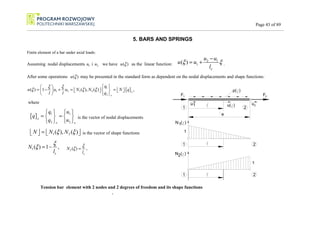
5. BARS AND SPRINGS
6. TRUSSES AND FRAMES
7. TWO AND THREE- DIMENSIONAL LINEAR ELASTOSTATICS
8. CST TRIANGULAR ELEMENT
9. 8-NODE QUADRILATERAL ELEMENT . NUMERICAL INTEGRATION
Computer lab: Introduction to practical problems of FE modeling in ANSYS/ 2D and 3D linear stress analysis/ Static analysis of simple shell structure/
Discretization error and adaptive meshing
Abilities: After completing the course the students will be able to build simple FE models and will know the possible applications and
limitations of the method in mechanics of structures.
Assesment method: Assesment based on tests and results of computer lab work (reports).
Practical work:Project/laboratory classes, where students will build and analyse the results of simple FE models of elastic structures
Recommended texts (reading):
[1] Huebner K. H., Dewhirst D. L., Smith D.E., Byrom T. G.: The finite element method for engineers, J. Wiley & Sons, Inc., 2001.
[2] Zagrajek T., Krzesinski G., Marek P.: MES w mechanice konstrukcji. Ćwiczenia z zastosowaniem programu ANSYS, Of.Wyd.PW 2005
[3] Bijak-Żochowski M., Jaworski A., Krzesiński G., Zagrajek T.: Mechanika Materiałów i Konstrukcji, Tom 2, Warszawa, Of. Wyd. PW, 2005
[4] Saeed Moaveni: Finite Element Analysis. Theory and Application with ANSYS, Paerson Ed. 2003
[5] Cook R. D.: Finite Element Modeling for Stress Analysis, John Wiley & Sons , 1995
[6] Zienkiewicz O.C., Taylor R.: The Finite Element Method.- different publishers and editions
Page 2 of 89
_________________________________________________________________________________________________________________________________________________________________________
1. INTRODUCTION TO FINITE ELEMENT METHOD
The FEM is a numerical procedure that can be used to solve a large class of engineering problems including mechanics of structures, heat transfer,
electromagnetism, fluid flow and coupled fields problems (e.g. electro-thermal).
The simplest description.
The method involves dividing the geometrical model of the analysed structure into very small, simple pieces called finite elements, connected by
nodes. The behaviour of of the element is described by adequate physical laws. An unknown quantity (e.g. temperature, displacement vector,
electrical potential) is interpolated over an element from the nodal values using specially defined polynomials (called shape functions). The
procedure leads to the set of simultaneus algebraic equations with the nodal values being unknown.
During the solution process the nodal values (DOF- degrees of freedom of the model) are found. Then all interesting quantities ( strains, stresses)
are calculated within the elements. Finally the results may be presented in the required graphical form (the typical form of presentation is a contour
map)
MPa
0
50
100
150
200
250
300
350
400
450
MPa
0
-15
-30
-45
-60
-75
-90
-105
-120
-135
Finite Element Mesh Von Mises stress distribution Contact pressure between the shaft and the rotor disk
3D finite elements
u
w
u
v
FEM was developed in 1950's for solving complex problems of stress analysis - mainly for aeronautical industry. The development of the method
was connected with the progress in digital computers and numerical techniques.
Today the method is considered as the most powerful analysis method for problems described by partial differential equations.
Page 3 of 89
_________________________________________________________________________________________________________________________________________________________________________
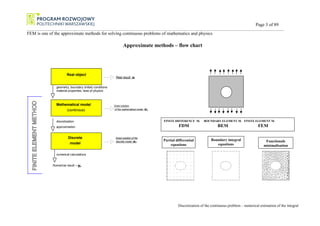
FEM is one of the approximate methods for solving continuous problems of mathematics and physics
Approximate methods – flow chart
Real object
Methematical model
(continous)
Discrete
model
Real result wr
Exact solution
of the mathematical model ws
Exact solution of the
discrete model wd
geometry, boundary (initial) conditions
material properties, laws pf physics
discretization
approximation
numerical calculations
Numerical result - wn
Discretization of the continuous problem – numerical estimation of the integral
Partial differential
equations
Boundary integral
equations
Functionals
minimalisation
FINITE DIFFERENCE M. BOUNDARY ELEMENT M. FINITE ELEMENT M.
FDM BEM FEM
Page 4 of 89
_________________________________________________________________________________________________________________________________________________________________________
The example – wooden board
Different models for the problem
a) model belki
b) model płyty
c) model trójwymiarowy bryły
q 0
N
m
p0
m
N
2
N
m
0 3
number of DOF
one dimensional model - beam
three dimensional model – solid volume
two- dimensional model - plate
x
f(x)
x1 x2 b
x =a
h
0 x =a+ih
i
h h h
f1
f2
f0
3
f
fi
Page 5 of 89
_________________________________________________________________________________________________________________________________________________________________________
BASIC STEPS IN THE FINITE ELEMENT METHOD (FE modeling)
Preprocessor (preprocessing phase)
In the preprocessing phase the mathematical problem is described and presented in the numerical, discrete form:
Steps:
Description of :
the analysed domain (geometry of the analysis object)
the material properties
the boundary conditions (loads and constraints)
the meshing (dividing the domain into the finite elements of the required density distribution)
FE model of the bolted joint of the high pressure vessel
entire connection, representative part of the structure and its discretization, FE nodes with load symbols
Page 6 of 89
_________________________________________________________________________________________________________________________________________________________________________
Processor (solution phase)
In this phase the user of the FE program defines the type of analysis (static, linear or nonlinear, dynamic, buckling ...... ) and other
details describing the method of calculations and solution process.
The FE program performs the calculations and writes the results in the adequate files.
Postprocesor
In this phase it is possible to present the interesting results in different forms: plots, graphs, animations, listings etc.
The user can create contour maps, tables, graphs and generate the reports.
Von Mises equivalent stress distribution (MPa). Contour map
Page 7 of 89
_________________________________________________________________________________________________________________________________________________________________________
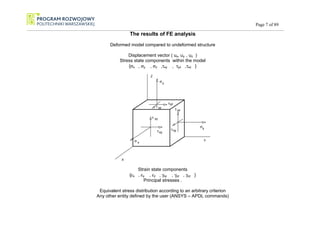
The results of FE analysis
Deformed model compared to undeformed structure
Displacement vector ( ux, uy , uz )
Stress state components within the model
{σx , σy , σz ,τxy , τyz ,τxz }
X
Y
Z
σ
τ
σ
σ
τ
τ
τ τ
τ
x
y
z
xy
xz
yz
xy
xz
yz
Strain state components
{εx , εy , εz , γxy , γyz , γxz }
Principal stresses .
Equivalent stress distribution according to an arbitrary criterion
Any other entity defined by the user (ANSYS – APDL commands)
Page 8 of 89
_________________________________________________________________________________________________________________________________________________________________________
2. APPLICATIONS OF FEM
Finite Element Analysis of Critical Central Connection Elements
of W7-X Stellator Coil Support System
The objective of Wendelstein 7-X project is the stellator-type fusion reactor. In this device plasma channel is under control of magnetic field coming from magnet
system of complex shape, made of 70 superconducting coils symmetrically arranged in 5 identical sections. Every coil is connected to central ring with two
extensions which transfer loads resulting from electromagnetic field and gravity.
During operation at a service temperature (ST) of 4K the superconducting coils of the W7-X magnet system exert high electromagnetic loads. Therefore, the
detailed analysis of the coil - central support connections, the so called Central Support Elements (CSE), is a critical item for W7-X. Each coil is fastened to the
CSS by two central support elements (CSE).
The aim of this work was to analyse mechanical behaviour of the bolted connections using detailed 3D finite element models (including bolts , washers, welds
etc). The Global Model of the structure, analysed by Efremov Institute in Russia, provided information about the loads acting on the connections.
Design analyses of the support structure elements: nonlinear simulations including contact with friction, plasticity,assembly stresses, submodelling technique
and using parametric models (14 bolted connections ) . The work performed for Institute of Plasma Physics, Greifswald , Germany.
The results of the numerical simulation help to check the magnitudes of displacements and stresses for different loading scenarios and
some modifications of the considered structures.
Page 9 of 89
_________________________________________________________________________________________________________________________________________________________________________
material 1 --- 1.4429 steel: shim, wedges, ring,
0
125
250
375
500
625
750
875
1000
1125
1250
0
.5
1
1.5
2
2.5
3
3.5
4
4.5
5
EPS
(x10**-2)
Stress-strain curve for material 1 (1.4429 steel) corresponding to the temperature
293 K (red graph), 77K (violet), 4K (blue)
Page 10 of 89
_________________________________________________________________________________________________________________________________________________________________________
Structural analysis and design of the "KLAUDIA" flight simulator
The FE model of the initial platform design has showed the
structure to be too flexibile. To find better solution the
simplified FE model has been built, easy for modifications.
The model has enabled quick verification of new concepts. The
final detailed FE model has confirmed the improvement of the
design. The fully nonlinear FE submodels have been built to
check the stress level in the main joints. Vibration
characteristics (natural frequencies and mode shapes) of the
structure have been found
The FE model was built using shell, solid, beam, mass and link
elements. The project was done for MP-PZL Aerospace Industries ,
Poland
Initial FE model
Modified (improved) design
submodel of the joint
Page 11 of 89
_________________________________________________________________________________________________________________________________________________________________________
FE analysis of thin-walled elements' deformation
during aluminium injection moulding
Numerical simulations have been performed to model the process of filling the mould by hot aluminium alloy. The analysis has enabled
improvements of the element stiffness diminishing geometrical changes caused by the process. Fluid flow simulation with transient
thermal analysis including phase change have been performed, followed by the structural elasto-plastic calculation of residual effects.
The project performed for Alusuisse Technological Center, Sierre, Switzerland.
FE model Velocity field during
injection
Temperature distribution (cooling effect) and displacements
Residual stress distribution
FE model of the die
Velocity and temperature distribution
Page 12 of 89
_________________________________________________________________________________________________________________________________________________________________________
FE analysis of a high pressure T-connection
°
°
°
°C
190
205
220
230
250
265
280
295
310
Temperature distribution
The aim of the analysis was to find out stress and strain distribution in a T-
connection caused by high internal pressure (2600 at) and temperature gradients.
External cooling, assembly procedure (screw pretension), contact and plasticity
effects have been included. The project done for ORLEN petrochemical company
FE model
MPa
0
50
100
200
300
400
500
600
700
Von Mises stress
Page 13 of 89
_________________________________________________________________________________________________________________________________________________________________________
FE analyses of rotor disks
MPa
0
50
100
150
200
250
300
350
400
450
Von Mises stress distribution
The aim of the analysis was to asses the right shape
details of the rotor to avoid high stresses and to find its
vibration characteristics.
FE mesh
The mode shape for the natural frequency
of 2203Hz
MPa
0
-15
-30
-45
-60
-75
-90
-105
-120
-135
Contact pressure between the shaft
and the rotor disk
Page 14 of 89
_________________________________________________________________________________________________________________________________________________________________________
Thermo-electrical analysis of aluminium reduction cells
The analyses were performed to find temperature field and
electrical potential distribution inside the reductant cell used
in the process of aluminium production. The project done
for Alusuisse Technological Center, Sierre, Switzerland.
FE model (quarter of the cell)
The influence of geometry, material properties and boundary
conditions on the phenomena that take place in the bath and liquid
aluminium is investigated. The analysis enabled to correct the design
and to improve efficiency of the processes.
Anode and cathode blocks
Temperature distribution
Electric potential distribution
Page 15 of 89
_________________________________________________________________________________________________________________________________________________________________________
FE analysis of the turbine blade locking part defects (imperfections)
Experiments show the presence of defects like surface scratch, or micro-crack in the region of blade locking part of the turbine
disks. Such imperfections may result in crack initiation and propagation. A segment of the turbine disk together with a blade has
been modelled (including contact). Half-elliptical crack has been introduced in the sub-model. Stress intensity factors and Rice
integral values have been calculated.
FE model Von Mises stress distribution
in the vicinity of the crack
Page 16 of 89
_________________________________________________________________________________________________________________________________________________________________________
FEM Analysis of the Winch Frame and Boom of the snow groomer
The aim of the analysis was to check the stiffness and stress level of the new design of the
structure. Numerical model consisted of FE shell elements supplemented by brick, beam,
link and mass elements. In regions of special care sub-models were used involving contact
elements. The results suggested essential changes of design. The project done for
PLUMETTAZ S.A., Bex, Switzerland
FE model
Displacements
Von Mises stress
Initial model
Modified design
Page 17 of 89
_________________________________________________________________________________________________________________________________________________________________________
CAD/CAE study of a New Design of Truck Frame
FE model Von Mises stress
CAD project
Page 18 of 89
_________________________________________________________________________________________________________________________________________________________________________
Finite element method in bone-implant system strength analysis
The three-dimensional FE models of the living tissues-implant systems can deliver the valuable information about
mechanisms of stress transfer and healing processes after the orthopaedic surgery. In the presented example some different variants
of the hip stem were considered to find the best solution, which should reduce stress concentration within the bone tissues. The model
of the femur was built using the data obtained from CT scans. The considered load corresponds to one leg stance of a man weighting
800N.
F2
F1
α1
α2
Finite element model of the femur endoprosthesis : body weight BW=800N, F1=2.47 BW, F2=1.55BW, α1=28°, α2= 40°
trabecular bone
cement
stem
cortical bone
contour points from the CT scans
Page 19 of 89
_________________________________________________________________________________________________________________________________________________________________________
FE model of the spine stabilizer and the von Mises stress distribution within the frame
Von Mises Equivalent stress (MPa)
FE model and selected results of numerical simulation of mandibular ostheosynthesis
Page 20 of 89
_________________________________________________________________________________________________________________________________________________________________________
3. FINITE DIFFERENCE METHOD (FDM) BOUNDARY ELEMENT METHOD (BEM)
AND FINITE ELEMENT METHOD (FEM)
Draft presentation for solving Poisson’s equation in 2D space
,
Poisson's equation is a partial differential equation with broad utility in electrostatics, mechanical engineering and theoretical physics.
2 2
1 2
2 2
1 2
( , ) 0
u u
f x x
x x
∂ ∂
+ + =
∂ ∂ ,
For vanishing f, this equation becomes Laplace's equation.
We consider a Dirichlet boundary condition on Γu and a Neumann boundary condition on Γq:
0
0
( ) ,
( )
( ) ,
u
q
u x u x
u x
q x q x
n
= ∈Γ
∂
= = ∈Γ
∂
where u0 and q0 are given functions defined on those portions of the boundary.
In some simple cases ( shape of the domain Ω and boundary conditions) the Poisson equation may be solved using analytical methods.
Ω
n2
Γq
n
n1
Γu
x1
(x)
x2
(y)
Page 21 of 89
_________________________________________________________________________________________________________________________________________________________________________
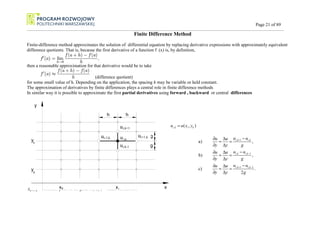
Finite Difference Method
Finite-difference method approximates the solution of differential equation by replacing derivative expressions with approximately equivalent
difference quotients. That is, because the first derivative of a function f (x) is, by definition,
then a reasonable approximation for that derivative would be to take
(difference quotient)
for some small value of h. Depending on the application, the spacing h may be variable or held constant.
The approximation of derivatives by finite differences plays a central role in finite difference methods
In similar way it is possible to approximate the first partial derivatives using forward , backward or central differences
,
,
i o
k o
x x ih
y y kg
= +
= +
, ( , )
i k i k
u u x y
=
,
o o
x y - reference point of the grid, ( , )
u x y - unknown function
, 1 ,
, , 1
, 1 , 1
a) ,
b) ,
c) .
2
i k i k
i k i k
i k i k
u u
u u
y y g
u u
u u
y y g
u u
u u
y y g
+
−
+ −
−
∂ ∆
≈ =
∂ ∆
−
∂ ∆
≈ =
∂ ∆
−
∂ ∆
≈ =
∂ ∆
h h
g
g
u
u u
u
i+1,k
i,k
i-1,k
i,k-1 ui,k+1
x
x
x
y
y
y
0 i
0
k
ui-1,k ui+1,k
ui,k-1
ui,k+1
Page 22 of 89
_________________________________________________________________________________________________________________________________________________________________________
Differences corresponding to higher derivatives
2 2
1, , 1,
2 2 2
2 2
, 1 , , 1
2 2 2
2
,
2
.
i k i k i k
i k i k i k
u u u
u u
x x h
u u u
u u
y y g
+ −
+ −
− +
∂ ∆
≈ =
∂ ∆
− +
∂ ∆
≈ =
∂ ∆
Using the finite differences we can approximate the partial differential equation at any point (xi, yj ) by an algebraic equation .
In the case of Poissons equation:
( ) ( ) ( )
1, , 1, , 1 , , 1
2 2
1 1
2 2 , 0
i j i j i j i j i j i j i j
u u u u u u f x y
h g
+ − + −
− + + − + + = .
If h g
= i 0
f ≡ (Laplace equation) we get
1, 1, , 1 , 1
,
4
i j i j i j i j
i j
u u u u
u
+ − + −
+ + +
= .
N grid points in the domain Ω , N equations, N unknows
[ ]{ } { }
A u b
=
discrete form of boundary conditions
1
2 0 1
2 0
h
h
δ
δ
a) b)
In the case of irregular boundary shape
a) assumed 0 2
1
hu u
u
h
δ
δ
+
=
+
instead of 0
u u
=
b) assumed 0 2
1
hu u
u
h
δ
δ
−
=
−
instead of 0
u u
=
4 4
2, 1, , 1, 2,
4 4 4
4 6 4
i j i j i j i j i j
u u u u u
u u
x x h
+ + − −
− + − +
∂ ∆
≈ =
∂ ∆
Page 23 of 89
_________________________________________________________________________________________________________________________________________________________________________
x
y y
r
θ
1
2
3
4
5
6
h
g
0
x
x
y
c)
x
y
d)
e)
l
Page 24 of 89
_________________________________________________________________________________________________________________________________________________________________________
Boundary Element Method
Uses the boundary integral equation ( equivalent to the Poisson’s equation with the adequate b.c.)
( )
( ) ( ) ( ) ( , ) ( ) ( , ) ( ) ( ) ( , ) ( )
u x
c u u x q x d x u x d x f x u x dR x
n
ξ ξ ξ ξ ξ
∗ ∗ ∗
Γ Γ Ω
∂
= − Γ + Γ +
∂
∫ ∫ ∫
( )
c ξ - coefficient equal to 1/2 on the smooth contour, 1 inside the domain Ω
Kernel functions
1 1
( , ) ln
2
u x
r
ξ
π
∗  
= =  
 
, (36)
2 2
1 1 2 2
( ) ( )
r x x
ξ ξ
= − + − .
( , )
( , )
u x
q x
n
ξ
ξ
∗
∗ ∂
=
∂
. (37)
1 2
1 2
1 1 2 2
2
,
( )
,
2
u u
q n n
x x
r n r n
q
r
π
∗ ∗
∗
∗
∂ ∂
= ⋅ + ⋅
∂ ∂
− ⋅ + ⋅
=
i i i
i
x r
r
x r r
ξ
−
∂
= =
∂
.
The boundary integral equation states the relation between ( )
u x and its derivative in normal direction
( )
( )
u x
q x
n
∂
=
∂
on the boundary Γ.
x
x 2
1
r
r
r1
2
Ω
Γ
Γu
Γ Γ =Γ
u q
q
n
n
n
1
2
ξ
x
Page 25 of 89
_________________________________________________________________________________________________________________________________________________________________________
The numerical approach
1. Discretization of the boundary (LE boundary elements)
2. Approximation of ( )
u x and ( )
q x on the boundary
(e.g. u(Pi), q(Pi) constant on boundary elements)
3 . Building the set of linear equations
1 1
1
( ) ( , ) ( ) ( , ) ( )
2
( ) ( , ) 1,2,..
j j
LE LE
i i j j i j j
j j
i
u P u P x q P d q P x u P d
f x u P x dR i LE
∗ ∗
= =
Γ Γ
∗
Ω
= Γ − Γ
+ =
∑ ∑
∫ ∫
∫
1 1
1
( ) ( ) ( ) , 1,2...
2
LE LE
i ij j ij j i
j j
u P U q P Q u P f i LE
∗ ∗
= =
= ⋅ − ⋅ + =
∑ ∑ . ( ) ( , ) ( )
i i
f f x u P x d x
∗
Ω
= Ω
∫
{ } { } { } { }
1
2
u U q Q u f
∗ ∗
   
= − +
    .
LE linear equations with the unknows ( )
j
u P (if the point j
P Œ q
Γ ) or ( )
i
q P (if i
P Œ u
Γ )
Finally: [ ]{ } { }
A y b
=
The solution {y} represents unknown boundary values of u and q.
The matrix A – full, unsymmetric
4. Solution - provides complete information about the function ( )
u x and its derivative ( )
q x on the boundary
Boundary Element Method reduces the number of unknown parameters (DOF of the discrete model) in comparison to FDM and FEM ( domain
methods).
x
x2
1
P
P
j
i
r
Page 26 of 89
_________________________________________________________________________________________________________________________________________________________________________
Finite Element Method
Equivalent problem of minimising of the fuctional:
2 2
1 2 0
1 2
1
( ) 2 ( , ) ,
2 q
u u
I u f x x u d q ud
x x
Ω Γ
 
   
∂ ∂
 
= + − Ω − Γ
   
∂ ∂
 
   
 
∫ ∫
with the Dirchlet b. c.
0
( ) ,
u x u
= u
x ∈Γ
1. Discretization of the solution domain Ω into elements Ωi , i=1,LE,
connected in the nodes
1
LE
e
i=
Ω = Ω
∪ i 0
i j
Ω Ω =
∩ j
i ≠ ,
2.Approximation of function ( )
u x within the finite element in the form of polynomials dependent on the unknown nodal values ui
1 2 1 2
1
( , ) ( , )
LWE
i i
i
u x x N x x u
=
= ∑
LWE – number of nodes of the element
i
u , i = 1,...,LWE - nodal values of the approximated function,
Ni(x1,x2) – shape functions
3. Discrete form of the functional
2 2
1 2 0
1 1
1 2
1
( ) 2 ( , )
2 i j
LE LK
i j
i j
u u
I u f x x u d q ud
x x
= =
Ω Γ
 
   
∂ ∂
 
≅ + − Ω − Γ
   
∂ ∂
 
   
 
∑ ∑
∫ ∫
obszar
kontur
e
węzły elementy
x 2
x1
2
1
u(x ,x )
2
x
x1
u1
u2
u3
u8
u7
u6
u5
u4
e
1
2
3
4
5
6
7
8
LWE=8
approximation of the
function u(x,y) over
the element Ωe
nodes elements
contour
domain
Page 27 of 89
_________________________________________________________________________________________________________________________________________________________________________
In each element
1
1 1
1
2 2
,
.
LWE
i
i
i
LWE
i
i
i
N
u
u
x x
N
u
u
x x
=
=
∂
∂
=
∂ ∂
∂
∂
=
∂ ∂
∑
∑
In this way the functional I is replaced by the function of several unknows , 1,2,...,
i
u i LW
= , where LW denotes the number of nodes of the finite
element mesh. In the matrix form :
11 12 13 1 1 1
21 22 23 2 2
31 32
1 2 3 1 2 3,
3 3
1
1
( ) , , ,..., , , ,
2
LW
LW LW
LW LW LW LW LW
k k k k u b
k k k u b
k k
I u u u u u u u u u
u b
k k u b
     
     
     
   
   
≈ −
     
   
     
     
     
   
 
…
…
… … …
[ ]{ } { }
1 1
1 1
1
2 LW LW
LW LW
LW LW
I u u u b
K
× ×
× ×
×
≈ −
   
   
.
Necessary (and sufficient) condition of the minimum:
0
i
I
u
∂
=
∂
, 1, ,
i LW
= … . matrix: sparse, symmetrical, positive defined, banded
Hence
[ ]{ } { }
K u b
= , (+ Dirichlet b.c.)
Set of the simultaneuous equations with unknown nodal values of the investigated function.
zerowe
elementy
LW
m
Page 28 of 89
_________________________________________________________________________________________________________________________________________________________________________
4. BEAMS
RITZ-RAYLAYGH METHOD and FINITE ELEMENT METHOD
Principle of minimum potential energy.
The potential energy of an elastic body is defined as
Total potential energy (V)= Strain energy (U) potential energy of loading
− (Wz)
In theory of elasticity the potential energy is the sum of the elastic energy and the work potential:
1
2
z ij ij i i i i
V U W d X u d p u d
σ ε
Ω Ω Γ
= − = Ω − Ω − Γ
∫ ∫ ∫
Ω – domain of the elastic body, Γ – boundary, ij
σ – stress state tensor, ij
ε – strain state tensor ,
i
u – displacement vector, i
p – boundary load (traction), Xi– body loads
The potential energy is a functional of the displacement field. The body force is prescribed over the volume of the body, and the traction is
prescribed on the surface Γ . The first two integral extends over the volume of the body. The third integral extends over the boundary.
The principle of minimum potential energy states that,
the displacement field that represents the solution of the problem fullfills the displacement boundary conditions and inimizes
the total potential energy.
min!
z
V U W
= − = ,
Page 29 of 89
_________________________________________________________________________________________________________________________________________________________________________
Total potential energy of the beam loaded by the distributed load
N
m
p
 
 
 
:
2
0 0
1
( )
2
l l
V EI w dx pwdx
′′
= −
∫ ∫ ,
where the function w(x) describes deflection of the beam
Ritz method
3. The parameters ai are determined by requirement that the
functional is minimized with respect to ai
0
i
V
a
∂
=
∂
, 1,...,
i n
= .
[ ]{ } { }
A a b
=
4. The solution provides ai, and the approximate solution
1
( ) ( )
n
i i
i
w x a x
ϕ
=
= ∑
ɶ .
Hence the approximate internal forces in the beam
( ) ( ),
( ) ( ).
q
M x EIw x
T x EIw x
′′
=
′′′
= −
ɶ ɶ
ɶ ɶ
1.The problem must be stated in a variational form,
as a minimization problem, that is:
find w(x) minimizing the functional V(w)
2. The solution is approximated by a finite linear combination of the
form:
1
( ) ( )
n
i i
i
w x a x
ϕ
=
= ∑
ɶ
where ai denote the undetermined parameters termed Ritz
coefficients,
and φi are the assumed approximation functions (i=1,2...n).
The approximate functions φi must be linearly independent
and
3. Finally functional V is approximated by the function of n variables
ai
V=V(a1, a2 , a3 , ....an )
Page 30 of 89
_________________________________________________________________________________________________________________________________________________________________________
EXAMPLE
Find the deflection of the cantilever beam under the load 0
N
p
m
 
 
 
using the analytical solution of the differential equation and compare it to the
approximate solution using Ritz method with the function 3
4
2
3
2
1
)
(
~ x
a
x
a
x
a
a
x
w +
+
+
= .
w(x)
p0
x
Exact analytical solution
( )
( ) g
M x
w x
EI
′′ =
( ) 0
w x = ,
( )
0
w x
d
dx
=
Solution
2 2 2
0
( ) (6 4 ) ,
24
p
w x l lx x x
EI
p
= − +
Max. deflection w(l)= p0 l2
/8 EI
The approximate solution 3
4
2
3
2
1
)
(
~ x
a
x
a
x
a
a
x
w +
+
+
= has to satisfy the displacement boundary conditions
( 0) 0,
w x = =
ɶ ( 0) 0
w x
′ = =
ɶ .
Thus
3
4
2
3
)
(
~ x
a
x
a
x
w +
= .
)
4
3
(
)
12
12
4
(
2
4
4
3
3
3
2
4
2
4
3
2
3
l
a
l
a
p
l
a
l
a
a
l
a
EI
V +
−
+
+
= .
2
0
( ) ( ) ,
2
q
p
M x l x
= −
Page 31 of 89
_________________________________________________________________________________________________________________________________________________________________________
( )
( )
3
2 0
3 4
3
4
2 3 0
3 4
4
8 12 0,
2 3
12 24 0.
2 4
p l
V EI
la l a
a
p l
V EI
l a l a
a
∂
= + − =
∂
∂
= + − =
∂
2
0 0
3 4
5
,
24 12
p l p l
a a
EI EI
= = −
Finally the approximate solution is
2
2 3
0 0
2 0
0
0
5
( ) ,
24 12
5
( ) ,
12 2
( ) .
2
q
p l p
w x x x
EI EI
p l
M x p l x
p l
T x
= −
= −
−
=
ɶ
ɶ
ɶ
Graphs presenting exact (bold line) and approximate (dashed line ) solutions
of the cantilever beam:
displacement, bending moment, shear force
x
W(x)
x
W(x)
~
l
l
4 2
l
4
3l
10
-2 pl
EJ
1.318
1.172
4.427
8.35
12.5
12.5
8.203
4.167
W(x)
~
W(x)
M (x)
M (x)
~
g
g
4
l
2
l
4
3l
l
0.417
0.5
0.292
0.167
0.42
-0.083
0.281
0.125
0.031
pl
*
2
*
T(x)
~
T(x)
pl
*
x
4
l
2
l
4
3l
l
g
M (x)
~
M (x)
g
0.5
1 T(x)
T(x)
~
Page 32 of 89
_________________________________________________________________________________________________________________________________________________________________________
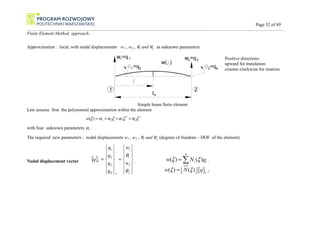
Finite Element Method approach
Approximation : local, with nodal displacements w1 , w2 , 1 2
and
θ θ as unknown parameters
l
1 2
e
w( )
w =q
1 1
=q2
1 =q4
2
w =q
2 3
Simple beam finite element
Lets assume first the polynomial approximation within the element
3
4
2
3
2
1
)
( ξ
α
ξ
α
ξ
α
α
ξ +
+
+
=
w
with four unknown parameters i
α .
The required new parameters : nodal displacements w1 , w2 , 1 2
and
θ θ (degrees of freedom – DOF of the element)
Nodal displacement vector { }














=














=
2
2
1
1
4
3
2
1
θ
θ
w
w
q
q
q
q
q
e
e .
4
1
( ) ( )
i i
i
w N q
ξ ξ
=
= ∑ .
{ }
( ) ( ) ,
e
w N q
ξ ξ
=  
 
Positive directions:
upward for translation
counter clockwise for rotation
Page 33 of 89
_________________________________________________________________________________________________________________________________________________________________________
Relation between 4
3
2
1 ,
,
, α
α
α
α and 4
3
2
1 ,
,
, q
q
q
q
1 1
2 2
2 3
3 1 2 3 4
2
4 2 3 4
(0) ,
(0) ,
( ) ,
( ) 2 3 .
e e e
e e
q w
dw
q
d
q w l l l l
dw
q l l l
d
α
α
ξ
α α α α
α α α
ξ
= =
= =
= = + + +
= = + +
In the matrix form
1 1
2 2
2 3
3 3
2
4 4
1 0 0 0
0 1 0 0
.
1
0 1 2 3
e e e
e e
q
q
l l l
q
l l
q
α
α
α
α
 
   
 
   
   
 
=
   
 
   
 
   
 
   
 
The approximate deflection may be presented in the form
1 1
2 2
2 3
1 2 3 4
3 3
4 4
( ) 1, , , ( ), ( ), ( ), ( )
q
q
w N N N N
q
q
α
α
ξ ξ ξ ξ ξ ξ ξ ξ
α
α
   
   
   
 
= =  
   
 
 
   
   
   
,
2 3
1 2 3
2 3
2 2
2 3
3 2 3
2 3
4 2
( ) 1 3 2 ,
( ) 2 ,
( ) 3 2 ,
( ) .
e e
e e
e e
e e
N
l l
N
l l
N
l l
N
l l
ξ ξ
ξ
ξ ξ
ξ ξ
ξ ξ
ξ
ξ ξ
ξ
= − +
= − +
= −
−
= +
The functions ( )
i
N ξ are called shape functions of the beam element.
1 1
2 2
3 3
2 2
4 4
3 3 2
1 0 0 0
0 1 0 0
3 2 3 1
2 1 2 1
e e e
e
e e e e
q
q
q
l l l l q
l l l l
α
α
α
α
 
 
 
 
   
 
   
   
 
=
   
− − −
 
   
 
   
   
 
−
 
 
 
 
displacement and node 1
slope at node 1
displacement at node 2
slope at node 2
Page 34 of 89
_________________________________________________________________________________________________________________________________________________________________________
( )
i
N ξ describes deflection of the beam element , where 1
i
q = , and for 0
j
j i q
≠ = (see graphs).
N ( )
1 1
1
2
N ( ) N ( )
4
N ( )
3
tg =1
e
tg =1
e
e
e
Shape functions of a beam element
{ }
{ }
{ }
( ) ( ) ,
( ) ( ) ,
( ) ( ) .
e
e
e
w N q
w N q
w N q
ξ ξ
ξ ξ
ξ ξ
=  
 
′ ′
=  
 
′′ ′′
=  
 
Total potential energy of the beam element of the length e
l
2
0 0
( ( )) ( ) ( )
2
e e
l l
e e ze i i j j
EI
V U W w d p w d Pw M
ξ ξ ξ ξ ξ ϑ
′′
= − = − − −
∫ ∫ .
Page 35 of 89
_________________________________________________________________________________________________________________________________________________________________________
{ } { }
0 0
1 1 1 2 1 3 1 4
2 1 2 2 2 3 2 4
3 1 3 2 3 3 3 4
4 1 4 2 4 3 4 4
( ) ( )
2 2
2
e e
l l
e e
e
e
EI EI
U w w d q N N q d
N N N N N N N N
N N N N N N N N
EI
q
N N N N N N N N
N N N N N N N N
ξ ξ ξ ξ
′′ ′′ ′′ ′′
= = =
   
   
 
′′ ′′ ′′ ′′ ′′ ′′ ′′ ′′

 ′′ ′′ ′′ ′′ ′′ ′′ ′′ ′′

=  
 
 ′′ ′′ ′′ ′′ ′′ ′′ ′′ ′′

 ′′ ′′ ′′ ′′ ′′ ′′ ′′ ′′

∫ ∫
{ }
0
.
e
l
e
d q
ξ







∫
[ ] { }
1
2
e e
e e
U q k q
=  
  ,
.
Matrix [ ]e
k is named stiffness matrix of beam element. After integration
[ ]
2 2
3
2 2
6 3 6 3
3 2 3
2
6 3 6 3
3 3 2
e e
e e e e
e
e e
e
e e e e
l l
l l l l
EI
k
l l
l
l l l l
−
 
 
−
 
=
 
− − −
 
−
 
 
.
[ ]
1 1 1 2 1 3 1 4
0 0 0 0
2 1 2 2 2 3 2 4
0 0 0 0
3 1 3 2 3 3 3 4
0 0 0 0
4 1 4 2
0 0
e e e e
e e e e
e e e e
e e
l l l l
l l l l
e l l l l
l l
N N d N N d N N d N N d
k EI
N N d N N d N N d N N d
N N d N N d
ξ ξ ξ ξ
ξ ξ ξ ξ
ξ ξ ξ ξ
ξ ξ
′′ ′′ ′′ ′′ ′′ ′′ ′′ ′′
′′ ′′ ′′ ′′ ′′ ′′ ′′ ′′
=
′′ ′′ ′′ ′′ ′′ ′′ ′′ ′′
′′ ′′ ′′ ′′
∫ ∫ ∫ ∫
∫ ∫ ∫ ∫
∫ ∫ ∫ ∫
∫ 4 3 4 4
0 0
e e
l l
N N d N N d
ξ ξ
 
 
 
 
 
 
 
 
 
 
 
′′ ′′ ′′ ′′
 
 
 
∫ ∫ ∫
Page 36 of 89
_________________________________________________________________________________________________________________________________________________________________________
The external work done by the traction p:
{ }
0 0
( ) ( ) ( ) ( )
e e
l l
p
ze e
W p w d p N q d
ξ ξ ξ ξ ξ ξ
= = =
 
 
∫ ∫ { }
1 2 3 4
0
( ) ( ) , ( ) ( ) , ( ) ( ) , ( ) ( ) ,
e
l
e
N p d N p d N p d N p d q d
ξ ξ ξ ξ ξ ξ ξ ξ ξ ξ ξ ξ ξ
=  
 
∫
{ }
1
2
1 2 3 4
3
4
, , ,
p e e e e
ze e
e
e
q
q
W F F F F F q
q
q
 
 
 
 
= =  
   
 
 
 
 
,
0
( ) ( )
e
l
e
i i
F N p d
ξ ξ ξ
= ∫
e
i
F - equivalent nodal forces
0
1 3
2
0
2
2
0
4
2
12
12
e e e
e e
e e
p l
F F
p l
F
p l
F
= =
=
−
=
Equivalent nodal forces corresponding to the constant and linear distribution of 0
p load
(kinematically equivalent or work-equivalent !)
Total potential energy of the beam element
  [ ] { }   { }
4 4 4 1
1 4 1 4
4 1
1
2
e e ze
V U W q q q F
k e e
e e
e
× ×
× ×
×
= − = − .
1 2
0
p
p
2
0 e 0 e
2
0 e
12
2
12
2
e
0
p
p
p
P0
1 2
F1=3p0 le/ 20 F3= 7p0 le/ 20
F2=p0 le
2
/ 30 F4= -p0 le
2
/ 20
Page 37 of 89
_________________________________________________________________________________________________________________________________________________________________________
The conditions for finding the minimum of Ve:
0
e
i
V
q
∂
=
∂ , 1,2,3, ,
i n
= …
[ ] { } { }
e e e
k q F
= .
1 1
2 2
2 2
3
3 3
2 2
4 4
6 3 6 3
3 2 3
2
6 3 6 3
3 3 2
e e
e e e e
e e
e
e e
e e e e
l l q F
q F
l l l l
EI
q F
l l
l
q F
l l l l
−    
   
−    
=
   
− − −    
   
−    
Set of linear equations for one element model of the considered cantilever beam:
Page 38 of 89
_________________________________________________________________________________________________________________________________________________________________________
1
2
2 2
0
3
3
2 2 2
4 0
0
6 3 6 3
0
3 2 3
2
6 3 6 3 2
3 3 2
12
F
l l F
l l l l
EI p l
q
l l
l
q
l l l l p l
 
 
−  
 
 
−    
=
   
− − −    
   
− −
 
 
 
Constraints q1=0 and q2=0 may be taken into account by
the transformation of the set of equation to the form [ ] { }
1
2
3
4
F
F
A b
q
q
 
 
 
=
 
 
 
 
or by reductionof the problem to
0
3 4
3
2
2 0
3 4
3
2
(6 3 ) ,
2
2
( 3 2 ) ,
12
p l
EI
q lq
l
p l
EI
lq l q
l
− =
−
− + =
Solution is:
4
0
3
3
0
4
1
8
1
6
p l
q
EI
p l
q
EI
=
=
Finally the deflection function from the one element model is
2 2
2 3 2 3
0 0 0 0
3 1 2 1 5
( )
8 6 8 6 24 12
p l p l p l p l
w
EI EI EI EI
ξ ξ ξ ξ ξ
−
   
= − + + = −
   
   
The same result as obtained in the case of Ritz method – why?
Page 39 of 89
_________________________________________________________________________________________________________________________________________________________________________
Dividing the beam into LE elements
global nodal displacements vector { }
1 1
2 1
3 2
4 2
5 3
6 3
7 4
8 4
q w
q
q w
q
q
q w
q
q w
q
θ
θ
θ
θ
   
   
   
   
   
   
= =
   
   
   
   
   
   
 
 
.
N=8 nodal diplacements (degrees of freedom of the FE model)
Strain energy e
U of each of the elements
[ ] { }
1
2
e e e
e
U q k q
=  
   [ ]{ }
*
1
1
1
2
e
N N N
N e
q q
k
× ×
×
= ,
1
k∗
  =
  2
k∗
  =
  3
k∗
  =
 
1 2
0
p
3 4
P
M
1 2 3
1
q q3
q5
q7
q2 4
q q6
q8
=
3
e
e e e
1x4 4x4 4x1
element 1 with the global DOF :
q1, q2 , q3, q4
element 2 with the global DOF :
q3, q4 , q5, q6
element 3 with the global DOF :
q5, q6 , q7, q8
Page 40 of 89
_________________________________________________________________________________________________________________________________________________________________________
{ } [ ]{ }
1 1
1 1
2 2
LE LE
e e
e i
U U q k q q K q
∗
= =
 
 
= = =
   
   
 
 
 
∑ ∑ .
[ ]{ } { }
1
2
z
V U W q K q q F
= − = −
   
    ,
0
i
V
q
∂
=
∂ , 1,2,3, ,
i n
= …
[ ]{ } { }
K q F
= . + displacement boundary conditions (constraints)
For each element the internal forces M,T are calculated separately:
1
2
1 2 3 4
3
4
1
2
1 2 3 4
3
4
( ) ( ) , , , ,
( ) ( ) , , , .
q
e
e
q
q
M EIw EI N N N N
q
q
q
q
T EIw EI N N N N
q
q
ξ ξ
ξ ξ
 
 
 
 
′′ ′′ ′′ ′′
′′
= =  
 
   
 
 
 
 
 
 
′′′ ′′′ ′′′ ′′′
′′′
= − =  
 
   
 
 
1 2 3 4
3 2 3 2
1 3 2 4
3 2
12 6 2 12 6
( ) ( ) ( ) ( ) ( ) ,
2 3 2 3
12 6
( ) ( ) ( ) .
e e e
q e
e e e e
e e
l l l
M q l q q q EI
l l l l
T q q q q EI
l l
ξ ξ ξ ξ ξ
ξ
 
= − + − − − + −
 
 
 
= − − + +
 
 
Page 41 of 89
_________________________________________________________________________________________________________________________________________________________________________
For the case of 3-element model shown in the figure the final set of linear equations is
1
11
k 1
12
k 1
13
k 1
14
k 0 0 0 0
1
21
k 1
22
k 1
23
k 1
24
k 0 0 0 0
1
31
k 1
32
k 1 2
33 11
k k
+ 1 2
34 12
k k
+ 2
13
k 2
14
k 0 0
1
41
k 1
42
k 1 2
43 21
k k
+ 1 2
44 22
k k
+ 2
23
k 2
24
k 0 0
0 0 2
31
k 2
32
k 2 3
33 11
k k
+ 2 3
34 12
k k
+ 3
13
k 3
14
k
0 0 2
41
k 2
42
k 2 3
43 21
k k
+ 2 3
44 22
k k
+ 2
23
k 3
24
k
0 0 0 0 3
31
k 3
32
k 3
33
k 3
34
k
0 0 0 0 3
41
k 3
42
k 3
43
k 3
44
k
1 1
2 2
3 3
4 4
5 5
6 6
7 7
8 8
q F
q F
q F
q F
q F
q F
q F
q F
   
   
   
   
   
   
=
   
   
   
   
   
   
   
6 3 e
l –6 3 e
l 0 0 0 0
3 e
l 2
2 e
l 3 e
l
− 2
e
l 0 0 0 0
–6 3 e
l
− 12 0 –6 3 e
l 0 0
3 e
l 2
e
l 0 2
4 e
l 3 e
l
− 2
e
l 0 0
0 0 –6 3 e
l
− 12 0 –6 3 e
l
0 0 3 e
l 2
e
l 0 2
4 e
l 3 e
l
− 2
e
l
0 0 0 0 –6 3 e
l
− 6 3 e
l
−
3
2
e
EI
l
0 0 0 0 3 e
l 2
e
l 3 e
l
− 2
2 e
l
1
2
0
3
4 0
5
6 0
7
2
8 0
0
0
0
2
12
e
e
e
e
F
F
p l
q
q p l
q M
q p l
P
q
q p l
 
 
 
 
 
 
 
 
 
 
 
 
   
=
   
   
   
   
+
   
   
−
   
 
 
Page 42 of 89
_________________________________________________________________________________________________________________________________________________________________________
FEM calculations:
1. Generation of stiffness matrices [ ]e
k for all elements
2. Assembling the element matrices to obtain the global stiffness matrix [ ]
K
3. Finding the equivalent nodal force vector { }
F
4. Imposing the boundary conditions and the solution of the final set of linear equations – finding all nodal displacements { }
q
5. Calculation of the internal forces (bending moment, shear force) and the stresses within the elements
The example
Final set of equations (3 active DOF)
3
2 2
4 1
3
2 2
6 2
12 0 3
2
0 4
3 2
l q P
EI
l l q M
l
l l l q M
−
   
   
=
   
   
   
.
2
3 2
4 2 1
6 3 2
7 3 12
3 15 12
96
12 12 48
q w l l l P
l
q l M
EI
q l M
θ
θ
− −
     
     
= = −
     
     
− −
     
.
(exact solution – why?)
4x4
NxN
Nx1
Nx1
1
2
2 3
P
M
1
M
1 2
A B C
Page 43 of 89
_________________________________________________________________________________________________________________________________________________________________________
5. BARS AND SPRINGS
Finite element of a bar under axial loads:
Assuming nodal displacements 1
u i 2
u we have ( )
u ξ as the linear function:
2 1
1
( )
e
u u
u u
l
ξ ξ
−
= + .
After some operations ( )
u ξ may be presented in the standard form as dependent on the nodal displacements and shape functions:
{ }
1
1 2 1 2
2
( ) 1 ( ), ( ) e
e
q
u u u N N N q
q
l l
ξ ξ
ξ ξ ξ
 
 
= − + = =
   
 
   
 
   
,
where
{ } 1 1
2 2
e
e e
q u
q
q u
   
= =
   
   
is the vector of nodal displacements
1 2
( ), ( )
N N N
ξ ξ
=
   
    is the vector of shape functions
1( ) 1 ,
e
N
l
ξ
ξ = − 2 ( )
e
N
l
ξ
ξ = ,
Tension bar element with 2 nodes and 2 degrees of freedom and its shape functions
,
2
1
1
1
e
N ( )
1
N ( )
2
u( )
p( )
u1 2
u
1 2
1 2
F2
1
F
Page 44 of 89
_________________________________________________________________________________________________________________________________________________________________________
Strain energy of the element:
2
0 0
1
( ) ( ) ( ( ))
2 2
e e
l l
e
EA
U A d d
σ ξ ε ξ ξ ε ξ ξ
= =
∫ ∫ .
Taking into account that
1
1 2
2
( ) , .
e
q
du
N N
q
d
ε ξ
ξ
 
 
′ ′
= =  
 
   
we have
[ ] { }
1 1
1 2 1 2
2
0
2
1 1 1 2 1
1 2
2
0
2 1 2 2
, ,
2
1
, ,
2 2
e
e
l
e e
e
l
e
e e e
e
N q
EA
U q q N N d
q
N
N N N N q
EA
q q d q k q
q
N N N N
ξ
ξ
 
′  
  
′ ′
= =
     
   
 
′  
 
 
 
′ ′ ′ ′  
 
= =
   
 
   
 
′ ′ ′ ′  
 
∫
∫
where
[ ]
1 1
1 1
e
e
EA
k
l
−
 
=  
−
 
,
is the stiffness matrix of the rod element (symmetric, singular, positive semidefinite)
Page 45 of 89
_________________________________________________________________________________________________________________________________________________________________________
Equivalent nodal forces
The forces equivalent to the distributed load
N
( )
m
p ξ
 
 
 
.
1
1 2
2
0 0
1
1 2
2
0 0
( ) ( ) ( ) ( ), ( ) ( )
( ) ( ), ( ) ( ) .
e e
e e
l l
p
ze
e
l l
e
q
W p u d N p N p d
q
q
N p N p d
q
ξ ξ ξ ξ ξ ξ ξ ξ
ξ ξ ξ ξ ξ
 
= = =
   
 
 
   
=    
   
 
∫ ∫
∫ ∫
In result:
1
1 2
2
,
p e e
ze e
e
q
W F F
q
 
 
=  
 
 
, where
0
( ) ( )
e
l
e
i i
F N p d
ξ ξ ξ
= ∫ ,
e
i
F - the nodal forces equivalent to the distributed load p (‘work-equivalent’ or ‘kinematically’ equivalent)
Next steps of FE modelling are similar as in the case of the beam element. Finally we get the system of linear quations :
{ } { }
[ ]
K q F
= .
The right side vector { }
F contains the external forces acting on nodes of the model (active nodes and reactions).
The system is solved after taking into account all boundary conditions;
When the vector of nodal displacements is determined the stresses within each of elements are computed:
1 2 1
1 2
2
( )
( ), ( )
e
e
q E q q
E E N N
q l
σ ε ξ ξ
  −
 
′ ′
= = =
 
 
   
.
Example.
Page 46 of 89
_________________________________________________________________________________________________________________________________________________________________________
Solve the presented below rods using FE models consisted of 2 elements
a
1
1
q =0
2
q2
3
q =0
3
1 2
a
P
P
p0
1
1
q =0
1
2
0
2
p (l-a)
3
q =0
2
2
a) b)
Stiffness matrices of the two finite elements
[ ]
1 1 1
1 1
e
EA
k
a
−
 
=  
−
 
[ ]
2 1 1
1 1
e
EA
k
l a
−
 
=  
−
−  
.
System of simultaneous linear equations
.
After including the boundary conditions 1 3 0
q q
= = and 2
F P
= (case a) we have
1 1
2 2
3 3
1 1
0
1 1 1 1
1 1
a a q F
EA q F
a a l a l a
q F
l a l a
 
−
 
   
 
   
 
− + − =
   
 
− −    
     
 
−
 
− −
 
Page 47 of 89
_________________________________________________________________________________________________________________________________________________________________________
2
1
3
( )
,
( )
,
.
P l a a
q
EAl
P l a
F
l
Pa
F
l
−
=
− −
=
−
=
where 1
F and 3
F are the nodal forces (reactions).
In the case b the nodal force in the second node is:
0
2
( )
2
p l a
F
−
= ,
Thus
2
0
2
( )
2
p l a a
q
lEA
−
= ,
2
0
1
( )
2
p l a
F
l
− −
= ,
0
3
( )
2
p a l a
F
l
− −
= .
The reaction in the first node R1=F1
And the reaction in the third node
0 0 0 0
3 3
( ) ( ) ( ) ( )( )
2 2 2 2
p l a l p a l a p l a l p l a l a
R F
l l l l
− − − − − − +
= − = − = .
1 3 0 ( )
R R p l a
+ = − − .
FE solution in the case a is the exact one but in the case b the approximate (why?)
Page 48 of 89
_________________________________________________________________________________________________________________________________________________________________________
Spring element
1 2
q =u
1 1 q =u
2 2
k
F=k u=k(u -u )
*
[k] =k 1 -1
-1 1
2 1
e
Finite element of a spring
Strain energy
2
2 1 2 1
1 1 1
( ) ( )( )
2 2 2
e
U F u k u k u u u u
= ∆ = ∆ = − − .
[ ] { }
1
1 2
2
1
, ,
2
1
,
2
e
e e
e e
u
k k
U u u
u
k k
U q k q
−  
 
=    
   
−
   
=  
 
[ ]e
k k
k
k k
−
 
=  
−
 
, (stiffness matrix of a spring)
In the same way may be derived the stiffness matrix for the twisted shaft:
[ ]
1 1
1 1
s
e
e
GI
k
l
−
 
=  
−
 
,
where s
GI is a torsional stiffness and the nodal displacements correspond to the rotation of the end cross-sections.
The FE models of the elastic structures can be built dividing the structure into finite elements of different types ( beams, tension bars, springs etc.)
Page 49 of 89
_________________________________________________________________________________________________________________________________________________________________________
Example:
Find the finie element system of equations [ ]{ } { }
F
q
K = for the structure presented below
0
p
k 1
1 1
2
k
2
7
q
4
P P
1 2
1 3
2
1
q
7
q
q2 3
q 4
q 5
q 6
q
4
8
q q9
5 6
1 2
3
4 5
Solution
FE model may be created using 2 beam elements , one rod element and 2 spring elements. The total number of degrees of freedom is 9
The stiffness matrices of the beam elements
[ ] [ ]
2
1
1
2
1
1
2
1
1
2
1
1
2
1
1
1
1
3
1
2
1
2
3
3
3
6
3
6
3
2
3
3
6
3
6
2
l
l
l
l
l
l
l
l
l
l
l
l
l
EI
k
k e
e
−
−
−
−
−
−
=
= .
Degrees of freedom of the first element are 1 2 3 4
, , ,
q q q q , and for the second 6
5
4
3 ,
,
, q
q
q
q .
The stiffness matrix of the rod element (with the degrees of fredom 3
q and 7
q ). is
[ ] 





−
−
=
1
1
1
1
2
3
l
EA
k e .
The stiffness matrices of the springs:
[ ] 





−
−
=
1
1
1
1
1
4
k
k e [ ]
5
2
1 1
1 1
e
k k
−
 
=  
−
 
and corresponding degrees of freedom are 8
q , 1
q and 9
q 5
q .
Page 50 of 89
_________________________________________________________________________________________________________________________________________________________________________
The FE system of equations [ ]{ } { }
K q F
= for the assuming numbering of the degrees of freedom:
1 2 3 4 5 6 7 8 9
1
2
3
4
5
6
7
8
9
0 1
1
2
1 0 1
2
0 1
3
4
0 1
5
2
6
2
0 1
7
8
9
2
12
0
2
0
12
0
0
p l
P
q p l
q
p l
q
q
p l
q
P
q
p l
F
F
F
−
 
−
 
 
  −
 
   
   
   
   
   
   
= −
   
−
   
   
   
   
   
   
 
 
 
 
 
– Coefficients of the stiffness matrix of the element No 1 (beam)
– Coefficients of the stiffness matrix of the element No 2 (beam)
– Coefficients of the stiffness matrix of the element No 3 (rod)
– Coefficients of the stiffness matrix of the element No 4 (spring)
– Coefficients of the stiffness matrix of the element No 5 (spring)
Page 51 of 89
_________________________________________________________________________________________________________________________________________________________________________
[ ]
K may be written in the form
[ ]
1 4 1 1 1 4
11 22 12 13 14 12
1 1 1 1
21 22 23 24
1 1 1 2 3 1 2 2 2 3
31 32 33 11 11 34 12 13 14 12
1 1 1 2 1 2 2 2
41 42 43 21 44 22 23 24
2 2 2 5 2 5
31 32 33 22 34 12
2 2 2 2
9 9
41 42 43 44
3 3
21 11
0 0 0 0
0 0 0 0 0
0 0
0 0 0
0 0 0 0
0 0 0 0 0
0 0 0 0 0
k k k k k k
k k k k
k k k k k k k k k k
k k k k k k k k
k k k k k k
k k k k
k k
K
×
+
+ + +
+ +
= +
4 4
21 11
5 5
21 11
0 0
0 0 0 0 0 0 0
0 0 0 0 0 0 0
k k
k k
Page 52 of 89
_________________________________________________________________________________________________________________________________________________________________________
6. TRUSSES AND FRAMES
Trusses - structures made of simple straight bars (members), joined at their ends (nodes).
External forces and reactions to those forces are considered to act only at the nodes and result in forces in the members which are either tensile or
compressive forces. Other internal forces are explicitly excluded because all the joints in a truss are treated as articulated joints.
The examples of 2D truss and 2D frame
Frames are the structures with members that are rigidly connected - e.g. with welded joints. The members of frames can be loaded by concentrated
and distributed forces. As a result they carry all possible internal forces (normal and shear forces, bending moments and torsinal moments).
Page 53 of 89
_________________________________________________________________________________________________________________________________________________________________________
TRUSSES
2D trusses
Relation between the nodal displacements in local (element) coordinate systems and in global coordinates
1 2
,
e e
q q q
=
   
    along the axis of the rod 1 1 2 2
, , ,
g e
e
q u u
υ υ
  =  
 
  in x,y coordinate system
x
y
q1
q2
v1
v2
u2
u1
e
Finite element of a plane truss
Strain energy of the element
[ ] { } [ ] [ ] [ ]{ }
1 2 4 2 2 4
2 1
2 2 2 2 4 1
1 4
1 1
2 2
T T
q
e q k k
e
e e e
e
q
U q k q q k
T T
× × ×
×
× × ×
×
 
= =
 
    (*)
{ }
1
2
e q g q
e e e
U q k q
   
=     ,
The stiffness matrix of the truss element in global coordinate system
Example.
1
cos sin
i i
q u α υ α
= + . )
2
,
1
( =
i
1
1 1
2 2
2
cos sin 0 0
0 0 cos sin
e
e
u
q
q u
υ
α α
α α
υ
 
 
     
=
   
 
 
   
 
 
,
{ } [ ]{ }e
q
k
e q
T
q =
2 2
2 2
2 2
2 2
sin , cos
g e
e
c sc c sc
sc s sc s
EA
k
c sc c sc
l
sc s sc s
s c
α α
− −
− −
  =
  − −
− −
= =
Page 54 of 89
_________________________________________________________________________________________________________________________________________________________________________
Find the displacement vector of the node 4 of the simple 2D truss for the case 2
1 β
β = and the horizontal force P )
0
( =
γ .
q1
1
q2
8
q
q7
4
q
q3
6
q q5
3
2 =
2
1
1
4
2
3
P
Rozwiązanie
.The stiffness matrices of the three elements [ ] [ ] [ ]3
2
1
,
, e
ij
e
ij
e
ij k
k
k are defined by (*).
The system of FE equations:
1 1 1 1
11 12 13 14
1 1 1 1
21 22 23 24
2 2 2 2
11 12 13 14
2 2 2 2
21 22 23 24
3 3 3 3
11 12 13 14
3 3 3 3
21 22 23 24
1 1 2 2 3 3 1 2 3 1 2 3
31 32 31 32 31 32 33 33 33 34 34 34
1 1 2 2 3 3 1
41 42 41 42 41 42 43
0 0 0 0
0 0 0 0
0 0 0 0
0 0 0 0
0 0 0 0
0 0 0 0
k k k k
k k k k
k k k k
k k k k
k k k k
k k k k
k k k k k k k k k k k k
k k k k k k k
+ + + +
1
2
3
4
5
6
7
2 3 1 2 3
8
43 43 44 44 44
0
0
0
0
0
0
cos
sin
F
F
F
F
F
F
q P
q
k k k k k P
γ
γ
   
   
   
   
   
   
=
   
   
   
   
   
   
+ + + +  
 
.
Taking into account that 0
j
q = for 1,6
j = the set of quations may be reduced to
Element 1 nodes 1 and 4 slope angle 1
1 β
α = length
1
1
cosα
l
l = .
Element 2 nodes 2 and 4 slope angle 0
2 =
α length
2
2
cosα
l
l = .
Element 3 nodes 3 and 4 slope angle 2
3 β
α −
= length
3
3
cosα
l
l = .
Page 55 of 89
_________________________________________________________________________________________________________________________________________________________________________
2
3 3
7
1 1
2
3 3
8
1 1
sin
cos
i i i
i i
i i
i i i
i i
i i
c s c
q P
l l
EA
s c s
q P
l l
γ
γ
= =
= =
 
   
 
   
  =
   
 
   
     
 
 
∑ ∑
∑ ∑
.
Assuming 1 2
β β β
= = 0
γ =
3
7
2
8
1 2 0
0 2 0
c q P
EA
s c q
l
 
+    
=
     
 
 
 
 
,
where cos
c β
= , sin
s β
= .
Then
7 3
(1 2 )
Pl
q
EA c
=
+ ,
8 0
q = .
The normal forces in the elements are calculated from the nodal displacements in the local (element) coordinate systems
Page 56 of 89
_________________________________________________________________________________________________________________________________________________________________________
3D truss element in the coordinate system x,y,z
x
z
w1
w2
u2
u1
{q} =
e
v
w2
2
u
v
w
u2
1
1
1
y
v1
2
v
x
y
z
1
2
where cos
x x
c α
= , cos
y y
c α
= , cos
z z
c α
= .
2 2
2 2
2 2
2 2
2 2
2 2
x x y x z x x y x z
x y y y z x y y y z
x z y z z x z y z z
g
e
x x y x z x x y x z
e
x y y y z x y y y z
x z y z z x z y z z
c c c c c c c c c c
c c c c c c c c c c
c c c c c c c c c c
EA
k
c c c c c c c c c c
l
c c c c c c c c c c
c c c c c c c c c c
− − −
− − −
− − −
  =
  − − −
− − −
− − −
Page 57 of 89
_________________________________________________________________________________________________________________________________________________________________________
FRAMES
2D frame element in the local coordinate system
The stiffness matrix of a frame element assembled from the stiffness matrices of the beam element with four degrees of freedom and the rod
element with 2 degrees of freedom:
1 2 3 4 5 6
q1
q4
e
q2 5
q
q3 6
q
1 2
The stiffness matrix of a frame element in local coordinate system
The element with 6 DOF , the deformation defined by the functions ( )
u ξ i ( )
w ξ in the local c.s. It is called also 2D beam element.
[ ]
3 2 3 2
2 2
3 2 3 2
2 2
0 0 0 0
12 6 12 6
0 0
6 4 6 2
0 0
0 0 0 0
12 6 12 6
0 0
6 2 6 4
0 0
e e
e e e e
e e e e
e
e e
e e e e
e e e e
EA EA
l l
EI EI EI EI
l l l l
EI EI EI EI
l l l l
k
EA EA
l l
EI EI EI EI
l l l l
EI EI EI EI
l l l l
 
−
 
 
−
 
 
 
−
 
 
 
=
−
 
 
 
− − −
 
 
 
−
 
 
 
 
Page 58 of 89
_________________________________________________________________________________________________________________________________________________________________________
2D frame element in the global coordinate system xy
x
y
q1
q4
v1
v2
u2
u1
le
q2
1
2
5
q
q3
6
q
q1
q2
q3
q4
q5
q6
{q} =
e
v
2
2
u
e
{q } =
v
u2
1
1
1
g
The vectors of DOF of the frame element in the local c.s. {q}e and in the global c.s. {qg}e
The relation between the displacement of a node 1 in local (element) coordinate system and in global coordinate system
1 1 1
2 1 1
3 1
cos sin ,
sin cos ,
.
q u
q u
q
α υ α
α υ α
θ
= +


= − +

 =

[ ] [ ] { }
1 1
2 1
3 1
4 2
5 2
6 2
r r g e
e
q u
q
q
T T q
q u
q
q
υ
θ
υ
θ
   
   
   
   
   
= = ⋅
   
   
   
   
 
   
 
,
where the transformation matrix [ ]
r
T is
Page 59 of 89
_________________________________________________________________________________________________________________________________________________________________________
[ ]
0 0 0 0
0 0 0 0
0 0 1 0 0 0
0 0 0 0
0 0 0 0
0 0 0 0 0 1
r
c s
s c
T
c s
s c
 
 
−
 
 
=  
 
 
−
 
 
 
.
Strain energy of the element
[ ] { } [ ] [ ] [ ]{ }
{ }
1 1
,
2 2
1
,
2
T
e g r r g
e
e e e
e e
g
e g g
e e
e
U q k q q T k T q
U q k q
 
= =
 
   
 
 
=    
where [ ] [ ] [ ]
T
g
r e
e
k T k T
  =
  ,
is the stiffness matrix of the 3D frame element in global c.s.
Page 60 of 89
_________________________________________________________________________________________________________________________________________________________________________
3D frames (beams)
The local (element) coordinate system is connected with the axis of the element.
The element x’is oriented along the element.
The y’ axis is automatically set parallel to the global xy plane
(If the element is perpendicular to the xy plane the x’ is located
in parralel to the global y axis)
The element input data include:
- the node locations
- the cross-sectional area
- 2 moments of inertia about the principal axes of the section
- the parameters defining shear stiffness in the principal directions
and the torsional stiffness
x
z
w1
w2
u2
u1
{q} = u , v , w , , , , u , v , w , , ,
e
y
v1
2
v
1
1
z
1
2
x'
z'
y'
x
1
y
1
y
1
z
1
x
1 1 1 2 2 2
x y z
2 2 2
{q} = u , v , w , , , , u , v , w , , ,
e 1 1
x'
1
1
y' z'
1 1 2 2 2
x' y'
2 2
z'
2
' ' ' ' ' '
2
v
u
2
w
2
w'
v'1
u'
1
2
1
1
x'
z'
y'
x'
1
z'
1
y'
1
T
T
Page 61 of 89
_________________________________________________________________________________________________________________________________________________________________________
x
z
w1
w2
u2
u1
{q} = u , v , w , , , , u , v , w , , ,
e
y
v1
2
v
1
1
z
1
2
x'
z'
y'
x
1
y
1
y
1
z
1
x
1 1 1 2 2 2
x y z
2 2 2
{q} = u , v , w , , , , u , v , w , , ,
e 1 1
x'
1
1
y' z'
1 1 2 2 2
x' y'
2 2
z'
2
' ' ' ' ' '
2
v
u
2
w
2
w'
v'1
u'
1
2
1
1
x'
z'
y'
x'
1
z'
1
y'
1
T
T
[ ]
3
3
2
2
3 2 3
3 2 3
macierz symetryczna
12
0
12
0 0
0 0 0
6 4
0 0 0
6 4
0 0 0 0
0 0 0 0 0
12 6 12
0 0 0 0 0
12 12
6
0 0 0 0 0 0
0 0 0 0 0 0 0 0
6
0 0
e
z
e
y
e
s
e
y y
e
e
z z
e
e
e
e e
z z z
e e e
y y
z
e e e
s s
e e
y
EA
l
EI
l
EI
l
GI
l
EI EI
l
l
EI EI
l
l
k
EA EA
l l
EI EI EI
l l l
EI EI
EI
l l l
GI GI
l l
EI
l
′
′
′ ′
′ ′
′ ′ ′
′ ′
′
′
−
=
−
− −
−
−
− 2 2
2 2 2
6 4
12
0 0 0 0 0
6 2 6 4
0 0 0 0 0 0 0 0
y y
z
e
e e
z z z z
e
e e e
EI EI
EI
l l
l
EI EI EI EI
l
l l l
′ ′
′
′ ′ ′ ′
 
 
 
 
 
 
 
 
 
 
 
 
 
 
 
 
 
 
 
 
 
 
 
 
 
 
 
 
 
 
 
 
 
 
 
 
 
−
 
 
 
 
3D beam element and the corresponding stiffness matrix in the local (element) coordinate system x y z
′ ′ ′
Page 62 of 89
_________________________________________________________________________________________________________________________________________________________________________
7. TWO AND THREE- DIMENSIONAL LINEAR ELASTOSTATICS
The finite elements of trusses and beams are, due to specific assumptions and simplifications, one –dimensional. All field problems of stress analysis
are in fact three-dimensional. In some limited cases the mathematical description of the problem may be formally reduced to two dimensional models (plane
stress state, plane strain state, axisymmetry) or ore even one dimensional as discussed bef.
Consider a linearly elastic body of volume Ω, which is bounded by surface Γ.
y
x
e
p
u , ij ij
,
X
i
i
i
The body is referred to a three (or two) dimensional, rectangular, right-handed Cartesian coordinate system xi , i=1,3 (or x,y,z). The body is in
static equilibrium under the action of body forces Xi in Ω, prescribed surface tractions pi and prescribed displacements ui on on the boundary Γ
The three unknown internal fields are displacements ui , strains ij
ε and stresses ij
σ . All of them are defined in Ω.
(x1)
(x2)
z (x3)
Data:
Ω –the analysed volume (domain),
Γ –the boundary,
i
p –boundary tractions [N/m2
].,
i
X –body forces [N/m3
].
prescribed displacements ui on on the part
of the boundary Γ
Unknown internal fields:
i
u –displacement field,
ij
ε – strain state tensor,
ij
σ – strss state tensor,
Page 63 of 89
_________________________________________________________________________________________________________________________________________________________________________
Component notation (Einstein indicial notation) for Cartesian tensors
The notation is used in rectangular Cartesian coordinates. In this notation, writing ui is equivalent to writing the three components u1, u2, u3 of the
displacement field u.
The Einstein summation convention is a tensor notation, which is commonly used to implicitly define a sum. The convention states that when an
index is repeated in a term that implies a sum over all possible values for that index.
Three examples:
1 2 3
1 2 3
i i
i
i i
u u u u u
x x x x x
∂ ∂ ∂ ∂ ∂
= = + +
∂ ∂ ∂ ∂ ∂
∑
1 2 3
1 2 3
i i i i i
j j
j
j j
u u u u u
n n n n n
x x x x x
∂ ∂ ∂ ∂ ∂
= = + +
∂ ∂ ∂ ∂ ∂
∑
aij xj = bi i,j=1,n denotes the set of n linear equations
The indication of derivatives of tensors is simply illustrated in indicial notation by a comma.
,i
i
f
f
x
∂
=
∂
The comma in the above indicial notation indicates to take the derivative of f with respect to the coordinate xi .
Examples: 1 2 3
,
1 2 3
i i
i i
i
i i
u u u u u
u
x x x x x
∂ ∂ ∂ ∂ ∂
= = = + +
∂ ∂ ∂ ∂ ∂
∑
1 2 3
,
1 2 3
i i i i i
i j j j
j
j
j j
u u u u u
u n n n n n n
x x x x x
∂ ∂ ∂ ∂ ∂
= = = + +
∂ ∂ ∂ ∂ ∂
∑
The Kronecker delta is a convenient way of expressing the identity in indicial notation:
1
0
ij
if i j
if j
δ
 
=
=  
≠
 
The Kronecker delta follows the rules of index notation: ik ij jk
A A
δ
=
Page 64 of 89
_________________________________________________________________________________________________________________________________________________________________________
Strain state:
3 extensional strains 3 shearing strains
ε
ε
ε
∂
∂
∂
∂
∂
∂
x
x
y
y
z
z
u
x
u
y
u
z
=
=
=
γ
γ
γ
∂
∂
∂
∂
∂
∂
∂
∂
∂
∂
∂
∂
xy
x y
xz
x z
yz
z y
u
y
u
x
u
z
u
x
u
y
u
z
= +
= +
= +
γxy , γyz, γzx - engineering shearing strains
The strains may be written in the form of symmetric matrix assuming that
εxy= γxy/2 , εyz= γyz/2 , εzx= γxz/2. In this case the strains components form the symmetrical strain tensor.
The components of the strain tensor εij are often written in the form of symmetric matrix.
( )
, ,
1
2
ij i j j i
u u
ε = + ( εij=εji ) - kinematic equations
u
x
dx
A
B C
D
C’
D’
B’
A’
u
u
y
dy
x
x
+
∂
∂
u
u
x
dx
y
y
+
∂
∂
dy
α
β
α
∂
∂
β
∂
∂
γ α β
= =
= +
u
x
u
y
y x
xy
uy
y
x
Page 65 of 89
_________________________________________________________________________________________________________________________________________________________________________
Stress state : stress tensor ij
σ
Constitutive equations ( 3D Hook’s law)
σx (εx)
τxz
τxy
σz (εz)
σy (εy)
τzy
τyx
τzx
σx= σxx σy= σyy σz= σzz
E-Young’s modulus,
( )
G
E
2 1
=
+ ν
ν
ν
ν
- shear modulus, ν- Poisson’s ratio
( )
2
1 2
ij ij ij kk
v
G
v
σ ε δ ε
 
= +
 
−
 
1
2 1
ij ij ij kk
v
G v
ε σ δ σ
 
= −
 
+
 
(εkk= ε11 +ε22 +ε33)
Strain energy density: 1
'
2
x x y y z z xy xy yz yz zx zx
U σ ε σ ε σ ε τ γ τ γ τ γ
 
= + + + + +
 
U’= ½ εij σij
Principle of the total potential energy:
1
2
z ij ij i i i i
V U W d X u d p u d
σ ε
Ω Ω Γ
= − = Ω − Ω − Γ
∫ ∫ ∫ =min ,
( )
[ ]
( )
[ ]
( )
[ ]
( )
( )
ε σ σ σ
ε σ σ σ
ε σ σ σ
γ τ
γ τ
γ τ
σ
ν
ε
ν
ν
ε ε ε
σ
ν
ε
ν
ν
ε ε ε
σ
ν
ε ν
ν
ν
ν
x x y z
y y x z
z z x y
xy xy
yz yz
xz xz
x x x y z
y y x y z
z z
E
E
E
G
G
G
E
E
E
= − +
= − +
= − +
=
=
=

















=
+
+
−
+ +






=
+
+
−
+ +






=
+
+
−
1
1
1
1
1
1
1 1 2
1 1 2
1 1 2
⇒
( )
ν
ε ε ε
τ γ
τ γ
τ γ
x y z
xy xy
yz yz
xz xz
G
G
G
+ +






= ⋅
= ⋅
= ⋅
Page 66 of 89
_________________________________________________________________________________________________________________________________________________________________________
Matrix notation
Matrix notation is a modification of direct tensor notation in which everything is placed in matrix form, with some trickery used if need be. The
main advantages of the matrix notation are historical compatibility with finite element formulations, and ready computer implementation in
symbolic or numeric form.
The representation of scalars, which may be viewed as 1 × 1 matrices, does not change. Neither does the representation of vectors because vectors
are column (or row) matrices. Two-dimensional symmetric tensors are converted to one-dimensional arrays that list only the independent
components (six in three dimensions, three in two dimensions). Component order is a matter of convention, but usually the diagonal components are
listed first followed by the off-diagonal components.
For the strain and stress tensors this “vectorization” process produces the vectors { }
, ,
x x
y y
z z
xy xy
yz yz
zx zx
σ ε
σ ε
σ ε
σ ε
τ γ
τ γ
τ γ
   
   
   
   
   
= =
   
   
   
   
   
   
The relation between the strains and the displacement components in matrix notation:
{ } [ ]{ }
( , , ) ( , , )
x y z R u x y z
ε = ,
[ ]
R is called symmetric gradient matrix in the continuum mechanics literature.
For 3 dimensional case :
Page 67 of 89
_________________________________________________________________________________________________________________________________________________________________________
{ } [ ] { }
0 0
0 0
0 0
, , ,
0
0
0
x x
y y
x
z z
y
xy xy
z
yz yz
zx zx
x
y
u u
z
R u u
u w
y x
z y
z x
σ ε
σ ε
σ ε
σ ε υ
τ γ
τ γ
τ γ
∂
 
 
∂
 
∂
 
     
∂
     
∂
         
     
∂
       
= = = = =
       
 
∂ ∂
       
     
∂ ∂
     
     
∂ ∂
   
     
∂ ∂
 
 
∂ ∂
 
 
∂ ∂
 
In 2D case
x
y
xy
σ
σ σ
τ
 
 
=  
 
 
, { }
x
y
xy
ε
ε ε
γ
 
 
=  
 
 
, [ ]
0
0
x
R
y
y x
 
∂
 
∂
 
 
∂
=  
∂
 
 
∂ ∂
 
∂ ∂
 
 
, { }
u
u
υ
 
=  
 
.
Page 68 of 89
_________________________________________________________________________________________________________________________________________________________________________
Hook’s law:
{ } [ ]{ }
ε
σ D
= , [ ]
1 0 0 0
1 0 0 0
1 0 0 0
1 2
0 0 0 0 0
2
(1 )(1 2 )
1 2
0 0 0 0 0
2
1 2
0 0 0 0 0
2
v v v
v v v
v v v
v
E
D
v v
v
v
−
−
−
−
=
+ −
−
−
.
Plane stress state ( )
0, 0, 0
z yz zx
σ τ τ
= = = Plane strain state ( )
0, 0, 0
z yz zx
ε γ γ
= = =
[ ] 2
1 0
1 0
1
1
0 0
2
v
E
D v
v
v
=
−
−
[ ]
2
2
1
0
0
0
1
0
1
)
2
1
)(
1
( v
v
v
v
v
v
v
E
D
−
−
−
−
+
= .
Strain energy density
{ }
' 1
2
U ε σ
=  
 
Total potential energy : { } { } { }
1
2
z
V U W d X u d p u d
ε σ
Ω Ω Γ
= − = Ω − Ω − Γ
     
     
∫ ∫ ∫
Page 69 of 89
_________________________________________________________________________________________________________________________________________________________________________
Finite element method for 2D and 3D problems of theory of elasticity:
The domain Ω is divided into the subdomains (finite elements) Ωi :
1
LE
i
i=
Ω = Ω
∪ 0
i j
Ω Ω =
∩ j
i ≠ .
u
v
elementy dwuwymiarowe
LWE=3 LWE=6 LWE=4 LWE=8
elementy trójwymiarowe
w
u
v
LWE=4 LWE=10 LWE=8 LWE=20
LWE - liczba węzłów elementu
2D and 3D finite elements
Displacement field over the element is interpolated from the nodal displacements:
{ } [ ] { }
( , , ) e
u N x y z q
= ,
where { }e
q - nodal displacements vector , [ ]
N - shape functions matrix.
For example for the simplest trangular element with 3 nodes and 6 DOF the relation is
2D elements
3D elements
6DOF 12DOF 8DOF 16DOF
12DOF 24DOF 24DOF 60DOF
Page 70 of 89
_________________________________________________________________________________________________________________________________________________________________________
1
1
1 2 3 2
1 2 3 2
3
3
( , ) 0 ( , ) 0 ( , ) 0
( , )
0 ( , ) 0 ( , ) 0 ( , )
( , )
u
N x y N x y N x y u
u x y
N x y N x y N x y
x y
u
υ
υ
υ
υ
 
 
 
 
 
   
=
   
 
     
 
 
 
 
where Ni are the linear functions
Shape functions Nij are usually polynomials defined in local (element) coordinate systems.
Displacements, strains and stresses within each element are defined as the functions of the coordinates of the considered point and the nodal
displacements
{ } [ ]{ }
{ } [ ]{ } [ ][ ]{ } [ ]{ }
{ } [ ]{ } [ ][ ]{ }
,
,
.
e
e e
e
u N q
R u R N q B q
D D B q
ε
σ ε
=
= = =
= =
[B] – strain-displacement matrix
The strain energy of the element Ωe is:
{ }
1
2 e
e e
U d
ε σ
Ω
= Ω
 
 
∫ .
[ ] [ ] [ ] { }
1
2 e
T
e e
e
e
U q B D B q d
Ω
= Ω
 
 
∫ , [ ] { }
1
2
e e
e e
U q k q
=  
  .
Where
[ ] [ ] [ ][ ]
e e
T
e e
e
k B D B d B d
∗
Ω Ω
 
= Ω = Ω
 
∫ ∫ ,
is called the stiffness matrix of the element (symmetrical, singular, semi-positive defined) with the range equal to the number of DOF of the
element. Matrix [B] depends on the position within the element so the integration requires the special numerical techniques.
Page 71 of 89
_________________________________________________________________________________________________________________________________________________________________________
Total strain energy of the structure is the sum of the finite elements energy:
∑
=
=
LE
e
e
U
U
1
. (LE- number of finite elements in the model)
Using the global nodal displacement vector {q} [ ]{ }
1
1
1
2 nx
n n n
U q q
K
× ×
=  
  ,
where n is total number of DOF of the model and [ ]
K is the stiffness matrix of the model.
The next step in FEM algorithms is finding the equivalent nodal forces {F} corresponding to the distributet loads {p} and {X}.
The total potential energy of the model is:
[ ]{ } { }
1 1
1 1
1
2
z
n n
n n
n n
V U W q q q F
K
× ×
× ×
×
= − = −
   
    ,
The minimum is determined by the conditions
0
i
V
q
∂
=
∂
,
[ ]{ } { }
F
q
K = . (to be solved using neccesary displacement boundary conditions)
The strain and stress components in each finite element are found using the relations
{ } [ ]{ } { } [ ]{ } [ ][ ]{ }
,
e e
B q D D B q
ε σ ε
= = =
Page 72 of 89
_________________________________________________________________________________________________________________________________________________________________________
8. CONSTANT STRAIN TRIANGLE (CST)
3
1
3
1
( , ) ( , )
( , ) ( , )
i i
i
i i
i
u x y N x y u
v x y N x y v
=
=
= ⋅
= ⋅
∑
∑
Ni (xi, yi )= 1, Ni (xj, yj )= 0 for i≠j
1
1
2
1 2 3
1 2 3 2
3
3
( , ) 0 ( , ) 0 ( , ) 0
0 ( , ) 0 ( , ) 0 ( , )
e
u
v
u
N x y N x y N x y
u
N x y N x y N x y v
v
u
v
 
 
 
 
 
   
=
   
 
     
 
 
 
 
{ } [ ]{ }e
u N q
=
Page 73 of 89
_________________________________________________________________________________________________________________________________________________________________________
( , )
( , ) i
i
e
A x y
N x y
A
= 1 2 3
1 2 3
1 1 1
1
2
e
A x x x
y y y
= 2 1 3
1 3
1 1 1
1
2
A x x x
y y y
=
( )
1
( , )
2
i i i i
e
N x y a b x c y
A
= + +
i j k k j
i j k
i k j
a x y x y
b y y
c x x
= −
= −
= −
{ } [ ] [ ] { }
{ } [ ]{ }
( , )
( , )
3 2 3 2 6 1
( , ) 2 6
2 1
3 6 6 1
( , )
( , )
( , )
x
x y
y x y e
x y
xy
e
x y
u
x y R R N q
v
x y
B q
ε
ε ε
γ
ε
× × ×
×
×
× ×
 
 
   
 
= = =
     
 
   
 
=
Page 74 of 89
_________________________________________________________________________________________________________________________________________________________________________
Strain- displacement matrix [ ]
B :
[ ] [ ][ ]
3
1 2
3
1 2
3 3
1 1 2 2
0 0 0
0 0 0
N
N N
x x x
N
N N
B R N
y y y
N N
N N N N
y x y x y x
 
∂
∂ ∂
 
∂ ∂ ∂
 
 
∂
∂ ∂
= =  
∂ ∂ ∂
 
 
∂ ∂
∂ ∂ ∂ ∂
 
∂ ∂ ∂ ∂ ∂ ∂
 
 
[ ]
1 2 3
1 2 3
1 1 2 2 3 3
0 0 0
1
0 0 0
2 e
b b b
B c c c
A
c b c b c b
 
 
=  
 
 
With constant coefficients for each finite element.
CST – constant strain triangle! - linear displacement field within elements and
constant strains and stresses
{ } [ ]{ }
D
σ ε
=
{ } [ ][ ]{ }e
D B q
σ =
Page 75 of 89
_________________________________________________________________________________________________________________________________________________________________________
STRAIN ENERGY OF THE ELEMENT
{ } [ ] [ ][ ]{ }
1 1
2 2
e
T
e e e e e e e
A
U h dA A h q B D B q
ε σ
= =
   
   
∫
[ ] { }
1
2
e e e
U q k q e
=  
 
The stiffines matrix of the CST element [ ]e
k
[ ] [ ] [ ][ ]
6 3 3 3 3 6
1
2
T
e e
e
k A h B D B
× × ×
=
The strain energy of the entire model (N degrees of freedom)
[ ]{ }
1
2
U q K q
=  
 
where { }
q is the total nodal displacement vector. [ ]
K matrix – symmetrical, semi-positive defined , singular
[ ]{ } { }
1 1 1 1
1
min!
2
z
n n
n n n n
V U W q K q
q F
×
× × × ×
= − = − =
   
   
Global nodal forces vector { }
F is assembled from the equivalent nodal forces of all elements
Minimum of V with respect to {q} → [ ]{ } { }
K q F
=
Page 76 of 89
_________________________________________________________________________________________________________________________________________________________________________
Nodal forces of the Ωe element equivalent to the body load X
 
  :
{ } [ ]{ } { }
e e
x x
z e e
e e
e
W X u d X N q d F q
Ω Ω
 
= Ω = Ω =
   
     
∫ ∫ ,
[ ]
e
x
e
e
F X N d
Ω
  = Ω
 
 
  ∫ ( e.g. 1 1 1
( , ) ( , )
e
X
e
F X x y N x y d
Ω
= Ω
∫ )
Nodal forces equivalent to the surface traction p acting on the edge p
e
Γ of the element Ωe
{ } [ ]{ } { }
p p
e e
p p p p
z e e
e e
e
W p u d p N q d F q
Γ Γ
 
= Γ = Γ =
   
     
∫ ∫ ,
[ ]
p
e
p p
e
e
F p N d
Γ
  = Γ
 
 
  ∫ .
The total stiffnes matrix K is singular – the system of linear equations is modified by taking into account the current displacement boundary
conditions.
1 2 3 4 5 6
, , , , , X p
e e e
F F F F F F F F F
     
= = +
 
 
     
p
e
Γ
e
Ω
Page 77 of 89
_________________________________________________________________________________________________________________________________________________________________________
a) b)
c) d)
e) f)
The 2D model of a tensioned plate (under external loads being in equilibruim ). The correct and incorrect constraints
(constrained rigid body motion,unconstrained deformation)
Page 78 of 89
_________________________________________________________________________________________________________________________________________________________________________
Finite element program:
Preprocessor
Information describing
- the geometry,
-the material properties ,
-the loads, the displacement boundary conditions.
Discretization of the model using the chosen type of finite elemets
(e.g. CST)
Processor
Assembling the stiffness matrix using the stiffness matrices of all
finite elements
- Building the set of simultaneous equations with included
boundary conditions (displacement b.c. and equivalent
nodal forces)
- Solution of the set of equations – calculation of all nodal
displacements
Calculation of strain and stress components within all finite
elements
Postprocessor
Graphical presentation of the results (contour maps, isolines ,
isosurfaces, graphs, animations)
Listings, tables
User defined operations on the received results
Page 79 of 89
_________________________________________________________________________________________________________________________________________________________________________
RESULTS OBTAINED USING CST ELEMENTS - AVERAGING
Example –2D FE model of the cantilever beam
Finite element mesh
Vertical displacement distribution
Bending stress (σx ) distribution
X
Y
Z
-5.29
-4.702
-4.114
-3.526
-2.939
-2.351
-1.763
-1.175
-.587743
0
(element solution)
X
Y
Z
-2356
-1833
-1310
-786.708
-263.47
259.769
783.007
1306
1829
2353
X
Y
Z
Page 80 of 89
_________________________________________________________________________________________________________________________________________________________________________
stress vectors in the CST elements
X
Y
Z
-2356
-1833
-1310
-786.708
-263.47
259.769
783.007
1306
1829
2353
Averaged presentation (named nodal solution)
X
Y
Z
-1553
-1207
-860.368
-514.214
-168.061
178.093
524.247
870.401
1217
1563
1
2
i
Node n
{σ}1
{σ}2
{σ}i
Averaged stress vector
at node n
{σ}n
av
= Σ {σ}i
/ k
( k=7)
{ } { } { }
1 2 3
...
σ σ σ
≠ ≠ ≠
Page 81 of 89
_________________________________________________________________________________________________________________________________________________________________________
9. 8-NODE QUADRILATERAL ELEMENT. NUMERICAL INTEGRATION
The technique used for the formulation of the linear triangle can be formally extended to construct quadrilateral elements as well as higher order
triangles. But it is connected with some difficulties:
1. The construction of shape functions satisfying consistency requirements for higher order elements with curved boundaries becomes
increasingly difficult.
2. Computations of shape function derivatives to evaluate the strain-displacement matrix.
3. Integrals that appear in the expressions of the element stiffness matrix and consistent nodal force vector can no longer be carried out in
closed form.
The 8-node element is defined by eight nodes having two degrees of freedom at each node: translations in the nodal x (u) and y directions (v). It
provides more accurate results and can tolerate irregular shapes without much loss of accuracy. The 8-node are well suited to model curved
boundaries.
( ) ( )
, ,
x y
ξ η →
( ) ( )
1 1
1, 1 ,
x y
− − → ( ) ( )
2 2
1, 1 ,
x y
− → ( ) ( )
3 3
1,1 ,
x y
→ ( ) ( )
4 4
1,1 ,
x y
− →
( ) ( )
5 5
0, 1 ,
x y
− → ( ) ( )
6 6
1,0 ,
x y
→ ( ) ( )
7 7
0,1 ,
x y
→ ( ) ( )
8 8
1,0 ,
x y
− →
y
y
ξ
η
1 2
6
8
4 7 3
5
1
2
6
4
3
5
8
7
( )
1 1
,
x y
( )
2 2
,
x y
( )
5 5
,
x y
( )
3 3
,
x y
( )
6 6
,
x y
-1
1
1
-1
Page 82 of 89
_________________________________________________________________________________________________________________________________________________________________________
( ) ( )
8
1
, ,
i i
i
x N x
ξ η ξ η
=
= ∑
( ) ( )
8
1
, ,
i i
i
y N y
ξ η ξ η
=
= ∑
( )( )
2
5
1
( , ) 1 1
2
N ξ η ξ η
= − −
( )( )
2
6
1
( , ) 1 1
2
N ξ η ξ η
= + −
( )( )
2
7
1
( , ) 1 1
2
N ξ η ξ η
= − +
( )( )
2
8
1
( , ) 1 1
2
N ξ η ξ η
= − −
Shape functions N2 and N6
1
1
2
2
1 2 3 4 5 8
3
1 2 3 4 5 8
3
8
8
0 0 0 0 0 0
0 0 0 0 0 0
e
x
y
x
y
N N N N N N
x
x
N N N N N N
y
y
x
y
 
 
 
 
 
 
     
=
   
 
     
 
 
 
 
 
 
…
…
⋮
[ ] [ ]{ }
1
1
2
2
3
3
8
8
x
y
x
y
x
N N xy
x
y
y
x
y
 
 
 
 
 
 
   
= =
   
   
 
 
 
 
 
 
⋮
( ) ( )
8
1
, ,
i i
i
u N u
ξ η ξ η
=
= ∑ ( ) ( )
8
1
, ,
i i
i
v N v
ξ η ξ η
=
= ∑
η
ξ
η
ξ
N2(ξ, η) N6(ξ, η)
( )( )( )
2
1
( , ) 1 1 1
4
N ξ η ξ η ξ η
= − + − − +
( )( )( )
3
1
( , ) 1 1 1
4
N ξ η ξ η ξ η
= − + + − −
( )( )( )
4
1
( , ) 1 1 1
4
N ξ η ξ η ξ η
= − − + + −
( )( )( )
1
1
( , ) 1 1 1
4
N ξ η ξ η ξ η
= − − − + +
Page 83 of 89
_________________________________________________________________________________________________________________________________________________________________________
1
1
2
2
1 2 3 4 5 8
3
1 2 3 4 5 8
3
8
8
0 0 0 0 0 0
0 0 0 0 0 0
e
u
v
u
v
N N N N N N
u
u
N N N N N N
v
v
u
v
 
 
 
 
 
 
 
   
=
   
 
     
 
 
 
 
 
 
…
…
⋮
[ ]{ }e
u
N q
v
 
=
 
 
{ } [ ]{ } ( ) { } [ ]{ }
3 2 3 16
3 1 2 1 16 1
16 1
2 16
3 2
0
0 , e
x
R u N q B q
y
y x
ε ξ η
× ×
× × ×
×
×
×
 
∂
 
∂
 
 
∂
= = =
 
   
∂
 
 
∂ ∂
 
∂ ∂
 
 
[ ]
1 2 3 8
1 2 3 8
1 1 2 2 3 3 8 8
0 0 0 0
0 0 0 0
N N N N
x x x x
N N N N
B
y y y y
N N N N N N N N
y x y x y x y x
 
∂ ∂ ∂ ∂
 
∂ ∂ ∂ ∂
 
 
∂ ∂ ∂ ∂
=  
∂ ∂ ∂ ∂
 
 
∂ ∂ ∂ ∂ ∂ ∂ ∂ ∂
 
∂ ∂ ∂ ∂ ∂ ∂ ∂ ∂
 
 
…
…
…
Partial derivatives of shape functions with respect to the Cartesian coordinates x and y are required for the strain and stress calculations. Since the
shape functions are not directly functions of x and y but of the natural (local) coordinates ξ and η, the determination of Cartesian partial
derivatives is not trivial.
We need the Jacobian of two-dimensional transformations that connect the differentials of {x,y} to those of {ξ,η} and vice-versa
[ ] ( )
8 8
1 1
8 8
1 1
,
i i
i i
i i
i i
i i
i i
x y N N
x y
J J
x y N N
x y
ξ ξ ξ δξ
ξ η
η η η η
= =
= =
∂ ∂ ∂ ∂
 
 
⋅ ⋅
 
 
∂ ∂ ∂
 
 
= = =  
 
∂ ∂  
∂ ∂
 
⋅ ⋅
 
 
∂ ∂ ∂
   
∑ ∑
∑ ∑
Page 84 of 89
_________________________________________________________________________________________________________________________________________________________________________
Matrix J is called the Jacobian matrix of (x,y) with respect to (ξ,η), whereas J-1
is the Jacobian matrix of (ξ,η) with respect to (x,y).
J and J−1 are often called the Jacobian and inverse Jacobian, respectively. The scalar symbol J means the determinant of J: J =|J|=det J.
Jacobians play a crucial role in differential geometry.
i i i
N N N
x x x
ξ η
ξ η
∂ ∂ ∂ ∂ ∂
= ⋅ +
∂ ∂ ∂ ∂ ∂
i i i
N N N
y y y
ξ η
ξ η
∂ ∂ ∂ ∂ ∂
= ⋅ +
∂ ∂ ∂ ∂ ∂
[ ]
i i i
i i
i
N x y N N
x x
J
N N
N x y
y y
ξ ξ ξ
η η η
∂ ∂ ∂
    ∂ ∂
   
       
∂ ∂ ∂ ∂ ∂
     
 
= =
     
∂ ∂
∂ ∂ ∂
 
     
  ∂ ∂
     
∂ ∂ ∂    
   
{ } ( ) { }
, e
B q
ε ξ η
=  
 
( )
{ }
( )
[ ] [ ][ ]{ }
, ) ,
1 1
2 2
e e
T
e e
e
x y x y
U dxdy q B D B q dxdy
ε σ
Ω Ω
= =
   
   
∫ ∫
( )
( )
( )
( )
[ ]
, ,
, , det
A x y A
f x y dxdy f J d d
ξ η
ξ η ξ η
=
∫ ∫ [ ]
det
dxdy J d d
ξ η
=
( )
( )
[ ] ( ) ( ) { }
3 3
16 3 3 16
,
1/ 2 , , det ,
e
T
e e
e
U q B D B J d d q
ξ η
ξ η ξ η ξ η ξ η
×
× ×
Ω
=      
 
       
∫
[ ] 1
i i
i
i i i
N N
N
x x x
J
N N N
y y y
ξ η
ξ ξ
ξ η
η η
−
∂ ∂
   
∂ ∂ ∂
   
   
    ∂ ∂
∂ ∂ ∂
     
= =
 
     
∂ ∂ ∂ ∂ ∂
 
     
 
∂ ∂ ∂
     
∂ ∂
       
Page 85 of 89
_________________________________________________________________________________________________________________________________________________________________________
[ ] { }
1
2
e e
e e
U q k q
=  
 
[ ] [ ]
( )
[ ][ ] ( ) [ ] ( ) ( ) ( )
1 1
3 3
16 3 3 16 16 3
, 1 1
, , det , ,
e
T T
e
x
x y
k B D B dxdy B D B J d d B
ξ η ξ η ξ η ξ η ξ η
× × ×
Ω − −
= =        
       
∫ ∫ ∫ ∫
Nodal forces of the Ωe element equivalent to the body load:
{ } [ ]{ } { }
e e
x x
z e e
e e
e
W X u d X N q d F q
Ω Ω
 
= Ω = Ω =
   
     
∫ ∫ ,
[ ]
e
x
e
e
F X N d
Ω
  = Ω
 
 
  ∫ .
Work-equivalent nodal forces for uniform constant body load in the case of CST element and 8-node quadrilateral element
F/3
F/3
F/3
F/3
F/3
F/12
F/3
F/3
F/12
F/12
F/12
e
F A X
=
 
y
x
X
Page 86 of 89
_________________________________________________________________________________________________________________________________________________________________________
Finite element method results: continuous displacement field and discontinous stress field
1 2
u u
x x
∂ ∂
=
′ ′
∂ ∂
1 2
u u
y y
∂ ∂
≠
′ ′
∂ ∂
( ) ( )
1 2
x x
ε ε
′ ′
=
( ) ( )
1 2
y y
ε ε
′ ′
≠
( ) ( )
1 2
ij ij
σ σ
≠
⇒ ⇒
Displacement component (e.g. u(x,y)) interpolation over two finite elements
x′ y′
1
2
Page 87 of 89
_________________________________________________________________________________________________________________________________________________________________________
Numerical Gauss integration in FE algorihms
The use of numerical integration is essential for evaluating element integrals of isoparametric elements. The standard practice has been to use Gauss
integration1 because such rules use a minimal number of sample points to achieve a desired level of accuracy. This property is important for
efficient element calculations because we shall see that at each sample point we must evaluate a matrix product.
[ ] [ ]
( )
[ ][ ] ( )
( )
[ ] ( ) ( )
3 3
16 3 3 16
, ,
, , det ,
e e
T T
e
x y
k B D B dxdy B D B J d d
ξ η
ξ η ξ η ξ η ξ η
×
× ×
Ω Ω
= =      
     
∫ ∫
The numerical intergration have to be also performed for finding the equivalent nodal forces.
One dimensional integration
In general:
( ) ( )
1
b n
i i i n
i
a
F x dx F x R
α
=
= +
∑
∫
Introducing the new variable -1 ≤η≤ 1
( )
2 2
a b b a
x η
+ −
= + ⋅
2
b a
dx η
−
=
( ) ( ) ( )
1 1
1 1
2 2
b
a
b a b a
F x dx f d f d
η η η η
− −
− −
= =
∫ ∫ ∫
The Gauss integration
( ) ( )
1
1
1
n
i i n
i
f d w f R
η η η
=
−
= +
∑
∫
2
2
0
n
n n
d f
R
dη
 
=  
 
Here n ≥ 1 is the number of especially defined Gauss integration points, wi are the integration weights, and ηi are sample-point
abcissae in the interval [−1,1]. The use of the interval [−1,1] is no restriction, because an integral over another range, from a to
b can be transformed to the standard interval via a simple linear transformation of the independent variable, as shown above.
The values ηi and wi are defined in such a way to aim for best accuracy. Indeed, if we assume a polynomial expression, it is
easy to check that for n sampling a polynomial of degree 2n – 1 can be exactly integrated .
F(x)
x
x1
x=a
η=-1
η
x=b
η=1
x2 x3 x4 x5 xn
x1
Page 88 of 89
_________________________________________________________________________________________________________________________________________________________________________
Table below shows the positions and weighting coefficients for gaussian integration.
Abscissae and weight coefficients of the gaussian Quadrature
n çi (i=1,n) Wi (i=1,n)
1 0 2
2
1/ 3
−
1/ 3
+
1
1
3 0.6
−
0
0.6
+
5/9
8/9
5/9
4 -0.861136311594953
-0.339981043584856
+0.339981043584856
+0.861136311594953
0.347854845137454
0.652145154862546
0.652145154862546
0.347854845137454
5
Remarks: The sum of weighing coefficients is always 2
The integration gives the exact solution for polynomials of 2n-1 degree.
Numerical integration – rectangular region:
( ) ( ) ( )
( ) ( )
1 1 1
1 1 1
1 1 1
*
1 1 1
, , ,
, ,
n n n
i i j i i j
i j i
n n m
i j i j k k k
i i k
f d d f w d w w f
w w f w f
ξ η ξ η ξ η η ξ η
ξ η ξ η
= = =
− − −
= = =
 
≈ ≈ =
 
 
= =
∑ ∑ ∑
∫ ∫ ∫
∑∑ ∑
η1 η2 η3 η4
f(η )
η
-1
1
-1 1
1
*
1
5 5 25
9 9 81
w = × =
*
9
5 5 25
9 9 81
w = × =
*
3
5 5 25
9 9 81
w = × =
*
7
5 5 25
9 9 81
w = × =
*
4
8 5 40
9 9 81
w = × =
*
6
8 5 40
9 9 81
w = × =
*
2
5 8 40
9 9 81
w = × = *
8
5 8 40
9 9 81
w = × =
*
5
8 8 64
9 9 81
w = × = ξ
η
Page 89 of 89
_________________________________________________________________________________________________________________________________________________________________________
RESULTS OBTAINED USING 8-NODE ELEMENTS - AVERAGING
Example –2D FE model of the cantilever beam (compare to the results corresponding to discretization with CST elements)
X
Y
Z X
Y
Z
-3045
-2368
-1691
-1014
-336.56
340.577
1018
1695
2372
3049
Bending stress σx distribution (element solution)
X
Y
Z
MAY 18 2010
PLOT NO. 3
X
Y
Z
X
Y
Z
-743.468
-578.331
-413.194
-248.058
-82.921
82.216
247.352
412.489
577.626
742.762
ANSYS 11.0
MAY 18 2010
10:19:31
PLOT NO. 5
PRES-NORM
X
Y
Z
-743.468
-578.331
-413.194
-248.058
-82.921
82.216
247.352
412.489
577.626
742.762
ANSYS 11.0
MAY 18 2010
10:20:11
PLOT NO. 6
PRES-NORM
σx element and nodal solution σy element and nodal solution

FINITE ELEMENT METHOD I lecture notes.pdf

  • 1.
    Page 1 of89 _________________________________________________________________________________________________________________________________________________________________________ Course Title: FINITE ELEMENT METHOD I Type of course: undergraduate, graduate Field of study (Programme), specialization Aerospace Engineering, Power Engineering, Robotics, Computer Aided Engineering Format (Teaching methods) Lectures: 2hours/week Laboratory: 1hour/week Private study: 2hours/week Lecturers (course leader): Grzegorz Krzesiński Objective: To supply the basic knowledge and skills required for understanding and simple practical applications of FEM Contents (lecture’s programme): 1. INTRODUCTION TO FINITE ELEMENT METHOD 2. APPLICATIONS OF FEM 3. FINITE DIFFERENCE METHOD (FDM), BOUNDARY ELEMENT METHOD (BEM) AND FINITE ELEMENT METHOD (FEM) 4. BEAMS. RITZ-RAYLAYGH METHOD and FINITE ELEMENT METHOD 5. BARS AND SPRINGS 6. TRUSSES AND FRAMES 7. TWO AND THREE- DIMENSIONAL LINEAR ELASTOSTATICS 8. CST TRIANGULAR ELEMENT 9. 8-NODE QUADRILATERAL ELEMENT . NUMERICAL INTEGRATION Computer lab: Introduction to practical problems of FE modeling in ANSYS/ 2D and 3D linear stress analysis/ Static analysis of simple shell structure/ Discretization error and adaptive meshing Abilities: After completing the course the students will be able to build simple FE models and will know the possible applications and limitations of the method in mechanics of structures. Assesment method: Assesment based on tests and results of computer lab work (reports). Practical work:Project/laboratory classes, where students will build and analyse the results of simple FE models of elastic structures Recommended texts (reading): [1] Huebner K. H., Dewhirst D. L., Smith D.E., Byrom T. G.: The finite element method for engineers, J. Wiley & Sons, Inc., 2001. [2] Zagrajek T., Krzesinski G., Marek P.: MES w mechanice konstrukcji. Ćwiczenia z zastosowaniem programu ANSYS, Of.Wyd.PW 2005 [3] Bijak-Żochowski M., Jaworski A., Krzesiński G., Zagrajek T.: Mechanika Materiałów i Konstrukcji, Tom 2, Warszawa, Of. Wyd. PW, 2005 [4] Saeed Moaveni: Finite Element Analysis. Theory and Application with ANSYS, Paerson Ed. 2003 [5] Cook R. D.: Finite Element Modeling for Stress Analysis, John Wiley & Sons , 1995 [6] Zienkiewicz O.C., Taylor R.: The Finite Element Method.- different publishers and editions
  • 2.
    Page 2 of89 _________________________________________________________________________________________________________________________________________________________________________ 1. INTRODUCTION TO FINITE ELEMENT METHOD The FEM is a numerical procedure that can be used to solve a large class of engineering problems including mechanics of structures, heat transfer, electromagnetism, fluid flow and coupled fields problems (e.g. electro-thermal). The simplest description. The method involves dividing the geometrical model of the analysed structure into very small, simple pieces called finite elements, connected by nodes. The behaviour of of the element is described by adequate physical laws. An unknown quantity (e.g. temperature, displacement vector, electrical potential) is interpolated over an element from the nodal values using specially defined polynomials (called shape functions). The procedure leads to the set of simultaneus algebraic equations with the nodal values being unknown. During the solution process the nodal values (DOF- degrees of freedom of the model) are found. Then all interesting quantities ( strains, stresses) are calculated within the elements. Finally the results may be presented in the required graphical form (the typical form of presentation is a contour map) MPa 0 50 100 150 200 250 300 350 400 450 MPa 0 -15 -30 -45 -60 -75 -90 -105 -120 -135 Finite Element Mesh Von Mises stress distribution Contact pressure between the shaft and the rotor disk 3D finite elements u w u v FEM was developed in 1950's for solving complex problems of stress analysis - mainly for aeronautical industry. The development of the method was connected with the progress in digital computers and numerical techniques. Today the method is considered as the most powerful analysis method for problems described by partial differential equations.
  • 3.
    Page 3 of89 _________________________________________________________________________________________________________________________________________________________________________ FEM is one of the approximate methods for solving continuous problems of mathematics and physics Approximate methods – flow chart Real object Methematical model (continous) Discrete model Real result wr Exact solution of the mathematical model ws Exact solution of the discrete model wd geometry, boundary (initial) conditions material properties, laws pf physics discretization approximation numerical calculations Numerical result - wn Discretization of the continuous problem – numerical estimation of the integral Partial differential equations Boundary integral equations Functionals minimalisation FINITE DIFFERENCE M. BOUNDARY ELEMENT M. FINITE ELEMENT M. FDM BEM FEM
  • 4.
    Page 4 of89 _________________________________________________________________________________________________________________________________________________________________________ The example – wooden board Different models for the problem a) model belki b) model płyty c) model trójwymiarowy bryły q 0 N m p0 m N 2 N m 0 3 number of DOF one dimensional model - beam three dimensional model – solid volume two- dimensional model - plate x f(x) x1 x2 b x =a h 0 x =a+ih i h h h f1 f2 f0 3 f fi
  • 5.
    Page 5 of89 _________________________________________________________________________________________________________________________________________________________________________ BASIC STEPS IN THE FINITE ELEMENT METHOD (FE modeling) Preprocessor (preprocessing phase) In the preprocessing phase the mathematical problem is described and presented in the numerical, discrete form: Steps: Description of : the analysed domain (geometry of the analysis object) the material properties the boundary conditions (loads and constraints) the meshing (dividing the domain into the finite elements of the required density distribution) FE model of the bolted joint of the high pressure vessel entire connection, representative part of the structure and its discretization, FE nodes with load symbols
  • 6.
    Page 6 of89 _________________________________________________________________________________________________________________________________________________________________________ Processor (solution phase) In this phase the user of the FE program defines the type of analysis (static, linear or nonlinear, dynamic, buckling ...... ) and other details describing the method of calculations and solution process. The FE program performs the calculations and writes the results in the adequate files. Postprocesor In this phase it is possible to present the interesting results in different forms: plots, graphs, animations, listings etc. The user can create contour maps, tables, graphs and generate the reports. Von Mises equivalent stress distribution (MPa). Contour map
  • 7.
    Page 7 of89 _________________________________________________________________________________________________________________________________________________________________________ The results of FE analysis Deformed model compared to undeformed structure Displacement vector ( ux, uy , uz ) Stress state components within the model {σx , σy , σz ,τxy , τyz ,τxz } X Y Z σ τ σ σ τ τ τ τ τ x y z xy xz yz xy xz yz Strain state components {εx , εy , εz , γxy , γyz , γxz } Principal stresses . Equivalent stress distribution according to an arbitrary criterion Any other entity defined by the user (ANSYS – APDL commands)
  • 8.
    Page 8 of89 _________________________________________________________________________________________________________________________________________________________________________ 2. APPLICATIONS OF FEM Finite Element Analysis of Critical Central Connection Elements of W7-X Stellator Coil Support System The objective of Wendelstein 7-X project is the stellator-type fusion reactor. In this device plasma channel is under control of magnetic field coming from magnet system of complex shape, made of 70 superconducting coils symmetrically arranged in 5 identical sections. Every coil is connected to central ring with two extensions which transfer loads resulting from electromagnetic field and gravity. During operation at a service temperature (ST) of 4K the superconducting coils of the W7-X magnet system exert high electromagnetic loads. Therefore, the detailed analysis of the coil - central support connections, the so called Central Support Elements (CSE), is a critical item for W7-X. Each coil is fastened to the CSS by two central support elements (CSE). The aim of this work was to analyse mechanical behaviour of the bolted connections using detailed 3D finite element models (including bolts , washers, welds etc). The Global Model of the structure, analysed by Efremov Institute in Russia, provided information about the loads acting on the connections. Design analyses of the support structure elements: nonlinear simulations including contact with friction, plasticity,assembly stresses, submodelling technique and using parametric models (14 bolted connections ) . The work performed for Institute of Plasma Physics, Greifswald , Germany. The results of the numerical simulation help to check the magnitudes of displacements and stresses for different loading scenarios and some modifications of the considered structures.
  • 9.
    Page 9 of89 _________________________________________________________________________________________________________________________________________________________________________ material 1 --- 1.4429 steel: shim, wedges, ring, 0 125 250 375 500 625 750 875 1000 1125 1250 0 .5 1 1.5 2 2.5 3 3.5 4 4.5 5 EPS (x10**-2) Stress-strain curve for material 1 (1.4429 steel) corresponding to the temperature 293 K (red graph), 77K (violet), 4K (blue)
  • 10.
    Page 10 of89 _________________________________________________________________________________________________________________________________________________________________________ Structural analysis and design of the "KLAUDIA" flight simulator The FE model of the initial platform design has showed the structure to be too flexibile. To find better solution the simplified FE model has been built, easy for modifications. The model has enabled quick verification of new concepts. The final detailed FE model has confirmed the improvement of the design. The fully nonlinear FE submodels have been built to check the stress level in the main joints. Vibration characteristics (natural frequencies and mode shapes) of the structure have been found The FE model was built using shell, solid, beam, mass and link elements. The project was done for MP-PZL Aerospace Industries , Poland Initial FE model Modified (improved) design submodel of the joint
  • 11.
    Page 11 of89 _________________________________________________________________________________________________________________________________________________________________________ FE analysis of thin-walled elements' deformation during aluminium injection moulding Numerical simulations have been performed to model the process of filling the mould by hot aluminium alloy. The analysis has enabled improvements of the element stiffness diminishing geometrical changes caused by the process. Fluid flow simulation with transient thermal analysis including phase change have been performed, followed by the structural elasto-plastic calculation of residual effects. The project performed for Alusuisse Technological Center, Sierre, Switzerland. FE model Velocity field during injection Temperature distribution (cooling effect) and displacements Residual stress distribution FE model of the die Velocity and temperature distribution
  • 12.
    Page 12 of89 _________________________________________________________________________________________________________________________________________________________________________ FE analysis of a high pressure T-connection ° ° ° °C 190 205 220 230 250 265 280 295 310 Temperature distribution The aim of the analysis was to find out stress and strain distribution in a T- connection caused by high internal pressure (2600 at) and temperature gradients. External cooling, assembly procedure (screw pretension), contact and plasticity effects have been included. The project done for ORLEN petrochemical company FE model MPa 0 50 100 200 300 400 500 600 700 Von Mises stress
  • 13.
    Page 13 of89 _________________________________________________________________________________________________________________________________________________________________________ FE analyses of rotor disks MPa 0 50 100 150 200 250 300 350 400 450 Von Mises stress distribution The aim of the analysis was to asses the right shape details of the rotor to avoid high stresses and to find its vibration characteristics. FE mesh The mode shape for the natural frequency of 2203Hz MPa 0 -15 -30 -45 -60 -75 -90 -105 -120 -135 Contact pressure between the shaft and the rotor disk
  • 14.
    Page 14 of89 _________________________________________________________________________________________________________________________________________________________________________ Thermo-electrical analysis of aluminium reduction cells The analyses were performed to find temperature field and electrical potential distribution inside the reductant cell used in the process of aluminium production. The project done for Alusuisse Technological Center, Sierre, Switzerland. FE model (quarter of the cell) The influence of geometry, material properties and boundary conditions on the phenomena that take place in the bath and liquid aluminium is investigated. The analysis enabled to correct the design and to improve efficiency of the processes. Anode and cathode blocks Temperature distribution Electric potential distribution
  • 15.
    Page 15 of89 _________________________________________________________________________________________________________________________________________________________________________ FE analysis of the turbine blade locking part defects (imperfections) Experiments show the presence of defects like surface scratch, or micro-crack in the region of blade locking part of the turbine disks. Such imperfections may result in crack initiation and propagation. A segment of the turbine disk together with a blade has been modelled (including contact). Half-elliptical crack has been introduced in the sub-model. Stress intensity factors and Rice integral values have been calculated. FE model Von Mises stress distribution in the vicinity of the crack
  • 16.
    Page 16 of89 _________________________________________________________________________________________________________________________________________________________________________ FEM Analysis of the Winch Frame and Boom of the snow groomer The aim of the analysis was to check the stiffness and stress level of the new design of the structure. Numerical model consisted of FE shell elements supplemented by brick, beam, link and mass elements. In regions of special care sub-models were used involving contact elements. The results suggested essential changes of design. The project done for PLUMETTAZ S.A., Bex, Switzerland FE model Displacements Von Mises stress Initial model Modified design
  • 17.
    Page 17 of89 _________________________________________________________________________________________________________________________________________________________________________ CAD/CAE study of a New Design of Truck Frame FE model Von Mises stress CAD project
  • 18.
    Page 18 of89 _________________________________________________________________________________________________________________________________________________________________________ Finite element method in bone-implant system strength analysis The three-dimensional FE models of the living tissues-implant systems can deliver the valuable information about mechanisms of stress transfer and healing processes after the orthopaedic surgery. In the presented example some different variants of the hip stem were considered to find the best solution, which should reduce stress concentration within the bone tissues. The model of the femur was built using the data obtained from CT scans. The considered load corresponds to one leg stance of a man weighting 800N. F2 F1 α1 α2 Finite element model of the femur endoprosthesis : body weight BW=800N, F1=2.47 BW, F2=1.55BW, α1=28°, α2= 40° trabecular bone cement stem cortical bone contour points from the CT scans
  • 19.
    Page 19 of89 _________________________________________________________________________________________________________________________________________________________________________ FE model of the spine stabilizer and the von Mises stress distribution within the frame Von Mises Equivalent stress (MPa) FE model and selected results of numerical simulation of mandibular ostheosynthesis
  • 20.
    Page 20 of89 _________________________________________________________________________________________________________________________________________________________________________ 3. FINITE DIFFERENCE METHOD (FDM) BOUNDARY ELEMENT METHOD (BEM) AND FINITE ELEMENT METHOD (FEM) Draft presentation for solving Poisson’s equation in 2D space , Poisson's equation is a partial differential equation with broad utility in electrostatics, mechanical engineering and theoretical physics. 2 2 1 2 2 2 1 2 ( , ) 0 u u f x x x x ∂ ∂ + + = ∂ ∂ , For vanishing f, this equation becomes Laplace's equation. We consider a Dirichlet boundary condition on Γu and a Neumann boundary condition on Γq: 0 0 ( ) , ( ) ( ) , u q u x u x u x q x q x n = ∈Γ ∂ = = ∈Γ ∂ where u0 and q0 are given functions defined on those portions of the boundary. In some simple cases ( shape of the domain Ω and boundary conditions) the Poisson equation may be solved using analytical methods. Ω n2 Γq n n1 Γu x1 (x) x2 (y)
  • 21.
    Page 21 of89 _________________________________________________________________________________________________________________________________________________________________________ Finite Difference Method Finite-difference method approximates the solution of differential equation by replacing derivative expressions with approximately equivalent difference quotients. That is, because the first derivative of a function f (x) is, by definition, then a reasonable approximation for that derivative would be to take (difference quotient) for some small value of h. Depending on the application, the spacing h may be variable or held constant. The approximation of derivatives by finite differences plays a central role in finite difference methods In similar way it is possible to approximate the first partial derivatives using forward , backward or central differences , , i o k o x x ih y y kg = + = + , ( , ) i k i k u u x y = , o o x y - reference point of the grid, ( , ) u x y - unknown function , 1 , , , 1 , 1 , 1 a) , b) , c) . 2 i k i k i k i k i k i k u u u u y y g u u u u y y g u u u u y y g + − + − − ∂ ∆ ≈ = ∂ ∆ − ∂ ∆ ≈ = ∂ ∆ − ∂ ∆ ≈ = ∂ ∆ h h g g u u u u i+1,k i,k i-1,k i,k-1 ui,k+1 x x x y y y 0 i 0 k ui-1,k ui+1,k ui,k-1 ui,k+1
  • 22.
    Page 22 of89 _________________________________________________________________________________________________________________________________________________________________________ Differences corresponding to higher derivatives 2 2 1, , 1, 2 2 2 2 2 , 1 , , 1 2 2 2 2 , 2 . i k i k i k i k i k i k u u u u u x x h u u u u u y y g + − + − − + ∂ ∆ ≈ = ∂ ∆ − + ∂ ∆ ≈ = ∂ ∆ Using the finite differences we can approximate the partial differential equation at any point (xi, yj ) by an algebraic equation . In the case of Poissons equation: ( ) ( ) ( ) 1, , 1, , 1 , , 1 2 2 1 1 2 2 , 0 i j i j i j i j i j i j i j u u u u u u f x y h g + − + − − + + − + + = . If h g = i 0 f ≡ (Laplace equation) we get 1, 1, , 1 , 1 , 4 i j i j i j i j i j u u u u u + − + − + + + = . N grid points in the domain Ω , N equations, N unknows [ ]{ } { } A u b = discrete form of boundary conditions 1 2 0 1 2 0 h h δ δ a) b) In the case of irregular boundary shape a) assumed 0 2 1 hu u u h δ δ + = + instead of 0 u u = b) assumed 0 2 1 hu u u h δ δ − = − instead of 0 u u = 4 4 2, 1, , 1, 2, 4 4 4 4 6 4 i j i j i j i j i j u u u u u u u x x h + + − − − + − + ∂ ∆ ≈ = ∂ ∆
  • 23.
    Page 23 of89 _________________________________________________________________________________________________________________________________________________________________________ x y y r θ 1 2 3 4 5 6 h g 0 x x y c) x y d) e) l
  • 24.
    Page 24 of89 _________________________________________________________________________________________________________________________________________________________________________ Boundary Element Method Uses the boundary integral equation ( equivalent to the Poisson’s equation with the adequate b.c.) ( ) ( ) ( ) ( ) ( , ) ( ) ( , ) ( ) ( ) ( , ) ( ) u x c u u x q x d x u x d x f x u x dR x n ξ ξ ξ ξ ξ ∗ ∗ ∗ Γ Γ Ω ∂ = − Γ + Γ + ∂ ∫ ∫ ∫ ( ) c ξ - coefficient equal to 1/2 on the smooth contour, 1 inside the domain Ω Kernel functions 1 1 ( , ) ln 2 u x r ξ π ∗   = =     , (36) 2 2 1 1 2 2 ( ) ( ) r x x ξ ξ = − + − . ( , ) ( , ) u x q x n ξ ξ ∗ ∗ ∂ = ∂ . (37) 1 2 1 2 1 1 2 2 2 , ( ) , 2 u u q n n x x r n r n q r π ∗ ∗ ∗ ∗ ∂ ∂ = ⋅ + ⋅ ∂ ∂ − ⋅ + ⋅ = i i i i x r r x r r ξ − ∂ = = ∂ . The boundary integral equation states the relation between ( ) u x and its derivative in normal direction ( ) ( ) u x q x n ∂ = ∂ on the boundary Γ. x x 2 1 r r r1 2 Ω Γ Γu Γ Γ =Γ u q q n n n 1 2 ξ x
  • 25.
    Page 25 of89 _________________________________________________________________________________________________________________________________________________________________________ The numerical approach 1. Discretization of the boundary (LE boundary elements) 2. Approximation of ( ) u x and ( ) q x on the boundary (e.g. u(Pi), q(Pi) constant on boundary elements) 3 . Building the set of linear equations 1 1 1 ( ) ( , ) ( ) ( , ) ( ) 2 ( ) ( , ) 1,2,.. j j LE LE i i j j i j j j j i u P u P x q P d q P x u P d f x u P x dR i LE ∗ ∗ = = Γ Γ ∗ Ω = Γ − Γ + = ∑ ∑ ∫ ∫ ∫ 1 1 1 ( ) ( ) ( ) , 1,2... 2 LE LE i ij j ij j i j j u P U q P Q u P f i LE ∗ ∗ = = = ⋅ − ⋅ + = ∑ ∑ . ( ) ( , ) ( ) i i f f x u P x d x ∗ Ω = Ω ∫ { } { } { } { } 1 2 u U q Q u f ∗ ∗     = − +     . LE linear equations with the unknows ( ) j u P (if the point j P Œ q Γ ) or ( ) i q P (if i P Œ u Γ ) Finally: [ ]{ } { } A y b = The solution {y} represents unknown boundary values of u and q. The matrix A – full, unsymmetric 4. Solution - provides complete information about the function ( ) u x and its derivative ( ) q x on the boundary Boundary Element Method reduces the number of unknown parameters (DOF of the discrete model) in comparison to FDM and FEM ( domain methods). x x2 1 P P j i r
  • 26.
    Page 26 of89 _________________________________________________________________________________________________________________________________________________________________________ Finite Element Method Equivalent problem of minimising of the fuctional: 2 2 1 2 0 1 2 1 ( ) 2 ( , ) , 2 q u u I u f x x u d q ud x x Ω Γ       ∂ ∂   = + − Ω − Γ     ∂ ∂         ∫ ∫ with the Dirchlet b. c. 0 ( ) , u x u = u x ∈Γ 1. Discretization of the solution domain Ω into elements Ωi , i=1,LE, connected in the nodes 1 LE e i= Ω = Ω ∪ i 0 i j Ω Ω = ∩ j i ≠ , 2.Approximation of function ( ) u x within the finite element in the form of polynomials dependent on the unknown nodal values ui 1 2 1 2 1 ( , ) ( , ) LWE i i i u x x N x x u = = ∑ LWE – number of nodes of the element i u , i = 1,...,LWE - nodal values of the approximated function, Ni(x1,x2) – shape functions 3. Discrete form of the functional 2 2 1 2 0 1 1 1 2 1 ( ) 2 ( , ) 2 i j LE LK i j i j u u I u f x x u d q ud x x = = Ω Γ       ∂ ∂   ≅ + − Ω − Γ     ∂ ∂         ∑ ∑ ∫ ∫ obszar kontur e węzły elementy x 2 x1 2 1 u(x ,x ) 2 x x1 u1 u2 u3 u8 u7 u6 u5 u4 e 1 2 3 4 5 6 7 8 LWE=8 approximation of the function u(x,y) over the element Ωe nodes elements contour domain
  • 27.
    Page 27 of89 _________________________________________________________________________________________________________________________________________________________________________ In each element 1 1 1 1 2 2 , . LWE i i i LWE i i i N u u x x N u u x x = = ∂ ∂ = ∂ ∂ ∂ ∂ = ∂ ∂ ∑ ∑ In this way the functional I is replaced by the function of several unknows , 1,2,..., i u i LW = , where LW denotes the number of nodes of the finite element mesh. In the matrix form : 11 12 13 1 1 1 21 22 23 2 2 31 32 1 2 3 1 2 3, 3 3 1 1 ( ) , , ,..., , , , 2 LW LW LW LW LW LW LW LW k k k k u b k k k u b k k I u u u u u u u u u u b k k u b                           ≈ −                                   … … … … … [ ]{ } { } 1 1 1 1 1 2 LW LW LW LW LW LW I u u u b K × × × × × ≈ −         . Necessary (and sufficient) condition of the minimum: 0 i I u ∂ = ∂ , 1, , i LW = … . matrix: sparse, symmetrical, positive defined, banded Hence [ ]{ } { } K u b = , (+ Dirichlet b.c.) Set of the simultaneuous equations with unknown nodal values of the investigated function. zerowe elementy LW m
  • 28.
    Page 28 of89 _________________________________________________________________________________________________________________________________________________________________________ 4. BEAMS RITZ-RAYLAYGH METHOD and FINITE ELEMENT METHOD Principle of minimum potential energy. Principle of minimum potential energy. Principle of minimum potential energy. Principle of minimum potential energy. The potential energy of an elastic body is defined as Total potential energy (V)= Strain energy (U) potential energy of loading − (Wz) In theory of elasticity the potential energy is the sum of the elastic energy and the work potential: 1 2 z ij ij i i i i V U W d X u d p u d σ ε Ω Ω Γ = − = Ω − Ω − Γ ∫ ∫ ∫ Ω – domain of the elastic body, Γ – boundary, ij σ – stress state tensor, ij ε – strain state tensor , i u – displacement vector, i p – boundary load (traction), Xi– body loads The potential energy is a functional of the displacement field. The body force is prescribed over the volume of the body, and the traction is prescribed on the surface Γ . The first two integral extends over the volume of the body. The third integral extends over the boundary. The principle of minimum potential energy states that, the displacement field that represents the solution of the problem fullfills the displacement boundary conditions and inimizes the total potential energy. min! z V U W = − = ,
  • 29.
    Page 29 of89 _________________________________________________________________________________________________________________________________________________________________________ Total potential energy of the beam loaded by the distributed load N m p       : 2 0 0 1 ( ) 2 l l V EI w dx pwdx ′′ = − ∫ ∫ , where the function w(x) describes deflection of the beam Ritz method 3. The parameters ai are determined by requirement that the functional is minimized with respect to ai 0 i V a ∂ = ∂ , 1,..., i n = . [ ]{ } { } A a b = 4. The solution provides ai, and the approximate solution 1 ( ) ( ) n i i i w x a x ϕ = = ∑ ɶ . Hence the approximate internal forces in the beam ( ) ( ), ( ) ( ). q M x EIw x T x EIw x ′′ = ′′′ = − ɶ ɶ ɶ ɶ 1.The problem must be stated in a variational form, as a minimization problem, that is: find w(x) minimizing the functional V(w) 2. The solution is approximated by a finite linear combination of the form: 1 ( ) ( ) n i i i w x a x ϕ = = ∑ ɶ where ai denote the undetermined parameters termed Ritz coefficients, and φi are the assumed approximation functions (i=1,2...n). The approximate functions φi must be linearly independent and 3. Finally functional V is approximated by the function of n variables ai V=V(a1, a2 , a3 , ....an )
  • 30.
    Page 30 of89 _________________________________________________________________________________________________________________________________________________________________________ EXAMPLE Find the deflection of the cantilever beam under the load 0 N p m       using the analytical solution of the differential equation and compare it to the approximate solution using Ritz method with the function 3 4 2 3 2 1 ) ( ~ x a x a x a a x w + + + = . w(x) p0 x Exact analytical solution ( ) ( ) g M x w x EI ′′ = ( ) 0 w x = , ( ) 0 w x d dx = Solution 2 2 2 0 ( ) (6 4 ) , 24 p w x l lx x x EI p = − + Max. deflection w(l)= p0 l2 /8 EI The approximate solution 3 4 2 3 2 1 ) ( ~ x a x a x a a x w + + + = has to satisfy the displacement boundary conditions ( 0) 0, w x = = ɶ ( 0) 0 w x ′ = = ɶ . Thus 3 4 2 3 ) ( ~ x a x a x w + = . ) 4 3 ( ) 12 12 4 ( 2 4 4 3 3 3 2 4 2 4 3 2 3 l a l a p l a l a a l a EI V + − + + = . 2 0 ( ) ( ) , 2 q p M x l x = −
  • 31.
    Page 31 of89 _________________________________________________________________________________________________________________________________________________________________________ ( ) ( ) 3 2 0 3 4 3 4 2 3 0 3 4 4 8 12 0, 2 3 12 24 0. 2 4 p l V EI la l a a p l V EI l a l a a ∂ = + − = ∂ ∂ = + − = ∂ 2 0 0 3 4 5 , 24 12 p l p l a a EI EI = = − Finally the approximate solution is 2 2 3 0 0 2 0 0 0 5 ( ) , 24 12 5 ( ) , 12 2 ( ) . 2 q p l p w x x x EI EI p l M x p l x p l T x = − = − − = ɶ ɶ ɶ Graphs presenting exact (bold line) and approximate (dashed line ) solutions of the cantilever beam: displacement, bending moment, shear force x W(x) x W(x) ~ l l 4 2 l 4 3l 10 -2 pl EJ 1.318 1.172 4.427 8.35 12.5 12.5 8.203 4.167 W(x) ~ W(x) M (x) M (x) ~ g g 4 l 2 l 4 3l l 0.417 0.5 0.292 0.167 0.42 -0.083 0.281 0.125 0.031 pl * 2 * T(x) ~ T(x) pl * x 4 l 2 l 4 3l l g M (x) ~ M (x) g 0.5 1 T(x) T(x) ~
  • 32.
    Page 32 of89 _________________________________________________________________________________________________________________________________________________________________________ Finite Element Method approach Approximation : local, with nodal displacements w1 , w2 , 1 2 and θ θ as unknown parameters l 1 2 e w( ) w =q 1 1 =q2 1 =q4 2 w =q 2 3 Simple beam finite element Lets assume first the polynomial approximation within the element 3 4 2 3 2 1 ) ( ξ α ξ α ξ α α ξ + + + = w with four unknown parameters i α . The required new parameters : nodal displacements w1 , w2 , 1 2 and θ θ (degrees of freedom – DOF of the element) Nodal displacement vector { }               =               = 2 2 1 1 4 3 2 1 θ θ w w q q q q q e e . 4 1 ( ) ( ) i i i w N q ξ ξ = = ∑ . { } ( ) ( ) , e w N q ξ ξ =     Positive directions: upward for translation counter clockwise for rotation
  • 33.
    Page 33 of89 _________________________________________________________________________________________________________________________________________________________________________ Relation between 4 3 2 1 , , , α α α α and 4 3 2 1 , , , q q q q 1 1 2 2 2 3 3 1 2 3 4 2 4 2 3 4 (0) , (0) , ( ) , ( ) 2 3 . e e e e e q w dw q d q w l l l l dw q l l l d α α ξ α α α α α α α ξ = = = = = = + + + = = + + In the matrix form 1 1 2 2 2 3 3 3 2 4 4 1 0 0 0 0 1 0 0 . 1 0 1 2 3 e e e e e q q l l l q l l q α α α α                   =                         The approximate deflection may be presented in the form 1 1 2 2 2 3 1 2 3 4 3 3 4 4 ( ) 1, , , ( ), ( ), ( ), ( ) q q w N N N N q q α α ξ ξ ξ ξ ξ ξ ξ ξ α α               = =                       , 2 3 1 2 3 2 3 2 2 2 3 3 2 3 2 3 4 2 ( ) 1 3 2 , ( ) 2 , ( ) 3 2 , ( ) . e e e e e e e e N l l N l l N l l N l l ξ ξ ξ ξ ξ ξ ξ ξ ξ ξ ξ ξ ξ = − + = − + = − − = + The functions ( ) i N ξ are called shape functions of the beam element. 1 1 2 2 3 3 2 2 4 4 3 3 2 1 0 0 0 0 1 0 0 3 2 3 1 2 1 2 1 e e e e e e e e q q q l l l l q l l l l α α α α                         =     − − −                   −         displacement and node 1 slope at node 1 displacement at node 2 slope at node 2
  • 34.
    Page 34 of89 _________________________________________________________________________________________________________________________________________________________________________ ( ) i N ξ describes deflection of the beam element , where 1 i q = , and for 0 j j i q ≠ = (see graphs). N ( ) 1 1 1 2 N ( ) N ( ) 4 N ( ) 3 tg =1 e tg =1 e e e Shape functions of a beam element { } { } { } ( ) ( ) , ( ) ( ) , ( ) ( ) . e e e w N q w N q w N q ξ ξ ξ ξ ξ ξ =     ′ ′ =     ′′ ′′ =     Total potential energy of the beam element of the length e l 2 0 0 ( ( )) ( ) ( ) 2 e e l l e e ze i i j j EI V U W w d p w d Pw M ξ ξ ξ ξ ξ ϑ ′′ = − = − − − ∫ ∫ .
  • 35.
    Page 35 of89 _________________________________________________________________________________________________________________________________________________________________________ { } { } 0 0 1 1 1 2 1 3 1 4 2 1 2 2 2 3 2 4 3 1 3 2 3 3 3 4 4 1 4 2 4 3 4 4 ( ) ( ) 2 2 2 e e l l e e e e EI EI U w w d q N N q d N N N N N N N N N N N N N N N N EI q N N N N N N N N N N N N N N N N ξ ξ ξ ξ ′′ ′′ ′′ ′′ = = =           ′′ ′′ ′′ ′′ ′′ ′′ ′′ ′′   ′′ ′′ ′′ ′′ ′′ ′′ ′′ ′′  =      ′′ ′′ ′′ ′′ ′′ ′′ ′′ ′′   ′′ ′′ ′′ ′′ ′′ ′′ ′′ ′′  ∫ ∫ { } 0 . e l e d q ξ        ∫ [ ] { } 1 2 e e e e U q k q =     , . Matrix [ ]e k is named stiffness matrix of beam element. After integration [ ] 2 2 3 2 2 6 3 6 3 3 2 3 2 6 3 6 3 3 3 2 e e e e e e e e e e e e e e l l l l l l EI k l l l l l l l −     −   =   − − −   −     . [ ] 1 1 1 2 1 3 1 4 0 0 0 0 2 1 2 2 2 3 2 4 0 0 0 0 3 1 3 2 3 3 3 4 0 0 0 0 4 1 4 2 0 0 e e e e e e e e e e e e e e l l l l l l l l e l l l l l l N N d N N d N N d N N d N N d N N d N N d N N d k EI N N d N N d N N d N N d N N d N N d ξ ξ ξ ξ ξ ξ ξ ξ ξ ξ ξ ξ ξ ξ ′′ ′′ ′′ ′′ ′′ ′′ ′′ ′′ ′′ ′′ ′′ ′′ ′′ ′′ ′′ ′′ = ′′ ′′ ′′ ′′ ′′ ′′ ′′ ′′ ′′ ′′ ′′ ′′ ∫ ∫ ∫ ∫ ∫ ∫ ∫ ∫ ∫ ∫ ∫ ∫ ∫ 4 3 4 4 0 0 e e l l N N d N N d ξ ξ                       ′′ ′′ ′′ ′′       ∫ ∫ ∫
  • 36.
    Page 36 of89 _________________________________________________________________________________________________________________________________________________________________________ The external work done by the traction p: { } 0 0 ( ) ( ) ( ) ( ) e e l l p ze e W p w d p N q d ξ ξ ξ ξ ξ ξ = = =     ∫ ∫ { } 1 2 3 4 0 ( ) ( ) , ( ) ( ) , ( ) ( ) , ( ) ( ) , e l e N p d N p d N p d N p d q d ξ ξ ξ ξ ξ ξ ξ ξ ξ ξ ξ ξ ξ =     ∫ { } 1 2 1 2 3 4 3 4 , , , p e e e e ze e e e q q W F F F F F q q q         = =               , 0 ( ) ( ) e l e i i F N p d ξ ξ ξ = ∫ e i F - equivalent nodal forces 0 1 3 2 0 2 2 0 4 2 12 12 e e e e e e e p l F F p l F p l F = = = − = Equivalent nodal forces corresponding to the constant and linear distribution of 0 p load (kinematically equivalent or work-equivalent !) Total potential energy of the beam element   [ ] { }   { } 4 4 4 1 1 4 1 4 4 1 1 2 e e ze V U W q q q F k e e e e e × × × × × = − = − . 1 2 0 p p 2 0 e 0 e 2 0 e 12 2 12 2 e 0 p p p P0 1 2 F1=3p0 le/ 20 F3= 7p0 le/ 20 F2=p0 le 2 / 30 F4= -p0 le 2 / 20
  • 37.
    Page 37 of89 _________________________________________________________________________________________________________________________________________________________________________ The conditions for finding the minimum of Ve: 0 e i V q ∂ = ∂ , 1,2,3, , i n = … [ ] { } { } e e e k q F = . 1 1 2 2 2 2 3 3 3 2 2 4 4 6 3 6 3 3 2 3 2 6 3 6 3 3 3 2 e e e e e e e e e e e e e e e l l q F q F l l l l EI q F l l l q F l l l l −         −     =     − − −         −     Set of linear equations for one element model of the considered cantilever beam:
  • 38.
    Page 38 of89 _________________________________________________________________________________________________________________________________________________________________________ 1 2 2 2 0 3 3 2 2 2 4 0 0 6 3 6 3 0 3 2 3 2 6 3 6 3 2 3 3 2 12 F l l F l l l l EI p l q l l l q l l l l p l     −       −     =     − − −         − −       Constraints q1=0 and q2=0 may be taken into account by the transformation of the set of equation to the form [ ] { } 1 2 3 4 F F A b q q       =         or by reductionof the problem to 0 3 4 3 2 2 0 3 4 3 2 (6 3 ) , 2 2 ( 3 2 ) , 12 p l EI q lq l p l EI lq l q l − = − − + = Solution is: 4 0 3 3 0 4 1 8 1 6 p l q EI p l q EI = = Finally the deflection function from the one element model is 2 2 2 3 2 3 0 0 0 0 3 1 2 1 5 ( ) 8 6 8 6 24 12 p l p l p l p l w EI EI EI EI ξ ξ ξ ξ ξ −     = − + + = −         The same result as obtained in the case of Ritz method – why?
  • 39.
    Page 39 of89 _________________________________________________________________________________________________________________________________________________________________________ Dividing the beam into LE elements global nodal displacements vector { } 1 1 2 1 3 2 4 2 5 3 6 3 7 4 8 4 q w q q w q q q w q q w q θ θ θ θ                         = =                             . N=8 nodal diplacements (degrees of freedom of the FE model) Strain energy e U of each of the elements [ ] { } 1 2 e e e e U q k q =      [ ]{ } * 1 1 1 2 e N N N N e q q k × × × = , 1 k∗   =   2 k∗   =   3 k∗   =   1 2 0 p 3 4 P M 1 2 3 1 q q3 q5 q7 q2 4 q q6 q8 = 3 e e e e 1x4 4x4 4x1 element 1 with the global DOF : q1, q2 , q3, q4 element 2 with the global DOF : q3, q4 , q5, q6 element 3 with the global DOF : q5, q6 , q7, q8
  • 40.
    Page 40 of89 _________________________________________________________________________________________________________________________________________________________________________ { } [ ]{ } 1 1 1 1 2 2 LE LE e e e i U U q k q q K q ∗ = =     = = =               ∑ ∑ . [ ]{ } { } 1 2 z V U W q K q q F = − = −         , 0 i V q ∂ = ∂ , 1,2,3, , i n = … [ ]{ } { } K q F = . + displacement boundary conditions (constraints) For each element the internal forces M,T are calculated separately: 1 2 1 2 3 4 3 4 1 2 1 2 3 4 3 4 ( ) ( ) , , , , ( ) ( ) , , , . q e e q q M EIw EI N N N N q q q q T EIw EI N N N N q q ξ ξ ξ ξ         ′′ ′′ ′′ ′′ ′′ = =                     ′′′ ′′′ ′′′ ′′′ ′′′ = − =             1 2 3 4 3 2 3 2 1 3 2 4 3 2 12 6 2 12 6 ( ) ( ) ( ) ( ) ( ) , 2 3 2 3 12 6 ( ) ( ) ( ) . e e e q e e e e e e e l l l M q l q q q EI l l l l T q q q q EI l l ξ ξ ξ ξ ξ ξ   = − + − − − + −       = − − + +    
  • 41.
    Page 41 of89 _________________________________________________________________________________________________________________________________________________________________________ For the case of 3-element model shown in the figure the final set of linear equations is 1 11 k 1 12 k 1 13 k 1 14 k 0 0 0 0 1 21 k 1 22 k 1 23 k 1 24 k 0 0 0 0 1 31 k 1 32 k 1 2 33 11 k k + 1 2 34 12 k k + 2 13 k 2 14 k 0 0 1 41 k 1 42 k 1 2 43 21 k k + 1 2 44 22 k k + 2 23 k 2 24 k 0 0 0 0 2 31 k 2 32 k 2 3 33 11 k k + 2 3 34 12 k k + 3 13 k 3 14 k 0 0 2 41 k 2 42 k 2 3 43 21 k k + 2 3 44 22 k k + 2 23 k 3 24 k 0 0 0 0 3 31 k 3 32 k 3 33 k 3 34 k 0 0 0 0 3 41 k 3 42 k 3 43 k 3 44 k 1 1 2 2 3 3 4 4 5 5 6 6 7 7 8 8 q F q F q F q F q F q F q F q F                         =                             6 3 e l –6 3 e l 0 0 0 0 3 e l 2 2 e l 3 e l − 2 e l 0 0 0 0 –6 3 e l − 12 0 –6 3 e l 0 0 3 e l 2 e l 0 2 4 e l 3 e l − 2 e l 0 0 0 0 –6 3 e l − 12 0 –6 3 e l 0 0 3 e l 2 e l 0 2 4 e l 3 e l − 2 e l 0 0 0 0 –6 3 e l − 6 3 e l − 3 2 e EI l 0 0 0 0 3 e l 2 e l 3 e l − 2 2 e l 1 2 0 3 4 0 5 6 0 7 2 8 0 0 0 0 2 12 e e e e F F p l q q p l q M q p l P q q p l                             =                 +         −        
  • 42.
    Page 42 of89 _________________________________________________________________________________________________________________________________________________________________________ FEM calculations: 1. Generation of stiffness matrices [ ]e k for all elements 2. Assembling the element matrices to obtain the global stiffness matrix [ ] K 3. Finding the equivalent nodal force vector { } F 4. Imposing the boundary conditions and the solution of the final set of linear equations – finding all nodal displacements { } q 5. Calculation of the internal forces (bending moment, shear force) and the stresses within the elements The example Final set of equations (3 active DOF) 3 2 2 4 1 3 2 2 6 2 12 0 3 2 0 4 3 2 l q P EI l l q M l l l l q M −         =             . 2 3 2 4 2 1 6 3 2 7 3 12 3 15 12 96 12 12 48 q w l l l P l q l M EI q l M θ θ − −             = = −             − −       . (exact solution – why?) 4x4 NxN Nx1 Nx1 1 2 2 3 P M 1 M 1 2 A B C
  • 43.
    Page 43 of89 _________________________________________________________________________________________________________________________________________________________________________ 5. BARS AND SPRINGS Finite element of a bar under axial loads: Assuming nodal displacements 1 u i 2 u we have ( ) u ξ as the linear function: 2 1 1 ( ) e u u u u l ξ ξ − = + . After some operations ( ) u ξ may be presented in the standard form as dependent on the nodal displacements and shape functions: { } 1 1 2 1 2 2 ( ) 1 ( ), ( ) e e q u u u N N N q q l l ξ ξ ξ ξ ξ     = − + = =                 , where { } 1 1 2 2 e e e q u q q u     = =         is the vector of nodal displacements 1 2 ( ), ( ) N N N ξ ξ =         is the vector of shape functions 1( ) 1 , e N l ξ ξ = − 2 ( ) e N l ξ ξ = , Tension bar element with 2 nodes and 2 degrees of freedom and its shape functions , 2 1 1 1 e N ( ) 1 N ( ) 2 u( ) p( ) u1 2 u 1 2 1 2 F2 1 F
  • 44.
    Page 44 of89 _________________________________________________________________________________________________________________________________________________________________________ Strain energy of the element: 2 0 0 1 ( ) ( ) ( ( )) 2 2 e e l l e EA U A d d σ ξ ε ξ ξ ε ξ ξ = = ∫ ∫ . Taking into account that 1 1 2 2 ( ) , . e q du N N q d ε ξ ξ     ′ ′ = =         we have [ ] { } 1 1 1 2 1 2 2 0 2 1 1 1 2 1 1 2 2 0 2 1 2 2 , , 2 1 , , 2 2 e e l e e e l e e e e e N q EA U q q N N d q N N N N N q EA q q d q k q q N N N N ξ ξ   ′      ′ ′ = =             ′         ′ ′ ′ ′     = =             ′ ′ ′ ′     ∫ ∫ where [ ] 1 1 1 1 e e EA k l −   =   −   , is the stiffness matrix of the rod element (symmetric, singular, positive semidefinite)
  • 45.
    Page 45 of89 _________________________________________________________________________________________________________________________________________________________________________ Equivalent nodal forces The forces equivalent to the distributed load N ( ) m p ξ       . 1 1 2 2 0 0 1 1 2 2 0 0 ( ) ( ) ( ) ( ), ( ) ( ) ( ) ( ), ( ) ( ) . e e e e l l p ze e l l e q W p u d N p N p d q q N p N p d q ξ ξ ξ ξ ξ ξ ξ ξ ξ ξ ξ ξ ξ   = = =             =           ∫ ∫ ∫ ∫ In result: 1 1 2 2 , p e e ze e e q W F F q     =       , where 0 ( ) ( ) e l e i i F N p d ξ ξ ξ = ∫ , e i F - the nodal forces equivalent to the distributed load p (‘work-equivalent’ or ‘kinematically’ equivalent) Next steps of FE modelling are similar as in the case of the beam element. Finally we get the system of linear quations : { } { } [ ] K q F = . The right side vector { } F contains the external forces acting on nodes of the model (active nodes and reactions). The system is solved after taking into account all boundary conditions; When the vector of nodal displacements is determined the stresses within each of elements are computed: 1 2 1 1 2 2 ( ) ( ), ( ) e e q E q q E E N N q l σ ε ξ ξ   −   ′ ′ = = =         . Example.
  • 46.
    Page 46 of89 _________________________________________________________________________________________________________________________________________________________________________ Solve the presented below rods using FE models consisted of 2 elements a 1 1 q =0 2 q2 3 q =0 3 1 2 a P P p0 1 1 q =0 1 2 0 2 p (l-a) 3 q =0 2 2 a) b) Stiffness matrices of the two finite elements [ ] 1 1 1 1 1 e EA k a −   =   −   [ ] 2 1 1 1 1 e EA k l a −   =   − −   . System of simultaneous linear equations . After including the boundary conditions 1 3 0 q q = = and 2 F P = (case a) we have 1 1 2 2 3 3 1 1 0 1 1 1 1 1 1 a a q F EA q F a a l a l a q F l a l a   −               − + − =       − −             −   − −  
  • 47.
    Page 47 of89 _________________________________________________________________________________________________________________________________________________________________________ 2 1 3 ( ) , ( ) , . P l a a q EAl P l a F l Pa F l − = − − = − = where 1 F and 3 F are the nodal forces (reactions). In the case b the nodal force in the second node is: 0 2 ( ) 2 p l a F − = , Thus 2 0 2 ( ) 2 p l a a q lEA − = , 2 0 1 ( ) 2 p l a F l − − = , 0 3 ( ) 2 p a l a F l − − = . The reaction in the first node R1=F1 And the reaction in the third node 0 0 0 0 3 3 ( ) ( ) ( ) ( )( ) 2 2 2 2 p l a l p a l a p l a l p l a l a R F l l l l − − − − − − + = − = − = . 1 3 0 ( ) R R p l a + = − − . FE solution in the case a is the exact one but in the case b the approximate (why?)
  • 48.
    Page 48 of89 _________________________________________________________________________________________________________________________________________________________________________ Spring element 1 2 q =u 1 1 q =u 2 2 k F=k u=k(u -u ) * [k] =k 1 -1 -1 1 2 1 e Finite element of a spring Strain energy 2 2 1 2 1 1 1 1 ( ) ( )( ) 2 2 2 e U F u k u k u u u u = ∆ = ∆ = − − . [ ] { } 1 1 2 2 1 , , 2 1 , 2 e e e e e u k k U u u u k k U q k q −     =         −     =     [ ]e k k k k k −   =   −   , (stiffness matrix of a spring) In the same way may be derived the stiffness matrix for the twisted shaft: [ ] 1 1 1 1 s e e GI k l −   =   −   , where s GI is a torsional stiffness and the nodal displacements correspond to the rotation of the end cross-sections. The FE models of the elastic structures can be built dividing the structure into finite elements of different types ( beams, tension bars, springs etc.)
  • 49.
    Page 49 of89 _________________________________________________________________________________________________________________________________________________________________________ Example: Find the finie element system of equations [ ]{ } { } F q K = for the structure presented below 0 p k 1 1 1 2 k 2 7 q 4 P P 1 2 1 3 2 1 q 7 q q2 3 q 4 q 5 q 6 q 4 8 q q9 5 6 1 2 3 4 5 Solution FE model may be created using 2 beam elements , one rod element and 2 spring elements. The total number of degrees of freedom is 9 The stiffness matrices of the beam elements [ ] [ ] 2 1 1 2 1 1 2 1 1 2 1 1 2 1 1 1 1 3 1 2 1 2 3 3 3 6 3 6 3 2 3 3 6 3 6 2 l l l l l l l l l l l l l EI k k e e − − − − − − = = . Degrees of freedom of the first element are 1 2 3 4 , , , q q q q , and for the second 6 5 4 3 , , , q q q q . The stiffness matrix of the rod element (with the degrees of fredom 3 q and 7 q ). is [ ]       − − = 1 1 1 1 2 3 l EA k e . The stiffness matrices of the springs: [ ]       − − = 1 1 1 1 1 4 k k e [ ] 5 2 1 1 1 1 e k k −   =   −   and corresponding degrees of freedom are 8 q , 1 q and 9 q 5 q .
  • 50.
    Page 50 of89 _________________________________________________________________________________________________________________________________________________________________________ The FE system of equations [ ]{ } { } K q F = for the assuming numbering of the degrees of freedom: 1 2 3 4 5 6 7 8 9 1 2 3 4 5 6 7 8 9 0 1 1 2 1 0 1 2 0 1 3 4 0 1 5 2 6 2 0 1 7 8 9 2 12 0 2 0 12 0 0 p l P q p l q p l q q p l q P q p l F F F −   −       −                           = −     −                                   – Coefficients of the stiffness matrix of the element No 1 (beam) – Coefficients of the stiffness matrix of the element No 2 (beam) – Coefficients of the stiffness matrix of the element No 3 (rod) – Coefficients of the stiffness matrix of the element No 4 (spring) – Coefficients of the stiffness matrix of the element No 5 (spring)
  • 51.
    Page 51 of89 _________________________________________________________________________________________________________________________________________________________________________ [ ] K may be written in the form [ ] 1 4 1 1 1 4 11 22 12 13 14 12 1 1 1 1 21 22 23 24 1 1 1 2 3 1 2 2 2 3 31 32 33 11 11 34 12 13 14 12 1 1 1 2 1 2 2 2 41 42 43 21 44 22 23 24 2 2 2 5 2 5 31 32 33 22 34 12 2 2 2 2 9 9 41 42 43 44 3 3 21 11 0 0 0 0 0 0 0 0 0 0 0 0 0 0 0 0 0 0 0 0 0 0 0 0 0 0 0 0 k k k k k k k k k k k k k k k k k k k k k k k k k k k k k k k k k k k k k k k k K × + + + + + + = + 4 4 21 11 5 5 21 11 0 0 0 0 0 0 0 0 0 0 0 0 0 0 0 0 k k k k
  • 52.
    Page 52 of89 _________________________________________________________________________________________________________________________________________________________________________ 6. TRUSSES AND FRAMES Trusses - structures made of simple straight bars (members), joined at their ends (nodes). External forces and reactions to those forces are considered to act only at the nodes and result in forces in the members which are either tensile or compressive forces. Other internal forces are explicitly excluded because all the joints in a truss are treated as articulated joints. The examples of 2D truss and 2D frame Frames are the structures with members that are rigidly connected - e.g. with welded joints. The members of frames can be loaded by concentrated and distributed forces. As a result they carry all possible internal forces (normal and shear forces, bending moments and torsinal moments).
  • 53.
    Page 53 of89 _________________________________________________________________________________________________________________________________________________________________________ TRUSSES 2D trusses Relation between the nodal displacements in local (element) coordinate systems and in global coordinates 1 2 , e e q q q =         along the axis of the rod 1 1 2 2 , , , g e e q u u υ υ   =       in x,y coordinate system x y q1 q2 v1 v2 u2 u1 e Finite element of a plane truss Strain energy of the element [ ] { } [ ] [ ] [ ]{ } 1 2 4 2 2 4 2 1 2 2 2 2 4 1 1 4 1 1 2 2 T T q e q k k e e e e e q U q k q q k T T × × × × × × × ×   = =       (*) { } 1 2 e q g q e e e U q k q     =     , The stiffness matrix of the truss element in global coordinate system Example. 1 cos sin i i q u α υ α = + . ) 2 , 1 ( = i 1 1 1 2 2 2 cos sin 0 0 0 0 cos sin e e u q q u υ α α α α υ           =                 , { } [ ]{ }e q k e q T q = 2 2 2 2 2 2 2 2 sin , cos g e e c sc c sc sc s sc s EA k c sc c sc l sc s sc s s c α α − − − −   =   − − − − = =
  • 54.
    Page 54 of89 _________________________________________________________________________________________________________________________________________________________________________ Find the displacement vector of the node 4 of the simple 2D truss for the case 2 1 β β = and the horizontal force P ) 0 ( = γ . q1 1 q2 8 q q7 4 q q3 6 q q5 3 2 = 2 1 1 4 2 3 P Rozwiązanie .The stiffness matrices of the three elements [ ] [ ] [ ]3 2 1 , , e ij e ij e ij k k k are defined by (*). The system of FE equations: 1 1 1 1 11 12 13 14 1 1 1 1 21 22 23 24 2 2 2 2 11 12 13 14 2 2 2 2 21 22 23 24 3 3 3 3 11 12 13 14 3 3 3 3 21 22 23 24 1 1 2 2 3 3 1 2 3 1 2 3 31 32 31 32 31 32 33 33 33 34 34 34 1 1 2 2 3 3 1 41 42 41 42 41 42 43 0 0 0 0 0 0 0 0 0 0 0 0 0 0 0 0 0 0 0 0 0 0 0 0 k k k k k k k k k k k k k k k k k k k k k k k k k k k k k k k k k k k k k k k k k k k + + + + 1 2 3 4 5 6 7 2 3 1 2 3 8 43 43 44 44 44 0 0 0 0 0 0 cos sin F F F F F F q P q k k k k k P γ γ                         =                         + + + +     . Taking into account that 0 j q = for 1,6 j = the set of quations may be reduced to Element 1 nodes 1 and 4 slope angle 1 1 β α = length 1 1 cosα l l = . Element 2 nodes 2 and 4 slope angle 0 2 = α length 2 2 cosα l l = . Element 3 nodes 3 and 4 slope angle 2 3 β α − = length 3 3 cosα l l = .
  • 55.
    Page 55 of89 _________________________________________________________________________________________________________________________________________________________________________ 2 3 3 7 1 1 2 3 3 8 1 1 sin cos i i i i i i i i i i i i i i c s c q P l l EA s c s q P l l γ γ = = = =               =                     ∑ ∑ ∑ ∑ . Assuming 1 2 β β β = = 0 γ = 3 7 2 8 1 2 0 0 2 0 c q P EA s c q l   +     =               , where cos c β = , sin s β = . Then 7 3 (1 2 ) Pl q EA c = + , 8 0 q = . The normal forces in the elements are calculated from the nodal displacements in the local (element) coordinate systems
  • 56.
    Page 56 of89 _________________________________________________________________________________________________________________________________________________________________________ 3D truss element in the coordinate system x,y,z x z w1 w2 u2 u1 {q} = e v w2 2 u v w u2 1 1 1 y v1 2 v x y z 1 2 where cos x x c α = , cos y y c α = , cos z z c α = . 2 2 2 2 2 2 2 2 2 2 2 2 x x y x z x x y x z x y y y z x y y y z x z y z z x z y z z g e x x y x z x x y x z e x y y y z x y y y z x z y z z x z y z z c c c c c c c c c c c c c c c c c c c c c c c c c c c c c c EA k c c c c c c c c c c l c c c c c c c c c c c c c c c c c c c c − − − − − − − − −   =   − − − − − − − − −
  • 57.
    Page 57 of89 _________________________________________________________________________________________________________________________________________________________________________ FRAMES 2D frame element in the local coordinate system The stiffness matrix of a frame element assembled from the stiffness matrices of the beam element with four degrees of freedom and the rod element with 2 degrees of freedom: 1 2 3 4 5 6 q1 q4 e q2 5 q q3 6 q 1 2 The stiffness matrix of a frame element in local coordinate system The element with 6 DOF , the deformation defined by the functions ( ) u ξ i ( ) w ξ in the local c.s. It is called also 2D beam element. [ ] 3 2 3 2 2 2 3 2 3 2 2 2 0 0 0 0 12 6 12 6 0 0 6 4 6 2 0 0 0 0 0 0 12 6 12 6 0 0 6 2 6 4 0 0 e e e e e e e e e e e e e e e e e e e e e EA EA l l EI EI EI EI l l l l EI EI EI EI l l l l k EA EA l l EI EI EI EI l l l l EI EI EI EI l l l l   −     −       −       = −       − − −       −        
  • 58.
    Page 58 of89 _________________________________________________________________________________________________________________________________________________________________________ 2D frame element in the global coordinate system xy x y q1 q4 v1 v2 u2 u1 le q2 1 2 5 q q3 6 q q1 q2 q3 q4 q5 q6 {q} = e v 2 2 u e {q } = v u2 1 1 1 g The vectors of DOF of the frame element in the local c.s. {q}e and in the global c.s. {qg}e The relation between the displacement of a node 1 in local (element) coordinate system and in global coordinate system 1 1 1 2 1 1 3 1 cos sin , sin cos , . q u q u q α υ α α υ α θ = +   = − +   =  [ ] [ ] { } 1 1 2 1 3 1 4 2 5 2 6 2 r r g e e q u q q T T q q u q q υ θ υ θ                     = = ⋅                         , where the transformation matrix [ ] r T is
  • 59.
    Page 59 of89 _________________________________________________________________________________________________________________________________________________________________________ [ ] 0 0 0 0 0 0 0 0 0 0 1 0 0 0 0 0 0 0 0 0 0 0 0 0 0 0 0 1 r c s s c T c s s c     −     =       −       . Strain energy of the element [ ] { } [ ] [ ] [ ]{ } { } 1 1 , 2 2 1 , 2 T e g r r g e e e e e e g e g g e e e U q k q q T k T q U q k q   = =           =     where [ ] [ ] [ ] T g r e e k T k T   =   , is the stiffness matrix of the 3D frame element in global c.s.
  • 60.
    Page 60 of89 _________________________________________________________________________________________________________________________________________________________________________ 3D frames (beams) The local (element) coordinate system is connected with the axis of the element. The element x’is oriented along the element. The y’ axis is automatically set parallel to the global xy plane (If the element is perpendicular to the xy plane the x’ is located in parralel to the global y axis) The element input data include: - the node locations - the cross-sectional area - 2 moments of inertia about the principal axes of the section - the parameters defining shear stiffness in the principal directions and the torsional stiffness x z w1 w2 u2 u1 {q} = u , v , w , , , , u , v , w , , , e y v1 2 v 1 1 z 1 2 x' z' y' x 1 y 1 y 1 z 1 x 1 1 1 2 2 2 x y z 2 2 2 {q} = u , v , w , , , , u , v , w , , , e 1 1 x' 1 1 y' z' 1 1 2 2 2 x' y' 2 2 z' 2 ' ' ' ' ' ' 2 v u 2 w 2 w' v'1 u' 1 2 1 1 x' z' y' x' 1 z' 1 y' 1 T T
  • 61.
    Page 61 of89 _________________________________________________________________________________________________________________________________________________________________________ x z w1 w2 u2 u1 {q} = u , v , w , , , , u , v , w , , , e y v1 2 v 1 1 z 1 2 x' z' y' x 1 y 1 y 1 z 1 x 1 1 1 2 2 2 x y z 2 2 2 {q} = u , v , w , , , , u , v , w , , , e 1 1 x' 1 1 y' z' 1 1 2 2 2 x' y' 2 2 z' 2 ' ' ' ' ' ' 2 v u 2 w 2 w' v'1 u' 1 2 1 1 x' z' y' x' 1 z' 1 y' 1 T T [ ] 3 3 2 2 3 2 3 3 2 3 macierz symetryczna 12 0 12 0 0 0 0 0 6 4 0 0 0 6 4 0 0 0 0 0 0 0 0 0 12 6 12 0 0 0 0 0 12 12 6 0 0 0 0 0 0 0 0 0 0 0 0 0 0 6 0 0 e z e y e s e y y e e z z e e e e e z z z e e e y y z e e e s s e e y EA l EI l EI l GI l EI EI l l EI EI l l k EA EA l l EI EI EI l l l EI EI EI l l l GI GI l l EI l ′ ′ ′ ′ ′ ′ ′ ′ ′ ′ ′ ′ ′ − = − − − − − − 2 2 2 2 2 6 4 12 0 0 0 0 0 6 2 6 4 0 0 0 0 0 0 0 0 y y z e e e z z z z e e e e EI EI EI l l l EI EI EI EI l l l l ′ ′ ′ ′ ′ ′ ′                                                                           −         3D beam element and the corresponding stiffness matrix in the local (element) coordinate system x y z ′ ′ ′
  • 62.
    Page 62 of89 _________________________________________________________________________________________________________________________________________________________________________ 7. TWO AND THREE- DIMENSIONAL LINEAR ELASTOSTATICS The finite elements of trusses and beams are, due to specific assumptions and simplifications, one –dimensional. All field problems of stress analysis are in fact three-dimensional. In some limited cases the mathematical description of the problem may be formally reduced to two dimensional models (plane stress state, plane strain state, axisymmetry) or ore even one dimensional as discussed bef. Consider a linearly elastic body of volume Ω, which is bounded by surface Γ. y x e p u , ij ij , X i i i The body is referred to a three (or two) dimensional, rectangular, right-handed Cartesian coordinate system xi , i=1,3 (or x,y,z). The body is in static equilibrium under the action of body forces Xi in Ω, prescribed surface tractions pi and prescribed displacements ui on on the boundary Γ The three unknown internal fields are displacements ui , strains ij ε and stresses ij σ . All of them are defined in Ω. (x1) (x2) z (x3) Data: Ω –the analysed volume (domain), Γ –the boundary, i p –boundary tractions [N/m2 ]., i X –body forces [N/m3 ]. prescribed displacements ui on on the part of the boundary Γ Unknown internal fields: i u –displacement field, ij ε – strain state tensor, ij σ – strss state tensor,
  • 63.
    Page 63 of89 _________________________________________________________________________________________________________________________________________________________________________ Component notation (Einstein indicial notation) for Cartesian tensors The notation is used in rectangular Cartesian coordinates. In this notation, writing ui is equivalent to writing the three components u1, u2, u3 of the displacement field u. The Einstein summation convention is a tensor notation, which is commonly used to implicitly define a sum. The convention states that when an index is repeated in a term that implies a sum over all possible values for that index. Three examples: 1 2 3 1 2 3 i i i i i u u u u u x x x x x ∂ ∂ ∂ ∂ ∂ = = + + ∂ ∂ ∂ ∂ ∂ ∑ 1 2 3 1 2 3 i i i i i j j j j j u u u u u n n n n n x x x x x ∂ ∂ ∂ ∂ ∂ = = + + ∂ ∂ ∂ ∂ ∂ ∑ aij xj = bi i,j=1,n denotes the set of n linear equations The indication of derivatives of tensors is simply illustrated in indicial notation by a comma. ,i i f f x ∂ = ∂ The comma in the above indicial notation indicates to take the derivative of f with respect to the coordinate xi . Examples: 1 2 3 , 1 2 3 i i i i i i i u u u u u u x x x x x ∂ ∂ ∂ ∂ ∂ = = = + + ∂ ∂ ∂ ∂ ∂ ∑ 1 2 3 , 1 2 3 i i i i i i j j j j j j j u u u u u u n n n n n n x x x x x ∂ ∂ ∂ ∂ ∂ = = = + + ∂ ∂ ∂ ∂ ∂ ∑ The Kronecker delta is a convenient way of expressing the identity in indicial notation: 1 0 ij if i j if j δ   = =   ≠   The Kronecker delta follows the rules of index notation: ik ij jk A A δ =
  • 64.
    Page 64 of89 _________________________________________________________________________________________________________________________________________________________________________ Strain state: 3 extensional strains 3 shearing strains ε ε ε ∂ ∂ ∂ ∂ ∂ ∂ x x y y z z u x u y u z = = = γ γ γ ∂ ∂ ∂ ∂ ∂ ∂ ∂ ∂ ∂ ∂ ∂ ∂ xy x y xz x z yz z y u y u x u z u x u y u z = + = + = + γxy , γyz, γzx - engineering shearing strains The strains may be written in the form of symmetric matrix assuming that εxy= γxy/2 , εyz= γyz/2 , εzx= γxz/2. In this case the strains components form the symmetrical strain tensor. The components of the strain tensor εij are often written in the form of symmetric matrix. ( ) , , 1 2 ij i j j i u u ε = + ( εij=εji ) - kinematic equations u x dx A B C D C’ D’ B’ A’ u u y dy x x + ∂ ∂ u u x dx y y + ∂ ∂ dy α β α ∂ ∂ β ∂ ∂ γ α β = = = + u x u y y x xy uy y x
  • 65.
    Page 65 of89 _________________________________________________________________________________________________________________________________________________________________________ Stress state : stress tensor ij σ Constitutive equations ( 3D Hook’s law) σx (εx) τxz τxy σz (εz) σy (εy) τzy τyx τzx σx= σxx σy= σyy σz= σzz E-Young’s modulus, ( ) G E 2 1 = + ν ν ν ν - shear modulus, ν- Poisson’s ratio ( ) 2 1 2 ij ij ij kk v G v σ ε δ ε   = +   −   1 2 1 ij ij ij kk v G v ε σ δ σ   = −   +   (εkk= ε11 +ε22 +ε33) Strain energy density: 1 ' 2 x x y y z z xy xy yz yz zx zx U σ ε σ ε σ ε τ γ τ γ τ γ   = + + + + +   U’= ½ εij σij Principle of the total potential energy: 1 2 z ij ij i i i i V U W d X u d p u d σ ε Ω Ω Γ = − = Ω − Ω − Γ ∫ ∫ ∫ =min , ( ) [ ] ( ) [ ] ( ) [ ] ( ) ( ) ε σ σ σ ε σ σ σ ε σ σ σ γ τ γ τ γ τ σ ν ε ν ν ε ε ε σ ν ε ν ν ε ε ε σ ν ε ν ν ν ν x x y z y y x z z z x y xy xy yz yz xz xz x x x y z y y x y z z z E E E G G G E E E = − + = − + = − + = = =                  = + + − + +       = + + − + +       = + + − 1 1 1 1 1 1 1 1 2 1 1 2 1 1 2 ⇒ ( ) ν ε ε ε τ γ τ γ τ γ x y z xy xy yz yz xz xz G G G + +       = ⋅ = ⋅ = ⋅
  • 66.
    Page 66 of89 _________________________________________________________________________________________________________________________________________________________________________ Matrix notation Matrix notation is a modification of direct tensor notation in which everything is placed in matrix form, with some trickery used if need be. The main advantages of the matrix notation are historical compatibility with finite element formulations, and ready computer implementation in symbolic or numeric form. The representation of scalars, which may be viewed as 1 × 1 matrices, does not change. Neither does the representation of vectors because vectors are column (or row) matrices. Two-dimensional symmetric tensors are converted to one-dimensional arrays that list only the independent components (six in three dimensions, three in two dimensions). Component order is a matter of convention, but usually the diagonal components are listed first followed by the off-diagonal components. For the strain and stress tensors this “vectorization” process produces the vectors { } , , x x y y z z xy xy yz yz zx zx σ ε σ ε σ ε σ ε τ γ τ γ τ γ                     = =                         The relation between the strains and the displacement components in matrix notation: { } [ ]{ } ( , , ) ( , , ) x y z R u x y z ε = , [ ] R is called symmetric gradient matrix in the continuum mechanics literature. For 3 dimensional case :
  • 67.
    Page 67 of89 _________________________________________________________________________________________________________________________________________________________________________ { } [ ] { } 0 0 0 0 0 0 , , , 0 0 0 x x y y x z z y xy xy z yz yz zx zx x y u u z R u u u w y x z y z x σ ε σ ε σ ε σ ε υ τ γ τ γ τ γ ∂     ∂   ∂         ∂       ∂                 ∂         = = = = =           ∂ ∂               ∂ ∂             ∂ ∂           ∂ ∂     ∂ ∂     ∂ ∂   In 2D case x y xy σ σ σ τ     =       , { } x y xy ε ε ε γ     =       , [ ] 0 0 x R y y x   ∂   ∂     ∂ =   ∂     ∂ ∂   ∂ ∂     , { } u u υ   =     .
  • 68.
    Page 68 of89 _________________________________________________________________________________________________________________________________________________________________________ Hook’s law: { } [ ]{ } ε σ D = , [ ] 1 0 0 0 1 0 0 0 1 0 0 0 1 2 0 0 0 0 0 2 (1 )(1 2 ) 1 2 0 0 0 0 0 2 1 2 0 0 0 0 0 2 v v v v v v v v v v E D v v v v − − − − = + − − − . Plane stress state ( ) 0, 0, 0 z yz zx σ τ τ = = = Plane strain state ( ) 0, 0, 0 z yz zx ε γ γ = = = [ ] 2 1 0 1 0 1 1 0 0 2 v E D v v v = − − [ ] 2 2 1 0 0 0 1 0 1 ) 2 1 )( 1 ( v v v v v v v E D − − − − + = . Strain energy density { } ' 1 2 U ε σ =     Total potential energy : { } { } { } 1 2 z V U W d X u d p u d ε σ Ω Ω Γ = − = Ω − Ω − Γ             ∫ ∫ ∫
  • 69.
    Page 69 of89 _________________________________________________________________________________________________________________________________________________________________________ Finite element method for 2D and 3D problems of theory of elasticity: The domain Ω is divided into the subdomains (finite elements) Ωi : 1 LE i i= Ω = Ω ∪ 0 i j Ω Ω = ∩ j i ≠ . u v elementy dwuwymiarowe LWE=3 LWE=6 LWE=4 LWE=8 elementy trójwymiarowe w u v LWE=4 LWE=10 LWE=8 LWE=20 LWE - liczba węzłów elementu 2D and 3D finite elements Displacement field over the element is interpolated from the nodal displacements: { } [ ] { } ( , , ) e u N x y z q = , where { }e q - nodal displacements vector , [ ] N - shape functions matrix. For example for the simplest trangular element with 3 nodes and 6 DOF the relation is 2D elements 3D elements 6DOF 12DOF 8DOF 16DOF 12DOF 24DOF 24DOF 60DOF
  • 70.
    Page 70 of89 _________________________________________________________________________________________________________________________________________________________________________ 1 1 1 2 3 2 1 2 3 2 3 3 ( , ) 0 ( , ) 0 ( , ) 0 ( , ) 0 ( , ) 0 ( , ) 0 ( , ) ( , ) u N x y N x y N x y u u x y N x y N x y N x y x y u υ υ υ υ               =                     where Ni are the linear functions Shape functions Nij are usually polynomials defined in local (element) coordinate systems. Displacements, strains and stresses within each element are defined as the functions of the coordinates of the considered point and the nodal displacements { } [ ]{ } { } [ ]{ } [ ][ ]{ } [ ]{ } { } [ ]{ } [ ][ ]{ } , , . e e e e u N q R u R N q B q D D B q ε σ ε = = = = = = [B] – strain-displacement matrix The strain energy of the element Ωe is: { } 1 2 e e e U d ε σ Ω = Ω     ∫ . [ ] [ ] [ ] { } 1 2 e T e e e e U q B D B q d Ω = Ω     ∫ , [ ] { } 1 2 e e e e U q k q =     . Where [ ] [ ] [ ][ ] e e T e e e k B D B d B d ∗ Ω Ω   = Ω = Ω   ∫ ∫ , is called the stiffness matrix of the element (symmetrical, singular, semi-positive defined) with the range equal to the number of DOF of the element. Matrix [B] depends on the position within the element so the integration requires the special numerical techniques.
  • 71.
    Page 71 of89 _________________________________________________________________________________________________________________________________________________________________________ Total strain energy of the structure is the sum of the finite elements energy: ∑ = = LE e e U U 1 . (LE- number of finite elements in the model) Using the global nodal displacement vector {q} [ ]{ } 1 1 1 2 nx n n n U q q K × × =     , where n is total number of DOF of the model and [ ] K is the stiffness matrix of the model. The next step in FEM algorithms is finding the equivalent nodal forces {F} corresponding to the distributet loads {p} and {X}. The total potential energy of the model is: [ ]{ } { } 1 1 1 1 1 2 z n n n n n n V U W q q q F K × × × × × = − = −         , The minimum is determined by the conditions 0 i V q ∂ = ∂ , [ ]{ } { } F q K = . (to be solved using neccesary displacement boundary conditions) The strain and stress components in each finite element are found using the relations { } [ ]{ } { } [ ]{ } [ ][ ]{ } , e e B q D D B q ε σ ε = = =
  • 72.
    Page 72 of89 _________________________________________________________________________________________________________________________________________________________________________ 8. CONSTANT STRAIN TRIANGLE (CST) 3 1 3 1 ( , ) ( , ) ( , ) ( , ) i i i i i i u x y N x y u v x y N x y v = = = ⋅ = ⋅ ∑ ∑ Ni (xi, yi )= 1, Ni (xj, yj )= 0 for i≠j 1 1 2 1 2 3 1 2 3 2 3 3 ( , ) 0 ( , ) 0 ( , ) 0 0 ( , ) 0 ( , ) 0 ( , ) e u v u N x y N x y N x y u N x y N x y N x y v v u v               =                     { } [ ]{ }e u N q =
  • 73.
    Page 73 of89 _________________________________________________________________________________________________________________________________________________________________________ ( , ) ( , ) i i e A x y N x y A = 1 2 3 1 2 3 1 1 1 1 2 e A x x x y y y = 2 1 3 1 3 1 1 1 1 2 A x x x y y y = ( ) 1 ( , ) 2 i i i i e N x y a b x c y A = + + i j k k j i j k i k j a x y x y b y y c x x = − = − = − { } [ ] [ ] { } { } [ ]{ } ( , ) ( , ) 3 2 3 2 6 1 ( , ) 2 6 2 1 3 6 6 1 ( , ) ( , ) ( , ) x x y y x y e x y xy e x y u x y R R N q v x y B q ε ε ε γ ε × × × × × × ×           = = =               =
  • 74.
    Page 74 of89 _________________________________________________________________________________________________________________________________________________________________________ Strain- displacement matrix [ ] B : [ ] [ ][ ] 3 1 2 3 1 2 3 3 1 1 2 2 0 0 0 0 0 0 N N N x x x N N N B R N y y y N N N N N N y x y x y x   ∂ ∂ ∂   ∂ ∂ ∂     ∂ ∂ ∂ = =   ∂ ∂ ∂     ∂ ∂ ∂ ∂ ∂ ∂   ∂ ∂ ∂ ∂ ∂ ∂     [ ] 1 2 3 1 2 3 1 1 2 2 3 3 0 0 0 1 0 0 0 2 e b b b B c c c A c b c b c b     =       With constant coefficients for each finite element. CST – constant strain triangle! - linear displacement field within elements and constant strains and stresses { } [ ]{ } D σ ε = { } [ ][ ]{ }e D B q σ =
  • 75.
    Page 75 of89 _________________________________________________________________________________________________________________________________________________________________________ STRAIN ENERGY OF THE ELEMENT { } [ ] [ ][ ]{ } 1 1 2 2 e T e e e e e e e A U h dA A h q B D B q ε σ = =         ∫ [ ] { } 1 2 e e e U q k q e =     The stiffines matrix of the CST element [ ]e k [ ] [ ] [ ][ ] 6 3 3 3 3 6 1 2 T e e e k A h B D B × × × = The strain energy of the entire model (N degrees of freedom) [ ]{ } 1 2 U q K q =     where { } q is the total nodal displacement vector. [ ] K matrix – symmetrical, semi-positive defined , singular [ ]{ } { } 1 1 1 1 1 min! 2 z n n n n n n V U W q K q q F × × × × × = − = − =         Global nodal forces vector { } F is assembled from the equivalent nodal forces of all elements Minimum of V with respect to {q} → [ ]{ } { } K q F =
  • 76.
    Page 76 of89 _________________________________________________________________________________________________________________________________________________________________________ Nodal forces of the Ωe element equivalent to the body load X     : { } [ ]{ } { } e e x x z e e e e e W X u d X N q d F q Ω Ω   = Ω = Ω =           ∫ ∫ , [ ] e x e e F X N d Ω   = Ω       ∫ ( e.g. 1 1 1 ( , ) ( , ) e X e F X x y N x y d Ω = Ω ∫ ) Nodal forces equivalent to the surface traction p acting on the edge p e Γ of the element Ωe { } [ ]{ } { } p p e e p p p p z e e e e e W p u d p N q d F q Γ Γ   = Γ = Γ =           ∫ ∫ , [ ] p e p p e e F p N d Γ   = Γ       ∫ . The total stiffnes matrix K is singular – the system of linear equations is modified by taking into account the current displacement boundary conditions. 1 2 3 4 5 6 , , , , , X p e e e F F F F F F F F F       = = +           p e Γ e Ω
  • 77.
    Page 77 of89 _________________________________________________________________________________________________________________________________________________________________________ a) b) c) d) e) f) The 2D model of a tensioned plate (under external loads being in equilibruim ). The correct and incorrect constraints (constrained rigid body motion,unconstrained deformation)
  • 78.
    Page 78 of89 _________________________________________________________________________________________________________________________________________________________________________ Finite element program: Preprocessor Information describing - the geometry, -the material properties , -the loads, the displacement boundary conditions. Discretization of the model using the chosen type of finite elemets (e.g. CST) Processor Assembling the stiffness matrix using the stiffness matrices of all finite elements - Building the set of simultaneous equations with included boundary conditions (displacement b.c. and equivalent nodal forces) - Solution of the set of equations – calculation of all nodal displacements Calculation of strain and stress components within all finite elements Postprocessor Graphical presentation of the results (contour maps, isolines , isosurfaces, graphs, animations) Listings, tables User defined operations on the received results
  • 79.
    Page 79 of89 _________________________________________________________________________________________________________________________________________________________________________ RESULTS OBTAINED USING CST ELEMENTS - AVERAGING Example –2D FE model of the cantilever beam Finite element mesh Vertical displacement distribution Bending stress (σx ) distribution X Y Z -5.29 -4.702 -4.114 -3.526 -2.939 -2.351 -1.763 -1.175 -.587743 0 (element solution) X Y Z -2356 -1833 -1310 -786.708 -263.47 259.769 783.007 1306 1829 2353 X Y Z
  • 80.
    Page 80 of89 _________________________________________________________________________________________________________________________________________________________________________ stress vectors in the CST elements X Y Z -2356 -1833 -1310 -786.708 -263.47 259.769 783.007 1306 1829 2353 Averaged presentation (named nodal solution) X Y Z -1553 -1207 -860.368 -514.214 -168.061 178.093 524.247 870.401 1217 1563 1 2 i Node n {σ}1 {σ}2 {σ}i Averaged stress vector at node n {σ}n av = Σ {σ}i / k ( k=7) { } { } { } 1 2 3 ... σ σ σ ≠ ≠ ≠
  • 81.
    Page 81 of89 _________________________________________________________________________________________________________________________________________________________________________ 9. 8-NODE QUADRILATERAL ELEMENT. NUMERICAL INTEGRATION The technique used for the formulation of the linear triangle can be formally extended to construct quadrilateral elements as well as higher order triangles. But it is connected with some difficulties: 1. The construction of shape functions satisfying consistency requirements for higher order elements with curved boundaries becomes increasingly difficult. 2. Computations of shape function derivatives to evaluate the strain-displacement matrix. 3. Integrals that appear in the expressions of the element stiffness matrix and consistent nodal force vector can no longer be carried out in closed form. The 8-node element is defined by eight nodes having two degrees of freedom at each node: translations in the nodal x (u) and y directions (v). It provides more accurate results and can tolerate irregular shapes without much loss of accuracy. The 8-node are well suited to model curved boundaries. ( ) ( ) , , x y ξ η → ( ) ( ) 1 1 1, 1 , x y − − → ( ) ( ) 2 2 1, 1 , x y − → ( ) ( ) 3 3 1,1 , x y → ( ) ( ) 4 4 1,1 , x y − → ( ) ( ) 5 5 0, 1 , x y − → ( ) ( ) 6 6 1,0 , x y → ( ) ( ) 7 7 0,1 , x y → ( ) ( ) 8 8 1,0 , x y − → y y ξ η 1 2 6 8 4 7 3 5 1 2 6 4 3 5 8 7 ( ) 1 1 , x y ( ) 2 2 , x y ( ) 5 5 , x y ( ) 3 3 , x y ( ) 6 6 , x y -1 1 1 -1
  • 82.
    Page 82 of89 _________________________________________________________________________________________________________________________________________________________________________ ( ) ( ) 8 1 , , i i i x N x ξ η ξ η = = ∑ ( ) ( ) 8 1 , , i i i y N y ξ η ξ η = = ∑ ( )( ) 2 5 1 ( , ) 1 1 2 N ξ η ξ η = − − ( )( ) 2 6 1 ( , ) 1 1 2 N ξ η ξ η = + − ( )( ) 2 7 1 ( , ) 1 1 2 N ξ η ξ η = − + ( )( ) 2 8 1 ( , ) 1 1 2 N ξ η ξ η = − − Shape functions N2 and N6 1 1 2 2 1 2 3 4 5 8 3 1 2 3 4 5 8 3 8 8 0 0 0 0 0 0 0 0 0 0 0 0 e x y x y N N N N N N x x N N N N N N y y x y                   =                         … … ⋮ [ ] [ ]{ } 1 1 2 2 3 3 8 8 x y x y x N N xy x y y x y                 = =                     ⋮ ( ) ( ) 8 1 , , i i i u N u ξ η ξ η = = ∑ ( ) ( ) 8 1 , , i i i v N v ξ η ξ η = = ∑ η ξ η ξ N2(ξ, η) N6(ξ, η) ( )( )( ) 2 1 ( , ) 1 1 1 4 N ξ η ξ η ξ η = − + − − + ( )( )( ) 3 1 ( , ) 1 1 1 4 N ξ η ξ η ξ η = − + + − − ( )( )( ) 4 1 ( , ) 1 1 1 4 N ξ η ξ η ξ η = − − + + − ( )( )( ) 1 1 ( , ) 1 1 1 4 N ξ η ξ η ξ η = − − − + +
  • 83.
    Page 83 of89 _________________________________________________________________________________________________________________________________________________________________________ 1 1 2 2 1 2 3 4 5 8 3 1 2 3 4 5 8 3 8 8 0 0 0 0 0 0 0 0 0 0 0 0 e u v u v N N N N N N u u N N N N N N v v u v                   =                         … … ⋮ [ ]{ }e u N q v   =     { } [ ]{ } ( ) { } [ ]{ } 3 2 3 16 3 1 2 1 16 1 16 1 2 16 3 2 0 0 , e x R u N q B q y y x ε ξ η × × × × × × × ×   ∂   ∂     ∂ = = =       ∂     ∂ ∂   ∂ ∂     [ ] 1 2 3 8 1 2 3 8 1 1 2 2 3 3 8 8 0 0 0 0 0 0 0 0 N N N N x x x x N N N N B y y y y N N N N N N N N y x y x y x y x   ∂ ∂ ∂ ∂   ∂ ∂ ∂ ∂     ∂ ∂ ∂ ∂ =   ∂ ∂ ∂ ∂     ∂ ∂ ∂ ∂ ∂ ∂ ∂ ∂   ∂ ∂ ∂ ∂ ∂ ∂ ∂ ∂     … … … Partial derivatives of shape functions with respect to the Cartesian coordinates x and y are required for the strain and stress calculations. Since the shape functions are not directly functions of x and y but of the natural (local) coordinates ξ and η, the determination of Cartesian partial derivatives is not trivial. We need the Jacobian of two-dimensional transformations that connect the differentials of {x,y} to those of {ξ,η} and vice-versa [ ] ( ) 8 8 1 1 8 8 1 1 , i i i i i i i i i i i i x y N N x y J J x y N N x y ξ ξ ξ δξ ξ η η η η η = = = = ∂ ∂ ∂ ∂     ⋅ ⋅     ∂ ∂ ∂     = = =     ∂ ∂   ∂ ∂   ⋅ ⋅     ∂ ∂ ∂     ∑ ∑ ∑ ∑
  • 84.
    Page 84 of89 _________________________________________________________________________________________________________________________________________________________________________ Matrix J is called the Jacobian matrix of (x,y) with respect to (ξ,η), whereas J-1 is the Jacobian matrix of (ξ,η) with respect to (x,y). J and J−1 are often called the Jacobian and inverse Jacobian, respectively. The scalar symbol J means the determinant of J: J =|J|=det J. Jacobians play a crucial role in differential geometry. i i i N N N x x x ξ η ξ η ∂ ∂ ∂ ∂ ∂ = ⋅ + ∂ ∂ ∂ ∂ ∂ i i i N N N y y y ξ η ξ η ∂ ∂ ∂ ∂ ∂ = ⋅ + ∂ ∂ ∂ ∂ ∂ [ ] i i i i i i N x y N N x x J N N N x y y y ξ ξ ξ η η η ∂ ∂ ∂     ∂ ∂             ∂ ∂ ∂ ∂ ∂         = =       ∂ ∂ ∂ ∂ ∂           ∂ ∂       ∂ ∂ ∂         { } ( ) { } , e B q ε ξ η =     ( ) { } ( ) [ ] [ ][ ]{ } , ) , 1 1 2 2 e e T e e e x y x y U dxdy q B D B q dxdy ε σ Ω Ω = =         ∫ ∫ ( ) ( ) ( ) ( ) [ ] , , , , det A x y A f x y dxdy f J d d ξ η ξ η ξ η = ∫ ∫ [ ] det dxdy J d d ξ η = ( ) ( ) [ ] ( ) ( ) { } 3 3 16 3 3 16 , 1/ 2 , , det , e T e e e U q B D B J d d q ξ η ξ η ξ η ξ η ξ η × × × Ω =                 ∫ [ ] 1 i i i i i i N N N x x x J N N N y y y ξ η ξ ξ ξ η η η − ∂ ∂     ∂ ∂ ∂             ∂ ∂ ∂ ∂ ∂       = =         ∂ ∂ ∂ ∂ ∂           ∂ ∂ ∂       ∂ ∂        
  • 85.
    Page 85 of89 _________________________________________________________________________________________________________________________________________________________________________ [ ] { } 1 2 e e e e U q k q =     [ ] [ ] ( ) [ ][ ] ( ) [ ] ( ) ( ) ( ) 1 1 3 3 16 3 3 16 16 3 , 1 1 , , det , , e T T e x x y k B D B dxdy B D B J d d B ξ η ξ η ξ η ξ η ξ η × × × Ω − − = =                 ∫ ∫ ∫ ∫ Nodal forces of the Ωe element equivalent to the body load: { } [ ]{ } { } e e x x z e e e e e W X u d X N q d F q Ω Ω   = Ω = Ω =           ∫ ∫ , [ ] e x e e F X N d Ω   = Ω       ∫ . Work-equivalent nodal forces for uniform constant body load in the case of CST element and 8-node quadrilateral element F/3 F/3 F/3 F/3 F/3 F/12 F/3 F/3 F/12 F/12 F/12 e F A X = y x X
  • 86.
    Page 86 of89 _________________________________________________________________________________________________________________________________________________________________________ Finite element method results: continuous displacement field and discontinous stress field 1 2 u u x x ∂ ∂ = ′ ′ ∂ ∂ 1 2 u u y y ∂ ∂ ≠ ′ ′ ∂ ∂ ( ) ( ) 1 2 x x ε ε ′ ′ = ( ) ( ) 1 2 y y ε ε ′ ′ ≠ ( ) ( ) 1 2 ij ij σ σ ≠ ⇒ ⇒ Displacement component (e.g. u(x,y)) interpolation over two finite elements x′ y′ 1 2
  • 87.
    Page 87 of89 _________________________________________________________________________________________________________________________________________________________________________ Numerical Gauss integration in FE algorihms The use of numerical integration is essential for evaluating element integrals of isoparametric elements. The standard practice has been to use Gauss integration1 because such rules use a minimal number of sample points to achieve a desired level of accuracy. This property is important for efficient element calculations because we shall see that at each sample point we must evaluate a matrix product. [ ] [ ] ( ) [ ][ ] ( ) ( ) [ ] ( ) ( ) 3 3 16 3 3 16 , , , , det , e e T T e x y k B D B dxdy B D B J d d ξ η ξ η ξ η ξ η ξ η × × × Ω Ω = =             ∫ ∫ The numerical intergration have to be also performed for finding the equivalent nodal forces. One dimensional integration In general: ( ) ( ) 1 b n i i i n i a F x dx F x R α = = + ∑ ∫ Introducing the new variable -1 ≤η≤ 1 ( ) 2 2 a b b a x η + − = + ⋅ 2 b a dx η − = ( ) ( ) ( ) 1 1 1 1 2 2 b a b a b a F x dx f d f d η η η η − − − − = = ∫ ∫ ∫ The Gauss integration ( ) ( ) 1 1 1 n i i n i f d w f R η η η = − = + ∑ ∫ 2 2 0 n n n d f R dη   =     Here n ≥ 1 is the number of especially defined Gauss integration points, wi are the integration weights, and ηi are sample-point abcissae in the interval [−1,1]. The use of the interval [−1,1] is no restriction, because an integral over another range, from a to b can be transformed to the standard interval via a simple linear transformation of the independent variable, as shown above. The values ηi and wi are defined in such a way to aim for best accuracy. Indeed, if we assume a polynomial expression, it is easy to check that for n sampling a polynomial of degree 2n – 1 can be exactly integrated . F(x) x x1 x=a η=-1 η x=b η=1 x2 x3 x4 x5 xn x1
  • 88.
    Page 88 of89 _________________________________________________________________________________________________________________________________________________________________________ Table below shows the positions and weighting coefficients for gaussian integration. Abscissae and weight coefficients of the gaussian Quadrature n çi (i=1,n) Wi (i=1,n) 1 0 2 2 1/ 3 − 1/ 3 + 1 1 3 0.6 − 0 0.6 + 5/9 8/9 5/9 4 -0.861136311594953 -0.339981043584856 +0.339981043584856 +0.861136311594953 0.347854845137454 0.652145154862546 0.652145154862546 0.347854845137454 5 Remarks: The sum of weighing coefficients is always 2 The integration gives the exact solution for polynomials of 2n-1 degree. Numerical integration – rectangular region: ( ) ( ) ( ) ( ) ( ) 1 1 1 1 1 1 1 1 1 * 1 1 1 , , , , , n n n i i j i i j i j i n n m i j i j k k k i i k f d d f w d w w f w w f w f ξ η ξ η ξ η η ξ η ξ η ξ η = = = − − − = = =   ≈ ≈ =     = = ∑ ∑ ∑ ∫ ∫ ∫ ∑∑ ∑ η1 η2 η3 η4 f(η ) η -1 1 -1 1 1 * 1 5 5 25 9 9 81 w = × = * 9 5 5 25 9 9 81 w = × = * 3 5 5 25 9 9 81 w = × = * 7 5 5 25 9 9 81 w = × = * 4 8 5 40 9 9 81 w = × = * 6 8 5 40 9 9 81 w = × = * 2 5 8 40 9 9 81 w = × = * 8 5 8 40 9 9 81 w = × = * 5 8 8 64 9 9 81 w = × = ξ η
  • 89.
    Page 89 of89 _________________________________________________________________________________________________________________________________________________________________________ RESULTS OBTAINED USING 8-NODE ELEMENTS - AVERAGING Example –2D FE model of the cantilever beam (compare to the results corresponding to discretization with CST elements) X Y Z X Y Z -3045 -2368 -1691 -1014 -336.56 340.577 1018 1695 2372 3049 Bending stress σx distribution (element solution) X Y Z MAY 18 2010 PLOT NO. 3 X Y Z X Y Z -743.468 -578.331 -413.194 -248.058 -82.921 82.216 247.352 412.489 577.626 742.762 ANSYS 11.0 MAY 18 2010 10:19:31 PLOT NO. 5 PRES-NORM X Y Z -743.468 -578.331 -413.194 -248.058 -82.921 82.216 247.352 412.489 577.626 742.762 ANSYS 11.0 MAY 18 2010 10:20:11 PLOT NO. 6 PRES-NORM σx element and nodal solution σy element and nodal solution