Organizational Core Values
Yeganeh Majidi
NOV. 2015
1
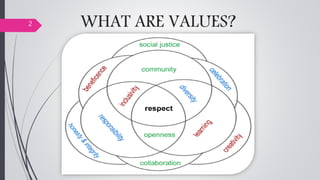
WHAT ARE VALUES?2
A Belief.
A Mission.
A Philosophy.
That is meaningful.
3
Values
Values represent basic convictions that-
A specific mode of conduct or end-state of existence is
personally or socially preferable to an opposite or converse
mode of conduct or end-state of existence.
Value is a judgmental element of what is right, good, or
desirable.
Values are our fundamental beliefs. They are the principles we use
to define that which is right, good and just. Values provide
guidance as we determine the right versus the wrong, the good
versus the bad. They are our standards.
Review dictionary definitions of values
4
IMPACT OF VALUES
 The values are integrated into the company's way of doing business (policies, procedures,
compensation practices, performance appraisals, etc.). They affect all aspects of the company from
what products get made or sold to how people are treated.
 They stand for something--that is, they have a clear and explicit philosophy about how they intend
to conduct their business.
 Organization's values are always in line with its purpose or mission, and the vision that the
organization is trying to achieve.
 Values form the foundation for everything that happens in your workplace. Founder’s values
premate the workplace. Founder will hire people who share the same values.
 Values largely govern the actions of the workforce.
 Values hold a major role in daily decision making, norms and relationship guidelines and how
people interact with each other and customers and suppliers.
5
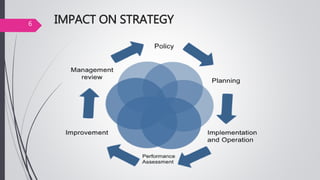
IMPACT ON STRATEGY6
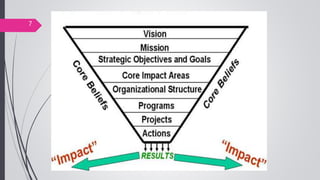
7
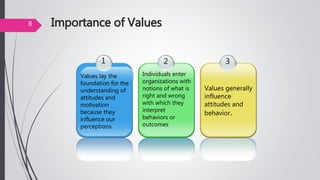
Importance of Values
1 2
Individuals enter
organizations with
notions of what is
right and wrong
with which they
interpret
behaviors or
outcomes
3
Values generally
influence
attitudes and
behavior.
Values lay the
foundation for the
understanding of
attitudes and
motivation
because they
influence our
perceptions.
8
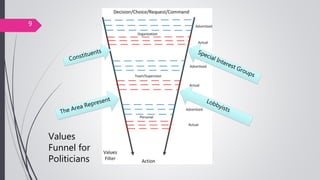
Values
Funnel for
Politicians
9
Advertised
Social Responsibility
Integrity
Customer Service
Profits
Share Holder Dividends
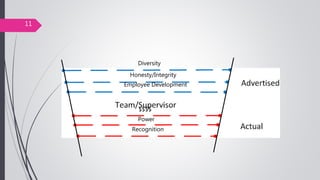
10
Power
Recognition
$$$$
Diversity
Honesty/Integrity
Employee Development
11
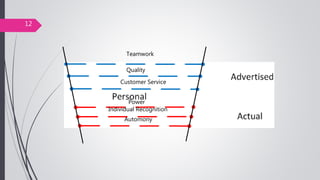
Teamwork
Quality
Customer Service
Individual Recognition
Power
Automony
12
Organizational Values.
 Organizational values define the acceptable standards which govern the
behaviour of individuals within the organization.
 Organizational Values are a set of beliefs that specify universal
expectations and preferred modes of behaviour in a company. They point
the way to purposeful action and approved behaviour.
-- Sears' commitment to trusting the customer.
-- Apple Computer's belief in the values of solving problems of society.
-- Marriott's values of systemization and standardization.
13
Definition of Values for organization
A value is a belief, a mission, or a philosophy that is really
meaningful to the organization. An example of a business value
is: "Customer Satisfaction." Another example of a value is "Being
Ethical and Truthful." Every organization has one or more values,
whether they are consciously aware of it or not. Another way of
saying it is that a value is a statement of the organization's
intention and commitment to achieve a high level of
performance on a specific QUALITATIVE factor.
14
IMPORTANCE OF ORGANIZATIONAL VALUES
1. Formation of mission and vision statement
2. Formation of organizational objectives
3. Formation of policies and procedures
4. Fulfilling customers needs
5. Competitive advantage
15
Values and Goals Statement
Businesses and other organizations
develop strategic plans in which
they list out their goals and values.
E.g., one organization indicated, "Provide growth opportunities for our
employees. Create economic value for our customers and
shareholders. Return value to the communities we serve."
16
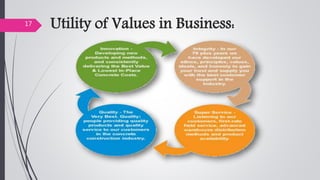
17 Utility of Values in Business:
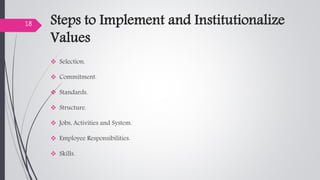
Steps to Implement and Institutionalize
Values
 Selection.
 Commitment.
 Standards.
 Structure.
 Jobs, Activities and System.
 Employee Responsibilities.
 Skills.
18
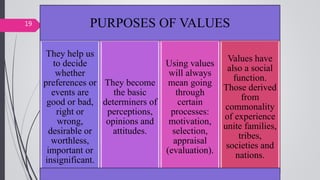
PURPOSES OF VALUES
They help us
to decide
whether
preferences or
events are
good or bad,
right or
wrong,
desirable or
worthless,
important or
insignificant.
They become
the basic
determiners of
perceptions,
opinions and
attitudes.
Using values
will always
mean going
through
certain
processes:
motivation,
selection,
appraisal
(evaluation).
Values have
also a social
function.
Those derived
from
commonality
of experience
unite families,
tribes,
societies and
nations.
19
CALSSIFICATION
DEPENDING ON WHO
EXERCISES THE VALUES
20
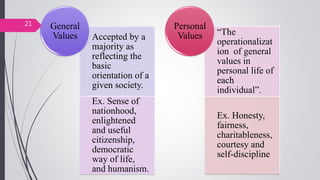
Accepted by a
majority as
reflecting the
basic
orientation of a
given society.
Ex. Sense of
nationhood,
enlightened
and useful
citizenship,
democratic
way of life,
and humanism.
General
Values “The
operationalizat
ion of general
values in
personal life of
each
individual”.
Ex. Honesty,
fairness,
charitableness,
courtesy and
self-discipline
Personal
Values
21
CLASSIFICATION ACCORDING
TO THE NATURE OF THE
BENEFITS EXPECTED
22
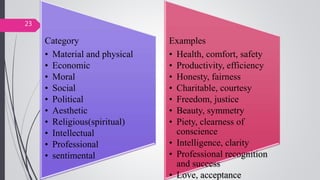
Category
• Material and physical
• Economic
• Moral
• Social
• Political
• Aesthetic
• Religious(spiritual)
• Intellectual
• Professional
• sentimental
Examples
• Health, comfort, safety
• Productivity, efficiency
• Honesty, fairness
• Charitable, courtesy
• Freedom, justice
• Beauty, symmetry
• Piety, clearness of
conscience
• Intelligence, clarity
• Professional recognition
and success
• Love, acceptance
23
CLASSIFICATION
ACCORDING TO THE NATURE
OF THEIR BENEFICIARIES
24
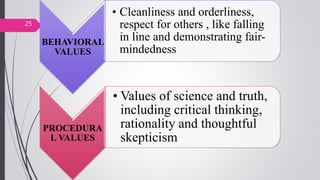
BEHAVIORAL
VALUES
• Cleanliness and orderliness,
respect for others , like falling
in line and demonstrating fair-
mindedness
PROCEDURA
L VALUES
• Values of science and truth,
including critical thinking,
rationality and thoughtful
skepticism
25
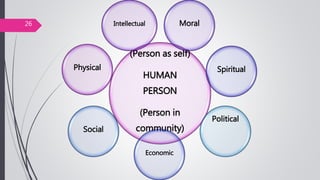
(Person as self)
HUMAN
PERSON
(Person in
community)
Physical
Intellectual Moral
Spiritual
Economic
Social
Political
26
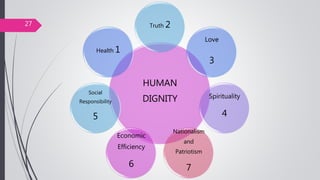
HUMAN
DIGNITY
Truth 2
Love
3
Spirituality
4
Nationalism
and
Patriotism
7
Economic
Efficiency
6
Social
Responsibility
5
Health 1
27
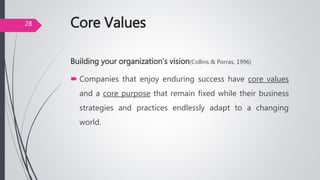
Core Values
Building your organization’s vision(Collins & Porras, 1996)
 Companies that enjoy enduring success have core values
and a core purpose that remain fixed while their business
strategies and practices endlessly adapt to a changing
world.
28
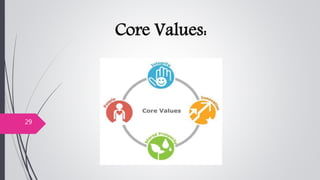
Core Values:
29
Core Values
Core values - A small set of timeless guiding principles
 Only a few values can be truly core
 To identify the core values, determine the values that are central and
passionately held
 Values must stand the test of time, they do not change with the market,
organization’s change markets to remain true to core values.
30
Core Values
Core Purpose is the organization’s reason for being
 Reflects people’s idealistic motivation for doing the organization’s work.
 Captures the soul of the organization.
 You might achieve a goal or complete a strategy, you cannot fulfill a purpose.
 Nike’s core purpose - to experience the emotion of competition, winning and
crushing competitors
 3M’s core purpose - to solve unsolved problems innovatively
 Walt Disney’s core purpose - to make people happy
31
Core Values
General Electric "I believe that our reputation for integrity and honorable dealings is our most important
asset. Your GE team believes that strong integrity is the foundation of great performance. I hold
myself to a high standard, and I know you will do the same.
" Jeffrey Immelt, Chairman & CEO
Google “We’re building a culture rooted in transparency, innovation, and scale.”
Sergey Brin & Larry Page
The Soul of Dell - Dell's success is built on a foundation of personal and professional integrity. We hold
ourselves to standards of ethical behavior that go well beyond legal minimums. We never compromise
these standards and we will never ask any member of the Dell team to do so either. We owe this to
our customers, suppliers, shareholders and other stakeholders. And we owe it to ourselves because
success without integrity is essentially meaningless.
Michael Dell, Chairman
32
Core Values
People who articulate core values must answer a few questions:
 What core values do you personally bring to work?
 What would you tell your children are the core values at work
and that you hope they will hold at work someday?
 If you awoke tomorrow with enough money to retire, would
you continue to live those core values?
 If you start a new organization, what core values would you
build into the new organization?
33
Core Values of Carroll School of Management
 Honesty & Integrity, We are committed to promoting the highest standards of
honesty and integrity
 Mutual Respect, We are committed to fostering an environment in which every
member of our community nurtures the spirit of trust, teamwork, openness and
respect
 Pursuit of Excellence, We are committed to creating an environment where all
members of the community pursue the highest possible level of academic
performance and personal development.
 Personal Accountability, We are committed to fostering an environment where every
member of the community understands and accepts responsibility for upholding
and reinforcing our values
34
Why are Core Values Important?
 There is a need for alignment between personal values and
organizational values
 When there is misalignment, bad things usually happen
 When there is alignment, your potential increases
significantly
35
How Core Values Can Improve Your
Organization
Increase productivity, help guide decision making, and boost
employee morale.
Kelly Batke
Director of Marketing
Wendy Pat Fong
Director of Customer Success
36
WHAT ARE CORE VALUES?
Core values support the vision, shape the culture, and
reflect what the organization values.
They are the essence of the organization’s identity –
the principles, beliefs, or philosophy of values.
37
• They help companies in the decision-making processes.
• They educate clients and potential customers about what
the organization is about and clarify the identity of the
organization.
• They can be a primary recruiting and retention tools.
WHAT ARE THE ADVANTAGES?38
• They are copied from another organization.
• They are not tied to your actual work
processes/goals.
• They are not specific enough.
• They are written by the wrong people.
WHY THEY HAVE FAILED39
Step 1:
Select 5-7 people who have a gut-level understanding of
your core values, are distinguished as the highest
performers, and are well respected by their peers and
management team.
These 5-7 people become your Mars group…
WHERE TO START40
Step 2:
Ask this group to list what they think the core values of the organization are.
Then ask them questions relating to each of the core values they have chosen:
Are the core values that you hold to be fundamental regardless of whether or
not they are awarded?
If you woke up tomorrow with enough money to retire for the rest of your life,
would you continue to hold on to these values?
WHERE TO START41
WHERE TO START
Step 2cont’d.
Can you envision these values being as valid 100 years from now as they
are today?
Would you want the organization to continue to hold these values, even if
at some point, they became a competitive disadvantage?
If you were to start a new organization tomorrow in a different line of
work, would you build the core values into the new organization
regardless of its activities?
42
LIVING YOUR VALUES
 Lead and live by example!
 Teaching the values
 Recognizing the values
 Hiring based on values
 Incorporating core values as part of your performance management
43
Examples of Organization Core
Values
44
NIKE, INC.
NIKE, INC was incorporated in 1964 as Blue Ribbon Sports by BILL BOWERMAN and
PHILL KNIGHTS and officially became NIKE,INC in may 1971.
Mission statement-
BRING INSPIRATION AND INNOVATION TO EVERY
ATHLETE* IN THE WORLD*
IF YOU HAVE A BODY, YOU ARE AN ATHLETE.
Values- Innovation, creativity, maintaining brand value, simplicity, fashionable,
consumers decides, dynamic, responsible(doing the right thing) , transparency,
promoting young and talented people.
45
MATCHING THE VALUES :
 In 1972, Nike footwear introduced “moon shoe” that features a waffle sole in
US Olympics.
 Nike has always sponsored young, talented and aggressive sports person. Nike
pays top athletes in many sports to use their products and promote and
advertise their technology and design.
46
 In 1973 the company sponsored Romanian tennis star Ilie Năstase and
American record holder athlete Steve Profantaine . In 1978 endorsed tennis
“bad boy” John McEnroe.
 In 1979, it introduced Nike Air. Gas- filled plastic membranes were inserted in
the sole to provide cushioning.
 In 1984, Nike signs Michael Jordan(NBA Player)into endorsement contract with
Jordan Air (originally banned by NBA).
 Nike introduces Nike Air Max shoe with a television ad featuring the “Beatles”
song “revolution”.
 In 1989, Nike enters European football market.
 Nike has also sponsored many other successful track and field athletes over
the years, such as Carl Lewis, Jackie Joyner-Kersee and Sebastian Coe. The
signing of basketball player Michael Jordan in 1984, with his subsequent
promotion of Nike over the course of his career, with Spike Lee as Mars
Blackmon, proved to be one of the biggest boosts to Nike's publicity and
sales.
 Nike also endorsed Tiger Woods soon after he gave up his amateur golf status
in 1996.
47
Starbucks
Starbucks is a good example of an
organization that is clear about its
core values. Note that while all six of
their core values are equally
important, the order in which they
appear speaks volumes about how
Starbucks operates.
48
Starbucks Core Values
1. Provide a great work environment
and treat each other with respect
and dignity.
2. Embrace diversity as an essential
component in the way we do
business.
3. Apply the highest standards of
excellence to the purchasing,
roasting and fresh delivery of our
coffee.
4. Develop enthusiastically satisfied
customers all the time.
5. Contribute positively to our
communities and our environment.
6. Recognize that profitability is
essential to our future success.
49
Starbucks Core Values
At Starbucks, performance is measured on the
basis of these core values. The information is
translated into a scorecard and readily shared
with managers, who in turn brainstorm ways to
continually improve. All decisions are driven by
these core values. The result? Starbucks has
enjoyed extraordinary growth and is widely
recognized as a high-performing organization,
even during times of economic turbulence.
50
Starbucks
 Our Coffee
 Our Partners
 Our Customers
 Our Stores
 Our Neighborhoods
 Our Shareholders
51
Procter & Gamble
Procter & Gamble is one of the
world’s leading makers of
consumer products. With
billions in sales, P&G has a
reputation for excellence in
marketing. It is a organization
whose leaders have assured its
enduring success by
continually reaffirming and
communicating its core values.
52
Procter & Gamble Core Values
People
• We attract and recruit the finest people in the world.
• We build our organization from within, promoting
and rewarding people without regard to any difference
unrelated to performance.
• We act on the conviction that the men and women of
Procter & Gamble will always be our most important
asset.
Leadership
• We are all leaders in our area of responsibility, with a
deep commitment to deliver leadership results.
• We have a clear vision of where we are going.
• We focus our goals to achieve leadership objectives
and strategies.
Ownership
• We accept personal accountability to meet the
business needs, improve our systems, and help others
improve their effectiveness.
• We all act like owners, treating the organization’s
assets as our own and behaving with the
organization’s long-term success in mind.
Integrity
• We always try to do the right thing.
• We are honest and straight-forward with each other.
• We operate within the letter and spirit of the law.
• We uphold the values and principles of P&G in every
action and decision.
• We are data-based and intellectually honest in
advocating proposals, including recognizing risks.
Trust
• We are determined to be the best at doing what
matters most.
• We have a healthy dissatisfaction with the status quo.
• We have a compelling desire to improve and to win
in the marketplace.
Passion for Winning
• We respect our P&G colleagues, customers, and
consumers and treat them as we want to be treated.
• We have confidence in each other’s capabilities and
intentions.
• We believe that people work best when there is a
foundation of trust.
53
Wells Fargo
With $390 billion in assets, Wells Fargo is one
of the few survivors of the global banking
crisis. Wells Fargo underscores the importance
of its values by saying that “if we threw out all
the policy manuals, we could still make
decisions based on our understanding of our
culture.” Look at Wells Fargo’s Core Values and
supporting behaviors to decide for yourself
how well they succeeded.
54
Wells Fargo Core Values
Ethics
• Maintain the highest standards with customers,
team members, stockholders and our communities.
• Value and reward open, honest two-way
communication.
• Be accountable for our conduct and our decisions.
• Only make promises you intend to keep—do the
things you say you’ll do.
• If things change, let people know.
• Avoid any actual or perceived conflict of interest.
Customer Satisfaction
• Consider the customer in all we do.
• Exceed the expectations of internal and external
customers—surprise and delight them.
• Do what’s right for the customer.
• Talk and act with the customer in mind.
• Build long-term customer relationships.
• Treat customers with care.
Leadership and Personal Accountability
Every team member contributes to our success and
should:
• Run it like you own it.
• Take prudent risks.
• Lead by example.
• Make decisions locally, close to the customer.
• Know your numbers.
• Consider customer, stockholder, team member and
community needs when making decisions.
• Care about each other.
Diversity
• Respect differences among team members,
customers and communities.
• Behave in a way that supports our corporate values.
• Take advantage of different perspectives.
• Support the diversity of our team members,
customers, and communities.
• Leverage diversity as a competitive advantage.
55
Avoid Hollow Values
When you’re defining an
organization’s core values, it’s
critical to avoid making them
sound hollow by inserting, for
example, your own personal
values for those of the organization,
or making the exercise too cute.
56
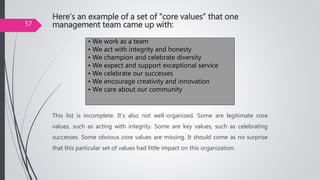
Here’s an example of a set of “core values” that one
management team came up with:
This list is incomplete. It’s also not well-organized. Some are legitimate core
values, such as acting with integrity. Some are key values, such as celebrating
successes. Some obvious core values are missing. It should come as no surprise
that this particular set of values had little impact on this organization.
• We work as a team
• We act with integrity and honesty
• We champion and celebrate diversity
• We expect and support exceptional service
• We celebrate our successes
• We encourage creativity and innovation
• We care about our community
57
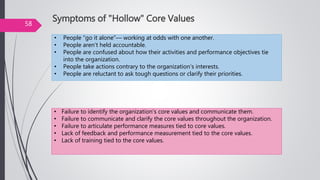
Symptoms of "Hollow" Core Values
Related Causes
• People “go it alone”— working at odds with one another.
• People aren’t held accountable.
• People are confused about how their activities and performance objectives tie
into the organization.
• People take actions contrary to the organization’s interests.
• People are reluctant to ask tough questions or clarify their priorities.
• Failure to identify the organization’s core values and communicate them.
• Failure to communicate and clarify the core values throughout the organization.
• Failure to articulate performance measures tied to core values.
• Lack of feedback and performance measurement tied to the core values.
• Lack of training tied to the core values.
58
Examples of Hollow Values
Here’s another example of what
I consider to be hollow values
from Jamba Juice, a health-
oriented seller of fruit-based
shakes and other products. Its
values spell out the word
“fiber.” The sentiment behind
these values is heartfelt. But
they don’t reflect what’s
essential to Jamba Juice. It’s a
cute marketing gimmick, not a
reflection of what’s truly
important to the organization.
Fun – Have fun. Smile and create a spirit of celebration for your
customers.
Integrity – Do what you say. Demonstrate good character and
encourage an atmosphere of mutual trust and respect.
Balance – Live a balanced life. Consider the needs of customers,
team members, and shareholders alike.
Empowerment – Believe in yourself. Be responsive and
innovative. Do whatever it takes to make your customer happy.
Respect – Be respectful. Help each other to grow. Contribute to
a vibrant and diverse community.
Jamba Juice Core Values
59
ZAPPOS
“The most important thing in creating a strong culture is that it
creates strong alignment within the organization. What the culture
is actually doesn't matter as much as the commitment to the
culture and core values of the organization.”
—Tony Hsieh, CEO
60
AVIS BUDGETGROUP
“The best strategic decision we made was making this a value-based
recognition program. The organization’s core values stay the same;
these are values that you want employees to carry with them. By basing
your program on core values, it eliminates the flavour of the month
feeling and the program is tied to something deeper and that makes it
better understood.”
— Mark Servodidio, Executive VP of Human Resources
61
Wegman’s Values
1.We care about people
2.High standards are a way of life. We pursue excellence in everything we do
3.We make difference in every community we serve.
4.We respect our people
5.We empower our people to make decisions that improve their work and
benefit our customers and our company.
62
Walmart
Since Sam Walton founded Walmart Stores, Inc., it has always been a
values-based, ethically led company. The values that guide our decisions
and our leadership are the 3 Basic Beliefs:
• Respect for the Individual
• Service to our Customers
• Striving for Excellence
63
Red Lobster
 Hospitality
 Fairness
 Caring
 Respect
 Quality
 Zip
 Balance
 Fun
64
 Service
 Diversity
 Inclusion
 Openness to Change
65
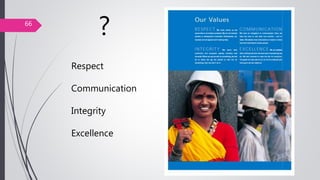
Respect
Communication
Integrity
Excellence
?66
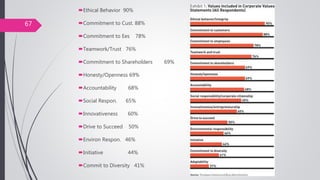
Ethical Behavior 90%
Commitment to Cust. 88%
Commitment to Ees 78%
Teamwork/Trust 76%
Commitment to Shareholders 69%
Honesty/Openness 69%
Accountability 68%
Social Respon. 65%
Innovativeness 60%
Drive to Succeed 50%
Environ Respon. 46%
Initiative 44%
Commit to Diversity 41%
67
Conclusion
You need to listen carefully for clues that your organization has
failed to engage in a deep examination of the organization’s
core values. If you sense this, or inherit a listless organization,
resolve to do something about it right away. Nothing is more
important if you want to build a leadership culture.
68
Thank you!
69

Yeganeh majidi

  • 1.
  • 2.
  • 3.
    A Belief. A Mission. APhilosophy. That is meaningful. 3
  • 4.
    Values Values represent basicconvictions that- A specific mode of conduct or end-state of existence is personally or socially preferable to an opposite or converse mode of conduct or end-state of existence. Value is a judgmental element of what is right, good, or desirable. Values are our fundamental beliefs. They are the principles we use to define that which is right, good and just. Values provide guidance as we determine the right versus the wrong, the good versus the bad. They are our standards. Review dictionary definitions of values 4
  • 5.
    IMPACT OF VALUES The values are integrated into the company's way of doing business (policies, procedures, compensation practices, performance appraisals, etc.). They affect all aspects of the company from what products get made or sold to how people are treated.  They stand for something--that is, they have a clear and explicit philosophy about how they intend to conduct their business.  Organization's values are always in line with its purpose or mission, and the vision that the organization is trying to achieve.  Values form the foundation for everything that happens in your workplace. Founder’s values premate the workplace. Founder will hire people who share the same values.  Values largely govern the actions of the workforce.  Values hold a major role in daily decision making, norms and relationship guidelines and how people interact with each other and customers and suppliers. 5
  • 6.
  • 7.
  • 8.
    Importance of Values 12 Individuals enter organizations with notions of what is right and wrong with which they interpret behaviors or outcomes 3 Values generally influence attitudes and behavior. Values lay the foundation for the understanding of attitudes and motivation because they influence our perceptions. 8
  • 9.
  • 10.
  • 11.
  • 12.
  • 13.
    Organizational Values.  Organizationalvalues define the acceptable standards which govern the behaviour of individuals within the organization.  Organizational Values are a set of beliefs that specify universal expectations and preferred modes of behaviour in a company. They point the way to purposeful action and approved behaviour. -- Sears' commitment to trusting the customer. -- Apple Computer's belief in the values of solving problems of society. -- Marriott's values of systemization and standardization. 13
  • 14.
    Definition of Valuesfor organization A value is a belief, a mission, or a philosophy that is really meaningful to the organization. An example of a business value is: "Customer Satisfaction." Another example of a value is "Being Ethical and Truthful." Every organization has one or more values, whether they are consciously aware of it or not. Another way of saying it is that a value is a statement of the organization's intention and commitment to achieve a high level of performance on a specific QUALITATIVE factor. 14
  • 15.
    IMPORTANCE OF ORGANIZATIONALVALUES 1. Formation of mission and vision statement 2. Formation of organizational objectives 3. Formation of policies and procedures 4. Fulfilling customers needs 5. Competitive advantage 15
  • 16.
    Values and GoalsStatement Businesses and other organizations develop strategic plans in which they list out their goals and values. E.g., one organization indicated, "Provide growth opportunities for our employees. Create economic value for our customers and shareholders. Return value to the communities we serve." 16
  • 17.
    17 Utility ofValues in Business:
  • 18.
    Steps to Implementand Institutionalize Values  Selection.  Commitment.  Standards.  Structure.  Jobs, Activities and System.  Employee Responsibilities.  Skills. 18
  • 19.
    PURPOSES OF VALUES Theyhelp us to decide whether preferences or events are good or bad, right or wrong, desirable or worthless, important or insignificant. They become the basic determiners of perceptions, opinions and attitudes. Using values will always mean going through certain processes: motivation, selection, appraisal (evaluation). Values have also a social function. Those derived from commonality of experience unite families, tribes, societies and nations. 19
  • 20.
  • 21.
    Accepted by a majorityas reflecting the basic orientation of a given society. Ex. Sense of nationhood, enlightened and useful citizenship, democratic way of life, and humanism. General Values “The operationalizat ion of general values in personal life of each individual”. Ex. Honesty, fairness, charitableness, courtesy and self-discipline Personal Values 21
  • 22.
    CLASSIFICATION ACCORDING TO THENATURE OF THE BENEFITS EXPECTED 22
  • 23.
    Category • Material andphysical • Economic • Moral • Social • Political • Aesthetic • Religious(spiritual) • Intellectual • Professional • sentimental Examples • Health, comfort, safety • Productivity, efficiency • Honesty, fairness • Charitable, courtesy • Freedom, justice • Beauty, symmetry • Piety, clearness of conscience • Intelligence, clarity • Professional recognition and success • Love, acceptance 23
  • 24.
    CLASSIFICATION ACCORDING TO THENATURE OF THEIR BENEFICIARIES 24
  • 25.
    BEHAVIORAL VALUES • Cleanliness andorderliness, respect for others , like falling in line and demonstrating fair- mindedness PROCEDURA L VALUES • Values of science and truth, including critical thinking, rationality and thoughtful skepticism 25
  • 26.
    (Person as self) HUMAN PERSON (Personin community) Physical Intellectual Moral Spiritual Economic Social Political 26
  • 27.
  • 28.
    Core Values Building yourorganization’s vision(Collins & Porras, 1996)  Companies that enjoy enduring success have core values and a core purpose that remain fixed while their business strategies and practices endlessly adapt to a changing world. 28
  • 29.
  • 30.
    Core Values Core values- A small set of timeless guiding principles  Only a few values can be truly core  To identify the core values, determine the values that are central and passionately held  Values must stand the test of time, they do not change with the market, organization’s change markets to remain true to core values. 30
  • 31.
    Core Values Core Purposeis the organization’s reason for being  Reflects people’s idealistic motivation for doing the organization’s work.  Captures the soul of the organization.  You might achieve a goal or complete a strategy, you cannot fulfill a purpose.  Nike’s core purpose - to experience the emotion of competition, winning and crushing competitors  3M’s core purpose - to solve unsolved problems innovatively  Walt Disney’s core purpose - to make people happy 31
  • 32.
    Core Values General Electric"I believe that our reputation for integrity and honorable dealings is our most important asset. Your GE team believes that strong integrity is the foundation of great performance. I hold myself to a high standard, and I know you will do the same. " Jeffrey Immelt, Chairman & CEO Google “We’re building a culture rooted in transparency, innovation, and scale.” Sergey Brin & Larry Page The Soul of Dell - Dell's success is built on a foundation of personal and professional integrity. We hold ourselves to standards of ethical behavior that go well beyond legal minimums. We never compromise these standards and we will never ask any member of the Dell team to do so either. We owe this to our customers, suppliers, shareholders and other stakeholders. And we owe it to ourselves because success without integrity is essentially meaningless. Michael Dell, Chairman 32
  • 33.
    Core Values People whoarticulate core values must answer a few questions:  What core values do you personally bring to work?  What would you tell your children are the core values at work and that you hope they will hold at work someday?  If you awoke tomorrow with enough money to retire, would you continue to live those core values?  If you start a new organization, what core values would you build into the new organization? 33
  • 34.
    Core Values ofCarroll School of Management  Honesty & Integrity, We are committed to promoting the highest standards of honesty and integrity  Mutual Respect, We are committed to fostering an environment in which every member of our community nurtures the spirit of trust, teamwork, openness and respect  Pursuit of Excellence, We are committed to creating an environment where all members of the community pursue the highest possible level of academic performance and personal development.  Personal Accountability, We are committed to fostering an environment where every member of the community understands and accepts responsibility for upholding and reinforcing our values 34
  • 35.
    Why are CoreValues Important?  There is a need for alignment between personal values and organizational values  When there is misalignment, bad things usually happen  When there is alignment, your potential increases significantly 35
  • 36.
    How Core ValuesCan Improve Your Organization Increase productivity, help guide decision making, and boost employee morale. Kelly Batke Director of Marketing Wendy Pat Fong Director of Customer Success 36
  • 37.
    WHAT ARE COREVALUES? Core values support the vision, shape the culture, and reflect what the organization values. They are the essence of the organization’s identity – the principles, beliefs, or philosophy of values. 37
  • 38.
    • They helpcompanies in the decision-making processes. • They educate clients and potential customers about what the organization is about and clarify the identity of the organization. • They can be a primary recruiting and retention tools. WHAT ARE THE ADVANTAGES?38
  • 39.
    • They arecopied from another organization. • They are not tied to your actual work processes/goals. • They are not specific enough. • They are written by the wrong people. WHY THEY HAVE FAILED39
  • 40.
    Step 1: Select 5-7people who have a gut-level understanding of your core values, are distinguished as the highest performers, and are well respected by their peers and management team. These 5-7 people become your Mars group… WHERE TO START40
  • 41.
    Step 2: Ask thisgroup to list what they think the core values of the organization are. Then ask them questions relating to each of the core values they have chosen: Are the core values that you hold to be fundamental regardless of whether or not they are awarded? If you woke up tomorrow with enough money to retire for the rest of your life, would you continue to hold on to these values? WHERE TO START41
  • 42.
    WHERE TO START Step2cont’d. Can you envision these values being as valid 100 years from now as they are today? Would you want the organization to continue to hold these values, even if at some point, they became a competitive disadvantage? If you were to start a new organization tomorrow in a different line of work, would you build the core values into the new organization regardless of its activities? 42
  • 43.
    LIVING YOUR VALUES Lead and live by example!  Teaching the values  Recognizing the values  Hiring based on values  Incorporating core values as part of your performance management 43
  • 44.
  • 45.
    NIKE, INC. NIKE, INCwas incorporated in 1964 as Blue Ribbon Sports by BILL BOWERMAN and PHILL KNIGHTS and officially became NIKE,INC in may 1971. Mission statement- BRING INSPIRATION AND INNOVATION TO EVERY ATHLETE* IN THE WORLD* IF YOU HAVE A BODY, YOU ARE AN ATHLETE. Values- Innovation, creativity, maintaining brand value, simplicity, fashionable, consumers decides, dynamic, responsible(doing the right thing) , transparency, promoting young and talented people. 45
  • 46.
    MATCHING THE VALUES:  In 1972, Nike footwear introduced “moon shoe” that features a waffle sole in US Olympics.  Nike has always sponsored young, talented and aggressive sports person. Nike pays top athletes in many sports to use their products and promote and advertise their technology and design. 46
  • 47.
     In 1973the company sponsored Romanian tennis star Ilie Năstase and American record holder athlete Steve Profantaine . In 1978 endorsed tennis “bad boy” John McEnroe.  In 1979, it introduced Nike Air. Gas- filled plastic membranes were inserted in the sole to provide cushioning.  In 1984, Nike signs Michael Jordan(NBA Player)into endorsement contract with Jordan Air (originally banned by NBA).  Nike introduces Nike Air Max shoe with a television ad featuring the “Beatles” song “revolution”.  In 1989, Nike enters European football market.  Nike has also sponsored many other successful track and field athletes over the years, such as Carl Lewis, Jackie Joyner-Kersee and Sebastian Coe. The signing of basketball player Michael Jordan in 1984, with his subsequent promotion of Nike over the course of his career, with Spike Lee as Mars Blackmon, proved to be one of the biggest boosts to Nike's publicity and sales.  Nike also endorsed Tiger Woods soon after he gave up his amateur golf status in 1996. 47
  • 48.
    Starbucks Starbucks is agood example of an organization that is clear about its core values. Note that while all six of their core values are equally important, the order in which they appear speaks volumes about how Starbucks operates. 48
  • 49.
    Starbucks Core Values 1.Provide a great work environment and treat each other with respect and dignity. 2. Embrace diversity as an essential component in the way we do business. 3. Apply the highest standards of excellence to the purchasing, roasting and fresh delivery of our coffee. 4. Develop enthusiastically satisfied customers all the time. 5. Contribute positively to our communities and our environment. 6. Recognize that profitability is essential to our future success. 49
  • 50.
    Starbucks Core Values AtStarbucks, performance is measured on the basis of these core values. The information is translated into a scorecard and readily shared with managers, who in turn brainstorm ways to continually improve. All decisions are driven by these core values. The result? Starbucks has enjoyed extraordinary growth and is widely recognized as a high-performing organization, even during times of economic turbulence. 50
  • 51.
    Starbucks  Our Coffee Our Partners  Our Customers  Our Stores  Our Neighborhoods  Our Shareholders 51
  • 52.
    Procter & Gamble Procter& Gamble is one of the world’s leading makers of consumer products. With billions in sales, P&G has a reputation for excellence in marketing. It is a organization whose leaders have assured its enduring success by continually reaffirming and communicating its core values. 52
  • 53.
    Procter & GambleCore Values People • We attract and recruit the finest people in the world. • We build our organization from within, promoting and rewarding people without regard to any difference unrelated to performance. • We act on the conviction that the men and women of Procter & Gamble will always be our most important asset. Leadership • We are all leaders in our area of responsibility, with a deep commitment to deliver leadership results. • We have a clear vision of where we are going. • We focus our goals to achieve leadership objectives and strategies. Ownership • We accept personal accountability to meet the business needs, improve our systems, and help others improve their effectiveness. • We all act like owners, treating the organization’s assets as our own and behaving with the organization’s long-term success in mind. Integrity • We always try to do the right thing. • We are honest and straight-forward with each other. • We operate within the letter and spirit of the law. • We uphold the values and principles of P&G in every action and decision. • We are data-based and intellectually honest in advocating proposals, including recognizing risks. Trust • We are determined to be the best at doing what matters most. • We have a healthy dissatisfaction with the status quo. • We have a compelling desire to improve and to win in the marketplace. Passion for Winning • We respect our P&G colleagues, customers, and consumers and treat them as we want to be treated. • We have confidence in each other’s capabilities and intentions. • We believe that people work best when there is a foundation of trust. 53
  • 54.
    Wells Fargo With $390billion in assets, Wells Fargo is one of the few survivors of the global banking crisis. Wells Fargo underscores the importance of its values by saying that “if we threw out all the policy manuals, we could still make decisions based on our understanding of our culture.” Look at Wells Fargo’s Core Values and supporting behaviors to decide for yourself how well they succeeded. 54
  • 55.
    Wells Fargo CoreValues Ethics • Maintain the highest standards with customers, team members, stockholders and our communities. • Value and reward open, honest two-way communication. • Be accountable for our conduct and our decisions. • Only make promises you intend to keep—do the things you say you’ll do. • If things change, let people know. • Avoid any actual or perceived conflict of interest. Customer Satisfaction • Consider the customer in all we do. • Exceed the expectations of internal and external customers—surprise and delight them. • Do what’s right for the customer. • Talk and act with the customer in mind. • Build long-term customer relationships. • Treat customers with care. Leadership and Personal Accountability Every team member contributes to our success and should: • Run it like you own it. • Take prudent risks. • Lead by example. • Make decisions locally, close to the customer. • Know your numbers. • Consider customer, stockholder, team member and community needs when making decisions. • Care about each other. Diversity • Respect differences among team members, customers and communities. • Behave in a way that supports our corporate values. • Take advantage of different perspectives. • Support the diversity of our team members, customers, and communities. • Leverage diversity as a competitive advantage. 55
  • 56.
    Avoid Hollow Values Whenyou’re defining an organization’s core values, it’s critical to avoid making them sound hollow by inserting, for example, your own personal values for those of the organization, or making the exercise too cute. 56
  • 57.
    Here’s an exampleof a set of “core values” that one management team came up with: This list is incomplete. It’s also not well-organized. Some are legitimate core values, such as acting with integrity. Some are key values, such as celebrating successes. Some obvious core values are missing. It should come as no surprise that this particular set of values had little impact on this organization. • We work as a team • We act with integrity and honesty • We champion and celebrate diversity • We expect and support exceptional service • We celebrate our successes • We encourage creativity and innovation • We care about our community 57
  • 58.
    Symptoms of "Hollow"Core Values Related Causes • People “go it alone”— working at odds with one another. • People aren’t held accountable. • People are confused about how their activities and performance objectives tie into the organization. • People take actions contrary to the organization’s interests. • People are reluctant to ask tough questions or clarify their priorities. • Failure to identify the organization’s core values and communicate them. • Failure to communicate and clarify the core values throughout the organization. • Failure to articulate performance measures tied to core values. • Lack of feedback and performance measurement tied to the core values. • Lack of training tied to the core values. 58
  • 59.
    Examples of HollowValues Here’s another example of what I consider to be hollow values from Jamba Juice, a health- oriented seller of fruit-based shakes and other products. Its values spell out the word “fiber.” The sentiment behind these values is heartfelt. But they don’t reflect what’s essential to Jamba Juice. It’s a cute marketing gimmick, not a reflection of what’s truly important to the organization. Fun – Have fun. Smile and create a spirit of celebration for your customers. Integrity – Do what you say. Demonstrate good character and encourage an atmosphere of mutual trust and respect. Balance – Live a balanced life. Consider the needs of customers, team members, and shareholders alike. Empowerment – Believe in yourself. Be responsive and innovative. Do whatever it takes to make your customer happy. Respect – Be respectful. Help each other to grow. Contribute to a vibrant and diverse community. Jamba Juice Core Values 59
  • 60.
    ZAPPOS “The most importantthing in creating a strong culture is that it creates strong alignment within the organization. What the culture is actually doesn't matter as much as the commitment to the culture and core values of the organization.” —Tony Hsieh, CEO 60
  • 61.
    AVIS BUDGETGROUP “The beststrategic decision we made was making this a value-based recognition program. The organization’s core values stay the same; these are values that you want employees to carry with them. By basing your program on core values, it eliminates the flavour of the month feeling and the program is tied to something deeper and that makes it better understood.” — Mark Servodidio, Executive VP of Human Resources 61
  • 62.
    Wegman’s Values 1.We careabout people 2.High standards are a way of life. We pursue excellence in everything we do 3.We make difference in every community we serve. 4.We respect our people 5.We empower our people to make decisions that improve their work and benefit our customers and our company. 62
  • 63.
    Walmart Since Sam Waltonfounded Walmart Stores, Inc., it has always been a values-based, ethically led company. The values that guide our decisions and our leadership are the 3 Basic Beliefs: • Respect for the Individual • Service to our Customers • Striving for Excellence 63
  • 64.
    Red Lobster  Hospitality Fairness  Caring  Respect  Quality  Zip  Balance  Fun 64
  • 65.
     Service  Diversity Inclusion  Openness to Change 65
  • 66.
  • 67.
    Ethical Behavior 90% Commitmentto Cust. 88% Commitment to Ees 78% Teamwork/Trust 76% Commitment to Shareholders 69% Honesty/Openness 69% Accountability 68% Social Respon. 65% Innovativeness 60% Drive to Succeed 50% Environ Respon. 46% Initiative 44% Commit to Diversity 41% 67
  • 68.
    Conclusion You need tolisten carefully for clues that your organization has failed to engage in a deep examination of the organization’s core values. If you sense this, or inherit a listless organization, resolve to do something about it right away. Nothing is more important if you want to build a leadership culture. 68
  • 69.