How Core Values Can 
Improve Your Organization 
Increase productivity, help guide decision making, and 
boost employee morale. 
Webinars
IT’S NICE TO MEET YOU. 
Kelly Batke 
Director of Marketing 
Wendy Pat Fong 
Director of Customer Success 
@7Geese #livecorevalues
AGENDA 
1. Core values: what are they? 
2. What are the advantages? 
3. Why have they failed 
4. How to define your core values 
5. How to live them 
6. Case Studies 
7. Q & A
POLL #1 
Does your organization have core values? 
Yes 
No
1 WHAT ARE CORE VALUES?
1 WHAT ARE CORE VALUES? 
Core values support the vision, shape the culture, 
and reflect what the company values. 
They are the essence of the company’s identity – 
the principles, beliefs, or philosophy of values.
2 WHAT ARE THE ADVANTAGES?
2 WHAT ARE THE ADVANTAGES? 
They help companies in the decision-making processes. 
They educate clients and potential customers about what the 
company is about and clarify the identity of the organization. 
They can be a primary recruiting and retention tools.
2 WHAT ARE THE ADVANTAGES? 
They help companies in the decision-making processes. 
They educate clients and potential customers about what the 
company is about and clarify the identity of the organization. 
They can be a primary recruiting and retention tools.
2 WHAT ARE THE ADVANTAGES? 
They help companies in the decision-making processes. 
They educate clients and potential customers about what the 
company is about and clarify the identity of the organization. 
They can be a primary recruiting and retention tools.
POLL #2 
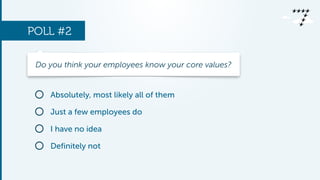
Do you think your employees know your core values? 
Absolutely, most likely all of them 
Just a few employees do 
I have no idea 
Definitely not
3 WHY THEY HAVE FAILED
3 WHY THEY HAVE FAILED 
They are copied from another company. 
They are not tied to your actual work processes/goals. 
They are not specific enough. 
They are written by the wrong people.
3 WHY THEY HAVE FAILED 
They are copied from another company. 
They are not tied to your actual work processes/goals. 
They are not specific enough. 
They are written by the wrong people.
3 WHY THEY HAVE FAILED 
They are copied from another company. 
They are not tied to your actual work processes/goals. 
They are not specific enough. 
They are written by the wrong people.
3 WHY THEY HAVE FAILED 
They are copied from another company. 
They are not tied to your actual work processes/goals. 
They are not specific enough. 
They are written by the wrong people.
4 WHERE TO START
4 WHERE TO START 
Step 1: 
Select 5-7 people who have a gut-level understanding of your core 
values, are distinguished as the highest performers, and are well 
respected by their peers and management team. 
These 5-7 people become your Mars group…
4 WHERE TO START 
Step 2: 
Ask this group to list what they think the core values of the organization are. 
Then ask them questions relating to each of the core values they have chosen: 
Are the core values that you hold to be fundamental regardless of whether or 
not they are awarded? 
If you woke up tomorrow with enough money to retire for the rest of your life, 
would you continue to hold on to these values?
4 WHERE TO START 
Step 2 cont’d. 
Can you envision these values being as valid 100 years from now as they are 
today? 
Would you want the organization to continue to hold these values, even if at 
some point, they became a competitive disadvantage? 
If you were to start a new organization tomorrow in a different line of work, 
would you build the core values into the new organization regardless of its 
activities?
L5IVLIINVGE YTOHUE RV AVLAULEUSES
5 LIVING YOUR VALUES 
Lead and live by example! 
Teaching the values 
Recognizing the values 
Hiring based on values 
Incorporating core values as part of your performance management
5 LIVING YOUR VALUES 
Lead and live by example! 
Teaching the values 
Recognizing the values 
Hiring based on values 
Incorporating core values as part of your performance management
5 LIVING YOUR VALUES 
Lead and live by example! 
Teaching the values 
Recognizing the values 
Hiring based on values 
Incorporating core values as part of your performance management
5 LIVING YOUR VALUES 
Lead and live by example! 
Teaching the values 
Recognizing the values 
Hiring based on values 
Incorporating core values as part of your performance management
5 LIVING YOUR VALUES 
Lead and live by example! 
Teaching the values 
Recognizing the values 
Hiring based on values 
Incorporating core values as part of your performance management
CASE STUDY: 7GEESE
CASE STUDY: ZAPPOS 
! 
“The most important thing in creating a strong culture is that it creates 
strong alignment within the organization. What the culture is actually doesn't 
matter as much as the commitment to the culture and core values of the 
organization.” 
— Tony Hsieh, CEO
CASE STUDY: AVIS BUDGET GROUP 
! 
“The best strategic decision we made was making this a value-based 
recognition program. The company’s core values stay the same; these are 
values that you want employees to carry with them. By basing your program 
on core values, it eliminates the flavour of the month feeling and the 
program is tied to something deeper and that makes it better understood.” 
— Mark Servodidio, Executive VP of Human Resources
CASE STUDY: HOOTSUITE
Try 7Geese Now! 
30-day free trial - no risk. 
www.7geese.com
Q & A
THANKS FOR 
JOINING! 
A recorded version of this Webinar will be available 
on our blog at blog.7geese.com 
Webinars

How to Live Your Core Values

  • 1.
    How Core ValuesCan Improve Your Organization Increase productivity, help guide decision making, and boost employee morale. Webinars
  • 2.
    IT’S NICE TOMEET YOU. Kelly Batke Director of Marketing Wendy Pat Fong Director of Customer Success @7Geese #livecorevalues
  • 3.
    AGENDA 1. Corevalues: what are they? 2. What are the advantages? 3. Why have they failed 4. How to define your core values 5. How to live them 6. Case Studies 7. Q & A
  • 4.
    POLL #1 Doesyour organization have core values? Yes No
  • 5.
    1 WHAT ARECORE VALUES?
  • 6.
    1 WHAT ARECORE VALUES? Core values support the vision, shape the culture, and reflect what the company values. They are the essence of the company’s identity – the principles, beliefs, or philosophy of values.
  • 7.
    2 WHAT ARETHE ADVANTAGES?
  • 8.
    2 WHAT ARETHE ADVANTAGES? They help companies in the decision-making processes. They educate clients and potential customers about what the company is about and clarify the identity of the organization. They can be a primary recruiting and retention tools.
  • 9.
    2 WHAT ARETHE ADVANTAGES? They help companies in the decision-making processes. They educate clients and potential customers about what the company is about and clarify the identity of the organization. They can be a primary recruiting and retention tools.
  • 10.
    2 WHAT ARETHE ADVANTAGES? They help companies in the decision-making processes. They educate clients and potential customers about what the company is about and clarify the identity of the organization. They can be a primary recruiting and retention tools.
  • 11.
    POLL #2 Doyou think your employees know your core values? Absolutely, most likely all of them Just a few employees do I have no idea Definitely not
  • 12.
    3 WHY THEYHAVE FAILED
  • 13.
    3 WHY THEYHAVE FAILED They are copied from another company. They are not tied to your actual work processes/goals. They are not specific enough. They are written by the wrong people.
  • 14.
    3 WHY THEYHAVE FAILED They are copied from another company. They are not tied to your actual work processes/goals. They are not specific enough. They are written by the wrong people.
  • 15.
    3 WHY THEYHAVE FAILED They are copied from another company. They are not tied to your actual work processes/goals. They are not specific enough. They are written by the wrong people.
  • 16.
    3 WHY THEYHAVE FAILED They are copied from another company. They are not tied to your actual work processes/goals. They are not specific enough. They are written by the wrong people.
  • 17.
  • 18.
    4 WHERE TOSTART Step 1: Select 5-7 people who have a gut-level understanding of your core values, are distinguished as the highest performers, and are well respected by their peers and management team. These 5-7 people become your Mars group…
  • 19.
    4 WHERE TOSTART Step 2: Ask this group to list what they think the core values of the organization are. Then ask them questions relating to each of the core values they have chosen: Are the core values that you hold to be fundamental regardless of whether or not they are awarded? If you woke up tomorrow with enough money to retire for the rest of your life, would you continue to hold on to these values?
  • 20.
    4 WHERE TOSTART Step 2 cont’d. Can you envision these values being as valid 100 years from now as they are today? Would you want the organization to continue to hold these values, even if at some point, they became a competitive disadvantage? If you were to start a new organization tomorrow in a different line of work, would you build the core values into the new organization regardless of its activities?
  • 21.
  • 22.
    5 LIVING YOURVALUES Lead and live by example! Teaching the values Recognizing the values Hiring based on values Incorporating core values as part of your performance management
  • 23.
    5 LIVING YOURVALUES Lead and live by example! Teaching the values Recognizing the values Hiring based on values Incorporating core values as part of your performance management
  • 24.
    5 LIVING YOURVALUES Lead and live by example! Teaching the values Recognizing the values Hiring based on values Incorporating core values as part of your performance management
  • 25.
    5 LIVING YOURVALUES Lead and live by example! Teaching the values Recognizing the values Hiring based on values Incorporating core values as part of your performance management
  • 26.
    5 LIVING YOURVALUES Lead and live by example! Teaching the values Recognizing the values Hiring based on values Incorporating core values as part of your performance management
  • 27.
  • 28.
    CASE STUDY: ZAPPOS ! “The most important thing in creating a strong culture is that it creates strong alignment within the organization. What the culture is actually doesn't matter as much as the commitment to the culture and core values of the organization.” — Tony Hsieh, CEO
  • 29.
    CASE STUDY: AVISBUDGET GROUP ! “The best strategic decision we made was making this a value-based recognition program. The company’s core values stay the same; these are values that you want employees to carry with them. By basing your program on core values, it eliminates the flavour of the month feeling and the program is tied to something deeper and that makes it better understood.” — Mark Servodidio, Executive VP of Human Resources
  • 30.
  • 31.
    Try 7Geese Now! 30-day free trial - no risk. www.7geese.com
  • 32.
  • 33.
    THANKS FOR JOINING! A recorded version of this Webinar will be available on our blog at blog.7geese.com Webinars