VALUES –
PERSONAL &
ORGANIZATION
AL
DR. PEEYUSH VERMA
VALUE  INTEGRITY
ACOUNTABILITY
2
 A personal value is absolute or relative and
ethical value, the assumption of which can be
the basis for ethical action.
 A value system is a set of consistent values
and measures. A principle value is a
foundation upon which other values and
measures of integrity are based.
3
4
 Constellation of likes, dislikes, view points, inner
inclinations, rational and irrational judgments,
prejudices and associated patterns that determine
a person’s view of the world.
 Basic conviction that a specific mode of conduct
or end-state of existence is personally or socially
preferable to an opposite or converse mode of
conduct or end-state of existence.
VALUE SYSTEM
An hierarchy based on a ranking of an
individual’s value in terms of their
intensity.
5
 These serve five purposes-
 As standards of behavior
 Guidance for decision making and conflict
resolution
 Values impact our thoughts and actions
 Values serve as an influence on employee
motivation and influence perception.
 Values generally influence attitude and behavior
thus guiding actions.
6
 Genetically- about 40%
 Environmental factors- culture, parents, friends,
teachers etc.
 Established in early years- on topics like
education, sex, politics etc..
7
 Key Forces
1. Family influence
2. Peer influence
3. Experience
4. Values and Morals
5. Situational Factors
6. Institutions (church, school)
7. Media
8. Professional roles and models
8
 Managerial Leadership values- These are
people’s belief regarding how they wish the
leaders of their organization to conduct
themselves ideally.
 Preferred Leadership Values-
 Honest, Competent
 Fair, Broad minded
 Dependable
 Supportive
 Forward looking
9
Changing Managerial values-
The organization must be dynamic as it
operates in constantly changing
environment. As the needs of its
members change, managerial
philosophies and values must change.
10
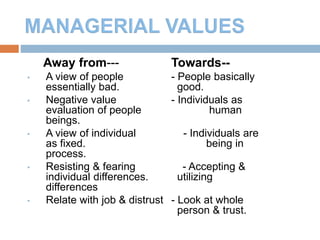
Away from--- Towards--
• A view of people - People basically
essentially bad. good.
• Negative value - Individuals as
evaluation of people human
beings.
• A view of individual - Individuals are
as fixed. being in
process.
• Resisting & fearing - Accepting &
individual differences. utilizing
differences
• Relate with job & distrust - Look at whole
person & trust.
11
A set of values that should guide the thinking
and behaviour of people in any organization-
 TRUTH- Treat others with uncompromising truth.
 TRUST- Lavish trust on your associates.
 MENTORING- Mentor unselfishly.
 OPENNESS- Be receptive to new ideas.
 GIVING CREDIT- Give credit where it is due.
 RISK TAKING- Take personal risks for the good
of the organization.
 HONESTY- Be honest in all dealings.
Cont…
12
 CARING- put the interest of others
before your own.
 SOCIAL CONSCIENCE
 RESPONSIBILITY & ACCOUNTABILITY
13
A very important set of values for
business survival and growth-
 Righteousness (DHARMA)
 Public Good (LOKA SANGRAHA)
 Efficacy (KAUSHALAM)
 Innovation ( VIVIDHATA)
 Learning (JIGASA)
 Respect for individual & human dignity
14
Where there is an alignment between
core values and common practices,
profitability will directly follow.
 Identifying core values
 Communicating core values
 Aligning values and practices
15
 A powerful force affecting behaviour
 Contain judgmental element to decide what is
right or desirable.
 Content attribute decides that a mode of
conduct is important.
 Intensity attribute decides how important mode
of conduct is. Values are not fixed. They change
over time.
 Many values are relatively stable and enduring.
 Hierarchy of values.
16
 Fundamental to understanding of
managing and organizational behaviour.
 Selection of missions, goals and
objectives.
 Lays foundation for the understanding of
attitudes, motivation and perceptions.
17
 OLD VALUES- Hard work, conservative,
loyalty
 PRESENT VALUES- Job satisfaction,
leisure time, loyalty to relationships,
flexibility, success and achievement,
ambition, loyalty to career
Cont…
18
 NEGATIVE VALUES- Anger, Meanness,
Arrogance, Crookedness, Greed, Lust
 POSITIVE VALUES- Integrity, Honesty,
Truthfulness, Kind heartedness, Humility,
Friendliness, Faith, Self Respect, Open-
minded, Creativity, Civil sense, Simplicity,
Forgiveness, Poise, Detachment

VALUES AND THEIR INCORPORATION

  • 1.
  • 2.
  • 3.
     A personalvalue is absolute or relative and ethical value, the assumption of which can be the basis for ethical action.  A value system is a set of consistent values and measures. A principle value is a foundation upon which other values and measures of integrity are based. 3
  • 4.
    4  Constellation oflikes, dislikes, view points, inner inclinations, rational and irrational judgments, prejudices and associated patterns that determine a person’s view of the world.  Basic conviction that a specific mode of conduct or end-state of existence is personally or socially preferable to an opposite or converse mode of conduct or end-state of existence. VALUE SYSTEM An hierarchy based on a ranking of an individual’s value in terms of their intensity.
  • 5.
    5  These servefive purposes-  As standards of behavior  Guidance for decision making and conflict resolution  Values impact our thoughts and actions  Values serve as an influence on employee motivation and influence perception.  Values generally influence attitude and behavior thus guiding actions.
  • 6.
    6  Genetically- about40%  Environmental factors- culture, parents, friends, teachers etc.  Established in early years- on topics like education, sex, politics etc..
  • 7.
    7  Key Forces 1.Family influence 2. Peer influence 3. Experience 4. Values and Morals 5. Situational Factors 6. Institutions (church, school) 7. Media 8. Professional roles and models
  • 8.
    8  Managerial Leadershipvalues- These are people’s belief regarding how they wish the leaders of their organization to conduct themselves ideally.  Preferred Leadership Values-  Honest, Competent  Fair, Broad minded  Dependable  Supportive  Forward looking
  • 9.
    9 Changing Managerial values- Theorganization must be dynamic as it operates in constantly changing environment. As the needs of its members change, managerial philosophies and values must change.
  • 10.
    10 Away from--- Towards-- •A view of people - People basically essentially bad. good. • Negative value - Individuals as evaluation of people human beings. • A view of individual - Individuals are as fixed. being in process. • Resisting & fearing - Accepting & individual differences. utilizing differences • Relate with job & distrust - Look at whole person & trust.
  • 11.
    11 A set ofvalues that should guide the thinking and behaviour of people in any organization-  TRUTH- Treat others with uncompromising truth.  TRUST- Lavish trust on your associates.  MENTORING- Mentor unselfishly.  OPENNESS- Be receptive to new ideas.  GIVING CREDIT- Give credit where it is due.  RISK TAKING- Take personal risks for the good of the organization.  HONESTY- Be honest in all dealings. Cont…
  • 12.
    12  CARING- putthe interest of others before your own.  SOCIAL CONSCIENCE  RESPONSIBILITY & ACCOUNTABILITY
  • 13.
    13 A very importantset of values for business survival and growth-  Righteousness (DHARMA)  Public Good (LOKA SANGRAHA)  Efficacy (KAUSHALAM)  Innovation ( VIVIDHATA)  Learning (JIGASA)  Respect for individual & human dignity
  • 14.
    14 Where there isan alignment between core values and common practices, profitability will directly follow.  Identifying core values  Communicating core values  Aligning values and practices
  • 15.
    15  A powerfulforce affecting behaviour  Contain judgmental element to decide what is right or desirable.  Content attribute decides that a mode of conduct is important.  Intensity attribute decides how important mode of conduct is. Values are not fixed. They change over time.  Many values are relatively stable and enduring.  Hierarchy of values.
  • 16.
    16  Fundamental tounderstanding of managing and organizational behaviour.  Selection of missions, goals and objectives.  Lays foundation for the understanding of attitudes, motivation and perceptions.
  • 17.
    17  OLD VALUES-Hard work, conservative, loyalty  PRESENT VALUES- Job satisfaction, leisure time, loyalty to relationships, flexibility, success and achievement, ambition, loyalty to career Cont…
  • 18.
    18  NEGATIVE VALUES-Anger, Meanness, Arrogance, Crookedness, Greed, Lust  POSITIVE VALUES- Integrity, Honesty, Truthfulness, Kind heartedness, Humility, Friendliness, Faith, Self Respect, Open- minded, Creativity, Civil sense, Simplicity, Forgiveness, Poise, Detachment