VALUES & PURPOSE
How to create corporate
For organisations, businesses and charities
Real world examples
and practical exercises
Includes
Values
Core values are...
The essential and enduring tenets of an organisation.
The central beliefs of an organisation—the principles by
which an organisation lives and breathes.
Those you would keep no matter how the world around you
changed.
Collins, J.C & Porras, J.I. (1996)
Dane, M. (2009)
1
2
3
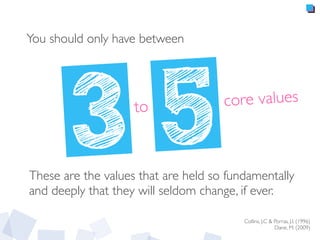
You should only have between
3	
  	
  5to
Collins, J.C & Porras, J.I. (1996)
Dane, M. (2009)
These are the values that are held so fundamentally
and deeply that they will seldom change, if ever.
core values
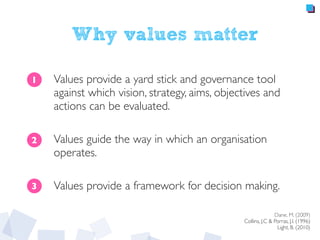
Why values matter
Values provide a yard stick and governance tool
against which vision, strategy, aims, objectives and
actions can be evaluated.
Values guide the way in which an organisation
operates.
Values provide a framework for decision making.
Dane, M. (2009)
Collins, J.C & Porras, J.I. (1996)
Light, B. (2010)
1
2
3
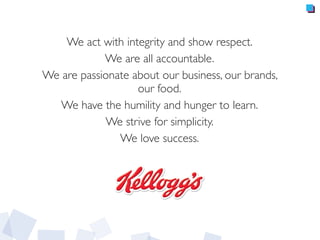
We act with integrity and show respect.
We are all accountable.
We are passionate about our business, our brands,
our food.
We have the humility and hunger to learn.
We strive for simplicity.
We love success.
Leadership. Ownership. Integrity.
Passion for winning.Trust.
Dependable and doing the right thing.
Open to different ideas and cultures.
Connected with our customers, communities,
regulators and each other.
Quality. Safety. Environmental Care.
Empowerment
Our approach means that everyone involved with Oxfam, from our staff and supporters to
people living in poverty, should feel they can make change happen.
Accountability
Our purpose-driven, results-focused approach means we take responsibility for our actions
and hold ourselves accountable. We believe that others should also be held accountable for
their actions.
Inclusiveness
We are open to everyone and embrace diversity. We believe everyone has a contribution to
make, regardless of visible and invisible differences.
Compassionate. Integrity. Responsible.
Fair and reasonable. Dynamic.
Respecting the unique worth of every person.
Encouraging people to fulfil their potential.
Working with hope.
Exercising responsible stewardship.
Compassionate. Courageous. Inclusive. Dynamic.
Exercise
Create a list of the potential values your organisation
might have—at this stage don’t worry about how many
values you write down. (You could also make a note of
any values your organisation definitely doesn’t hold).
Order and prioritise these values, with the most
important first. Group similar values together, then
consolidate and amalgamate as you go.
Look at the top 3-5 values for your organisation
individually: does each value pass the test overleaf?
1
2
3
Does each value pass the test?
If you were to start a new organisation, would you build it around this value
regardless of the sector?
Would you want your organisation to continue to stand for this core value 100
years into the future, no matter what changes occur in the outside world?
Would you want your organisation to hold this core value, even it at some
point in time it became a competitive or strategic disadvantage?
Do you believe that those who do not share this core value―those who
breach it consistently―simply do not belong in your organisation?
If you are truly honest, is this an authentic and timeless core value that you have
always held and will always hold or is it a value that you simply aspire to
achieve?
Collins, J.C. (2002)
Purpose
Purpose...
Is an organisation’s most fundamental reason for
being.
Captures the soul of the organisation.
Reflects people’s idealistic motivations for doing the
organisation’s work.
Is like a guiding star on the horizon—forever pursued
but never reached.
Collins, J.C. & Porras, J.I. (1996)
1
2
3
4
of an organisation’s
achievement.
Mourkogiannis, N. (2006)
PRIMARY SOURCE
Purpose is the
CORE ENERGY
Mourkogiannis, N. (2006)
Purpose is the
—the element that
fuels everything else,
big and small.
There are
4types of purpose
Mourkogiannis, N. (2006)
most likely to
engender success
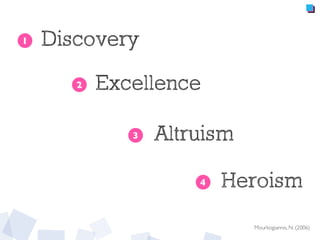
Heroism
Altruism
Excellence
Discovery
Mourkogiannis, N. (2006)
1
2
3
4
Discovery
Pursuit of the new and pursuit of advancement.
A love of innovation.
Life is an adventure.We are free to choose for
ourselves and should not be bound by
convention.
Ethics of choice, discovery, individuality, openness,
excitement, learning, quest, voyage, freedom.
Mourkogiannis, N. (2006)
Excellence
Pursuit of the intrinsically beautiful or elegant.
A belief that excellent performance in our role
in life represents the supreme good.
An ‘excellent’ business would prefer to turn
away customers than compromise its standards.
Ethics of virtue, quality, integrity, pride,
intelligence, citizenship, community, fulfilment.
Mourkogiannis, N. (2006)
Altruism
Pursuit of the helpful.
A desire to seek action that increases happiness.
Ethics of compassion, benevolence, empathy,
emotion, love, welfare, goodwill, well-being,
happiness.
Mourkogiannis, N. (2006)
Heroism
Pursuit of the effective.
A desire to seek action that demonstrates
achievement.
Ambition with an imperative to exercise
influence.
Ethics of power, self-mastery, authority, firmness,
efficiency, effectiveness, leadership, strength.
Mourkogiannis, N. (2006)
Making aspirational quality
accessible to all.
To organise the world’s information and make it
universally accessible and useful.
To bring inspiration and innovation to
every athlete* in the world.
*If you have a body, you are an athlete.
To make the best possible ice cream in
the best possible way.
To develop solid household products that retain
their beauty and performance for up to 20 years.
By all lawful means, to prevent cruelty, promote kindness
to and alleviate suffering of all animals.
To deliver an enduring national network of support
for our wounded and their families. We will inspire
and enable those who have made sacrifices on our
behalf to achieve their full potential.
To save lives at sea.
To beat cancer through research.
To drive change across society so that disabled people
have the same opportunities as
everyone else.
To transform lives by improving access to safe water,
improved hygiene and sanitation in the world’s poorest
communities.
Exercise
Briefly draft 3 different purpose statements for your
organisation. Don’t worry about getting it ‘right first
time’.
Note which purpose category each statement fits into.
Which is your preferred statement?
Share your preferred purpose with other people. Is it
thinking deep enough? Does your favored purpose pass
the test overleaf?
1
2
3
Does your purpose pass the test?
Do you find this purpose personally inspiring?
Can you envision this purpose being as valid 100 years from now as it is today?
Does the purpose help you think expansively about the long-term possibilities and range of
activities that your organisation can consider over the next 100 years, beyond your current
services, sectors and strategies?
Does the purpose help you decide what activities to not pursue, to eliminate from
consideration?
Is this purpose authentic―something true to what the organisation is all about―not merely
words on paper that ‘sound nice’?
Would this purpose be greeted with enthusiasm rather than cynicism by a broad base of
people within your organisation?
When telling your friends, family and loved ones what you do for a living, would you feel
proud in describing your work in terms of this purpose?
Collins, J.C. (2002)
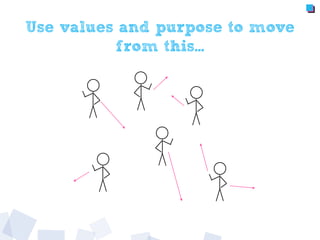
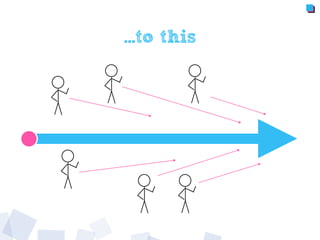
Use values and purpose to move
from this...
...to this
The process of getting there
Involve a wide range of people—giving others opportunity to
contribute creates engagement and ensures accurate insight.
Ask staff and stakeholders for their ideas on the organisation’s
values and purpose; include them in the creative process.
Collate these ideas, and with a small group that together
exemplifies your organisation, make decisions.
Finalise and publish the outcome in your marketing, corporate
communications, website and elsewhere to ensure consistent
messaging.
Live by these principles, make decisions by them.
1
2
3
4
5
If you need help understanding and communicating
your corporate values, purpose, vision or mission,
contact the Stocker Partnership and get started today!
+44 (0)24 76 100 193
hello@stockerpartnership.com
STOCKER
PARTNERSHIP
The Stocker Partnership
is a strategic innovation
consultancy
We help organisations to
create and exploit new
opportunities
024 76 100 193
hello@stockerpartnership.com
Matt Stocker
Debbie Stocker
www.stockerpartnership.com
Follow us on LinkedIn
Subscribe to our blog
Sign up to our newsletter
WE’RE NOT
BUT WE ARE
CLEVER
BIG
@mattstocker
@debbiestocker
Illustrations by Stina Jones (stinajones.co.uk), and Matt Stocker

How to create corporate values and purpose

  • 1.
    VALUES & PURPOSE Howto create corporate For organisations, businesses and charities Real world examples and practical exercises Includes
  • 2.
  • 3.
    Core values are... Theessential and enduring tenets of an organisation. The central beliefs of an organisation—the principles by which an organisation lives and breathes. Those you would keep no matter how the world around you changed. Collins, J.C & Porras, J.I. (1996) Dane, M. (2009) 1 2 3
  • 4.
    You should onlyhave between 3    5to Collins, J.C & Porras, J.I. (1996) Dane, M. (2009) These are the values that are held so fundamentally and deeply that they will seldom change, if ever. core values
  • 5.
    Why values matter Valuesprovide a yard stick and governance tool against which vision, strategy, aims, objectives and actions can be evaluated. Values guide the way in which an organisation operates. Values provide a framework for decision making. Dane, M. (2009) Collins, J.C & Porras, J.I. (1996) Light, B. (2010) 1 2 3
  • 6.
    We act withintegrity and show respect. We are all accountable. We are passionate about our business, our brands, our food. We have the humility and hunger to learn. We strive for simplicity. We love success.
  • 7.
  • 8.
    Dependable and doingthe right thing. Open to different ideas and cultures. Connected with our customers, communities, regulators and each other.
  • 9.
  • 10.
    Empowerment Our approach meansthat everyone involved with Oxfam, from our staff and supporters to people living in poverty, should feel they can make change happen. Accountability Our purpose-driven, results-focused approach means we take responsibility for our actions and hold ourselves accountable. We believe that others should also be held accountable for their actions. Inclusiveness We are open to everyone and embrace diversity. We believe everyone has a contribution to make, regardless of visible and invisible differences.
  • 11.
  • 12.
    Respecting the uniqueworth of every person. Encouraging people to fulfil their potential. Working with hope. Exercising responsible stewardship.
  • 13.
  • 14.
    Exercise Create a listof the potential values your organisation might have—at this stage don’t worry about how many values you write down. (You could also make a note of any values your organisation definitely doesn’t hold). Order and prioritise these values, with the most important first. Group similar values together, then consolidate and amalgamate as you go. Look at the top 3-5 values for your organisation individually: does each value pass the test overleaf? 1 2 3
  • 15.
    Does each valuepass the test? If you were to start a new organisation, would you build it around this value regardless of the sector? Would you want your organisation to continue to stand for this core value 100 years into the future, no matter what changes occur in the outside world? Would you want your organisation to hold this core value, even it at some point in time it became a competitive or strategic disadvantage? Do you believe that those who do not share this core value―those who breach it consistently―simply do not belong in your organisation? If you are truly honest, is this an authentic and timeless core value that you have always held and will always hold or is it a value that you simply aspire to achieve? Collins, J.C. (2002)
  • 16.
  • 17.
    Purpose... Is an organisation’smost fundamental reason for being. Captures the soul of the organisation. Reflects people’s idealistic motivations for doing the organisation’s work. Is like a guiding star on the horizon—forever pursued but never reached. Collins, J.C. & Porras, J.I. (1996) 1 2 3 4
  • 18.
    of an organisation’s achievement. Mourkogiannis,N. (2006) PRIMARY SOURCE Purpose is the
  • 19.
    CORE ENERGY Mourkogiannis, N.(2006) Purpose is the —the element that fuels everything else, big and small.
  • 20.
    There are 4types ofpurpose Mourkogiannis, N. (2006) most likely to engender success
  • 21.
  • 22.
    Discovery Pursuit of thenew and pursuit of advancement. A love of innovation. Life is an adventure.We are free to choose for ourselves and should not be bound by convention. Ethics of choice, discovery, individuality, openness, excitement, learning, quest, voyage, freedom. Mourkogiannis, N. (2006)
  • 23.
    Excellence Pursuit of theintrinsically beautiful or elegant. A belief that excellent performance in our role in life represents the supreme good. An ‘excellent’ business would prefer to turn away customers than compromise its standards. Ethics of virtue, quality, integrity, pride, intelligence, citizenship, community, fulfilment. Mourkogiannis, N. (2006)
  • 24.
    Altruism Pursuit of thehelpful. A desire to seek action that increases happiness. Ethics of compassion, benevolence, empathy, emotion, love, welfare, goodwill, well-being, happiness. Mourkogiannis, N. (2006)
  • 25.
    Heroism Pursuit of theeffective. A desire to seek action that demonstrates achievement. Ambition with an imperative to exercise influence. Ethics of power, self-mastery, authority, firmness, efficiency, effectiveness, leadership, strength. Mourkogiannis, N. (2006)
  • 26.
  • 27.
    To organise theworld’s information and make it universally accessible and useful.
  • 28.
    To bring inspirationand innovation to every athlete* in the world. *If you have a body, you are an athlete.
  • 29.
    To make thebest possible ice cream in the best possible way.
  • 30.
    To develop solidhousehold products that retain their beauty and performance for up to 20 years.
  • 31.
    By all lawfulmeans, to prevent cruelty, promote kindness to and alleviate suffering of all animals.
  • 32.
    To deliver anenduring national network of support for our wounded and their families. We will inspire and enable those who have made sacrifices on our behalf to achieve their full potential.
  • 33.
  • 34.
    To beat cancerthrough research.
  • 35.
    To drive changeacross society so that disabled people have the same opportunities as everyone else.
  • 36.
    To transform livesby improving access to safe water, improved hygiene and sanitation in the world’s poorest communities.
  • 37.
    Exercise Briefly draft 3different purpose statements for your organisation. Don’t worry about getting it ‘right first time’. Note which purpose category each statement fits into. Which is your preferred statement? Share your preferred purpose with other people. Is it thinking deep enough? Does your favored purpose pass the test overleaf? 1 2 3
  • 38.
    Does your purposepass the test? Do you find this purpose personally inspiring? Can you envision this purpose being as valid 100 years from now as it is today? Does the purpose help you think expansively about the long-term possibilities and range of activities that your organisation can consider over the next 100 years, beyond your current services, sectors and strategies? Does the purpose help you decide what activities to not pursue, to eliminate from consideration? Is this purpose authentic―something true to what the organisation is all about―not merely words on paper that ‘sound nice’? Would this purpose be greeted with enthusiasm rather than cynicism by a broad base of people within your organisation? When telling your friends, family and loved ones what you do for a living, would you feel proud in describing your work in terms of this purpose? Collins, J.C. (2002)
  • 39.
    Use values andpurpose to move from this...
  • 40.
  • 41.
    The process ofgetting there Involve a wide range of people—giving others opportunity to contribute creates engagement and ensures accurate insight. Ask staff and stakeholders for their ideas on the organisation’s values and purpose; include them in the creative process. Collate these ideas, and with a small group that together exemplifies your organisation, make decisions. Finalise and publish the outcome in your marketing, corporate communications, website and elsewhere to ensure consistent messaging. Live by these principles, make decisions by them. 1 2 3 4 5
  • 42.
    If you needhelp understanding and communicating your corporate values, purpose, vision or mission, contact the Stocker Partnership and get started today! +44 (0)24 76 100 193 hello@stockerpartnership.com
  • 43.
    STOCKER PARTNERSHIP The Stocker Partnership isa strategic innovation consultancy We help organisations to create and exploit new opportunities 024 76 100 193 hello@stockerpartnership.com Matt Stocker Debbie Stocker www.stockerpartnership.com Follow us on LinkedIn Subscribe to our blog Sign up to our newsletter WE’RE NOT BUT WE ARE CLEVER BIG @mattstocker @debbiestocker Illustrations by Stina Jones (stinajones.co.uk), and Matt Stocker