ACIDBASE&SALT
CHAPTER 2
CHEMISTRY
PRESENTATION
How we can know Acid & Base
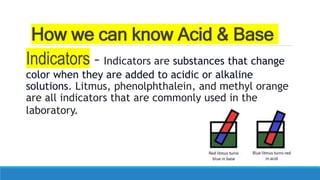
Indicators - Indicators are substances that change
color when they are added to acidic or alkaline
solutions. Litmus, phenolphthalein, and methyl orange
are all indicators that are commonly used in the
laboratory.
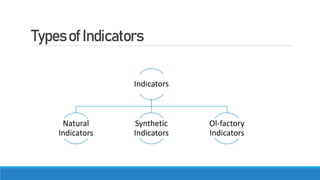
TypesofIndicators
Indicators
Natural
Indicators
Synthetic
Indicators
Ol-factory
Indicators
NaturalIndicators
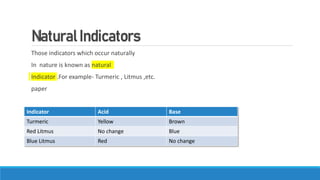
Those indicators which occur naturally
In nature is known as natural
Indicator .For example- Turmeric , Litmus ,etc.
paper
Indicator Acid Base
Turmeric Yellow Brown
Red Litmus No change Blue
Blue Litmus Red No change
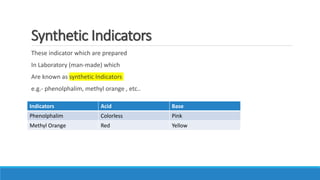
Synthetic Indicators
These indicator which are prepared
In Laboratory (man-made) which
Are known as synthetic Indicators
e.g.- phenolphalim, methyl orange , etc..
Indicators Acid Base
Phenolphalim Colorless Pink
Methyl Orange Red Yellow
OL-Factory Indicator
Those substances which change their
Oduor in acid & Base is known as
OL-Factory Indicator
E.g..-Onion, Vanilla, etc.
Indicator Acid Base
Onion Characteristics smell No smell
Vanilla Characteristics smell No smell
WhatareAcids
Acids
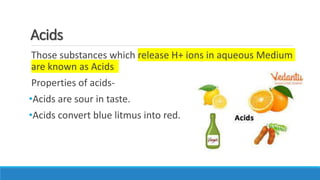
Those substances which release H+ ions in aqueous Medium
are known as Acids
Properties of acids-
•Acids are sour in taste.
•Acids convert blue litmus into red.
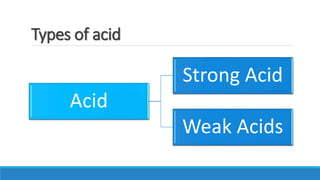
Types of acid
Acid
Strong Acid
Weak Acids
Strongacid
These acid which are complete dissociates completely in
aqueous medium are called strong acid .
For example : HCL , H2so4 and HNo3
WeakAcids
Those acids which is partially dissociate in aqueous medium
are known as Weak acids.
E.g. – H2so3 ,(Carbonic acid) , (H3CooH)(acetic acid)
carbonic acid used in cold drink
 while acetic acid used in
Vinegar
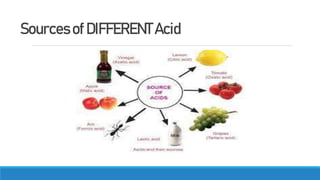
SourcesofDIFFERENTAcid
Base
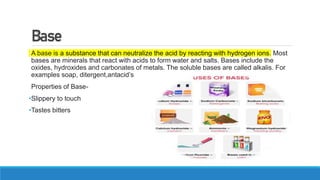
A base is a substance that can neutralize the acid by reacting with hydrogen ions. Most
bases are minerals that react with acids to form water and salts. Bases include the
oxides, hydroxides and carbonates of metals. The soluble bases are called alkalis. For
examples soap, ditergent,antacid’s
Properties of Base-
•Slippery to touch
•Tastes bitters
ChemicalReactionofacid&base
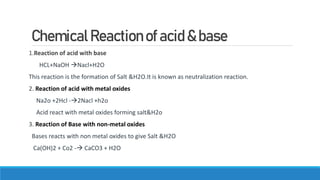
1.Reaction of acid with base
HCL+NaOH Nacl+H2O
This reaction is the formation of Salt &H2O.It is known as neutralization reaction.
2. Reaction of acid with metal oxides
Na2o +2Hcl -2Nacl +h2o
Acid react with metal oxides forming salt&H2o
3. Reaction of Base with non-metal oxides
Bases reacts with non metal oxides to give Salt &H2O
Ca(OH)2 + Co2 - CaCO3 + H2O
What is pH (“Potential of Hydrogen”)
pH is a measure of how acidic/basic water is. The range goes
from 0 - 14, with 7 being neutral. pHs of less than 7 indicate
acidity, whereas a pH of greater than 7 indicates a base. pH is
really a measure of the relative amount of free hydrogen and
hydroxyl ions in the water.
The various applications of pH in daily life
are:
•In the human body, all the physiological reactions take place at the pH of 7-7.8. pH is
very important for our digestive system.
•The pH of the soil is an important factor in the growth of crops and other plants. The
ideal pH for the growth of shrubs and crops ranges from 6.5 to 7.3
•When the pH of the mouth falls below 5.5. Our tooth starts decaying.
•The acidic effect of honeybees bite can be cured by using a base such as baking soda.
When a honeybee bites, it inserts an acidic substance into our body. To get relief from it,
an aqueous solution of a basic substance such as baking soda is applied around the
place of the bite. It helps to neutralize the acidic poison.
•In the stomach, hydrochloric acid is secreted as food enters the stomach. It turns the pH
of the stomach between 1 and 3.
Salts
Salt is an ionic compound that has a cation other than H+ and an anion other than OH–
and is obtained along with water in the neutralization reaction between acids and bases.
E.g.:- NaCl, CuCl2 etc. Sodium chloride is one of the best-known salt.
Salt is produce through neutralization reaction
Acid+BaseSalt+H2O
Types Of Salts
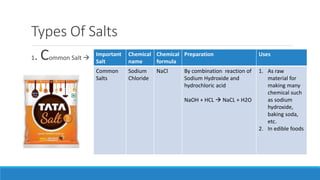
1. Common Salt 
Important
Salt
Chemical
name
Chemical
formula
Preparation Uses
Common
Salts
Sodium
Chloride
NaCl By combination reaction of
Sodium Hydroxide and
hydrochloric acid
NaOH + HCL  NaCL + H2O
1. As raw
material for
making many
chemical such
as sodium
hydroxide,
baking soda,
etc.
2. In edible foods
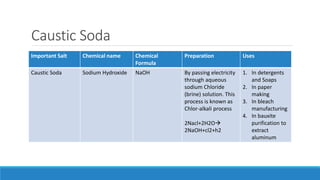
Caustic Soda
Important Salt Chemical name Chemical
Formula
Preparation Uses
Caustic Soda Sodium Hydroxide NaOH By passing electricity
through aqueous
sodium Chloride
(brine) solution. This
process is known as
Chlor-alkali process
2Nacl+2H2O
2NaOH+cl2+h2
1. In detergents
and Soaps
2. In paper
making
3. In bleach
manufacturing
4. In bauxite
purification to
extract
aluminum
Baking Soda
Important Salt Chemical name Chemical
Formula
Preparation Uses
Baking Soda Sodium Hydrogen
Carbonate /
Sodium
Bicarbonate
NaHco3 On reacting cold concentrated
sodium chloride (brine) solution
with ammonia and carbon
dioxide
NaCl+NH3+Co2+H2o  NaHCO3
+NH4cl
i. Preparation of
baking soda
ii. As an antacid
in medicine
iii. In soda ash
fire
extinguisher
Washing Soda
1. Important
Salt
1. Chemical
name
1. Chemical
Formula
1. Preparation 1. Uses
1. Washing
Soda
1. Sodium
Carbonate
Decahydrate
1. Na2Co3.10
H2o
1. By recrystallisation of
sodium carbonate in
water
2. Na2Co3+10h2oNa2Co
3.10h2o
1. In glass ,soap
and paper
industry
2. Cleaning agent
for domestic
purposes
3. Softening hard
water
Bleaching Powder
Important
Salts
Chemical Name Chemical
Formula
preparation Uses
Bleaching
Powder
Calcium
Oxychloride
CaOCl2 By passing chlorine gas over
dry slaked lime[Ca(OH2)]
Ca(Oh)2 +Cl2  CaOCl2
+H2O
I. For bleaching cotton
and linen for
bleaching wood pulp
in paper factories
and for bleaching
washed clothes in
laundry textile.
II. For disinfecting
drinking water
Plaster of Paris
Important Salt Chemical Name Chemical Formula Preparation Uses
Plaster of Paris Calcium Sulphate
Hemihydrate
CaSo4 ½ H20 By heating Gypsum
at 373K
CaSo4.2H2O
Caso4 ½
H2o +1 ½
H2O
I. For making
caste of
statues,model,
toys etc.
II. For making
fireproof
materials
III. For setting
Fracture Bones
Thank You ! 
PRESENTED BY 
MANAS RANJAN
KARTIK BHARDWAJ
HARI OM CHAUHAN
YOGESH

ACID BASE & SALT.pptx

  • 1.
  • 2.
    How we canknow Acid & Base Indicators - Indicators are substances that change color when they are added to acidic or alkaline solutions. Litmus, phenolphthalein, and methyl orange are all indicators that are commonly used in the laboratory.
  • 3.
  • 4.
    NaturalIndicators Those indicators whichoccur naturally In nature is known as natural Indicator .For example- Turmeric , Litmus ,etc. paper Indicator Acid Base Turmeric Yellow Brown Red Litmus No change Blue Blue Litmus Red No change
  • 5.
    Synthetic Indicators These indicatorwhich are prepared In Laboratory (man-made) which Are known as synthetic Indicators e.g.- phenolphalim, methyl orange , etc.. Indicators Acid Base Phenolphalim Colorless Pink Methyl Orange Red Yellow
  • 6.
    OL-Factory Indicator Those substanceswhich change their Oduor in acid & Base is known as OL-Factory Indicator E.g..-Onion, Vanilla, etc. Indicator Acid Base Onion Characteristics smell No smell Vanilla Characteristics smell No smell
  • 7.
  • 8.
    Acids Those substances whichrelease H+ ions in aqueous Medium are known as Acids Properties of acids- •Acids are sour in taste. •Acids convert blue litmus into red.
  • 9.
  • 10.
    Strongacid These acid whichare complete dissociates completely in aqueous medium are called strong acid . For example : HCL , H2so4 and HNo3
  • 11.
    WeakAcids Those acids whichis partially dissociate in aqueous medium are known as Weak acids. E.g. – H2so3 ,(Carbonic acid) , (H3CooH)(acetic acid) carbonic acid used in cold drink  while acetic acid used in Vinegar
  • 12.
  • 13.
    Base A base isa substance that can neutralize the acid by reacting with hydrogen ions. Most bases are minerals that react with acids to form water and salts. Bases include the oxides, hydroxides and carbonates of metals. The soluble bases are called alkalis. For examples soap, ditergent,antacid’s Properties of Base- •Slippery to touch •Tastes bitters
  • 14.
    ChemicalReactionofacid&base 1.Reaction of acidwith base HCL+NaOH Nacl+H2O This reaction is the formation of Salt &H2O.It is known as neutralization reaction. 2. Reaction of acid with metal oxides Na2o +2Hcl -2Nacl +h2o Acid react with metal oxides forming salt&H2o 3. Reaction of Base with non-metal oxides Bases reacts with non metal oxides to give Salt &H2O Ca(OH)2 + Co2 - CaCO3 + H2O
  • 15.
    What is pH(“Potential of Hydrogen”) pH is a measure of how acidic/basic water is. The range goes from 0 - 14, with 7 being neutral. pHs of less than 7 indicate acidity, whereas a pH of greater than 7 indicates a base. pH is really a measure of the relative amount of free hydrogen and hydroxyl ions in the water.
  • 16.
    The various applicationsof pH in daily life are: •In the human body, all the physiological reactions take place at the pH of 7-7.8. pH is very important for our digestive system. •The pH of the soil is an important factor in the growth of crops and other plants. The ideal pH for the growth of shrubs and crops ranges from 6.5 to 7.3 •When the pH of the mouth falls below 5.5. Our tooth starts decaying. •The acidic effect of honeybees bite can be cured by using a base such as baking soda. When a honeybee bites, it inserts an acidic substance into our body. To get relief from it, an aqueous solution of a basic substance such as baking soda is applied around the place of the bite. It helps to neutralize the acidic poison. •In the stomach, hydrochloric acid is secreted as food enters the stomach. It turns the pH of the stomach between 1 and 3.
  • 17.
    Salts Salt is anionic compound that has a cation other than H+ and an anion other than OH– and is obtained along with water in the neutralization reaction between acids and bases. E.g.:- NaCl, CuCl2 etc. Sodium chloride is one of the best-known salt. Salt is produce through neutralization reaction Acid+BaseSalt+H2O
  • 18.
    Types Of Salts 1.Common Salt  Important Salt Chemical name Chemical formula Preparation Uses Common Salts Sodium Chloride NaCl By combination reaction of Sodium Hydroxide and hydrochloric acid NaOH + HCL  NaCL + H2O 1. As raw material for making many chemical such as sodium hydroxide, baking soda, etc. 2. In edible foods
  • 19.
    Caustic Soda Important SaltChemical name Chemical Formula Preparation Uses Caustic Soda Sodium Hydroxide NaOH By passing electricity through aqueous sodium Chloride (brine) solution. This process is known as Chlor-alkali process 2Nacl+2H2O 2NaOH+cl2+h2 1. In detergents and Soaps 2. In paper making 3. In bleach manufacturing 4. In bauxite purification to extract aluminum
  • 20.
    Baking Soda Important SaltChemical name Chemical Formula Preparation Uses Baking Soda Sodium Hydrogen Carbonate / Sodium Bicarbonate NaHco3 On reacting cold concentrated sodium chloride (brine) solution with ammonia and carbon dioxide NaCl+NH3+Co2+H2o  NaHCO3 +NH4cl i. Preparation of baking soda ii. As an antacid in medicine iii. In soda ash fire extinguisher
  • 21.
    Washing Soda 1. Important Salt 1.Chemical name 1. Chemical Formula 1. Preparation 1. Uses 1. Washing Soda 1. Sodium Carbonate Decahydrate 1. Na2Co3.10 H2o 1. By recrystallisation of sodium carbonate in water 2. Na2Co3+10h2oNa2Co 3.10h2o 1. In glass ,soap and paper industry 2. Cleaning agent for domestic purposes 3. Softening hard water
  • 22.
    Bleaching Powder Important Salts Chemical NameChemical Formula preparation Uses Bleaching Powder Calcium Oxychloride CaOCl2 By passing chlorine gas over dry slaked lime[Ca(OH2)] Ca(Oh)2 +Cl2  CaOCl2 +H2O I. For bleaching cotton and linen for bleaching wood pulp in paper factories and for bleaching washed clothes in laundry textile. II. For disinfecting drinking water
  • 23.
    Plaster of Paris ImportantSalt Chemical Name Chemical Formula Preparation Uses Plaster of Paris Calcium Sulphate Hemihydrate CaSo4 ½ H20 By heating Gypsum at 373K CaSo4.2H2O Caso4 ½ H2o +1 ½ H2O I. For making caste of statues,model, toys etc. II. For making fireproof materials III. For setting Fracture Bones
  • 24.
    Thank You ! PRESENTED BY  MANAS RANJAN KARTIK BHARDWAJ HARI OM CHAUHAN YOGESH