© Boardworks Ltd 2004
1 of 20 © Boardworks Ltd 2004
1 of 34
KS3 Chemistry
7E Acids and Alkalis
© Boardworks Ltd 2004
1 of 20 © Boardworks Ltd 2004
2 of 34
Contents
7E Acids and Alkalis
Neutralization
Summary activities
What are acids and alkalis?
Indicators and the pH scale
Hazard symbols
© Boardworks Ltd 2004
1 of 20 © Boardworks Ltd 2004
3 of 34
What is an acid?
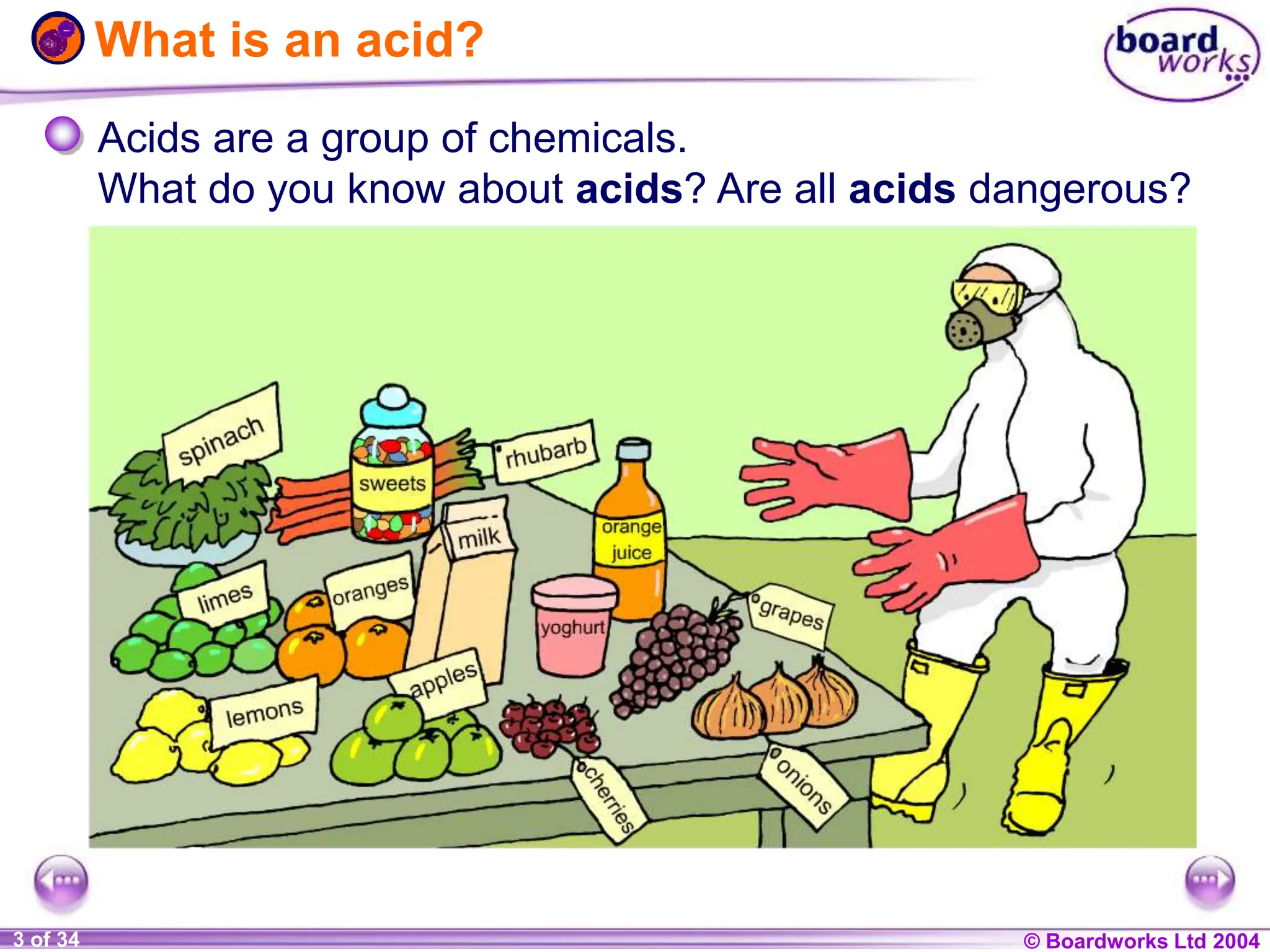
Acids are a group of chemicals.
What do you know about acids? Are all acids dangerous?
© Boardworks Ltd 2004
1 of 20 © Boardworks Ltd 2004
4 of 34
What is an acid?
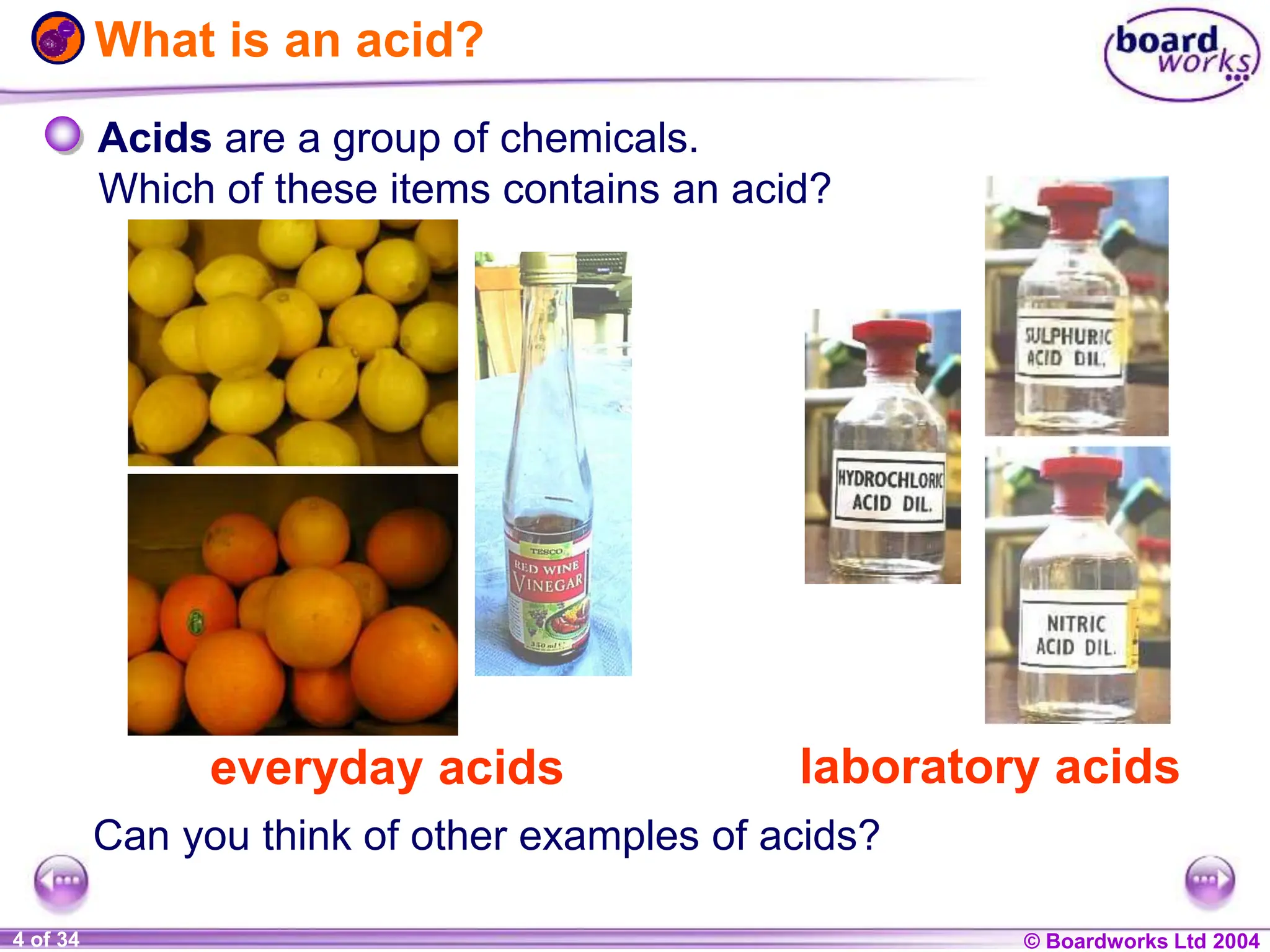
everyday acids laboratory acids
Acids are a group of chemicals.
Can you think of other examples of acids?
Which of these items contains an acid?
© Boardworks Ltd 2004
1 of 20 © Boardworks Ltd 2004
5 of 34
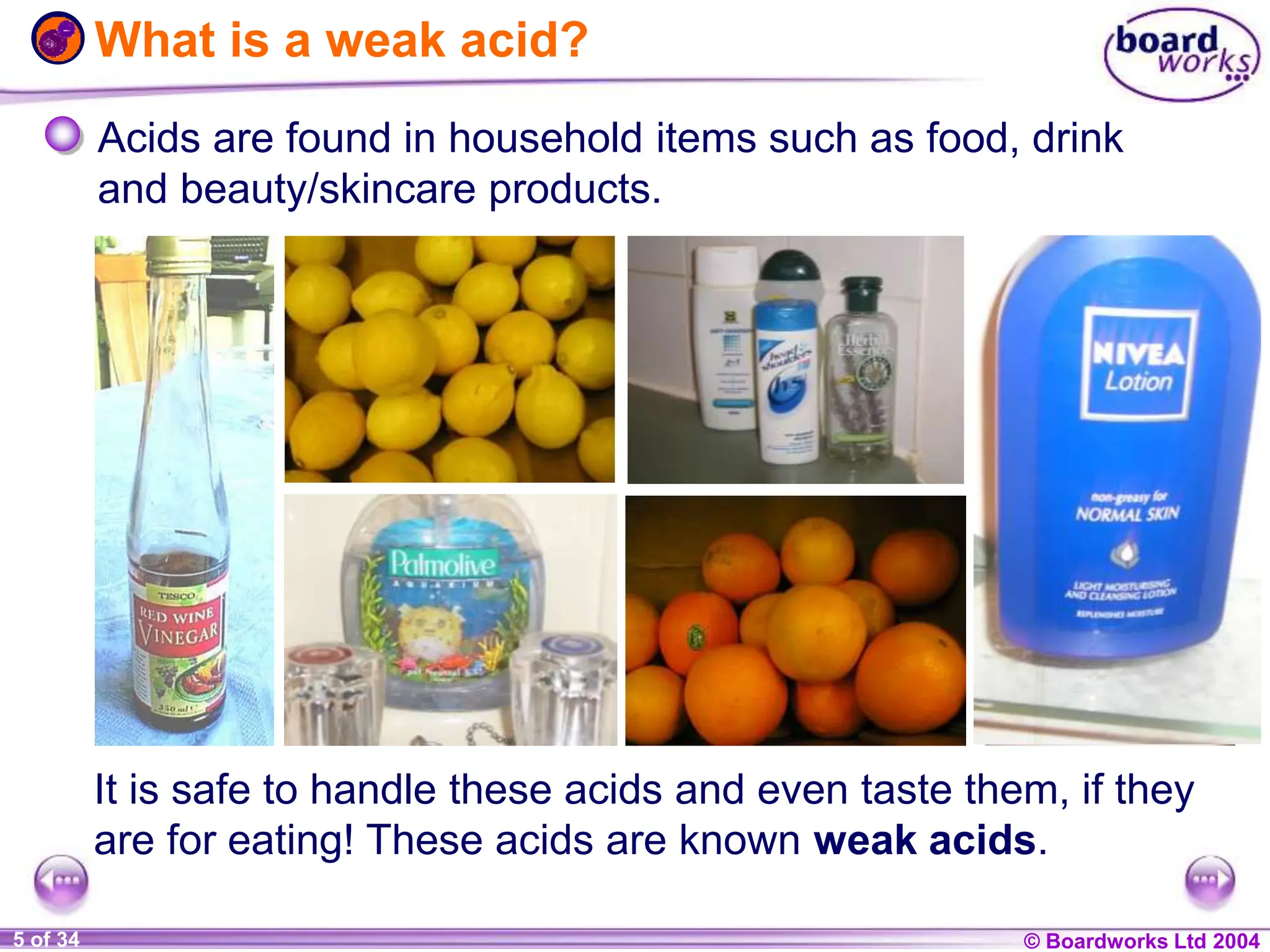
What is a weak acid?
Acids are found in household items such as food, drink
and beauty/skincare products.
It is safe to handle these acids and even taste them, if they
are for eating! These acids are known weak acids.
© Boardworks Ltd 2004
1 of 20 © Boardworks Ltd 2004
6 of 34
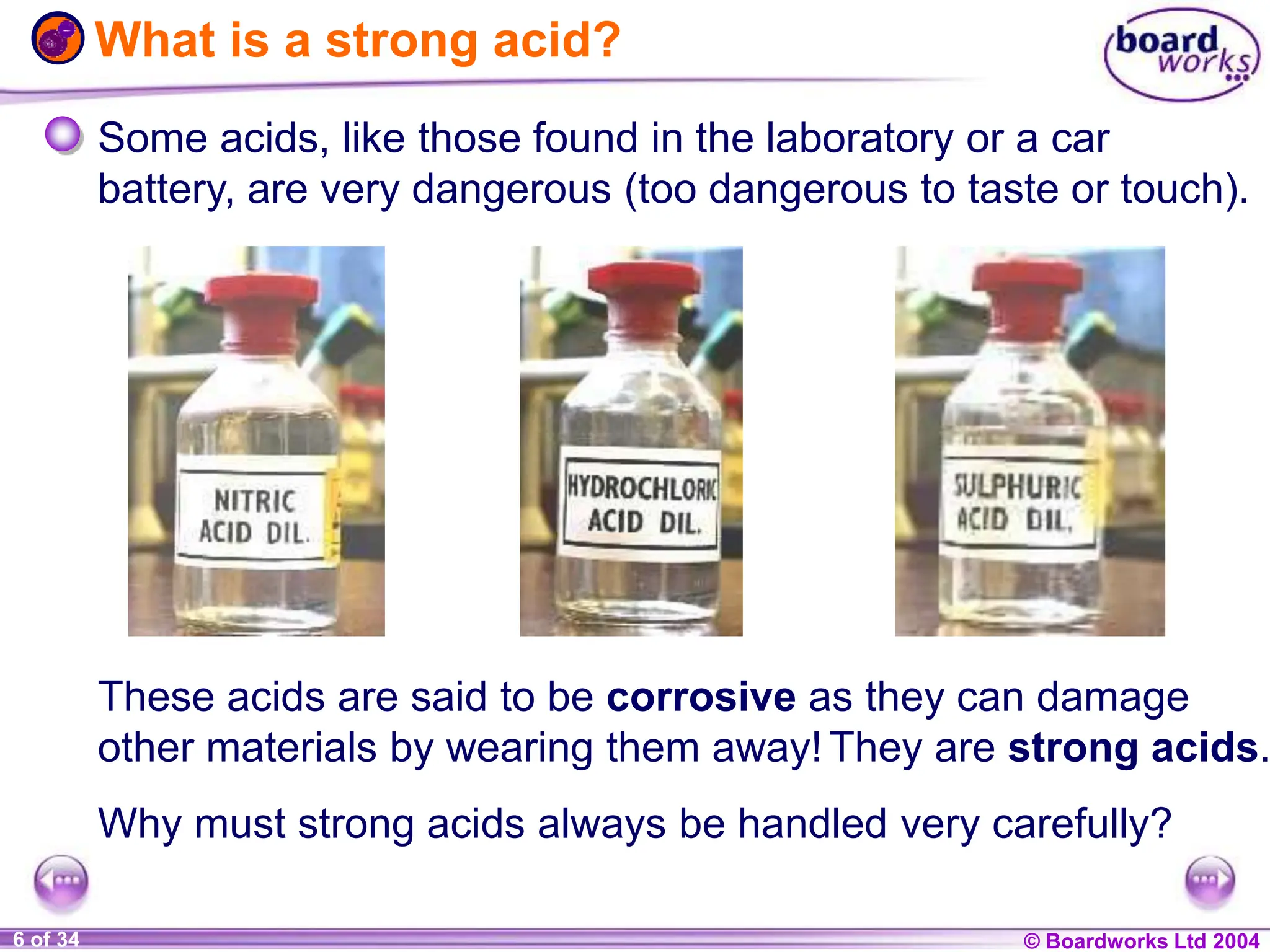
What is a strong acid?
Some acids, like those found in the laboratory or a car
battery, are very dangerous (too dangerous to taste or touch).
These acids are said to be corrosive as they can damage
other materials by wearing them away!They are strong acids.
Why must strong acids always be handled very carefully?
© Boardworks Ltd 2004
1 of 20 © Boardworks Ltd 2004
7 of 34
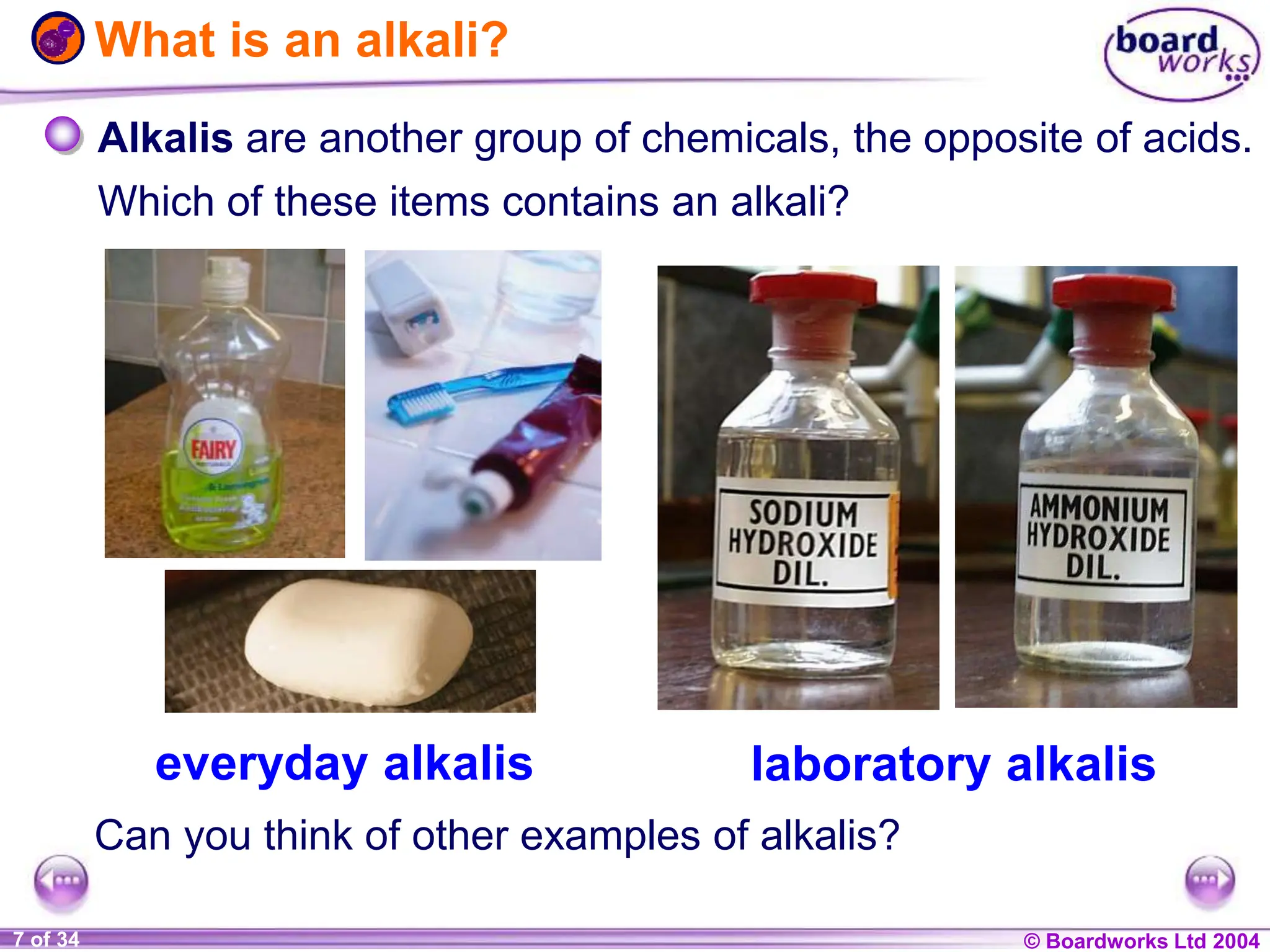
What is an alkali?
everyday alkalis laboratory alkalis
Alkalis are another group of chemicals, the opposite of acids.
Which of these items contains an alkali?
Can you think of other examples of alkalis?
© Boardworks Ltd 2004
1 of 20 © Boardworks Ltd 2004
8 of 34
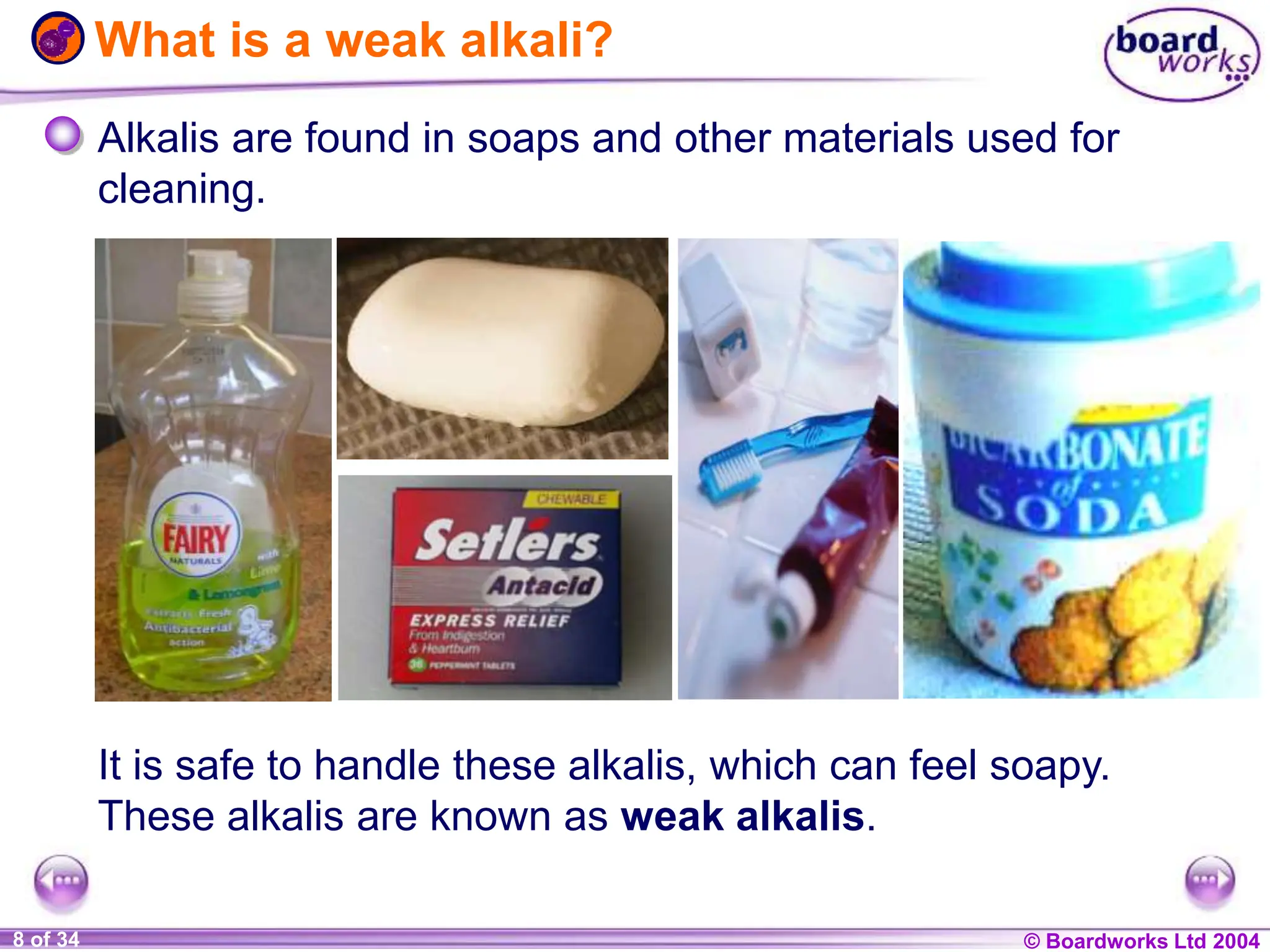
What is a weak alkali?
Alkalis are found in soaps and other materials used for
cleaning.
It is safe to handle these alkalis, which can feel soapy.
These alkalis are known as weak alkalis.
© Boardworks Ltd 2004
1 of 20 © Boardworks Ltd 2004
9 of 34
What is a strong alkali?
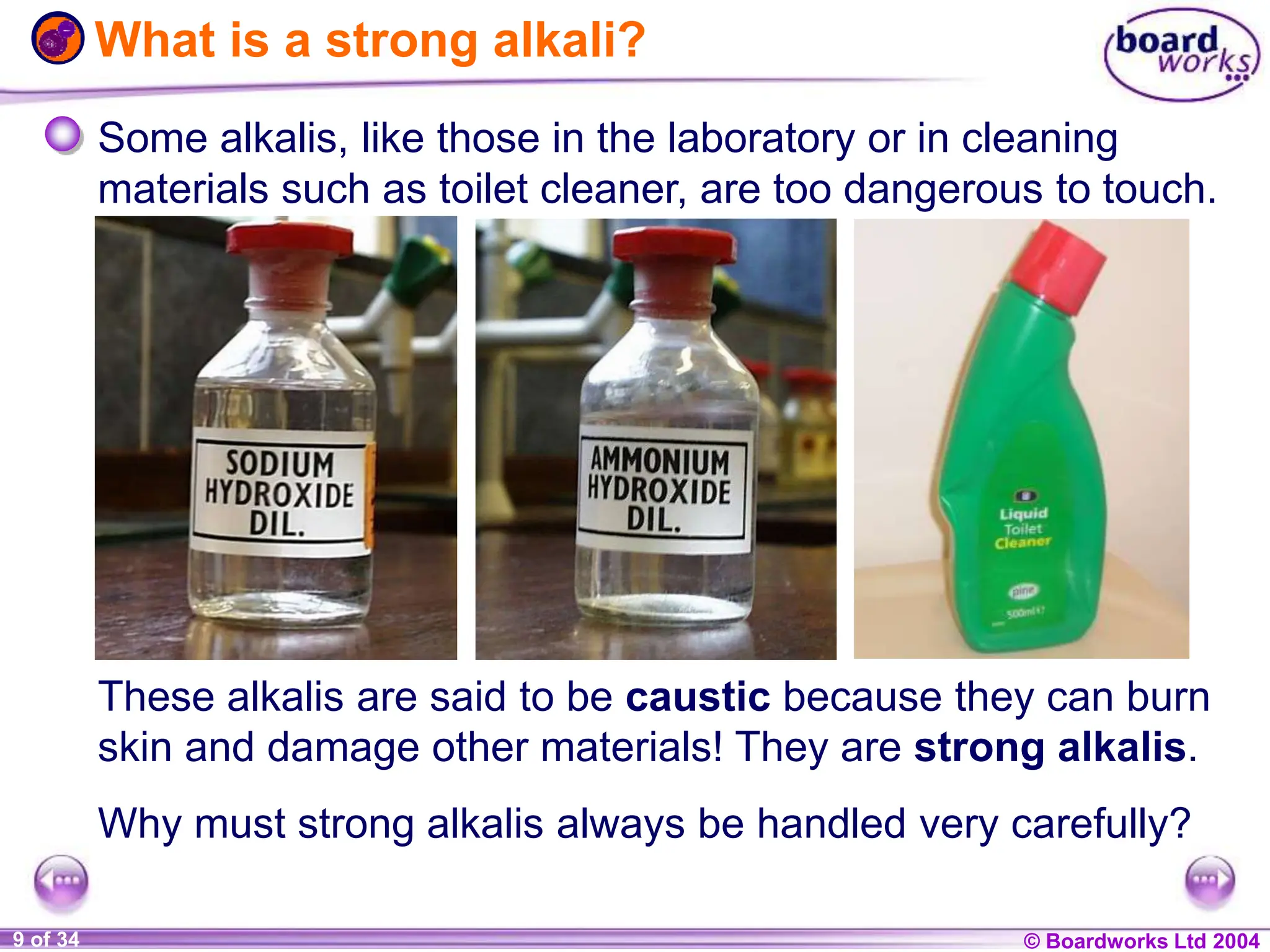
Some alkalis, like those in the laboratory or in cleaning
materials such as toilet cleaner, are too dangerous to touch.
These alkalis are said to be caustic because they can burn
skin and damage other materials! They are strong alkalis.
Why must strong alkalis always be handled very carefully?
© Boardworks Ltd 2004
1 of 20 © Boardworks Ltd 2004
10 of 34
Contents
7E Acids and Alkalis
Neutralization
Summary activities
What are acids and alkalis?
Indicators and the pH scale
Hazard symbols
© Boardworks Ltd 2004
1 of 20 © Boardworks Ltd 2004
11 of 34
How can you tell which chemicals are safe and which are
dangerous?
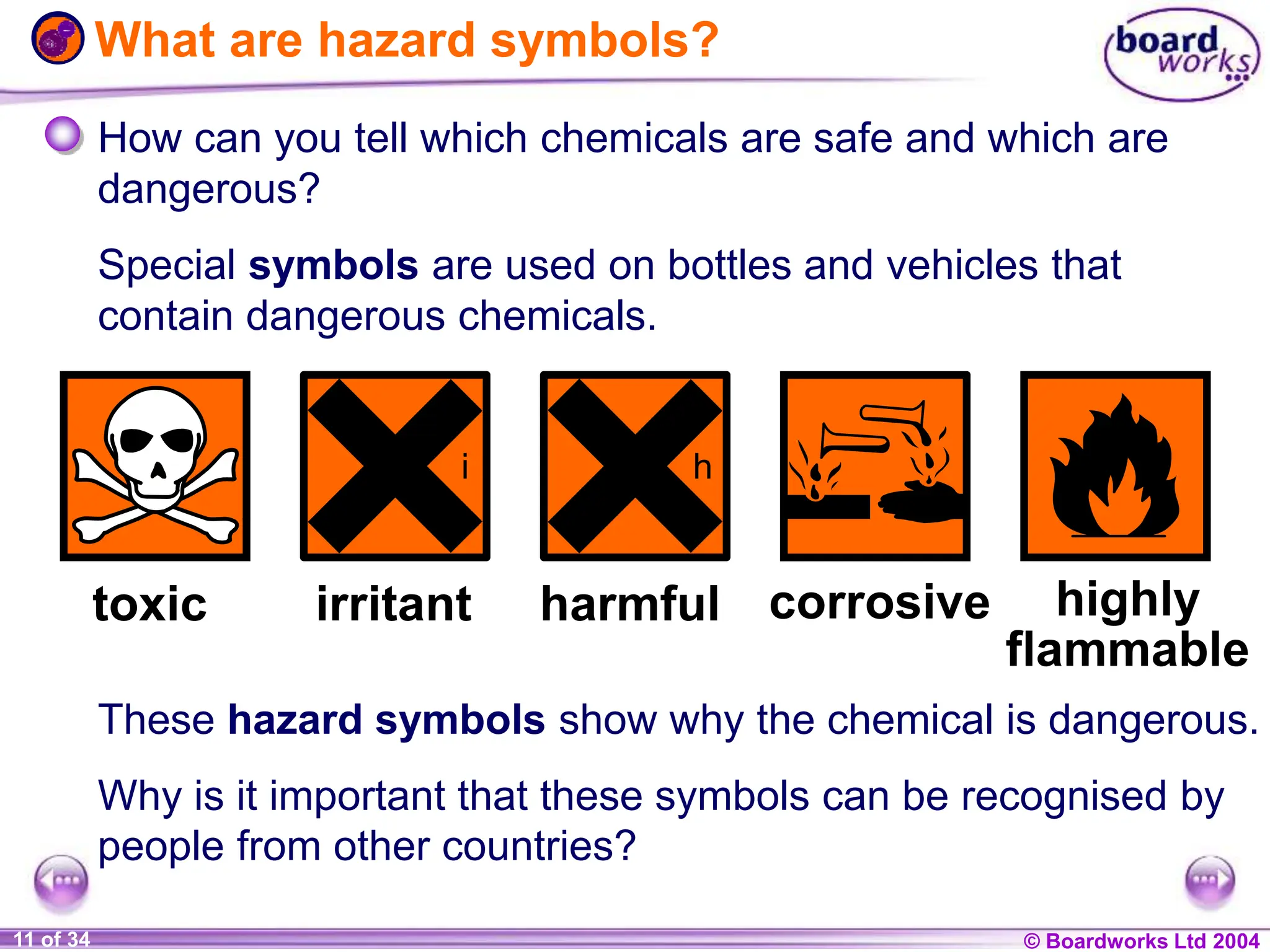
Special symbols are used on bottles and vehicles that
contain dangerous chemicals.
What are hazard symbols?
corrosive
harmful
irritant
toxic
These hazard symbols show why the chemical is dangerous.
Why is it important that these symbols can be recognised by
i h
highly
flammable
people from other countries?
© Boardworks Ltd 2004
1 of 20 © Boardworks Ltd 2004
12 of 34
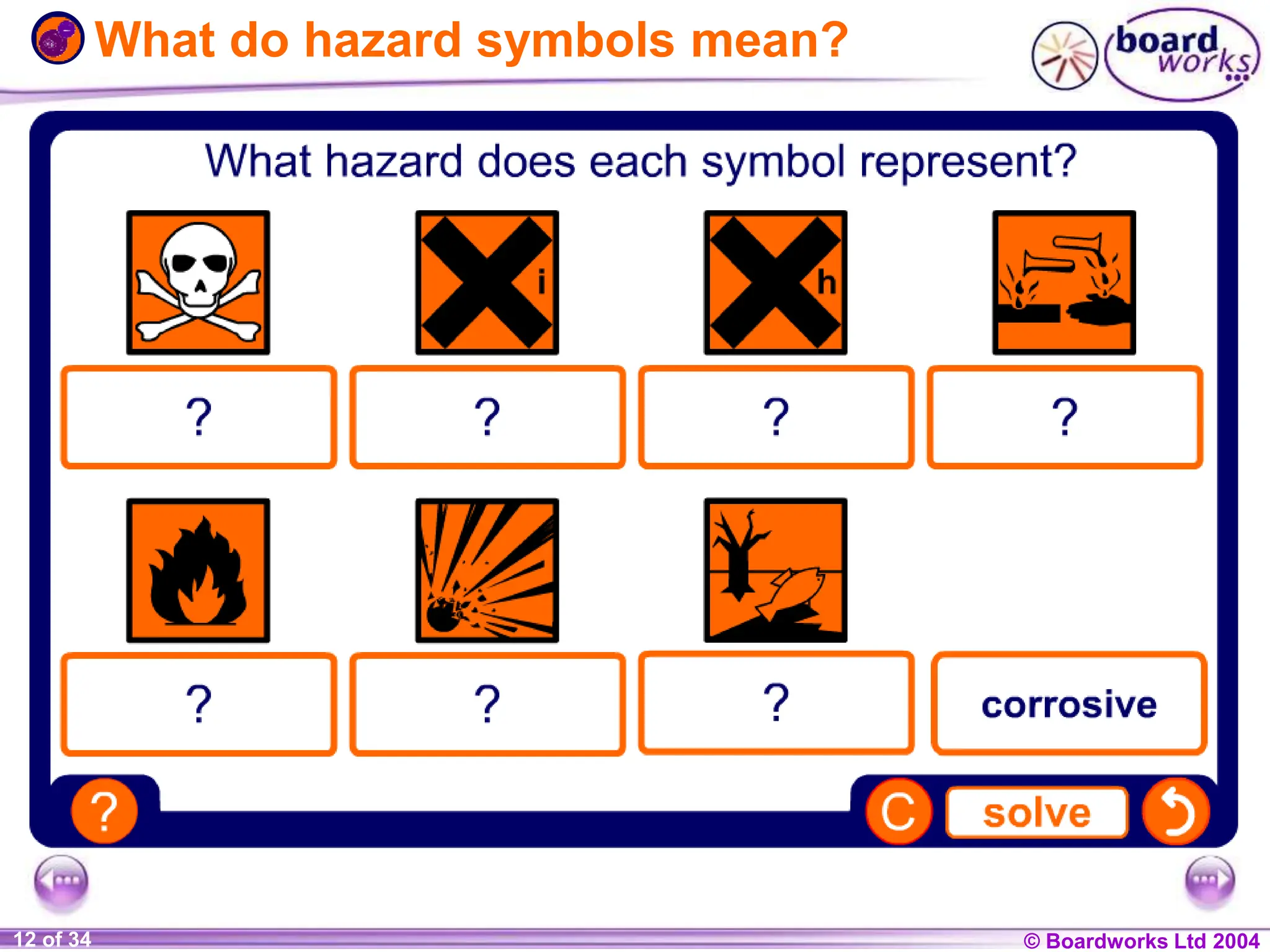
What do hazard symbols mean?
© Boardworks Ltd 2004
1 of 20 © Boardworks Ltd 2004
13 of 34
Contents
7E Acids and Alkalis
Neutralization
Summary activities
What are acids and alkalis?
Indicators and the pH scale
Hazard symbols
© Boardworks Ltd 2004
1 of 20 © Boardworks Ltd 2004
14 of 34
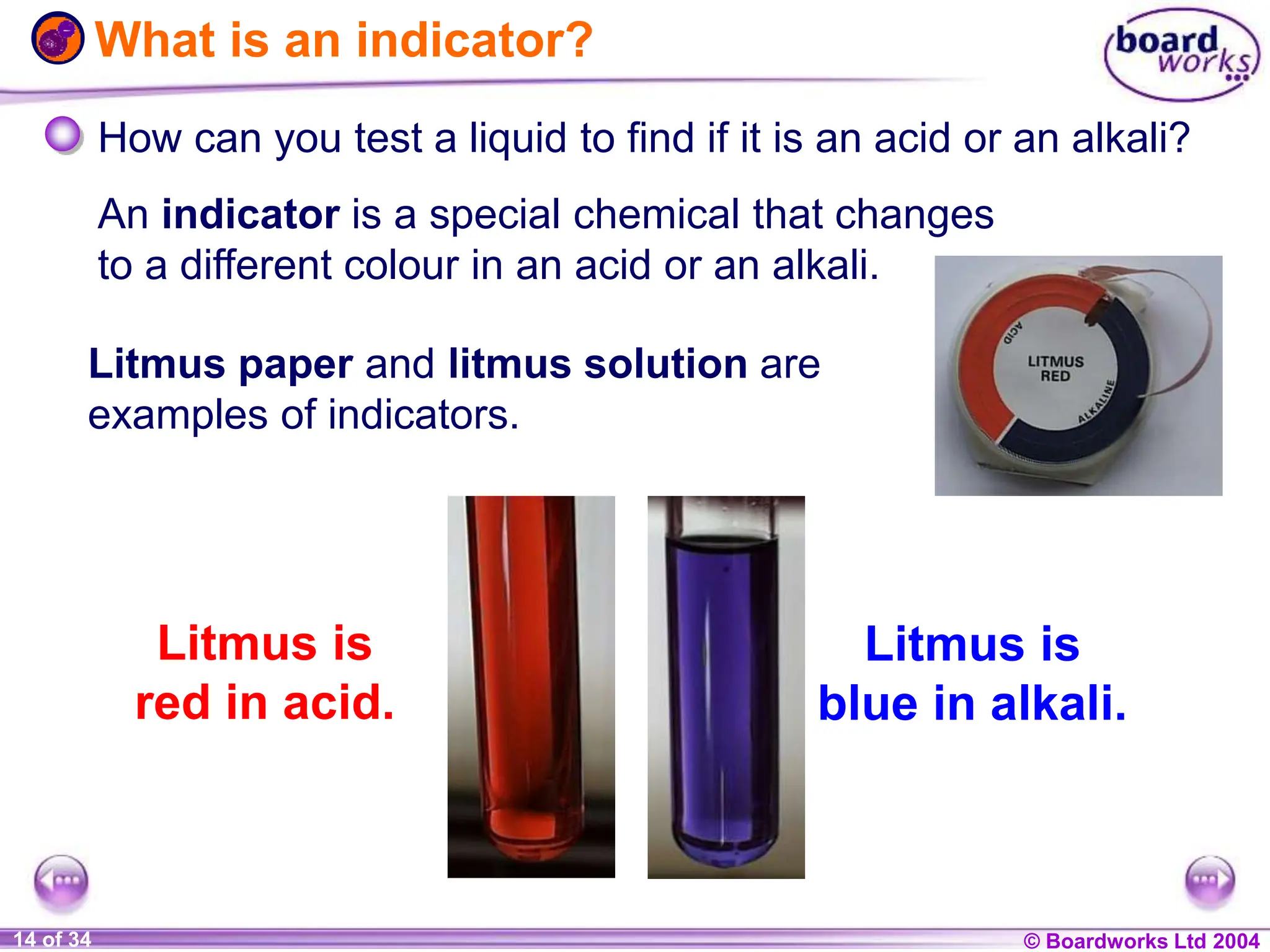
How can you test a liquid to find if it is an acid or an alkali?
An indicator is a special chemical that changes
to a different colour in an acid or an alkali.
What is an indicator?
Litmus paper and litmus solution are
examples of indicators.
Litmus is
red in acid.
Litmus is
blue in alkali.
© Boardworks Ltd 2004
1 of 20 © Boardworks Ltd 2004
15 of 34
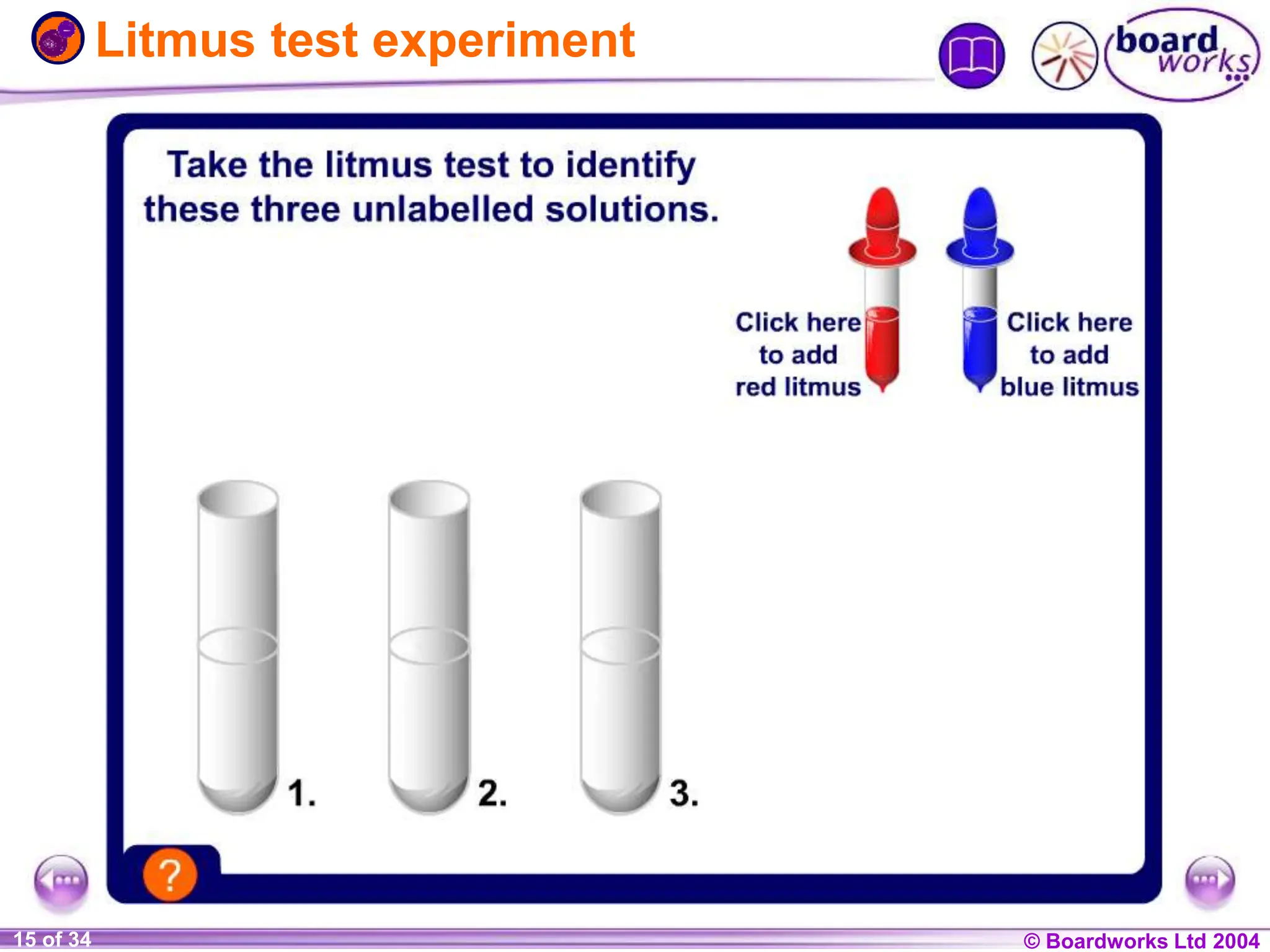
Litmus test experiment
© Boardworks Ltd 2004
1 of 20 © Boardworks Ltd 2004
16 of 34
Litmus is used to show if a solution is acid or alkali.
Litmus does not show if the acid or alkali is weak or strong.
What is universal indicator?
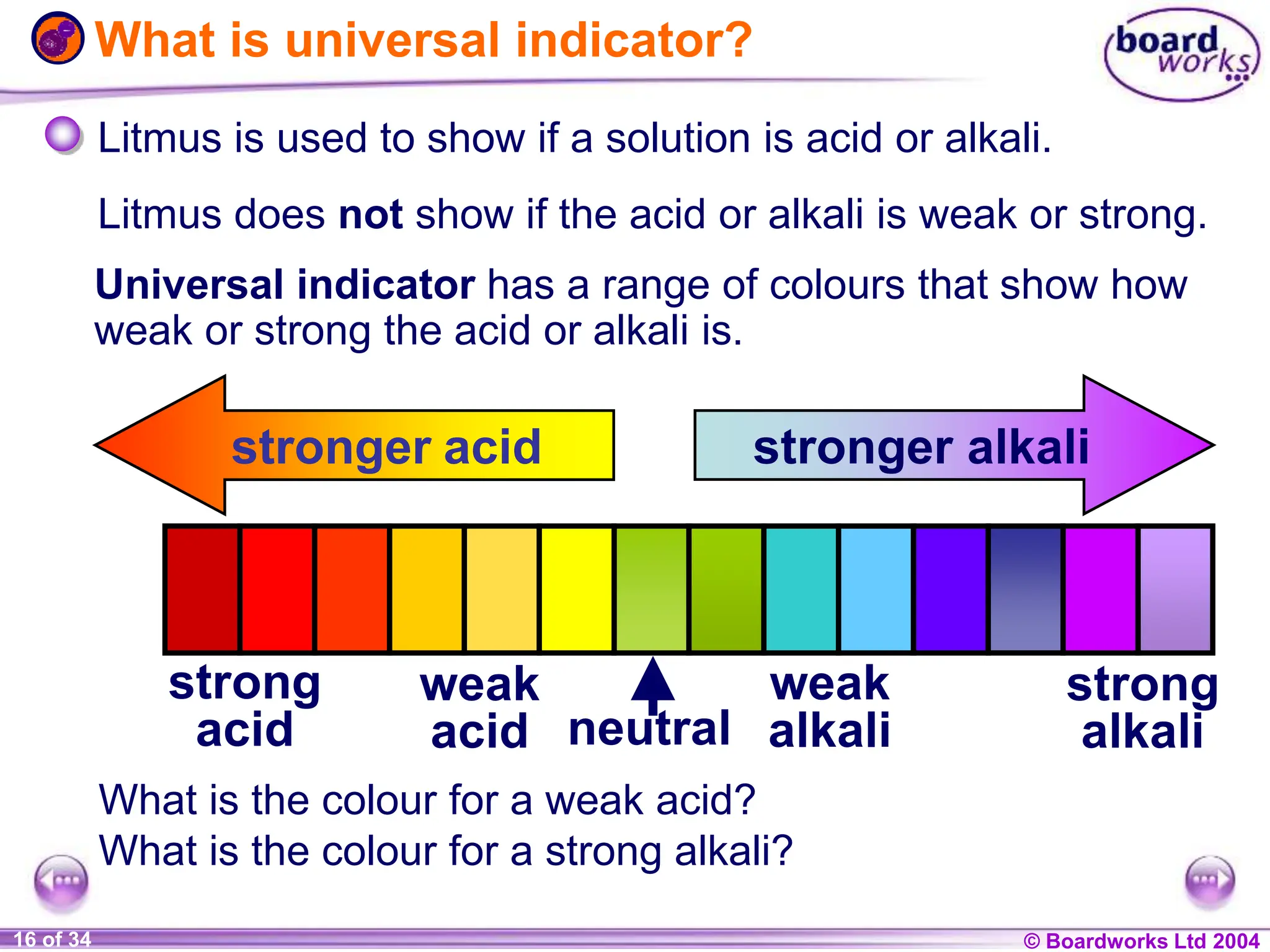
Universal indicator has a range of colours that show how
weak or strong the acid or alkali is.
stronger alkali
stronger acid
What is the colour for a weak acid?
What is the colour for a strong alkali?
weak
alkali
weak
acid
strong
alkali
neutral
strong
acid
© Boardworks Ltd 2004
1 of 20 © Boardworks Ltd 2004
17 of 34
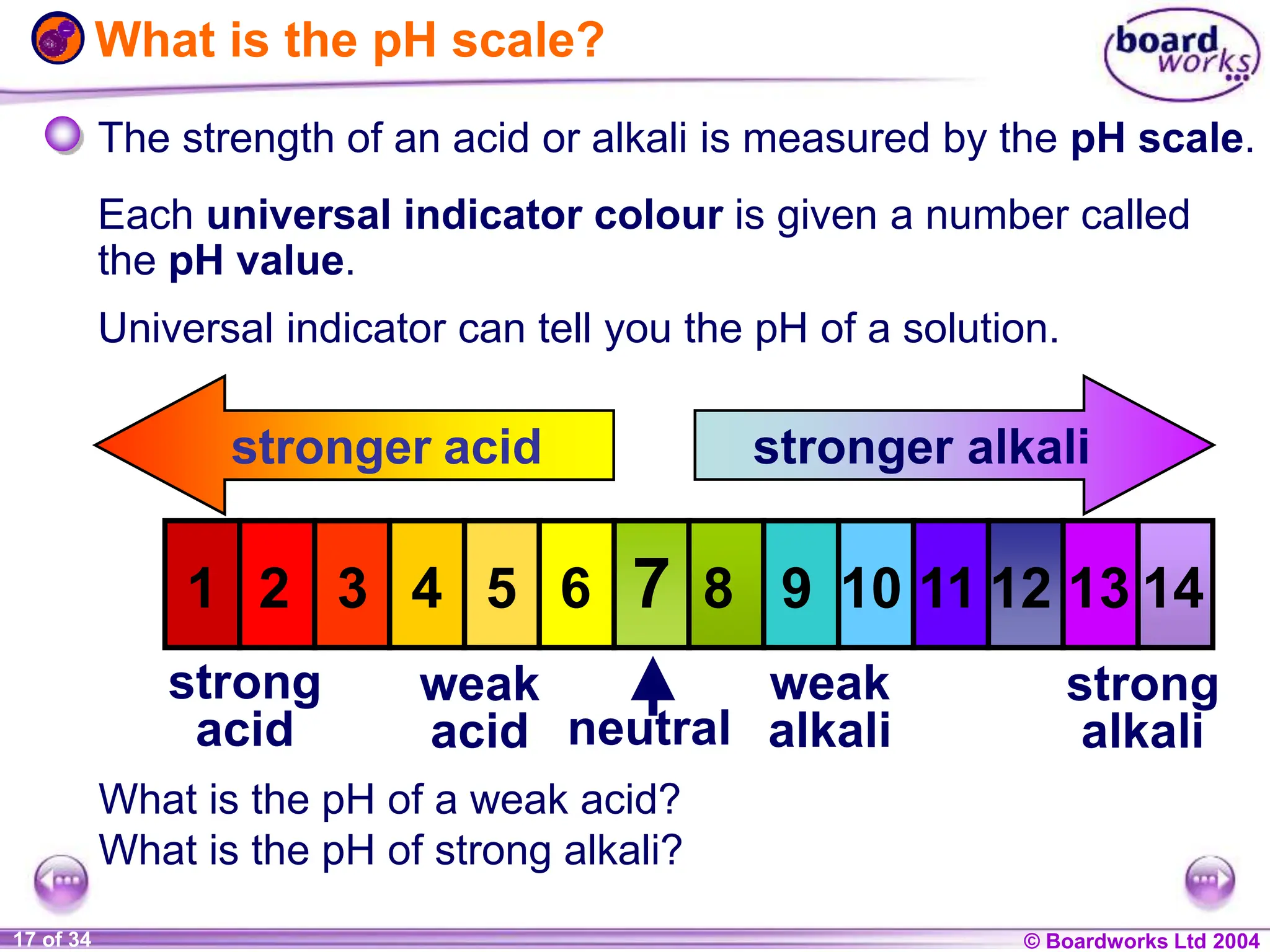
The strength of an acid or alkali is measured by the pH scale.
What is the pH scale?
Each universal indicator colour is given a number called
the pH value.
Universal indicator can tell you the pH of a solution.
What is the pH of a weak acid?
What is the pH of strong alkali?
weak
alkali
weak
acid
strong
alkali
strong
acid
stronger alkali
stronger acid
neutral
1 2 3 4 5 6 7 8 9 10 11 12 13 14
© Boardworks Ltd 2004
1 of 20 © Boardworks Ltd 2004
18 of 34
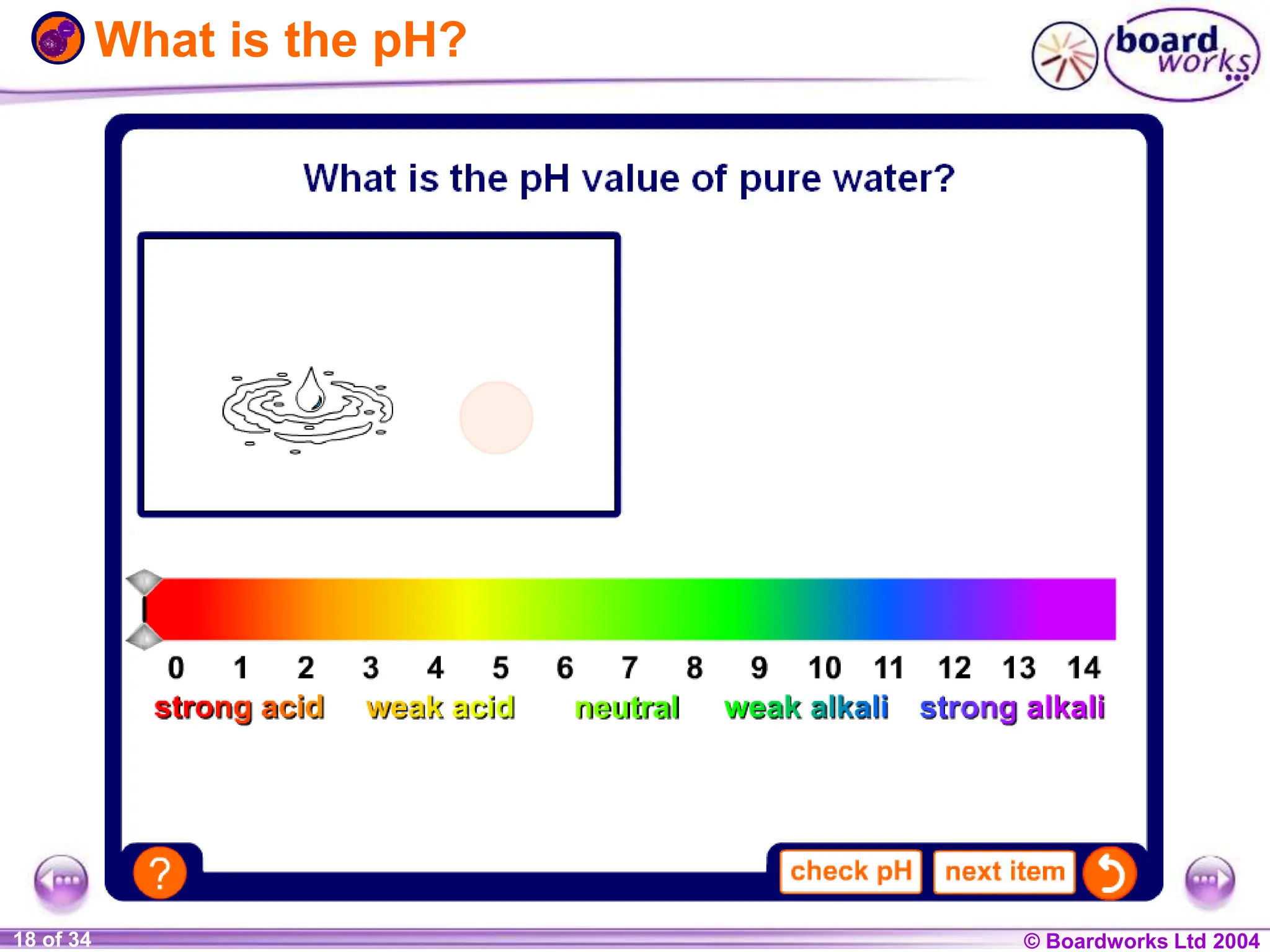
What is the pH?
© Boardworks Ltd 2004
1 of 20 © Boardworks Ltd 2004
19 of 34
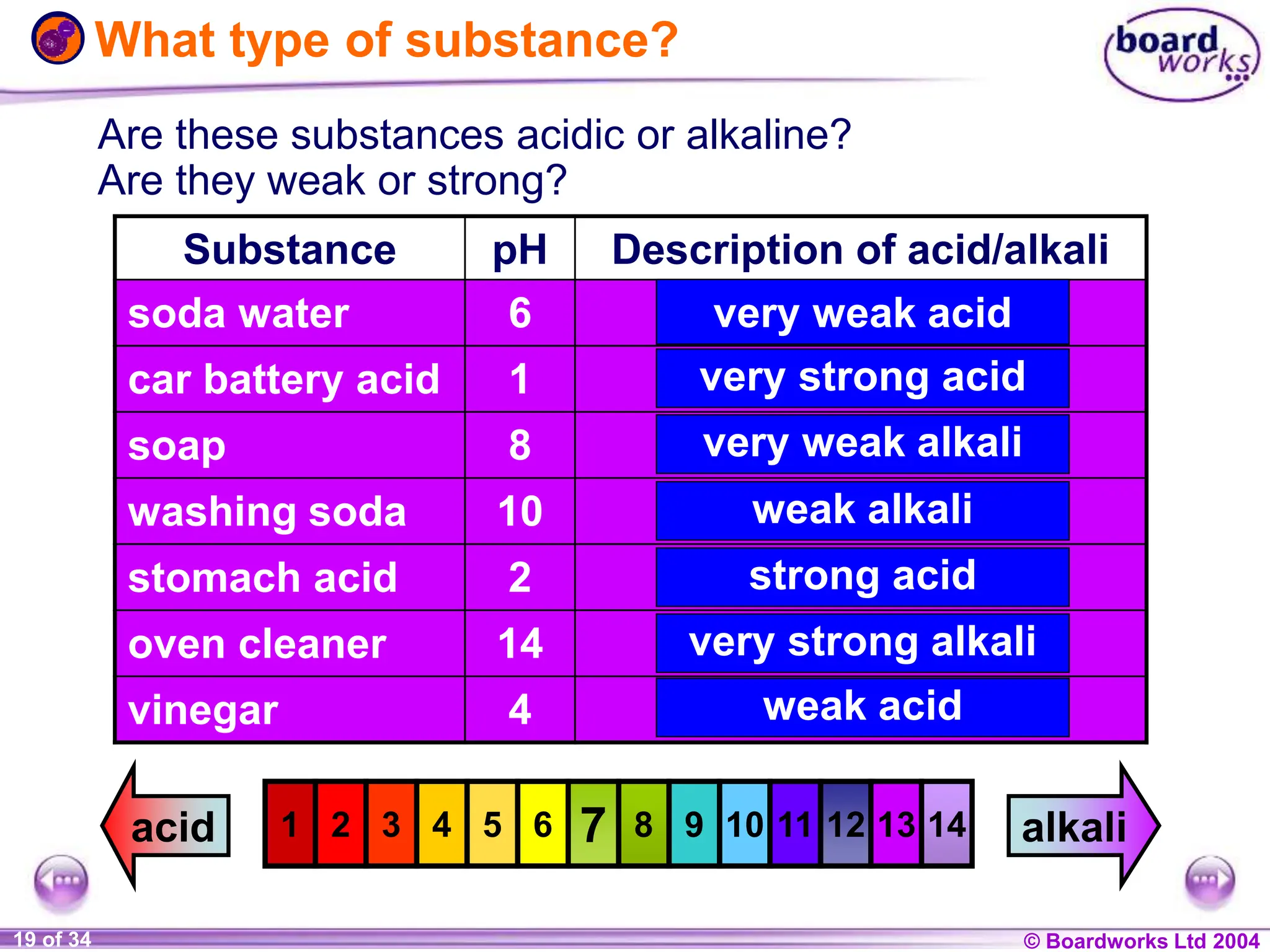
Are these substances acidic or alkaline?
Are they weak or strong?
1 2 14
13
12
11
10
9
8
7
6
5
4
3
Substance pH Description of acid/alkali
soda water 6
car battery acid 1
soap 8
washing soda 10
stomach acid 2
oven cleaner 14
vinegar 4
very weak acid
very strong acid
very weak alkali
weak alkali
strong acid
very strong alkali
weak acid
alkali
acid
What type of substance?
© Boardworks Ltd 2004
1 of 20 © Boardworks Ltd 2004
20 of 34
Contents
7E Acids and Alkalis
Neutralization
Summary activities
What are acids and alkalis?
Indicators and the pH scale
Hazard symbols
© Boardworks Ltd 2004
1 of 20 © Boardworks Ltd 2004
21 of 34
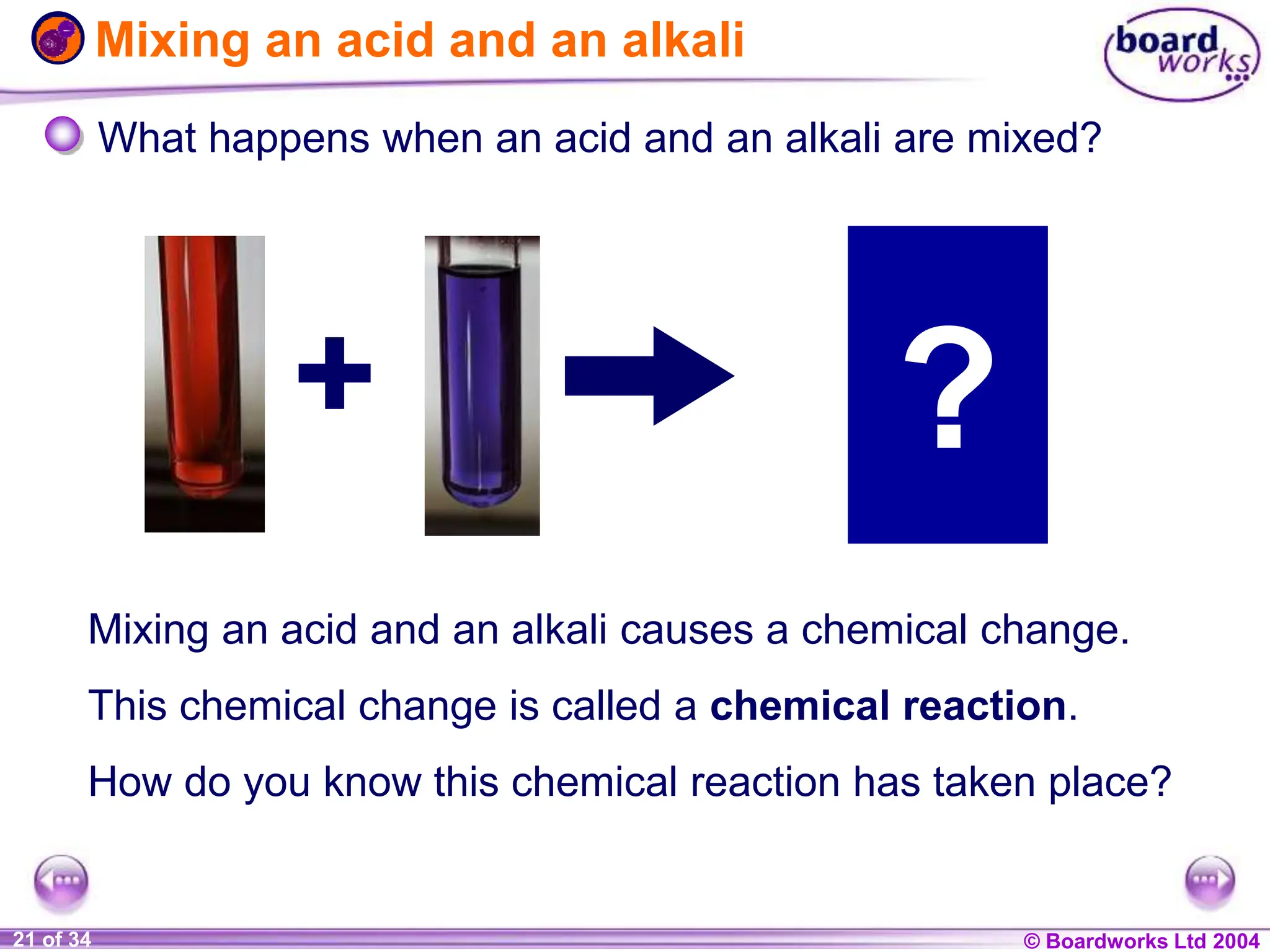
Mixing an acid and an alkali
What happens when an acid and an alkali are mixed?
Mixing an acid and an alkali causes a chemical change.
This chemical change is called a chemical reaction.
How do you know this chemical reaction has taken place?
?
© Boardworks Ltd 2004
1 of 20 © Boardworks Ltd 2004
22 of 34
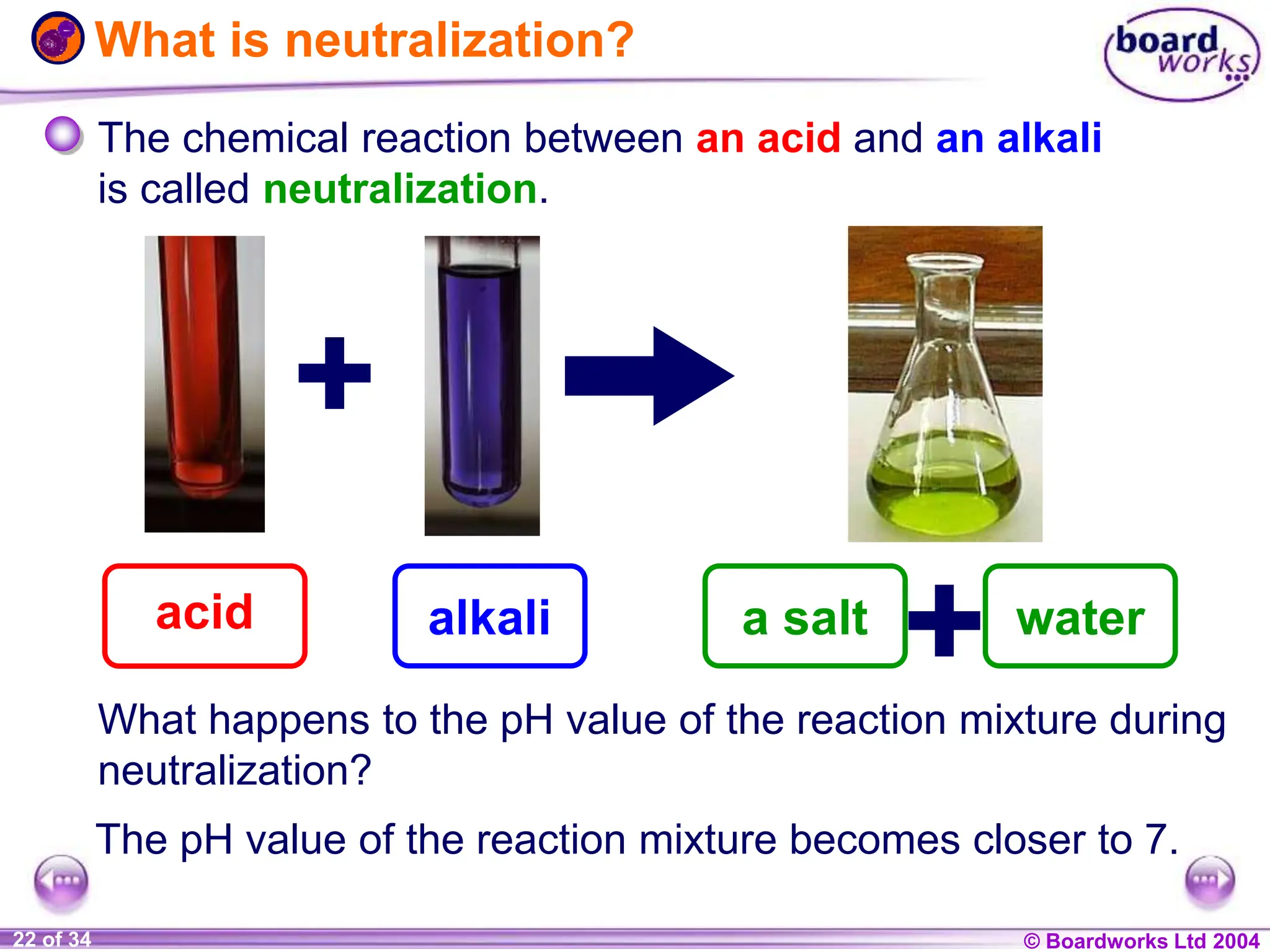
What is neutralization?
The chemical reaction between an acid and an alkali
is called neutralization.
What happens to the pH value of the reaction mixture during
neutralization?
acid alkali a salt water
The pH value of the reaction mixture becomes closer to 7.
© Boardworks Ltd 2004
1 of 20 © Boardworks Ltd 2004
23 of 34
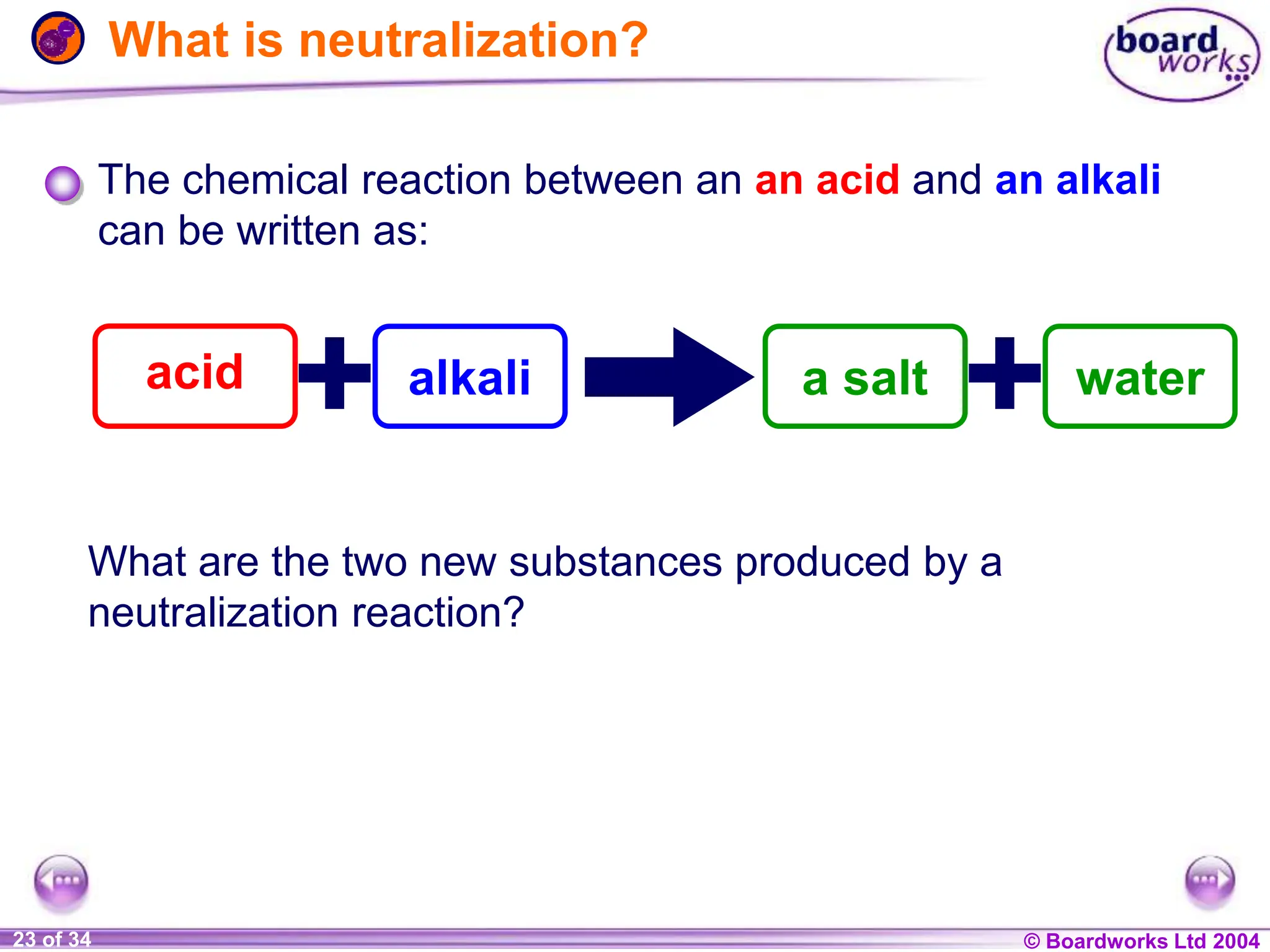
What is neutralization?
The chemical reaction between an an acid and an alkali
can be written as:
What are the two new substances produced by a
neutralization reaction?
a salt
acid alkali water
© Boardworks Ltd 2004
1 of 20 © Boardworks Ltd 2004
24 of 34
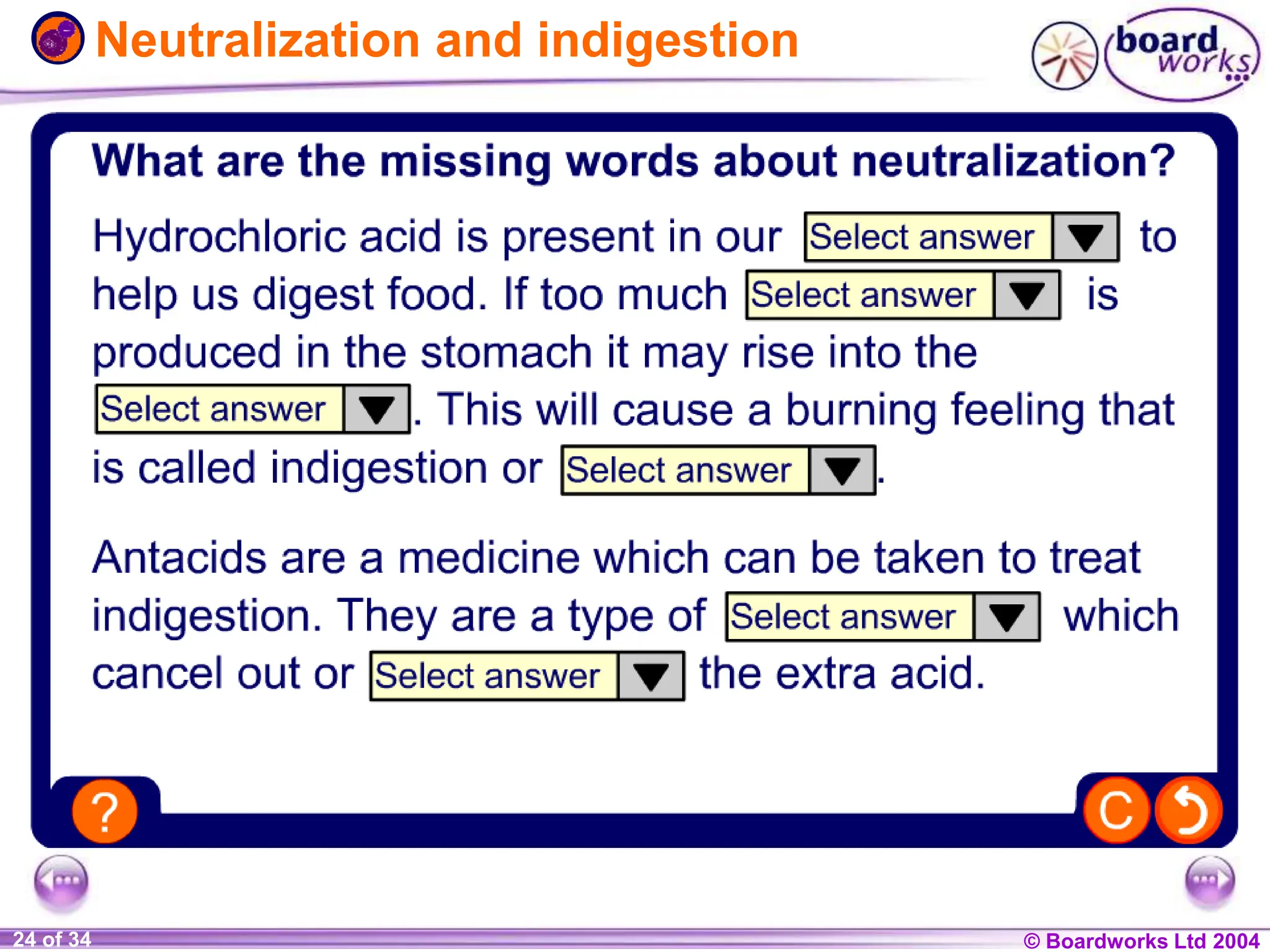
Neutralization and indigestion
© Boardworks Ltd 2004
1 of 20 © Boardworks Ltd 2004
25 of 34
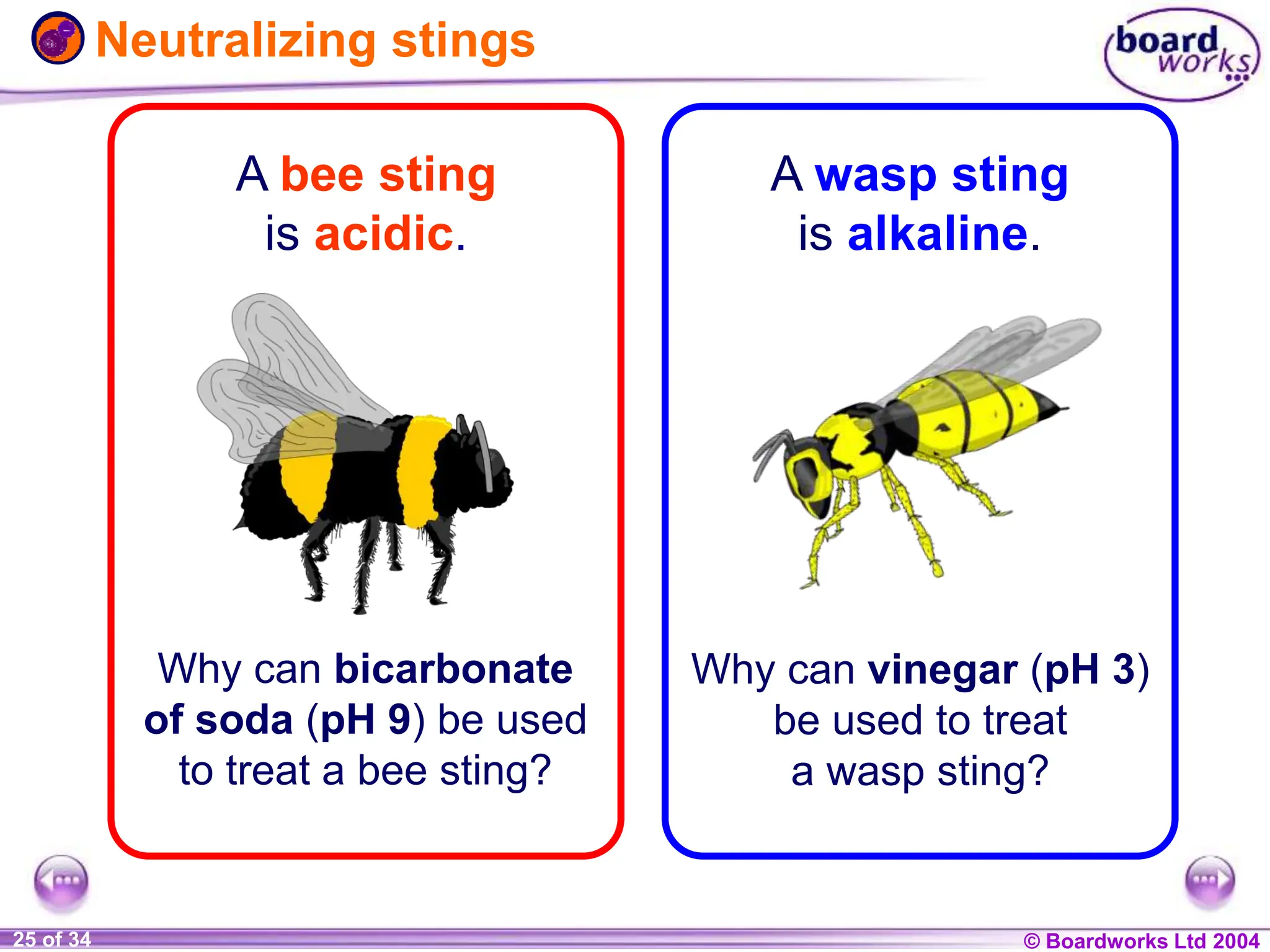
Neutralizing stings
A bee sting
is acidic.
A wasp sting
is alkaline.
Why can bicarbonate
of soda (pH 9) be used
to treat a bee sting?
Why can vinegar (pH 3)
be used to treat
a wasp sting?
© Boardworks Ltd 2004
1 of 20 © Boardworks Ltd 2004
26 of 34
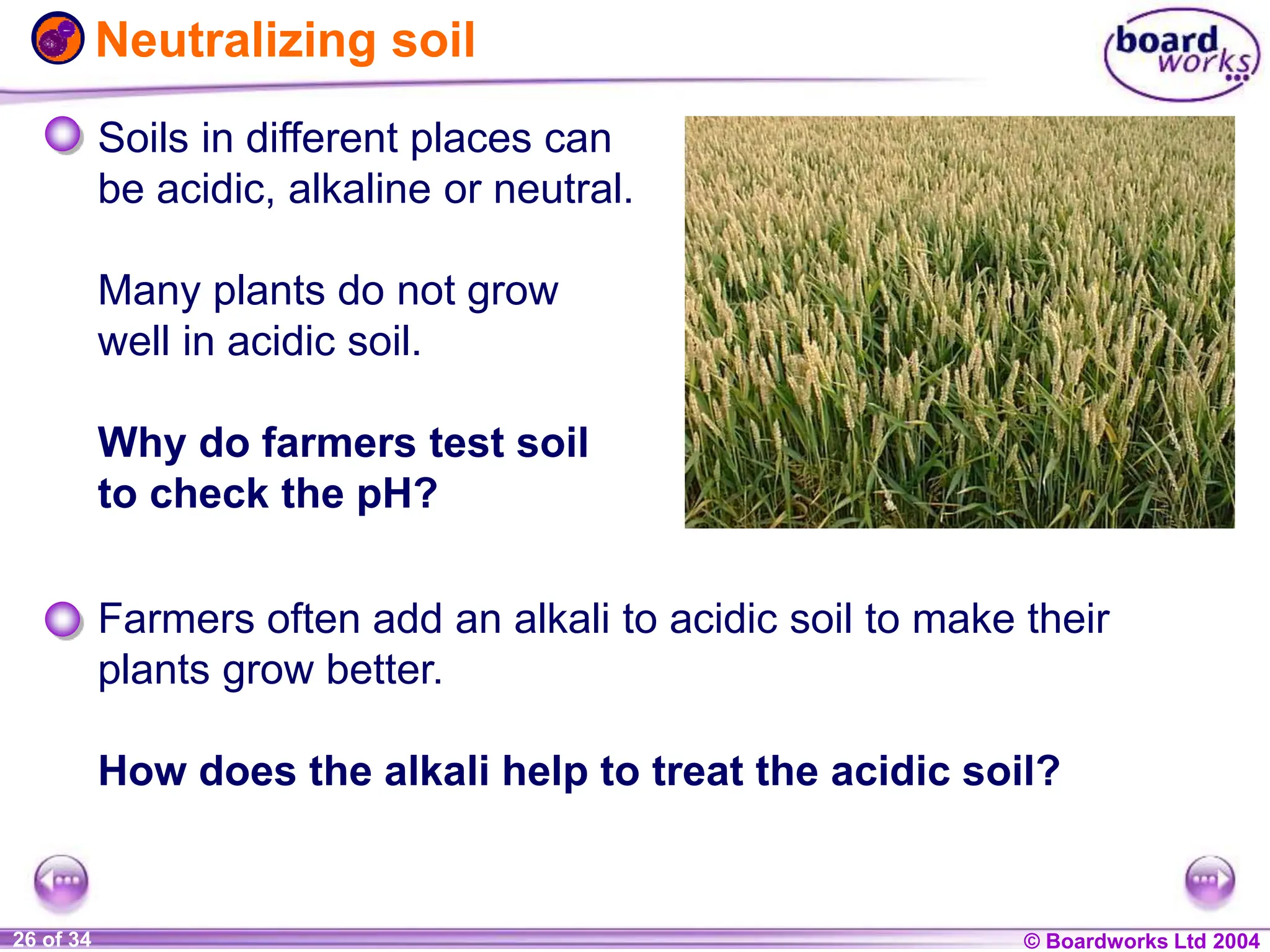
Neutralizing soil
Soils in different places can
be acidic, alkaline or neutral.
Many plants do not grow
well in acidic soil.
Why do farmers test soil
to check the pH?
Farmers often add an alkali to acidic soil to make their
plants grow better.
How does the alkali help to treat the acidic soil?
© Boardworks Ltd 2004
1 of 20 © Boardworks Ltd 2004
27 of 34
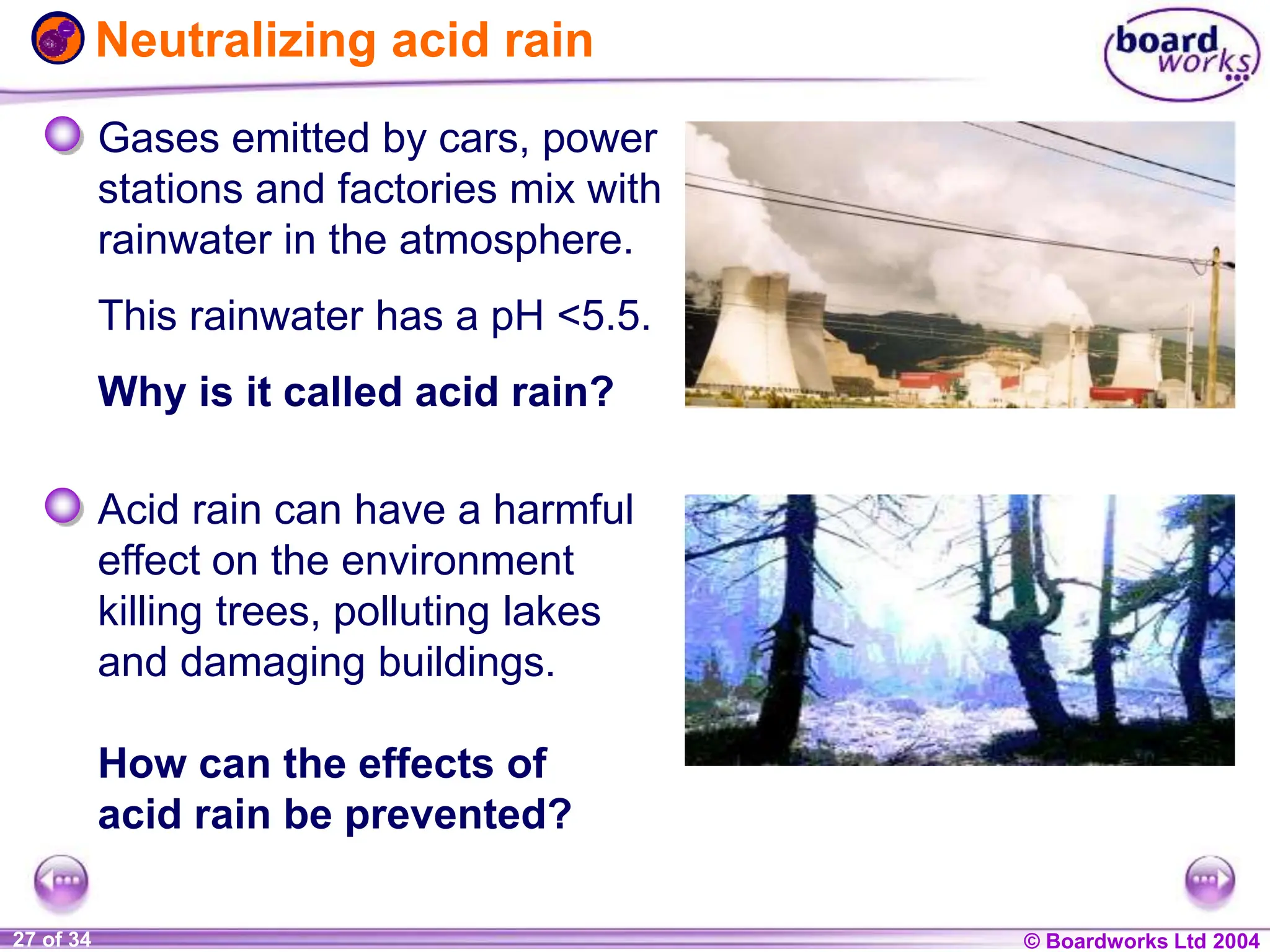
Neutralizing acid rain
Gases emitted by cars, power
stations and factories mix with
rainwater in the atmosphere.
This rainwater has a pH <5.5.
Why is it called acid rain?
Acid rain can have a harmful
effect on the environment
killing trees, polluting lakes
and damaging buildings.
How can the effects of
acid rain be prevented?
© Boardworks Ltd 2004
1 of 20 © Boardworks Ltd 2004
28 of 34
Contents
7E Acids and Alkalis
Neutralization
Summary activities
What are acids and alkalis?
Indicators and the pH scale
Hazard symbols
© Boardworks Ltd 2004
1 of 20 © Boardworks Ltd 2004
29 of 34
Glossary
 acid – A chemical that has a pH less than 7.
 alkali – A chemical that has a pH greater than 7 and
dissolves in water.
 indicator – A special chemical that changes into different
colours in acid and alkali solutions.
 neutral – A chemical with a pH of 7 that is not an acid or
an alkali.
 neutralization – The chemical reaction between an acid
and an alkali.
 pH scale – The range of values that shows how strong or
weak an acid or alkali is.
 universal indicator – The indicator that shows the pH
value of a chemical.
© Boardworks Ltd 2004
1 of 20 © Boardworks Ltd 2004
30 of 34
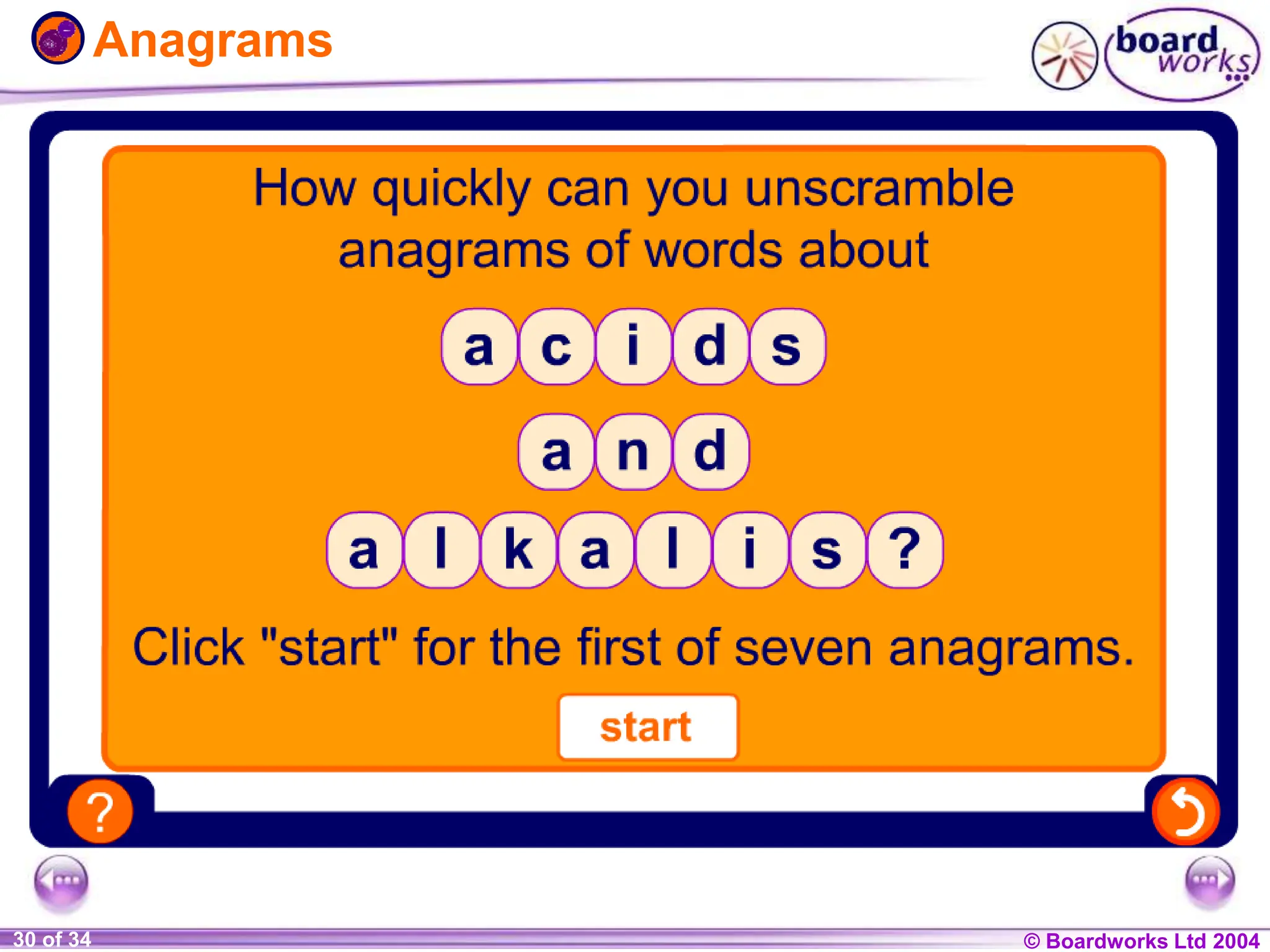
Anagrams
© Boardworks Ltd 2004
1 of 20 © Boardworks Ltd 2004
31 of 34
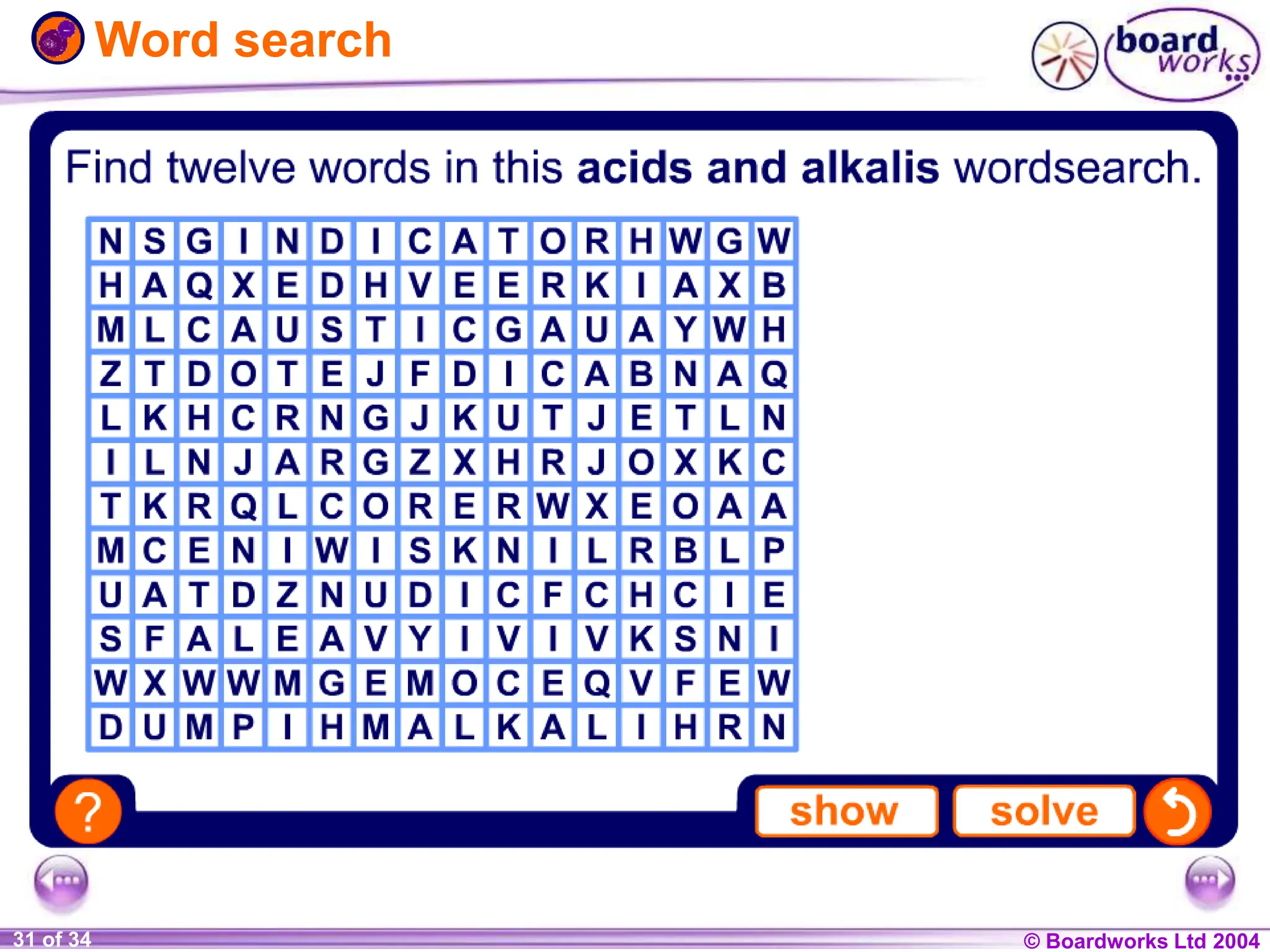
Word search
© Boardworks Ltd 2004
1 of 20 © Boardworks Ltd 2004
32 of 34
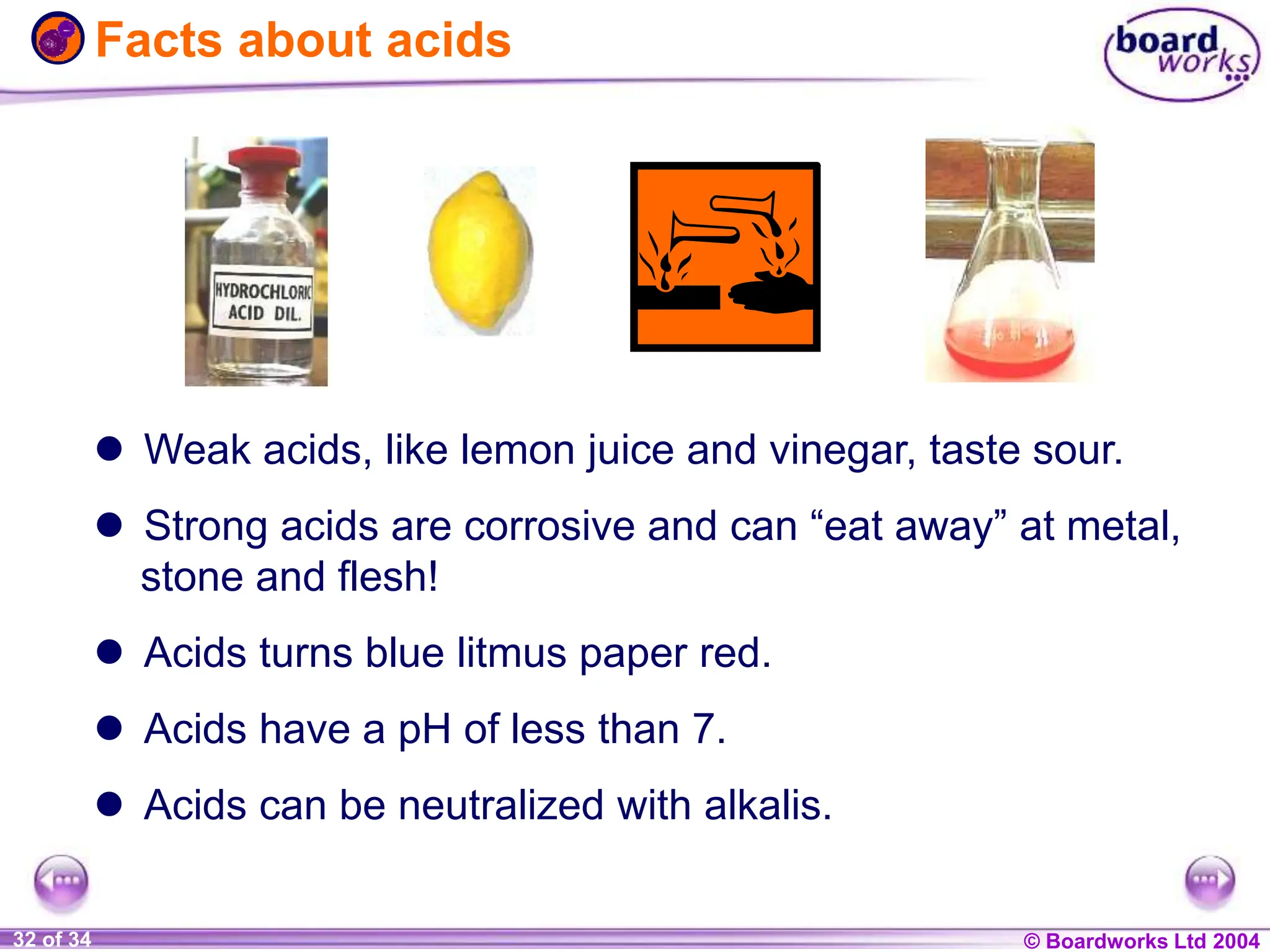
 Weak acids, like lemon juice and vinegar, taste sour.
 Strong acids are corrosive and can “eat away” at metal,
stone and flesh!
 Acids turns blue litmus paper red.
 Acids have a pH of less than 7.
 Acids can be neutralized with alkalis.
Facts about acids
© Boardworks Ltd 2004
1 of 20 © Boardworks Ltd 2004
33 of 34
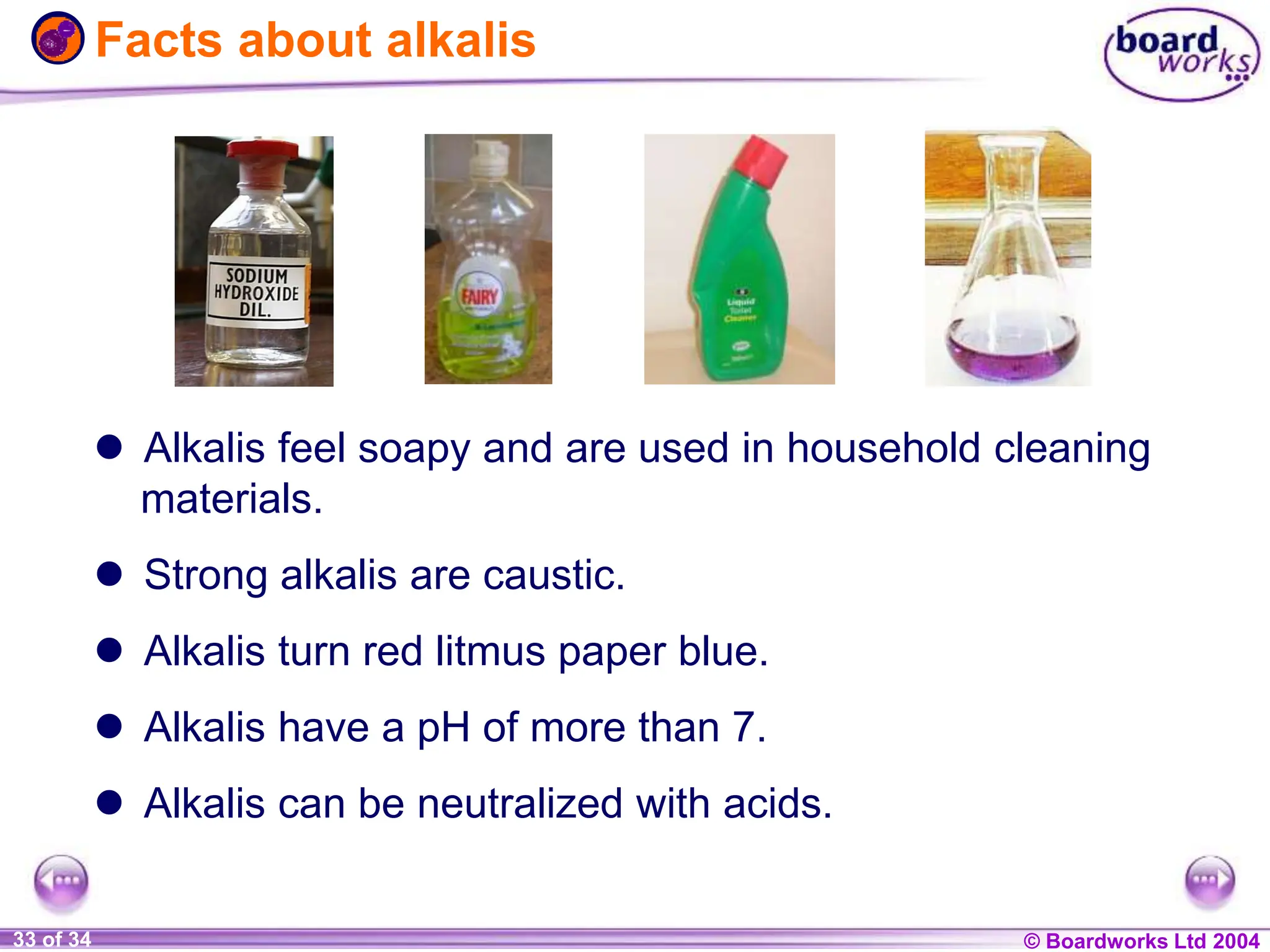
 Alkalis feel soapy and are used in household cleaning
materials.
 Strong alkalis are caustic.
 Alkalis turn red litmus paper blue.
 Alkalis have a pH of more than 7.
 Alkalis can be neutralized with acids.
Facts about alkalis
© Boardworks Ltd 2004
1 of 20 © Boardworks Ltd 2004
34 of 34
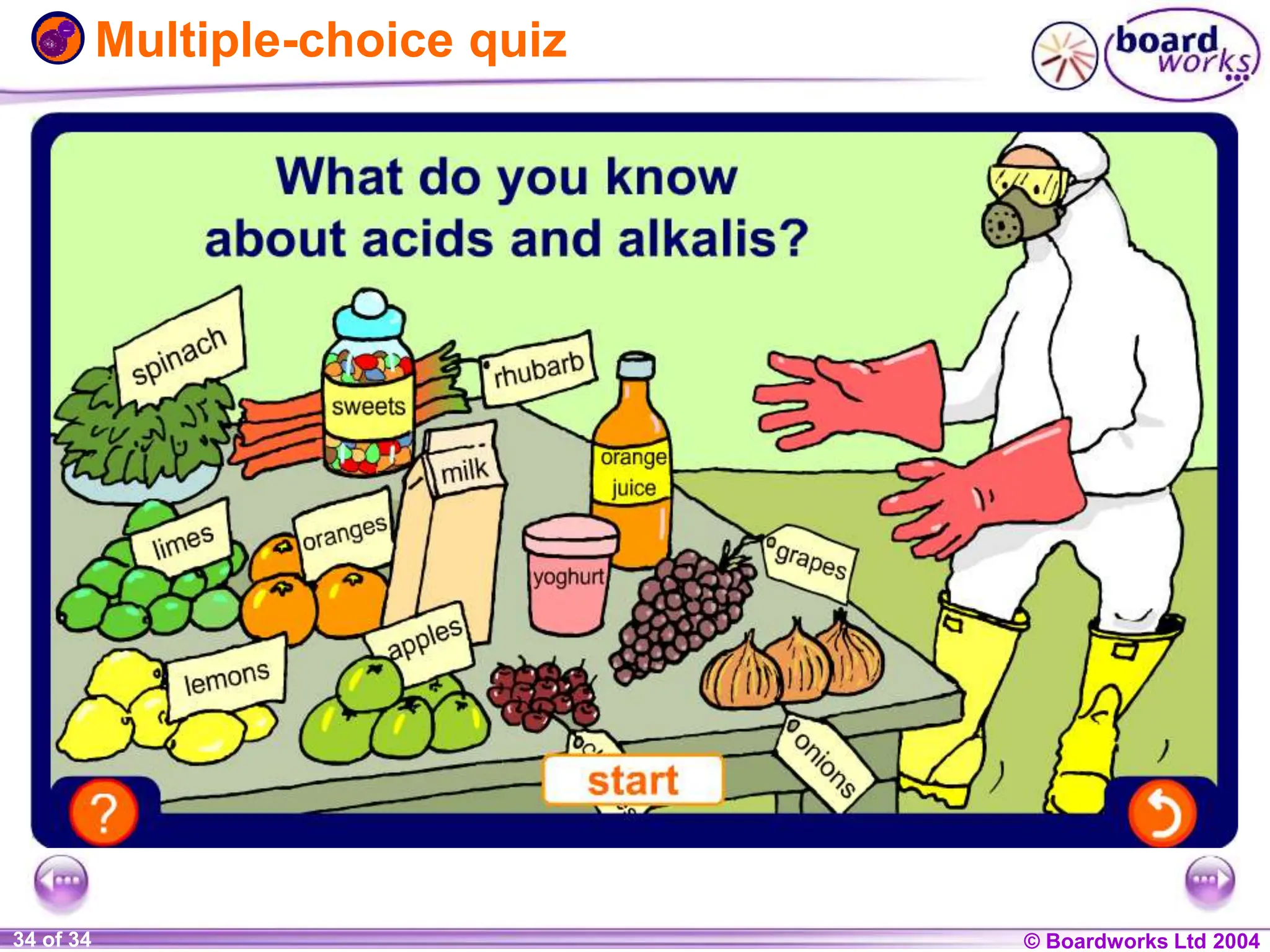
Multiple-choice quiz

Acids-and-Alkalis-KS3-interactive-lesson.ppt

  • 1.
    © Boardworks Ltd2004 1 of 20 © Boardworks Ltd 2004 1 of 34 KS3 Chemistry 7E Acids and Alkalis
  • 2.
    © Boardworks Ltd2004 1 of 20 © Boardworks Ltd 2004 2 of 34 Contents 7E Acids and Alkalis Neutralization Summary activities What are acids and alkalis? Indicators and the pH scale Hazard symbols
  • 3.
    © Boardworks Ltd2004 1 of 20 © Boardworks Ltd 2004 3 of 34 What is an acid? Acids are a group of chemicals. What do you know about acids? Are all acids dangerous?
  • 4.
    © Boardworks Ltd2004 1 of 20 © Boardworks Ltd 2004 4 of 34 What is an acid? everyday acids laboratory acids Acids are a group of chemicals. Can you think of other examples of acids? Which of these items contains an acid?
  • 5.
    © Boardworks Ltd2004 1 of 20 © Boardworks Ltd 2004 5 of 34 What is a weak acid? Acids are found in household items such as food, drink and beauty/skincare products. It is safe to handle these acids and even taste them, if they are for eating! These acids are known weak acids.
  • 6.
    © Boardworks Ltd2004 1 of 20 © Boardworks Ltd 2004 6 of 34 What is a strong acid? Some acids, like those found in the laboratory or a car battery, are very dangerous (too dangerous to taste or touch). These acids are said to be corrosive as they can damage other materials by wearing them away!They are strong acids. Why must strong acids always be handled very carefully?
  • 7.
    © Boardworks Ltd2004 1 of 20 © Boardworks Ltd 2004 7 of 34 What is an alkali? everyday alkalis laboratory alkalis Alkalis are another group of chemicals, the opposite of acids. Which of these items contains an alkali? Can you think of other examples of alkalis?
  • 8.
    © Boardworks Ltd2004 1 of 20 © Boardworks Ltd 2004 8 of 34 What is a weak alkali? Alkalis are found in soaps and other materials used for cleaning. It is safe to handle these alkalis, which can feel soapy. These alkalis are known as weak alkalis.
  • 9.
    © Boardworks Ltd2004 1 of 20 © Boardworks Ltd 2004 9 of 34 What is a strong alkali? Some alkalis, like those in the laboratory or in cleaning materials such as toilet cleaner, are too dangerous to touch. These alkalis are said to be caustic because they can burn skin and damage other materials! They are strong alkalis. Why must strong alkalis always be handled very carefully?
  • 10.
    © Boardworks Ltd2004 1 of 20 © Boardworks Ltd 2004 10 of 34 Contents 7E Acids and Alkalis Neutralization Summary activities What are acids and alkalis? Indicators and the pH scale Hazard symbols
  • 11.
    © Boardworks Ltd2004 1 of 20 © Boardworks Ltd 2004 11 of 34 How can you tell which chemicals are safe and which are dangerous? Special symbols are used on bottles and vehicles that contain dangerous chemicals. What are hazard symbols? corrosive harmful irritant toxic These hazard symbols show why the chemical is dangerous. Why is it important that these symbols can be recognised by i h highly flammable people from other countries?
  • 12.
    © Boardworks Ltd2004 1 of 20 © Boardworks Ltd 2004 12 of 34 What do hazard symbols mean?
  • 13.
    © Boardworks Ltd2004 1 of 20 © Boardworks Ltd 2004 13 of 34 Contents 7E Acids and Alkalis Neutralization Summary activities What are acids and alkalis? Indicators and the pH scale Hazard symbols
  • 14.
    © Boardworks Ltd2004 1 of 20 © Boardworks Ltd 2004 14 of 34 How can you test a liquid to find if it is an acid or an alkali? An indicator is a special chemical that changes to a different colour in an acid or an alkali. What is an indicator? Litmus paper and litmus solution are examples of indicators. Litmus is red in acid. Litmus is blue in alkali.
  • 15.
    © Boardworks Ltd2004 1 of 20 © Boardworks Ltd 2004 15 of 34 Litmus test experiment
  • 16.
    © Boardworks Ltd2004 1 of 20 © Boardworks Ltd 2004 16 of 34 Litmus is used to show if a solution is acid or alkali. Litmus does not show if the acid or alkali is weak or strong. What is universal indicator? Universal indicator has a range of colours that show how weak or strong the acid or alkali is. stronger alkali stronger acid What is the colour for a weak acid? What is the colour for a strong alkali? weak alkali weak acid strong alkali neutral strong acid
  • 17.
    © Boardworks Ltd2004 1 of 20 © Boardworks Ltd 2004 17 of 34 The strength of an acid or alkali is measured by the pH scale. What is the pH scale? Each universal indicator colour is given a number called the pH value. Universal indicator can tell you the pH of a solution. What is the pH of a weak acid? What is the pH of strong alkali? weak alkali weak acid strong alkali strong acid stronger alkali stronger acid neutral 1 2 3 4 5 6 7 8 9 10 11 12 13 14
  • 18.
    © Boardworks Ltd2004 1 of 20 © Boardworks Ltd 2004 18 of 34 What is the pH?
  • 19.
    © Boardworks Ltd2004 1 of 20 © Boardworks Ltd 2004 19 of 34 Are these substances acidic or alkaline? Are they weak or strong? 1 2 14 13 12 11 10 9 8 7 6 5 4 3 Substance pH Description of acid/alkali soda water 6 car battery acid 1 soap 8 washing soda 10 stomach acid 2 oven cleaner 14 vinegar 4 very weak acid very strong acid very weak alkali weak alkali strong acid very strong alkali weak acid alkali acid What type of substance?
  • 20.
    © Boardworks Ltd2004 1 of 20 © Boardworks Ltd 2004 20 of 34 Contents 7E Acids and Alkalis Neutralization Summary activities What are acids and alkalis? Indicators and the pH scale Hazard symbols
  • 21.
    © Boardworks Ltd2004 1 of 20 © Boardworks Ltd 2004 21 of 34 Mixing an acid and an alkali What happens when an acid and an alkali are mixed? Mixing an acid and an alkali causes a chemical change. This chemical change is called a chemical reaction. How do you know this chemical reaction has taken place? ?
  • 22.
    © Boardworks Ltd2004 1 of 20 © Boardworks Ltd 2004 22 of 34 What is neutralization? The chemical reaction between an acid and an alkali is called neutralization. What happens to the pH value of the reaction mixture during neutralization? acid alkali a salt water The pH value of the reaction mixture becomes closer to 7.
  • 23.
    © Boardworks Ltd2004 1 of 20 © Boardworks Ltd 2004 23 of 34 What is neutralization? The chemical reaction between an an acid and an alkali can be written as: What are the two new substances produced by a neutralization reaction? a salt acid alkali water
  • 24.
    © Boardworks Ltd2004 1 of 20 © Boardworks Ltd 2004 24 of 34 Neutralization and indigestion
  • 25.
    © Boardworks Ltd2004 1 of 20 © Boardworks Ltd 2004 25 of 34 Neutralizing stings A bee sting is acidic. A wasp sting is alkaline. Why can bicarbonate of soda (pH 9) be used to treat a bee sting? Why can vinegar (pH 3) be used to treat a wasp sting?
  • 26.
    © Boardworks Ltd2004 1 of 20 © Boardworks Ltd 2004 26 of 34 Neutralizing soil Soils in different places can be acidic, alkaline or neutral. Many plants do not grow well in acidic soil. Why do farmers test soil to check the pH? Farmers often add an alkali to acidic soil to make their plants grow better. How does the alkali help to treat the acidic soil?
  • 27.
    © Boardworks Ltd2004 1 of 20 © Boardworks Ltd 2004 27 of 34 Neutralizing acid rain Gases emitted by cars, power stations and factories mix with rainwater in the atmosphere. This rainwater has a pH <5.5. Why is it called acid rain? Acid rain can have a harmful effect on the environment killing trees, polluting lakes and damaging buildings. How can the effects of acid rain be prevented?
  • 28.
    © Boardworks Ltd2004 1 of 20 © Boardworks Ltd 2004 28 of 34 Contents 7E Acids and Alkalis Neutralization Summary activities What are acids and alkalis? Indicators and the pH scale Hazard symbols
  • 29.
    © Boardworks Ltd2004 1 of 20 © Boardworks Ltd 2004 29 of 34 Glossary  acid – A chemical that has a pH less than 7.  alkali – A chemical that has a pH greater than 7 and dissolves in water.  indicator – A special chemical that changes into different colours in acid and alkali solutions.  neutral – A chemical with a pH of 7 that is not an acid or an alkali.  neutralization – The chemical reaction between an acid and an alkali.  pH scale – The range of values that shows how strong or weak an acid or alkali is.  universal indicator – The indicator that shows the pH value of a chemical.
  • 30.
    © Boardworks Ltd2004 1 of 20 © Boardworks Ltd 2004 30 of 34 Anagrams
  • 31.
    © Boardworks Ltd2004 1 of 20 © Boardworks Ltd 2004 31 of 34 Word search
  • 32.
    © Boardworks Ltd2004 1 of 20 © Boardworks Ltd 2004 32 of 34  Weak acids, like lemon juice and vinegar, taste sour.  Strong acids are corrosive and can “eat away” at metal, stone and flesh!  Acids turns blue litmus paper red.  Acids have a pH of less than 7.  Acids can be neutralized with alkalis. Facts about acids
  • 33.
    © Boardworks Ltd2004 1 of 20 © Boardworks Ltd 2004 33 of 34  Alkalis feel soapy and are used in household cleaning materials.  Strong alkalis are caustic.  Alkalis turn red litmus paper blue.  Alkalis have a pH of more than 7.  Alkalis can be neutralized with acids. Facts about alkalis
  • 34.
    © Boardworks Ltd2004 1 of 20 © Boardworks Ltd 2004 34 of 34 Multiple-choice quiz