EPIDEMIOLOGY OF YAWS
Namita Batra Guin
Associate Professor
Dept. of Community Health Nursing
• Chronic, Contagious, highly infectious, Non-
venereal disease caused by Spirochaete
Treponema pallidum.
Usually begins in early childhood.
Primary skin lesion followed by generalised
eruption and a late stage of destructive and
disfiguring and debilitating lesions of skin and
bone.
Chronic disease showing relapses over several
years.
•
•
•
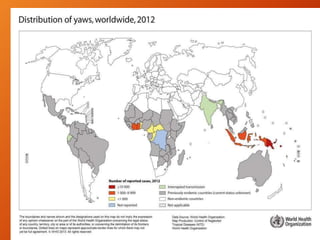
GEOGRAPHIC DISTRIBUTION
Exclusively confined to the belt between the
Tropic of Cancer and Capricorn.
Significant public health problem in Africa,
South-east Asia and Central America in the
past
Resurgence in certain areas of Africa
Persistent low level in India till a decade ago.
•
•
•
•
INDIA
Reported from tribal communities living in
hilly forests and difficult to reach areas in 49
districts of 10 states.
States affected – Andhra Pradesh, Assam,
Chhattisgarh, Gujrat, Jharkhand, Madhya
Pradesh, Maharashtra, Orissa, Tamil Nadu,
U.P
.
•
•
• Number of cases brought down from 3500
1996 to zero in 2004.
Certfication of disease free status in 2011
in
•
AGENT
Treponema pertenue
Resembles T. pallidum culturally and
morphologically
Occurs in the epidermis of lesions, lymph
spleen and bone marrow.
•
•
• glands,
Reservoir- Man is the only known reservoir Most
latent cases found in cluster around an infectious
case
Source of infection
Skin lesions and exudates from early lesions
HOST FACTORS
AGE-Primarily a disease
adolescence.
GENDER: M> F
IMMUNITY –
of childhood and
No natural immunity.
ENVIRONMENTAL FACTORS
CLIMATE –
Endemic in warm and humid climate.
SOCIAL FACTORS –
More common in tribal people
Poor personal hygiene, overcrowding,
living predisposing factors
low std. of
MODE OF
DIRECT CONTACT
FOMITES
VECTORS
TRANSMISSION
INCUBATION
9 – 90 DAYS
PERIOD –
CLINICAL FEATURES
EARLY YAWS-
Primary lesion (Mother Yaws) appears at the
inoculation after 3-5 weeks.
Seen on exposed parts of body
Lymph glands are enlarged.
With in next 3-6 weeks generalised eruption
•
- site of
-
-
- appears
consists of large yellow, crusted, granulomatous
eruptions .
-During next five years, mucous membrane, periosteal
snd bone lesions develop, subside and relapse.
- The early lesions are highly infectioous
• LATE YAWS
- Destructive and deforming lesions of skin,
bone and periosteum develop.
CRAB Yaws – lesions of palm and soles
Gangosa – lesions of soft palate, hard palate
and nose
CONTROL OF YAWS
1. SURVEY-
Clinical survey of all families in endemic area.
Should not cover less than 95% of total population.
2. TREATMENT
Single dose of Azithromycin or single long acting
Penicillin will cure infection
Simultaneous treatment of cases and their likely
contacts in the community will interrupt
transmission
• WHO has recommended 3 treatment policies-
TOTAL MASS TREATMENT- In hyperendemic areas(>
10% prevalence of clinically active Yaws).
Entire population treated with Pen G.
JUVENILE MASS TREATMENT – In mesoendemic
areas(5-10% prevalence).
Treatment given to cases, contacts and all children
below 15 years
SELECTIVE MASS TREATMENT – In hypoendemic
areas(<5% prevalence)
Treatment to cases, household and other obvious
contacts
3. RESURVEY AND TREATMENT-
Resuveys every6-12 months to assess problem
magnitude.
4. SURVEILLANCE-
Surveillance and Containment measures for
affected villages, households and contacts of
known Yaws cases.
Epidemiological investigations to trace possible
sources of infection, prophylactic treatment of
contacts, follw up of cases
5. ENVIRONMENT IMPROVEMENT
6. ERADICATION EFFORTS-
TOTAL COMMUNITY TREATMENT
TOTAL TARGETTED TREATMENT
THANK YOU

Yaws

  • 1.
    EPIDEMIOLOGY OF YAWS NamitaBatra Guin Associate Professor Dept. of Community Health Nursing
  • 2.
    • Chronic, Contagious,highly infectious, Non- venereal disease caused by Spirochaete Treponema pallidum. Usually begins in early childhood. Primary skin lesion followed by generalised eruption and a late stage of destructive and disfiguring and debilitating lesions of skin and bone. Chronic disease showing relapses over several years. • • •
  • 3.
    GEOGRAPHIC DISTRIBUTION Exclusively confinedto the belt between the Tropic of Cancer and Capricorn. Significant public health problem in Africa, South-east Asia and Central America in the past Resurgence in certain areas of Africa Persistent low level in India till a decade ago. • • • •
  • 5.
    INDIA Reported from tribalcommunities living in hilly forests and difficult to reach areas in 49 districts of 10 states. States affected – Andhra Pradesh, Assam, Chhattisgarh, Gujrat, Jharkhand, Madhya Pradesh, Maharashtra, Orissa, Tamil Nadu, U.P . • • • Number of cases brought down from 3500 1996 to zero in 2004. Certfication of disease free status in 2011 in •
  • 6.
    AGENT Treponema pertenue Resembles T.pallidum culturally and morphologically Occurs in the epidermis of lesions, lymph spleen and bone marrow. • • • glands, Reservoir- Man is the only known reservoir Most latent cases found in cluster around an infectious case Source of infection Skin lesions and exudates from early lesions
  • 7.
    HOST FACTORS AGE-Primarily adisease adolescence. GENDER: M> F IMMUNITY – of childhood and No natural immunity.
  • 8.
    ENVIRONMENTAL FACTORS CLIMATE – Endemicin warm and humid climate. SOCIAL FACTORS – More common in tribal people Poor personal hygiene, overcrowding, living predisposing factors low std. of
  • 9.
  • 10.
    CLINICAL FEATURES EARLY YAWS- Primarylesion (Mother Yaws) appears at the inoculation after 3-5 weeks. Seen on exposed parts of body Lymph glands are enlarged. With in next 3-6 weeks generalised eruption • - site of - - - appears consists of large yellow, crusted, granulomatous eruptions . -During next five years, mucous membrane, periosteal snd bone lesions develop, subside and relapse. - The early lesions are highly infectioous
  • 12.
    • LATE YAWS -Destructive and deforming lesions of skin, bone and periosteum develop. CRAB Yaws – lesions of palm and soles Gangosa – lesions of soft palate, hard palate and nose
  • 14.
    CONTROL OF YAWS 1.SURVEY- Clinical survey of all families in endemic area. Should not cover less than 95% of total population. 2. TREATMENT Single dose of Azithromycin or single long acting Penicillin will cure infection Simultaneous treatment of cases and their likely contacts in the community will interrupt transmission
  • 15.
    • WHO hasrecommended 3 treatment policies- TOTAL MASS TREATMENT- In hyperendemic areas(> 10% prevalence of clinically active Yaws). Entire population treated with Pen G. JUVENILE MASS TREATMENT – In mesoendemic areas(5-10% prevalence). Treatment given to cases, contacts and all children below 15 years SELECTIVE MASS TREATMENT – In hypoendemic areas(<5% prevalence) Treatment to cases, household and other obvious contacts
  • 16.
    3. RESURVEY ANDTREATMENT- Resuveys every6-12 months to assess problem magnitude. 4. SURVEILLANCE- Surveillance and Containment measures for affected villages, households and contacts of known Yaws cases. Epidemiological investigations to trace possible sources of infection, prophylactic treatment of contacts, follw up of cases
  • 17.
    5. ENVIRONMENT IMPROVEMENT 6.ERADICATION EFFORTS- TOTAL COMMUNITY TREATMENT TOTAL TARGETTED TREATMENT
  • 18.