
GERIATRIC CARE
NURSING
Mrs. Namita Batra Guin
Professor
Deptt. of Community Health Nursing
Geriatrics
It is a sub specialty of internal medicine
and family medicine that focuses on
health care of elderly people.
Geriatric Nursing: Nursing care of aged
people given in the home, the hospital
or special institutions like nursing
homes, psychiatric institutions etc.
Gerontology
◦ The scientific study of biological,
psychological, and sociological
phenomena associated with old
age and aging
AGEING
It is a progressive and generalized impairment of body
functions resulting in loss of adaptive responses to stress
and increasing the risk of age-related diseases.
People more than 60 years are considered elderly.
Old age is not a disease but a normal inevitable
biological phenomenon.
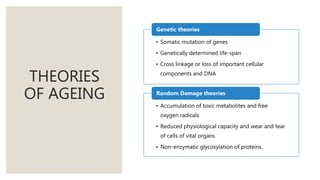
THEORIES
OF AGEING
• Somatic mutation of genes
• Genetically determined life-span
• Cross linkage or loss of important cellular
components and DNA
Genetic theories
• Accumulation of toxic metabolites and free
oxygen radicals
• Reduced physiological capacity and wear and tear
of cells of vital organs
• Non-enzymatic glycosylation of proteins.
Random Damage theories
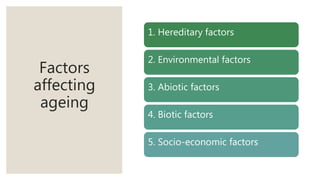
Factors
affecting
ageing
1. Hereditary factors
2. Environmental factors
3. Abiotic factors
4. Biotic factors
5. Socio-economic factors
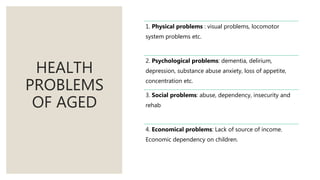
HEALTH
PROBLEMS
OF AGED
1. Physical problems : visual problems, locomotor
system problems etc.
2. Psychological problems: dementia, delirium,
depression, substance abuse anxiety, loss of appetite,
concentration etc.
3. Social problems: abuse, dependency, insecurity and
rehab
4. Economical problems: Lack of source of income.
Economic dependency on children.
AGING PROCESS AND
CHANGES
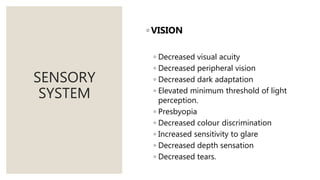
SENSORY
SYSTEM
◦ VISION
◦ Decreased visual acuity
◦ Decreased peripheral vision
◦ Decreased dark adaptation
◦ Elevated minimum threshold of light
perception.
◦ Presbyopia
◦ Decreased colour discrimination
◦ Increased sensitivity to glare
◦ Decreased depth sensation
◦ Decreased tears.
SENSORY
SYSTEM
◦Assessment findings
◦ Arcus sinilis – a gray or white arc visible
above and below the outer part of the
cornea.
◦ Cataract
◦ Macular degeneration.
◦ Glaucoma
◦ Smaller pupil size
◦ Dry, red eyes.
◦ Vitreous floaters.
SENSORY
SYSTEM
◦ HEARING
◦ Hearing loss
◦ Consonants are not heard well.
◦ Hearing capacity decreases with age and
greater in men.
◦ Increase in the sound threshold.
◦ Decreased speech discrimination.
◦ Cerumen impaction
◦ Usual progression from high tone or high
frequency loss to a general loss of both
low and high tones.
SENSORY
SYSTEM
◦ Assessment findings
◦ Increased volume of patient’s own voice.
◦ Turning of head towards speaker.
◦ Requesting speaker to repeat
◦ Inappropriate answers
◦ The person may withdraw, demonstrate
short span and become frustrated, angry
and depressed.
◦ Lack of response to a loud noise.
SENSORY SYSTEM
◦ SMELL
◦ Changes in smell due to nasal sinus disease preventing odours from
reaching smell receptors.
◦ Decreased discrimination.
◦ Decreased more in men
◦ ASSESSMENT FINDINGS
◦ Inability to notice unpleasant odours.
◦ Decreased appetite.
SENSORY SYSTEM
◦ TASTE
◦ Taste buds decreases with age specially in men.
◦ Taste buds lost from from the front to the back
◦ ASSESSMENT FINDINGS
◦ Complaints of food has no taste.
◦ Excessive use of sugar and salt.
◦ Inability to identify the foods.
◦ Decrease in appetite and weight loss.
◦ Decreased pleasure from food
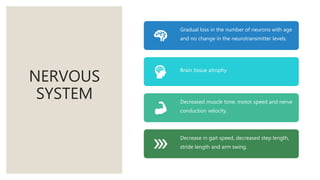
NERVOUS
SYSTEM
Gradual loss in the number of neurons with age
and no change in the neurotransmitter levels.
Brain tissue atrophy
Decreased muscle tone, motor speed and nerve
conduction velocity.
Decrease in gait speed, decreased step length,
stride length and arm swing.
NERVOUS SYSTEM
◦ASSESSMENT FINDINGS
◦ Decreased position and vibrant sense.
◦ Diminished reflexes, possible absent ankle jerks.
◦ Complaints of falls and impaired balance
◦ Wide based gait with decreased arm swing
CARDIOVASCULAR SYSTEM
◦ Valves of heart become thick and rigid, as a result of sclerosis
and fibrosis.
◦ Blood vessels become thick and rigid, resulting in elevated
blood pressure.
◦ Maximum heart rate and aerobic capacity decreased with
age.
◦ Decline in maximum oxygen consumption.
◦ Decreased baroreceptor sensitivity.
CARDIOVASCULAR SYSTEM
◦ ASSSESSMENT FINDINGS
◦ Pre hypertension
◦ Prolonged tachycardia may occur following a stressful
event.
◦ Hypertension
RESPIRATORY SYSTEM
◦ Weakening of intercostal muscles and elastic recoil of the chest
wall diminishes.
◦ Residual volume and functional residual capacity increase.
◦ Partial pressure of oxygen decreases.
◦ Decrease in mucous transport or ciliary system, therefore reduced
clearance of mucus and foreign bodies.
RESPIRATORY SYSTEM
◦ ASSESSMENT FINDINGS
◦Prolonged cough, inability to raise secretions.
◦Increased frequency of respiratory infections.
GENITOURINARY SYSTEM
◦ Females
◦Thinning of vaginal walls.
◦Narrowing of vagina in size and loss of elasticity
◦Decreased vaginal secretions resulting in vaginal dryness,
itching and decreased acidity.
◦Involution of uterus and ovaries.
◦Decreased pubococcygeal muscle tone resulting in
relaxed vagina and perineum.
GENITOURINARY SYSTEM
◦ Males
◦Penis and testes decreases in size and levels of
androgens diminishes.
◦Erectile dysfunction.
GENITOURINARY SYSTEM
◦ ASSESSMENT FINDINGS
◦Vaginal dryness, painful intercourse.
◦Atrophic vaginitis
◦Urinary incontinence, BPH and prostatic cancer.
MUSCULOSKELETAL SYSTEM
◦Declining muscle mass
◦Decreased bone density, more in women
◦Decreased thickness and resiliency of cartilage.
◦Bone resorption exceeds bone formation resulting in decline
of bone density.
◦Injuries to cartilage.
MUSCULOSKELETAL SYSTEM
◦ ASSESSMENT FINDINGS
◦Muscle atrophy
◦Increased incidence of fractures
◦Joint stiffness
◦Decreased bone density
◦Alteration in posture, ability to transfer and gait
◦Complaint of dizziness
INTEGUMENTARY SYSTEM
◦Thinning of three layers of skin and decreased ability
to function as barrier.
◦Fewer melanocytes and decreased tanning.
◦Less efficient thermoregulation because of fewer
sweat glands.
◦Drier skin because of decreased number of sebaceous
glands.
INTEGUMENTARY SYSTEM
◦ASSESSMENT FINDINGS
◦Reduced sensory output and decreased
elasticity.
◦More prone to heat stress.
◦Hypothermia.
ENDOCRINE SYSTEM
◦Decreased secretion of trophic hormones from pituitary glands.
◦Blunted growth hormone release during the times of stress.
◦Elevated vasopressin and exaggerated response to osmotic
challenge
◦Elevated levels of FSH and LH because of reduced end organ
response.
◦Normal insulin secretion at rest and an age related decrease in
secretion in response to glucose overload.
HEMATOPOETIC SYSTEM
◦Bone marrow cellularity is decreased during older life.
◦Declining marrow activity.
IMMUNOGENIC SYSTEM
◦The function of T-lymphocytes declines with age due to
involution and atrophy of thymus gland.
◦Decreased T cell helper activity and increased T cell
suppressor activity.
◦Declined b cell function as a result of T cell changes.
IMMUNOGENIC SYSTEM
◦ASSESSMENT FINDINGS
◦More frequent infections.
◦Increased incidence of many types of cancers.
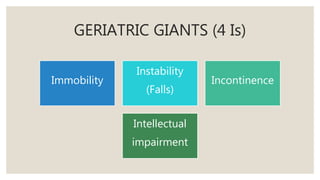
GERIATRIC GIANTS (4 Is)
Immobility
Instability
(Falls)
Incontinence
Intellectual
impairment
GERIATRIC
CARE
NEED
◦ Elderly population will keep on rising due to
advancing medical technology.
◦ Disease present atypically and at an earlier
stage
◦ Often multiorgan system involvement.
◦ Worsening of pre-existing disease are
frequent.
◦ Burden over health care system
◦ Burden over the nation’s economy.
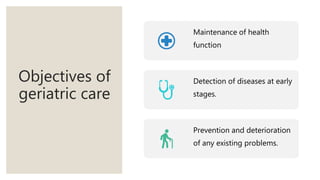
Objectives of
geriatric care
Maintenance of health
function
Detection of diseases at early
stages.
Prevention and deterioration
of any existing problems.
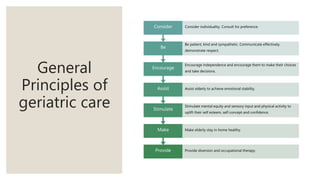
General
Principles of
geriatric care
Provide Provide diversion and occupational therapy.
Make Make elderly stay in home healthy.
Stimulate
Stimulate mental equity and sensory input and physical activity to
uplift their self esteem, self concept and confidence.
Assist Assist elderly to achieve emotional stability.
Encourage
Encourage independence and encourage them to make their choices
and take decisions.
Be
Be patient, kind and sympathetic. Communicate effectively,
demonstrate respect.
Consider Consider individuality. Consult his preference.
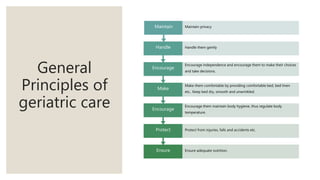
General
Principles of
geriatric care
Ensure Ensure adequate nutrition.
Protect Protect from injuries, falls and accidents etc.
Encourage
Encourage them maintain body hygiene, thus regulate body
temperature.
Make
Make them comfortable by providing comfortable bed, bed linen
etc.. Keep bed dry, smooth and unwrinkled.
Encourage
Encourage independence and encourage them to make their choices
and take decisions.
Handle Handle them gently
Maintain Maintain privacy
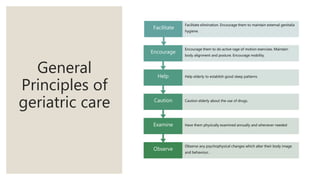
General
Principles of
geriatric care
Observe
Observe any psychophysical changes which alter their body image
and behaviour..
Examine Have them physically examined annually and whenever needed
Caution Caution elderly about the use of drugs.
Help Help elderly to establish good sleep patterns
Encourage
Encourage them to do active rage of motion exercises. Maintain
body alignment and posture. Encourage mobility.
Facilitate
Facilitate elimination. Encourage them to maintain external genitalia
hygiene.
Gerontological nursing practice
◦ Ageing is a natural process common to all living
organisms.
◦ Various factors influence aging process.
◦ Unique data and knowledge are used in applying the
nursing the nursing process to older population.
◦ Older adults share similar self care and human needs
with all other human beings.
◦ Gerontological nursing strives to help older adults
achieve the wholeness by reaching optimum levels of
physical, psychological, social and spiritual health.
GERIATRIC HEALTH
ASSESSMENT
◦ HEALTH HISTORY
◦ PHYSICAL ASSESSMENT
◦ COMPREHENSIVE ASSESSMENT
◦ FUNCTIONAL ASSESSMENT
◦ MENTAL STATUS ASSESSMENT
◦ ASSESSMENT OF SOCIAL SUPPORT
◦ ENVIRONMENT AND SAFETY ASSESSMENT
◦ INTEGRATED ASSESSMENT
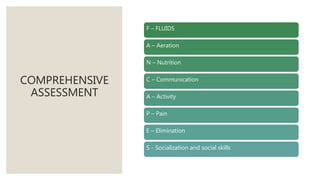
COMPREHENSIVE
ASSESSMENT
F – FLUIDS
A – Aeration
N – Nutrition
C – Communication
A – Activity
P – Pain
E – Elimination
S - Socialization and social skills
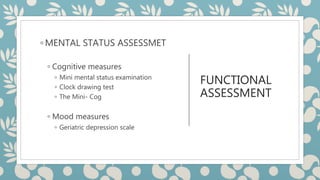
FUNCTIONAL
ASSESSMENT
◦ MENTAL STATUS ASSESSMET
◦ Cognitive measures
◦ Mini mental status examination
◦ Clock drawing test
◦ The Mini- Cog
◦ Mood measures
◦ Geriatric depression scale
INTEGRATED ASSESSMENT
◦Social resources
◦Economic resources
◦Mental health
◦Physical health
◦Activities of daily living
PREVENTIVE HEALTHCARE IN ELDERLY
◦The role of prevention in geriatrics is to delay the onset of
age-related decompensatory problems of body functions
◦It includes-
◦Primary prevention
◦Secondary prevention
◦Tertiary prevention
Primary Prevention
◦Control of B.P., Weight and diabetes
◦Avoid smoking and alcohol
◦Regular and moderate physical exercise.
◦Avoidance of drug abuse and self medication
◦Well balanced diet with plenty of vegetables and fruits, low
in saturated fats, refined sugars and fast foods.
◦Cultivation of interest in reading, listening to music and
other recreational activities.
◦Avoid plenty of food intake.
Primary Prevention
◦Periodical screening for blood pressure, vision and
screening
◦Plan for future, financial security.
◦Yoga exercises and meditation
◦Immunization against influenza, pneumonia, tetanus and
hepatitis B.
◦ Injury prevention- removal of obstacles, railing in bathroom, low level switches, easy and safe access to
water
Secondary Prevention
◦ Screening
◦Cancers
◦Diabetes
◦Dental problems.
◦Drug adverse effects
◦Infections
◦Nutritional deficiencies
◦Early detection and treatment of diseases and disability
Tertiary Prevention
◦Cataract surgery, provision of spectacles
◦Hearing aids, artificial limbs, prosthesis
◦Physiotherapy, vocational therapy, psychological and
social therapy depending upon functional capacity.
◦Deaddiction counselling
◦Establishment of old age homes and clubs.
◦Establishment of geriatric clinics.
Interventions in rehabilitation
◦Hard interventions
◦ Drugs
◦ Physiotherapy
◦ Occupational therapy
◦ Aids and adaptation
◦ Speech and language therapists
◦Soft interventions
◦ Advice
◦ Education
◦ Counseling
◦ Encouragement
◦ Listening
Supporting the caregiver
◦Social attitude
◦Physician’s support
◦Organization of day care centers.
◦Hospitalization in case of chronic illness
◦Counselling the caregiver
◦Training the caregiver
Responsibilities of Community Health
Nurse
◦Health Assessment
◦Arranging and promoting nutrition
◦Promoting activity and exercise
◦Preventing care of elderly
◦Providing psychological support
Roles of Community Health Nurse
◦Researcher
◦Leader
◦Educator
◦Advocate
◦Administrator
◦Primary health care provider
BENEFITS TO OLD AGE PEOPLE IN INDIA
LAWS IN INDIA TO PROTECT THE OLD
PEOPLE
◦Section 125(1) (d)- If any person having sufficient
means neglects or refuses to maintain his father or
mother, unable to maintain himself or herself, a
Magistrate of first class may, upon proof of such
neglect or refusal, order such person to make monthly
allowances for maintenance of his wife or mother, at
such monthly rate not exceeding Rs 500 in the whole,
as such Magistrate thinks fit, and to pay the same to
such person as the Magistrate may from time to time
direct.
LAWS IN INDIA TO PROTECT THE OLD
PEOPLE
◦Section 125(3) - If any person so ordered fails without
sufficient cause to comply with the order, any such
Magistrate may, for every breach of the order, issue a
warrant for levying the amount due in the manner
provided for levying fines, and may sentence such
person, for the whole or any part of each month’s
allowance remaining unpaid after the execution of the
warrant, to imprisonment for a term which may extend
to one month or until payment if sooner made
INDIRA GANDHI NATIONAL OLD AGE
PENSION SCHEME
◦ Objective: To disburse pension to the old age people.
◦ Assistance provided: A monthly pension of Rs 600 - Rs 1000
depending upon the state share of the pension.
◦ Beneficiary: Beyond 65 years of age belonging to BPL. And
60 years above for persons affected by leprosy, blindness,
paralysis of both limbs and insanity.
National Policy on older persons
◦ Formed in January 1999 under the ministry of
social justice and empowerment.
◦The goal of national policy is the well being of
older persons.
National Policy on senior citizens 2011
◦ Formed in January 2011
◦This policy addresses issues concerning senior citizens
living in urban and rural areas, special needs of the
older people.
◦AIM: Promote the concept of “Ageing in Place” or
ageing in own home, housing, income security and
homecare services, old age pension and access to
healthcare insurance schemes and other programmes
and services to facilitate and sustain dignity in old age.
ANNAPURNA SCHEME
◦ The Annapurna Scheme aims at providing food
security to meet the requirement of those Senior
Citizens who though eligible have remained
uncovered under the National Old Age Pension
Scheme (NOAPS).
◦Under the Annapurna Scheme, 10 kg of food
grains per month are to be provided free of cost'
to the Beneficiary.
NATIONAL PROGRAM FOR
HEALTHCARE OF THE ELDERLY
(NPHCE)
◦Launched in 2010.
◦Objectives:
◦ To provide accessible, affordable, and high-quality long-term,
comprehensive and dedicated care services to an Ageing
population;
◦ Creating a new “architecture” for Ageing;
◦ To build a framework to create an enabling environment for “a
Society for all Ages”;
◦ To promote the concept of Active and Healthy Ageing;
NATIONAL PROGRAM FOR
HEALTHCARE OF THE ELDERLY
(NPHCE)
◦ At sub-center level, Domiciliary visits for attention and care to home bound /
bedridden elderly persons and provide training to the family care providers in
looking after the disabled elderly persons.
◦ At PHC level, Conducting a routine health assessment of the elderly persons
based on simple clinical examination relating to eye, BP
, blood sugar, etc.
◦ At CHC level, Geriatric Clinic for the elderly persons twice a week. Rehabilitation
Unit for physiotherapy and counselling
NATIONAL PROGRAM FOR
HEALTHCARE OF THE ELDERLY
(NPHCE)
◦ At District Hospital, Geriatric Clinic for regular dedicated OPD services to
the Elderly. Ten-bedded Geriatric Ward for in-patient care of the Elderly
◦ Geriatric Regional center, 30-bedded Geriatric Ward for in-patient care and
dedicated beds for the elderly patients in the various specialties viz.
Surgery, Orthopedics, Psychiatry, Urology, Ophthalmology, Neurology etc.
◦ There are 8 regional geriatric centers in India.
MINISTRY OF RAILWAYS
◦Concessions to senior citizens
◦As per Indian Railway Catering and Tourism
Corporation (IRCTC), 40% concession for male
(60 years and above) and 50% for female
senior citizens (above 58 years)is granted in
train fares of all classes.
MINISTRY OF RAILWAYS
◦Concessions to senior citizens
◦As per Indian Railway Catering and Tourism
Corporation (IRCTC), 40% concession for male
(60 years and above) and 50% for female
senior citizens (above 58 years)is granted in
train fares of all classes.
MINISTRY OF FINANCE
◦ Exemption limit Rs. 3,00,000 for senior citizens above 60 years
but less than 80 years.
◦ Exemption limit Rs. 5,00,000 for senior citizens above 80 years.
◦ Exemption from e-filing.
◦ Exemption from payment of advance tax
◦ Income tax rebate for Medical Treatment for Specified Diseases
for Senior Citizens.
◦ Income tax rebate for Medical Insurance Premium for Senior
Citizens.
◦ Higher rates of interest on saving schemes of senior citizens.
MINISTRY OF HEALTH AND FAMILY
WELFARE
◦The Senior Citizens Health Insurance Scheme (SCHIS) as
top up over existing Rashtriya Swasthya Bima Yojana
(RSBY) scheme is being implemented for senior citizens
aged 60 years and above.
◦SCHIS provides enhanced coverage of Rs. 30,000 per
senior citizen in the family eligible for coverage under
RSBY).
HELPAGE INDIA
◦It is a secular, non-profit largest involuntary
organization set up in 1978.
◦The organization works for the cause and care of
disadvantaged older persons to improve their quality
of life.
◦It recently became the first and only Indian
organization to be honoured with the ‘UN Population
Award 2020’ for its exemplary work in the field of
ageing, relief efforts work during the Covid 19
pandemic
HELPAGE INDIA
◦ The organization addresses elder needs and advocating for their
rights, such as their right to Universal Pension, quality Healthcare,
action against Elder Abuse and many more at a national, state and
societal level with Central and State governments.
◦ The programs are focused on direct interventions in the areas
of Healthcare (mobile healthcare units, cataract
surgeries), Agecare (helplines, senior citizen care homes and day
care centres, physiotherapy), Livelihoods (elder-self-help groups;
linkages with government schemes), Disaster Response (e.g. covid19
relief response), as well as Advocacy and Awareness on rights and
policies relating to elders.
International Day of Older persons
◦The 1st October is observed every year as the International
Day of Older Persons internationally. Being the nodal
Ministry for the welfare of senior citizens, Ministry of Social
Justice & Empowerment has been celebrating the occasion
every year by organizing a series of programmes and
felicitating the distinguished senior citizens with
Vayoshrestha Samman.
◦The main idea behind these celebrations is to reiterate the
government's commitment towards welfare of the elderly
and to ensure that the services rendered by the elderly get
its due recognition in the society.

geriatric care nursing.pptx

  • 1.
    GERIATRIC CARE NURSING Mrs. NamitaBatra Guin Professor Deptt. of Community Health Nursing
  • 2.
    Geriatrics It is asub specialty of internal medicine and family medicine that focuses on health care of elderly people. Geriatric Nursing: Nursing care of aged people given in the home, the hospital or special institutions like nursing homes, psychiatric institutions etc.
  • 3.
    Gerontology ◦ The scientificstudy of biological, psychological, and sociological phenomena associated with old age and aging
  • 4.
    AGEING It is aprogressive and generalized impairment of body functions resulting in loss of adaptive responses to stress and increasing the risk of age-related diseases. People more than 60 years are considered elderly. Old age is not a disease but a normal inevitable biological phenomenon.
  • 5.
    THEORIES OF AGEING • Somaticmutation of genes • Genetically determined life-span • Cross linkage or loss of important cellular components and DNA Genetic theories • Accumulation of toxic metabolites and free oxygen radicals • Reduced physiological capacity and wear and tear of cells of vital organs • Non-enzymatic glycosylation of proteins. Random Damage theories
  • 6.
    Factors affecting ageing 1. Hereditary factors 2.Environmental factors 3. Abiotic factors 4. Biotic factors 5. Socio-economic factors
  • 7.
    HEALTH PROBLEMS OF AGED 1. Physicalproblems : visual problems, locomotor system problems etc. 2. Psychological problems: dementia, delirium, depression, substance abuse anxiety, loss of appetite, concentration etc. 3. Social problems: abuse, dependency, insecurity and rehab 4. Economical problems: Lack of source of income. Economic dependency on children.
  • 8.
  • 9.
    SENSORY SYSTEM ◦ VISION ◦ Decreasedvisual acuity ◦ Decreased peripheral vision ◦ Decreased dark adaptation ◦ Elevated minimum threshold of light perception. ◦ Presbyopia ◦ Decreased colour discrimination ◦ Increased sensitivity to glare ◦ Decreased depth sensation ◦ Decreased tears.
  • 10.
    SENSORY SYSTEM ◦Assessment findings ◦ Arcussinilis – a gray or white arc visible above and below the outer part of the cornea. ◦ Cataract ◦ Macular degeneration. ◦ Glaucoma ◦ Smaller pupil size ◦ Dry, red eyes. ◦ Vitreous floaters.
  • 11.
    SENSORY SYSTEM ◦ HEARING ◦ Hearingloss ◦ Consonants are not heard well. ◦ Hearing capacity decreases with age and greater in men. ◦ Increase in the sound threshold. ◦ Decreased speech discrimination. ◦ Cerumen impaction ◦ Usual progression from high tone or high frequency loss to a general loss of both low and high tones.
  • 12.
    SENSORY SYSTEM ◦ Assessment findings ◦Increased volume of patient’s own voice. ◦ Turning of head towards speaker. ◦ Requesting speaker to repeat ◦ Inappropriate answers ◦ The person may withdraw, demonstrate short span and become frustrated, angry and depressed. ◦ Lack of response to a loud noise.
  • 13.
    SENSORY SYSTEM ◦ SMELL ◦Changes in smell due to nasal sinus disease preventing odours from reaching smell receptors. ◦ Decreased discrimination. ◦ Decreased more in men ◦ ASSESSMENT FINDINGS ◦ Inability to notice unpleasant odours. ◦ Decreased appetite.
  • 14.
    SENSORY SYSTEM ◦ TASTE ◦Taste buds decreases with age specially in men. ◦ Taste buds lost from from the front to the back ◦ ASSESSMENT FINDINGS ◦ Complaints of food has no taste. ◦ Excessive use of sugar and salt. ◦ Inability to identify the foods. ◦ Decrease in appetite and weight loss. ◦ Decreased pleasure from food
  • 15.
    NERVOUS SYSTEM Gradual loss inthe number of neurons with age and no change in the neurotransmitter levels. Brain tissue atrophy Decreased muscle tone, motor speed and nerve conduction velocity. Decrease in gait speed, decreased step length, stride length and arm swing.
  • 16.
    NERVOUS SYSTEM ◦ASSESSMENT FINDINGS ◦Decreased position and vibrant sense. ◦ Diminished reflexes, possible absent ankle jerks. ◦ Complaints of falls and impaired balance ◦ Wide based gait with decreased arm swing
  • 17.
    CARDIOVASCULAR SYSTEM ◦ Valvesof heart become thick and rigid, as a result of sclerosis and fibrosis. ◦ Blood vessels become thick and rigid, resulting in elevated blood pressure. ◦ Maximum heart rate and aerobic capacity decreased with age. ◦ Decline in maximum oxygen consumption. ◦ Decreased baroreceptor sensitivity.
  • 18.
    CARDIOVASCULAR SYSTEM ◦ ASSSESSMENTFINDINGS ◦ Pre hypertension ◦ Prolonged tachycardia may occur following a stressful event. ◦ Hypertension
  • 19.
    RESPIRATORY SYSTEM ◦ Weakeningof intercostal muscles and elastic recoil of the chest wall diminishes. ◦ Residual volume and functional residual capacity increase. ◦ Partial pressure of oxygen decreases. ◦ Decrease in mucous transport or ciliary system, therefore reduced clearance of mucus and foreign bodies.
  • 20.
    RESPIRATORY SYSTEM ◦ ASSESSMENTFINDINGS ◦Prolonged cough, inability to raise secretions. ◦Increased frequency of respiratory infections.
  • 21.
    GENITOURINARY SYSTEM ◦ Females ◦Thinningof vaginal walls. ◦Narrowing of vagina in size and loss of elasticity ◦Decreased vaginal secretions resulting in vaginal dryness, itching and decreased acidity. ◦Involution of uterus and ovaries. ◦Decreased pubococcygeal muscle tone resulting in relaxed vagina and perineum.
  • 22.
    GENITOURINARY SYSTEM ◦ Males ◦Penisand testes decreases in size and levels of androgens diminishes. ◦Erectile dysfunction.
  • 23.
    GENITOURINARY SYSTEM ◦ ASSESSMENTFINDINGS ◦Vaginal dryness, painful intercourse. ◦Atrophic vaginitis ◦Urinary incontinence, BPH and prostatic cancer.
  • 24.
    MUSCULOSKELETAL SYSTEM ◦Declining musclemass ◦Decreased bone density, more in women ◦Decreased thickness and resiliency of cartilage. ◦Bone resorption exceeds bone formation resulting in decline of bone density. ◦Injuries to cartilage.
  • 25.
    MUSCULOSKELETAL SYSTEM ◦ ASSESSMENTFINDINGS ◦Muscle atrophy ◦Increased incidence of fractures ◦Joint stiffness ◦Decreased bone density ◦Alteration in posture, ability to transfer and gait ◦Complaint of dizziness
  • 26.
    INTEGUMENTARY SYSTEM ◦Thinning ofthree layers of skin and decreased ability to function as barrier. ◦Fewer melanocytes and decreased tanning. ◦Less efficient thermoregulation because of fewer sweat glands. ◦Drier skin because of decreased number of sebaceous glands.
  • 27.
    INTEGUMENTARY SYSTEM ◦ASSESSMENT FINDINGS ◦Reducedsensory output and decreased elasticity. ◦More prone to heat stress. ◦Hypothermia.
  • 28.
    ENDOCRINE SYSTEM ◦Decreased secretionof trophic hormones from pituitary glands. ◦Blunted growth hormone release during the times of stress. ◦Elevated vasopressin and exaggerated response to osmotic challenge ◦Elevated levels of FSH and LH because of reduced end organ response. ◦Normal insulin secretion at rest and an age related decrease in secretion in response to glucose overload.
  • 29.
    HEMATOPOETIC SYSTEM ◦Bone marrowcellularity is decreased during older life. ◦Declining marrow activity.
  • 30.
    IMMUNOGENIC SYSTEM ◦The functionof T-lymphocytes declines with age due to involution and atrophy of thymus gland. ◦Decreased T cell helper activity and increased T cell suppressor activity. ◦Declined b cell function as a result of T cell changes.
  • 31.
    IMMUNOGENIC SYSTEM ◦ASSESSMENT FINDINGS ◦Morefrequent infections. ◦Increased incidence of many types of cancers.
  • 32.
    GERIATRIC GIANTS (4Is) Immobility Instability (Falls) Incontinence Intellectual impairment
  • 33.
    GERIATRIC CARE NEED ◦ Elderly populationwill keep on rising due to advancing medical technology. ◦ Disease present atypically and at an earlier stage ◦ Often multiorgan system involvement. ◦ Worsening of pre-existing disease are frequent. ◦ Burden over health care system ◦ Burden over the nation’s economy.
  • 34.
    Objectives of geriatric care Maintenanceof health function Detection of diseases at early stages. Prevention and deterioration of any existing problems.
  • 35.
    General Principles of geriatric care ProvideProvide diversion and occupational therapy. Make Make elderly stay in home healthy. Stimulate Stimulate mental equity and sensory input and physical activity to uplift their self esteem, self concept and confidence. Assist Assist elderly to achieve emotional stability. Encourage Encourage independence and encourage them to make their choices and take decisions. Be Be patient, kind and sympathetic. Communicate effectively, demonstrate respect. Consider Consider individuality. Consult his preference.
  • 36.
    General Principles of geriatric care EnsureEnsure adequate nutrition. Protect Protect from injuries, falls and accidents etc. Encourage Encourage them maintain body hygiene, thus regulate body temperature. Make Make them comfortable by providing comfortable bed, bed linen etc.. Keep bed dry, smooth and unwrinkled. Encourage Encourage independence and encourage them to make their choices and take decisions. Handle Handle them gently Maintain Maintain privacy
  • 37.
    General Principles of geriatric care Observe Observeany psychophysical changes which alter their body image and behaviour.. Examine Have them physically examined annually and whenever needed Caution Caution elderly about the use of drugs. Help Help elderly to establish good sleep patterns Encourage Encourage them to do active rage of motion exercises. Maintain body alignment and posture. Encourage mobility. Facilitate Facilitate elimination. Encourage them to maintain external genitalia hygiene.
  • 38.
    Gerontological nursing practice ◦Ageing is a natural process common to all living organisms. ◦ Various factors influence aging process. ◦ Unique data and knowledge are used in applying the nursing the nursing process to older population. ◦ Older adults share similar self care and human needs with all other human beings. ◦ Gerontological nursing strives to help older adults achieve the wholeness by reaching optimum levels of physical, psychological, social and spiritual health.
  • 39.
    GERIATRIC HEALTH ASSESSMENT ◦ HEALTHHISTORY ◦ PHYSICAL ASSESSMENT ◦ COMPREHENSIVE ASSESSMENT ◦ FUNCTIONAL ASSESSMENT ◦ MENTAL STATUS ASSESSMENT ◦ ASSESSMENT OF SOCIAL SUPPORT ◦ ENVIRONMENT AND SAFETY ASSESSMENT ◦ INTEGRATED ASSESSMENT
  • 40.
    COMPREHENSIVE ASSESSMENT F – FLUIDS A– Aeration N – Nutrition C – Communication A – Activity P – Pain E – Elimination S - Socialization and social skills
  • 41.
    FUNCTIONAL ASSESSMENT ◦ MENTAL STATUSASSESSMET ◦ Cognitive measures ◦ Mini mental status examination ◦ Clock drawing test ◦ The Mini- Cog ◦ Mood measures ◦ Geriatric depression scale
  • 42.
    INTEGRATED ASSESSMENT ◦Social resources ◦Economicresources ◦Mental health ◦Physical health ◦Activities of daily living
  • 43.
    PREVENTIVE HEALTHCARE INELDERLY ◦The role of prevention in geriatrics is to delay the onset of age-related decompensatory problems of body functions ◦It includes- ◦Primary prevention ◦Secondary prevention ◦Tertiary prevention
  • 44.
    Primary Prevention ◦Control ofB.P., Weight and diabetes ◦Avoid smoking and alcohol ◦Regular and moderate physical exercise. ◦Avoidance of drug abuse and self medication ◦Well balanced diet with plenty of vegetables and fruits, low in saturated fats, refined sugars and fast foods. ◦Cultivation of interest in reading, listening to music and other recreational activities. ◦Avoid plenty of food intake.
  • 45.
    Primary Prevention ◦Periodical screeningfor blood pressure, vision and screening ◦Plan for future, financial security. ◦Yoga exercises and meditation ◦Immunization against influenza, pneumonia, tetanus and hepatitis B. ◦ Injury prevention- removal of obstacles, railing in bathroom, low level switches, easy and safe access to water
  • 46.
    Secondary Prevention ◦ Screening ◦Cancers ◦Diabetes ◦Dentalproblems. ◦Drug adverse effects ◦Infections ◦Nutritional deficiencies ◦Early detection and treatment of diseases and disability
  • 47.
    Tertiary Prevention ◦Cataract surgery,provision of spectacles ◦Hearing aids, artificial limbs, prosthesis ◦Physiotherapy, vocational therapy, psychological and social therapy depending upon functional capacity. ◦Deaddiction counselling ◦Establishment of old age homes and clubs. ◦Establishment of geriatric clinics.
  • 48.
    Interventions in rehabilitation ◦Hardinterventions ◦ Drugs ◦ Physiotherapy ◦ Occupational therapy ◦ Aids and adaptation ◦ Speech and language therapists ◦Soft interventions ◦ Advice ◦ Education ◦ Counseling ◦ Encouragement ◦ Listening
  • 49.
    Supporting the caregiver ◦Socialattitude ◦Physician’s support ◦Organization of day care centers. ◦Hospitalization in case of chronic illness ◦Counselling the caregiver ◦Training the caregiver
  • 50.
    Responsibilities of CommunityHealth Nurse ◦Health Assessment ◦Arranging and promoting nutrition ◦Promoting activity and exercise ◦Preventing care of elderly ◦Providing psychological support
  • 51.
    Roles of CommunityHealth Nurse ◦Researcher ◦Leader ◦Educator ◦Advocate ◦Administrator ◦Primary health care provider
  • 52.
    BENEFITS TO OLDAGE PEOPLE IN INDIA
  • 53.
    LAWS IN INDIATO PROTECT THE OLD PEOPLE ◦Section 125(1) (d)- If any person having sufficient means neglects or refuses to maintain his father or mother, unable to maintain himself or herself, a Magistrate of first class may, upon proof of such neglect or refusal, order such person to make monthly allowances for maintenance of his wife or mother, at such monthly rate not exceeding Rs 500 in the whole, as such Magistrate thinks fit, and to pay the same to such person as the Magistrate may from time to time direct.
  • 54.
    LAWS IN INDIATO PROTECT THE OLD PEOPLE ◦Section 125(3) - If any person so ordered fails without sufficient cause to comply with the order, any such Magistrate may, for every breach of the order, issue a warrant for levying the amount due in the manner provided for levying fines, and may sentence such person, for the whole or any part of each month’s allowance remaining unpaid after the execution of the warrant, to imprisonment for a term which may extend to one month or until payment if sooner made
  • 55.
    INDIRA GANDHI NATIONALOLD AGE PENSION SCHEME ◦ Objective: To disburse pension to the old age people. ◦ Assistance provided: A monthly pension of Rs 600 - Rs 1000 depending upon the state share of the pension. ◦ Beneficiary: Beyond 65 years of age belonging to BPL. And 60 years above for persons affected by leprosy, blindness, paralysis of both limbs and insanity.
  • 56.
    National Policy onolder persons ◦ Formed in January 1999 under the ministry of social justice and empowerment. ◦The goal of national policy is the well being of older persons.
  • 57.
    National Policy onsenior citizens 2011 ◦ Formed in January 2011 ◦This policy addresses issues concerning senior citizens living in urban and rural areas, special needs of the older people. ◦AIM: Promote the concept of “Ageing in Place” or ageing in own home, housing, income security and homecare services, old age pension and access to healthcare insurance schemes and other programmes and services to facilitate and sustain dignity in old age.
  • 58.
    ANNAPURNA SCHEME ◦ TheAnnapurna Scheme aims at providing food security to meet the requirement of those Senior Citizens who though eligible have remained uncovered under the National Old Age Pension Scheme (NOAPS). ◦Under the Annapurna Scheme, 10 kg of food grains per month are to be provided free of cost' to the Beneficiary.
  • 59.
    NATIONAL PROGRAM FOR HEALTHCAREOF THE ELDERLY (NPHCE) ◦Launched in 2010. ◦Objectives: ◦ To provide accessible, affordable, and high-quality long-term, comprehensive and dedicated care services to an Ageing population; ◦ Creating a new “architecture” for Ageing; ◦ To build a framework to create an enabling environment for “a Society for all Ages”; ◦ To promote the concept of Active and Healthy Ageing;
  • 60.
    NATIONAL PROGRAM FOR HEALTHCAREOF THE ELDERLY (NPHCE) ◦ At sub-center level, Domiciliary visits for attention and care to home bound / bedridden elderly persons and provide training to the family care providers in looking after the disabled elderly persons. ◦ At PHC level, Conducting a routine health assessment of the elderly persons based on simple clinical examination relating to eye, BP , blood sugar, etc. ◦ At CHC level, Geriatric Clinic for the elderly persons twice a week. Rehabilitation Unit for physiotherapy and counselling
  • 61.
    NATIONAL PROGRAM FOR HEALTHCAREOF THE ELDERLY (NPHCE) ◦ At District Hospital, Geriatric Clinic for regular dedicated OPD services to the Elderly. Ten-bedded Geriatric Ward for in-patient care of the Elderly ◦ Geriatric Regional center, 30-bedded Geriatric Ward for in-patient care and dedicated beds for the elderly patients in the various specialties viz. Surgery, Orthopedics, Psychiatry, Urology, Ophthalmology, Neurology etc. ◦ There are 8 regional geriatric centers in India.
  • 62.
    MINISTRY OF RAILWAYS ◦Concessionsto senior citizens ◦As per Indian Railway Catering and Tourism Corporation (IRCTC), 40% concession for male (60 years and above) and 50% for female senior citizens (above 58 years)is granted in train fares of all classes.
  • 63.
    MINISTRY OF RAILWAYS ◦Concessionsto senior citizens ◦As per Indian Railway Catering and Tourism Corporation (IRCTC), 40% concession for male (60 years and above) and 50% for female senior citizens (above 58 years)is granted in train fares of all classes.
  • 64.
    MINISTRY OF FINANCE ◦Exemption limit Rs. 3,00,000 for senior citizens above 60 years but less than 80 years. ◦ Exemption limit Rs. 5,00,000 for senior citizens above 80 years. ◦ Exemption from e-filing. ◦ Exemption from payment of advance tax ◦ Income tax rebate for Medical Treatment for Specified Diseases for Senior Citizens. ◦ Income tax rebate for Medical Insurance Premium for Senior Citizens. ◦ Higher rates of interest on saving schemes of senior citizens.
  • 65.
    MINISTRY OF HEALTHAND FAMILY WELFARE ◦The Senior Citizens Health Insurance Scheme (SCHIS) as top up over existing Rashtriya Swasthya Bima Yojana (RSBY) scheme is being implemented for senior citizens aged 60 years and above. ◦SCHIS provides enhanced coverage of Rs. 30,000 per senior citizen in the family eligible for coverage under RSBY).
  • 66.
    HELPAGE INDIA ◦It isa secular, non-profit largest involuntary organization set up in 1978. ◦The organization works for the cause and care of disadvantaged older persons to improve their quality of life. ◦It recently became the first and only Indian organization to be honoured with the ‘UN Population Award 2020’ for its exemplary work in the field of ageing, relief efforts work during the Covid 19 pandemic
  • 67.
    HELPAGE INDIA ◦ Theorganization addresses elder needs and advocating for their rights, such as their right to Universal Pension, quality Healthcare, action against Elder Abuse and many more at a national, state and societal level with Central and State governments. ◦ The programs are focused on direct interventions in the areas of Healthcare (mobile healthcare units, cataract surgeries), Agecare (helplines, senior citizen care homes and day care centres, physiotherapy), Livelihoods (elder-self-help groups; linkages with government schemes), Disaster Response (e.g. covid19 relief response), as well as Advocacy and Awareness on rights and policies relating to elders.
  • 68.
    International Day ofOlder persons ◦The 1st October is observed every year as the International Day of Older Persons internationally. Being the nodal Ministry for the welfare of senior citizens, Ministry of Social Justice & Empowerment has been celebrating the occasion every year by organizing a series of programmes and felicitating the distinguished senior citizens with Vayoshrestha Samman. ◦The main idea behind these celebrations is to reiterate the government's commitment towards welfare of the elderly and to ensure that the services rendered by the elderly get its due recognition in the society.