

COMMUNITY HEALTH NURSING
CLINICAL TEACHING
Presented by
SHWETA
Bsc. Nursing
• 3
CONTENT
Introduction
Definition
Epidemiological determinants- Agent, Host and Environment
Mode of transmission
Signs and Symptoms
Diagnosis
Treatment
Complication
Prevention & Control
Yaws is a tropical
infection of the skin,
bones and joints caused
by the spirochete
bacterium Treponema
pallidum pertenue. The
disease begins with a
round, hard swelling of
the skin, 2 to 5
centimeters in diameter.
The center may break
open and form an ulcer.
DEFINITION
Yaws is a chronic contagious disease. It is a crippling
disease, lesions on palms and soles which may disable a
person for long periods making him dependent on
others.
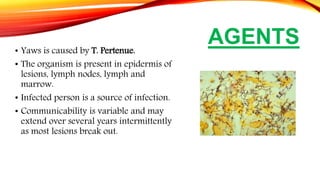
AGENTS• Yaws is caused by T. Pertenue.
• The organism is present in epidermis of
lesions, lymph nodes, lymph and
marrow.
• Infected person is a source of infection.
• Communicability is variable and may
extend over several years intermittently
as most lesions break out.
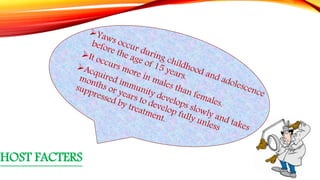
HOST FACTERS
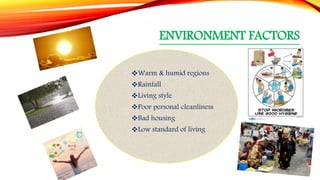
ENVIRONMENT FACTORS
Warm & humid regions
Rainfall
Living style
Poor personal cleanliness
Bad housing
Low standard of living
MODE OF TRANSMISSION
• Direct contact with the secretions of infectious lesions.
• Indirect contact – The organism can remain alive on fomites in hot & humid conditions.
• Mechanical- The insects feeding on lesions has the possibility to transit the infection
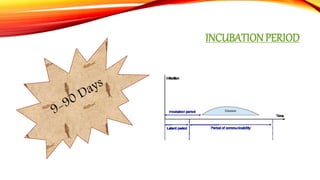
INCUBATION PERIOD
SIGNS AND SYMPTOMS
• There are two basic stages of yaws
disease - early (infectious) and late
(non-infectious):
• In early yaws, an initial papule develops
at the site of entry of the causative
organism. This papule is full of the
organisms and may persist for 3-6
months followed by natural healing.
Without treatment, this is followed by
disseminated skin lesions over the body.
Bone pain and bone lesions may also
occur.
• Late yaws appears after five years of the
initial infection and is characterized by
disabling consequences of the nose,
bones and palmar/plantar
hyperkeratosis.
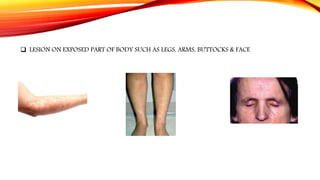
 LESION ON EXPOSED PART OF BODY SUCH AS LEGS, ARMS, BUTTOCKS & FACE
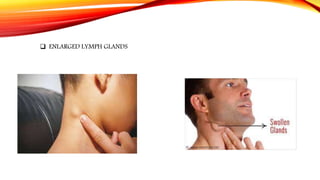
 ENLARGED LYMPH GLANDS
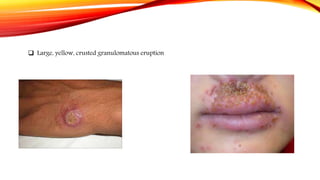
 Large, yellow, crusted granulomatous eruption
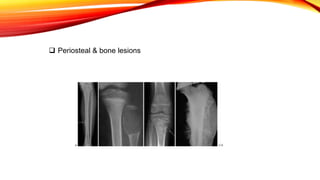
 Periosteal & bone lesions
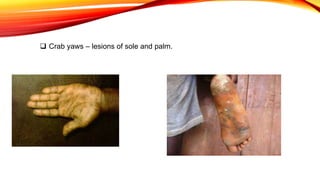
 Crab yaws – lesions of sole and palm.
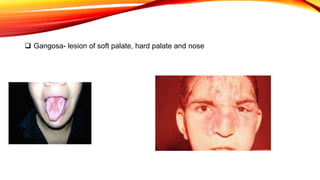
 Gangosa- lesion of soft palate, hard palate and nose
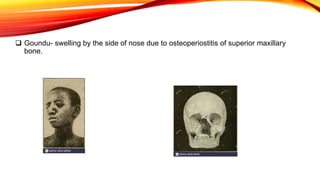
 Goundu- swelling by the side of nose due to osteoperiostitis of superior maxillary
bone.
Laboratory diagnostic
Nontreponemal test (eg, rapid plasma reagent [RPR], VDRL) results are
positive in all stages, except very early lesions.
Confirmatory Treponemal tests (eg, Treponema pallidum
hemagglutination [TPHA], microhemagglutination Treponema
pallidum [MHA-TP], fluorescent treponema antibody absorption
[FTA-ABS]) are not practical in remote areas.
Results of dark-field examination of early lesions will be
positive.
Biopsy of late lesions may be needed to show characteristic
histopathology.
Histologic Findings: Typical histopathology of early yaws shows
papillomatous epidermal hyperplasia, focal spongiosis, and
intraepidermal microabscesses.
Treponemes are found in the epidermidis.
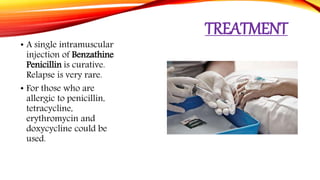
TREATMENT
• A single intramuscular
injection of Benzathine
Penicillin is curative.
Relapse is very rare.
• For those who are
allergic to penicillin,
tetracycline,
erythromycin and
doxycycline could be
used.
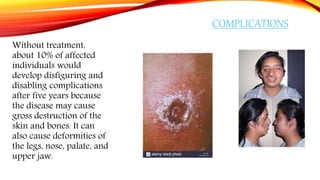
COMPLICATIONS
Without treatment,
about 10% of affected
individuals would
develop disfiguring and
disabling complications
after five years because
the disease may cause
gross destruction of the
skin and bones. It can
also cause deformities of
the legs, nose, palate, and
upper jaw.
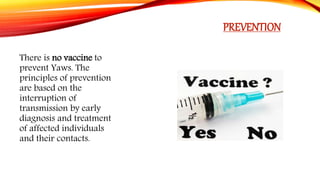
PREVENTION
There is no vaccine to
prevent Yaws. The
principles of prevention
are based on the
interruption of
transmission by early
diagnosis and treatment
of affected individuals
and their contacts.
CONTROL OF YAWS
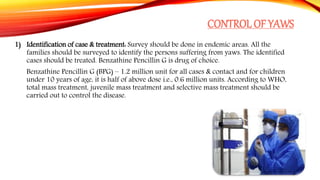
1) Identification of case & treatment: Survey should be done in endemic areas. All the
families should be surveyed to identify the persons suffering from yaws. The identified
cases should be treated. Benzathine Pencillin G is drug of choice.
Benzathine Pencillin G (BPG) – 1.2 million unit for all cases & contact and for children
under 10 years of age, it is half of above dose i.e., 0.6 million units. According to WHO,
total mass treatment, juvenile mass treatment and selective mass treatment should be
carried out to control the disease.
2) Surveys & resurveys: Surveys & follow up resurveys should be carried out in order
to find out, the missing cases & new cases in order to interrupt the transmission.
The resurveys should be done after 6 to 12 months.
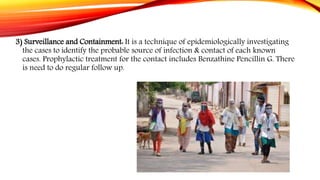
3) Surveillance and Containment: It is a technique of epidemiologically investigating
the cases to identify the probable source of infection & contact of each known
cases. Prophylactic treatment for the contact includes Benzathine Pencillin G. There
is need to do regular follow up.
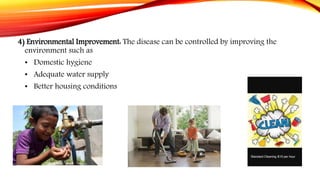
4) Environmental Improvement: The disease can be controlled by improving the
environment such as
• Domestic hygiene
• Adequate water supply
• Better housing conditions
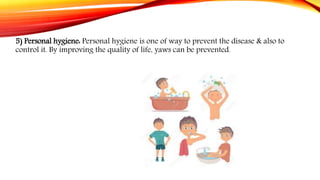
5) Personal hygiene: Personal hygiene is one of way to prevent the disease & also to
control it. By improving the quality of life, yaws can be prevented.
SUMMARY
• Yaws is a chronic infection that affects mainly the skin, bone and cartilage.
• The disease occurs mainly in poor communities in warm, humid, tropical areas of Africa, Asia
and Latin America.
• The causative organism is a bacterium called Treponema pertenue, a subspecies of Treponema
pallidum that causes venereal syphilis. However, yaws is a non-venereal infection.
• About 75% of people affected are children under 15 years of age (peak incidence occurs in
children aged 6-10 years); males and females are affected and no race is exempt.
• Yaws is transmitted mainly through direct skin contact with an infected person.
• A single skin lesion develops at the point of entry of the bacterium after 2–4 weeks. Without
treatment, multiple lesions appear all over the body.
• Overcrowding, poor personal hygiene and poor sanitation facilitate the spread of the disease.
• The disease is rarely fatal; however, it can lead to chronic disfigurement and disability. Yaws can
be treated with a single dose of a cheap and effective antibiotic: Benzathine Penicillin injection
cures the disease.
REFERENCE
• Kumari’s Neelam ‘A Textbook of COMMUNITY HEALTH NURSING –I’, PV Books
publication, p.g. no. 546-8.
• Park’s K ‘PREVENTIVE AND SOCIAL MEDICINE’, 23rd Edition, p.g 341-3
• Websites-
-www.who.int
-www.medscape.com
-medlineplus.gov
-www.ncbi.nlm.nih.gov
-www.slideshare.net
Yaws
Yaws

Yaws

  • 2.
    COMMUNITY HEALTH NURSING CLINICALTEACHING Presented by SHWETA Bsc. Nursing
  • 3.
  • 4.
    CONTENT Introduction Definition Epidemiological determinants- Agent,Host and Environment Mode of transmission Signs and Symptoms Diagnosis Treatment Complication Prevention & Control
  • 5.
    Yaws is atropical infection of the skin, bones and joints caused by the spirochete bacterium Treponema pallidum pertenue. The disease begins with a round, hard swelling of the skin, 2 to 5 centimeters in diameter. The center may break open and form an ulcer.
  • 6.
    DEFINITION Yaws is achronic contagious disease. It is a crippling disease, lesions on palms and soles which may disable a person for long periods making him dependent on others.
  • 8.
    AGENTS• Yaws iscaused by T. Pertenue. • The organism is present in epidermis of lesions, lymph nodes, lymph and marrow. • Infected person is a source of infection. • Communicability is variable and may extend over several years intermittently as most lesions break out.
  • 9.
  • 10.
    ENVIRONMENT FACTORS Warm &humid regions Rainfall Living style Poor personal cleanliness Bad housing Low standard of living
  • 11.
    MODE OF TRANSMISSION •Direct contact with the secretions of infectious lesions. • Indirect contact – The organism can remain alive on fomites in hot & humid conditions. • Mechanical- The insects feeding on lesions has the possibility to transit the infection
  • 12.
  • 13.
    SIGNS AND SYMPTOMS •There are two basic stages of yaws disease - early (infectious) and late (non-infectious): • In early yaws, an initial papule develops at the site of entry of the causative organism. This papule is full of the organisms and may persist for 3-6 months followed by natural healing. Without treatment, this is followed by disseminated skin lesions over the body. Bone pain and bone lesions may also occur. • Late yaws appears after five years of the initial infection and is characterized by disabling consequences of the nose, bones and palmar/plantar hyperkeratosis.
  • 14.
     LESION ONEXPOSED PART OF BODY SUCH AS LEGS, ARMS, BUTTOCKS & FACE
  • 15.
  • 16.
     Large, yellow,crusted granulomatous eruption
  • 17.
     Periosteal &bone lesions
  • 18.
     Crab yaws– lesions of sole and palm.
  • 19.
     Gangosa- lesionof soft palate, hard palate and nose
  • 20.
     Goundu- swellingby the side of nose due to osteoperiostitis of superior maxillary bone.
  • 21.
    Laboratory diagnostic Nontreponemal test(eg, rapid plasma reagent [RPR], VDRL) results are positive in all stages, except very early lesions. Confirmatory Treponemal tests (eg, Treponema pallidum hemagglutination [TPHA], microhemagglutination Treponema pallidum [MHA-TP], fluorescent treponema antibody absorption [FTA-ABS]) are not practical in remote areas. Results of dark-field examination of early lesions will be positive. Biopsy of late lesions may be needed to show characteristic histopathology. Histologic Findings: Typical histopathology of early yaws shows papillomatous epidermal hyperplasia, focal spongiosis, and intraepidermal microabscesses. Treponemes are found in the epidermidis.
  • 22.
    TREATMENT • A singleintramuscular injection of Benzathine Penicillin is curative. Relapse is very rare. • For those who are allergic to penicillin, tetracycline, erythromycin and doxycycline could be used.
  • 23.
    COMPLICATIONS Without treatment, about 10%of affected individuals would develop disfiguring and disabling complications after five years because the disease may cause gross destruction of the skin and bones. It can also cause deformities of the legs, nose, palate, and upper jaw.
  • 25.
    PREVENTION There is novaccine to prevent Yaws. The principles of prevention are based on the interruption of transmission by early diagnosis and treatment of affected individuals and their contacts.
  • 26.
    CONTROL OF YAWS 1)Identification of case & treatment: Survey should be done in endemic areas. All the families should be surveyed to identify the persons suffering from yaws. The identified cases should be treated. Benzathine Pencillin G is drug of choice. Benzathine Pencillin G (BPG) – 1.2 million unit for all cases & contact and for children under 10 years of age, it is half of above dose i.e., 0.6 million units. According to WHO, total mass treatment, juvenile mass treatment and selective mass treatment should be carried out to control the disease.
  • 27.
    2) Surveys &resurveys: Surveys & follow up resurveys should be carried out in order to find out, the missing cases & new cases in order to interrupt the transmission. The resurveys should be done after 6 to 12 months.
  • 28.
    3) Surveillance andContainment: It is a technique of epidemiologically investigating the cases to identify the probable source of infection & contact of each known cases. Prophylactic treatment for the contact includes Benzathine Pencillin G. There is need to do regular follow up.
  • 29.
    4) Environmental Improvement:The disease can be controlled by improving the environment such as • Domestic hygiene • Adequate water supply • Better housing conditions
  • 30.
    5) Personal hygiene:Personal hygiene is one of way to prevent the disease & also to control it. By improving the quality of life, yaws can be prevented.
  • 31.
    SUMMARY • Yaws isa chronic infection that affects mainly the skin, bone and cartilage. • The disease occurs mainly in poor communities in warm, humid, tropical areas of Africa, Asia and Latin America. • The causative organism is a bacterium called Treponema pertenue, a subspecies of Treponema pallidum that causes venereal syphilis. However, yaws is a non-venereal infection. • About 75% of people affected are children under 15 years of age (peak incidence occurs in children aged 6-10 years); males and females are affected and no race is exempt. • Yaws is transmitted mainly through direct skin contact with an infected person. • A single skin lesion develops at the point of entry of the bacterium after 2–4 weeks. Without treatment, multiple lesions appear all over the body. • Overcrowding, poor personal hygiene and poor sanitation facilitate the spread of the disease. • The disease is rarely fatal; however, it can lead to chronic disfigurement and disability. Yaws can be treated with a single dose of a cheap and effective antibiotic: Benzathine Penicillin injection cures the disease.
  • 32.
    REFERENCE • Kumari’s Neelam‘A Textbook of COMMUNITY HEALTH NURSING –I’, PV Books publication, p.g. no. 546-8. • Park’s K ‘PREVENTIVE AND SOCIAL MEDICINE’, 23rd Edition, p.g 341-3 • Websites- -www.who.int -www.medscape.com -medlineplus.gov -www.ncbi.nlm.nih.gov -www.slideshare.net