Dr . Sameeha Khan
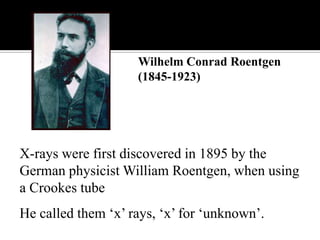
Wilhelm Conrad Roentgen
(1845-1923)

X-rays were first discovered in 1895 by the
German physicist William Roentgen, when using
a Crookes tube
He called them „x‟ rays, „x‟ for „unknown‟.
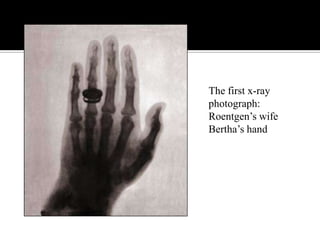
The first x-ray
photograph:
Roentgen‟s wife
Bertha‟s hand
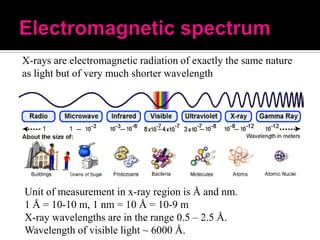
X-rays are electromagnetic radiation of exactly the same nature
as light but of very much shorter wavelength

Unit of measurement in x-ray region is Å and nm.
1 Å = 10-10 m, 1 nm = 10 Å = 10-9 m
X-ray wavelengths are in the range 0.5 – 2.5 Å.
Wavelength of visible light ~ 6000 Å.
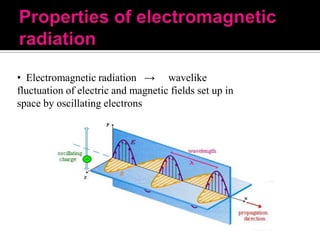
• Electromagnetic radiation → wavelike
fluctuation of electric and magnetic fields set up in
space by oscillating electrons
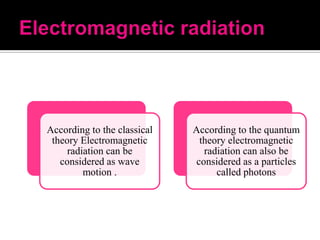
According to the classical
theory Electromagnetic
radiation can be
considered as wave
motion .

According to the quantum
theory electromagnetic
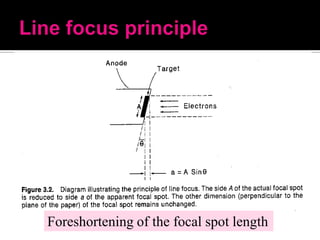
radiation can also be
considered as a particles
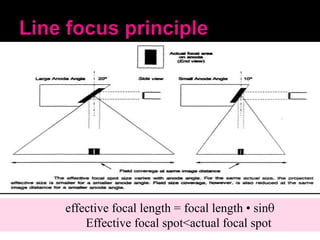
called photons
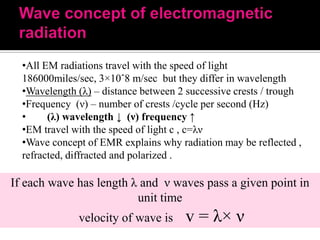
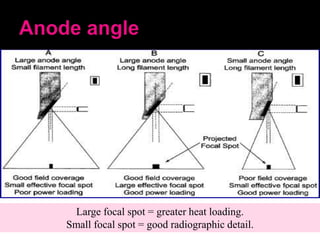
•All EM radiations travel with the speed of light
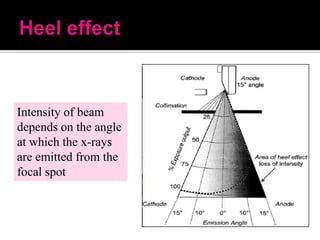
186000miles/sec, 3×10ˆ8 m/sec but they differ in wavelength
•Wavelength (λ) – distance between 2 successive crests / trough
•Frequency (ν) – number of crests /cycle per second (Hz)
•
(λ) wavelength ↓ (ν) frequency ↑
•EM travel with the speed of light c , c=λν
•Wave concept of EMR explains why radiation may be reflected ,
refracted, diffracted and polarized .

If each wave has length λ and ν waves pass a given point in
unit time
velocity of wave is

v = λ× ν
•Short EM waves like XRAYS react with matter as if they are
particles rather than waves.
•These particles are discrete bundles of energy and each bundle is
called quantum /photon.
•Photon travel at the speed of light.
•Amount of energy carried by each photon depends on frequency of
radiation.
•If frequency doubled energy doubled .
•Particle concept can explain the interaction with matter like
photoelectric and Compton effect .

Energy calculated E=hν
h= Planck's constant (4.13×10 ˆ-18 Kev sec )
Relationship between wavelength and frequency
ν= c/λ
c – velocity of light (~3×10⁸ m/s)
also E= hν
Instead of ν
E =hc/λ ( h×c = 12.4)

E= 12.4/λ
•Energy of photon =ev
•X-ray measured in kilo ev , 1Kev = 1000 ev
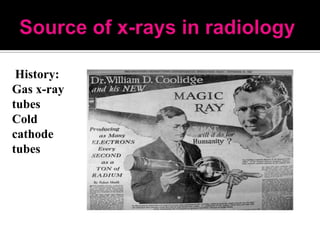
History:
Gas x-ray
tubes
Cold
cathode
tubes
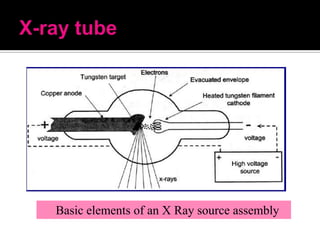
Basic elements of an X Ray source assembly
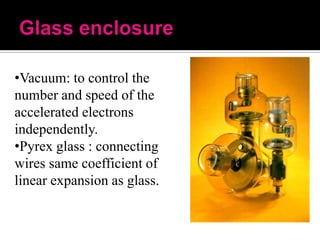
•Vacuum: to control the
number and speed of the
accelerated electrons
independently.
•Pyrex glass : connecting
wires same coefficient of
linear expansion as glass.
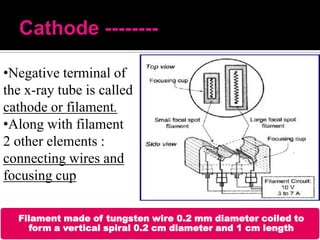
•Negative terminal of
the x-ray tube is called
cathode or filament.
•Along with filament
2 other elements :
connecting wires and
focusing cup
Filament made of tungsten wire 0.2 mm diameter coiled to
form a vertical spiral 0.2 cm diameter and 1 cm length
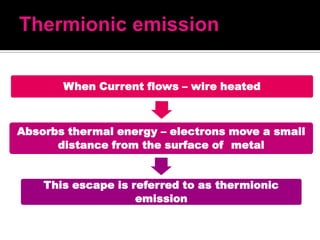
When Current flows – wire heated

Absorbs thermal energy – electrons move a small
distance from the surface of metal
This escape is referred to as thermionic
emission
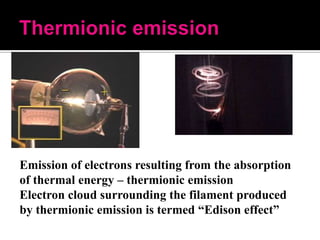
Emission of electrons resulting from the absorption
of thermal energy – thermionic emission
Electron cloud surrounding the filament produced
by thermionic emission is termed “Edison effect”
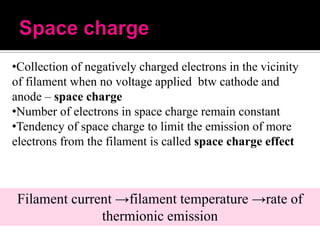
•Collection of negatively charged electrons in the vicinity
of filament when no voltage applied btw cathode and
anode – space charge
•Number of electrons in space charge remain constant
•Tendency of space charge to limit the emission of more
electrons from the filament is called space charge effect

Filament current →filament temperature →rate of
thermionic emission
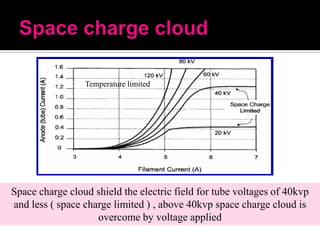
Temperature limited

Space charge cloud shield the electric field for tube voltages of 40kvp
and less ( space charge limited ) , above 40kvp space charge cloud is
overcome by voltage applied
1.
2.
3.
4.
5.

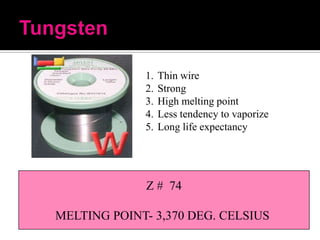
Thin wire
Strong
High melting point
Less tendency to vaporize
Long life expectancy

Z # 74
MELTING POINT- 3,370 DEG. CELSIUS
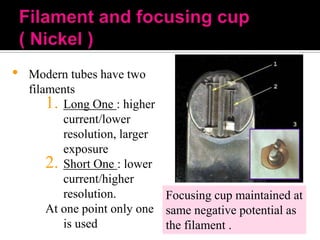
•

Modern tubes have two
filaments
1. Long One : higher
current/lower
resolution, larger
exposure
2. Short One : lower
current/higher
resolution.
Focusing cup maintained at
At one point only one same negative potential as
is used
the filament .
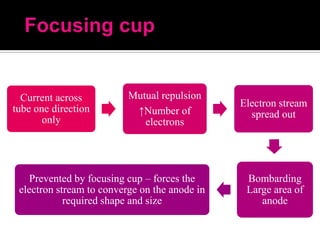
Current across
tube one direction
only

Mutual repulsion
↑Number of
electrons

Prevented by focusing cup – forces the
electron stream to converge on the anode in
required shape and size

Electron stream
spread out

Bombarding
Large area of
anode
•Filament vaporization – shorten the life
•Not heated for too long- filament boosting circuit
•Vaporized filament usually deposited on the inner
surface of glass wall
•Color deepens as the tube ages- bronze colored
“sunburn”
•Tends to increase filtration and changes the
quality of beam
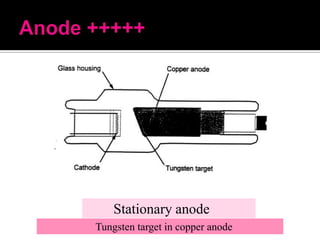
Stationary anode
Tungsten target in copper anode
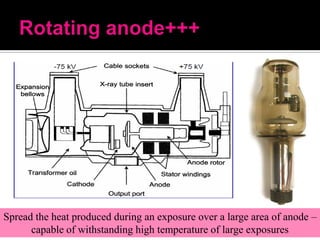
Spread the heat produced during an exposure over a large area of anode –
capable of withstanding high temperature of large exposures
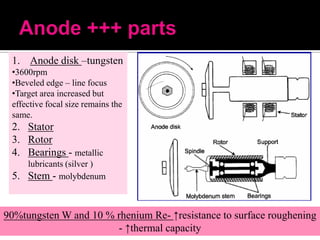
1. Anode disk –tungsten
•3600rpm
•Beveled edge – line focus
•Target area increased but
effective focal size remains the
same.

2. Stator
3. Rotor
4. Bearings - metallic
lubricants (silver )
5. Stem - molybdenum

90%tungsten W and 10 % rhenium Re- ↑resistance to surface roughening
- ↑thermal capacity
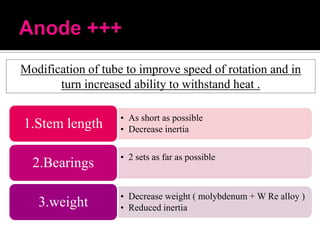
Modification of tube to improve speed of rotation and in
turn increased ability to withstand heat .

1.Stem length
2.Bearings
3.weight

• As short as possible
• Decrease inertia
• 2 sets as far as possible

• Decrease weight ( molybdenum + W Re alloy )
• Reduced inertia
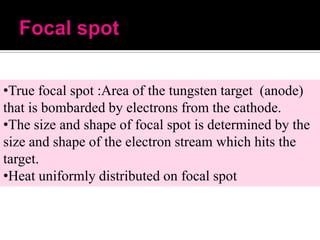
•True focal spot :Area of the tungsten target (anode)
that is bombarded by electrons from the cathode.
•The size and shape of focal spot is determined by the
size and shape of the electron stream which hits the
target.
•Heat uniformly distributed on focal spot
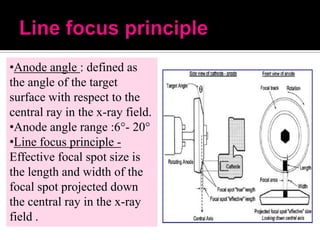
•Anode angle : defined as
the angle of the target
surface with respect to the
central ray in the x-ray field.
•Anode angle range :6°- 20°
•Line focus principle Effective focal spot size is
the length and width of the
focal spot projected down
the central ray in the x-ray
field .
Foreshortening of the focal spot length
effective focal length = focal length • sin
Effective focal spot<actual focal spot
Large focal spot = greater heat loading.
Small focal spot = good radiographic detail.
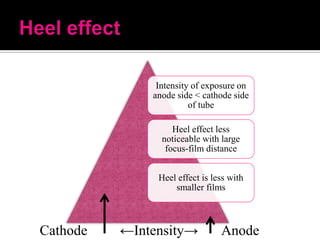
Intensity of beam
depends on the angle
at which the x-rays
are emitted from the
focal spot
Intensity of exposure on
anode side < cathode side
of tube
Heel effect less
noticeable with large
focus-film distance
Heel effect is less with
smaller films

Cathode

←Intensity→

Anode
1.
2.
3.
4.

X-rays travel in straight lines.
X-rays are electrically neutral
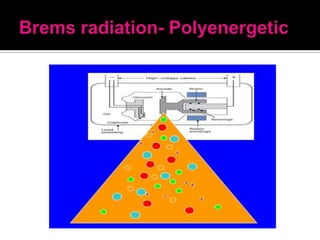
X-rays are Polyenergetic and heterogeneous
X-rays travel at the speed of light electromagnetic radiation
5. X-rays are highly penetrating , invisible rays.
6. X-rays cannot be deflected by electric field or
magnetic field.
7. X-rays cannot be focused by lens.
8. Photographic film is blackened by X-rays.
9. Fluorescent materials glow when X-rays are directed
at them.
10. Produce chemical and biologic changes by ionization
and excitation.
11. Liberate minute amounts of energies while passing
through matter.
12. X-rays interact with matter produce photoelectric and
Compton effect.
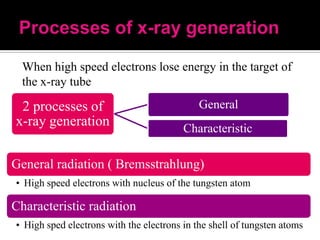
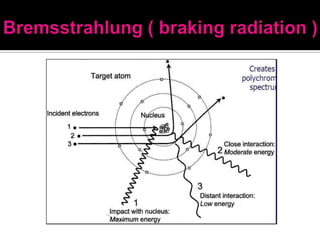
When high speed electrons lose energy in the target of
the x-ray tube

2 processes of
x-ray generation

General
Characteristic

General radiation ( Bremsstrahlung)
• High speed electrons with nucleus of the tungsten atom

Characteristic radiation
• High sped electrons with the electrons in the shell of tungsten atoms
0.5%time electron
comes in proximity
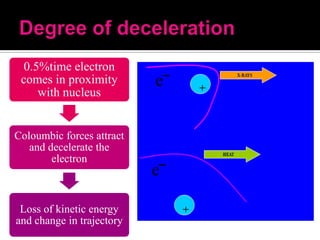
with nucleus

Coloumbic forces attract
and decelerate the
electron

Loss of kinetic energy
and change in trajectory

e‾

+

e‾
+
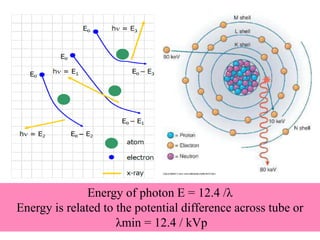
Enrgy of photon = enrgy of
initial ectron – enrgy of
braked electron

Energy of photon E = 12.4 /λ
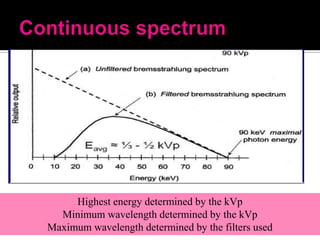
Energy is related to the potential difference across tube or
λmin = 12.4 / kVp
Highest energy determined by the kVp
Minimum wavelength determined by the kVp
Maximum wavelength determined by the filters used
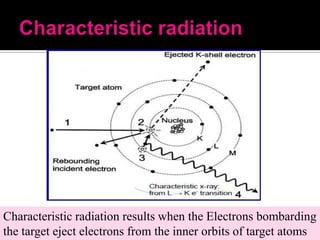
Characteristic radiation results when the Electrons bombarding
the target eject electrons from the inner orbits of target atoms
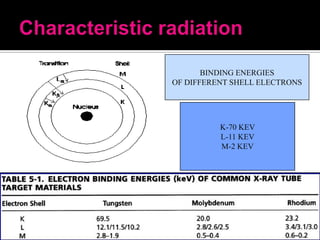
BINDING ENERGIES
OF DIFFERENT SHELL ELECTRONS

K-70 KEV
L-11 KEV
M-2 KEV
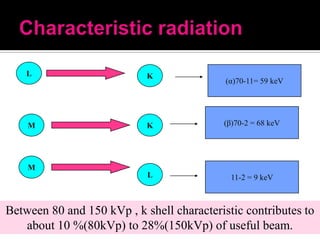
L

K

(α)70-11= 59 keV

K

(β)70-2 = 68 keV

L

M

11-2 = 9 keV

M

Between 80 and 150 kVp , k shell characteristic contributes to
about 10 %(80kVp) to 28%(150kVp) of useful beam.
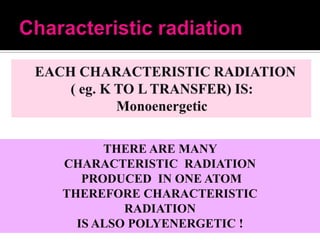
THERE ARE MANY
CHARACTERISTIC RADIATION
PRODUCED IN ONE ATOM
THEREFORE CHARACTERISTIC
RADIATION
IS ALSO POLYENERGETIC !
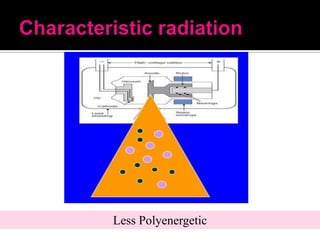
Less Polyenergetic
Thank you

Xray production 2

  • 1.
  • 2.
    Wilhelm Conrad Roentgen (1845-1923) X-rayswere first discovered in 1895 by the German physicist William Roentgen, when using a Crookes tube He called them „x‟ rays, „x‟ for „unknown‟.
  • 3.
  • 4.
    X-rays are electromagneticradiation of exactly the same nature as light but of very much shorter wavelength Unit of measurement in x-ray region is Å and nm. 1 Å = 10-10 m, 1 nm = 10 Å = 10-9 m X-ray wavelengths are in the range 0.5 – 2.5 Å. Wavelength of visible light ~ 6000 Å.
  • 5.
    • Electromagnetic radiation→ wavelike fluctuation of electric and magnetic fields set up in space by oscillating electrons
  • 6.
    According to theclassical theory Electromagnetic radiation can be considered as wave motion . According to the quantum theory electromagnetic radiation can also be considered as a particles called photons
  • 7.
    •All EM radiationstravel with the speed of light 186000miles/sec, 3×10ˆ8 m/sec but they differ in wavelength •Wavelength (λ) – distance between 2 successive crests / trough •Frequency (ν) – number of crests /cycle per second (Hz) • (λ) wavelength ↓ (ν) frequency ↑ •EM travel with the speed of light c , c=λν •Wave concept of EMR explains why radiation may be reflected , refracted, diffracted and polarized . If each wave has length λ and ν waves pass a given point in unit time velocity of wave is v = λ× ν
  • 8.
    •Short EM waveslike XRAYS react with matter as if they are particles rather than waves. •These particles are discrete bundles of energy and each bundle is called quantum /photon. •Photon travel at the speed of light. •Amount of energy carried by each photon depends on frequency of radiation. •If frequency doubled energy doubled . •Particle concept can explain the interaction with matter like photoelectric and Compton effect . Energy calculated E=hν h= Planck's constant (4.13×10 ˆ-18 Kev sec )
  • 9.
    Relationship between wavelengthand frequency ν= c/λ c – velocity of light (~3×10⁸ m/s) also E= hν Instead of ν E =hc/λ ( h×c = 12.4) E= 12.4/λ •Energy of photon =ev •X-ray measured in kilo ev , 1Kev = 1000 ev
  • 10.
  • 11.
    Basic elements ofan X Ray source assembly
  • 12.
    •Vacuum: to controlthe number and speed of the accelerated electrons independently. •Pyrex glass : connecting wires same coefficient of linear expansion as glass.
  • 13.
    •Negative terminal of thex-ray tube is called cathode or filament. •Along with filament 2 other elements : connecting wires and focusing cup Filament made of tungsten wire 0.2 mm diameter coiled to form a vertical spiral 0.2 cm diameter and 1 cm length
  • 14.
    When Current flows– wire heated Absorbs thermal energy – electrons move a small distance from the surface of metal This escape is referred to as thermionic emission
  • 15.
    Emission of electronsresulting from the absorption of thermal energy – thermionic emission Electron cloud surrounding the filament produced by thermionic emission is termed “Edison effect”
  • 16.
    •Collection of negativelycharged electrons in the vicinity of filament when no voltage applied btw cathode and anode – space charge •Number of electrons in space charge remain constant •Tendency of space charge to limit the emission of more electrons from the filament is called space charge effect Filament current →filament temperature →rate of thermionic emission
  • 17.
    Temperature limited Space chargecloud shield the electric field for tube voltages of 40kvp and less ( space charge limited ) , above 40kvp space charge cloud is overcome by voltage applied
  • 18.
    1. 2. 3. 4. 5. Thin wire Strong High meltingpoint Less tendency to vaporize Long life expectancy Z # 74 MELTING POINT- 3,370 DEG. CELSIUS
  • 19.
    • Modern tubes havetwo filaments 1. Long One : higher current/lower resolution, larger exposure 2. Short One : lower current/higher resolution. Focusing cup maintained at At one point only one same negative potential as is used the filament .
  • 20.
    Current across tube onedirection only Mutual repulsion ↑Number of electrons Prevented by focusing cup – forces the electron stream to converge on the anode in required shape and size Electron stream spread out Bombarding Large area of anode
  • 21.
    •Filament vaporization –shorten the life •Not heated for too long- filament boosting circuit •Vaporized filament usually deposited on the inner surface of glass wall •Color deepens as the tube ages- bronze colored “sunburn” •Tends to increase filtration and changes the quality of beam
  • 22.
  • 23.
    Spread the heatproduced during an exposure over a large area of anode – capable of withstanding high temperature of large exposures
  • 24.
    1. Anode disk–tungsten •3600rpm •Beveled edge – line focus •Target area increased but effective focal size remains the same. 2. Stator 3. Rotor 4. Bearings - metallic lubricants (silver ) 5. Stem - molybdenum 90%tungsten W and 10 % rhenium Re- ↑resistance to surface roughening - ↑thermal capacity
  • 25.
    Modification of tubeto improve speed of rotation and in turn increased ability to withstand heat . 1.Stem length 2.Bearings 3.weight • As short as possible • Decrease inertia • 2 sets as far as possible • Decrease weight ( molybdenum + W Re alloy ) • Reduced inertia
  • 26.
    •True focal spot:Area of the tungsten target (anode) that is bombarded by electrons from the cathode. •The size and shape of focal spot is determined by the size and shape of the electron stream which hits the target. •Heat uniformly distributed on focal spot
  • 27.
    •Anode angle :defined as the angle of the target surface with respect to the central ray in the x-ray field. •Anode angle range :6°- 20° •Line focus principle Effective focal spot size is the length and width of the focal spot projected down the central ray in the x-ray field .
  • 28.
    Foreshortening of thefocal spot length
  • 29.
    effective focal length= focal length • sin Effective focal spot<actual focal spot
  • 30.
    Large focal spot= greater heat loading. Small focal spot = good radiographic detail.
  • 31.
    Intensity of beam dependson the angle at which the x-rays are emitted from the focal spot
  • 32.
    Intensity of exposureon anode side < cathode side of tube Heel effect less noticeable with large focus-film distance Heel effect is less with smaller films Cathode ←Intensity→ Anode
  • 33.
    1. 2. 3. 4. X-rays travel instraight lines. X-rays are electrically neutral X-rays are Polyenergetic and heterogeneous X-rays travel at the speed of light electromagnetic radiation 5. X-rays are highly penetrating , invisible rays.
  • 34.
    6. X-rays cannotbe deflected by electric field or magnetic field. 7. X-rays cannot be focused by lens. 8. Photographic film is blackened by X-rays. 9. Fluorescent materials glow when X-rays are directed at them. 10. Produce chemical and biologic changes by ionization and excitation. 11. Liberate minute amounts of energies while passing through matter. 12. X-rays interact with matter produce photoelectric and Compton effect.
  • 35.
    When high speedelectrons lose energy in the target of the x-ray tube 2 processes of x-ray generation General Characteristic General radiation ( Bremsstrahlung) • High speed electrons with nucleus of the tungsten atom Characteristic radiation • High sped electrons with the electrons in the shell of tungsten atoms
  • 36.
    0.5%time electron comes inproximity with nucleus Coloumbic forces attract and decelerate the electron Loss of kinetic energy and change in trajectory e‾ + e‾ +
  • 38.
    Enrgy of photon= enrgy of initial ectron – enrgy of braked electron Energy of photon E = 12.4 /λ Energy is related to the potential difference across tube or λmin = 12.4 / kVp
  • 39.
    Highest energy determinedby the kVp Minimum wavelength determined by the kVp Maximum wavelength determined by the filters used
  • 41.
    Characteristic radiation resultswhen the Electrons bombarding the target eject electrons from the inner orbits of target atoms
  • 42.
    BINDING ENERGIES OF DIFFERENTSHELL ELECTRONS K-70 KEV L-11 KEV M-2 KEV
  • 43.
    L K (α)70-11= 59 keV K (β)70-2= 68 keV L M 11-2 = 9 keV M Between 80 and 150 kVp , k shell characteristic contributes to about 10 %(80kVp) to 28%(150kVp) of useful beam.
  • 44.
    THERE ARE MANY CHARACTERISTICRADIATION PRODUCED IN ONE ATOM THEREFORE CHARACTERISTIC RADIATION IS ALSO POLYENERGETIC !
  • 45.
  • 47.

Editor's Notes

  • #11 Earlier tubes were cold cathode tubes , glass bulb with small amount of gas , cathode was not heated , application of high voltage across the terminals caused ionization of gas in tube with release of stream of electrons which produced x-rays upon striking the positive terminal – inefficient and tube ma could not be changed independently of kv.
  • #14 Connecting wires – supply both voltage and amperage to heat the filament
  • #17 Space charge – prevent the electrons from being emitted from the filament until they have acquired sufficient thermal energy to overcome the force caused by space charge Loss of electrons – filament positive – attracts some electrons back – when filament heated to its emission temp ,state of equilibrium reached ,here number of electrons returning equal to number of electrons emitted
  • #18 When potential difference is insufficient to cause almost all the elctrons to be pulled away from the filament the instant they are emitted – residual space charge Untill 40 kv the increse in kilovoltage produces a significant increase tube current evn thou filament heating remains same Above 40 kv however the increse in kv produce very little change in tube current In this example 40 kv is the saturation voltage Below 40 kv it is space charge limited Above 40 kv space charge effect no influence – tube current determined by the number of electrons made available by the eheated filament – temperature limited
  • #21 Xray current 100mA , 0.1 A1 ampere = rate of flow of 1 coulumb of electricity thro a conductor in 1 sec – 1 columb is 6.25 * 10^ 17
  • #22 X-ray circuit is turned on ,but no exposure is made ,a standby current heats the filament to a value corresponding to low current – for exposure, circuit will increase the filament current to required value and soon after exposure lower it standby value.
  • #23 Tungsten target embedded in the large mass of copper Tungsten plate greater than 1 cm Tungsten atomic number 74 , high melting point Tungsten Good absorber and dissipater of heat Small target in larger copper – heat dissipation – even though high melting temp cannot withstand repeated exposures – cu better conductor of heat .so used for better conduction of heat and increased speed of cooling Tungsten larger than the focal size , as copper in the immediate vicinity can melt when the exposure increases the target temp by 1000. and cu doesn&apos;t have such high melting temperature 1070 oc .
  • #25 At 3600 rpm , every 1/60thsec the target is opposite the electron beam . Rest of the time used for cooling typical disk diameter- 75,100,125mm Circumference = 2π r Stator coils –magnetic field produced by stator coils provide power for rotation Magnetic fields produced by stator induces a current in the rotor – provides power to rotate anode Bearings – anode assembly rotates on this Lubricants – earlier oil , graphite Stem – molybdenum( 2600) for heat dissipation , ↑length ↑inertia ↑load on bearings Inertia leads to delay 0.5 – 1 sec – safety circuit prevents exposure until rotor reaches full speed
  • #26 Molybdenum disc with tungsten rhenium alloy target attached to it Weight of anode itself
  • #27 The size ands shape of focsal spot can be determined by the size and shape of elctron stream Size and shape of ecltron stream – by dimension of filament tungsten wire coil , focusing cup , position of filament from focusing cup Focal spot is the area of anode bombarded by electrons from cathode – most energy converted into heat Heat uniformly distributed on over the focal spot – large amount of heat accumulated on the on anode – melting point of anode tungsten is 3370 – Large focal spot for greater heat loading Small focal spot for good radiographic detail
  • #28 From where the xrays are emitted from the tube
  • #30 Smaller anode angle will produce smaller focal spot and smaller field coverage
  • #32 Intensity of x-ray beam is not uniformly distributed thro all portions of beam. decreased intensity at the anode side of tube as absorption by the target itself
  • #37 99% produce heat Electron attracted by the positive nucleus gets deflected from the original direction – electron loses energy and slowed down when its direction changes.Xray photon energy equal to the loss of kinetic energy
  • #38 German
  • #39 Initial elctron – deflected electron
  • #42 Binding energy E for k shell of tungsten is 70 kevCathode electron should have more than 70 kVp to eject k shell electron K shell electron ejected after impinging electron uses 70 kVp to eject it – remaining energy shared between initial and ejected electron – both these electrons leave the atom . Removal of electron makesthe atom to have positive charge – return to normal state by losing excess energy Now the atom is unstable – k shell electron is replaced by l shell- l shell more energy than k shell – gives up the excess energy in the form of single x-ray photon