Semantics
refers to the meaning of a languange that
can be found in dictionaries. .
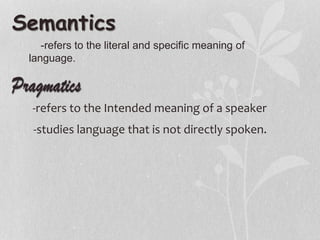
Semantics
-refers to the literal and specific meaning of
language.
-studies language that is not directly spoken.
-refers to the Intended meaning of a speaker
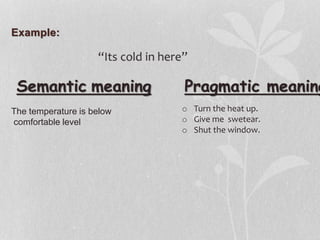
Example:
Semantic meaning
The temperature is below
comfortable level
Pragmatic meaning
o Turn the heat up.
o Give me swetear.
o Shut the window.
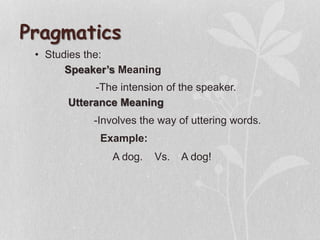
• Studies the:
Pragmatics
Utterance Meaning
Speaker’s Meaning
-The intension of the speaker.
-Involves the way of uttering words.
Example:
A dog. Vs. A dog!
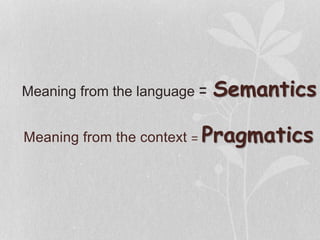
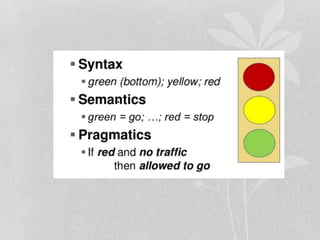
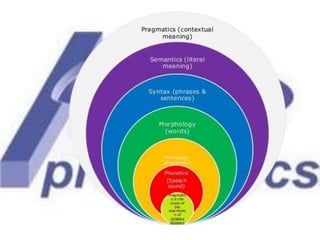
Meaning from the language = Semantics
Meaning from the context = Pragmatics
Several Types of Context:
1. Physical
ContextObjects surrounding the communication
place and time of the the communication
Location affects the interpretation.
If you will see a sign like this near a school:
SLOW DOWN. PUPILS CROSSING THE STREET.
Epistemic Context
-what is known by both speaker and hearer.
Linguistic Context
What has been said before in the conversation.
Linda came home late yesterday. She thought
nobody would notice.
Social Context
the social relationship of the people involved in
communication.
Pragmatics and Contextual
Knowledge
Two people come at a library and they talking really loud.
They sit at your table and continue their babbling. So, you look
up them and say
“Excuse me? Could you please speak a little bit more? I
missed what you said.”
.
• Pysical: The conversation occurs in library
• Epistesmic: Libraries are quite places
• Linguistic: Sarcastic tone of voice
• Social Context: You have the right to ask someone to
• Be quiet in a place where people are supposed to be quiet.
Pragmatics focuses not on what people say but
how they say it and how others interpret their utterances
in social contexts
”Utterances are literally the units of sound you make
when you talk, but the signs that accompany those
utterances are what give the sounds their true meaning”
-Geoffrey Finch
More examples:
“Nice day”
Semantic meaning:
What a lovely day.
But depending to the speakers facial expression, tone of
voice, or the relationship that exist between the speaker and
hearer, then it can mean its opposite thing which is
This is not a nice day.
Do you know where can I get gas?
Pragmaticlly response: There’s a gas
station around the corner
Literal answer: yes
Can you pass me a salt?
Literal answer: yes
Pragmatically response: [/le passes
the salt;
Semantic and Pragmatic

Semantic and Pragmatic

  • 2.
    Semantics refers to themeaning of a languange that can be found in dictionaries. .
  • 4.
    Semantics -refers to theliteral and specific meaning of language. -studies language that is not directly spoken. -refers to the Intended meaning of a speaker
  • 5.
    Example: Semantic meaning The temperatureis below comfortable level Pragmatic meaning o Turn the heat up. o Give me swetear. o Shut the window.
  • 6.
    • Studies the: Pragmatics UtteranceMeaning Speaker’s Meaning -The intension of the speaker. -Involves the way of uttering words. Example: A dog. Vs. A dog!
  • 7.
    Meaning from thelanguage = Semantics Meaning from the context = Pragmatics
  • 8.
    Several Types ofContext: 1. Physical ContextObjects surrounding the communication place and time of the the communication Location affects the interpretation.
  • 9.
    If you willsee a sign like this near a school: SLOW DOWN. PUPILS CROSSING THE STREET.
  • 10.
    Epistemic Context -what isknown by both speaker and hearer.
  • 11.
    Linguistic Context What hasbeen said before in the conversation. Linda came home late yesterday. She thought nobody would notice.
  • 12.
    Social Context the socialrelationship of the people involved in communication.
  • 13.
    Pragmatics and Contextual Knowledge Twopeople come at a library and they talking really loud. They sit at your table and continue their babbling. So, you look up them and say “Excuse me? Could you please speak a little bit more? I missed what you said.” .
  • 14.
    • Pysical: Theconversation occurs in library • Epistesmic: Libraries are quite places • Linguistic: Sarcastic tone of voice • Social Context: You have the right to ask someone to • Be quiet in a place where people are supposed to be quiet.
  • 15.
    Pragmatics focuses noton what people say but how they say it and how others interpret their utterances in social contexts
  • 16.
    ”Utterances are literallythe units of sound you make when you talk, but the signs that accompany those utterances are what give the sounds their true meaning” -Geoffrey Finch
  • 17.
    More examples: “Nice day” Semanticmeaning: What a lovely day. But depending to the speakers facial expression, tone of voice, or the relationship that exist between the speaker and hearer, then it can mean its opposite thing which is This is not a nice day.
  • 18.
    Do you knowwhere can I get gas? Pragmaticlly response: There’s a gas station around the corner Literal answer: yes
  • 19.
    Can you passme a salt? Literal answer: yes Pragmatically response: [/le passes the salt;