

LANGUAGE
Definitions:
• Language is one of the many methods of human
communication.
• It may either be spoken or written and consists of
the use of words in a structured and conventional
way.
• It also involves different styles and techniques to
successfully achieve the goal or conveying a clear
and correct message to the readers.
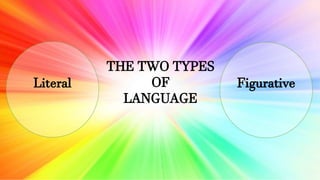
THE TWO TYPES
OF
LANGUAGE
Literal Figurative
Literal or Ordinary Language
• Are words that usually carry their
denotative meaning or their dictionary
definition.
• These words are viewed as lifeless, drab and
boring; since they lack poetic substance.
• Literal or ordinary language is still
important, because it gives a sense of
realness to the text
Figurative or Symbolic Language
• It is the use of words, phrases and
expressions that goes beyond their literal
meaning.
• It is used to turn normal writing into
evocative, convincing, and powerful
written pieces.
THE DIFFERENT
FIGURES OF SPEECH
Euphemism
It is the substitution of an agreeable or less
offensive expression in place of one that may
offend or suggest something unpleasant to the
listener.
Example:
“Shake what your mama gave you
Misbehave you”
- Wiggle by Jason Derulo
Epithet
These are names or phrases that deploy the
distinctive characteristic of a person, animal,
or a deity. This is usually used when calling
upon something or someone based on one’s
need.
Example:
“Ar Rahman, Ar Raheem, Al Malik,
Ul Quddoos, As Salaam, Ul Mumin,
Ul Muhaimin, Ul ‘Azeez”
- 99 Names of Allah (swt)
by Kamal Uddin
Example:
“Elohim- The Creator, Jehovah Shammah- The Lord
is there, Adonai- May Master, EL Elyon- The God
Most High, YHWH- You are the Lord,
M'kaddishkem- Sanctfies You”
- Name of God
by Laurell Hubick
Eponym
This is a name of a person or deity which is so
commonly associated with some widely
organized trait or characteristic that the name
itself becomes a substitute for a trait or
characteristic.
Example:
“Make me your Aphrodite. Make me your one and
only”
- Dark Horse by Katy Perry
Hyperbole
It is the exaggeration or over statement of
speech.
Example:
“I'd catch a grenade for you
Throw my hand on a blade for you
I'd jump in front of a train for you
You know I'd do anything for you”
- Grenade by Bruno Mars
Metaphor
It is a figure of speech which makes and
implicit, implied, or hidden comparison
between two unrelated things. The
resemblance of the two contradictory things is
based on their common characteristics.
Example:
“Your voice was the soundtrack of my summer
Do you know you're unlike any other?
You'll always be my thunder, and I said
Your eyes are the brightest of all the colors”
- Thunder by Boys Like Girls
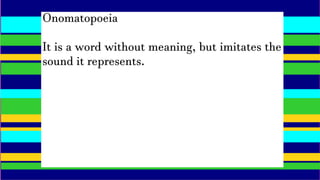
Onomatopoeia
It is a word without meaning, but imitates the
sound it represents.
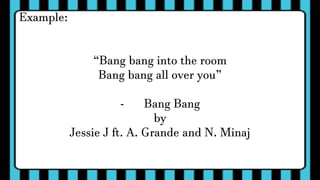
Example:
“Bang bang into the room
Bang bang all over you”
- Bang Bang
by
Jessie J ft. A. Grande and N. Minaj
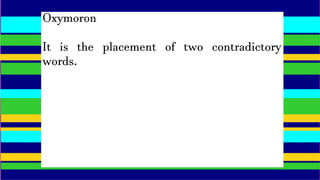
Oxymoron
It is the placement of two contradictory
words.
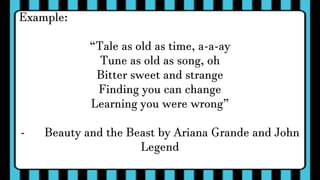
Example:
“Tale as old as time, a-a-ay
Tune as old as song, oh
Bitter sweet and strange
Finding you can change
Learning you were wrong”
- Beauty and the Beast by Ariana Grande and John
Legend
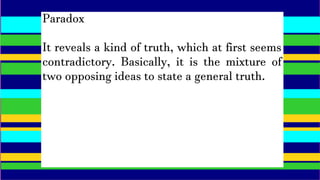
Paradox
It reveals a kind of truth, which at first seems
contradictory. Basically, it is the mixture of
two opposing ideas to state a general truth.
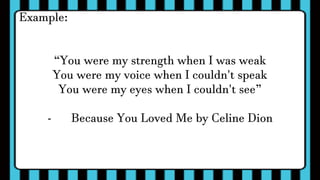
Example:
“You were my strength when I was weak
You were my voice when I couldn't speak
You were my eyes when I couldn't see”
- Because You Loved Me by Celine Dion
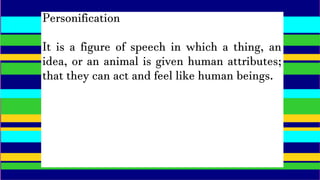
Personification
It is a figure of speech in which a thing, an
idea, or an animal is given human attributes;
that they can act and feel like human beings.
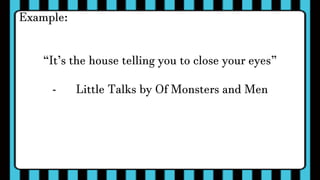
Example:
“It’s the house telling you to close your eyes”
- Little Talks by Of Monsters and Men
Simile
It makes a comparison , showing similarities
between two different things. Unlike a
metaphor, it draws a resemblance with the
help of the words “like” or “as”. Therefore,
the resemblance can be differentiated and not
totally merging the idea of their comparison.
Example:
“Why does love always feel like a battlefield, a
battlefield, a battlefield”
- Battlefield by Jordin Sparks
Understatement
It is used to state what is apparent or what is
obvious as if the receiver of the statement is
oblivious of the truth.
Example:
“Hey
I know there are some things we need to talk about
And I can't stay
Just let me hold you for a little longer now”
- Never Be Alone by Shawn Mendez
Euphemism
It is the substitution of an agreeable or less
offensive expression in place of one that may
offend or suggest something unpleasant to the
listener.
Example:
“Shake what your mama gave you
Misbehave you”
- Wiggle by Jason Derulo
Euphemism
It is the substitution of an agreeable or less
offensive expression in place of one that may
offend or suggest something unpleasant to the
listener.
Example:
“Shake what your mama gave you
Misbehave you”
- Wiggle by Jason Derulo
CLASS ACTIVITY
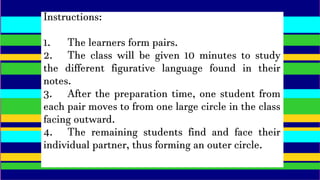
Instructions:
1. The learners form pairs.
2. The class will be given 10 minutes to study
the different figurative language found in their
notes.
3. After the preparation time, one student from
each pair moves to from one large circle in the class
facing outward.
4. The remaining students find and face their
individual partner, thus forming an outer circle.
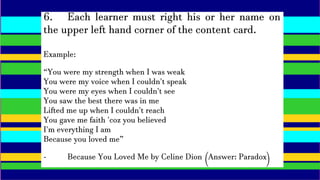
6. Each learner must right his or her name on
the upper left hand corner of the content card.
Example:
“You were my strength when I was weak
You were my voice when I couldn't speak
You were my eyes when I couldn't see
You saw the best there was in me
Lifted me up when I couldn't reach
You gave me faith 'coz you believed
I'm everything I am
Because you loved me”
- Because You Loved Me by Celine Dion (Answer: Paradox)
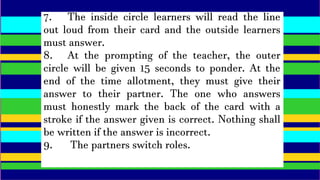
7. The inside circle learners will read the line
out loud from their card and the outside learners
must answer.
8. At the prompting of the teacher, the outer
circle will be given 15 seconds to ponder. At the
end of the time allotment, they must give their
answer to their partner. The one who answers
must honestly mark the back of the card with a
stroke if the answer given is correct. Nothing shall
be written if the answer is incorrect.
9. The partners switch roles.
11. The same prep time and score recording will
be observed.
12. Inside circle students rotate clockwise to a
new partner.
13. Repeat all the steps.
14. All cards will be collected and the teacher will
synthesize the activity.
QUESTIONS
How will life be without the senses?
How are the senses a big help to creative writing?
Based on your own understanding, how can analogy
help with the development of your writing?
How hard was it for you to guess the figures of speech
and why?
How do you differentiate the usefulness of figurative
language from literal language to creative writing?
INDIVIDUAL ACTIVITY
You will complete a worksheet titled “Example Splash”. You are
asked to compose your original examples for the different topics that
have been discussed in the class. The purpose of this task is to assess
if the you are able to distinguish between the different ways of using
imagery, analogy, and figures of speech.
Rubric for the Number 1 Task:
Relevance to the topic 15
Organization 15
Total 30
JOURNAL
The world is a beautiful place. You don’t
even need a painting or a camera to
appreciate it. All of the things here on earth
can be enjoyed because you have been given
eyes to see, a tongue to taste, ears to listen
and hear, skin to feel, and a nose to smell.
How would life be without these senses?
How will you influence others on taking
care of their sensory organs?
THANK YOU!

Language and Figures of Speech

  • 1.
  • 2.
    Definitions: • Language isone of the many methods of human communication. • It may either be spoken or written and consists of the use of words in a structured and conventional way. • It also involves different styles and techniques to successfully achieve the goal or conveying a clear and correct message to the readers.
  • 3.
  • 4.
    Literal or OrdinaryLanguage • Are words that usually carry their denotative meaning or their dictionary definition. • These words are viewed as lifeless, drab and boring; since they lack poetic substance. • Literal or ordinary language is still important, because it gives a sense of realness to the text
  • 5.
    Figurative or SymbolicLanguage • It is the use of words, phrases and expressions that goes beyond their literal meaning. • It is used to turn normal writing into evocative, convincing, and powerful written pieces.
  • 6.
  • 7.
    Euphemism It is thesubstitution of an agreeable or less offensive expression in place of one that may offend or suggest something unpleasant to the listener.
  • 8.
    Example: “Shake what yourmama gave you Misbehave you” - Wiggle by Jason Derulo
  • 9.
    Epithet These are namesor phrases that deploy the distinctive characteristic of a person, animal, or a deity. This is usually used when calling upon something or someone based on one’s need.
  • 10.
    Example: “Ar Rahman, ArRaheem, Al Malik, Ul Quddoos, As Salaam, Ul Mumin, Ul Muhaimin, Ul ‘Azeez” - 99 Names of Allah (swt) by Kamal Uddin
  • 11.
    Example: “Elohim- The Creator,Jehovah Shammah- The Lord is there, Adonai- May Master, EL Elyon- The God Most High, YHWH- You are the Lord, M'kaddishkem- Sanctfies You” - Name of God by Laurell Hubick
  • 12.
    Eponym This is aname of a person or deity which is so commonly associated with some widely organized trait or characteristic that the name itself becomes a substitute for a trait or characteristic.
  • 13.
    Example: “Make me yourAphrodite. Make me your one and only” - Dark Horse by Katy Perry
  • 14.
    Hyperbole It is theexaggeration or over statement of speech.
  • 15.
    Example: “I'd catch agrenade for you Throw my hand on a blade for you I'd jump in front of a train for you You know I'd do anything for you” - Grenade by Bruno Mars
  • 16.
    Metaphor It is afigure of speech which makes and implicit, implied, or hidden comparison between two unrelated things. The resemblance of the two contradictory things is based on their common characteristics.
  • 17.
    Example: “Your voice wasthe soundtrack of my summer Do you know you're unlike any other? You'll always be my thunder, and I said Your eyes are the brightest of all the colors” - Thunder by Boys Like Girls
  • 18.
    Onomatopoeia It is aword without meaning, but imitates the sound it represents.
  • 19.
    Example: “Bang bang intothe room Bang bang all over you” - Bang Bang by Jessie J ft. A. Grande and N. Minaj
  • 20.
    Oxymoron It is theplacement of two contradictory words.
  • 21.
    Example: “Tale as oldas time, a-a-ay Tune as old as song, oh Bitter sweet and strange Finding you can change Learning you were wrong” - Beauty and the Beast by Ariana Grande and John Legend
  • 22.
    Paradox It reveals akind of truth, which at first seems contradictory. Basically, it is the mixture of two opposing ideas to state a general truth.
  • 23.
    Example: “You were mystrength when I was weak You were my voice when I couldn't speak You were my eyes when I couldn't see” - Because You Loved Me by Celine Dion
  • 24.
    Personification It is afigure of speech in which a thing, an idea, or an animal is given human attributes; that they can act and feel like human beings.
  • 25.
    Example: “It’s the housetelling you to close your eyes” - Little Talks by Of Monsters and Men
  • 26.
    Simile It makes acomparison , showing similarities between two different things. Unlike a metaphor, it draws a resemblance with the help of the words “like” or “as”. Therefore, the resemblance can be differentiated and not totally merging the idea of their comparison.
  • 27.
    Example: “Why does lovealways feel like a battlefield, a battlefield, a battlefield” - Battlefield by Jordin Sparks
  • 28.
    Understatement It is usedto state what is apparent or what is obvious as if the receiver of the statement is oblivious of the truth.
  • 29.
    Example: “Hey I know thereare some things we need to talk about And I can't stay Just let me hold you for a little longer now” - Never Be Alone by Shawn Mendez
  • 30.
    Euphemism It is thesubstitution of an agreeable or less offensive expression in place of one that may offend or suggest something unpleasant to the listener.
  • 31.
    Example: “Shake what yourmama gave you Misbehave you” - Wiggle by Jason Derulo
  • 32.
    Euphemism It is thesubstitution of an agreeable or less offensive expression in place of one that may offend or suggest something unpleasant to the listener.
  • 33.
    Example: “Shake what yourmama gave you Misbehave you” - Wiggle by Jason Derulo
  • 34.
  • 35.
    Instructions: 1. The learnersform pairs. 2. The class will be given 10 minutes to study the different figurative language found in their notes. 3. After the preparation time, one student from each pair moves to from one large circle in the class facing outward. 4. The remaining students find and face their individual partner, thus forming an outer circle.
  • 36.
    6. Each learnermust right his or her name on the upper left hand corner of the content card. Example: “You were my strength when I was weak You were my voice when I couldn't speak You were my eyes when I couldn't see You saw the best there was in me Lifted me up when I couldn't reach You gave me faith 'coz you believed I'm everything I am Because you loved me” - Because You Loved Me by Celine Dion (Answer: Paradox)
  • 37.
    7. The insidecircle learners will read the line out loud from their card and the outside learners must answer. 8. At the prompting of the teacher, the outer circle will be given 15 seconds to ponder. At the end of the time allotment, they must give their answer to their partner. The one who answers must honestly mark the back of the card with a stroke if the answer given is correct. Nothing shall be written if the answer is incorrect. 9. The partners switch roles.
  • 38.
    11. The sameprep time and score recording will be observed. 12. Inside circle students rotate clockwise to a new partner. 13. Repeat all the steps. 14. All cards will be collected and the teacher will synthesize the activity.
  • 39.
  • 40.
    How will lifebe without the senses?
  • 41.
    How are thesenses a big help to creative writing?
  • 42.
    Based on yourown understanding, how can analogy help with the development of your writing?
  • 43.
    How hard wasit for you to guess the figures of speech and why?
  • 44.
    How do youdifferentiate the usefulness of figurative language from literal language to creative writing?
  • 45.
  • 46.
    You will completea worksheet titled “Example Splash”. You are asked to compose your original examples for the different topics that have been discussed in the class. The purpose of this task is to assess if the you are able to distinguish between the different ways of using imagery, analogy, and figures of speech. Rubric for the Number 1 Task: Relevance to the topic 15 Organization 15 Total 30
  • 47.
  • 48.
    The world isa beautiful place. You don’t even need a painting or a camera to appreciate it. All of the things here on earth can be enjoyed because you have been given eyes to see, a tongue to taste, ears to listen and hear, skin to feel, and a nose to smell. How would life be without these senses? How will you influence others on taking care of their sensory organs?
  • 49.