SYSTEMIC
FUNCTIONAL
LINGUISTICS
TEXTUAL METAFUNCTION
 The term involves all of the grammatical systems responsible for
managing the flow of discourse.
 Textual Meta-function involves the creation of text. It is a resource for
presenting interpersonal and ideational meanings as information that can
be shared by speaker and listener into text unfolding in context.
 According to Halliday, Textual meta-function is realized through thematic
structure, information structure and cohesion.
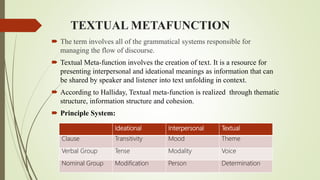
 Principle System:
Ideational Interpersonal Textual
Clause Transitivity Mood Theme
Verbal Group Tense Modality Voice
Nominal Group Modification Person Determination
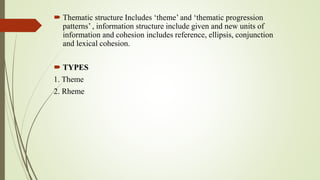
 Thematic structure Includes ‘theme’ and ‘thematic progression
patterns’ , information structure include given and new units of
information and cohesion includes reference, ellipsis, conjunction
and lexical cohesion.
 TYPES
1. Theme
2. Rheme
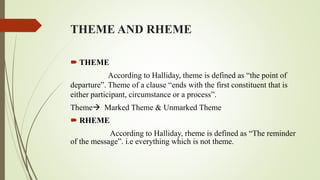
THEME AND RHEME
 THEME
According to Halliday, theme is defined as “the point of
departure”. Theme of a clause “ends with the first constituent that is
either participant, circumstance or a process”.
Theme Marked Theme & Unmarked Theme
 RHEME
According to Halliday, rheme is defined as “The reminder
of the message”. i.e everything which is not theme.
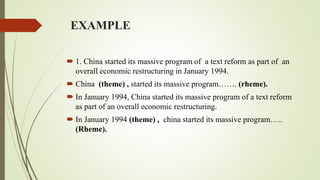
EXAMPLE
 1. China started its massive program of a text reform as part of an
overall economic restructuring in January 1994.
 China (theme) , started its massive program……. (rheme).
 In January 1994, China started its massive program of a text reform
as part of an overall economic restructuring.
 In January 1994 (theme) , china started its massive program…..
(Rheme).
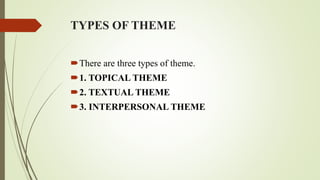
TYPES OF THEME
There are three types of theme.
1. TOPICAL THEME
2. TEXTUAL THEME
3. INTERPERSONAL THEME
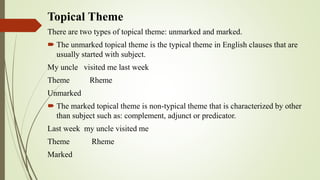
Topical Theme
There are two types of topical theme: unmarked and marked.
 The unmarked topical theme is the typical theme in English clauses that are
usually started with subject.
My uncle visited me last week
Theme Rheme
Unmarked
 The marked topical theme is non-typical theme that is characterized by other
than subject such as: complement, adjunct or predicator.
Last week my uncle visited me
Theme Rheme
Marked
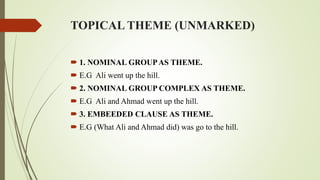
TOPICAL THEME (UNMARKED)
 1. NOMINAL GROUPAS THEME.
 E.G Ali went up the hill.
 2. NOMINAL GROUP COMPLEX AS THEME.
 E.G Ali and Ahmad went up the hill.
 3. EMBEEDED CLAUSE AS THEME.
 E.G (What Ali and Ahmad did) was go to the hill.
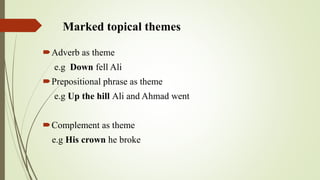
Marked topical themes
Adverb as theme
e.g Down fell Ali
Prepositional phrase as theme
e.g Up the hill Ali and Ahmad went
Complement as theme
e.g His crown he broke
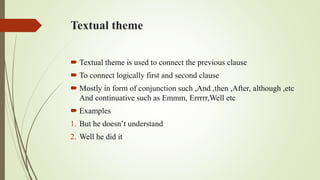
Textual theme
 Textual theme is used to connect the previous clause
 To connect logically first and second clause
 Mostly in form of conjunction such ,And ,then ,After, although ,etc
And continuative such as Emmm, Errrrr,Well etc
 Examples
1. But he doesn’t understand
2. Well he did it
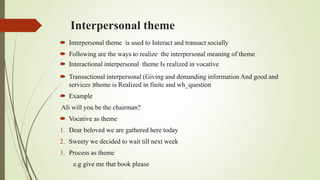
Interpersonal theme
 Interpersonal theme is used to Interact and transact socially
 Following are the ways to realize the interpersonal meaning of theme
 Interactional interpersonal theme Is realized in vocative
 Transactional interpersonal (Giving and demanding information And good and
services )theme is Realized in finite and wh_question
 Example
Ali will you be the chairman?
 Vocative as theme
1. Dear beloved we are gathered here today
2. Sweety we decided to wait till next week
3. Process as theme
e.g give me that book please
Theme and mood
 What is the element that is typically chosen as theme in an
English clause
 The answer to that question depends upon the mood
 Mood is the major interpersonal system of clause.
 It provides interactants involved in dialogue with the resources o
giving and demanding commodity either information or goods
and services.
 Every free clause selects its mood.
 Some like John and Good night are minor clauses, have no
thematic structure.
Theme and Mood
The other major clauses are:
1. Imperative mood ( demanding goods and services)
2. Declarative mood ( giving information)
3. Interrogative mood (demanding information) It is either yes/no
or wh questions.
Examples
Declarative Mood
Ali eats honey.
Theme and Mood
 Interrogative
Does Ali eat honey?
Who eats honey?
does Ali not eat honey?
 imperative
let’s eat.
give me that glass.
Pass the salt
Each of these moods in turn form The point of view of their thematic
structure
Theme in declarative Clauses
Marked and unmarked themes in declarative clauses.
 Unmarked Theme:
When sentence starts with personal pronoun (I) and he, she etc. and pronoun functions as ;Head’
then subject is unmarked theme.
e.g
I had a little nut-free.
She went to Lahore.
What I want is a cup of tea.
 Marked Theme:
When sentences start with adverbial group, prepositional phrase (adjunct) and complement, then
they function as ‘Head’. So, subject is marked theme.
e.g
On Saturday night, I lost my keys.
Suddenly, rain started at night.
Theme and Mood
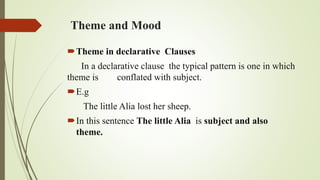
Theme in declarative Clauses
In a declarative clause the typical pattern is one in which
theme is conflated with subject.
E.g
The little Alia lost her sheep.
In this sentence The little Alia is subject and also
theme.
Theme and Mood
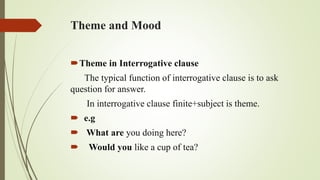
Theme in Interrogative clause
The typical function of interrogative clause is to ask
question for answer.
In interrogative clause finite+subject is theme.
 e.g
 What are you doing here?
 Would you like a cup of tea?
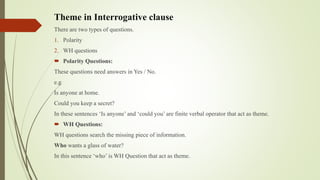
Theme in Interrogative clause
There are two types of questions.
1. Polarity
2. WH questions
 Polarity Questions:
These questions need answers in Yes / No.
e.g
Is anyone at home.
Could you keep a secret?
In these sentences ‘Is anyone’ and ‘could you’ are finite verbal operator that act as theme.
 WH Questions:
WH questions search the missing piece of information.
Who wants a glass of water?
In this sentence ‘who’ is WH Question that act as theme.
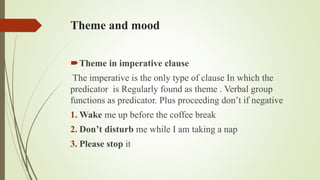
Theme and mood
Theme in imperative clause
The imperative is the only type of clause In which the
predicator is Regularly found as theme . Verbal group
functions as predicator. Plus proceeding don’t if negative
1. Wake me up before the coffee break
2. Don’t disturb me while I am taking a nap
3. Please stop it

Textual metafunction

  • 1.
  • 2.
    TEXTUAL METAFUNCTION  Theterm involves all of the grammatical systems responsible for managing the flow of discourse.  Textual Meta-function involves the creation of text. It is a resource for presenting interpersonal and ideational meanings as information that can be shared by speaker and listener into text unfolding in context.  According to Halliday, Textual meta-function is realized through thematic structure, information structure and cohesion.  Principle System: Ideational Interpersonal Textual Clause Transitivity Mood Theme Verbal Group Tense Modality Voice Nominal Group Modification Person Determination
  • 3.
     Thematic structureIncludes ‘theme’ and ‘thematic progression patterns’ , information structure include given and new units of information and cohesion includes reference, ellipsis, conjunction and lexical cohesion.  TYPES 1. Theme 2. Rheme
  • 4.
    THEME AND RHEME THEME According to Halliday, theme is defined as “the point of departure”. Theme of a clause “ends with the first constituent that is either participant, circumstance or a process”. Theme Marked Theme & Unmarked Theme  RHEME According to Halliday, rheme is defined as “The reminder of the message”. i.e everything which is not theme.
  • 5.
    EXAMPLE  1. Chinastarted its massive program of a text reform as part of an overall economic restructuring in January 1994.  China (theme) , started its massive program……. (rheme).  In January 1994, China started its massive program of a text reform as part of an overall economic restructuring.  In January 1994 (theme) , china started its massive program….. (Rheme).
  • 6.
    TYPES OF THEME Thereare three types of theme. 1. TOPICAL THEME 2. TEXTUAL THEME 3. INTERPERSONAL THEME
  • 7.
    Topical Theme There aretwo types of topical theme: unmarked and marked.  The unmarked topical theme is the typical theme in English clauses that are usually started with subject. My uncle visited me last week Theme Rheme Unmarked  The marked topical theme is non-typical theme that is characterized by other than subject such as: complement, adjunct or predicator. Last week my uncle visited me Theme Rheme Marked
  • 8.
    TOPICAL THEME (UNMARKED) 1. NOMINAL GROUPAS THEME.  E.G Ali went up the hill.  2. NOMINAL GROUP COMPLEX AS THEME.  E.G Ali and Ahmad went up the hill.  3. EMBEEDED CLAUSE AS THEME.  E.G (What Ali and Ahmad did) was go to the hill.
  • 9.
    Marked topical themes Adverbas theme e.g Down fell Ali Prepositional phrase as theme e.g Up the hill Ali and Ahmad went Complement as theme e.g His crown he broke
  • 10.
    Textual theme  Textualtheme is used to connect the previous clause  To connect logically first and second clause  Mostly in form of conjunction such ,And ,then ,After, although ,etc And continuative such as Emmm, Errrrr,Well etc  Examples 1. But he doesn’t understand 2. Well he did it
  • 11.
    Interpersonal theme  Interpersonaltheme is used to Interact and transact socially  Following are the ways to realize the interpersonal meaning of theme  Interactional interpersonal theme Is realized in vocative  Transactional interpersonal (Giving and demanding information And good and services )theme is Realized in finite and wh_question  Example Ali will you be the chairman?  Vocative as theme 1. Dear beloved we are gathered here today 2. Sweety we decided to wait till next week 3. Process as theme e.g give me that book please
  • 12.
    Theme and mood What is the element that is typically chosen as theme in an English clause  The answer to that question depends upon the mood  Mood is the major interpersonal system of clause.  It provides interactants involved in dialogue with the resources o giving and demanding commodity either information or goods and services.  Every free clause selects its mood.  Some like John and Good night are minor clauses, have no thematic structure.
  • 13.
    Theme and Mood Theother major clauses are: 1. Imperative mood ( demanding goods and services) 2. Declarative mood ( giving information) 3. Interrogative mood (demanding information) It is either yes/no or wh questions. Examples Declarative Mood Ali eats honey.
  • 14.
    Theme and Mood Interrogative Does Ali eat honey? Who eats honey? does Ali not eat honey?  imperative let’s eat. give me that glass. Pass the salt Each of these moods in turn form The point of view of their thematic structure
  • 15.
    Theme in declarativeClauses Marked and unmarked themes in declarative clauses.  Unmarked Theme: When sentence starts with personal pronoun (I) and he, she etc. and pronoun functions as ;Head’ then subject is unmarked theme. e.g I had a little nut-free. She went to Lahore. What I want is a cup of tea.  Marked Theme: When sentences start with adverbial group, prepositional phrase (adjunct) and complement, then they function as ‘Head’. So, subject is marked theme. e.g On Saturday night, I lost my keys. Suddenly, rain started at night.
  • 16.
    Theme and Mood Themein declarative Clauses In a declarative clause the typical pattern is one in which theme is conflated with subject. E.g The little Alia lost her sheep. In this sentence The little Alia is subject and also theme.
  • 17.
    Theme and Mood Themein Interrogative clause The typical function of interrogative clause is to ask question for answer. In interrogative clause finite+subject is theme.  e.g  What are you doing here?  Would you like a cup of tea?
  • 18.
    Theme in Interrogativeclause There are two types of questions. 1. Polarity 2. WH questions  Polarity Questions: These questions need answers in Yes / No. e.g Is anyone at home. Could you keep a secret? In these sentences ‘Is anyone’ and ‘could you’ are finite verbal operator that act as theme.  WH Questions: WH questions search the missing piece of information. Who wants a glass of water? In this sentence ‘who’ is WH Question that act as theme.
  • 19.
    Theme and mood Themein imperative clause The imperative is the only type of clause In which the predicator is Regularly found as theme . Verbal group functions as predicator. Plus proceeding don’t if negative 1. Wake me up before the coffee break 2. Don’t disturb me while I am taking a nap 3. Please stop it