AP Terms and Definitions

1.ad hominem fallacy-- (Latin for "to the man") a fallacy of logic in which a
person's character or motive is attacked instead of that person's argument.

2.ad populum fallacy-- (Latin for "to the crowd") a fallacy of logic in which the
widespread occurrence of something is assumed to make it true or right; e.g. "The
Escort is the most widely sold car in the world; therefore, it must be the best."

3.allegory--a story in which the people, places, and things represent general
concepts or moral qualities.

4.allusion--a brief reference to a person, place, event, or passage in a work of
literature or the Bible assumed to be sufficiently well known to be recognized by
the reader; e.g. "I am Lazarus, come from the dead." T. S. Eliot

5.analogy--a comparison between two things in which the more complex is
explained in terms of the more simple; e.g. comparing a year-long profile of the
stock index to a roller-coaster ride.

6.anecdote--a short entertaining account of some happening, frequently personal
or biographical.

7.anticlimax--a sudden drop from the dignified or important in thought or
expression to the commonplace or trivial, often for humorous effect.

8.appeal to authority--citation of information from people recognized for their
special knowledge of a subject for the purpose of strengthening a speaker or
writer's arguments.

9.argumentation--exploration of a problem by investigating all sides of it;
persuasion through reason.

10.begging the question--a fallacy of logical argument that assumes as true the
very thing that one is trying to prove; e.g. 1. The Bible is the infallible word of
God. 2. The Bible says that God exists. Therefore, 3. God exists.

11.cause and effect--examination of the causes and/or effects of a situation or
phenomenon; e.g. Essay topics such as "How did the incumbent mayor lose the
election?" or "What causes obesity?" are well suited to cause and effect
exposition.

12.chronological ordering--arrangement in the order in which things occur; may
move from past to present or in reverse chronological order, from present to past.

13.classification as a means of ordering--arrangement of objects according to
class; e.g. media classified as print, television, and radio.


                                                                                      1
14.colloquial expression--words and phrases used in everyday speech but avoided
in formal writing; e.g. Jack was bummed out about his chemistry grade instead of
Jack was upset about his chemistry grade.

15.damning with faint praise--intentional use of a positive statement that has a
negative implication; e.g. "Your new hairdo is so...interesting.

16.deduction (deductive reasoning)--a form of reasoning that begins with a
generalization, then applies the generalization to a specific case or cases; opposite
to induction. (see syllogism)

17.digression--a temporary departure from the main subject in speaking or
writing.

18.ellipsis--1. In grammar, the omission of a word or words necessary for
complete construction but understood in context. E.g. "If (it is) possible, (you)
come early." 2. The sign (...) that something has been left out of a quotation. "To
be or not...that is the question."

19.euphemism--the use of a word or phrase that is less direct, but that is also less
distasteful or less offensive than another; e.g."he is at rest" is a euphemism for
"he is dead."

20.expository writing--writing that explains or analyzes.

21.false dilemma--a fallacy of logical argument which is committed when too few
of the available alternatives are considered, and all but one are assessed and
deemed impossible or unacceptable; e.g. A father speaking to his son says, "Are
you going to go to college and make something of yourself, or are you going to
end up being an unemployable bum like me?" The dilemma is the son's
supposed choice limitation: either he goes to college or he will be a bum. The
dilemma is false, because the alternative of not going to college but still being
employable has not been considered.

22.hyperbole--an extravagant exaggeration of fact, used either for serious or
comic effect; e.g.
    "Your beauty, that did haunt me in my sleep
     To undertake the death of all the world,
     So I might live one hour in your sweet bosom."
                      Shakespeare, Richard III

23.imagery--lively descriptions which impress the images of things upon the
mind; figures of speech.

24.induction (inductive reasoning)--a form of reasoning which works from a
body of fact to the formulation of a generalization; opposite to deduction;


                                                                                   2
frequently used as the principal form of reasoning in science and history.

25.inverted syntax--reversing the normal word order of a sentence; e.g.
 "Whose woods these are I think I know." Robert Frost

26.irony--a method of humorous or sarcastic expression in which the intended
meaning of the words is the opposite of their usual meaning; e.g. saying that a
cold, windy, rainy day is "lovely."

27.litotes--in rhetoric, a figure in which an affirmative is expressed by a negation
of the contrary. A "citizen of no mean city" is, therefore, "a citizen of an
important or famous city."

28.metaphor--a figure of speech in which one thing is compared to another by
being spoken of as though it were that thing; e.g. "...a sea of troubles."
    William Bradford, The History of Plymouth Plantation

29.non sequitur--a statement that does not follow logically from what preceded
it.

30.order of importance--a method of organizing a paper according to the relative
significance of the subtopics.

31.oxymoron--a figure of speech in which contradictory terms or ideas are
combined; e.g. "thunderous silence."

32.parable--a short story from which a lesson may be drawn; Christ used the
parable to teach his followers moral truths. The parable of the Sower and the
Good Samaritan are examples of his parables.

33.parallel syntactic structures--using the same part of speech or syntactic
structure in (1) each element of a series, (2) before and after coordinating
conjunctions (and, but, yet, or, for, nor), and (3) after each of a pair of correlative
conjunctions (not only...but also, neither...nor, both...and, etc.). Below are
examples for definitions (1) and (3):
  (1) Over the hill, through the woods, and to grandmother's house
        we go.
  (3) That vegetable is both rich in vitamins and low in calories.

34.paradox--a statement which seems self-contradictory, but which may be true
in fact.
  "Success is counted sweetest
   By those who ne'er succeed..." Emily Dickinson

35.parody--a literary composition which imitates the characteristic style of a
serious work or writer and uses its features to treat trivial, nonsensical material
in an attempt at humor or satire.


                                                                                       3
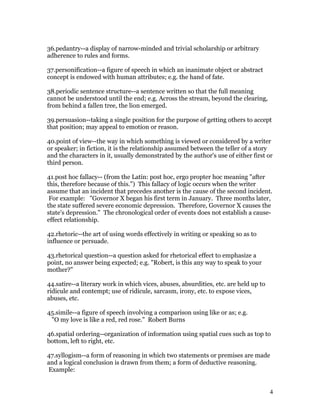
36.pedantry--a display of narrow-minded and trivial scholarship or arbitrary
adherence to rules and forms.

37.personification--a figure of speech in which an inanimate object or abstract
concept is endowed with human attributes; e.g. the hand of fate.

38.periodic sentence structure--a sentence written so that the full meaning
cannot be understood until the end; e.g. Across the stream, beyond the clearing,
from behind a fallen tree, the lion emerged.

39.persuasion--taking a single position for the purpose of getting others to accept
that position; may appeal to emotion or reason.

40.point of view--the way in which something is viewed or considered by a writer
or speaker; in fiction, it is the relationship assumed between the teller of a story
and the characters in it, usually demonstrated by the author's use of either first or
third person.

41.post hoc fallacy-- (from the Latin: post hoc, ergo propter hoc meaning "after
this, therefore because of this.") This fallacy of logic occurs when the writer
assume that an incident that precedes another is the cause of the second incident.
 For example: "Governor X began his first term in January. Three months later,
the state suffered severe economic depression. Therefore, Governor X causes the
state's depression." The chronological order of events does not establish a cause-
effect relationship.

42.rhetoric--the art of using words effectively in writing or speaking so as to
influence or persuade.

43.rhetorical question--a question asked for rhetorical effect to emphasize a
point, no answer being expected; e.g. "Robert, is this any way to speak to your
mother?"

44.satire--a literary work in which vices, abuses, absurdities, etc. are held up to
ridicule and contempt; use of ridicule, sarcasm, irony, etc. to expose vices,
abuses, etc.

45.simile--a figure of speech involving a comparison using like or as; e.g.
 "O my love is like a red, red rose." Robert Burns

46.spatial ordering--organization of information using spatial cues such as top to
bottom, left to right, etc.

47.syllogism--a form of reasoning in which two statements or premises are made
and a logical conclusion is drawn from them; a form of deductive reasoning.
Example:


                                                                                      4
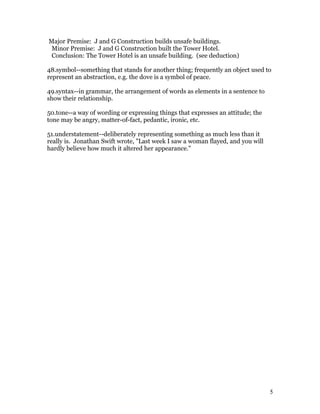
Major Premise: J and G Construction builds unsafe buildings.
 Minor Premise: J and G Construction built the Tower Hotel.
 Conclusion: The Tower Hotel is an unsafe building. (see deduction)

48.symbol--something that stands for another thing; frequently an object used to
represent an abstraction, e.g. the dove is a symbol of peace.

49.syntax--in grammar, the arrangement of words as elements in a sentence to
show their relationship.

50.tone--a way of wording or expressing things that expresses an attitude; the
tone may be angry, matter-of-fact, pedantic, ironic, etc.

51.understatement--deliberately representing something as much less than it
really is. Jonathan Swift wrote, "Last week I saw a woman flayed, and you will
hardly believe how much it altered her appearance."


                                                                                 5

Ap terms and vocabulary

  • 1.
    AP Terms andDefinitions 1.ad hominem fallacy-- (Latin for "to the man") a fallacy of logic in which a person's character or motive is attacked instead of that person's argument. 2.ad populum fallacy-- (Latin for "to the crowd") a fallacy of logic in which the widespread occurrence of something is assumed to make it true or right; e.g. "The Escort is the most widely sold car in the world; therefore, it must be the best." 3.allegory--a story in which the people, places, and things represent general concepts or moral qualities. 4.allusion--a brief reference to a person, place, event, or passage in a work of literature or the Bible assumed to be sufficiently well known to be recognized by the reader; e.g. "I am Lazarus, come from the dead." T. S. Eliot 5.analogy--a comparison between two things in which the more complex is explained in terms of the more simple; e.g. comparing a year-long profile of the stock index to a roller-coaster ride. 6.anecdote--a short entertaining account of some happening, frequently personal or biographical. 7.anticlimax--a sudden drop from the dignified or important in thought or expression to the commonplace or trivial, often for humorous effect. 8.appeal to authority--citation of information from people recognized for their special knowledge of a subject for the purpose of strengthening a speaker or writer's arguments. 9.argumentation--exploration of a problem by investigating all sides of it; persuasion through reason. 10.begging the question--a fallacy of logical argument that assumes as true the very thing that one is trying to prove; e.g. 1. The Bible is the infallible word of God. 2. The Bible says that God exists. Therefore, 3. God exists. 11.cause and effect--examination of the causes and/or effects of a situation or phenomenon; e.g. Essay topics such as "How did the incumbent mayor lose the election?" or "What causes obesity?" are well suited to cause and effect exposition. 12.chronological ordering--arrangement in the order in which things occur; may move from past to present or in reverse chronological order, from present to past. 13.classification as a means of ordering--arrangement of objects according to class; e.g. media classified as print, television, and radio. 1
  • 2.
    14.colloquial expression--words andphrases used in everyday speech but avoided in formal writing; e.g. Jack was bummed out about his chemistry grade instead of Jack was upset about his chemistry grade. 15.damning with faint praise--intentional use of a positive statement that has a negative implication; e.g. "Your new hairdo is so...interesting. 16.deduction (deductive reasoning)--a form of reasoning that begins with a generalization, then applies the generalization to a specific case or cases; opposite to induction. (see syllogism) 17.digression--a temporary departure from the main subject in speaking or writing. 18.ellipsis--1. In grammar, the omission of a word or words necessary for complete construction but understood in context. E.g. "If (it is) possible, (you) come early." 2. The sign (...) that something has been left out of a quotation. "To be or not...that is the question." 19.euphemism--the use of a word or phrase that is less direct, but that is also less distasteful or less offensive than another; e.g."he is at rest" is a euphemism for "he is dead." 20.expository writing--writing that explains or analyzes. 21.false dilemma--a fallacy of logical argument which is committed when too few of the available alternatives are considered, and all but one are assessed and deemed impossible or unacceptable; e.g. A father speaking to his son says, "Are you going to go to college and make something of yourself, or are you going to end up being an unemployable bum like me?" The dilemma is the son's supposed choice limitation: either he goes to college or he will be a bum. The dilemma is false, because the alternative of not going to college but still being employable has not been considered. 22.hyperbole--an extravagant exaggeration of fact, used either for serious or comic effect; e.g. "Your beauty, that did haunt me in my sleep To undertake the death of all the world, So I might live one hour in your sweet bosom." Shakespeare, Richard III 23.imagery--lively descriptions which impress the images of things upon the mind; figures of speech. 24.induction (inductive reasoning)--a form of reasoning which works from a body of fact to the formulation of a generalization; opposite to deduction; 2
  • 3.
    frequently used asthe principal form of reasoning in science and history. 25.inverted syntax--reversing the normal word order of a sentence; e.g. "Whose woods these are I think I know." Robert Frost 26.irony--a method of humorous or sarcastic expression in which the intended meaning of the words is the opposite of their usual meaning; e.g. saying that a cold, windy, rainy day is "lovely." 27.litotes--in rhetoric, a figure in which an affirmative is expressed by a negation of the contrary. A "citizen of no mean city" is, therefore, "a citizen of an important or famous city." 28.metaphor--a figure of speech in which one thing is compared to another by being spoken of as though it were that thing; e.g. "...a sea of troubles." William Bradford, The History of Plymouth Plantation 29.non sequitur--a statement that does not follow logically from what preceded it. 30.order of importance--a method of organizing a paper according to the relative significance of the subtopics. 31.oxymoron--a figure of speech in which contradictory terms or ideas are combined; e.g. "thunderous silence." 32.parable--a short story from which a lesson may be drawn; Christ used the parable to teach his followers moral truths. The parable of the Sower and the Good Samaritan are examples of his parables. 33.parallel syntactic structures--using the same part of speech or syntactic structure in (1) each element of a series, (2) before and after coordinating conjunctions (and, but, yet, or, for, nor), and (3) after each of a pair of correlative conjunctions (not only...but also, neither...nor, both...and, etc.). Below are examples for definitions (1) and (3): (1) Over the hill, through the woods, and to grandmother's house we go. (3) That vegetable is both rich in vitamins and low in calories. 34.paradox--a statement which seems self-contradictory, but which may be true in fact. "Success is counted sweetest By those who ne'er succeed..." Emily Dickinson 35.parody--a literary composition which imitates the characteristic style of a serious work or writer and uses its features to treat trivial, nonsensical material in an attempt at humor or satire. 3
  • 4.
    36.pedantry--a display ofnarrow-minded and trivial scholarship or arbitrary adherence to rules and forms. 37.personification--a figure of speech in which an inanimate object or abstract concept is endowed with human attributes; e.g. the hand of fate. 38.periodic sentence structure--a sentence written so that the full meaning cannot be understood until the end; e.g. Across the stream, beyond the clearing, from behind a fallen tree, the lion emerged. 39.persuasion--taking a single position for the purpose of getting others to accept that position; may appeal to emotion or reason. 40.point of view--the way in which something is viewed or considered by a writer or speaker; in fiction, it is the relationship assumed between the teller of a story and the characters in it, usually demonstrated by the author's use of either first or third person. 41.post hoc fallacy-- (from the Latin: post hoc, ergo propter hoc meaning "after this, therefore because of this.") This fallacy of logic occurs when the writer assume that an incident that precedes another is the cause of the second incident. For example: "Governor X began his first term in January. Three months later, the state suffered severe economic depression. Therefore, Governor X causes the state's depression." The chronological order of events does not establish a cause- effect relationship. 42.rhetoric--the art of using words effectively in writing or speaking so as to influence or persuade. 43.rhetorical question--a question asked for rhetorical effect to emphasize a point, no answer being expected; e.g. "Robert, is this any way to speak to your mother?" 44.satire--a literary work in which vices, abuses, absurdities, etc. are held up to ridicule and contempt; use of ridicule, sarcasm, irony, etc. to expose vices, abuses, etc. 45.simile--a figure of speech involving a comparison using like or as; e.g. "O my love is like a red, red rose." Robert Burns 46.spatial ordering--organization of information using spatial cues such as top to bottom, left to right, etc. 47.syllogism--a form of reasoning in which two statements or premises are made and a logical conclusion is drawn from them; a form of deductive reasoning. Example: 4
  • 5.
    Major Premise: Jand G Construction builds unsafe buildings. Minor Premise: J and G Construction built the Tower Hotel. Conclusion: The Tower Hotel is an unsafe building. (see deduction) 48.symbol--something that stands for another thing; frequently an object used to represent an abstraction, e.g. the dove is a symbol of peace. 49.syntax--in grammar, the arrangement of words as elements in a sentence to show their relationship. 50.tone--a way of wording or expressing things that expresses an attitude; the tone may be angry, matter-of-fact, pedantic, ironic, etc. 51.understatement--deliberately representing something as much less than it really is. Jonathan Swift wrote, "Last week I saw a woman flayed, and you will hardly believe how much it altered her appearance." 5