

A written language is the representation
of a spoken or gestural language by means
of a writing system.
A written language exists only as a
complement to a specific spoken language,
and no natural language is purely written.
However, extinct languages may be, in
effect, purely written if only their
writings survive.
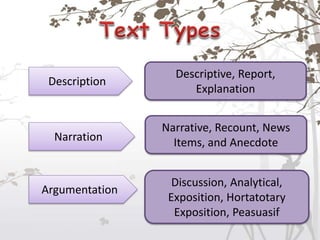
Description
Narration
Argumentation
Narrative, Recount, News
Items, and Anecdote
Descriptive, Report,
Explanation
Discussion, Analytical,
Exposition, Hortatotary
Exposition, Peasuasif
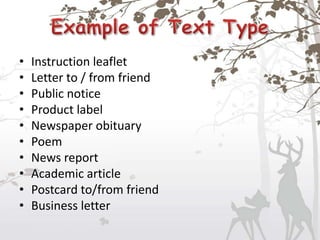
• Instruction leaflet
• Letter to / from friend
• Public notice
• Product label
• Newspaper obituary
• Poem
• News report
• Academic article
• Postcard to/from friend
• Business letter
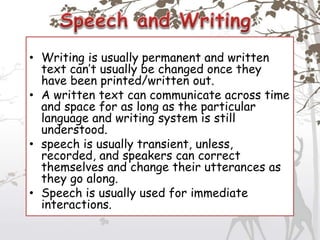
• Writing is usually permanent and written
text can’t usually be changed once they
have been printed/written out.
• A written text can communicate across time
and space for as long as the particular
language and writing system is still
understood.
• speech is usually transient, unless,
recorded, and speakers can correct
themselves and change their utterances as
they go along.
• Speech is usually used for immediate
interactions.
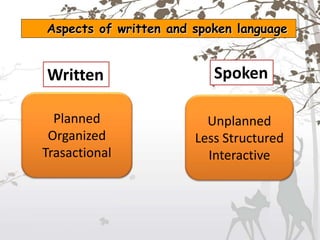
Aspects of written and spoken language
Written Spoken
Planned
Organized
Trasactional
Unplanned
Less Structured
Interactive
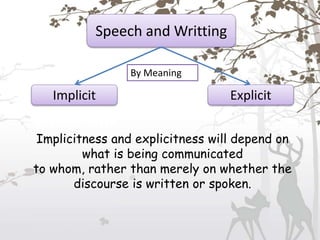
Speech and Writting
ExplicitImplicit
Implicitness and explicitness will depend on
what is being communicated
to whom, rather than merely on whether the
discourse is written or spoken.
By Meaning
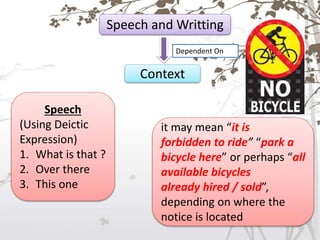
Speech and Writting
Dependent On
Context
Speech
(Using Deictic
Expression)
1. What is that ?
2. Over there
3. This one
it may mean “it is
forbidden to ride” “park a
bicycle here” or perhaps “all
available bicycles
already hired / sold”,
depending on where the
notice is located
THE Differences between
written
&
spoken
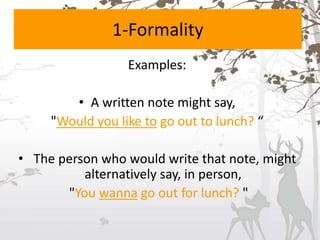
1-Formality
Examples:
• A written note might say,
"Would you like to go out to lunch? “
• The person who would write that note, might
alternatively say, in person,
"You wanna go out for lunch? "
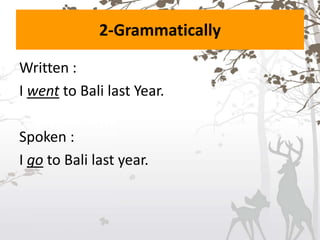
Written :
I went to Bali last Year.
Spoken :
I go to Bali last year.
2-Grammatically
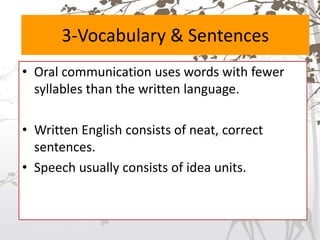
3-Vocabulary & Sentences
• Oral communication uses words with fewer
syllables than the written language.
• Written English consists of neat, correct
sentences.
• Speech usually consists of idea units.
Examples of Written Language
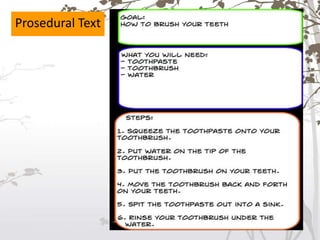
Prosedural Text
Persuasive Text
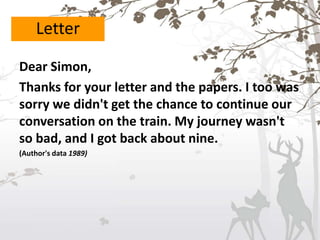
Dear Simon,
Thanks for your letter and the papers. I too was
sorry we didn't get the chance to continue our
conversation on the train. My journey wasn't
so bad, and I got back about nine.
(Author's data 1989)
Letter
Between written and spoken language have a
message to the reader or listener, understand
about contain the text and conversation.
We treat written and spoken language as of
equal importance. Both of them are part of the
language.
Discourse written

Discourse written

  • 2.
    A written languageis the representation of a spoken or gestural language by means of a writing system. A written language exists only as a complement to a specific spoken language, and no natural language is purely written. However, extinct languages may be, in effect, purely written if only their writings survive.
  • 3.
    Description Narration Argumentation Narrative, Recount, News Items,and Anecdote Descriptive, Report, Explanation Discussion, Analytical, Exposition, Hortatotary Exposition, Peasuasif
  • 4.
    • Instruction leaflet •Letter to / from friend • Public notice • Product label • Newspaper obituary • Poem • News report • Academic article • Postcard to/from friend • Business letter
  • 5.
    • Writing isusually permanent and written text can’t usually be changed once they have been printed/written out. • A written text can communicate across time and space for as long as the particular language and writing system is still understood. • speech is usually transient, unless, recorded, and speakers can correct themselves and change their utterances as they go along. • Speech is usually used for immediate interactions.
  • 6.
    Aspects of writtenand spoken language Written Spoken Planned Organized Trasactional Unplanned Less Structured Interactive
  • 7.
    Speech and Writting ExplicitImplicit Implicitnessand explicitness will depend on what is being communicated to whom, rather than merely on whether the discourse is written or spoken. By Meaning
  • 8.
    Speech and Writting DependentOn Context Speech (Using Deictic Expression) 1. What is that ? 2. Over there 3. This one it may mean “it is forbidden to ride” “park a bicycle here” or perhaps “all available bicycles already hired / sold”, depending on where the notice is located
  • 9.
  • 10.
    1-Formality Examples: • A writtennote might say, "Would you like to go out to lunch? “ • The person who would write that note, might alternatively say, in person, "You wanna go out for lunch? "
  • 11.
    Written : I wentto Bali last Year. Spoken : I go to Bali last year. 2-Grammatically
  • 12.
    3-Vocabulary & Sentences •Oral communication uses words with fewer syllables than the written language. • Written English consists of neat, correct sentences. • Speech usually consists of idea units.
  • 13.
  • 14.
  • 15.
  • 16.
    Dear Simon, Thanks foryour letter and the papers. I too was sorry we didn't get the chance to continue our conversation on the train. My journey wasn't so bad, and I got back about nine. (Author's data 1989) Letter
  • 17.
    Between written andspoken language have a message to the reader or listener, understand about contain the text and conversation. We treat written and spoken language as of equal importance. Both of them are part of the language.