


Types of communication
 Internal
 Circular
 Notice
 Memos
 External
 Business letters
 E-mail message
 Proposal
 Telegram
COMMON ETIQUETTES IN
WRITTEN COMMUNICATION
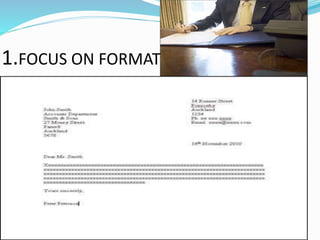
 Focus on format
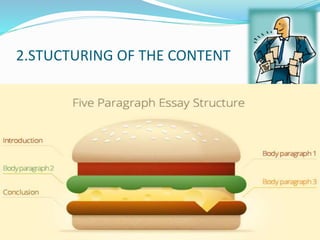
 Structuring of the content
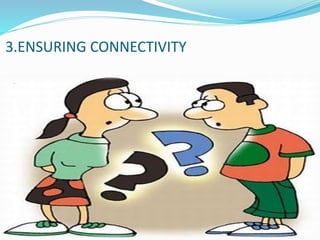
 Ensuring connectivity
 Tempering the content as per the level of formality
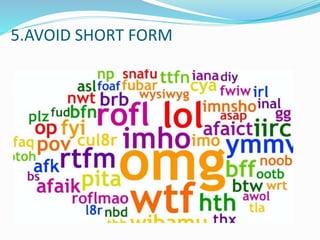
 Avoid short form
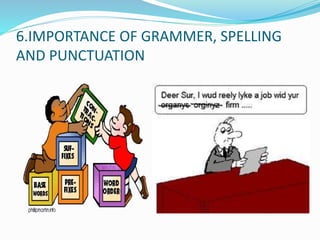
 Importance of grammar, spelling and punctuation
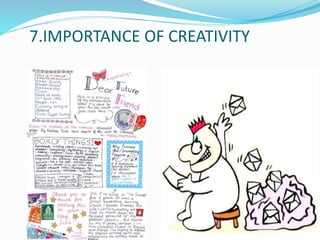
 Importance of creativity
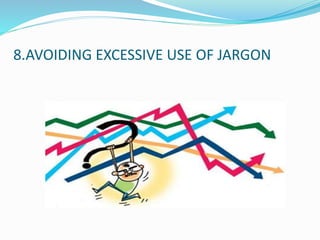
 Avoiding excessive use of jargon
 Awareness of the audience/medium
1.FOCUS ON FORMAT
2.STUCTURING OF THE CONTENT
3.ENSURING CONNECTIVITY
4.TEMPERING THE CONTENT AS PER
THE LEVEL OF FORMALITY
5.AVOID SHORT FORM
6.IMPORTANCE OF GRAMMER, SPELLING
AND PUNCTUATION
7.IMPORTANCE OF CREATIVITY
8.AVOIDING EXCESSIVE USE OF JARGON
9.AWARNESS OF THE AUDIENCE/MEDIUM
ADVANTAGES
Creates a permanent record
Allows you to store information for future reference
Easily distributed
It is a permanent means of communication. Thus, it is
useful where record maintenance is required.
Written communication is more precise and explicit.
Effective written communication develops and
enhances an organization’s image.
Necessary for legal and binding documentation
DISADVANTAGES
Written communication does not save upon the costs.
If the receivers of the written message are separated by
distance and if they need to clear their doubts, the
response is not spontaneous.
Written communication is time-consuming as the
feedback is not immediate.
Effective written communication requires great skills
and competencies in language and vocabulary use.
DIFFERENT WRITING STYLES
 Colloquial
 Casual
 Formal
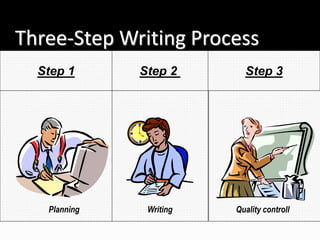
Three-Step Writing Process
Step 1 Step 3Step 2
Planning Writing Quality controll
 Completeness
 Conciseness
 Consideration
 Clarity
 Concreteness
 Courtesy
 Correctness
7 c’s of communication
Written communication

Written communication