Written Communication
One of the best method to communicate
It is one of the oldest known forms of
communication
In today’s age of information and technology ,
writing has become a lost art.
Writing is an extension of human
language across time and space.
Writing most likely began as a
consequence of political expansion in
ancient cultures , which needed reliable
means for transmitting information's ,
maintaining financial accounts , keeping
historical records and similar activites.
Around the 4th millennium BC ,
the complexity of trade and
administration outgrew the power
of memory and writing became a
more dependable method of
recording and presenting
transactions in a permanent form.
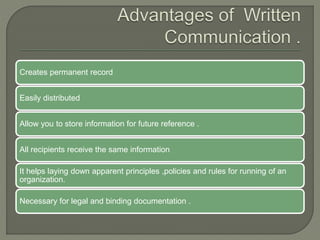
Creates permanent record
Easily distributed
Allow you to store information for future reference .
All recipients receive the same information
It helps laying down apparent principles ,policies and rules for running of an
organization.
Necessary for legal and binding documentation .
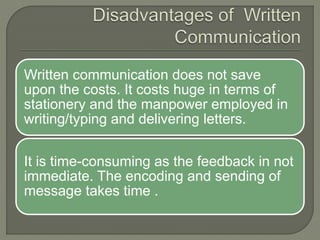
Written communication does not save
upon the costs. It costs huge in terms of
stationery and the manpower employed in
writing/typing and delivering letters.
It is time-consuming as the feedback in not
immediate. The encoding and sending of
message takes time .
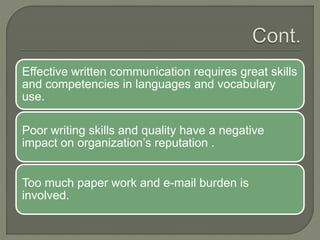
Effective written communication requires great skills
and competencies in languages and vocabulary
use.
Poor writing skills and quality have a negative
impact on organization’s reputation .
Too much paper work and e-mail burden is
involved.
Continuing with the series of
etiquettes in communication,
language expert Preeti
Shirodkar tells us about what
we need to keep in Ming while
communicating in writing.
While written communication affords greater
flexibility , since it can be edited and both
composed and read at leisure or at one’s pace ,
a great deal of care needs to be taken, in order
to ensure its effectiveness ; as it can serve as a
point of reference, which one can turn to time
and again , thus creating a more lasting impact .
The various formal writing forms have a pre-determined,
universally accepted format that accompanies them.
Moreover , these formats are likely to change with time, due
to the evolving nature of communication and /or technology .
For example , the semi block format that was earlier the most
relied upon format for letter writing has now given way to the
full block format , after the wide spread use of computers.
Be aware of the use of various writing formats
Introduction, Body and conclusion :
While writing one should ensure that the content
is well organized , with the overview/basic details
comprising the introduction ; all major points with
their explanation and exemplification constituting
the body(preferably divided into a separate
paragraph each for every new point , with
titles and subtitles, if necessary).
That content that comprises a
piece of writing should reflect
fluency and should be connected
through a logical flow of thought,
in order to prevent
misinterpretation and catch the
attention of the reader.
Moreover, care should be taken to ensure that the
flow is not brought about through a
forced/deliberate use of connectives , as this make
the piece extremely uninteresting and artificial .
lack of connectivity can often lead to
communication gaps , misinterpretation and
doubts.
The level of formality that is
shared between the sender
and receiver should define
the use of salutations ,the
vocabulary , the content , the
format and even the medium.
Though not integral to the matter
communicated , this courtesy helps in
creating a balanced impression about
the communicator
Tone your communication bearing in
mind how formal or casual your
relationship is with the receiver.
People may not be aware of the
meaning of various short and may thus
find it difficult to interpret them. Moreover
, short forms can at time be culture
specific or even organization specific and
may thus unnecessarily complicate the
communication .
Improper grammar can at worst cause
miscommunication and at least result in
unwanted humor and should be thus
avoided. So too, spellings can create
the same effect or can even reflect a
careless attitude on part of the sender.
Finally, effective use of punctuations facilitates
reading and interpretation and can in rare
cases even prevent a completely meaning,
which can result in miscommunication .
Bad grammar and spellings can land you in
trouble even today.
One need to be aware of and sensitive to the emotions
, need and nature of the audience in choosing the
vocabulary, content , illustrations , formats and medium
of communication, as a discomfort in the audience
would hamper rather than facilitate communication.
Don’t take your audience for granted . Make sure they
understand what you're talking.
In order to hold the reader’s attention need to be creative to break the
tedium of writing and prevent monotony from creeping in.
This is specially true in the case of all detailed writing that seeks to
hold the readers attention .
Make sure your communication doesn’t end up in a pile of garbage .
Be a little creative .
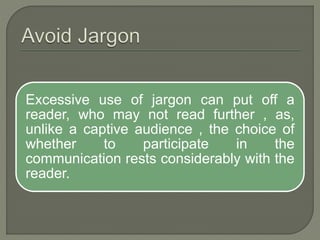
Excessive use of jargon can put off a
reader, who may not read further , as,
unlike a captive audience , the choice of
whether to participate in the
communication rests considerably with the
reader.
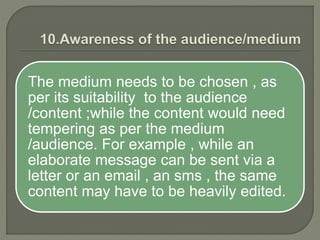
The medium needs to be chosen , as
per its suitability to the audience
/content ;while the content would need
tempering as per the medium
/audience. For example , while an
elaborate message can be sent via a
letter or an email , an sms , the same
content may have to be heavily edited.
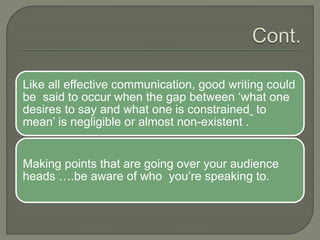
Like all effective communication, good writing could
be said to occur when the gap between ‘what one
desires to say and what one is constrained to
mean’ is negligible or almost non-existent .
Making points that are going over your audience
heads ….be aware of who you’re speaking to.
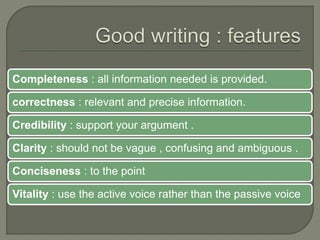
Completeness : all information needed is provided.
correctness : relevant and precise information.
Credibility : support your argument .
Clarity : should not be vague , confusing and ambiguous .
Conciseness : to the point
Vitality : use the active voice rather than the passive voice
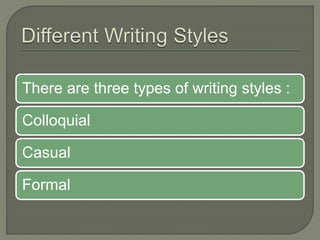
There are three types of writing styles :
Colloquial
Casual
Formal
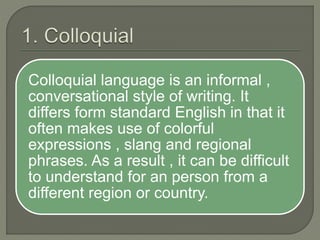
Colloquial language is an informal ,
conversational style of writing. It
differs form standard English in that it
often makes use of colorful
expressions , slang and regional
phrases. As a result , it can be difficult
to understand for an person from a
different region or country.
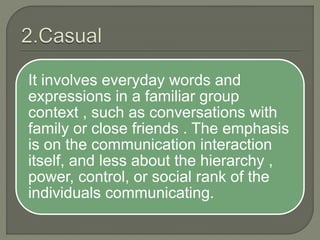
It involves everyday words and
expressions in a familiar group
context , such as conversations with
family or close friends . The emphasis
is on the communication interaction
itself, and less about the hierarchy ,
power, control, or social rank of the
individuals communicating.
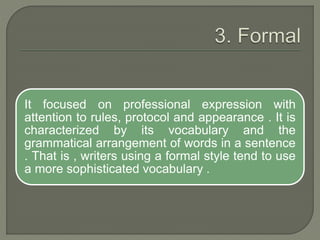
It focused on professional expression with
attention to rules, protocol and appearance . It is
characterized by its vocabulary and the
grammatical arrangement of words in a sentence
. That is , writers using a formal style tend to use
a more sophisticated vocabulary .
Be specific : Just like a reporter,
communicate the “who, what, where, why,
when and how” of what needs to done .
Stay objective and specific.
Avoid Passive Voice : Instead of writing
“the program was planned by Gaurav , “
Gaurav planned the program .”
Be concise : There is no need to be long-
winded. Get to the point . You’ll lose
readers if you spout off too long!
Get Things Right : Take great care when
spelling people’s name, and other specifics
. And also make sure that you do a careful
proof of your work.
Know When Formal Language is Required :if your
are writing an informal language note to group
members, it’s fine to use contractions (“don’t” in place
of “do not”)
Read It Out Loud : One very effective way to self-
proof your work is to read it out loud. This will help
you to determine if your have used incorrect words, if
your sentences run on too long, if your tensed don’t
match and more.
No matter what you are writing a few things can
create a negative first impression about your
intelligence and your level of care : misspellings
, grammatical mistakes, missed words
,messy(confused) delivery and incomplete work.
Written communication

Written communication

  • 1.
  • 2.
    One of thebest method to communicate It is one of the oldest known forms of communication In today’s age of information and technology , writing has become a lost art.
  • 3.
    Writing is anextension of human language across time and space. Writing most likely began as a consequence of political expansion in ancient cultures , which needed reliable means for transmitting information's , maintaining financial accounts , keeping historical records and similar activites.
  • 4.
    Around the 4thmillennium BC , the complexity of trade and administration outgrew the power of memory and writing became a more dependable method of recording and presenting transactions in a permanent form.
  • 5.
    Creates permanent record Easilydistributed Allow you to store information for future reference . All recipients receive the same information It helps laying down apparent principles ,policies and rules for running of an organization. Necessary for legal and binding documentation .
  • 6.
    Written communication doesnot save upon the costs. It costs huge in terms of stationery and the manpower employed in writing/typing and delivering letters. It is time-consuming as the feedback in not immediate. The encoding and sending of message takes time .
  • 7.
    Effective written communicationrequires great skills and competencies in languages and vocabulary use. Poor writing skills and quality have a negative impact on organization’s reputation . Too much paper work and e-mail burden is involved.
  • 8.
    Continuing with theseries of etiquettes in communication, language expert Preeti Shirodkar tells us about what we need to keep in Ming while communicating in writing.
  • 9.
    While written communicationaffords greater flexibility , since it can be edited and both composed and read at leisure or at one’s pace , a great deal of care needs to be taken, in order to ensure its effectiveness ; as it can serve as a point of reference, which one can turn to time and again , thus creating a more lasting impact .
  • 10.
    The various formalwriting forms have a pre-determined, universally accepted format that accompanies them. Moreover , these formats are likely to change with time, due to the evolving nature of communication and /or technology . For example , the semi block format that was earlier the most relied upon format for letter writing has now given way to the full block format , after the wide spread use of computers. Be aware of the use of various writing formats
  • 11.
    Introduction, Body andconclusion : While writing one should ensure that the content is well organized , with the overview/basic details comprising the introduction ; all major points with their explanation and exemplification constituting the body(preferably divided into a separate paragraph each for every new point , with titles and subtitles, if necessary).
  • 12.
    That content thatcomprises a piece of writing should reflect fluency and should be connected through a logical flow of thought, in order to prevent misinterpretation and catch the attention of the reader.
  • 13.
    Moreover, care shouldbe taken to ensure that the flow is not brought about through a forced/deliberate use of connectives , as this make the piece extremely uninteresting and artificial . lack of connectivity can often lead to communication gaps , misinterpretation and doubts.
  • 14.
    The level offormality that is shared between the sender and receiver should define the use of salutations ,the vocabulary , the content , the format and even the medium.
  • 15.
    Though not integralto the matter communicated , this courtesy helps in creating a balanced impression about the communicator Tone your communication bearing in mind how formal or casual your relationship is with the receiver.
  • 16.
    People may notbe aware of the meaning of various short and may thus find it difficult to interpret them. Moreover , short forms can at time be culture specific or even organization specific and may thus unnecessarily complicate the communication .
  • 17.
    Improper grammar canat worst cause miscommunication and at least result in unwanted humor and should be thus avoided. So too, spellings can create the same effect or can even reflect a careless attitude on part of the sender.
  • 18.
    Finally, effective useof punctuations facilitates reading and interpretation and can in rare cases even prevent a completely meaning, which can result in miscommunication . Bad grammar and spellings can land you in trouble even today.
  • 19.
    One need tobe aware of and sensitive to the emotions , need and nature of the audience in choosing the vocabulary, content , illustrations , formats and medium of communication, as a discomfort in the audience would hamper rather than facilitate communication. Don’t take your audience for granted . Make sure they understand what you're talking.
  • 20.
    In order tohold the reader’s attention need to be creative to break the tedium of writing and prevent monotony from creeping in. This is specially true in the case of all detailed writing that seeks to hold the readers attention . Make sure your communication doesn’t end up in a pile of garbage . Be a little creative .
  • 21.
    Excessive use ofjargon can put off a reader, who may not read further , as, unlike a captive audience , the choice of whether to participate in the communication rests considerably with the reader.
  • 22.
    The medium needsto be chosen , as per its suitability to the audience /content ;while the content would need tempering as per the medium /audience. For example , while an elaborate message can be sent via a letter or an email , an sms , the same content may have to be heavily edited.
  • 23.
    Like all effectivecommunication, good writing could be said to occur when the gap between ‘what one desires to say and what one is constrained to mean’ is negligible or almost non-existent . Making points that are going over your audience heads ….be aware of who you’re speaking to.
  • 24.
    Completeness : allinformation needed is provided. correctness : relevant and precise information. Credibility : support your argument . Clarity : should not be vague , confusing and ambiguous . Conciseness : to the point Vitality : use the active voice rather than the passive voice
  • 25.
    There are threetypes of writing styles : Colloquial Casual Formal
  • 26.
    Colloquial language isan informal , conversational style of writing. It differs form standard English in that it often makes use of colorful expressions , slang and regional phrases. As a result , it can be difficult to understand for an person from a different region or country.
  • 27.
    It involves everydaywords and expressions in a familiar group context , such as conversations with family or close friends . The emphasis is on the communication interaction itself, and less about the hierarchy , power, control, or social rank of the individuals communicating.
  • 28.
    It focused onprofessional expression with attention to rules, protocol and appearance . It is characterized by its vocabulary and the grammatical arrangement of words in a sentence . That is , writers using a formal style tend to use a more sophisticated vocabulary .
  • 29.
    Be specific :Just like a reporter, communicate the “who, what, where, why, when and how” of what needs to done . Stay objective and specific. Avoid Passive Voice : Instead of writing “the program was planned by Gaurav , “ Gaurav planned the program .”
  • 30.
    Be concise :There is no need to be long- winded. Get to the point . You’ll lose readers if you spout off too long! Get Things Right : Take great care when spelling people’s name, and other specifics . And also make sure that you do a careful proof of your work.
  • 31.
    Know When FormalLanguage is Required :if your are writing an informal language note to group members, it’s fine to use contractions (“don’t” in place of “do not”) Read It Out Loud : One very effective way to self- proof your work is to read it out loud. This will help you to determine if your have used incorrect words, if your sentences run on too long, if your tensed don’t match and more.
  • 32.
    No matter whatyou are writing a few things can create a negative first impression about your intelligence and your level of care : misspellings , grammatical mistakes, missed words ,messy(confused) delivery and incomplete work.