Topic:
Writing Skill
Group Members
Sehar Jaan
Hassan Sheraz
Abrar Bashir
Maria Fatima
Hasan Waseem
Nabeel Mukhtar
UNIVERSTY OF LAHORE SGD CAMPUS
BSSE 3 SEMESTER
Writing
One of the best methods to communicate
Writing is one of the oldest known forms of
communication.
Writing is a process where symbols have to be
arranged according to a certain conventions to
form words and words have to be arranged to
form sentences.
Cont…..
Writing involves encoding of a message
of some kind: that is we translate our
thoughts into language.
Any idea can be conveyed
through writing. If you
can think it, you can
write it.
Why Writing is important?
Writing aims to capture a thought or idea,
to transfer it to a permanent format,
making it tangible.
Creates a permanent record.
Allows you to store information for future
reference.
Easily distributed.
Cont..
All recipients receive the same
information
Necessary for legal and binding
documentation
“You cannot depend on your
eyes when your imagination is
out of focus.”
- Mark Twain
Writing Skills
Your Writing = Your Personality
The ability to write does not require a
unique talent or an outstanding mental
ability.
Writing skills are specific abilities which
help writers put their thoughts into words in
a meaningful form and to mentally interact
with the message
Cont..
 Writing skills help the learner gain
independence , comprehensibility ,
fluency and creativity in writing.
A basic understanding of writing and a
commitment to writing well in all
situations is needed as a professional.
Questions a writer asks
 How do I begin?
 What is my purpose?
 How do I make my point clear?
 How do I create a logical flow?
 How do I say what I mean?
 How do I avoid grammatical errors?
 How can I make my message brief?
 How can I create a visual effect?
The Writing Process
i. Planning
ii. Writing
iii. Quality Control
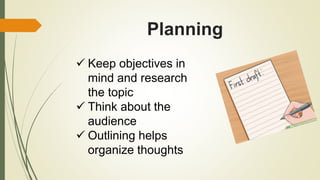
Planning
 Keep objectives in
mind and research
the topic
 Think about the
audience
 Outlining helps
organize thoughts
Writing
 Follow your outline, use
your handbook
 Inspiration is acceptable
but must be carefully
reviewed
 Use the interview
approach to supplement
the outline (who, what,
where, when, how)
Quality Control
 Reread your
work
 Be critical of
your own work
Considerations while writing
 Who?
 What?
 When?
 Why?
 Where?
 How?
Good Writing
o Completeness: all information needed is provided
o Correctness: relevant and precise information
o Credibility: support your argument
o Clarity: should not be vague, confusing, ambiguous
o Conciseness: to the point
o Consideration: anticipate the reader’s reaction
o Vitality: use the active voice rather than the passive
voice
Business Documents
A good business document should always
answer the following questions:
What is this document about?
Why has it come to be?
Who wrote it?
How is it organized?
What is it trying to accomplish
What supports the conclusion?
What problem or opportunity does it address?
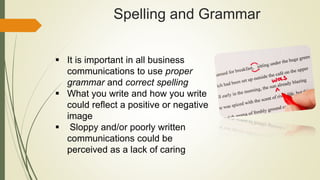
Spelling and Grammar
 It is important in all business
communications to use proper
grammar and correct spelling
 What you write and how you write
could reflect a positive or negative
image
 Sloppy and/or poorly written
communications could be
perceived as a lack of caring
Spelling and Grammar Tips
Proofread communications before sending
Use spell and grammar check if available
Make sure to have subject, verb and tense
agreement
Ensure proper word usage:
affect/effect there/their
among/between shall/will
can/may than/then
Types of Writing
E-mails
Letters and Memos
Agendas
Reports
Promotional Material
Academic Documents
Research (scientific) manuscripts
White Papers
E-Mails
E-mail is fast, convenient and easy
Email is now the dominant method of communicating
in business.
Convenient for communicating with people in different
places and different time zones
Excellent mechanism for follow-up or action items after
a meeting
Messages can be saved and retrieved easily
Easier to communicate
with people who
understand written
English but don’t speak it
well.
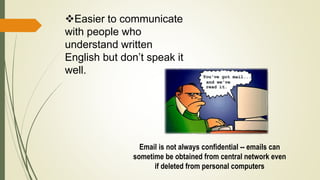
Email is not always confidential -- emails can
sometime be obtained from central network even
if deleted from personal computers
Cont…
 Many users do not realize the potential outcome of
what is being sent through e-mails
 Business e-mails should be concise and to the point
 The language used in business e-mails should not
be overly informal
E-Mail Manners
 Always include a subject or e-mail title
 Avoid the “ready, aim, fire” approach
 Don’t be too-casual
 Make one point per e-mail
 Make the font user-friendly
 Don’t use all capital or lower-case letters
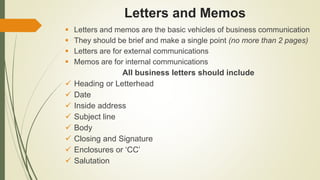
Letters and Memos
 Letters and memos are the basic vehicles of business communication
 They should be brief and make a single point (no more than 2 pages)
 Letters are for external communications
 Memos are for internal communications
All business letters should include
 Heading or Letterhead
 Date
 Inside address
 Subject line
 Body
 Closing and Signature
 Enclosures or ‘CC’
 Salutation
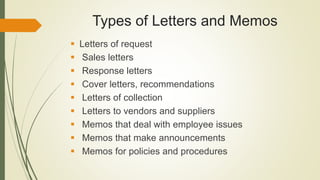
Types of Letters and Memos
 Letters of request
 Sales letters
 Response letters
 Cover letters, recommendations
 Letters of collection
 Letters to vendors and suppliers
 Memos that deal with employee issues
 Memos that make announcements
 Memos for policies and procedures
“The greatest problem in
communication is the illusion that
it has been accomplished.”
- George Bernard Shaw
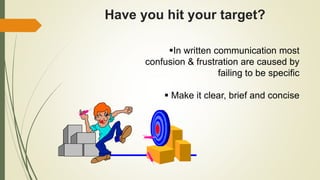
Have you hit your target?
In written communication most
confusion & frustration are caused by
failing to be specific
 Make it clear, brief and concise
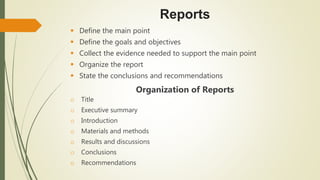
Reports
 Define the main point
 Define the goals and objectives
 Collect the evidence needed to support the main point
 Organize the report
 State the conclusions and recommendations
Organization of Reports
o Title
o Executive summary
o Introduction
o Materials and methods
o Results and discussions
o Conclusions
o Recommendations
Punctuation
• Use commas to separate elements in a series, and to separate
ideas or clauses.
• Use correct punctuation in abbreviations; e.g., for example i.e.,
that is etc.,
• Do not use multiple punctuation marks, for example: !!! ... ???,
etc.
• Punctuation of lists and tables
• Hyphen and dash usage
• Confusion between its and it's
• Abbreviations and acronyms
• Use active voice
• Do not switch tenses very often
• Proofread for accuracy
Commandments
1. Know what you want to say before you say it.
2. Keep it simple.
3. Use bullet points.
4. WIIFM (What's in It For Me?)
5. Don't get bogged down
6. Call to action
7. Edit
8. Spell check
9. Take 5 before hitting send
10.Follow up
Conclusions
 Utilize full potential of written communication
 Use frequent e-mails as per your requirement
 What you write will ultimately define you as a
professional to your colleagues and superiors
 Match the appropriate communication method to
the recipient
 Eliminating excessive or unnecessary
communication will improve your workflow
 Mastering these skills will improve your ability
and enhance your career
Discussion?
Writing skills

Writing skills

  • 2.
  • 3.
    Group Members Sehar Jaan HassanSheraz Abrar Bashir Maria Fatima Hasan Waseem Nabeel Mukhtar
  • 4.
    UNIVERSTY OF LAHORESGD CAMPUS BSSE 3 SEMESTER
  • 5.
    Writing One of thebest methods to communicate Writing is one of the oldest known forms of communication. Writing is a process where symbols have to be arranged according to a certain conventions to form words and words have to be arranged to form sentences.
  • 6.
    Cont….. Writing involves encodingof a message of some kind: that is we translate our thoughts into language.
  • 7.
    Any idea canbe conveyed through writing. If you can think it, you can write it.
  • 8.
    Why Writing isimportant? Writing aims to capture a thought or idea, to transfer it to a permanent format, making it tangible. Creates a permanent record. Allows you to store information for future reference. Easily distributed.
  • 9.
    Cont.. All recipients receivethe same information Necessary for legal and binding documentation
  • 10.
    “You cannot dependon your eyes when your imagination is out of focus.” - Mark Twain
  • 11.
    Writing Skills Your Writing= Your Personality The ability to write does not require a unique talent or an outstanding mental ability. Writing skills are specific abilities which help writers put their thoughts into words in a meaningful form and to mentally interact with the message
  • 12.
    Cont..  Writing skillshelp the learner gain independence , comprehensibility , fluency and creativity in writing. A basic understanding of writing and a commitment to writing well in all situations is needed as a professional.
  • 13.
    Questions a writerasks  How do I begin?  What is my purpose?  How do I make my point clear?  How do I create a logical flow?  How do I say what I mean?  How do I avoid grammatical errors?  How can I make my message brief?  How can I create a visual effect?
  • 14.
    The Writing Process i.Planning ii. Writing iii. Quality Control
  • 15.
    Planning  Keep objectivesin mind and research the topic  Think about the audience  Outlining helps organize thoughts
  • 16.
    Writing  Follow youroutline, use your handbook  Inspiration is acceptable but must be carefully reviewed  Use the interview approach to supplement the outline (who, what, where, when, how)
  • 17.
    Quality Control  Rereadyour work  Be critical of your own work
  • 18.
    Considerations while writing Who?  What?  When?  Why?  Where?  How?
  • 19.
    Good Writing o Completeness:all information needed is provided o Correctness: relevant and precise information o Credibility: support your argument o Clarity: should not be vague, confusing, ambiguous o Conciseness: to the point o Consideration: anticipate the reader’s reaction o Vitality: use the active voice rather than the passive voice
  • 20.
    Business Documents A goodbusiness document should always answer the following questions: What is this document about? Why has it come to be? Who wrote it? How is it organized? What is it trying to accomplish What supports the conclusion? What problem or opportunity does it address?
  • 21.
    Spelling and Grammar It is important in all business communications to use proper grammar and correct spelling  What you write and how you write could reflect a positive or negative image  Sloppy and/or poorly written communications could be perceived as a lack of caring
  • 22.
    Spelling and GrammarTips Proofread communications before sending Use spell and grammar check if available Make sure to have subject, verb and tense agreement Ensure proper word usage: affect/effect there/their among/between shall/will can/may than/then
  • 23.
    Types of Writing E-mails Lettersand Memos Agendas Reports Promotional Material Academic Documents Research (scientific) manuscripts White Papers
  • 24.
    E-Mails E-mail is fast,convenient and easy Email is now the dominant method of communicating in business. Convenient for communicating with people in different places and different time zones Excellent mechanism for follow-up or action items after a meeting Messages can be saved and retrieved easily
  • 25.
    Easier to communicate withpeople who understand written English but don’t speak it well. Email is not always confidential -- emails can sometime be obtained from central network even if deleted from personal computers
  • 26.
    Cont…  Many usersdo not realize the potential outcome of what is being sent through e-mails  Business e-mails should be concise and to the point  The language used in business e-mails should not be overly informal E-Mail Manners  Always include a subject or e-mail title  Avoid the “ready, aim, fire” approach  Don’t be too-casual  Make one point per e-mail  Make the font user-friendly  Don’t use all capital or lower-case letters
  • 27.
    Letters and Memos Letters and memos are the basic vehicles of business communication  They should be brief and make a single point (no more than 2 pages)  Letters are for external communications  Memos are for internal communications All business letters should include  Heading or Letterhead  Date  Inside address  Subject line  Body  Closing and Signature  Enclosures or ‘CC’  Salutation
  • 28.
    Types of Lettersand Memos  Letters of request  Sales letters  Response letters  Cover letters, recommendations  Letters of collection  Letters to vendors and suppliers  Memos that deal with employee issues  Memos that make announcements  Memos for policies and procedures
  • 29.
    “The greatest problemin communication is the illusion that it has been accomplished.” - George Bernard Shaw
  • 30.
    Have you hityour target? In written communication most confusion & frustration are caused by failing to be specific  Make it clear, brief and concise
  • 31.
    Reports  Define themain point  Define the goals and objectives  Collect the evidence needed to support the main point  Organize the report  State the conclusions and recommendations Organization of Reports o Title o Executive summary o Introduction o Materials and methods o Results and discussions o Conclusions o Recommendations
  • 32.
    Punctuation • Use commasto separate elements in a series, and to separate ideas or clauses. • Use correct punctuation in abbreviations; e.g., for example i.e., that is etc., • Do not use multiple punctuation marks, for example: !!! ... ???, etc. • Punctuation of lists and tables • Hyphen and dash usage • Confusion between its and it's • Abbreviations and acronyms • Use active voice • Do not switch tenses very often • Proofread for accuracy
  • 33.
    Commandments 1. Know whatyou want to say before you say it. 2. Keep it simple. 3. Use bullet points. 4. WIIFM (What's in It For Me?) 5. Don't get bogged down 6. Call to action 7. Edit 8. Spell check 9. Take 5 before hitting send 10.Follow up
  • 34.
    Conclusions  Utilize fullpotential of written communication  Use frequent e-mails as per your requirement  What you write will ultimately define you as a professional to your colleagues and superiors  Match the appropriate communication method to the recipient  Eliminating excessive or unnecessary communication will improve your workflow  Mastering these skills will improve your ability and enhance your career
  • 35.