WRITING SCRIPT
Dr. J. JANARDHAN
WRITING THE SCRIPT
OUTLINE YOUR STORY
• Begin with a basic flow of your narrative.
• Focus on the conflict of the story; conflict drives drama.
• Keep length in mind.
• A long screenplay doesn’t have a realistic chance
• Can’t be reduced into less than two hours of screen time
WRITING THE SCRIPT
Write in three acts
• The pillars of a screenplay are the Three Acts
• Act One: This is the set-up for the story.
• Introduce the world and the characters
• Set the tone/genre of the story (comedy, action, romance, etc.)
• Introduce your protagonist
• Begin exploring the conflict that will drive the story
• Act One is typically 30 pages. For comedies, 24 pages
WRITING THE SCRIPT
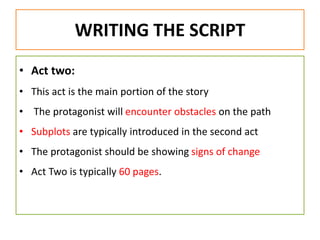
• Act two:
• This act is the main portion of the story
• The protagonist will encounter obstacles on the path
• Subplots are typically introduced in the second act
• The protagonist should be showing signs of change
• Act Two is typically 60 pages.
WRITING THE SCRIPT
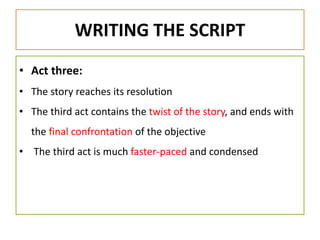
• Act three:
• The story reaches its resolution
• The third act contains the twist of the story, and ends with
the final confrontation of the objective
• The third act is much faster-paced and condensed
WRITING THE SCRIPT
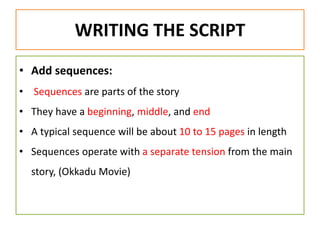
• Add sequences:
• Sequences are parts of the story
• They have a beginning, middle, and end
• A typical sequence will be about 10 to 15 pages in length
• Sequences operate with a separate tension from the main
story, (Okkadu Movie)
WRITING THE SCRIPT
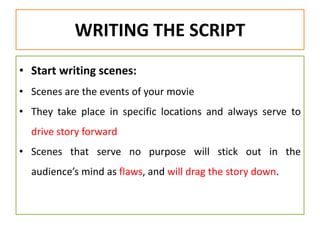
• Start writing scenes:
• Scenes are the events of your movie
• They take place in specific locations and always serve to
drive story forward
• Scenes that serve no purpose will stick out in the
audience’s mind as flaws, and will drag the story down.
WRITING THE SCRIPT
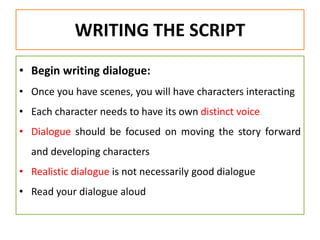
• Begin writing dialogue:
• Once you have scenes, you will have characters interacting
• Each character needs to have its own distinct voice
• Dialogue should be focused on moving the story forward
and developing characters
• Realistic dialogue is not necessarily good dialogue
• Read your dialogue aloud
WRITING THE SCRIPT
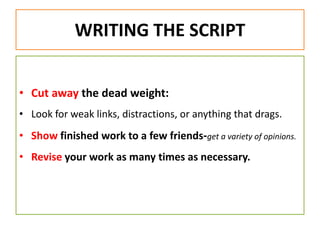
• Cut away the dead weight:
• Look for weak links, distractions, or anything that drags.
• Show finished work to a few friends-get a variety of opinions.
• Revise your work as many times as necessary.
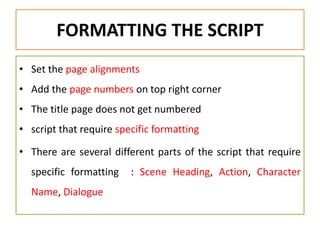
FORMATTING THE SCRIPT
• Set the page alignments
• Add the page numbers on top right corner
• The title page does not get numbered
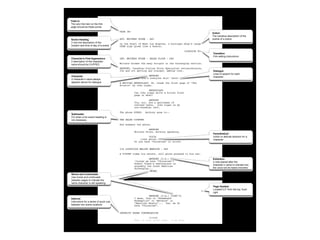
• script that require specific formatting
• There are several different parts of the script that require
specific formatting : Scene Heading, Action, Character
Name, Dialogue
THANK YOU

Writing script 26.02.2018-converted

  • 1.
  • 2.
    WRITING THE SCRIPT OUTLINEYOUR STORY • Begin with a basic flow of your narrative. • Focus on the conflict of the story; conflict drives drama. • Keep length in mind. • A long screenplay doesn’t have a realistic chance • Can’t be reduced into less than two hours of screen time
  • 3.
    WRITING THE SCRIPT Writein three acts • The pillars of a screenplay are the Three Acts • Act One: This is the set-up for the story. • Introduce the world and the characters • Set the tone/genre of the story (comedy, action, romance, etc.) • Introduce your protagonist • Begin exploring the conflict that will drive the story • Act One is typically 30 pages. For comedies, 24 pages
  • 4.
    WRITING THE SCRIPT •Act two: • This act is the main portion of the story • The protagonist will encounter obstacles on the path • Subplots are typically introduced in the second act • The protagonist should be showing signs of change • Act Two is typically 60 pages.
  • 5.
    WRITING THE SCRIPT •Act three: • The story reaches its resolution • The third act contains the twist of the story, and ends with the final confrontation of the objective • The third act is much faster-paced and condensed
  • 6.
    WRITING THE SCRIPT •Add sequences: • Sequences are parts of the story • They have a beginning, middle, and end • A typical sequence will be about 10 to 15 pages in length • Sequences operate with a separate tension from the main story, (Okkadu Movie)
  • 7.
    WRITING THE SCRIPT •Start writing scenes: • Scenes are the events of your movie • They take place in specific locations and always serve to drive story forward • Scenes that serve no purpose will stick out in the audience’s mind as flaws, and will drag the story down.
  • 8.
    WRITING THE SCRIPT •Begin writing dialogue: • Once you have scenes, you will have characters interacting • Each character needs to have its own distinct voice • Dialogue should be focused on moving the story forward and developing characters • Realistic dialogue is not necessarily good dialogue • Read your dialogue aloud
  • 9.
    WRITING THE SCRIPT •Cut away the dead weight: • Look for weak links, distractions, or anything that drags. • Show finished work to a few friends-get a variety of opinions. • Revise your work as many times as necessary.
  • 10.
    FORMATTING THE SCRIPT •Set the page alignments • Add the page numbers on top right corner • The title page does not get numbered • script that require specific formatting • There are several different parts of the script that require specific formatting : Scene Heading, Action, Character Name, Dialogue
  • 12.