DRAMAIts Elements
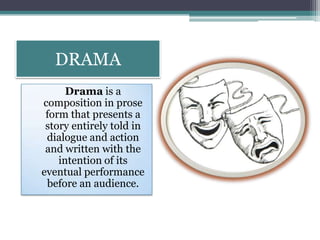
DRAMA	Drama is a composition in prose form that presents a story entirely told in dialogue and action and written with the intention of its eventual performance before an audience.
DRAMADrama has a two-fold nature: LITERATURE and THEATRE.
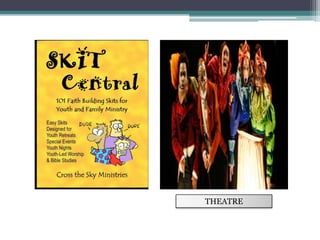
THEATRE
ELEMENTS OF DRAMA
SETTINGSetting identifies the time and place in which the events occur. It consists of the historical period, the moment, day and season in which the incidents take place. It also includes the sceneries in the performance which are usually found in the preliminary descriptions.
CHARACTERSCharacters are the people in the play and thus considered as the principal material in a drama.
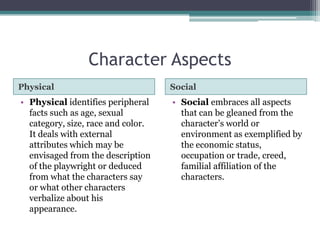
Character AspectsPhysicalSocialPhysical identifies peripheral facts such as age, sexual category, size, race and color. It deals with external attributes which may be envisaged from the description of the playwright or deduced from what the characters say or what other characters verbalize about his appearance.Social embraces all aspects that can be gleaned from the character’s world or environment as exemplified by the economic status, occupation or trade, creed, familial affiliation of the characters.
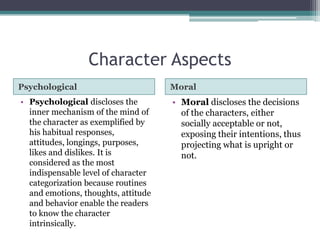
Character AspectsPsychologicalMoralPsychological discloses the inner mechanism of the mind of the character as exemplified by his habitual responses, attitudes, longings, purposes, likes and dislikes. It is considered as the most indispensable level of character categorization because routines and emotions, thoughts, attitude and behavior enable the readers to know the character intrinsically.Moral discloses the decisions of the characters, either socially acceptable or not, exposing their intentions, thus projecting what is upright or not.
PLOTPlot lays out the series of events that form the entirety of the play. It serves as a structural framework which brings the events to a cohesive form and sense.
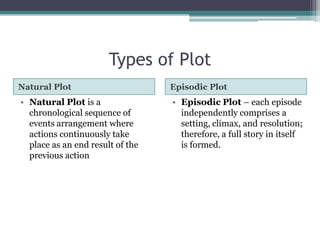
Types of PlotNatural PlotEpisodic PlotNatural Plot is a chronological sequence of events arrangement where actions continuously take place as an end result of the previous actionEpisodic Plot – each episode independently comprises a setting, climax, and resolution; therefore, a full story in itself is formed.
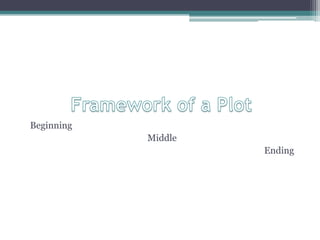
Framework of a PlotBeginningMiddleEnding
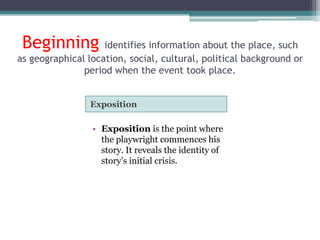
Beginningidentifies information about the place, such as geographical location, social, cultural, political background or period when the event took place.ExpositionExposition is the point where the playwright commences his story. It reveals the identity of story’s initial crisis.
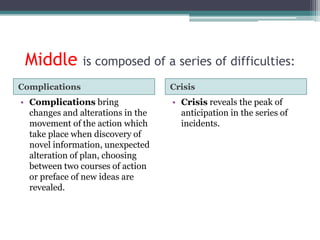
Middleis composed of a series of difficulties:ComplicationsCrisisComplications bring changes and alterations in the movement of the action which take place when discovery of novel information, unexpected alteration of plan, choosing between two courses of action or preface of new ideas are revealed. Crisis reveals the peak of anticipation in the series of incidents.
Middleis composed of a series of difficulties:Obligatory SceneDiscoveryObligatory Scene identifies the open collision between two opposing characters or forces.Discovery discloses points which are previously unknown, characterized as something mysterious, strange, unfamiliar and thus revealed through objects, persons, facts, values, or self-discovered.
Endingis the final major component of the story which brings the condition back to its stability. This part brings satisfaction to the audience which extends to the final curtain as peace is completely restored.
THEMETheme is considered as the unifying element that defines the dramatized idea of the play. It is the over-all sense or implication of the action. It defines the problem, emphasizes the ethical judgment and suggest attitude or course of action that eliminates the crisis is an acceptable way.
STYLEStyle refers to the mode of expression or presentation of the play which points out the playwright’s position or viewpoint in life.
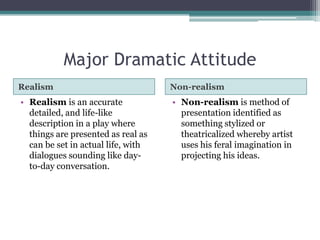
Major Dramatic AttitudeRealismNon-realismRealism is an accurate detailed, and life-like description in a play where things are presented as real as can be set in actual life, with dialogues sounding like day-to-day conversation.Non-realism is method of presentation identified as something stylized or theatricalized whereby artist uses his feral imagination in projecting his ideas.
GENRES OF DRAMA
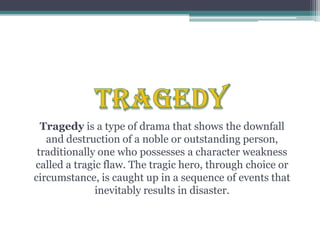
TRAGEDYTragedy is a type of drama that shows the downfall and destruction of a noble or outstanding person, traditionally one who possesses a character weakness called a tragic flaw. The tragic hero, through choice or circumstance, is caught up in a sequence of events that inevitably results in disaster.
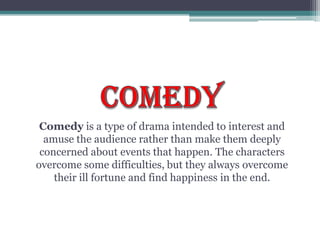
COMEDYComedy is a type of drama intended to interest and amuse the audience rather than make them deeply concerned about events that happen. The characters overcome some difficulties, but they always overcome their ill fortune and find happiness in the end.
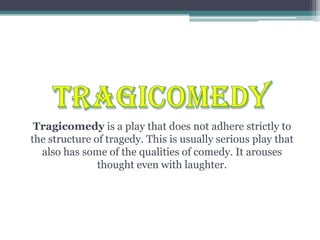
TRAGICOMEDYTragicomedy is a play that does not adhere strictly to the structure of tragedy. This is usually serious play that also has some of the qualities of comedy. It arouses thought even with laughter.
FARCEFarce is a play that brings laughter for the sake of laughter, usually making use grossly embellished events and characters. It has very swift movements, has ridiculous situations, and does not stimulate thought.
MELODRAMAMelodrama shows events that follow each other rapidly, but seems to be governed always by chance. The characters are victims in the hands of merciless fate.

Elements of Drama

  • 1.
  • 2.
    DRAMA Drama is acomposition in prose form that presents a story entirely told in dialogue and action and written with the intention of its eventual performance before an audience.
  • 3.
    DRAMADrama has atwo-fold nature: LITERATURE and THEATRE.
  • 4.
  • 5.
  • 6.
    SETTINGSetting identifies thetime and place in which the events occur. It consists of the historical period, the moment, day and season in which the incidents take place. It also includes the sceneries in the performance which are usually found in the preliminary descriptions.
  • 7.
    CHARACTERSCharacters are thepeople in the play and thus considered as the principal material in a drama.
  • 8.
    Character AspectsPhysicalSocialPhysical identifiesperipheral facts such as age, sexual category, size, race and color. It deals with external attributes which may be envisaged from the description of the playwright or deduced from what the characters say or what other characters verbalize about his appearance.Social embraces all aspects that can be gleaned from the character’s world or environment as exemplified by the economic status, occupation or trade, creed, familial affiliation of the characters.
  • 9.
    Character AspectsPsychologicalMoralPsychological disclosesthe inner mechanism of the mind of the character as exemplified by his habitual responses, attitudes, longings, purposes, likes and dislikes. It is considered as the most indispensable level of character categorization because routines and emotions, thoughts, attitude and behavior enable the readers to know the character intrinsically.Moral discloses the decisions of the characters, either socially acceptable or not, exposing their intentions, thus projecting what is upright or not.
  • 10.
    PLOTPlot lays outthe series of events that form the entirety of the play. It serves as a structural framework which brings the events to a cohesive form and sense.
  • 11.
    Types of PlotNaturalPlotEpisodic PlotNatural Plot is a chronological sequence of events arrangement where actions continuously take place as an end result of the previous actionEpisodic Plot – each episode independently comprises a setting, climax, and resolution; therefore, a full story in itself is formed.
  • 12.
    Framework of aPlotBeginningMiddleEnding
  • 13.
    Beginningidentifies information aboutthe place, such as geographical location, social, cultural, political background or period when the event took place.ExpositionExposition is the point where the playwright commences his story. It reveals the identity of story’s initial crisis.
  • 14.
    Middleis composed ofa series of difficulties:ComplicationsCrisisComplications bring changes and alterations in the movement of the action which take place when discovery of novel information, unexpected alteration of plan, choosing between two courses of action or preface of new ideas are revealed. Crisis reveals the peak of anticipation in the series of incidents.
  • 15.
    Middleis composed ofa series of difficulties:Obligatory SceneDiscoveryObligatory Scene identifies the open collision between two opposing characters or forces.Discovery discloses points which are previously unknown, characterized as something mysterious, strange, unfamiliar and thus revealed through objects, persons, facts, values, or self-discovered.
  • 16.
    Endingis the finalmajor component of the story which brings the condition back to its stability. This part brings satisfaction to the audience which extends to the final curtain as peace is completely restored.
  • 17.
    THEMETheme is consideredas the unifying element that defines the dramatized idea of the play. It is the over-all sense or implication of the action. It defines the problem, emphasizes the ethical judgment and suggest attitude or course of action that eliminates the crisis is an acceptable way.
  • 18.
    STYLEStyle refers tothe mode of expression or presentation of the play which points out the playwright’s position or viewpoint in life.
  • 19.
    Major Dramatic AttitudeRealismNon-realismRealismis an accurate detailed, and life-like description in a play where things are presented as real as can be set in actual life, with dialogues sounding like day-to-day conversation.Non-realism is method of presentation identified as something stylized or theatricalized whereby artist uses his feral imagination in projecting his ideas.
  • 20.
  • 21.
    TRAGEDYTragedy is atype of drama that shows the downfall and destruction of a noble or outstanding person, traditionally one who possesses a character weakness called a tragic flaw. The tragic hero, through choice or circumstance, is caught up in a sequence of events that inevitably results in disaster.
  • 22.
    COMEDYComedy is atype of drama intended to interest and amuse the audience rather than make them deeply concerned about events that happen. The characters overcome some difficulties, but they always overcome their ill fortune and find happiness in the end.
  • 23.
    TRAGICOMEDYTragicomedy is aplay that does not adhere strictly to the structure of tragedy. This is usually serious play that also has some of the qualities of comedy. It arouses thought even with laughter.
  • 24.
    FARCEFarce is aplay that brings laughter for the sake of laughter, usually making use grossly embellished events and characters. It has very swift movements, has ridiculous situations, and does not stimulate thought.
  • 25.
    MELODRAMAMelodrama shows eventsthat follow each other rapidly, but seems to be governed always by chance. The characters are victims in the hands of merciless fate.