Workshop on
Script Writing for
Telecast
Dr.Sheik Mohamed.S.H
M.A.,(JMC) MPhil.,M.A.,(PA)., M.A.,(SW).,
PGDBA.,PGDICL.,PGDPR.,D.M.Art.,Ph.D
Assistant Professor
Department of Electronic Media
St.Thomas College of Arts and Science
Koyambedu,Chennai,Tamil Nadu,India.
DEPARTMENT OF VISUAL COMMUNICATION
organises
Story
Story
A story is a narrative, either real
or imagined, that conveys a
sequence of events or
experiences, often featuring
characters, settings, and a plot. It
is typically designed to entertain,
inform, teach, or inspire the
audience by engaging their
emotions or intellect.
A story is more than
just a series of
events.
Elements of story
The elements of a story are the
essential components that help
build the narrative and make it
engaging.
➔ Plot
➔ Setting
➔ Characters
➔ Conflict
➔ Theme
➔ Point of View
➔ Tone and Mood
Types of Story
There are many different types
of stories, each with unique
characteristics, purposes, and
structures.
➔ Fictional Stories
➔ Non-Fictional Stories
➔ Narrative Structures and
Types
➔ Myth and Folklore
➔ Theme
➔ Other forms of stories
➔ Semi-Fictional stories
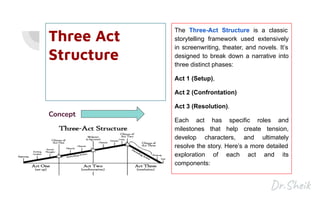
Three Act
Structure
Concept
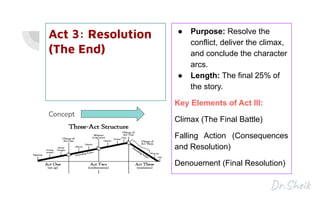
The Three-Act Structure is a classic
storytelling framework used extensively
in screenwriting, theater, and novels. It’s
designed to break down a narrative into
three distinct phases:
Act 1 (Setup),
Act 2 (Confrontation)
Act 3 (Resolution).
Each act has specific roles and
milestones that help create tension,
develop characters, and ultimately
resolve the story. Here’s a more detailed
exploration of each act and its
components:
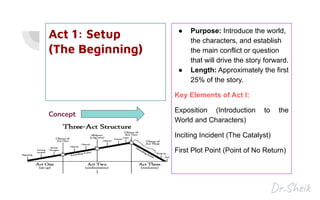
Act 1: Setup
(The Beginning)
Concept
● Purpose: Introduce the world,
the characters, and establish
the main conflict or question
that will drive the story forward.
● Length: Approximately the first
25% of the story.
Key Elements of Act I:
Exposition (Introduction to the
World and Characters)
Inciting Incident (The Catalyst)
First Plot Point (Point of No Return)
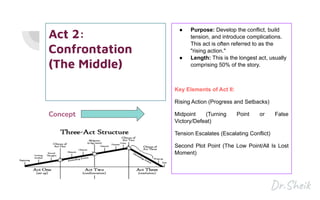
Act 2:
Confrontation
(The Middle)
Concept
● Purpose: Develop the conflict, build
tension, and introduce complications.
This act is often referred to as the
"rising action."
● Length: This is the longest act, usually
comprising 50% of the story.
Key Elements of Act II:
Rising Action (Progress and Setbacks)
Midpoint (Turning Point or False
Victory/Defeat)
Tension Escalates (Escalating Conflict)
Second Plot Point (The Low Point/All Is Lost
Moment)
Act 3: Resolution
(The End)
Concept
● Purpose: Resolve the
conflict, deliver the climax,
and conclude the character
arcs.
● Length: The final 25% of
the story.
Key Elements of Act III:
Climax (The Final Battle)
Falling Action (Consequences
and Resolution)
Denouement (Final Resolution)
Script
Scriptwriting for media involves creating the blueprint for visual
and audio content in formats such as TV shows, films,
podcasts, commercials, or online videos.
Film/TV: Requires detailed descriptions of visuals and dialogue.
Podcast: Focus on dialogue, sound effects, and pacing.
Commercial: Short, impactful writing with a clear message.
Online Video (YouTube, etc.): Conversational tone, fast-paced.
Understanding Medium
Target Audience: Know who the content is aimed at.
Message: Determine the main message or theme of your
script.
Format: Will it be narrative, documentary, or something
else?
Define the Concept
Title Page: Include title, writer’s name, and contact info.
Logline: A short sentence summarizing the story or
message.
Act Structure (for films/TV):
● Act 1: Introduction of characters and setting.
● Act 2: Conflict or rising action.
● Act 3: Resolution.
Structure Your Script
● Scene Heading (Slug Line): Include whether it’s an interior (INT.) or
exterior (EXT.) scene, location, and time of day. Example: INT. OFFICE -
DAY
● Action: Describe the visual actions. Be concise but clear. Example: John
opens the drawer, revealing a hidden letter.
● Dialogue: Write conversations, focusing on the flow, tone, and character
voices. Example: JOHN (angrily) Why didn’t you tell me?
● Parentheticals: Indicate how a line should be delivered. Example: MARY
(sarcastically) Oh, sure, like you’d understand.
Scene Writing
● Keep scenes tight, focused, and essential to the story.
● Use pauses or beats in dialogue to create natural
rhythm.
Pacing and Timing
● For visual media, include descriptions of camera angles
(if required), key movements, and scene transitions.
● For podcasts or audio, emphasize sound cues,
background noise, or any changes in tone.
Visual and Audio
Elements
● After writing the first draft, revise for clarity, flow, and
consistency.
● Remove unnecessary dialogue or actions.
Edit and Revise
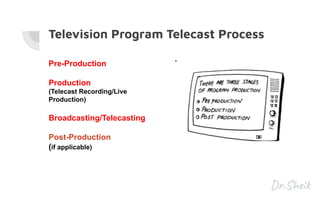
Television Program Telecast Process
Pre-Production
Production
(Telecast Recording/Live
Production)
Broadcasting/Telecasting
Post-Production
(if applicable)
*
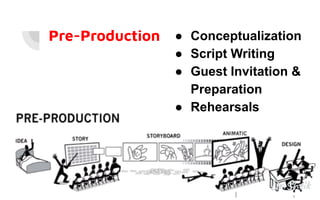
Pre-Production ● Conceptualization
● Script Writing
● Guest Invitation &
Preparation
● Rehearsals
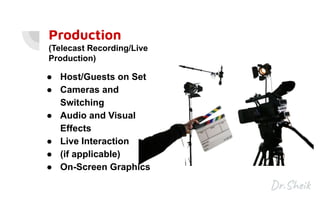
Production
(Telecast Recording/Live
Production)
● Host/Guests on Set
● Cameras and
Switching
● Audio and Visual
Effects
● Live Interaction
● (if applicable)
● On-Screen Graphics
Broadcasting/Telecasting
● Live Broadcast:
● Pre-recorded Telecast: Intro: The show begins with an intro
sequence, including the show’s title and theme music.
○ Content Segments: The show unfolds based on the script. If
there are breaks or commercials, these are timed in between.
○ Commercial Breaks: Ads or promotions air at specific points
during the telecast.
○ Technical Monitoring: Engineers continuously monitor the
broadcast to ensure there are no disruptions or technical
issues.
● Live Timing Adjustments
Post-Production (if applicable)
Editing: For pre-recorded
programs, editors finalize
the episode, adjusting
pacing, adding music,
transitions, and polishing
visual elements before
airing.
Promotion: Teasers,
trailers, or short clips of
the telecast might be
aired to promote the
upcoming episode.
Important Techniques in Script Writing
Show, Don’t Tell
Use of Conflict
Dialogue as Action
Three-Act Structure
Hook
Visual Writing
Pacing
Subtext
Character Arcs
Economy of Language
Voice
Thematic Depth
Use of Silence
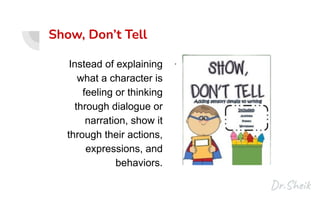
Show, Don’t Tell
Instead of explaining
what a character is
feeling or thinking
through dialogue or
narration, show it
through their actions,
expressions, and
behaviors.
.
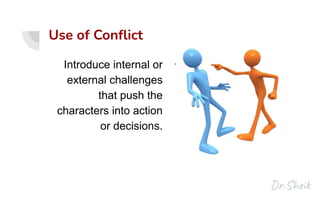
Use of Conflict
Introduce internal or
external challenges
that push the
characters into action
or decisions.
.
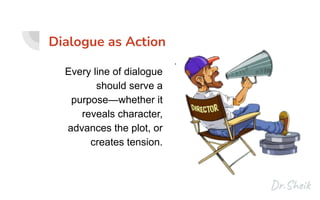
Dialogue as Action
Every line of dialogue
should serve a
purpose—whether it
reveals character,
advances the plot, or
creates tension.
.
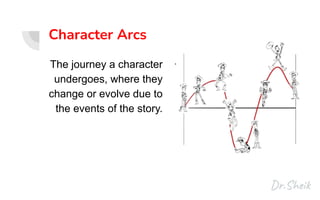
Character Arcs
The journey a character
undergoes, where they
change or evolve due to
the events of the story.
.
News Script
General Concepts
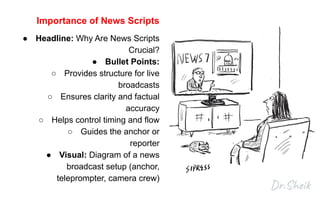
Importance of News Scripts
● Headline: Why Are News Scripts
Crucial?
● Bullet Points:
○ Provides structure for live
broadcasts
○ Ensures clarity and factual
accuracy
○ Helps control timing and flow
○ Guides the anchor or
reporter
● Visual: Diagram of a news
broadcast setup (anchor,
teleprompter, camera crew)
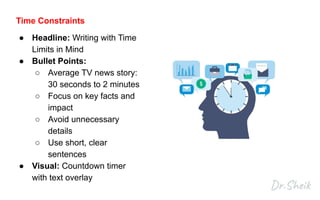
Time Constraints
● Headline: Writing with Time
Limits in Mind
● Bullet Points:
○ Average TV news story:
30 seconds to 2 minutes
○ Focus on key facts and
impact
○ Avoid unnecessary
details
○ Use short, clear
sentences
● Visual: Countdown timer
with text overlay
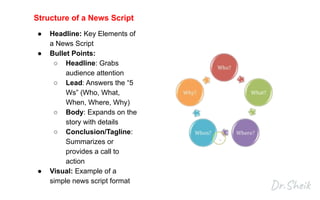
Structure of a News Script
● Headline: Key Elements of
a News Script
● Bullet Points:
○ Headline: Grabs
audience attention
○ Lead: Answers the “5
Ws” (Who, What,
When, Where, Why)
○ Body: Expands on the
story with details
○ Conclusion/Tagline:
Summarizes or
provides a call to
action
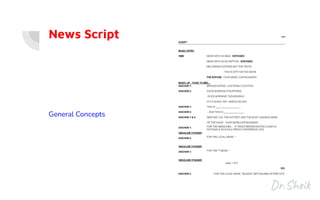
● Visual: Example of a
simple news script format
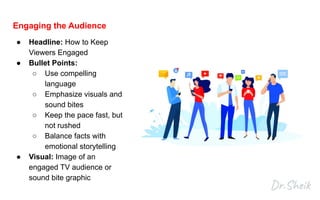
Engaging the Audience
● Headline: How to Keep
Viewers Engaged
● Bullet Points:
○ Use compelling
language
○ Emphasize visuals and
sound bites
○ Keep the pace fast, but
not rushed
○ Balance facts with
emotional storytelling
● Visual: Image of an
engaged TV audience or
sound bite graphic
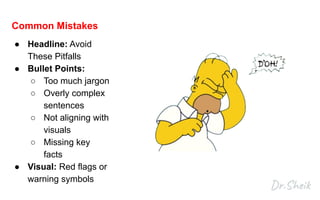
Common Mistakes
● Headline: Avoid
These Pitfalls
● Bullet Points:
○ Too much jargon
○ Overly complex
sentences
○ Not aligning with
visuals
○ Missing key
facts
● Visual: Red flags or
warning symbols
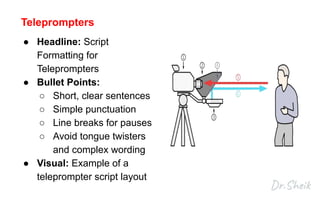
Teleprompters
● Headline: Script
Formatting for
Teleprompters
● Bullet Points:
○ Short, clear sentences
○ Simple punctuation
○ Line breaks for pauses
○ Avoid tongue twisters
and complex wording
● Visual: Example of a
teleprompter script layout
Conclusion
Script Telecasting
Thank You!

Introduction to Script Writing By Dr.Sheik

  • 1.
    Workshop on Script Writingfor Telecast Dr.Sheik Mohamed.S.H M.A.,(JMC) MPhil.,M.A.,(PA)., M.A.,(SW)., PGDBA.,PGDICL.,PGDPR.,D.M.Art.,Ph.D Assistant Professor Department of Electronic Media St.Thomas College of Arts and Science Koyambedu,Chennai,Tamil Nadu,India. DEPARTMENT OF VISUAL COMMUNICATION organises
  • 2.
  • 3.
    Story A story isa narrative, either real or imagined, that conveys a sequence of events or experiences, often featuring characters, settings, and a plot. It is typically designed to entertain, inform, teach, or inspire the audience by engaging their emotions or intellect. A story is more than just a series of events.
  • 4.
    Elements of story Theelements of a story are the essential components that help build the narrative and make it engaging. ➔ Plot ➔ Setting ➔ Characters ➔ Conflict ➔ Theme ➔ Point of View ➔ Tone and Mood
  • 5.
    Types of Story Thereare many different types of stories, each with unique characteristics, purposes, and structures. ➔ Fictional Stories ➔ Non-Fictional Stories ➔ Narrative Structures and Types ➔ Myth and Folklore ➔ Theme ➔ Other forms of stories ➔ Semi-Fictional stories
  • 6.
    Three Act Structure Concept The Three-ActStructure is a classic storytelling framework used extensively in screenwriting, theater, and novels. It’s designed to break down a narrative into three distinct phases: Act 1 (Setup), Act 2 (Confrontation) Act 3 (Resolution). Each act has specific roles and milestones that help create tension, develop characters, and ultimately resolve the story. Here’s a more detailed exploration of each act and its components:
  • 7.
    Act 1: Setup (TheBeginning) Concept ● Purpose: Introduce the world, the characters, and establish the main conflict or question that will drive the story forward. ● Length: Approximately the first 25% of the story. Key Elements of Act I: Exposition (Introduction to the World and Characters) Inciting Incident (The Catalyst) First Plot Point (Point of No Return)
  • 8.
    Act 2: Confrontation (The Middle) Concept ●Purpose: Develop the conflict, build tension, and introduce complications. This act is often referred to as the "rising action." ● Length: This is the longest act, usually comprising 50% of the story. Key Elements of Act II: Rising Action (Progress and Setbacks) Midpoint (Turning Point or False Victory/Defeat) Tension Escalates (Escalating Conflict) Second Plot Point (The Low Point/All Is Lost Moment)
  • 9.
    Act 3: Resolution (TheEnd) Concept ● Purpose: Resolve the conflict, deliver the climax, and conclude the character arcs. ● Length: The final 25% of the story. Key Elements of Act III: Climax (The Final Battle) Falling Action (Consequences and Resolution) Denouement (Final Resolution)
  • 10.
    Script Scriptwriting for mediainvolves creating the blueprint for visual and audio content in formats such as TV shows, films, podcasts, commercials, or online videos.
  • 11.
    Film/TV: Requires detaileddescriptions of visuals and dialogue. Podcast: Focus on dialogue, sound effects, and pacing. Commercial: Short, impactful writing with a clear message. Online Video (YouTube, etc.): Conversational tone, fast-paced. Understanding Medium
  • 12.
    Target Audience: Knowwho the content is aimed at. Message: Determine the main message or theme of your script. Format: Will it be narrative, documentary, or something else? Define the Concept
  • 13.
    Title Page: Includetitle, writer’s name, and contact info. Logline: A short sentence summarizing the story or message. Act Structure (for films/TV): ● Act 1: Introduction of characters and setting. ● Act 2: Conflict or rising action. ● Act 3: Resolution. Structure Your Script
  • 14.
    ● Scene Heading(Slug Line): Include whether it’s an interior (INT.) or exterior (EXT.) scene, location, and time of day. Example: INT. OFFICE - DAY ● Action: Describe the visual actions. Be concise but clear. Example: John opens the drawer, revealing a hidden letter. ● Dialogue: Write conversations, focusing on the flow, tone, and character voices. Example: JOHN (angrily) Why didn’t you tell me? ● Parentheticals: Indicate how a line should be delivered. Example: MARY (sarcastically) Oh, sure, like you’d understand. Scene Writing
  • 15.
    ● Keep scenestight, focused, and essential to the story. ● Use pauses or beats in dialogue to create natural rhythm. Pacing and Timing
  • 16.
    ● For visualmedia, include descriptions of camera angles (if required), key movements, and scene transitions. ● For podcasts or audio, emphasize sound cues, background noise, or any changes in tone. Visual and Audio Elements
  • 17.
    ● After writingthe first draft, revise for clarity, flow, and consistency. ● Remove unnecessary dialogue or actions. Edit and Revise
  • 18.
    Television Program TelecastProcess Pre-Production Production (Telecast Recording/Live Production) Broadcasting/Telecasting Post-Production (if applicable) *
  • 19.
    Pre-Production ● Conceptualization ●Script Writing ● Guest Invitation & Preparation ● Rehearsals
  • 20.
    Production (Telecast Recording/Live Production) ● Host/Guestson Set ● Cameras and Switching ● Audio and Visual Effects ● Live Interaction ● (if applicable) ● On-Screen Graphics
  • 21.
    Broadcasting/Telecasting ● Live Broadcast: ●Pre-recorded Telecast: Intro: The show begins with an intro sequence, including the show’s title and theme music. ○ Content Segments: The show unfolds based on the script. If there are breaks or commercials, these are timed in between. ○ Commercial Breaks: Ads or promotions air at specific points during the telecast. ○ Technical Monitoring: Engineers continuously monitor the broadcast to ensure there are no disruptions or technical issues. ● Live Timing Adjustments
  • 22.
    Post-Production (if applicable) Editing:For pre-recorded programs, editors finalize the episode, adjusting pacing, adding music, transitions, and polishing visual elements before airing. Promotion: Teasers, trailers, or short clips of the telecast might be aired to promote the upcoming episode.
  • 23.
    Important Techniques inScript Writing Show, Don’t Tell Use of Conflict Dialogue as Action Three-Act Structure Hook Visual Writing Pacing Subtext Character Arcs Economy of Language Voice Thematic Depth Use of Silence
  • 24.
    Show, Don’t Tell Insteadof explaining what a character is feeling or thinking through dialogue or narration, show it through their actions, expressions, and behaviors. .
  • 25.
    Use of Conflict Introduceinternal or external challenges that push the characters into action or decisions. .
  • 26.
    Dialogue as Action Everyline of dialogue should serve a purpose—whether it reveals character, advances the plot, or creates tension. .
  • 27.
    Character Arcs The journeya character undergoes, where they change or evolve due to the events of the story. .
  • 28.
  • 29.
    Importance of NewsScripts ● Headline: Why Are News Scripts Crucial? ● Bullet Points: ○ Provides structure for live broadcasts ○ Ensures clarity and factual accuracy ○ Helps control timing and flow ○ Guides the anchor or reporter ● Visual: Diagram of a news broadcast setup (anchor, teleprompter, camera crew)
  • 30.
    Time Constraints ● Headline:Writing with Time Limits in Mind ● Bullet Points: ○ Average TV news story: 30 seconds to 2 minutes ○ Focus on key facts and impact ○ Avoid unnecessary details ○ Use short, clear sentences ● Visual: Countdown timer with text overlay
  • 31.
    Structure of aNews Script ● Headline: Key Elements of a News Script ● Bullet Points: ○ Headline: Grabs audience attention ○ Lead: Answers the “5 Ws” (Who, What, When, Where, Why) ○ Body: Expands on the story with details ○ Conclusion/Tagline: Summarizes or provides a call to action ● Visual: Example of a simple news script format
  • 32.
    Engaging the Audience ●Headline: How to Keep Viewers Engaged ● Bullet Points: ○ Use compelling language ○ Emphasize visuals and sound bites ○ Keep the pace fast, but not rushed ○ Balance facts with emotional storytelling ● Visual: Image of an engaged TV audience or sound bite graphic
  • 33.
    Common Mistakes ● Headline:Avoid These Pitfalls ● Bullet Points: ○ Too much jargon ○ Overly complex sentences ○ Not aligning with visuals ○ Missing key facts ● Visual: Red flags or warning symbols
  • 34.
    Teleprompters ● Headline: Script Formattingfor Teleprompters ● Bullet Points: ○ Short, clear sentences ○ Simple punctuation ○ Line breaks for pauses ○ Avoid tongue twisters and complex wording ● Visual: Example of a teleprompter script layout
  • 35.
  • 36.