INT. LECTURE HALL – DAY
Iain stands at the front of the
room, talking, while his class
sits around enraptured.
At the back of the class Russ
has fallen asleep on his desk,
hood pulled up over his head.
IAIN:
Russ, wake up. You’re in film
class.
Writing a film script
A quick introduction to:
Acts & plot twists
Understanding scenes
Action, Dialogue & character
Today you will learn about creative
planning for film productions.
Creative planning is perhaps the most important
part of any film production.
Without a good idea it doesn’t matter how
successfully the rest of the planning, filming and
editing goes; a poorly thought out, weak,
unoriginal or derivative idea will make for a
weak film.
Creative planning is important…
But what is it?
Creative planning is all the planning and
development we do to flesh out our ideas, and
turn them into a filmable plan. This includes:
1. Script (or screenplay)
2. Proposal (or treatment)
3. Storyboards
Today
You will be learning about script-writing (or
screen-writing).
By the end of today, you
• MUST understand the basic structure of a film
script
• SHOULD understand the different
components of a scene
• COULD understand how to develop your
characters into more believable people.
A quick reminder
What are the three things that make up any films
concept?
1. A person
2. In a place
3. Trying to do something
If you don’t know about film concepts check out
Syd Fields rule of story concepting before you go
any further. It’s the first step to a good film script.
What is a script?
Your film script is the written version of
your films story.
A script (also known as a screenplay) is a piece of
creative writing which sets out what happens in your
film; where it takes place, who’s in it, what they say.
Like any story it is written with a beginning, a middle and
an end. Unlike a novel it is written in a set format.
A typical script structure
The films narrative (or story) is broken down into 3
acts:
1. Act 1: beginning, where the characters & story are
setup, and the heroes goal is revealed.
2. Act 2: middle, where the conflict happens & people try
to stop the hero from achieving their goal.
3. Act 3: the end, where problems are resolved and the
character either succeeds or fails to achieve their goal.
In a typical single (or feature film) each act lasts roughly 30
minutes, apart from act 2 which can last up to an hour.
A typical script structure
But how do you stop a film feeling boring
or predictable?
Well, you need plot twists of course!
At the end of each act there’s normally a
twist which moves the story forward in a
new way, throwing unexpected challenges
at our hero.
Plot twists? Like what? How about…
• Luke Skywalkers parents are killed by the
empire!
• Obi-Wan Kenobi gets killed by Darth Vader!
• Ra’s Al Ghul is alive & burns down Wayne
Manor!
• The Joker escapes custody!
• Iron Man escapes captivity and returns to
America!
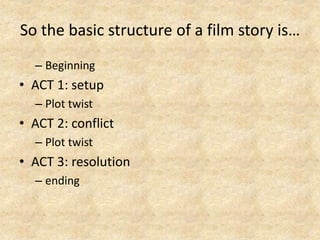
So the basic structure of a film story is…
– Beginning
• ACT 1: setup
– Plot twist
• ACT 2: conflict
– Plot twist
• ACT 3: resolution
– ending
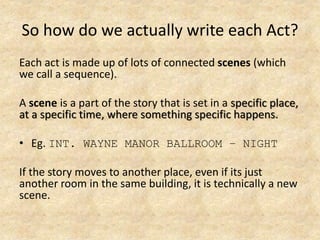
So how do we actually write each Act?
Each act is made up of lots of connected scenes (which
we call a sequence).
A scene is a part of the story that is set in a specific place,
at a specific time, where something specific happens.
• Eg. INT. WAYNE MANOR BALLROOM – NIGHT
If the story moves to another place, even if its just
another room in the same building, it is technically a new
scene.
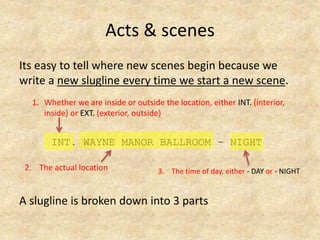
Acts & scenes
Its easy to tell where new scenes begin because we
write a new slugline every time we start a new scene.
INT. WAYNE MANOR BALLROOM – NIGHT
A slugline is broken down into 3 parts
1. Whether we are inside or outside the location, either INT. (interior,
inside) or EXT. (exterior, outside)
2. The actual location 3. The time of day, either - DAY or - NIGHT
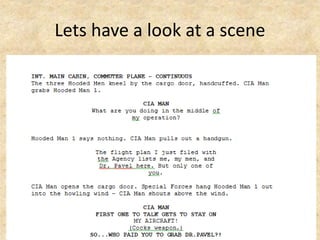
Lets have a look at a scene
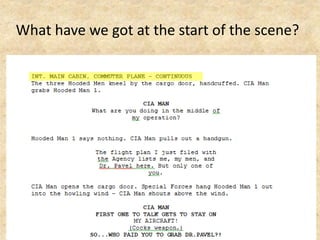
What have we got at the start of the scene?
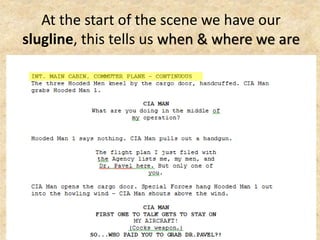
At the start of the scene we have our
slugline, this tells us when & where we are
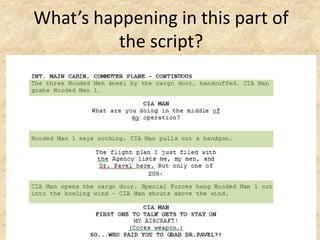
What’s happening in this part of
the script?
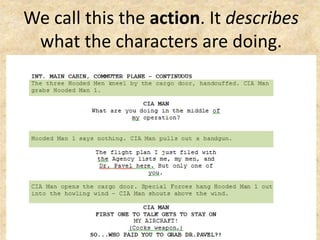
We call this the action. It describes
what the characters are doing.
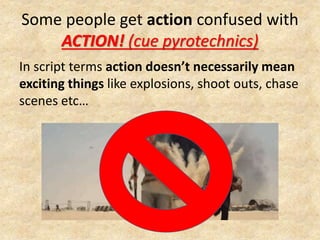
Some people get action confused with
ACTION! (cue pyrotechnics)
In script terms action doesn’t necessarily mean
exciting things like explosions, shoot outs, chase
scenes etc…
Some people get action confused with
ACTION! (cue pyrotechnics)
In script terms action is just a phrase we use to
describe people doing things.
Those things could be mundane, everyday things
like walking, sitting, drinking a cup of tea, waiting
for a bus, logging onto a computer
or they could also be more exciting things like
torpedoing a death star, blowing off the safe doors
etc…
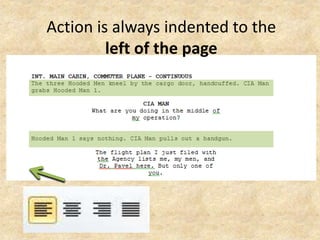
Action is always indented to the
left of the page
All of the action is written in present tense.
I.E. its happening in the here and now.
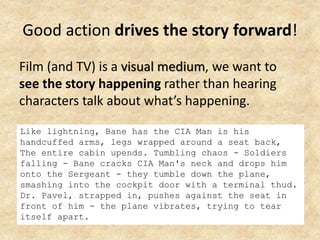
Good action drives the story forward!
Film (and TV) is a visual medium, we want to
see the story happening rather than hearing
characters talk about what’s happening.
Like lightning, Bane has the CIA Man is his
handcuffed arms, legs wrapped around a seat back,
The entire cabin upends. Tumbling chaos - Soldiers
falling - Bane cracks CIA Man's neck and drops him
onto the Sergeant - they tumble down the plane,
smashing into the cockpit door with a terminal thud.
Dr. Pavel, strapped in, pushes against the seat in
front of him - the plane vibrates, trying to tear
itself apart.
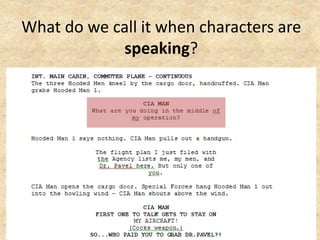
What do we call it when characters are
speaking?
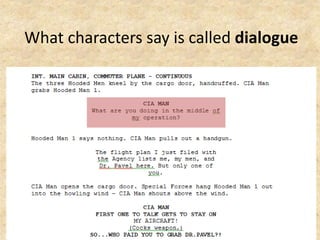
What characters say is called dialogue
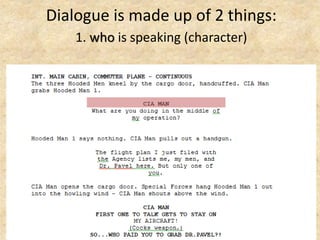
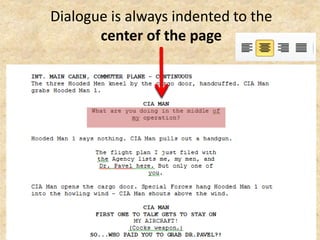
Dialogue is made up of 2 things:
1. who is speaking (character)
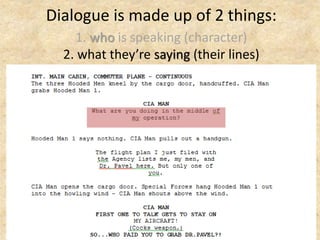
Dialogue is made up of 2 things:
1. who is speaking (character)
2. what they’re saying (their lines)
Dialogue is always indented to the
center of the page
Dialogue is one of the hardest things
to write.
You need to find each characters individual voice, you
need to think about:
1. what their motivations are (their goals)
2. how their mood is affecting what they say,
3. how their dialogue serves your scene (do you need
the scene to end in a certain way? Does the character
need to find anything specific out? Etc…)
(important: every scene needs to have a purpose,
dialogue should help serve that purpose)
How do I write better dialogue?
Well, it takes a lot of practice, but the first step is to
know your character.
• What are their beliefs?
• How have their past experiences (their backstory)
helped to form those beliefs?
• How do those beliefs shape the way they act?
• What do they think of other characters & why?
• All of these are their character traits.
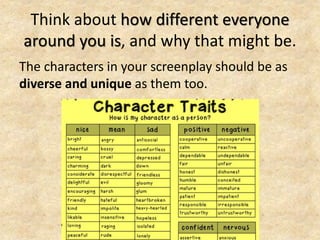
Think about how different everyone
around you is, and why that might be.
The characters in your screenplay should be as
diverse and unique as them too.
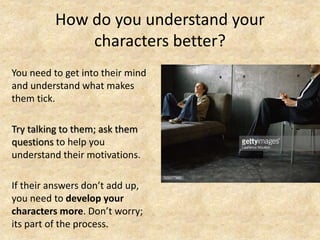
How do you understand your
characters better?
You need to get into their mind
and understand what makes
them tick.
Try talking to them; ask them
questions to help you
understand their motivations.
If their answers don’t add up,
you need to develop your
characters more. Don’t worry;
its part of the process.
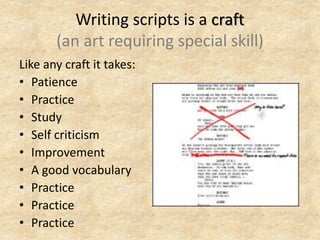
Writing scripts is a craft
(an art requiring special skill)
Like any craft it takes:
• Patience
• Practice
• Study
• Self criticism
• Improvement
• A good vocabulary
• Practice
• Practice
• Practice
What should I do next?
Step 1: read more screenplays
http://www.imsdb.com
Step 2: try to build up your vocabulary (especially action
verbs & synonyms)
http://www.dictionary.com/
Step 3: try to think of some simple story concepts and
grow your ideas from there (rather than thinking of “cool
scenes” and reverse engineering how your script gets
there)

Writing a film script (introduction to the basics)

  • 1.
    INT. LECTURE HALL– DAY Iain stands at the front of the room, talking, while his class sits around enraptured. At the back of the class Russ has fallen asleep on his desk, hood pulled up over his head. IAIN: Russ, wake up. You’re in film class. Writing a film script A quick introduction to: Acts & plot twists Understanding scenes Action, Dialogue & character
  • 2.
    Today you willlearn about creative planning for film productions. Creative planning is perhaps the most important part of any film production. Without a good idea it doesn’t matter how successfully the rest of the planning, filming and editing goes; a poorly thought out, weak, unoriginal or derivative idea will make for a weak film.
  • 3.
    Creative planning isimportant… But what is it? Creative planning is all the planning and development we do to flesh out our ideas, and turn them into a filmable plan. This includes: 1. Script (or screenplay) 2. Proposal (or treatment) 3. Storyboards
  • 4.
    Today You will belearning about script-writing (or screen-writing).
  • 5.
    By the endof today, you • MUST understand the basic structure of a film script • SHOULD understand the different components of a scene • COULD understand how to develop your characters into more believable people.
  • 6.
    A quick reminder Whatare the three things that make up any films concept? 1. A person 2. In a place 3. Trying to do something If you don’t know about film concepts check out Syd Fields rule of story concepting before you go any further. It’s the first step to a good film script.
  • 7.
    What is ascript? Your film script is the written version of your films story. A script (also known as a screenplay) is a piece of creative writing which sets out what happens in your film; where it takes place, who’s in it, what they say. Like any story it is written with a beginning, a middle and an end. Unlike a novel it is written in a set format.
  • 8.
    A typical scriptstructure The films narrative (or story) is broken down into 3 acts: 1. Act 1: beginning, where the characters & story are setup, and the heroes goal is revealed. 2. Act 2: middle, where the conflict happens & people try to stop the hero from achieving their goal. 3. Act 3: the end, where problems are resolved and the character either succeeds or fails to achieve their goal. In a typical single (or feature film) each act lasts roughly 30 minutes, apart from act 2 which can last up to an hour.
  • 9.
    A typical scriptstructure But how do you stop a film feeling boring or predictable? Well, you need plot twists of course! At the end of each act there’s normally a twist which moves the story forward in a new way, throwing unexpected challenges at our hero.
  • 10.
    Plot twists? Likewhat? How about… • Luke Skywalkers parents are killed by the empire! • Obi-Wan Kenobi gets killed by Darth Vader! • Ra’s Al Ghul is alive & burns down Wayne Manor! • The Joker escapes custody! • Iron Man escapes captivity and returns to America!
  • 11.
    So the basicstructure of a film story is… – Beginning • ACT 1: setup – Plot twist • ACT 2: conflict – Plot twist • ACT 3: resolution – ending
  • 12.
    So how dowe actually write each Act? Each act is made up of lots of connected scenes (which we call a sequence). A scene is a part of the story that is set in a specific place, at a specific time, where something specific happens. • Eg. INT. WAYNE MANOR BALLROOM – NIGHT If the story moves to another place, even if its just another room in the same building, it is technically a new scene.
  • 13.
    Acts & scenes Itseasy to tell where new scenes begin because we write a new slugline every time we start a new scene. INT. WAYNE MANOR BALLROOM – NIGHT A slugline is broken down into 3 parts 1. Whether we are inside or outside the location, either INT. (interior, inside) or EXT. (exterior, outside) 2. The actual location 3. The time of day, either - DAY or - NIGHT
  • 14.
    Lets have alook at a scene
  • 15.
    What have wegot at the start of the scene?
  • 16.
    At the startof the scene we have our slugline, this tells us when & where we are
  • 17.
    What’s happening inthis part of the script?
  • 18.
    We call thisthe action. It describes what the characters are doing.
  • 19.
    Some people getaction confused with ACTION! (cue pyrotechnics) In script terms action doesn’t necessarily mean exciting things like explosions, shoot outs, chase scenes etc…
  • 20.
    Some people getaction confused with ACTION! (cue pyrotechnics) In script terms action is just a phrase we use to describe people doing things. Those things could be mundane, everyday things like walking, sitting, drinking a cup of tea, waiting for a bus, logging onto a computer or they could also be more exciting things like torpedoing a death star, blowing off the safe doors etc…
  • 21.
    Action is alwaysindented to the left of the page
  • 22.
    All of theaction is written in present tense. I.E. its happening in the here and now.
  • 23.
    Good action drivesthe story forward! Film (and TV) is a visual medium, we want to see the story happening rather than hearing characters talk about what’s happening. Like lightning, Bane has the CIA Man is his handcuffed arms, legs wrapped around a seat back, The entire cabin upends. Tumbling chaos - Soldiers falling - Bane cracks CIA Man's neck and drops him onto the Sergeant - they tumble down the plane, smashing into the cockpit door with a terminal thud. Dr. Pavel, strapped in, pushes against the seat in front of him - the plane vibrates, trying to tear itself apart.
  • 24.
    What do wecall it when characters are speaking?
  • 25.
    What characters sayis called dialogue
  • 26.
    Dialogue is madeup of 2 things: 1. who is speaking (character)
  • 27.
    Dialogue is madeup of 2 things: 1. who is speaking (character) 2. what they’re saying (their lines)
  • 28.
    Dialogue is alwaysindented to the center of the page
  • 29.
    Dialogue is oneof the hardest things to write. You need to find each characters individual voice, you need to think about: 1. what their motivations are (their goals) 2. how their mood is affecting what they say, 3. how their dialogue serves your scene (do you need the scene to end in a certain way? Does the character need to find anything specific out? Etc…) (important: every scene needs to have a purpose, dialogue should help serve that purpose)
  • 30.
    How do Iwrite better dialogue? Well, it takes a lot of practice, but the first step is to know your character. • What are their beliefs? • How have their past experiences (their backstory) helped to form those beliefs? • How do those beliefs shape the way they act? • What do they think of other characters & why? • All of these are their character traits.
  • 31.
    Think about howdifferent everyone around you is, and why that might be. The characters in your screenplay should be as diverse and unique as them too.
  • 32.
    How do youunderstand your characters better? You need to get into their mind and understand what makes them tick. Try talking to them; ask them questions to help you understand their motivations. If their answers don’t add up, you need to develop your characters more. Don’t worry; its part of the process.
  • 33.
    Writing scripts isa craft (an art requiring special skill) Like any craft it takes: • Patience • Practice • Study • Self criticism • Improvement • A good vocabulary • Practice • Practice • Practice
  • 34.
    What should Ido next? Step 1: read more screenplays http://www.imsdb.com Step 2: try to build up your vocabulary (especially action verbs & synonyms) http://www.dictionary.com/ Step 3: try to think of some simple story concepts and grow your ideas from there (rather than thinking of “cool scenes” and reverse engineering how your script gets there)