Script
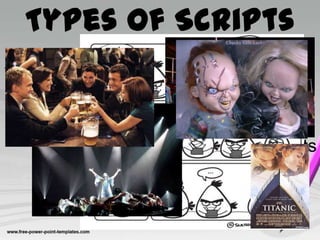
Types of Scripts
Comics


                   Performing Arts


          Recorded Media
DEFINITION AND
IMPORTANCE OF
THE SCRIPT
 The soul of the Play

       Denotes the flow of the conversation
                    between the characters

 Helps in comprehension of the audience
            about the characters.

        The literary part of the play

It serves as a blue print of the play.
HOW TO MAKE A
GOOD SCRIPT
• The first thing to think about when
preparing a script is to put yourself in
         the audience’s shoes.
–Theme
–Make an outline
–Make the story
  • Characters
  • Plot
  • Dialogue
PLOT
• Classifications of the plot
  – Episodic: Episodic plots involve episodes: several events
              are linked together with each event or “episode”
              containing a possible climax.
  – Rising Action: This plot contains a conflict, tension, and
                     climax to resolve the conflict.
  – Quest: This type involves an adventurer who sets off on a
            journey and reaches a goal.
  – Transformation: In this variety of plot, a person changes
                        character because of an experience.
  – Revenge or Justice: In a revenge story, a bad thing
                            happens, but eventually everything
                            works out evenly.
PLOT
• Exposition
     • It is an introduction to the setting and characters.
• Conflict
     • This struggle or conflict can be anything from a concept
       in one person’s head to a battle between characters
  – Complications
             » make the conflict even more interesting.

• Climax
     • The climax happens when the conflict is resolved in
       some way.
By:
Geraldine Patricia Cana
Valerie Durias
Dianne Nicole Esquivel
Charmaine Michelle Lacson

Script

  • 1.
  • 2.
    Types of Scripts Comics Performing Arts Recorded Media
  • 3.
  • 4.
     The soulof the Play Denotes the flow of the conversation between the characters Helps in comprehension of the audience about the characters. The literary part of the play It serves as a blue print of the play.
  • 5.
    HOW TO MAKEA GOOD SCRIPT
  • 6.
    • The firstthing to think about when preparing a script is to put yourself in the audience’s shoes. –Theme –Make an outline –Make the story • Characters • Plot • Dialogue
  • 7.
    PLOT • Classifications ofthe plot – Episodic: Episodic plots involve episodes: several events are linked together with each event or “episode” containing a possible climax. – Rising Action: This plot contains a conflict, tension, and climax to resolve the conflict. – Quest: This type involves an adventurer who sets off on a journey and reaches a goal. – Transformation: In this variety of plot, a person changes character because of an experience. – Revenge or Justice: In a revenge story, a bad thing happens, but eventually everything works out evenly.
  • 8.
    PLOT • Exposition • It is an introduction to the setting and characters. • Conflict • This struggle or conflict can be anything from a concept in one person’s head to a battle between characters – Complications » make the conflict even more interesting. • Climax • The climax happens when the conflict is resolved in some way.
  • 9.
    By: Geraldine Patricia Cana ValerieDurias Dianne Nicole Esquivel Charmaine Michelle Lacson