QUALITATIVE RESEARCH
Dr Janardhan Juvvigunta
What is qualitative data?
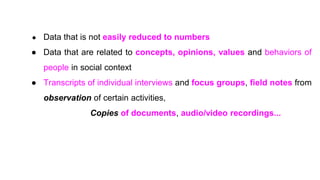
● Data that is not easily reduced to numbers
● Data that are related to concepts, opinions, values and behaviors of
people in social context
● Transcripts of individual interviews and focus groups, field notes from
observation of certain activities,
Copies of documents, audio/video recordings...
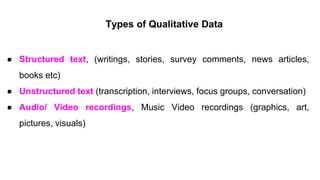
Types of Qualitative Data
● Structured text, (writings, stories, survey comments, news articles,
books etc)
● Unstructured text (transcription, interviews, focus groups, conversation)
● Audio/ Video recordings, Music Video recordings (graphics, art,
pictures, visuals)
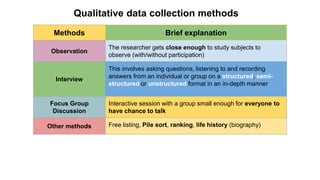
Qualitative data collection methods
Methods Brief explanation
Observation
The researcher gets close enough to study subjects to
observe (with/without participation)
Interview
This involves asking questions, listening to and recording
answers from an individual or group on a structured, semi-
structured or unstructured format in an in-depth manner
Focus Group
Discussion
Interactive session with a group small enough for everyone to
have chance to talk
Other methods Free listing, Pile sort, ranking, life history (biography)
Qualitative Analysis
● QDA is usually based on an interpretative philosophy.
● The idea is to examine the meaningful and symbolic content of
qualitative data
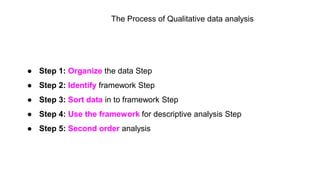
The Process of Qualitative data analysis
● Step 1: Organize the data Step
● Step 2: Identify framework Step
● Step 3: Sort data in to framework Step
● Step 4: Use the framework for descriptive analysis Step
● Step 5: Second order analysis
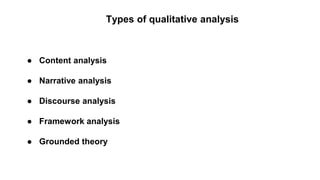
Types of qualitative analysis
● Content analysis
● Narrative analysis
● Discourse analysis
● Framework analysis
● Grounded theory
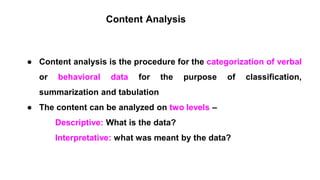
Content Analysis
● Content analysis is the procedure for the categorization of verbal
or behavioral data for the purpose of classification,
summarization and tabulation
● The content can be analyzed on two levels –
Descriptive: What is the data?
Interpretative: what was meant by the data?
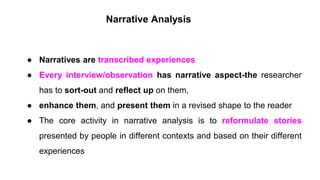
Narrative Analysis
● Narratives are transcribed experiences
● Every interview/observation has narrative aspect-the researcher
has to sort-out and reflect up on them,
● enhance them, and present them in a revised shape to the reader
● The core activity in narrative analysis is to reformulate stories
presented by people in different contexts and based on their different
experiences
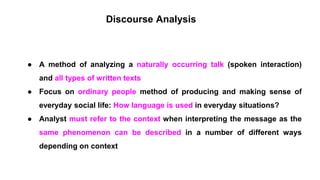
Discourse Analysis
● A method of analyzing a naturally occurring talk (spoken interaction)
and all types of written texts
● Focus on ordinary people method of producing and making sense of
everyday social life: How language is used in everyday situations?
● Analyst must refer to the context when interpreting the message as the
same phenomenon can be described in a number of different ways
depending on context
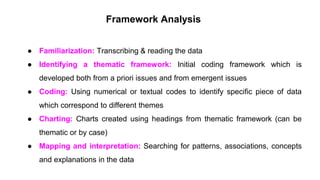
Framework Analysis
● Familiarization: Transcribing & reading the data
● Identifying a thematic framework: Initial coding framework which is
developed both from a priori issues and from emergent issues
● Coding: Using numerical or textual codes to identify specific piece of data
which correspond to different themes
● Charting: Charts created using headings from thematic framework (can be
thematic or by case)
● Mapping and interpretation: Searching for patterns, associations, concepts
and explanations in the data
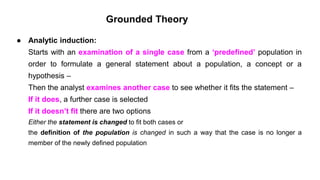
Grounded Theory
● Analytic induction:
Starts with an examination of a single case from a ‘predefined’ population in
order to formulate a general statement about a population, a concept or a
hypothesis –
Then the analyst examines another case to see whether it fits the statement –
If it does, a further case is selected
If it doesn’t fit there are two options
Either the statement is changed to fit both cases or
the definition of the population is changed in such a way that the case is no longer a
member of the newly defined population
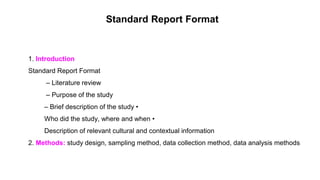
Standard Report Format
1. Introduction
Standard Report Format
– Literature review
– Purpose of the study
– Brief description of the study •
Who did the study, where and when •
Description of relevant cultural and contextual information
2. Methods: study design, sampling method, data collection method, data analysis methods
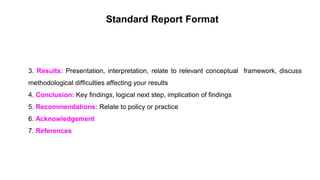
Standard Report Format
3. Results: Presentation, interpretation, relate to relevant conceptual framework, discuss
methodological difficulties affecting your results
4. Conclusion: Key findings, logical next step, implication of findings
5. Recommendations: Relate to policy or practice
6. Acknowledgement
7. References
THANK YOU

Qualitative research 2 (1)

  • 1.
  • 2.
  • 3.
    ● Data thatis not easily reduced to numbers ● Data that are related to concepts, opinions, values and behaviors of people in social context ● Transcripts of individual interviews and focus groups, field notes from observation of certain activities, Copies of documents, audio/video recordings...
  • 4.
    Types of QualitativeData ● Structured text, (writings, stories, survey comments, news articles, books etc) ● Unstructured text (transcription, interviews, focus groups, conversation) ● Audio/ Video recordings, Music Video recordings (graphics, art, pictures, visuals)
  • 5.
    Qualitative data collectionmethods Methods Brief explanation Observation The researcher gets close enough to study subjects to observe (with/without participation) Interview This involves asking questions, listening to and recording answers from an individual or group on a structured, semi- structured or unstructured format in an in-depth manner Focus Group Discussion Interactive session with a group small enough for everyone to have chance to talk Other methods Free listing, Pile sort, ranking, life history (biography)
  • 6.
    Qualitative Analysis ● QDAis usually based on an interpretative philosophy. ● The idea is to examine the meaningful and symbolic content of qualitative data
  • 7.
    The Process ofQualitative data analysis ● Step 1: Organize the data Step ● Step 2: Identify framework Step ● Step 3: Sort data in to framework Step ● Step 4: Use the framework for descriptive analysis Step ● Step 5: Second order analysis
  • 8.
    Types of qualitativeanalysis ● Content analysis ● Narrative analysis ● Discourse analysis ● Framework analysis ● Grounded theory
  • 9.
    Content Analysis ● Contentanalysis is the procedure for the categorization of verbal or behavioral data for the purpose of classification, summarization and tabulation ● The content can be analyzed on two levels – Descriptive: What is the data? Interpretative: what was meant by the data?
  • 10.
    Narrative Analysis ● Narrativesare transcribed experiences ● Every interview/observation has narrative aspect-the researcher has to sort-out and reflect up on them, ● enhance them, and present them in a revised shape to the reader ● The core activity in narrative analysis is to reformulate stories presented by people in different contexts and based on their different experiences
  • 11.
    Discourse Analysis ● Amethod of analyzing a naturally occurring talk (spoken interaction) and all types of written texts ● Focus on ordinary people method of producing and making sense of everyday social life: How language is used in everyday situations? ● Analyst must refer to the context when interpreting the message as the same phenomenon can be described in a number of different ways depending on context
  • 12.
    Framework Analysis ● Familiarization:Transcribing & reading the data ● Identifying a thematic framework: Initial coding framework which is developed both from a priori issues and from emergent issues ● Coding: Using numerical or textual codes to identify specific piece of data which correspond to different themes ● Charting: Charts created using headings from thematic framework (can be thematic or by case) ● Mapping and interpretation: Searching for patterns, associations, concepts and explanations in the data
  • 13.
    Grounded Theory ● Analyticinduction: Starts with an examination of a single case from a ‘predefined’ population in order to formulate a general statement about a population, a concept or a hypothesis – Then the analyst examines another case to see whether it fits the statement – If it does, a further case is selected If it doesn’t fit there are two options Either the statement is changed to fit both cases or the definition of the population is changed in such a way that the case is no longer a member of the newly defined population
  • 14.
    Standard Report Format 1.Introduction Standard Report Format – Literature review – Purpose of the study – Brief description of the study • Who did the study, where and when • Description of relevant cultural and contextual information 2. Methods: study design, sampling method, data collection method, data analysis methods
  • 15.
    Standard Report Format 3.Results: Presentation, interpretation, relate to relevant conceptual framework, discuss methodological difficulties affecting your results 4. Conclusion: Key findings, logical next step, implication of findings 5. Recommendations: Relate to policy or practice 6. Acknowledgement 7. References
  • 16.