Rozi Khan GPGJC Swat
Elements of Drama:  The elements of drama, by which dramatic works can be analyzed and evaluated, can be categorized into three major areas: literary elements technical elements performance elements Rozi Khan GPGJC Swat
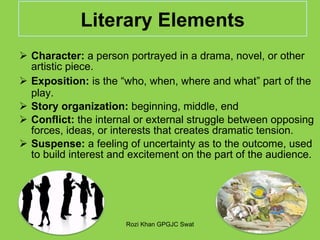
Literary Elements Plot:   the series of events that take place in a play. There are 6 stages in a  plot structure : Initial incident Preliminary event Rising action Climax Falling action   Denouement or Conclusion Rozi Khan GPGJC Swat
Character:  a person portrayed in a drama, novel, or other artistic piece. Exposition:  is the “who, when, where and what” part of the play. Story organization:  beginning, middle, end Conflict:  the internal or external struggle between opposing forces, ideas, or interests that creates dramatic tension.  Suspense:  a feeling of uncertainty as to the outcome, used to build interest and excitement on the part of the audience. Rozi Khan GPGJC Swat Literary Elements
Theme:  the basic idea of a play; the idea, point of view, or perception that binds together a work of art.  Language :  in drama, the particular manner of verbal expression, the diction or style of writing, or the speech or phrasing that suggests a class or profession or type of character.  Style:  the shaping of dramatic material, settings, or costumes in a deliberately realistic or nonrealistic manner.  Rozi Khan GPGJC Swat Literary Elements
Dialogue:  the speeches of characters, usually, of more then one character on stage. Monologue : a long speech made by one actor; a monologue may be delivered alone or in the presence of others.  Soliloquy : a speech by a single actor who is  ALONE  on stage  Rozi Khan GPGJC Swat Literary Elements
Technical Elements Scenery (set):  the theatrical equipment, such as  curtains, flats, backdrops, or platforms, used in a dramatic production to communicate surroundings.  Costumes:  clothing's, masks and accessories worn by actors to portray character and period.  Props:  short for  properties;  any  article, except costume or scenery,  used as part of a dramatic production; any moveable object that appears on stage during a performance, from a telephone to a train.  Rozi Khan GPGJC Swat
Lights:   the placement, intensity, and color of lights to help communicate environment, mood, or feeling  Sound:  the effects an audience hears during  performance to communicate character, context, or environment  Makeup:  costumes, wigs, and body paint used to transform an actor into a character.   Technical Elements Rozi Khan GPGJC Swat
Performance Elements Acting:  the use of face, body, and voice to portray character  Character motivation:  the cause or reasons for a character’s behavior; an incentive or inducement for further action for a character  Character analysis:  in responding to dramatic art, the process of examining how the elements of drama—literary, technical, and performance—are used  empathy:  the capacity to relate to the feelings of another.  Rozi Khan GPGJC Swat
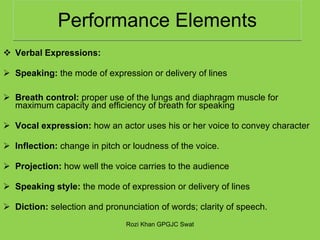
Verbal Expressions: Speaking:  the mode of expression or delivery of lines  Breath control:  proper use of the lungs and diaphragm muscle for  maximum capacity and efficiency of breath for speaking  Vocal expression:  how an actor uses his or her voice to convey character Inflection:  change in pitch or loudness of the voice.  Projection:  how well the voice carries to the audience  Speaking style:  the mode of expression or delivery of lines Diction:  selection and pronunciation of words; clarity of speech.  Performance Elements Rozi Khan GPGJC Swat
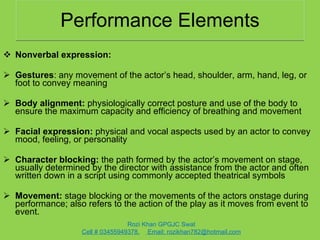
Nonverbal expression: Gestures : any movement of the actor’s head, shoulder, arm, hand, leg, or foot to convey meaning  Body alignment:  physiologically correct posture and use of the body to ensure the maximum capacity and efficiency of breathing and movement  Facial expression:  physical and vocal aspects used by an actor to convey mood, feeling, or personality Character blocking:  the path formed by the actor’s movement on stage, usually determined by the director with assistance from the actor and often written down in a script using commonly accepted theatrical symbols  Movement:  stage blocking or the movements of the actors onstage during performance; also refers to the action of the play as it moves from event to event.  Performance Elements Rozi Khan GPGJC Swat Cell # 03455949378,  Email: rozikhan782@hotmail.com