CREATIVE WRITING
PROMPTING
PRE-WRITING STRATEGIES
FOUR-SQUARE ORGANIZATION
Vinnitsa Teacher Training 2013
Peace Corps Ukraine - Sophia Trumbauer
What do you
see?
Describe in
detail...
Where is this?
What is
happening?
Who is there?
Why...why?
Creative Writing Strategies
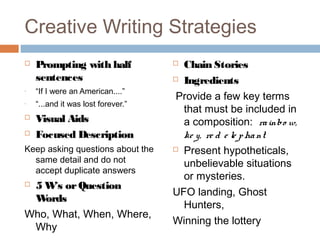
 Prompting with half
sentences
- “If I were an American....”
- “...and it was lost forever.”
 Visual Aids
 Focused Description
Keep asking questions about the
same detail and do not
accept duplicate answers
 5 W’s orQuestion
Words
Who, What, When, Where,
Why
 Chain Stories
 Ingredients
Provide a few key terms
that must be included in
a composition: rainbo w,
ke y, re d e le phant
 Present hypotheticals,
unbelievable situations
or mysteries.
UFO landing, Ghost
Hunters,
Winning the lottery
Write On Contest
 International Creative Writing
Contest created by Peace Corps
Volunteers
 Provides six weeks of pre-
contest Creative Writing lessons
and suggestions
 Creates an open environment
for creative expression. Essays
are judged upon their ideas,
originality and vocabulary.
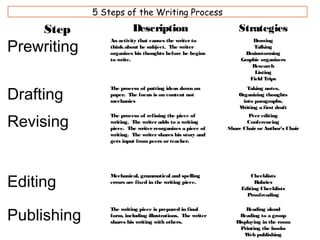
5 Steps of the Writing Process
Step Description Strategies
Prewriting
An activity that causes the writerto
thinkabout he subject. The writer
organizes his thoughts before he begins
to write.
Drawing
Talking
Brainstorming
Graphic organizers
Research
Listing
Field Trips
Drafting
The process of putting ideas down on
paper. The focus is on content not
mechanics
Taking notes,
Organizing thoughts
into paragraphs,
Writing a first draft
Revising
The process of refining the piece of
writing. The writer adds to a writing
piece. The writerreorganizes a piece of
writing. The writer shares his story and
gets input frompeers orteacher.
Peer editing
Conferencing
Share Chair orAuthor’s Chair
Editing
Mechanical, grammatical and spelling
errors are fixed in the writing piece.
Checklists
Rubrics
Editing Checklists
Proofreading
Publishing
The writing piece is prepared in final
form, including illustrations. The writer
shares his writing with others.
Reading aloud
Reading to a group
Displaying in the room
Printing the books
Web publishing
Pre-Writing
 Depressurize the situation
Pressure and timing can help to produce writing, but more
creative writing comes with enough time, a positive
environment and allowing for mistakes.
 Keep writing (don’t get distracted)
- Students will come up with any excuse to avoid writing
compositions. Someone may not like their first attempt or
cannot think of the right word - ignore any ‘hiccups’ on the
way and keep your class focused on the task.
 Utilize a Pre-Writing Strategy
-
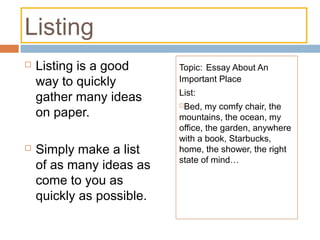
Listing
 Listing is a good
way to quickly
gather many ideas
on paper.
 Simply make a list
of as many ideas as
come to you as
quickly as possible.
Topic: Essay About An
Important Place
List:
Bed, my comfy chair, the
mountains, the ocean, my
office, the garden, anywhere
with a book, Starbucks,
home, the shower, the right
state of mind…
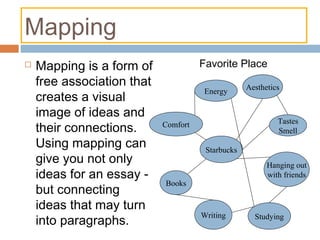
Mapping
 Mapping is a form of
free association that
creates a visual
image of ideas and
their connections.
Using mapping can
give you not only
ideas for an essay -
but connecting
ideas that may turn
into paragraphs.
Favorite Place
Comfort
Starbucks
Aesthetics
Books
Tastes
Smell
Hanging out
with friends
Writing Studying
Energy
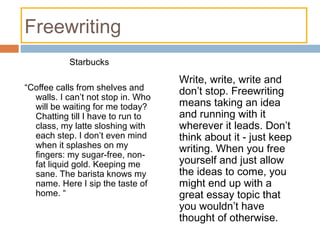
Freewriting
Starbucks
“Coffee calls from shelves and
walls. I can’t not stop in. Who
will be waiting for me today?
Chatting till I have to run to
class, my latte sloshing with
each step. I don’t even mind
when it splashes on my
fingers: my sugar-free, non-
fat liquid gold. Keeping me
sane. The barista knows my
name. Here I sip the taste of
home. “
Write, write, write and
don’t stop. Freewriting
means taking an idea
and running with it
wherever it leads. Don’t
think about it - just keep
writing. When you free
yourself and just allow
the ideas to come, you
might end up with a
great essay topic that
you wouldn’t have
thought of otherwise.
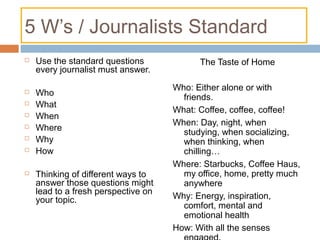
5 W’s / Journalists Standard
 Use the standard questions
every journalist must answer.
 Who
 What
 When
 Where
 Why
 How
 Thinking of different ways to
answer those questions might
lead to a fresh perspective on
your topic.
The Taste of Home
Who: Either alone or with
friends.
What: Coffee, coffee, coffee!
When: Day, night, when
studying, when socializing,
when thinking, when
chilling…
Where: Starbucks, Coffee Haus,
my office, home, pretty much
anywhere
Why: Energy, inspiration,
comfort, mental and
emotional health
How: With all the senses
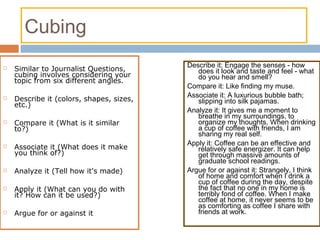
Cubing
 Similar to Journalist Questions,
cubing involves considering your
topic from six different angles.
 Describe it (colors, shapes, sizes,
etc.)
 Compare it (What is it similar
to?)
 Associate it (What does it make
you think of?)
 Analyze it (Tell how it's made)
 Apply it (What can you do with
it? How can it be used?)
 Argue for or against it
Describe it: Engage the senses - how
does it look and taste and feel - what
do you hear and smell?
Compare it: Like finding my muse.
Associate it: A luxurious bubble bath;
slipping into silk pajamas.
Analyze it: It gives me a moment to
breathe in my surroundings, to
organize my thoughts. When drinking
a cup of coffee with friends, I am
sharing my real self.
Apply it: Coffee can be an effective and
relatively safe energizer. It can help
get through massive amounts of
graduate school readings.
Argue for or against it: Strangely, I think
of home and comfort when I drink a
cup of coffee during the day, despite
the fact that no one in my home is
terribly fond of coffee. When I make
coffee at home, it never seems to be
as comforting as coffee I share with
friends at work.
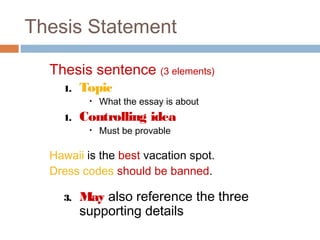
Thesis Statement
Thesis sentence (3 elements)
1. Topic
• What the essay is about
1. Controlling idea
• Must be provable
Hawaii is the best vacation spot.
Dress codes should be banned.
3. May also reference the three
supporting details
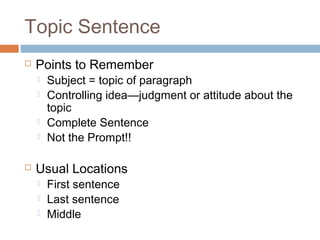
Topic Sentence
 Points to Remember
 Subject = topic of paragraph
 Controlling idea—judgment or attitude about the
topic
 Complete Sentence
 Not the Prompt!!
 Usual Locations
 First sentence
 Last sentence
 Middle
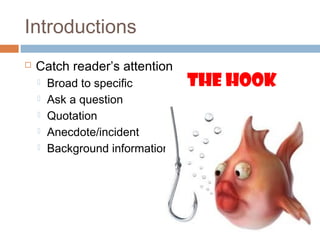
Introductions
 Catch reader’s attention
 Broad to specific
 Ask a question
 Quotation
 Anecdote/incident
 Background information
The Hook
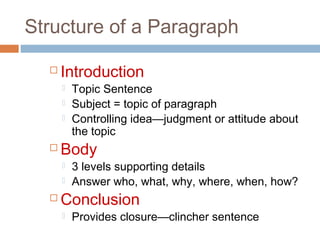
Structure of a Paragraph
 Introduction
 Topic Sentence
 Subject = topic of paragraph
 Controlling idea—judgment or attitude about
the topic
 Body
 3 levels supporting details
 Answer who, what, why, where, when, how?
 Conclusion
 Provides closure—clincher sentence
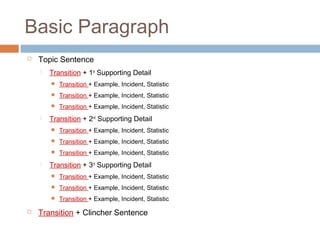
Basic Paragraph
 Topic Sentence
 Transition + 1st
Supporting Detail
 Transition + Example, Incident, Statistic
 Transition + 2nd
Supporting Detail
 Transition + Example, Incident, Statistic
 Transition + 3rd
Supporting Detail
 Transition + Example, Incident, Statistic
 Transition + Clincher Sentence
Sample Paragraph
 My experience in the nature study area was full of surprises.
 First of all, many unexpected creatures crossed our path.
 For example, as soon as we left the parking area and entered the
grassy path, a long snake slithered along the edge of the high
grass and quickly disappeared.
 In addition, I was surprised by how colorful the grasses, which
from a distance all appear to be green, actually are.
 Specifically, the primarily green landscape is dotted with countless
purple tassels and brown stalks.
 Finally and most importantly, I was unprepared for how quickly
I felt surrounded by nature.
 Although the noise from passing cars and airplanes occasionally
intrudes, the high prairie grasses and rolling pathways create a
sense that one is removed from civilization.
 Altogether, the nature study area unexpectedly allows one to
enjoy an ever-changing natural environment without leaving
campus.
Transition words and expressions help
connect ideas within and between
paragraphs. They do this by showing
relationships, such as addition or contrast
or result
Teacher: Your paper
doesn’t show a smooth flow
of thoughts. You need to
add transitions between
ideas and paragraphs.
Student: I have no idea
what a transition is.
What are some words
that I can use to make
my paper flow?
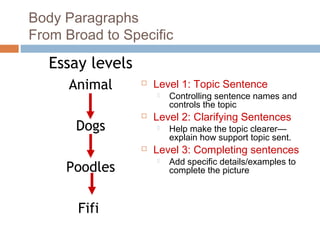
Body Paragraphs
From Broad to Specific
 Level 1: Topic Sentence
 Controlling sentence names and
controls the topic
 Level 2: Clarifying Sentences
 Help make the topic clearer—
explain how support topic sent.
 Level 3: Completing sentences
 Add specific details/examples to
complete the picture
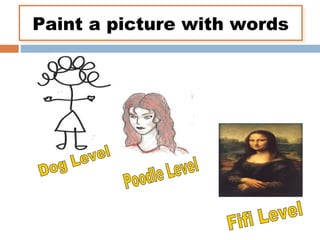
Essay levels
Animal
Dogs
Poodles
Fifi
Paint a picture with wordsPaint a picture with words
Sensory Details
 Sight
 Description
 Specific Nouns
 Specific Verbs
 Touch
 Texture
 Hearing
 Onomatopoeia
 Smell
 fragrances
 Taste
Variety is the spice of
life…
• Names (people, films, restaurants)
• My closest friend, Mrs. Smith, Titanic, Maria’s Pizzaria
• Numbers
• Three goldfish, 100 meters, a thousand years
• Dates/Times
• Sunday morning, a quiet afternoon, before sunset
• Places
• Blue mountains, inner city sidewalk, endless desert, Seattle
• Colors
• Crimson, burnt sienna, kelly green, chocolate, toast, peach
• Comparisons
• Like a mad dog, golf ball size, big as a whale
• Sensory Details
• Wiggle, clammy, murky, boom, clank, spicy, tangy
• Active Verbs
• Looked—glanced, squinted, peeked
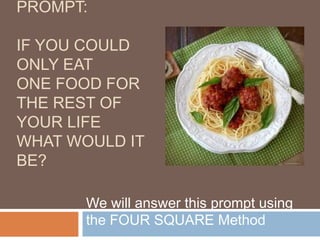
PROMPT:
IF YOU COULD
ONLY EAT
ONE FOOD FOR
THE REST OF
YOUR LIFE
WHAT WOULD IT
BE?
We will answer this prompt using
the FOUR SQUARE Method
Reasons why people choose foods
 TASTE
 texture, ingredients, sweet, sour, spicy
 APPEARANCE
 how the food looks, smells, presentation
 MEMORIES & TRADITIONS
 Holidays, special occasions, ethnic foods
 COST
 cheap fast foods, budget constraints
 CONVENIENCE
 food is ready to eat, available
 EASY TO FIX
 Few ingredients, simple recipe
 HABIT
 food is familiar and safe, know what to expect
 PEER PRESSURE
 Advertising, friend’s favorite
 Favorite
 Prefer
 Nothing better
 Crazy about
 Enjoy
 Partial to
 Desire
 Food
 Meal
 Repast
 Cuisine
 Menu
 Dishes
Alternative words
 Fun
 Entertainment
 Amusement
 Pleasure
 Satisfying
 Easy
 Simple
 Trouble-free
 Effortless
 Uncomplicated
 Delicious
 Tasty
 Mouth-watering
 Yummy
 Appetizing
Thesis statement:
“My favorite food is spaghetti and meatballs.
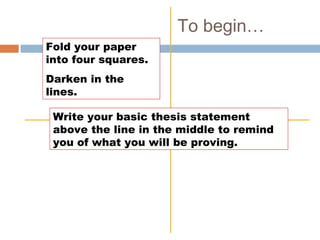
Fold your paper
into four squares.
Darken in the
lines.
To begin…
Write your basic thesis statement
above the line in the middle to remind
you of what you will be proving.
My favorite food is spaghetti and meatballs.
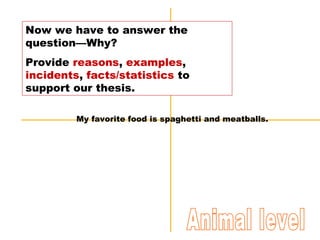
Now we have to answer the
question—Why?
Provide reasons, examples,
incidents, facts/statistics to
support our thesis.
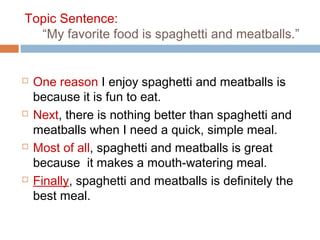
Topic Sentence:
“My favorite food is spaghetti and meatballs.”
 One reason I enjoy spaghetti and meatballs is
because it is fun to eat.
 Next, there is nothing better than spaghetti and
meatballs when I need a quick, simple meal.
 Most of all, spaghetti and meatballs is great
because it makes a mouth-watering meal.
 Finally, spaghetti and meatballs is definitely the
best meal.
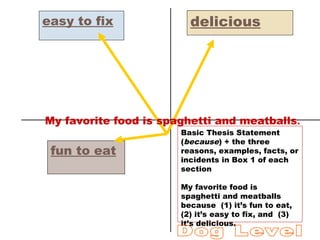
easy to fix
fun to eat
delicious
Basic Thesis Statement
(because) + the three
reasons, examples, facts, or
incidents in Box 1 of each
section
My favorite food is
spaghetti and meatballs
because (1) it’s fun to eat,
(2) it’s easy to fix, and (3)
it’s delicious.
My favorite food is spaghetti and meatballs.
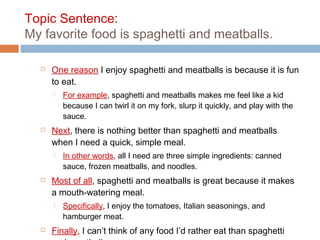
Topic Sentence:
My favorite food is spaghetti and meatballs.
 One reason I enjoy spaghetti and meatballs is because it is fun
to eat.
 For example, spaghetti and meatballs makes me feel like a kid
because I can twirl it on my fork, slurp it quickly, and play with the
sauce.
 Next, there is nothing better than spaghetti and meatballs
when I need a quick, simple meal.
 In other words, all I need are three simple ingredients: canned
sauce, frozen meatballs, and noodles.
 Most of all, spaghetti and meatballs is great because it makes
a mouth-watering meal.
 Specifically, I enjoy the tomatoes, Italian seasonings, and
hamburger meat.
 Finally, I can’t think of any food I’d rather eat than spaghetti
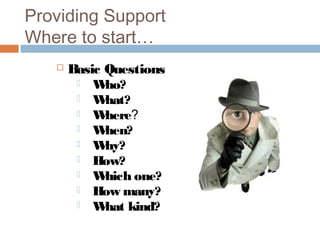
Providing Support
Where to start…
 Basic Questions
 Who?
 What?
 Where?
 When?
 Why?
 How?
 Which one?
 How many?
 What kind?
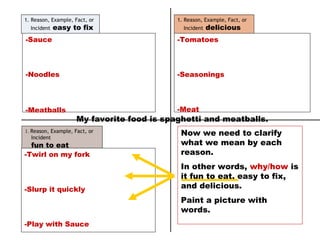
-Sauce
-Noodles
-Meatballs
-Twirl on my fork
-Slurp it quickly
-Play with Sauce
-Tomatoes
-Seasonings
-Meat
My favorite food is spaghetti and meatballs.
1. Reason, Example, Fact, or
Incident easy to fix
1. Reason, Example, Fact, or
Incident
fun to eat
1. Reason, Example, Fact, or
Incident delicious
Now we need to clarify
what we mean by each
reason.
In other words, why/how is
it fun to eat, easy to fix,
and delicious.
Paint a picture with
words.
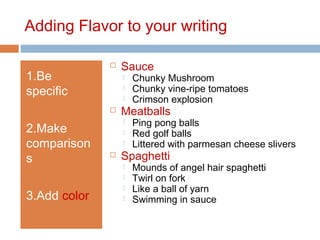
Adding Flavor to your writing
1.Be
specific
2.Make
comparison
s
3.Add color
 Sauce
 Chunky Mushroom
 Chunky vine-ripe tomatoes
 Crimson explosion
 Meatballs
 Ping pong balls
 Red golf balls
 Littered with parmesan cheese slivers
 Spaghetti
 Mounds of angel hair spaghetti
 Twirl on fork
 Like a ball of yarn
 Swimming in sauce
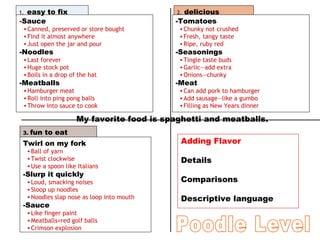
-Sauce
•Canned, preserved or store bought
•Find it almost anywhere
•Just open the jar and pour
-Noodles
•Last forever
•Huge stock pot
•Boils in a drop of the hat
-Meatballs
•Hamburger meat
•Roll into ping pong balls
•Throw into sauce to cook
Twirl on my fork
•Ball of yarn
•Twist clockwise
•Use a spoon like Italians
-Slurp it quickly
•Loud, smacking noises
•Sloop up noodles
•Noodles slap nose as loop into mouth
-Sauce
•Like finger paint
•Meatballs=red golf balls
•Crimson explosion
-Tomatoes
•Chunky not crushed
•Fresh, tangy taste
•Ripe, ruby red
-Seasonings
•Tingle taste buds
•Garlic—add extra
•Onions—chunky
-Meat
•Can add pork to hamburger
•Add sausage—like a gumbo
•Filling as New Years dinner
My favorite food is spaghetti and meatballs.
1. easy to fix
3. fun to eat
2. delicious
Adding Flavor
Details
Comparisons
Descriptive language
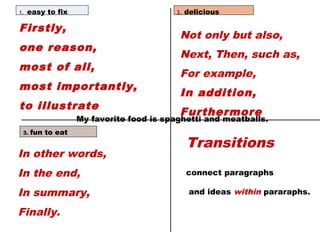
My favorite food is spaghetti and meatballs.
1. easy to fix
3. fun to eat
2. delicious
Transitions
connect paragraphs
and ideas within pararaphs.
Firstly,
one reason,
most of all,
most importantly,
to illustrate
Not only but also,
Next, Then, such as,
For example,
In addition,
Furthermore
In other words,
In the end,
In summary,
Finally.
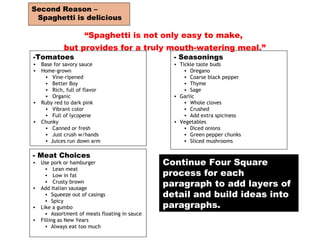
- Seasonings
• Tickle taste buds
• Oregano
• Coarse black pepper
• Thyme
• Sage
• Garlic
• Whole cloves
• Crushed
• Add extra spiciness
• Vegetables
• Diced onions
• Green pepper chunks
• Sliced mushrooms
-Tomatoes
• Base for savory sauce
• Home-grown
• Vine-ripened
• Better Boy
• Rich, full of flavor
• Organic
• Ruby red to dark pink
• Vibrant color
• Full of lycopene
• Chunky
• Canned or fresh
• Just crush w/hands
• Juices run down arm
- Meat Choices
• Use pork or hamburger
• Lean meat
• Low in fat
• Crusty brown
• Add Italian sausage
• Squeeze out of casings
• Spicy
• Like a gumbo
• Assortment of meats floating in sauce
• Filling as New Years
• Always eat too much
“Spaghetti is not only easy to make,
but provides for a truly mouth-watering meal.”
Continue Four Square
process for each
paragraph to add layers of
detail and build ideas into
paragraphs.
Second Reason –
Spaghetti is delicious
Patterns of Organization
 Chronological Order
 Narrative (story/incident)
 Process (step-by-step)
 Description
 Illustration (examples)
 Orderof Importance
 Comparison/Contrast
 Block
 Point by Point
 Cause/Effect
 Spatial
 Classification
 Definition
Organizational Patters
 Narrative paragraph
“Last week we cooked spaghetti for family dinner...”
—it was fun to eat together
 Process paragraph
“Came home from work late last Thursday, tired and
exhausted...”
— I wanted something easy to fix
 Illustrational paragraph
“I crave comfort food when I’m feeling down...”
- it tastes delicious and brings up my mood
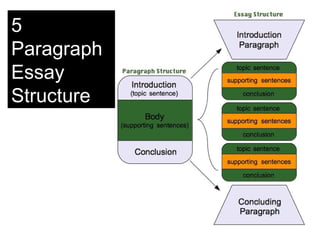
5
Paragraph
Essay
Structure
Conclusions
 Provide closure
 Summarize main points
-tie together
-do not restate thesis exactly
 Call to action
-Active voice,
-statements
 Look to the future
Cre ative thinking le ads to
m o re co m ple x thinking patte rns,
Hig he r le ve llang uag e skills and m o re de ve lo pe d pe o ple .
Four Square Method originated by Mack Gipson, Jr.
Pre-Writing strategies developed by Anne Lamott
Thank you for attending!!!
Do you have any
questions?
Contact me anytime
Email:
SophiaTrumbauer@gmail.com
Contact me anytime
Email:
SophiaTrumbauer@gmail.com

Writing lesson presentation

  • 1.
    CREATIVE WRITING PROMPTING PRE-WRITING STRATEGIES FOUR-SQUAREORGANIZATION Vinnitsa Teacher Training 2013 Peace Corps Ukraine - Sophia Trumbauer
  • 2.
  • 5.
    Where is this? Whatis happening? Who is there? Why...why?
  • 6.
    Creative Writing Strategies Prompting with half sentences - “If I were an American....” - “...and it was lost forever.”  Visual Aids  Focused Description Keep asking questions about the same detail and do not accept duplicate answers  5 W’s orQuestion Words Who, What, When, Where, Why  Chain Stories  Ingredients Provide a few key terms that must be included in a composition: rainbo w, ke y, re d e le phant  Present hypotheticals, unbelievable situations or mysteries. UFO landing, Ghost Hunters, Winning the lottery
  • 7.
    Write On Contest International Creative Writing Contest created by Peace Corps Volunteers  Provides six weeks of pre- contest Creative Writing lessons and suggestions  Creates an open environment for creative expression. Essays are judged upon their ideas, originality and vocabulary.
  • 8.
    5 Steps ofthe Writing Process Step Description Strategies Prewriting An activity that causes the writerto thinkabout he subject. The writer organizes his thoughts before he begins to write. Drawing Talking Brainstorming Graphic organizers Research Listing Field Trips Drafting The process of putting ideas down on paper. The focus is on content not mechanics Taking notes, Organizing thoughts into paragraphs, Writing a first draft Revising The process of refining the piece of writing. The writer adds to a writing piece. The writerreorganizes a piece of writing. The writer shares his story and gets input frompeers orteacher. Peer editing Conferencing Share Chair orAuthor’s Chair Editing Mechanical, grammatical and spelling errors are fixed in the writing piece. Checklists Rubrics Editing Checklists Proofreading Publishing The writing piece is prepared in final form, including illustrations. The writer shares his writing with others. Reading aloud Reading to a group Displaying in the room Printing the books Web publishing
  • 9.
    Pre-Writing  Depressurize thesituation Pressure and timing can help to produce writing, but more creative writing comes with enough time, a positive environment and allowing for mistakes.  Keep writing (don’t get distracted) - Students will come up with any excuse to avoid writing compositions. Someone may not like their first attempt or cannot think of the right word - ignore any ‘hiccups’ on the way and keep your class focused on the task.  Utilize a Pre-Writing Strategy -
  • 10.
    Listing  Listing isa good way to quickly gather many ideas on paper.  Simply make a list of as many ideas as come to you as quickly as possible. Topic: Essay About An Important Place List: Bed, my comfy chair, the mountains, the ocean, my office, the garden, anywhere with a book, Starbucks, home, the shower, the right state of mind…
  • 11.
    Mapping  Mapping isa form of free association that creates a visual image of ideas and their connections. Using mapping can give you not only ideas for an essay - but connecting ideas that may turn into paragraphs. Favorite Place Comfort Starbucks Aesthetics Books Tastes Smell Hanging out with friends Writing Studying Energy
  • 12.
    Freewriting Starbucks “Coffee calls fromshelves and walls. I can’t not stop in. Who will be waiting for me today? Chatting till I have to run to class, my latte sloshing with each step. I don’t even mind when it splashes on my fingers: my sugar-free, non- fat liquid gold. Keeping me sane. The barista knows my name. Here I sip the taste of home. “ Write, write, write and don’t stop. Freewriting means taking an idea and running with it wherever it leads. Don’t think about it - just keep writing. When you free yourself and just allow the ideas to come, you might end up with a great essay topic that you wouldn’t have thought of otherwise.
  • 13.
    5 W’s /Journalists Standard  Use the standard questions every journalist must answer.  Who  What  When  Where  Why  How  Thinking of different ways to answer those questions might lead to a fresh perspective on your topic. The Taste of Home Who: Either alone or with friends. What: Coffee, coffee, coffee! When: Day, night, when studying, when socializing, when thinking, when chilling… Where: Starbucks, Coffee Haus, my office, home, pretty much anywhere Why: Energy, inspiration, comfort, mental and emotional health How: With all the senses
  • 14.
    Cubing  Similar toJournalist Questions, cubing involves considering your topic from six different angles.  Describe it (colors, shapes, sizes, etc.)  Compare it (What is it similar to?)  Associate it (What does it make you think of?)  Analyze it (Tell how it's made)  Apply it (What can you do with it? How can it be used?)  Argue for or against it Describe it: Engage the senses - how does it look and taste and feel - what do you hear and smell? Compare it: Like finding my muse. Associate it: A luxurious bubble bath; slipping into silk pajamas. Analyze it: It gives me a moment to breathe in my surroundings, to organize my thoughts. When drinking a cup of coffee with friends, I am sharing my real self. Apply it: Coffee can be an effective and relatively safe energizer. It can help get through massive amounts of graduate school readings. Argue for or against it: Strangely, I think of home and comfort when I drink a cup of coffee during the day, despite the fact that no one in my home is terribly fond of coffee. When I make coffee at home, it never seems to be as comforting as coffee I share with friends at work.
  • 15.
    Thesis Statement Thesis sentence(3 elements) 1. Topic • What the essay is about 1. Controlling idea • Must be provable Hawaii is the best vacation spot. Dress codes should be banned. 3. May also reference the three supporting details
  • 16.
    Topic Sentence  Pointsto Remember  Subject = topic of paragraph  Controlling idea—judgment or attitude about the topic  Complete Sentence  Not the Prompt!!  Usual Locations  First sentence  Last sentence  Middle
  • 17.
    Introductions  Catch reader’sattention  Broad to specific  Ask a question  Quotation  Anecdote/incident  Background information The Hook
  • 18.
    Structure of aParagraph  Introduction  Topic Sentence  Subject = topic of paragraph  Controlling idea—judgment or attitude about the topic  Body  3 levels supporting details  Answer who, what, why, where, when, how?  Conclusion  Provides closure—clincher sentence
  • 19.
    Basic Paragraph  TopicSentence  Transition + 1st Supporting Detail  Transition + Example, Incident, Statistic  Transition + Example, Incident, Statistic  Transition + Example, Incident, Statistic  Transition + 2nd Supporting Detail  Transition + Example, Incident, Statistic  Transition + Example, Incident, Statistic  Transition + Example, Incident, Statistic  Transition + 3rd Supporting Detail  Transition + Example, Incident, Statistic  Transition + Example, Incident, Statistic  Transition + Example, Incident, Statistic  Transition + Clincher Sentence
  • 20.
    Sample Paragraph  Myexperience in the nature study area was full of surprises.  First of all, many unexpected creatures crossed our path.  For example, as soon as we left the parking area and entered the grassy path, a long snake slithered along the edge of the high grass and quickly disappeared.  In addition, I was surprised by how colorful the grasses, which from a distance all appear to be green, actually are.  Specifically, the primarily green landscape is dotted with countless purple tassels and brown stalks.  Finally and most importantly, I was unprepared for how quickly I felt surrounded by nature.  Although the noise from passing cars and airplanes occasionally intrudes, the high prairie grasses and rolling pathways create a sense that one is removed from civilization.  Altogether, the nature study area unexpectedly allows one to enjoy an ever-changing natural environment without leaving campus.
  • 21.
    Transition words andexpressions help connect ideas within and between paragraphs. They do this by showing relationships, such as addition or contrast or result Teacher: Your paper doesn’t show a smooth flow of thoughts. You need to add transitions between ideas and paragraphs. Student: I have no idea what a transition is. What are some words that I can use to make my paper flow?
  • 22.
    Body Paragraphs From Broadto Specific  Level 1: Topic Sentence  Controlling sentence names and controls the topic  Level 2: Clarifying Sentences  Help make the topic clearer— explain how support topic sent.  Level 3: Completing sentences  Add specific details/examples to complete the picture Essay levels Animal Dogs Poodles Fifi
  • 23.
    Paint a picturewith wordsPaint a picture with words
  • 24.
    Sensory Details  Sight Description  Specific Nouns  Specific Verbs  Touch  Texture  Hearing  Onomatopoeia  Smell  fragrances  Taste
  • 25.
    Variety is thespice of life…
  • 26.
    • Names (people,films, restaurants) • My closest friend, Mrs. Smith, Titanic, Maria’s Pizzaria • Numbers • Three goldfish, 100 meters, a thousand years • Dates/Times • Sunday morning, a quiet afternoon, before sunset • Places • Blue mountains, inner city sidewalk, endless desert, Seattle • Colors • Crimson, burnt sienna, kelly green, chocolate, toast, peach • Comparisons • Like a mad dog, golf ball size, big as a whale • Sensory Details • Wiggle, clammy, murky, boom, clank, spicy, tangy • Active Verbs • Looked—glanced, squinted, peeked
  • 27.
    PROMPT: IF YOU COULD ONLYEAT ONE FOOD FOR THE REST OF YOUR LIFE WHAT WOULD IT BE? We will answer this prompt using the FOUR SQUARE Method
  • 28.
    Reasons why peoplechoose foods  TASTE  texture, ingredients, sweet, sour, spicy  APPEARANCE  how the food looks, smells, presentation  MEMORIES & TRADITIONS  Holidays, special occasions, ethnic foods  COST  cheap fast foods, budget constraints  CONVENIENCE  food is ready to eat, available  EASY TO FIX  Few ingredients, simple recipe  HABIT  food is familiar and safe, know what to expect  PEER PRESSURE  Advertising, friend’s favorite
  • 29.
     Favorite  Prefer Nothing better  Crazy about  Enjoy  Partial to  Desire  Food  Meal  Repast  Cuisine  Menu  Dishes Alternative words  Fun  Entertainment  Amusement  Pleasure  Satisfying  Easy  Simple  Trouble-free  Effortless  Uncomplicated  Delicious  Tasty  Mouth-watering  Yummy  Appetizing Thesis statement: “My favorite food is spaghetti and meatballs.
  • 30.
    Fold your paper intofour squares. Darken in the lines. To begin… Write your basic thesis statement above the line in the middle to remind you of what you will be proving.
  • 31.
    My favorite foodis spaghetti and meatballs. Now we have to answer the question—Why? Provide reasons, examples, incidents, facts/statistics to support our thesis.
  • 32.
    Topic Sentence: “My favoritefood is spaghetti and meatballs.”  One reason I enjoy spaghetti and meatballs is because it is fun to eat.  Next, there is nothing better than spaghetti and meatballs when I need a quick, simple meal.  Most of all, spaghetti and meatballs is great because it makes a mouth-watering meal.  Finally, spaghetti and meatballs is definitely the best meal.
  • 33.
    easy to fix funto eat delicious Basic Thesis Statement (because) + the three reasons, examples, facts, or incidents in Box 1 of each section My favorite food is spaghetti and meatballs because (1) it’s fun to eat, (2) it’s easy to fix, and (3) it’s delicious. My favorite food is spaghetti and meatballs.
  • 34.
    Topic Sentence: My favoritefood is spaghetti and meatballs.  One reason I enjoy spaghetti and meatballs is because it is fun to eat.  For example, spaghetti and meatballs makes me feel like a kid because I can twirl it on my fork, slurp it quickly, and play with the sauce.  Next, there is nothing better than spaghetti and meatballs when I need a quick, simple meal.  In other words, all I need are three simple ingredients: canned sauce, frozen meatballs, and noodles.  Most of all, spaghetti and meatballs is great because it makes a mouth-watering meal.  Specifically, I enjoy the tomatoes, Italian seasonings, and hamburger meat.  Finally, I can’t think of any food I’d rather eat than spaghetti
  • 35.
    Providing Support Where tostart…  Basic Questions  Who?  What?  Where?  When?  Why?  How?  Which one?  How many?  What kind?
  • 36.
    -Sauce -Noodles -Meatballs -Twirl on myfork -Slurp it quickly -Play with Sauce -Tomatoes -Seasonings -Meat My favorite food is spaghetti and meatballs. 1. Reason, Example, Fact, or Incident easy to fix 1. Reason, Example, Fact, or Incident fun to eat 1. Reason, Example, Fact, or Incident delicious Now we need to clarify what we mean by each reason. In other words, why/how is it fun to eat, easy to fix, and delicious. Paint a picture with words.
  • 37.
    Adding Flavor toyour writing 1.Be specific 2.Make comparison s 3.Add color  Sauce  Chunky Mushroom  Chunky vine-ripe tomatoes  Crimson explosion  Meatballs  Ping pong balls  Red golf balls  Littered with parmesan cheese slivers  Spaghetti  Mounds of angel hair spaghetti  Twirl on fork  Like a ball of yarn  Swimming in sauce
  • 38.
    -Sauce •Canned, preserved orstore bought •Find it almost anywhere •Just open the jar and pour -Noodles •Last forever •Huge stock pot •Boils in a drop of the hat -Meatballs •Hamburger meat •Roll into ping pong balls •Throw into sauce to cook Twirl on my fork •Ball of yarn •Twist clockwise •Use a spoon like Italians -Slurp it quickly •Loud, smacking noises •Sloop up noodles •Noodles slap nose as loop into mouth -Sauce •Like finger paint •Meatballs=red golf balls •Crimson explosion -Tomatoes •Chunky not crushed •Fresh, tangy taste •Ripe, ruby red -Seasonings •Tingle taste buds •Garlic—add extra •Onions—chunky -Meat •Can add pork to hamburger •Add sausage—like a gumbo •Filling as New Years dinner My favorite food is spaghetti and meatballs. 1. easy to fix 3. fun to eat 2. delicious Adding Flavor Details Comparisons Descriptive language
  • 39.
    My favorite foodis spaghetti and meatballs. 1. easy to fix 3. fun to eat 2. delicious Transitions connect paragraphs and ideas within pararaphs. Firstly, one reason, most of all, most importantly, to illustrate Not only but also, Next, Then, such as, For example, In addition, Furthermore In other words, In the end, In summary, Finally.
  • 40.
    - Seasonings • Tickletaste buds • Oregano • Coarse black pepper • Thyme • Sage • Garlic • Whole cloves • Crushed • Add extra spiciness • Vegetables • Diced onions • Green pepper chunks • Sliced mushrooms -Tomatoes • Base for savory sauce • Home-grown • Vine-ripened • Better Boy • Rich, full of flavor • Organic • Ruby red to dark pink • Vibrant color • Full of lycopene • Chunky • Canned or fresh • Just crush w/hands • Juices run down arm - Meat Choices • Use pork or hamburger • Lean meat • Low in fat • Crusty brown • Add Italian sausage • Squeeze out of casings • Spicy • Like a gumbo • Assortment of meats floating in sauce • Filling as New Years • Always eat too much “Spaghetti is not only easy to make, but provides for a truly mouth-watering meal.” Continue Four Square process for each paragraph to add layers of detail and build ideas into paragraphs. Second Reason – Spaghetti is delicious
  • 41.
    Patterns of Organization Chronological Order  Narrative (story/incident)  Process (step-by-step)  Description  Illustration (examples)  Orderof Importance  Comparison/Contrast  Block  Point by Point  Cause/Effect  Spatial  Classification  Definition
  • 42.
    Organizational Patters  Narrativeparagraph “Last week we cooked spaghetti for family dinner...” —it was fun to eat together  Process paragraph “Came home from work late last Thursday, tired and exhausted...” — I wanted something easy to fix  Illustrational paragraph “I crave comfort food when I’m feeling down...” - it tastes delicious and brings up my mood
  • 43.
  • 45.
    Conclusions  Provide closure Summarize main points -tie together -do not restate thesis exactly  Call to action -Active voice, -statements  Look to the future Cre ative thinking le ads to m o re co m ple x thinking patte rns, Hig he r le ve llang uag e skills and m o re de ve lo pe d pe o ple .
  • 46.
    Four Square Methodoriginated by Mack Gipson, Jr. Pre-Writing strategies developed by Anne Lamott Thank you for attending!!! Do you have any questions? Contact me anytime Email: SophiaTrumbauer@gmail.com Contact me anytime Email: SophiaTrumbauer@gmail.com