
Rina Gegollaj
Istog
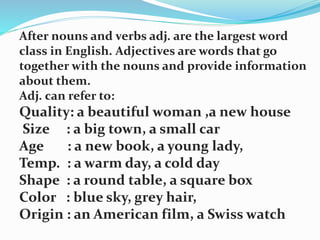
After nouns and verbs adj. are the largest word
class in English. Adjectives are words that go
together with the nouns and provide information
about them.
Adj. can refer to:
Quality: a beautiful woman ,a new house
Size : a big town, a small car
Age : a new book, a young lady,
Temp. : a warm day, a cold day
Shape : a round table, a square box
Color : blue sky, grey hair,
Origin : an American film, a Swiss watch
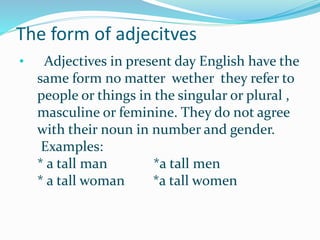
The form of adjecitves
• Adjectives in present day English have the
same form no matter wether they refer to
people or things in the singular or plural ,
masculine or feminine. They do not agree
with their noun in number and gender.
Examples:
* a tall man *a tall men
* a tall woman *a tall women
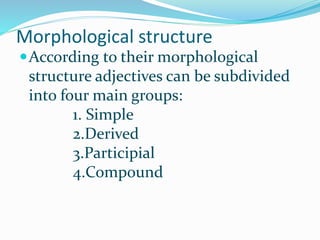
Morphological structure
According to their morphological
structure adjectives can be subdivided
into four main groups:
1. Simple
2.Derived
3.Participial
4.Compound
“
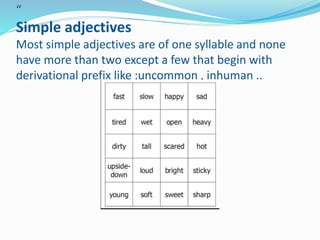
Simple adjectives
Most simple adjectives are of one syllable and none
have more than two except a few that begin with
derivational prefix like :uncommon , inhuman ..
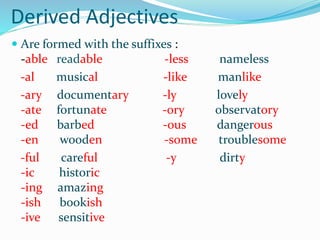
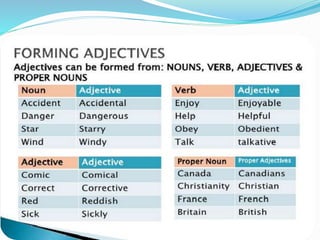
Derived Adjectives
 Are formed with the suffixes :
-able readable -less nameless
-al musical -like manlike
-ary documentary -ly lovely
-ate fortunate -ory observatory
-ed barbed -ous dangerous
-en wooden -some troublesome
-ful careful -y dirty
-ic historic
-ing amazing
-ish bookish
-ive sensitive
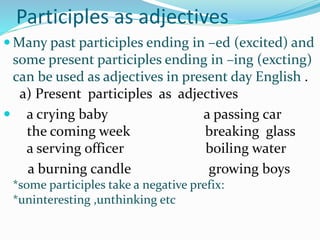
Participles as adjectives
 Many past participles ending in –ed (excited) and
some present participles ending in –ing (excting)
can be used as adjectives in present day English .
a) Present participles as adjectives
 a crying baby a passing car
the coming week breaking glass
a serving officer boiling water
a burning candle growing boys
*some participles take a negative prefix:
*uninteresting ,unthinking etc
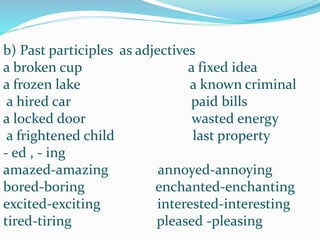
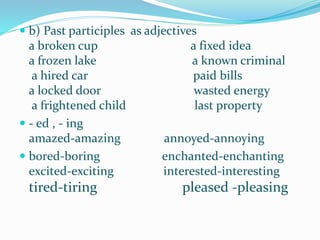
b) Past participles as adjectives
a broken cup a fixed idea
a frozen lake a known criminal
a hired car paid bills
a locked door wasted energy
a frightened child last property
- ed , - ing
amazed-amazing annoyed-annoying
bored-boring enchanted-enchanting
excited-exciting interested-interesting
tired-tiring pleased -pleasing
 b) Past participles as adjectives
a broken cup a fixed idea
a frozen lake a known criminal
a hired car paid bills
a locked door wasted energy
a frightened child last property
 - ed , - ing
amazed-amazing annoyed-annoying
 bored-boring enchanted-enchanting
excited-exciting interested-interesting
tired-tiring pleased -pleasing
Compound adjectives
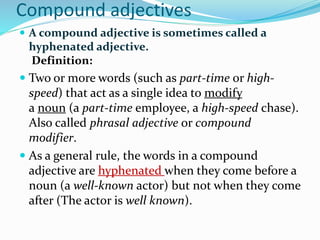
 A compound adjective is sometimes called a
hyphenated adjective.
Definition:
 Two or more words (such as part-time or high-
speed) that act as a single idea to modify
a noun (a part-time employee, a high-speed chase).
Also called phrasal adjective or compound
modifier.
 As a general rule, the words in a compound
adjective are hyphenated when they come before a
noun (a well-known actor) but not when they come
after (The actor is well known).
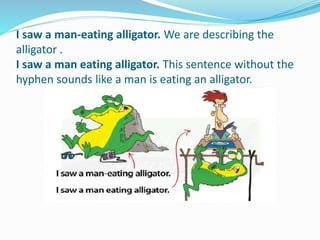
I saw a man-eating alligator. We are describing the
alligator .
I saw a man eating alligator. This sentence without the
hyphen sounds like a man is eating an alligator.
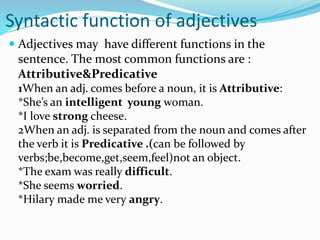
Syntactic function of adjectives
 Adjectives may have different functions in the
sentence. The most common functions are :
Attributive&Predicative
1When an adj. comes before a noun, it is Attributive:
*She’s an intelligent young woman.
*I love strong cheese.
2When an adj. is separated from the noun and comes after
the verb it is Predicative .(can be followed by
verbs;be,become,get,seem,feel)not an object.
*The exam was really difficult.
*She seems worried.
*Hilary made me very angry.
 We say that adjective is Predicative or is used
Predicatively when it comes after a linking verb
(be,seem,etc) or some other state verbs , in which
case it function as :
Subject complement :
 This ticket is old. He is careless.Your sister seems angry
Adjectives
Adjectives

Adjectives

  • 1.
  • 2.
    After nouns andverbs adj. are the largest word class in English. Adjectives are words that go together with the nouns and provide information about them. Adj. can refer to: Quality: a beautiful woman ,a new house Size : a big town, a small car Age : a new book, a young lady, Temp. : a warm day, a cold day Shape : a round table, a square box Color : blue sky, grey hair, Origin : an American film, a Swiss watch
  • 3.
    The form ofadjecitves • Adjectives in present day English have the same form no matter wether they refer to people or things in the singular or plural , masculine or feminine. They do not agree with their noun in number and gender. Examples: * a tall man *a tall men * a tall woman *a tall women
  • 4.
    Morphological structure According totheir morphological structure adjectives can be subdivided into four main groups: 1. Simple 2.Derived 3.Participial 4.Compound
  • 5.
    “ Simple adjectives Most simpleadjectives are of one syllable and none have more than two except a few that begin with derivational prefix like :uncommon , inhuman ..
  • 6.
    Derived Adjectives  Areformed with the suffixes : -able readable -less nameless -al musical -like manlike -ary documentary -ly lovely -ate fortunate -ory observatory -ed barbed -ous dangerous -en wooden -some troublesome -ful careful -y dirty -ic historic -ing amazing -ish bookish -ive sensitive
  • 7.
    Participles as adjectives Many past participles ending in –ed (excited) and some present participles ending in –ing (excting) can be used as adjectives in present day English . a) Present participles as adjectives  a crying baby a passing car the coming week breaking glass a serving officer boiling water a burning candle growing boys *some participles take a negative prefix: *uninteresting ,unthinking etc
  • 8.
    b) Past participlesas adjectives a broken cup a fixed idea a frozen lake a known criminal a hired car paid bills a locked door wasted energy a frightened child last property - ed , - ing amazed-amazing annoyed-annoying bored-boring enchanted-enchanting excited-exciting interested-interesting tired-tiring pleased -pleasing
  • 9.
     b) Pastparticiples as adjectives a broken cup a fixed idea a frozen lake a known criminal a hired car paid bills a locked door wasted energy a frightened child last property  - ed , - ing amazed-amazing annoyed-annoying  bored-boring enchanted-enchanting excited-exciting interested-interesting tired-tiring pleased -pleasing
  • 10.
    Compound adjectives  Acompound adjective is sometimes called a hyphenated adjective. Definition:  Two or more words (such as part-time or high- speed) that act as a single idea to modify a noun (a part-time employee, a high-speed chase). Also called phrasal adjective or compound modifier.  As a general rule, the words in a compound adjective are hyphenated when they come before a noun (a well-known actor) but not when they come after (The actor is well known).
  • 11.
    I saw aman-eating alligator. We are describing the alligator . I saw a man eating alligator. This sentence without the hyphen sounds like a man is eating an alligator.
  • 12.
    Syntactic function ofadjectives  Adjectives may have different functions in the sentence. The most common functions are : Attributive&Predicative 1When an adj. comes before a noun, it is Attributive: *She’s an intelligent young woman. *I love strong cheese. 2When an adj. is separated from the noun and comes after the verb it is Predicative .(can be followed by verbs;be,become,get,seem,feel)not an object. *The exam was really difficult. *She seems worried. *Hilary made me very angry.
  • 13.
     We saythat adjective is Predicative or is used Predicatively when it comes after a linking verb (be,seem,etc) or some other state verbs , in which case it function as : Subject complement :  This ticket is old. He is careless.Your sister seems angry