Lesson 4 
Day 4
Question of the Day 
• What is your special talent? 
• What talent would you most like to 
have? 
• Why would you like to have this 
talent more than any other? 
T336
Read Aloud 
• Why might we want to read the story 
“Jumping for Joy”? 
• To learn or enjoy 
T337
Read Aloud
Read Aloud 
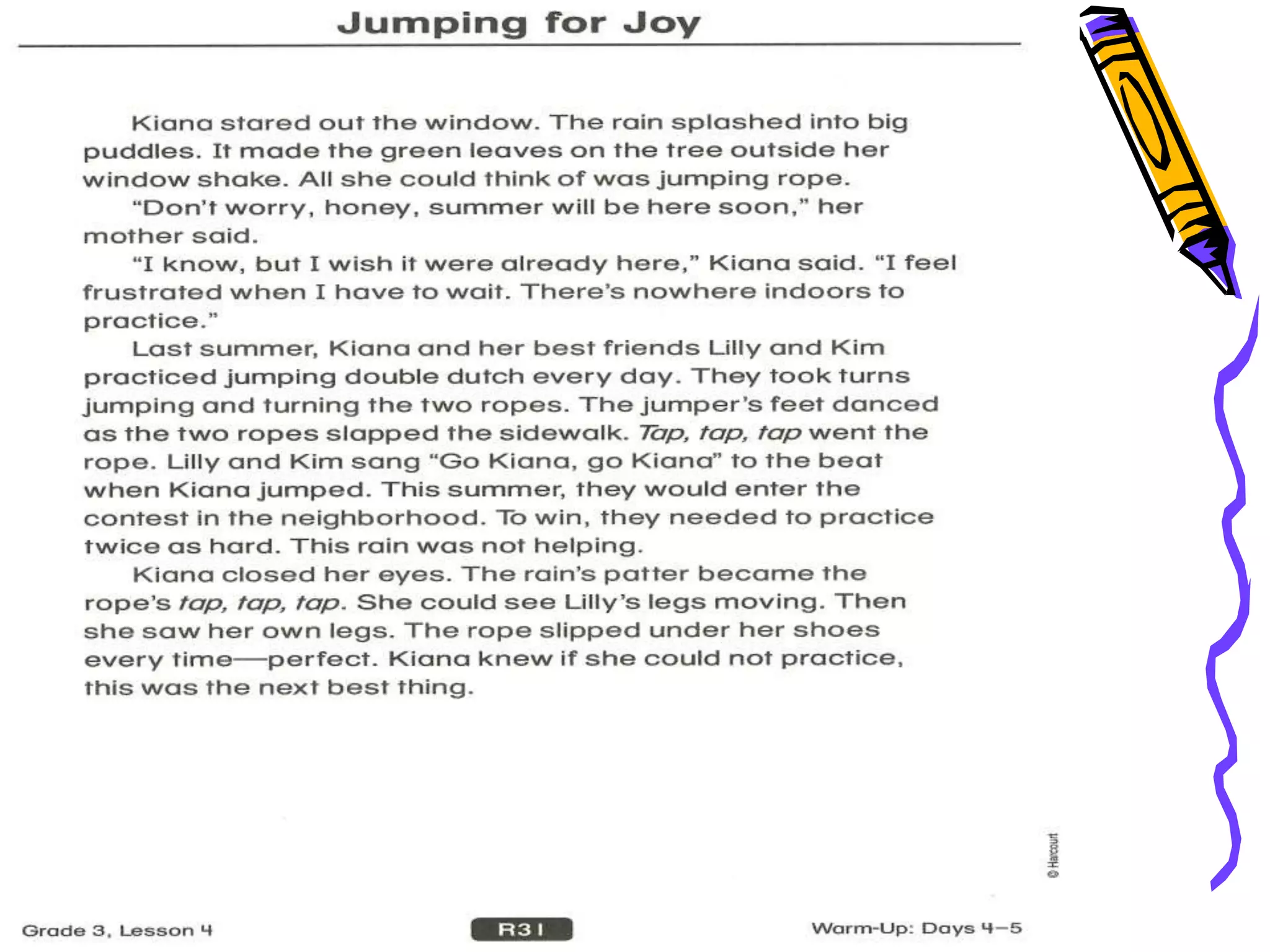
• What did Kiana wish for? 
• Why did she wish for summer? 
t337
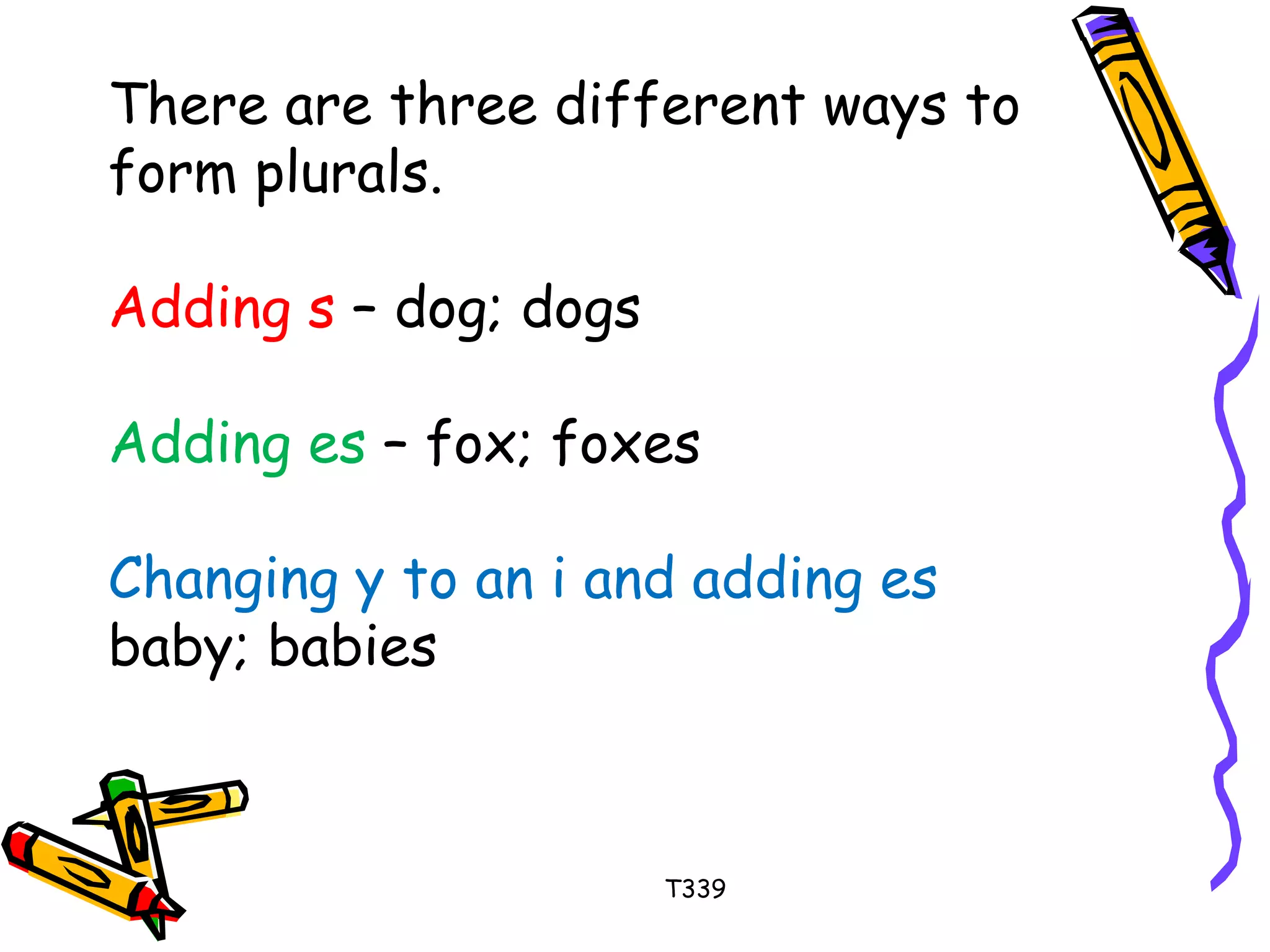
There are three different ways to 
form plurals. 
Adding s – dog; dogs 
Adding es – fox; foxes 
Changing y to an i and adding es 
baby; babies 
T339
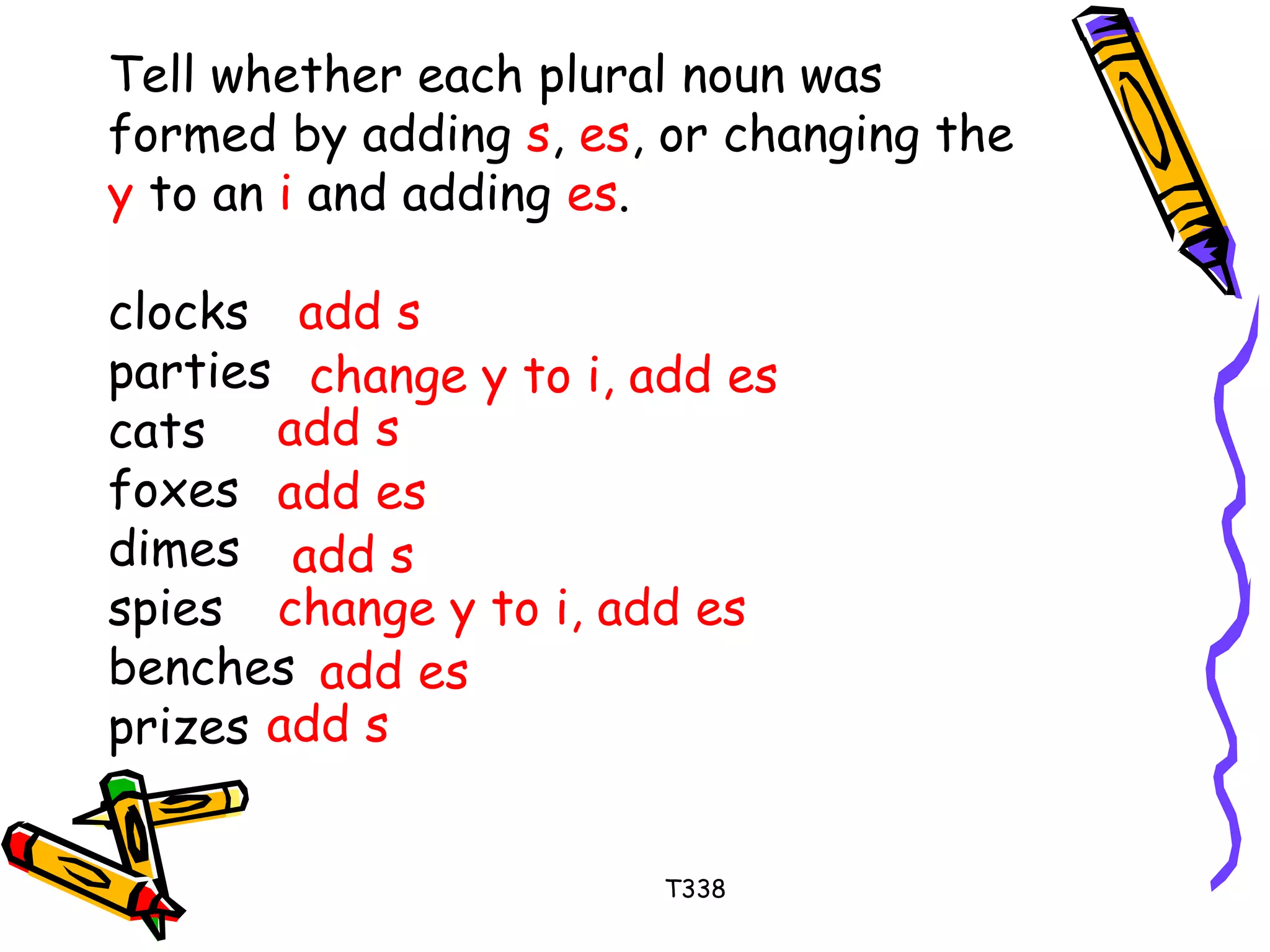
Tell whether each plural noun was 
formed by adding s, es, or changing the 
y to an i and adding es. 
clocks 
parties 
cats 
foxes 
dimes 
spies 
benches 
prizes 
add s 
change y to i, add es 
add s 
add es 
add s 
change y to i, add es 
add es 
add s 
T338
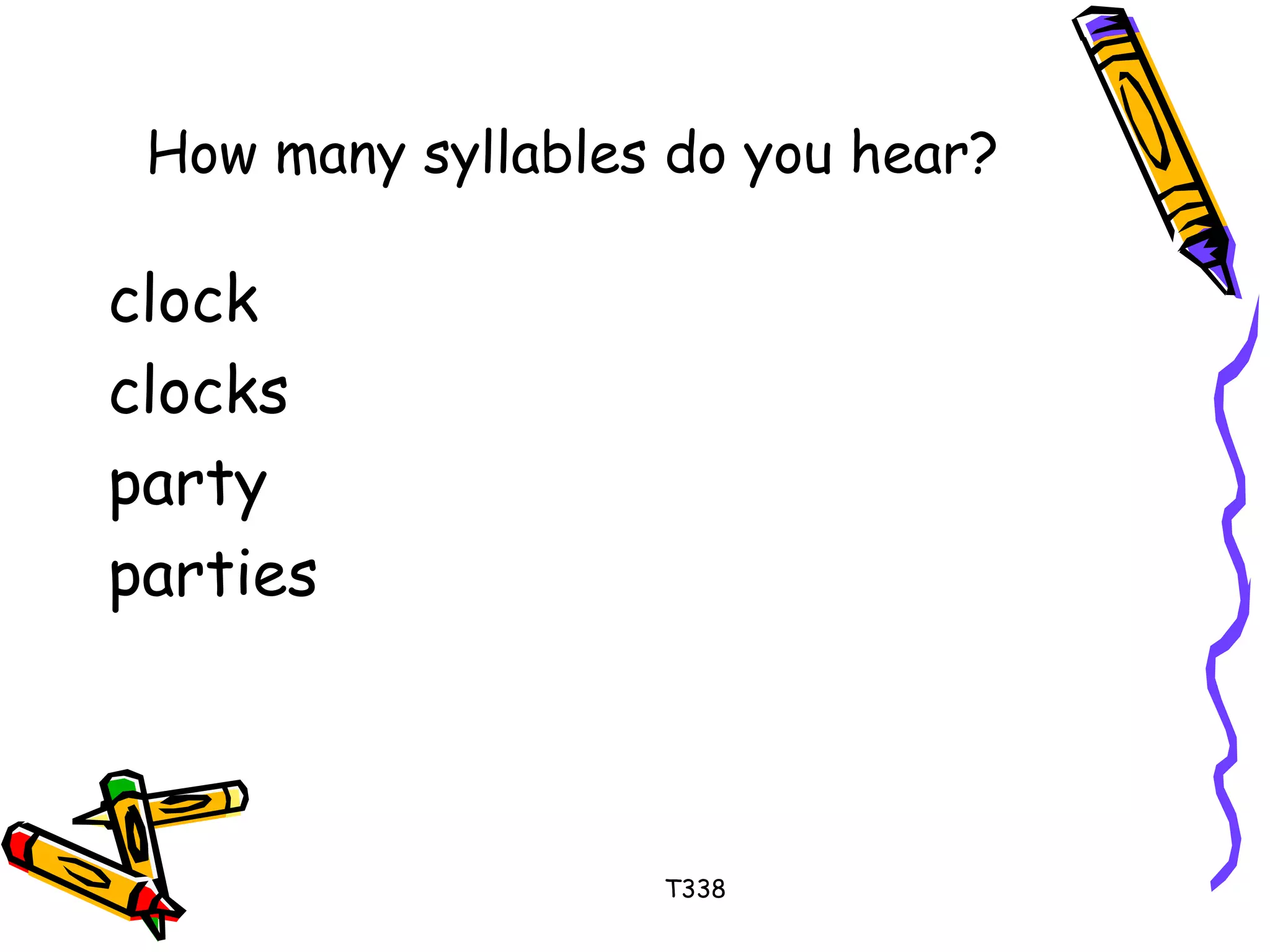
How many syllables do you hear? 
clock 
clocks 
party 
parties 
T338
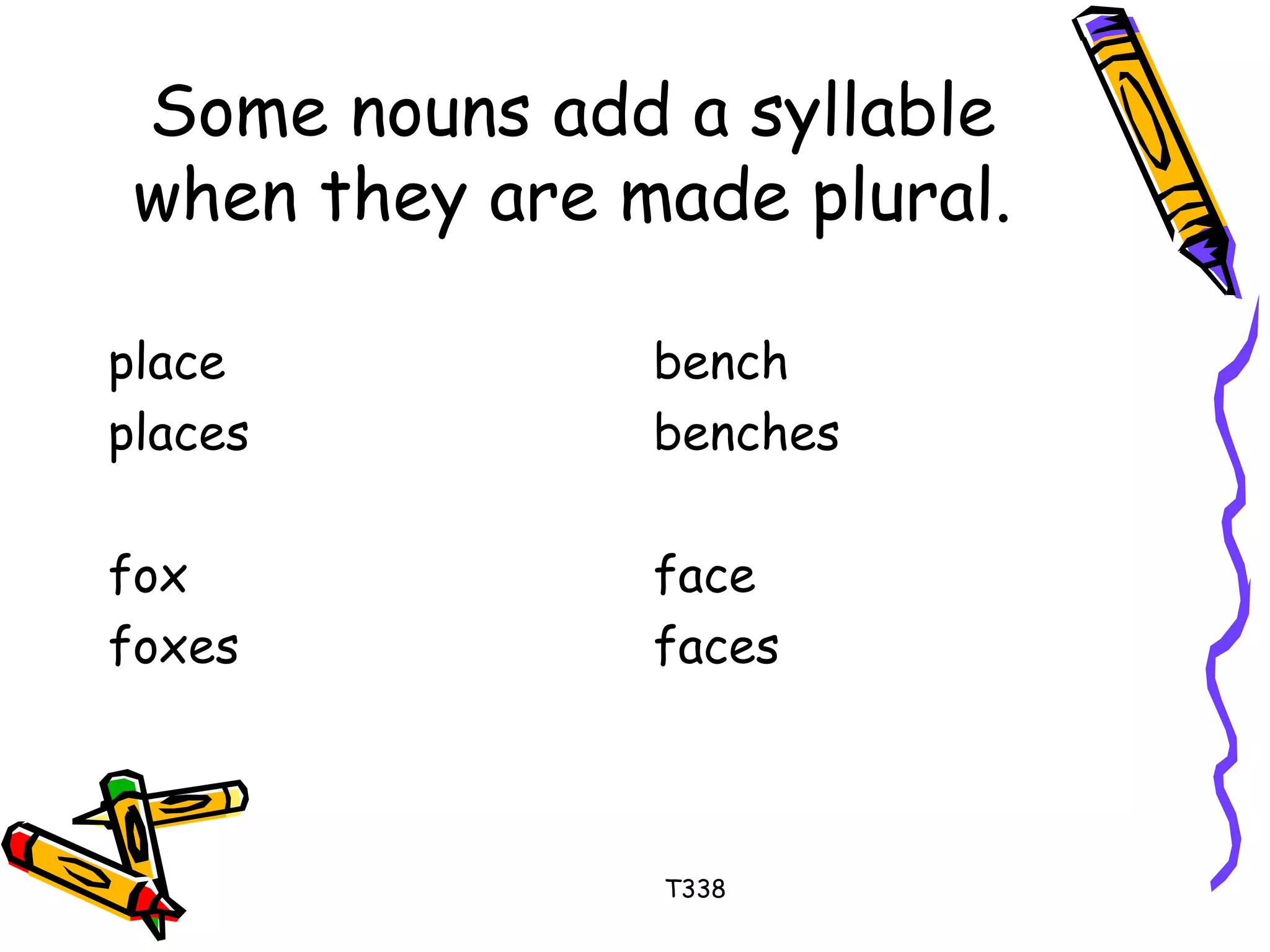
Some nouns add a syllable 
when they are made plural. 
place 
places 
fox 
foxes 
bench 
benches 
face 
faces 
T338
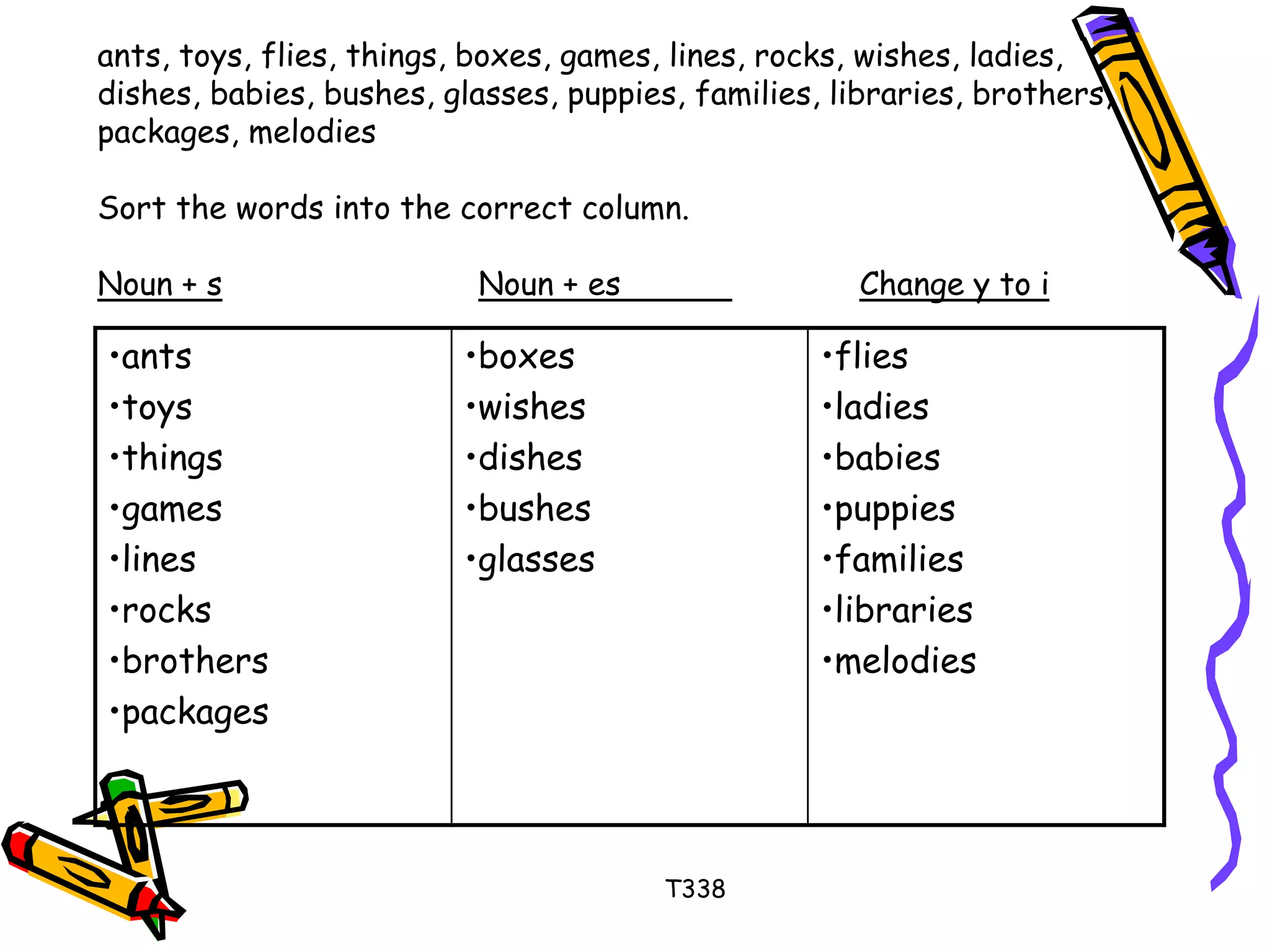
ants, toys, flies, things, boxes, games, lines, rocks, wishes, ladies, 
dishes, babies, bushes, glasses, puppies, families, libraries, brothers, 
packages, melodies 
Sort the words into the correct column. 
Noun + s Noun + es Change y to i 
•ants 
•boxes 
•flies 
•toys 
•wishes 
•ladies 
•things 
•dishes 
•babies 
•games 
•bushes 
•puppies 
•lines 
•glasses 
•families 
•rocks 
•libraries 
•brothers 
•melodies 
•packages 
T338
Good readers read at a 
comfortable, steady pace and do 
not stumble over words. 
Good readers: 
• pronounce words clearly 
• listen to themselves read to check 
their reading pace. 
T340
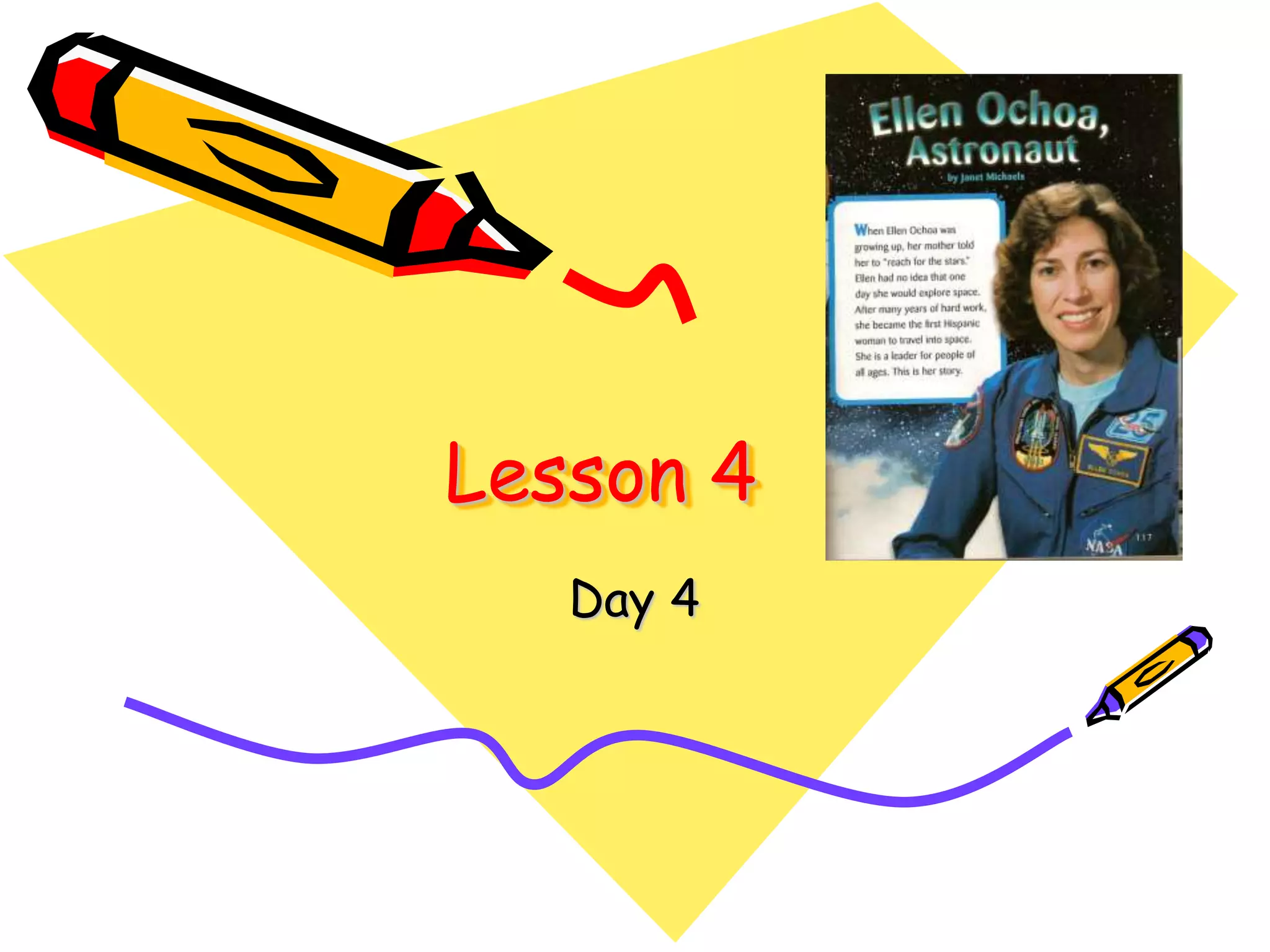
As I read a passage from “Ellen Ochoa, 
Astronaut,” I am going to read at an 
even speed so that I do not stumble 
when I get to a harder word. I am 
going to listen to myself read to hear 
if I am getting slower or speeding up 
when I should not be. 
Turn to page 124-125. 
Turn and read page 124 with your 
partner. 
»Listen as I read. 
T340
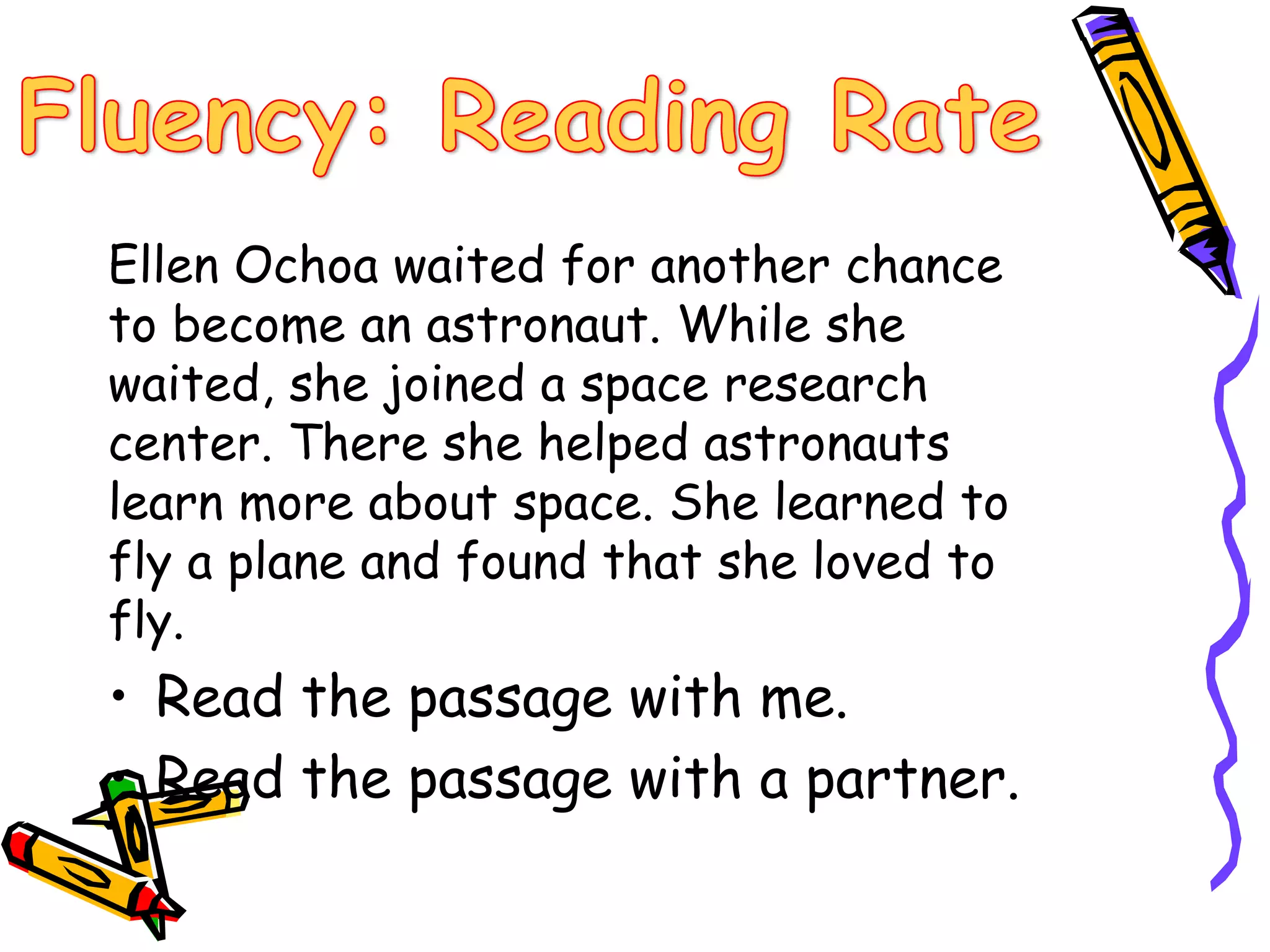
Ellen Ochoa waited for another chance 
to become an astronaut. While she 
waited, she joined a space research 
center. There she helped astronauts 
learn more about space. She learned to 
fly a plane and found that she loved to 
fly. 
• Read the passage with me. 
• Read the passage with a partner.
Locate Information 
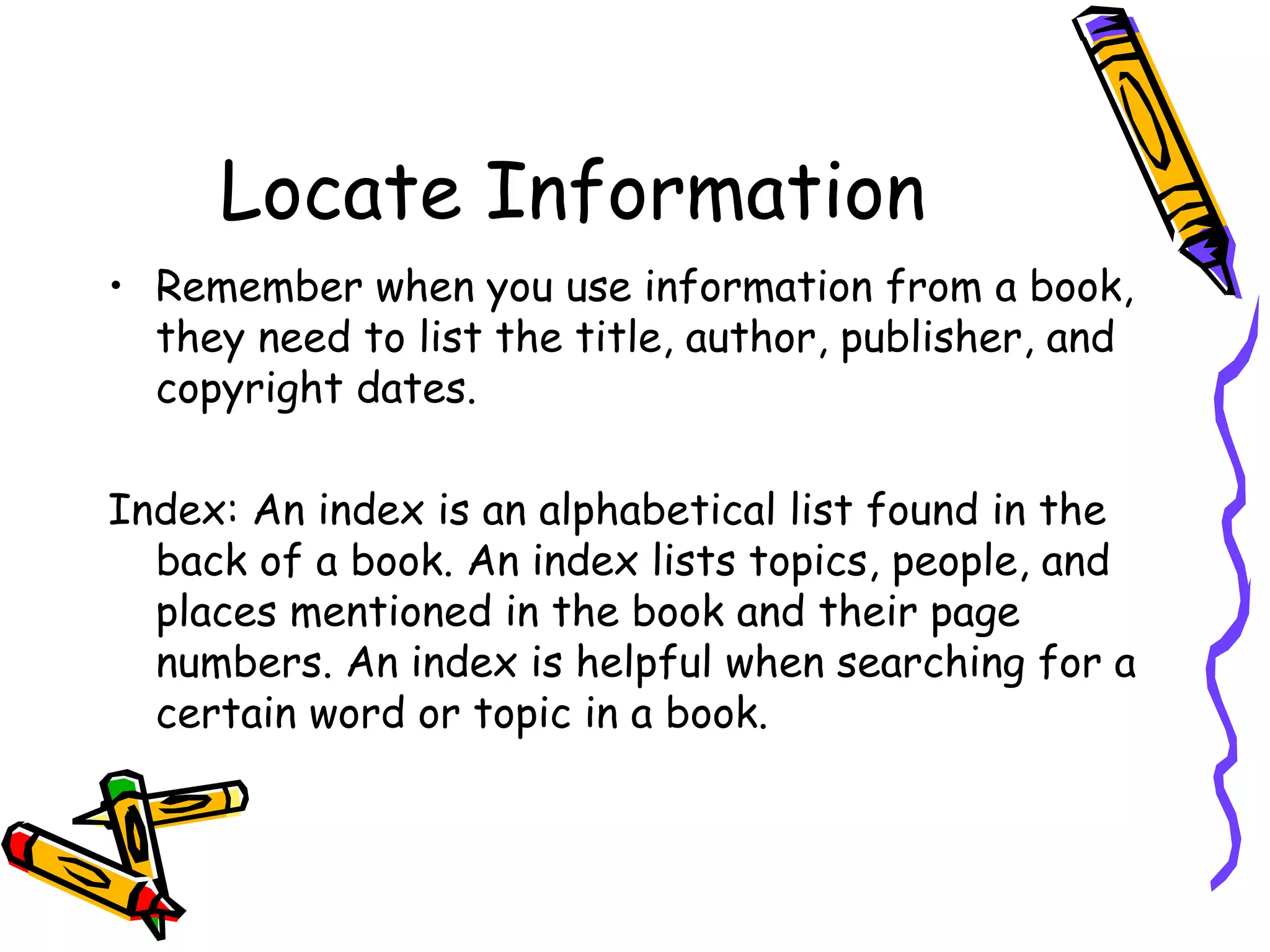
• Remember when you use information from a book, 
they need to list the title, author, publisher, and 
copyright dates. 
Index: An index is an alphabetical list found in the 
back of a book. An index lists topics, people, and 
places mentioned in the book and their page 
numbers. An index is helpful when searching for a 
certain word or topic in a book.
Locate Information 
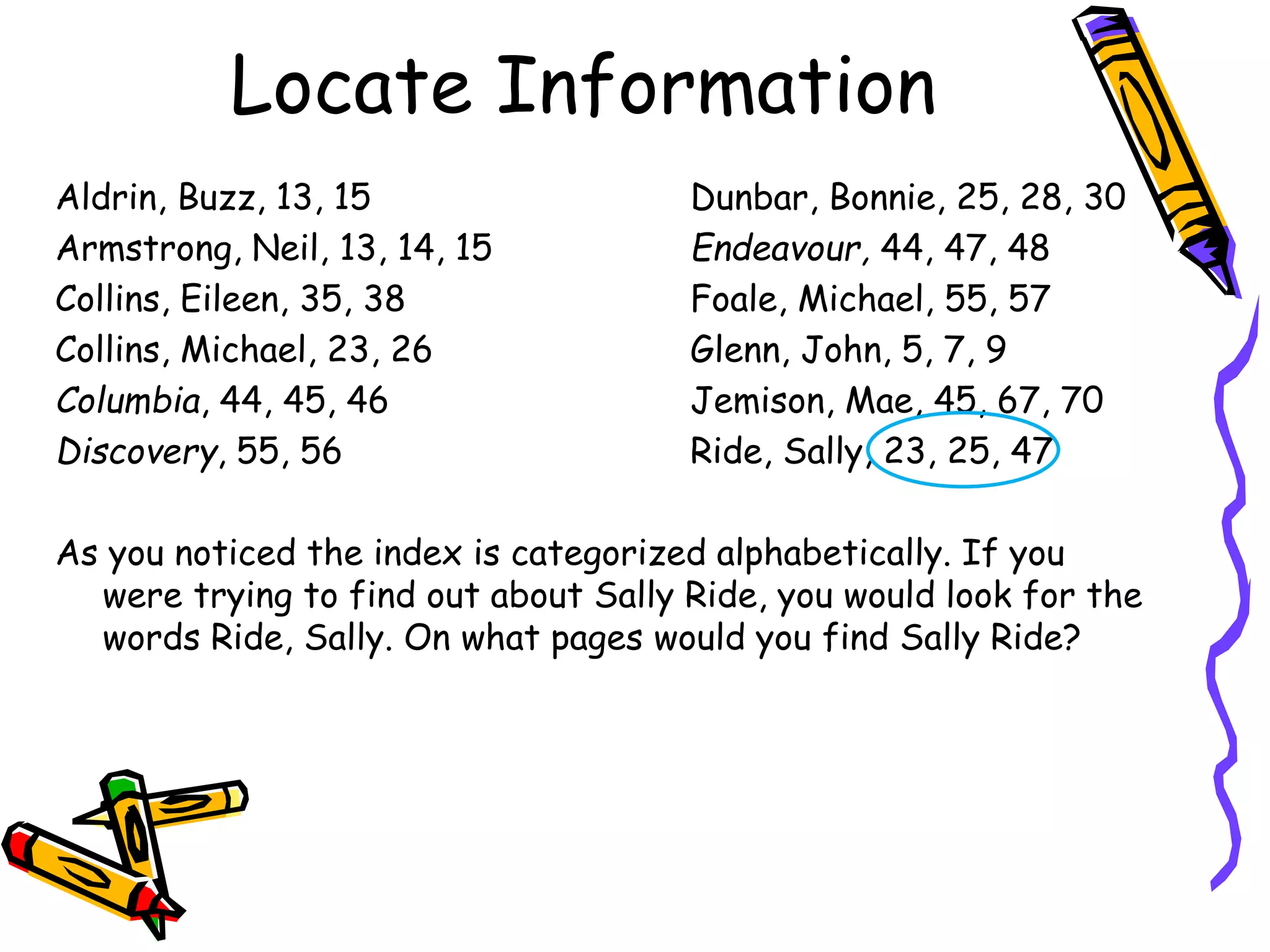
Aldrin, Buzz, 13, 15 Dunbar, Bonnie, 25, 28, 30 
Armstrong, Neil, 13, 14, 15 Endeavour, 44, 47, 48 
Collins, Eileen, 35, 38 Foale, Michael, 55, 57 
Collins, Michael, 23, 26 Glenn, John, 5, 7, 9 
Columbia, 44, 45, 46 Jemison, Mae, 45, 67, 70 
Discovery, 55, 56 Ride, Sally, 23, 25, 47 
As you noticed the index is categorized alphabetically. If you 
were trying to find out about Sally Ride, you would look for the 
words Ride, Sally. On what pages would you find Sally Ride?
Use a Dictionary 
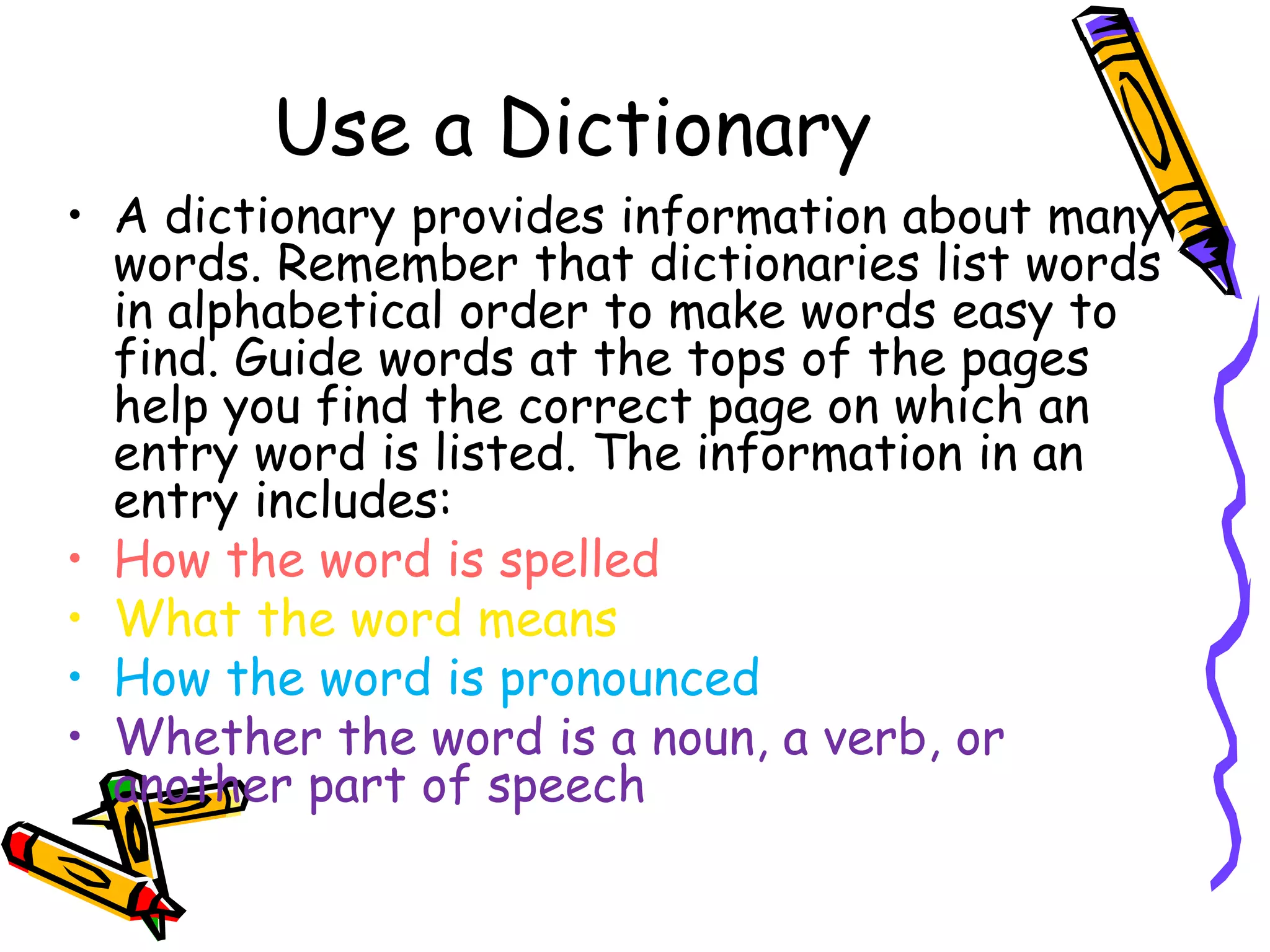
• A dictionary provides information about many 
words. Remember that dictionaries list words 
in alphabetical order to make words easy to 
find. Guide words at the tops of the pages 
help you find the correct page on which an 
entry word is listed. The information in an 
entry includes: 
• How the word is spelled 
• What the word means 
• How the word is pronounced 
• Whether the word is a noun, a verb, or 
another part of speech
Use a Dictionary 
• Doctor (doc ter) Noun .1 a person who treats people when 
they are sick verb 2. to change something, to change how 
something looks. 
• I’m not sure how to say the word or what it means as I read. 
I find the entry word for mound on a page in the dictionary. 
To see how its pronounced, I look at the word in 
parentheses. I say mound. I then notice that mound is a 
noun. I see that it has two meanings numbered 1 and 2. I 
think about how the word is used in the sentence and check 
my idea with the two definitions in the dictionary entry. 
• Mound (maund) Noun 1. a heap of something such as dirt or 
potatoes. 2 the raised area in the middle of a baseball 
diamond, from which the pitcher throws the ball.
What information can be found on a 
title or copyright page? 
• title, author, publisher, publication 
date 
When will you need this information? 
• When you need to cite where you got 
information. 
T341
• The glossary is like a mini-dictionary 
located at the back of many 
nonfiction books. 
• A glossary contains definitions for 
words that are used in that book. 
• As you are reading and come across a 
word you do not know, one place you 
can look for information about the 
word’s meaning is the glossary. 
T341
Use your Reading book to 
look up the following words: 
• persevere 
• Do you have to persevere through a 
hard math problem? 
T341-343
confidence 
• Tell about a moment when you have 
had confidence. 
T341-343
ambitious 
• Raise your hand if you are ambitious. 
T341-343
attain 
• Name a goal you would like to attain. 
T341-343
invention 
disappointed 
• Thumbs up if you think a person who 
created an invention would be 
disappointed in these situations. 
• The invention breaks when it is first 
used. 
• The invention is a hit. 
• The invention does not work. 
T341-343
talented 
apply 
• Why would an employer be glad to 
have a talented person apply for a 
job? 
T341-343
research 
• Raise your hand if what I name is 
something you would have to 
research before you write about it. 
• a biography of an astronaut 
• a newsletter about a trip 
• a story about a prince 
• a report about space 
T341-343
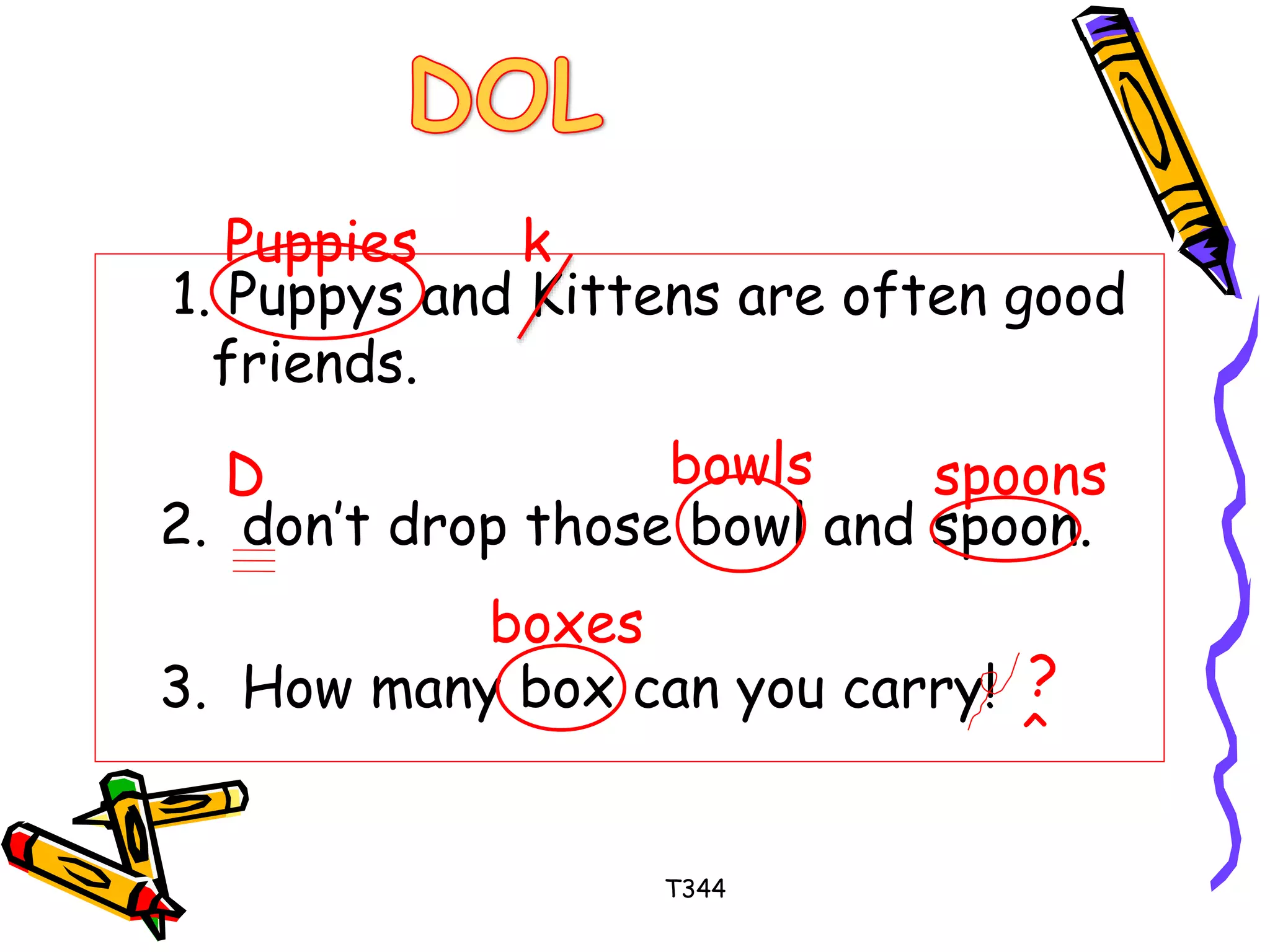
1. Puppys and Kittens are often good 
friends. 
2. don’t drop those bowl and spoon. 
3. How many box can you carry! 
T344 
Puppies k 
D bowls spoons 
boxes 
? 
^
Compound Subjects & 
Predicates 
• The subject is who or what a 
sentence is about. 
• A compound subject has more than 
one subject. 
• For example: 
• Dolphins and whales live in the 
ocean. 
• Dolphins and whales is a compound 
subject.
Compound Subjects & 
Predicates 
• A predicate is what the suject does. 
• A compound predicate has more than 
one verb. 
• For example: 
• The twin girls sang and rode bicycles. 
• sang and rode is the compound 
predicate.
Compound Subjects and 
Predicates 
• Find the compound subject in this sentence. 
• Jeffrey and Anna wash the dishes. 
• Jeffrey and Anna 
• Find the compound predicate in this sentence. 
• Louise sweeps and mops the floor. 
• sweeps and mops the floor. 
• Write 2 sentences about chores. One needs to have a compound 
subject and the other one needs a compound predicate. 
T344
Writing: 
A Biography 
• Is the story of a real person’s life as 
told by another person. 
• Begins when the person is born or is 
very young. 
• Is usually told in time order. 
• Gives dates and place names. 
• Includes facts about what the person 
has done. 
• Uses he or she, his or her. 
T345
Writing: 
A Biography 
• Remember that the organization of a 
biography is very important. 
• Presenting events in the order in 
which they happened and including 
dates or ages guides the reader as he 
or she reads a person’s life story. 
T345

Lesson 4 day 4

  • 1.
  • 2.
    Question of theDay • What is your special talent? • What talent would you most like to have? • Why would you like to have this talent more than any other? T336
  • 3.
    Read Aloud •Why might we want to read the story “Jumping for Joy”? • To learn or enjoy T337
  • 4.
  • 5.
    Read Aloud •What did Kiana wish for? • Why did she wish for summer? t337
  • 6.
    There are threedifferent ways to form plurals. Adding s – dog; dogs Adding es – fox; foxes Changing y to an i and adding es baby; babies T339
  • 7.
    Tell whether eachplural noun was formed by adding s, es, or changing the y to an i and adding es. clocks parties cats foxes dimes spies benches prizes add s change y to i, add es add s add es add s change y to i, add es add es add s T338
  • 8.
    How many syllablesdo you hear? clock clocks party parties T338
  • 9.
    Some nouns adda syllable when they are made plural. place places fox foxes bench benches face faces T338
  • 10.
    ants, toys, flies,things, boxes, games, lines, rocks, wishes, ladies, dishes, babies, bushes, glasses, puppies, families, libraries, brothers, packages, melodies Sort the words into the correct column. Noun + s Noun + es Change y to i •ants •boxes •flies •toys •wishes •ladies •things •dishes •babies •games •bushes •puppies •lines •glasses •families •rocks •libraries •brothers •melodies •packages T338
  • 11.
    Good readers readat a comfortable, steady pace and do not stumble over words. Good readers: • pronounce words clearly • listen to themselves read to check their reading pace. T340
  • 12.
    As I reada passage from “Ellen Ochoa, Astronaut,” I am going to read at an even speed so that I do not stumble when I get to a harder word. I am going to listen to myself read to hear if I am getting slower or speeding up when I should not be. Turn to page 124-125. Turn and read page 124 with your partner. »Listen as I read. T340
  • 13.
    Ellen Ochoa waitedfor another chance to become an astronaut. While she waited, she joined a space research center. There she helped astronauts learn more about space. She learned to fly a plane and found that she loved to fly. • Read the passage with me. • Read the passage with a partner.
  • 14.
    Locate Information •Remember when you use information from a book, they need to list the title, author, publisher, and copyright dates. Index: An index is an alphabetical list found in the back of a book. An index lists topics, people, and places mentioned in the book and their page numbers. An index is helpful when searching for a certain word or topic in a book.
  • 15.
    Locate Information Aldrin,Buzz, 13, 15 Dunbar, Bonnie, 25, 28, 30 Armstrong, Neil, 13, 14, 15 Endeavour, 44, 47, 48 Collins, Eileen, 35, 38 Foale, Michael, 55, 57 Collins, Michael, 23, 26 Glenn, John, 5, 7, 9 Columbia, 44, 45, 46 Jemison, Mae, 45, 67, 70 Discovery, 55, 56 Ride, Sally, 23, 25, 47 As you noticed the index is categorized alphabetically. If you were trying to find out about Sally Ride, you would look for the words Ride, Sally. On what pages would you find Sally Ride?
  • 16.
    Use a Dictionary • A dictionary provides information about many words. Remember that dictionaries list words in alphabetical order to make words easy to find. Guide words at the tops of the pages help you find the correct page on which an entry word is listed. The information in an entry includes: • How the word is spelled • What the word means • How the word is pronounced • Whether the word is a noun, a verb, or another part of speech
  • 17.
    Use a Dictionary • Doctor (doc ter) Noun .1 a person who treats people when they are sick verb 2. to change something, to change how something looks. • I’m not sure how to say the word or what it means as I read. I find the entry word for mound on a page in the dictionary. To see how its pronounced, I look at the word in parentheses. I say mound. I then notice that mound is a noun. I see that it has two meanings numbered 1 and 2. I think about how the word is used in the sentence and check my idea with the two definitions in the dictionary entry. • Mound (maund) Noun 1. a heap of something such as dirt or potatoes. 2 the raised area in the middle of a baseball diamond, from which the pitcher throws the ball.
  • 18.
    What information canbe found on a title or copyright page? • title, author, publisher, publication date When will you need this information? • When you need to cite where you got information. T341
  • 19.
    • The glossaryis like a mini-dictionary located at the back of many nonfiction books. • A glossary contains definitions for words that are used in that book. • As you are reading and come across a word you do not know, one place you can look for information about the word’s meaning is the glossary. T341
  • 20.
    Use your Readingbook to look up the following words: • persevere • Do you have to persevere through a hard math problem? T341-343
  • 21.
    confidence • Tellabout a moment when you have had confidence. T341-343
  • 22.
    ambitious • Raiseyour hand if you are ambitious. T341-343
  • 23.
    attain • Namea goal you would like to attain. T341-343
  • 24.
    invention disappointed •Thumbs up if you think a person who created an invention would be disappointed in these situations. • The invention breaks when it is first used. • The invention is a hit. • The invention does not work. T341-343
  • 25.
    talented apply •Why would an employer be glad to have a talented person apply for a job? T341-343
  • 26.
    research • Raiseyour hand if what I name is something you would have to research before you write about it. • a biography of an astronaut • a newsletter about a trip • a story about a prince • a report about space T341-343
  • 27.
    1. Puppys andKittens are often good friends. 2. don’t drop those bowl and spoon. 3. How many box can you carry! T344 Puppies k D bowls spoons boxes ? ^
  • 28.
    Compound Subjects & Predicates • The subject is who or what a sentence is about. • A compound subject has more than one subject. • For example: • Dolphins and whales live in the ocean. • Dolphins and whales is a compound subject.
  • 29.
    Compound Subjects & Predicates • A predicate is what the suject does. • A compound predicate has more than one verb. • For example: • The twin girls sang and rode bicycles. • sang and rode is the compound predicate.
  • 30.
    Compound Subjects and Predicates • Find the compound subject in this sentence. • Jeffrey and Anna wash the dishes. • Jeffrey and Anna • Find the compound predicate in this sentence. • Louise sweeps and mops the floor. • sweeps and mops the floor. • Write 2 sentences about chores. One needs to have a compound subject and the other one needs a compound predicate. T344
  • 31.
    Writing: A Biography • Is the story of a real person’s life as told by another person. • Begins when the person is born or is very young. • Is usually told in time order. • Gives dates and place names. • Includes facts about what the person has done. • Uses he or she, his or her. T345
  • 32.
    Writing: A Biography • Remember that the organization of a biography is very important. • Presenting events in the order in which they happened and including dates or ages guides the reader as he or she reads a person’s life story. T345