Writing for Academic PublicationHelen Fallon NUI Maynooth [2010]
Presentation OverviewSection 1: Getting Started (Writing to prompt, writing to a word limit, brainstorming/clustering/mapping
Section 2: Defining audience and purpose, outlining
Section 3: Identifying publishing outlet, writing a query e-mail
Section 4: Elements of an article
Section 5: Writing the article – structure, style and storytelling
Section 6: Submission
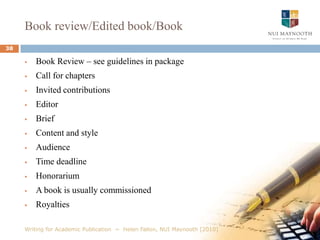
Section 6: Books, book chapters, conferences etc
Section 7: Your Writing Plan2Writing for Academic Publication  ~  Helen Fallon, NUI Maynooth [2010]
TASK 1 - Getting StartedWrite for five minutes, in sentences, without stopping, using one of the following prompts
I am interested in writing about…
An area of my experience which I would like to write about is…
A really interesting project that I think people would be interested in reading about is…
I feel at my most creative when I’m writing about…Murray, R. (2005) Writing for Academic Journals.  Maidenhead: Open University Press (see section on writing to prompt)3Writing for Academic Publication  ~  Helen Fallon, NUI Maynooth [2010]
TASK 2 - Writing to a time and word limit4Write for five minutes in sentences, in no more than fifty words, explaining to your department head why is it important for your unit/college that your research is made public)Writing for Academic Publication  ~  Helen Fallon, NUI Maynooth [2010]
On WritingIf you’re clear in your mind about what you are going to paint, there is no point in painting it (Picasso)I have to start to write to have ideas (Françoise Sagan)Writing is a process of discovery. Sometimes you don't know what you know. You may know it but have no idea how it fits together (Alice Walker)Maimon, Elaine P.(2007)  A Writer’s Resource: A Handbook for Writing and Research.  2nd ed. Boston: McGraw-Hill (see section on clustering)5Writing for Academic Publication  ~  Helen Fallon, NUI Maynooth [2010]
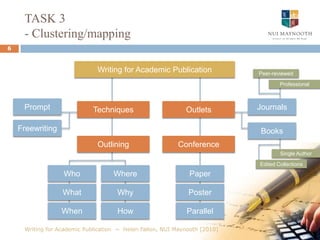
TASK 3 - Clustering/mapping6Writing for Academic PublicationPeer-reviewedProfessionalPromptJournalsTechniquesOutletsFreewritingBooksOutliningConferenceSingle AuthorEdited CollectionsPaperWhoWherePosterWhatWhy ParallelWhenHowWriting for Academic Publication  ~  Helen Fallon, NUI Maynooth [2010]
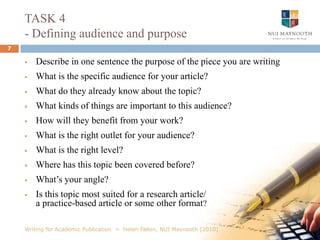
TASK 4 - Defining audience and purposeDescribe in one sentence the purpose of the piece you are writing
What is the specific audience for your article?
What do they already know about the topic?
What kinds of things are important to this audience?
How will they benefit from your work?
What is the right outlet for your audience?
What is the right level?
Where has this topic been covered before?
What’s your angle?
Is this topic most suited for a research article/a practice-based article or some other format?7Writing for Academic Publication  ~  Helen Fallon, NUI Maynooth [2010]
OutliningOrder ideas
Sift & eliminate ideas
Contextualise/Give framework
View structure at a glanceThe reason many aspiring authors fail is that they throw themselves immediately into the activity of writing without realizing it is the forethought, analysis and preparation that determine the quality of the finished product 	Day, A. (2007) How to Get Research Published in Journals. Burlington, VT.: Ashgate. P. 9	what, who, when, where, why, how8Writing for Academic Publication  ~  Helen Fallon, NUI Maynooth [2010]
OutliningMurray, R. (2005) Writing for Academic Journals. Maidenhead: McGraw-Hill/Open University Press, p. 99Writing for Academic Publication  ~  Helen Fallon, NUI Maynooth [2010]
Brown’s 8 questions for writing a research articleWho are the intended readers?
What did you do? (limit 50 words)
Why did you do it? (limit 50 words)
What happened? (limit 50 words)
What do the results mean in theory?(limit 50 words)
What do the results mean in practice? (limit 50 words)
What is the key benefit for readers? (limit 25 words)

Writing for Academic Publication

  • 1.
    Writing for AcademicPublicationHelen Fallon NUI Maynooth [2010]
  • 2.
    Presentation OverviewSection 1:Getting Started (Writing to prompt, writing to a word limit, brainstorming/clustering/mapping
  • 3.
    Section 2: Definingaudience and purpose, outlining
  • 4.
    Section 3: Identifyingpublishing outlet, writing a query e-mail
  • 5.
    Section 4: Elementsof an article
  • 6.
    Section 5: Writingthe article – structure, style and storytelling
  • 7.
  • 8.
    Section 6: Books,book chapters, conferences etc
  • 9.
    Section 7: YourWriting Plan2Writing for Academic Publication ~ Helen Fallon, NUI Maynooth [2010]
  • 10.
    TASK 1 -Getting StartedWrite for five minutes, in sentences, without stopping, using one of the following prompts
  • 11.
    I am interestedin writing about…
  • 12.
    An area ofmy experience which I would like to write about is…
  • 13.
    A really interestingproject that I think people would be interested in reading about is…
  • 14.
    I feel atmy most creative when I’m writing about…Murray, R. (2005) Writing for Academic Journals. Maidenhead: Open University Press (see section on writing to prompt)3Writing for Academic Publication ~ Helen Fallon, NUI Maynooth [2010]
  • 15.
    TASK 2 -Writing to a time and word limit4Write for five minutes in sentences, in no more than fifty words, explaining to your department head why is it important for your unit/college that your research is made public)Writing for Academic Publication ~ Helen Fallon, NUI Maynooth [2010]
  • 16.
    On WritingIf you’reclear in your mind about what you are going to paint, there is no point in painting it (Picasso)I have to start to write to have ideas (Françoise Sagan)Writing is a process of discovery. Sometimes you don't know what you know. You may know it but have no idea how it fits together (Alice Walker)Maimon, Elaine P.(2007) A Writer’s Resource: A Handbook for Writing and Research. 2nd ed. Boston: McGraw-Hill (see section on clustering)5Writing for Academic Publication ~ Helen Fallon, NUI Maynooth [2010]
  • 17.
    TASK 3 -Clustering/mapping6Writing for Academic PublicationPeer-reviewedProfessionalPromptJournalsTechniquesOutletsFreewritingBooksOutliningConferenceSingle AuthorEdited CollectionsPaperWhoWherePosterWhatWhy ParallelWhenHowWriting for Academic Publication ~ Helen Fallon, NUI Maynooth [2010]
  • 18.
    TASK 4 -Defining audience and purposeDescribe in one sentence the purpose of the piece you are writing
  • 19.
    What is thespecific audience for your article?
  • 20.
    What do theyalready know about the topic?
  • 21.
    What kinds ofthings are important to this audience?
  • 22.
    How will theybenefit from your work?
  • 23.
    What is theright outlet for your audience?
  • 24.
    What is theright level?
  • 25.
    Where has thistopic been covered before?
  • 26.
  • 27.
    Is this topicmost suited for a research article/a practice-based article or some other format?7Writing for Academic Publication ~ Helen Fallon, NUI Maynooth [2010]
  • 28.
  • 29.
  • 30.
  • 31.
    View structure ata glanceThe reason many aspiring authors fail is that they throw themselves immediately into the activity of writing without realizing it is the forethought, analysis and preparation that determine the quality of the finished product Day, A. (2007) How to Get Research Published in Journals. Burlington, VT.: Ashgate. P. 9 what, who, when, where, why, how8Writing for Academic Publication ~ Helen Fallon, NUI Maynooth [2010]
  • 32.
    OutliningMurray, R. (2005)Writing for Academic Journals. Maidenhead: McGraw-Hill/Open University Press, p. 99Writing for Academic Publication ~ Helen Fallon, NUI Maynooth [2010]
  • 33.
    Brown’s 8 questionsfor writing a research articleWho are the intended readers?
  • 34.
    What did youdo? (limit 50 words)
  • 35.
    Why did youdo it? (limit 50 words)
  • 36.
  • 37.
    What do theresults mean in theory?(limit 50 words)
  • 38.
    What do theresults mean in practice? (limit 50 words)
  • 39.
    What is thekey benefit for readers? (limit 25 words)

Editor's Notes

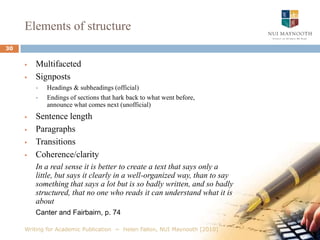
  • #30 Read – learn a lot from looking closely at what works for others. Could model articles on other articles that work well. The kinds of stories that you want to tell about your work will have similarities in form, if not in content, to others that are already in print. Learn to analyse articles that you consider to be clear and well written, working out how it is constructed, and what it is about its structure that is helpful in conveying its meaning. Can use structure from another article as a template. (basic underlying structure/won’t be an exact match) - storyboard conceptNumber of different structures that could achieve the same ends in different ways.The structure of a thesis or conference paper will not be the same as the structure for a journal articleIn planning structure need to considerThe needs of your audience. Be aware that they do not know what you want to tell them; that is why you are writing, and why they are reading what you have written.Sometimes writers are so close to their subject matter that they write as if they expect their readers are already familiar with their ideas.
  • #31 Headings & subheadings break up text and make a manuscript visually more attractive. They allow the reader to see at a glance the themes and structure of the paper. It is helpful to have at least one heading per page, however the best guide is your target journalSentence Length – writing in short sentences is easier. Gradually, as you become more confident, you could develop a more flowing style – using a range of sentence length and punctuation.Punctuation and paragraphingButcher (2002)Have at least three sentences and be no longer than a page (generally)New paragraph should indication a chance of direction in your thinking, or a new idea. Ideally, new paragraphs begin each time you move from one clear idea to another. Each paragraph should have one major theme or idea. The first sentence usually carries the idea in any paragraph. Paragraphs should have a logical sequence, each new one advancing ideas in previous paragraphs. .