ACADEMIC HONESTY
Citation?
237d May, 2016
Zakir Hossain
Teacher-Librarian
PLAGIARISM AND
CITATION BASICS
A QUICK GUIDE ON HOW TO PROPERLY
RESEARCH…without getting in trouble!

PLAGIARISM?
 To plagiarize means “to commit literary
theft.”
 “To present as new and original an idea or
product derived from an existing source.”
 You must give credit to the “owner” of
the information that you use in your
paper, otherwise you are STEALING!
PLAGIARISM…Exceptions!
 Certain well-known facts do not need
to be cited.
◦ Ex: Walt Disney founded the Disney
company and created one of the most
well-known cartoon characters of all time,
Mickey Mouse. (NOT PLAGIARISM)
◦ Ex: Raised on a farm near Marceline,
Missouri, Walt became interested in
drawing at an early age, selling his first
sketches to neighbors when he was only
seven years old. (PLAGIARISM—IF NOT
CITED)
Why cite?
 Proper citation is a key element in academic scholarship and
intellectual exchange. When we cite we:
 show respect for the work of others
 help a reader to distinguish our work from the work of others
who have contributed to our work
 give the reader the opportunity to check the validity of our use
of other people’s work
 give the reader the opportunity to follow up our references,
out of interest
 show and receive proper credit for our research process
 demonstrate that we are able to use reliable sources and
critically assess them to support our work
 establish the credibility and authority of our knowledge and
ideas
 demonstrate that we are able to draw our own conclusions
 share the blame (if we get it wrong).
WHEN DO I NEED TO CITE?
 Whenever you borrow words or ideas:
 whenever you use quotes
 whenever you paraphrase
 whenever you use an idea that someone
else has already expressed
 whenever you make specific reference to
the work of another
 whenever someone else's work has been
critical in developing your own ideas.
 In order to prevent plagiarism, we must
cite sources we use..
• Ideally, no more than 25 percent of
your paper should be direct quotations..
• Paraphrase as much as you can..
• Use direct quotations when citing a
statistic or original theory..
• Use author's words if they capture a
point exactly..
YOU SHOULD KNOW ……
MLA Citation Style
 In-text or Parenthetical Citations
 Bibliographical references/ Cited works/
References (The first word of your citation
match the corresponding entry on your Works
Cited page!)
In-Text or Parenthetical Citations
…a system in which you give your source
in parentheses immediately after you
give the information.
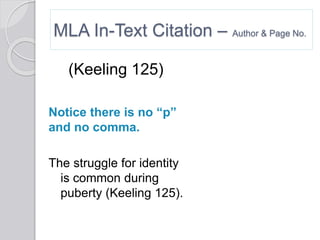
MLA In-Text Citation – Author & Page No.
(Keeling 125)
Notice there is no “p”
and no comma.
The struggle for identity
is common during
puberty (Keeling 125).
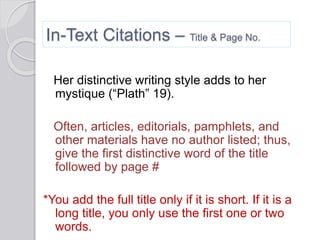
In-Text Citations – Title & Page No.
Her distinctive writing style adds to her
mystique (“Plath” 19).
Often, articles, editorials, pamphlets, and
other materials have no author listed; thus,
give the first distinctive word of the title
followed by page #
*You add the full title only if it is short. If it is a
long title, you only use the first one or two
words.
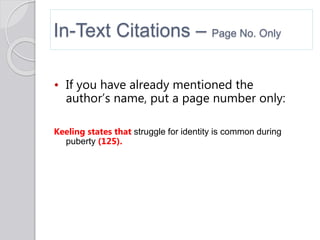
In-Text Citations – Page No. Only
• If you have already mentioned the
author’s name, put a page number only:
Keeling states that struggle for identity is common during
puberty (125).
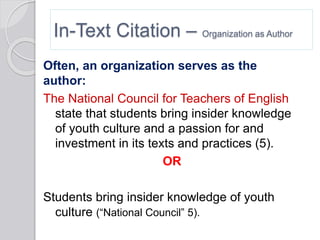
In-Text Citation – Organization as Author
Often, an organization serves as the
author:
The National Council for Teachers of English
state that students bring insider knowledge
of youth culture and a passion for and
investment in its texts and practices (5).
OR
Students bring insider knowledge of youth
culture (“National Council” 5).
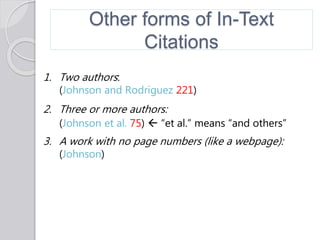
Other forms of In-Text
Citations
1. Two authors:
(Johnson and Rodriguez 221)
2. Three or more authors:
(Johnson et al. 75)  “et al.” means “and others”
3. A work with no page numbers (like a webpage):
(Johnson)
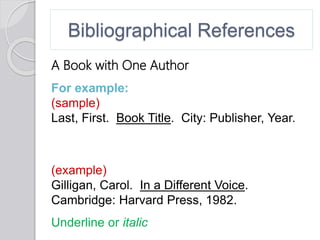
Bibliographical References
A Book with One Author
For example:
(sample)
Last, First. Book Title. City: Publisher, Year.
(example)
Gilligan, Carol. In a Different Voice.
Cambridge: Harvard Press, 1982.
Underline or italic
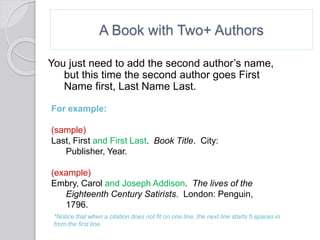
A Book with Two+ Authors
You just need to add the second author’s name,
but this time the second author goes First
Name first, Last Name Last.
For example:
(sample)
Last, First and First Last. Book Title. City:
Publisher, Year.
(example)
Embry, Carol and Joseph Addison. The lives of the
Eighteenth Century Satirists. London: Penguin,
1796.
*Notice that when a citation does not fit on one line, the next line starts 5 spaces in
from the first line.
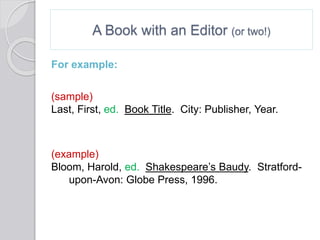
A Book with an Editor (or two!)
For example:
(sample)
Last, First, ed. Book Title. City: Publisher, Year.
(example)
Bloom, Harold, ed. Shakespeare’s Baudy. Stratford-
upon-Avon: Globe Press, 1996.
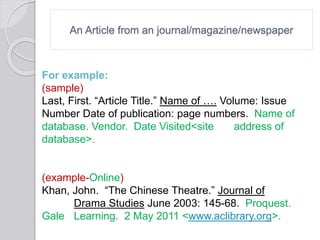
An Article from an journal/magazine/newspaper
For example:
(sample)
Last, First. “Article Title.” Name of …. Volume: Issue
Number Date of publication: page numbers. Name of
database. Vendor. Date Visited<site address of
database>.
(example-Online)
Khan, John. “The Chinese Theatre.” Journal of
Drama Studies June 2003: 145-68. Proquest.
Gale Learning. 2 May 2011 <www.aclibrary.org>.
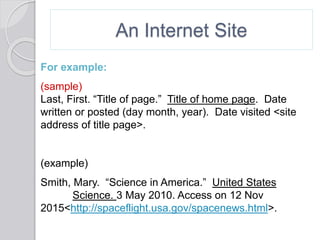
An Internet Site
For example:
(sample)
Last, First. “Title of page.” Title of home page. Date
written or posted (day month, year). Date visited <site
address of title page>.
(example)
Smith, Mary. “Science in America.” United States
Science. 3 May 2010. Access on 12 Nov
2015<http://spaceflight.usa.gov/spacenews.html>.
Now for some practice!
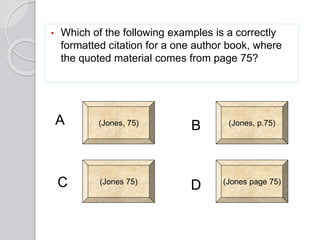
• Which of the following examples is a correctly
formatted citation for a one author book, where
the quoted material comes from page 75?
(Jones, 75) (Jones, p.75)
(Jones page 75)(Jones 75)
A
C
B
D
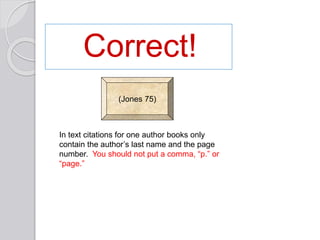
Correct!
(Jones 75)
In text citations for one author books only
contain the author’s last name and the page
number. You should not put a comma, “p.” or
“page.”
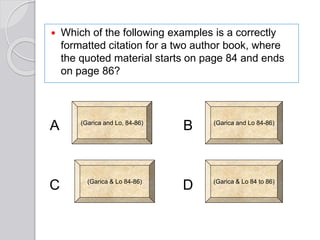
 Which of the following examples is a correctly
formatted citation for a two author book, where
the quoted material starts on page 84 and ends
on page 86?
(Garica and Lo, 84-86) (Garica and Lo 84-86)
(Garica & Lo 84 to 86)(Garica & Lo 84-86)
D
B
C
A
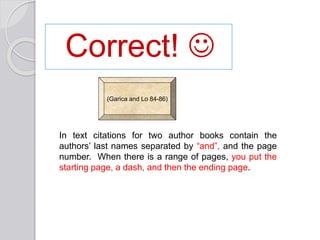
Correct! 
In text citations for two author books contain the
authors’ last names separated by “and”, and the page
number. When there is a range of pages, you put the
starting page, a dash, and then the ending page.
(Garica and Lo 84-86)
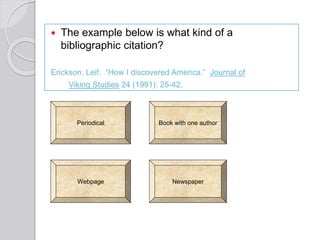
 The example below is what kind of a
bibliographic citation?
Erickson, Leif. “How I discovered America.” Journal of
Viking Studies 24 (1991): 25-42.
Periodical Book with one author
NewspaperWebpage
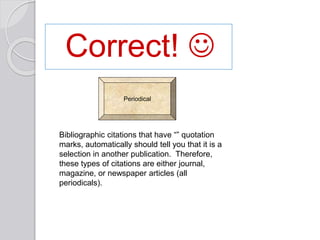
Correct! 
Bibliographic citations that have “” quotation
marks, automatically should tell you that it is a
selection in another publication. Therefore,
these types of citations are either journal,
magazine, or newspaper articles (all
periodicals).
Periodical
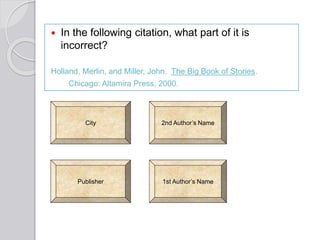
 In the following citation, what part of it is
incorrect?
Holland, Merlin, and Miller, John. The Big Book of Stories.
Chicago: Altamira Press, 2000.
City 2nd Author’s Name
1st Author’s NamePublisher
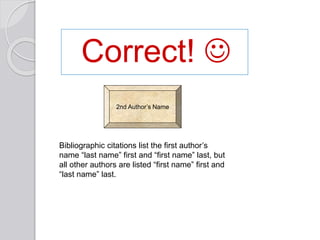
Correct! 
Bibliographic citations list the first author’s
name “last name” first and “first name” last, but
all other authors are listed “first name” first and
“last name” last.
2nd Author’s Name
BEWARE OF CERTAIN
SITES!
 You should know by now that
WIKIPEDIA and .com sites are unreliable
sources.
 Watch…
 See what I mean?
 Stick to .edu, .org, or .gov sites, which
come from reliable educational
institutions, organizations, or the
government.
What you learned today
In this lesson you learned:
1. about plagiarism,
2. the importance of citation styles,
3. and how to use MLA citation style.
Good Luck building your research
paper. Use your LRC—we can
help you be Successful!
Cited works
 “Plagiarism and Citation Basic”. Aceess on 2 Nov
2015
http://www.slideshare.net/caitlingillmett/plagiarism-
and-citation-basics
 “Trinity College Library”. MLA Citation. Access on
11 Oct 2015
http://www.slideshare.net/caitlingillmett/plagiarism-
and-citation-basics

Citation Lesson for Middle and High School Teacher-Librarians

  • 1.
    ACADEMIC HONESTY Citation? 237d May,2016 Zakir Hossain Teacher-Librarian
  • 2.
    PLAGIARISM AND CITATION BASICS AQUICK GUIDE ON HOW TO PROPERLY RESEARCH…without getting in trouble! 
  • 3.
    PLAGIARISM?  To plagiarizemeans “to commit literary theft.”  “To present as new and original an idea or product derived from an existing source.”  You must give credit to the “owner” of the information that you use in your paper, otherwise you are STEALING!
  • 4.
    PLAGIARISM…Exceptions!  Certain well-knownfacts do not need to be cited. ◦ Ex: Walt Disney founded the Disney company and created one of the most well-known cartoon characters of all time, Mickey Mouse. (NOT PLAGIARISM) ◦ Ex: Raised on a farm near Marceline, Missouri, Walt became interested in drawing at an early age, selling his first sketches to neighbors when he was only seven years old. (PLAGIARISM—IF NOT CITED)
  • 5.
    Why cite?  Propercitation is a key element in academic scholarship and intellectual exchange. When we cite we:  show respect for the work of others  help a reader to distinguish our work from the work of others who have contributed to our work  give the reader the opportunity to check the validity of our use of other people’s work  give the reader the opportunity to follow up our references, out of interest  show and receive proper credit for our research process  demonstrate that we are able to use reliable sources and critically assess them to support our work  establish the credibility and authority of our knowledge and ideas  demonstrate that we are able to draw our own conclusions  share the blame (if we get it wrong).
  • 6.
    WHEN DO INEED TO CITE?  Whenever you borrow words or ideas:  whenever you use quotes  whenever you paraphrase  whenever you use an idea that someone else has already expressed  whenever you make specific reference to the work of another  whenever someone else's work has been critical in developing your own ideas.
  • 7.
     In orderto prevent plagiarism, we must cite sources we use.. • Ideally, no more than 25 percent of your paper should be direct quotations.. • Paraphrase as much as you can.. • Use direct quotations when citing a statistic or original theory.. • Use author's words if they capture a point exactly.. YOU SHOULD KNOW ……
  • 8.
    MLA Citation Style In-text or Parenthetical Citations  Bibliographical references/ Cited works/ References (The first word of your citation match the corresponding entry on your Works Cited page!)
  • 9.
    In-Text or ParentheticalCitations …a system in which you give your source in parentheses immediately after you give the information.
  • 10.
    MLA In-Text Citation– Author & Page No. (Keeling 125) Notice there is no “p” and no comma. The struggle for identity is common during puberty (Keeling 125).
  • 11.
    In-Text Citations –Title & Page No. Her distinctive writing style adds to her mystique (“Plath” 19). Often, articles, editorials, pamphlets, and other materials have no author listed; thus, give the first distinctive word of the title followed by page # *You add the full title only if it is short. If it is a long title, you only use the first one or two words.
  • 12.
    In-Text Citations –Page No. Only • If you have already mentioned the author’s name, put a page number only: Keeling states that struggle for identity is common during puberty (125).
  • 13.
    In-Text Citation –Organization as Author Often, an organization serves as the author: The National Council for Teachers of English state that students bring insider knowledge of youth culture and a passion for and investment in its texts and practices (5). OR Students bring insider knowledge of youth culture (“National Council” 5).
  • 14.
    Other forms ofIn-Text Citations 1. Two authors: (Johnson and Rodriguez 221) 2. Three or more authors: (Johnson et al. 75)  “et al.” means “and others” 3. A work with no page numbers (like a webpage): (Johnson)
  • 15.
    Bibliographical References A Bookwith One Author For example: (sample) Last, First. Book Title. City: Publisher, Year. (example) Gilligan, Carol. In a Different Voice. Cambridge: Harvard Press, 1982. Underline or italic
  • 16.
    A Book withTwo+ Authors You just need to add the second author’s name, but this time the second author goes First Name first, Last Name Last. For example: (sample) Last, First and First Last. Book Title. City: Publisher, Year. (example) Embry, Carol and Joseph Addison. The lives of the Eighteenth Century Satirists. London: Penguin, 1796. *Notice that when a citation does not fit on one line, the next line starts 5 spaces in from the first line.
  • 17.
    A Book withan Editor (or two!) For example: (sample) Last, First, ed. Book Title. City: Publisher, Year. (example) Bloom, Harold, ed. Shakespeare’s Baudy. Stratford- upon-Avon: Globe Press, 1996.
  • 18.
    An Article froman journal/magazine/newspaper For example: (sample) Last, First. “Article Title.” Name of …. Volume: Issue Number Date of publication: page numbers. Name of database. Vendor. Date Visited<site address of database>. (example-Online) Khan, John. “The Chinese Theatre.” Journal of Drama Studies June 2003: 145-68. Proquest. Gale Learning. 2 May 2011 <www.aclibrary.org>.
  • 19.
    An Internet Site Forexample: (sample) Last, First. “Title of page.” Title of home page. Date written or posted (day month, year). Date visited <site address of title page>. (example) Smith, Mary. “Science in America.” United States Science. 3 May 2010. Access on 12 Nov 2015<http://spaceflight.usa.gov/spacenews.html>.
  • 20.
    Now for somepractice!
  • 21.
    • Which ofthe following examples is a correctly formatted citation for a one author book, where the quoted material comes from page 75? (Jones, 75) (Jones, p.75) (Jones page 75)(Jones 75) A C B D
  • 22.
    Correct! (Jones 75) In textcitations for one author books only contain the author’s last name and the page number. You should not put a comma, “p.” or “page.”
  • 23.
     Which ofthe following examples is a correctly formatted citation for a two author book, where the quoted material starts on page 84 and ends on page 86? (Garica and Lo, 84-86) (Garica and Lo 84-86) (Garica & Lo 84 to 86)(Garica & Lo 84-86) D B C A
  • 24.
    Correct!  In textcitations for two author books contain the authors’ last names separated by “and”, and the page number. When there is a range of pages, you put the starting page, a dash, and then the ending page. (Garica and Lo 84-86)
  • 25.
     The examplebelow is what kind of a bibliographic citation? Erickson, Leif. “How I discovered America.” Journal of Viking Studies 24 (1991): 25-42. Periodical Book with one author NewspaperWebpage
  • 26.
    Correct!  Bibliographic citationsthat have “” quotation marks, automatically should tell you that it is a selection in another publication. Therefore, these types of citations are either journal, magazine, or newspaper articles (all periodicals). Periodical
  • 27.
     In thefollowing citation, what part of it is incorrect? Holland, Merlin, and Miller, John. The Big Book of Stories. Chicago: Altamira Press, 2000. City 2nd Author’s Name 1st Author’s NamePublisher
  • 28.
    Correct!  Bibliographic citationslist the first author’s name “last name” first and “first name” last, but all other authors are listed “first name” first and “last name” last. 2nd Author’s Name
  • 29.
    BEWARE OF CERTAIN SITES! You should know by now that WIKIPEDIA and .com sites are unreliable sources.  Watch…  See what I mean?  Stick to .edu, .org, or .gov sites, which come from reliable educational institutions, organizations, or the government.
  • 30.
    What you learnedtoday In this lesson you learned: 1. about plagiarism, 2. the importance of citation styles, 3. and how to use MLA citation style. Good Luck building your research paper. Use your LRC—we can help you be Successful!
  • 31.
    Cited works  “Plagiarismand Citation Basic”. Aceess on 2 Nov 2015 http://www.slideshare.net/caitlingillmett/plagiarism- and-citation-basics  “Trinity College Library”. MLA Citation. Access on 11 Oct 2015 http://www.slideshare.net/caitlingillmett/plagiarism- and-citation-basics