Academic Writing
What do you want your writing to say about you?
Transportation and Logistics
Student Orientation
Tom Jirik
Communication Coordinator
8/27/2015
“It’s as interesting and as difficult to
say a thing well as to paint it. There is
the art of lines and colours, but the
art of words exists too, and will never
be less important.”
-- Vincent van Gogh
Post-Impressionist Dutch painter
“The difference between the right
word and the almost right word is the
difference between lightning and the
lightning bug.”
-- Mark Twain
American author
and humorist
“Writing – the art of applying the seat
of the pants to the seat of the chair.”
--Mary Heaton Vorse
American journalist,
labor activist, and novelist
What’s the Point?
• Communicating clearly
• Communicating effectively
• Communicating professionally
 Reflects on your as a professional
 Reflects on your research
 Helps you to advance your ideas
 Is critical to collaboration
Why good writing is important
Know
Your
Audience
Put tools in your toolbox
• Style guides
• Dictionaries
• Thesaurus
• Books on writing
• Another set of eyes
• Learn your
weaknesses
• Tips and tricks
Style
More than being a snappy
dresser
Style guide/style manual
• A set of standards for the writing and
design of documents, either for general
use or for a specific publication,
organization or field.
• The implementation of a style guide
provides uniformity in style and
formatting of a document.
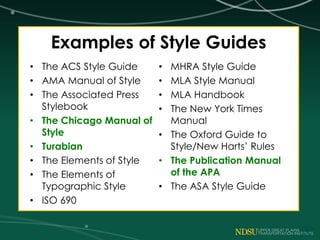
Examples of Style Guides
• The ACS Style Guide
• AMA Manual of Style
• The Associated Press
Stylebook
• The Chicago Manual of
Style
• Turabian
• The Elements of Style
• The Elements of
Typographic Style
• ISO 690
• MHRA Style Guide
• MLA Style Manual
• MLA Handbook
• The New York Times
Manual
• The Oxford Guide to
Style/New Harts’ Rules
• The Publication Manual
of the APA
• The ASA Style Guide
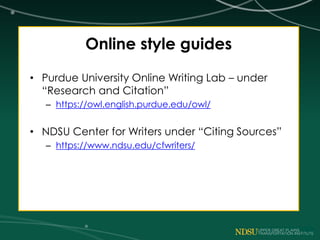
Online style guides
• Purdue University Online Writing Lab – under
“Research and Citation”
– https://owl.english.purdue.edu/owl/
• NDSU Center for Writers under “Citing Sources”
– https://www.ndsu.edu/cfwriters/
Online Guides
• University writing programs
• Professional organizations
• Publishing companies/organizations
Be careful
Is it complete?
Is it up to date?
Does it apply to you?
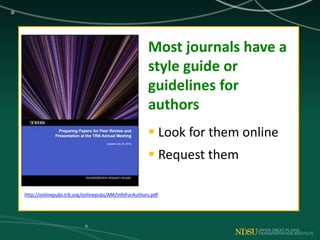
Most journals have a
style guide or
guidelines for
authors
 Look for them online
 Request them
http://onlinepubs.trb.org/onlinepubs/AM/InfoForAuthors.pdf
TRB receives more than 5,300 papers per year
• only 20% Published in Transportation Research Record
• only 60% are presented at the TRB annual meeting.
TRB’s Paper Author Resource Page:
http://www.trb.org/AnnualMeeting/AMPaperAuthorResource.aspx
Top 10 Ways to Get Your Paper Rejected
1. Ignore the word limit.
2. Ignore the formatting rules.
3. Include spelling and grammar mistakes.
4. Do not provide relevant references.
5. Submit nearly identical papers to several committees or even one committee.
6. Do not revise your paper—think of it as a work of art.
7. Insert random tables and graphics.
8. Never explain the main findings—your readers should be able to figure that out.
9. Do not respond to reviewer comments.
10. Miss deadlines.
Condensed in “Writing a Paper for the Transportation Research Record”
http://onlinepubs.trb.org/onlinepubs/am/2015/WritingForTheTRRecord.pdf adapted from Horacio Plotkin. How to Get Your
Paper Rejected. BMJ, 329, p. 1469 (Dec. 18, 2004). www.bmj.com/cgi/content/full/329/7480/1469.
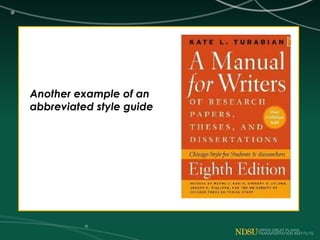
Another example of an
abbreviated style guide
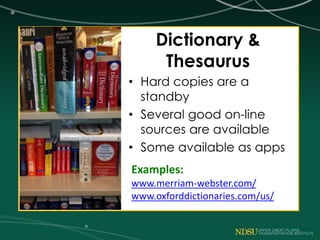
Dictionary &
Thesaurus
• Hard copies are a
standby
• Several good on-line
sources are available
• Some available as apps
Examples:
www.merriam-webster.com/
www.oxforddictionaries.com/us/
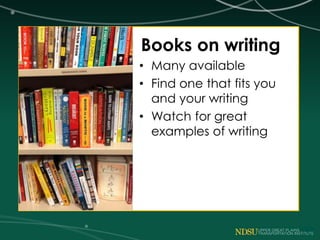
Books on writing
• Many available
• Find one that fits you
and your writing
• Watch for great
examples of writing
Another set of eyes
Find someone else to read your copy
• Critical eye
• Willing to be honest
• Unfamiliar with what you’ve written
Learn your weaknesses
• Learn what to watch out for in your text
• Be cautious in your writing
• Pay extra attention to these items in your
editing
Give credit where credit is due
Plagiarism and documentation
The following slides on plagiarism are adapted with permission from the
NDSU Center for Writers.
https://www.ndsu.edu/cfwriters/
Plagiarism is:
• Dishonest
• Serious breach of professional ethics
• Cheating
Plagiarism can damage your professional
reputation beyond repair
NDSU Code of Academic Responsibility and
Conduct
“Academic misconduct (intentional or otherwise) includes but is not
limited to . . .
Plagiarizing, i.e., submitting work that is, in part or in whole, not
entirely one’s own, without attributing such portions to their correct
sources.”*
NDSU Policy Manual, Section 335, http://www.ndsu.nodak.edu/policy/335.htm
North Dakota State University Policy Manual Section 326: Academic Misconduct
3.1 Academic or scientific misconduct shall mean fabrication, falsification,
plagiarism, misrepresentation of sources, breach of confidentiality, or other
practices. . .
3.8 Plagiarism shall mean taking over ideas, methods, or written words of another
without acknowledgment of and with the intention that they be credited as the
work of the deceiver. Different academic disciplines may have their own separate
definition which may add additional elements that need to be taken into
consideration in an allegation of plagiarism.
Penalties
North Dakota State University Policy Manual
Section 326: Academic Misconduct
10.2 Sanctions resulting from academic misconduct may include, but are not
limited to, termination of employment or student status, termination of current
research activity, special prior review of future research activities, written
reprimand, probation for a specific period of time, and/or suspension of rights
and responsibilities.
10.3 In cases of students, recommendations for sanction or disciplinary actions
will be forwarded to the Vice President for Student Affairs or the Graduate Dean
to determine appropriate administration of any sanctions.
Section 335 Code of Academic Responsibility and Conduct
12.Rescission of degrees. A degree previously awarded may be rescinded if it is
determined that the graduate’s actions taken to obtain the degree involved
academic misconduct.
Two Types of Plagiarism
1. Intentional—Deliberately turning in an entire paper or
portions of a paper (i.e., patchwriting) that you have not
written with the intent to deceive the instructor:
• Hiring someone to write a paper;
• Buying a paper off the Internet:
• Copying and pasting an entire source
or portions of one source to submit as
original work;
• Copying and pasting portions of many
sources to submit as original work
(also called patchwriting).
Two Types of Plagiarism
2. Unintentional—Accidentally or unknowingly
failing to meet standards of academic integrity:
• Forgetting to acknowledge the
author/source with in-text citations;
• Forgetting to include quotation marks
when copying exact words;
• Failing to paraphrase or summarize
completely;
• Failing to contribute to the paper
(patchwriting).
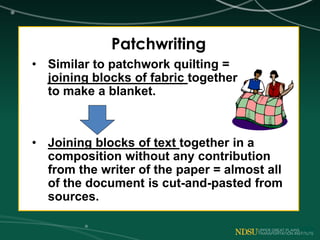
Patchwriting
• Similar to patchwork quilting =
joining blocks of fabric together
to make a blanket.
• Joining blocks of text together in a
composition without any contribution
from the writer of the paper = almost all
of the document is cut-and-pasted from
sources.
Patchwriting
Variations but still unacceptable:
• slightly altering the words and sentences to make
them look like original writing;
• including in-text citations but failing to work with
the material by paraphrasing the ideas and by
contributing an original organizational structure
with an introduction, clear thesis and claims,
transitions, and explanations.
Warning
All types of plagiarism
are serious—
intentional and unintentional.
~~~~~~
Learn to avoid plagiarism to maintain
your academic integrity.
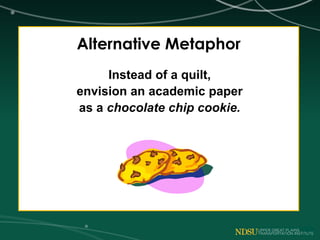
Alternative Metaphor
Instead of a quilt,
envision an academic paper
as a chocolate chip cookie.
Alternative Metaphor
• The “cookie” contains the writer’s own
ideas— introduction, thesis, subpoints,
explanations, discussion, transitions.
• The “chocolate chips” are small pieces of
source material within the cookie—clearly
identifiable quotations, summaries, and
paraphrases
Avoiding Plagiarism
• Begin your writing process early to allow
ample time for revision.
Avoiding Plagiarism
• Take careful notes from sources
–author/date/title/page/URL
–identify exact quotations with
quotation marks immediately
–summarize and paraphrase
carefully
Avoiding Plagiarism
• Avoid patchwriting
– structure the paper with your own
introduction, thesis, claims,
explanations, and transitions
– use sources to support or illustrate your
points
– paraphrase and summarize most of the
source material and use quotations
sparingly
Avoiding Plagiarism
• Use direct quotations sparingly
(if allowed in your field)
• Follow a style guide (Chicago, APA, etc.) to
identify the author and source:
Smith (1981, p. 255) defines
schizophrenia as “a mental disease . .
.”
Avoiding Plagiarism
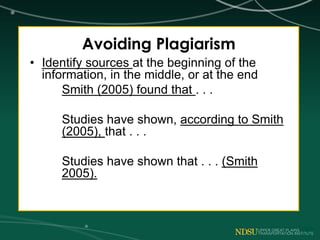
• Identify sources at the beginning of the
information, in the middle, or at the end
Smith (2005) found that . . .
Studies have shown, according to Smith
(2005), that . . .
Studies have shown that . . . (Smith
2005).
Paraphrasing & Summarizing
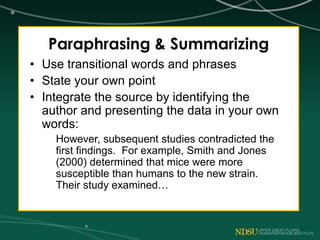
• Use transitional words and phrases
• State your own point
• Integrate the source by identifying the
author and presenting the data in your own
words:
However, subsequent studies contradicted the
first findings. For example, Smith and Jones
(2000) determined that mice were more
susceptible than humans to the new strain.
Their study examined…
Paraphrasing & Summarizing
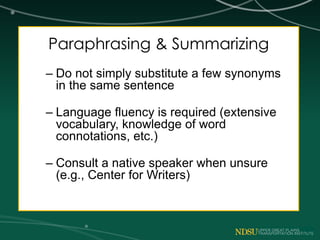
– Do not simply substitute a few synonyms
in the same sentence
– Language fluency is required (extensive
vocabulary, knowledge of word
connotations, etc.)
– Consult a native speaker when unsure
(e.g., Center for Writers)
Responsible Paraphrase
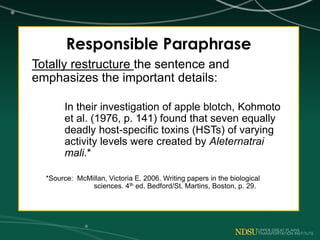
Totally restructure the sentence and
emphasizes the important details:
In their investigation of apple blotch, Kohmoto
et al. (1976, p. 141) found that seven equally
deadly host-specific toxins (HSTs) of varying
activity levels were created by Aleternatrai
mali.*
*Source: McMillan, Victoria E. 2006. Writing papers in the biological
sciences. 4th ed. Bedford/St. Martins, Boston, p. 29.
A word about documentation
Footnotes, endnotes, bibliographies and
reference lists
Demanded by:
– Ethics
– Copyright laws
– Courtesy to readers
Helpful to:
– You
– Future readers
Resources for documentation
• “References” tab in Microsoft Word
• Other software for generating
Writing email
Things to think about
– Is this the correct media for the message?
– Is it going to the right people?
– Do you know the receiver(s)?
– Is privacy an issue?
Writing email
Content
– Subject line – short, descriptive, specific
– Change the subject line to reflect content
– Use a courtesy title or greeting
– Keep message brief and to the point
– State up-front what action you want reader
to take
– Avoid jargon and “institution speak.” Use
language appropriate to your audience.
Writing email
Content
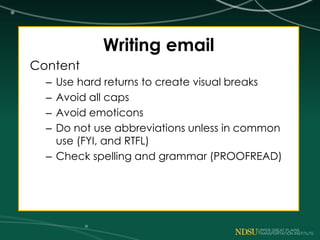
– Use hard returns to create visual breaks
– Avoid all caps
– Avoid emoticons
– Do not use abbreviations unless in common
use (FYI, and RTFL)
– Check spelling and grammar (PROOFREAD)
Writing email
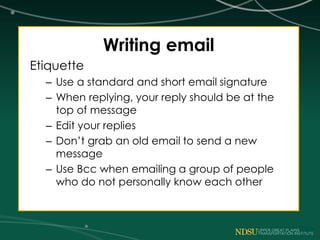
Etiquette
– Use a standard and short email signature
– When replying, your reply should be at the
top of message
– Edit your replies
– Don’t grab an old email to send a new
message
– Use Bcc when emailing a group of people
who do not personally know each other
Writing email
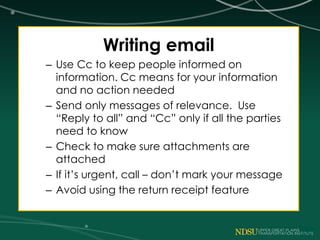
– Use Cc to keep people informed on
information. Cc means for your information
and no action needed
– Send only messages of relevance. Use
“Reply to all” and “Cc” only if all the parties
need to know
– Check to make sure attachments are
attached
– If it’s urgent, call – don’t mark your message
– Avoid using the return receipt feature
Tips,
Tricks
and Things to Watch out for
Punctuation
“If you find a sentence particularly hard
to punctuate, consider rewriting it; the
problem may be one of style rather
than punctuation. A well-written
sentence almost punctuates itself.”
--Jan Venolia,
Author of Write Right!
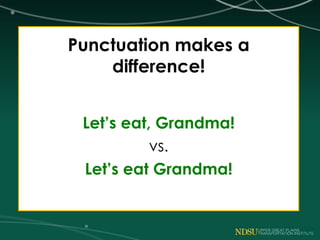
Punctuation makes a
difference!
Let’s eat, Grandma!
vs.
Let’s eat Grandma!
Apostrophe
Has three uses
• To form possessives of nouns
• To show the omission of letters
• To indicate certain plurals of lowercase letters
Apostrophe
Not only is an apostrophe sometimes omitted
where it is needed, but even more often it is
used where it doesn’t belong.
Who’s book is this?
Whose book is this?
Remember: The apostrophe takes the place of
“is” when you say who’s. . .
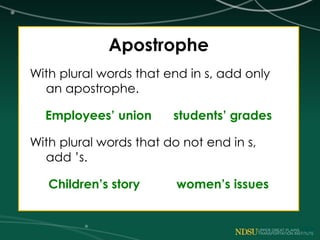
Apostrophe
With plural words that end in s, add only
an apostrophe.
Employees’ union students’ grades
With plural words that do not end in s,
add ’s.
Children’s story women’s issues
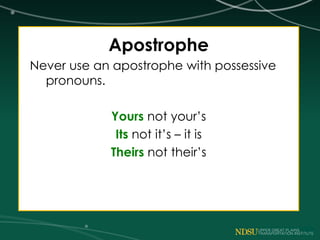
Apostrophe
Never use an apostrophe with possessive
pronouns.
Yours not your’s
Its not it’s – it is
Theirs not their’s
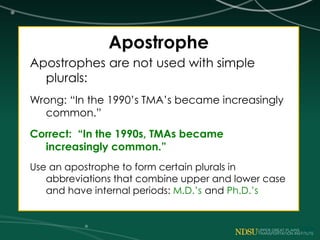
Apostrophe
Apostrophes are not used with simple
plurals:
Wrong: “In the 1990’s TMA’s became increasingly
common.”
Correct: “In the 1990s, TMAs became
increasingly common.”
Use an apostrophe to form certain plurals in
abbreviations that combine upper and lower case
and have internal periods: M.D.’s and Ph.D.’s
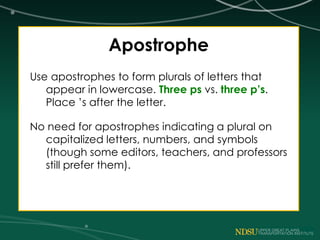
Apostrophe
Use apostrophes to form plurals of letters that
appear in lowercase. Three ps vs. three p’s.
Place ’s after the letter.
No need for apostrophes indicating a plural on
capitalized letters, numbers, and symbols
(though some editors, teachers, and professors
still prefer them).
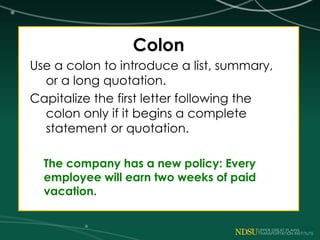
Colon
Use a colon to introduce a list, summary,
or a long quotation.
Capitalize the first letter following the
colon only if it begins a complete
statement or quotation.
The company has a new policy: Every
employee will earn two weeks of paid
vacation.
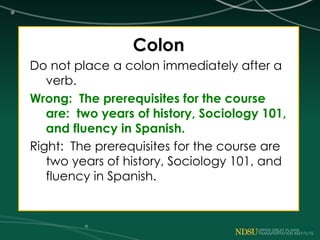
Colon
Do not place a colon immediately after a
verb.
Wrong: The prerequisites for the course
are: two years of history, Sociology 101,
and fluency in Spanish.
Right: The prerequisites for the course are
two years of history, Sociology 101, and
fluency in Spanish.
Comma
“Commas are like shots of
tequila. One or two might be
fine, but 42 is bad.”
-- the Internet
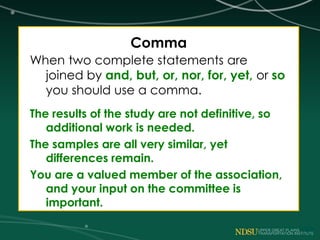
Comma
When two complete statements are
joined by and, but, or, nor, for, yet, or so
you should use a comma.
The results of the study are not definitive, so
additional work is needed.
The samples are all very similar, yet
differences remain.
You are a valued member of the association,
and your input on the committee is
important.
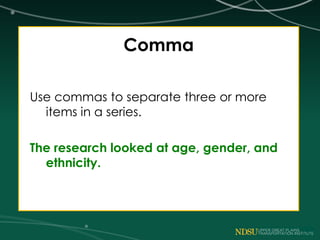
Comma
Use commas to separate three or more
items in a series.
The research looked at age, gender, and
ethnicity.
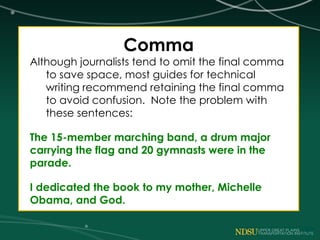
Comma
Although journalists tend to omit the final comma
to save space, most guides for technical
writing recommend retaining the final comma
to avoid confusion. Note the problem with
these sentences:
The 15-member marching band, a drum major
carrying the flag and 20 gymnasts were in the
parade.
I dedicated the book to my mother, Michelle
Obama, and God.
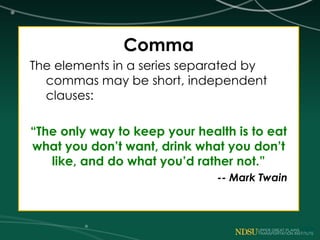
Comma
The elements in a series separated by
commas may be short, independent
clauses:
“The only way to keep your health is to eat
what you don’t want, drink what you don’t
like, and do what you’d rather not.”
-- Mark Twain
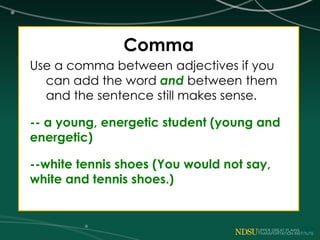
Comma
Use a comma between adjectives if you
can add the word and between them
and the sentence still makes sense.
-- a young, energetic student (young and
energetic)
--white tennis shoes (You would not say,
white and tennis shoes.)
Comma
Commas are needed after an
introductory phrase (many of which
begin with a preposition).
In the case of two competing theories, chose one
that you seek to prove or to disprove through
your research.
Through our analysis, we. . .
In conclusion, the team found. . .
Comma
Put a comma after introductory words:
However, Thus,
Therefore, Consequently,
This is also the case when a semi-colon
precedes the introductory word:
A shortage of materials has currently halted the
construction; however, we plan to resume as
soon as possible once our shipment arrives.
Semicolon
Semicolons are useful between
independent clauses that contain
commas.
The coach, a man of few words, led his
team by example; however, the words
he used were chosen carefully.
If you rephrase the sentence or create two
separate sentences and avoid the semicolons,
your document may be easier to read.
Semicolon
Use semicolons to separate long or
complicated items in a series:
The lottery winners included an elderly
gentleman who had never before
bought a lottery ticket; a high school
student hoping to use the winnings for
college; and a reporter who bought her
ticket while writing a story about
corruption in the lottery system.
Semicolon
Use a semicolon to separate many items
in a series:
The following items must be tracked
monthly: gallons of fuel; vehicle
mileage; driver hours; passenger one-
way trips; passenger fairs; contract
income; supply costs; personnel wages;
and maintenance costs.
Hyphen or Dash
Use a single hyphen or dash between
inclusive numbers or dates.
199-2000 pp. 111-136
Use a single hyphen or dash between a
compound of two or more words within
a hyphenated word.
Minneapolis-St. Paul area well-balanced
post-World War I quasi-judicial
Hyphen or Dash
Use two hyphens or dashes for emphasis,
to indicate an abrupt change, or with
explanatory words or phrases.
“People want to know why I. . .write such
gross stuff. I like to tell them I have the
heart of a small boy–and I keep it in a
jar on my desk.”
-- Stephen King
American author
Dashes
“The overuse of dashes is the sign of a lazy
writer.”
-- Michael Gartner
Newspaper editor &
Pulitzer Prize-winning editorial writer
Hyphen
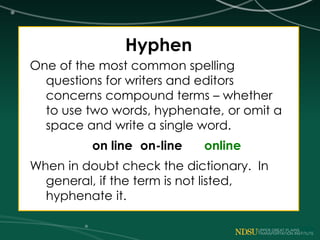
One of the most common spelling
questions for writers and editors
concerns compound terms – whether
to use two words, hyphenate, or omit a
space and write a single word.
on line on-line online
When in doubt check the dictionary. In
general, if the term is not listed,
hyphenate it.
Hyphen
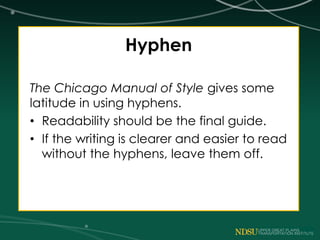
The Chicago Manual of Style gives some
latitude in using hyphens.
• Readability should be the final guide.
• If the writing is clearer and easier to read
without the hyphens, leave them off.
Hyphen
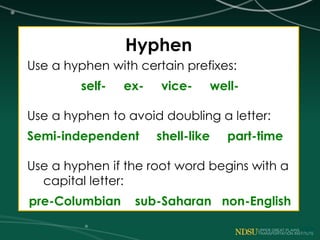
Use a hyphen with certain prefixes:
self- ex- vice- well-
Use a hyphen to avoid doubling a letter:
Semi-independent shell-like part-time
Use a hyphen if the root word begins with a
capital letter:
pre-Columbian sub-Saharan non-English
Hyphen
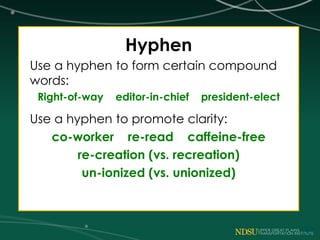
Use a hyphen to form certain compound
words:
Right-of-way editor-in-chief president-elect
Use a hyphen to promote clarity:
co-worker re-read caffeine-free
re-creation (vs. recreation)
un-ionized (vs. unionized)
Hyphen
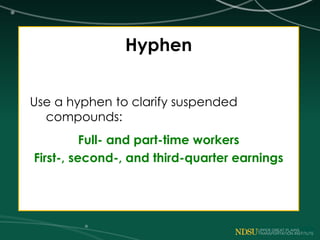
Use a hyphen to clarify suspended
compounds:
Full- and part-time workers
First-, second-, and third-quarter earnings
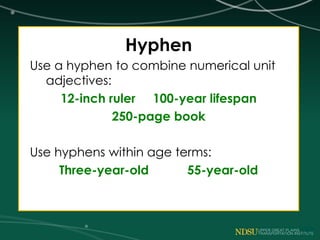
Hyphen
Use a hyphen to combine numerical unit
adjectives:
12-inch ruler 100-year lifespan
250-page book
Use hyphens within age terms:
Three-year-old 55-year-old
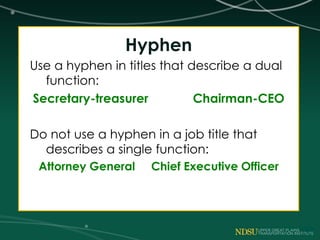
Hyphen
Use a hyphen in titles that describe a dual
function:
Secretary-treasurer Chairman-CEO
Do not use a hyphen in a job title that
describes a single function:
Attorney General Chief Executive Officer
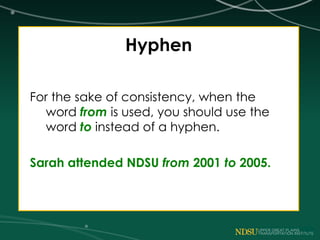
Hyphen
For the sake of consistency, when the
word from is used, you should use the
word to instead of a hyphen.
Sarah attended NDSU from 2001 to 2005.
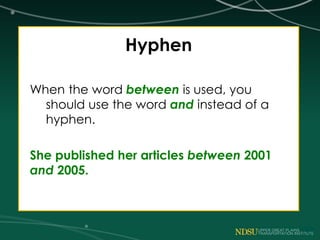
Hyphen
When the word between is used, you
should use the word and instead of a
hyphen.
She published her articles between 2001
and 2005.
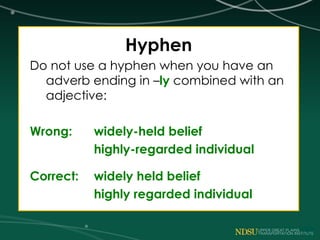
Hyphen
Do not use a hyphen when you have an
adverb ending in –ly combined with an
adjective:
Wrong: widely-held belief
highly-regarded individual
Correct: widely held belief
highly regarded individual
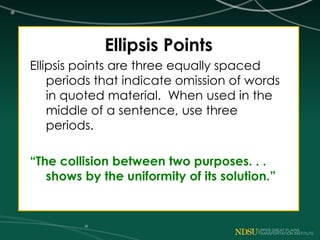
Ellipsis Points
Ellipsis points are three equally spaced
periods that indicate omission of words
in quoted material. When used in the
middle of a sentence, use three
periods.
“The collision between two purposes. . .
shows by the uniformity of its solution.”
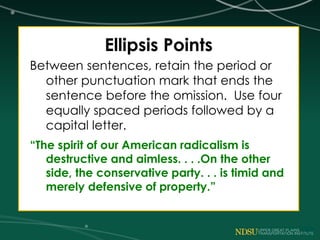
Ellipsis Points
Between sentences, retain the period or
other punctuation mark that ends the
sentence before the omission. Use four
equally spaced periods followed by a
capital letter.
“The spirit of our American radicalism is
destructive and aimless. . . .On the other
side, the conservative party. . . is timid and
merely defensive of property.”
Ellipsis Points
Note: You have a duty not to
misrepresent the original work through
the use of ellipsis. Accuracy of intent is
critical.
Quotation Marks
Periods and commas are always placed
inside the closing quotation marks.
Colons, semicolons, question marks and
exclamation points all follow closing
quotation marks unless a question mark
or exclamation point belongs to the
quoted material.
Which of Shakespeare’s characters said,
“All the world’s a stage. . . .”?
Capitalization
Capitalize prepositions in titles if they
consist of four or more letters:
Since Through Under
Around During Toward
Above Between Until
Against
Capitalization
Do not capitalize words such as
government, federal, state,
administration unless they are part of
the title of a specific entity.
U.S. Government vs. federal government
federal budget vs. Federal Highway
Administration
Capitalization
Do not capitalize seasons (fall, winter,
spring, summer) except when used to
denote an issue of a journal (Summer
2005).
Capitalization
Do not capitalize terms when they suggest
direction (western provinces, eastern
Australia, central states) unless they
refer to a compass point or specific
location (Middle East, North Pole, the
Left Bank).
Capitalization
Capitalize African American, Caucasian,
Hispanic, Native American, Asian but
do not capitalize generic terms such as
black(s) or white(s).
Capitalize personal titles only if they
precede the name and are not
separated by a comma:
President Barack Obama Professor Johnson
the treasurer, Bill Olson board chair, Al Jones
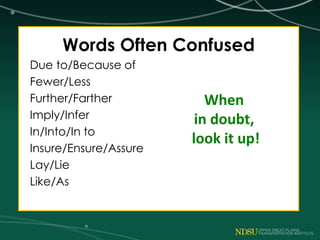
Words often Confused
Accept/Except
Adverse/Averse
Advice/Advise
Affect/Effect
Allude/Elude/Refer
Alternate/Alternative
Apt/Liable/Likely/Prone
Because/Since
Biannual/Biennial
Complement/Compliment
Comprise/Composed of
Words Often Confused
Due to/Because of
Fewer/Less
Further/Farther
Imply/Infer
In/Into/In to
Insure/Ensure/Assure
Lay/Lie
Like/As
When
in doubt,
look it up!
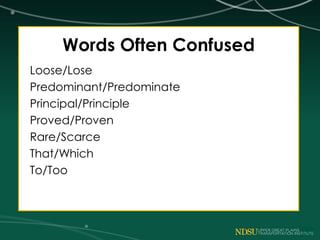
Words Often Confused
Loose/Lose
Predominant/Predominate
Principal/Principle
Proved/Proven
Rare/Scarce
That/Which
To/Too
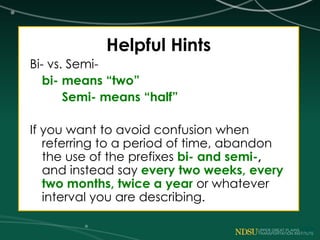
Helpful Hints
Bi- vs. Semi-
bi- means “two”
Semi- means “half”
If you want to avoid confusion when
referring to a period of time, abandon
the use of the prefixes bi- and semi-,
and instead say every two weeks, every
two months, twice a year or whatever
interval you are describing.
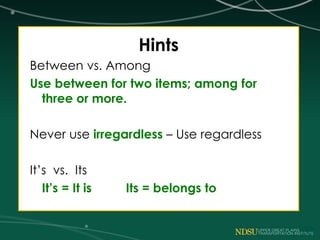
Hints
Between vs. Among
Use between for two items; among for
three or more.
Never use irregardless – Use regardless
It’s vs. Its
It’s = It is Its = belongs to
More Hints!
Data
While acceptance of the word data as a
singular has become common, in
scientific and formal writing, the plural
form is still preferred.
data are… not data is…
Still More Hints
People vs. Persons
Use people for larger groups; persons for
an exact or small number.
Never use and etc. Use etc.
et cetera means “and other unspecified
things of the same class.”
Make Sure Your Meaning is
Clear
Rewrite to eliminate misplaced modifiers:
People with deficient metabolizing systems or
children may be unjustly burdened by
genetically engineered food.
It’s a 30-minute documentary on the Bay
Area’s housing and growth crisis produced
by the Association of Bay Area
Governments.
Using Numbers in Text
Numbers less than 10 should be spelled
out.
Numbers 10 or greater should be written
as numerals.
This rule applies for rankings also: first,
second and third but 12th, 20th, and 25th.
Using Numbers in Text
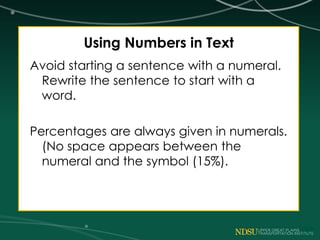
Avoid starting a sentence with a numeral.
Rewrite the sentence to start with a
word.
Percentages are always given in numerals.
(No space appears between the
numeral and the symbol (15%).
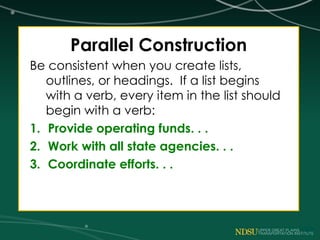
Parallel Construction
Be consistent when you create lists,
outlines, or headings. If a list begins
with a verb, every item in the list should
begin with a verb:
1. Provide operating funds. . .
2. Work with all state agencies. . .
3. Coordinate efforts. . .
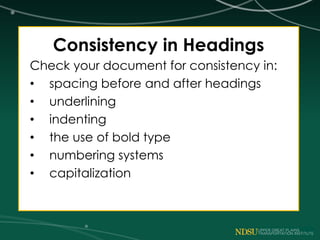
Consistency in Headings
Check your document for consistency in:
• spacing before and after headings
• underlining
• indenting
• the use of bold type
• numbering systems
• capitalization
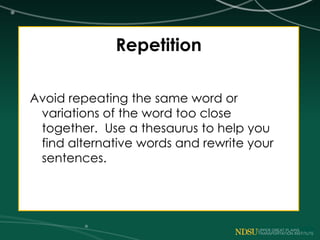
Repetition
Avoid repeating the same word or
variations of the word too close
together. Use a thesaurus to help you
find alternative words and rewrite your
sentences.
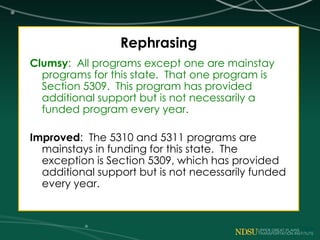
Rephrasing
Clumsy: All programs except one are mainstay
programs for this state. That one program is
Section 5309. This program has provided
additional support but is not necessarily a
funded program every year.
Improved: The 5310 and 5311 programs are
mainstays in funding for this state. The
exception is Section 5309, which has provided
additional support but is not necessarily funded
every year.
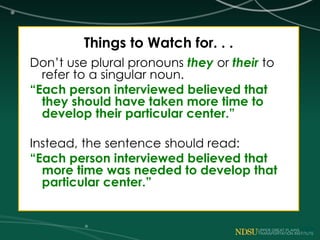
Things to Watch for. . .
Don’t use plural pronouns they or their to
refer to a singular noun.
“Each person interviewed believed that
they should have taken more time to
develop their particular center.”
Instead, the sentence should read:
“Each person interviewed believed that
more time was needed to develop that
particular center.”
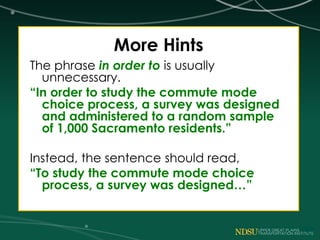
More Hints
The phrase in order to is usually
unnecessary.
“In order to study the commute mode
choice process, a survey was designed
and administered to a random sample
of 1,000 Sacramento residents.”
Instead, the sentence should read,
“To study the commute mode choice
process, a survey was designed…”
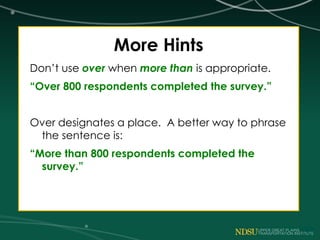
More Hints
Don’t use over when more than is appropriate.
“Over 800 respondents completed the survey.”
Over designates a place. A better way to phrase
the sentence is:
“More than 800 respondents completed the
survey.”
More Hints
i.e. means “that is”
e.g. means “for example”
Always put a comma after them.
(i.e.,…) or (e.g.,…)
Note that e.g. and i.e. are not italicized.
Still More Hints
et al. means “and others”
It is always written with a period after the
second element only. It is used in
bibliographies, but as a rule should not
be used for the words “and others”
within the text (except in citing
references). The abbreviation is applied
only to persons, not to things.
Limiting Prepositional Phrases
Prepositions can easily be overdone.
Words ending in -ance, -ence, -ity, -
ment, -sion, or -tion are often “buried
verbs” and require additional
prepositional phrases to complete the
idea.
Our efforts toward maximization of profits
failed.
vs. Our efforts to maximize profits failed.
Jargon and Acronyms
Know your audience
Overuse can lead to:
Misunderstandings
Lack of comprehension
Reader exasperation
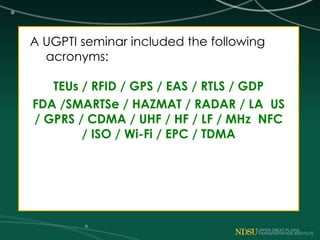
A UGPTI seminar included the following
acronyms:
TEUs / RFID / GPS / EAS / RTLS / GDP
FDA /SMARTSe / HAZMAT / RADAR / LA US
/ GPRS / CDMA / UHF / HF / LF / MHz NFC
/ ISO / Wi-Fi / EPC / TDMA
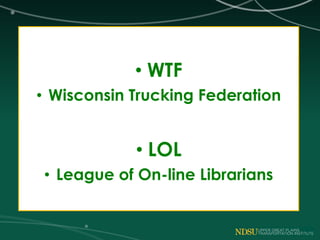
• WTF
• Wisconsin Trucking Federation
• LOL
• League of On-line Librarians
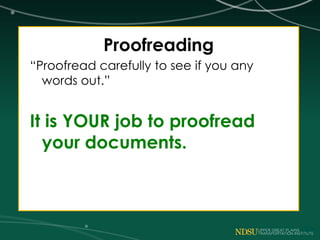
Proofreading
“Proofread carefully to see if you any
words out.”
It is YOUR job to proofread
your documents.
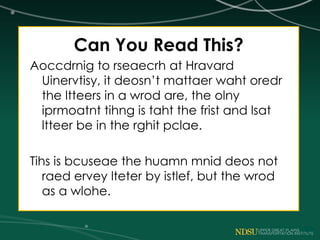
Can You Read This?
Aoccdrnig to rseaecrh at Hravard
Uinervtisy, it deosn’t mattaer waht oredr
the ltteers in a wrod are, the olny
iprmoatnt tihng is taht the frist and lsat
ltteer be in the rghit pclae.
Tihs is bcuseae the huamn mnid deos not
raed ervey lteter by istlef, but the wrod
as a wlohe.
References
Write Right: A Desktop Digest of
Punctuation, Grammar and Style (4th
Edition) by Jan Venolia.
The Chicago Manual of Style (16th Edition)
– University of Chicago Press.
Professional Email Guidelines. University of
Minnesota Communicators Forum.
http://umcf.umn.edu/resources/emailgu
ide.php
Acknowledgements
Dr. Pat Mokhtarian, University of California,
Davis, and Carol Wright, Easter Seals
Project Action (formerly with UGPTI)
provided several of the examples and
concepts used in this presentation.

Academic Writing

  • 1.
    Academic Writing What doyou want your writing to say about you? Transportation and Logistics Student Orientation Tom Jirik Communication Coordinator 8/27/2015
  • 2.
    “It’s as interestingand as difficult to say a thing well as to paint it. There is the art of lines and colours, but the art of words exists too, and will never be less important.” -- Vincent van Gogh Post-Impressionist Dutch painter
  • 3.
    “The difference betweenthe right word and the almost right word is the difference between lightning and the lightning bug.” -- Mark Twain American author and humorist
  • 4.
    “Writing – theart of applying the seat of the pants to the seat of the chair.” --Mary Heaton Vorse American journalist, labor activist, and novelist
  • 5.
    What’s the Point? •Communicating clearly • Communicating effectively • Communicating professionally
  • 6.
     Reflects onyour as a professional  Reflects on your research  Helps you to advance your ideas  Is critical to collaboration Why good writing is important
  • 7.
  • 8.
    Put tools inyour toolbox • Style guides • Dictionaries • Thesaurus • Books on writing • Another set of eyes • Learn your weaknesses • Tips and tricks
  • 9.
    Style More than beinga snappy dresser
  • 10.
    Style guide/style manual •A set of standards for the writing and design of documents, either for general use or for a specific publication, organization or field. • The implementation of a style guide provides uniformity in style and formatting of a document.
  • 11.
    Examples of StyleGuides • The ACS Style Guide • AMA Manual of Style • The Associated Press Stylebook • The Chicago Manual of Style • Turabian • The Elements of Style • The Elements of Typographic Style • ISO 690 • MHRA Style Guide • MLA Style Manual • MLA Handbook • The New York Times Manual • The Oxford Guide to Style/New Harts’ Rules • The Publication Manual of the APA • The ASA Style Guide
  • 12.
    Online style guides •Purdue University Online Writing Lab – under “Research and Citation” – https://owl.english.purdue.edu/owl/ • NDSU Center for Writers under “Citing Sources” – https://www.ndsu.edu/cfwriters/
  • 13.
    Online Guides • Universitywriting programs • Professional organizations • Publishing companies/organizations Be careful Is it complete? Is it up to date? Does it apply to you?
  • 14.
    Most journals havea style guide or guidelines for authors  Look for them online  Request them http://onlinepubs.trb.org/onlinepubs/AM/InfoForAuthors.pdf
  • 15.
    TRB receives morethan 5,300 papers per year • only 20% Published in Transportation Research Record • only 60% are presented at the TRB annual meeting. TRB’s Paper Author Resource Page: http://www.trb.org/AnnualMeeting/AMPaperAuthorResource.aspx
  • 16.
    Top 10 Waysto Get Your Paper Rejected 1. Ignore the word limit. 2. Ignore the formatting rules. 3. Include spelling and grammar mistakes. 4. Do not provide relevant references. 5. Submit nearly identical papers to several committees or even one committee. 6. Do not revise your paper—think of it as a work of art. 7. Insert random tables and graphics. 8. Never explain the main findings—your readers should be able to figure that out. 9. Do not respond to reviewer comments. 10. Miss deadlines. Condensed in “Writing a Paper for the Transportation Research Record” http://onlinepubs.trb.org/onlinepubs/am/2015/WritingForTheTRRecord.pdf adapted from Horacio Plotkin. How to Get Your Paper Rejected. BMJ, 329, p. 1469 (Dec. 18, 2004). www.bmj.com/cgi/content/full/329/7480/1469.
  • 17.
    Another example ofan abbreviated style guide
  • 18.
    Dictionary & Thesaurus • Hardcopies are a standby • Several good on-line sources are available • Some available as apps Examples: www.merriam-webster.com/ www.oxforddictionaries.com/us/
  • 19.
    Books on writing •Many available • Find one that fits you and your writing • Watch for great examples of writing
  • 20.
    Another set ofeyes Find someone else to read your copy • Critical eye • Willing to be honest • Unfamiliar with what you’ve written
  • 22.
    Learn your weaknesses •Learn what to watch out for in your text • Be cautious in your writing • Pay extra attention to these items in your editing
  • 23.
    Give credit wherecredit is due Plagiarism and documentation The following slides on plagiarism are adapted with permission from the NDSU Center for Writers. https://www.ndsu.edu/cfwriters/
  • 24.
    Plagiarism is: • Dishonest •Serious breach of professional ethics • Cheating Plagiarism can damage your professional reputation beyond repair
  • 25.
    NDSU Code ofAcademic Responsibility and Conduct “Academic misconduct (intentional or otherwise) includes but is not limited to . . . Plagiarizing, i.e., submitting work that is, in part or in whole, not entirely one’s own, without attributing such portions to their correct sources.”* NDSU Policy Manual, Section 335, http://www.ndsu.nodak.edu/policy/335.htm
  • 26.
    North Dakota StateUniversity Policy Manual Section 326: Academic Misconduct 3.1 Academic or scientific misconduct shall mean fabrication, falsification, plagiarism, misrepresentation of sources, breach of confidentiality, or other practices. . . 3.8 Plagiarism shall mean taking over ideas, methods, or written words of another without acknowledgment of and with the intention that they be credited as the work of the deceiver. Different academic disciplines may have their own separate definition which may add additional elements that need to be taken into consideration in an allegation of plagiarism.
  • 27.
    Penalties North Dakota StateUniversity Policy Manual Section 326: Academic Misconduct 10.2 Sanctions resulting from academic misconduct may include, but are not limited to, termination of employment or student status, termination of current research activity, special prior review of future research activities, written reprimand, probation for a specific period of time, and/or suspension of rights and responsibilities. 10.3 In cases of students, recommendations for sanction or disciplinary actions will be forwarded to the Vice President for Student Affairs or the Graduate Dean to determine appropriate administration of any sanctions. Section 335 Code of Academic Responsibility and Conduct 12.Rescission of degrees. A degree previously awarded may be rescinded if it is determined that the graduate’s actions taken to obtain the degree involved academic misconduct.
  • 28.
    Two Types ofPlagiarism 1. Intentional—Deliberately turning in an entire paper or portions of a paper (i.e., patchwriting) that you have not written with the intent to deceive the instructor: • Hiring someone to write a paper; • Buying a paper off the Internet: • Copying and pasting an entire source or portions of one source to submit as original work; • Copying and pasting portions of many sources to submit as original work (also called patchwriting).
  • 29.
    Two Types ofPlagiarism 2. Unintentional—Accidentally or unknowingly failing to meet standards of academic integrity: • Forgetting to acknowledge the author/source with in-text citations; • Forgetting to include quotation marks when copying exact words; • Failing to paraphrase or summarize completely; • Failing to contribute to the paper (patchwriting).
  • 30.
    Patchwriting • Similar topatchwork quilting = joining blocks of fabric together to make a blanket. • Joining blocks of text together in a composition without any contribution from the writer of the paper = almost all of the document is cut-and-pasted from sources.
  • 31.
    Patchwriting Variations but stillunacceptable: • slightly altering the words and sentences to make them look like original writing; • including in-text citations but failing to work with the material by paraphrasing the ideas and by contributing an original organizational structure with an introduction, clear thesis and claims, transitions, and explanations.
  • 32.
    Warning All types ofplagiarism are serious— intentional and unintentional. ~~~~~~ Learn to avoid plagiarism to maintain your academic integrity.
  • 33.
    Alternative Metaphor Instead ofa quilt, envision an academic paper as a chocolate chip cookie.
  • 34.
    Alternative Metaphor • The“cookie” contains the writer’s own ideas— introduction, thesis, subpoints, explanations, discussion, transitions. • The “chocolate chips” are small pieces of source material within the cookie—clearly identifiable quotations, summaries, and paraphrases
  • 35.
    Avoiding Plagiarism • Beginyour writing process early to allow ample time for revision.
  • 36.
    Avoiding Plagiarism • Takecareful notes from sources –author/date/title/page/URL –identify exact quotations with quotation marks immediately –summarize and paraphrase carefully
  • 37.
    Avoiding Plagiarism • Avoidpatchwriting – structure the paper with your own introduction, thesis, claims, explanations, and transitions – use sources to support or illustrate your points – paraphrase and summarize most of the source material and use quotations sparingly
  • 38.
    Avoiding Plagiarism • Usedirect quotations sparingly (if allowed in your field) • Follow a style guide (Chicago, APA, etc.) to identify the author and source: Smith (1981, p. 255) defines schizophrenia as “a mental disease . . .”
  • 39.
    Avoiding Plagiarism • Identifysources at the beginning of the information, in the middle, or at the end Smith (2005) found that . . . Studies have shown, according to Smith (2005), that . . . Studies have shown that . . . (Smith 2005).
  • 40.
    Paraphrasing & Summarizing •Use transitional words and phrases • State your own point • Integrate the source by identifying the author and presenting the data in your own words: However, subsequent studies contradicted the first findings. For example, Smith and Jones (2000) determined that mice were more susceptible than humans to the new strain. Their study examined…
  • 41.
    Paraphrasing & Summarizing –Do not simply substitute a few synonyms in the same sentence – Language fluency is required (extensive vocabulary, knowledge of word connotations, etc.) – Consult a native speaker when unsure (e.g., Center for Writers)
  • 42.
    Responsible Paraphrase Totally restructurethe sentence and emphasizes the important details: In their investigation of apple blotch, Kohmoto et al. (1976, p. 141) found that seven equally deadly host-specific toxins (HSTs) of varying activity levels were created by Aleternatrai mali.* *Source: McMillan, Victoria E. 2006. Writing papers in the biological sciences. 4th ed. Bedford/St. Martins, Boston, p. 29.
  • 43.
    A word aboutdocumentation Footnotes, endnotes, bibliographies and reference lists Demanded by: – Ethics – Copyright laws – Courtesy to readers Helpful to: – You – Future readers
  • 44.
    Resources for documentation •“References” tab in Microsoft Word • Other software for generating
  • 45.
    Writing email Things tothink about – Is this the correct media for the message? – Is it going to the right people? – Do you know the receiver(s)? – Is privacy an issue?
  • 46.
    Writing email Content – Subjectline – short, descriptive, specific – Change the subject line to reflect content – Use a courtesy title or greeting – Keep message brief and to the point – State up-front what action you want reader to take – Avoid jargon and “institution speak.” Use language appropriate to your audience.
  • 47.
    Writing email Content – Usehard returns to create visual breaks – Avoid all caps – Avoid emoticons – Do not use abbreviations unless in common use (FYI, and RTFL) – Check spelling and grammar (PROOFREAD)
  • 48.
    Writing email Etiquette – Usea standard and short email signature – When replying, your reply should be at the top of message – Edit your replies – Don’t grab an old email to send a new message – Use Bcc when emailing a group of people who do not personally know each other
  • 49.
    Writing email – UseCc to keep people informed on information. Cc means for your information and no action needed – Send only messages of relevance. Use “Reply to all” and “Cc” only if all the parties need to know – Check to make sure attachments are attached – If it’s urgent, call – don’t mark your message – Avoid using the return receipt feature
  • 50.
  • 51.
    Punctuation “If you finda sentence particularly hard to punctuate, consider rewriting it; the problem may be one of style rather than punctuation. A well-written sentence almost punctuates itself.” --Jan Venolia, Author of Write Right!
  • 52.
    Punctuation makes a difference! Let’seat, Grandma! vs. Let’s eat Grandma!
  • 53.
    Apostrophe Has three uses •To form possessives of nouns • To show the omission of letters • To indicate certain plurals of lowercase letters
  • 54.
    Apostrophe Not only isan apostrophe sometimes omitted where it is needed, but even more often it is used where it doesn’t belong. Who’s book is this? Whose book is this? Remember: The apostrophe takes the place of “is” when you say who’s. . .
  • 55.
    Apostrophe With plural wordsthat end in s, add only an apostrophe. Employees’ union students’ grades With plural words that do not end in s, add ’s. Children’s story women’s issues
  • 56.
    Apostrophe Never use anapostrophe with possessive pronouns. Yours not your’s Its not it’s – it is Theirs not their’s
  • 57.
    Apostrophe Apostrophes are notused with simple plurals: Wrong: “In the 1990’s TMA’s became increasingly common.” Correct: “In the 1990s, TMAs became increasingly common.” Use an apostrophe to form certain plurals in abbreviations that combine upper and lower case and have internal periods: M.D.’s and Ph.D.’s
  • 58.
    Apostrophe Use apostrophes toform plurals of letters that appear in lowercase. Three ps vs. three p’s. Place ’s after the letter. No need for apostrophes indicating a plural on capitalized letters, numbers, and symbols (though some editors, teachers, and professors still prefer them).
  • 59.
    Colon Use a colonto introduce a list, summary, or a long quotation. Capitalize the first letter following the colon only if it begins a complete statement or quotation. The company has a new policy: Every employee will earn two weeks of paid vacation.
  • 60.
    Colon Do not placea colon immediately after a verb. Wrong: The prerequisites for the course are: two years of history, Sociology 101, and fluency in Spanish. Right: The prerequisites for the course are two years of history, Sociology 101, and fluency in Spanish.
  • 61.
    Comma “Commas are likeshots of tequila. One or two might be fine, but 42 is bad.” -- the Internet
  • 62.
    Comma When two completestatements are joined by and, but, or, nor, for, yet, or so you should use a comma. The results of the study are not definitive, so additional work is needed. The samples are all very similar, yet differences remain. You are a valued member of the association, and your input on the committee is important.
  • 63.
    Comma Use commas toseparate three or more items in a series. The research looked at age, gender, and ethnicity.
  • 64.
    Comma Although journalists tendto omit the final comma to save space, most guides for technical writing recommend retaining the final comma to avoid confusion. Note the problem with these sentences: The 15-member marching band, a drum major carrying the flag and 20 gymnasts were in the parade. I dedicated the book to my mother, Michelle Obama, and God.
  • 65.
    Comma The elements ina series separated by commas may be short, independent clauses: “The only way to keep your health is to eat what you don’t want, drink what you don’t like, and do what you’d rather not.” -- Mark Twain
  • 66.
    Comma Use a commabetween adjectives if you can add the word and between them and the sentence still makes sense. -- a young, energetic student (young and energetic) --white tennis shoes (You would not say, white and tennis shoes.)
  • 67.
    Comma Commas are neededafter an introductory phrase (many of which begin with a preposition). In the case of two competing theories, chose one that you seek to prove or to disprove through your research. Through our analysis, we. . . In conclusion, the team found. . .
  • 68.
    Comma Put a commaafter introductory words: However, Thus, Therefore, Consequently, This is also the case when a semi-colon precedes the introductory word: A shortage of materials has currently halted the construction; however, we plan to resume as soon as possible once our shipment arrives.
  • 69.
    Semicolon Semicolons are usefulbetween independent clauses that contain commas. The coach, a man of few words, led his team by example; however, the words he used were chosen carefully. If you rephrase the sentence or create two separate sentences and avoid the semicolons, your document may be easier to read.
  • 70.
    Semicolon Use semicolons toseparate long or complicated items in a series: The lottery winners included an elderly gentleman who had never before bought a lottery ticket; a high school student hoping to use the winnings for college; and a reporter who bought her ticket while writing a story about corruption in the lottery system.
  • 71.
    Semicolon Use a semicolonto separate many items in a series: The following items must be tracked monthly: gallons of fuel; vehicle mileage; driver hours; passenger one- way trips; passenger fairs; contract income; supply costs; personnel wages; and maintenance costs.
  • 72.
    Hyphen or Dash Usea single hyphen or dash between inclusive numbers or dates. 199-2000 pp. 111-136 Use a single hyphen or dash between a compound of two or more words within a hyphenated word. Minneapolis-St. Paul area well-balanced post-World War I quasi-judicial
  • 73.
    Hyphen or Dash Usetwo hyphens or dashes for emphasis, to indicate an abrupt change, or with explanatory words or phrases. “People want to know why I. . .write such gross stuff. I like to tell them I have the heart of a small boy–and I keep it in a jar on my desk.” -- Stephen King American author
  • 74.
    Dashes “The overuse ofdashes is the sign of a lazy writer.” -- Michael Gartner Newspaper editor & Pulitzer Prize-winning editorial writer
  • 75.
    Hyphen One of themost common spelling questions for writers and editors concerns compound terms – whether to use two words, hyphenate, or omit a space and write a single word. on line on-line online When in doubt check the dictionary. In general, if the term is not listed, hyphenate it.
  • 76.
    Hyphen The Chicago Manualof Style gives some latitude in using hyphens. • Readability should be the final guide. • If the writing is clearer and easier to read without the hyphens, leave them off.
  • 77.
    Hyphen Use a hyphenwith certain prefixes: self- ex- vice- well- Use a hyphen to avoid doubling a letter: Semi-independent shell-like part-time Use a hyphen if the root word begins with a capital letter: pre-Columbian sub-Saharan non-English
  • 78.
    Hyphen Use a hyphento form certain compound words: Right-of-way editor-in-chief president-elect Use a hyphen to promote clarity: co-worker re-read caffeine-free re-creation (vs. recreation) un-ionized (vs. unionized)
  • 79.
    Hyphen Use a hyphento clarify suspended compounds: Full- and part-time workers First-, second-, and third-quarter earnings
  • 80.
    Hyphen Use a hyphento combine numerical unit adjectives: 12-inch ruler 100-year lifespan 250-page book Use hyphens within age terms: Three-year-old 55-year-old
  • 81.
    Hyphen Use a hyphenin titles that describe a dual function: Secretary-treasurer Chairman-CEO Do not use a hyphen in a job title that describes a single function: Attorney General Chief Executive Officer
  • 82.
    Hyphen For the sakeof consistency, when the word from is used, you should use the word to instead of a hyphen. Sarah attended NDSU from 2001 to 2005.
  • 83.
    Hyphen When the wordbetween is used, you should use the word and instead of a hyphen. She published her articles between 2001 and 2005.
  • 84.
    Hyphen Do not usea hyphen when you have an adverb ending in –ly combined with an adjective: Wrong: widely-held belief highly-regarded individual Correct: widely held belief highly regarded individual
  • 85.
    Ellipsis Points Ellipsis pointsare three equally spaced periods that indicate omission of words in quoted material. When used in the middle of a sentence, use three periods. “The collision between two purposes. . . shows by the uniformity of its solution.”
  • 86.
    Ellipsis Points Between sentences,retain the period or other punctuation mark that ends the sentence before the omission. Use four equally spaced periods followed by a capital letter. “The spirit of our American radicalism is destructive and aimless. . . .On the other side, the conservative party. . . is timid and merely defensive of property.”
  • 87.
    Ellipsis Points Note: Youhave a duty not to misrepresent the original work through the use of ellipsis. Accuracy of intent is critical.
  • 88.
    Quotation Marks Periods andcommas are always placed inside the closing quotation marks. Colons, semicolons, question marks and exclamation points all follow closing quotation marks unless a question mark or exclamation point belongs to the quoted material. Which of Shakespeare’s characters said, “All the world’s a stage. . . .”?
  • 89.
    Capitalization Capitalize prepositions intitles if they consist of four or more letters: Since Through Under Around During Toward Above Between Until Against
  • 90.
    Capitalization Do not capitalizewords such as government, federal, state, administration unless they are part of the title of a specific entity. U.S. Government vs. federal government federal budget vs. Federal Highway Administration
  • 91.
    Capitalization Do not capitalizeseasons (fall, winter, spring, summer) except when used to denote an issue of a journal (Summer 2005).
  • 92.
    Capitalization Do not capitalizeterms when they suggest direction (western provinces, eastern Australia, central states) unless they refer to a compass point or specific location (Middle East, North Pole, the Left Bank).
  • 93.
    Capitalization Capitalize African American,Caucasian, Hispanic, Native American, Asian but do not capitalize generic terms such as black(s) or white(s). Capitalize personal titles only if they precede the name and are not separated by a comma: President Barack Obama Professor Johnson the treasurer, Bill Olson board chair, Al Jones
  • 94.
  • 95.
    Words Often Confused Dueto/Because of Fewer/Less Further/Farther Imply/Infer In/Into/In to Insure/Ensure/Assure Lay/Lie Like/As When in doubt, look it up!
  • 96.
  • 97.
    Helpful Hints Bi- vs.Semi- bi- means “two” Semi- means “half” If you want to avoid confusion when referring to a period of time, abandon the use of the prefixes bi- and semi-, and instead say every two weeks, every two months, twice a year or whatever interval you are describing.
  • 98.
    Hints Between vs. Among Usebetween for two items; among for three or more. Never use irregardless – Use regardless It’s vs. Its It’s = It is Its = belongs to
  • 99.
    More Hints! Data While acceptanceof the word data as a singular has become common, in scientific and formal writing, the plural form is still preferred. data are… not data is…
  • 100.
    Still More Hints Peoplevs. Persons Use people for larger groups; persons for an exact or small number. Never use and etc. Use etc. et cetera means “and other unspecified things of the same class.”
  • 101.
    Make Sure YourMeaning is Clear Rewrite to eliminate misplaced modifiers: People with deficient metabolizing systems or children may be unjustly burdened by genetically engineered food. It’s a 30-minute documentary on the Bay Area’s housing and growth crisis produced by the Association of Bay Area Governments.
  • 102.
    Using Numbers inText Numbers less than 10 should be spelled out. Numbers 10 or greater should be written as numerals. This rule applies for rankings also: first, second and third but 12th, 20th, and 25th.
  • 103.
    Using Numbers inText Avoid starting a sentence with a numeral. Rewrite the sentence to start with a word. Percentages are always given in numerals. (No space appears between the numeral and the symbol (15%).
  • 104.
    Parallel Construction Be consistentwhen you create lists, outlines, or headings. If a list begins with a verb, every item in the list should begin with a verb: 1. Provide operating funds. . . 2. Work with all state agencies. . . 3. Coordinate efforts. . .
  • 105.
    Consistency in Headings Checkyour document for consistency in: • spacing before and after headings • underlining • indenting • the use of bold type • numbering systems • capitalization
  • 106.
    Repetition Avoid repeating thesame word or variations of the word too close together. Use a thesaurus to help you find alternative words and rewrite your sentences.
  • 107.
    Rephrasing Clumsy: All programsexcept one are mainstay programs for this state. That one program is Section 5309. This program has provided additional support but is not necessarily a funded program every year. Improved: The 5310 and 5311 programs are mainstays in funding for this state. The exception is Section 5309, which has provided additional support but is not necessarily funded every year.
  • 108.
    Things to Watchfor. . . Don’t use plural pronouns they or their to refer to a singular noun. “Each person interviewed believed that they should have taken more time to develop their particular center.” Instead, the sentence should read: “Each person interviewed believed that more time was needed to develop that particular center.”
  • 109.
    More Hints The phrasein order to is usually unnecessary. “In order to study the commute mode choice process, a survey was designed and administered to a random sample of 1,000 Sacramento residents.” Instead, the sentence should read, “To study the commute mode choice process, a survey was designed…”
  • 110.
    More Hints Don’t useover when more than is appropriate. “Over 800 respondents completed the survey.” Over designates a place. A better way to phrase the sentence is: “More than 800 respondents completed the survey.”
  • 111.
    More Hints i.e. means“that is” e.g. means “for example” Always put a comma after them. (i.e.,…) or (e.g.,…) Note that e.g. and i.e. are not italicized.
  • 112.
    Still More Hints etal. means “and others” It is always written with a period after the second element only. It is used in bibliographies, but as a rule should not be used for the words “and others” within the text (except in citing references). The abbreviation is applied only to persons, not to things.
  • 113.
    Limiting Prepositional Phrases Prepositionscan easily be overdone. Words ending in -ance, -ence, -ity, - ment, -sion, or -tion are often “buried verbs” and require additional prepositional phrases to complete the idea. Our efforts toward maximization of profits failed. vs. Our efforts to maximize profits failed.
  • 114.
    Jargon and Acronyms Knowyour audience Overuse can lead to: Misunderstandings Lack of comprehension Reader exasperation
  • 115.
    A UGPTI seminarincluded the following acronyms: TEUs / RFID / GPS / EAS / RTLS / GDP FDA /SMARTSe / HAZMAT / RADAR / LA US / GPRS / CDMA / UHF / HF / LF / MHz NFC / ISO / Wi-Fi / EPC / TDMA
  • 116.
    • WTF • WisconsinTrucking Federation • LOL • League of On-line Librarians
  • 117.
    Proofreading “Proofread carefully tosee if you any words out.” It is YOUR job to proofread your documents.
  • 118.
    Can You ReadThis? Aoccdrnig to rseaecrh at Hravard Uinervtisy, it deosn’t mattaer waht oredr the ltteers in a wrod are, the olny iprmoatnt tihng is taht the frist and lsat ltteer be in the rghit pclae. Tihs is bcuseae the huamn mnid deos not raed ervey lteter by istlef, but the wrod as a wlohe.
  • 119.
    References Write Right: ADesktop Digest of Punctuation, Grammar and Style (4th Edition) by Jan Venolia. The Chicago Manual of Style (16th Edition) – University of Chicago Press. Professional Email Guidelines. University of Minnesota Communicators Forum. http://umcf.umn.edu/resources/emailgu ide.php
  • 120.
    Acknowledgements Dr. Pat Mokhtarian,University of California, Davis, and Carol Wright, Easter Seals Project Action (formerly with UGPTI) provided several of the examples and concepts used in this presentation.

Editor's Notes

  • #2 Thanks for choosing to spend 90 minutes of your day with me. Most of us couldn’t wait to get out of high school English class. T
  • #3 There is an art to good writing that even a visual artist like Vincent van Gogh recognized.
  • #4 There is great power in choosing the right words and combining them in a special way. Words have changed relationships and changed the world. They have the power to move -- to change hearts and minds.
  • #5 Writing can be intimidating, but the hardest part sometimes is just getting started. Much of writing is not great art. It is not great oration or argument. But it IS a means of conveying ideas, thoughts and facts and it you owe it to yourself and to your reader to do the best job possible.
  • #6 Clearly – people have little time to waste and little tolerance for those who waste their time. Effectively – get your ideas across without confusion Professionally – how you write reflects on you. If your writing is sloppy, full of errors and typos, and riddled with poor punctuation, what does that say about you and your organization.
  • #8 Perhaps the most important slide in this entire presentation. Knowing your audience will tell you how to write – technical vs. non-technical, acronyms vs. spell out and explanation, determines your main point. In short your audience determines what you write and how you write it. Pause for a moment before you start writing.
  • #11 Uniformity and consistency will help readers by giving them a sense of what to expect. They won’t have to question if there is a reason for inconsistency, ie why a word may be capitalized in one place and not in the next. This is especially important within individual documents. Seeing that you’ve given the forethought to write and edit consistently conveys a high level of professionalism and care in your work.
  • #14 Develop your own style guide for common issues and usage. This will help with consistency in your documents over time and among co-workers.
  • #20 Read something to stimulate your creativity. Look for more tips and tricks to improve your writing. Watch for examples. Magazines, newspaper features, books, on-line writing, e-mails and memos. Stop to think about what made the passage good. What can I take away from this to make my reading better. Old book examples. Lee Kline example.
  • #21 Don’t look for praise. You want someone who’s willing to point out your mistakes. “The best writers are the ones who don’t mind being edited.” My eyes see things that I “thought” that I typed. What I wrote isn’t what I intended to write – watch out for tone and hidden meaning. Errors that are hidden in your own writing are glaringly obvious to someone else. Wouldn’t you rather have a co-worker point them out than a supervisor or a client? Example: overhead doors underbid by $50,000.
  • #22 How valuable is a really good proofreader?
  • #23 Everybody has bad habits, learn what they are and work hard to avoid them when writing, to root them out when editing.
  • #44 Nobody likes to references. NOBODY! But they are important particularly in technical writing. A charge of plagarism can ruin your career and may cast doubt on the credibility of your office, agency or business. In the future when you come back to what you’ve written, it will be helpful to have sources accurately identified and referenced. Use your word processor.
  • #52 Good advice. Very often, rewriting is easier and yields better effects than trying to figure out the right way to write or punctuate a difficult sentence.
  • #53 All kidding aside, Punctuation helps clarify meaning and makes your writing easier to read. If it doesn’t something’s wrong.
  • #57 Numbers – like 1980s, 2X4s, etc.
  • #58 Note that the trend toward eliminating periods in abbreviations may alter this rule.
  • #59  With symbols, as in some engineering documents, and with individual letters, you may want to use the apostrophe. Keep your reader in mind. What will be easiest to read and enhance clarity.
  • #61 Be cautious of titles that have colons in them (like the title of this presentation) they are often pretentious and unnecessarily clumsy or cutesy. Some critics call them “Colonic” titles.
  • #62 Moderation. If you find yourself breaking up your sentences with lots of commas, rethink your sentence structure. Your text may be more readable if you write shorter sentences. Make good choices.
  • #64 Arguments among writers and editors regarding the use of the serial comma. From a documentary about Merle Haggard: “Among those intereviewed were his two ex-wives, Kris Kristofferson and Robert Duvall.” Most style guides (other than those for journalists) recommend the use of the serial comma.
  • #65 This is called the serial comma or the “Oxford” comma. Virulent supporters on both sides. Watch out for grammar nerds. Omitting the comma without some careful reading can cause confusion.
  • #76 Stay up on terminology in your field. If it’s accepted practice, then don’t stick to an archaic rulebook.
  • #95 Accept is a verb that means to receive , admit, regard as true, say yes. Except is a preposition that means excluding Adverse means unfavorable, contrary or hostile and can never be applied to humans. Averse means unwilling or disinclined or loath and is always followed by the preposition “to” Advice is a none and means recommendation, counsel, opinion offered as guidance Advise is a verb and is the act of giving advice. Affect is a verb and means to have an influence on, to improess or to move, to produce a change in something or someone Effect (as a noun) means the way one thing acts upon another Effect as a verb is to produce a result; to cause something to occure or to bring about an outcome. Allude means to indirectly refer to something Elude means to escape attention or understanding Refer means to directly call attention to something Alternate is something or someone that serves in place of another Alternative is a second option that does not replace the first. Alternative can also be a verb meaning to take turns Apt implies a habitual or natural tendency. Likely implies a probability of something happening. Liable and prone suggest negative consequences. Because implies a cause and effect. Since is a more precise word used to refer only to time. Biannual is twice each year. Biennial is every other year. Complements supplement each other and add something the others lack. Compliment is to say nice things about someone. Complement also means the full number needed to make something complete Comprise means to consist of (no “of”) or to make up, to contain. When the whole comes before the part. Compose means to combine to put something in order to make up. Often used at end of sentence. When the part comes before the whole
  • #96 Due to is an adjective. Because of is an adverb Use fewer for people or things in the plural. Less for things that can’t be counted or has no plural. Farther refers to physical distances. Further refers to figurative, remote. Imply means to suggest without explicitly stating. Infer means to arrive at a conclusion based on evidence. Imply is more assertive and active. In generally means inside something. Into means movement toward the inside of something. Assure means to make confident of. Ensure means to make certain something happens. Insure is to issue an insurance policy. Lie means to rest or to assume or be situated in a horizontal position. Lay means to put or place. Lie also means to deceive. Use like when no verb follows. Like is a preposition. As is a conjunction.