Characteristics
of
Research
Marrianne S. Ledesma-Aves
PR1-SHS Teacher I
What makes a
good
research?
When can we say that research is
of good quality? When can we
say that it is not of good
quality?”
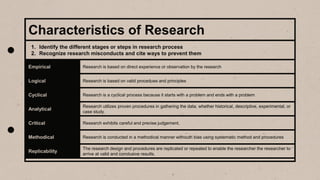
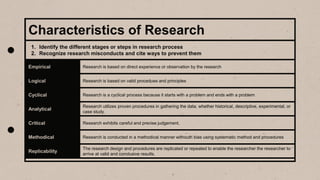
Characteristics of Research
Empirical Research is based on direct experience or observation by the research
Logical Research is based on valid procedues and principles
Cyclical Research is a cyclical process because it starts with a problem and ends with a problem
Analytical
Research utilizes proven procedures in gathering the data, whether historical, descriptive, experimental, or
case study.
Critical Research exhibits careful and precise judgement.
Methodical Research is conducted in a methodical manner withouth bias using systematic method and procedures
Replicability
The research design and procedures are replicated or repeated to enable the researcher the researcher to
arrive at valid and conclusive results.
1. Identify the different stages or steps in research process
2. Recognize research misconducts and cite ways to prevent them
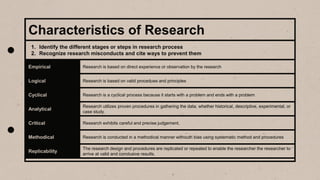
Characteristics of Research
Empirical Research is based on direct experience or observation by the research
Logical Research is based on valid procedues and principles
Cyclical Research is a cyclical process because it starts with a problem and ends with a problem
Analytical
Research utilizes proven procedures in gathering the data, whether historical, descriptive, experimental, or
case study.
Critical Research exhibits careful and precise judgement.
Methodical Research is conducted in a methodical manner withouth bias using systematic method and procedures
Replicability
The research design and procedures are replicated or repeated to enable the researcher the researcher to
arrive at valid and conclusive results.

1. Identify the different stages or steps in research process
2. Recognize research misconducts and cite ways to prevent them
Characteristics of Research
Empirical Research is based on direct experience or observation by the research
Logical Research is based on valid procedues and principles
Cyclical Research is a cyclical process because it starts with a problem and ends with a problem
Analytical
Research utilizes proven procedures in gathering the data, whether historical, descriptive, experimental, or
case study.
Critical Research exhibits careful and precise judgement.
Methodical Research is conducted in a methodical manner withouth bias using systematic method and procedures
Replicability
The research design and procedures are replicated or repeated to enable the researcher the researcher to
arrive at valid and conclusive results.
1. Identify the different stages or steps in research process
2. Recognize research misconducts and cite ways to prevent them
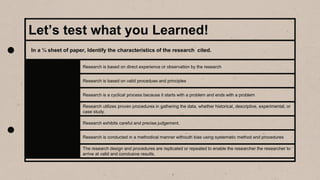
Let’s test what you Learned!
Research is based on direct experience or observation by the research
Research is based on valid procedues and principles
Research is a cyclical process because it starts with a problem and ends with a problem
Research utilizes proven procedures in gathering the data, whether historical, descriptive, experimental, or
case study.
Research exhibits careful and precise judgement.
Research is conducted in a methodical manner withouth bias using systematic method and procedures
The research design and procedures are replicated or repeated to enable the researcher the researcher to
arrive at valid and conclusive results.
In a ¼ sheet of paper, Identify the characteristics of the research cited.
Let’s Test Your
Knowledge!
In a group, you would try to apply the characteristics of a good research to the
research that you used on your Homework.
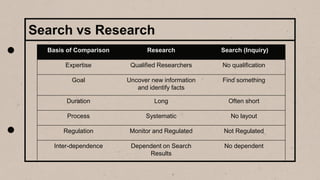
Search vs Research
Basis of Comparison Research Search (Inquiry)
Expertise Qualified Researchers No qualification
Goal Uncover new information
and identify facts
Find something
Duration Long Often short
Process Systematic No layout
Regulation Monitor and Regulated Not Regulated
Inter-dependence Dependent on Search
Results
No dependent
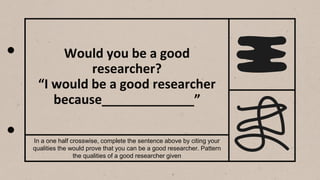
Would you be a good
researcher?
“I would be a good researcher
because_____________”
In a one half crosswise, complete the sentence above by citing your
qualities the would prove that you can be a good researcher. Pattern
the qualities of a good researcher given
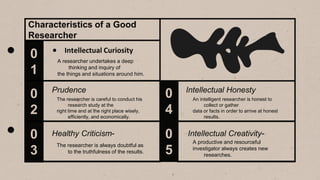
Characteristics of a Good
Researcher
0
1
A researcher undertakes a deep
thinking and inquiry of
the things and situations around him.
0
3
An intelligent researcher is honest to
collect or gather
data or facts in order to arrive at honest
results.
0
4
A productive and resourceful
investigator always creates new
researches.
0
2
The researcher is careful to conduct his
research study at the
right time and at the right place wisely,
efficiently, and economically.
0
5
The researcher is always doubtful as
to the truthfulness of the results.
 Intellectual Curiosity
Prudence
Healthy Criticism-
Intellectual Honesty
Intellectual Creativity-
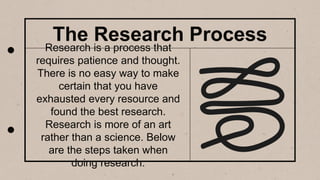
The Research Process
Research is a process that
requires patience and thought.
There is no easy way to make
certain that you have
exhausted every resource and
found the best research.
Research is more of an art
rather than a science. Below
are the steps taken when
doing research.
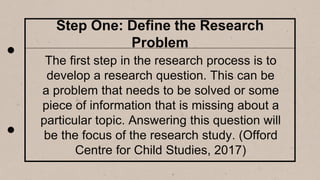
Step One: Define the Research
Problem
The first step in the research process is to
develop a research question. This can be
a problem that needs to be solved or some
piece of information that is missing about a
particular topic. Answering this question will
be the focus of the research study. (Offord
Centre for Child Studies, 2017)
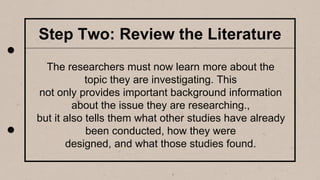
Step Two: Review the Literature
The researchers must now learn more about the
topic they are investigating. This
not only provides important background information
about the issue they are researching.,
but it also tells them what other studies have already
been conducted, how they were
designed, and what those studies found.
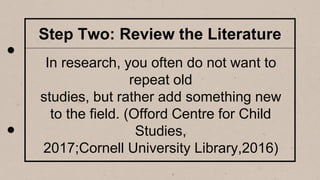
Step Two: Review the Literature
In research, you often do not want to
repeat old
studies, but rather add something new
to the field. (Offord Centre for Child
Studies,
2017;Cornell University Library,2016)
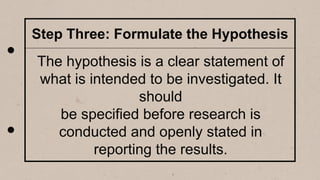
Step Three: Formulate the Hypothesis
The hypothesis is a clear statement of
what is intended to be investigated. It
should
be specified before research is
conducted and openly stated in
reporting the results.
Step Four: Design Research
The research design refers to the
overall strategy that you choose to
integrate the
different components of the study in a
coherent and logical way, thereby,
ensuring you will
effectively address the research
problem;
Step Four: Design Research
it constitutes the blueprint for the
collection,
measurement and analysis of data.
Step Five: Collect Data
The collection of data is a critical step in
providing the information needed to
answer the research question. Every
study includes the collection of some
type of data -whether it is from the
literature or from subjects - to answer
the research question (Blankenship,
2010).
Step Five: Collect Data
Depending on the plan of the research,
data can be collected in the form of
words on a survey, with a
questionnaire, through observations, or
from the literature. (Offord Centre for
Child Studies, 2017; Human Kinetics,
2017
Step Six: Analyze Data & Step Seven:
Interpret and Report
Analysis of data plays an important
role in the achievement of research
aim and objectives. (Dudovskiy,
2016) Once the data have been
collected, these must be analyzed
in order to answer the original
research question
Ethics of Research
Ethics generally is considered to deal with beliefs
about what is right or wrong, proper or improper,
good or bad. According to a dictionary definition
(Webster‘s 1968), to be ethical is to conform to
accepted professional practice.
Ethics of Research
Ethics should be applied in all stages of research from
planning, to gathering of data, to the analysis and
interpretation and evaluation (oral examination) of
the research. Research ethics provides guidelines
for the responsible conduct of research. In addition,
it educates and monitors scientists conducting
research to ensure a high ethical standard.
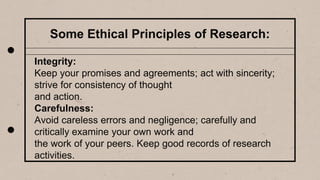
Some Ethical Principles of Research:
Honesty:
Honestly report data, results, methods and procedures,
and publication status. Do not fabricate, falsify, or
misrepresent data.
Objectivity:
Strive to avoid bias in experimental design, data analysis,
data interpretation, peer review, personnel decisions,
grant writing, expert testimony, and other aspects of
research.
Some Ethical Principles of Research:
Integrity:
Keep your promises and agreements; act with sincerity;
strive for consistency of thought
and action.
Carefulness:
Avoid careless errors and negligence; carefully and
critically examine your own work and
the work of your peers. Keep good records of research
activities.
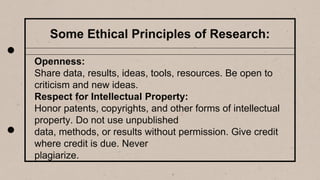
Some Ethical Principles of Research:
Openness:
Share data, results, ideas, tools, resources. Be open to
criticism and new ideas.
Respect for Intellectual Property:
Honor patents, copyrights, and other forms of intellectual
property. Do not use unpublished
data, methods, or results without permission. Give credit
where credit is due. Never
plagiarize.
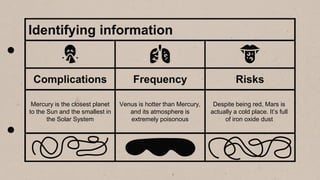
Mercury is the closest planet
to the Sun and the smallest in
the Solar System
Venus is hotter than Mercury,
and its atmosphere is
extremely poisonous
Despite being red, Mars is
actually a cold place. It’s full
of iron oxide dust
Identifying information
Complications Frequency Risks
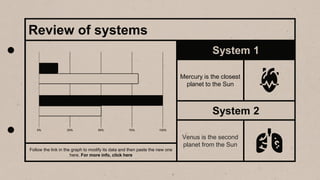
Review of systems
Follow the link in the graph to modify its data and then paste the new one
here. For more info, click here
System 1
System 2
Mercury is the closest
planet to the Sun
Venus is the second
planet from the Sun
Images reveal large amounts of data, so
remember: use an image instead of a long text.
Your audience will appreciate it
Physical
examination
—Someone Famous
“This is a quote, words full of
wisdom that someone important
said and can make the reader get
inspired.”
A picture is worth a
thousand words
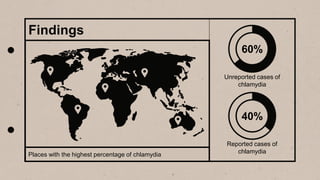
Findings
Places with the highest percentage of chlamydia
60%
40%
Unreported cases of
chlamydia
Reported cases of
chlamydia
“Venus is the second planet from
the Sun”
“Jupiter is the biggest planet of
them all”
“Despite being red, Mars is a cold
place”
“Saturn is a gas giant and has
several rings”
Discussion
Dr. Shawn Murphy Dr. Neil Melendez
Dr. Claire Brown Dr. Audrey Lim
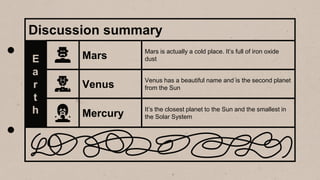
Discussion summary
E
a
r
t
h Mercury
Venus
Mars
It’s the closest planet to the Sun and the smallest in
the Solar System
Venus has a beautiful name and is the second planet
from the Sun
Mars is actually a cold place. It’s full of iron oxide
dust
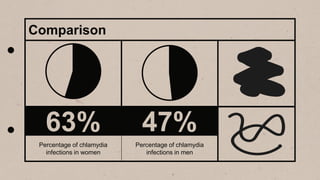
63%
Percentage of chlamydia
infections in women
47%
Percentage of chlamydia
infections in men
Comparison
Awesome
words
Mercury is the closest planet to the
Sun
Neptune is the farthest planet from
the Sun
Jupiter is the biggest planet of
them all
Venus is the second planet from
the Sun
Mars is actually a very cold place
Saturn is composed of hydrogen
and helium
Diagnosis
Urine sample
Tests Vagina
Laboratory Cotton swab
Specimens
Mercury is the closest planet to the Sun and
the smallest one in the Solar System—it’s only
a bit larger than the Moon
Venus has a beautiful name and is the second
planet from the Sun. It’s hotter than Mercury
and its atmosphere is very poisonous
Treatment
Antibiotics Abstinence
You can replace the image on the screen
with your own work. Just right-click on it
and select “Replace image”
Mockup
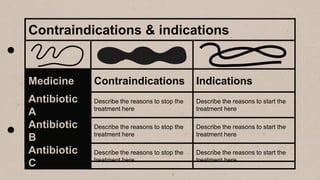
Contraindications & indications
Medicine Contraindications Indications
Antibiotic
A
Describe the reasons to stop the
treatment here
Describe the reasons to start the
treatment here
Antibiotic
B
Describe the reasons to stop the
treatment here
Describe the reasons to start the
treatment here
Antibiotic
C
Describe the reasons to stop the
treatment here
Describe the reasons to start the
treatment here
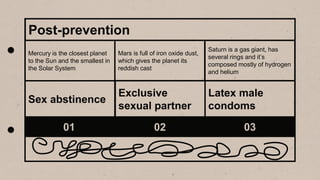
Post-prevention
01 02 03
Sex abstinence
Mercury is the closest planet
to the Sun and the smallest in
the Solar System
Latex male
condoms
Exclusive
sexual partner
Mars is full of iron oxide dust,
which gives the planet its
reddish cast
Saturn is a gas giant, has
several rings and it’s
composed mostly of hydrogen
and helium
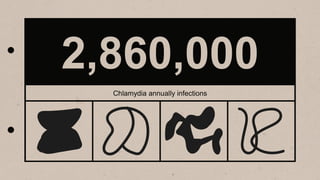
2,860,000
Chlamydia annually infections
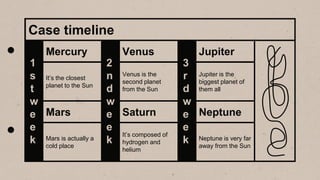
Case timeline
1
s
t
w
e
e
k
Mercury
It’s the closest
planet to the Sun
Mars
Mars is actually a
cold place
2
n
d
w
e
e
k
Venus
Venus is the
second planet
from the Sun
Saturn
It’s composed of
hydrogen and
helium
3
r
d
w
e
e
k
Jupiter
Jupiter is the
biggest planet of
them all
Neptune
Neptune is very far
away from the Sun
Mercury is the closest planet to the Sun and
the smallest one in the Solar System—it’s only
a bit larger than the Moon. The planet’s name
has nothing to do with the liquid metal, since
Mercury was named after a Roman god
Conclusions
● Author (year). Title of the publication. Publisher
References
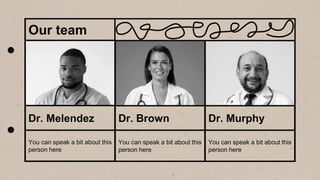
You can speak a bit about this
person here
You can speak a bit about this
person here
You can speak a bit about this
person here
Our team
Dr. Melendez Dr. Brown Dr. Murphy
CREDITS: This presentation template was created by Slidesgo, including
icons by Flaticon, and infographics & images by Freepik
Thanks!
Does anyone have any questions?
addyouremail@freepik.com
+91 620 421 838
yourwebsite.com
Please keep this slide for attribution
Diseases icon pack
Here’s an assortment of alternative resources whose style fits the one of this template:
Alternative resources
Did you like the resources of this template?
Get them for free at our other websites!
Photos:
● Recycled paper texture
● Doctor putting on surgical gloves with
copy space
● Front view of female doctor holding
stethoscope with copy space
● Close up on doctor getting ready for
work
Resources
● Close up on health worker
Icons:
● Diseases filled icon pack
For more information about editing slides, please read our FAQs or visit our blog:
https://slidesgo.com/faqs and https://slidesgo.com/slidesgo-school
Instructions for use
If you have a free account, in order to use this template, you must credit Slidesgo by keeping the Thanks slide. Please
refer to the next slide to read the instructions for premium users.
As a Free user, you are allowed to:
- Modify this template.
- Use it for both personal and commercial projects.
You are not allowed to:
- Sublicense, sell or rent any of Slidesgo Content (or a modified version of Slidesgo Content).
- Distribute Slidesgo Content unless it has been expressly authorized by Slidesgo.
- Include Slidesgo Content in an online or offline database or file.
- Offer Slidesgo templates (or modified versions of Slidesgo templates) for download.
- Acquire the copyright of Slidesgo Content.
As a Premium user, you can use this template without attributing Slidesgo or keeping the "Thanks" slide.
You are allowed to:
● Modify this template.
● Use it for both personal and commercial purposes.
● Hide or delete the “Thanks” slide and the mention to Slidesgo in the credits.
● Share this template in an editable format with people who are not part of your team.
You are not allowed to:
● Sublicense, sell or rent this Slidesgo Template (or a modified version of this Slidesgo Template).
● Distribute this Slidesgo Template (or a modified version of this Slidesgo Template) or include it in a database or in
any other product or service that offers downloadable images, icons or presentations that may be subject to
distribution or resale.
● Use any of the elements that are part of this Slidesgo Template in an isolated and separated way from this
Template.
● Register any of the elements that are part of this template as a trademark or logo, or register it as a work in an
intellectual property registry or similar.
For more information about editing slides, please read our FAQs or visit our blog:
https://slidesgo.com/faqs and https://slidesgo.com/slidesgo-school
Instructions for use (premium users)
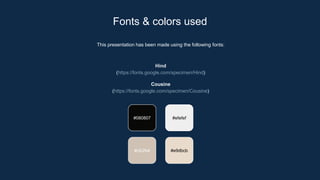
This presentation has been made using the following fonts:
Hind
(https://fonts.google.com/specimen/Hind)
Cousine
(https://fonts.google.com/specimen/Cousine)
#080807 #efefef
#cfc2b4 #e9dbcb
Fonts & colors used
Create your Story with our illustrated concepts. Choose the style you like the most, edit its colors, pick
the background and layers you want to show and bring them to life with the animator panel! It will boost
your presentation. Check out how it works.
Storyset
Pana Amico Bro Rafiki Cuate
You can easily resize these resources without losing quality. To change the color, just ungroup the resource
and click on the object you want to change. Then, click on the paint bucket and select the color you want.
Group the resource again when you’re done. You can also look for more infographics on Slidesgo.
Use our editable graphic resources...
JANUARY FEBRUARY MARCH APRIL MAY JUNE
PHASE 1
PHASE 2
Task 1
Task 2
Task 1
Task 2
JANUARY FEBRUARY MARCH APRIL
PHASE 1
Task 1
Task 2
You can resize these icons without losing quality.
You can change the stroke and fill color; just select the icon and click on the paint bucket/pen.
In Google Slides, you can also use Flaticon’s extension, allowing you to customize and add even more icons.
...and our sets of editable icons
Educational Icons Medical Icons
Business Icons Teamwork Icons
Help & Support Icons Avatar Icons
Creative Process Icons Performing Arts Icons
Nature Icons
SEO & Marketing Icons
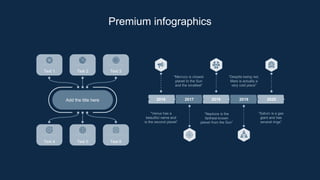
Add the title here
Text 1 Text 2 Text 3
Text 4 Text 5 Text 6
2016 2017 2018 2019 2020
“Despite being red,
Mars is actually a
very cold place”
“Mercury is closest
planet to the Sun
and the smallest”
“Neptune is the
farthest-known
planet from the Sun”
“Saturn is a gas
giant and has
several rings”
“Venus has a
beautiful name and
is the second planet”
Premium infographics
“Mercury is closest
planet to the Sun
and the smallest”
“Mercury is closest
planet to the Sun
and the smallest”
“Mercury is closest
planet to the Sun
and the smallest”
“Mercury is closest
planet to the Sun
and the smallest”
TITLE 1
75%
75%
Premium infographics
Digital Marketing
Premium Icons
Online Learning
Premium Icons
Laboratory
Premium Icons
Goals & Results
Premium Icons
Infographic Elements
Premium Icons
PR1 Lesson 2.pptx

PR1 Lesson 2.pptx

  • 1.
  • 2.
  • 3.
    When can wesay that research is of good quality? When can we say that it is not of good quality?”
  • 4.
    Characteristics of Research EmpiricalResearch is based on direct experience or observation by the research Logical Research is based on valid procedues and principles Cyclical Research is a cyclical process because it starts with a problem and ends with a problem Analytical Research utilizes proven procedures in gathering the data, whether historical, descriptive, experimental, or case study. Critical Research exhibits careful and precise judgement. Methodical Research is conducted in a methodical manner withouth bias using systematic method and procedures Replicability The research design and procedures are replicated or repeated to enable the researcher the researcher to arrive at valid and conclusive results. 1. Identify the different stages or steps in research process 2. Recognize research misconducts and cite ways to prevent them
  • 5.
    Characteristics of Research EmpiricalResearch is based on direct experience or observation by the research Logical Research is based on valid procedues and principles Cyclical Research is a cyclical process because it starts with a problem and ends with a problem Analytical Research utilizes proven procedures in gathering the data, whether historical, descriptive, experimental, or case study. Critical Research exhibits careful and precise judgement. Methodical Research is conducted in a methodical manner withouth bias using systematic method and procedures Replicability The research design and procedures are replicated or repeated to enable the researcher the researcher to arrive at valid and conclusive results. 1. Identify the different stages or steps in research process 2. Recognize research misconducts and cite ways to prevent them
  • 6.
    Characteristics of Research EmpiricalResearch is based on direct experience or observation by the research Logical Research is based on valid procedues and principles Cyclical Research is a cyclical process because it starts with a problem and ends with a problem Analytical Research utilizes proven procedures in gathering the data, whether historical, descriptive, experimental, or case study. Critical Research exhibits careful and precise judgement. Methodical Research is conducted in a methodical manner withouth bias using systematic method and procedures Replicability The research design and procedures are replicated or repeated to enable the researcher the researcher to arrive at valid and conclusive results. 1. Identify the different stages or steps in research process 2. Recognize research misconducts and cite ways to prevent them
  • 7.
    Let’s test whatyou Learned! Research is based on direct experience or observation by the research Research is based on valid procedues and principles Research is a cyclical process because it starts with a problem and ends with a problem Research utilizes proven procedures in gathering the data, whether historical, descriptive, experimental, or case study. Research exhibits careful and precise judgement. Research is conducted in a methodical manner withouth bias using systematic method and procedures The research design and procedures are replicated or repeated to enable the researcher the researcher to arrive at valid and conclusive results. In a ¼ sheet of paper, Identify the characteristics of the research cited.
  • 8.
    Let’s Test Your Knowledge! Ina group, you would try to apply the characteristics of a good research to the research that you used on your Homework.
  • 9.
    Search vs Research Basisof Comparison Research Search (Inquiry) Expertise Qualified Researchers No qualification Goal Uncover new information and identify facts Find something Duration Long Often short Process Systematic No layout Regulation Monitor and Regulated Not Regulated Inter-dependence Dependent on Search Results No dependent
  • 10.
    Would you bea good researcher? “I would be a good researcher because_____________” In a one half crosswise, complete the sentence above by citing your qualities the would prove that you can be a good researcher. Pattern the qualities of a good researcher given
  • 11.
    Characteristics of aGood Researcher 0 1 A researcher undertakes a deep thinking and inquiry of the things and situations around him. 0 3 An intelligent researcher is honest to collect or gather data or facts in order to arrive at honest results. 0 4 A productive and resourceful investigator always creates new researches. 0 2 The researcher is careful to conduct his research study at the right time and at the right place wisely, efficiently, and economically. 0 5 The researcher is always doubtful as to the truthfulness of the results.  Intellectual Curiosity Prudence Healthy Criticism- Intellectual Honesty Intellectual Creativity-
  • 12.
    The Research Process Researchis a process that requires patience and thought. There is no easy way to make certain that you have exhausted every resource and found the best research. Research is more of an art rather than a science. Below are the steps taken when doing research.
  • 13.
    Step One: Definethe Research Problem The first step in the research process is to develop a research question. This can be a problem that needs to be solved or some piece of information that is missing about a particular topic. Answering this question will be the focus of the research study. (Offord Centre for Child Studies, 2017)
  • 14.
    Step Two: Reviewthe Literature The researchers must now learn more about the topic they are investigating. This not only provides important background information about the issue they are researching., but it also tells them what other studies have already been conducted, how they were designed, and what those studies found.
  • 15.
    Step Two: Reviewthe Literature In research, you often do not want to repeat old studies, but rather add something new to the field. (Offord Centre for Child Studies, 2017;Cornell University Library,2016)
  • 16.
    Step Three: Formulatethe Hypothesis The hypothesis is a clear statement of what is intended to be investigated. It should be specified before research is conducted and openly stated in reporting the results.
  • 17.
    Step Four: DesignResearch The research design refers to the overall strategy that you choose to integrate the different components of the study in a coherent and logical way, thereby, ensuring you will effectively address the research problem;
  • 18.
    Step Four: DesignResearch it constitutes the blueprint for the collection, measurement and analysis of data.
  • 19.
    Step Five: CollectData The collection of data is a critical step in providing the information needed to answer the research question. Every study includes the collection of some type of data -whether it is from the literature or from subjects - to answer the research question (Blankenship, 2010).
  • 20.
    Step Five: CollectData Depending on the plan of the research, data can be collected in the form of words on a survey, with a questionnaire, through observations, or from the literature. (Offord Centre for Child Studies, 2017; Human Kinetics, 2017
  • 21.
    Step Six: AnalyzeData & Step Seven: Interpret and Report Analysis of data plays an important role in the achievement of research aim and objectives. (Dudovskiy, 2016) Once the data have been collected, these must be analyzed in order to answer the original research question
  • 22.
    Ethics of Research Ethicsgenerally is considered to deal with beliefs about what is right or wrong, proper or improper, good or bad. According to a dictionary definition (Webster‘s 1968), to be ethical is to conform to accepted professional practice.
  • 23.
    Ethics of Research Ethicsshould be applied in all stages of research from planning, to gathering of data, to the analysis and interpretation and evaluation (oral examination) of the research. Research ethics provides guidelines for the responsible conduct of research. In addition, it educates and monitors scientists conducting research to ensure a high ethical standard.
  • 24.
    Some Ethical Principlesof Research: Honesty: Honestly report data, results, methods and procedures, and publication status. Do not fabricate, falsify, or misrepresent data. Objectivity: Strive to avoid bias in experimental design, data analysis, data interpretation, peer review, personnel decisions, grant writing, expert testimony, and other aspects of research.
  • 25.
    Some Ethical Principlesof Research: Integrity: Keep your promises and agreements; act with sincerity; strive for consistency of thought and action. Carefulness: Avoid careless errors and negligence; carefully and critically examine your own work and the work of your peers. Keep good records of research activities.
  • 26.
    Some Ethical Principlesof Research: Openness: Share data, results, ideas, tools, resources. Be open to criticism and new ideas. Respect for Intellectual Property: Honor patents, copyrights, and other forms of intellectual property. Do not use unpublished data, methods, or results without permission. Give credit where credit is due. Never plagiarize.
  • 27.
    Mercury is theclosest planet to the Sun and the smallest in the Solar System Venus is hotter than Mercury, and its atmosphere is extremely poisonous Despite being red, Mars is actually a cold place. It’s full of iron oxide dust Identifying information Complications Frequency Risks
  • 29.
    Review of systems Followthe link in the graph to modify its data and then paste the new one here. For more info, click here System 1 System 2 Mercury is the closest planet to the Sun Venus is the second planet from the Sun
  • 30.
    Images reveal largeamounts of data, so remember: use an image instead of a long text. Your audience will appreciate it Physical examination
  • 31.
    —Someone Famous “This isa quote, words full of wisdom that someone important said and can make the reader get inspired.”
  • 32.
    A picture isworth a thousand words
  • 33.
    Findings Places with thehighest percentage of chlamydia 60% 40% Unreported cases of chlamydia Reported cases of chlamydia
  • 34.
    “Venus is thesecond planet from the Sun” “Jupiter is the biggest planet of them all” “Despite being red, Mars is a cold place” “Saturn is a gas giant and has several rings” Discussion Dr. Shawn Murphy Dr. Neil Melendez Dr. Claire Brown Dr. Audrey Lim
  • 35.
    Discussion summary E a r t h Mercury Venus Mars It’sthe closest planet to the Sun and the smallest in the Solar System Venus has a beautiful name and is the second planet from the Sun Mars is actually a cold place. It’s full of iron oxide dust
  • 36.
    63% Percentage of chlamydia infectionsin women 47% Percentage of chlamydia infections in men Comparison
  • 37.
  • 38.
    Mercury is theclosest planet to the Sun Neptune is the farthest planet from the Sun Jupiter is the biggest planet of them all Venus is the second planet from the Sun Mars is actually a very cold place Saturn is composed of hydrogen and helium Diagnosis Urine sample Tests Vagina Laboratory Cotton swab Specimens
  • 39.
    Mercury is theclosest planet to the Sun and the smallest one in the Solar System—it’s only a bit larger than the Moon Venus has a beautiful name and is the second planet from the Sun. It’s hotter than Mercury and its atmosphere is very poisonous Treatment Antibiotics Abstinence
  • 40.
    You can replacethe image on the screen with your own work. Just right-click on it and select “Replace image” Mockup
  • 41.
    Contraindications & indications MedicineContraindications Indications Antibiotic A Describe the reasons to stop the treatment here Describe the reasons to start the treatment here Antibiotic B Describe the reasons to stop the treatment here Describe the reasons to start the treatment here Antibiotic C Describe the reasons to stop the treatment here Describe the reasons to start the treatment here
  • 42.
    Post-prevention 01 02 03 Sexabstinence Mercury is the closest planet to the Sun and the smallest in the Solar System Latex male condoms Exclusive sexual partner Mars is full of iron oxide dust, which gives the planet its reddish cast Saturn is a gas giant, has several rings and it’s composed mostly of hydrogen and helium
  • 43.
  • 44.
    Case timeline 1 s t w e e k Mercury It’s theclosest planet to the Sun Mars Mars is actually a cold place 2 n d w e e k Venus Venus is the second planet from the Sun Saturn It’s composed of hydrogen and helium 3 r d w e e k Jupiter Jupiter is the biggest planet of them all Neptune Neptune is very far away from the Sun
  • 45.
    Mercury is theclosest planet to the Sun and the smallest one in the Solar System—it’s only a bit larger than the Moon. The planet’s name has nothing to do with the liquid metal, since Mercury was named after a Roman god Conclusions
  • 46.
    ● Author (year).Title of the publication. Publisher ● Author (year). Title of the publication. Publisher ● Author (year). Title of the publication. Publisher ● Author (year). Title of the publication. Publisher ● Author (year). Title of the publication. Publisher ● Author (year). Title of the publication. Publisher References
  • 47.
    You can speaka bit about this person here You can speak a bit about this person here You can speak a bit about this person here Our team Dr. Melendez Dr. Brown Dr. Murphy
  • 48.
    CREDITS: This presentationtemplate was created by Slidesgo, including icons by Flaticon, and infographics & images by Freepik Thanks! Does anyone have any questions? addyouremail@freepik.com +91 620 421 838 yourwebsite.com Please keep this slide for attribution
  • 49.
  • 50.
    Here’s an assortmentof alternative resources whose style fits the one of this template: Alternative resources
  • 51.
    Did you likethe resources of this template? Get them for free at our other websites! Photos: ● Recycled paper texture ● Doctor putting on surgical gloves with copy space ● Front view of female doctor holding stethoscope with copy space ● Close up on doctor getting ready for work Resources ● Close up on health worker ● Close up on health worker Icons: ● Diseases filled icon pack
  • 52.
    For more informationabout editing slides, please read our FAQs or visit our blog: https://slidesgo.com/faqs and https://slidesgo.com/slidesgo-school Instructions for use If you have a free account, in order to use this template, you must credit Slidesgo by keeping the Thanks slide. Please refer to the next slide to read the instructions for premium users. As a Free user, you are allowed to: - Modify this template. - Use it for both personal and commercial projects. You are not allowed to: - Sublicense, sell or rent any of Slidesgo Content (or a modified version of Slidesgo Content). - Distribute Slidesgo Content unless it has been expressly authorized by Slidesgo. - Include Slidesgo Content in an online or offline database or file. - Offer Slidesgo templates (or modified versions of Slidesgo templates) for download. - Acquire the copyright of Slidesgo Content.
  • 53.
    As a Premiumuser, you can use this template without attributing Slidesgo or keeping the "Thanks" slide. You are allowed to: ● Modify this template. ● Use it for both personal and commercial purposes. ● Hide or delete the “Thanks” slide and the mention to Slidesgo in the credits. ● Share this template in an editable format with people who are not part of your team. You are not allowed to: ● Sublicense, sell or rent this Slidesgo Template (or a modified version of this Slidesgo Template). ● Distribute this Slidesgo Template (or a modified version of this Slidesgo Template) or include it in a database or in any other product or service that offers downloadable images, icons or presentations that may be subject to distribution or resale. ● Use any of the elements that are part of this Slidesgo Template in an isolated and separated way from this Template. ● Register any of the elements that are part of this template as a trademark or logo, or register it as a work in an intellectual property registry or similar. For more information about editing slides, please read our FAQs or visit our blog: https://slidesgo.com/faqs and https://slidesgo.com/slidesgo-school Instructions for use (premium users)
  • 54.
    This presentation hasbeen made using the following fonts: Hind (https://fonts.google.com/specimen/Hind) Cousine (https://fonts.google.com/specimen/Cousine) #080807 #efefef #cfc2b4 #e9dbcb Fonts & colors used
  • 55.
    Create your Storywith our illustrated concepts. Choose the style you like the most, edit its colors, pick the background and layers you want to show and bring them to life with the animator panel! It will boost your presentation. Check out how it works. Storyset Pana Amico Bro Rafiki Cuate
  • 56.
    You can easilyresize these resources without losing quality. To change the color, just ungroup the resource and click on the object you want to change. Then, click on the paint bucket and select the color you want. Group the resource again when you’re done. You can also look for more infographics on Slidesgo. Use our editable graphic resources...
  • 59.
    JANUARY FEBRUARY MARCHAPRIL MAY JUNE PHASE 1 PHASE 2 Task 1 Task 2 Task 1 Task 2 JANUARY FEBRUARY MARCH APRIL PHASE 1 Task 1 Task 2
  • 62.
    You can resizethese icons without losing quality. You can change the stroke and fill color; just select the icon and click on the paint bucket/pen. In Google Slides, you can also use Flaticon’s extension, allowing you to customize and add even more icons. ...and our sets of editable icons
  • 63.
  • 64.
  • 65.
    Help & SupportIcons Avatar Icons
  • 66.
    Creative Process IconsPerforming Arts Icons
  • 67.
  • 68.
  • 69.
    Add the titlehere Text 1 Text 2 Text 3 Text 4 Text 5 Text 6 2016 2017 2018 2019 2020 “Despite being red, Mars is actually a very cold place” “Mercury is closest planet to the Sun and the smallest” “Neptune is the farthest-known planet from the Sun” “Saturn is a gas giant and has several rings” “Venus has a beautiful name and is the second planet” Premium infographics
  • 70.
    “Mercury is closest planetto the Sun and the smallest” “Mercury is closest planet to the Sun and the smallest” “Mercury is closest planet to the Sun and the smallest” “Mercury is closest planet to the Sun and the smallest” TITLE 1 75% 75% Premium infographics
  • 71.
  • 72.
  • 73.
  • 74.
  • 75.