The Academic Writing Task No reason to wrinkle your nose. How to succeed: understand what you are writing about approach the task with no fear
Myths about writing Myth #1: The “Paint by Numbers” myth Myth #2: Writers only start writing when they have everything figured out Myth #3: Perfect first drafts
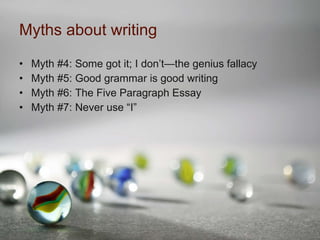
Myths about writing Myth #4: Some got it; I don’t—the genius fallacy Myth #5: Good grammar is good writing Myth #6: The Five Paragraph Essay Myth #7: Never use “I”
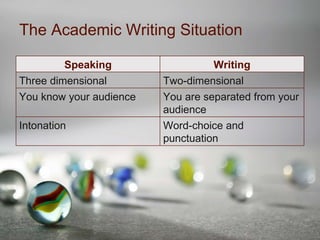
The Academic Writing Situation Speaking Writing Three dimensional Two-dimensional You know your audience You are separated from your audience Intonation Word-choice and punctuation
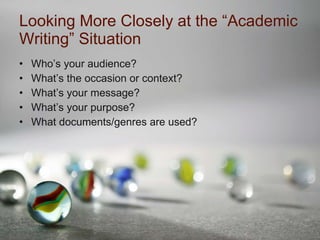
Looking More Closely at the “Academic Writing” Situation Who’s your audience? What’s the occasion or context? What’s your message? What’s your purpose? What documents/genres are used?
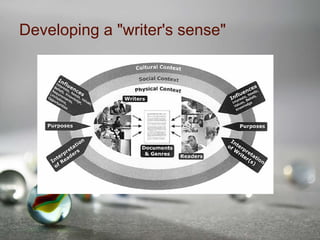
Developing a "writer's sense"
So... What's new? Research Skills Complex Texts Disciplinary Concepts Strategies for: Synthesizing Analyzing Responding Critically
Academic Writing Is an Argument Argument: carefully arranged and supported presentation of a viewpoint. Purpose: not so much to win the argument as to earn your audience’s consideration (and even approval) of your perspective. Courtroom analogy. Stating your opinion is not enough—you have to back it up too.
Academic Writing Is an Analysis Don’t write a summary unless directly asked to. You can count on the instructor expecting you to: Read closely Research adequately Write an argument where you will demonstrate your ability to apply and use important concepts you have been studying. An analysis breaks a subject apart to study it closely, and from this inspection, ideas for writing emerge.
Academic Writing Is an Analysis When writing assignments call on you to analyze, they require you to: Identify the parts of the subject (parts of an ad, parts of a short story, parts of Hamlet’s character) Show how these parts fit or don’t fit together to create some larger effect or meaning. Your interpretation of how these parts fit together constitutes your claim or thesis.
Three Common Types of College Writing Assignments The Closed Writing Assignment: In your opinion, do you believe Hamlet was truly mad? These kinds of writing assignments present you with two counter claims and ask you to determine from your own analysis the more valid claim. These topics define the claim for you, so the major task of the writing assignment then is working out the support for the claim.
Three Common Types of College Writing Assignments The Semi-Open Writing Assignment: Discuss the role of law in Antigone. Explain the relationship between character and fate in Hamlet. Although these topics chart out a subject matter for you to write upon, they don’t offer up claims you can easily use in your paper.
Three Common Types of College Writing Assignments The Semi-Open Writing Assignment: The question, for example, is not whether law plays a role in Antígone (we already take for granted it does), but rather what sort of role law plays. Your eventual paper, then, needs to present what you found from this analysis—the treasure you found from your digging.
Three Common Types of College Writing Assignments The Open Writing Assignment  Analyze the role of a character in Dante’s The Inferno What does it mean to be an “American” in the 21st Century? Decide both your writing topic and your thesis. Understand the subject well before choosing a topic. Limit your text to a manageable size.
Picking and Limiting a Writing Topic Look for things that interest you. State the topic clearly. Size: not too broad, not too restricted.
Three Characteristics of Academic Writing Clear evidence in writing that the writer has been persistent, open-minded, and disciplined in study. The dominance of reason over emotions or sensual perception. An imagined reader who is coolly rational, reading for information, and intending to formulate a reasoned response.
The Format of the Academic Essay Make a point and support it. The thesis is debatable and open to interpretation, not a statement of the obvious. Organization: introduction, body, and conclusion. Every assertion needs support.
The Format of the Academic Essay Present the sources of outside information. Transition when moving from one point to another. Pay attention to MLA or APA document formats. Check grammar and revise.
Conclusion Write consciously. Thinking, hard work, and practice.
References IRVIN, L. Lennie. “What is academic writing?” ZEMLIANSKY, Pavel, LOWE, Charles (ed.). Writing Spaces: Readings on Writing. Indiana: Parlour Press, 2010. 6 Set 2011 <http://writingspaces.org/sites/default/files/irvin--what-is-academic-writing.pdf>
THANK YOU

What is academic writing

  • 1.
  • 2.
    The Academic WritingTask No reason to wrinkle your nose. How to succeed: understand what you are writing about approach the task with no fear
  • 3.
    Myths about writingMyth #1: The “Paint by Numbers” myth Myth #2: Writers only start writing when they have everything figured out Myth #3: Perfect first drafts
  • 4.
    Myths about writingMyth #4: Some got it; I don’t—the genius fallacy Myth #5: Good grammar is good writing Myth #6: The Five Paragraph Essay Myth #7: Never use “I”
  • 5.
    The Academic WritingSituation Speaking Writing Three dimensional Two-dimensional You know your audience You are separated from your audience Intonation Word-choice and punctuation
  • 6.
    Looking More Closelyat the “Academic Writing” Situation Who’s your audience? What’s the occasion or context? What’s your message? What’s your purpose? What documents/genres are used?
  • 7.
  • 8.
    So... What's new?Research Skills Complex Texts Disciplinary Concepts Strategies for: Synthesizing Analyzing Responding Critically
  • 9.
    Academic Writing Isan Argument Argument: carefully arranged and supported presentation of a viewpoint. Purpose: not so much to win the argument as to earn your audience’s consideration (and even approval) of your perspective. Courtroom analogy. Stating your opinion is not enough—you have to back it up too.
  • 10.
    Academic Writing Isan Analysis Don’t write a summary unless directly asked to. You can count on the instructor expecting you to: Read closely Research adequately Write an argument where you will demonstrate your ability to apply and use important concepts you have been studying. An analysis breaks a subject apart to study it closely, and from this inspection, ideas for writing emerge.
  • 11.
    Academic Writing Isan Analysis When writing assignments call on you to analyze, they require you to: Identify the parts of the subject (parts of an ad, parts of a short story, parts of Hamlet’s character) Show how these parts fit or don’t fit together to create some larger effect or meaning. Your interpretation of how these parts fit together constitutes your claim or thesis.
  • 12.
    Three Common Typesof College Writing Assignments The Closed Writing Assignment: In your opinion, do you believe Hamlet was truly mad? These kinds of writing assignments present you with two counter claims and ask you to determine from your own analysis the more valid claim. These topics define the claim for you, so the major task of the writing assignment then is working out the support for the claim.
  • 13.
    Three Common Typesof College Writing Assignments The Semi-Open Writing Assignment: Discuss the role of law in Antigone. Explain the relationship between character and fate in Hamlet. Although these topics chart out a subject matter for you to write upon, they don’t offer up claims you can easily use in your paper.
  • 14.
    Three Common Typesof College Writing Assignments The Semi-Open Writing Assignment: The question, for example, is not whether law plays a role in Antígone (we already take for granted it does), but rather what sort of role law plays. Your eventual paper, then, needs to present what you found from this analysis—the treasure you found from your digging.
  • 15.
    Three Common Typesof College Writing Assignments The Open Writing Assignment Analyze the role of a character in Dante’s The Inferno What does it mean to be an “American” in the 21st Century? Decide both your writing topic and your thesis. Understand the subject well before choosing a topic. Limit your text to a manageable size.
  • 16.
    Picking and Limitinga Writing Topic Look for things that interest you. State the topic clearly. Size: not too broad, not too restricted.
  • 17.
    Three Characteristics ofAcademic Writing Clear evidence in writing that the writer has been persistent, open-minded, and disciplined in study. The dominance of reason over emotions or sensual perception. An imagined reader who is coolly rational, reading for information, and intending to formulate a reasoned response.
  • 18.
    The Format ofthe Academic Essay Make a point and support it. The thesis is debatable and open to interpretation, not a statement of the obvious. Organization: introduction, body, and conclusion. Every assertion needs support.
  • 19.
    The Format ofthe Academic Essay Present the sources of outside information. Transition when moving from one point to another. Pay attention to MLA or APA document formats. Check grammar and revise.
  • 20.
    Conclusion Write consciously.Thinking, hard work, and practice.
  • 21.
    References IRVIN, L.Lennie. “What is academic writing?” ZEMLIANSKY, Pavel, LOWE, Charles (ed.). Writing Spaces: Readings on Writing. Indiana: Parlour Press, 2010. 6 Set 2011 <http://writingspaces.org/sites/default/files/irvin--what-is-academic-writing.pdf>
  • 22.