Writing For AcademicJournals 3rd Rowena Murray
download
https://ebookbell.com/product/writing-for-academic-journals-3rd-
rowena-murray-6985638
Explore and download more ebooks at ebookbell.com
2.
Here are somerecommended products that we believe you will be
interested in. You can click the link to download.
Writing For Academic Journals 4th Edition Rowena Murray
https://ebookbell.com/product/writing-for-academic-journals-4th-
edition-rowena-murray-56883448
Writing For Academic Journals 2nd Edition Rowena Murray
https://ebookbell.com/product/writing-for-academic-journals-2nd-
edition-rowena-murray-2339560
Writing For Academic Journals Study Skills S 1st Edition Rowena Murray
https://ebookbell.com/product/writing-for-academic-journals-study-
skills-s-1st-edition-rowena-murray-2443924
Writing For Academic Success Student Success 2nd Edition Gail Craswell
https://ebookbell.com/product/writing-for-academic-success-student-
success-2nd-edition-gail-craswell-52506934
3.
Commentary For AcademicWriting For Graduate Students John M Swales
https://ebookbell.com/product/commentary-for-academic-writing-for-
graduate-students-john-m-swales-47394560
Commentary For Academic Writing For Graduate Students 2d Ed Essential
Tasks And Skills Michigan Series In English For Academic Professional
Purposes 2nd Swales
https://ebookbell.com/product/commentary-for-academic-writing-for-
graduate-students-2d-ed-essential-tasks-and-skills-michigan-series-in-
english-for-academic-professional-purposes-2nd-swales-35088828
Teaching Writing For Academic Purposes To Multilingual Students John
Bitchener
https://ebookbell.com/product/teaching-writing-for-academic-purposes-
to-multilingual-students-john-bitchener-46483828
The Easy Writer Formal Writing For Academic Purpose 3rd Ed Winifred
Belmont
https://ebookbell.com/product/the-easy-writer-formal-writing-for-
academic-purpose-3rd-ed-winifred-belmont-10345860
A Practical Writing Guide For Academic Librarians Keeping It Short And
Sweet Anne Langley Jonathan David Wallace
https://ebookbell.com/product/a-practical-writing-guide-for-academic-
librarians-keeping-it-short-and-sweet-anne-langley-jonathan-david-
wallace-56934334
5.
Streamline the processof
writing academic papers
Target a journal, find
topics and develop
arguments
Make time to write
Get to grips with using
social media
Rowena Murray
Open UP Study Skills
Writing for
Academic Journals
Writing for Academic Journals
Third Edition
Praise for the second edition of Writing for Academic Journals:
"Academics are expected to write but seldom consider and discuss the nature
of academic writing. As a result, the practice is shrouded in mystery. Writing for
Academic Journals makes explicit much of what is normally opaque and it should be
among the first ports of call for any academic who is contemplating getting published.
This new edition achieves the near-impossible: improving on what was already
acknowledged as a first-rate compendium".
Professor Ronald Barnett, Institute of Education, University of London, UK
"Our experience is that Rowena's practical approach works for busy academic staff. Not
only does it enable them to increase their publication output and meet deadlines, but it
boosts enthusiasm for writing and stimulates creative thinking."
Kate Morss, Director, Queen Margaret University College, Edinburgh, UK
Writing for publication is a daunting and time-consuming task for many academics. And
yet the pressure for academics to publish has never been greater. This book demystifies
the process of writing academic papers, showing readers what good papers look like and
how they can be written.
Offering a research-informed understanding of the contemporary challenges of writing
for publication, this book gives practical advice for overcoming common obstacles such
as finding a topic, targeting journals and finding the time to write. The author offers a
range of helpful writing strategies, making this an invaluable handbook for academics
at all stages of their career, from doctoral students to early career researchers and even
experienced academics.
The third edition has been comprehensively updated to reflect the changing landscape
of academic writing, including the most recent research and theory on writing across
the disciplines. Drawing on her extensive experience of running writing workshops and
working closely with academics on developing writing, Rowena Murray offers practical
and tested strategies for good academic writing.
New to the third edition:
Advice on how to use social media to promote your publications
More examples from different disciplines and journals
More advice on how to tackle writer’s block
Extended end-of-chapter checklists
New evidence that these strategies really work!
Rowena Murray is Professor of Education at the University of the West of Scotland.
www.openup.co.uk
Cover design by Naomi Mitchell
3rd
edition
Writing
for
Academic
Journals
Third
Edition
Rowena
Murray
6.
Writing for AcademicJournals
Third edition
25540.indb i
25540.indb i 16/08/2013 09:11
16/08/2013 09:11
Contents
Preface xi
Acknowledgements xiii
Introduction:Beyond reason and vanity 1
This book 2
Further reading 3
1 Why write for academic journals? 5
Reasons for writing 6
Reasons for publishing 7
Internal and external drivers 7
Career implications 9
Research profile 11
What is academic writing? 11
What can research on academic writing tell us? 13
Can it be learned? 15
Is it innate? 18
What is ‘research’? 19
Reasons for not writing 23
‘I haven’t done any research’ 25
Intellectual capacity 25
Turgid writing 26
Narrow range 27
Pre-peer review 28
Guilt, fear and anxiety 29
Procrastination 31
The writing self 32
Team and collaborative writing 33
Barriers to writing 34
An integrative strategy 35
Checklist 36
Further reading 37
25540.indb vii
25540.indb vii 16/08/2013 09:11
16/08/2013 09:11
13.
viii CONTENTS
2 Targetinga journal 38
‘That’s interesting!’ 39
Getting to know the journals 40
Judging journals 42
Journals that ‘count’ 43
Choosing a journal 43
Peer reviewed or professional? 44
Instructions for authors 46
Journal resources for authors 46
Websites for authors 47
Analysing a journal 47
Working out what is acceptable 57
Analysing abstracts 57
Defining genre 62
Joining the conversation 64
Cloning or creativity? 65
Mediating 66
Personal negotiations 66
Contacting the editor 67
Editors’ responses 69
Wait time 69
Checklist 70
Further reading 70
3 Finding time to write 71
Incremental writing 74
‘Binge’ or ‘snack’? 75
A writing plan 76
Goal setting 80
30-minute slots 84
Monitoring progress 84
Creating a place for writing in your life 85
Becoming a regular writer 87
From process to programme 88
Writer’s block 89
Checklist 90
Further reading 91
4 Finding a topic and developing an argument 92
Finding a topic 93
Conference presentations 94
Thesis 97
Freewriting 97
25540.indb viii
25540.indb viii 16/08/2013 09:11
16/08/2013 09:11
14.
CONTENTS ix
Generative writing104
Writing to prompts 105
The writing ‘sandwich’ 108
Finding readers: critic, mentor, buddy and others 113
Finding a voice 114
Finding an argument 115
Formulating a hypothesis 116
Constructing an argument 117
The quality question 118
Calibrating your topic 118
Writing a working title 119
Checklist 119
Further reading 120
5 Outlining 121
Level 3 outlining 127
Allocating word lengths 131
Writing a 275-word abstract – Brown’s 8 questions 131
Writing a 375-word abstract – Murray’s 10 prompts 137
Calibrating your outline 138
Checklist 140
Further reading 140
6 Drafting 141
What constitutes good writing in journals? 142
Shaping sections 150
Streamlining 151
Turning headings into prompts 152
Internal critique 160
Checklist 161
Further reading 161
7 Revising the draft 162
Foregrounding generic aspects of academic style 164
Revising the outline 167
Revising drafts 168
Generative writing 170
Using the writers’ group 171
The critical friend and the ‘tame’ subject expert 171
Revision processes 172
Iterative processes 173
Developing a concise style 174
Grammar 174
25540.indb ix
25540.indb ix 16/08/2013 09:11
16/08/2013 09:11
15.
x CONTENTS
Polishing 175
Thefinal revision 176
Checklist 177
Further reading 177
8 Dialogue and feedback 178
A writers’ group 179
Writing retreat 185
Dialogue 192
More freewriting and generative writing 193
Checklist 195
Further reading 195
9 Responding to reviewers’ feedback 196
The ‘grim reader’ 197
Examples of reviewers’ comments 199
Destructive feedback 203
What to do with hostile reviews 205
Contradictory comments 206
Rejection 207
Resubmission 210
Responding to feedback from editors and reviewers 211
Acceptance 211
Proofs 213
Offprints 214
Checklist 215
Further reading 216
10 After publication 217
Marketing your writing 217
Social media 219
What now? 221
What next? 222
Recycling and ‘salami slicing’ 224
Writing a book 225
Developing a programme for writing 225
Checklist 227
Further reading 227
Conclusion: Beyond ritual and rivalry 228
Bibliography 230
Index 238
25540.indb x
25540.indb x 16/08/2013 09:11
16/08/2013 09:11
16.
Preface
This book isbased on the assumption that the writing skills you learned in
school – which is when most people seem to learn most about writing – do not
equip you for your entire career. This means that we can develop our writing
skills throughout our careers, and that writing development – or whatever you
want to call it – is not remedial; far from it.
When we come to the subject of writing for academic journals, there are
other problematic misconceptions:
You cannot write for academic journals until you have immersed yourself in the
literature.
You cannot write for academic journals if you have not done any research.
These and other widely accepted conceptions about writing for academic jour-
nals have, of course, an element of truth in them; you do have to know the
literature, and you do have to contextualize your contribution in terms of the
other work.
However, ‘immersing yourself’ in the literature is itself a long-term process.
If you wait until you feel you have achieved that, you may never write. If you
wait until you have found your place in the literature, you may lose the crea-
tive spark, the germ of your own idea and your commitment to write. In
reality, it is the process of publishing a paper that helps you to establish your
place in the literature. Writing is one way of deepening your understanding of
previous work.
If this is true, then you need strategies to write and develop your ideas while
you are still learning about academic writing in your field. You also have to
overcome the misconception that you cannot publish anything because you
have not done any ‘real’ or empirical research. In some fields that may be true
most of the time, but there are many varieties of paper published in different
disciplines.
Many see writing as a discipline-specific activity and will wonder how this
book can possibly address new writers in every field. The answer lies in a
generic approach, showing how, while each discipline is indeed in many ways
quite different, there are similarities in writing published in journals across
disciplines.
25540.indb xi
25540.indb xi 16/08/2013 09:11
16/08/2013 09:11
17.
xii PREFACE
Yet eachfield does have its own rhetoric; in fact, each journal has, in a
sense, its own genre, its own prevailing conventions and values at a specific
time. In this book detailed analysis of journal articles from different fields in
specific periods demonstrates the process of working out precisely what
journal editors and reviewers are looking for.
25540.indb xii
25540.indb xii 16/08/2013 09:11
16/08/2013 09:11
18.
Acknowledgements
Once again, Iwant to thank everyone at Open University Press/McGraw-Hill
for the high standard of their support and advice.
I also want to thank the reviewers who critiqued the second edition of this
book and provided detailed, thoughtful and useful suggestions for this new
edition.
Dr Morag Thow MBE of Glasgow Caledonian University continues to
provide unstoppable support.
Many others, at many other institutions, in writing groups, courses, retreats,
one-to-one interviews and informal discussions have helped me understand
what goes on when we write. Without all these rehearsals and airings, my
ideas would not have developed beyond my reading, observations and
my own writing. So, thank you to all of you.
25540.indb xiii
25540.indb xiii 16/08/2013 09:11
16/08/2013 09:11
Introduction: Beyond
reason andvanity
The title of this introduction, ‘Beyond reason and vanity’, echoes Skinner’s
Beyond Freedom and Dignity, the intention being not only to introduce, impli-
citly, from the start, the important behavioural dimension of writing but also
to reposition writing for academic journals: it cannot be reduced to a set of
professional imperatives. What this means is that, given the lack of imme-
diate, or even long-term, reward for publishing, there must also be personal
motives. The satisfaction that writing a paper brings only comes later,
sometimes much later, long after the writing is finished. Nor will publication
necessarily bring any tangible reward at all.
Academics and professionals who publish regularly must therefore have
somehow moved beyond ‘reason’, not in the sense that they have lost their
minds, but in the sense that they do not, they say, find their deepest
motivation to publish in organizational or political directives; ironically, the
scoring systems used to value – and devalue – publications are, for some,
including some of those who are highly successful in academic writing,
the last thing they would think of if you asked them what motivates them
to write.
Given that few academics or researchers who aim to publish in the top
journals will ever achieve this, most must have other reasons to write. They
must also have moved beyond ‘vanity’, in the sense that they aspire to more
than making themselves look good by accumulating a pile of publications.
Nor is regular publication a guarantee – for everyone – of career progression;
for most, publication does not automatically bring status and promotion,
and even regular high-ranking publication may not bring credibility in the
writer’s own institution.
In fact, the dominant characteristic of those who do academic writing is
their persistence, as much as anything else, which keeps them going when
others give up:
25540.indb 1
25540.indb 1 16/08/2013 09:11
16/08/2013 09:11
21.
2 WRITING FORACADEMIC JOURNALS
A writer needs obstinate perseverance to succeed. Writing is a fairly
thankless undertaking. I think people get tired of it pretty quickly, so
sticking with it is the greatest part of the battle.
(Messud, quoted in Roberts et al. 2002: 50)
This makes the process of developing effective, meaningful, motivational and
behavioural strategies more complex.
Theoretically, what might be seen as the primary purpose of writing for
publication – achieving ‘hits’ in some kind of research audit – must, therefore,
be broadened to encompass what might be seen as less rational motives: self-
expression, creativity, personal meaning, pleasure and enjoyment. In reality,
however, these two types of motivation – what we might call the political, or
social, and the personal – may work in opposition. There are those who would
argue that academics and professionals are eternally plagued by a tension
between ‘idealism and practicality’ (Rossen 1993: 5). Perhaps the competitive-
ness endemic in academic writing can be read as an externalization of this
internal conflict.
This book
This book is aimed at all academic writers, published or otherwise, since
continuing to write and publish, and finding a purpose in doing so, is an
ongoing challenge. There is a persistent tension between ‘scholarship as a
means to an end or as an end in itself’ (Rossen 1993: 3). In the present climate,
the same could be said of writing for academic journals.
What distinguishes this book from others on the subject – apart from its
exclusive focus on the writing of journal articles – is that it deals not only with
increasing or improving output, but also with the process of changing writing
practices. Productive strategies are provided to help writers change their
practices.
Change takes time. Stages in the process of becoming a regular, productive
writer are outlined. By adopting and/or adapting these strategies writers will
become more productive, will write more readily and will find more enjoy-
ment in the process. There is also evidence that they will be successful. By
working through this book writers can discover their own reasons for writing.
Each chapter includes writing activities that progress the writing project in
stages, from start to finish, from finding topics to responding to reviewers and,
finally, marketing the article to a wider audience. All the activities have been
tried and tested in writers’ groups at many universities, old and new, in many
countries and in other types of institution. Chapters are linked by questions
or comments repeatedly raised by writers because, unless these issues are
addressed, the writing project may falter or fail.
25540.indb 2
25540.indb 2 16/08/2013 09:11
16/08/2013 09:11
22.
FURTHER READING 3
Inpractice, some writers immediately take to some of the writing strategies
described here; others find them counter-intuitive or not immediately produc-
tive. The trick is to adopt or adapt them, as appropriate, and, more impor-
tantly, to stick with them for long enough to see the benefit. Clearly, reading
about a writing strategy, or even trying it once or twice, will have little or no
impact on your practice or output.
This book argues that you may have to change your writing habits; in order
to become a regular writer you may have to use both ‘snack’ and ‘binge’ strate-
gies. Writing is not treated as a skill that you learn once and for all time, but
as a professional task that continues to present an on-going challenge to new
and experienced writers alike.
Writing for academic journals is widely perceived as one of the most
discipline-specific activities. Many academics, researchers and professionals
assume that it is not possible to discuss writing in a generic way, and that only
someone in their area can provide useful feedback or instruction. Yet, this is to
ignore the deep structures of research arguments across a wide range of
subjects, as illustrated in this book. This material is, therefore, relevant to all
disciplines.
This book combines research- and practice-based approaches in order to
help writers change their approach to writing and adjust their academic
writing practices. There is some evidence that, once adopted, these new strat-
egies can help writers with other, non-scholarly writing tasks.
The emphasis is on what writers do – or can do – rather than on what editors
or reviewers do. Although the role of the reviewers is also discussed in this
book, the focus is on how writers can respond to feedback in order to move
their writing towards publication.
That nature of the academy (and of academic work) is to foster rivalry
through discrimination between various theories and ideas, which are
largely – as critics of the academy delight in pointing out – subjective,
which heightens the tension between scholars all the more.
(Rossen 1993: 3)
Instead of fixating on this ‘rivalry’, like many of those who say they want to
write but never do, or being distracted by your critics’ covert ‘subjectivity’,
you can focus on simply getting on with your writing.
Further reading
McGrail, R.M., Rickard, C.M. and Jones, R. (2006) Publish or perish: a systematic review
of interventions to increase academic publication rates, Higher Education Research and
Development, 25(1): 19–35.
25540.indb 3
25540.indb 3 16/08/2013 09:11
16/08/2013 09:11
23.
4 WRITING FORACADEMIC JOURNALS
Mayrath, M.C. (2008) Attributions of productive authors in educational psychology
journals, Educational Psychology Review, 20: 41–56.
Murray, R. (2008) Incremental writing: a model for thesis writers and supervisors, South
African Journal of Higher Education, 21(8): 1067–77.
25540.indb 4
25540.indb 4 16/08/2013 09:11
16/08/2013 09:11
24.
1
Why write foracademic
journals?
Reasons for writing • Reasons for publishing • Internal and external
drivers • Career implications • Research profile • What is academic
writing? • What can research on academic writing tell us? • Can it be
learned? • Is it innate? • What is ‘research’? • Reasons for not writing •
‘I haven’t done any research’ • Intellectual capacity • Turgid writing •
Narrow range • Pre-peer review • Guilt, fear and anxiety • Procrastination
• The writing self • Team and collaborative writing • Barriers to writing •
An integrative strategy • Checklist • Further reading
This chapter explores the potential purposes of scholarly writing – why do we
do it? What’s in it for us? The aim is to prompt readers, particularly if you have
not published much or at all in academic journals, to address your motiva-
tions. These can be quite mixed. New writers are often ambivalent about
academic journals, even, sometimes particularly, journals in their field, and
this can be a barrier to writing. It is crucial to address the issues that come up
most frequently in discussions at this stage; if the issues are not addressed, it
is unlikely that there will be any writing.
You may not like the kinds of writing you see in journals in your field. Many
new writers express a strong antipathy to what they see there:
‘I don’t want to write that turgid stuff.’
‘I want to write something that I would want to read.’
‘No one will read it if it’s published in that journal.’
25540.indb 5
25540.indb 5 16/08/2013 09:11
16/08/2013 09:11
25.
6 WRITING FORACADEMIC JOURNALS
On the positive side, most new writers have something ‘in the locker’,
something that they have been meaning to write about for some time. Many
feel guilty, and may have to start by putting the sense of failure – at not having
made more progress – behind them. In order to do this, some type of re-tuning
of motivation might be necessary.
The reason why addressing this question – why write for academics jour-
nals? – is so important is because there are so many competing tasks in
academics and professional lives, and they all seem to impinge on writing
(Carnell et al. 2008; MacLeod et al. 2012). There is competition not only to
get published in journals but also to find time to write, and this can lead to
huge pressures on the individual (Hey 2001; Ball 2003; Gill 2010). The trick is
not just to work harder or longer (Acker and Armenti 2004), but to find
personal reasons for writing. The external reasons – the pressure to publish –
are very strong, but it is arguably personal motivation that will keep you
going.
Reasons for writing
Since it can have so many effects, there is potentially a wide range of personal
and/or professional reasons for writing:
• working out what you think, clarifying your thinking or starting to think;
• having a ‘rant’, letting off steam, ‘uncluttering’ your brain;
• telling others what you think;
• persuading others to take it on board.
This list is no more than a starting point for thinking about where you
are in what could be seen as a continuum between writing for yourself
and writing for others: which is more important to you now? Which do
you feel more ready to do? Which do you want to do in the short term?
Starting today? If you have always had a feeling – as many seem to – that you
would like to write, if only you knew how to go about it, then now is the time
to start.
Some writers argue that they like writing and do not lack confidence, but
see no reason to get into print. They have other ways, they argue, of gaining
professional recognition and other outlets for their communications than
academic journals. Of course, this is always an option, as long as you are clear
about and comfortable with any consequences there may be for your career.
And what about consequences for your learning? If you do not regularly
submit your writing to journals, where else will you get the type of hard
critique provided by journal reviewers?
25540.indb 6
25540.indb 6 16/08/2013 09:11
16/08/2013 09:11
26.
INTERNAL AND EXTERNALDRIVERS 7
Reasons for publishing
Your reasons for publishing may be much more closely linked to external
drivers – and to other people’s criteria – or, perhaps, to your awareness that
you are expected to establish such a link.
Reasons for publishing in academic journals
• career progression – moving up to the next rung on the ladder
• gaining recognition for work you have done
• stopping someone else taking credit for your work or using your materials
• personal satisfaction of completing a new goal
• setting yourself a new challenge
• helping your students to gain recognition for their work
• learning how to write to a high standard
• contributing to knowledge
• building your institution’s status
• developing a profile
Some of these reasons are more altruistic than others. Co-authoring with
students, for example, can help them in their search for a good job after grad-
uation, in some professions. They will certainly have learned from publishing,
provided you allow them to participate in the process, and you will have
modelled a form of continuing professional development. In addition, if you
have not published before, this is an excellent way of developing a small-scale
piece of work for a journal.
Internal and external drivers
For writing, as for other professional tasks, there is a complex mixture of
internal and external motivations. What is interesting is that when it comes
to writing for academic journals, these motivations may seem to be in opposi-
tion, and they can work against each other. Even in discussion among those
who want to write for journals, there can be resistance to actually doing it.
Both external and internal drivers may combine if your aim is to get on in
your career, yet this might be complicated by your ambivalence towards the
writing you see published in the journal articles in your field. You may be
ambivalent about joining what you see as one big ‘game’. You may even
25540.indb 7
25540.indb 7 16/08/2013 09:11
16/08/2013 09:11
27.
8 WRITING FORACADEMIC JOURNALS
develop feelings of antipathy towards those who regularly publish. This may
be compounded by your or others’ scepticism about the publishing process.
When I say in writers’ workshops – in an attempt at humour rather than
cynicism – that the quickest, surest way to get published is to change your first
name to ‘Professor’, there is often rueful laughter, followed by an important
discussion of the differences between articles published by those who already
have a body of work and an established profile in the discipline and those
published by ‘unknowns’. Of course, reviewing should be blind, but even
when it is, it can be easy to identify authors from their references or from gaps
in their references (i.e. if they have anonymized references to their own work).
The important lesson is that once you have a body of work and experience,
you may write quite different types of articles, and these may be very different
from your first publication.
Internal drivers include your intention genuinely to develop your writing
skills, yet you may feel ambivalent about feedback you receive from peers and
reviewers. You may invest time in researching a journal, yet feel that they
have ‘missed the point’ of your article, or been too harsh in their critique, or
that they seem to be confusing it with another article entirely. You may flat
out disagree with the feedback. The criticisms may indeed be unfair and
unhelpful, but your reaction may be as much about the emotional side of
receiving criticism of your writing as about research debates. You have, after
all, invested so much of yourself in your writing. Until you have been through
the process several times, you may find yourself taking criticism personally.
It will come as no comfort to know that as your knowledge of journal
writing deepens, you may uncover new layers of ambivalence: once you are
regularly publishing, you may feel that you know what you are doing and
resent reviewers who seem to think that you don’t. This might be the best
indication yet that it is an on-going struggle to bridge the gap between your
internal and external drivers. You may continue to feel that what started out
as your distinctive voice has morphed into journal-speak. It is important,
particularly when you are getting started, to have a way periodically to refocus
on what’s in it for you to publish in academic journals.
There are those who will find all of this a bit pathetic; of course we all have
to publish as part of our jobs – why all this ambivalence? Surely it is your
responsibility to add to the store of knowledge and to keep yourself up to date
for the sake of your students, your colleagues and your field? If this is your
view, you will, in theory, find it easier to make time and space for your writing,
although when you start to, for the first time, there will be consequences for
other people:
You have to be very clear, if you want to write, what place it occupies
in your life. I’m afraid that if you’re ambitious, it often has to have first
place – it sometimes has to take precedence over human relationships and
anything else.
(Mantel, quoted in Roberts et al. 2002: 75)
25540.indb 8
25540.indb 8 16/08/2013 09:11
16/08/2013 09:11
28.
CAREER IMPLICATIONS 9
Evenif you just want to ‘get on’ in your career, that is, you do not neces-
sarily want to get to the very top – far from it, perhaps – there are those
who will be ready to label you as ‘ambitious’, and this can have many different
associations, some of which you may find more acceptable than others. Even
if you simply want recognition for your work in terms of career progression
or promotion – some will call that ‘ambitious’ – there may be those who see
you as selfish. No matter how much time and energy you plough into other
roles, supporting students when no one else will, representing your depart-
ment on more than your share of committees, and being course leader on
more courses than two or more of your colleagues, there will be people in your
peer group who refuse to see all your efforts. ‘How did you find time to
write’, they wonder, ‘if you really are so busy?’ Come the day you actually do
defer a task to finish an article, there may be a cataclysmic reaction. You may
be branded as someone who is prone to ‘dropping the ball’ or not being a
‘team player’ for the rest of your career in that workplace, but perhaps also
beyond it.
The point of this one-sided narrative is to characterize another type of
external driver: the increasingly negative reactions – real or imagined, both
can have real impact on those who write or want to write – that your writing
may provoke in other people. These can drive against your writing, convincing
you to make less time for it, not more. You do have to make writing more
important than anything else at some point, in order to get it done at all. If
you never make it the priority you will never do it. You have to ask yourself,
what exactly are you waiting for?:
Write as if you are dying. It works. Imagine if you’ve only got a year to live
or something. I think that’s the best motivator to get you to do it.
(Gemmell, quoted in Roberts et al. 2002: 57)
While this view will seem extreme to some, it does raise the question of how
long you have to get started and to become a regular writer for academic jour-
nals. How long are you going to wait to get started? Another few months?
Another year? Or two?
Career implications
Progressing in your career is a compelling reason to write for journals. You
may not enjoy the career appraisal or review process – that periodic, more or
less statutory discussion with your head of department or director about your
progress and goals – and you may not even find it useful; yet it does give
you an opportunity to make connections between what you want to do in
your writing and what is valued in your place of work.
25540.indb 9
25540.indb 9 16/08/2013 09:11
16/08/2013 09:11
29.
10 WRITING FORACADEMIC JOURNALS
These connections are not always apparent to heads and managers, who,
for various reasons, may never actually read what you write. The same goes
for your applications for promotion: do not expect senior officers to read
your work, or even to have a grasp of its significance in your field, or in any
sense. They are just as likely to read your publications as you are to read
theirs – i.e. not very likely. As long as they don’t stop you doing what you
want to do – in your writing – you can consider yourself to be in a fairly
privileged position.
You may think that your work is so directly linked to the priorities in your
workplace that it hardly needs to be said. Think again. Take every opportunity
to make that link explicit. As you develop your publication plans and inten-
tions, think about how you can, if not ‘align’, then simply explain them
in terms that are relevant to workplace strategies and priorities. In some
disciplines, this will be superfluous; in fact, you may think the whole process
of formal career review is superfluous. But in some areas, and perhaps at
some times, it is much more important to make these links explicit. No one
will do this for you; in fact, it may be that no one else can do it as well as
you can.
As you are contemplating the publishing component of your career, there-
fore, you may have to update your answers to four questions:
1 What are the precise or general targets for publishing in your area/
department/faculty/institution?
2 What are the current themes/priorities for research and scholarship in your
discipline/department/faculty/funding bodies?
3 Have you discussed with your head of department/manager – as part of your
appraisal or review – how you will meet those targets, including resources
you will need?
4 Do you have general or specific, formal or informal, agreement to your
publishing plans from your head of department, line manager and/or
research mentor/advisor?
Find out, if you can, others’ answers to these questions, noting the inter-
esting array of answers and areas of convergence. Note any dislocations,
however minor, between the stated agenda and what is going on in practice,
without, if you can avoid it, becoming too involved in what others are doing
or not doing. You have no control over that, and is it really any of your busi-
ness, unless there are opportunities to work together? The purpose of this
dialogue is to gauge your colleagues’ views, not to compare your outputs to
theirs. If there is a problem with someone else’s written work being published,
surely it is your line manager’s problem?
This is not to say that your output should be fixed for your entire career.
You may want to do different types of writing for publication at different
stages in your career, from ‘initial career’, when you might still be developing
publications from your thesis; to ‘middle career’, perhaps a time to write a
25540.indb 10
25540.indb 10 16/08/2013 09:11
16/08/2013 09:11
30.
WHAT IS ACADEMICWRITING? 11
single-authored book, proposals for external research funding or other appro-
priate output; to ‘later career’, when you might be asked to write a guest
contribution to an edited volume, publishable keynote, special issue of a
journal etc. (Blaxter et al. 1998a: 140). Again, it depends on your discipline
and, above all, on your understanding of how people construct a programme
of publications at different stages in their careers. Take a look at some websites:
what and where are junior and senior researchers publishing in your disci-
pline or sub-discipline? Study the trajectory of their publications over their
careers.
The broader context for your writing in research assessment – in whatever
form it takes in your current workplace – will probably provide increasing
pressure to publish in high-ranking journals. The history of research assess-
ment shows a trend from ‘benign’ to having ‘bite’ (Gilroy and McNamara
2009: 321), not only affecting universities’ research incomes but also leading
to the closure of university departments. There is great pressure on academics
and professionals in these increasingly performative settings (Hey 2001; Acker
and Armenti 2004).
Research profile
Developing a research profile is a compelling reason to write journal articles.
Are you thinking ahead? Do you want to be published in certain journals, not
in others, and think you have no chance of getting into the high-ranking
journals? It may seem premature to be thinking of developing a research
profile, but your first publication may present you to the research community
in a particular way. It is important that you can live with that.
If you want to develop a profile, will you have to focus your publications
in a certain area, not publishing too widely? Or will you be able to use
diversity, in your writing, to make a broader impact, thereby reaching a range
of audiences?
Would it be useful to co-author with someone who has an established
research profile? Who will be first author? Can you develop a longer term
writing partnership, where you take turns as first author?
What is academic writing?
The craft or art of writing is the clumsy attempt to find symbols for the
wordlessness. In utter loneliness a writer tries to explain the inexplicable.
(Steinbeck 1970: 14)
25540.indb 11
25540.indb 11 16/08/2013 09:11
16/08/2013 09:11
31.
12 WRITING FORACADEMIC JOURNALS
Academic writing is that set of conventions we see in a thesis or published
article in our discipline, a definition that becomes more precise once you scru-
tinize examples of published writing in your target journals.
Some argue that academic writing is a narrowly defined set of specialisms
and knowledges, so narrow that it leaves ‘huge gaps in our understanding’:
It is the desire to think and write more, to fill some of these gaps that
informs my desire to leave the academy – to think and write on subjects of
my choice, in the manner that I wish to write, in whatever voice I choose.
There is so much emphasis on asserting a one-dimensional ‘voice’ in
academic life. I enjoy writing about many subjects in different ways.
(hooks [sic] 1999: 141)
hooks – who refused to use capital letters as part of her resistance to systems
of oppression, including language – argues that our subjectivity is ‘colonized’
in academic writing, and it is certainly true that across the disciplines
subjectivity has traditionally had little or no value. This has begun to change
recently, in some disciplines, but in others such changes are still seen as
inappropriate to the enterprise of research.
Words associated with writing about research
• objective
• hierarchical
• focused
• conservative
• neutral
If hooks’s argument applies, then there are gaps not simply in the literature,
but created by the literature. The academic approach to research – and the
academic style available for writing about it – is inherently limited. Those who
find it limiting are not necessarily limited themselves; it is important to
acknowledge that much of what we think, say and do in the course of our
work can become invisible when we publish.
That accounts for academic writing, the product, but what about the
process? A published article creates an illusion of linear progression, when, as
we all know, writing is a dynamic, cyclical process. While the merits of
published articles are often discussed, there is relatively little discussion of
how writing actually gets done: what are the stages, and how do we fit
them into our other tasks? How do productive writers manage to get so much
done? – a question to be asked not so much in awe or envy as in anticipation
of a practical answer.
25540.indb 12
25540.indb 12 16/08/2013 09:11
16/08/2013 09:11
32.
WHAT CAN RESEARCHON ACADEMIC WRITING TELL US? 13
What can research on academic writing tell us?
There is a body of knowledge on writing – about how it is learned and how it
is done, about what constitutes good writing and how it is achieved. There is
a substantial amount of scholarship on how undergraduate writing skills can
be developed, but less on academic writers, meaning the academics and
professionals who conduct research in a range of settings. Some time ago
Blaxter et al. (1998b) argued that research on academic writing was ‘patchy’,
but now there is a knowledge base.
For example, there is research on the strategies used by productive academic
writers (Hartley 2008). Hartley and Branthwaite (1989) studied British psychol-
ogists and found that their results matched closely those of Boice (1987). This
research offers pointers that later researchers endorsed:
1 Make a rough plan (which you needn’t necessarily stick to).
2 Complete sections one at a time. It may help to do them in order.
3 Use a word processor if possible.
4 Revise and redraft at least twice.
5 Plan to spend about two to five hours writing per week in term time.
6 Find quiet conditions in which to write and, if possible, always write in
the same place (or places).
7 Set goals and targets for yourself.
8 Invite colleagues and friends to comment on early drafts.
9 Collaborate with longstanding colleagues and trusted friends.
(Hartley and Branthwaite 1989: 449)
What is interesting, and still useful, about this list is that it shows the way to
a productive writing process. There is advice on how many hours you should
try to spend on writing per week, which does not sound like much, but it is
probably more manageable than the higher figure many new writers would set
themselves. Point 6 recalls all that study skills advice that we give students. In
this context it sounds a bit rigid, but this is what worked for the productive
writers in the study. Perhaps, as psychologists, they were better at identifying
productive behaviours. They would, for example, understand the power of
goals and targets both in theory and in practice. A 2008 study shows that
productive writers (in a social science discipline) have particular attributions,
are adept at disengaging from other professional tasks in order to write and are
no less busy with these other tasks than their colleagues are (Mayrath 2008).
Some of the best books on academic writing focus on strategies for produc-
tivity (Boice 1990a; Bolker 1998; Silvia 2007). Many of these draw on psychology,
which helpfully brings in the behavioural dimension of writing (Murray et al.
2008) – academic writing is not just technical (grammar, punctuation and para-
graph structure) or cognitive (strategies for thinking about writing); it is about
25540.indb 13
25540.indb 13 16/08/2013 09:11
16/08/2013 09:11
33.
14 WRITING FORACADEMIC JOURNALS
what we actually do when we write, and how we manage our motivation.
Boice’s research shows that many writing problems are related to behaviours.
Boice (1987, 1990a) developed writing strategies for academic writing,
backed up by empirical evidence. His approach is still relevant, though con-
tentious to those who have developed other modes of working: he advocates
regular writing in short bursts, ‘regular’ meaning daily and ‘short’ meaning as
little as thirty minutes. For those who have never tried this, the ‘snack’
approach often contradicts their favoured ‘binge’ mode.
Elbow’s freewriting – both public and private, i.e. to be read by someone
else, or not – is a valuable technique for all writers, though some require more
persuasion than others on this point. The value of what he calls ‘low stakes
writing’ cannot be overstated; although all writing is targeted at a specific
audience, it is important to have a space to write that is removed from their
potentially endless judgements, as anticipating these judgements can inhibit
or delay thinking and writing. Overdoing this anticipation can make an
emerging article lose its focus.
Boice and Elbow were influential in the development of the approach
proposed in this book: their idea that good, productive academic writing
occurs through regular writing – and might not be achieved without regular
writing – was novel when they first suggested it, and it still surprises academics
and professionals to this day.
In addition to these apparently individual writing strategies, this book
draws on my own research showing the impact of writers’ groups (Murray and
Moore 2006; Murray and Newton 2008). While solitary writing may be the
most familiar model of academic writing, there are benefits to writing in
different types of group.
What is new in this book is the development of an integrative writing strategy.
When thinking or talking about academic writing, again and again I come back
to the question of whether it is possible or sensible to talk about any one of the
dimensions of writing separately from the others (Murray 2008). Can we talk
about rhetorical skills without, for example, talking about the need to – and the
skill to, the confidence to – negotiate time to write on a daily basis? People tell
me all the time that there is no time to write. They feel they constantly have to
switch tasks and roles around, stretching deadlines for other things in order to
write – and sometimes, they say, it is simply impossible to write. Surely making
time for writing is also a skill? Although, do we not already do that in other
areas of our professional lives? Negotiating processes are involved in writing
and in time management, and my work has opened up some of these individual
and group negotiations, which have generally remained tacit or hidden from
view both in the literature on academic writing and in routine discussions in
institutions (Murray and Newton 2009; MacLeod et al. 2012; Murray et al. 2012).
One wonders why, if writing is so important in academic and professional
life, there has not been more research. A systematic review of academic writing
development found very few studies (McGrail et al. 2006). There could, for
example, be much more on what productive writers actually do, but perhaps they
25540.indb 14
25540.indb 14 16/08/2013 09:11
16/08/2013 09:11
34.
CAN IT BELEARNED? 15
would be unwilling to share their ‘secrets’ in any case. The real reason may lie in
the complexity of writing, involving potentially several different disciplines:
1 The psychology of writing, including motivation and meaning making.
2 The social dimension to writing, usually seen as a solitary act, but which, since
it is aimed at specific audiences, might benefit from discussion and feedback.
3 The rhetorical dimension, including not only mechanics of writing, but also
persuasive strategies.
4 The cognitive dimension, defining ways of thinking about writing,
including attribution and self-efficacy.
Another block to research on academic writing may, of course, be a residual
stigma associated with writing development. It only takes one influential and/
or senior member of staff or senior officer to say that researchers would be
better spending their time writing than attending writers’ groups, for example,
to kill off the initiative of academics, researchers, staff developers and any
others within earshot. These writers will function quite well without the
explicit support of senior staff, but senior colleagues’ active resistance or
explicit criticism will make it very difficult to continue.
Debate about the need for writing development will rage on. There are those
who blame schools; others blame new technologies for what they see as the
degradation of students’ grammar. In reality, some academics and researchers
will be as unsure of how to use the semicolon as students. Perhaps we can
admit that what we learned at school about writing – whether that included
grammar or not – was never likely to be sufficient for writing a journal article.
There is also a misconception that writing can be separated from learning
and research: I have heard it said, by a very senior keynote speaker, opening a
conference that I had been invited to address on academic writing, that ‘We
all know that it is the quality of the research that matters, not the writing.’ He
seemed to single out my session for this censure, since that was the subject of
my presentation listed in the conference programme. This not only poten-
tially positioned me as wasting my time and the time of conference delegates,
but also potentially discouraged others at his institution from seeking, or
perhaps providing, writing development. Moments like that explain why
people do not generally talk about the challenge of writing.
Can it be learned?
How much of this literature on academic writing is familiar to academics and
professionals? To what extent are these tried and tested strategies taken up in
academic and other research settings? It has been argued that academics,
researchers and other professionals who write journal articles learn about
writing in the course of their careers:
25540.indb 15
25540.indb 15 16/08/2013 09:11
16/08/2013 09:11
35.
16 WRITING FORACADEMIC JOURNALS
Successful university lecturers are likely to have spent many years
developing acceptable ways of constructing their own knowledge through
their own writing practices in a variety of disciplinary contexts.
(Lea and Street 1998: 163)
Yet many, even those who have completed research degrees, say this is not
how it works; it is simply not possible to learn everything you need to know
about research and writing as you go along: ‘It was unspoken but it just seemed
obvious: that’s what one does. And then it turned out that I was terribly bad
at it’ (Ellmann, quoted in Hanks 2003). While it would be interesting – and
worthwhile – to research why this might be, it is the purpose of this book to
address the stated need for guidance and development in the demanding task
of writing for academic journals, particularly for new writers: there is no need
to pretend that you know all you need to know about writing.
When they experience writing development, many are surprised at how little
they know about writing and some are relieved finally to be able to admit it:
The writing process was something I hadn’t given much thought to before
starting the [writing] course. . . . One of the first topics explored was how
is academic writing learned? The answer . . . seems to be by trial and error.
On reflection I cannot recall being given formal instruction on the specifics
of academic writing during my undergraduate career. This trial and error
process is not just confined to academic writing; it extends to all forms of
writing.
(Participant in Academic Writing module, Advanced Academic
Studies course, University of Strathclyde)
What we learned about writing at school – without wanting to criticize that
in any way – was not sufficient preparation for all the writing we have to do
throughout our professional lives. How could it be? Yet there is an assumption
that writing development or instruction is only for those who struggle with
writing, perhaps non-native speakers, or those whose writing skills are poor.
Although this assumption persists, there is growing acknowledgement that we
ought to learn more about writing if we want to be published in academic
journals. In some disciplines, some support is provided during the doctorate,
but in others there is nothing at all for writers faced with the new challenge of
writing for journals. What exactly we need to learn about writing at the
doctoral level and beyond is, of course, a matter of some debate.
Meanwhile, the pressure on academics and professionals to publish in jour-
nals increases year by year. In addition, as more institutions are granted
university status, and new disciplines join higher education, there is an urgent
need for support in this area. These writers, some of whom are highly experi-
enced, face even more intense pressure to participate in audit exercises that
make publication targets very specific. Many of these lecturers will not have
published in the past, but will be expected to do so immediately. They have to
25540.indb 16
25540.indb 16 16/08/2013 09:11
16/08/2013 09:11
36.
CAN IT BELEARNED? 17
run to catch up with the other, more established disciplines with whom they
will be compared. This pressure to publish is international, as, it appears, is the
demand for development and support.
The stigma previously attached to what I call ‘writing development’ is
thankfully being eroded, as academics, postgraduates and undergraduates
recognize that it is in their interest – and not just their universities’ interest –
to raise the standard of their writing by learning more about it.
Writing for publication requires a difficult transformation for those who
have recently completed – or are still working on – a thesis or dissertation. It
can be a complex transformation, involving several dimensions of change.
Many new writers do not have rhetorical knowledge – knowledge of the tech-
niques of persuasive writing that are the building blocks of scholarly writing.
Consequently, they may make errors in their first articles, some of which,
in my development work across the UK and elsewhere, I find recur across
disciplines:
New writers’ errors
• Writing too much about the research ‘problem’
• Overstating the problem and claiming too much for their solutions
• Overstating the critique of others’ work
• Not saying what they mean, losing focus through indirect writing
• Putting too many ideas in one article
Defining the problem is clearly a crucial step in an argument. Yet many new
writers spend too long on this, in their early drafts, and produce an over-long
first draft that then has to be radically cut. Alternatively, perhaps they have an
article that asserts there is ‘a problem’, but new writers do not always perceive
the gradations of argument that are available and end up overstating the
critique, demolishing the opposition and drawing fire from reviewers. They
are often able to say, immediately, when challenged, what it is they are trying
to write: this is where it helps to have dialogue with colleagues who can say
‘write that down’. Balanced, usable sentences often appear in discussions that
are focused on a journal article and, if that is an obvious point to make, then
it should be noted that such discussions – focused on the writing of a specific
article for a specific journal – are not routine in the working lives of academics
and researchers. Nor do new writers know how to initiate this type of discus-
sion, how to manage it, who to have it with and what they might gain from
doing so. This is why such practices are described in some detail in this book.
Of course, any writer can make any of the above errors at any time, but
these seem to feature particularly in new writers’ texts. What these early errors
have in common is the writers’ lack of rhetorical development of their
argument. They assert their points, without the necessary definitions and
25540.indb 17
25540.indb 17 16/08/2013 09:11
16/08/2013 09:11
37.
18 WRITING FORACADEMIC JOURNALS
justifications. Once these flaws are pointed out to writers – as flaws – they can
quickly modulate their tone, trim their critique and prune their article.
It is possible, therefore, to learn about writing; in fact, it can happen very
quickly, once the principles have been pointed out. For that reason, this book
defines and illustrates many of the key principles of academic writing, with
examples from different disciplines.
For instance, whenever I introduce the subject of paragraph structure – and
its role in argument – to a group of academics, professionals or researchers I
inevitably use such terms as ‘topic sentence’ and ask them if they know what
it means. Almost always, a silence falls. ‘Is that the silence of “we know this
already, move on” . . . or the silence of “we don’t know, tell us”’, I ask. Usually,
a few immediately respond that they do not know. The point here is not that
these writers should study grammar or linguistics, but that they have gaps in
their knowledge about how sentences and paragraphs work. This can affect
not only how they talk about writing with students or colleagues, but also
how they manage their own writing.
Writing can, of course, be learned. The problem is that there are very few
formal, or informal, opportunities to learn. One editor, speaking at a recent
world conference, said that it was the universities’ job to provide training in
academic writing, so that students coming through would be able to write well.
Feedback from journal editors and reviewers teaches us some lessons, but it
is not advisable to set out to use them in that way. They will not appreciate it.
Not all of them want to help writers learn; some would prefer all their submis-
sions to be from ‘learned’ writers. Some of the more cutting reviews that we
see may result from reviewers’ frustration at having to provide what they see
as basic guidance. Some report that, in any case, they find it difficult to give
feedback on writing. They do not always have an explanation for why a piece
of text does not work; they simply know that it doesn’t.
If academic writing can be learned, then can it be un-learned? People who
do not write regularly, who have stopped writing for a while, or feel that it is
difficult, say, ‘I’ve forgotten how to write.’ The cure is, as always, to start
writing again – ‘It’s not till I write that I realize that I can’, as one put it – but
perhaps write in new ways. It is possible to have a sense of incompetence at
the very thought of writing, and this, if it goes on for long enough, can be
aversive: it will stop you writing. This is something you have to find ways to
avoid, if you are to write for academic journals.
Is it innate?
As for many other aspects of our professional roles for which we received no
training or education, there is a tenacious myth that there are those who can
write and those who cannot: ‘Those who can, do. Those who can’t, teach. And
25540.indb 18
25540.indb 18 16/08/2013 09:11
16/08/2013 09:11
38.
WHAT IS ‘RESEARCH’?19
those who can’t teach, teach gym/history/maths/law/education/writing/golf/
[other bias against a discipline].’
On the few occasions when writing ability is discussed in universities there
are popular assumptions about what makes some people productive writers,
and it is not all about technical skill:
• These people are just good writers.
• Some are better at making time for writing.
• Those who publish are more selfish; they don’t care about their students or
their colleagues.
For new writers and emerging researchers there is a potential double bind
here: you should be able to write already on the basis on your education and
experience, yet if you were really good enough you would already have written
more than you have.
When people talk about academic writing development, including training
initiatives whose impact is evidenced in publications, senior colleagues, some
initially and others serially, react with indifference at least and open scepti-
cism at worst. This suggests that, across many different institutions, and in
several countries, it is difficult to get past the remedial model: participation in
writing development can be seen as an intellectual deficiency or personal
weakness.
The ability to write successfully for academic journals is not, of course,
innate, although, interestingly, many people still think that it is. Yet, in the
absence of formal training, perhaps it is true, ironically, that ‘those who can,
do’, or can we rewrite that as, ‘in the past, those who could, already did.’
This is not an excuse for avoiding writing development or, importantly,
writing discussions. There are strategies for productive writing and ways of
making time for writing in overloaded academic and professional working
lives. Perhaps you do need to think about being more ‘selfish’, if that means
putting your goal – writing – first. Perhaps you do need to overcome the sense
that writers are a breed apart. Perhaps you need to learn new tricks.
What is ‘research’?
I discovered long ago in collecting and classifying marine animals that
what I found was closely intermeshed with how I felt at the moment.
(Steinbeck 1962: 181)
This suggests that what constitutes ‘research’ will be closely related to your
own interests and perspectives. All sorts of studies count as research, in some
disciplines, and the growing rigour and credibility of a range of qualitative
25540.indb 19
25540.indb 19 16/08/2013 09:11
16/08/2013 09:11
39.
20 WRITING FORACADEMIC JOURNALS
methods has opened the door for those who do not want to use quantitative
methods, for example.
Research is as much about the work you are currently doing, including
teaching, as anything else. If you have expertise, experience and a profile in
an area, then it makes sense to find your research in that area, unless you
hate it with a passion. If you can find the right journal, and can construct a
sufficient contribution, then you have a potential publication.
For example, a brief survey of the sub-field of social work dealing with resi-
dential childcare produced the following types of work in published journal
articles:
1 This is both a review of . . . as well as an attempt to place the issue in a
practical and reasonable context (Anglin 1999).
2 A theoretical model is offered . . . (Pazaratz 2001).
3 The author draws upon 30 years of experience in . . . (Gavin and Lister
2001).
4 This article looks at how. .. There is a discussion of practical skills and
training directions (Ziegler 2001).
The first example shows how what the author considers an ‘issue’ can be the
subject of review and research, while still being relevant to practice, a feature
many new writers say is important to them. The second example demon-
strates that a new model, developed by the author, can make an important
contribution. The third explicitly draws on extensive experience, making
the case that this is itself an important body of knowledge. In the fourth,
relatively non-academic terms such as ‘looks at’ have clearly been judged
sufficient for publication. Such options will not be available in all fields, but
they are available in more fields than many new writers realize.
In other fields, personal experience, the personal voice and the first person, ‘I’,
are off-limits, both stylistically and philosophically. In some disciplines, they
simply cannot constitute the ingredients of new knowledge. This will be obvious
to writers in those disciplines, but it is important that writers are not put off by
criteria that drift across from other disciplines. In your discipline, you know
what does and does not count as new knowledge from your reading and other
academic and professional activities. This is no time to be distracted by writing
– and what other people say about writing – in other disciplines than your own.
Brew (2001) has argued that academic research – not just the writing that is
published about it – is itself narrow, requiring closer links to living with uncer-
tainty, ambiguity and the actual processes of researching. Calling for more
‘reflexivity’ and ‘critical questioning’, Brew opens up new possibilities, for some
disciplines, for a rigorous critique of research itself and the development of new
ways of thinking: ‘We cannot escape seeing an outdated epistemology infusing
practice’ (p. 177). There is also a prompt here for analysis of practice. In other
words, while experienced colleagues may attribute your views on the narrow-
ness of academic writing in your discipline to your inexperience and naïvity,
25540.indb 20
25540.indb 20 16/08/2013 09:11
16/08/2013 09:11
40.
WHAT IS ‘RESEARCH’?21
you have grounds for critiquing existing work and established principles. There
is bound to be some such critique in your own discipline; you will not be the
first to have these feelings or ideas about academic writing in your discipline.
Even failure – with, of course, a careful definition of what constitutes
‘failure’ – can be a fruitful topic for academic writing:
Research must acknowledge its disasters as well as its achievements; its
rigidities as well as its creativity; its power and its powerlessness; its
openness and its dogmatic blinkers.
(Brew 2001: 186)
Research can be quite narrowly defined, but acknowledging that narrow-
ness, carefully identifying its nature and form, can strengthen your argu-
ments. (Identifying the ‘causes’ of such narrowness would be a more complex
argument, since cause-and-effect arguments are much more complex than
arguments about the ‘way things are’.) A key problem for researchers in many
fields is how such critiques can be made credible and robust.
Brew (2004) analysed the conceptions of research held by established senior
researchers and identified four categories of research experience: ‘The domino
(series of tasks), trading (a social phenomenon emphasizing products), layer
(excavating reality) and journey (research transforms the researcher)’ (p. 214).
Whether or not you feel you already have, or aspire to, one of these, it is as
well to consider your own orientation as something real, part of your identity
and, therefore, worth defining. Otherwise your concept of ‘research’ might
remain amorphous or even internally contested. Work out where you are
coming from, which definition of ‘research’ is meaningfulto you, and then
you can start to give the tasks, trades, layers or stops on your journey some
definition in real time and space, among real people. Brew’s perspective, it
should be noted, is underpinned by her research – phenomenography – which
reveals the lived experience of researchers.
Of the orientations Brew proposes, the ‘trading’ variation is interesting for
its social nature:
Whether the research outcomes are conceived in terms of publications,
research grants, the achievement of objectives or social benefits, more
often than not in this variation, research is described in terms of
relationships, activities or ideas of other people (e.g. research assistants,
collaborators or other researchers in the field).
(Brew 2004: 221)
This implies that networks, collaborations and beneficiaries, in a variety of
senses, are positioned in the research process at a more than conceptual level.
A related aspect of this variation, one that might link directly to writing –
interesting that Brew uses the word ‘variation’, perhaps to emphasize
plurality – is the idea that research is for an audience. Clearly, this suggests
25540.indb 21
25540.indb 21 16/08/2013 09:11
16/08/2013 09:11
41.
22 WRITING FORACADEMIC JOURNALS
that it is important to develop not just an internal sense of audience, but also
real external audiences, for our research and writing.
The strongest link to writing is, in fact, with this trading orientation, as
Brew illustrates with a quotation from one of the participants in her study:
I’m with the school that believes you should always be writing while you
are researching and I always tell my . . . students too, that it’s fatal just to
go away and read for a year. You should always be writing, . . . even if what
you have written is discarded you should always be writing . . . Half the
time is reading, half the time is writing.
(Brew 2004: 222)
This suggests that if you want to publish research regularly you should
get yourself into the habit of writing during the research process, but that
you should not try to do all this on your own; your social situation,
including the social context of your professional life, can enable or inhibit
your writing. This last point may come as no surprise; many of those who
say they want to write say lack of support is a barrier. But you need to take
steps to change this: take time to build peer relationships that will provide a
forum, both critical and supportive, for your research. Develop some of this
‘trading’ mentality and find others who have it too. The motivation for
doing this is that the trading variation is more likely to lead to publication
(Brew 2004).
You will, of course, come across others with whom you want to work, but
whose orientation towards research clashes with yours. This may mean that
they can, for a while, perhaps not forever, serve as research colleagues for you
and you for them. Getting your different definitions of ‘research’ out into the
open at an early stage will help you bridge the gap. This discussion may also
sharpen your understanding of research.
To complicate matters further, you may change your orientation to research
as you do more of it, or as you write more about it or as you learn from
reviewers’ feedback. This too could be a topic for peer discussion, as long as
the focus is on external products (the ‘trading variation’).
Much of this, including what some will see as the potential narrowness of
Brew’s or others’ conceptions of research, can itself be a topic for your writing.
In fact, in some disciplines, the question of what does and does not constitute
research is a recurring subject of debate, and not just in the academics-versus-
practitioners contest. Looking across a range of disciplines, you can see that
making the case for your research as sufficient to be given the name is often
among the first steps in the argument. This is another reason to write about it,
and it may, in fact, be part of the text you write. This is a subject that you can
usefully write about now.
Alternatively, you can use this as an ‘excuse’ to get started: writing about
potential orientations towards research, writing your response to Brew’s ‘vari-
ations’, writing about your work in relation to what others have called research
25540.indb 22
25540.indb 22 16/08/2013 09:11
16/08/2013 09:11
42.
REASONS FOR NOTWRITING 23
and constructing links between the two could be an important part of your
reorientation as a researcher.
You can take this a step further and consider writing in different forms – as
a conscious development process, but with the possibility of publication in
mind – such as narrative: outline your history as a researcher; describe your
journey towards research; describe your attitudes, feelings and approaches at
different stages in the process. What might start out as exploratory writing
might become redefining, recovering and developing an identity as a
researcher: how are you positioned as a researcher or writer in your scholarly
community? Is there integration or alienation?
This is not just a matter of writing a ‘how I see myself now’ snapshot diary
entry or essay, but more a matter of writing yourself back into research. Many
people who are new to research, and to academic writing, have at some stage
in their careers written themselves out of research and, as their careers take
shape, have found it difficult to write themselves back in.
Although academic writing in your discipline may not allow such subjec-
tivity, there are potential benefits in developing a subjective response to
research; it may be important for your long-term motivation. If academic
writing – and a great deal of research – has its origins in a set of positivistic
assumptions, then it may be productive to explore the limits of those assump-
tions. In some disciplines, their dominance is being eroded in any case. In
others they are ripe for challenge: ‘Historically, subjectivity has been the priv-
ilege of those with the power to control institutional discourses’ (Bensimon
1995: 599).
Academic discourses have been constructed over time, they have been tried
and tested and are now widely trusted; but this does not mean that the ‘rules’
of academic writing never change. It is not only cynics, the excluded and the
disenchanted who take issue with what constitutes research. Some creative
thinkers never tire of challenging established or privileged concepts.
In some disciplines, this will seem like wasting time; there is no need to
develop an orientation, since researching – and writing about it – is obviously
what academics and researchers do. Yet Brew’s research did include a wide
range of disciplines, and so we can learn from her work what established
senior researchers see as research, and there are even hints about how they do
it. Surely this is a more sensible way of learning about research than ‘simply
getting on with it’?
Reasons for not writing
Reasons given for actively taking up a position of not writing give insights
into the nature of professional workplaces and the terms and conditions of
those who are expected to write for publication at this time:
25540.indb 23
25540.indb 23 16/08/2013 09:11
16/08/2013 09:11
43.
24 WRITING FORACADEMIC JOURNALS
• I don’t have any time for writing.
• I can’t write in my office.
• I’m not ambitious.
• My teaching comes first.
• I review journal articles, but I don’t write for journals.
• I don’t want to play the publications game.
• I’m too tired when I get home to do any writing.
• I resent giving up so much of my personal time to writing.
• I do a lot of writing, just not for publication.
• No one will read it anyway.
• I’m probably just afraid of rejection.
• I don’t write well.
Many reasons for not writing have their origin in lack of confidence. This in
turn is sustained by lack of education about the characteristics of high-quality
academic writing – the product and the process – and lack of clear goal setting.
Those who decide that the problem lies not with academic writing but with
their deficiencies can congratulate themselves on being right: they are right
in the sense that there is a gap in their knowledge about how academic
writing is produced. Even those who do have some knowledge may have a
‘knowing–doing’ gap, whereby they have accumulated the knowledge without
developing the practice.
In some higher education cultures, identifying your ‘deficiencies’ or ‘needs’
helps to determine the content of courses or other activities you need to take
or do in order to develop; in other cultures the very idea of ‘deficiencies’
amounts to an admission of failure, and the line stops there. Yet we can all,
theoretically, comfortably admit that no one can know everything about
academic writing; everyone learns something about it from doing it. The
paradox is that people still fault themselves for not having learned more when
no teaching was available in the first place. The problem is that there is little
or no progressive discussion about how advanced writing is learned, about
who needs to learn about it, or which modes of learning might work best for
them or, most importantly, who might teach it.
You may feel that you already know that your work ‘makes a difference’ and
feel no need to ‘publish for publishing’s sake’; you may feel that there is no
point. Secure in your knowledge of your work’s significance, you decide not
to write.
There are, therefore, reasons behind the reasons: like many, many others,
you may find that you lack the education, support or environment for writing.
The sooner you admit that you can learn about writing, the better. Then
you can set about looking for a course, group, mentor, programme or website.
The activities in this book will help you to start, progress and complete an
article.
25540.indb 24
25540.indb 24 16/08/2013 09:11
16/08/2013 09:11
44.
INTELLECTUAL CAPACITY 25
‘Ihaven’t done any research’
This barrier to writing is popular among academics in universities that have
relatively recently included research and publication in academic workloads
and professions in which writing journal articles is new. Many think they
simply have nothing to write about.
Consequently, it seems to be an important part of the process of becoming
an academic writer to take the time thoroughly to thrash out what does and
does not constitute research in your discipline and, possibly, to broaden your
definition of research for your area, a point covered in an earlier section.
Until you have reconfigured your work and your ideas – in writing – they
will continue to seem far too modest for an academic journal. Yet, most
journal articles do make modest contributions. Define what yours is, as this is
an essential element of most articles anyway. Until you do, the voice telling
you that you did not do that work as ‘research’, and therefore should not be
representing it as such, will keep droning on and may stop you writing.
Intellectual capacity
Some years ago, in the midst of my discussion of ways to become an effective
and efficient writer, one response was, ‘Well, yes, that’s all very well. But you’re
assuming that everyone has the intellectual capacity to write for publication.
Not everyone does, you know.’ Well, yes, I had been assuming that everyone
in the group of writers and potential writers in front of me was capable of
finding something to publish somewhere. I did not think it was my remit to
judge writers’ capacity; nor was I qualified to do so across the range of disci-
plines represented in the group.
It is a legitimate question, but what was he really asking? The intellectual
capacity to do what? To analyse the literature, to work out what still needs to
be done and to plan a piece of writing about that? And how would that intel-
lectual capacity have been measured? Do we all need to have first-class under-
graduate degrees? PhDs with distinction? Royal Society fellowships? What
would be sufficient demonstration of ‘intellectual capacity’?
And how would that intellectual capacity have developed in the first place;
could it be that writing for academic journals is one way of developing it,
teaching us how to raise the standard of our work, our thinking and our
writing? You have to handle the question of your intellectual ability very care-
fully; it can be transformed into a reason not to write. Surely some of what
experienced writers know about writing for publication was learned through
writing for publication?
25540.indb 25
25540.indb 25 16/08/2013 09:11
16/08/2013 09:11
45.
26 WRITING FORACADEMIC JOURNALS
Many people will challenge your ability to write for academic journals. This
challenge is, of course, legitimate, though its relentless repetition can be
wearing. Academics and professionals who are deemed ‘non-research-active’
may have to justify time devoted to research and writing. However, few of
them are likely to have dedicated writing time in any case.
Whatever your starting point, it is possible to develop your knowledge,
understanding and skills through writing for publication. Writing provides
one of the few opportunities to develop. The purpose of your academic writing
is to persuade readers to think about your ideas, at least, but it is also to
develop those ideas. This requires you to accept that no matter how many
hours you put into making your article ‘perfect’ you may continue to make
mistakes, produce weak arguments and overstate your claims, but you will
also find ways to strengthen your research and your writing.
In the end, I do still assume that everyone has something to write about.
The question is, can everyone find the right journals for their work?
Turgid writing
They make it so tedious – footnotes and bibliographies! They’re just
ridiculous. Who cares what you read? Just get on with it.
(Ellmann, quoted in Hanks 2003: 20)
New writers are often dismayed at what they find in academic journals. They
reject the inherent value of articles published in a style they do not like. They
resist the implicit injunction to ‘write that way’. They reject the opportunity
to transform their ideas into a new genre. Ironically, they often use the domi-
nant styles and structures to construct arguments for not writing for academic
journals.
This argument then provides a rationale for not writing at all; after all, the
argument goes, who would want to join such degraded, self-serving, navel-
gazing debates? In some discussions, in many different institutions, a small
minority of participants literally makes this a reason not to write for academic
journals at all. Again, that is, of course, an option, but not one explored very
thoroughly in this book.
Critiquing the dominant norms and forms of academic journals is an impor-
tant activity. Negotiating the extent to which we choose to reproduce what we
find there is an essential part of the writing process. Seeing publication as some
kind of ‘game’ can stimulate new writers to find out what the ‘rules’ are and how
the ‘referees’ apply them, so that they can then go off to ‘train’ and ‘play’ to ‘win’
or ‘lose’. Discussing the pros and cons of targeting journals that we do not enjoy
reading – though they might ‘count’ heavily in research scoring systems – is an
important stage in developing and sustaining the motivation to write.
25540.indb 26
25540.indb 26 16/08/2013 09:11
16/08/2013 09:11
46.
NARROW RANGE 27
However,writing for academic journals is not about performance; it is about
persuasion. People in our fields will not read our writing, no matter how fresh
we think our style is, if we do not make some allowance for their perspectives.
This means that we always have to adjust our writing style to suit our audi-
ence. We already do this. You already know this. You have to at least consider
adopting some features of the so-called ‘turgid’ style. This might require a
change of your perspective: for example, if you think some points in the arti-
cles are too laboured, sentences too long and ideas too obvious, this might
indicate areas that have to be very carefully, perhaps more extensively, argued
in that journal, ideas that are more contested than you thought they were
and/or the extent to which you have to embed your ideas in existing work in
specific ways for that specific journal.
The decision not to write for a journal because you do not like its style – or
any other aspect of its content, editorial board or presentation – is superficial.
It may even indicate a lack of understanding of why the journal is written
in a certain way. Accepting that you may have something to learn from
analysing – and producing – a different style is more likely to develop
your writing skills and your understanding of what it is that gets published
in your field.
This is a contentious point; feelings run high in discussions of what consti-
tutes ‘acceptable’ writing and ‘new knowledge’. Personal preferences are very
powerful; people have very strong views on and feelings about what constitutes
good writing. Once we have our preferences in perspective, we can begin to see
that a range – not an infinite range, but a range, all the same – of options is open
to us, one of them being to redefine what you think constitutes ‘turgid’ writing.
Narrow range
While some see the range of writing options available in academic journals as
just too narrow, others see it as a plus, as it helps them decide what to write
and how, in the sense that they see it as a framework for their writing.
Finding options in the narrow range
Only certain topics are accepted 䉫 I can relate my work to those topics
They do not publish my method 䉫 I can focus on other aspects of my work
We’re never allowed to write ‘I’ 䉫 I can discuss subjectivity in the methods
Those who have not yet published are sometimes a little uncomfortable
with this approach, seeing it as exactly the kind of game playing they despise.
But it is about being rhetorical (Murray 2010). It involves looking for a way to
25540.indb 27
25540.indb 27 16/08/2013 09:11
16/08/2013 09:11
47.
28 WRITING FORACADEMIC JOURNALS
join a conversation that has been going on, in the literature, in a specific
journal, in specific terms for ten or twenty years or more.
Pre-peer review
Most people who have spent any time thinking about or doing research will
know how important peer review is; fewer will be aware of how important it
is to get feedback – ‘pre-peer review’ – on your writing before you submit it to
a journal. You may think your writing is not ready to show to anyone else, but
it is probably a good idea not to expect that feeling to go away, even when it
is published.
What stops writers showing their writing to others? Lack of confidence?
Lack of understanding of how it might help them? Lack of trust in colleagues?
Lack of definition of the sort of feedback they are looking for? A bad experi-
ence: they gave writing to someone once and were severely critiqued? Not
leaving enough time – just wanting to submit it?
If you have had bad feedback on your academic writing before, why was
that? Did you ask for the type of feedback you needed? Did you say you
wanted constructive feedback? Or did you take it for granted that that was
what you would get? Did you just react too emotionally or too analytically to
the feedback? Did you ask the wrong person? All of these must happen some-
times, but the trick is to keep going.
In a ‘pre-peer review’ you might be looking for feedback on the continuity
of your argument. Does it seem convincing? Does it make a contribution?
Does it seem appropriate for the journal you are targeting? That might be
sufficient feedback. Write these questions on a separate page, staple it to your
article, highlight them in colour, put it all in a plastic envelope so that the
front sheet cannot become detached, and negotiate a deadline with your
readers for their feedback.
I once asked a senior colleague for feedback on a draft article that the journal
had returned with major revisions required. Eight months later he put it in my
mail tray with one comment written at the top of the first page: ‘I presume
this has already been submitted.’ Why did that happen? In hindsight, I can
see that he was not the right person – I learned not to give him my articles for
feedback – but I only found that out by asking him in the first place.
Another way of getting feedback in the early stages of developing an article is
to email the journal editor to check that both your proposed subject and what
you intend to say about it are of sufficient interest – as they see it – to readers of
their journal (see ‘Contacting the editor’ section in Chapter 2). Without this
early checking, you might write an article that they are interested in, but not in
the form that you plan to write it, because, for example, it takes a direction that
they think moves away from the journal’s focus at a specific time.
25540.indb 28
25540.indb 28 16/08/2013 09:11
16/08/2013 09:11
48.
GUILT, FEAR ANDANXIETY 29
Pre-peer review
Reviewer Type of feedback
Mentor Advice about journals and editors
Senior colleague Guidance on writing about your
subject
Someone who has published in Specific information about editorial
your target journal recently preferences
Colleague in any discipline Feedback on your proposed
‘contribution’
Colleague in department/discipline Constructive critique of your idea
Constant ally Encouragement to write at all
This is not to say that every writer has to have every type of feedback; it can
be difficult enough to find one person who is prepared to supply feedback of
any kind. The purpose of this list of pre-peer reviewers and their possible roles
is to prompt writers, particularly new writers, to do some lateral thinking
about finding feedback.
Don’t forget to tell your reader which type of feedback you are looking for;
it can save everyone time and effort. This is easier said than done: people are
very busy; they do not have much time to read each other’s work.
Guilt, fear and anxiety
Many people report that they can be quite creative in finding ways to avoid
writing: numerous cups of coffee . . . washing the cups right away . . . checking
references . . . checking emails . . . updating . . . various things . . . putting on
the washing . . . cleaning the bathroom . . . taking out the washing and
hanging it up . . . cutting grass . . . watching it grow . . . another cup of coffee.
There are potential distractions in almost endless lists of domestic and profes-
sional tasks. Many new and experienced writers say these avoidance tactics are
related to their uncertainties about their writing projects, but they may also be
related to writing itself. How many of us were ever taught strategies to start
writing quickly and easily, so we could avoid procrastinating?
On the other hand, some see their displacement activities as essential steps
in the writing process, even if they are not entirely happy with this process.
This is often cited as a reason for not trying the generative strategies that are
proposed later in this book: ‘What can I possibly write in half an hour? It takes
25540.indb 29
25540.indb 29 16/08/2013 09:11
16/08/2013 09:11
49.
30 WRITING FORACADEMIC JOURNALS
me half an hour to get started.’ These writers say that they cannot simply ‘start
writing’ on demand, right away.
Whatever the purpose or value attributed to such beliefs and behaviours, if
they work to stimulate your writing, then well and good. If they do not, guilt
follows. Guilt at not having done ‘enough’ is a recurring theme in so many
writers’ discussions.
Fear and anxiety recur so often that it seems important to invest time in
confidence building (Moore 2003). If you want to become a successful academic
writer, it might not be enough simply to learn more about the technical skills;
it might be equally important to invest time in developing your confidence
through new types of writing activity, dealt with later in this book.
The institution in which you work is not likely to change, in order to give
you more time to write and more recognition for your writing, but you can
develop an identity as a writer within that context. Over time, as you publish
more, guilt, fear and anxiety do not disappear, but they do diminish.
Before you start to see yourself as a neurotic or timid loser, you should
consider the very real risks that you run by submitting your work to an
academic journal. While ‘risks’ is perhaps the wrong word – some might say
‘challenges’ – it can nevertheless feel risky for a number of reasons:
• Your work is subjected to the hardest critique you have known.
• Experts scrutinize your research and your writing.
• You make mistakes.
• You ‘put your head above the parapet’.
• You attract criticism.
• You unintentionally criticize an authority, causing conflict.
• You develop your argument beyond what you can logically claim and
beyond the evidence you have.
These are not imaginary risks; writing for academic journals means writing
at the edge of your – and perhaps others’, though they may not admit it –
certainty. Until your article has been peer reviewed, you may not be sure that
you have made a contribution. In addition, when you submit your first article,
there are more potential risks:
• What you have decided not to say is seen as a serious omission.
• Your critique of others’ work is seen as too strong.
• Your statement of the problem is seen as too general, under-referenced.
• You haven’t cited key people in the field, even those you disagree with.
• Linking your work with that of established figures is seen as presumptuous.
However, even successful, published authors may encounter new risks:
• Unsuccessful colleagues passively or actively loathe or seek to undermine you.
• Your growing confidence is seen as arrogance.
25540.indb 30
25540.indb 30 16/08/2013 09:11
16/08/2013 09:11
50.
PROCRASTINATION 31
• Whatyou write about is devalued in your institution or its relevance to its
research strategy is questioned.
The trick is to get to grips with these potential risks, work out which ones are
holding you back and discuss them with trusted colleagues who want you to
succeed.
We have all had these thoughts. We all have our particular trigger, the one
that makes us lose confidence from time to time. The bad news is that it may
stay with you – simply publishing articles will not make all these rational and
irrational fears and anxieties go away. The good news is that addressing these
risks will make you strengthen your written arguments.
In practice, over time, these thoughts can become quite destructive prompts,
that is, prompts that tell you not to write (see Chapter 4 for more on writing
to prompts). They can also make you lose focus in your writing, as you try to
strengthen your arguments with added detail, evidence or references. This
may be why so many new writers put so much into their first drafts of their
first articles. They often have two or three articles’ worth of material, but feel
that they need to bolster their article, when, in fact, making the case for the
work they did or making the proposal that it needed to be done might be
publishable articles in their own right, in some disciplines.
This section has explored fears and anxieties in some depth because new
writers seem to find many reasons not to get started, or, once started, to give
up when they are asked to revise and resubmit articles. This is partly due to
lack of understanding of the process and partly to lack of confidence in their
ability to meet this new challenge, often without any training or support, and
also partly to fears that may go back to their early education:
Throughout my twenty years of teaching at a number of universities I have
witnessed the terror and anguish many students feel about writing. Many
acknowledge that their hatred and fear of writing surfaced in grade school
and gathered momentum through high school, reaching a paralyzing
peak in the college years.
(hooks 1999: 169)
Submitting an article to an academic journal can leave you feeling precar-
ious, but that is not just because you are weak and inexperienced; it is the
very nature of the writing act, some would argue, and it is embedded in your
experience of writing at various stages in your life up to this point.
Procrastination
Putting off writing until you have ‘more time’? Until you feel ‘ready to write’?
Convinced that if you had more time you would write more?
25540.indb 31
25540.indb 31 16/08/2013 09:11
16/08/2013 09:11
51.
32 WRITING FORACADEMIC JOURNALS
Tasks that have deadlines get done before those that do not. You already
know that a deadline forces you to prioritize. Anything with a deadline is
automatically more important than something without. This is a professional
approach to competing priorities.
For some academics, teaching is the priority. For other professionals, seeing
patients or clients is the priority. Sometimes, the priority is non-negotiable,
such as when marking exam scripts consumes large periods of time at certain
points in the year. In other words, in many workplaces writing is last in a long
list of tasks and, as long as it has no fixed deadline, the first to be dropped.
Even when writers start to put writing time slots in their diaries, it often proves
very difficult to protect them. For some, it is impossible.
There are, therefore, very good reasons for putting writing off, as other priori-
ties arise. It may even feel subversive to be thinking about ways to lever writing
into your timetable. Do you need to ask anyone’s permission to do so? Who else
will you tell? Who will support you as you do this? Who will undermine you? Is
it simply easier to procrastinate, rather than risking the hostility of colleagues?
Some people will respect your efforts to stop procrastinating. How can you
recruit their support and continue to access it to keep you going?
Those who write for a living find antidotes to guilt, fear and anxiety. They
know what to do to keep writing. However, it is only by using such strategies
that we can find ease, enjoyment and creativity in writing. You have to find
your own antidotes and persevere when even those fail you:
You need perseverance, courage, bloody-mindedness, a capacity for hard
work, endurance . . .
(Weldon, quoted in Roberts et al. 2002: 7)
The writing self
Academic writing is not neutral. It is gendered, raced, classed and, therefore,
potentially discriminatory in these and many other ways. These factors affect
the role and status of the writer in academia and will impact on the new
writer’s learning needs in relation to academic writing. The community of
academic writers is diverse, though the community of editors and reviewers
may be less so. Some will see these issues as irrelevant to the development of
the writing self; others will see the writing self as positioned by the organi-
zation of other writers and the position of publishing in their disciplines. For
them, the whole enterprise may seem so fixed as to give the illusion of trans-
parency, particularly to those who are already publishing in journals. Where
does the new writer fit into all this?
Do you really need to let yourself be pinned down? There are ways of finding
room for yourself in academic journals. For example, an interesting strategy is
25540.indb 32
25540.indb 32 16/08/2013 09:11
16/08/2013 09:11
52.
TEAM AND COLLABORATIVEWRITING 33
noted by Blaxter et al. (1998a: 146): ‘You can, of course, use a number of different
styles and voices. You might also use different names, as some academics [and
professionals] do, for different kinds of writing.’ While some will find this a bit
extreme – and limiting to their developing research profile – others will see that
perhaps they have more options than the exclusivity of certain journals suggests.
However you choose to deal with the selectivity that operates in journals
across the fields, it might help to think of yourself as a writer and to think
through what that might mean in terms of your sense of yourself:
1 Have a reason to write that is not just about meeting other people’s standards.
2 Make writing meaningful for yourself.
3 Reward yourself for making sacrifices for writing.
4 Take care of yourself, as a writer: physically, mentally and spiritually.
5 Find someone with whom you can have an open discussion about your
writing, not just analysing barriers, but ranging over possibilities and
experiences.
Many writers’ experiences and perceptions of academic writing are of fierce
competition. The sheer numbers of us trying to get published means that
there is, literally, fierce competition to get published in journals. But this need
not be your motivation to write. Some people are simply not motivated by
competition; they find it demotivating. If you expected universal collegiality
in higher education, you may be disappointed by this. But there is no need to
endure competition until you retire. This is not to say that opting out of the
‘struggle’ to publish is your best option – though it is certainly one option –
but that you have to find some way of either ignoring other people’s sense of
the on-going competition or find other reasons to write, some of which you
might just keep to yourself, if you feel they would put you at risk in your
context. However, others will argue that ‘keeping it to yourself’ is exactly the
kind of self-silencing that power structures depend on, so perhaps this should
also be a topic of discussion with others who write.
Team and collaborative writing
This is a good way of not ‘going it alone’, or, as one new writer put it, ‘We can
begin to run in packs’, and you may also be bringing some collaboration into
this world of competition, with all the advantages – if you manage it well – of
pooling strengths, skills and contacts. It might help, if you are just starting to
write, to have someone who can help you make writing decisions, help you
with writing dilemmas or who will simply listen.
You may be able to work and write with, and learn from, more experienced
colleagues. You may be able to step outside your territory or tribe. There may
25540.indb 33
25540.indb 33 16/08/2013 09:11
16/08/2013 09:11
53.
34 WRITING FORACADEMIC JOURNALS
be issues of voice, ownership, career implications, politics and time that you
should discuss at the start of the collaboration. These may relate to the require-
ments of the organization that funded the research.
However, there may also be disadvantages for new writers, and over the
longer term this should not be your sole strategy, if it is the case in your
discipline that ‘those without sole publications are not rewarded for their
team-playing skills’ (Blaxter et al. 1998a: 144).
Barriers to writing
The greatest problem I can see for academics [and professionals] in post is
not finding the motivation to write but the time amidst all the pressure
and heavy workloads of teaching and administration.
(Anonymous reviewer)
This reviewer is right: time is definitely, absolutely and across all the disci-
plines the inhibiting factor for academic writers. This is evidenced in evalua-
tions, focus groups, questionnaires and informal discussions where academic
writers cited lack of time as the barrier they had not been able to overcome.
As the reviewer points out, even those who say that they have the ‘motiva-
tion’ to write cannot do so if the time does not exist in which to do it, or if
they are so exhausted from other work that they have no energy left for
writing. This suggests that even if you succeed in motivating yourself and are
ready to write, you still have this problem to solve: how will you find time for
writing and, even when you do, how will you protect it from all the other
demands on your diary?
But are ‘motivation’ and our use of ‘time’ as separate as the reviewer makes
out? Is your use of time not driven by your motivation? Do you not allocate
your time to tasks that you decide to perform, knowing how much is needed for
each task? Or is this too simplistic? Are you really free to decide how to spend
your time, when there are so many external demands that simply must be met?
In theory, you know that you are the one who decides how much – or how
little – time to spend on each of your professional tasks. In practice, however,
there are so many interruptions that academics and professionals report that
they rarely even get through their ‘to do’ lists. Moreover, there are priorities
that cannot be deferred: when there is marking to be done, or when the
department is visited by the auditors, inspectors, examiners or a validating
body, we simply have to drop everything else and catch up with it in the
evening or over the weekend or both.
This is the reality of many academics’ and professionals’ lives (Hey 2001).
Can any amount of talk about your ‘motivation’ really make a difference in
this context? In order to answer that question you have to go back to your
25540.indb 34
25540.indb 34 16/08/2013 09:11
16/08/2013 09:11
54.
AN INTEGRATIVE STRATEGY35
motivation: obvious as it is, it has to be said that if you are genuinely –
positively – motivated to write, then you will find a way to do so. If you are
not, then you won’t.
A key barrier, therefore, may be holding on to the idea that you have tried,
really tried, to make time for writing, and it simply does not work. I am not
trying to make light of this barrier; there are many, many people who are at
this point, but there are also those who have managed somehow to get beyond
it. I do not in any way want to make light of what is a difficult journey – from
not writing to regular publication. In fact, I would argue that there are some
situations where the barriers are, in fact, insurmountable: anyone with a
family and/or others to care for, anyone going through a break-up or a bereave-
ment, or anyone who is ill should, in my view, let themselves off the hook for
a while. Having said that, some people find that a new challenge gives them
just what they need to take them out of themselves, to look beyond their situ-
ations and to move forward in their lives. This is a very personal matter. Some
decide – rightly or wrongly for their own and others’ wellbeing – that it is too
risky for their careers to take time out.
Whatever your situation, the purpose of this chapter is not to analyse
reasons for not writing – though that can be very instructive – but to open up
discussion of ways of solving the problem of finding time to write, even when
it seems almost impossible. Ways of making time for writing are addressed in
much more depth in Chapter 3.
The key point is that if you are in the position of not being able to find time
to write, it is time to face up to the need for change. This may involve casting
off some of the writing strategies you currently use – they aren’t working. Not
talking about your writing with people who focus on barriers to writing – they
aren’t helping. Not trying to solve this problem with people who are not
writing journal articles – they aren’t writing. This book describes many writing
strategies and ways of working with others to overcome barriers to writing.
These strategies not only help to solve the problem of making time to write
but also take up less time, use up less energy and – for new writers particularly
– reduce the need for endless, potentially demotivating revisions.
An integrative strategy
Writing can be integrative in the sense that it is related to other academic and
professional roles, and you can find many types of outlet for the types of
writing that you could develop from your different roles: ‘biographical, confes-
sional or developmental’ (Blaxter et al. 1998a: 139).
Writing can be integrative in another sense: it is one of the themes of this
book that new writers can – and should – work on more than one dimension
of writing. Rather than using just one of the strategies proposed in this book,
25540.indb 35
25540.indb 35 16/08/2013 09:11
16/08/2013 09:11
there’s a wildman roaming through the woods up there, who may
sneak in and scalp us any night.”
“Great!” cried Jack.
“All to the string beans!” exclaimed Bert. “How did you happen to
stumble on such a combination as that?”
Tom told, and the two newcomers expressed their satisfaction in
unmeasured terms.
“Let’s start right away!” exclaimed Jack.
“Oh, there’s lots to do yet,” spoke Tom. “If you fellows will get off
your store-clothes, you can help crate this boat.”
“Sure we will!” came from Bert. “We left our grips at your house.
We’ll go back and change into our old duds.”
“Good idea,” declared Tom. “Mother’s got your rooms all ready for
you.”
“We know. She took us up to ’em first shot,” said Jack. “Great little
mother you’ve got, boy!”
“Glad you like her,” laughed Tom.
A little later the three chums were back at the boathouse making
the crate. There was hammering, pounding, splitting and sawing—
that is, when there was a cessation in the talk, which was not very
often, as the lads had much to say to each other.
Then, too, each one had a different idea of how the work ought to
be done, and they argued freely, though good-naturedly.
“Say, we’ll never get anything done if we keep this up,” said Tom
after a while.
“That’s right. Talk less and work more,” advised Bert.
“Here comes Dick Jones. He’ll help,” said Tom, and he explained
that his village chum was going to camp with them. Dick was
introduced to the two Elmwood Hall boys, and they liked him at
once, as he did them.
57.
After that thework went on better, for it was no small task to
crate the motorboat and an additional pair of hands were much
needed.
“And what did you say the name of the lake is, where we’re going
camping?” asked Jack, during a pause in the hammering and
sawing.
“Lake Woonset,” explained Tom. “It’s an Indian name. Didn’t I
mention it before?”
“You did, but I guess I forgot it. Lake Woonset, near Wilden, in
New York state. Say, Bert—!”
“By Jove, that’s so. It just occurred to me too,” interrupted Bert.
“What did?” asked Tom. “What’s up? What’s the matter with Lake
Woonset?”
“Nothing, but isn’t it near Crystal Lake?” asked Jack, a curious look
on his face.
“Yes,” answered Tom. “But Crystal Lake is a small one. Why, what
has that to do with our going camping?”
“Nothing much, only we’ve got some curious news for you. Who
do you think is going to camp at Crystal Lake?”
“I can’t imagine, unless it’s Sam Heller and that sneaking crony of
his, Nick Johnson.”
“Worse than that,” declared Bert. “It’s our old enemy, Professor
Skeel!”
58.
CHAPTER IV
OFF TOCAMP
“What’s that?” cried Tom. “Are you joking? Professor Skeel going
to camp near us?”
“I’m not joking a bit,” declared Bert. “You can ask Jack.”
“It’s true enough,” put in Tom’s roommate at college. “We heard it
the other day—just before we came on here—from your old friend,
Bruce Bennington. I don’t know why we didn’t think to tell you
before, except that I didn’t recall that Crystal Lake, and the one
where we’re going camping, were so near together.”
“They’re about five miles apart,” said Tom. “But how is it that Mr.
Skeel is going up there? The last I saw of him was when the ship
picked us up from the derelict, the time we were wrecked, and he
went on to Honolulu. What brought him back from there?”
“It seems the place didn’t agree with him,” explained Jack. “He
tried to get into some business there but he failed. I guess he didn’t
play fair. Anyhow his health failed, and the doctor said he had to get
back to the United States. So he came.”
“Then he heard of a relative of his who was going up to camp in
the New York woods, and he decided to go along. In some way
Bruce Bennington got word of it. You know Mr. Skeel tried to play a
mean trick on Bruce once.”
“Sure he knows it,” put in Bert. “Didn’t Tom show up old Skeel?”
“Oh, yes, I forgot about that,” admitted Jack. “Well, anyhow, our
old enemy Skeel is going to camp near us, it seems.”
59.
“It won’t botherme,” spoke Tom. “I don’t believe he’ll come near
our place, and, if he does, we’ll just politely ask him to move on.”
“Sure,” said Jack. “But it’s rather odd that he should be so near
us.”
“It is,” agreed Tom. They discussed, for some time, the possibility
of meeting the former Latin teacher, who had been so unpleasant to
them, and then they resumed work on making the cradle, or crate,
for the motorboat.
There were busy times ahead of the boys. Their camp equipment
had to be gotten together, packed for shipment, and then came the
details of arranging for a food supply, though not much of this could
be done until they reached Wilden.
“And maybe we’ll come across the fortune that’s hidden in the old
mill,” suggested Jack, laughing.
“Or we may make friends with the wild man.”
“Don’t build too much on that,” advised Tom.
“Anyhow, we won’t want to be puttering around the old mill
much,” said Dick. “We’ll be out in the boat, or fishing, or going in
swimming, or something like that most of the time.”
“Or else hunting,” suggested Tom. “I hope you fellows brought
guns.”
“We sure did,” spoke Jack.
The boys packed their kits of clothing, taking only as much as was
absolutely necessary, for they were going to rough it. A small
quantity of the most needful medicines were put up, and some other
supplies were included.
Their grips and guns they would carry with them, but the tent, a
portable cooking stove, and a case of canned provisions, as well as
some in pasteboard packages, were to be shipped by express. The
motorboat, which had been well crated up, was to go by freight.
60.
By letter Tomhad arranged for a supply of gasolene which was to
be left at a small settlement at one end of the lake. They could also
get additional provisions there and some supplies, and they hoped to
get fish enough to help out on the meals.
Finally everything had been packed up. The motorboat had been
shipped, with the other things, and the boys were to leave the next
morning. They would have to travel all day, reaching the town of
Wilden at night. They would sleep there, and go on to camp the
next day.
The evening mail came in, and there was a letter for Mrs. Fairfield.
It was from her former school chum, Mrs. Henderson, and as soon
as Tom’s mother read it she exclaimed:
“Oh Tom! That old Jason Wallace is worse than ever.”
“How so?” asked Tom.
“It seems the other day that some campers who were staying
near the old mill went in the ruins and began digging about. He saw
them and had a quarrel with them. Now he’s got an old army
musket and he keeps going about the place like a sentinel, Mrs.
Henderson says. He threatens to shoot anyone who comes near. Oh,
I don’t want you to go there!” and Mrs. Fairfield was seriously
alarmed.
“Don’t worry, mother,” spoke Tom. “I won’t take any chances. I
guess us fellows can make friends with old Wallace, and we’ll have
him so tame that he’ll eat out of our hands, and show us all the
interesting places in the woods and about the old mill.”
“Oh, Tom, you will be careful; won’t you?” asked his mother.
“Sure I will,” he promised, and she had to be content with that.
Later, when Tom told Jack and Bert about the news from the place
where they were going camping, Jack said:
“I wonder if it could have been Mr. Skeel who bothered the old
man?”
61.
“It can’t be,”declared Bert. “Why he’s hardly up there yet.”
“He might be,” spoke Jack. “If he is, and he hears anything about
treasure, I’ll wager that he gets after it. And he’ll make trouble
whereever he goes—he’s that way.”
“He sure is,” agreed Tom, thinking of how the former professor
had hidden away a secret supply of food and drink when the others
were trying to save themselves from starvation in the lifeboat.
“Well, anyhow, we don’t need to worry,” said Dick, who had come
over to Tom’s house to have a last talk before the start in the
morning.
“That’s right,” agreed Tom. “Now let’s go over everything, and see
what we’ve forgotten.”
This took them the best part of the evening, and having found
that they had omitted a few things, they packed them into their
grips and went to bed, Dick promising to come over early in the
morning to go with the three chums to the train which they were all
to take to reach Wilden.
Mr. and Mrs. Fairfield went to the station with the boys. The
baggage was checked, and Tom had to spend some time saying
good-bye to a number of his town chums.
“Hey, wish you’d take me along,” said Dent Wilcox, as he shuffled
along the depot platform. He seemed to have forgotten his little
feeling against Tom for not taking him in the motorboat, the day our
hero got the letter from his chum. “Can’t you take me, Tom?”
“I might if you’d promise to chop all the wood, go for all the water,
do the cooking, wash the dishes, make the beds, sweep up, and run
for gasolene.”
“Huh!” exclaimed Dent, looking for a place to sit down. “I guess I
don’t want to go.”
“And we don’t want you,” spoke Tom in a low voice.
62.
There was atoot of the whistle, a puffing of smoke, and the train
that was to take our lads to camp, pulled in. The last good-byes
were said, Mrs. Fairfield made Tom promise about a dozen things
that he would be careful about, and gave him so many injunctions
that he forgot half of them. Mr. Fairfield shook his son’s hand, and
those of his chums, and there was a trace of moisture in the eyes of
father and son as they said farewell.
“Be careful, Tom,” said his father. “Don’t be tempted too much by
the fortune in the old mill.”
“I won’t dad, but—er—that is, I think I’ll have a try for it—wild
man or not.”
“Well, I supposed you would, after you heard the story. But don’t
worry your mother.”
“I won’t. Good-bye!”
“All aboard!” called the conductor, and the boys hurried into the
car. They waved their hands out of the windows and, a moment
later, the train pulled out. Tom had a last glimpse of his mother with
her handkerchief to her eyes, and he felt a lump coming into his
throat.
“Oh, here, this won’t do!” he exclaimed half aloud. “I must send
her a postal from the first post office, to cheer her up,” and he
carried out that intention.
As the cars clicked along the rails, Jack, who had been looking into
the coach just ahead of the one in which he and his chums were
riding, uttered an exclamation.
“What’s the matter—forget something?” asked Tom.
“No, but I just saw someone I know.”
“Oh, if that’s the case, go ahead up and talk to her,” laughed Bert.
“He’s the greatest chap for girls I ever saw,” he confided to Tom.
“He’ll spot a pretty girl anywhere. And he knows so many of ’em.”
“This isn’t a girl,” said Jack in a low voice.
63.
“No? Who isit then?” asked Tom, curiously.
“It’s our old enemy, Sam Heller; and Nick Johnson is with him!”
64.
CHAPTER V
LAUNCHING THEBOAT
For a moment Tom did not answer, but stared at Jack as if he
could not believe what his chum said. Then our hero asked:
“Are you sure?”
“Of course I am. Take a look for yourself,” and Jack moved over so
that Tom could have a glimpse into the other car.
“It’s those chaps, sure enough,” spoke Tom. “This is a great go!
Sam Heller and that nuisance Nick Johnson on the same train with
us, and the prospect of meeting Professor Skeel when we get to
camp. I don’t like this!”
“Neither do I,” agreed Bert. “But we can’t help it.”
“Do you think those two fellows are going to meet that mean
professor you spoke of?” asked Dick.
“I hardly imagine so,” answered Jack. “Mr. Skeel wasn’t any too
friendly with even Sam Heller, though Sam was more in his class
than the rest of us. No, I guess it’s just a coincidence, that Sam and
his crony are on this train. But I’d like to know where they got on,
and where they’re going.”
“They must have boarded the train before we did,” explained Bert,
“for I’ve been looking out of the window at every station we came to
since Briartown, and I didn’t see them hop on.”
“That’s right,” agreed Jack. “Come to think of it now, Sam lives in
Newtonville, and that’s not far below your town, Tom. Nick was
probably visiting Sam, and the two are off on a trip together.”
65.
“Yes, but whereare they going?” persisted Tom. “I hope, if they’re
going camping, that they don’t pick out any spot near us. There’ll be
sure to be trouble if they do. I won’t stand for any more nonsense
from either Sam or Nick.”
“And I don’t blame you,” declared Bert.
“There’s one way to find out where they’re going,” suggested Dick
Jones.
“How?” asked Tom.
“Ask ’em.”
“That’s right!” laughed Tom. “Only I don’t like to do it. There’d be
sure to be a quarrel if I did, for Sam and I never got along well
together.”
“I’ll ask ’em,” offered Jack. “While I’m not any too friendly with
them I think I can get into a conversation with ’em, and learn what’s
up. Shall I?”
“Go ahead,” spoke Tom; and Jack sauntered into the next coach.
Sam and Nick were surprised to see him, of course, and they
probably suspected that Tom was somewhere about, but they did
not admit it, or show much curiosity regarding Jack’s presence, so
unexpectedly manifested.
“Going far?” asked Jack.
“Oh, not so very,” replied Sam, coolly. “And yet we may make
quite a trip of it before we finish; eh, Nick?”
“Sure. Where are you bound for, Jack?”
“Oh, we’re just going camping—Tom Fairfield, Bert Wilson and a
friend of Tom’s.”
“No camp life for ours!” exclaimed Sam. “It’s too much work. We
stop at hotels.”
“Yes, and you miss half the fun,” rejoined Jack.
66.
There was somemore conversation, and then Jack went back to
join his chums.
“Did you learn anything?” asked Tom.
“Not much. They were as close-mouthed as clams. I did my best
to pump them without showing too much curiosity as to where they
were going, but there was ‘nothing doing,’ as our friend Shakespeare
might say. I guess they thought I wanted to know, and so they took
special pains to keep mum. But we won’t let it make any difference
to us.”
“That’s right,” agreed Tom. “Maybe there won’t be any trouble
after all.”
The boys traveled all that day, the journey being a pleasant one
for the four chums, who had much to talk about. They took an
observation now and then of the forward car, and saw that Sam and
his crony were still aboard.
“Well, we’ll soon be at Wilden,” remarked Tom, as the day was
drawing to a close.
“Where are we going to stop?” asked Jack.
“At a hotel, of course,” put in Bert.
“Hotel nothing!” exclaimed Tom. “In the first place there isn’t any,
and in the second place mother’s friend, Mrs. Henderson, would feel
hurt if we didn’t put up at her house. She wrote specially to invite us
when she heard we were going camping near Lake Woonset. So
we’ll go there, and proceed to make ourselves at home.”
The train pulled into a station a few miles below Wilden, and to
the surprise of Tom and his chums, Sam Heller and his crony got off.
Our friends watched them.
“What do you know about that!” exclaimed Jack, as he leaned out
of a window to look. “The expressman is pulling off some tents and
other camping stuff, and Sam is telling him where to place it. Say,
those fellows are going camping after all their high-flown talk about
67.
a hotel, andI’ll wager we run across them again before the
summer’s over!”
“I shouldn’t wonder,” spoke Tom. “No matter, we’ll have a good
time anyhow. We’d better be getting ready to leave on our own
hook.”
As the train pulled out again our friends saw Sam and Nick
arranging their tent and baggage, but the two did not look up at
their former schoolmates.
Wilden was soon reached, and as Tom was making inquiries of the
freight agent as to whether or not his boat had arrived a man
stepped up and greeted our hero.
“Isn’t this Tom Fairfield, and his camping chums?” he asked
pleasantly.
“It is, and you—”
“I’m Mr. Amos Henderson. My wife used to go to school with your
mother, and when Sallie—that’s my wife—heard you were coming up
here she got all ready for you. She sent me down to the station to
bring you up to the house. I said I didn’t think I’d know you, but
land shucks! Sallie said that didn’t matter. She told me to pick out
four boys, and they’d be sure to be the right ones.
“And I did, by gum! Though it wasn’t a hard matter, seeing as how
you’re the only ones who got off the train. But come on now,
supper’s waiting, and Sallie won’t like it to get cold.”
Tom and his chums, pleased with their warm reception, followed
Mr. Henderson, and were soon sitting down to a substantial meal,
enlivened by much talk.
“Tell us all you can about the old mill, and that crazy man, please,”
asked Tom, during a lull in the conversation.
“Oh, I do hope you don’t run across him!” exclaimed Mrs.
Henderson. “He’s really dangerous,” and she proceeded to give a few
68.
more details ofthe story of the secret of the mill, already
substantially known to my readers.
Tom and his chums asked innumerable questions, as to how to
reach the mill, and where the best spot to camp would be.
“I can see what those boys are pointing for,” said Mr. Henderson
when the four had gone to bed.
“What?” asked his wife.
“The old mill. You couldn’t keep ’em away with ropes. They’ll go
poking about it, looking for that treasure, which I don’t believe
exists, and they’ll have a row with old Wallace as sure as chickens.”
“Oh, Amos! What had we better do?”
“Can’t do anything, as I can see. Those boys will do as they
please, anyhow. But I guess they can look out for themselves.”
Early the next morning Tom went to see about getting the boat
and other stuff carted to the camp in the woods. On the advice of
Mr. Henderson they had picked out the east shore of the lake, that
being the nearest to Wilden.
“And that side is the most direct road to the old mill, by way of the
river,” said Mr. Henderson, “but,” he added, with a twinkle in his
eyes, “I don’t ’spose you boys will go there.”
“Oh, won’t we though!” exclaimed Tom, laughing.
Provisions were bought, the camping stuff, together with the boat,
was loaded upon a heavy wagon, and with good-byes to the
Hendersons, the boys started for the depths of the woods. The boat
had been hard to get on the wagon, and they knew they would have
difficult work launching it, but the wagon-driver and his helper
promised to assist.
During the drive through the woods Tom and the others kept a
lookout on every side for a possible glimpse of the old man who had
searched so long for the mill-treasure, but they did not see him. The
69.
scenery became moreand more wild, and the road was almost
impassable in places.
“Say, this looks like the jumping-off place,” remarked Dick, as they
passed through a particularly lonely spot.
“It’s just what we want,” declared Tom. “We’ll do some real
camping out here.”
“Yes, I guess no one will bother you,” said the driver. “No one
hardly ever goes to Lake Woonset, except maybe a fellow who wants
some good fishing now and then. I like it myself, but I haven’t been
but twice in the last three years. It sure is lonesome.”
“How much farther to the lake?” asked Dick, after a pause.
“About a mile. You can see it when we get to the top of the next
hill, but the road winds around.”
A little later they had a glimpse of a beautiful sheet of water, set in
the midst of wooded hills.
“That’s great!” cried Tom, and the others agreed with him.
They drove along the edge of the lake until they came to a place
where a spring bubbled out, and Tom exclaimed:
“Here’s where we’ll camp! Let’s unload and get the boat into the
water. I want to see if she’ll run.”
“Got gasolene?” asked Jack.
“Yes, there’s plenty on the wagon, and I’ve arranged for a supply
to be brought up to the lower end of the lake, and left there. A
couple of barrels ought to last us all summer.”
It was hard work to unload the boat, and harder still to launch it,
but it was finally accomplished, and when the tents and camping
paraphernalia had been stacked up, the driver and his helper turned
back toward civilization.
“Say, it sure is lonesome!” exclaimed Dick, when the rattle of the
wagon had died away.
70.
“It won’t bein a minute,” said Tom. “We’ve got lots to do to get
our camp in shape. Come on, now, everybody get busy, and we’ll try
out the boat.”
There was some little work to be done to it, and then, having filled
the gasolene tank, and improvised a dock out of some dead tree
trunks, the boys were ready for a spin.
“Now to see if she’ll run,” remarked Tom, as he prepared to turn
over the flywheel.
There was a wheeze, a cough, a sigh and a groan, and the Tag
started off as if she had never an idea of balking.
“Hurray!” cried Tom. “This is great!”
As they skimmed over the smooth lake, the beauty of it impressed
them more and more, and they were delighted with their camping
place. Tom steered the boat into a little cove, and as he neared the
shore something moved in the bushes.
“Look!” whispered Jack. “It’s a deer, maybe.”
A moment later a man, with a long white beard, and clad in
ragged garments, fairly leaped into view. For a moment he stood
staring at the slowly moving motorboat, as if he could not believe
the evidence of his eyes. Then with a howl of rage he leaped into
the water, and began swimming toward the craft.
71.
CHAPTER VI
A BIGFISH
“Look at him!” yelled Tom. “What in the world is he doing?”
“Who is he?” inquired Jack.
“Put around!” excitedly yelled Bert. “He’s coming after us!”
The man was swimming directly toward the boat as if he
contemplated an attack, and for a moment, though they knew he
could not seriously harm them, the boys were actually afraid. For the
swimmer had a really ferocious look as he came on through the
water. He got to a shallow place, and stood up, running toward the
boys.
“What do you make of this, Tom?” asked Jack.
“I don’t know what to make,” answered Tom, as he turned the
boat away from the man. “But I think I can guess who he is.”
“Who?” cried his three chums.
“That’s the hermit—the wild man—old Wallace—who has been
hunting for the fortune in the mill so long that his mind is affected.”
“By Jove! I believe you’re right,” said Jack.
“But what’s he coming after us for?” asked Dick, for the aged man
was swimming again now, and could not hear the talk in the boat.
“I don’t—” began Tom when the old man interrupted with another
of his wild cries, following it with:
“Get out of this lake! What are you doing here? This is my lake! All
this country around here is mine! Leave at once! Get out of my
lake!” and again he yelled like a madman.
72.
“This is fierce,”said Dick.
“It gets on my nerves,” admitted Tom. “Let’s hurry away. He may
swim out after us so far that he can’t get back again, and I don’t
want to be even indirectly responsible for any harm coming to him.”
“Speed up then,” advised Jack, “and we’ll get so far away that he’ll
see it will be hopeless to keep after us.”
“That’s what I will,” agreed Tom, and, speeding up the motor, the
Tag was soon well out in the water.
“Go away! Get out of my lake!” yelled the old man, as he again
stood up in a shallow part, and shook his fist at the boys. “Never
come here again!”
Then he turned and went back toward shore.
“Thank goodness for that,” spoke Tom. “He’s got some sense left,
anyhow.”
“Whew! That was an experience,” remarked Jack, as the boat
turned a point of land, and the hermit was out of sight. “I hope he
doesn’t find our camp.”
“I don’t believe he will,” said Tom. “I guess he was just walking
around, and when he saw the motorboat it sort of frightened him. I
don’t suppose there’s ever been a craft like this on the lake before,
and the old man may have imagined it was some sort of infernal
machine. He came at us if he was going to throw us all overboard.”
“He’s a fierce character,” declared Bert. “The less we see of him
the better.”
“And you don’t catch me monkeying around any mysterious old
mill, if a fellow like that lives in it,” added Dick.
“You said he had a gun, too, didn’t you, Tom?” asked Jack.
“That’s what I heard, but maybe it’s a mistake. He didn’t have one
this time, anyhow.”
73.
The boys discussedtheir odd experience as they motored along,
and soon they were back where they had left their camp stuff. It had
not been disturbed, and there was no sign that the hermit had taken
a short cut through the woods to get to their location, as Tom had
half feared he might do.
“Now to get busy!” exclaimed our hero as they landed at the
improvised dock. “There’s lots to do. In the first place we’ll have an
election.”
“What for?” asked Jack.
“To choose a cook. We’ve got to eat, and some one has to cook.
We’ll take turns at it.”
They selected a cook by the simple process of drawing lots, and
the choice fell upon Dick, who made a wry face about it.
“What’s the matter?” asked Tom, with a laugh.
“I can’t cook a little bit,” was the answer.
“Oh, sure you can,” declared Jack. “Anyhow we’ve only got canned
stuff so far, and you can read the directions and go by them. Start in
now and get us up a meal. I’m hungry.”
“So am I!” came in a chorus from the other two.
“Well, if I’ve got to cook, you fellows have to get wood and water,”
declared Dick. “That’s one of the rules of this camp.”
“All right,” agreed Jack, “only we won’t need wood with our oil
stove. I’ll get you water though,” and he started toward the spring
with a pail.
While Dick was getting out the food, and lighting the stove, Tom
and Bert opened the tents and got ready to set them up. They also
laid out their stores, and planned how they would arrange the camp.
When Jack came back with the water he helped at this work and
soon one tent was set up.
“Dinner!” called Dick, after fussing about the stove for some time.
74.
“What are yougoing to give us?” asked Tom.
“And what are we going to eat from?” asked Jack. “Where’s your
table cloth? Set out the knives and forks.”
“Table! Table cloth!” exclaimed Dick with a grunt. “Say, if you think
this is a summer hotel you’ve got another guess coming. I’ve broken
out the dishes, and knives, forks and spoons. You can use your lap
or a log for a table, though we charge ten cents extra for logs. The
money goes to found a home for aged cooks.”
“Never mind about that!” exclaimed Tom. “Just give us some grub
and we’ll do the rest.”
“Where’s the bill of fare?” asked Jack. “I’m particular about what I
eat.”
“Soup, corned roast beef, potato chips, bread, butter, jam,
condensed milk and coffee,” rattled off Dick.
“I’ll take it all!” came from Bert.
“Same here!” chorused the other two, and soon the lads were
passing around the food.
“Say, this is all right,” declared Tom, as he tasted the mock-turtle
soup. They had brought along several cases of canned goods, soup
among them.
“It’s easy to make,” explained Dick. “All you do is to open the can,
chuck in some hot water, heat the mixture for a few minutes, and
your soup is made.”
“How about the roast beef?” asked Bert.
“I—er—I boiled that,” explained Dick calmly.
“Boiled it!” cried Tom. “Boiled roast beef! Oh wow!”
“What difference does it make, as long as it’s hot?” demanded the
young cook. “Here, you taste it, and see if it isn’t good. I put some
ketchup on it, and a lot of spices, and it tastes——”
75.
“It must tastelike a mixture of Hungarian goulash and Chinese
chop-suey!” laughed Tom. “Boiled roast beef! Oh my stars!”
“Well, you don’t have to eat it,” fired back Dick, as he dished out a
curious mixture. The boys tasted it, and to their surprise it was very
good, or perhaps their appetites made it seem so. Then with bread,
jam and coffee the meal progressed, and they all declared it a good
one.
“Now for finishing up the tents, and getting ready for the night,”
suggested Tom.
The cooking tent was put up, with an awning connecting it with
the sleeping quarters, and with a table that was made of pieces of
packing boxes. They had folding cots, and these were set up, and
the bed clothes gotten out. Then each one picked his cot, arranged
his personal belongings near or under it, and the camp was in fairly
good shape.
“And now to begin to enjoy ourselves,” said Tom.
“If only the old hermit doesn’t come puttering around to bother
us,” suggested Jack. “Bur—r—r—r! When I think of the fierce way he
started after us it gives me a cold shiver.”
“He was sort of uncanny,” agreed Bert. “But I guess he won’t
bother us. I don’t know what the rest of you are going to do, but I’m
going fishing. I think some nice fresh fish would be pretty nearly as
good as boiled roast beef. Oh, wait until I tell the fellows about
that!” he laughed. “We’ll have to have it at one of our midnight
suppers in Elmwood Hall.”
“That’s right,” agreed Tom. “But don’t you let ’em worry you, Dick.
You’re doing fine.”
“They can’t worry me,” declared Tom’s country chum. “I can do
queerer stunts in cooking than that. You just wait.”
“Well, if we’re going fishing let’s go,” suggested Jack.
76.
The boys hadbrought their rods and tackle with them, and soon
they had dug some worms, caught a few grasshoppers, and were
casting in from some rocks and logs on the shore of the lake.
They had been fishing for perhaps half an hour, and no one had
had more than some nibbles, when Jack, who was perched on a
high rock, close to deep water, suddenly felt a jerk on his line.
“A bite! A bite!” he cried. “And a big one, too! Oh, fellows, I’ve got
a dandy. Watch me pull him in!”
His reel was whirring at a fast clip, singing the song of the fish,
and he was holding the butt, and winding in as fast as he could.
There was a splash in the water, and a flash of silver drops as a
big fish broke.
“Give him line! Give him line!” cried Tom.
“Reel in! Give him the butt more,” suggested Dick.
“Pull him in!” yelled Bert.
Jack was working frantically. The big fish leaped and plunged.
Suddenly Jack leaned over a bit too far, lost his balance, and a
moment later he was floundering in the lake.
77.
CHAPTER VII
A MIDNIGHTVISITOR
“Help! Get a boat! Help me out! Blub! Splub! Come on!”
stammered and yelled Jack, as he went down under the water, and
came up again, somewhat entangled in his fishing tackle.
“Don’t let the fish get away!” cried Tom.
“Grab him by the tail!” advised Dick.
“Hold him, no matter if you do get wet,” was Bert’s contribution.
“You’ve had all the luck!”
“Luck! Luck!” retorted Jack. “If you call it luck to fall in the lake I
——”
He was interrupted by a flurry of the big fish, that had not yet
gotten off the hook, and, as Jack had instinctively kept hold of the
rod, the finny prize was still a captive.
“It’s luck to get a fish like that,” declared Tom. “If I had him I
wouldn’t let go,” and he started across the rocks to the aid of his
chum. Dick and Bert had also laid aside their rods and were hurrying
to the immersed one.
By this time Jack had managed to swim ashore, as he was only a
few feet from it, and he was clambering up the rocky bank, keeping
hold of his rod and line as best he could.
“Is he off?” asked Tom anxiously, as he joined his comrade. “Have
you got the big fish yet?”
“Say, you care more about the fish than you do about me!”
objected Jack.
78.
“Why shouldn’t I?”asked our hero, with a laugh. “This is the first
fish any of us caught. Reel in now. Never mind about yourself, you’ll
dry, but we want that fish!”
Jack did have enough sporting blood to forget his own condition,
and soon he was reeling in the fish, which was still on the hook. But
most of the fight was gone from him, and it did not take much of an
effort to land him. The prize proved to be a large bass.
“That will be great when Dick cooks it!” exclaimed Bert, as he held
up Jack’s catch.
“Me cook it!” cried the village lad. “Say, I thought everyone had to
cook his own catch.”
“Not much!” exclaimed Tom. “You’re cook for this week, and you
have to serve up all the fish and game we bring in. I’m thinking of
bringing in a bear soon.”
“And I’ve got an idea where I can get a lot of frogs’ legs,” added
Bert.
“I’ll manage to furnish a mock turtle, and we can make more
soup,” added Jack. “Or, if you like, I’ll keep on with the fish.”
“Say!” cried Dick. “You fellows can cook your own game. I’ll
manage the canned stuff and——”
“Yes, and I suppose you’ll fricassee the baked beans if we don’t
watch you,” put in Tom with a laugh.
“Oh, get out!” ejaculated the exasperated cook.
“Well, I got the fish, anyhow,” said Jack as, dripping water from
every point, he held up his prize. “It’s a beaut, too.”
“It nearly got you,” commented Tom. “But say, there must be
great fishing in this lake when they come right up to shore and take
the bait that way.”
“Oh, we’ve struck a good place all right,” declared Jack. “As soon
as we get straightened out we’ll go out in the middle, and pull in
79.
Welcome to ourwebsite – the perfect destination for book lovers and
knowledge seekers. We believe that every book holds a new world,
offering opportunities for learning, discovery, and personal growth.
That’s why we are dedicated to bringing you a diverse collection of
books, ranging from classic literature and specialized publications to
self-development guides and children's books.
More than just a book-buying platform, we strive to be a bridge
connecting you with timeless cultural and intellectual values. With an
elegant, user-friendly interface and a smart search system, you can
quickly find the books that best suit your interests. Additionally,
our special promotions and home delivery services help you save time
and fully enjoy the joy of reading.
Join us on a journey of knowledge exploration, passion nurturing, and
personal growth every day!
ebookbell.com






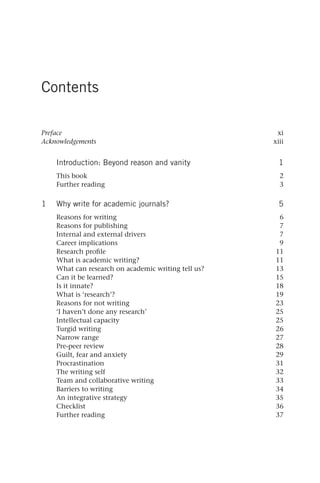
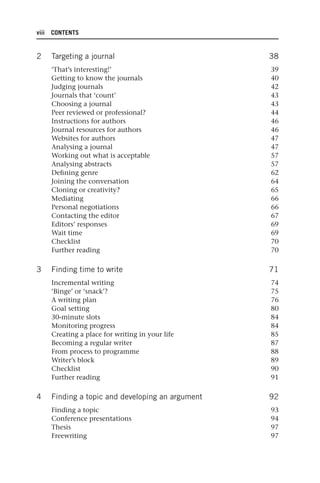
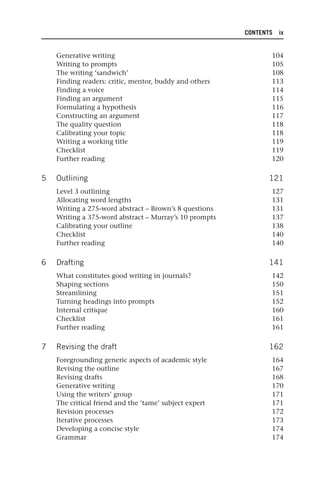
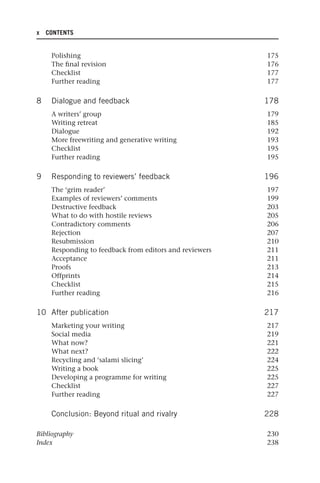
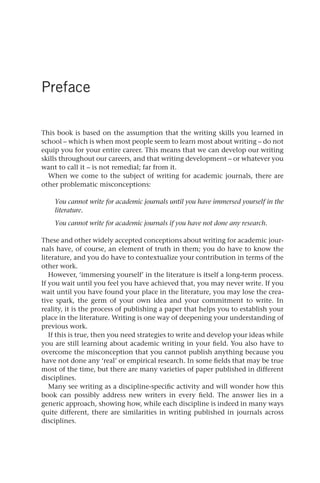
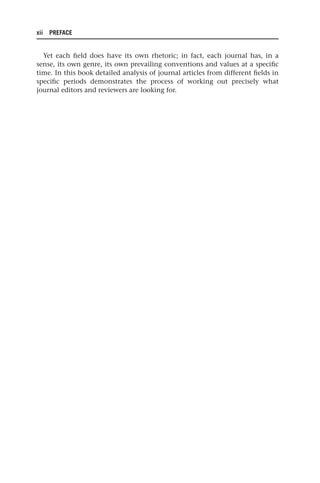

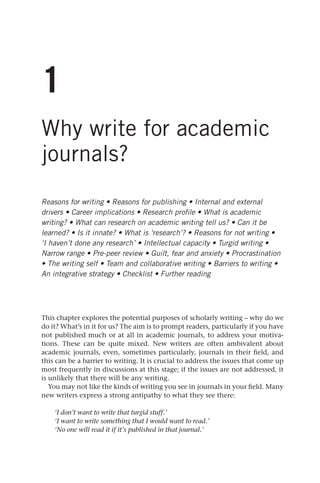
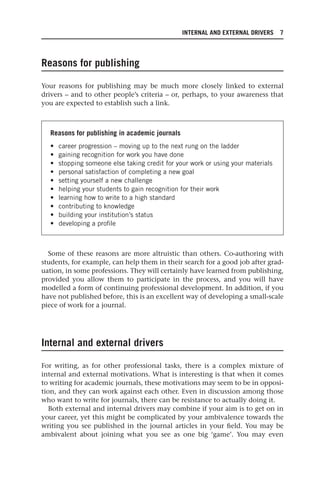
![12 WRITING FOR ACADEMIC JOURNALS
Academic writing is that set of conventions we see in a thesis or published
article in our discipline, a definition that becomes more precise once you scru-
tinize examples of published writing in your target journals.
Some argue that academic writing is a narrowly defined set of specialisms
and knowledges, so narrow that it leaves ‘huge gaps in our understanding’:
It is the desire to think and write more, to fill some of these gaps that
informs my desire to leave the academy – to think and write on subjects of
my choice, in the manner that I wish to write, in whatever voice I choose.
There is so much emphasis on asserting a one-dimensional ‘voice’ in
academic life. I enjoy writing about many subjects in different ways.
(hooks [sic] 1999: 141)
hooks – who refused to use capital letters as part of her resistance to systems
of oppression, including language – argues that our subjectivity is ‘colonized’
in academic writing, and it is certainly true that across the disciplines
subjectivity has traditionally had little or no value. This has begun to change
recently, in some disciplines, but in others such changes are still seen as
inappropriate to the enterprise of research.
Words associated with writing about research
• objective
• hierarchical
• focused
• conservative
• neutral
If hooks’s argument applies, then there are gaps not simply in the literature,
but created by the literature. The academic approach to research – and the
academic style available for writing about it – is inherently limited. Those who
find it limiting are not necessarily limited themselves; it is important to
acknowledge that much of what we think, say and do in the course of our
work can become invisible when we publish.
That accounts for academic writing, the product, but what about the
process? A published article creates an illusion of linear progression, when, as
we all know, writing is a dynamic, cyclical process. While the merits of
published articles are often discussed, there is relatively little discussion of
how writing actually gets done: what are the stages, and how do we fit
them into our other tasks? How do productive writers manage to get so much
done? – a question to be asked not so much in awe or envy as in anticipation
of a practical answer.
25540.indb 12
25540.indb 12 16/08/2013 09:11
16/08/2013 09:11](https://image.slidesharecdn.com/3492819-250622111517-d1cfafd8/85/Writing-For-Academic-Journals-3rd-Rowena-Murray-31-320.jpg)
![16 WRITING FOR ACADEMIC JOURNALS
Successful university lecturers are likely to have spent many years
developing acceptable ways of constructing their own knowledge through
their own writing practices in a variety of disciplinary contexts.
(Lea and Street 1998: 163)
Yet many, even those who have completed research degrees, say this is not
how it works; it is simply not possible to learn everything you need to know
about research and writing as you go along: ‘It was unspoken but it just seemed
obvious: that’s what one does. And then it turned out that I was terribly bad
at it’ (Ellmann, quoted in Hanks 2003). While it would be interesting – and
worthwhile – to research why this might be, it is the purpose of this book to
address the stated need for guidance and development in the demanding task
of writing for academic journals, particularly for new writers: there is no need
to pretend that you know all you need to know about writing.
When they experience writing development, many are surprised at how little
they know about writing and some are relieved finally to be able to admit it:
The writing process was something I hadn’t given much thought to before
starting the [writing] course. . . . One of the first topics explored was how
is academic writing learned? The answer . . . seems to be by trial and error.
On reflection I cannot recall being given formal instruction on the specifics
of academic writing during my undergraduate career. This trial and error
process is not just confined to academic writing; it extends to all forms of
writing.
(Participant in Academic Writing module, Advanced Academic
Studies course, University of Strathclyde)
What we learned about writing at school – without wanting to criticize that
in any way – was not sufficient preparation for all the writing we have to do
throughout our professional lives. How could it be? Yet there is an assumption
that writing development or instruction is only for those who struggle with
writing, perhaps non-native speakers, or those whose writing skills are poor.
Although this assumption persists, there is growing acknowledgement that we
ought to learn more about writing if we want to be published in academic
journals. In some disciplines, some support is provided during the doctorate,
but in others there is nothing at all for writers faced with the new challenge of
writing for journals. What exactly we need to learn about writing at the
doctoral level and beyond is, of course, a matter of some debate.
Meanwhile, the pressure on academics and professionals to publish in jour-
nals increases year by year. In addition, as more institutions are granted
university status, and new disciplines join higher education, there is an urgent
need for support in this area. These writers, some of whom are highly experi-
enced, face even more intense pressure to participate in audit exercises that
make publication targets very specific. Many of these lecturers will not have
published in the past, but will be expected to do so immediately. They have to
25540.indb 16
25540.indb 16 16/08/2013 09:11
16/08/2013 09:11](https://image.slidesharecdn.com/3492819-250622111517-d1cfafd8/85/Writing-For-Academic-Journals-3rd-Rowena-Murray-35-320.jpg)
![WHAT IS ‘RESEARCH’? 19
those who can’t teach, teach gym/history/maths/law/education/writing/golf/
[other bias against a discipline].’
On the few occasions when writing ability is discussed in universities there
are popular assumptions about what makes some people productive writers,
and it is not all about technical skill:
• These people are just good writers.
• Some are better at making time for writing.
• Those who publish are more selfish; they don’t care about their students or
their colleagues.
For new writers and emerging researchers there is a potential double bind
here: you should be able to write already on the basis on your education and
experience, yet if you were really good enough you would already have written
more than you have.
When people talk about academic writing development, including training
initiatives whose impact is evidenced in publications, senior colleagues, some
initially and others serially, react with indifference at least and open scepti-
cism at worst. This suggests that, across many different institutions, and in
several countries, it is difficult to get past the remedial model: participation in
writing development can be seen as an intellectual deficiency or personal
weakness.
The ability to write successfully for academic journals is not, of course,
innate, although, interestingly, many people still think that it is. Yet, in the
absence of formal training, perhaps it is true, ironically, that ‘those who can,
do’, or can we rewrite that as, ‘in the past, those who could, already did.’
This is not an excuse for avoiding writing development or, importantly,
writing discussions. There are strategies for productive writing and ways of
making time for writing in overloaded academic and professional working
lives. Perhaps you do need to think about being more ‘selfish’, if that means
putting your goal – writing – first. Perhaps you do need to overcome the sense
that writers are a breed apart. Perhaps you need to learn new tricks.
What is ‘research’?
I discovered long ago in collecting and classifying marine animals that
what I found was closely intermeshed with how I felt at the moment.
(Steinbeck 1962: 181)
This suggests that what constitutes ‘research’ will be closely related to your
own interests and perspectives. All sorts of studies count as research, in some
disciplines, and the growing rigour and credibility of a range of qualitative
25540.indb 19
25540.indb 19 16/08/2013 09:11
16/08/2013 09:11](https://image.slidesharecdn.com/3492819-250622111517-d1cfafd8/85/Writing-For-Academic-Journals-3rd-Rowena-Murray-38-320.jpg)
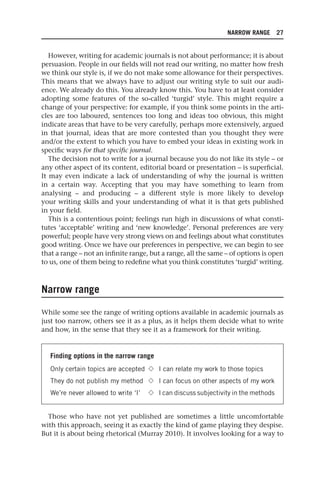
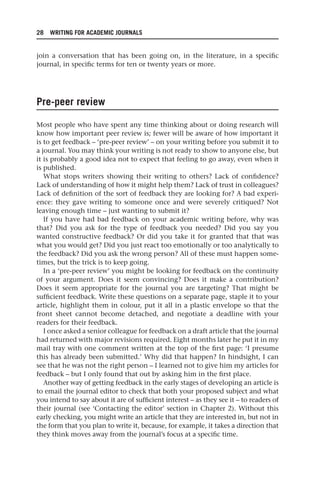
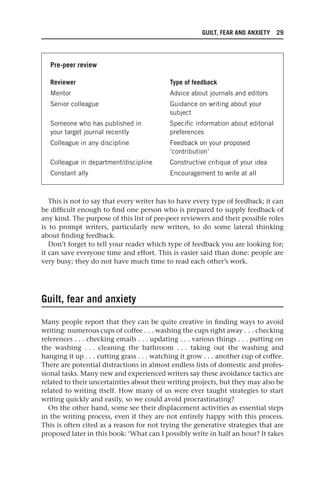
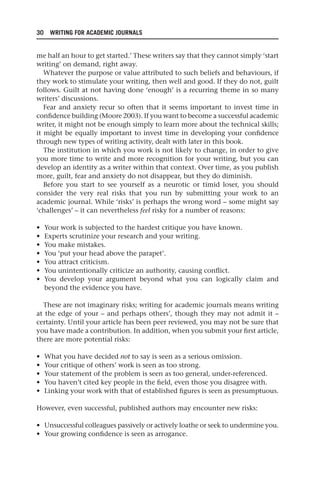
![TEAM AND COLLABORATIVE WRITING 33
noted by Blaxter et al. (1998a: 146): ‘You can, of course, use a number of different
styles and voices. You might also use different names, as some academics [and
professionals] do, for different kinds of writing.’ While some will find this a bit
extreme – and limiting to their developing research profile – others will see that
perhaps they have more options than the exclusivity of certain journals suggests.
However you choose to deal with the selectivity that operates in journals
across the fields, it might help to think of yourself as a writer and to think
through what that might mean in terms of your sense of yourself:
1 Have a reason to write that is not just about meeting other people’s standards.
2 Make writing meaningful for yourself.
3 Reward yourself for making sacrifices for writing.
4 Take care of yourself, as a writer: physically, mentally and spiritually.
5 Find someone with whom you can have an open discussion about your
writing, not just analysing barriers, but ranging over possibilities and
experiences.
Many writers’ experiences and perceptions of academic writing are of fierce
competition. The sheer numbers of us trying to get published means that
there is, literally, fierce competition to get published in journals. But this need
not be your motivation to write. Some people are simply not motivated by
competition; they find it demotivating. If you expected universal collegiality
in higher education, you may be disappointed by this. But there is no need to
endure competition until you retire. This is not to say that opting out of the
‘struggle’ to publish is your best option – though it is certainly one option –
but that you have to find some way of either ignoring other people’s sense of
the on-going competition or find other reasons to write, some of which you
might just keep to yourself, if you feel they would put you at risk in your
context. However, others will argue that ‘keeping it to yourself’ is exactly the
kind of self-silencing that power structures depend on, so perhaps this should
also be a topic of discussion with others who write.
Team and collaborative writing
This is a good way of not ‘going it alone’, or, as one new writer put it, ‘We can
begin to run in packs’, and you may also be bringing some collaboration into
this world of competition, with all the advantages – if you manage it well – of
pooling strengths, skills and contacts. It might help, if you are just starting to
write, to have someone who can help you make writing decisions, help you
with writing dilemmas or who will simply listen.
You may be able to work and write with, and learn from, more experienced
colleagues. You may be able to step outside your territory or tribe. There may
25540.indb 33
25540.indb 33 16/08/2013 09:11
16/08/2013 09:11](https://image.slidesharecdn.com/3492819-250622111517-d1cfafd8/85/Writing-For-Academic-Journals-3rd-Rowena-Murray-52-320.jpg)
![34 WRITING FOR ACADEMIC JOURNALS
be issues of voice, ownership, career implications, politics and time that you
should discuss at the start of the collaboration. These may relate to the require-
ments of the organization that funded the research.
However, there may also be disadvantages for new writers, and over the
longer term this should not be your sole strategy, if it is the case in your
discipline that ‘those without sole publications are not rewarded for their
team-playing skills’ (Blaxter et al. 1998a: 144).
Barriers to writing
The greatest problem I can see for academics [and professionals] in post is
not finding the motivation to write but the time amidst all the pressure
and heavy workloads of teaching and administration.
(Anonymous reviewer)
This reviewer is right: time is definitely, absolutely and across all the disci-
plines the inhibiting factor for academic writers. This is evidenced in evalua-
tions, focus groups, questionnaires and informal discussions where academic
writers cited lack of time as the barrier they had not been able to overcome.
As the reviewer points out, even those who say that they have the ‘motiva-
tion’ to write cannot do so if the time does not exist in which to do it, or if
they are so exhausted from other work that they have no energy left for
writing. This suggests that even if you succeed in motivating yourself and are
ready to write, you still have this problem to solve: how will you find time for
writing and, even when you do, how will you protect it from all the other
demands on your diary?
But are ‘motivation’ and our use of ‘time’ as separate as the reviewer makes
out? Is your use of time not driven by your motivation? Do you not allocate
your time to tasks that you decide to perform, knowing how much is needed for
each task? Or is this too simplistic? Are you really free to decide how to spend
your time, when there are so many external demands that simply must be met?
In theory, you know that you are the one who decides how much – or how
little – time to spend on each of your professional tasks. In practice, however,
there are so many interruptions that academics and professionals report that
they rarely even get through their ‘to do’ lists. Moreover, there are priorities
that cannot be deferred: when there is marking to be done, or when the
department is visited by the auditors, inspectors, examiners or a validating
body, we simply have to drop everything else and catch up with it in the
evening or over the weekend or both.
This is the reality of many academics’ and professionals’ lives (Hey 2001).
Can any amount of talk about your ‘motivation’ really make a difference in
this context? In order to answer that question you have to go back to your
25540.indb 34
25540.indb 34 16/08/2013 09:11
16/08/2013 09:11](https://image.slidesharecdn.com/3492819-250622111517-d1cfafd8/85/Writing-For-Academic-Journals-3rd-Rowena-Murray-53-320.jpg)