Academic Writing
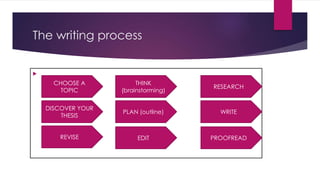
The writing process

CHOOSE A
TOPIC
THINK
(brainstorming)
RESEARCH
DISCOVER YOUR
THESIS
PLAN (outline) WRITE
REVISE EDIT PROOFREAD
Topic
 Choose a topic you are interested in
 Then, narrow your ideas from subjects to topics. A subject is a broad concept: abortion, the Cold War,
Toyota’s management style are a few examples. These are not paper topics; these could all be the
subjects of books
 Narrow a subject by looking at its smaller parts, or by choosing a specific problem, time period, or place
to cover. You may need to do a little general research here if you do not know much about the
subject. Also asking yourself “Who? What? Where? When? Why? and How?” questions about the
subject can help you limit the subject and determine your interests
 Doing this with abortion, for example, leads to topics like the reasons American women choose
abortion rather than adoption, the psychological effects of previous abortions on women who become
pregnant again, the consequences of Poland’s ban on abortions on Polish women’s lives, solutions to
ending the practice of using abortion as a tool for gender selection in India, and whether or not the
morning after pill should be sold to girls under 16. From here, choose a topic which fits the prescribed
purpose of your paper
Brainstorming
 When you have a topic, start brainstorming. Write down all the possible
answers to your question, and write down all the information, opinions, and
questions you have about your topic. Brainstorming will help you see what
you already know, what you think, what you think you know, and what
else you need to find out about your topic. Writing things down also
ensures that you will not forget your great ideas later. (Although this is a
really short section, it is a very important step!)
Research
 What you must remember is that “doing good research takes time.”
 Do not expect to do research once and find everything that you need for your paper. You will
continue doing research throughout the writing process. As you discover a thesis, make a basic
outline and then a detailed outline, write your paper, and revise it. Also, do not be afraid to
change your topic a little (or a lot) if your research leads you in a different direction.
 To make research more effective and less time-consuming, you can do three things:
 Plan your research before your start
 Set up and follow a research schedule. Give yourself a set amount of time to do your preliminary
research. Start working on your paper, and go back to researching later when you know exactly
what you need to find.
 Immediately record source information. Write down the address or bookmark the web page of
every good source, even if you are not sure if you will use it…you may want to later.
Thesis statement
 The thesis statement is the most important sentence in your paper. If someone asked you, “What does your paper say?”
your answer would be your thesis statement. Everything you write will support this statement.
 A good thesis statement usually includes:
 Main idea of the paper. ONE idea. The entire paper is based on this statement.
 Your opinion or point of view. The thesis statement is not a fact nor a question, but your view of the topic and what you
want to say about it.
 Purpose of the paper. From the thesis, it should be clear what the paper will do.
 Answer to the research question. Ask yourself the question and then answer it with your thesis. Is it truly an answer?
 An element of surprise. This means that the thesis is interesting, engaging, and perhaps not so expected.
 Clarity. It should be understandable after one reading and have no mistakes.
 It’s useful to have a thesis idea at the beginning to help you focus, but it’s also OK to change your thesis statement as you
go through the writing process and learn and think more about your topic.
Planning – Basic outline
 A basic outline is your first attempt to organize the ideas of your paper. It will help you focus your
research and consider the order of your ideas
 Example of a basic outline before research (Analysis paper):
 Research Question: Why has childhood obesity increased in the United States?
 Thesis: Childhood obesity has increased in the United States due to the unhealthy environment in
which many American children are raised.
 Sections:
 I. Children eat more than in the past.
 II. Children often do not eat healthy meals.
 III. Children do not have as much physical activity as in the past.
 IV. Parents model bad habits.
 V. Others say that food companies advertising are responsible.
Breaking sections into smaller parts
 EXAMPLE BASIC OUTLINE after more thinking and/or
research (analysis paper):
 Research Question: Why has childhood obesity
increased in the United States?
 Thesis: Childhood obesity has increased in the
United States due to the unhealthy environment
in which many American children are raised.
 Sections:
 I. Children eat more than in the past (portion sizes
have increased).
 II. Children often do not eat healthy meals.
 1. Healthy food is hard to get (expensive + rare).
 2. Schools provide unhealthy food
 III. Children do not have as much physical
activity as in the past.
 1. Physical activity in schools has decreased.
 2. Some children live in areas unsafe for outdoor
activity.
 3. Many children watch too much TV.
 IV. Parents model bad habits.
 1. Parents do not have time, money, or
information to prepare healthy meals.
 V. Food companies and advertising may bear
some responsibility, but parents should be able to
help children resist them.
 (5 sections, with a total of 8 paragraphs)
Writing the first draft
 Be prepared before you start – have a purpose, a thesis, enough research,
and a plan (some sort of outline). And then, just write.
 Do not worry about perfection yet. Do not worry about grammar.
 Keep going! If you are missing information, mark the spot and then do
more research later to fill in the gap.
 Be aware of plagiarism. Write down the source whenever you use anything
from a source.
 Do not wait until the last minute! You will need time to revise, edit, and
proofread.
Revising
 Your first draft is complete, but your paper is far from finished. The next step
is to revise your paper – strengthen the content.
 Get feedback: Listen to the advice of your reviewers, but remember that in
the end, your paper is your responsibility
 Read your paper for focus. Read every sentence of your paper and ask
yourself, “Does this support the thesis statement?” If it doesn’t, cross it out
or change it.
 Read each body paragraph for support. Read a body paragraph, and
then read its topic sentence (TS) again. Does the paragraph support the TS
enough?
 Re-read your paper as the audience. Make sure that the tone fits the
pretended audience
Writing the second draft
 Once you know what to fix, you must do it. Be daring. You will not have a good
paper if you are afraid to change things. How should you change your paper?
 Erase words, sentences or paragraphs; eliminate all unnecessary or irrelevant
ideas.
 Add words, sentences or paragraphs; add new points, details, or explanations.
 Reorganize words, sentences or paragraphs; put everything in a logical order.
 Re-write words, sentences or paragraphs; keep your ideas but present them
better.
 Revise your second draft and keep revising. Good writers actually tend to
revise more rather than less as they gain more writing experience.
Editing
 Editing will make your writing more precise and easier to understand
 Editing strategies for specific problems:
 Connection between ideas
 Read the beginning and end of every paragraph to make sure they flow
together.
 Go through the paper sentence by sentence and find connections
between them.
 If the ideas don't connect, add a transition, pronoun, repeated word,
synonym, or another sentence.
 Wordiness
 Find all the very long sentences (25 words or more). Can they be rewritten
more clearly and concisely?
 Read each sentence. After each one, ask, “Is it necessary to the
paragraph? Does it add something new? Could it be eliminated
completely or partly? Could it be combined?”
 Read each sentence word by word. Is every word necessary? Could some
be eliminated or re-written in a shorter, clearer way? Could passive verbs
be rewritten as active ones?
 Repetition, Lack of variety
 Read each sentence and ask, “What is the purpose of this sentence?” Does it
introduce a new idea? Does it support or explain the previous idea? or does it
just repeat it?
 Read the first 5 words of each sentence to find sentences starting in the same
way (such as with a transition word). Change some so your sentences have
variety.
 Look at the length of every sentence. There should be a variety of short and
long sentences. Make sentences shorter by dividing them or longer by
combining.
 Find words which are repeated a lot. Use a thesaurus to find other words to use.
 Sentence structure: Fix fragments, run-ons, and word order.
 Word choice: Find all the long words. Could some be replaced with
shorter, clearer words?
 Clarity: Read your paper without using a lot of effort – you're just reading
because you are interested in the topic. If you have to read something
twice, it's not clear.
Proofreading
 When you think your paper is ready, it's time to proofread (check for
mistakes)
 Do not look at your paper for 24 hours (this requires time management
skills!)
 Print your paper – you'll see mistakes that you might not see on a computer
screen.
 Think about the grammar, spelling, punctuation, capitalization, meaning...
of every word. If you are unsure about anything, use a dictionary or
grammar book.
 Print your paper and proofread it again!
Essay structure
 All essays share the same basic structure, although they may differ in
content and style. The essence of an essay is an opinion, expressed as a
thesis statement or proposition, and a logical sequence of arguments and
information organized in support of the proposition.
 Essay structure:
 Introduction
 Body paragraphs
 Conclusion
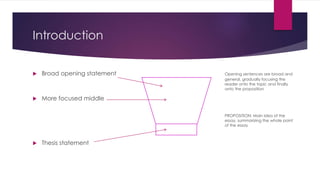
Introduction
 Broad opening statement Opening sentences are broad and
general, gradually focusing the
reader onto the topic and finally
onto the proposition
 More focused middle
PROPOSITION: Main idea of the
essay, summarizing the whole point
of the essay
 Thesis statement
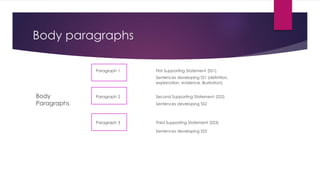
Body paragraphs
Paragraph 1 First Supporting Statement (SS1)
Sentences developing SS1 (definition,
explanation, evidence, illustration)
Body Paragraph 2 Second Supporting Statement (SS2)
Paragraphs Sentences developing SS2
Paragraph 3 Third Supporting Statement (SS3)
Sentences developing SS3
Paragraphs
 In order for your essay to come across clearly, it is essential that your
paragraphs are well structured.
 Paragraphs should be arranged in a logical sequence and should also be
well linked.
 Connections can be made between sentences and between paragraphs
by using signposts or transitional words and phrases to indicate change,
comparison, or agreement.
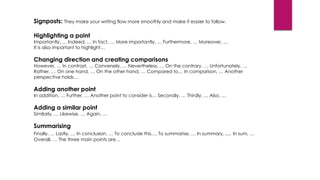
Signposts: They make your writing flow more smoothly and make it easier to follow.
Highlighting a point
Importantly, … Indeed, … In fact, … More importantly, … Furthermore, … Moreover, …
It is also important to highlight…
Changing direction and creating comparisons
However, … In contrast, … Conversely, … Nevertheless, … On the contrary, … Unfortunately, …
Rather, … On one hand, … On the other hand, … Compared to… In comparison, … Another
perspective holds…
Adding another point
In addition, … Further, … Another point to consider is… Secondly, … Thirdly, … Also, …
Adding a similar point
Similarly, … Likewise, … Again, …
Summarising
Finally, … Lastly, … In conclusion, … To conclude this…, To summarise, … In summary, … In sum, …
Overall, … The three main points are…
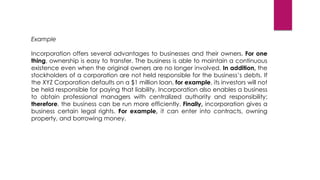
Example
Incorporation offers several advantages to businesses and their owners. For one
thing, ownership is easy to transfer. The business is able to maintain a continuous
existence even when the original owners are no longer involved. In addition, the
stockholders of a corporation are not held responsible for the business’s debts. If
the XYZ Corporation defaults on a $1 million loan, for example, its investors will not
be held responsible for paying that liability. Incorporation also enables a business
to obtain professional managers with centralized authority and responsibility;
therefore, the business can be run more efficiently. Finally, incorporation gives a
business certain legal rights. For example, it can enter into contracts, owning
property, and borrowing money.
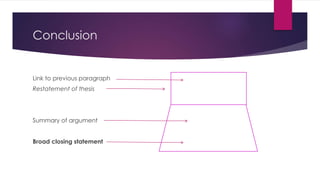
Conclusion
Link to previous paragraph
Restatement of thesis
Summary of argument
Broad closing statement
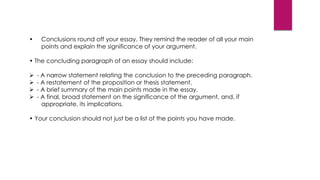
• Conclusions round off your essay. They remind the reader of all your main
points and explain the significance of your argument.
• The concluding paragraph of an essay should include:
 - A narrow statement relating the conclusion to the preceding paragraph.
 - A restatement of the proposition or thesis statement.
 - A brief summary of the main points made in the essay.
 - A final, broad statement on the significance of the argument, and, if
appropriate, its implications.
• Your conclusion should not just be a list of the points you have made.
Example
By promoting a caring atmosphere in schools, teachers can reduce the
likelihood of bullying. Above all, teachers need to inform themselves and the
rest of the school community so that together they can develop a policy to
discourage bullying. By educating themselves about bullying, teachers and
parents have the knowledge to set up effective programs and structures both
within the classroom and for the whole school. Furthermore, by removing the
opportunity for children to bully, providing children with a stimulating
environment, and giving them the tools to deal with conflict appropriately,
teachers can reduce children’s inclination to bully. Although bullying will never
be fully eradicated and must be dealt with as soon as it occurs, increasing
awareness of the problem is making schools a safer and more enjoyable
environment in which children can learn.
Essay format
General APA (American Psychological Association) Guidelines:
APA Style establishes standards of written communication concerning:
 the organization of content
 writing style
 citing references
 and how to prepare a manuscript for publication in certain disciplines.
Your essay should be typed, double-spaced on standard-sized paper (8.5" x 11") with 1" margins on all sides. You
should use a clear font that is highly readable. APA recommends using 12 pt. Times New Roman font.
References
• Whitaker, A., (2009). Academic Writing Guide: A step-by-Step Guide to
Writing Academic Papers. Bratislava, Slovakia: CityUniversity of Seatle
• Bowker, N. (2007) Academic Writing: A guide to Tertiary Level Writing.
Palmerston North, NZ: Massey University
• Owl Purdue Online Writing Lab. General APA Guidelines. Retrieved from
https://owl.english.purdue.edu/owl/resource/560/01/

Academic writing

  • 1.
  • 2.
    The writing process  CHOOSEA TOPIC THINK (brainstorming) RESEARCH DISCOVER YOUR THESIS PLAN (outline) WRITE REVISE EDIT PROOFREAD
  • 3.
    Topic  Choose atopic you are interested in  Then, narrow your ideas from subjects to topics. A subject is a broad concept: abortion, the Cold War, Toyota’s management style are a few examples. These are not paper topics; these could all be the subjects of books  Narrow a subject by looking at its smaller parts, or by choosing a specific problem, time period, or place to cover. You may need to do a little general research here if you do not know much about the subject. Also asking yourself “Who? What? Where? When? Why? and How?” questions about the subject can help you limit the subject and determine your interests  Doing this with abortion, for example, leads to topics like the reasons American women choose abortion rather than adoption, the psychological effects of previous abortions on women who become pregnant again, the consequences of Poland’s ban on abortions on Polish women’s lives, solutions to ending the practice of using abortion as a tool for gender selection in India, and whether or not the morning after pill should be sold to girls under 16. From here, choose a topic which fits the prescribed purpose of your paper
  • 4.
    Brainstorming  When youhave a topic, start brainstorming. Write down all the possible answers to your question, and write down all the information, opinions, and questions you have about your topic. Brainstorming will help you see what you already know, what you think, what you think you know, and what else you need to find out about your topic. Writing things down also ensures that you will not forget your great ideas later. (Although this is a really short section, it is a very important step!)
  • 5.
    Research  What youmust remember is that “doing good research takes time.”  Do not expect to do research once and find everything that you need for your paper. You will continue doing research throughout the writing process. As you discover a thesis, make a basic outline and then a detailed outline, write your paper, and revise it. Also, do not be afraid to change your topic a little (or a lot) if your research leads you in a different direction.  To make research more effective and less time-consuming, you can do three things:  Plan your research before your start  Set up and follow a research schedule. Give yourself a set amount of time to do your preliminary research. Start working on your paper, and go back to researching later when you know exactly what you need to find.  Immediately record source information. Write down the address or bookmark the web page of every good source, even if you are not sure if you will use it…you may want to later.
  • 6.
    Thesis statement  Thethesis statement is the most important sentence in your paper. If someone asked you, “What does your paper say?” your answer would be your thesis statement. Everything you write will support this statement.  A good thesis statement usually includes:  Main idea of the paper. ONE idea. The entire paper is based on this statement.  Your opinion or point of view. The thesis statement is not a fact nor a question, but your view of the topic and what you want to say about it.  Purpose of the paper. From the thesis, it should be clear what the paper will do.  Answer to the research question. Ask yourself the question and then answer it with your thesis. Is it truly an answer?  An element of surprise. This means that the thesis is interesting, engaging, and perhaps not so expected.  Clarity. It should be understandable after one reading and have no mistakes.  It’s useful to have a thesis idea at the beginning to help you focus, but it’s also OK to change your thesis statement as you go through the writing process and learn and think more about your topic.
  • 7.
    Planning – Basicoutline  A basic outline is your first attempt to organize the ideas of your paper. It will help you focus your research and consider the order of your ideas  Example of a basic outline before research (Analysis paper):  Research Question: Why has childhood obesity increased in the United States?  Thesis: Childhood obesity has increased in the United States due to the unhealthy environment in which many American children are raised.  Sections:  I. Children eat more than in the past.  II. Children often do not eat healthy meals.  III. Children do not have as much physical activity as in the past.  IV. Parents model bad habits.  V. Others say that food companies advertising are responsible.
  • 8.
    Breaking sections intosmaller parts  EXAMPLE BASIC OUTLINE after more thinking and/or research (analysis paper):  Research Question: Why has childhood obesity increased in the United States?  Thesis: Childhood obesity has increased in the United States due to the unhealthy environment in which many American children are raised.  Sections:  I. Children eat more than in the past (portion sizes have increased).  II. Children often do not eat healthy meals.  1. Healthy food is hard to get (expensive + rare).  2. Schools provide unhealthy food  III. Children do not have as much physical activity as in the past.  1. Physical activity in schools has decreased.  2. Some children live in areas unsafe for outdoor activity.  3. Many children watch too much TV.  IV. Parents model bad habits.  1. Parents do not have time, money, or information to prepare healthy meals.  V. Food companies and advertising may bear some responsibility, but parents should be able to help children resist them.  (5 sections, with a total of 8 paragraphs)
  • 9.
    Writing the firstdraft  Be prepared before you start – have a purpose, a thesis, enough research, and a plan (some sort of outline). And then, just write.  Do not worry about perfection yet. Do not worry about grammar.  Keep going! If you are missing information, mark the spot and then do more research later to fill in the gap.  Be aware of plagiarism. Write down the source whenever you use anything from a source.  Do not wait until the last minute! You will need time to revise, edit, and proofread.
  • 10.
    Revising  Your firstdraft is complete, but your paper is far from finished. The next step is to revise your paper – strengthen the content.  Get feedback: Listen to the advice of your reviewers, but remember that in the end, your paper is your responsibility  Read your paper for focus. Read every sentence of your paper and ask yourself, “Does this support the thesis statement?” If it doesn’t, cross it out or change it.  Read each body paragraph for support. Read a body paragraph, and then read its topic sentence (TS) again. Does the paragraph support the TS enough?  Re-read your paper as the audience. Make sure that the tone fits the pretended audience
  • 11.
    Writing the seconddraft  Once you know what to fix, you must do it. Be daring. You will not have a good paper if you are afraid to change things. How should you change your paper?  Erase words, sentences or paragraphs; eliminate all unnecessary or irrelevant ideas.  Add words, sentences or paragraphs; add new points, details, or explanations.  Reorganize words, sentences or paragraphs; put everything in a logical order.  Re-write words, sentences or paragraphs; keep your ideas but present them better.  Revise your second draft and keep revising. Good writers actually tend to revise more rather than less as they gain more writing experience.
  • 12.
    Editing  Editing willmake your writing more precise and easier to understand  Editing strategies for specific problems:  Connection between ideas  Read the beginning and end of every paragraph to make sure they flow together.  Go through the paper sentence by sentence and find connections between them.  If the ideas don't connect, add a transition, pronoun, repeated word, synonym, or another sentence.
  • 13.
     Wordiness  Findall the very long sentences (25 words or more). Can they be rewritten more clearly and concisely?  Read each sentence. After each one, ask, “Is it necessary to the paragraph? Does it add something new? Could it be eliminated completely or partly? Could it be combined?”  Read each sentence word by word. Is every word necessary? Could some be eliminated or re-written in a shorter, clearer way? Could passive verbs be rewritten as active ones?
  • 14.
     Repetition, Lackof variety  Read each sentence and ask, “What is the purpose of this sentence?” Does it introduce a new idea? Does it support or explain the previous idea? or does it just repeat it?  Read the first 5 words of each sentence to find sentences starting in the same way (such as with a transition word). Change some so your sentences have variety.  Look at the length of every sentence. There should be a variety of short and long sentences. Make sentences shorter by dividing them or longer by combining.  Find words which are repeated a lot. Use a thesaurus to find other words to use.
  • 15.
     Sentence structure:Fix fragments, run-ons, and word order.  Word choice: Find all the long words. Could some be replaced with shorter, clearer words?  Clarity: Read your paper without using a lot of effort – you're just reading because you are interested in the topic. If you have to read something twice, it's not clear.
  • 16.
    Proofreading  When youthink your paper is ready, it's time to proofread (check for mistakes)  Do not look at your paper for 24 hours (this requires time management skills!)  Print your paper – you'll see mistakes that you might not see on a computer screen.  Think about the grammar, spelling, punctuation, capitalization, meaning... of every word. If you are unsure about anything, use a dictionary or grammar book.  Print your paper and proofread it again!
  • 17.
    Essay structure  Allessays share the same basic structure, although they may differ in content and style. The essence of an essay is an opinion, expressed as a thesis statement or proposition, and a logical sequence of arguments and information organized in support of the proposition.  Essay structure:  Introduction  Body paragraphs  Conclusion
  • 18.
    Introduction  Broad openingstatement Opening sentences are broad and general, gradually focusing the reader onto the topic and finally onto the proposition  More focused middle PROPOSITION: Main idea of the essay, summarizing the whole point of the essay  Thesis statement
  • 19.
    Body paragraphs Paragraph 1First Supporting Statement (SS1) Sentences developing SS1 (definition, explanation, evidence, illustration) Body Paragraph 2 Second Supporting Statement (SS2) Paragraphs Sentences developing SS2 Paragraph 3 Third Supporting Statement (SS3) Sentences developing SS3
  • 20.
    Paragraphs  In orderfor your essay to come across clearly, it is essential that your paragraphs are well structured.  Paragraphs should be arranged in a logical sequence and should also be well linked.  Connections can be made between sentences and between paragraphs by using signposts or transitional words and phrases to indicate change, comparison, or agreement.
  • 21.
    Signposts: They makeyour writing flow more smoothly and make it easier to follow. Highlighting a point Importantly, … Indeed, … In fact, … More importantly, … Furthermore, … Moreover, … It is also important to highlight… Changing direction and creating comparisons However, … In contrast, … Conversely, … Nevertheless, … On the contrary, … Unfortunately, … Rather, … On one hand, … On the other hand, … Compared to… In comparison, … Another perspective holds… Adding another point In addition, … Further, … Another point to consider is… Secondly, … Thirdly, … Also, … Adding a similar point Similarly, … Likewise, … Again, … Summarising Finally, … Lastly, … In conclusion, … To conclude this…, To summarise, … In summary, … In sum, … Overall, … The three main points are…
  • 22.
    Example Incorporation offers severaladvantages to businesses and their owners. For one thing, ownership is easy to transfer. The business is able to maintain a continuous existence even when the original owners are no longer involved. In addition, the stockholders of a corporation are not held responsible for the business’s debts. If the XYZ Corporation defaults on a $1 million loan, for example, its investors will not be held responsible for paying that liability. Incorporation also enables a business to obtain professional managers with centralized authority and responsibility; therefore, the business can be run more efficiently. Finally, incorporation gives a business certain legal rights. For example, it can enter into contracts, owning property, and borrowing money.
  • 23.
    Conclusion Link to previousparagraph Restatement of thesis Summary of argument Broad closing statement
  • 24.
    • Conclusions roundoff your essay. They remind the reader of all your main points and explain the significance of your argument. • The concluding paragraph of an essay should include:  - A narrow statement relating the conclusion to the preceding paragraph.  - A restatement of the proposition or thesis statement.  - A brief summary of the main points made in the essay.  - A final, broad statement on the significance of the argument, and, if appropriate, its implications. • Your conclusion should not just be a list of the points you have made.
  • 25.
    Example By promoting acaring atmosphere in schools, teachers can reduce the likelihood of bullying. Above all, teachers need to inform themselves and the rest of the school community so that together they can develop a policy to discourage bullying. By educating themselves about bullying, teachers and parents have the knowledge to set up effective programs and structures both within the classroom and for the whole school. Furthermore, by removing the opportunity for children to bully, providing children with a stimulating environment, and giving them the tools to deal with conflict appropriately, teachers can reduce children’s inclination to bully. Although bullying will never be fully eradicated and must be dealt with as soon as it occurs, increasing awareness of the problem is making schools a safer and more enjoyable environment in which children can learn.
  • 26.
    Essay format General APA(American Psychological Association) Guidelines: APA Style establishes standards of written communication concerning:  the organization of content  writing style  citing references  and how to prepare a manuscript for publication in certain disciplines. Your essay should be typed, double-spaced on standard-sized paper (8.5" x 11") with 1" margins on all sides. You should use a clear font that is highly readable. APA recommends using 12 pt. Times New Roman font.
  • 27.
    References • Whitaker, A.,(2009). Academic Writing Guide: A step-by-Step Guide to Writing Academic Papers. Bratislava, Slovakia: CityUniversity of Seatle • Bowker, N. (2007) Academic Writing: A guide to Tertiary Level Writing. Palmerston North, NZ: Massey University • Owl Purdue Online Writing Lab. General APA Guidelines. Retrieved from https://owl.english.purdue.edu/owl/resource/560/01/