Helen Fallon, Deputy Librarian,
National University of Ireland Maynooth
Helen.b.fallon@nuim.ie
Goals of this workshop
 Increased energy and confidence in writing
 Greater understanding of the mechanics of
writing
 Greater understanding of the different
requirements of peer-reviewed and
professional journals
 Increased knowledge on finding out about
publishing opportunities and publicising your
publications
Task 1– Writing to Prompt
 Write for five minutes, in sentences, without
stopping, using one of the following prompts
 I am interested in writing about…
 An area of my research which I would like to write
about is…
 I feel at my most creative when I’m writing about…
Task 2- Finding Topics
Work with a colleague and list as many
topics as you can that you feel you could
write about. These topics could relate to
work you have been involved in, subjects
that interest you or topics you have done
research on
Next list the sources you might use in
your article
Task 3 – Making a case for writing
Write for five minutes in sentences,
in no more than fifty words,
explaining to your department head
why is it important that you publish
Task 4– Defining audience and Purpose
Describe in one sentence the purpose of
the piece you are writing
What is the audience for your article?
What’s your angle?
What data do you have?
Is this topic most suited for a research
article/a practice-based article or some
other format e.g poster?
Practice-based article
 Based primarily on experience
 Give some background
 Describe what happened
 What was the impact
 Reflection – what worked, what didn’t work
so well, what could be done to improve it
 Conclusion
 (who, what, when, where, how)
Research-based article
• Must draw on research
• Generally longer than practice-based article
e.g. 5,000 words
• Double blind peer review
• Has an abstract (informative or structured)
• Literature Review
• Gives methodology and results
• References
Outlining/Structuring
 There are different ways to structure articles
 Study the format of articles in the journal you
hope to target
 Read first for story then for structure
 Model articles on other articles that work well
(template)
 Different structures can achieve the same end
in different ways
 Be aware of your audience
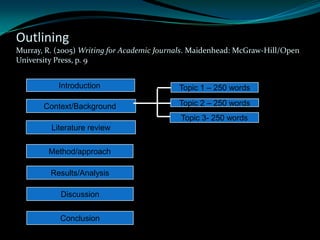
Outlining
Murray, R. (2005) Writing for Academic Journals. Maidenhead: McGraw-Hill/Open
University Press, p. 9
Context/Background
Literature review
Method/approach
Results/Analysis
Discussion
Conclusion
Topic 1 – 250 words
Topic 2 – 250 words
Topic 3- 250 words
Introduction
Task 5 - Outlining
Draw up an outline for an article you wish
to write
Give approximate number of words in
each section
Write a description of each section
beginning with the words This section will
cover…
Elements of a peer-reviewed article
 Title
 Abstract & Keywords
 Introduction
 Literature review
 Methodology
 Results/Analysis
 Discussion
 Conclusion
 References
Task 6 - Drafting a query e-mail
 Before writing/submitting
 Identify journal
 Identify editor
 Single sentences
 I am writing an article on…
 My experience is this area…
 I think that readers of your journal would be
interested in… because…
Writing
To begin writing you have to begin
writing
Writing generates ideas
Don’t look for perfection, just write
Give yourself permission to write
badly
All writing is rewriting
Writing
 Can start at any point, but generally not
introduction or conclusion
 Scientists often write the results section up
first
 Write in sentences
 No more than one idea in each sentence
 Logical movement from sentence to sentence
and from paragraph to paragraph
Style
 House style (journal style)
 First, second or third person
 Active or passive voice
 Tense
 Transitions
 Signposts
 Headings & subheadings (official)
Endings of sections that hark back to what went before,
announce what comes next (unofficial)
 Movement/Coherence/clarity
Writing as Storytelling
 Writing as storytelling
 Beginning, middle and end (not necessarily in
that order)
 What makes a story interesting?
 A story has a theme
 A story has movement
 A story has a flow
 Something happens/changes
Drafting and Revising
Draft and redraft
Number and date drafts
Refer back to your audience & purpose
statement
Ask a critical colleague to read
Revise title, abstract & article
Drafting and Revising
When finished put aside for at least a
week
Reread
Spell check
Recheck submission guidelines
File preprint
Let go
Submission
 Professional Journal – editor
 Academic Journal – double blind peer-reviewers
 Accept as is
 Accept with revisions
 Revise and resubmit
 Reject
 Make changes as quickly as possible
 Reread
 Resubmit
 Keep postprint
Publicising Your Work
Deposit in Institutional Repository
Policy available at www.sherpa.ac.uk
Create a profile using google scholar
http://scholar.google.co.uk/intl/en/schol
ar/citations.html
Create a profile on Academia.edu
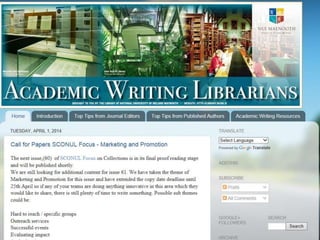
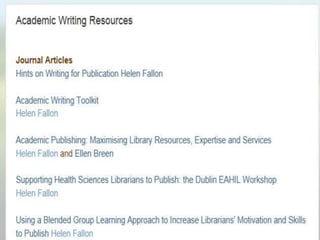
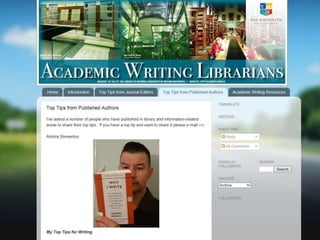
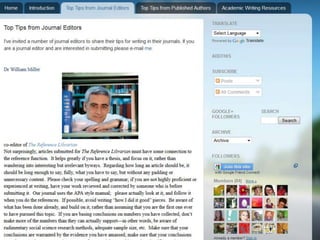
Academic Writing Librarians Blog
 To encourage/promote academic writing
among library staff
 Calls for papers/posters/book chapters etc.
 Links to my articles on academic writing
 Tips from published authors
 Tips from journal editors
 Other
http://www.academicwritinglibrarian.blogspot.ie/
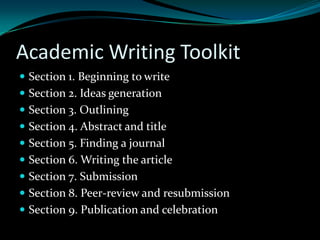
Academic Writing Toolkit
 Section 1. Beginning to write
 Section 2. Ideas generation
 Section 3. Outlining
 Section 4. Abstract and title
 Section 5. Finding a journal
 Section 6. Writing the article
 Section 7. Submission
 Section 8. Peer-review and resubmission
 Section 9. Publication and celebration
Follow Academic Writing Librarians
 Follow Helen Fallon on Twitter for updates
 Access the blog at
 http://academicwritinglibrarian.blogspot.ie/
 Sign up as a follower
 Follow by e-mail from the box on the homepage
Moving on with your writing
Write
Describe, reflect
and evaluate
Talk
Notebook
Data
Collaborate
Be strategic
Cite key people
Set realistic goals
Give and look for
peer support
Celebrate
Bibliography on Academic Writing
Academic Writing Librarians
http://anltc.ie/wp-content/uploads/2013/09/BIBLIOGRAPHY-ON-ACADEMIC-WRITING.pdf
Online Academic Writing Group
 E-mail helen.b.fallon@nuim.ie by Friday 4 April
Put online Writing Group in title of Message

16.00 qs1 mon helen fallon

  • 1.
    Helen Fallon, DeputyLibrarian, National University of Ireland Maynooth Helen.b.fallon@nuim.ie
  • 3.
    Goals of thisworkshop  Increased energy and confidence in writing  Greater understanding of the mechanics of writing  Greater understanding of the different requirements of peer-reviewed and professional journals  Increased knowledge on finding out about publishing opportunities and publicising your publications
  • 4.
    Task 1– Writingto Prompt  Write for five minutes, in sentences, without stopping, using one of the following prompts  I am interested in writing about…  An area of my research which I would like to write about is…  I feel at my most creative when I’m writing about…
  • 5.
    Task 2- FindingTopics Work with a colleague and list as many topics as you can that you feel you could write about. These topics could relate to work you have been involved in, subjects that interest you or topics you have done research on Next list the sources you might use in your article
  • 6.
    Task 3 –Making a case for writing Write for five minutes in sentences, in no more than fifty words, explaining to your department head why is it important that you publish
  • 7.
    Task 4– Definingaudience and Purpose Describe in one sentence the purpose of the piece you are writing What is the audience for your article? What’s your angle? What data do you have? Is this topic most suited for a research article/a practice-based article or some other format e.g poster?
  • 8.
    Practice-based article  Basedprimarily on experience  Give some background  Describe what happened  What was the impact  Reflection – what worked, what didn’t work so well, what could be done to improve it  Conclusion  (who, what, when, where, how)
  • 9.
    Research-based article • Mustdraw on research • Generally longer than practice-based article e.g. 5,000 words • Double blind peer review • Has an abstract (informative or structured) • Literature Review • Gives methodology and results • References
  • 10.
    Outlining/Structuring  There aredifferent ways to structure articles  Study the format of articles in the journal you hope to target  Read first for story then for structure  Model articles on other articles that work well (template)  Different structures can achieve the same end in different ways  Be aware of your audience
  • 11.
    Outlining Murray, R. (2005)Writing for Academic Journals. Maidenhead: McGraw-Hill/Open University Press, p. 9 Context/Background Literature review Method/approach Results/Analysis Discussion Conclusion Topic 1 – 250 words Topic 2 – 250 words Topic 3- 250 words Introduction
  • 12.
    Task 5 -Outlining Draw up an outline for an article you wish to write Give approximate number of words in each section Write a description of each section beginning with the words This section will cover…
  • 13.
    Elements of apeer-reviewed article  Title  Abstract & Keywords  Introduction  Literature review  Methodology  Results/Analysis  Discussion  Conclusion  References
  • 14.
    Task 6 -Drafting a query e-mail  Before writing/submitting  Identify journal  Identify editor  Single sentences  I am writing an article on…  My experience is this area…  I think that readers of your journal would be interested in… because…
  • 15.
    Writing To begin writingyou have to begin writing Writing generates ideas Don’t look for perfection, just write Give yourself permission to write badly All writing is rewriting
  • 16.
    Writing  Can startat any point, but generally not introduction or conclusion  Scientists often write the results section up first  Write in sentences  No more than one idea in each sentence  Logical movement from sentence to sentence and from paragraph to paragraph
  • 17.
    Style  House style(journal style)  First, second or third person  Active or passive voice  Tense  Transitions  Signposts  Headings & subheadings (official) Endings of sections that hark back to what went before, announce what comes next (unofficial)  Movement/Coherence/clarity
  • 18.
    Writing as Storytelling Writing as storytelling  Beginning, middle and end (not necessarily in that order)  What makes a story interesting?  A story has a theme  A story has movement  A story has a flow  Something happens/changes
  • 19.
    Drafting and Revising Draftand redraft Number and date drafts Refer back to your audience & purpose statement Ask a critical colleague to read Revise title, abstract & article
  • 20.
    Drafting and Revising Whenfinished put aside for at least a week Reread Spell check Recheck submission guidelines File preprint Let go
  • 21.
    Submission  Professional Journal– editor  Academic Journal – double blind peer-reviewers  Accept as is  Accept with revisions  Revise and resubmit  Reject  Make changes as quickly as possible  Reread  Resubmit  Keep postprint
  • 22.
    Publicising Your Work Depositin Institutional Repository Policy available at www.sherpa.ac.uk Create a profile using google scholar http://scholar.google.co.uk/intl/en/schol ar/citations.html Create a profile on Academia.edu
  • 23.
    Academic Writing LibrariansBlog  To encourage/promote academic writing among library staff  Calls for papers/posters/book chapters etc.  Links to my articles on academic writing  Tips from published authors  Tips from journal editors  Other http://www.academicwritinglibrarian.blogspot.ie/
  • 26.
    Academic Writing Toolkit Section 1. Beginning to write  Section 2. Ideas generation  Section 3. Outlining  Section 4. Abstract and title  Section 5. Finding a journal  Section 6. Writing the article  Section 7. Submission  Section 8. Peer-review and resubmission  Section 9. Publication and celebration
  • 29.
    Follow Academic WritingLibrarians  Follow Helen Fallon on Twitter for updates  Access the blog at  http://academicwritinglibrarian.blogspot.ie/  Sign up as a follower  Follow by e-mail from the box on the homepage
  • 30.
    Moving on withyour writing Write Describe, reflect and evaluate Talk Notebook Data Collaborate Be strategic Cite key people Set realistic goals Give and look for peer support Celebrate
  • 31.
    Bibliography on AcademicWriting Academic Writing Librarians http://anltc.ie/wp-content/uploads/2013/09/BIBLIOGRAPHY-ON-ACADEMIC-WRITING.pdf
  • 32.
    Online Academic WritingGroup  E-mail helen.b.fallon@nuim.ie by Friday 4 April Put online Writing Group in title of Message