WRITING ASSESSMENT
GROUP 4
Yurizal
Iin Widya Lestari
Indri Astuti
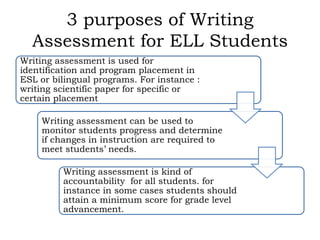
3 purposes of Writing
Assessment for ELL Students
Writing assessment is used for
identification and program placement in
ESL or bilingual programs. For instance :
writing scientific paper for specific or
certain placement
Writing assessment can be used to
monitor students progress and determine
if changes in instruction are required to
meet students’ needs.
Writing assessment is kind of
accountability for all students. for
instance in some cases students should
attain a minimum score for grade level
advancement.
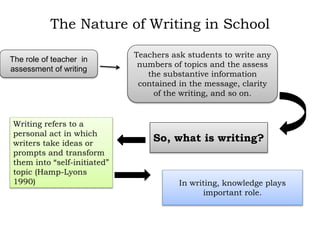
The Nature of Writing in School
The role of teacher in
assessment of writing
Teachers ask students to write any
numbers of topics and the assess
the substantive information
contained in the message, clarity
of the writing, and so on.
So, what is writing?
Writing refers to a
personal act in which
writers take ideas or
prompts and transform
them into “self-initiated”
topic (Hamp-Lyons
1990) In writing, knowledge plays
important role.
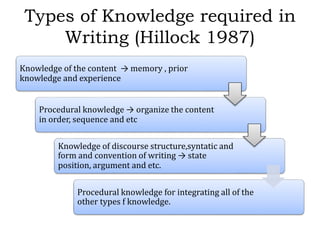
Types of Knowledge required in
Writing (Hillock 1987)
Knowledge of the content → memory , prior
knowledge and experience
Procedural knowledge → organize the content
in order, sequence and etc
Knowledge of discourse structure,syntatic and
form and convention of writing → state
position, argument and etc.
Procedural knowledge for integrating all of the
other types f knowledge.
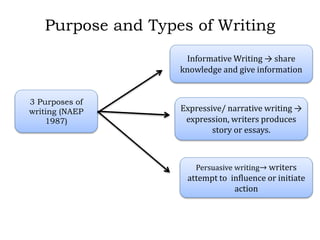
Purpose and Types of Writing
3 Purposes of
writing (NAEP
1987)
Informative Writing → share
knowledge and give information
Expressive/ narrative writing →
expression, writers produces
story or essays.
Persuasive writing→ writers
attempt to influence or initiate
action
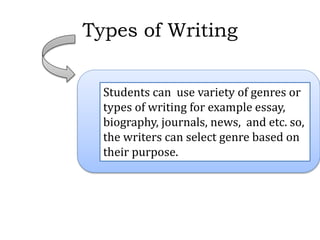
Types of Writing
Students can use variety of genres or
types of writing for example essay,
biography, journals, news, and etc. so,
the writers can select genre based on
their purpose.
Writing Instruction
• Traditionally, writing and reading were
taught independently of the writing process.
writing could be assessed by asking
students to respond multiple choice item
and etc.
• There are two recent departures from the
traditional paradigm about writing
assessment namely process writing and
writing across the curriculum
Writing Instruction
• Students are involved in the construction of
narratives on topics which they have personal
interest (Hudelson,1989). So students share
their writing with peers and etc
• In process writing, there are some stages such
as: (1) prewriting, (2) writing, (3) post writing
• While an important component of process
writing instruction is conferencing (Church
1993)
Writing across the Curriculum
• Students who write about topics tend to
understand them better (Shuman 1984)
• Students write to learn rather than learn to
write (Newmann 1989)
• Teachers give students opportunities to write
for varied purposes in the content area such as
note taking, summarizing text and so on.
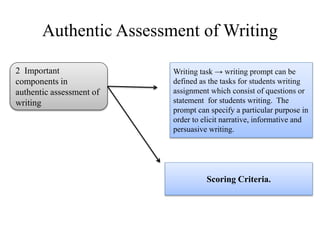
Authentic Assessment of Writing
2 Important
components in
authentic assessment of
writing
Writing task → writing prompt can be
defined as the tasks for students writing
assignment which consist of questions or
statement for students writing. The
prompt can specify a particular purpose in
order to elicit narrative, informative and
persuasive writing.
Scoring Criteria.
Criteria for Writing
• Invite the desire type of writing or genre
• Engage the thinking, problem solving,
composing and text making process central to
the type of writing
• Be challenging for many students and
accessible to all
• Provide equitable opportunities for all students
to respond
• Produce interesting
• Be liked by many students
Integrated Language Assessment
• Language art Teachers in Prince William
County, Virginia, designed an assessment of
persuasive writing for seventh and teenth
grade.
• Students → reading topics (newspapers and
other articles)→ students were asked to write
a persuasive writing.
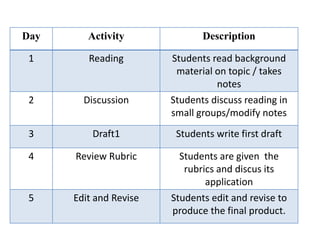
Day Activity Description
1 Reading Students read background
material on topic / takes
notes
2 Discussion Students discuss reading in
small groups/modify notes
3 Draft1 Students write first draft
4 Review Rubric Students are given the
rubrics and discus its
application
5 Edit and Revise Students edit and revise to
produce the final product.
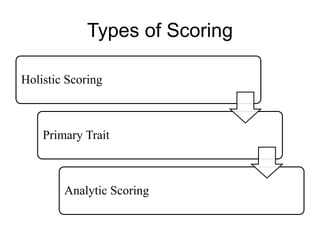
Types of Scoring
Holistic Scoring
Primary Trait
Analytic Scoring
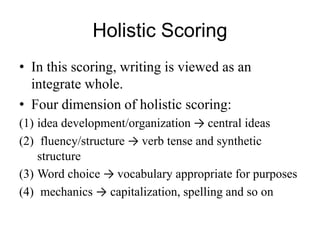
Holistic Scoring
• In this scoring, writing is viewed as an
integrate whole.
• Four dimension of holistic scoring:
(1) idea development/organization → central ideas
(2) fluency/structure → verb tense and synthetic
structure
(3) Word choice → vocabulary appropriate for purposes
(4) mechanics → capitalization, spelling and so on
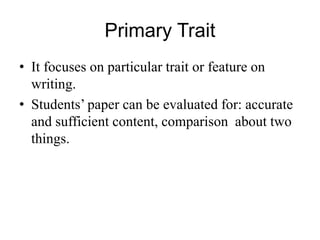
Primary Trait
• It focuses on particular trait or feature on
writing.
• Students’ paper can be evaluated for: accurate
and sufficient content, comparison about two
things.
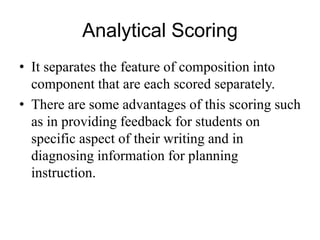
Analytical Scoring
• It separates the feature of composition into
component that are each scored separately.
• There are some advantages of this scoring such
as in providing feedback for students on
specific aspect of their writing and in
diagnosing information for planning
instruction.
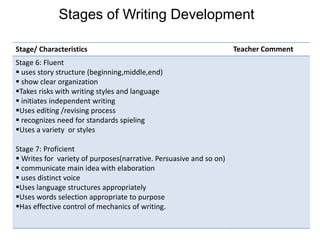
Stages of Writing Development
Stage/ Characteristics Teacher Comment
Stage 6: Fluent
 uses story structure (beginning,middle,end)
 show clear organization
Takes risks with writing styles and language
 initiates independent writing
Uses editing /revising process
 recognizes need for standards spieling
Uses a variety or styles
Stage 7: Proficient
 Writes for variety of purposes(narrative. Persuasive and so on)
 communicate main idea with elaboration
 uses distinct voice
Uses language structures appropriately
Uses words selection appropriate to purpose
Has effective control of mechanics of writing.
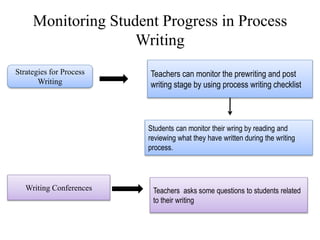
Monitoring Student Progress in Process
Writing
Strategies for Process
Writing
Teachers can monitor the prewriting and post
writing stage by using process writing checklist
Students can monitor their wring by reading and
reviewing what they have written during the writing
process.
Writing Conferences Teachers asks some questions to students related
to their writing
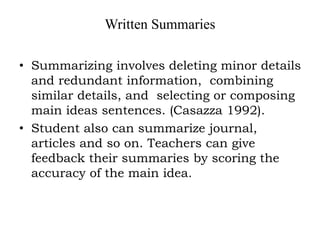
Written Summaries
• Summarizing involves deleting minor details
and redundant information, combining
similar details, and selecting or composing
main ideas sentences. (Casazza 1992).
• Student also can summarize journal,
articles and so on. Teachers can give
feedback their summaries by scoring the
accuracy of the main idea.
Self Assessment in Writing
• Self assessment encourages students to
think about their purpose in writing and to
reflect on what and how much they are
learning.
• Self assessment can be applied through
journals, learning logs, self assessment of
interest and writing assessment and
checklists of writing skills.
Peer Assessment in Writing
• It involves the students in evaluation
of writing.
• Peer will read and check the other
students’ writing and they will give
score through scoring rubrics.
Using Writing Assessment in Instruction
• Select prompts that are appropriate for the
students
• Select rubrics students can use
• Share the rubrics with students
• Identify benchmark papers
• Review how students write not just what they
write
• Provide time and instructional support for self
assessment and peer assessment
• Introduce self assessment gradually
• Use conferencing to discuss writing with
students

Writing assessment

  • 1.
    WRITING ASSESSMENT GROUP 4 Yurizal IinWidya Lestari Indri Astuti
  • 2.
    3 purposes ofWriting Assessment for ELL Students Writing assessment is used for identification and program placement in ESL or bilingual programs. For instance : writing scientific paper for specific or certain placement Writing assessment can be used to monitor students progress and determine if changes in instruction are required to meet students’ needs. Writing assessment is kind of accountability for all students. for instance in some cases students should attain a minimum score for grade level advancement.
  • 3.
    The Nature ofWriting in School The role of teacher in assessment of writing Teachers ask students to write any numbers of topics and the assess the substantive information contained in the message, clarity of the writing, and so on. So, what is writing? Writing refers to a personal act in which writers take ideas or prompts and transform them into “self-initiated” topic (Hamp-Lyons 1990) In writing, knowledge plays important role.
  • 4.
    Types of Knowledgerequired in Writing (Hillock 1987) Knowledge of the content → memory , prior knowledge and experience Procedural knowledge → organize the content in order, sequence and etc Knowledge of discourse structure,syntatic and form and convention of writing → state position, argument and etc. Procedural knowledge for integrating all of the other types f knowledge.
  • 5.
    Purpose and Typesof Writing 3 Purposes of writing (NAEP 1987) Informative Writing → share knowledge and give information Expressive/ narrative writing → expression, writers produces story or essays. Persuasive writing→ writers attempt to influence or initiate action
  • 6.
    Types of Writing Studentscan use variety of genres or types of writing for example essay, biography, journals, news, and etc. so, the writers can select genre based on their purpose.
  • 7.
    Writing Instruction • Traditionally,writing and reading were taught independently of the writing process. writing could be assessed by asking students to respond multiple choice item and etc. • There are two recent departures from the traditional paradigm about writing assessment namely process writing and writing across the curriculum
  • 8.
    Writing Instruction • Studentsare involved in the construction of narratives on topics which they have personal interest (Hudelson,1989). So students share their writing with peers and etc • In process writing, there are some stages such as: (1) prewriting, (2) writing, (3) post writing • While an important component of process writing instruction is conferencing (Church 1993)
  • 9.
    Writing across theCurriculum • Students who write about topics tend to understand them better (Shuman 1984) • Students write to learn rather than learn to write (Newmann 1989) • Teachers give students opportunities to write for varied purposes in the content area such as note taking, summarizing text and so on.
  • 10.
    Authentic Assessment ofWriting 2 Important components in authentic assessment of writing Writing task → writing prompt can be defined as the tasks for students writing assignment which consist of questions or statement for students writing. The prompt can specify a particular purpose in order to elicit narrative, informative and persuasive writing. Scoring Criteria.
  • 11.
    Criteria for Writing •Invite the desire type of writing or genre • Engage the thinking, problem solving, composing and text making process central to the type of writing • Be challenging for many students and accessible to all • Provide equitable opportunities for all students to respond • Produce interesting • Be liked by many students
  • 12.
    Integrated Language Assessment •Language art Teachers in Prince William County, Virginia, designed an assessment of persuasive writing for seventh and teenth grade. • Students → reading topics (newspapers and other articles)→ students were asked to write a persuasive writing.
  • 13.
    Day Activity Description 1Reading Students read background material on topic / takes notes 2 Discussion Students discuss reading in small groups/modify notes 3 Draft1 Students write first draft 4 Review Rubric Students are given the rubrics and discus its application 5 Edit and Revise Students edit and revise to produce the final product.
  • 14.
    Types of Scoring HolisticScoring Primary Trait Analytic Scoring
  • 15.
    Holistic Scoring • Inthis scoring, writing is viewed as an integrate whole. • Four dimension of holistic scoring: (1) idea development/organization → central ideas (2) fluency/structure → verb tense and synthetic structure (3) Word choice → vocabulary appropriate for purposes (4) mechanics → capitalization, spelling and so on
  • 16.
    Primary Trait • Itfocuses on particular trait or feature on writing. • Students’ paper can be evaluated for: accurate and sufficient content, comparison about two things.
  • 17.
    Analytical Scoring • Itseparates the feature of composition into component that are each scored separately. • There are some advantages of this scoring such as in providing feedback for students on specific aspect of their writing and in diagnosing information for planning instruction.
  • 18.
    Stages of WritingDevelopment Stage/ Characteristics Teacher Comment Stage 6: Fluent  uses story structure (beginning,middle,end)  show clear organization Takes risks with writing styles and language  initiates independent writing Uses editing /revising process  recognizes need for standards spieling Uses a variety or styles Stage 7: Proficient  Writes for variety of purposes(narrative. Persuasive and so on)  communicate main idea with elaboration  uses distinct voice Uses language structures appropriately Uses words selection appropriate to purpose Has effective control of mechanics of writing.
  • 19.
    Monitoring Student Progressin Process Writing Strategies for Process Writing Teachers can monitor the prewriting and post writing stage by using process writing checklist Students can monitor their wring by reading and reviewing what they have written during the writing process. Writing Conferences Teachers asks some questions to students related to their writing
  • 20.
    Written Summaries • Summarizinginvolves deleting minor details and redundant information, combining similar details, and selecting or composing main ideas sentences. (Casazza 1992). • Student also can summarize journal, articles and so on. Teachers can give feedback their summaries by scoring the accuracy of the main idea.
  • 21.
    Self Assessment inWriting • Self assessment encourages students to think about their purpose in writing and to reflect on what and how much they are learning. • Self assessment can be applied through journals, learning logs, self assessment of interest and writing assessment and checklists of writing skills.
  • 22.
    Peer Assessment inWriting • It involves the students in evaluation of writing. • Peer will read and check the other students’ writing and they will give score through scoring rubrics.
  • 23.
    Using Writing Assessmentin Instruction • Select prompts that are appropriate for the students • Select rubrics students can use • Share the rubrics with students • Identify benchmark papers • Review how students write not just what they write • Provide time and instructional support for self assessment and peer assessment • Introduce self assessment gradually • Use conferencing to discuss writing with students

Editor's Notes