WRITING
ASSESSMENT
LINSAY STEFANY DONCEL C.
LINA FERNANDA CARVAJAL G.
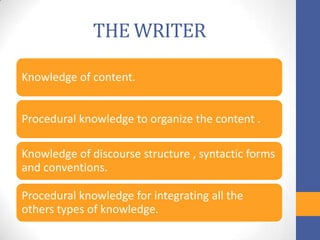
THE WRITER

Knowledge of content.


Procedural knowledge to organize the content .

Knowledge of discourse structure , syntactic forms
and conventions.

Procedural knowledge for integrating all the
others types of knowledge.
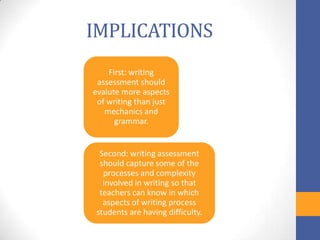
IMPLICATIONS
    First: writing
 assessment should
evalute more aspects
 of writing than just
   mechanics and
      grammar.


 Second: writing assessment
 should capture some of the
  processes and complexity
  involved in writing so that
 teachers can know in which
  aspects of writing process
students are having difficulty.
PURPOSES AND TYPES OF
          WRITING
The purpose in writing determines the nature of the writing;
students need clear specification of the purpose in order to plan
and compose a piece that responds to the task.

PURPOSES:
1. Informative/ expository writing: share knowledge and give
    information, direction, or ideas.
2. Expressive / narrative writing: it is a personal or imaginative
    expression in which the writer produces stories or essays.
3. Persuasive writing: writers attempt to influence others and
    initiate action or change.
Students’ writing ability may vary considerable depending on
the purpose or topic.
GENRE:
1. Biographies.
2. Essays
3. Stories
4. Journal
5. Letters
6. Newspaper reports
7. Manuals
8. Research papers

Determines the style or decisions about language and
organization.
WRITING INSTRUCTION
Writing should not be considered as an isolated skill.

PROCESS WRITING:
1. Pre-writing.
2. Writing
3. Post-writing
4. Conferencing
Teacher meets with students individually and ask questions
about the processes they use in writing, how they select the
topic, plans the writing nad composes the written pieces.
WRITING ACROSS THE
          CURRICULUM
Students who write about topics tend to understand them
better.
Teachers give students opportunities to write for varied
purposes in the content areas such as:
1. Note taking from lectures
2. Reading assignments
3. Summarizing text
4. Reporting experiments in science
5. Analyzing or explaining problem-solving.
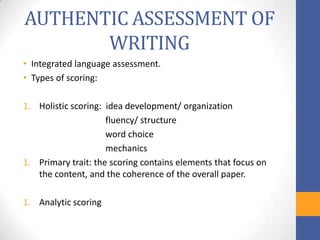
AUTHENTIC ASSESSMENT OF
       WRITING
• Integrated language assessment.
• Types of scoring:

1. Holistic scoring: idea development/ organization
                     fluency/ structure
                     word choice
                     mechanics
1. Primary trait: the scoring contains elements that focus on
   the content, and the coherence of the overall paper.

1. Analytic scoring
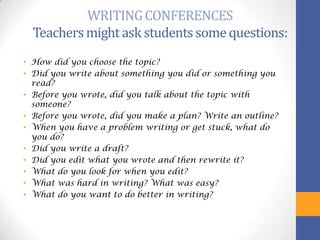
WRITING CONFERENCES
  Teachers might ask students some questions:
• How did you choose the topic?
• Did you write about something you did or something you
  read?
• Before you wrote, did you talk about the topic with
  someone?
• Before you wrote, did you make a plan? Write an outline?
• When you have a problem writing or get stuck, what do
  you do?
• Did you write a draft?
• Did you edit what you wrote and then rewrite it?
• What do you look for when you edit?
• What was hard in writing? What was easy?
• What do you want to do better in writing?
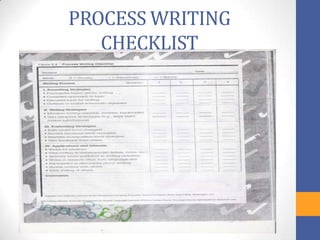
PROCESS WRITING
   CHECKLIST
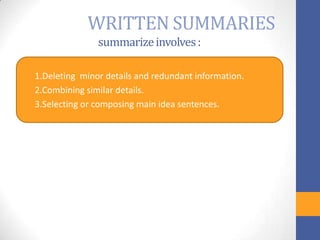
WRITTEN SUMMARIES
                 summarize involves :

• 1.Deleting minor details and redundant information.
• 2.Combining similar details.
• 3.Selecting or composing main idea sentences.
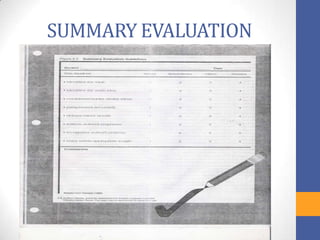
SUMMARY EVALUATION
STUDENTS CAN WRITE SUMMARIES IN BOTH

                                 Dialogue journals


•   Select a topics
•   Students write in class for five to ten minutes at the end.
•   Students write at their own proficiency level on self selected topics of interest.
•   Teacher does not correct the student’s language.
•   Topic initiation ,elaboration, variety ,use of different genres expression of interest
    and attitudes.
LEARNING LOGS
 • Students entries during the last five minutes of each period, responding to the
   following types of questions:
 • What did I learn today ?
 • What strategies or approaches worked best for me in
   learning?
 • What will I do to understand better?
Those questions are useful for students insecure to raise their hands in class and
ask questions .
Teacher can review students’ learning needs.
 • Does the student define and /or use new vocabulary from
   the lesson ?
 • Does the student use content vocabulary appropriately?
 • Does the student illustrate and label drawings correctly?
 • Does the student identify a range of strategies that worked
   in learning?
 • Does the student have reasonable plans for improving her or
   his learning?
both dialogue journals and learning
logs can help students 'self-evaluation
in documenting the progress they are
making in learning, in writing and
understanding new concepts, and
identifying a plans to improve learning.
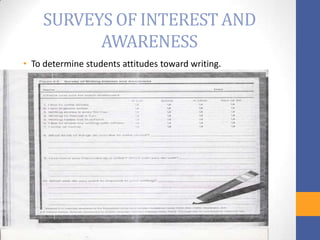
SURVEYS OF INTEREST AND
          AWARENESS
• To determine students attitudes toward writing.
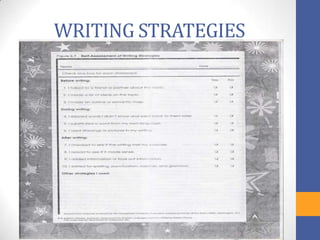
WRITING STRATEGIES
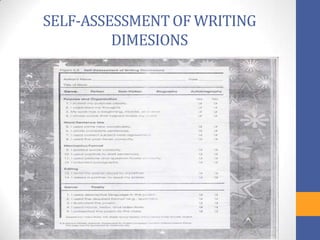
SELF-ASSESSMENT OF WRITING
         DIMESIONS
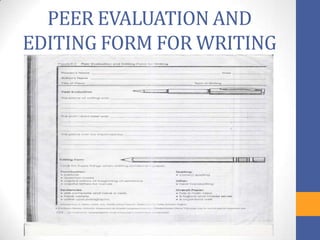
PEER EVALUATION AND
EDITING FORM FOR WRITING
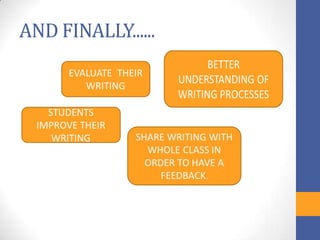
AND FINALLY......

Writing assessment

  • 1.
    WRITING ASSESSMENT LINSAY STEFANY DONCELC. LINA FERNANDA CARVAJAL G.
  • 2.
    THE WRITER Knowledge ofcontent. Procedural knowledge to organize the content . Knowledge of discourse structure , syntactic forms and conventions. Procedural knowledge for integrating all the others types of knowledge.
  • 3.
    IMPLICATIONS First: writing assessment should evalute more aspects of writing than just mechanics and grammar. Second: writing assessment should capture some of the processes and complexity involved in writing so that teachers can know in which aspects of writing process students are having difficulty.
  • 4.
    PURPOSES AND TYPESOF WRITING The purpose in writing determines the nature of the writing; students need clear specification of the purpose in order to plan and compose a piece that responds to the task. PURPOSES: 1. Informative/ expository writing: share knowledge and give information, direction, or ideas. 2. Expressive / narrative writing: it is a personal or imaginative expression in which the writer produces stories or essays. 3. Persuasive writing: writers attempt to influence others and initiate action or change. Students’ writing ability may vary considerable depending on the purpose or topic.
  • 5.
    GENRE: 1. Biographies. 2. Essays 3.Stories 4. Journal 5. Letters 6. Newspaper reports 7. Manuals 8. Research papers Determines the style or decisions about language and organization.
  • 6.
    WRITING INSTRUCTION Writing shouldnot be considered as an isolated skill. PROCESS WRITING: 1. Pre-writing. 2. Writing 3. Post-writing 4. Conferencing Teacher meets with students individually and ask questions about the processes they use in writing, how they select the topic, plans the writing nad composes the written pieces.
  • 7.
    WRITING ACROSS THE CURRICULUM Students who write about topics tend to understand them better. Teachers give students opportunities to write for varied purposes in the content areas such as: 1. Note taking from lectures 2. Reading assignments 3. Summarizing text 4. Reporting experiments in science 5. Analyzing or explaining problem-solving.
  • 8.
    AUTHENTIC ASSESSMENT OF WRITING • Integrated language assessment. • Types of scoring: 1. Holistic scoring: idea development/ organization fluency/ structure word choice mechanics 1. Primary trait: the scoring contains elements that focus on the content, and the coherence of the overall paper. 1. Analytic scoring
  • 9.
    WRITING CONFERENCES Teachers might ask students some questions: • How did you choose the topic? • Did you write about something you did or something you read? • Before you wrote, did you talk about the topic with someone? • Before you wrote, did you make a plan? Write an outline? • When you have a problem writing or get stuck, what do you do? • Did you write a draft? • Did you edit what you wrote and then rewrite it? • What do you look for when you edit? • What was hard in writing? What was easy? • What do you want to do better in writing?
  • 10.
  • 11.
    WRITTEN SUMMARIES summarize involves : • 1.Deleting minor details and redundant information. • 2.Combining similar details. • 3.Selecting or composing main idea sentences.
  • 12.
  • 13.
    STUDENTS CAN WRITESUMMARIES IN BOTH Dialogue journals • Select a topics • Students write in class for five to ten minutes at the end. • Students write at their own proficiency level on self selected topics of interest. • Teacher does not correct the student’s language. • Topic initiation ,elaboration, variety ,use of different genres expression of interest and attitudes.
  • 14.
    LEARNING LOGS •Students entries during the last five minutes of each period, responding to the following types of questions: • What did I learn today ? • What strategies or approaches worked best for me in learning? • What will I do to understand better? Those questions are useful for students insecure to raise their hands in class and ask questions . Teacher can review students’ learning needs. • Does the student define and /or use new vocabulary from the lesson ? • Does the student use content vocabulary appropriately? • Does the student illustrate and label drawings correctly? • Does the student identify a range of strategies that worked in learning? • Does the student have reasonable plans for improving her or his learning?
  • 15.
    both dialogue journalsand learning logs can help students 'self-evaluation in documenting the progress they are making in learning, in writing and understanding new concepts, and identifying a plans to improve learning.
  • 16.
    SURVEYS OF INTERESTAND AWARENESS • To determine students attitudes toward writing.
  • 17.
  • 18.
  • 19.
  • 20.