teaching writing to L2 learners
Pateyeva Natalia, PhD
Teacher trainer
“Writing is a way of talking without being
interrupted.”
Jules Renard
By the end of this workshop
participants will be able to:
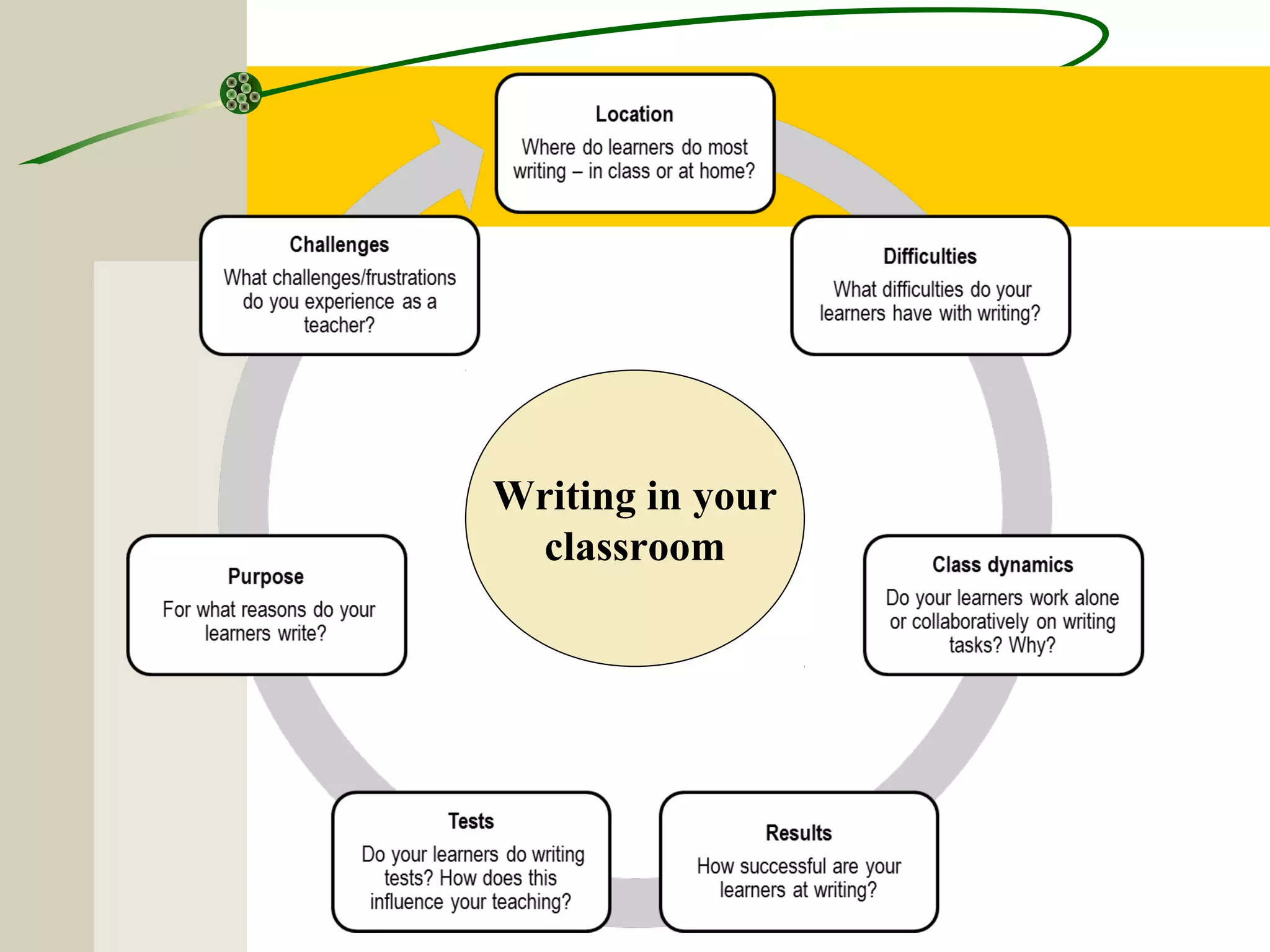
Assess the issues involved in teaching writing in their own
classrooms.
Identify the approaches involved in producing different types of
writing.
Match writing sub-skills to a process writing framework.
Analyze writing tasks from the point of view of audience, purpose and
context.
To provide an understanding on the principles of teaching writing
To provide a short overview on how writing is taught and evaluated
by teachers to achieve certain objectives
The main points to present
1. Writing at glance and types of classroom
writing performance
2. The principles of teaching writing
3. How student writing is evaluated
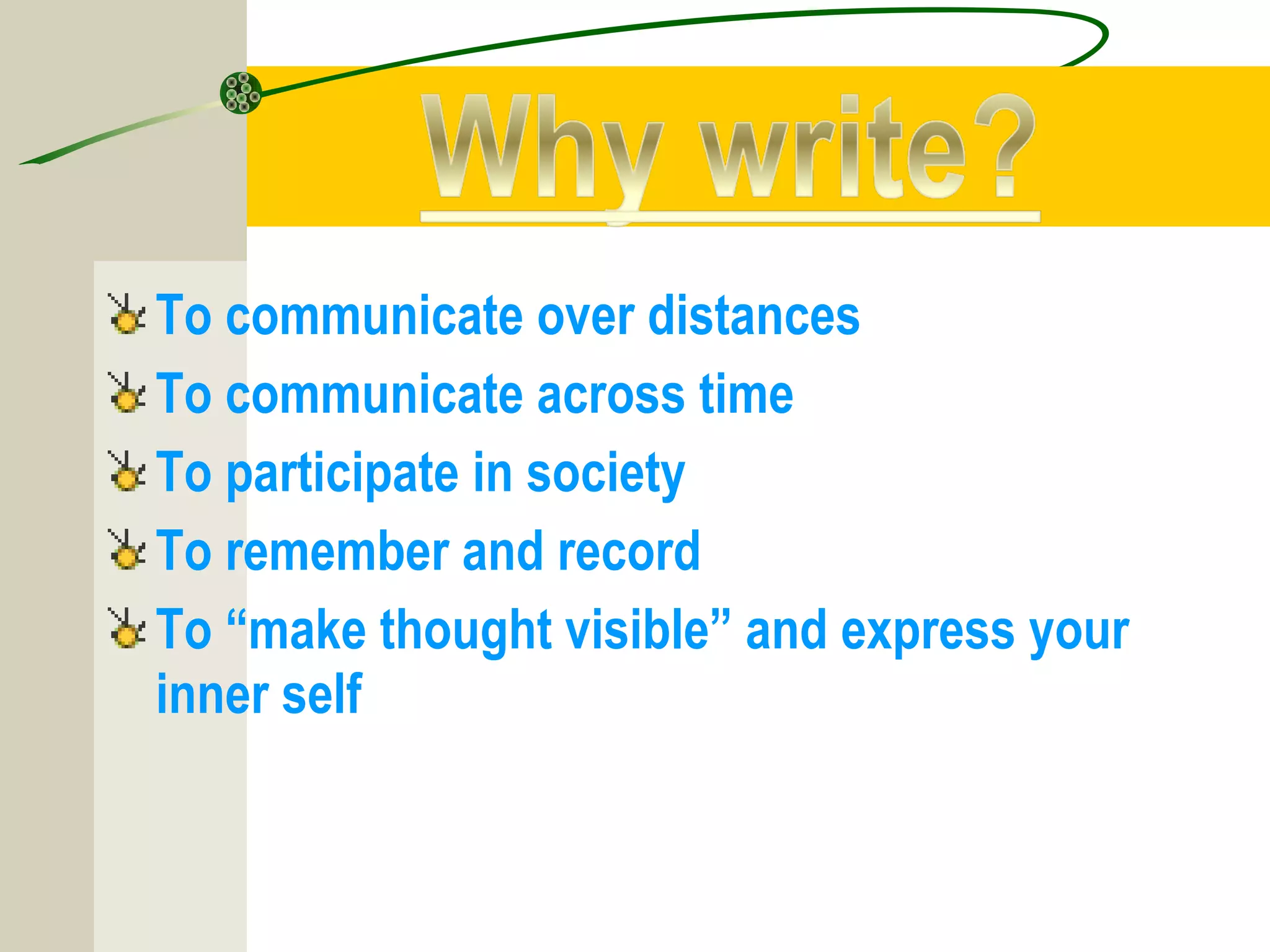
To communicate over distances
To communicate across time
To participate in society
To remember and record
To “make thought visible” and express your
inner self
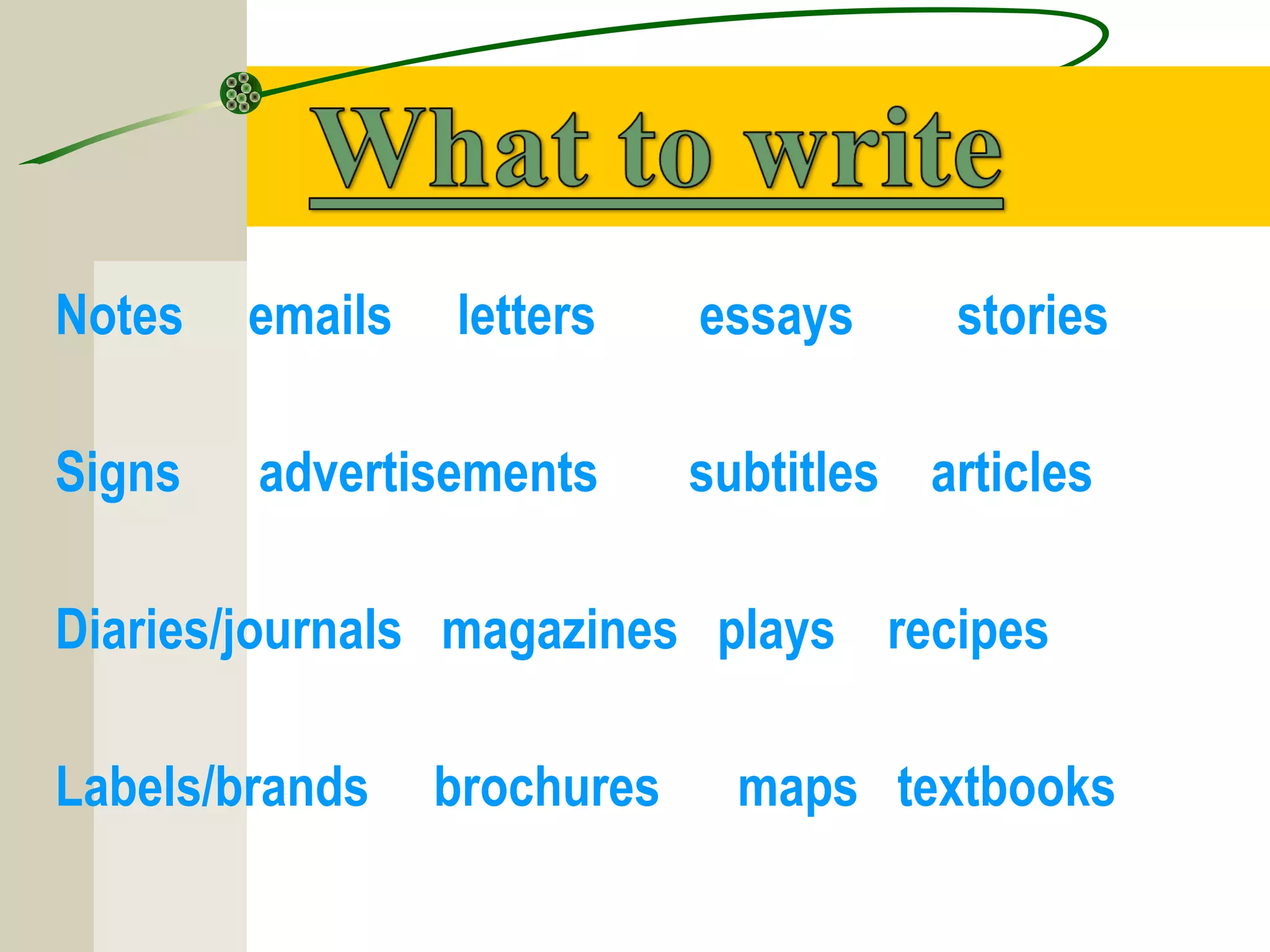
Notes emails letters essays stories
Signs advertisements subtitles articles
Diaries/journals magazines plays recipes
Labels/brands brochures maps textbooks
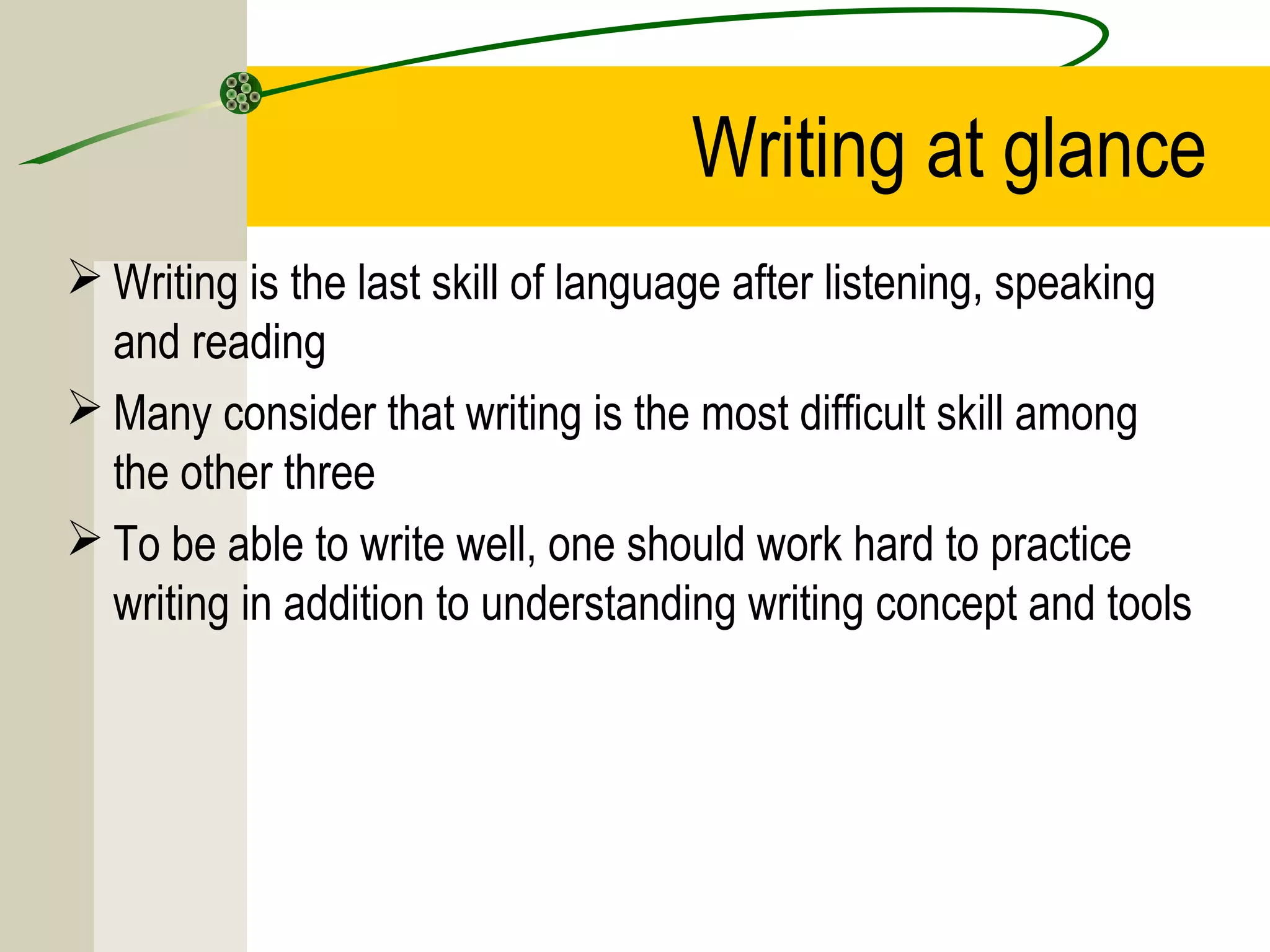
Writing at glance
 Writing is the last skill of language after listening, speaking
and reading
 Many consider that writing is the most difficult skill among
the other three
 To be able to write well, one should work hard to practice
writing in addition to understanding writing concept and tools
Writing in your
classroom
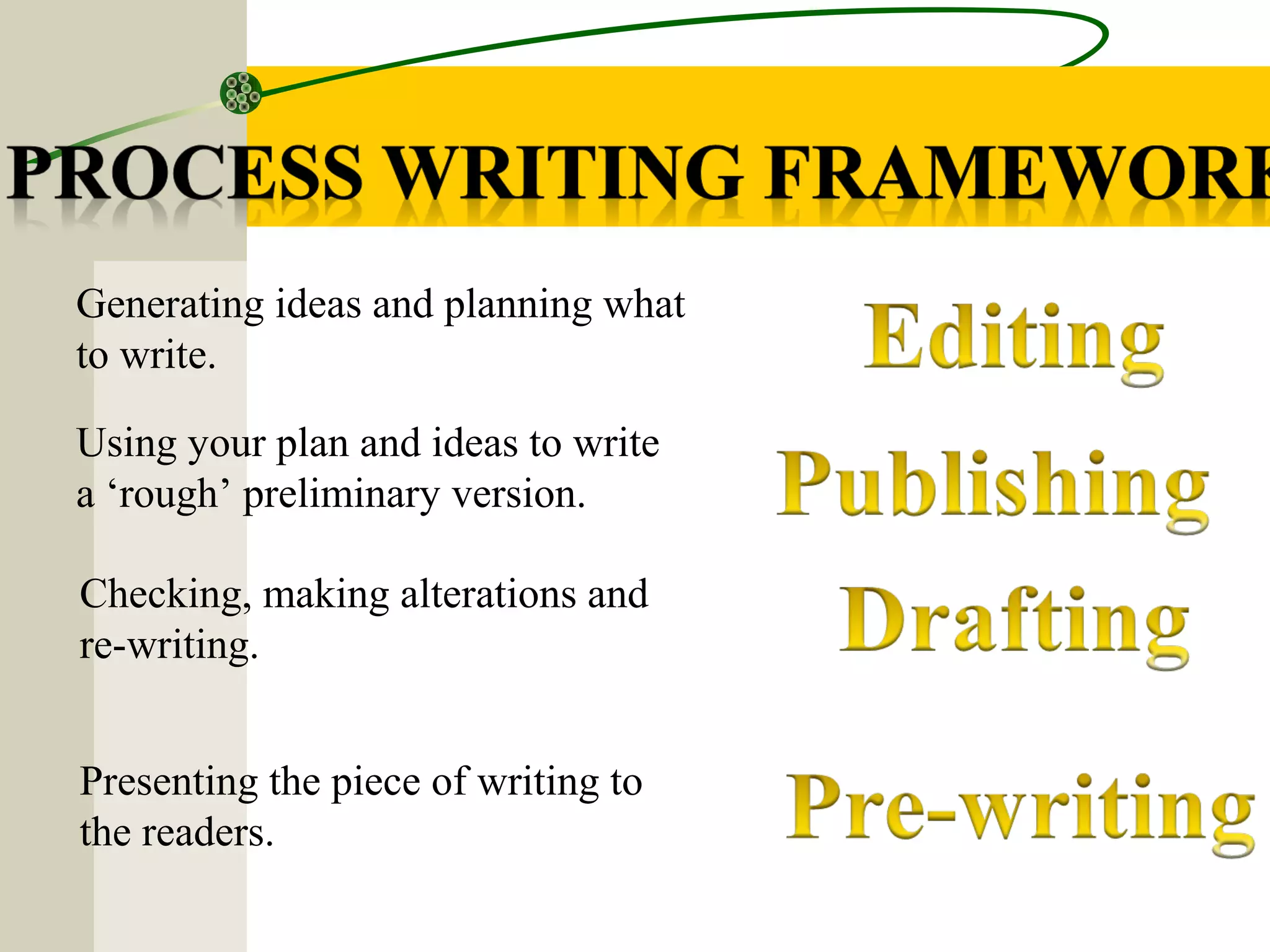
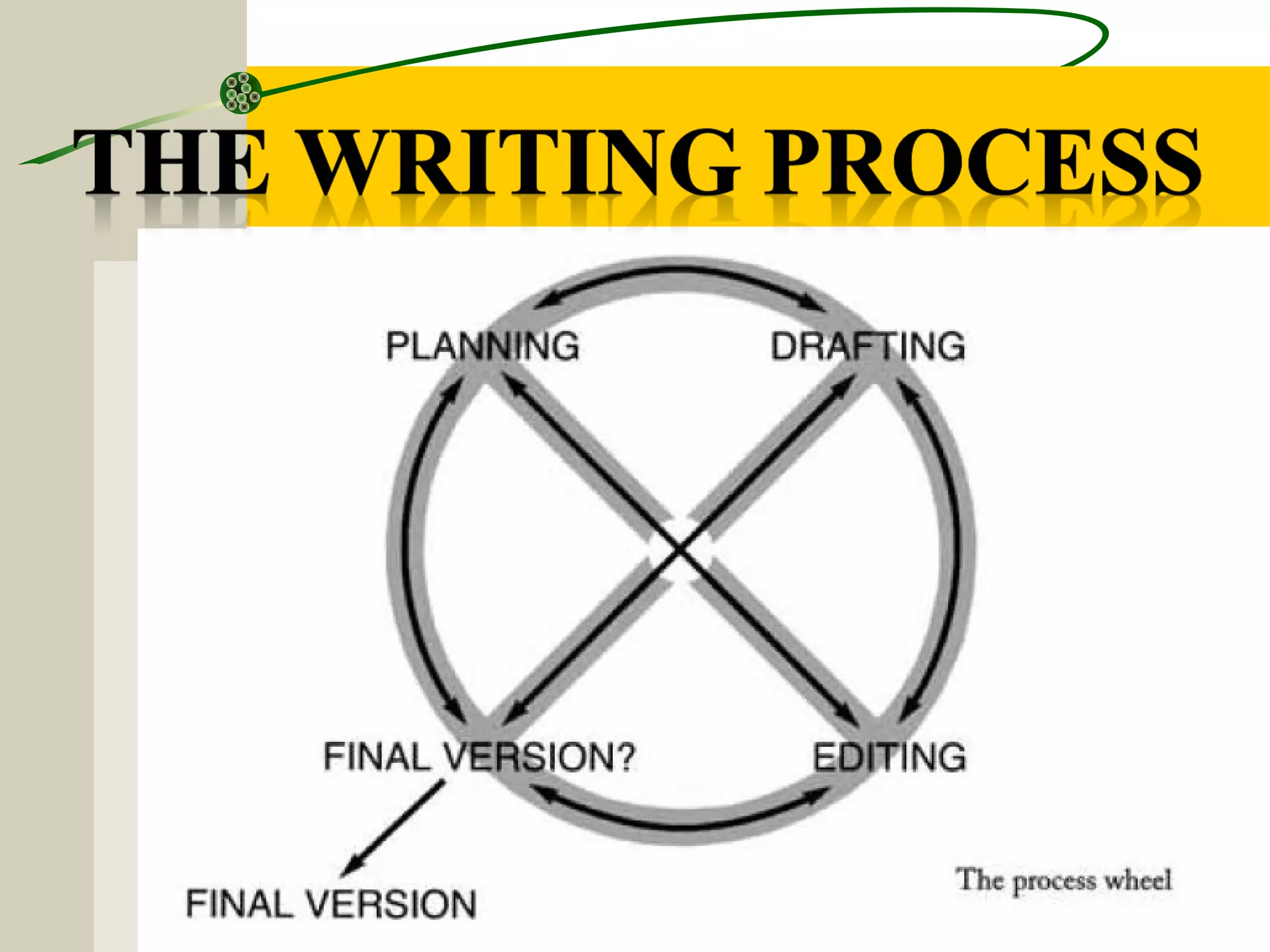
Using your plan and ideas to write
a ‘rough’ preliminary version.
Presenting the piece of writing to
the readers.
Checking, making alterations and
re-writing.
Generating ideas and planning what
to write.
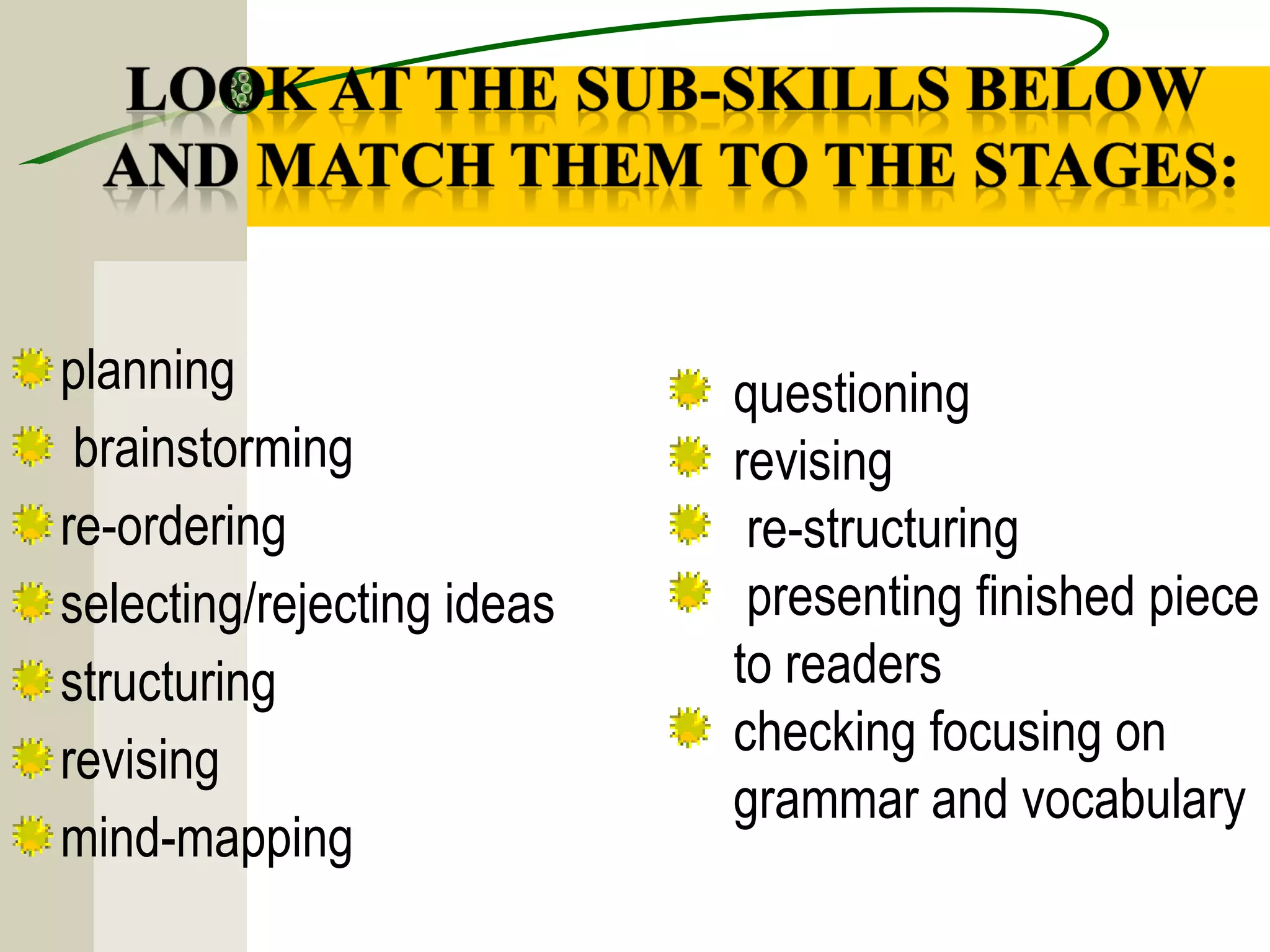
planning
brainstorming
re-ordering
selecting/rejecting ideas
structuring
revising
mind-mapping
questioning
revising
re-structuring
presenting finished piece
to readers
checking focusing on
grammar and vocabulary
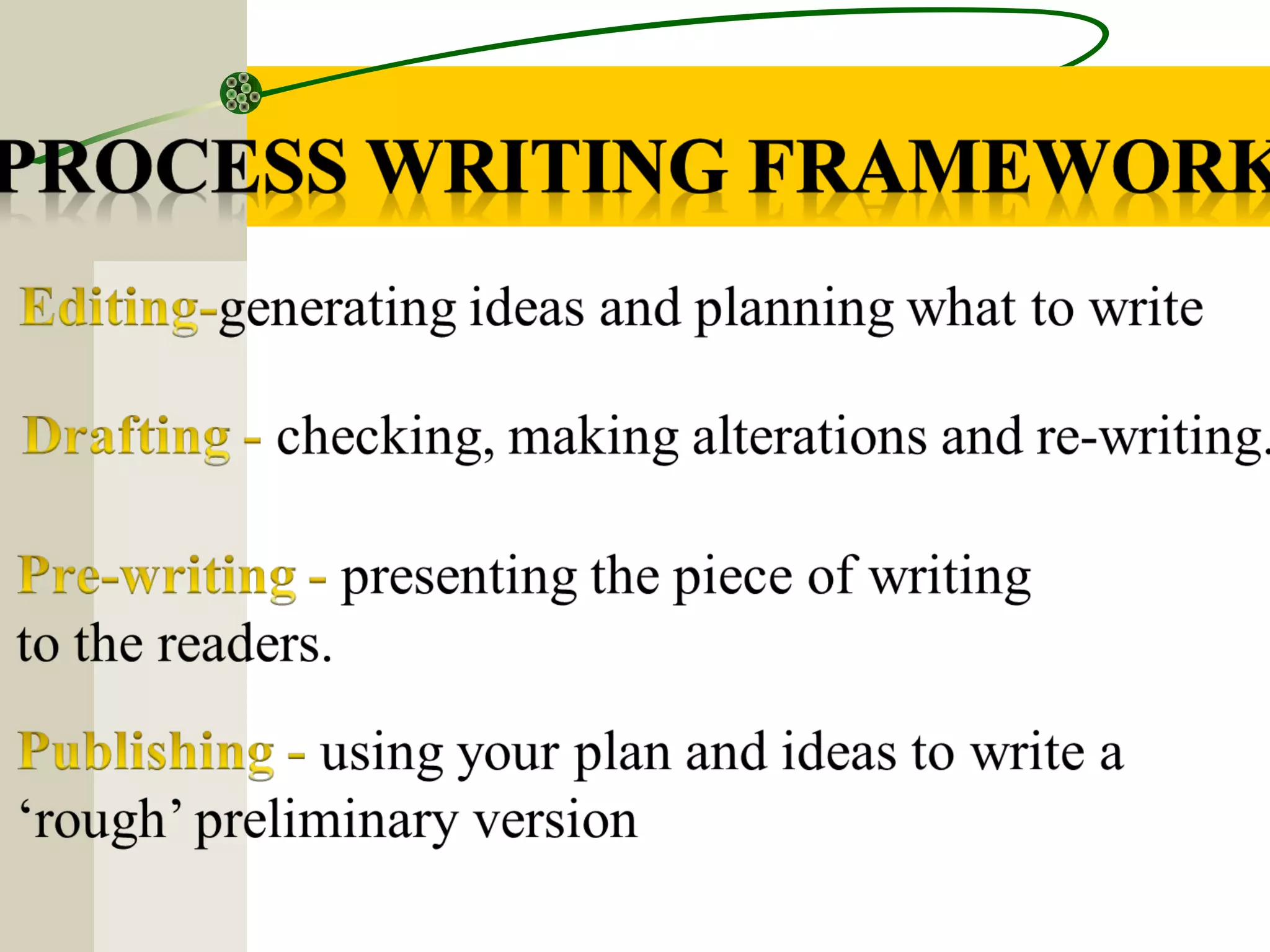
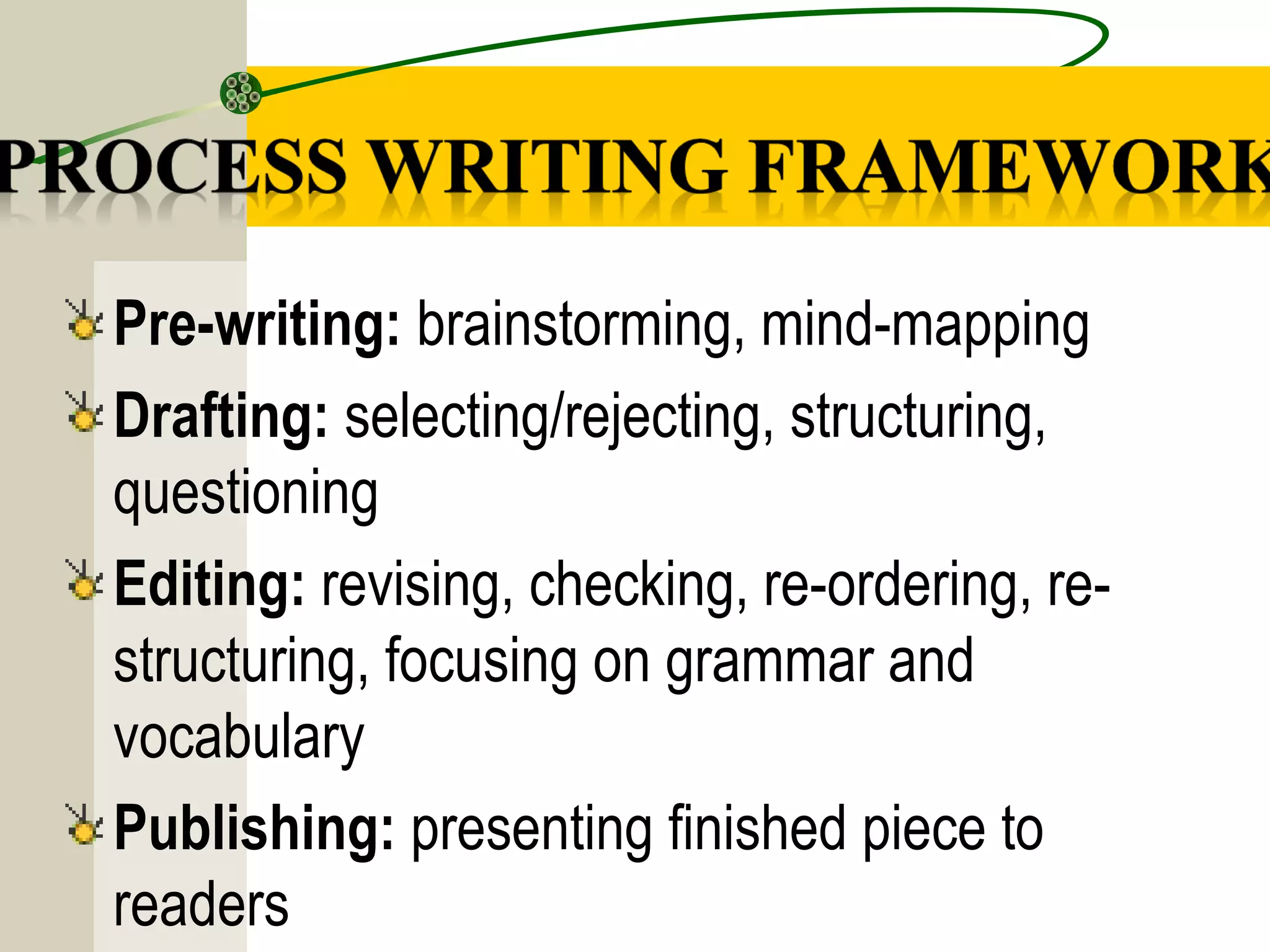
Pre-writing: brainstorming, mind-mapping
Drafting: selecting/rejecting, structuring,
questioning
Editing: revising, checking, re-ordering, re-
structuring, focusing on grammar and
vocabulary
Publishing: presenting finished piece to
readers
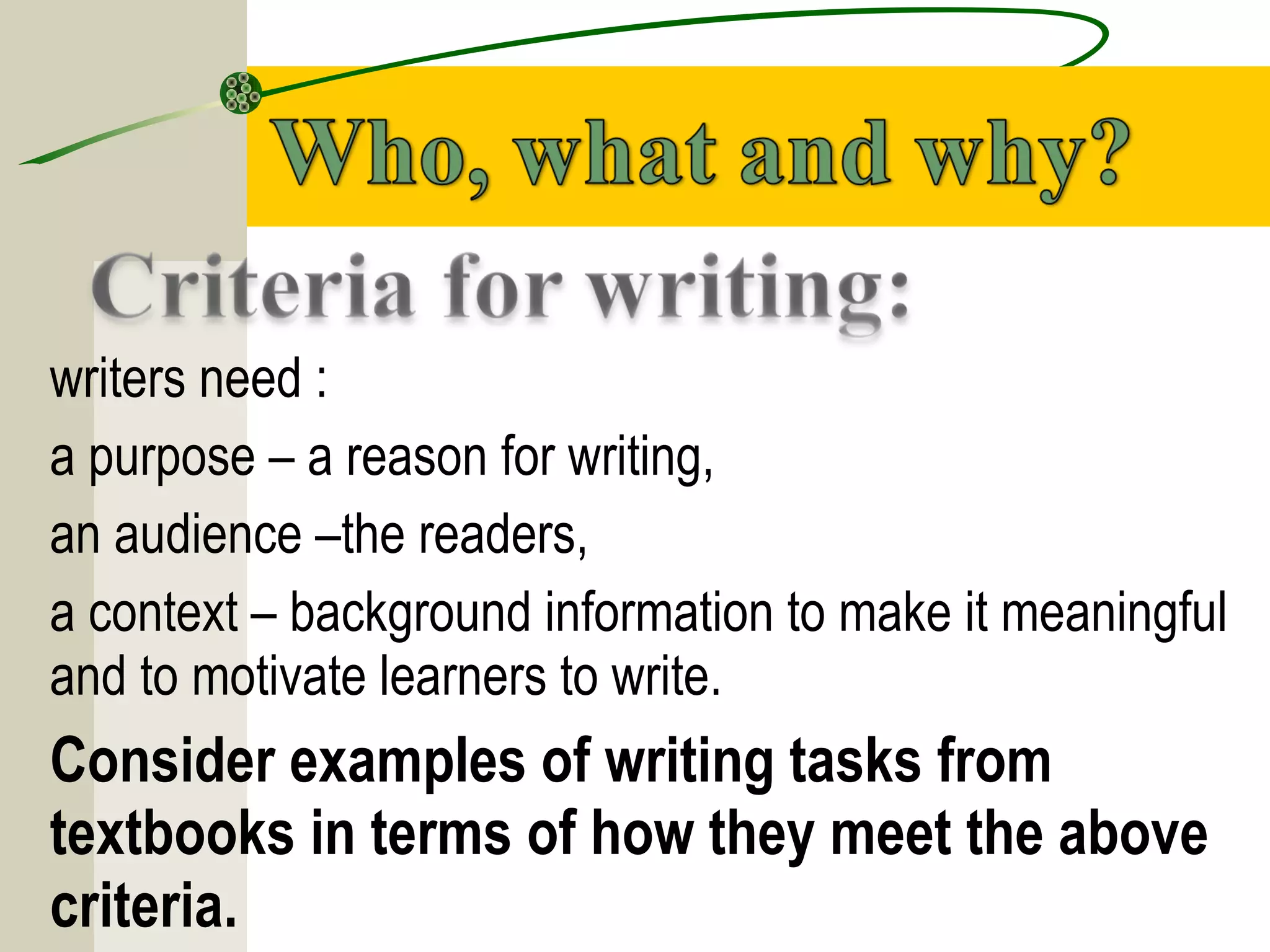
writers need :
a purpose – a reason for writing,
an audience –the readers,
a context – background information to make it meaningful
and to motivate learners to write.
Consider examples of writing tasks from
textbooks in terms of how they meet the above
criteria.
1. There is no audience. To make it more
meaningful ask learners to write an article for an
international student magazine, special issue on
festivals around the world.
2. The task works as it is but could be made more
meaningful by having half the class write the
complaint and the other half write the manager’s
response.
3. The task provides no guidance to help learners
write the story. Support could be given by
supplying pictures, prompt words, gapped
sentences, the beginning of a story etc. If the
learners work in groups, they could write the
stories for their classmates.
4. This task could be contextualized, for example,
“You are having a party. Your classmates are your
guests. Draw a map from the school to your home,
without indicating exactly where your home is. Now
write directions.” The ‘guests’ then have to pinpoint
the home of the ‘host’ from the directions.
5. This needs a purpose and an audience. For
example:”Imagine you are at a crossroads in your
life. You have an appointment with a ‘life coach’
but first she has asked you to write about yourself.
What can you tell her to prepare for your meeting?
Think about your plans and ambitions etc.
Takes too much time
Loss of student focus / interest
Not suited to some personalities
Students need to be taught it (peer
editing / planning / stages)
Restricts spontaneity and range of
writing activities.
The creation of a product
Writing seen as a communicative and
purposeful activity
Teaches students to plan and research
Student collaboration is developed.
Feedback and response given.
Isn't it surprising how many things, if
not said immediately, seem not
worth saying ten minutes from
now?  ~ Arnot L. Sheppard, Jr.
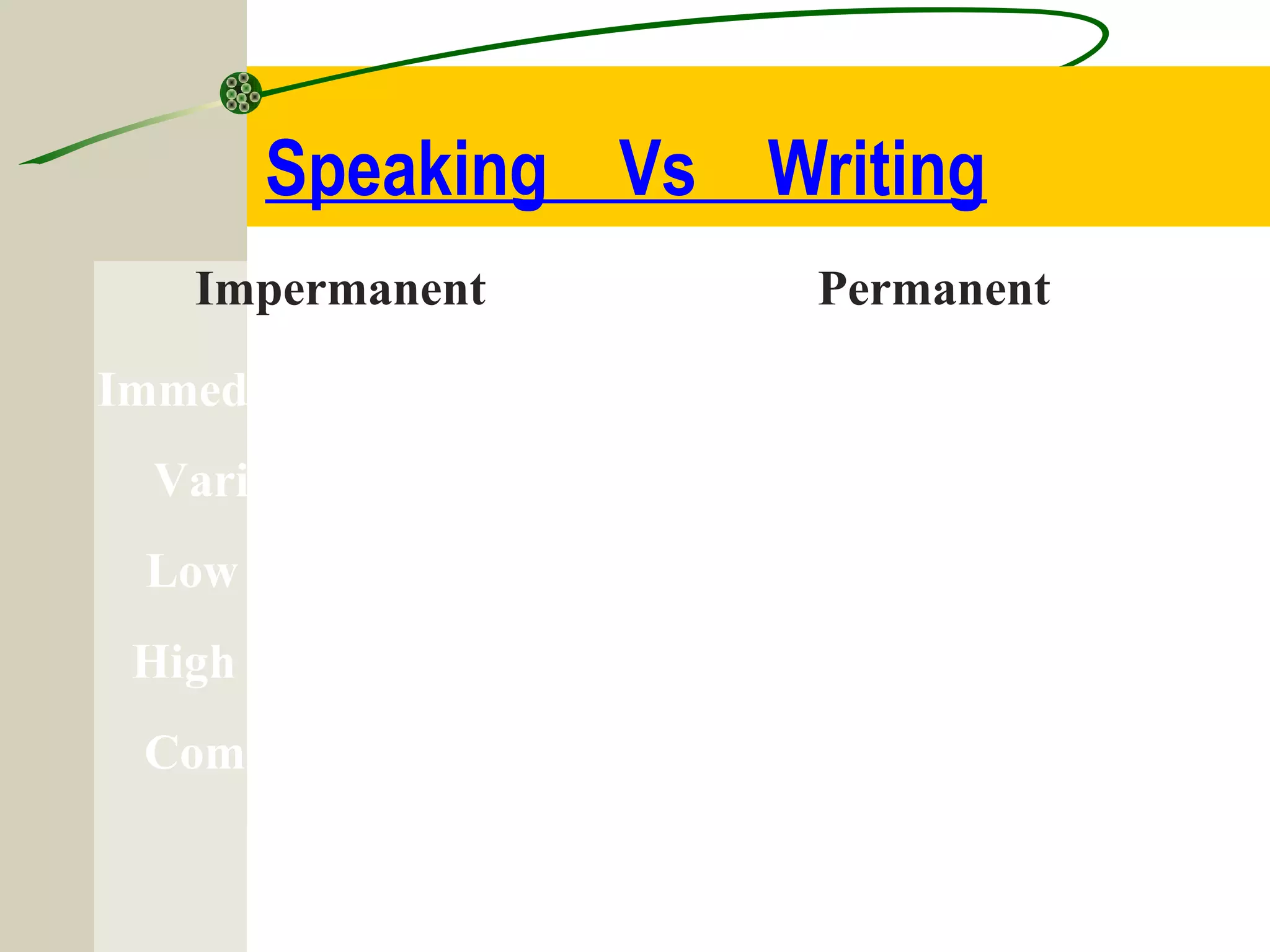
Speaking Vs Writing
Impermanent Permanent
Immediate (unplanned) Delayed (planned)
Variation / Casual Conventional / Stylized
Low lexical density High lexical density
High Paralinguistics Low Paralinguistics
Communal activity Solitary Activity
Universal Learned
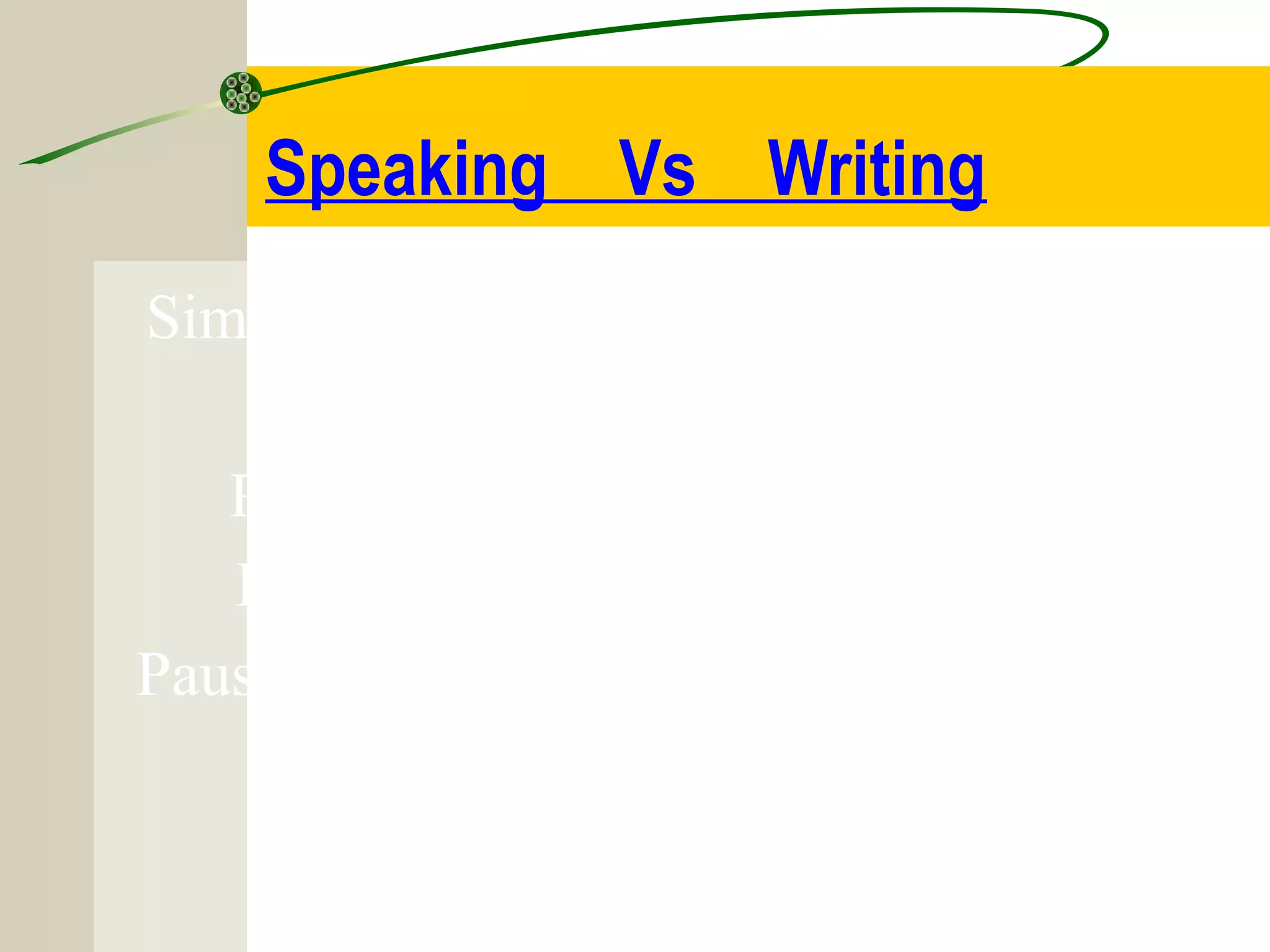
Simple sentences Complex sentences
Voiced Thought / Read
Pronounce Spell
Feedback No feedback
Pause / Intonation Punctuation
Speaking Vs Writing
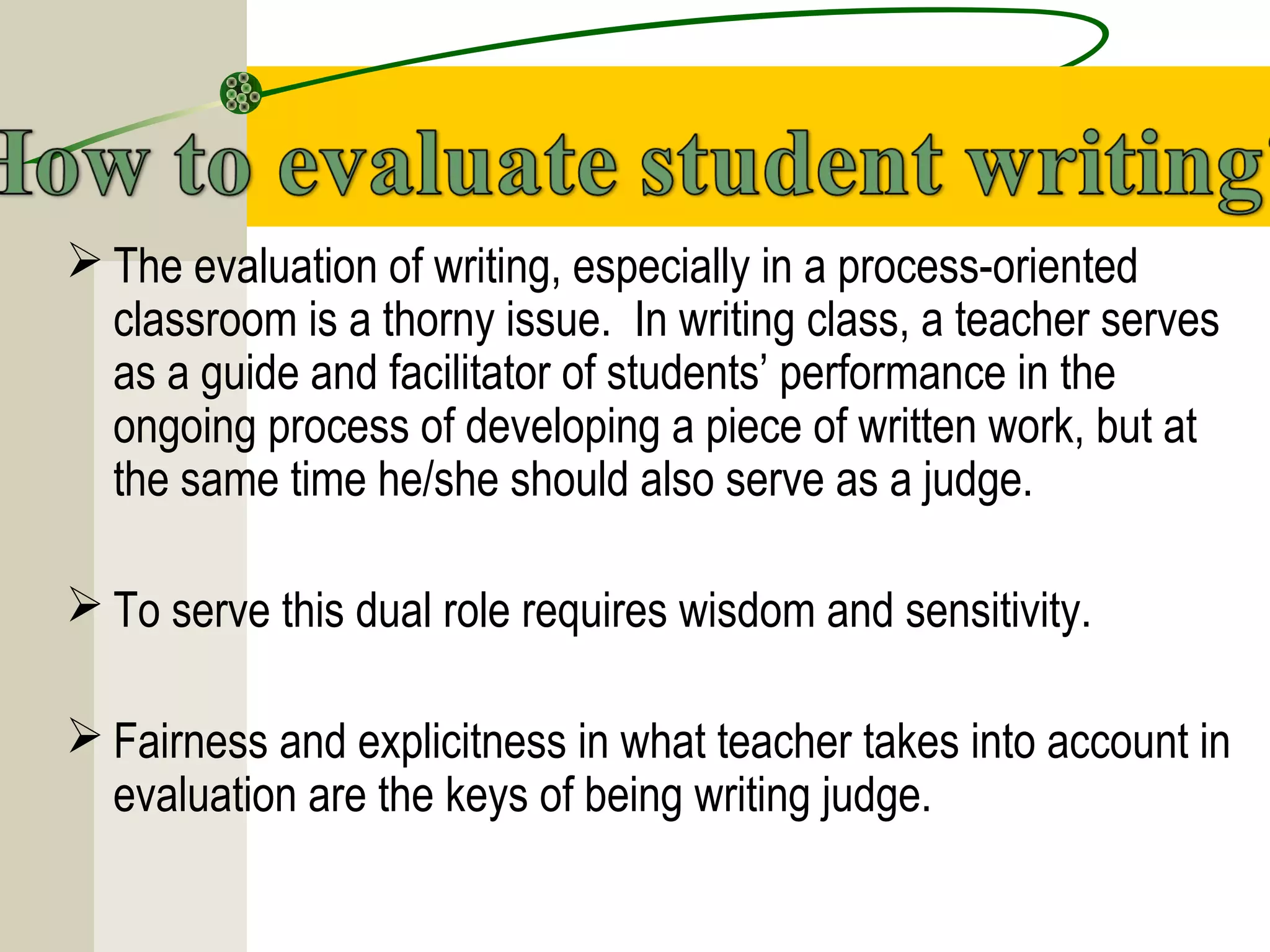
 The evaluation of writing, especially in a process-oriented
classroom is a thorny issue. In writing class, a teacher serves
as a guide and facilitator of students’ performance in the
ongoing process of developing a piece of written work, but at
the same time he/she should also serve as a judge.
 To serve this dual role requires wisdom and sensitivity.
 Fairness and explicitness in what teacher takes into account in
evaluation are the keys of being writing judge.
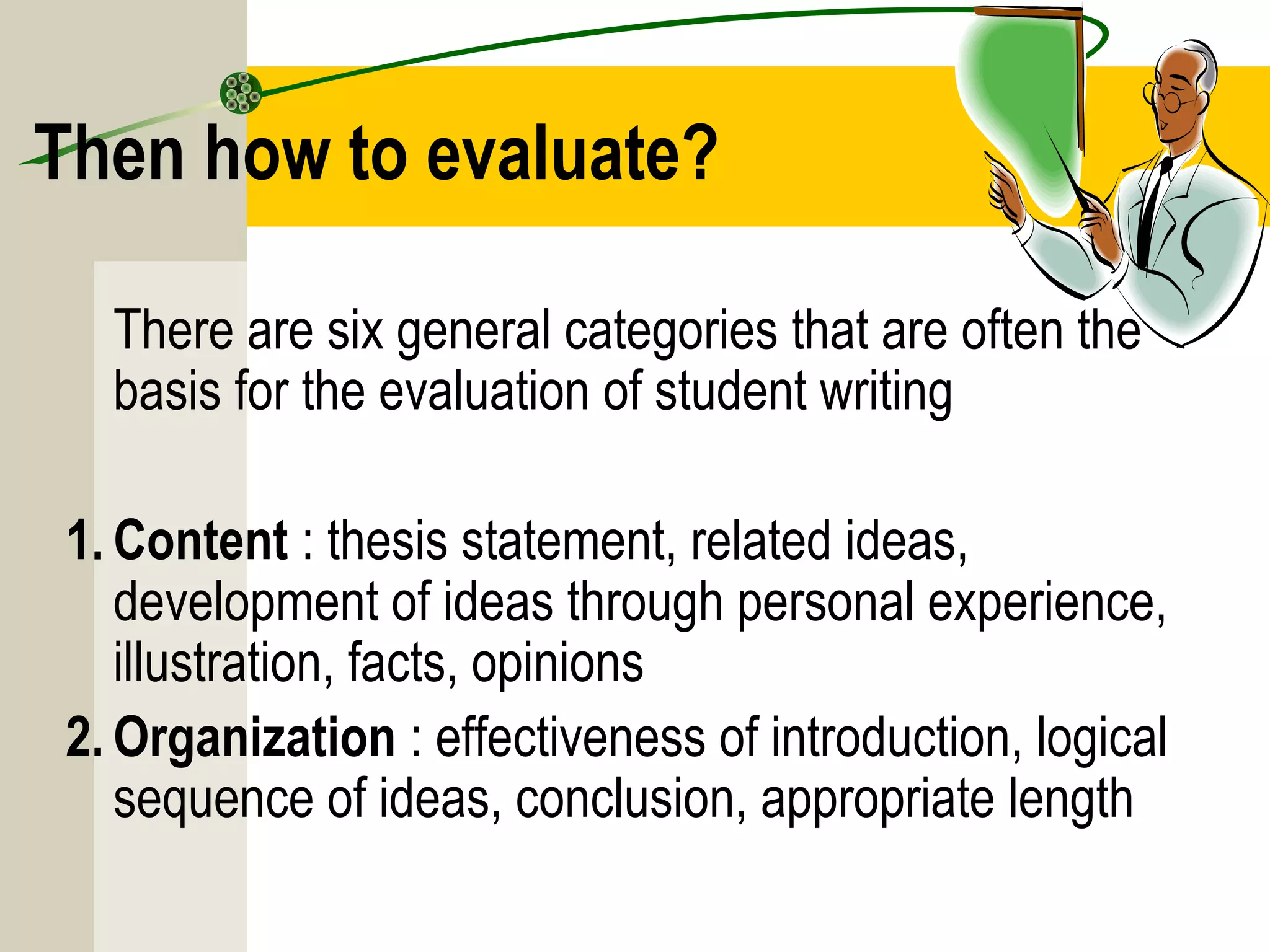
Then how to evaluate?
There are six general categories that are often the
basis for the evaluation of student writing
1. Content : thesis statement, related ideas,
development of ideas through personal experience,
illustration, facts, opinions
2. Organization : effectiveness of introduction, logical
sequence of ideas, conclusion, appropriate length
next categories
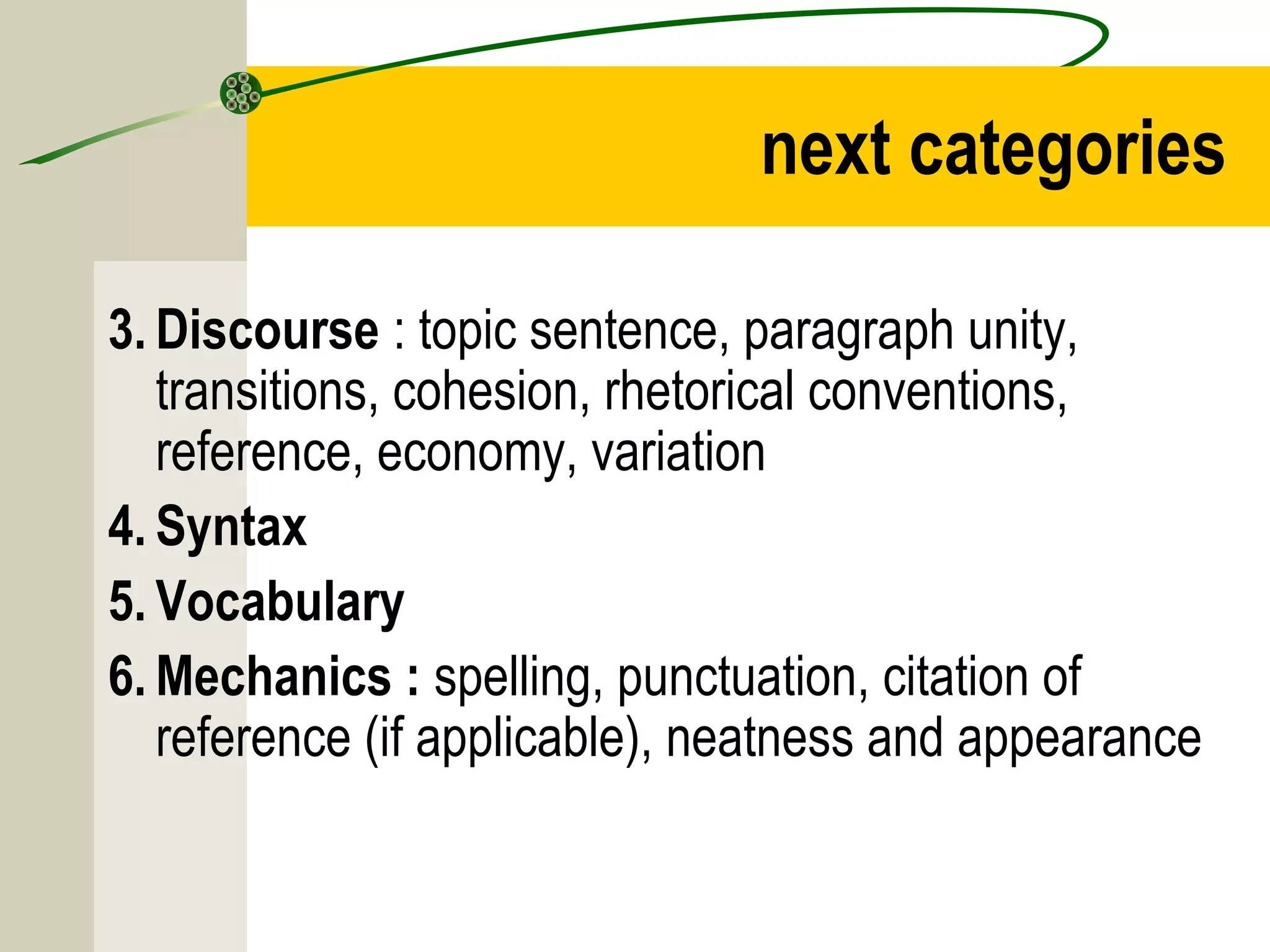
3. Discourse : topic sentence, paragraph unity,
transitions, cohesion, rhetorical conventions,
reference, economy, variation
4. Syntax
5. Vocabulary
6. Mechanics : spelling, punctuation, citation of
reference (if applicable), neatness and appearance
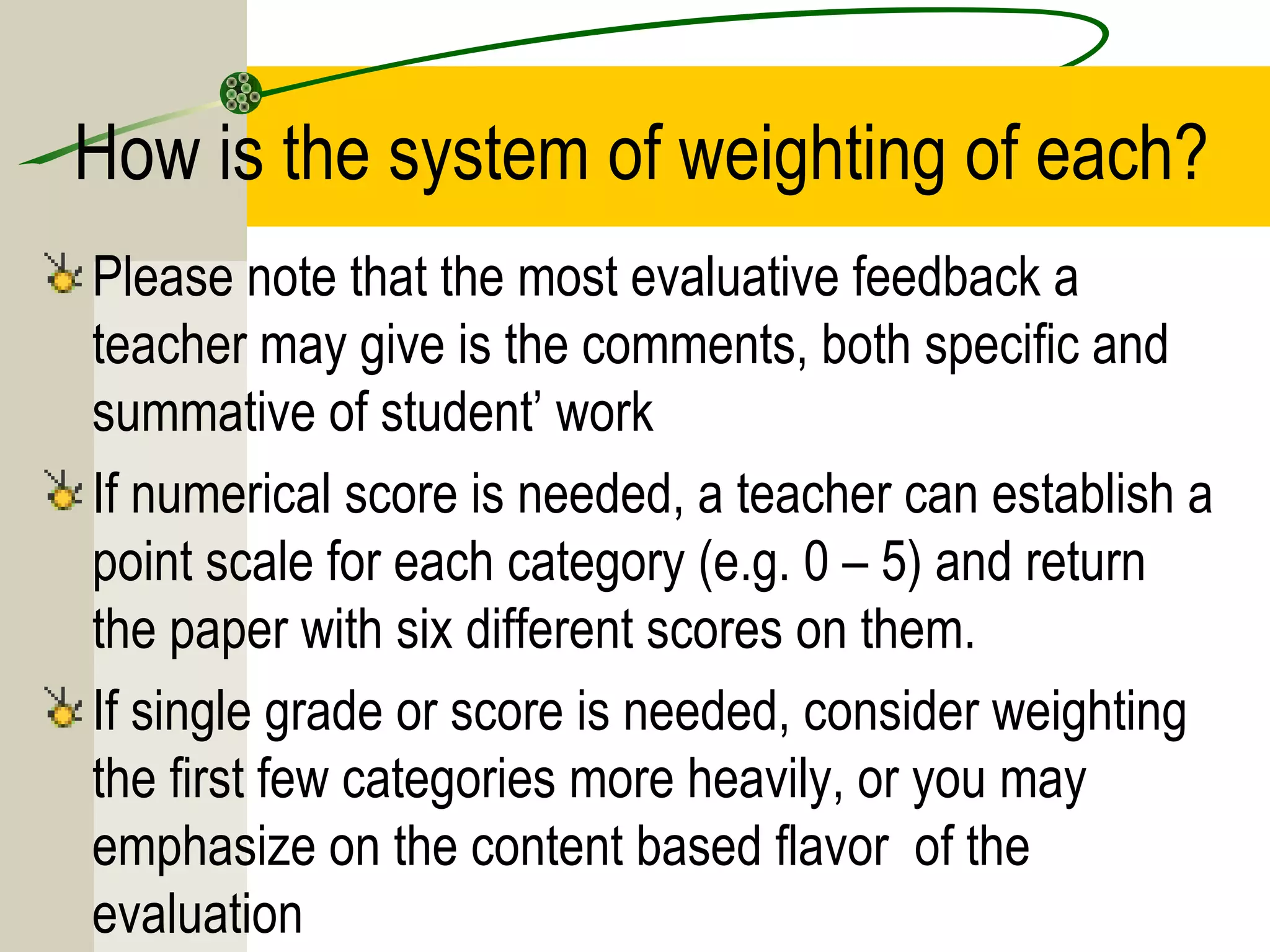
How is the system of weighting of each?
Please note that the most evaluative feedback a
teacher may give is the comments, both specific and
summative of student’ work
If numerical score is needed, a teacher can establish a
point scale for each category (e.g. 0 – 5) and return
the paper with six different scores on them.
If single grade or score is needed, consider weighting
the first few categories more heavily, or you may
emphasize on the content based flavor of the
evaluation
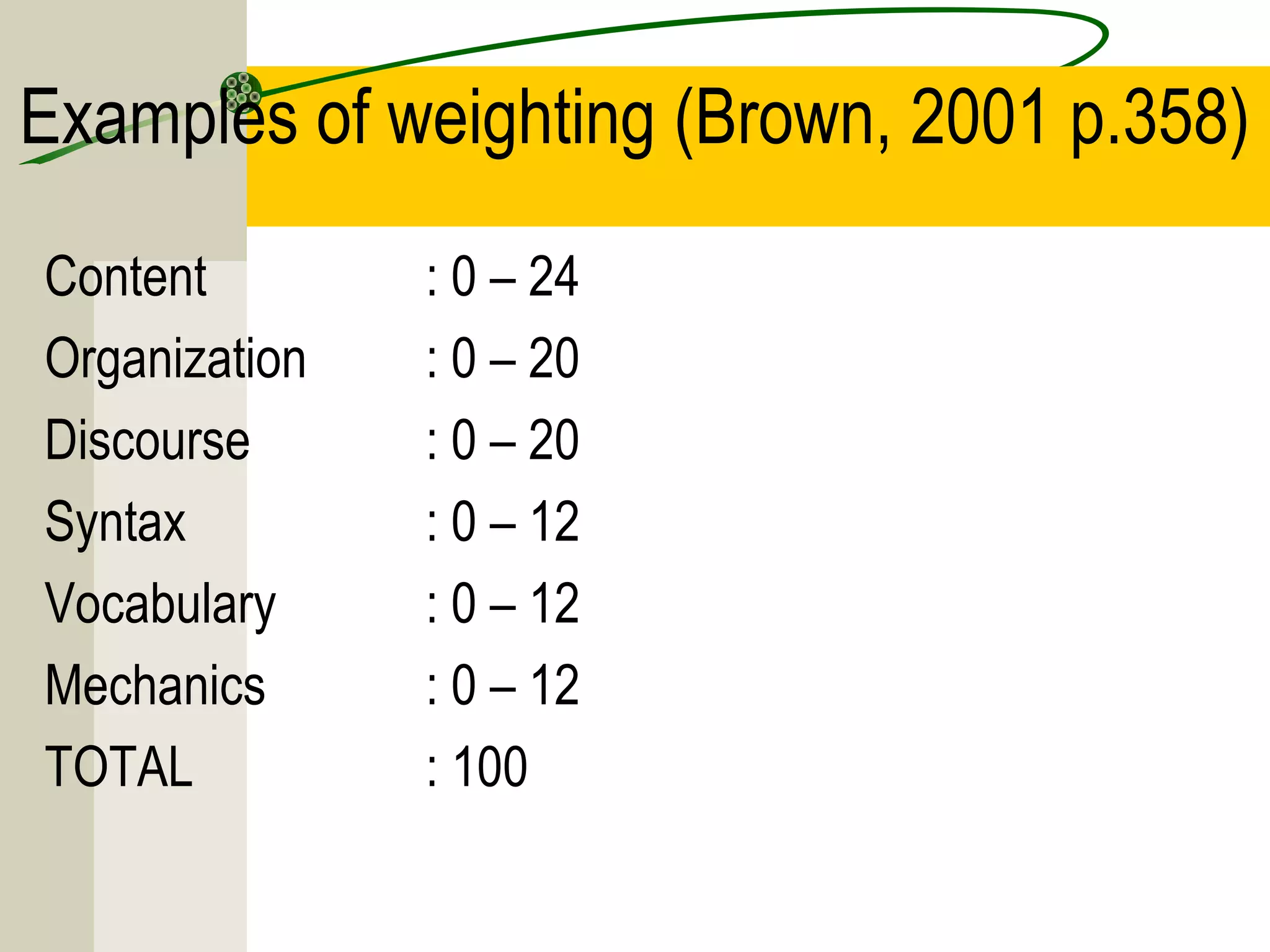
Examples of weighting (Brown, 2001 p.358)
Content : 0 – 24
Organization : 0 – 20
Discourse : 0 – 20
Syntax : 0 – 12
Vocabulary : 0 – 12
Mechanics : 0 – 12
TOTAL : 100
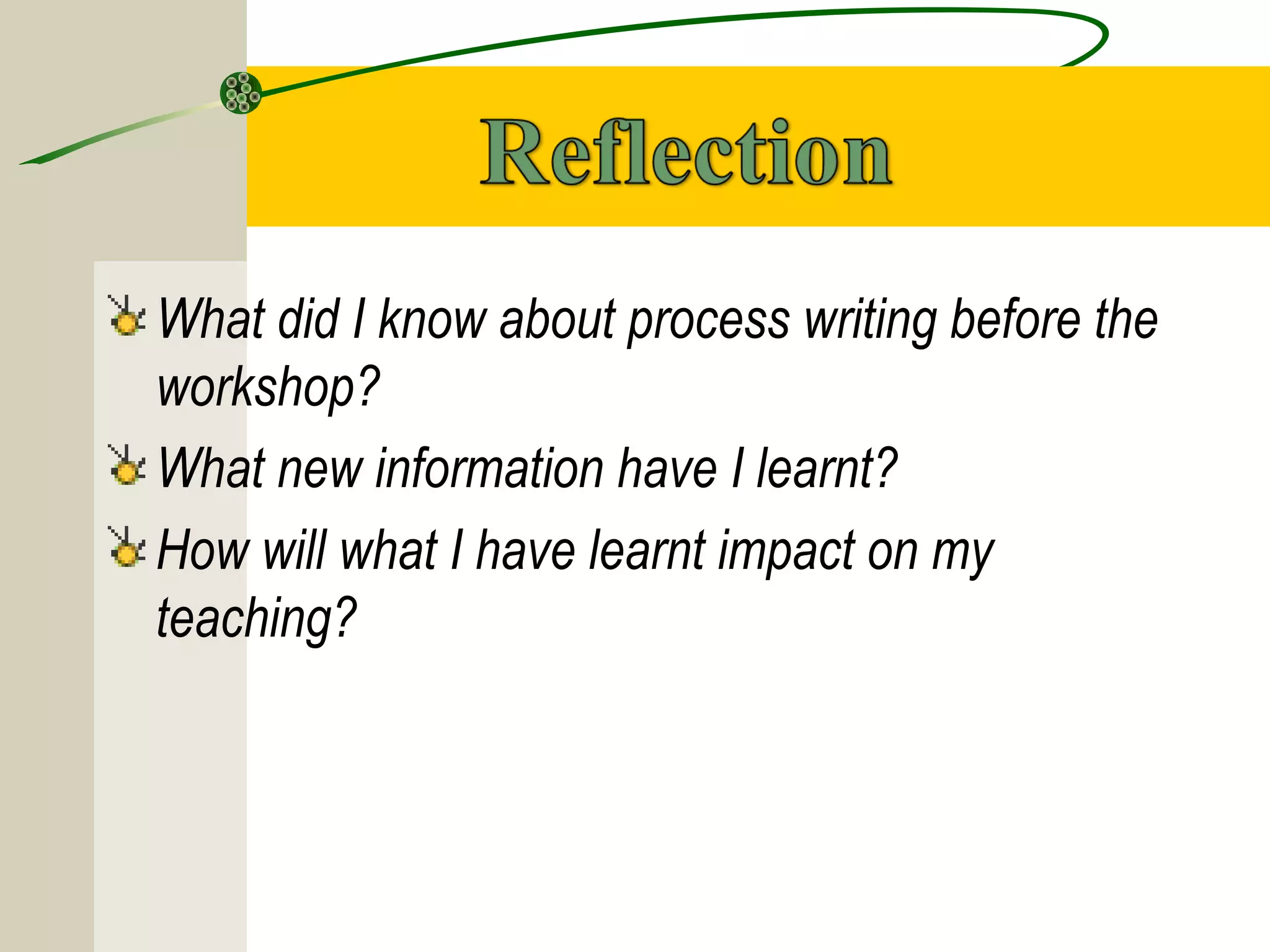
What did I know about process writing before the
workshop?
What new information have I learnt?
How will what I have learnt impact on my
teaching?
Thank you very much
Is there any question?
References
Writing, Tricia Hedge, OUP (1998).
HD. Brown. (2001). Teaching by Principles. London: Longman
Simple Writing Activities (Oxford Basics), Jill and Charles
Hadfield, OUP (2000).
Process Writing, White R & Arndt V, pp 51–52; pp 69-77; pp108-
109; pp 122-123, and pp 137–138,
Longman (1991).
Harmer J, The Practise of English Language Teaching, pp255-
268 Longman (2001).
Ur P, A Coursebook in Language Teaching, pp159-175 CUP
(1996).
http://www.teachingenglish.org.uk/think/articles/approaches-
process-writing

6.06.2013 teaching writing

  • 1.
    teaching writing toL2 learners Pateyeva Natalia, PhD Teacher trainer “Writing is a way of talking without being interrupted.” Jules Renard
  • 2.
    By the endof this workshop participants will be able to: Assess the issues involved in teaching writing in their own classrooms. Identify the approaches involved in producing different types of writing. Match writing sub-skills to a process writing framework. Analyze writing tasks from the point of view of audience, purpose and context. To provide an understanding on the principles of teaching writing To provide a short overview on how writing is taught and evaluated by teachers to achieve certain objectives
  • 3.
    The main pointsto present 1. Writing at glance and types of classroom writing performance 2. The principles of teaching writing 3. How student writing is evaluated
  • 5.
    To communicate overdistances To communicate across time To participate in society To remember and record To “make thought visible” and express your inner self
  • 7.
    Notes emails lettersessays stories Signs advertisements subtitles articles Diaries/journals magazines plays recipes Labels/brands brochures maps textbooks
  • 8.
    Writing at glance Writing is the last skill of language after listening, speaking and reading  Many consider that writing is the most difficult skill among the other three  To be able to write well, one should work hard to practice writing in addition to understanding writing concept and tools
  • 9.
  • 11.
    Using your planand ideas to write a ‘rough’ preliminary version. Presenting the piece of writing to the readers. Checking, making alterations and re-writing. Generating ideas and planning what to write.
  • 13.
  • 14.
    Pre-writing: brainstorming, mind-mapping Drafting:selecting/rejecting, structuring, questioning Editing: revising, checking, re-ordering, re- structuring, focusing on grammar and vocabulary Publishing: presenting finished piece to readers
  • 16.
    writers need : apurpose – a reason for writing, an audience –the readers, a context – background information to make it meaningful and to motivate learners to write. Consider examples of writing tasks from textbooks in terms of how they meet the above criteria.
  • 17.
    1. There isno audience. To make it more meaningful ask learners to write an article for an international student magazine, special issue on festivals around the world. 2. The task works as it is but could be made more meaningful by having half the class write the complaint and the other half write the manager’s response.
  • 18.
    3. The taskprovides no guidance to help learners write the story. Support could be given by supplying pictures, prompt words, gapped sentences, the beginning of a story etc. If the learners work in groups, they could write the stories for their classmates.
  • 19.
    4. This taskcould be contextualized, for example, “You are having a party. Your classmates are your guests. Draw a map from the school to your home, without indicating exactly where your home is. Now write directions.” The ‘guests’ then have to pinpoint the home of the ‘host’ from the directions.
  • 20.
    5. This needsa purpose and an audience. For example:”Imagine you are at a crossroads in your life. You have an appointment with a ‘life coach’ but first she has asked you to write about yourself. What can you tell her to prepare for your meeting? Think about your plans and ambitions etc.
  • 22.
    Takes too muchtime Loss of student focus / interest Not suited to some personalities Students need to be taught it (peer editing / planning / stages) Restricts spontaneity and range of writing activities.
  • 23.
    The creation ofa product Writing seen as a communicative and purposeful activity Teaches students to plan and research Student collaboration is developed. Feedback and response given.
  • 24.
    Isn't it surprisinghow many things, if not said immediately, seem not worth saying ten minutes from now?  ~ Arnot L. Sheppard, Jr.
  • 25.
    Speaking Vs Writing ImpermanentPermanent Immediate (unplanned) Delayed (planned) Variation / Casual Conventional / Stylized Low lexical density High lexical density High Paralinguistics Low Paralinguistics Communal activity Solitary Activity Universal Learned
  • 26.
    Simple sentences Complexsentences Voiced Thought / Read Pronounce Spell Feedback No feedback Pause / Intonation Punctuation Speaking Vs Writing
  • 27.
     The evaluationof writing, especially in a process-oriented classroom is a thorny issue. In writing class, a teacher serves as a guide and facilitator of students’ performance in the ongoing process of developing a piece of written work, but at the same time he/she should also serve as a judge.  To serve this dual role requires wisdom and sensitivity.  Fairness and explicitness in what teacher takes into account in evaluation are the keys of being writing judge.
  • 28.
    Then how toevaluate? There are six general categories that are often the basis for the evaluation of student writing 1. Content : thesis statement, related ideas, development of ideas through personal experience, illustration, facts, opinions 2. Organization : effectiveness of introduction, logical sequence of ideas, conclusion, appropriate length
  • 29.
    next categories 3. Discourse: topic sentence, paragraph unity, transitions, cohesion, rhetorical conventions, reference, economy, variation 4. Syntax 5. Vocabulary 6. Mechanics : spelling, punctuation, citation of reference (if applicable), neatness and appearance
  • 30.
    How is thesystem of weighting of each? Please note that the most evaluative feedback a teacher may give is the comments, both specific and summative of student’ work If numerical score is needed, a teacher can establish a point scale for each category (e.g. 0 – 5) and return the paper with six different scores on them. If single grade or score is needed, consider weighting the first few categories more heavily, or you may emphasize on the content based flavor of the evaluation
  • 31.
    Examples of weighting(Brown, 2001 p.358) Content : 0 – 24 Organization : 0 – 20 Discourse : 0 – 20 Syntax : 0 – 12 Vocabulary : 0 – 12 Mechanics : 0 – 12 TOTAL : 100
  • 32.
    What did Iknow about process writing before the workshop? What new information have I learnt? How will what I have learnt impact on my teaching?
  • 33.
    Thank you verymuch Is there any question?
  • 34.
    References Writing, Tricia Hedge,OUP (1998). HD. Brown. (2001). Teaching by Principles. London: Longman Simple Writing Activities (Oxford Basics), Jill and Charles Hadfield, OUP (2000). Process Writing, White R & Arndt V, pp 51–52; pp 69-77; pp108- 109; pp 122-123, and pp 137–138, Longman (1991). Harmer J, The Practise of English Language Teaching, pp255- 268 Longman (2001). Ur P, A Coursebook in Language Teaching, pp159-175 CUP (1996). http://www.teachingenglish.org.uk/think/articles/approaches- process-writing

Editor's Notes