Sandra L Rodriguez
         Abel Periñan
Milton Ferney Morales
PURPOSE AND TYPES OF WRITING
 1. INFORMATIVE WRITING

You can tell when a text is informative as it:
• has one subject. (for example: Cats)
• uses a specific type of language. (Cats are
predators).
• contains new information. (Cats are members
of the feline family.)
• uses facts and data. (Cats were held in high
regard in ancient Egypt.)
• has taught you something by the end of it.
(Cats have been domesticated for centuries.)
2. EXPRESIVE /NARRATIVE WRITING

is personal writing. It expresses and explores the
  personal feelings of the writer.
PERSUASIVE WRITING
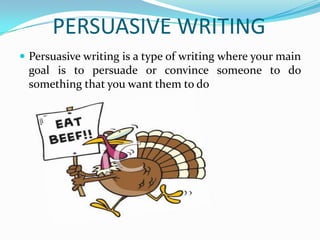
 Persuasive writing is a type of writing where your main
 goal is to persuade or convince someone to do
 something that you want them to do
Grade Five Writing Assessment

Types of Writing


Narrative

1. Creating an imaginative story in a short story form

Informational

1. Writing related to any non-fiction writing in order to inform or
explain a topic to the reader

Persuasive

1. Students will take a position on a issue topic that they are familiar
with
WRITING INSTRUCTION
Exist 3 stages of writing process

• Prewriting, or motivation, discussion, and concept
  development.

• Writing: which takes place in the classroom or at home


• Post writing: students share their writing with others .
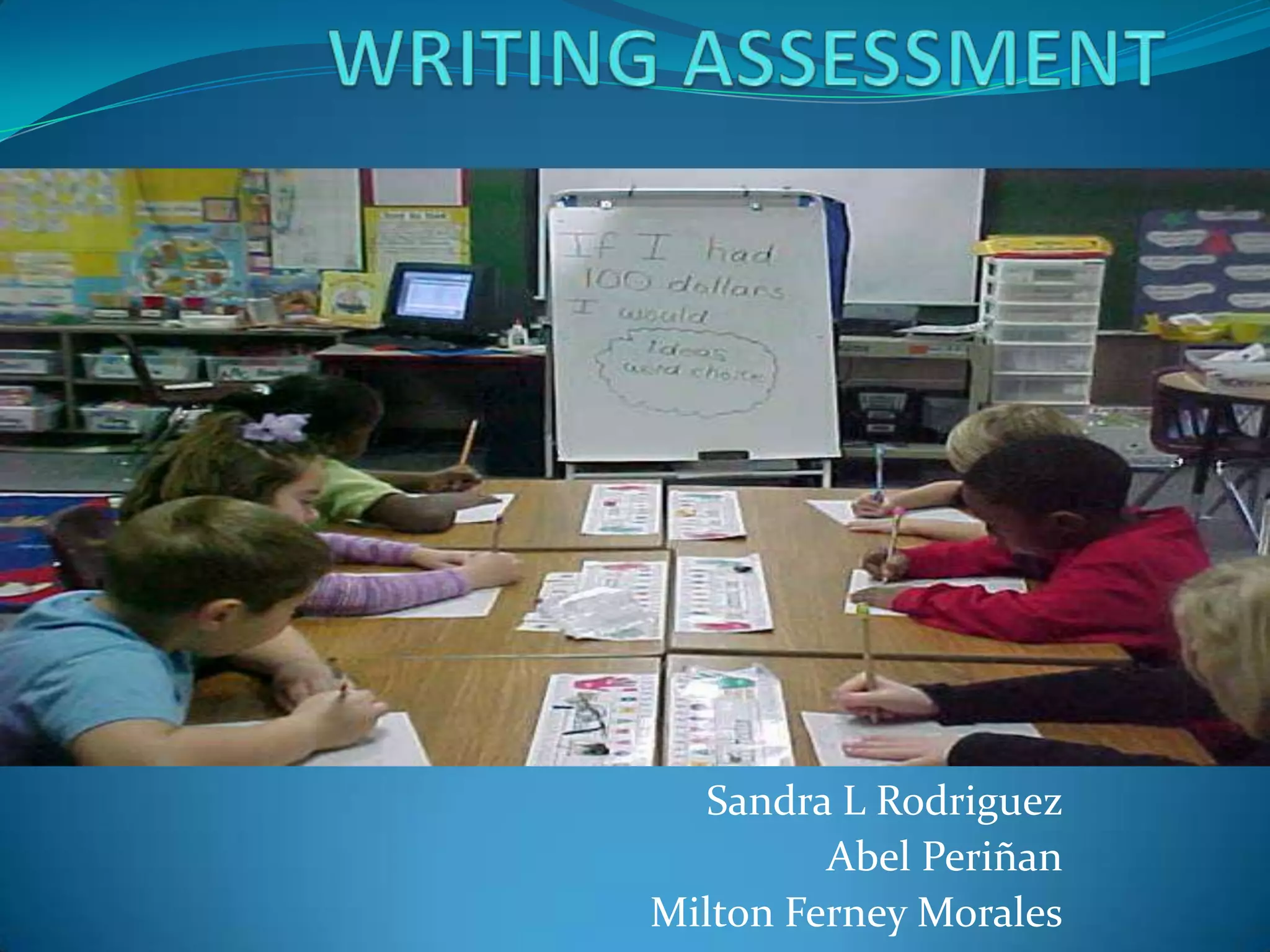
TODAY’S ASSIGNMENT
 Today you will write about something that happened to
 you of something that interest you. You may choose
 your own topic. For example, you might want to write
 about something that happened when you were a child,
 or about someone in your family, a trip you had, or a
 game you liked to play.
THE CRITERIA
 A standard, rule, or test on which a judgment or
  decision can be based

 At the end of the module, the learner is expected to be able to -
         - demonstrate detailed understanding of the influences of the
historical and social context within which the chosen       text is set,
both from the study of the text itself and from    the study of other
contemporary literature.
Criteria for assessment should be
 specific to each task
 clear and sufficiently detailed so as to provide
    guidance to students undertaking assessment task
   transparent
   justifiable (i.e. linked to learning objectives) and
    achievable
   appropriate to weightings
   where appropriate, supported by a verbal or written
    statement about what constitutes the various levels of
    performance
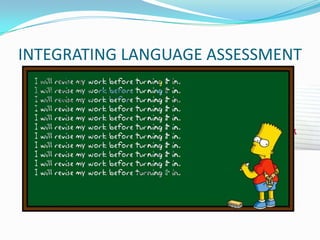
INTEGRATING LANGUAGE ASSESSMENT
TYPES OF SCORING
 Holistic scoring
 Primary trait
 Analytic scoring
HOLISTIC SCORING
 Variety of criteria to produce a single score.
 Total quality is a sum of many components
 Writing is viewed as a whole.


    Idea development and organization.
    Fluency/structure
    Word choice
    Mechanics
FEATURES
 The focus of a score reported using a holistic rubric is on the overall
  quality, proficiency, or understanding of the specific .

 Quick scoring process.


 This is basically due to the fact that the teacher is required to read
  through or otherwise examine the student product or performance only
  once, in order to get an "overall" sense of what the student was able to
  accomplish
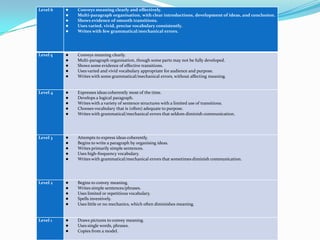
Level 6      Conveys meaning clearly and effectively.
             Multi-paragraph organisation, with clear introductions, development of ideas, and conclusion.
             Shows evidence of smooth transitions.
             Uses varied, vivid, precise vocabulary consistently.
             Writes with few grammatical/mechanical errors.


Level 5      Conveys meaning clearly.
             Multi-paragraph organisation, though some parts may not be fully developed.
             Shows some evidence of effective transitions.
             Uses varied and vivid vocabulary appropriate for audience and purpose.
             Writes with some grammatical/mechanical errors, without affecting meaning.


Level 4      Expresses ideas coherently most of the time.
             Develops a logical paragraph.
             Writes with a variety of sentence structures with a limited use of transitions.
             Chooses vocabulary that is (often) adequate to purpose.
             Writes with grammatical/mechanical errors that seldom diminish communication.


Level 3      Attempts to express ideas coherently.
             Begins to write a paragraph by organising ideas.
             Writes primarily simple sentences.
             Uses high-frequency vocabulary.
             Writes with grammatical/mechanical errors that sometimes diminish communication.


Level 2      Begins to convey meaning.
             Writes simple sentences/phrases.
             Uses limited or repetitious vocabulary.
             Spells inventively.
             Uses little or no mechanics, which often diminishes meaning.


Level 1      Draws pictures to convey meaning.
             Uses single words, phrases.
             Copies from a model.
PRIMARY TRAIT
 Could be a language-based feature emphasizing any
  one or more of the criteria for holistic scoring .
 If focuses in one specific aspect.
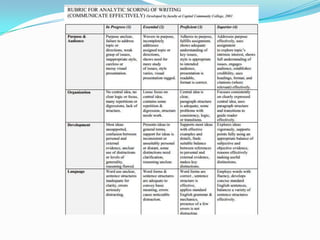
ANALYTIC SCORING
 Separates the features into components that are each
  scored separately.
 results initially in several scores, followed by a
  summed total score-their use represents assessment
  on a multidimensional level
 The degree of feedback offered to students-and to
  teachers-is significant.
•Teacher collects information about student writing
processes, progress, and response to instruction.

•Direct observation of writing…
•Conferencing with students…
STRATEGIES FOR PROCESS
             WRITING
*Prewriting Strategies: Formulates topics before.
*Writing Strategies: monitors writing, uses adaptive
  techniques.
*Postwriting Strategies: edits, revises, rewrites, get
  feedback from others.
*Applications of Interests: writes for pleasure, uses
  writing to communicate, write in others subjects areas,
  participate in discussions about writing, edits writing
  of others.
WRITING SUMMARIES
 Here students are able to:
 Identify the topic.
 Identify the main idea.
 Combine similar details.
 Paraphrase accurately.
 Delete minor detail and redundant informat…
 Recognize author’s purpose.
 Reflect author’s emphasis.
SELF-ASSESSMENT IN WRITTING
 Self-assessment encourages Students to think about
    the purpose in writing.
   *Dialogue journals.
   *Learning Logs.
   *Surveys of interest and awareness.
   *Writing checklist.
PEER ASSESSMENT IN WRITING
 It involves students in evaluation…
 Each St is encouraged to respond to the other Sts
    paper by answering three questions: …
   Look for this think to editing someone’s paper:
   Punctuation
   Sentences
   Spelling
   Overall paper (main idea, is logical, organization)
USING WRITING ASSESSMENT IN
INSTRUCTION
 Select prompts that are appropriate for Sts.
 Select rubrics Sts can use.
 Select the rubrics with Sts.
 Identify benchmark paper.
 Review how Sts write not just what they write.
 Provide time and instructional support for self- and
  peer assessment.
 Introduce self-assessment gradually.
 Use conferencing to discuss writing with Sts.
CONCLUSION

 Writing is a process that must be
 understood and applied rather
 than simply as a product to be
 evaluate.

Writing assessment. 8

  • 1.
    Sandra L Rodriguez Abel Periñan Milton Ferney Morales
  • 2.
    PURPOSE AND TYPESOF WRITING  1. INFORMATIVE WRITING You can tell when a text is informative as it: • has one subject. (for example: Cats) • uses a specific type of language. (Cats are predators). • contains new information. (Cats are members of the feline family.) • uses facts and data. (Cats were held in high regard in ancient Egypt.) • has taught you something by the end of it. (Cats have been domesticated for centuries.)
  • 3.
    2. EXPRESIVE /NARRATIVEWRITING is personal writing. It expresses and explores the personal feelings of the writer.
  • 4.
    PERSUASIVE WRITING  Persuasivewriting is a type of writing where your main goal is to persuade or convince someone to do something that you want them to do
  • 5.
    Grade Five WritingAssessment Types of Writing Narrative 1. Creating an imaginative story in a short story form Informational 1. Writing related to any non-fiction writing in order to inform or explain a topic to the reader Persuasive 1. Students will take a position on a issue topic that they are familiar with
  • 6.
    WRITING INSTRUCTION Exist 3stages of writing process • Prewriting, or motivation, discussion, and concept development. • Writing: which takes place in the classroom or at home • Post writing: students share their writing with others .
  • 8.
    TODAY’S ASSIGNMENT  Todayyou will write about something that happened to you of something that interest you. You may choose your own topic. For example, you might want to write about something that happened when you were a child, or about someone in your family, a trip you had, or a game you liked to play.
  • 9.
    THE CRITERIA  Astandard, rule, or test on which a judgment or decision can be based  At the end of the module, the learner is expected to be able to - - demonstrate detailed understanding of the influences of the historical and social context within which the chosen text is set, both from the study of the text itself and from the study of other contemporary literature.
  • 10.
    Criteria for assessmentshould be  specific to each task  clear and sufficiently detailed so as to provide guidance to students undertaking assessment task  transparent  justifiable (i.e. linked to learning objectives) and achievable  appropriate to weightings  where appropriate, supported by a verbal or written statement about what constitutes the various levels of performance
  • 11.
  • 12.
    TYPES OF SCORING Holistic scoring  Primary trait  Analytic scoring
  • 13.
    HOLISTIC SCORING  Varietyof criteria to produce a single score.  Total quality is a sum of many components  Writing is viewed as a whole. Idea development and organization. Fluency/structure Word choice Mechanics
  • 14.
    FEATURES  The focusof a score reported using a holistic rubric is on the overall quality, proficiency, or understanding of the specific .  Quick scoring process.  This is basically due to the fact that the teacher is required to read through or otherwise examine the student product or performance only once, in order to get an "overall" sense of what the student was able to accomplish
  • 15.
    Level 6  Conveys meaning clearly and effectively.  Multi-paragraph organisation, with clear introductions, development of ideas, and conclusion.  Shows evidence of smooth transitions.  Uses varied, vivid, precise vocabulary consistently.  Writes with few grammatical/mechanical errors. Level 5  Conveys meaning clearly.  Multi-paragraph organisation, though some parts may not be fully developed.  Shows some evidence of effective transitions.  Uses varied and vivid vocabulary appropriate for audience and purpose.  Writes with some grammatical/mechanical errors, without affecting meaning. Level 4  Expresses ideas coherently most of the time.  Develops a logical paragraph.  Writes with a variety of sentence structures with a limited use of transitions.  Chooses vocabulary that is (often) adequate to purpose.  Writes with grammatical/mechanical errors that seldom diminish communication. Level 3  Attempts to express ideas coherently.  Begins to write a paragraph by organising ideas.  Writes primarily simple sentences.  Uses high-frequency vocabulary.  Writes with grammatical/mechanical errors that sometimes diminish communication. Level 2  Begins to convey meaning.  Writes simple sentences/phrases.  Uses limited or repetitious vocabulary.  Spells inventively.  Uses little or no mechanics, which often diminishes meaning. Level 1  Draws pictures to convey meaning.  Uses single words, phrases.  Copies from a model.
  • 16.
    PRIMARY TRAIT  Couldbe a language-based feature emphasizing any one or more of the criteria for holistic scoring .  If focuses in one specific aspect.
  • 17.
    ANALYTIC SCORING  Separatesthe features into components that are each scored separately.  results initially in several scores, followed by a summed total score-their use represents assessment on a multidimensional level  The degree of feedback offered to students-and to teachers-is significant.
  • 19.
    •Teacher collects informationabout student writing processes, progress, and response to instruction. •Direct observation of writing… •Conferencing with students…
  • 20.
    STRATEGIES FOR PROCESS WRITING *Prewriting Strategies: Formulates topics before. *Writing Strategies: monitors writing, uses adaptive techniques. *Postwriting Strategies: edits, revises, rewrites, get feedback from others. *Applications of Interests: writes for pleasure, uses writing to communicate, write in others subjects areas, participate in discussions about writing, edits writing of others.
  • 21.
    WRITING SUMMARIES  Herestudents are able to:  Identify the topic.  Identify the main idea.  Combine similar details.  Paraphrase accurately.  Delete minor detail and redundant informat…  Recognize author’s purpose.  Reflect author’s emphasis.
  • 22.
    SELF-ASSESSMENT IN WRITTING Self-assessment encourages Students to think about the purpose in writing.  *Dialogue journals.  *Learning Logs.  *Surveys of interest and awareness.  *Writing checklist.
  • 23.
    PEER ASSESSMENT INWRITING  It involves students in evaluation…  Each St is encouraged to respond to the other Sts paper by answering three questions: …  Look for this think to editing someone’s paper:  Punctuation  Sentences  Spelling  Overall paper (main idea, is logical, organization)
  • 24.
    USING WRITING ASSESSMENTIN INSTRUCTION  Select prompts that are appropriate for Sts.  Select rubrics Sts can use.  Select the rubrics with Sts.  Identify benchmark paper.  Review how Sts write not just what they write.  Provide time and instructional support for self- and peer assessment.  Introduce self-assessment gradually.  Use conferencing to discuss writing with Sts.
  • 25.
    CONCLUSION  Writing isa process that must be understood and applied rather than simply as a product to be evaluate.