The Development of Writing  There are a large number of languages in the world today that exist only in speech and  do not have a written form For the languages that do have writing systems, the development of writing is a relatively recent phenomenon The roots of writing tradition go back only a few thousand years An account of the early history gradually emerged but it comprises many gaps and ambiguities It is difficult to decide whether a piece of graphic expression should be taken as an artistic image or as a symbol of primitive writing
Practically it is possible to differentiate or assume as artistic expression conveys subjective and personal meanings and linguistic symbol is conventionalized and institutionalized Problematic area: In Egyptian an Greek the same word was used for both ‘write’ and ‘draw’ The Fact: Writing systems evolved independently of each other at different times in several parts of the world – in Mesopotamia, China, Meso-America etc.  Much of the evidence used in the reconstruction of ancient writing systems comes from inscriptions on stones or tablets found in the rubble of ruined cities
Precursors Tables discovered in various parts of the Middle East and south-east Europe from around 3500 BC. Large number of tablets found in sites around the Rivers Tigris and Euphrates made by Sumerians Such tablets seem to have recorded matters such as business transactions, tax account, land sales etc. However, The interpretation of single signs and early groups of signs is often not possible There are no clear borders between picture/symbol and what is already a sign in a writing system (specific phonetic content which would be read in the same way by any reader in a group of readers) The system was developed so that information could be recorded
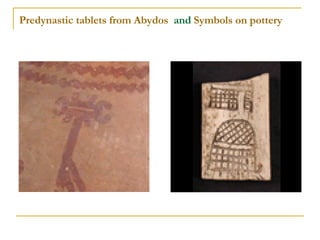
Predynastic tablets from Abydos   and  Symbols on pottery                    
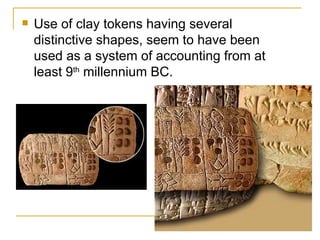
Use of clay tokens having several distinctive shapes, seem to have been used as a system of accounting from at least 9 th  millennium BC.
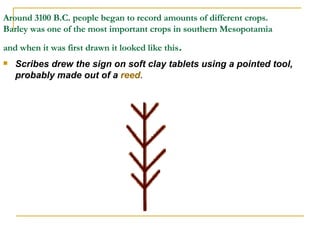
Around 3100 B.C. people began to record amounts of different crops. Barley was one of the most important crops in southern Mesopotamia and when it was first drawn it looked like this .  Scribes drew the sign on soft clay tablets using a pointed tool, probably made out of a  reed .
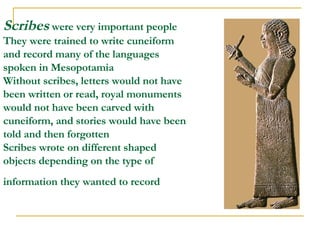
Scribes  were very important people They were trained to write cuneiform and record many of the languages spoken in Mesopotamia Without scribes, letters would not have been written or read, royal monuments would not have been carved with cuneiform, and stories would have been told and then forgotten  Scribes wrote on different shaped objects depending on the type of information they wanted to record
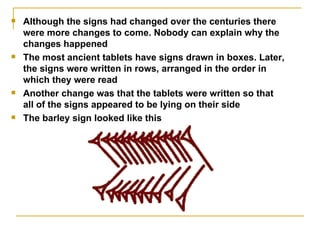
Although the signs had changed over the centuries there were more changes to come. Nobody can explain why the changes happened The most ancient tablets have signs drawn in boxes. Later, the signs were written in rows, arranged in the order in which they were read  Another change was that the tablets were written so that all of the signs appeared to be lying on their side  The barley sign looked like this
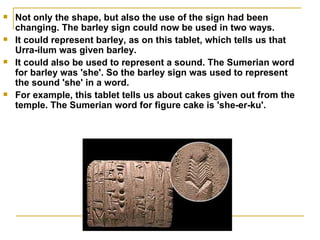
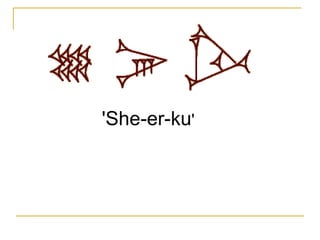
Not only the shape, but also the use of the sign had been changing. The barley sign could now be used in two ways.  It could represent barley, as on this tablet, which tells us that Urra-ilum was given barley.  It could also be used to represent a sound. The Sumerian word for barley was 'she'. So the barley sign was used to represent the sound 'she' in a word.  For example, this tablet tells us about cakes given out from the temple. The Sumerian word for figure cake is 'she-er-ku'.
'She-er-ku '
Stages in the development of writing Stage 1: Signs are only used as symbols Stage 2: The beginning of writing: limited standardization The surviving sources indicate that the hieroglyphic writing system followed from the beginning the rules/system which were used throughout Egyptian history Early developments include the emergence of norms in writing direction, forms of individual signs, orthography of single words, and the gradual tendency towards writing longer inscriptions  Already in the first dynasties the writing system began to become standardized. Actions are often expressed not by writing a word (verb), but by depicting the action
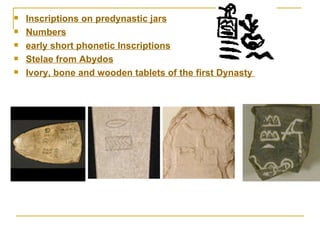
Inscriptions on  predynastic  jars Numbers early short phonetic Inscriptions Stelae from Abydos Ivory, bone and wooden tablets of the first Dynasty
Stage 3: developing   standardization   It seems that at the beginning only very few people could write: at these limits, standardization was not needed At the point where the writing was used for more people, a fixed system was needed, and soon developed Even in the Third Dynasty most inscriptions still consist of lists of titles or offerings The signs and the writing of many words are already those found in the Old Kingdom
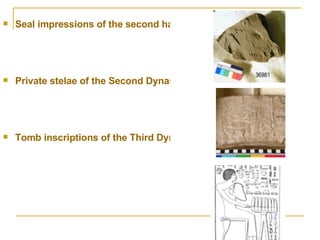
Seal impressions of the second half of the first Dynasty and later Private stelae of the Second Dynasty are more complex Tomb inscriptions of the Third Dynasty are mainly titles
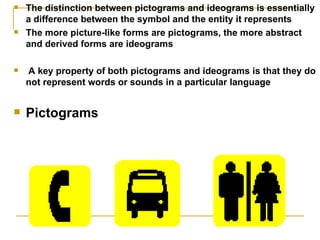
Types of Writing Systems Pictograms and Ideograms   When the picture of something (like the sun) comes to represent particular image or recognizable picture of entities in a certain way, it can be described as a form of picture-writing or pictogram Modern forms of pictograms lead you to the phone booth, bus stop, coffee shop and to the restrooms at the airport even if you don't speak and read the particular language When a pictogram takes a more fixed symbolic form and comes to be used for instance not only to represent 'sun' but also 'heat' and 'daytime', it is considered as part of a system of idea-writing or ideograms
no intention to draw the reality exactly or artistically rather symbols must be sufficiently clear and simple to enable them to be immediately recognized and reproduced as occasion demands as part of a narrative The sequence of the symbols may be described verbally in variety o f ways Importance of context and background information Convey abstract or conventional meaning Ideograms or ideographs display no clear pictorial link with external reality No pure ideographic system exists All primitive writing system were mixture of pictographic, ideographic, and linguistic elements
The distinction between pictograms and ideograms is essentially a difference between the symbol and the entity it represents The more picture-like forms are pictograms, the more abstract and derived forms are ideograms A key property of both pictograms and ideograms is that they do not represent words or sounds in a particular language Pictograms
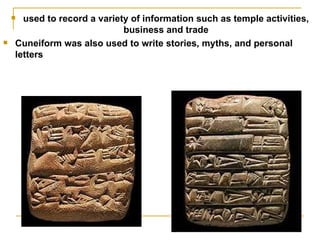
Cuneiform Dates from 4 th  millennium BC. Used to express both non-phonological and phonological writing systems in several languages Derives from ‘Latin’ meaning ‘wedge-shaped’ Refers to the technique used to make symbols A stylus was pressed into a tablet of soft clay to make a sequence of short straight strokes Later on other materials were used At first symbols were written top to bottom Later symbols were turned to their sides, from left to right Earliest form was developed from pictographs
used to record a variety of information such as temple activities, business and trade Cuneiform was also used to write stories, myths, and personal letters
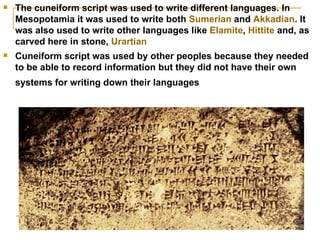
The cuneiform script was used to write different languages. In Mesopotamia it was used to write both  Sumerian  and  Akkadian . It was also used to write other languages like  Elamite ,  Hittite  and, as carved here in stone,  Urartian Cuneiform script was used by other peoples because they needed to be able to record information but they did not have their own systems for writing down their languages
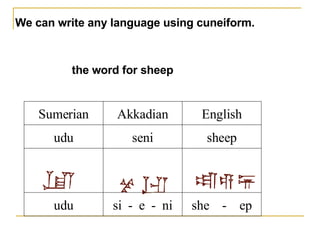
We can write any language using cuneiform.  the word for sheep   she    -    ep si  -  e  -  ni udu sheep seni udu English Akkadian Sumerian
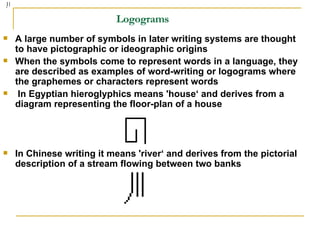
Logograms  A large number of symbols in later writing systems are thought to have pictographic or ideographic origins When the symbols come to represent words in a language, they are described as examples of word-writing or logograms where the graphemes or characters represent words In Egyptian hieroglyphics means 'house‘ and derives from a diagram representing the floor-plan of a house In Chinese writing it means 'river‘ and derives from the pictorial description of a stream flowing between two banks
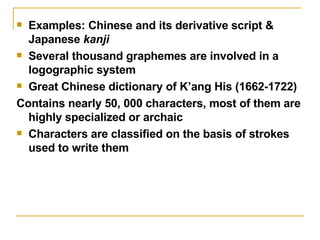
Examples: Chinese and its derivative script & Japanese  kanji Several thousand graphemes are involved in a logographic system Great Chinese dictionary of K’ang His (1662-1722) Contains nearly 50, 000 characters, most of them are highly specialized or archaic Characters are classified on the basis of strokes used to write them
Rebus Writing   The process of Rebus writing is a way of using existing symbols to represent the sounds of language The symbol for one entity is taken over as the symbol for the sound of the spoken word that is used to refer to that entity This, of course, establishes a sizeable reduction of the number of symbols needed in a writing system  /ba/ means 'boat‘ /baba/  means 'father'
Syllabic Writing   When a writing system employs a set of symbols which represent the pronunciation of syllables, it is described as syllabic writing Phonological system Each grapheme corresponds to a spoken syllable, vowel-consonant pair usually There do not seem to be any purely syllabic writing systems in use today, but Japanese can be described as having an at least partly syllabic writing system In the 19th century Cherokee Indians invented and used a syllabic writing system to produce written from spoken language The first fully developed syllabic writing system was used by the Phoenicians at around 1000 B.C.
Alphabetic Writing   An alphabet is essentially a set of written symbols which each represent a single type of sound Direct correspondence between graphemes and phonemes System needs a small number of units Arbitrary Nature This is what seems to have occurred in languages such as Arabic and Hebrew The early Greeks included symbols for vowels in their alphabet, and the modern European alphabet can be traced from Egyptian to Phoenician then to Early Greek and finally to the Roman alphabet
Written English   There does seem to be a frequent mismatch between the forms of written and the sounds of spoken English today There may be a number of historical reasons for this, one of them is  language change   Fixed spelling of written English in the form that was used in fifteenth century England Derivations from forms used in writing in other languages Recreation from old English I sixteenth century by spelling reformers Written form provide unreliable clues with reference to spoken English

The Development Of Writing

  • 1.
    The Development ofWriting There are a large number of languages in the world today that exist only in speech and do not have a written form For the languages that do have writing systems, the development of writing is a relatively recent phenomenon The roots of writing tradition go back only a few thousand years An account of the early history gradually emerged but it comprises many gaps and ambiguities It is difficult to decide whether a piece of graphic expression should be taken as an artistic image or as a symbol of primitive writing
  • 2.
    Practically it ispossible to differentiate or assume as artistic expression conveys subjective and personal meanings and linguistic symbol is conventionalized and institutionalized Problematic area: In Egyptian an Greek the same word was used for both ‘write’ and ‘draw’ The Fact: Writing systems evolved independently of each other at different times in several parts of the world – in Mesopotamia, China, Meso-America etc. Much of the evidence used in the reconstruction of ancient writing systems comes from inscriptions on stones or tablets found in the rubble of ruined cities
  • 3.
    Precursors Tables discoveredin various parts of the Middle East and south-east Europe from around 3500 BC. Large number of tablets found in sites around the Rivers Tigris and Euphrates made by Sumerians Such tablets seem to have recorded matters such as business transactions, tax account, land sales etc. However, The interpretation of single signs and early groups of signs is often not possible There are no clear borders between picture/symbol and what is already a sign in a writing system (specific phonetic content which would be read in the same way by any reader in a group of readers) The system was developed so that information could be recorded
  • 4.
    Predynastic tablets fromAbydos and Symbols on pottery                 
  • 5.
    Use of claytokens having several distinctive shapes, seem to have been used as a system of accounting from at least 9 th millennium BC.
  • 6.
    Around 3100 B.C.people began to record amounts of different crops. Barley was one of the most important crops in southern Mesopotamia and when it was first drawn it looked like this . Scribes drew the sign on soft clay tablets using a pointed tool, probably made out of a reed .
  • 7.
    Scribes werevery important people They were trained to write cuneiform and record many of the languages spoken in Mesopotamia Without scribes, letters would not have been written or read, royal monuments would not have been carved with cuneiform, and stories would have been told and then forgotten Scribes wrote on different shaped objects depending on the type of information they wanted to record
  • 8.
    Although the signshad changed over the centuries there were more changes to come. Nobody can explain why the changes happened The most ancient tablets have signs drawn in boxes. Later, the signs were written in rows, arranged in the order in which they were read Another change was that the tablets were written so that all of the signs appeared to be lying on their side The barley sign looked like this
  • 9.
    Not only theshape, but also the use of the sign had been changing. The barley sign could now be used in two ways. It could represent barley, as on this tablet, which tells us that Urra-ilum was given barley. It could also be used to represent a sound. The Sumerian word for barley was 'she'. So the barley sign was used to represent the sound 'she' in a word. For example, this tablet tells us about cakes given out from the temple. The Sumerian word for figure cake is 'she-er-ku'.
  • 10.
  • 11.
    Stages in thedevelopment of writing Stage 1: Signs are only used as symbols Stage 2: The beginning of writing: limited standardization The surviving sources indicate that the hieroglyphic writing system followed from the beginning the rules/system which were used throughout Egyptian history Early developments include the emergence of norms in writing direction, forms of individual signs, orthography of single words, and the gradual tendency towards writing longer inscriptions Already in the first dynasties the writing system began to become standardized. Actions are often expressed not by writing a word (verb), but by depicting the action
  • 12.
    Inscriptions on predynastic jars Numbers early short phonetic Inscriptions Stelae from Abydos Ivory, bone and wooden tablets of the first Dynasty
  • 13.
    Stage 3: developing standardization It seems that at the beginning only very few people could write: at these limits, standardization was not needed At the point where the writing was used for more people, a fixed system was needed, and soon developed Even in the Third Dynasty most inscriptions still consist of lists of titles or offerings The signs and the writing of many words are already those found in the Old Kingdom
  • 14.
    Seal impressions ofthe second half of the first Dynasty and later Private stelae of the Second Dynasty are more complex Tomb inscriptions of the Third Dynasty are mainly titles
  • 15.
    Types of WritingSystems Pictograms and Ideograms When the picture of something (like the sun) comes to represent particular image or recognizable picture of entities in a certain way, it can be described as a form of picture-writing or pictogram Modern forms of pictograms lead you to the phone booth, bus stop, coffee shop and to the restrooms at the airport even if you don't speak and read the particular language When a pictogram takes a more fixed symbolic form and comes to be used for instance not only to represent 'sun' but also 'heat' and 'daytime', it is considered as part of a system of idea-writing or ideograms
  • 16.
    no intention todraw the reality exactly or artistically rather symbols must be sufficiently clear and simple to enable them to be immediately recognized and reproduced as occasion demands as part of a narrative The sequence of the symbols may be described verbally in variety o f ways Importance of context and background information Convey abstract or conventional meaning Ideograms or ideographs display no clear pictorial link with external reality No pure ideographic system exists All primitive writing system were mixture of pictographic, ideographic, and linguistic elements
  • 17.
    The distinction betweenpictograms and ideograms is essentially a difference between the symbol and the entity it represents The more picture-like forms are pictograms, the more abstract and derived forms are ideograms A key property of both pictograms and ideograms is that they do not represent words or sounds in a particular language Pictograms
  • 18.
    Cuneiform Dates from4 th millennium BC. Used to express both non-phonological and phonological writing systems in several languages Derives from ‘Latin’ meaning ‘wedge-shaped’ Refers to the technique used to make symbols A stylus was pressed into a tablet of soft clay to make a sequence of short straight strokes Later on other materials were used At first symbols were written top to bottom Later symbols were turned to their sides, from left to right Earliest form was developed from pictographs
  • 19.
    used to recorda variety of information such as temple activities, business and trade Cuneiform was also used to write stories, myths, and personal letters
  • 20.
    The cuneiform scriptwas used to write different languages. In Mesopotamia it was used to write both Sumerian and Akkadian . It was also used to write other languages like Elamite , Hittite and, as carved here in stone, Urartian Cuneiform script was used by other peoples because they needed to be able to record information but they did not have their own systems for writing down their languages
  • 21.
    We can writeany language using cuneiform. the word for sheep  she    -    ep si  -  e  -  ni udu sheep seni udu English Akkadian Sumerian
  • 22.
    Logograms Alarge number of symbols in later writing systems are thought to have pictographic or ideographic origins When the symbols come to represent words in a language, they are described as examples of word-writing or logograms where the graphemes or characters represent words In Egyptian hieroglyphics means 'house‘ and derives from a diagram representing the floor-plan of a house In Chinese writing it means 'river‘ and derives from the pictorial description of a stream flowing between two banks
  • 23.
    Examples: Chinese andits derivative script & Japanese kanji Several thousand graphemes are involved in a logographic system Great Chinese dictionary of K’ang His (1662-1722) Contains nearly 50, 000 characters, most of them are highly specialized or archaic Characters are classified on the basis of strokes used to write them
  • 24.
    Rebus Writing The process of Rebus writing is a way of using existing symbols to represent the sounds of language The symbol for one entity is taken over as the symbol for the sound of the spoken word that is used to refer to that entity This, of course, establishes a sizeable reduction of the number of symbols needed in a writing system /ba/ means 'boat‘ /baba/ means 'father'
  • 25.
    Syllabic Writing When a writing system employs a set of symbols which represent the pronunciation of syllables, it is described as syllabic writing Phonological system Each grapheme corresponds to a spoken syllable, vowel-consonant pair usually There do not seem to be any purely syllabic writing systems in use today, but Japanese can be described as having an at least partly syllabic writing system In the 19th century Cherokee Indians invented and used a syllabic writing system to produce written from spoken language The first fully developed syllabic writing system was used by the Phoenicians at around 1000 B.C.
  • 26.
    Alphabetic Writing An alphabet is essentially a set of written symbols which each represent a single type of sound Direct correspondence between graphemes and phonemes System needs a small number of units Arbitrary Nature This is what seems to have occurred in languages such as Arabic and Hebrew The early Greeks included symbols for vowels in their alphabet, and the modern European alphabet can be traced from Egyptian to Phoenician then to Early Greek and finally to the Roman alphabet
  • 27.
    Written English There does seem to be a frequent mismatch between the forms of written and the sounds of spoken English today There may be a number of historical reasons for this, one of them is language change Fixed spelling of written English in the form that was used in fifteenth century England Derivations from forms used in writing in other languages Recreation from old English I sixteenth century by spelling reformers Written form provide unreliable clues with reference to spoken English