Presentedby:
RASHMI N.
Dos in LIS
University of Mysore
CONTENTS:
• Meaning
• Background
• Structure
• Components
• Fundamental concepts
• Advantages and Disadvantages
• Conclusion
INTRODUCTION
• The World Wide Web is a way
of exchanging information
between computers on the
Internet.
• The World Wide Web is the
network of pages of images,
texts and sounds on the
Internet which can be viewed
using browser software .
Background
1989-1990 – Tim Berners-Lee
invents the World Wide Web at
CERN
 Means for transferring text and
graphics simultaneously
Client/Server data transfer
protocol
Established a common language
for sharing information on
computers
Structure
Clients use browser application to
send URIs via HTTP to servers
requesting a Web page
Web pages constructed using HTML
and consist of text, graphics, sounds
plus embedded files
 The entire system runs over
standard networking protocols
(TCP/IP, DNS,…)
Four basic phases:
 connection
 request
 response
 close
First, the user can use the
browser to connect with the server. The
browser works by using a special
protocol, which is called HTTP to request
a specially encoded text from the web
server. The text is written in HTML,
which tells the browser how to display
the text on the user’s screen. . One can
also use ftp, gopher, telnet and archive
to command the server to search for the
information desired. Web pages are
written in HTML
Semantic Components:
Hyper Text Transfer Protocol
(HTTP)
Hyper Text Markup Language
(HTML)
extensible Markup Language
(XML)
Uniform Resource Identifiers
(URIs)
The Fundamental concept
of the World Wide Web
Hypertext
•Hypertext is text which contains links to other texts. The
term was coined by Ted Nelson around 1965 .
Hypermedia
•Hypermedia is a term used for hypertext which is not
constrained to be text: it can include graphics, video and
sound.
WEB Browser
• A web browser displays a web document and enables
users to access web documents.
WEB Server
•This is a program that waits patiently for the browser to
request a web page. The servers looks for the requested
information, retrieves it and send it to the browser or sends
an error message if the file is not found.
Uniform Resource Locator (URL)
•These are the web addresses. The resource locator is an
addressing system .
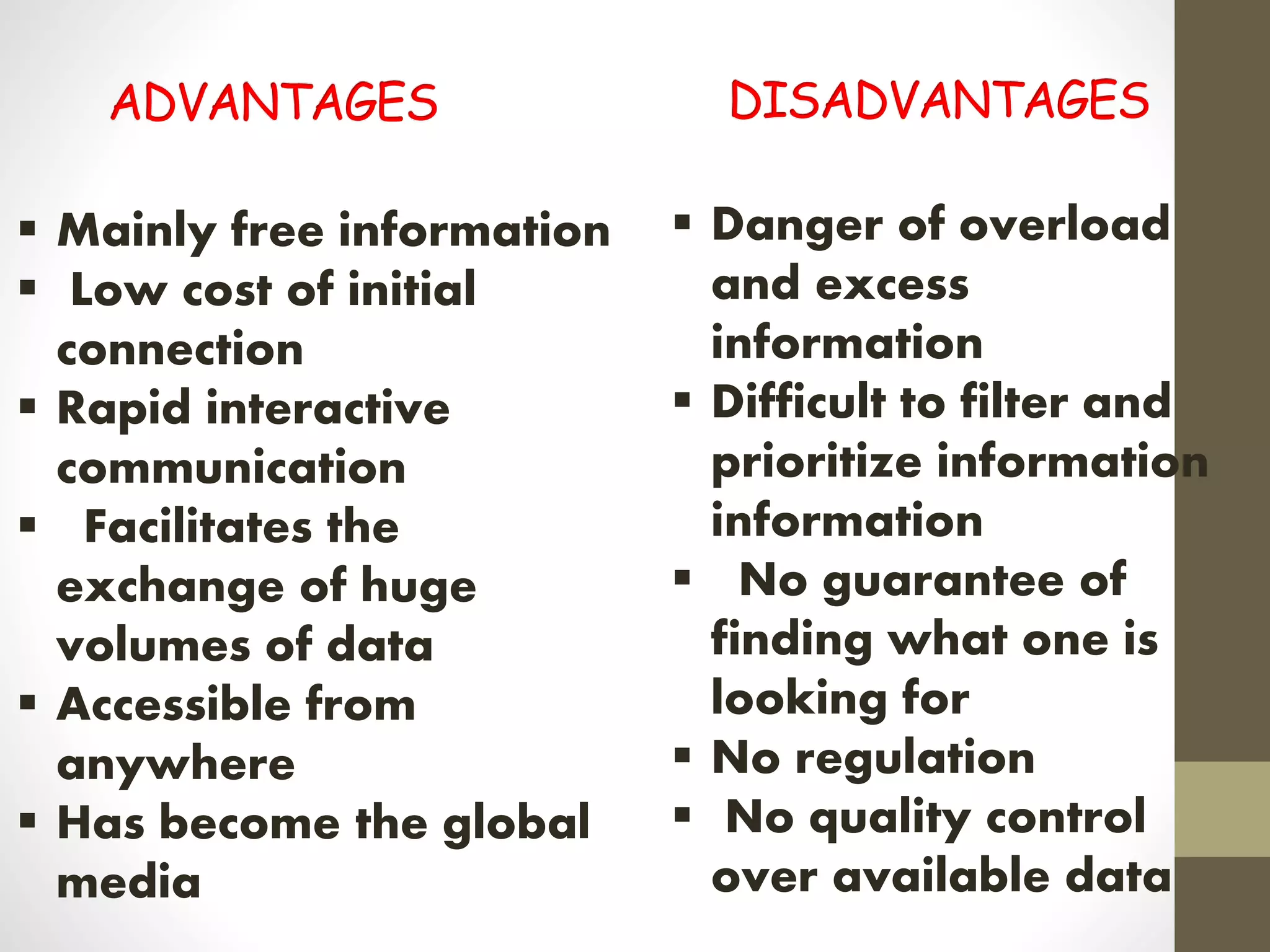
 Mainly free information
 Low cost of initial
connection
 Rapid interactive
communication
 Facilitates the
exchange of huge
volumes of data
 Accessible from
anywhere
 Has become the global
media
 Danger of overload
and excess
information
 Difficult to filter and
prioritize information
information
 No guarantee of
finding what one is
looking for
 No regulation
 No quality control
over available data
WORLD INTERNET USAGE AND POPULATION STATISTICS
JUNE 30, 2016 - Update
World Regions
Populati
on
( 2016
Est.)
Population
% of World
Intern
et
Users
30
June
2016
Penetrati
on
Rate (%
Pop.)
Growth
2000-
2016
Table
% Users
Asia
4,052,652,
889
55.2 %
1,846,2
12,654
45.6 % 1,515.2% 50.2 %
Europe
832,073,22
4
11.3 %
614,979
,903
73.9 % 485.2% 16.7 %
Latin America /
Caribbean
626,119,78
8
8.5 %
384,751
,302
61.5 % 2,029.4% 10.5 %
Africa
1,185,529,
578
16.2 %
340,783
,342
28.7 % 7,448.8% 9.3 %
North America
359,492,29
3
4.9 %
320,067
,193
89.0 % 196.1% 8.7 %
Middle East
246,700,90
0
3.4 %
141,489
,765
57.4 % 4,207.4% 3.8 %
Oceania / Australia 37,590,820 0.5 %
27,540,
654
73.3 % 261.4% 0.8 %
WORLD TOTAL
7,340,159,4
92
100.0 %
3,675,82
4,813
50.1 % 918.3% 100.0 %
Internet World Wide Web
The Internet is a global
system of interconnected
computer networks.
Its access is provided by
ISPs.
It runs applications like
www, ftp, html etc.
Web is collection
of text documents
and other
resources, linked
by hyperlinks
and URLs
 Usually accessed
by web browsers
Its an application
running on
Internet
WWW is a way of exchanging
information.
Tim Berners Lee invents the World Wide
Web (www) at Cern .
WWW is constructed using HTML
There are basic steps to create Web
pages
Internet and WWW are the two
different concept. WWW is one of the
services that run on internet.
Conclusion
• The World Wide Web was have
today was created by some very
bright, talented people who either
had vision, or were inspired by
other talented people’s visions.
• Their perseverance and hard work
brought us to where we are today.
• There is a lot to be learned by
studying these people, their early
work and keeping in mind what
they had to work with.
World wide web

World wide web

  • 2.
    Presentedby: RASHMI N. Dos inLIS University of Mysore
  • 3.
    CONTENTS: • Meaning • Background •Structure • Components • Fundamental concepts • Advantages and Disadvantages • Conclusion
  • 4.
    INTRODUCTION • The WorldWide Web is a way of exchanging information between computers on the Internet. • The World Wide Web is the network of pages of images, texts and sounds on the Internet which can be viewed using browser software .
  • 5.
    Background 1989-1990 – TimBerners-Lee invents the World Wide Web at CERN  Means for transferring text and graphics simultaneously Client/Server data transfer protocol Established a common language for sharing information on computers
  • 6.
    Structure Clients use browserapplication to send URIs via HTTP to servers requesting a Web page Web pages constructed using HTML and consist of text, graphics, sounds plus embedded files  The entire system runs over standard networking protocols (TCP/IP, DNS,…)
  • 7.
    Four basic phases: connection  request  response  close
  • 8.
    First, the usercan use the browser to connect with the server. The browser works by using a special protocol, which is called HTTP to request a specially encoded text from the web server. The text is written in HTML, which tells the browser how to display the text on the user’s screen. . One can also use ftp, gopher, telnet and archive to command the server to search for the information desired. Web pages are written in HTML
  • 9.
    Semantic Components: Hyper TextTransfer Protocol (HTTP) Hyper Text Markup Language (HTML) extensible Markup Language (XML) Uniform Resource Identifiers (URIs)
  • 10.
    The Fundamental concept ofthe World Wide Web Hypertext •Hypertext is text which contains links to other texts. The term was coined by Ted Nelson around 1965 . Hypermedia •Hypermedia is a term used for hypertext which is not constrained to be text: it can include graphics, video and sound.
  • 11.
    WEB Browser • Aweb browser displays a web document and enables users to access web documents. WEB Server •This is a program that waits patiently for the browser to request a web page. The servers looks for the requested information, retrieves it and send it to the browser or sends an error message if the file is not found. Uniform Resource Locator (URL) •These are the web addresses. The resource locator is an addressing system .
  • 12.
     Mainly freeinformation  Low cost of initial connection  Rapid interactive communication  Facilitates the exchange of huge volumes of data  Accessible from anywhere  Has become the global media  Danger of overload and excess information  Difficult to filter and prioritize information information  No guarantee of finding what one is looking for  No regulation  No quality control over available data
  • 13.
    WORLD INTERNET USAGEAND POPULATION STATISTICS JUNE 30, 2016 - Update World Regions Populati on ( 2016 Est.) Population % of World Intern et Users 30 June 2016 Penetrati on Rate (% Pop.) Growth 2000- 2016 Table % Users Asia 4,052,652, 889 55.2 % 1,846,2 12,654 45.6 % 1,515.2% 50.2 % Europe 832,073,22 4 11.3 % 614,979 ,903 73.9 % 485.2% 16.7 % Latin America / Caribbean 626,119,78 8 8.5 % 384,751 ,302 61.5 % 2,029.4% 10.5 % Africa 1,185,529, 578 16.2 % 340,783 ,342 28.7 % 7,448.8% 9.3 % North America 359,492,29 3 4.9 % 320,067 ,193 89.0 % 196.1% 8.7 % Middle East 246,700,90 0 3.4 % 141,489 ,765 57.4 % 4,207.4% 3.8 % Oceania / Australia 37,590,820 0.5 % 27,540, 654 73.3 % 261.4% 0.8 % WORLD TOTAL 7,340,159,4 92 100.0 % 3,675,82 4,813 50.1 % 918.3% 100.0 %
  • 15.
    Internet World WideWeb The Internet is a global system of interconnected computer networks. Its access is provided by ISPs. It runs applications like www, ftp, html etc. Web is collection of text documents and other resources, linked by hyperlinks and URLs  Usually accessed by web browsers Its an application running on Internet
  • 16.
    WWW is away of exchanging information. Tim Berners Lee invents the World Wide Web (www) at Cern . WWW is constructed using HTML There are basic steps to create Web pages Internet and WWW are the two different concept. WWW is one of the services that run on internet.
  • 17.
    Conclusion • The WorldWide Web was have today was created by some very bright, talented people who either had vision, or were inspired by other talented people’s visions. • Their perseverance and hard work brought us to where we are today. • There is a lot to be learned by studying these people, their early work and keeping in mind what they had to work with.