Presented By –
Pijush Kanti Das
(IT/15/01)
ACKNOWLEDGEMENT
I am highly indebted to PROF. KALYANASISH SHEE sir for
his guidance and constant supervision as well as for providing
necessary information regarding this presentation & also for
his support in completing the presentation.
I would like to express my gratitude towards my friends for
their kind co-operation and encouragement which helped me
in completion of this presentation.
Contents
What isWorldWide Web?
History
Structure
WWW Components
Fundamental Concept of WWW
How WebWorks?
Difference between Internet and WWW
3d Map of WWW
Web 2.0
What is World Wide Web?
• The WorldWide Web (WWW) is a network of
online content that is formatted in HTML and
accessed via HTTP.The term refers to all the
interlinked HTML pages that can be accessed over
the Internet.
• It is the way of exchanging information between
the computers on the Internet.
• A document on the web is calledWeb Page,
identified by a unique address called Uniform
Resource Locator (URL).
HISTORY
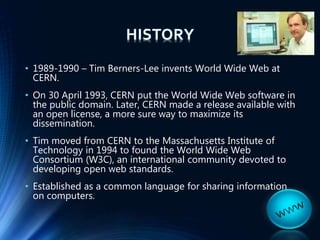
• 1989-1990 – Tim Berners-Lee invents World Wide Web at
CERN.
• On 30 April 1993, CERN put the World Wide Web software in
the public domain. Later, CERN made a release available with
an open license, a more sure way to maximize its
dissemination.
• Tim moved from CERN to the Massachusetts Institute of
Technology in 1994 to found the World Wide Web
Consortium (W3C), an international community devoted to
developing open web standards.
• Established as a common language for sharing information
on computers.
STRUCTURE
 Clients use browser application to send URIs via HTTP to servers
requesting a Web Page.
 Web Pages constructed using HTML (or other markup language)
and consists of text, sounds, graphics plus embedded files.
 Servers ( or Caches) respond with requested Web Page
• Or with Error message
 Client’s browser renders Web Page returned by server
• Page is written with Hyper Text Markup Language (HTML).
• Displaying text, graphics and sound in browser.
• Writing data as well.
 The entire system runs over standard networking protocols
(TCP/IP, DNS etc.)
World Wide Web Components
 Structural Components :
 Clients/Browsers – to dominant implementations.
 Servers – Run on sophisticated hardware.
 Caches – Many interesting implementations.
 Internet – The global infrastructure which facilitates
data transfer.
 Semantic Components :
 Hyper Text Transfer Protocol (HTTP)
 Hyper Text Markup Language (HTML)
 Extensible Markup Language (XML)
 Uniform Resource Identifiers (URIs)
The Fundamental Concept of
World Wide Web
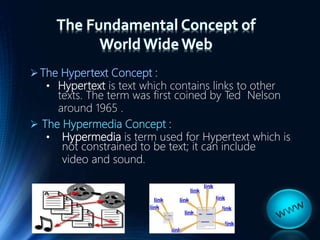
The Hypertext Concept :
• Hypertext is text which contains links to other
texts. The term was first coined by Ted Nelson
around 1965 .
 The Hypermedia Concept :
• Hypermedia is term used for Hypertext which is
not constrained to be text; it can include
video and sound.
Web Browser :
• A web browser is a software program that allows a user to
access, and display web pages. Browsers are used primarily for
displaying and accessing websites on the internet, as well as
other content created using languages such as Hypertext
Markup Language (HTML) and Extensible Markup Language
(XML).
 Web Server :
• This program that waits patiently for the browser to request a
Web Page. The servers looks for the requested information,
retrieves it and send it to the browser or sends an error
message if the file is not found.
 Uniform Resource Locator (URL) :
• These are the web addresses. The resource locator is an
addressing system.
The Difference between
Internet and WorldWide Web
 Many people use the terms Internet and World Wide Web, but in
fact the two terms are not synonymous. The Internet and the Web
are two separate but related things.
 The Internet s a massive network of networks. It connects millions of
computers together globally, forming a network in which any
computer can communicate with any other computer as long as they
are both connected to the Internet.
 The World Wide Web, or simply Web, is a way of accessing
information over the medium if the Internet.
 So the Web is just a portion of the Internet, a larger portion, but two
terms are not synonymous and should not be confused.
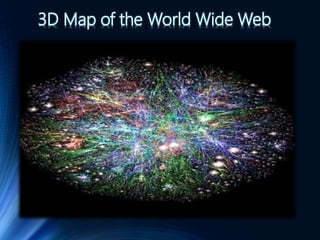
3D Map of the World Wide Web
WEB 2.0
 Web 2.0 is the term given to describe a second generation of the
World Wide Web. It refers to the features of the World Wide Web
which allow people to collaborate and share information online. One
see the transition rom static HTML.
 Web 2.0 provides a number of online tools and platforms which are
now defining how people share their perspectives, opinions, thoughts
and experiences.
 Examples :
o Social Networking Websites – facebook.com, twitter.com,
instagram.com
o Music and Video Websites – youtube.com
o Image Websites – imgur.com, flickr.com
o Blogging Websites – blogger.com, wordpress.com
REFERENCES
 https://en.wikipedia.org/wiki/World_Wide_Web
https://www.techopedia.com/definition/5217/world-wide-web-
www
https://webfoundation.org/about/vision/history-of-the-web/
https://webdesign.tutsplus.com/articles/a-brief-history-of-the-
world-wide-web-- webdesign-8710
https://home.cern/science/computing/birth-web
https://www.slideshare.net/Zainab.Muneer/world-wide-web-
1183940
World wide web ppt

World wide web ppt

  • 1.
    Presented By – PijushKanti Das (IT/15/01)
  • 2.
    ACKNOWLEDGEMENT I am highlyindebted to PROF. KALYANASISH SHEE sir for his guidance and constant supervision as well as for providing necessary information regarding this presentation & also for his support in completing the presentation. I would like to express my gratitude towards my friends for their kind co-operation and encouragement which helped me in completion of this presentation.
  • 3.
    Contents What isWorldWide Web? History Structure WWWComponents Fundamental Concept of WWW How WebWorks? Difference between Internet and WWW 3d Map of WWW Web 2.0
  • 4.
    What is WorldWide Web? • The WorldWide Web (WWW) is a network of online content that is formatted in HTML and accessed via HTTP.The term refers to all the interlinked HTML pages that can be accessed over the Internet. • It is the way of exchanging information between the computers on the Internet. • A document on the web is calledWeb Page, identified by a unique address called Uniform Resource Locator (URL).
  • 5.
    HISTORY • 1989-1990 –Tim Berners-Lee invents World Wide Web at CERN. • On 30 April 1993, CERN put the World Wide Web software in the public domain. Later, CERN made a release available with an open license, a more sure way to maximize its dissemination. • Tim moved from CERN to the Massachusetts Institute of Technology in 1994 to found the World Wide Web Consortium (W3C), an international community devoted to developing open web standards. • Established as a common language for sharing information on computers.
  • 6.
    STRUCTURE  Clients usebrowser application to send URIs via HTTP to servers requesting a Web Page.  Web Pages constructed using HTML (or other markup language) and consists of text, sounds, graphics plus embedded files.  Servers ( or Caches) respond with requested Web Page • Or with Error message  Client’s browser renders Web Page returned by server • Page is written with Hyper Text Markup Language (HTML). • Displaying text, graphics and sound in browser. • Writing data as well.  The entire system runs over standard networking protocols (TCP/IP, DNS etc.)
  • 7.
    World Wide WebComponents  Structural Components :  Clients/Browsers – to dominant implementations.  Servers – Run on sophisticated hardware.  Caches – Many interesting implementations.  Internet – The global infrastructure which facilitates data transfer.  Semantic Components :  Hyper Text Transfer Protocol (HTTP)  Hyper Text Markup Language (HTML)  Extensible Markup Language (XML)  Uniform Resource Identifiers (URIs)
  • 8.
    The Fundamental Conceptof World Wide Web The Hypertext Concept : • Hypertext is text which contains links to other texts. The term was first coined by Ted Nelson around 1965 .  The Hypermedia Concept : • Hypermedia is term used for Hypertext which is not constrained to be text; it can include video and sound.
  • 9.
    Web Browser : •A web browser is a software program that allows a user to access, and display web pages. Browsers are used primarily for displaying and accessing websites on the internet, as well as other content created using languages such as Hypertext Markup Language (HTML) and Extensible Markup Language (XML).  Web Server : • This program that waits patiently for the browser to request a Web Page. The servers looks for the requested information, retrieves it and send it to the browser or sends an error message if the file is not found.  Uniform Resource Locator (URL) : • These are the web addresses. The resource locator is an addressing system.
  • 11.
    The Difference between Internetand WorldWide Web  Many people use the terms Internet and World Wide Web, but in fact the two terms are not synonymous. The Internet and the Web are two separate but related things.  The Internet s a massive network of networks. It connects millions of computers together globally, forming a network in which any computer can communicate with any other computer as long as they are both connected to the Internet.  The World Wide Web, or simply Web, is a way of accessing information over the medium if the Internet.  So the Web is just a portion of the Internet, a larger portion, but two terms are not synonymous and should not be confused.
  • 12.
    3D Map ofthe World Wide Web
  • 13.
    WEB 2.0  Web2.0 is the term given to describe a second generation of the World Wide Web. It refers to the features of the World Wide Web which allow people to collaborate and share information online. One see the transition rom static HTML.  Web 2.0 provides a number of online tools and platforms which are now defining how people share their perspectives, opinions, thoughts and experiences.  Examples : o Social Networking Websites – facebook.com, twitter.com, instagram.com o Music and Video Websites – youtube.com o Image Websites – imgur.com, flickr.com o Blogging Websites – blogger.com, wordpress.com
  • 14.