WORLD WIDE WEB
“WWW”, "Web" or "W3"
• (Tim Berners-Lee), a British scientist,
invented the World Wide Web (WWW)
in 1989, while working at CERN. The
Web was published on 1992 originally
conceived and developed to meet the
demand for automated information-
sharing between scientists in
universities and institutes around the
world.
HISTORY
• The World Wide Web also known as
the web, WWW or W3 is the
network of pages of images, texts
and sounds on the Internet which
can be viewed using browser
software and also refers to all the
public websites or pages that users
can access on their local
computers and other devices
through the internet.
WHAT IS WORLD WIDE WEB?
World Wide Web, or Web
• Is consists of a worldwide collection of
electronic documents.
(Web pages)
Web pages
• are generally sets of text files coded
with special notation called Hypertext
Markup Language (HTML) that is
interpreted by a web browser program
reading the file.
• a set of related web pages located under a
single domain name,
WEB Server
• This is a program that waits patiently for the
browser to request a web page. The servers
looks for the requested information, retrieves
it and send it to the browser or sends an error
message if the file is not found.
Website
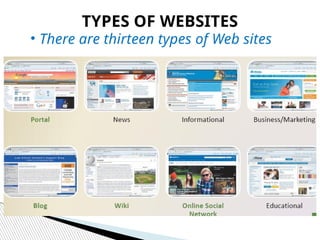
• There are thirteen types of Web sites
TYPES OF WEBSITES
TYPES OF WEBSITES
• A web browser displays a web document
and enables users to access web
documents.
WEB Server
• This is a program that waits patiently for
the browser to request a web page. The
servers looks for the requested
information, retrieves it and send it to the
browser or sends an error message if the
file is not found.
WEB Browser
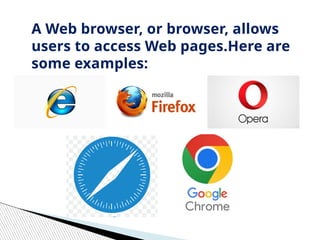
A Web browser, or browser, allows
users to access Web pages.Here are
some examples:
Hypertext Transfer Protocol (HTTP)
Hypertext Transfer Protocol
(HTTP)
A client-server application that standardizes data
transfer and communication between computers,
allowing users to access web pages
Hypertext Markup Language
(HTML)
A language that formats pages with hypertext
links, and is the most common format for
WWW KEY COMPONENTS
WWW KEY COMPONENTS
Uniform Resource Locator (URL
• Also called as the web address and a unique
identifier that clients use to access web pages
Domain Names
• Domain names are human-readable addresses
used to identify and access websites on the
internet. They serve as a more user-friendly
alternative to numerical IP addresses.
WWW KEY COMPONENTS
Hyperlinks
• Hyperlinks are clickable links that connect
web pages and resources together.They
enable users to navigate from one page to
another and are a fundamental aspect of web
navigation
Cookies
• Web page cookies, also known as HTTP
cookies or browser cookies, are small pieces
of data stored on a user’s web browser by
websites.
The Hypertext concept
• Hypertext is text which contains links to
other texts. The term was coined by Ted
Nelson around 1965 .
The Hypermedia concept
• Hypermedia is a term used for hypertext
which is not constrained to be text: it can
include graphics, video and sound
The Fundamental concept of
the World Wide Web
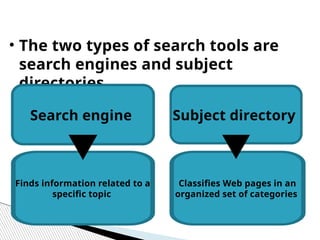
• The two types of search tools are
search engines and subject
directories
Search engine Subject directory
Finds information related to a
specific topic
Classifies Web pages in an
organized set of categories
A search engine is helpful in locating
items such as:
Image
s
Videos Audi
o
News Maps Blogs
People or
Businesses
Thank you for listening
1. It is the network of pages of images, texts and
sounds on the Internet which can be viewed using
browser software?
2. He invents the World Wide Web (www) while
working at Cern?
3. It is a program that waits patiently for the
browser to request a web page?
4. It displays a web document and enables users to
access web documents?
5.It is also called a web address?
Quiz

wwworworldwidewebdefinitionwithexamples.pptx

  • 1.
  • 2.
    • (Tim Berners-Lee),a British scientist, invented the World Wide Web (WWW) in 1989, while working at CERN. The Web was published on 1992 originally conceived and developed to meet the demand for automated information- sharing between scientists in universities and institutes around the world. HISTORY
  • 3.
    • The WorldWide Web also known as the web, WWW or W3 is the network of pages of images, texts and sounds on the Internet which can be viewed using browser software and also refers to all the public websites or pages that users can access on their local computers and other devices through the internet. WHAT IS WORLD WIDE WEB?
  • 4.
    World Wide Web,or Web • Is consists of a worldwide collection of electronic documents. (Web pages) Web pages • are generally sets of text files coded with special notation called Hypertext Markup Language (HTML) that is interpreted by a web browser program reading the file.
  • 6.
    • a setof related web pages located under a single domain name, WEB Server • This is a program that waits patiently for the browser to request a web page. The servers looks for the requested information, retrieves it and send it to the browser or sends an error message if the file is not found. Website
  • 7.
    • There arethirteen types of Web sites TYPES OF WEBSITES
  • 8.
  • 9.
    • A webbrowser displays a web document and enables users to access web documents. WEB Server • This is a program that waits patiently for the browser to request a web page. The servers looks for the requested information, retrieves it and send it to the browser or sends an error message if the file is not found. WEB Browser
  • 10.
    A Web browser,or browser, allows users to access Web pages.Here are some examples:
  • 11.
    Hypertext Transfer Protocol(HTTP) Hypertext Transfer Protocol (HTTP) A client-server application that standardizes data transfer and communication between computers, allowing users to access web pages Hypertext Markup Language (HTML) A language that formats pages with hypertext links, and is the most common format for WWW KEY COMPONENTS
  • 12.
    WWW KEY COMPONENTS UniformResource Locator (URL • Also called as the web address and a unique identifier that clients use to access web pages Domain Names • Domain names are human-readable addresses used to identify and access websites on the internet. They serve as a more user-friendly alternative to numerical IP addresses.
  • 13.
    WWW KEY COMPONENTS Hyperlinks •Hyperlinks are clickable links that connect web pages and resources together.They enable users to navigate from one page to another and are a fundamental aspect of web navigation Cookies • Web page cookies, also known as HTTP cookies or browser cookies, are small pieces of data stored on a user’s web browser by websites.
  • 14.
    The Hypertext concept •Hypertext is text which contains links to other texts. The term was coined by Ted Nelson around 1965 . The Hypermedia concept • Hypermedia is a term used for hypertext which is not constrained to be text: it can include graphics, video and sound The Fundamental concept of the World Wide Web
  • 15.
    • The twotypes of search tools are search engines and subject directories Search engine Subject directory Finds information related to a specific topic Classifies Web pages in an organized set of categories
  • 16.
    A search engineis helpful in locating items such as: Image s Videos Audi o News Maps Blogs People or Businesses
  • 17.
    Thank you forlistening
  • 18.
    1. It isthe network of pages of images, texts and sounds on the Internet which can be viewed using browser software? 2. He invents the World Wide Web (www) while working at Cern? 3. It is a program that waits patiently for the browser to request a web page? 4. It displays a web document and enables users to access web documents? 5.It is also called a web address? Quiz