
Welcome To The Presentation
Name: Mishuk Hossan
ID:
Batch:
Topic: World Wide Web
(WWW)
Agenda :
 World Wide Web
 Background of WWW
 Structure
 Components
 Fundamental Concepts
 Creating a Web page
 Difference between WWW & Internet
 Conclusion
What Is World Wide Web?
 WWW, Web or W3
 The World Wide Web is a way of exchanging
information between computers on the Internet.
 The World Wide Web is the network of pages of
images, texts and sounds on the Internet which can be
viewed using browser software .
WWW …… Background ?
1989-1990 – Tim Berners-Lee invented the World Wide
Web at CERN
 Means for transferring text and graphics
simultaneously
Lots of previous attempts (Gopher, WAIS, Archie, etc.)
Client/Server data transfer protocol
Established a common language for sharing information
on computers
Structure
 Clients use browser application to send URIs via HTTP to
servers requesting a Web page
 Web pages constructed using HTML and consist of text,
graphics, sounds plus embedded files
 Servers (or caches) respond with requested Web page
 Client’s browser renders Web page returned by server
 The entire system runs over standard networking protocols
(TCP/IP, DNS,…)
WWW Components
• Structural Components:
 Clients/browsers
Servers
Caches
Internet
• Semantic Components:
Hyper Text Transfer Protocol (HTTP)
Hyper Text Markup Language (HTML)
Uniform Resource Identifiers (URIs)
The Fundamental concept of the WWW
 The Hypertext concept
 The Hypermedia concept
 Web browser
 Web server
 URL
Creating A Webpage
Web pages are generally sets of text files coded
with special notation called Hypertext Markup
Language (HTML) that is interpreted by a web
browser program reading the file.
The difference between WWW &
Internet
 Many people use the terms Internet and World Wide Web,
but in fact the two terms are not synonymous. The
Internet and the Web are two separate but related things.
 The Internet is a massive network of networks. It
connects millions of computers together globally, forming
a network in which any computer can communicate with
any other computer as long as they are both connected to
the Internet.
 The World Wide Web, or simply Web, is a way of
accessing information over the medium of the Internet.
Examples
www.stamforduniversity.edu.bd
www.facebook.com
www.google.com
www.yahoo.com
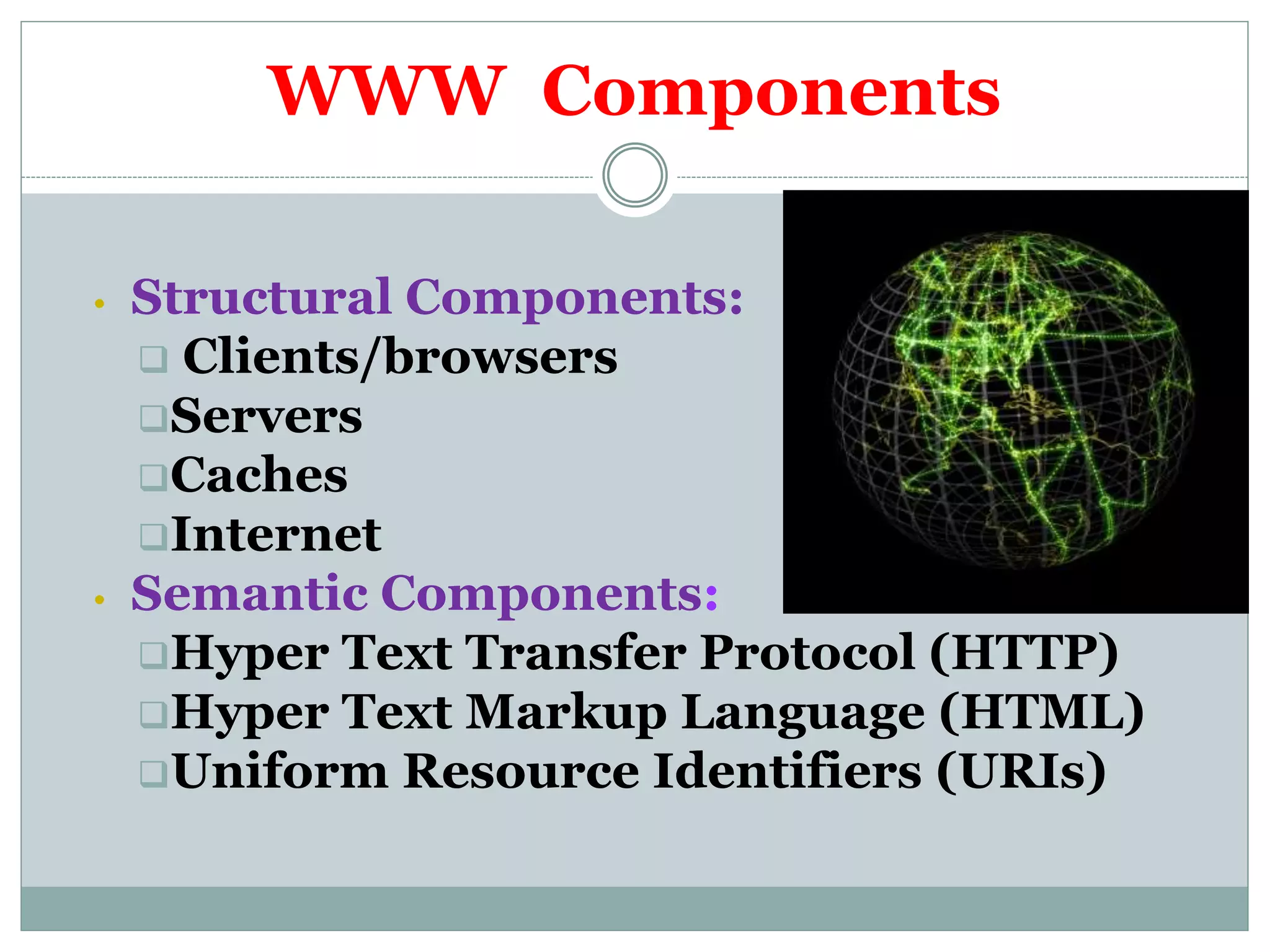
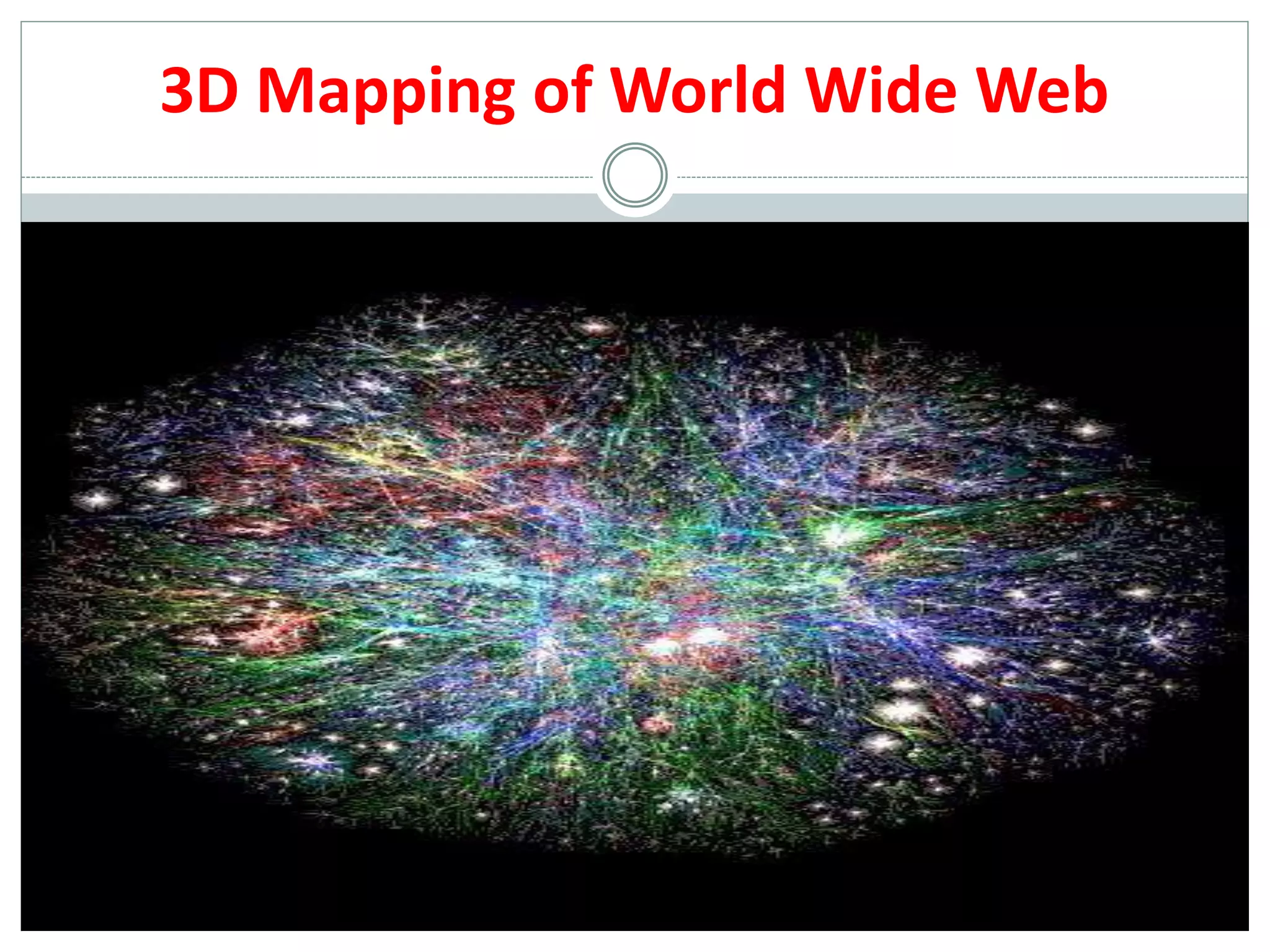
3D Mapping of World Wide Web
Conclusion
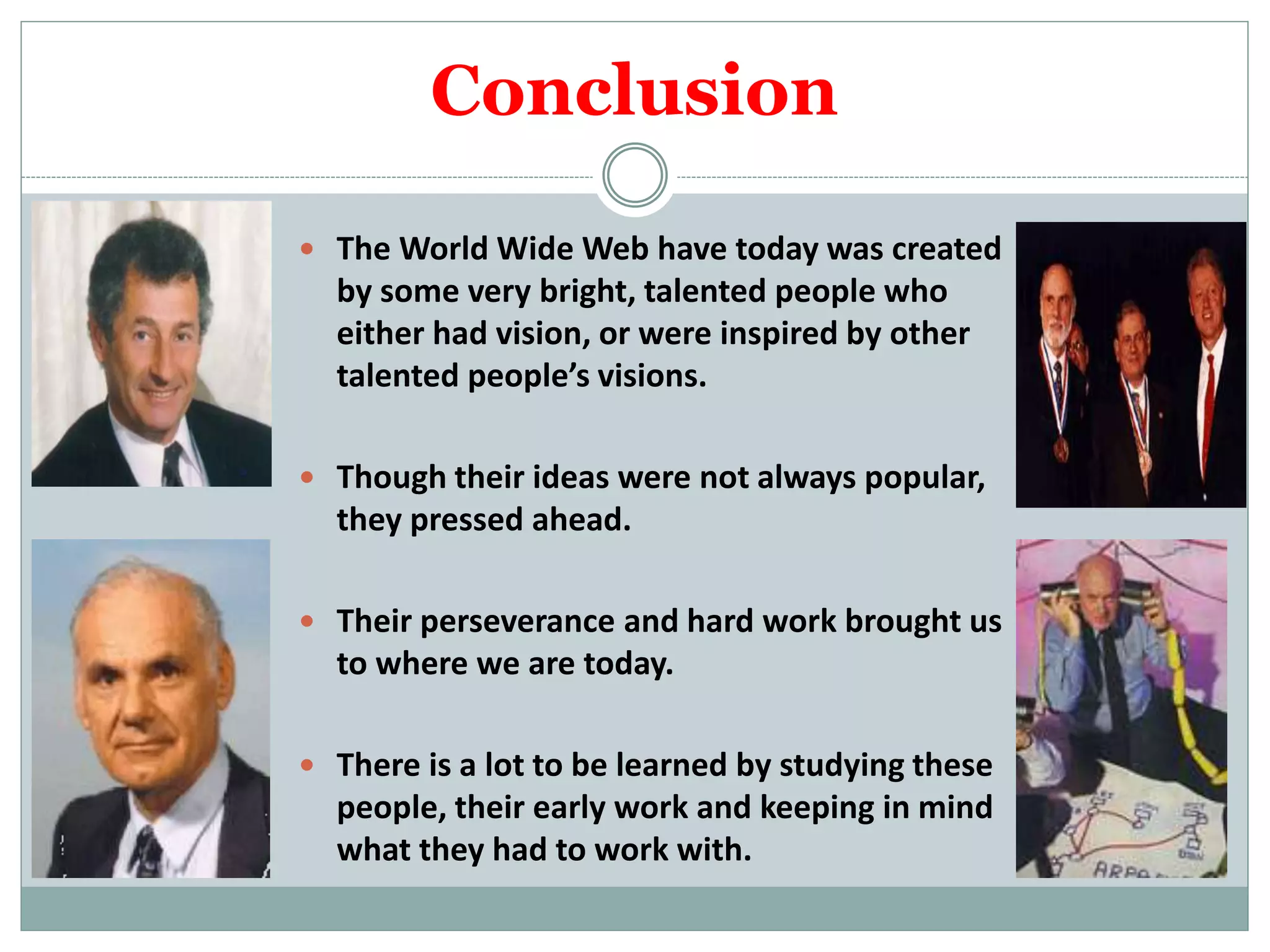
 The World Wide Web have today was created
by some very bright, talented people who
either had vision, or were inspired by other
talented people’s visions.
 Though their ideas were not always popular,
they pressed ahead.
 Their perseverance and hard work brought us
to where we are today.
 There is a lot to be learned by studying these
people, their early work and keeping in mind
what they had to work with.
Any Query ???

World wide web (www)

  • 1.
    Welcome To ThePresentation
  • 2.
  • 3.
  • 4.
    Agenda :  WorldWide Web  Background of WWW  Structure  Components  Fundamental Concepts  Creating a Web page  Difference between WWW & Internet  Conclusion
  • 5.
    What Is WorldWide Web?  WWW, Web or W3  The World Wide Web is a way of exchanging information between computers on the Internet.  The World Wide Web is the network of pages of images, texts and sounds on the Internet which can be viewed using browser software .
  • 6.
    WWW …… Background? 1989-1990 – Tim Berners-Lee invented the World Wide Web at CERN  Means for transferring text and graphics simultaneously Lots of previous attempts (Gopher, WAIS, Archie, etc.) Client/Server data transfer protocol Established a common language for sharing information on computers
  • 7.
    Structure  Clients usebrowser application to send URIs via HTTP to servers requesting a Web page  Web pages constructed using HTML and consist of text, graphics, sounds plus embedded files  Servers (or caches) respond with requested Web page  Client’s browser renders Web page returned by server  The entire system runs over standard networking protocols (TCP/IP, DNS,…)
  • 8.
    WWW Components • StructuralComponents:  Clients/browsers Servers Caches Internet • Semantic Components: Hyper Text Transfer Protocol (HTTP) Hyper Text Markup Language (HTML) Uniform Resource Identifiers (URIs)
  • 9.
    The Fundamental conceptof the WWW  The Hypertext concept  The Hypermedia concept  Web browser  Web server  URL
  • 10.
    Creating A Webpage Webpages are generally sets of text files coded with special notation called Hypertext Markup Language (HTML) that is interpreted by a web browser program reading the file.
  • 11.
    The difference betweenWWW & Internet  Many people use the terms Internet and World Wide Web, but in fact the two terms are not synonymous. The Internet and the Web are two separate but related things.  The Internet is a massive network of networks. It connects millions of computers together globally, forming a network in which any computer can communicate with any other computer as long as they are both connected to the Internet.  The World Wide Web, or simply Web, is a way of accessing information over the medium of the Internet.
  • 12.
  • 13.
    3D Mapping ofWorld Wide Web
  • 14.
    Conclusion  The WorldWide Web have today was created by some very bright, talented people who either had vision, or were inspired by other talented people’s visions.  Though their ideas were not always popular, they pressed ahead.  Their perseverance and hard work brought us to where we are today.  There is a lot to be learned by studying these people, their early work and keeping in mind what they had to work with.
  • 15.